
Tank Cars: Hauling Liquid Products Since The 1860s
Last revised: August 29, 2024
By: Adam Burns
One of the most prolific car types you will find moving within a freight train today is the tank car. This versatile piece of rolling stock has long been used to handle liquid or liquefied products, usually some type of chemical or petroleum-based commodity.
Its use has increased over the years diversified to also include food-based products and ethanol.
However, this was not always the case and in many ways the tank car is a "specialty" freight car, meaning it was originally created to haul a specific commodity.
While the perception changed somewhat in recent times, the industry has often been quite stubborn about accepting new technologies, or any change at all for that matter.
So, when new oil companies began appearing after reserves were discovered in the 1860s railroads were, not surprisingly, hostile to developing a new type of car to haul the commodity.
In his authoritative title, "The American Railroad Freight Car," author John White, Jr. notes the first types of tank cars, essentially flat cars to which wooden vats were attached, appeared during the 1860's.
The Central Pacific is known to have used such specialized cars to transport water. However, prior to the discovery of oil by Colonel Edward Drake near Titusville, Pennsylvania on August 27, 1859, the tank car was virtually non-existent.
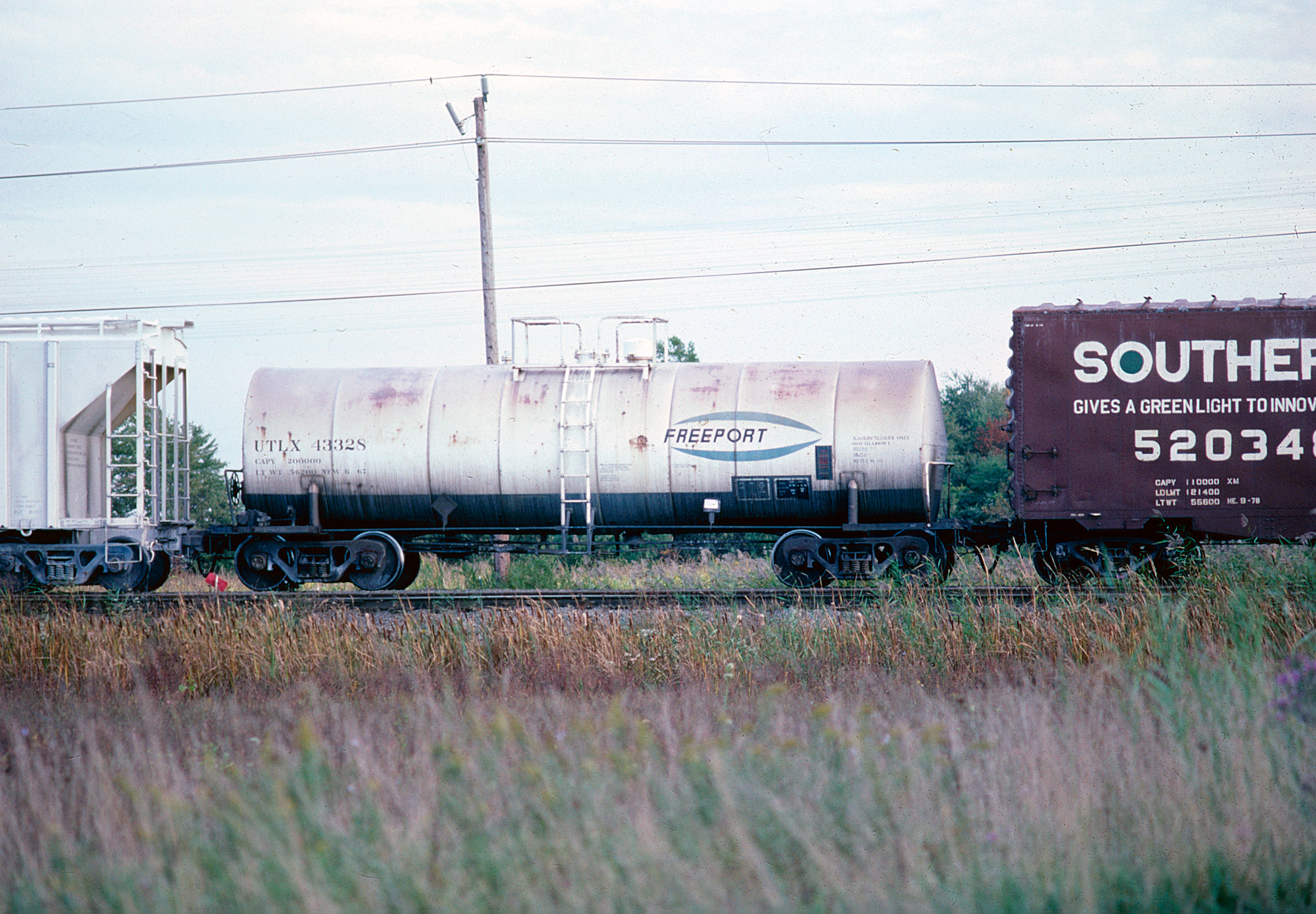 Union Tank Car #43328 (leased to Freeport-McMoRan) used to haul kaolin slurry, is seen here in service during October of 1982. American-Rails.com collection.
As Mike Schafer notes in his book, "Freight Train Cars," the tank car's development occurred long after the other traditional designs (flatcar, hopper, boxcar, and gondola).
It was born purely out of necessity as the fledgling oil industry, which got its start when Edwin Drake discovered rich reserves near present-day Titusville, Pennsylvania, demanded a better car for the movement of its product.
Of course, as it later turned the railroads had a major financial incentive to do so; there was big money in oil.
Before the car was developed railroads used a combination of boxcars, flatcars, and gondolas to haul everything from lumber and coal to crude oil, molasses, and water (by use of barrels).
The inefficiencies of hauling liquids this way (barrels meant much less of the commodity could be transported and barrel construction was never sealed well resulting in constant leaking issues) quickly became obvious not only by oil companies but also other businesses which had their liquid goods shipped via railroads.
In today's industry there are currently seven specifications that comprise a tank car's designation. These are broken by:
- Authorizing agency (AAR – Association of American Railroads, DOT – U.S. Department of Transportation, TC – Transport Canada)
- Class designation (determines the car's type)
- Delimiter letter (determines whether a car carries pressurization or not and if so other factors regarding such)
- Tank test pressure (rated by pounds-per-square-inch or PSIG)
- Construction material (if not steel)
- A designation determining whether the car was constructed via fusion welding (using either "W" or "AL")
- A designation describing fittings, linings, and other related materials
For instance, in the AAR's sample, a car may carry the following description; DOT111A100ALW1.
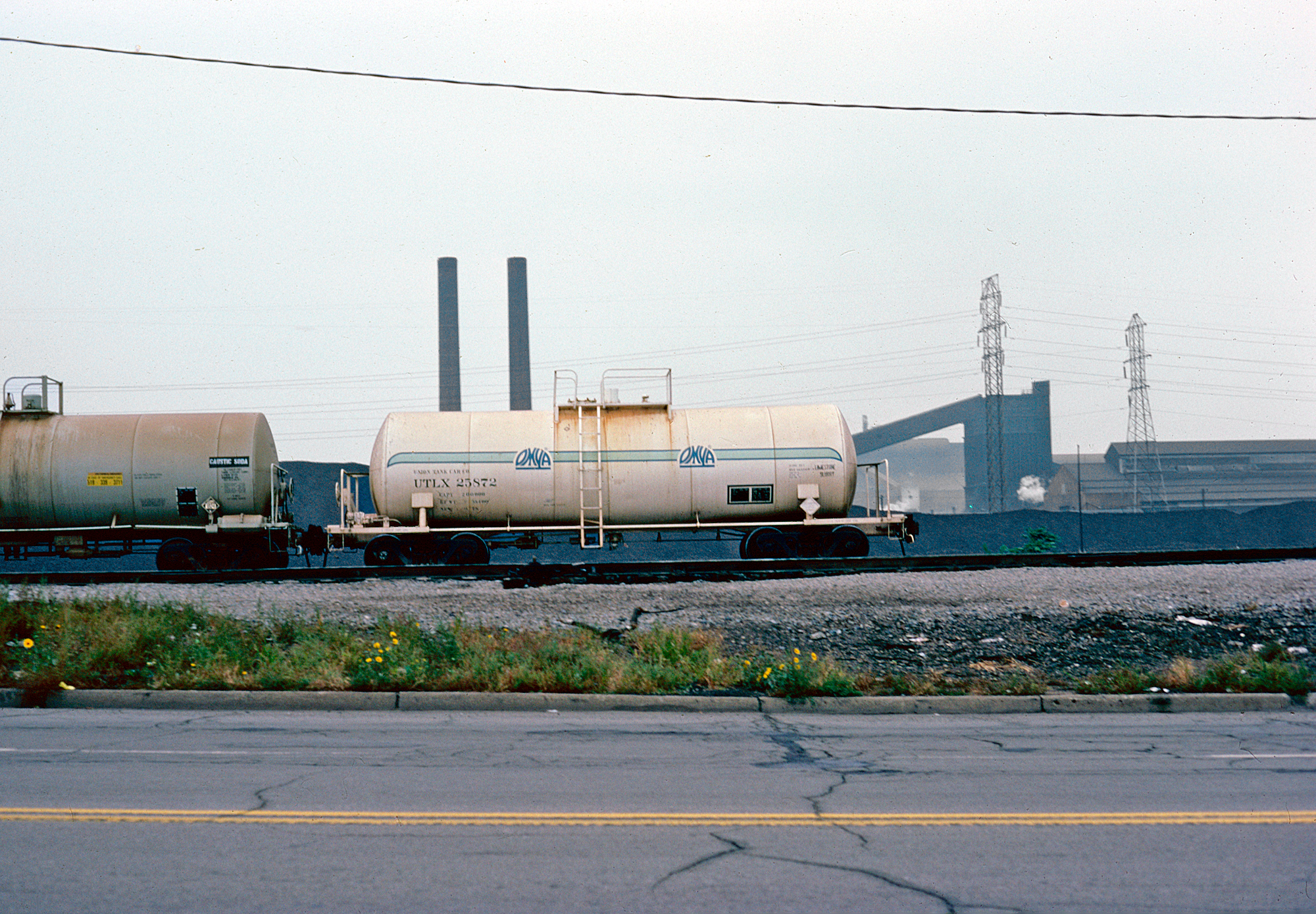 Union Tank Car #25872 (leased to Omya, Inc.), used to haul limestone slurry, is seen here in service during September of 1982. American-Rails.com collection.
The earliest version of tank cars, or the "oil car" as it was known then, began to appear in the early 1860s during the Civil War. Essentially, a standard flatcar was employed with two or three vertical vats placed on top.
Unfortunately, the design had several flaws; the most obvious was that it could not hold much product due to height and width issues.
Additionally, leaking was again an issue. By the late 1860s, following the war, the first true tank cars began to take shape.
In this particular case the early vertical vat-on-flat-car design was changed to a horizontal iron tank, which was then mounted to a traditional flat car.
The design was roughly similar to what is now commonly in service today, featuring a top dome (with safety valve) to load the product as well as a discharge valve at the bottom. It allowed for much more product to be shipped via one car and quickly found widespread use.
These first vertical cars were about 28 feet in length and hauled around 3,400 gallons. By the 1870s and 1880s tank cars were found in service across the industry, thanks largely to the booming oil/petroleum business.
Despite a better design the car was still traditionally built with a wooden under-frame sporting a horizontal iron tank.
However, as the 20th century progressed the car's construction materials improved with the development of steel and welded seams it was much stronger and thus was built larger to haul much heavier loads.
There were also more commodities to haul ranging from chlorine, ammonia, and various refined petroleum products such as gasoline and kerosene to edibles oils and milk, which required special interior glass-linings.
Tank Car Types
Non-Pressurized Designations
| Type | Meaning |
|---|---|
| DOT-111 | Insulated or non-insulated, without an expansion dome. |
| DOT-115 | Insulated with a carbon or alloy (stainless) steel or an aluminum inner container (tank) and a carbon steel outer shell (tank, not jacket). Otherwise known as a tank within a tank. |
| DOT-206 | Insulated with an inner-container (tank) and carbon steel outer-shell. Similar to DOT-115. |
| DOT-211 | Insulated or non-insulated, without an expansion dome. Similar to DOT-111. |
Pressurized Designations
| Type | Meaning |
|---|---|
| DOT-105 | Insulated carbon or alloy steel. |
| DOT-109 | Insulated or non-insulated, carbon steel or aluminum. |
| DOT-112 | Insulated or non-insulated, carbon or alloy steel. |
| DOT-114 | Insulated or non-insulated, carbon or alloy steel. |
| DOT-120 | Insulated carbon steel or aluminum. |
Cryogenic Liquid Designations
| Type | Meaning |
|---|---|
| DOT-113 | Vacuum insulated with a high alloy or nickel alloy inner container (tank) and carbon steel outer shell (tank, not jacket). |
| AAR-204 | Vacuum insulated with an inner alloy steel container (tank) and carbon steel outer shell (tank, not jacket). Similar to DOT-113. |
Delimiter Letter
Pressurized/Non-Pressurized Designations
| Type | Meaning |
|---|---|
| A | No significance. |
| J | Equipped with a thermal protection system covered by a jacket and tank head puncture-resistance system. |
| S | Equipped with a tank head puncture-resistance system. |
| T | Equipped with a thermal protection system not covered by a jacket (the thermal protection material is sprayed directly onto the tank’s surface) and tank head punctureresistance system. |
Cryogenic Designations
| Type | Meaning |
|---|---|
| A | Authorized for -423 degrees fahrenheit loading. |
| B | Authorized for -260 degrees fahrenheit loading. |
| C | Authorized for -155 degrees fahrenheit loading. |
Construction Material
| Type | Meaning |
|---|---|
| AL | Tank car was constructed using aluminum. |
| None | For all other construction materials no number or letter designation is used. |
Tank Pressure
| Type | Meaning |
|---|---|
| Non-Pressurized | Normally rated between 60 to 100 psig. |
| Pressurized | Normally rated between 100 to 600 psig. |
| Cryogenic | Normally rated between 60 to 120 psig. |
As Mr. Schafer's book notes by 1930 there were some 100,000 tank cars in service hauling more than 100 different products.
Despite the widespread use of the tanker railroads still found the car somewhat of annoyance since it typically could only haul one product, which often meant it returned to the customer empty.
For instance, a car carrying oil could not haul any other product, such as a food-based commodity. This led to the rise of privately-owned rail car fleets, especially within the petroleum and chemical industry.
Two of the most well known today is the Union Tank Car Company and GATX Corporation.
Throughout the first half of the 20th century the car's demand continued to climb, first with the introduction of the automobile and then later during both World Wars with a brief decline during the great depression.
Today, most tankers are privately owned and as mentioned above carry a wide range of products from industrial to food-based.
Over the last half-century or so the tank car has not changed significantly, with any alterations being within the general design itself to accommodate various commodities (such as differing positions of the dome, walkways, and pressurized/non-pressurized railroad cars).
If you are curious as to what a car may be carrying their product is usually labeled on the lower-right hand corner of the car along with other reporting marks (and will say something such as "ammonia," "chlorine," or some type of acid).
Given the fact that today there are so many differing types of bulk liquid commodities being handled the tanks car will certainly always be one type of freight cars used by the railroad industry for years to come.
Tank cars currently range widely in size from 40 to 60 feet in length and capable of hauling between 15,000 to more than 30,000 gallons.
One interesting design from DuPont during the 1980s featured a car that could handle 43,800 gallons which was well over 60 feet in length, requiring the use of four trucks (16 axles).
While tankers may appear roughly the same in wide appearance except for their general size the cars range widely in the designation from how they were constructed to what commodities they carry.
As a result they fall under a series of different classifications. In 2010 the Association of American Railroads in conjunction with several companies and agencies released a detailed "Field Guide To Tank Cars."
While the car types and designations are briefly covered here the document provides an in-depth look on the topic.
Recent Articles


-
Atlantic and Danville Railway: Serving Southern VA
Oct 13, 26 04:32 PM
 Atlantic and Danville Railway, chartered in 1882, incorporated September 1883. Three-foot line to Claremont, then Norfolk to Danville. Southern lease from September 1, 1899, to July 1, 1949. Alco RS2s…
 -
Norfolk, Franklin and Danville Railroad: Map, Roster, History
Oct 13, 26 04:26 PM
 Norfolk, Franklin and Danville Railway, chartered October 2, 1962, and operating from November 1, 1962. Norfolk to Danville, 210.8 miles. Two Alco RS36s and four RS11s. Merged into the N&W on December…
 -
Norfolk & Western Diesel Roster (All-Time)
Oct 12, 26 11:59 PM
 Norfolk & Western diesel roster, all-time. 1,464 locomotives built new for the railroad, from the 1955 GP9s and RS-3s through the C36-7s, plus the merger fleets.
 -
Norfolk & Western Steam Roster (Post 1900)
Oct 12, 26 11:52 PM
 Norfolk & Western steam since 1898. The Roanoke grid: 1,266 locomotives, the J, the A, and the Y, and the last road steam on May 7, 1960.
 -
Norfolk & Western Railway: Map, Logo, Rosters, History
Oct 12, 26 11:45 PM
 The Norfolk & Western, from the City Point Railroad of 1838 to Norfolk Southern. Pocahontas coal, Roanoke steam, and the 1964 expansion.
 -
Louisiana Railroad Museums (2026): A Complete Guide
Oct 12, 26 11:24 PM
 Louisiana railroad museums—the DeQuincy depot, the Long Leaf sawmill, Jackson’s model railroad, and Southern Pacific 745. Confirm hours on each site.
 -
Michigan Railroad Museums (2026): A Complete Guide
Oct 12, 26 11:14 PM
 Michigan railroad museums—Pere Marquette 1225 at Owosso, Durand Union Station, The Henry Ford, and the Mount Clemens depot. Confirm hours on each site.
 -
Mississippi Railroad Museums (2026): A Complete Guide
Oct 12, 26 10:52 PM
 Mississippi railroad museums—McComb’s rebuilt Illinois Central depot and Illinois Central 2542, and the Casey Jones museum at Water Valley. Confirm hours on each site.
 -
The "E2b": PRR's Experimental Freight Electrics
Oct 12, 26 10:33 PM
 PRR class E2b: six GE B-B freight electrics, 4939–4944, 2,500 hp, 11 kV AC. Specifications, roster, and the 1964 scrap.
 -
Alaska Railroad Museums (2026): A Complete Guide
Oct 12, 26 10:10 PM
 Alaska railroad museums—the Museum of Alaska in Wasilla, Tanana Valley No. 1 at Pioneer Park, and the Engine 557 shop. Confirm hours on each site.
 -
Western and Atlantic Railroad: Map, History, Timetables
Oct 12, 26 09:55 PM
 The Western & Atlantic Railroad of the State of Georgia, authorized December 21, 1836, from Atlanta to Chattanooga. The state still owns the 137.33-mile line. CSX leases it. The through railroad opene…
 -
Nashville, Chattanooga & St. Louis Steam Roster (Post 1900)
Oct 12, 26 09:52 PM
 Nashville, Chattanooga & St. Louis steam since 1900. Drury's class grid: Consolidations, 51 Mikados, three 2-8-8-2s, Pacifics, and 25 4-8-4s. Last steam was January 4, 1953.
 -
Nashville, Chattanooga & St. Louis Diesel Roster (All-Time)
Oct 12, 26 09:27 PM
 Nashville, Chattanooga & St. Louis diesel roster, all-time. Switchers from 1941, 37 GP7s, and the F3s and F7s. The quantity column totals 132 locomotives.
 -
Nashville, Chattanooga and St. Louis Railway: Map, History, Logo
Oct 12, 26 08:41 PM
 The Nashville, Chattanooga & St. Louis, the Dixie Line. Charter of December 11, 1845, the Cumberland tunnel, and the Louisville & Nashville merger of August 30, 1957.
 -
Idaho Railroad Museums (2026): A Complete Guide
Oct 12, 26 02:44 PM
 Idaho railroad museums—Nampa’s 1903 depot, Wallace’s Northern Pacific depot, and Boise’s 1925 Union Pacific depot. Confirm hours on each site.
 -
Hawaii Railroad Museums (2026): A Complete Guide
Oct 12, 26 12:50 PM
Hawaii railroad museums—the Hawaiian Railway Society at Ewa Beach and the Laupahoehoe Train Museum on the Big Island. Confirm hours on each site. -
Marietta and Cincinnati Railroad: Map, History, Timetable
Oct 12, 26 11:44 AM
 Marietta and Cincinnati Railroad, chartered March 8, 1845 as the Belpre & Cincinnati. Opened in April 1857, sold under foreclosure December 9, 1882, and succeeded by the Baltimore & Ohio Southwestern…
 -
Tennessee Railroad Museums (2026): A Complete Guide
Oct 12, 26 11:39 AM
 Tennessee railroad museums—TVRM and Southern 4501 in Chattanooga, the Tennessee Central museum in Nashville, Casey Jones in Jackson, and the depots at Cookeville, Cowan, and Townsend.
 -
Virginia Railroad Museums (2026): A Complete Guide
Oct 12, 26 09:40 AM
 Virginia railroad museums—Roanoke’s Virginia Museum of Transportation and the O. Winston Link Museum, the C&O center at Clifton Forge, and the depots in Richmond, Fairfax Station, Suffolk, Parksley, a…
 -
Louisville & Nashville Diesel Roster (All-Time)
Oct 12, 26 12:15 AM
 Louisville & Nashville diesel roster, all-time. Switchers from 1939, the cab units, and EMD, Alco, and GE hoods through the SD50s. The quantity column totals 1948 locomotives, plus 29 yard slugs.
 -
Louisville & Nashville Steam Roster (Post 1900)
Oct 11, 26 05:44 PM
Louisville & Nashville steam since 1900. Drury's class grid: Consolidations, 165 heavy Mikados, 42 Big Emma 2-8-4s, Pacifics, and 22 Mountains. Last steam January 1957. -
Louisville and Nashville Railroad: Map, Rosters, History
Oct 11, 26 05:39 PM
 Louisville & Nashville, the Old Reliable. Charter of March 5, 1850, Milton H. Smith, the 921-mile main line, Big Emma, and the December 29, 1982 merger. Steam and diesel rosters are companion pages.
 -
Oregon Railroad Museums (2026): A Complete Guide
Oct 11, 26 05:19 PM
 Oregon railroad museums—the Oregon Rail Heritage Center, Brooks trolleys, Canby’s 1891 depot, Medford’s Willamette, and Train Mountain. Confirm hours on each site.
 -
Texas Railroad Museums (2026): A Complete Guide
Oct 11, 26 05:15 PM
 Texas railroad museums—Frisco’s Big Boy 4018, Galveston’s Santa Fe depot, Temple’s 1911 station, Plano’s interurban, and Fort Worth & Denver 304. Confirm hours on each site.
 -
Wisconsin Railroad Museums (2026): A Complete Guide
Oct 10, 26 11:51 PM
Wisconsin railroad museums—Green Bay’s Big Boy 4017 and Eisenhower’s A4, Mid-Continent at North Freedom, East Troy’s interurban, and the Riverside & Great Northern. Confirm hours on each site. -
Interstate Railroad (Virginia): Map, Roster, Logo, History
Oct 10, 26 11:22 PM
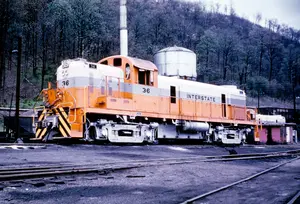
 Interstate Railroad, a Virginia coal road chartered February 18, 1896. Andover shops. Ten Alco RS3s, 30–39. Southern control in 1961. The company ended October 31, 1985.
 -
North Carolina Railroad Museums (2026): A Complete Guide
Oct 10, 26 11:16 PM
North Carolina railroad museums—Spencer Shops, Wilmington’s Atlantic Coast Line 250, Hamlet’s Seaboard depot, and the New Hope Valley Railway. Confirm hours on each site. -
New Mexico Railroad Museums (2026): A Complete Guide
Oct 10, 26 10:54 PM
 New Mexico railroad museums—Santa Fe 2926 in Albuquerque, the Clovis depot, Alamogordo’s Toy Train Depot, and Belen. Confirm hours on each site.
 -
New York Railroad Museums (2026): A Complete Guide
Oct 10, 26 09:33 PM
 New York railroad museums—Phoenicia, Medina’s New York Central freight house, the Transit Museum, Long Island 35 and 39, and GG1 4933. Confirm hours on each site.
 -
Columbia, Newberry & Laurens Railroad: History, Timetable, Roster
Oct 10, 26 09:08 PM
 Columbia, Newberry & Laurens Railroad, Columbia to Laurens, 75 miles. Chartered in 1885. Five Atlantic Coast Line GP7s, 100–104. Merged into the Seaboard System on April 30, 1984.
 -
New Haven Diesel Roster (All-Time)
Oct 10, 26 06:35 PM
 New Haven diesel roster, all-time. 558 road numbers: 60 DL-109s, 30 FA-1s, 27 PA-1s, 60 FL9s, and the switchers from HH600 0900. Serials and order numbers.
 -
New Haven Steam Roster (Post 1900)
Oct 10, 26 06:31 PM
 New Haven steam since 1900. Drury's class grid: 226 Moguls, 33 Mikados, 50 Santa Fes, 70 Mountains, 141 Pacifics, and 10 Hudsons. Last fan trip July 19, 1953.
 -
New Haven Railroad: Rosters, Map, Logo, History, Trains
Oct 10, 26 06:26 PM
 New York, New Haven and Hartford. The Shore Line, Hell Gate, the 1952 map at 1,838.89 miles, and the railroad Penn Central took at 11:59:59 p.m. on December 31, 1968.
 -
C&O's 4-6-4 "Hudson" Locomotives (Class L): Specs, Roster, History
Oct 10, 26 05:36 PM
 Chesapeake & Ohio Class L 4-6-4 Hudsons. Eight L-2s, five L-1 rebuilds, five L-2-As. Specs, Baldwin works numbers, and the roster. No. 490 survives.
 -
Alton Railroad: Map, History, Timetables
Oct 09, 26 10:31 PM
 Alton Railroad, chartered February 27, 1847 as the Alton & Sangamon. Chicago, St. Louis, and Kansas City, the 1937 Official Guide, and the May 31, 1947 merger into the Gulf, Mobile & Ohio.
 -
Mobile & Ohio Steam Roster (Post 1900)
Oct 09, 26 12:26 PM
 Mobile & Ohio steam since 1900. Drury's class grid: 48 six-wheel switchers, 107 Ten-Wheelers, 15 Consolidations, 58 Mikados, and 14 Pacifics. Last revenue steam October 7, 1949.
 -
Mobile & Ohio Railroad: History, Map, Timetable
Oct 09, 26 11:31 AM
 Mobile & Ohio Railroad, chartered in 1848. Columbus on April 22, 1861, the Cairo & St. Louis, the March 1940 Official Guide, and the September 13, 1940 merger into the Gulf, Mobile & Ohio.
 -
Gulf, Mobile & Northern Steam Roster (Post 1900)
Oct 09, 26 10:42 AM
 Gulf, Mobile & Northern steam since 1900. Drury's class grid: Ten-Wheelers, Mikados, Russian Decapods, Pacifics 425 and 426, and three light 4-8-2s. Last revenue steam October 7, 1949.
 -
Gulf, Mobile & Ohio Diesel Roster (All-Time)
Oct 09, 26 10:41 AM
 Gulf, Mobile & Ohio diesel roster, all-time. The 1935 boxcab, DL-107s, 55 FA-1s, F3s and F7s, the Ingalls 4-S, GP30s through GP38-2s, and 21 SD40s. Serials and order numbers.
 -
Gulf, Mobile & Northern Railroad: History, Rebel Route
Oct 09, 26 10:36 AM
 Gulf, Mobile & Northern, from the 1890 Mobile, Jackson & Kansas City to the Rebel and the September 13, 1940 merger into the Gulf, Mobile & Ohio. Steam roster is the companion page.
 -
Gulf, Mobile & Ohio Railroad: Map, Photos, Trains, History
Oct 08, 26 11:48 PM
 Gulf, Mobile & Ohio, chartered in 1938 and merged September 13, 1940. The Mobile & Ohio, the Alton on May 31, 1947, the Rebel Route, and Illinois Central Gulf on August 10, 1972.
 -
New Jersey Railroad Museums (2026): A Complete Guide
Oct 08, 26 11:37 PM
 New Jersey railroad museums—Whippany, Maywood, Pine Creek, Mahwah’s Erie depot, Phillipsburg, and Boonton. Confirm hours on each site.
 -
New Hampshire Railroad Museums (2026): A Complete Guide
Oct 08, 26 11:34 PM
 New Hampshire railroad museums—North Conway, the Flying Yankee, Ashland, Gorham, Raymond, and Sandown. Confirm hours on each site.
 -
Missouri Railroad Museums (2026): A Complete Guide
Oct 08, 26 11:00 PM
 Missouri railroad museums—the National Museum of Transportation, Patee House, Frisco 4524, the Chicago & Alton depot, and Marceline. Confirm hours on each site.
 -
Milwaukee Road X3800: Deer Lodge’s Shop Goat
Oct 08, 26 04:28 PM
 Milwaukee Road X3800, the a home-built shop goat that served the Deer Lodge, MT yard. It was a 220-volt DC switcher, powered through an extension cord that moved electrics into a roundhouse where the…
 -
Key West Extension (Overseas Railroad): History, Construction, Decline
Oct 08, 26 03:59 PM
 Henry Flagler's Overseas Railroad, Miami to Key West, 1905–1935. The Seven Mile Bridge, the 1935 Labor Day Hurricane, and the road that became U.S. 1.
 -
Florida East Coast Steam Roster (Post 1900)
Oct 08, 26 02:34 PM
 Florida East Coast steam since 1897. Seventeen Ten-Wheelers, twenty Atlantics, eighty-seven Pacifics, ninety Mountains, fifteen Mikados, and the switchers.
 -
Florida East Coast Diesel Roster (All-Time)
Oct 08, 26 02:12 PM
 Florida East Coast diesel roster, all-time. E units from 1939, F3s, BL2s, GP7s and GP9s, the GP40-2 orders, 22 SD40-2s, and 24 ES44C4s. Serials and EMD order numbers.
 -
Florida East Coast Railway: Map, History, Rosters
Oct 08, 26 01:46 PM
 Florida East Coast Railway, Henry Flagler's line from Jacksonville to Miami and Key West. Receivership in 1931, the 1963 strike, Grupo México in 2017, and Brightline on the same track.
 -
Minnesota Railroad Museums (2026): A Complete Guide
Oct 08, 26 10:32 AM
Minnesota railroad museums—the Lake Superior Railroad Museum, Two Harbors, Jackson Street, Willmar’s Great Northern 2523, and Currie. Confirm hours on each site.
%20used%20to%20haul%20kaolin%20slurry%2C%20is%20seen%20here%20in%20service%20during%20October%20of%201982.%20%20American-Rails.com%20collection.)
%2C%20used%20to%20haul%20limestone%20slurry%2C%20is%20seen%20here%20in%20service%20during%20September%20of%201982.%20American-Rails.com%20collection.)