- Home ›
- Freight Cars ›
- Gondolas
Gondola Rail Car (Trains): Specs, History, Photos
Last revised: February 26, 2025
By: Adam Burns
Perhaps more than any other freight car designs, gondolas (also known as simply "gons"), a close relative of the flatcar but often sporting low ribbed sides, is the catchall of the railroad industry.
Often getting little respect it is typically beaten to death in service but is well-liked for its multitude of uses. The history of this utilitarian car can be traced back to the earliest years of the industry.
In his book, "The American Railroad Freight Car," author John White, Jr. notes that the Baltimore & Ohio, an industrial pioneer credited with countless "firsts," placed the original gondola in service in 1830. For many years the gondola remained basically the same in design and character.
However, in the 20th century several specialized types entered service such as a side-dump version for bulk materials, one which could carry large sheets of steel, and the most popular in today's industry the "Bathtub" gondola for use in hauling coal.
In any event, this car appears very likely to remain an important tool within the industry for many years to come.
Photos
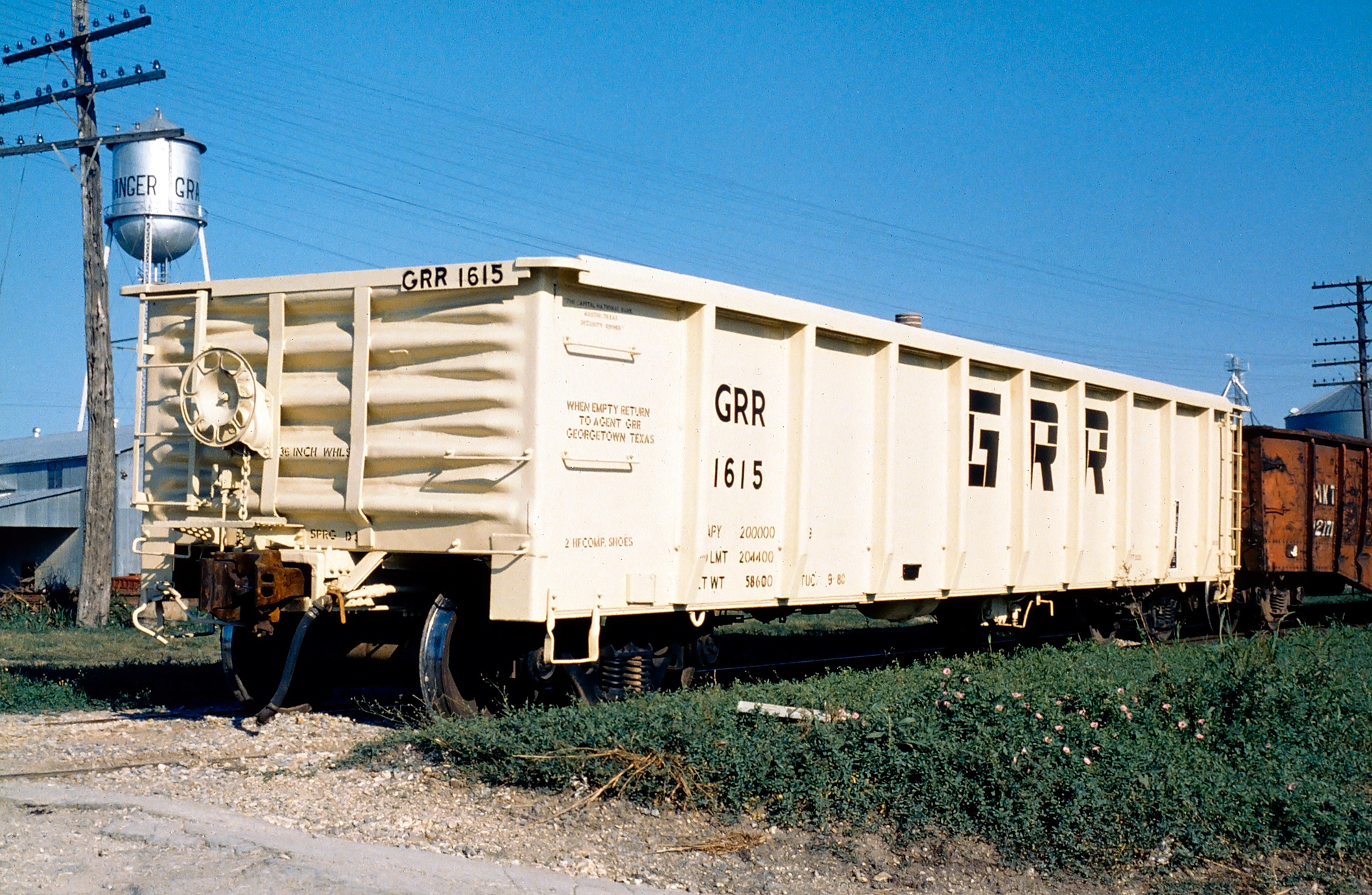 Georgetown Railroad gondola #1615 at Granger, Texas circa 1982. Mike Bledsoe photo. American-Rails.com collection.
History
If you come across a gondola moving within a train do not be surprised if its sides are bowed outwards from all of the heavy use it has experienced over the years.
Likewise, the car in its most basic form is rarely ever maintained more than required to keep it in service. This usually means that as long as the bearings, truck assemblies, knuckle couplers, air-hoses, and other basic over-the-road equipment functions as intended little more is ever done.
However, gons are also one of the most versatile of railroad cars used for everything from carrying junk and scrap metal to new rails, steel coils, and other commodities.
The gondola’s humble beginnings date back to essentially the beginning of our country’s earliest railroads. The B&O, previously mentioned, placed the first in service that year. The railroad referred to them as "flour cars," designed by noted engineer Benjamin Latrobe.
Early Examples
The were first mentioned in the B&O's 1831 annual report and contained friction-bearing wheels designed by a self-taught engineer, Ross Winans.
The car was based from a similar design put into service in England on the Liverpool & Manchester; it was 9 feet 6 inches long, by 7 feet 8 inches wide with a 44-inch wheelbase (the wheels were 30 inches in diameter).
They featured very low sides around 2-feet in height, just enough to secure barrels of flour and prevent them from falling off. At the time these little cars can handle only a few tons of ladding; by the Civil War period the cars were nearly 30 feet in length and could handle about 15 tons.
As demand grew and a locomotive's power increased, larger and larger designs were unveiled. By the late 19th century the cars were 36 feet in length and could handle around 30 tons.
The modern gondola from the mid-20th century onward is about 50 feet in length and can handle up to 70 tons according to Mike Schafer's and Mike McBride's book, "Freight Train Cars."
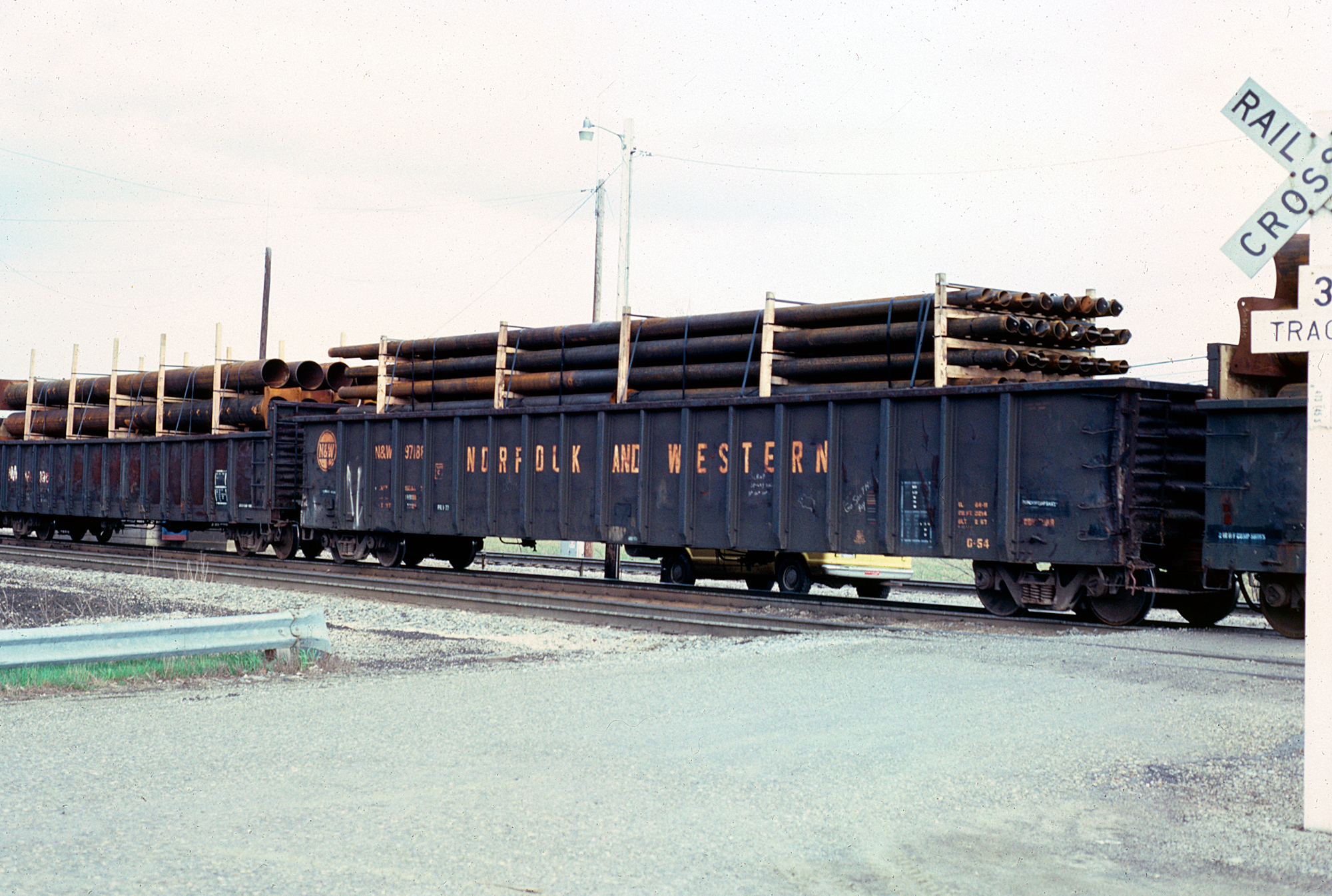 Norfolk & Western gondolas are seen here hauling loads of pipe; June, 1983. American-Rails.com collection.
Today the standard gondola resembling a flatcar with low sides generally measuring somewhere in the range of 50 feet with a capacity of nearly 100 tons. The standard design, however, isn't the only type currently in use.
Some gons look nearly like boxcars but with open tops, commonly for the purpose of handling lightweight materials such as woodchips (although some railroads have modified hoppers with much higher sides for the same purpose!).
Others versions feature hatched tops to cover goods from the outside weather, and some even appear as the common hopper car which typically carries coal.
One of the first noticeable changes to the gondola occurred in 1905 when the Ralston Steel Car Company of Columbus, Ohio came up with a drop-bottom system with outward chutes that allowed the floor to be manually opened and use the force of gravity to quickly and efficiently remove the car's contents, which would disperse to the sides.
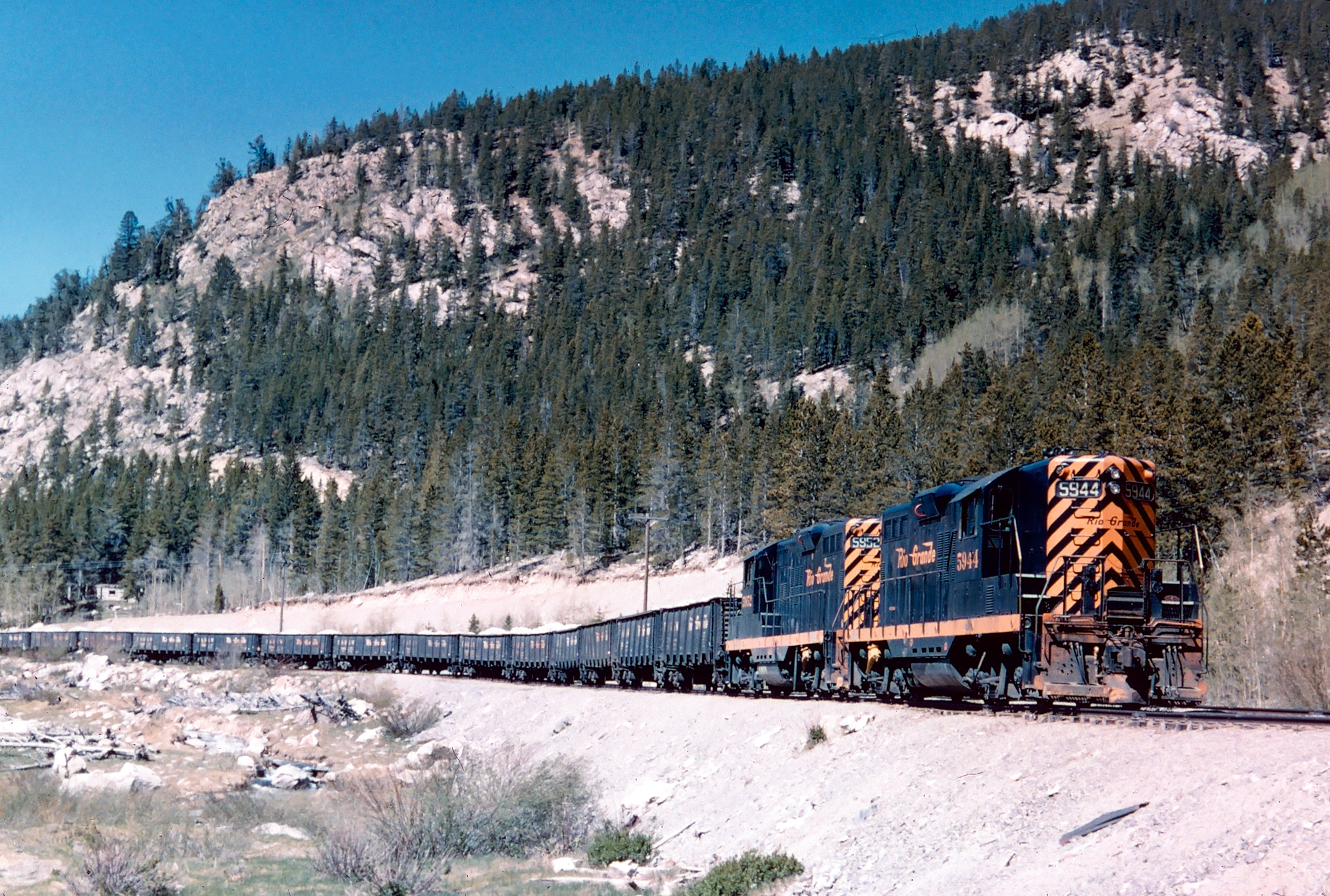 Rio Grande GP9's #5944 and #5952 with loads of limestone at the quarry near Monarch, Colorado on June 17, 1970. Ed Fulcomer photo. American-Rails.com collection.
Bathtub Gons
Many railroads found this useful in a wide range of applications, such as in maintenance-of-way service for ballast operations allowing for fast dispensing of the stone along the sides of the rails.
Today, gondolas designed this way are still used in such a fashion. During the second-half of the 20th century a similar version to this design came into use, the "Bathtub" gondola. This version employs wide, bottom "belly" doors that can be opened to immediately dispense their contents.
Railroads found this design useful in coal service since the car could carry more product than the hopper (which is built with chutes within the structure for unloading) and yet still quickly be unloaded. Today, this gondola has become nearly as common as the hopper.
Dimensions (Modern Cars)
Gons are sometimes mistaken for hopper cars. The reason the car is still classified as a gondola is that it does not have angled drop-bottom hatches or chutes like open-top hopper cars.
If gons are being used to haul coal they are usually emptied all at once by being tipped upside down or having their load immediately emptied from their 90-degree drop-bottom hatches.
In other words, hoppers contain some type of angled or sloped drop-bottom chutes, which use the force of gravity to quickly unload their cargo without having to tilt or turn the car upside down in any way.
Other versions of the gondola that can technically be classified as such due to their very design includes the coil car, used to haul large sheets of rolled steel (which typically are covered to remain out of the elements) and the well car, which has a depressed center and low sides to haul one or two intermodal ship containers.
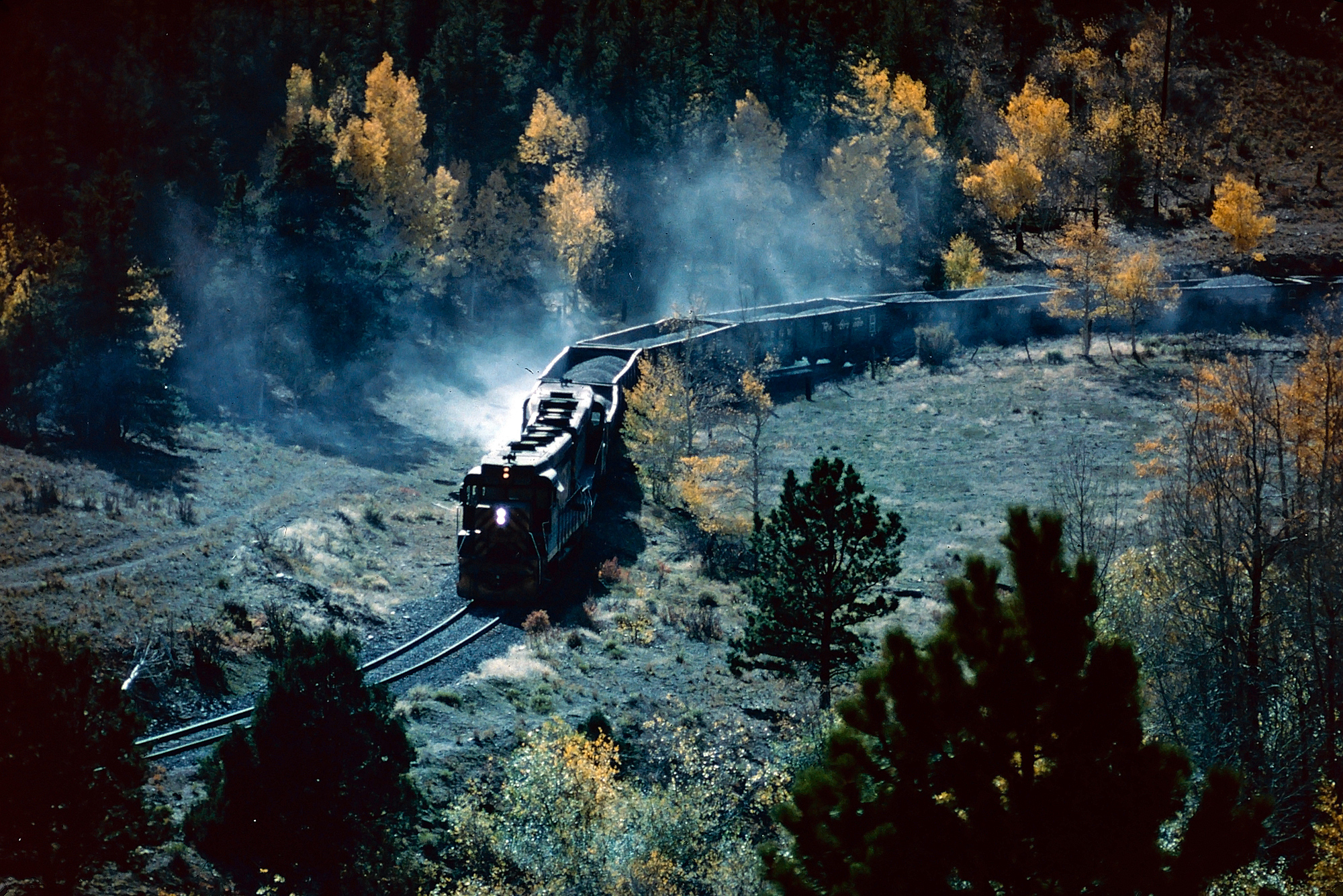 Rio Grande GP30's #3002 and #3015 bring gondola loads of limestone off the Monarch Branch at Maysville, Colorado on October 8, 1979. Robert Harmen photo. American-Rails.com collection.
Other Types
Of course, this car has also been classified as a flatcar to further confuse matters!
Aside from handling coiled steel, low-sided gondolas have been used in other specialized applications; short bulkheads have been added to the car's end for pulpwood service and covers continue to be applied in modern-day service for products which must remain dry. In recent years this car has become particularly in high demand due to the explosion in this market.
While the original gondola design will likely always retain their image as the least respected of all freight cars roaming our nation’s rails, they will also likely always retain their important function for the railroads by hauling either scrap metal and junk or dense bulk materials and general merchandise.
Whatever its use may be on a day-to-day basis the gondola certainly will not be retired anytime soon.
Recent Articles


-
West Virginia Railroad Museums (2026): A Complete Guide
Oct 16, 26 12:52 PM
 West Virginia railroad museums—Cass Scenic’s geared steam, the Hinton C&O collection, and the Martinsburg B&O roundhouse. Confirm hours and which locomotive is assigned.
 -
Washington Railroad Museums (2026): A Complete Guide
Oct 16, 26 12:46 PM
 Washington railroad museums—Snoqualmie, Elbe, Chehalis, Reardan, and the Northern Pacific depot at Toppenish. Confirm hours and which locomotive is assigned.
 -
Vermont Railroad Museums (2026): A Complete Guide
Oct 16, 26 12:42 PM
 Vermont railroad museums—the Shelburne Museum’s 1890 station, Central Vermont No. 220, and the private car Grand Isle. Confirm hours on the site.
 -
Tennessee Central Railway: Map, Logo, Rosters, History
Oct 16, 26 11:32 AM
 Tennessee Central Railway, Harriman to Hopkinsville. Reorganized January 26, 1922. Last day August 31, 1968. Thirty-one diesels and the railroad's steam roster.
 -
Southern Railway Steam Roster (Post 1900)
Oct 16, 26 09:40 AM
 Southern Railway steam locomotives built since 1900. Ps-4 Pacifics, Ts Mountains, USRA Santa Fes, and the subsidiary grids for the CNO&TP, Alabama Great Southern, and New Orleans and Northeastern.
 -
Southern Railway (USA): Map, Locomotives, Logo, History
Oct 16, 26 09:28 AM
 The Southern Railway, formed July 1, 1894 from the Richmond and Danville and the East Tennessee, Virginia and Georgia. Washington. Norfolk Southern Railway on December 31, 1990.
 -
Seaboard Coast Line Diesel Roster (All-Time)
Oct 15, 26 04:21 PM
 All-time diesel roster of the Seaboard Coast Line. Inherited Coast Line and Seaboard locomotives, then 623 new locomotives in the printed orders, plus 28 acquired from other railroads.
 -
Seaboard Coast Line Railroad: Map, History, Photos
Oct 15, 26 04:17 PM
 The Seaboard Coast Line, formed July 1, 1967 from the Atlantic Coast Line and the Seaboard Air Line. Jacksonville. Family Lines, then the Seaboard System on December 29, 1982.
 -
South Carolina Railroad Museums (2026): A Complete Guide
Oct 15, 26 02:54 PM
 South Carolina railroad museums—Winnsboro’s Rockton & Rion line, Spartanburg’s Hub City depot, Greenwood’s Baldwin No. 19, and the Best Friend replica. Confirm hours on each site.
 -
South Dakota Railroad Museums (2026): A Complete Guide
Oct 15, 26 10:55 AM
 South Dakota railroad museums—the Hill City museum beside the 1880 Train, and Prairie Village at Madison. Confirm hours, and confirm whether Hill City is still open.
 -
Seaboard Air Line Diesel Roster (All-Time)
Oct 15, 26 10:46 AM
 All-time diesel roster of the Seaboard Air Line. 734 locomotives: E4s in 1938, Centipedes, Alco road switchers, and GP40s through February 1967. Serials included.
 -
Seaboard Air Line Steam Roster (Post 1900)
Oct 15, 26 10:39 AM
 Seaboard Air Line steam locomotives built since 1900. Mikados, Russian Decapods, 2-10-2s, and the 2-6-6-4s sold to the Baltimore and Ohio in 1947. Drury's class grid.
 -
Seaboard Air Line Railroad: Map, Rosters, History
Oct 15, 26 10:34 AM
 The Seaboard Air Line, chartered in the Portsmouth and Roanoke of 1832 and formed July 1, 1900. Inland route to Florida. Merged into the Seaboard Coast Line on July 1, 1967.
 -
Utah Railroad Museums (2026): A Complete Guide
Oct 15, 26 12:04 AM
 Utah railroad museums—Ogden Union Station, Golden Spike at Promontory, the Helper mining museum, and the Heber Valley Railroad. Confirm hours on each site.
 -
Escanaba & Lake Superior Diesel Roster (All-Time)
Oct 14, 26 10:44 PM
 All-time diesel roster of the Escanaba & Lake Superior. 30 locomotives: Baldwin switchers and RS-12s, two RF16s, three GP38s, three SD40-2s, and the Reserve Mining units. Serials and order numbers.
 -
Escanaba & Lake Superior Railroad: In Service Since 1898
Oct 14, 26 09:04 PM
 Escanaba & Lake Superior Railroad, chartered November 17, 1898, and still operating from Wells, Michigan. Logging line to Channing, the Milwaukee Road lines, and the diesel roster.
 -
Richmond, Fredericksburg & Potomac Diesel Roster (All-Time)
Oct 14, 26 08:49 PM
 All-time diesel roster of the Richmond, Fredericksburg and Potomac. 107 locomotives: 22 Alco S2s, one SW1, and an Electro-Motive road fleet from E8s to GP40-2s. Serials and order numbers.
 -
Richmond, Fredericksburg & Potomac Steam Roster (Since 1900)
Oct 14, 26 08:46 PM
 Richmond, Fredericksburg and Potomac steam locomotives built since 1900. Pacifics, Mountains, Berkshire-type 2-8-4s, and the named 4-8-4s. Last revenue run December 17, 1954.
 -
Richmond, Fredericksburg and Potomac Railroad: Map, Rosters, Logo
Oct 14, 26 08:36 PM
 The Richmond, Fredericksburg and Potomac, chartered February 25, 1834. A 113-mile Richmond–Washington bridge line. Named 4-8-4s, Potomac Yard, and the CSX sale of October 10, 1991.
 -
North Dakota Railroad Museums (2026): A Complete Guide
Oct 14, 26 08:29 PM
North Dakota railroad museums—Mandan’s state museum, the Railroad Museum of Minot, and Bonanzaville’s Northern Pacific 684. Confirm hours on each site. -
Oklahoma Railroad Museums (2026): A Complete Guide
Oct 14, 26 08:02 PM
Oklahoma railroad museums—the Oklahoma Railway Museum, Enid’s Frisco 1519, Waynoka’s Harvey House, and El Reno’s Rock Island depot. Confirm hours on each site. -
Oneida & Western Railroad: Map, History, Timetable
Oct 14, 26 06:47 PM
Oneida & Western Railroad, a Tennessee short line from Oneida to Jamestown. Chartered in 1912, opened to East Jamestown in 1921, and to Jamestown on December 10, 1930. Last revenue train March 4, 1954… -
Oneida and Western Railroad (Shamrock Coal Company)
Oct 14, 26 03:20 PM
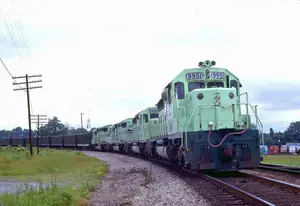
 Shamrock Coal's mint-green coal trains, 1979–1987. Eight EMD SD40-2s, OWTX 9950–9957, order 786246. Two 72-car gondola sets. Louisville & Nashville, then CSX. Sold to BC Rail.
 -
Rhode Island Railroad Museums (2026): A Complete Guide
Oct 14, 26 03:03 PM
 Rhode Island railroad museums—the Friends’ museum in the 1875 Kingston depot, on the old New York, Providence and Boston. Confirm what is on view.
 -
Original Norfolk Southern Diesel Roster (All-Time)
Oct 14, 26 12:40 PM
 All-time diesel roster of the original Norfolk Southern Railway. 59 locomotives: Baldwin switchers and AS-416s, three GE 70-tonners, 17 GP18s, and seven GP38s. Serials and order numbers.
 -
Original Norfolk Southern Railway: Map, Rosters, History
Oct 14, 26 10:09 AM
 The original Norfolk Southern Railway, chartered in 1870 as the Elizabeth City & Norfolk. Norfolk to Charlotte. Merged into the Southern Railway on January 1, 1974. Baldwin diesels and the GP18s and G…
 -
Nebraska Railroad Museums (2026): A Complete Guide
Oct 14, 26 10:00 AM
 Nebraska railroad museums—the Durham Museum, Kenefick Park, Cody Park, and the Golden Spike Tower over Bailey Yard. Confirm hours on each site.
 -
Nevada Railroad Museums (2026): A Complete Guide
Oct 14, 26 09:51 AM
 Nevada railroad museums—Carson City, Boulder City, the Nevada Northern at East Ely, and the Virginia City depot. Confirm hours on each site.
 -
Montana Railroad Museums (2026): A Complete Guide
Oct 14, 26 12:17 AM
 Montana railroad museums—the Livingston depot, Fort Missoula’s Willamette, the Harlowton Milwaukee depot, and the Whitefish station. Confirm hours on each site.
 -
"Jawn Henry" Locomotive: Specs, Diagram, Photos
Oct 14, 26 12:03 AM
 Norfolk & Western No. 2300, class TE-1, the steam turbine-electric Jawn Henry. Baldwin-Lima-Hamilton, Westinghouse, and Babcock & Wilcox, May 1954. Specifications, the road tests, and the Dece…
 -
Atlantic and Danville Railway: Serving Southern VA
Oct 13, 26 04:32 PM
 Atlantic and Danville Railway, chartered in 1882, incorporated September 1883. Three-foot line to Claremont, then Norfolk to Danville. Southern lease from September 1, 1899, to July 1, 1949. Alco RS2s…
 -
Norfolk, Franklin and Danville Railroad: Map, Roster, History
Oct 13, 26 04:26 PM
 Norfolk, Franklin and Danville Railway, chartered October 2, 1962, and operating from November 1, 1962. Norfolk to Danville, 210.8 miles. Two Alco RS36s and four RS11s. Merged into the N&W on December…
 -
Norfolk & Western Diesel Roster (All-Time)
Oct 12, 26 11:59 PM
 Norfolk & Western diesel roster, all-time. 1,464 locomotives built new for the railroad, from the 1955 GP9s and RS-3s through the C36-7s, plus the merger fleets.
 -
Norfolk & Western Steam Roster (Post 1900)
Oct 12, 26 11:52 PM
 Norfolk & Western steam since 1898. The Roanoke grid: 1,266 locomotives, the J, the A, and the Y, and the last road steam on May 7, 1960.
 -
Norfolk & Western Railway: Map, Logo, Rosters, History
Oct 12, 26 11:45 PM
 The Norfolk & Western, from the City Point Railroad of 1838 to Norfolk Southern. Pocahontas coal, Roanoke steam, and the 1964 expansion.
 -
Louisiana Railroad Museums (2026): A Complete Guide
Oct 12, 26 11:24 PM
 Louisiana railroad museums—the DeQuincy depot, the Long Leaf sawmill, Jackson’s model railroad, and Southern Pacific 745. Confirm hours on each site.
 -
Michigan Railroad Museums (2026): A Complete Guide
Oct 12, 26 11:14 PM
 Michigan railroad museums—Pere Marquette 1225 at Owosso, Durand Union Station, The Henry Ford, and the Mount Clemens depot. Confirm hours on each site.
 -
Mississippi Railroad Museums (2026): A Complete Guide
Oct 12, 26 10:52 PM
Mississippi railroad museums—McComb’s rebuilt Illinois Central depot and Illinois Central 2542, and the Casey Jones museum at Water Valley. Confirm hours on each site. -
The "E2b": PRR's Experimental Freight Electrics
Oct 12, 26 10:33 PM
 PRR class E2b: six GE B-B freight electrics, 4939–4944, 2,500 hp, 11 kV AC. Specifications, roster, and the 1964 scrap.
 -
Alaska Railroad Museums (2026): A Complete Guide
Oct 12, 26 10:10 PM
 Alaska railroad museums—the Museum of Alaska in Wasilla, Tanana Valley No. 1 at Pioneer Park, and the Engine 557 shop. Confirm hours on each site.
 -
Western and Atlantic Railroad: Map, History, Timetables
Oct 12, 26 09:55 PM
 The Western & Atlantic Railroad of the State of Georgia, authorized December 21, 1836, from Atlanta to Chattanooga. The state still owns the 137.33-mile line. CSX leases it. The through railroad opene…
 -
Nashville, Chattanooga & St. Louis Steam Roster (Post 1900)
Oct 12, 26 09:52 PM
 Nashville, Chattanooga & St. Louis steam since 1900. Drury's class grid: Consolidations, 51 Mikados, three 2-8-8-2s, Pacifics, and 25 4-8-4s. Last steam was January 4, 1953.
 -
Nashville, Chattanooga & St. Louis Diesel Roster (All-Time)
Oct 12, 26 09:27 PM
 Nashville, Chattanooga & St. Louis diesel roster, all-time. Switchers from 1941, 37 GP7s, and the F3s and F7s. The quantity column totals 132 locomotives.
 -
Nashville, Chattanooga and St. Louis Railway: Map, History, Logo
Oct 12, 26 08:41 PM
 The Nashville, Chattanooga & St. Louis, the Dixie Line. Charter of December 11, 1845, the Cumberland tunnel, and the Louisville & Nashville merger of August 30, 1957.
 -
Idaho Railroad Museums (2026): A Complete Guide
Oct 12, 26 02:44 PM
Idaho railroad museums—Nampa’s 1903 depot, Wallace’s Northern Pacific depot, and Boise’s 1925 Union Pacific depot. Confirm hours on each site. -
Hawaii Railroad Museums (2026): A Complete Guide
Oct 12, 26 12:50 PM
Hawaii railroad museums—the Hawaiian Railway Society at Ewa Beach and the Laupahoehoe Train Museum on the Big Island. Confirm hours on each site. -
Marietta and Cincinnati Railroad: Map, History, Timetable
Oct 12, 26 11:44 AM
 Marietta and Cincinnati Railroad, chartered March 8, 1845 as the Belpre & Cincinnati. Opened in April 1857, sold under foreclosure December 9, 1882, and succeeded by the Baltimore & Ohio Southwestern…
 -
Tennessee Railroad Museums (2026): A Complete Guide
Oct 12, 26 11:39 AM
Tennessee railroad museums—TVRM and Southern 4501 in Chattanooga, the Tennessee Central museum in Nashville, Casey Jones in Jackson, and the depots at Cookeville, Cowan, and Townsend. -
Virginia Railroad Museums (2026): A Complete Guide
Oct 12, 26 09:40 AM
 Virginia railroad museums—Roanoke’s Virginia Museum of Transportation and the O. Winston Link Museum, the C&O center at Clifton Forge, and the depots in Richmond, Fairfax Station, Suffolk, Parksley, a…
 -
Louisville & Nashville Diesel Roster (All-Time)
Oct 12, 26 12:15 AM
 Louisville & Nashville diesel roster, all-time. Switchers from 1939, the cab units, and EMD, Alco, and GE hoods through the SD50s. The quantity column totals 1948 locomotives, plus 29 yard slugs.