Railroad Tycoons & Barons (USA): Gilded Age Builders & Financiers
Last revised: August 11, 2026
By: Adam Burns
Railroad tycoons—also called barons, magnates, or empire builders—were the capitalists, promoters, and executives who assembled much of the United States’ rail network from the mid-nineteenth century into the early twentieth. Names such as Cornelius Vanderbilt, Jay Gould, James J. Hill, Edward H. Harriman, and Collis P. Huntington became shorthand for private power over transportation. Their systems grew into the classic New York Central, Union Pacific, Southern Pacific, Great Northern, Missouri Pacific, and many others that still shape the Class I map under later names.
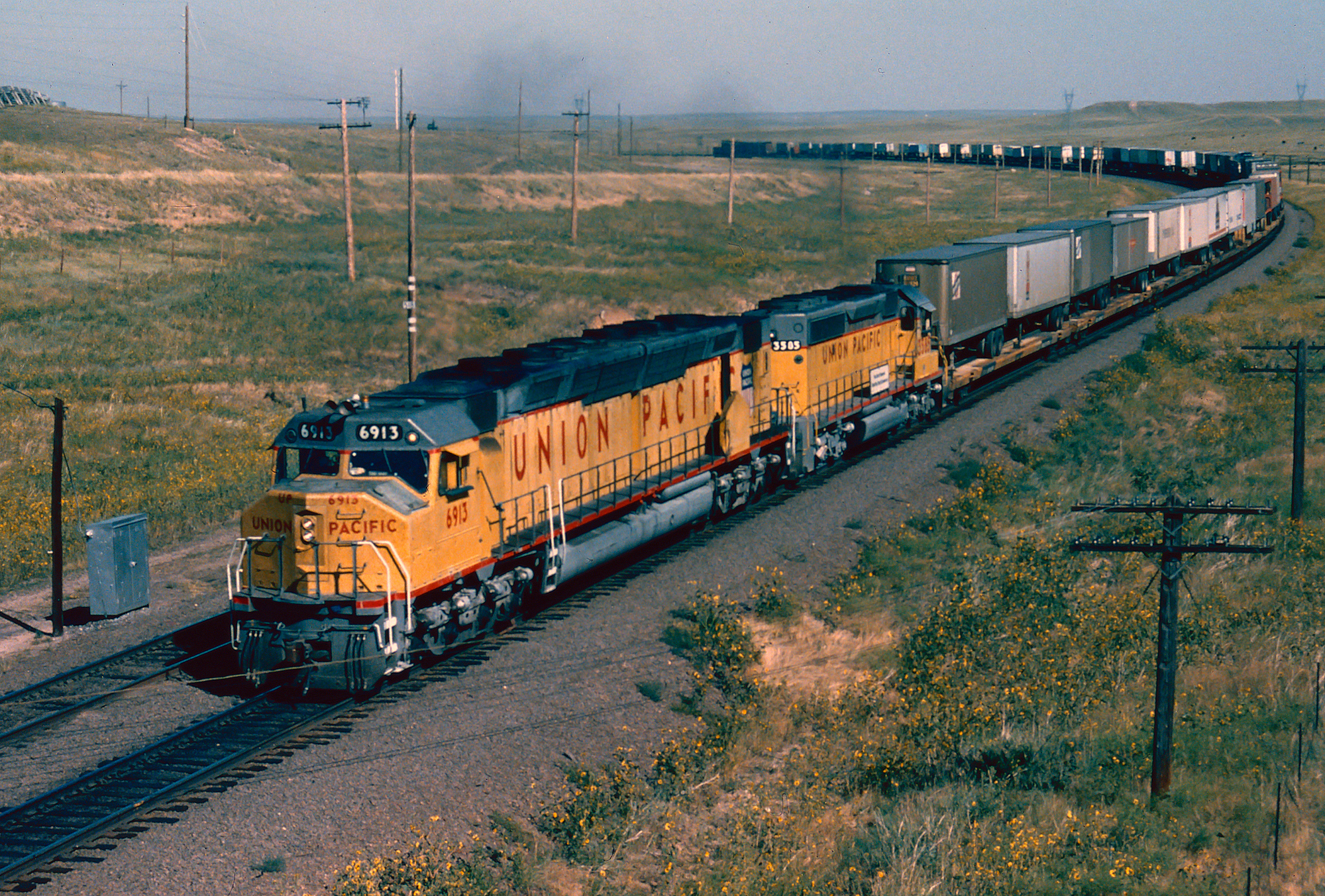
Union Pacific power on Sherman Hill at Speer, Wyoming, August 8, 1984—still rolling a corridor Edward Harriman rebuilt into one of the West’s strongest properties. Mike Bledsoe photo. American-Rails.com collection.
This page is a hub: context for the Gilded Age rail capitalist, a mileage timeline, short portraits of the major figures, a directory of men covered in depth elsewhere on American-Rails.com, and names worth featuring next. Full biographies live on the linked articles; use this page as the map of the territory.
On this page: Who counted as a tycoon · Builders vs financiers · Mileage timeline · Major portraits · Directory & railroads controlled · More names to know · Regulation backlash · Long shadow
Who Counted as a Railroad Tycoon?
There is no official roster. In practice the label fits men who did one or more of the following at national scale:
- Promoted or financed major construction (transcontinentals, trunk lines, coal roads)
- Assembled regional systems by merger, lease, and stock control
- Dominated Wall Street trading in railroad securities
- Linked rail empires to steamship, land, mining, or political networks
Most of the famous barons flourished between roughly 1850 and 1915—the era when U.S. railroad mileage exploded from a few thousand miles to more than a quarter-million. Some were pure operators; others pure financiers; many mixed both. A few twentieth-century presidents (for example B&O’s Daniel Willard) are remembered as “great railroaders” more than Gilded Age barons, but they appear in the directory because readers look for them here.
Public memory still leans on the “robber baron” caricature: ruthless, anti-competitive, indifferent to safety. That image was real enough in rebates, rate wars, stock water, and political influence to fuel Progressive regulation. It is also incomplete. Some of the same men left carefully engineered systems, developed agricultural hinterlands, and rebuilt bankrupt properties into durable carriers. This hub tries to hold both truths: the map they built, and the backlash they provoked.
Builders, Financiers, and System-Makers
It helps to sort careers by method rather than by newspaper villainy alone.
| Type | Emphasis | Examples |
|---|---|---|
| System builders / operators | Engineering, territory development, long-term physical plant | James J. Hill (Great Northern); Harriman after taking UP; often Vanderbilt as consolidator-operator |
| Financiers / market operators | Securities, control fights, fluid corporate empires | Jay Gould; Daniel Drew; Jim Fisk |
| Construction / regional promoters | Building a road as industrial or political project | Big Four on Central Pacific; Cyrus K. Holliday (Santa Fe); Jay Cooke (Northern Pacific finance) |
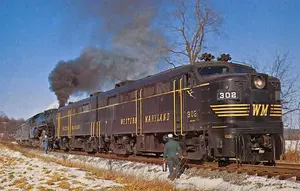
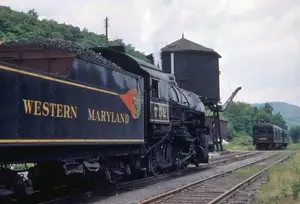
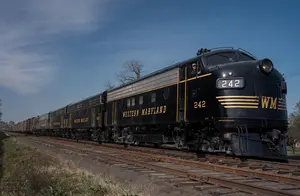
| Heirs & completers | Expanding or trying to finish a parent’s design | George Gould (transcontinental ambition via MoPac–D&RG–WP–WM) |
| Twentieth-century presidents | Professional management under regulation | Daniel Willard (B&O)—different era, same public interest in “railroad men” |
Most individuals blur categories. Huntington mixed politics, construction, and monopoly control of the Southern Pacific. Vanderbilt began on the water and only later became a rail consolidator. Gould left real railroads behind, but his reputation rests as much on the Erie wars and market tactics as on any single main line.
How Fast the Network Grew
The barons’ era is the era of national expansion. Approximate U.S. railroad route-mileage (standard historical tallies; sources vary slightly by year definition):
| Year | Approx. route-miles |
|---|---|
| 1840 | 2,808 |
| 1850 | 9,021 |
| 1860 | 30,000+ |
| 1870 | 52,922 |
| 1880 | 93,267 |
| 1890 | 163,597 |
| 1900 | 193,346 |
| 1916 (peak) | 254,037 |
That curve is the backdrop for every biography linked below: private capital, land grants, immigrant labor, and local boosterism filling a continent with iron in two generations.
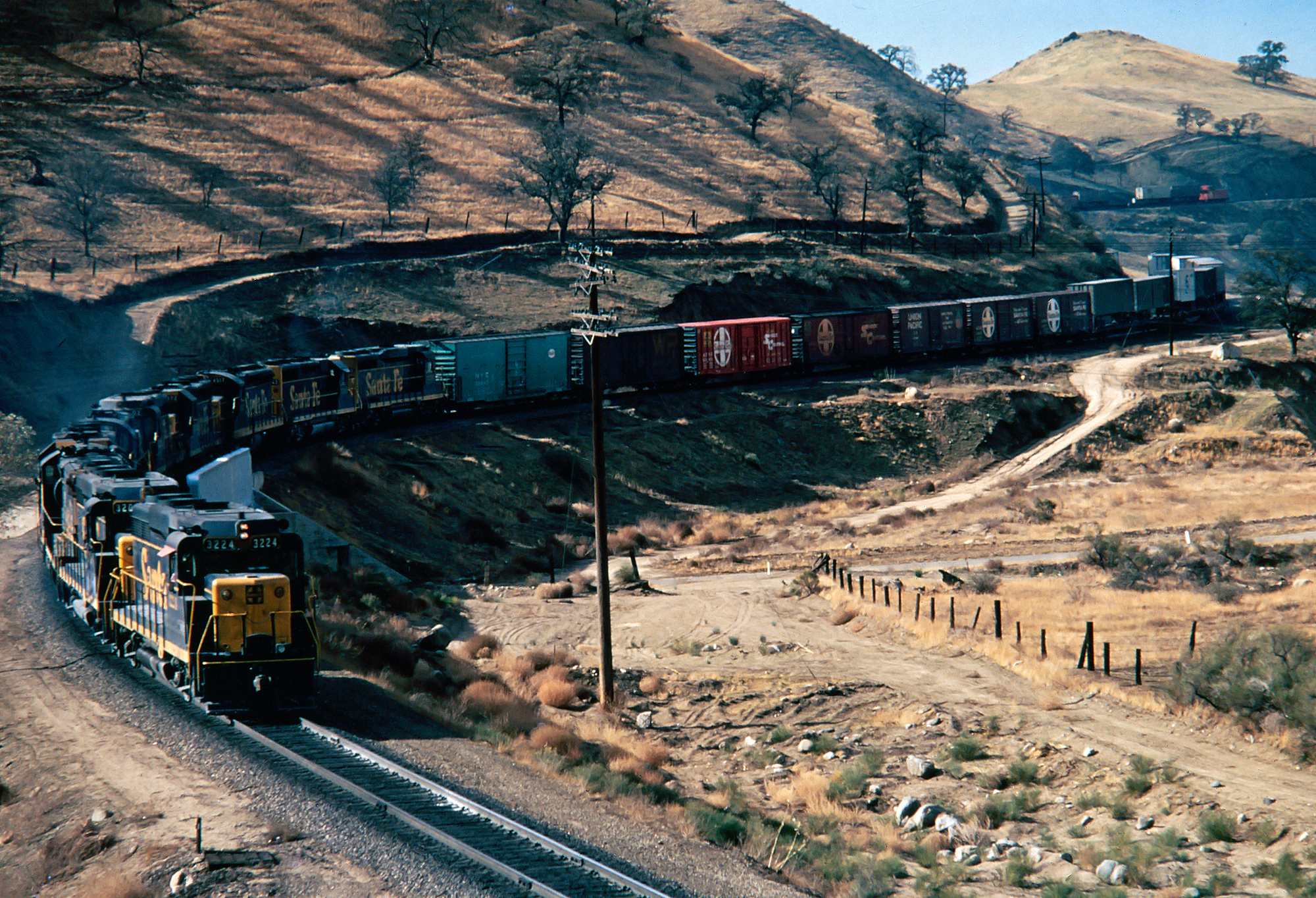
Santa Fe power on Tehachapi at Caliente, California, circa 1970—descendant of the road Cyrus K. Holliday set in motion and later barons expanded. American-Rails.com collection.
Major Portraits
Cornelius Vanderbilt — “The Commodore”
Vanderbilt (1794–1877) is the archetype of the eastern consolidator. He left school early, worked with his father, and at sixteen ran a ferry between Staten Island and New York City. Steamboat success on the Hudson earned him the nickname Commodore and a reputation as a hard, practical operator. He entered railroading in earnest in the 1860s: control of the New York & Harlem (1863), then the Hudson River Railroad, then the original New York Central, forming the New York Central & Hudson River and pushing west via the Lake Shore & Michigan Southern toward Chicago. The Water Level Route empire that later battled the Pennsylvania was largely his design. Full Vanderbilt biography →
Collis P. Huntington and the Big Four
Huntington, with Mark Hopkins, Leland Stanford, and Charles Crocker, organized the Central Pacific (1861) as the western leg of the first transcontinental under the Pacific Railroad Act of 1862. Construction began at Sacramento in January 1863, forced a roadbed through the Sierra Nevada with picks, powder, and Chinese labor, and met Union Pacific at Promontory Summit, Utah, on May 10, 1869. The group also secured the Southern Pacific and eventually folded CP into the SP system (lease 1885; CP corporate life continued far longer on paper). Huntington later helped rebuild the Chesapeake & Ohio into a major eastern coal road. The Big Four combined political skill, construction management, and long-term territorial control. Huntington · Crocker · Stanford · Hopkins
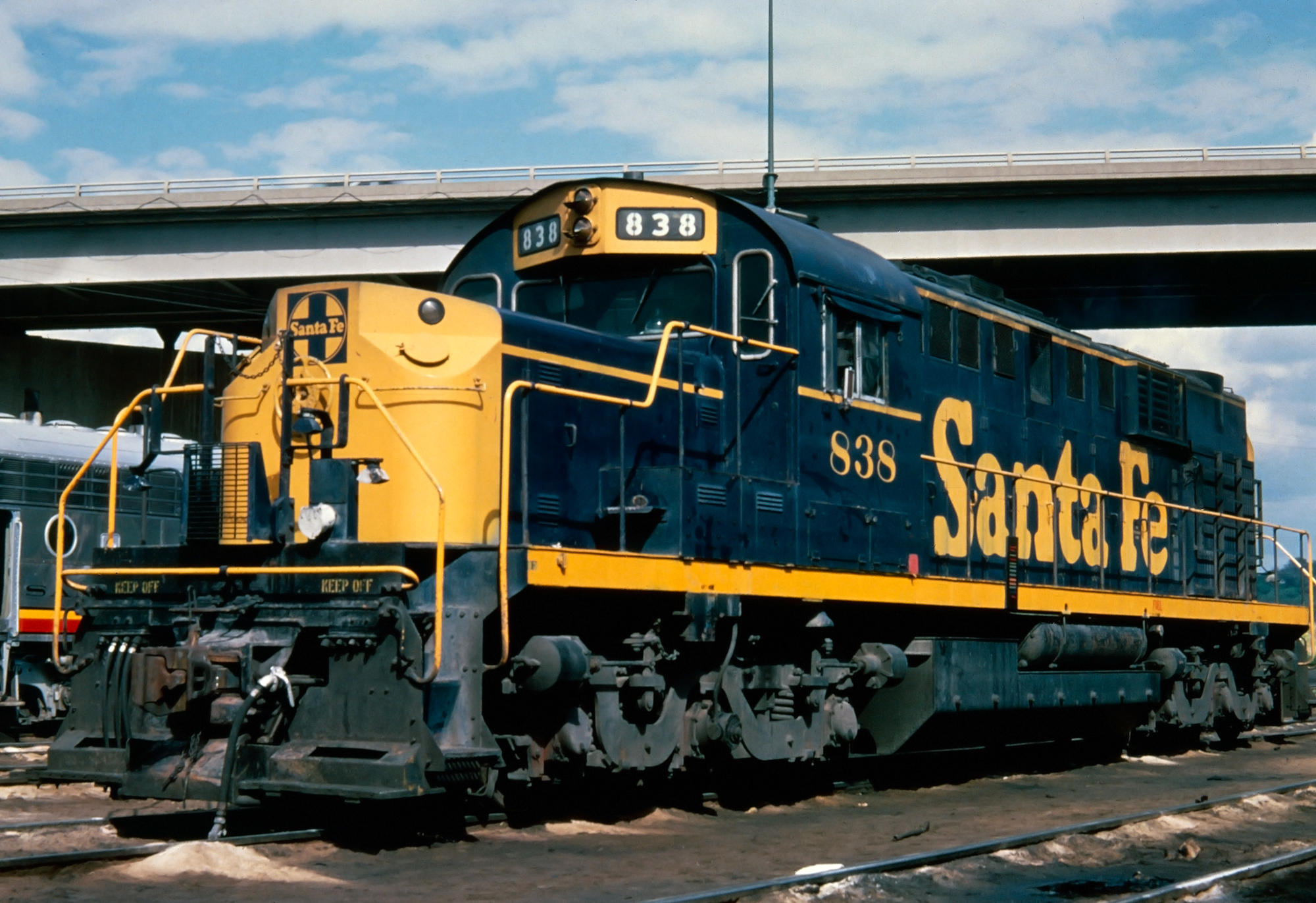
Santa Fe RSD15 #838 at Argentine Yard, Kansas, late 1960s—power on a system whose nineteenth-century foundation was laid by Holliday and expanded by later managers and capital. American-Rails.com collection.
James J. Hill — “Empire Builder”
Hill rose through steamboats and Minnesota commerce, then rebuilt the failed St. Paul & Pacific into the St. Paul, Minneapolis & Manitoba and, in 1889, the Great Northern Railway, reaching Seattle in 1893. Unlike the first transcontinentals, the GN is famous for building largely without the same federal land-grant dependence, with careful grades and close attention to settlement and traffic. Hill also pursued northern control fights and dreamed of combining GN, Northern Pacific, Burlington, and related properties—a vision blocked in his day but realized decades later as Burlington Northern (today inside BNSF). Full Hill biography →
Edward H. Harriman
Harriman remade the Union Pacific after its distressed years, pouring capital into plant and operations, and for a time linked UP with Southern Pacific and other holdings (Illinois Central, Alton, Erie interests, and more appear on his control list). He is the model of the rehabilitating system-maker: less a frontier promoter than a reorganizer who believed physical efficiency produced financial power. Full Harriman biography →
Jay Gould and George Gould
Jay Gould remains the most controversial of the major barons: Erie wars with Drew and Fisk, then a shifting southwestern and midwestern empire (Missouri Pacific, Texas & Pacific, Wabash, Iron Mountain, and others). He understood corporate structure and markets as weapons. His eldest son, George Gould, inherited the web and tried to complete a true coast-to-coast chain—Western Pacific, Rio Grande bridge, Missouri Pacific, Wabash, Western Maryland, and the ill-fated Wabash-Pittsburgh Terminal assault on the Steel City against the Pennsylvania. Overextension and the Panic of 1907 wrecked the design; George sold out of key holdings by 1918. Jay Gould · George Gould · Jim Fisk · Daniel Drew
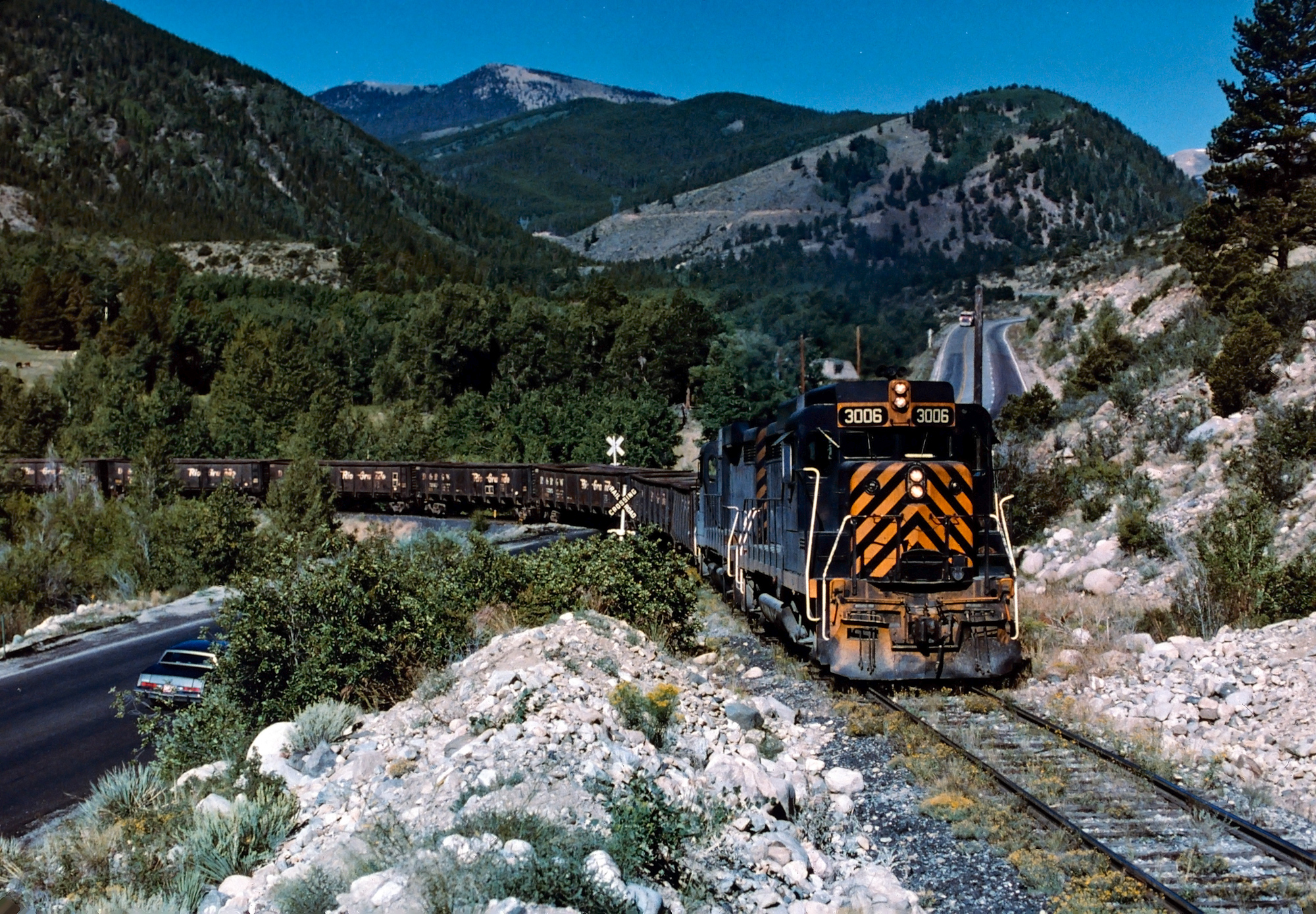
Rio Grande GP30s on the Monarch Branch west of Maysville, Colorado, August 24, 1979—mountain railroading on a system that once formed the bridge in George Gould’s transcontinental scheme. Robert Harmen photo.
Directory: Tycoons Covered on American-Rails.com
Each entry links to a full article where one exists. “Railroads controlled” lists major properties associated with that career (control was often partial, temporary, or through holding companies).
Cornelius “Commodore” Vanderbilt
Railroads / properties: New York & Harlem; Hudson River Railroad; New York Central & Hudson River; Lake Shore & Michigan Southern; Canada Southern interests.
James J. Hill (“Empire Builder”)
Railroads / properties: St. Paul & Pacific; St. Paul, Minneapolis & Manitoba; Great Northern; related Minnesota and Pacific Northwest lines; influence fights involving Northern Pacific, Burlington, and Spokane, Portland & Seattle–era northern strategies.
Edward H. Harriman
Railroads / properties: Union Pacific; Southern Pacific (period of control); Illinois Central; Chicago & Alton; Central of Georgia; Erie interests; other reorganizations.
Jay Gould
Railroads / properties: Erie; Missouri Pacific; Texas & Pacific; Wabash; St. Louis, Iron Mountain & Southern; International-Great Northern; Terminal Railroad Association of St. Louis; earlier northeastern properties.
George Gould
Railroads / properties: Missouri Pacific family; Western Pacific; Denver & Rio Grande Western; Wabash; Western Maryland; Wabash-Pittsburgh Terminal; Wheeling & Lake Erie; related Mid-Atlantic coal roads.
Collis P. Huntington
Railroads / properties: Central Pacific; Southern Pacific; Chesapeake & Ohio.
Charles Crocker · Leland Stanford · Mark Hopkins
Railroads / properties: Central Pacific (Big Four); SP-era western expansion.
Jim Fisk · Daniel Drew
Railroads / properties: Erie Railroad (Erie wars with Vanderbilt and Gould).
Jay Cooke
Railroads / properties: Northern Pacific (finance and promotion; collapse of Cooke’s firm helped trigger the Panic of 1873).
Cyrus K. Holliday
Railroads / properties: Atchison, Topeka & Santa Fe (founder / early leadership).
Daniel Willard
Railroads / properties: Baltimore & Ohio (celebrated early–mid twentieth-century president; reformer-manager more than Gilded Age baron).
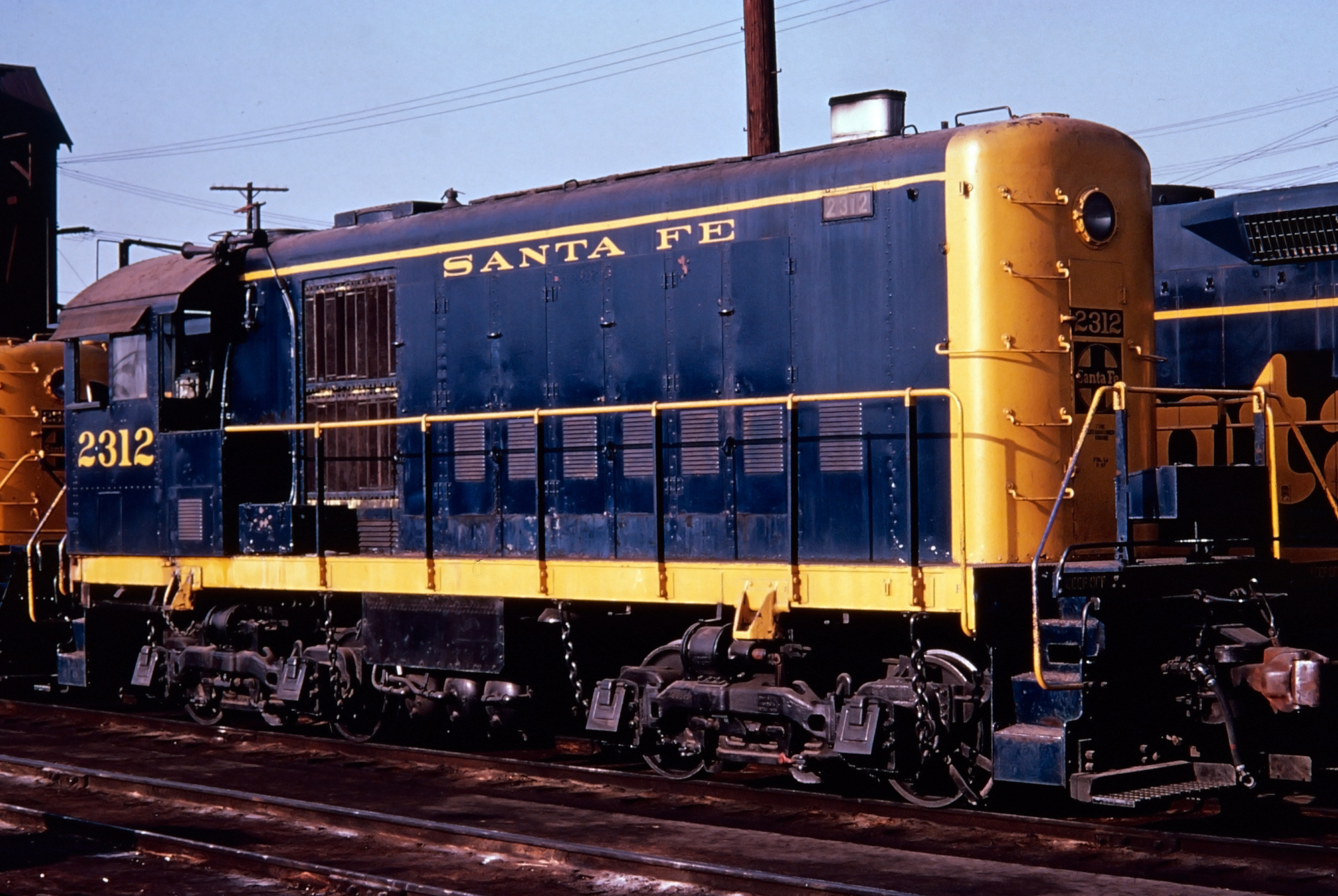
Santa Fe HH1000 #2312 at First Street Yard, Los Angeles, 1960s—late steam-era diesel switcher on a road whose corporate story begins with Holliday’s prairie charter. American-Rails.com collection.
More Names Worth Featuring
These figures are not all linked to full biographies on the site yet, but they belong in any serious tycoon/baron map.
| Name | Why they matter | Core systems / notes |
|---|---|---|
| J.P. Morgan | Reorganized bankrupt roads; brokered peace (e.g., West Shore / South Penn settlement); defined banker control of rail capital | Erie, Reading-era reorganizations; northern securities fights; industry-wide influence |
| Henry Villard | Northern Pacific completion era; Portland/Northwest strategy | Northern Pacific; Oregon & related lines |
| Thomas A. Scott | Pennsylvania Railroad empire under and after J. Edgar Thomson | PRR; southern and western investments |
| J. Edgar Thomson | Professionalized PRR engineering and management | Pennsylvania Railroad |
| William H. Vanderbilt | Inherited and expanded the Commodore’s NYC system | New York Central family of roads |
| William Rockefeller / Standard Oil circle | Oil traffic, rate politics, interlocking directorates | Influence on eastern and midwestern roads |
| Henry Flagler | Florida East Coast; tourism and land development by rail | FEC; broader Flagler enterprises |
| Henry B. Plant | Florida and Gulf coast system-building | Plant System (later ACL family) |
| John Murray Forbes / Boston capital | Midwest roads financed from New England | Chicago, Burlington & Quincy roots; Michigan Central era capital |
| Frederick Weyerhaeuser (timber-rail nexus) | Not a classic “rail baron” but essential to northwest rail traffic | Timber lands feeding NP/GN/Milwaukee territories |
| Arthur E. Stilwell | Promoter of Kansas City, Mexico & Orient and related dreams | KCM&O; Port Arthur–era projects |
| George Pullman | Palace-car empire that defined first-class travel | Pullman Company (equipment more than route-miles) |
| George Westinghouse | Air brake and electrical systems that made modern railroading possible | Supplier-industrialist, not a system owner |
| E.H. Harriman’s circle / Otto Kahn / Kuhn Loeb | Investment banking behind reorganizations | UP and other rehabilitations |
| Robert R. Young (20th c.) | C&O / NYC fights; modern “rail baron” in public imagination | Alleghany Corp.; mid-century control contests |
| Patrick B. McGinnis (20th c.) | Controversial New Haven leadership | New Haven; later B&M era notoriety |
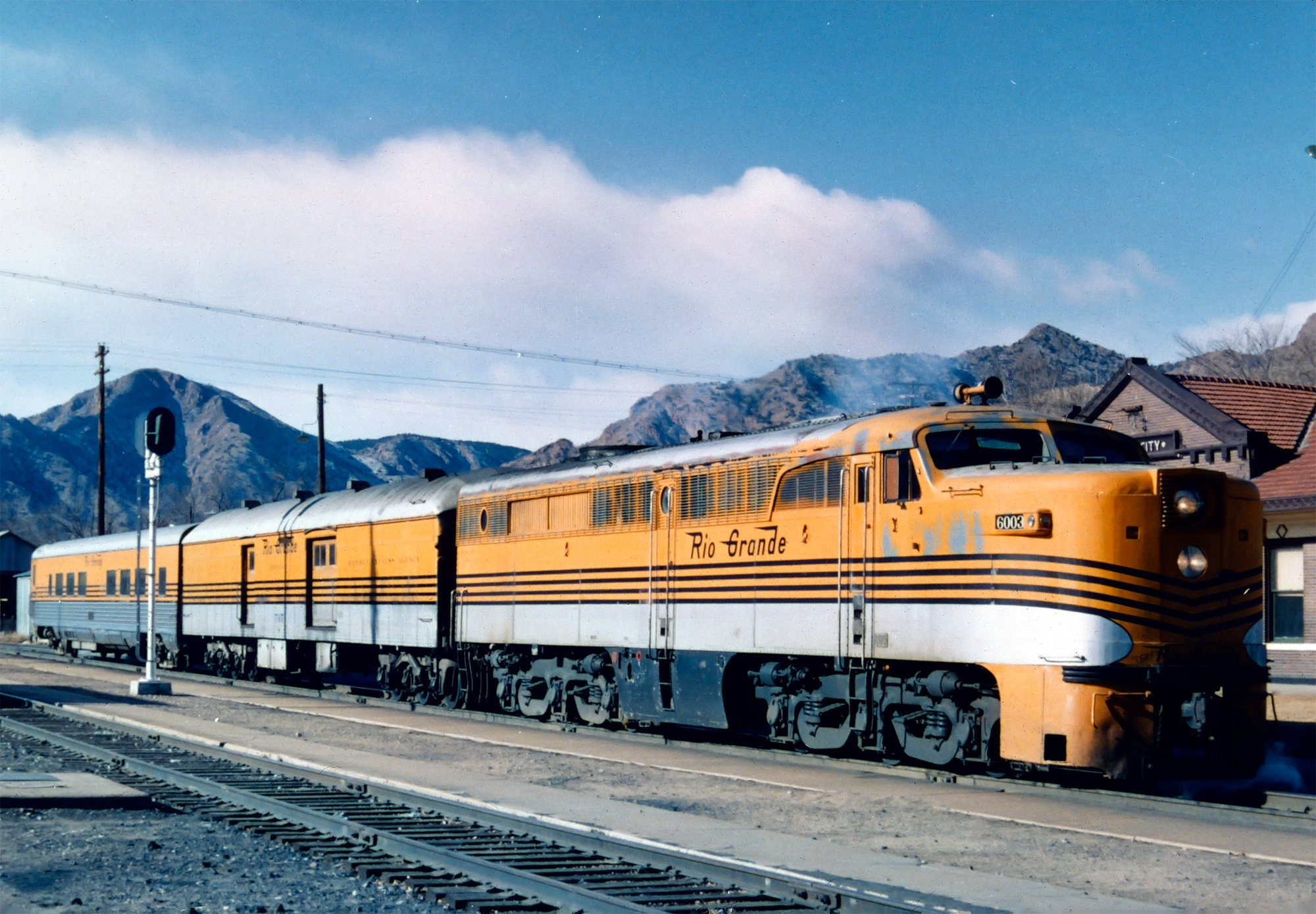
Rio Grande PA-1 #6003 with the Royal Gorge at Cañon City, Colorado, January 7, 1967. Ed Fulcomer photo. American-Rails.com collection.
Reputation, Safety, and the Regulatory Backlash
Were the tycoons simply wretched people who cared nothing for the public? Not entirely, and not uniformly. Hill encouraged settlement along the Great Northern and sometimes subsidized movers. Harriman poured money into safer, heavier plant. Vanderbilt’s consolidations reduced chaotic parallel competition in the New York–Chicago corridor even as they concentrated power. At the same time, rate discrimination, rebates to favored shippers (especially oil), stock watering, and political influence were widespread enough to make “the railroads” a Progressive target.
Until late in the nineteenth century there was little federal oversight of rates or many operating practices. Casualties among workers and passengers were horrific by modern standards; automatic couplers, air brakes, and signal systems spread only under legal and competitive pressure (the Safety Appliance Act of 1893 is a landmark). Editorial cartoons of the era made the octopus and the hog a national language of distrust.
Key federal steps in rate and service regulation included:
- Interstate Commerce Act (1887) — created the Interstate Commerce Commission
- Elkins Act (1903) — struck at rebates
- Hepburn Act (1906) — real rate authority for the ICC
- Mann-Elkins Act (1910) — further expanded federal power
Those laws responded directly to the visible power of the barons’ generation. A century later, many historians argue the pendulum swung too far: rigid regulation left railroads poorly equipped for truck and auto competition, contributing to the bankruptcies and restructuring of the 1960s–1970s. The Staggers Rail Act (1980) restored substantial pricing freedom and is widely credited with helping revive freight rail productivity. The tycoons did not write Staggers—but the political economy they triggered shaped the entire arc from 1887 to 1980.
The Long Shadow: Empire-Building Then and Now
The drive to control gateways, eliminate parallel competition, and test private scale against public authority did not end with top hats and private cars. Merger waves that created Burlington Northern, expanded Union Pacific, formed CSX and Norfolk Southern, and combined Canadian Pacific with Kansas City Southern follow a logic Vanderbilt and Hill would recognize: network scale and strategic corridors win.
Each generation reopens the same questions. How much concentration is efficient? When does private empire-building serve shippers and the wider economy, and when does it require restraint? The Gilded Age barons operated with almost no federal rate regulation at first; their successors live under labor law, environmental rules, and residual economic oversight far denser than 1870. The ambition—to assemble and hold the most valuable map—remains familiar.
For American-Rails readers, the practical legacy is simple: when you read a fallen-flag history of the New York Central, Great Northern, Southern Pacific, or Missouri Pacific, you are usually reading a tycoon’s unfinished sentence, completed by later managers, regulators, and merger lawyers.
Related Reading on American-Rails.com
- Railroad History (USA)
- Fallen Flags — the systems the barons assembled
- New York Central — Vanderbilt’s eastern masterpiece
- Class I Railroads today — heirs of the old empires
- Famous railroad landmarks
Sources & Further Reading
- Schafer, Mike. Classic American Railroads and More Classic American Railroads
- Solomon, Brian. Southern Pacific Railroad and related system histories
- Biographical literature on Vanderbilt, Gould, Hill, Harriman, and the Big Four (popular and academic)
- Interstate Commerce Act and Progressive-era railroad regulation summaries
- Individual American-Rails.com baron biographies linked in the directory above
Hub page restructured and expanded August 2026: clearer directory layout, builder-vs-financier framing, corrected emphasis on regulation, an extended list of additional barons for future coverage, and tighter links to full biographies. Photos illustrate successor systems on corridors the Gilded Age generation put on the map.
Recent Articles


-
Iowa Halloween Train Rides (2026)
Sep 29, 26 11:58 PM
 2026 Iowa Halloween train. Boone & Scenic Valley Pumpkin Express, October 10, 10:00 a.m. from 225 10th Street. About 1 hour 15 minutes. Children pick a pumpkin.
 -
Arizona Halloween Train Rides (2026)
Sep 29, 26 11:43 PM
 2026 Arizona Halloween train. Grand Canyon Railway Pumpkin Patch Train from Williams, $39 with a pumpkin included. Select October dates on the ticket calendar. Haunted train cars are optional.
 -
Nevada Northern Halloween Trains (2026)
Sep 29, 26 06:18 PM
 Nevada Northern 2026 Halloween trains in Ely. Pumpkin Patch Caper to Keystone Gulch and the Haunted Ghost Train. Adult tickets start at $45. Dates are on the railroad’s calendar. Confirm on nnry.com.
 -
Grand Canyon Railway Pumpkin Patch Train (2026)
Sep 29, 26 02:42 PM
 Grand Canyon Railway Pumpkin Patch Train—select October 2026 dates from Williams, $39 with a pumpkin included. Haunted train cars are optional. Days are on the ticket calendar. Confirm on thetrain.com…
 -
Cass Scenic Railroad Halloween Trains (2026)
Sep 29, 26 02:37 PM
 Cass Scenic Halloween Trains—October 30 and 31, 2026, steam, 5:00 p.m. from Cass Depot. About two hours to Whittaker. Adult $75. Candy for every child. Confirm on mountainrailwv.com.
 -
Halloween Train Rides (2026): Pumpkin Patch, Haunted & Spooky Trips
Sep 29, 26 11:26 AM
 2026 Halloween train rides in nine checked states. Conway Scenic Halloween Express October 24–25. Strasburg’s three fall tickets. Great Smoky Mountains Railroad’s October trains are the gorge and rive…
 -
Maine Halloween Train Rides (2026)
Sep 29, 26 11:08 AM
 2026 Maine Halloween trains. Seashore Pumpkin Patch Trolley through October 18, adult $17. Happy Trolleyween October 23–25 at $15. WW&F Pumpkin Pickin’ October 3, 12, 17, and 24. Downeast’s booking it…
 -
Kentucky Halloween Train Rides (2026)
Sep 29, 26 10:58 AM
 2026 Kentucky Halloween trains. Kentucky Railway Museum Trick and Track Express, October 24 and 31, from $17. Bluegrass Scenic pumpkin trains in Versailles. Confirm on the ticket shop.
 -
Connecticut Halloween Train Rides (2026)
Sep 29, 26 10:26 AM
 2026 Connecticut Halloween trains. East Windsor Pumpkin Patch Fridays through Sundays, October 2–31. Naugatuck coach $20. Shore Line Pumpkin Patch on nine October days. Confirm on each site.
 -
Pennsylvania Halloween Train Rides (2026)
Sep 29, 26 09:45 AM
 2026 Pennsylvania Halloween trains—Everett October 3, 4, 10, and 17, Strasburg’s three fall shows, Oil Creek on October 24, plus Kutztown, Kempton, Honesdale, Middletown, and West Chester.
 -
New York Halloween Train Rides (2026)
Sep 29, 26 12:08 AM
2026 New York Halloween trains—Catskill Pumpkin Express October 17–18 and 24–25, Adirondack pumpkin and family trains, Arcade & Attica haunt, Cooperstown patch and trick-or-treat, Tupper Lake triv… -
North Carolina Halloween Train Rides (2026)
Sep 28, 26 11:56 PM
 2026 North Carolina Halloween trains—New Hope Valley Track or Treat on October 10, 17, 23, and 24, and Tweetsie Ghost Train Friday and Saturday nights through October 31. GSMR’s October menu is the go…
 -
Tweetsie Railroad Ghost Train Halloween Festival (2026)
Sep 28, 26 11:44 PM
 Tweetsie Ghost Train—Friday and Saturday nights September 25–October 31, 2026, in Blowing Rock. Adult $65, child $45. One reserved steam ride plus the park. Ages 8 and up for the haunt.
 -
Milwaukee Road Class A 4-4-2: Specs, Roster, History
Sep 28, 26 11:20 PM
 Milwaukee Road Class A Atlantics 1–4, Alco 1935–1937, for the Hiawatha. Order S-1740, 84-inch drivers, 19x28, 300 psi, 30,685 lb. Full builder specs, roster, and the May 15, 1935 run at 112.5 mph. All…
 -
Strasburg Rail Road Halloween Trains (2026)
Sep 28, 26 11:00 PM
 Strasburg’s 2026 Halloween tickets—Pumpkins in Paradise on October 3, The Haunting of Pumpkin Junction, and The Brakeman’s Curse through October 25. Three fares. Legacy of Sleepy Hollow is an earlier…
 -
GSMR Peanuts Pumpkin Train (2026): Not on This Year’s Ticket Menu
Sep 28, 26 10:50 PM
Great Smoky Mountains Railroad’s September 28, 2026 ticket menu lists Nantahala and Tuckasegee excursions. A Peanuts Great Pumpkin train is not on that menu. Polar Express is on the November calendar. -
New Jersey Halloween Train Rides (2026)
Sep 28, 26 06:45 PM
2026 New Jersey Halloween trains—Black River & Western to Everitt Farms through October 25, Delaware River Great Pumpkin through November 1, Whippany October 4, 10, and 11, Pine Creek night trains. -
New Hampshire Halloween Train Rides (2026)
Sep 28, 26 05:17 PM
 2026 New Hampshire Halloween train—Conway Scenic Halloween Express, October 24 and 25, about 1 hour from North Conway. Coach adult $30. Confirm on conwayscenic.com.
 -
Conway Scenic Pumpkin Patch Express (2026): Dates, Tickets & Tips
Sep 28, 26 05:09 PM
 Conway Scenic Halloween Express—October 24 and 25, 2026, about 1 hour from North Conway. Coach adult $30. A pumpkin after the ride while supplies last. Confirm on conwayscenic.com.
 -
Black River & Western Pumpkin Trains (2026): Dates, Tickets & Tips
Sep 28, 26 02:20 PM
 Suggested meta description: Black River & Western Pumpkin Train—Flemington to Everitt Farms, weekends September 26–October 25, 2026. Pumpkin patch, maze, and wagon rides. Confirm on blackriverrail…
 -
Scenic Dinner Train Rides (2026): A Complete Guide
Sep 28, 26 01:30 PM
 2026 scenic dinner trains by state—a seated meal on the train. Branson through October 30, Cincinnati Saturdays, Potomac Eagle, and the full state list. Confirm on the railroad.
 -
West Virginia Dinner Train Rides (2026): A Complete Guide
Sep 28, 26 11:58 AM
 2026 Potomac Eagle dining from Romney—about 3 hours in the Trough. Premium three courses $124. Superior four courses $159, ages 17 and older. Confirm on potomaceagle.com.
 -
Washington Dinner Train Rides (2026): A Complete Guide
Sep 28, 26 11:51 AM
 2026 Chehalis-Centralia dinner trains have run. The July 18 Roaring 20s dinner was $89. The planning calendar lists no later dinner. Confirm on steamtrainride.com.
 -
Texas Dinner Train Rides (2026): A Complete Guide
Sep 28, 26 11:27 AM
 2026 Texas has no plated dinner aboard the train. Grapevine sells snacks. The Texas State Railroad Dogwood lunch was served at the Rusk depot. Confirm on the railroad.
 -
Ohio Dinner Train Rides (2026): A Complete Guide
Sep 28, 26 10:15 AM
2026 Ohio dinner trains—Cincinnati Saturdays, $140, about 3 hours, ages 12 and up. Hocking Valley Elegant Dinner Train October 17 and November 7, from $95. -
Missouri Dinner Train Rides (2026): A Complete Guide
Sep 28, 26 10:09 AM
 2026 Branson Scenic Railway dinner train—three courses, about 2 hours, Fridays and Saturdays through October 30. Dome $123.50 plus tax. Confirm on bransontrain.com.
 -
Minnesota Dinner Train Rides (2026): A Complete Guide
Sep 28, 26 09:40 AM
 2026 North Shore Scenic Northwoods Dinner Train in Duluth—four courses in the SkyView dome, 2½ hours, $90, through September 26. Confirm on duluthtrains.com.
 -
Maine Dinner Train Rides (2026): A Complete Guide
Sep 28, 26 09:29 AM
 2026 Maine has no dining-car dinner. WW&F Pig Roast at SeaLyon Farm was June 13 and has run, $54.95. Sunset Express was a drink and ended September 5.
 -
Greenbrier, Cheat & Elk Railroad: Western Maryland's Logging Line
Sep 26, 26 11:59 PM
 Greenbrier, Cheat and Elk—the logging railroad the Western Maryland bought in 1927. Cass to Spruce, Summit Cut at 4,066.6 feet, Elk River Branch, Laurel Bank.
 -
Elkins (Western Maryland): Yard, History, Operations
Sep 26, 26 11:56 PM
 Western Maryland at Elkins—the Elkins Division yard, roundhouse, and wash rack. Belington, Durbin, Black Fork, and the Elk River branches met here.
 -
B&O's "Cincinnatian" (Train): Route, Consist, Timetable
Sep 26, 26 11:51 PM
 B&O Cincinnatian—Mount Clare five-car streamliner, January 19, 1947, trains 75 and 76. P-7d Pacifics 5301–5304. Detroit–Cincinnati from June 25, 1950, trains 53 and 54. Last run April 30, 1971.
 -
The Semaphore: Railroading's Classic Signal
Sep 26, 26 11:51 AM
 Railroad semaphore signals: blade and spectacle, lower quadrant and upper quadrant, US&S Style B and GRS Model 2A, Robinson’s track circuit, and the last blades on the Raton Subdivision.
 -
Black Fork Grade (Western Maryland): History and Operations
Sep 26, 26 11:47 AM
 Black Fork Grade—the Western Maryland climb through Blackwater Canyon. Thomas to Hendricks, past 3 percent, an H-9 and ten loads, helpers off at Fairfax.
 -
Western Maryland Steam Locomotives: History & Roster
Sep 26, 26 11:39 AM
 Western Maryland steam—H-9 Consolidations, I-2 Decapods, Lima 2-8-8-2s, Baldwin Challengers, and twelve Baldwin Potomac 4-8-4s. Post-1900 roster.
 -
Western Maryland Diesel Roster: All-Time
Sep 26, 26 11:32 AM
 Western Maryland diesels—S1 102 in 1941, fourteen F7 boosters, BL2s, hammerhead RS3s, Circus SD40s, and Chessie GP40-2s. Serials and order numbers.
 -
The Dutch Line (Western Maryland): History, Map, Operations
Sep 25, 26 09:38 PM
 Western Maryland Dutch Line—the Hanover Subdivision. Emory Grove to Highfield via Hanover and Gettysburg, York branch 1893, stone trains, and the route CSX still runs.
 -
The Durbin Branch (Western Maryland): History, Map, Operations
Sep 25, 26 09:13 PM
 Western Maryland Durbin Branch—the Coal & Iron Railway, 46.9 miles Elkins to Durbin, opened July 27, 1903. Mixed train until April 10, 1959. H-7B Consolidations.
 -
Western Maryland Railway: Map, Rosters, Logo, History
Sep 25, 26 10:24 AM
 Western Maryland Railway—the Fast Freight Line. Baltimore, Carroll & Frederick, May 27, 1852. Connellsville Extension 1912. Chessie, then into the B&O May 1, 1983.
 -
Illinois Dinner Train Rides (2026): A Complete Guide
Sep 25, 26 09:52 AM
2026 Monticello Railway Museum Murder Mystery Dinner Train—June 13, July 11, August 1, and September 5 have run. Three courses, about 2 hours, $112. Confirm on mrym.org. -
Georgia Dinner Train Rides (2026): A Complete Guide
Sep 25, 26 12:29 AM
 2026 Azalea Sprinter dinner train from Nashville and Willacoochee, Georgia—2½ hours. Club Car adult $147, Executive adult $177. Confirm on azaleasprinter.com.
 -
Baldwin "Centipede" Locomotives: Specs, Roster, Photos
Sep 25, 26 12:02 AM
 Baldwin DR-12-8-1500/2 Centipede—2-D+D-2, two 608SC engines, 3,000 hp. SAL 4500 from the 1943 test bed. 54 on the serial list, 52 sold. PRR BP60 then BH50. None preserved.
 -
Florida Dinner Train Rides (2026): A Complete Guide
Sep 24, 26 11:56 PM
 2026 Seminole Gulf Murder Mystery Dinner Train in Fort Myers—five courses cooked onboard, 3½ hours, $129 or $135 Saturday, plus tax and gratuity. Confirm on semgulf.com.
 -
West Virginia Northern Railroad: Map, Photos, History
Sep 24, 26 11:27 PM
 West Virginia Northern—Kingwood to Tunnelton, 11 miles of Preston County coal. Narrow gauge 1888, standard gauge 1895. Last freight February 19, 1991. Consolidations 8 and 9 survive.
 -
Rutland Railroad: Map, Rosters, History, Logo
Sep 24, 26 01:18 PM
 Rutland Railroad—Follett’s Champlain & Connecticut River, November 1, 1843. Bellows Falls–Burlington December 18, 1849. Green Mountain Gateway. Last train September 25, 1961. Vermont Railway Janua…
 -
Arkansas Dinner Train Rides (2026): A Complete Guide
Sep 24, 26 01:12 PM
 2026 Eureka Springs & North Arkansas Dinner Train—Eurekan dining car, about 2 hours, $53.62 tax included, opens May 9, Tuesday, Wednesday, Friday, and Saturday. Confirm on esnarailway.com.
 -
Arizona Dinner Train Rides (2026): A Complete Guide
Sep 24, 26 01:01 PM
2026 Arizona has no plated dinner train. Grand Canyon Railway sells snacks in the cars and meals in Williams or at the rim. Verde Canyon includes a charcuterie tray. -
Rail News, The Latest
Sep 24, 26 12:36 PM
This page provides a portal to the latest in rail news, from preservation and restortation subjects to other notable topics. -
Cotton Belt 819 Moved Outside at Pine Bluff for Evaluation
Sep 24, 26 12:35 PM
Cotton Belt 819 left the Pine Bluff shop on September 22, 2026, first time outside in about 30 years. RDG Steam Services is evaluating the engine. No donation link posted. -
Reading Steam Locomotives: History, Roster & Photos
Sep 24, 26 12:14 PM
 Reading steam—Wootten fireboxes, Camelback Consolidations, Mallets, K-1 Santa Fes, G-3 Pacifics, T-1 4-8-4s. Post-1900 roster after Drury. Rambles ended October 17, 1964.
 -
Reading Diesel Roster: All-Time
Sep 24, 26 12:10 PM
 Reading diesel roster—AGEIR boxcabs, FTs, FA-1s, RS-3s, Train Masters, GP30s through GP39-2s. Serials and order numbers. Conrail April 1, 1976.