Boston and Maine Railroad: "Route Of The Minute Man"
Last revised: September 16, 2026
By: Adam Burns
The Boston & Maine was the largest railroad in New England, and for more than a century it was the railroad New England rode. The slogan was Route Of The Minute Man. Reporting mark BM. The Massachusetts ancestor, the Andover & Wilmington, was chartered March 15, 1833, and opened to Andover on August 8, 1836. New Hampshire chartered the Boston & Maine itself on June 27, 1835. By the early twentieth century the system held more than 2,000 route-miles from Boston north to Portland and the White Mountains, west through the Hoosac Tunnel to Troy and Mechanicville, and up the Connecticut River toward Montreal. It connected with the New Haven, the Boston & Albany, the Maine Central, the Central Vermont, the Rutland, and the Delaware & Hudson.
Bondholders put the company into Section 77 on March 12, 1970. Alan G. Dustin kept it out of Conrail on April 1, 1976. Timothy Mellon’s Guilford Transportation Industries took title on June 30, 1983, for $24.25 million. Guilford became Pan Am Railways in 2006. CSX closed on Pan Am on June 1, 2022.
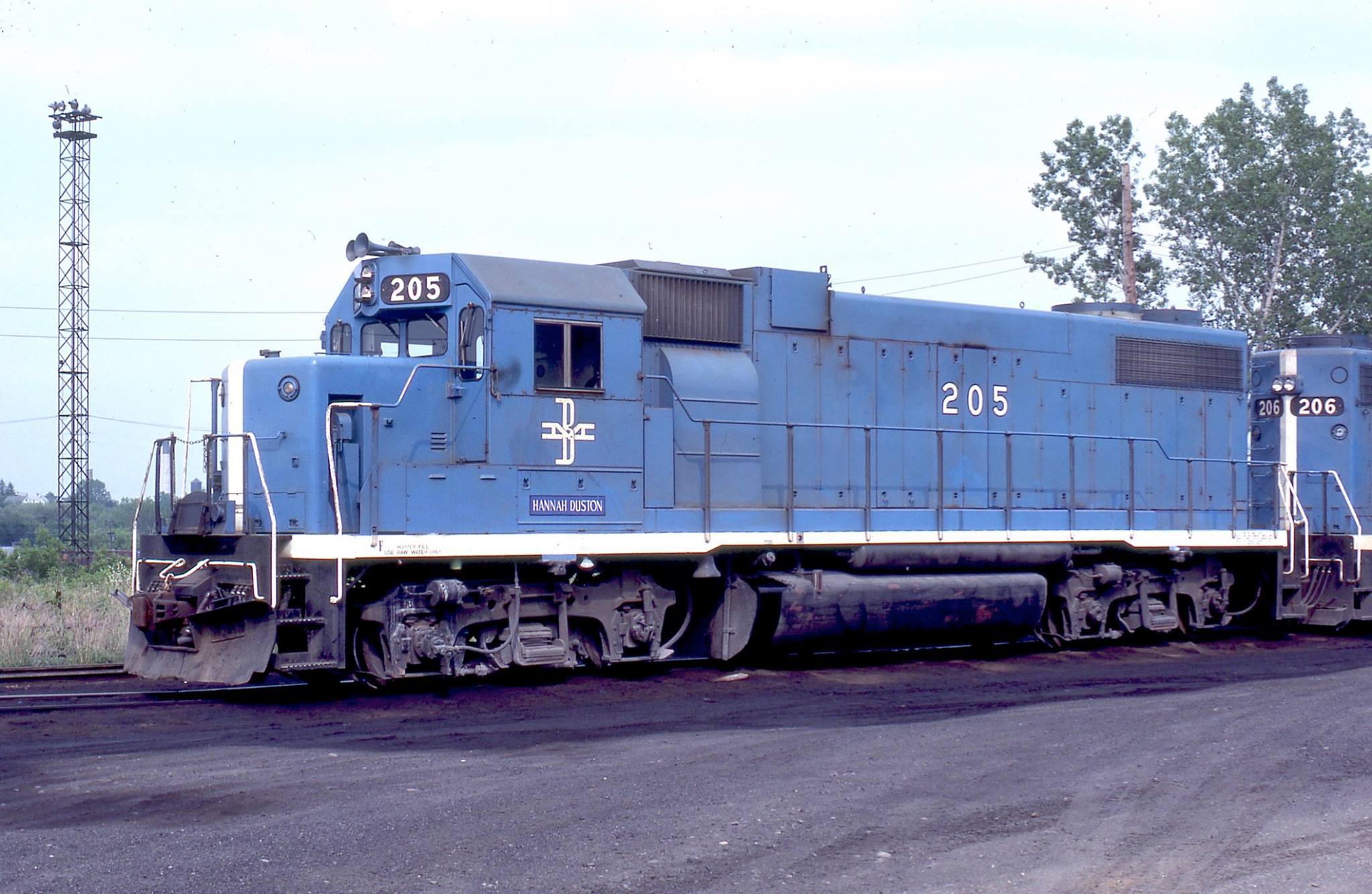
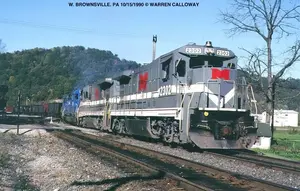
Relatively new Boston & Maine GP38-2s at Mechanicville, New York, during the 1970s. Warren Calloway photo.
On this page: At a glance · Andover to Portland · The Eastern · Boston & Lowell · New Hampshire · Fitchburg and Hoosac · Worcester, Nashua & Portland · Peak plant · Passenger trains · Steam and diesel · McGinnis · 1970, Dustin, Conrail · Guilford, Pan Am, CSX · What remains
At a glance
Boston & Maine Railroad logo. Author’s work.
| Item | Detail |
|---|---|
| Headquarters | Boston, Massachusetts |
| Charters | Andover & Wilmington, Massachusetts, March 15, 1833. Boston & Maine, New Hampshire, June 27, 1835 |
| First trains | Andover, August 8, 1836. Exeter, New Hampshire, June 26, 1840 |
| Dates of operation | 1836 through Guilford title June 30, 1983 |
| States served | Massachusetts, New Hampshire, Maine, Vermont, New York; leased lines into Quebec |
| Route-miles | Peak plant over 2,300 (Boston & Maine Railroad Historical Society). 2,084 (1930). About 1,700 (1950) |
| Principal lines | Boston–Dover–Portland; Boston–Portsmouth–Portland (Eastern); Boston–White River Junction; Boston–Troy / Rotterdam Junction (Fitchburg); Springfield–Berlin, N.H.; Worcester–Portland (WN&P); Dover–Intervale |
| Yards / shops | Boston, East Deerfield, Rigby (South Portland), Mechanicville. Shops at North Billerica, Massachusetts, and Concord, New Hampshire |
| Gauge | 4 feet 8½ inches |
| Slogan / mark | Route Of The Minute Man / BM |
| Locomotives (1963) | 235. Freight cars 5,490. Passenger cars 155 |
| Section 77 | Bondholders’ petition March 12, 1970, U.S. District Court, District of Massachusetts |
| Guilford | Title June 30, 1983, $24.25 million. Pan Am Railways name, 2006 |
| CSX | Closed on Pan Am June 1, 2022. Genesee & Wyoming Berkshire & Eastern west of Ayer |
| Rosters | Steam (post-1900) · All-time diesel |
Peak mileage follows the Boston & Maine Railroad Historical Society. 1930 figure is the Official Guide-era plant. Guilford close is the June 30, 1983, title date (UPI). Information compiled September 16, 2026.
Andover to Portland
People in Andover wanted a railroad to the Boston & Lowell at Wilmington, less than eight miles. Massachusetts chartered the Andover & Wilmington on March 15, 1833. Trains reached Andover August 8, 1836. The name became Andover & Haverhill on April 18, 1837, then Boston & Portland on April 3, 1839, as the object stretched toward Maine. New Hampshire had already chartered a Boston & Maine on June 27, 1835, to carry the same idea from the Massachusetts line to the Maine line. Maine incorporated the Maine, New Hampshire & Massachusetts on March 30, 1836, to finish the job from Portland to Great Falls.
Rails reached East Kingston, New Hampshire, on January 1, 1840, and Exeter on June 26. Dover opened a temporary depot September 24, 1841. The Boston & Portland and the New Hampshire Boston & Maine united on November 5, 1841. The Maine company joined on June 3, 1844. The name that survived was Boston & Maine.
On February 23, 1843, the railroad opened Exeter to South Berwick, Maine, and met the Portland, Saco & Portsmouth, which already ran into Portland. For a time the B&M and its coastal rival, the Eastern, jointly leased the PS&P rather than race each other into the city. The B&M’s own Portland extension, South Berwick to Portland, opened February 15, 1873. Until then the inland road was a guest on someone else’s last miles.
South of Wilmington the B&M at first used the Boston & Lowell into Boston. That arrangement did not last. In 1845 it built its own line from Wilmington Junction into Haymarket Square and put a Greek Revival station on the square. Causeway Street’s Union Station—North Station—gathered the north-side roads under one roof in 1893. From then on Boston meant North Station if you were riding the B&M.
Whitefield is a diamond, not a slogan. The B&M Berlin line crossed the Maine Central Mountain Division at a crew-operated ball mast dated to 1875. One ball let the B&M over the Maine Central; two balls let the Maine Central over the B&M. That plant is the hardware behind the word highball.
The Eastern
Massachusetts chartered the Eastern Railroad on April 14, 1836. Construction started in August 1837. The Eastern hugged the Atlantic: Boston, Lynn, Salem, Newburyport, Portsmouth, and on toward Portland, reaching the New Hampshire line on November 9, 1840. The B&M ran inland through Lawrence, Haverhill, and Dover. Two roads, two Portland routes, the same destination. The Eastern had its own Boston terminal. The inland road, until 1845, did not.
They fought for decades and still shared the PS&P into Portland. The B&M leased the Eastern on December 23, 1883, and bought it outright in the spring of 1890. After that the inland line was the Inside Gateway and the Eastern was the coastal main. Both still exist in pieces. MBTA’s Haverhill Line uses the old B&M; the Newburyport/Rockport Line uses the Eastern.
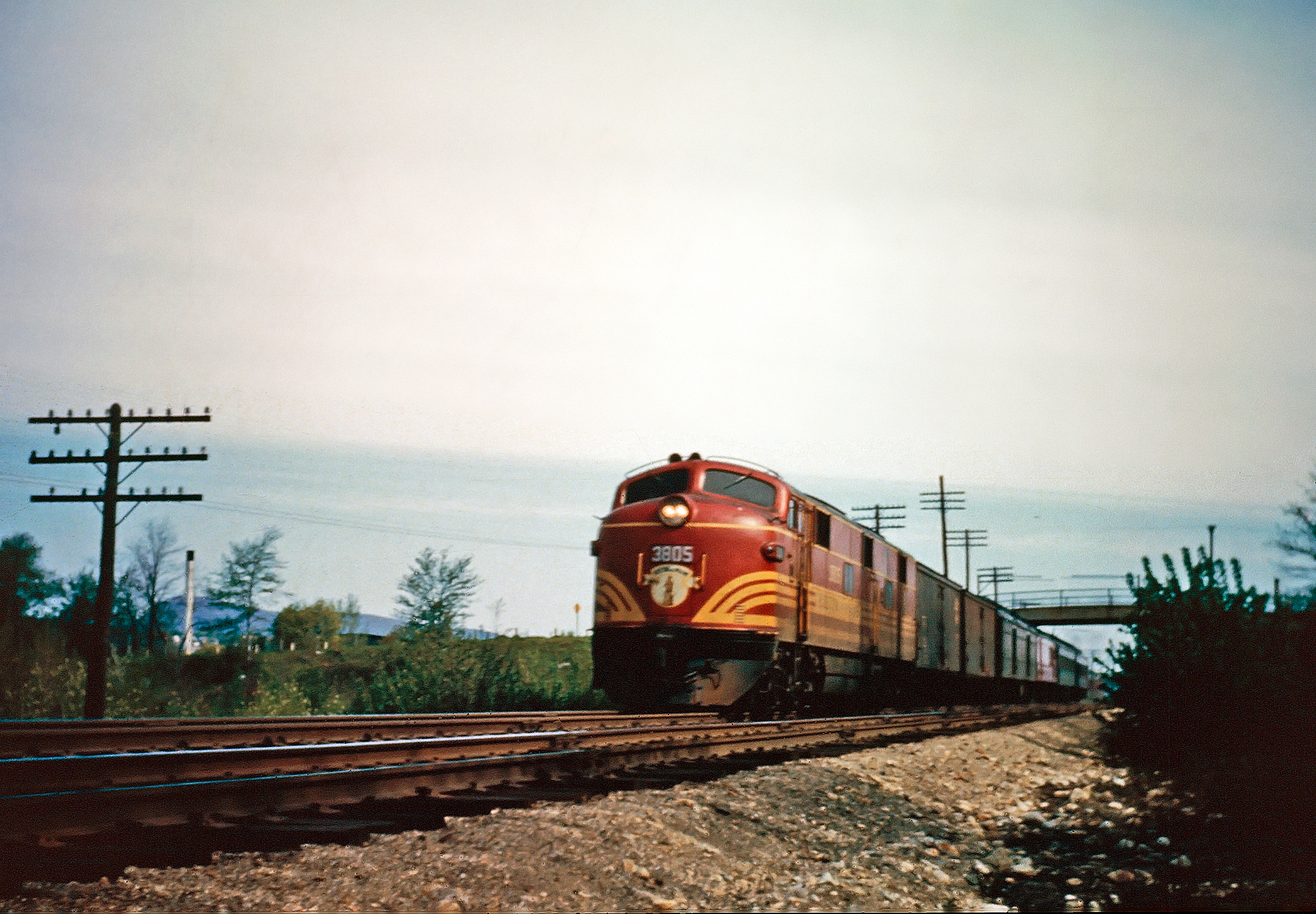
Boston & Maine E7A #3805 leads a Greenfield-Springfield train southbound through Chicopee, Massachusetts on May 20, 1956. Photographer unknown. American-Rails.com collection.
Boston & Lowell
The Boston & Lowell is older than the B&M. Massachusetts chartered it June 5, 1830, with a thirty-year monopoly between Boston and the mills at Lowell. The 26-mile road opened in 1835, the same year Worcester opened on the Boston & Worcester. From Lowell it reached Nashua and Keene, and it gathered branches to Salem, Concord, and Ayer. For years it was the B&M’s landlord into Boston and then its rival.
The New Hampshire Supreme Court refused, early in 1887, to ratify a Boston & Lowell lease of the Northern Railroad. That broke the Lowell’s Montreal ambition and left it strained. The B&M leased the Boston & Lowell on April 1, 1887, guaranteed the dividends, and folded the property into what became the Southern Division. The original Boston–Lowell iron is still a railroad: MBTA’s Lowell Line, with freight rights on the same corridor.
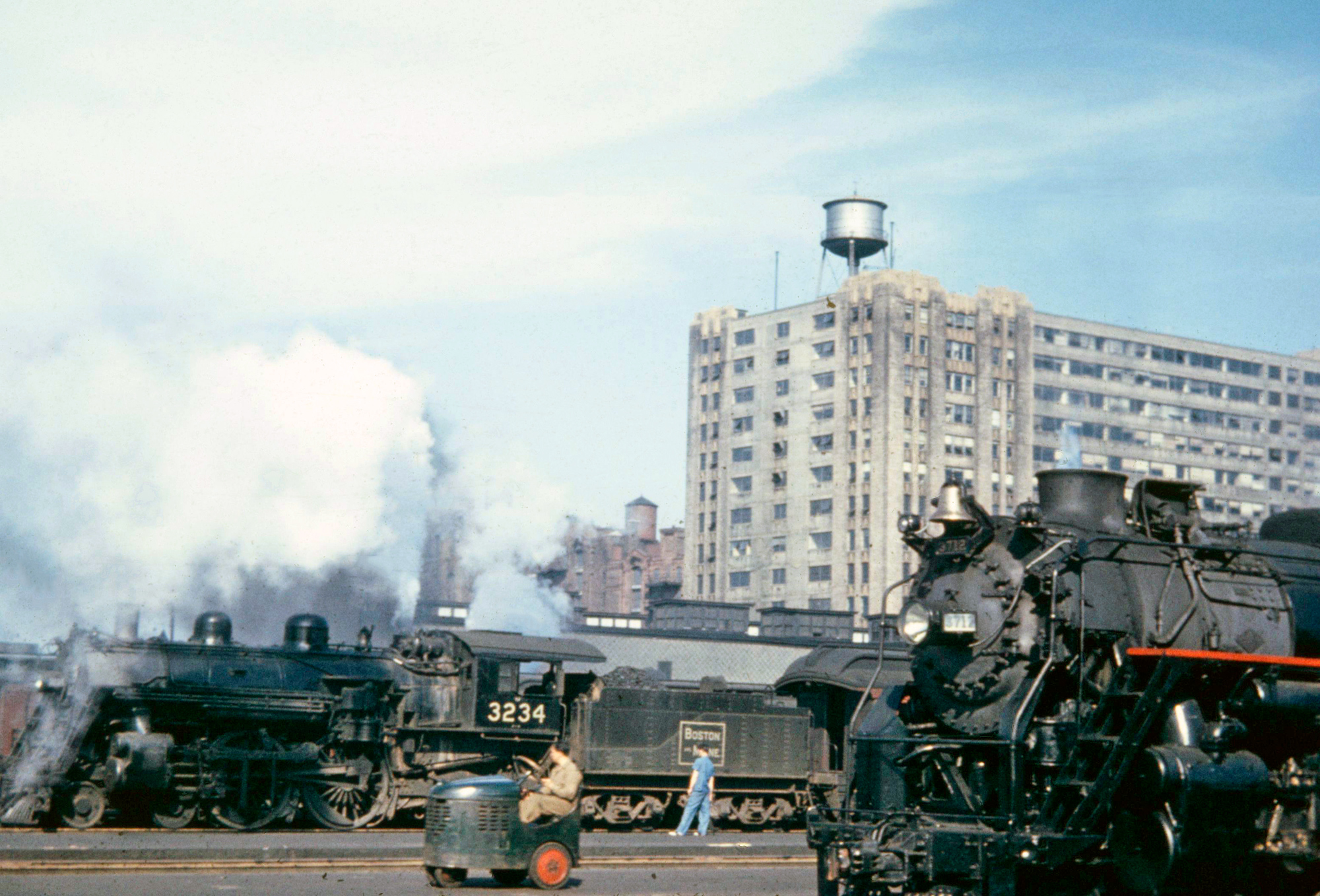
A busy scene at Boston’s North Station during the 1950s. In the foreground is Boston & Maine 4-6-2 #3712 (P-4); in the background, 4-4-2 #3234 (J-1e). Author’s collection.
New Hampshire: Concord, the Northern, Concord & Montreal
New Hampshire was not a branch. It was half the map. The Boston, Concord & Montreal, incorporated 1844, opened Concord to Tilton on May 22, 1848, Plymouth on June 21, 1850 via Laconia and Meredith, and Wells River, Vermont, on May 10, 1853. The B&M first took the BC&M in 1887, then lost it. The Concord & Montreal, a July 24, 1889, consolidation of the BC&M and the Concord Railroad, lasted only a few independent years. The B&M leased it on April 1, 1895. That lease put Concord, Manchester, Nashua, Bellows Falls, and Wells River on one payroll.
The Northern Railroad was a Concord–White River Junction company, chartered by New Hampshire in 1844 to reach some point on the Connecticut River. Franklin opened December 28, 1846; Lebanon, November 17, 1847; then the river bridge into White River Junction, about seventy miles in all. A single branch, the Franklin & Bristol, ran Franklin to Bristol from 1849. The Boston & Lowell had taken the Northern in 1884. On July 24, 1889, the New Hampshire General Court allowed the B&M to lease it. Bruce Heald, in A History of the Boston & Maine Railroad, is the construction authority for that date. Last passenger train, January 3, 1965. Guilford abandoned Boscawen–Lebanon, 59 miles, in 1991.
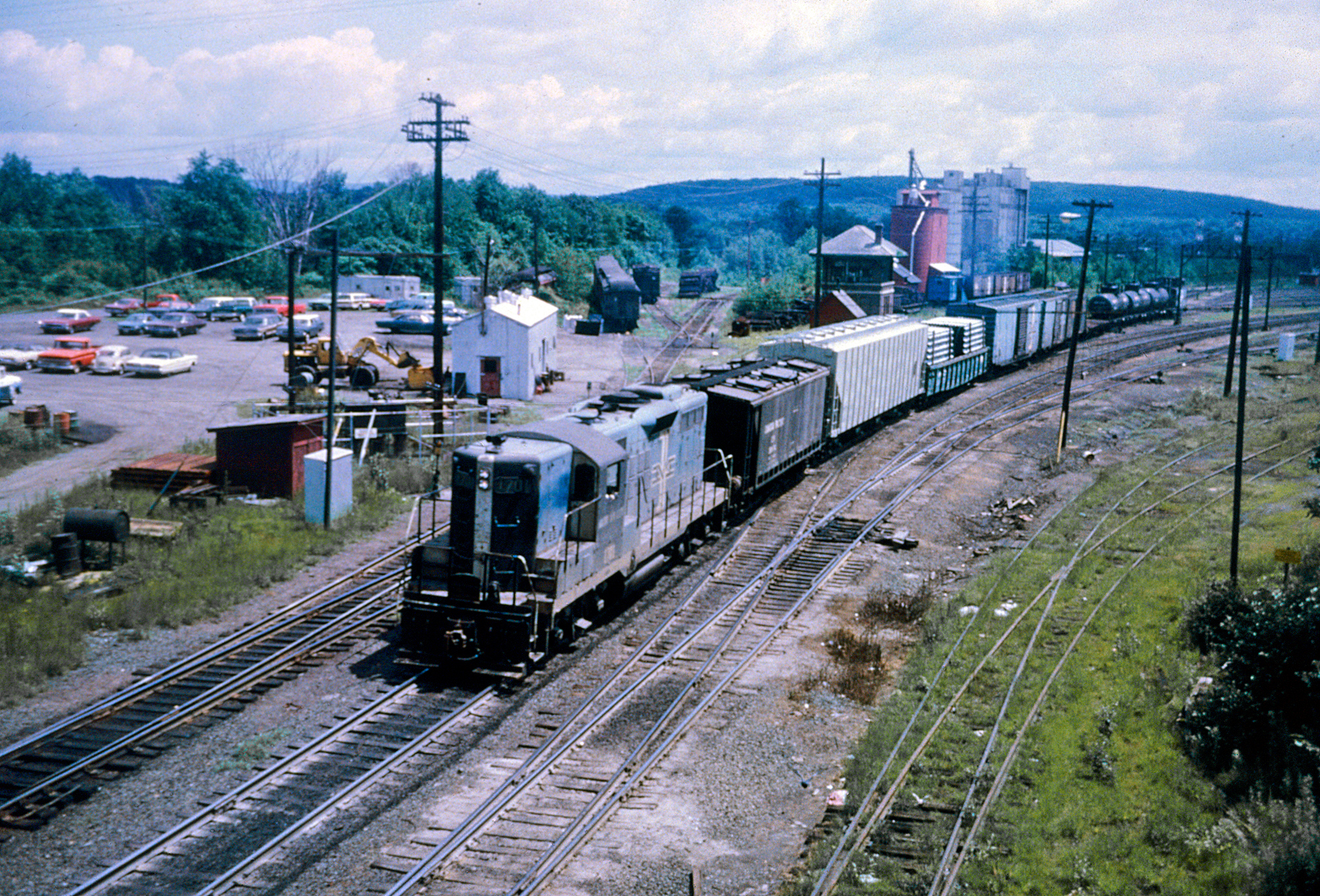
Boston & Maine GP9 #1701 leads a short train west out of the yard at East Deerfield, Massachusetts, on July 28, 1972. The interlocking tower and the McClelland Farm Road overpass at the west end of the yard made this a famous B&M photograph. American-Rails.com collection.
Fitchburg, Hoosac, and the west door
The Fitchburg was the piece that made the B&M a bridge road instead of a Boston commuter machine with Maine attached. Chartered March 3, 1842, it opened Boston to Fitchburg on March 5, 1845. West of Fitchburg the Vermont & Massachusetts and the Troy & Greenfield carried the idea over the Hoosac Range. The state of Massachusetts finished the tunnel after private money and Herman Haupt’s contract both failed. First train through the bore, February 9, 1875. Regular passenger service Boston–Troy, 1876. At 4.75 miles it was the longest railroad tunnel in the country when it opened. The tunnel has its own page.
The Fitchburg gathered the Troy & Greenfield, the Troy & Boston, and the Boston, Hoosac Tunnel & Western, reaching Mechanicville, Rotterdam Junction, and a D&H/Erie interchange that paid the freight bills. The B&M leased the Fitchburg for 99 years from July 1, 1900—the same morning the New York Central took the Boston & Albany. New York had to choose. It took the B&A. The B&M took the tunnel. After the lease the property was the Fitchburg Division. Mike Schafer, in Classic American Railroads, notes more than a dozen scheduled freights a day on that route after World War II. East Deerfield remains the hump. Mechanicville remains the west end of the old B&M in eastern New York, at the Hudson and the D&H.
Steam in the tunnel was a choking assignment. The B&M electrified Hoosac in 1911 under the same Charles S. Mellen who then sat on both the New Haven and the B&M. Diesels later replaced the motors. Single track returned in 1957 for clearance. Last regular passenger train through the bore, November 28, 1958.
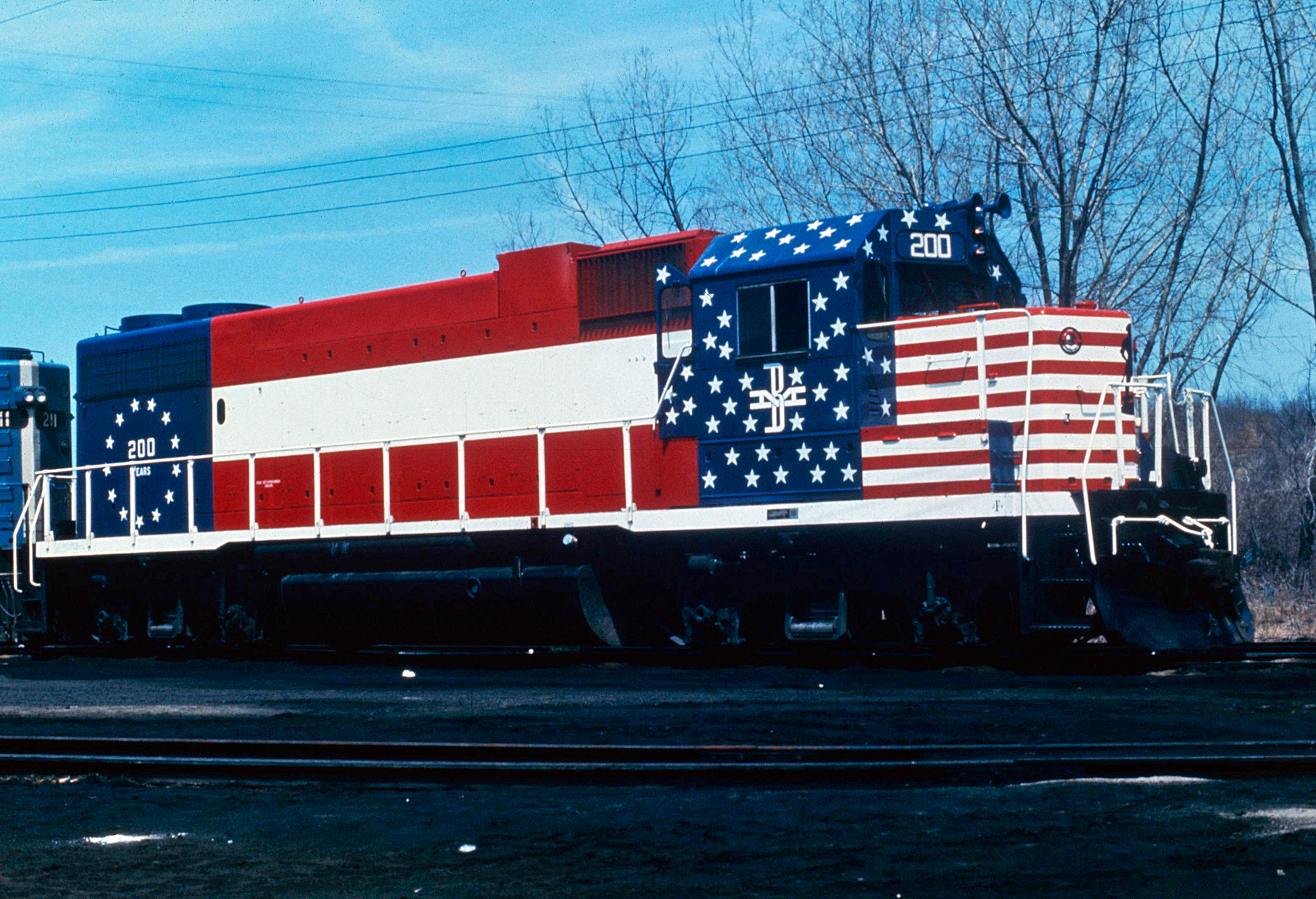
Boston & Maine GP38-2 #200 in Bicentennial livery at Mechanicville, New York, on April 17, 1975. G. Berisso photo. American-Rails.com collection.
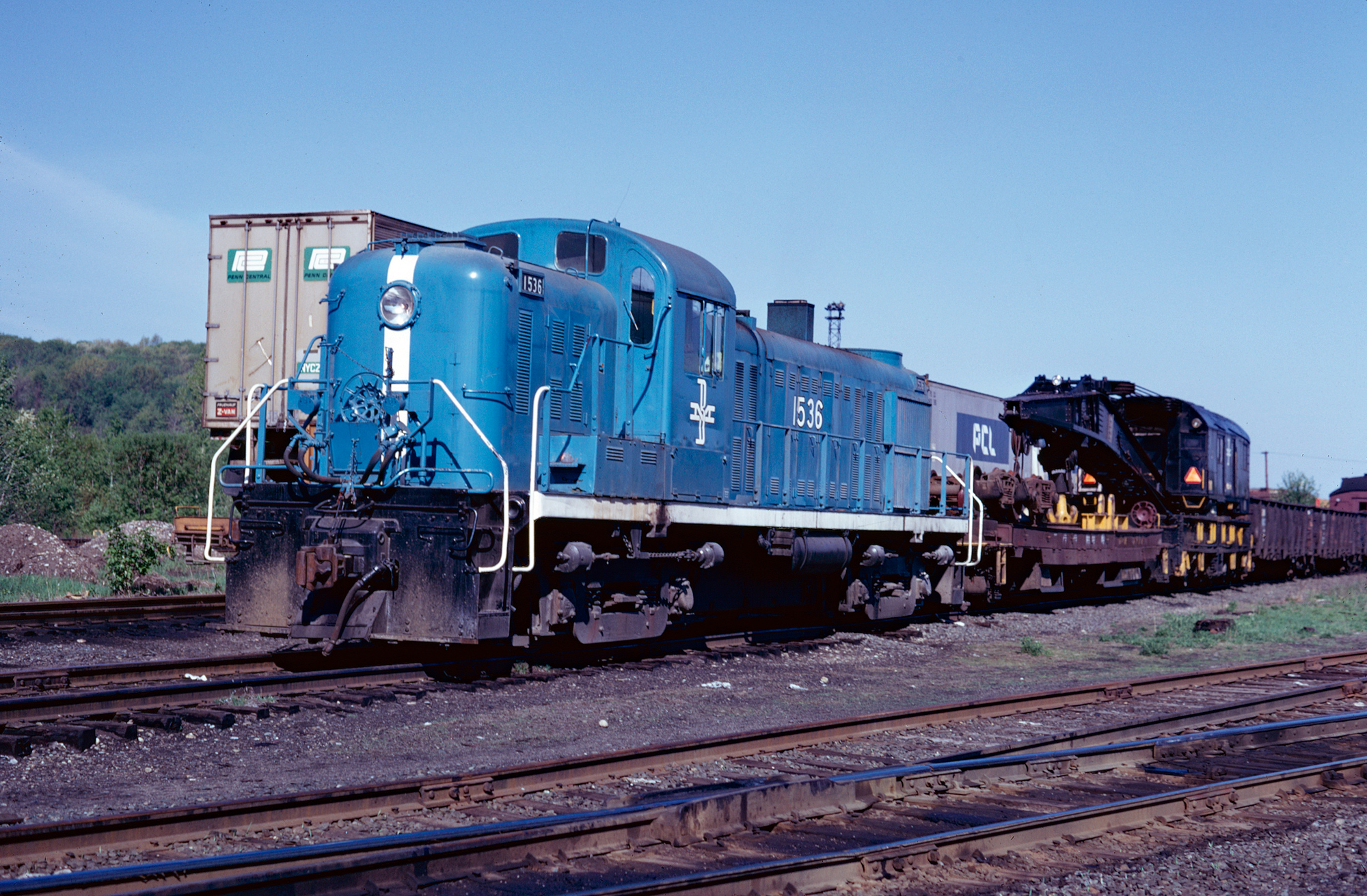
Boston & Maine RS3 #1536 has a work train in the yard at Mechanicville, New York, on May 17, 1975. Ray Sabo photo. American-Rails.com collection.
Worcester, Nashua & Portland
A third Portland route came through Worcester. The Worcester & Nashua, formed 1845, opened Worcester to Nashua by late 1848. The Nashua & Rochester, 1847, connected its namesake cities and was leased by the W&N in 1874. Those two, with the Portland & Rochester, became the Worcester, Nashua & Rochester in 1883. The B&M took control in 1886 and called it the Worcester, Nashua & Portland Division, 146.9 miles. For a generation the railroad had three routes between Massachusetts and Portland, enough traffic to keep all three. After World War I the extras started to come out. The Depression made the WN&P look redundant. New Hampshire segments went in 1932. By the 1950s two large pieces remained, west of Portland and Worcester–Hollis. By the 1980s most of the old WN&P was gone.
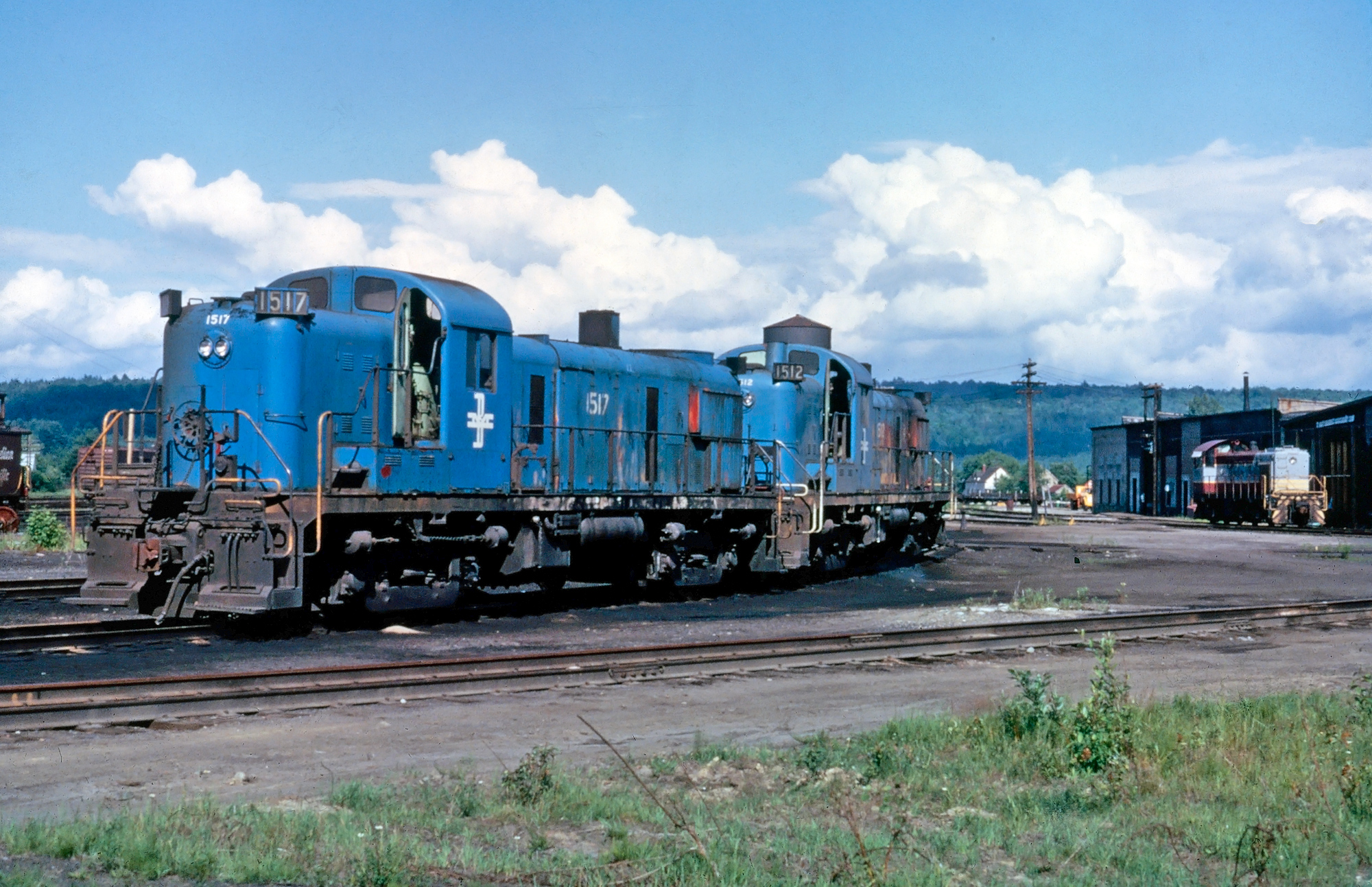
Boston & Maine RS3s #1517 and #1512 layover at the engine terminal in Brownville Junction, Maine, on July 6, 1970. A Canadian Pacific Alco switcher sits in the background. American-Rails.com collection.
Peak plant
Until the late nineteenth century the B&M was still a small road. Schafer puts the independent network around 200 miles before the post–Civil War mill boom. Then the leases arrived in a rush: Eastern, Boston & Lowell, Northern, Concord & Montreal, Fitchburg. The Boston & Maine Railroad Historical Society puts the peak plant at more than 2,300 route-miles, about 1,200 steam locomotives, and a workforce on the order of 28,000. The 1930 figure commonly cited is 2,084 miles. J. P. Morgan and the New Haven took control around 1910. Antitrust pulled that apart. Lease debt, Eastern funded debt, and the Fitchburg obligation put the company into receivership in August 1916. James H. Hustis sat as receiver. The 1919 reorganization folded the principal leased roads into one Boston & Maine and reset the paper. Edward S. French, president from 1930 to 1952, ran the railroad through the Depression and the war.
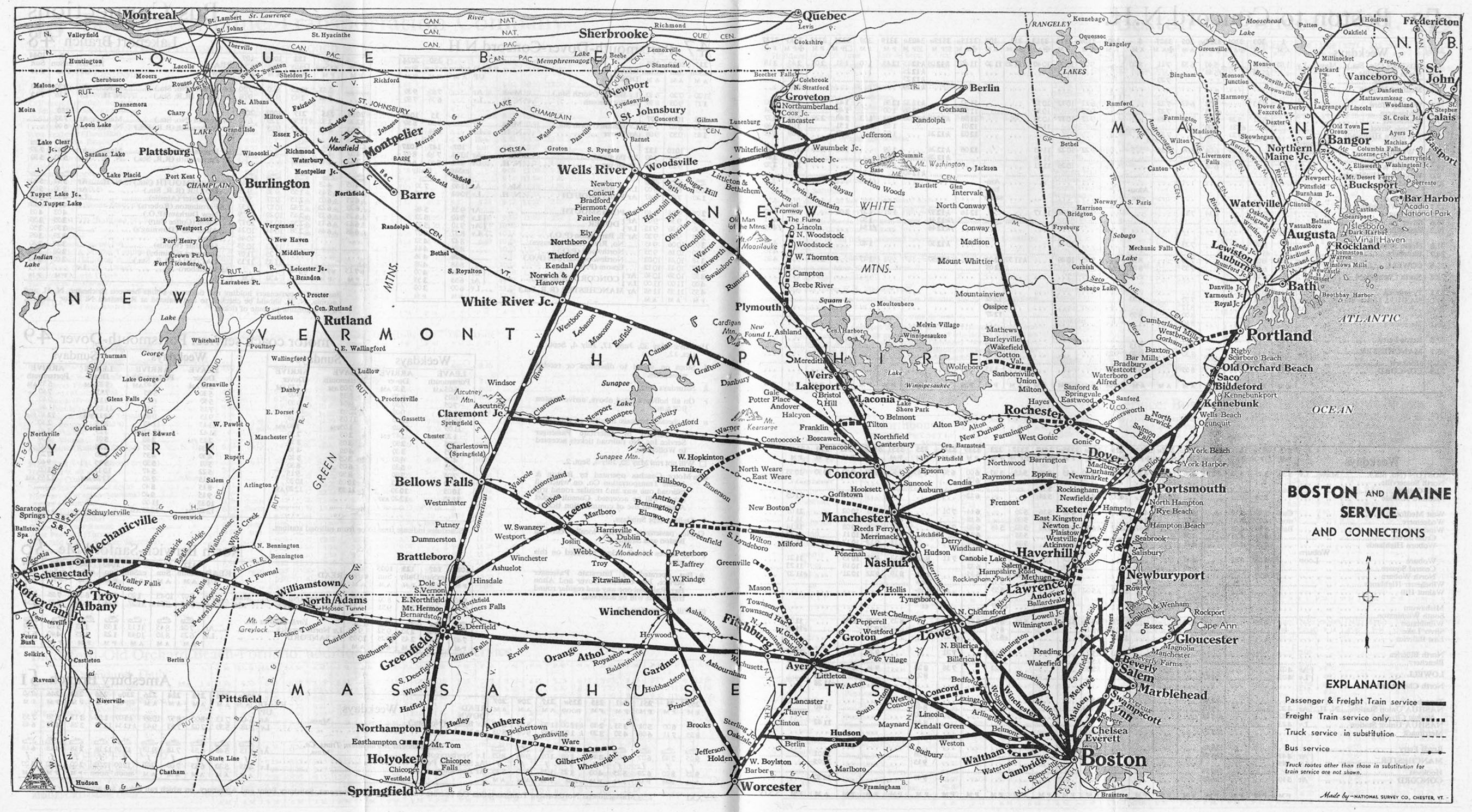
An official 1946 system map of the Boston & Maine. Author’s collection.
Major yards sat at Boston, East Deerfield on the Fitchburg, Rigby in South Portland, and Mechanicville. The central locomotive shop opened at North Billerica, Massachusetts, in 1913, five miles south of Lowell. Concord, New Hampshire, kept shops of its own. Freight was New England freight: textiles, shoes, paper, furniture, coal inbound, milk in cans, less-than-carload merchandise. Distances were short. Trucks were always close. The Fitchburg to the D&H and Erie at Mechanicville was the long-haul door that mattered.
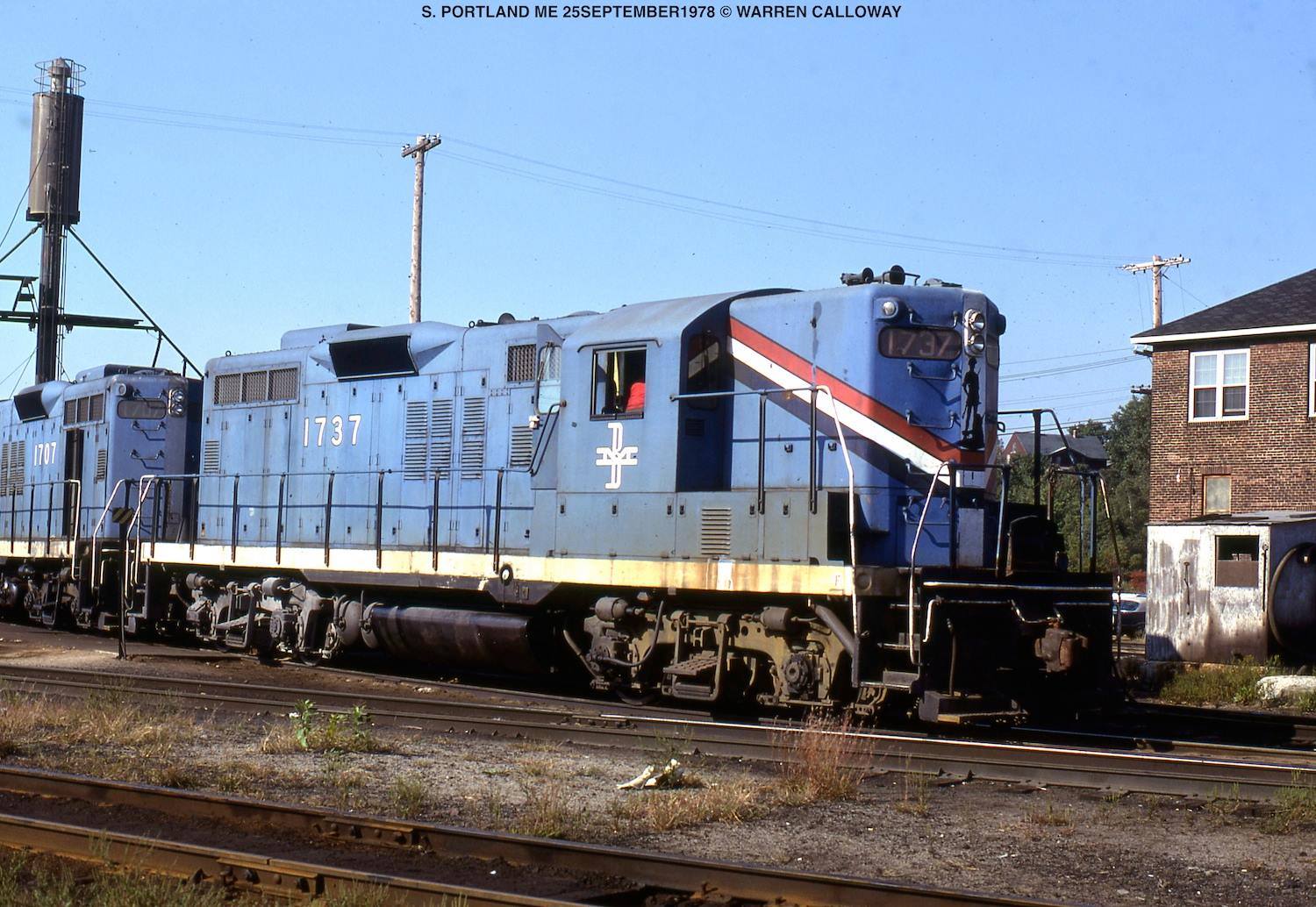
A pair of Boston & Maine GP9s at South Portland, Maine, on September 25, 1978. Warren Calloway photo.

Boston & Maine GP38-2 #200 (renumbered from 212) in Bicentennial livery at Rigby Yard, South Portland, Maine, on March 23, 1975, soon after the unit arrived. Ronald Johnson photo.
Passenger trains
North Station was a commuter factory. Long-distance trains were fewer, and most of them were partnerships. The Minute Man was the Boston–Troy name train, Fitchburg Division, the slogan made rolling stock. Montreal was a three-road problem. The Alouette and the Ambassador / New Englander used B&M and Canadian Pacific or Central Vermont iron. The Montrealer / Washingtonian was a five-railroad overnight: Pennsylvania, New Haven, B&M Springfield–White River Junction, Central Vermont, Canadian National. Last conventional Montrealer / Washingtonian, September 3–4, 1966.
Maine was a B&M–Maine Central joint. The Flying Yankee, Budd’s 1935 shovel-nose, was a near-sister of Burlington Zephyr 9900, Boston–Bangor with the Maine Central. The Pine Tree and the Kennebec covered Boston–Portland–Bangor. The Gull went farthest: Boston to Halifax, Nova Scotia, B&M, Maine Central, Canadian National, and Canadian Pacific, last run 1960. Seasonal trains filled the summer: the East Wind, Washington–Bangor; the Bar Harbor Express, Washington–Ellsworth; the State of Maine, New York–Portland. The Green Mountain Flyer reached Montreal via the Rutland, with a Boston section the B&M handed off at Bellows Falls. Other names stayed closer to home: the Cheshire to White River Junction, the Mountaineer to Littleton and Bethlehem, the Day White Mountains New York–Berlin.
Amtrak took what was left of the intercity map on May 1, 1971. The commuter railroad remained. The Massachusetts Bay Transportation Authority, created August 3, 1964, signed a subsidy with the B&M on December 14, 1964. On December 27, 1976, the MBTA bought the north-side commuter equipment, the maintenance plant, and about 250 miles of right-of-way. The B&M kept freight rights and kept running the trains. On March 12, 1977, it also took the south-side contract over former New Haven and Boston & Albany lines out of South Station—the first time one operator had both sides of Boston. Guilford inherited that contract. It did not last the decade.
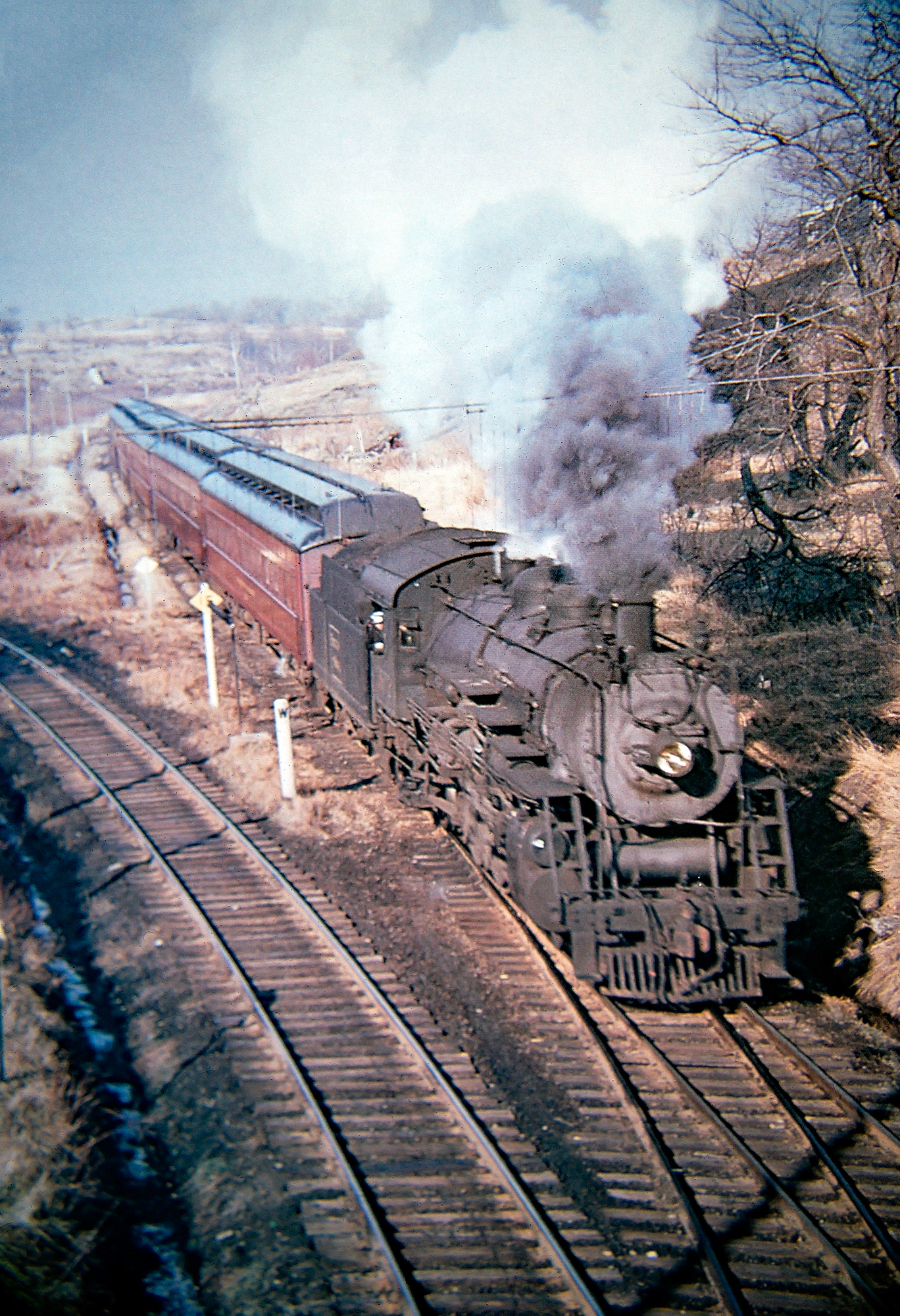
Boston & Maine 4-6-2 #3692 arrives in Marblehead, Massachusetts, with an outbound Boston–Marblehead commuter run on February 2, 1956. American-Rails.com collection.

Boston & Maine F2A #4225 at Springfield, Massachusetts, on December 10, 1962. Rick Burn photo.
Steam and diesel
The post-1900 steam fleet was New England power: Moguls and Consolidations on the branches, Pacifics on the named trains and the commuter peaks, a handful of Lima 2-8-4s and Baldwin 4-8-2s for the Fitchburg. The P-4 Lima Pacifics, 3710–3719, carried names. 3713, The Constitution, is the one that survives. Last steam in commuter service, July 23, 1956. The class-by-class record is the steam roster.
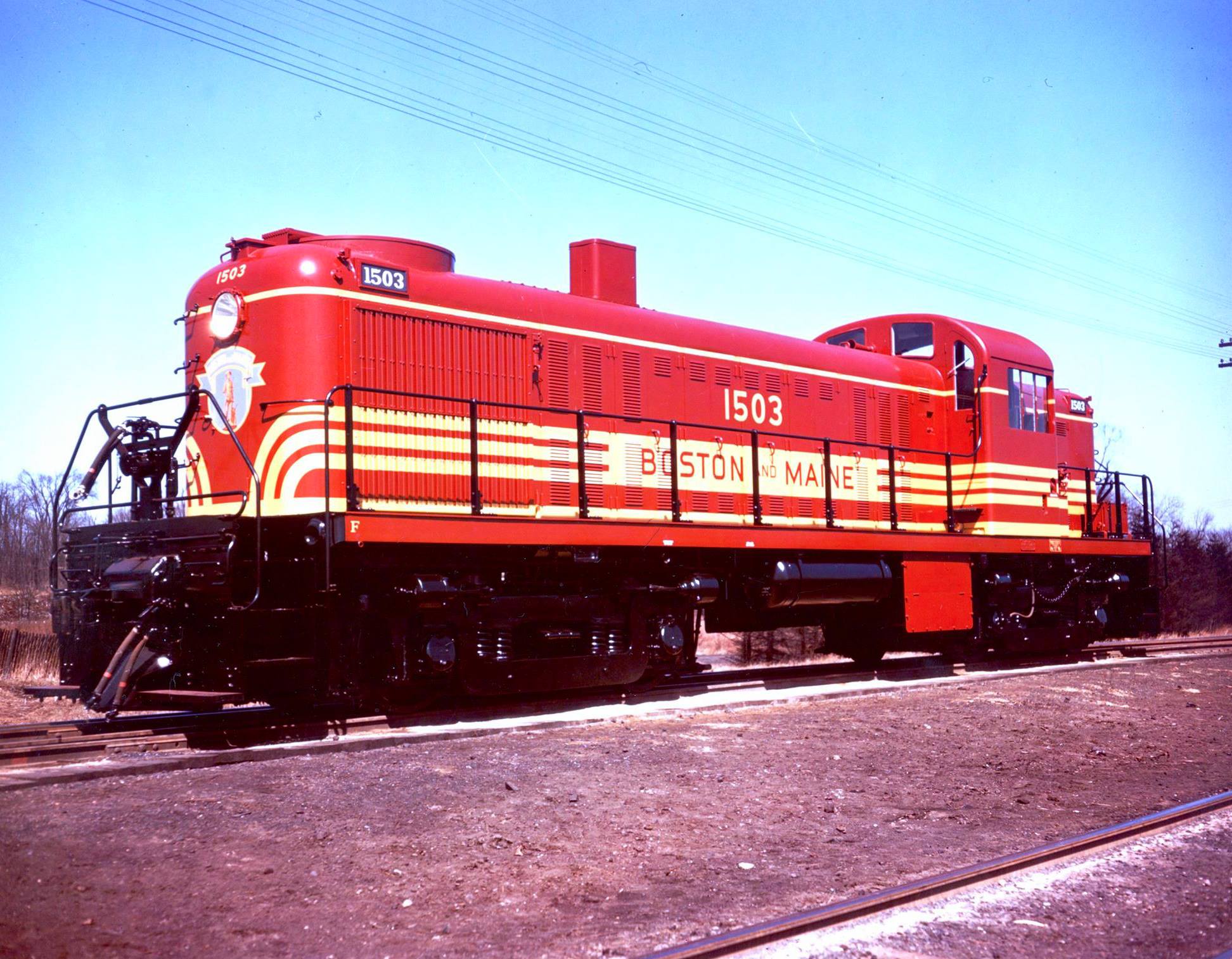
An American Locomotive builder’s photograph of new Boston & Maine RS2 #1503, circa 1949. Warren Calloway collection.
Dieselization started early. A GE/Ingersoll-Rand boxcab, 1100, arrived in 1935, the same year EMC turned out Flying Yankee power car 6000. Alco HH switchers, EMC SCs, and EMD SW1s filled the yards. Wartime FTs, then F2s, F3s, F7s, and E7s, took the mains. Alco RS2s and RS3s and EMD GP7s and GP9s finished steam. Four BL2s, 1550–1553, were an EMD experiment that stuck around. Budd RDCs—the railroad called them Highliners—reached 109 cars, the largest such fleet in the country, and by 1958 covered nearly all remaining passenger work except the Montreal trains. Second-generation power was EMD: GP18s in 1961, then GP38-2s in 1973–74 and GP40-2s in 1977 under Dustin. Unit-by-unit is the diesel roster.

An Electro-Motive builder’s photograph of freshly outshopped Boston & Maine GP9 #1701 in early 1957.

During a visit to the Boston & Maine roundhouse and yard at West Lebanon, New Hampshire, in the 1960s, Marty Bernard caught F7A #4265 and GP7 #1576 laying over between assignments.

An A-B-B set of Boston & Maine F7s, led by #4266, with a piggyback freight (perhaps BJ-1) at Ayer, Massachusetts, circa 1970. Photographer unknown.
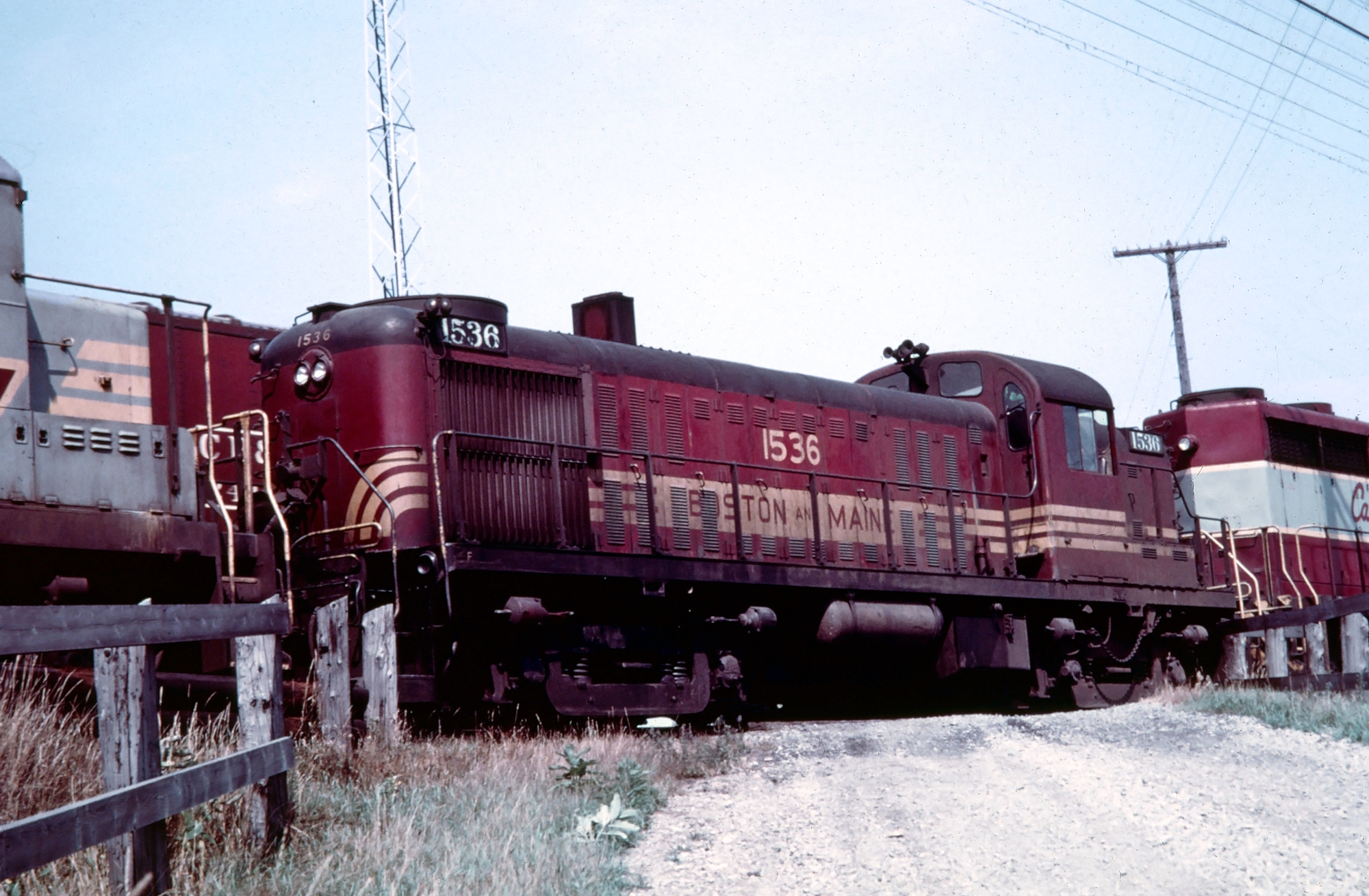
Boston & Maine RS3 #1536 at the east end of Canadian Pacific’s yard in Smiths Falls, Ontario, in the summer of 1966. American-Rails.com collection.
McGinnis
Patrick B. McGinnis left the New Haven presidency on January 20, 1956, and was Boston & Maine president about six hours later. He had already taken the board in a 1955 proxy fight that ended the French era and cancelled the last B&M–Maine Central corporate tie. Maroon and gold gave way to blue. FTs went back to La Grange as trade-in on GP9s. Streamlined passenger cars were sold. Maintenance was deferred. McGinnis and his successor, Daniel A. Benson, were convicted in 1966 of financial improprieties on the sale of those cars. Richard J. Mulhern followed. Deficits that began in 1958 did not stop. Stockholders declined an ICC-approved affiliation with Norfolk & Western, Erie Lackawanna, and the D&H—the Dereco grouping that later took the D&H without the B&M.
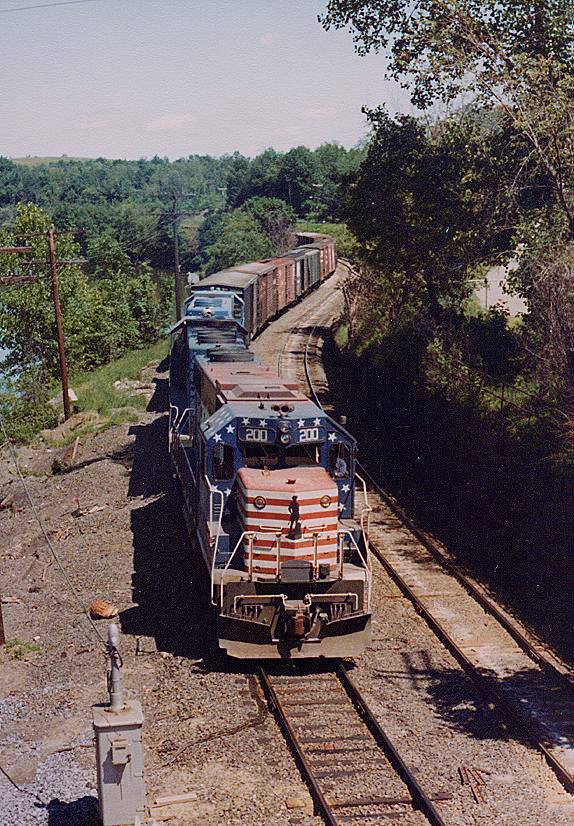
Boston & Maine GP38-2 #200, in the road’s Bicentennial livery, leads a westbound freight on the main line at Valley Falls, New York, on June 24, 1978. Doug Kroll photo.
March 12, 1970, Dustin, and staying out of Conrail
On March 12, 1970, certain bondholders filed a petition in the U.S. District Court for the District of Massachusetts to reorganize the Boston & Maine Corporation under Section 77 of the Bankruptcy Act. The court approved the petition and appointed trustees. The docket is 70-250-M. Trustees took operating control in May. Twelve years of unpaid taxes, unpaid bond interest, and thin capital spending sat on the table. John W. Barriger III, the “doctor of sick railroads,” became president January 1, 1971, and stayed through January 1973. Paul W. Cherington, from Harvard Business School, followed. F. C. “Buck” Dumaine’s Amoskeag bought enough defaulted first-mortgage bonds in 1973 to become the de facto owner under the court. Dumaine sent Alan G. “Dusty” Dustin. Dustin became president and CEO in August 1974.
The trustees declined inclusion in Conrail. When Conrail started on April 1, 1976, the B&M was still a separate company in Section 77. Dustin sold the commuter plant to the MBTA that December, kept freight rights, bought GP40-2s, rebuilt track and signals, and went after piggyback and coal. The railroad posted its first ordinary-income profit since 1957 in 1980. In 1982 it picked up former Conrail lines in Massachusetts and Connecticut. It was still in court. It was no longer a candidate for liquidation.
Guilford, Pan Am, CSX
Timothy Mellon had already bought the Maine Central, in June 1981, through Guilford Transportation Industries, named for Guilford, Connecticut. A federal judge in Boston approved the Boston & Maine sale on June 23, 1983. Mellon took title on June 30, 1983, for $24.25 million. Dustin stayed into 1984. Guilford painted locomotives dark gray with an orange stripe and a large G, and it sublettered Boston & Maine, Maine Central, and Springfield Terminal on the cabs. The D&H came from N&W’s Dereco on January 4, 1984, for $500,000. That story is the D&H page: bankruptcy June 20, 1988, Canadian Pacific in January 1991.
Guilford’s method was to lease B&M and Maine Central operations to Springfield Terminal, an MEC subsidiary with short-line work rules, and to abandon what it did not want. Hundreds of miles came out in the 1980s and 1990s, including Northern Railroad iron between Boscawen and Lebanon. Labor struck in 1986 and 1987. Track on the Connecticut River line deteriorated until Amtrak pulled the Montrealer. In 1998 Guilford bought the Pan American World Airways name. In 2006 it restyled the railroad Pan Am Railways. Blue paint replaced the G. Sublettering remained. With Norfolk Southern it formed Pan Am Southern in 2008, the Patriot Corridor from the Hudson to Ayer and Boston over the old Fitchburg.
CSX announced Pan Am in November 2020. The Surface Transportation Board approved the transaction on April 14, 2022. CSX closed on June 1, 2022. Genesee & Wyoming took the former Boston & Maine west of Ayer as the Berkshire & Eastern, operating the old Pan Am Southern for NS. Guilford is a date on the 1980s page. The 2022 closing is the 2020s.
What remains
CSX runs the old B&M freight mains east of Ayer: Boston to Portland, the Lowell and New Hampshire fragments that still carry cars, Springfield toward White River Junction. West of Ayer the Fitchburg is Berkshire & Eastern / Norfolk Southern through the Hoosac Tunnel to Mechanicville and Rotterdam Junction. MBTA owns the north-side commuter lines out of North Station—Fitchburg, Lowell, Haverhill, Newburyport/Rockport—and a contractor runs the trains. Amtrak’s Downeaster uses the Portland route. Conway Scenic has run from the old B&M depot in North Conway since 1974. Hobo Railroad sits on a piece of the Pemigewasset. The Whitefield mast is still there. The corporate name Boston & Maine Corporation still exists on paper under CSX, the way so many fallen flags do. The railroad a passenger meant by “the B&M” ended the morning Mellon took the keys.
Related reading on American-Rails.com
- B&M steam roster · B&M diesel roster · Flying Yankee · Hoosac Tunnel
- Alouette · Ambassador / New Englander · Montrealer / Washingtonian · The Gull
- Pine Tree · Kennebec · East Wind · Bar Harbor Express · State of Maine · Green Mountain Flyer
- Maine Central · Boston & Albany · New Haven · Delaware & Hudson
- Central Vermont · Rutland · Bangor & Aroostook · Pan Am Railways
- Conrail · CSX · Highball · Commuter rail
- Fallen flags · Railroads in the 1820s/1830s · Railroads in the 1970s · Railroads in the 1980s · Railroads in the 2020s
Sources
- Boston & Maine Railroad Historical Society. Company history: Andover & Wilmington origin; peak plant over 2,300 route-miles, ~1,200 steam locomotives, workforce ~28,000; New Haven/Morgan control circa 1910; 1919 reorganization; McGinnis 1955; Dustin 1974–84; MBTA commuter sale 1976; first ordinary-income profit since 1957 in 1980
- ICC valuation, Boston & Maine Railroad (WikiProject Trains transcription). Andover & Wilmington March 15, 1833; New Hampshire charter June 27, 1835; Maine, New Hampshire & Massachusetts March 30, 1836; Boston & Portland union November 5, 1841; Maine company union June 3, 1844. Fitchburg 99-year lease from July 1, 1900
- Heald, Bruce D. A History of the Boston & Maine Railroad: Exploring New Hampshire’s Rugged Heart by Rail. Charleston, S.C.: History Press, 2007. Northern Railroad lease July 24, 1889; New Hampshire construction
- Schafer, Mike. Classic American Railroads. Osceola, Wis.: MBI. Independent B&M around 200 miles until late-nineteenth-century expansion; Fitchburg Division traffic after World War II
- Kirkland, Edward Chase. Men, Cities and Transportation: A Study in New England History, 1820–1900. Cambridge: Harvard University Press, 1948. New England charter and lease context
- In re Boston and Maine Corporation, U.S. District Court, District of Massachusetts, No. 70-250-M. Bondholders’ Section 77 petition March 12, 1970; trustees appointed; 120-day findings under the Regional Rail Reorganization Act
- UPI, June 23, 1983. Federal judge approved sale to Guilford Industries; Mellon to take title June 30; $24.25 million
- “Remembering the Boston & Maine Railroad.” Classic Trains, October 2019. McGinnis January 20, 1956; last commuter steam July 23, 1956; RDC fleet; Barriger January 1, 1971; Dustin August 1974; Guilford June 30, 1983
- Boston & Maine Railroad Historical Society, roster of officers (Rick Nowell compilation). Hustis, French, McGinnis, Benson, Mulhern, Barriger, Cherington, Dustin; Guilford acquisition June–July 1983
- CSX / Surface Transportation Board: Pan Am announced November 2020; STB April 14, 2022; closed June 1, 2022. Genesee & Wyoming Berkshire & Eastern west of Ayer
- Live American-Rails Hoosac, Flying Yankee, named-train, steam-roster, diesel-roster, Maine Central, Boston & Albany, New Haven, D&H, Conrail, decade, and Pan Am pages as linked above
Recent Articles


-
Western Maryland Railway: Map, Rosters, Logo, History
Sep 25, 26 10:24 AM
 Western Maryland Railway—the Fast Freight Line. Baltimore, Carroll & Frederick, May 27, 1852. Connellsville Extension 1912. Chessie, then into the B&O May 1, 1983.
 -
Illinois Dinner Train Rides (2026): A Complete Guide
Sep 25, 26 09:52 AM
 2026 Monticello Railway Museum Murder Mystery Dinner Train—June 13, July 11, August 1, and September 5 have run. Three courses, about 2 hours, $112. Confirm on mrym.org.
 -
Georgia Dinner Train Rides (2026): A Complete Guide
Sep 25, 26 12:29 AM
 2026 Azalea Sprinter dinner train from Nashville and Willacoochee, Georgia—2½ hours. Club Car adult $147, Executive adult $177. Confirm on azaleasprinter.com.
 -
Baldwin "Centipede" Locomotives: Specs, Roster, Photos
Sep 25, 26 12:02 AM
 Baldwin DR-12-8-1500/2 Centipede—2-D+D-2, two 608SC engines, 3,000 hp. SAL 4500 from the 1943 test bed. 54 on the serial list, 52 sold. PRR BP60 then BH50. None preserved.
 -
Florida Dinner Train Rides (2026): A Complete Guide
Sep 24, 26 11:56 PM
 2026 Seminole Gulf Murder Mystery Dinner Train in Fort Myers—five courses cooked onboard, 3½ hours, $129 or $135 Saturday, plus tax and gratuity. Confirm on semgulf.com.
 -
West Virginia Northern Railroad: Map, Photos, History
Sep 24, 26 11:27 PM
 West Virginia Northern—Kingwood to Tunnelton, 11 miles of Preston County coal. Narrow gauge 1888, standard gauge 1895. Last freight February 19, 1991. Consolidations 8 and 9 survive.
 -
Rutland Railroad: Map, Rosters, History, Logo
Sep 24, 26 01:18 PM
 Rutland Railroad—Follett’s Champlain & Connecticut River, November 1, 1843. Bellows Falls–Burlington December 18, 1849. Green Mountain Gateway. Last train September 25, 1961. Vermont Railway Janua…
 -
Arkansas Dinner Train Rides (2026): A Complete Guide
Sep 24, 26 01:12 PM
 2026 Eureka Springs & North Arkansas Dinner Train—Eurekan dining car, about 2 hours, $53.62 tax included, opens May 9, Tuesday, Wednesday, Friday, and Saturday. Confirm on esnarailway.com.
 -
Arizona Dinner Train Rides (2026): A Complete Guide
Sep 24, 26 01:01 PM
 2026 Arizona has no plated dinner train. Grand Canyon Railway sells snacks in the cars and meals in Williams or at the rim. Verde Canyon includes a charcuterie tray.
 -
Rail News, The Latest
Sep 24, 26 12:36 PM
This page provides a portal to the latest in rail news, from preservation and restortation subjects to other notable topics. -
Cotton Belt 819 Moved Outside at Pine Bluff for Evaluation
Sep 24, 26 12:35 PM
 Cotton Belt 819 left the Pine Bluff shop on September 22, 2026, first time outside in about 30 years. RDG Steam Services is evaluating the engine. No donation link posted.
 -
Reading Steam Locomotives: History, Roster & Photos
Sep 24, 26 12:14 PM
 Reading steam—Wootten fireboxes, Camelback Consolidations, Mallets, K-1 Santa Fes, G-3 Pacifics, T-1 4-8-4s. Post-1900 roster after Drury. Rambles ended October 17, 1964.
 -
Reading Diesel Roster: All-Time
Sep 24, 26 12:10 PM
 Reading diesel roster—AGEIR boxcabs, FTs, FA-1s, RS-3s, Train Masters, GP30s through GP39-2s. Serials and order numbers. Conrail April 1, 1976.
 -
Reading Railroad: Map, Logo, History, Rosters
Sep 24, 26 12:08 PM
 Reading Company—Philadelphia & Reading, 1833. Anthracite, Port Richmond, Reading Terminal. Operating company January 1, 1924. Conrail April 1, 1976.
 -
Nevada Dinner Train Rides (2026): A Complete Guide
Sep 24, 26 12:02 PM
 2026 Nevada Northern Taste of Italy—adults-only gala from East Ely. The September 19 date has run. Confirm any later night on nnry.com.
 -
North Carolina Dinner Train Rides (2026): A Complete Guide
Sep 24, 26 11:24 AM
 2026 North Carolina dinner trains—NCTM Wine & Dine in Spencer sold out February 13–15. GSMR First Class is the plated meal on the Nantahala Gorge excursion. Confirm on the railroad.
 -
Railway Express Agency (REA): Signs, Trucks, Logo & History
Sep 24, 26 09:40 AM
 Railway Express Agency—railroad-owned express company. Incorporated December 7, 1928. Operations March 1, 1929. Red diamond, green trucks. Last regular express November 7, 1975.
 -
Michigan Dinner Train Rides (2026): A Complete Guide
Sep 24, 26 09:28 AM
 2026 Steam Railroading Institute dining in Owosso—select evenings, no public dinner dates posted. Confirm on michigansteamtrain.com.
 -
Pittsburgh and West Virginia Railway: Map, Rosters, History
Sep 24, 26 12:24 AM
 Pittsburgh & West Virginia—the Hi-Line. Wabash-Pittsburgh Terminal 1904. Railway January 29, 1917. Connellsville February 11, 1931. N&W lease October 16, 1964. Wheeling & Lake Erie from May 17, 1990.
 -
Indiana Dinner Train Rides (2026): A Complete Guide
Sep 24, 26 12:13 AM
2026 Spirit of Jasper Ride & Dine is paused. No public trains. Depot at 201 Mill Street stays open as a rental. Confirm on spiritofjaspertrain.com. -
New Jersey Dinner Train Rides (2026): A Complete Guide
Sep 24, 26 12:01 AM
2026 Woodstown Central Dining in Motion—private table of four from $190, about an hour, Salem County. Confirm on woodstowncentral.com. -
Maryland Dinner Train Rides (2026): A Complete Guide
Sep 23, 26 05:19 PM
 2026 Western Maryland Scenic Allegheny Mountain Dinner Train—Cumberland, 3 hours, 21+, Saturday 7 p.m. Confirm on wmsr.com.
 -
Pittsburgh and Lake Erie Railroad: Map, Rosters, Photos
Sep 23, 26 03:28 PM
 Pittsburgh & Lake Erie—the Little Giant. Chartered 1875, Pittsburgh to Youngstown February 10, 1879. New York Central from 1883. Independent May 15, 1979. Last day September 11, 1992.
 -
Kansas Dinner Train Rides (2026): A Complete Guide
Sep 23, 26 01:11 PM
 2026 Abilene & Smoky Valley Smoky Valley Limited—two hours from the Rock Island Depot, about $72–$110, dates into December 31. Confirm on asvrr.org.
 -
The Belpaire Firebox: Simplicity and Greater Power
Sep 23, 26 01:03 PM
 Belpaire firebox—Alfred Belpaire, 1864. Square crown, straight staybolts at right angles. Pennsylvania standard after the 1880s. Great Northern was the other big user.
 -
Pennsylvania Railroad (PRR) Electric Roster: All Classes
Sep 23, 26 12:57 PM
Pennsylvania Railroad electrics—DD1s into Penn Station, P5s, 139 GG1s, B1 switchers, and 66 E44s. Class roster, 1905–1963. No unit-by-unit GG1 list. -
Penn Central Diesel Roster: All-Time
Sep 23, 26 12:46 PM
 Penn Central diesel roster—PRR classes on NYC, PRR, and New Haven power. New orders carry serials. GP38-2s are 7940-8162. Conrail April 1, 1976.
 -
Penn Central Railroad: Map, History, Logo
Sep 23, 26 12:32 PM
 Penn Central—Pennsylvania and New York Central merged February 1, 1968. New Haven January 1, 1969. Section 77 bankruptcy June 21, 1970. Conrail April 1, 1976.
 -
Iowa Dinner Train Rides (2026): A Complete Guide
Sep 23, 26 11:42 AM
 2026 Boone & Scenic Valley Wolf Dinner Train—Saturdays May–October, Union Pacific dining cars, Bass Point Creek High Bridge. Confirm on bsvrr.com.
 -
Pennsylvania-Reading Seashore Lines: Map, Roster, History
Sep 23, 26 12:32 AM
 Pennsylvania-Reading Seashore Lines—Atlantic City Railroad renamed July 15, 1933. Pennsylvania two-thirds, Reading one-third. Camden to Atlantic City, Cape May, and Millville. Conrail April 1, 1976.
 -
Wisconsin Dinner Train Rides (2026): A Complete Guide
Sep 23, 26 12:28 AM
2026 Wisconsin Great Northern dinner train in Trego—$105, Namekagon River, January 8–31 and May 5–December 17. Mid-Continent’s remaining 2026 calendar is snack and scenic. Confirm on the railroad. -
New Hampshire Dinner Train Rides (2026): A Complete Guide
Sep 23, 26 12:21 AM
2026 Cafe Lafayette Dinner Train in North Woodstock—five courses, 2 hours, from $125. Children under 6 not allowed. Confirm on nhdinnertrain.com. -
PRR "GG-1" Locomotives: Roster, Photos, Specs
Sep 23, 26 12:13 AM
 PRR GG1 electric: 139 locomotives, 4800–4938, built 1934–1943. Specs, Loewy shell, Amtrak numbers, and the last revenue trip on October 28, 1983.
 -
Montana Dinner Train Rides (2026): A Complete Guide
Sep 23, 26 12:04 AM
2026 Charlie Russell Chew Choo from Hanover, near Lewistown—4.5 hours, prime rib, adult $151. Remaining listed dates sold out. Confirm on montanadinnertrain.com. -
Kentucky Dinner Train Rides (2026): A Complete Guide
Sep 22, 26 11:52 PM
2026 My Old Kentucky Dinner Train in Bardstown—four courses, 2.5 hours, adult $116. Confirm on kydinnertrain.com. -
Tennessee Dinner Train Rides (2026): A Complete Guide
Sep 22, 26 11:45 PM
2026 TVRM Chattanooga Dinner Train—Grand Junction, select Fri/Sat March 6–October 24, 6 p.m., from $110. Confirm on tvrail.com. -
The Trainphone: PRR's Wireless Radio System
Sep 22, 26 11:17 PM
 Pennsylvania Trainphone—Union Switch & Signal inductive telephone. Bel-Del trial 1941, Frenchtown November 29, 1943. Carriers at 88 kHz and 144 kHz. Out of service April 30, 1967.
 -
Pennsylvania (PRR) Steam Roster: Post 1906
Sep 22, 26 11:13 PM
 ennsylvania steam after 1906—H8, H9, and H10 Consolidations, 574 L1s Mikados, 598 I1s Decapods, 425 K4s Pacifics, 301 M1 Mountains. Drury’s grid. Last steam November 30, 1957.
 -
Pennsylvania Railroad (PRR) Diesel Roster: All-Time List
Sep 22, 26 10:59 PM
 Pennsylvania diesel roster—SW 3908 in June 1937, then Alco, Baldwin, EMD, Fairbanks-Morse, GE, and Lima. Serials and Alco order numbers. Penn Central February 1, 1968.
 -
Pennsylvania Railroad: Map, Logo, History, Rosters
Sep 22, 26 10:02 PM
 Pennsylvania Railroad—chartered April 13, 1846, Harrisburg–Pittsburgh, Horseshoe Curve 1854, Penn Station 1910. Standard Railroad of the World. Penn Central February 1, 1968.
 -
Pennsylvania Dinner Train Rides (2026): A Complete Guide
Sep 22, 26 04:48 PM
 2026 Pennsylvania dinner trains—Colebrookdale Dining Class in Boyertown and Strasburg Dinner on the Rails. Confirm on each railroad.
 -
New York, Ontario & Western Steam Locomotives: History & Roster
Sep 22, 26 04:40 PM
 NYO&W steam—camelback 2-8-0s and 2-6-0s, Class X Bull Moose 2-10-2s, Class Y and Y-2 Mountains. All-time class roster. Steam finished in the summer of 1948. None saved.
 -
New York, Ontario & Western Diesel Roster: All-Time
Sep 22, 26 04:36 PM
 NYO&W diesel—five GE 44-tonners 101-105, eighteen FTs, seven F3s, twenty-one NW2s. Serials and the NW2 order E824. Railroad liquidated March 29 1957.
 -
New York, Ontario & Western Railway: Map, Roster, History
Sep 22, 26 04:26 PM
 New York, Ontario & Western—New York & Oswego Midland chartered January 11 1866, O&W January 21 1880. Scranton coal, West Shore rights. Last train March 29 1957.
 -
Massachusetts Dinner Train Rides (2026): A Complete Guide
Sep 22, 26 04:16 PM
 2026 Cape Cod Dinner Train—Hyannis, Buzzards Bay, and North Falmouth. Four-course, 3–3½ hours, from $99.99. Confirm on capetrain.com.
 -
Colorado Dinner Train Rides (2026): A Complete Guide
Sep 22, 26 03:51 PM
 2026 Royal Gorge Route First Class Dinner and Lunch from Cañon City. About 2 hours, 12+, from $199+. Confirm on royalgorgeroute.com.
 -
New York and Long Branch Railroad: A PRR & CNJ Subsidiary
Sep 22, 26 03:11 PM
 New York & Long Branch—chartered April 8 1868, Perth Amboy–Long Branch July 1 1875, Bay Head Junction 1881. Jersey Central and Pennsylvania trains. Conrail April 1 1976. NJ Transit North Jersey Co…
 -
Monongahela Railway Steam Locomotives: History & Roster
Sep 22, 26 01:34 PM
 Monongahela steam—H-5 Consolidations, USRA light Mikados 170–179, Baldwin L-2s, ex-P&LE L-3s. All-time roster. Last steam May 26, 1954.
 -
Monongahela Railway Diesel Roster: All-Time
Sep 22, 26 01:16 PM
 Monongahela diesel—27 Baldwin S-12s, NYC RF-16 sharks, P&LE GP7s, GP38s 2000–2004, Super 7s 2300–2310. Serials and orders. Last steam May 26, 1954.
 -
Monongahela Railway: Map, Rosters, History
Sep 22, 26 01:14 PM
 Monongahela Railway—incorporated December 31 1900, Railway July 1 1915. Brownsville–Fairmont coal road. Last steam May 26 1954. Conrail May 1 1993.