
"City of St Louis" (Train): Schedule, Route, Consist
Last revised: February 23, 2025
By: Adam Burns
The City of Saint Louis was just one train in the Union Pacific’s premier fleet of passenger trains. A very late entrant into the railroad's City fleet, the St. Louis
was not inaugurated into after World War II.
However, it proved to be a fairly successful train, in no small part to the UP's reputation for impeccable service.
The train eventually operated a routing similar to the City of Los Angeles, although at first it did not reach the Pacific Coast.
The railroad hosted an entire array of plush City trains, all of which were quite successful. For the St. Louis, it was a short-lived train surviving barely twenty years under its own name.
Today, the City fleet can still be witnessed, in a manner of speaking, as the UP’s official business train is not only decorated in the Cities’ classic livery but also includes some of the original equipment, right down to a set of E9As and E9Bs that power the consist.
Photos
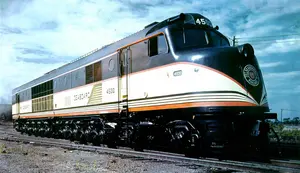
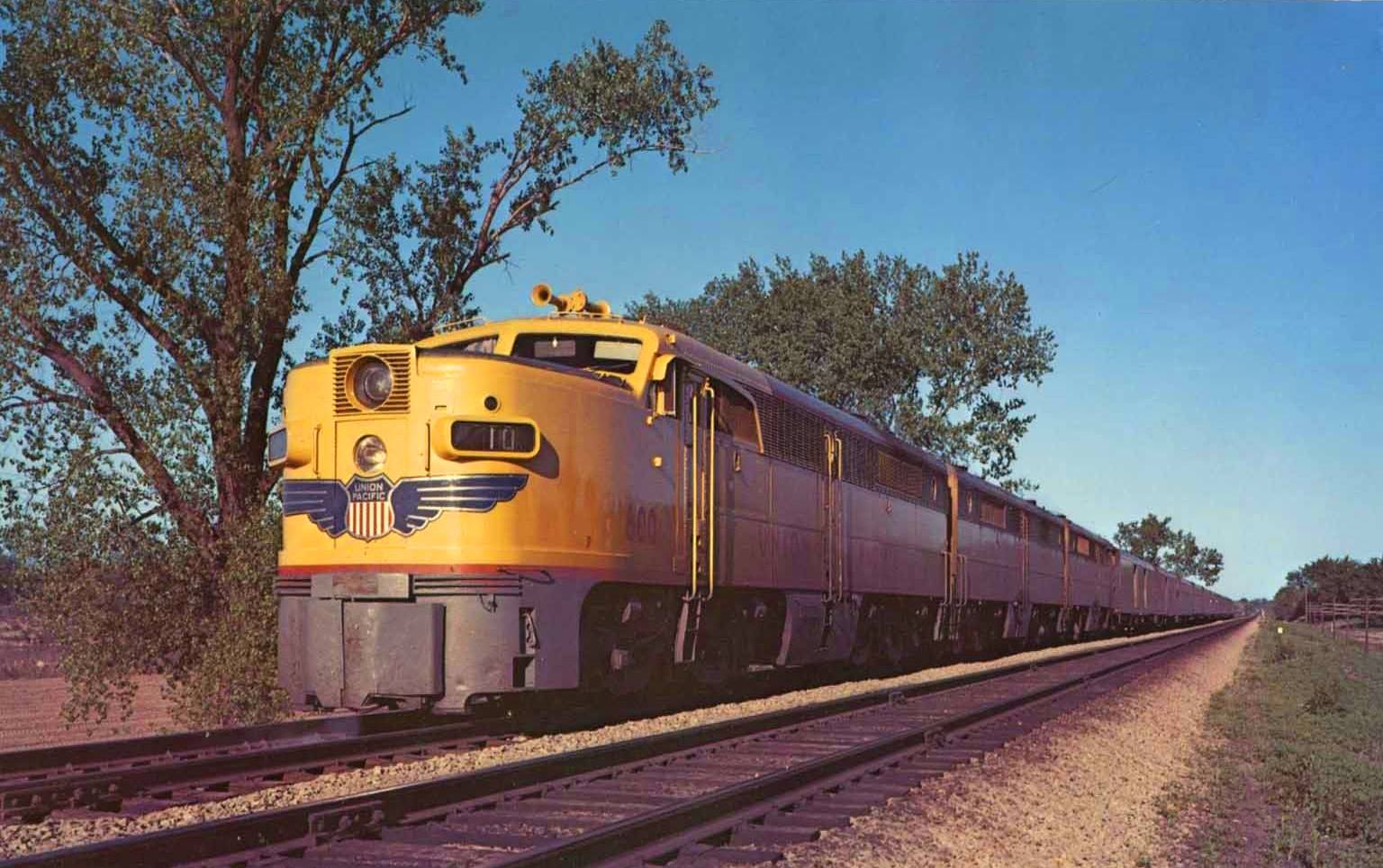 A Union Pacific company photo featuring a PA-PB-PA set ahead of train #10, the eastbound "City of St. Louis" (Los Angeles - St. Louis), near Lawrence, Kansas circa 1956. Note the train is not yet a "Domeliner," missing its dome-lounge-observation.
History
Union Pacific has a very long and storied history. The Union Pacific’s City fleet is credited with being the first lightweight streamlined passenger train to operate in the United States. In February of 1934 the City of Salina, the first in the fleet, debuted as a three-car lightweight trainset that the was named the M-10000.
At A Glance
47 Hours, 45 Minutes (Westbound) 46 Hours, 44 Minutes (Eastbound) |
|
9 (Westbound) 10 (Eastbound) | |
Union Passenger Terminal (Los Angeles) Union Station (St. Louis) |
* At this time the train lost its through status as a separate train. It was combined with the "City of Los Angeles" west of Ogden in April, 1964. In 1968 the "City of St. Louis" was combined with the "City of San Francisco," which combined again with the "City of Los Angeles"/"Challenger" in September of that year. By June, 1968, the train was renamed as the "City of Kansas City." Its name was retained until the start of Amtrak, although by that point had largely disappeared as a separate run.
Union Pacific was so impressed with the train, and the response it received from the public, the railroad purchased seven more sets and the City fleet was born! Following the City of Salina, also in 1934, was the City of Portland, City of Los Angeles, City of San Francisco, and finally City of Denver in 1936.
Consist (1958)
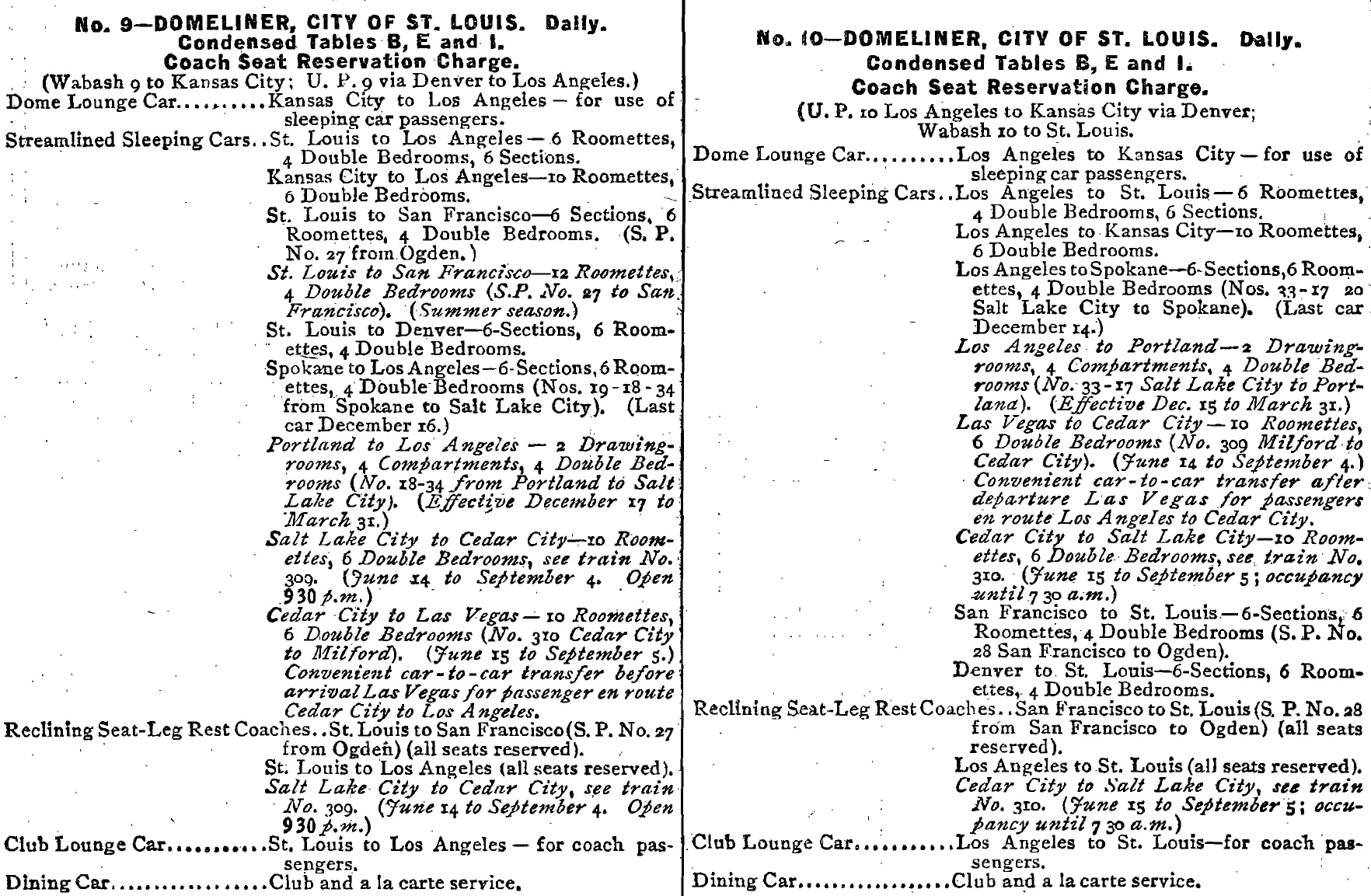
The later trains, notably the Los Angeles and San Francisco, operated as non-articulated consists using Electro-Motive's new E2 diesel locomotives.
The City fleet became revered throughout the west and rivaled the Santa Fe’s legendary Super Chief, and every other western passenger train, in exquisiteness and fine traveling.
Once the trains received their Domeliners in the mid-1950s they became the lavish way to travel for many of Hollywood's elite.
The City of St. Louis was another of Union Pacific’s vast City fleet of trains connecting the Midwest with the west coast. The train debuted on June 2, 1946 originally connecting its namesake city (in conjunction with the Wabash Railroad between Kansas City-St. Louis) with Cheyenne, Wyoming via Denver.
Timetable (1958)
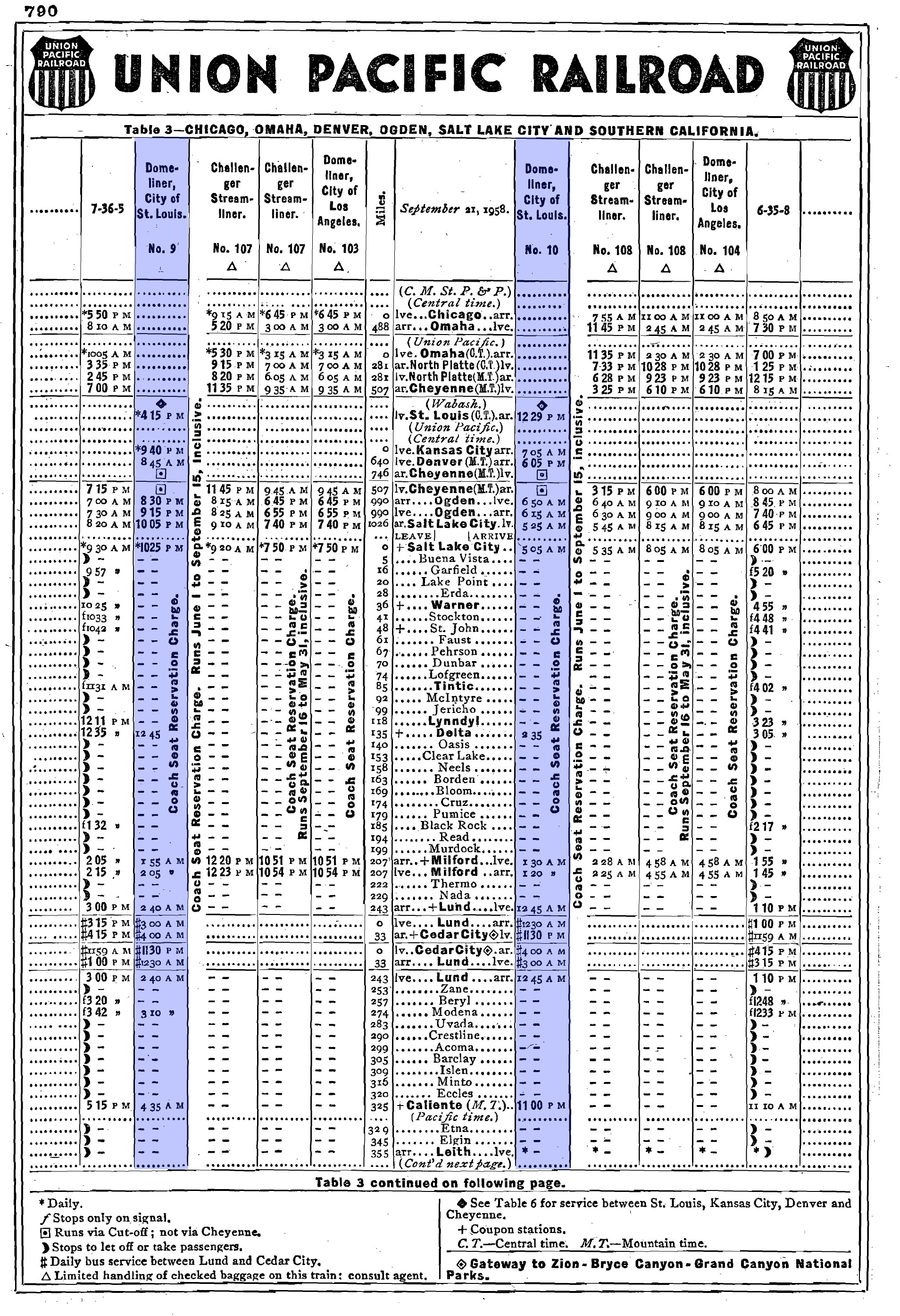
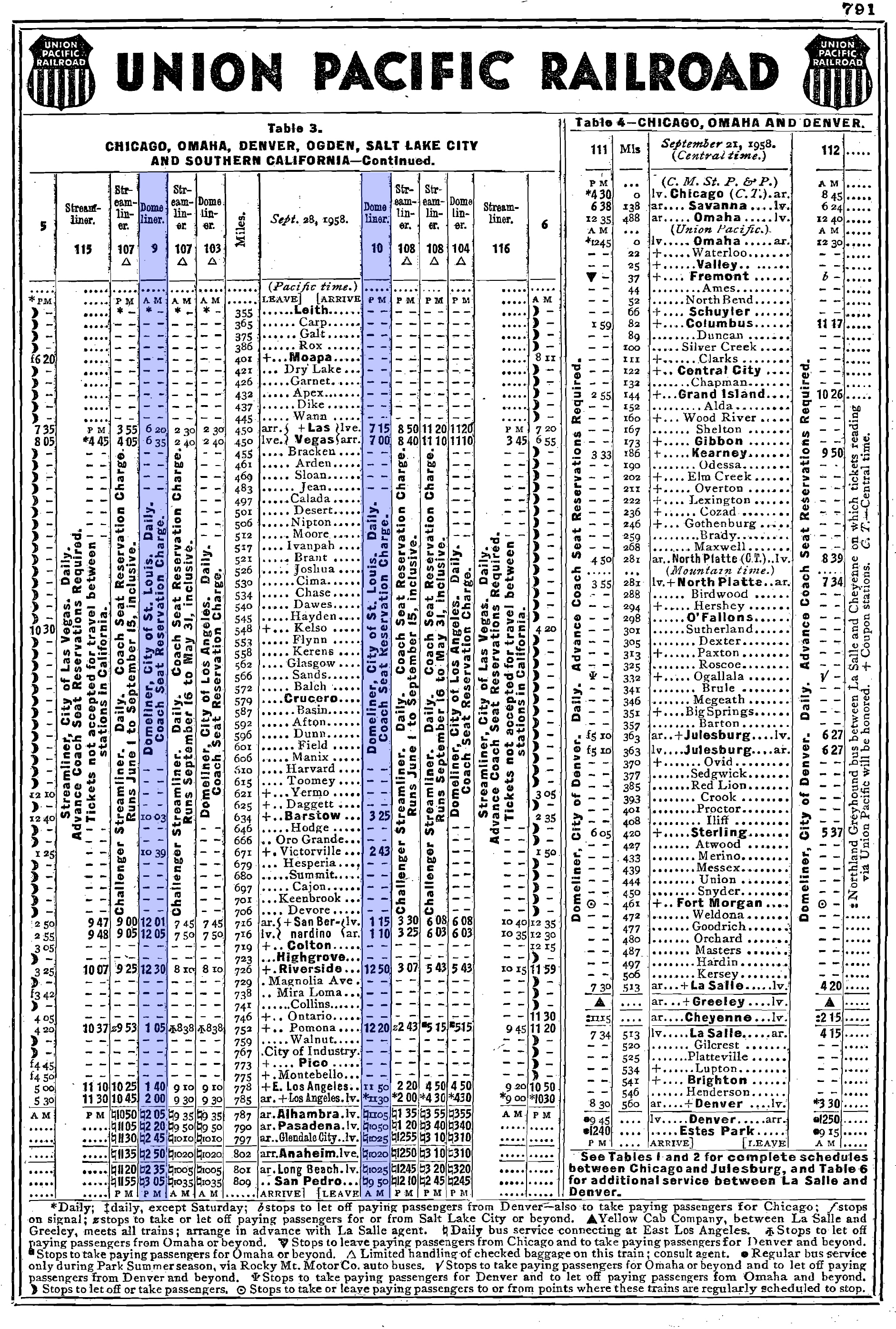
For its first four years of service the train only operated through sleeper service to Portland, San Francisco, and Los Angeles via Cheyenne. However, later in 1951 it began dedicated service as its own train all of the way to Los Angeles.
Not long after the St. Louis hit the rails it was upgraded with lightweight, all-streamlined equipment in 1947 featuring diners, Pullman sleepers, lounges, observations, and even dome cars which were added in 1958 from Pullman-Standard and American Car & Foundry.
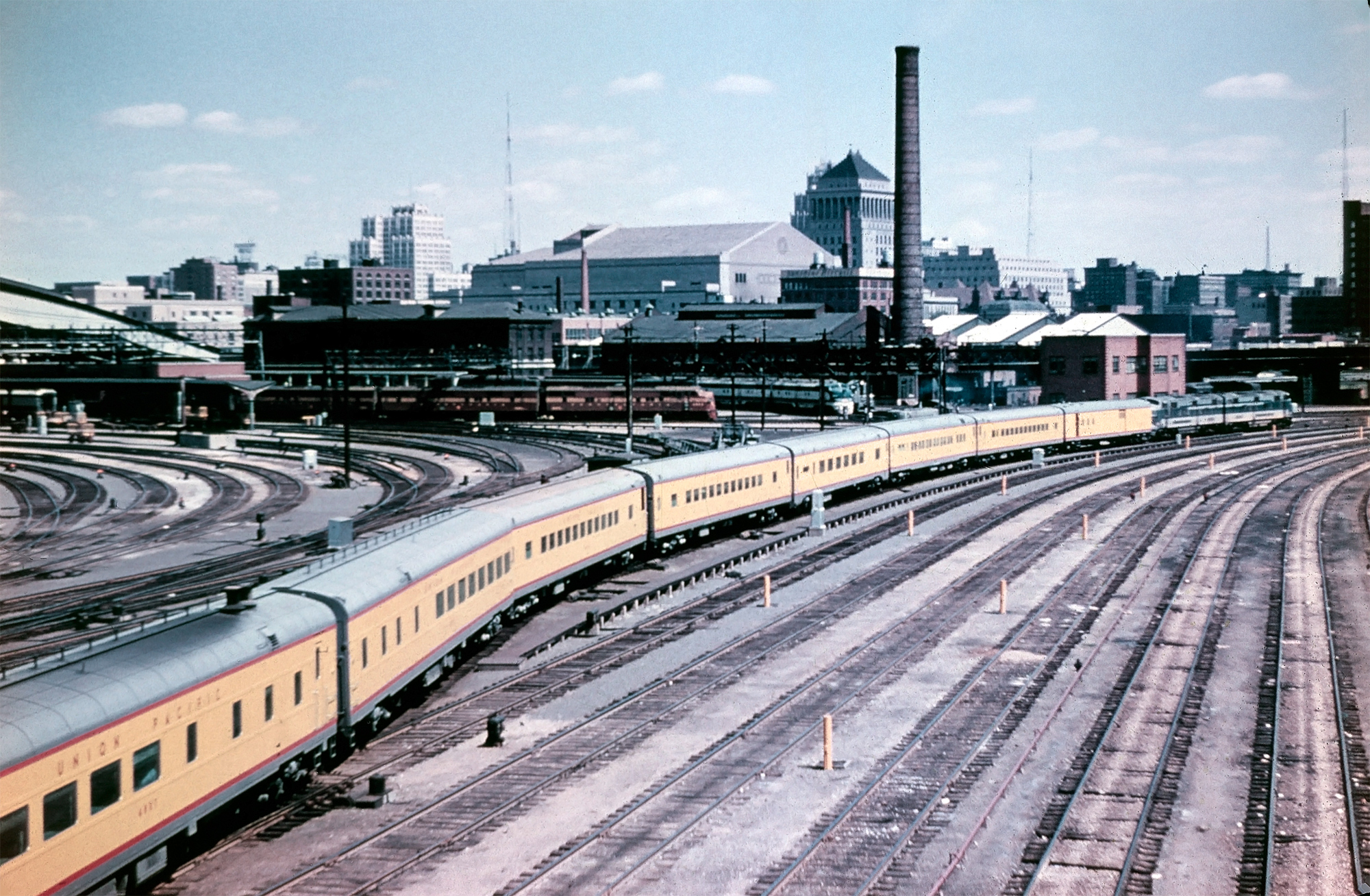 The joint Union Pacific/Wabash "City of St. Louis," arrives at St. Louis Union Station on August 31, 1955. American-Rails.com collection.
After the Wabash was leased by the Norfolk & Western Railway in 1964 the latter company ferried the City of St. Louis between St. Louis Union Station and Kansas City Union Station.
Operating on a schedule of nearly 47 hours the train listed as #9 (westbound) and #10 (eastbound) on UP's official timetable, normally carried an average train speed of about 50 mph the entire trip.
Through the end the City of St. Louis, along with her sister City trains, remained a top-notch, all matching consist (of Armour yellow and grey) by Union Pacific.
Timetable (April, 1967)
| Read Down Time/Leave (Train #209/Norfolk & Western) | Milepost | Location | Read Up Time/Arrive (Train #210/Norfolk & Western) |
|---|---|---|---|
| 3:40 PM (Dp) | 0.0 | 3:15 PM (Ar) | |
| 4:00 PM | 5 | 2:40 PM | |
| 22 | F 2:09 PM | ||
| 5:39 PM | 109 | 12:52 PM | |
| 5:56 PM (Ar) | 123 | 12:39 PM (Dp) | |
| 5:56 PM (Dp) | 123 | 12:39 PM (Ar) | |
| 6:20 PM (Ar) | 147 | 12:12 PM (Dp) | |
| 6:23 PM (Dp) | 147 | 12:07 PM (Ar) | |
| 8:45 PM (Ar) | 278 | 10:00 AM (Dp) | |
| Time/Leave (Train #9/Union Pacific) | Milepost | Location | Time/Arrive (Train #10/Union Pacific) |
| 9:20 PM (Ar) | 278 | 9:25 AM (Dp) | |
| F | 280 | F | |
| 9:59 PM | 318 | 8:19 AM | |
| 10:32 PM | 346 | 7:53 AM | |
| 11:25 PM | 397 | 7:03 AM | |
| 11:49 PM (Ar) | 418 | 6:30 AM (Dp) | |
| 11:54 PM (Dp) | 418 | 6:20 AM (Ar) | |
| F | 442 | F | |
| 12:40 AM (Ar) | 465 | 5:22 AM (Dp) | |
| 12:55 AM (Dp) | 465 | 5:10 AM (Ar) | |
| F | 502 | F | |
| F | 541 | F | |
| 3:09 AM (Ar) | 581 | 3:09 AM (Dp) | |
| 2:19 AM (Ar) | 581 | 2:04 AM (Ar) | |
| 3:27 AM | 655 | 12:52 AM | |
| 4:10 AM (Ar) | 708 | 12:05 AM (Dp) | |
| 4:13 AM (Dp) | 708 | 11:59 AM (Ar) | |
| 5:38 AM (Ar) | 814 | 10:31 PM (Dp) | |
| 5:39 AM (Dp) | 814 | 10:30 PM (Ar) | |
| 5:57 AM | 829 | 10:10 PM | |
| 8:10 AM (Ar) | 918 | 8:40 PM (Dp) | |
| 8:40 AM (Dp) | 918 | 8:15 PM (Ar) | |
| F 9:25 AM | 965 | ||
| 9:35 AM | 970 | 6:57 PM | |
| 11:30 AM (Ar) | 1080 | 5:02 PM (Dp) | |
| 11:45 AM (Dp) | 1080 | 4:50 PM (Ar) | |
| 1:35 PM (Ar) | 1197 | 3:06 PM (Dp) | |
| 1:40 PM (Dp) | 1197 | 3:05 PM (Ar) | |
| 3:24 PM | 1316 | 1:15 PM | |
| 3:50 PM (Ar) | 1331 | 12:55 PM (Dp) | |
| 4:00 PM (Dp) | 1331 | 12:45 PM (Ar) | |
| 5:41 PM (Ar) | 1431 | 11:05 AM (Dp) | |
| 5:45 PM (Dp) | 1431 | ||
| 7:30 PM (Ar) | 1507 | 9:35 AM (Dp) | |
| Time/Leave (Train #103/City Of Los Angeles) | Milepost | Location | Time/Arrive (Train #104/City Of Los Angeles) |
| 8:00 PM (Dp) | 1507 | 8:55 AM (Ar) | |
| 8:50 PM (Ar) | 1543 | 8:00 AM (Dp) | |
| 9:15 PM (Dp) | 1543 | 7:35 AM (Ar) | |
| F | 1678 | F | |
| 12:30 PM (Ar) | 1750 | 3:50 AM (Dp) | |
| 12:40 PM (Dp) | 1750 | 3:40 AM (Ar) | |
| F | 1868 | F | |
| 4:40 AM (Ar) | 1993 | 10:05 PM (Dp) | |
| 4:55 AM (Dp) | 1993 | 9:50 PM (Ar) | |
| 8:20 AM | 2177 | 6:30 PM | |
| F 9:00 AM | 2214 | F 5:50 PM | |
| 10:25 AM (Ar) | 2259 | 4:25 PM (Dp) | |
| 10:30 AM (Dp) | 2259 | 4:20 PM (Ar) | |
| 11:00 AM | 2269 | 3:57 PM | |
| 11:35 AM | 2295 | 3:22 PM | |
| 12:10 PM | 2321 | 2:50 PM | |
| 12:30 PM (Ar) | 2328 | 2:30 PM (Dp) |
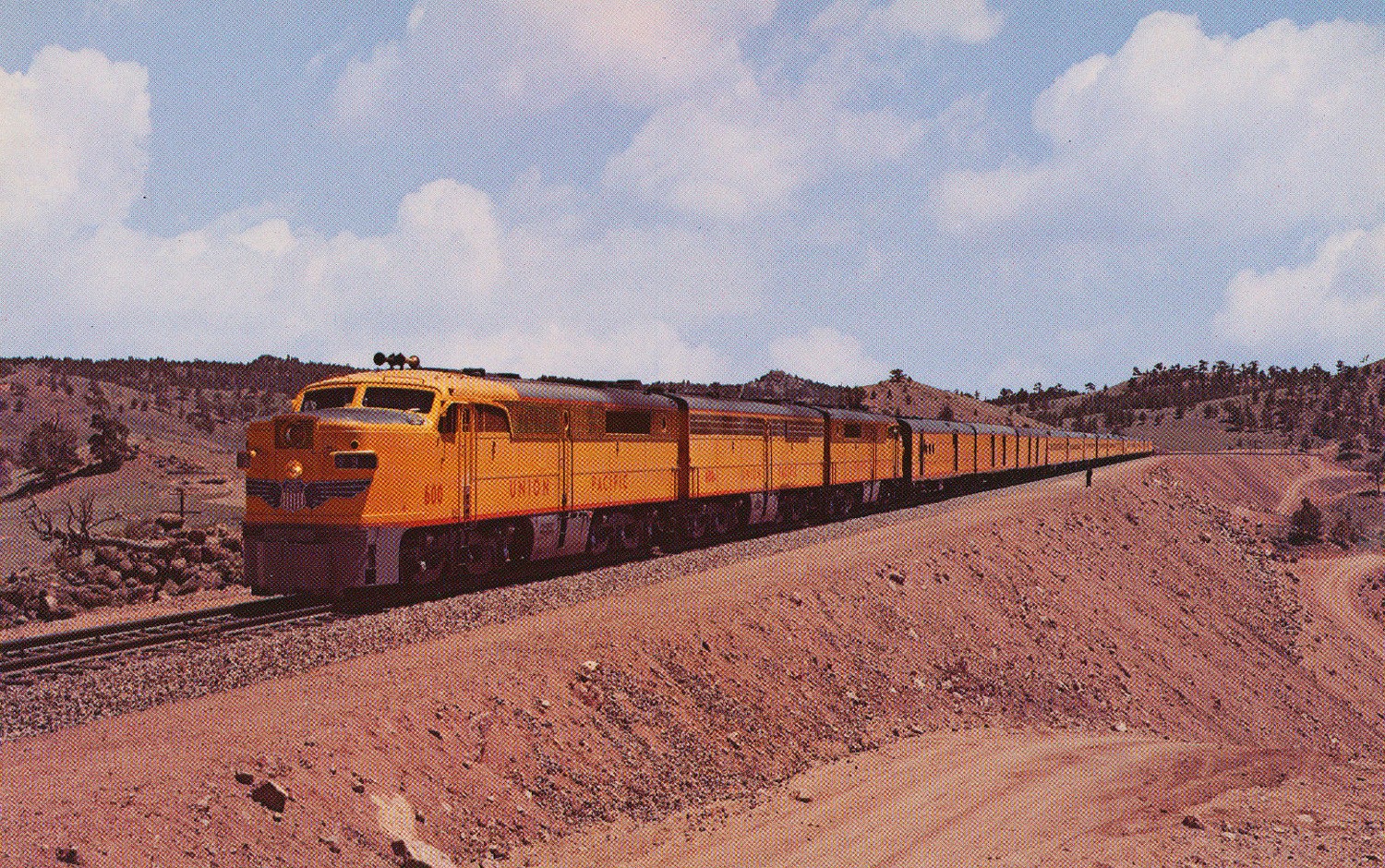 A Union Pacific company photo featuring a PA-PB-PA set with train #9, the westbound "City of St. Louis" (St. Louis - Los Angeles), on the new low-grade alignment along home rails near Cheyenne, Wyoming during the early 1950s.
Final Years
As rail travel patronage continued to slump through the 1960s the train was eventually downgraded, however, and combined with the City of Los Angeles west of Ogden, Utah.
In June 1968 the City of St.Louis was further cut back, operating to only Kansas City and renamed as the City of Kansas City.
In 1970 Union Pacific pulled the popular Domeliners from all of its City trains. While service remained satisfactory, however, this did not secure the Kansas City or other trains’ futures, as none were retained when Amtrak began service in the spring of 1971. Today, the fleet can still be witnessed through Union Pacific's official business train.
Sources
- Johnston, Bob and Welsh, Joe. Art Of The Streamliner, The. New York: Andover Junction Publications, 2001.
- Schafer, Mike and Welsh, Joe. Streamliners, History of a Railroad Icon. St. Paul: MBI Publishing, 2003.
- Welsh, Joe and Holland, Kevin. Union Pacific Railroad. Minneapolis: Voyageur Press, 2009.
Recent Articles


-
Kentucky Halloween Train Rides (2026)
Sep 29, 26 10:58 AM
 2026 Kentucky Halloween trains. Kentucky Railway Museum Trick and Track Express, October 24 and 31, from $17. Bluegrass Scenic pumpkin trains in Versailles. Confirm on the ticket shop.
 -
Connecticut Halloween Train Rides (2026)
Sep 29, 26 10:26 AM
 2026 Connecticut Halloween trains. East Windsor Pumpkin Patch Fridays through Sundays, October 2–31. Naugatuck coach $20. Shore Line Pumpkin Patch on nine October days. Confirm on each site.
 -
Pennsylvania Halloween Train Rides (2026)
Sep 29, 26 09:45 AM
 2026 Pennsylvania Halloween trains—Everett October 3, 4, 10, and 17, Strasburg’s three fall shows, Oil Creek on October 24, plus Kutztown, Kempton, Honesdale, Middletown, and West Chester.
 -
New York Halloween Train Rides (2026)
Sep 29, 26 12:08 AM
 2026 New York Halloween trains—Catskill Pumpkin Express October 17–18 and 24–25, Adirondack pumpkin and family trains, Arcade & Attica haunt, Cooperstown patch and trick-or-treat, Tupper Lake triv…
 -
North Carolina Halloween Train Rides (2026)
Sep 28, 26 11:56 PM
 2026 North Carolina Halloween trains—New Hope Valley Track or Treat on October 10, 17, 23, and 24, and Tweetsie Ghost Train Friday and Saturday nights through October 31. GSMR’s October menu is the go…
 -
Tweetsie Railroad Ghost Train Halloween Festival (2026)
Sep 28, 26 11:44 PM
 Tweetsie Ghost Train—Friday and Saturday nights September 25–October 31, 2026, in Blowing Rock. Adult $65, child $45. One reserved steam ride plus the park. Ages 8 and up for the haunt.
 -
Milwaukee Road Class A 4-4-2: Specs, Roster, History
Sep 28, 26 11:20 PM
 Milwaukee Road Class A Atlantics 1–4, Alco 1935–1937, for the Hiawatha. Order S-1740, 84-inch drivers, 19x28, 300 psi, 30,685 lb. Full builder specs, roster, and the May 15, 1935 run at 112.5 mph. All…
 -
Strasburg Rail Road Halloween Trains (2026)
Sep 28, 26 11:00 PM
 Strasburg’s 2026 Halloween tickets—Pumpkins in Paradise on October 3, The Haunting of Pumpkin Junction, and The Brakeman’s Curse through October 25. Three fares. Legacy of Sleepy Hollow is an earlier…
 -
GSMR Peanuts Pumpkin Train (2026): Not on This Year’s Ticket Menu
Sep 28, 26 10:50 PM
Great Smoky Mountains Railroad’s September 28, 2026 ticket menu lists Nantahala and Tuckasegee excursions. A Peanuts Great Pumpkin train is not on that menu. Polar Express is on the November calendar. -
New Jersey Halloween Train Rides (2026)
Sep 28, 26 06:45 PM
2026 New Jersey Halloween trains—Black River & Western to Everitt Farms through October 25, Delaware River Great Pumpkin through November 1, Whippany October 4, 10, and 11, Pine Creek night trains. -
New Hampshire Halloween Train Rides (2026)
Sep 28, 26 05:17 PM
 2026 New Hampshire Halloween train—Conway Scenic Halloween Express, October 24 and 25, about 1 hour from North Conway. Coach adult $30. Confirm on conwayscenic.com.
 -
Conway Scenic Pumpkin Patch Express (2026): Dates, Tickets & Tips
Sep 28, 26 05:09 PM
 Conway Scenic Halloween Express—October 24 and 25, 2026, about 1 hour from North Conway. Coach adult $30. A pumpkin after the ride while supplies last. Confirm on conwayscenic.com.
 -
Black River & Western Pumpkin Trains (2026): Dates, Tickets & Tips
Sep 28, 26 02:20 PM
 Suggested meta description: Black River & Western Pumpkin Train—Flemington to Everitt Farms, weekends September 26–October 25, 2026. Pumpkin patch, maze, and wagon rides. Confirm on blackriverrail…
 -
Scenic Dinner Train Rides (2026): A Complete Guide
Sep 28, 26 01:30 PM
 2026 scenic dinner trains by state—a seated meal on the train. Branson through October 30, Cincinnati Saturdays, Potomac Eagle, and the full state list. Confirm on the railroad.
 -
West Virginia Dinner Train Rides (2026): A Complete Guide
Sep 28, 26 11:58 AM
 2026 Potomac Eagle dining from Romney—about 3 hours in the Trough. Premium three courses $124. Superior four courses $159, ages 17 and older. Confirm on potomaceagle.com.
 -
Washington Dinner Train Rides (2026): A Complete Guide
Sep 28, 26 11:51 AM
 2026 Chehalis-Centralia dinner trains have run. The July 18 Roaring 20s dinner was $89. The planning calendar lists no later dinner. Confirm on steamtrainride.com.
 -
Texas Dinner Train Rides (2026): A Complete Guide
Sep 28, 26 11:27 AM
 2026 Texas has no plated dinner aboard the train. Grapevine sells snacks. The Texas State Railroad Dogwood lunch was served at the Rusk depot. Confirm on the railroad.
 -
Ohio Dinner Train Rides (2026): A Complete Guide
Sep 28, 26 10:15 AM
2026 Ohio dinner trains—Cincinnati Saturdays, $140, about 3 hours, ages 12 and up. Hocking Valley Elegant Dinner Train October 17 and November 7, from $95. -
Missouri Dinner Train Rides (2026): A Complete Guide
Sep 28, 26 10:09 AM
 2026 Branson Scenic Railway dinner train—three courses, about 2 hours, Fridays and Saturdays through October 30. Dome $123.50 plus tax. Confirm on bransontrain.com.
 -
Minnesota Dinner Train Rides (2026): A Complete Guide
Sep 28, 26 09:40 AM
 2026 North Shore Scenic Northwoods Dinner Train in Duluth—four courses in the SkyView dome, 2½ hours, $90, through September 26. Confirm on duluthtrains.com.
 -
Maine Dinner Train Rides (2026): A Complete Guide
Sep 28, 26 09:29 AM
 2026 Maine has no dining-car dinner. WW&F Pig Roast at SeaLyon Farm was June 13 and has run, $54.95. Sunset Express was a drink and ended September 5.
 -
Greenbrier, Cheat & Elk Railroad: Western Maryland's Logging Line
Sep 26, 26 11:59 PM
 Greenbrier, Cheat and Elk—the logging railroad the Western Maryland bought in 1927. Cass to Spruce, Summit Cut at 4,066.6 feet, Elk River Branch, Laurel Bank.
 -
Elkins (Western Maryland): Yard, History, Operations
Sep 26, 26 11:56 PM
 Western Maryland at Elkins—the Elkins Division yard, roundhouse, and wash rack. Belington, Durbin, Black Fork, and the Elk River branches met here.
 -
B&O's "Cincinnatian" (Train): Route, Consist, Timetable
Sep 26, 26 11:51 PM
 B&O Cincinnatian—Mount Clare five-car streamliner, January 19, 1947, trains 75 and 76. P-7d Pacifics 5301–5304. Detroit–Cincinnati from June 25, 1950, trains 53 and 54. Last run April 30, 1971.
 -
The Semaphore: Railroading's Classic Signal
Sep 26, 26 11:51 AM
 Railroad semaphore signals: blade and spectacle, lower quadrant and upper quadrant, US&S Style B and GRS Model 2A, Robinson’s track circuit, and the last blades on the Raton Subdivision.
 -
Black Fork Grade (Western Maryland): History and Operations
Sep 26, 26 11:47 AM
 Black Fork Grade—the Western Maryland climb through Blackwater Canyon. Thomas to Hendricks, past 3 percent, an H-9 and ten loads, helpers off at Fairfax.
 -
Western Maryland Steam Locomotives: History & Roster
Sep 26, 26 11:39 AM
 Western Maryland steam—H-9 Consolidations, I-2 Decapods, Lima 2-8-8-2s, Baldwin Challengers, and twelve Baldwin Potomac 4-8-4s. Post-1900 roster.
 -
Western Maryland Diesel Roster: All-Time
Sep 26, 26 11:32 AM
 Western Maryland diesels—S1 102 in 1941, fourteen F7 boosters, BL2s, hammerhead RS3s, Circus SD40s, and Chessie GP40-2s. Serials and order numbers.
 -
The Dutch Line (Western Maryland): History, Map, Operations
Sep 25, 26 09:38 PM
 Western Maryland Dutch Line—the Hanover Subdivision. Emory Grove to Highfield via Hanover and Gettysburg, York branch 1893, stone trains, and the route CSX still runs.
 -
The Durbin Branch (Western Maryland): History, Map, Operations
Sep 25, 26 09:13 PM
 Western Maryland Durbin Branch—the Coal & Iron Railway, 46.9 miles Elkins to Durbin, opened July 27, 1903. Mixed train until April 10, 1959. H-7B Consolidations.
 -
Western Maryland Railway: Map, Rosters, Logo, History
Sep 25, 26 10:24 AM
 Western Maryland Railway—the Fast Freight Line. Baltimore, Carroll & Frederick, May 27, 1852. Connellsville Extension 1912. Chessie, then into the B&O May 1, 1983.
 -
Illinois Dinner Train Rides (2026): A Complete Guide
Sep 25, 26 09:52 AM
2026 Monticello Railway Museum Murder Mystery Dinner Train—June 13, July 11, August 1, and September 5 have run. Three courses, about 2 hours, $112. Confirm on mrym.org. -
Georgia Dinner Train Rides (2026): A Complete Guide
Sep 25, 26 12:29 AM
 2026 Azalea Sprinter dinner train from Nashville and Willacoochee, Georgia—2½ hours. Club Car adult $147, Executive adult $177. Confirm on azaleasprinter.com.
 -
Baldwin "Centipede" Locomotives: Specs, Roster, Photos
Sep 25, 26 12:02 AM
 Baldwin DR-12-8-1500/2 Centipede—2-D+D-2, two 608SC engines, 3,000 hp. SAL 4500 from the 1943 test bed. 54 on the serial list, 52 sold. PRR BP60 then BH50. None preserved.
 -
Florida Dinner Train Rides (2026): A Complete Guide
Sep 24, 26 11:56 PM
 2026 Seminole Gulf Murder Mystery Dinner Train in Fort Myers—five courses cooked onboard, 3½ hours, $129 or $135 Saturday, plus tax and gratuity. Confirm on semgulf.com.
 -
West Virginia Northern Railroad: Map, Photos, History
Sep 24, 26 11:27 PM
 West Virginia Northern—Kingwood to Tunnelton, 11 miles of Preston County coal. Narrow gauge 1888, standard gauge 1895. Last freight February 19, 1991. Consolidations 8 and 9 survive.
 -
Rutland Railroad: Map, Rosters, History, Logo
Sep 24, 26 01:18 PM
 Rutland Railroad—Follett’s Champlain & Connecticut River, November 1, 1843. Bellows Falls–Burlington December 18, 1849. Green Mountain Gateway. Last train September 25, 1961. Vermont Railway Janua…
 -
Arkansas Dinner Train Rides (2026): A Complete Guide
Sep 24, 26 01:12 PM
 2026 Eureka Springs & North Arkansas Dinner Train—Eurekan dining car, about 2 hours, $53.62 tax included, opens May 9, Tuesday, Wednesday, Friday, and Saturday. Confirm on esnarailway.com.
 -
Arizona Dinner Train Rides (2026): A Complete Guide
Sep 24, 26 01:01 PM
 2026 Arizona has no plated dinner train. Grand Canyon Railway sells snacks in the cars and meals in Williams or at the rim. Verde Canyon includes a charcuterie tray.
 -
Rail News, The Latest
Sep 24, 26 12:36 PM
This page provides a portal to the latest in rail news, from preservation and restortation subjects to other notable topics. -
Cotton Belt 819 Moved Outside at Pine Bluff for Evaluation
Sep 24, 26 12:35 PM
Cotton Belt 819 left the Pine Bluff shop on September 22, 2026, first time outside in about 30 years. RDG Steam Services is evaluating the engine. No donation link posted. -
Reading Steam Locomotives: History, Roster & Photos
Sep 24, 26 12:14 PM
 Reading steam—Wootten fireboxes, Camelback Consolidations, Mallets, K-1 Santa Fes, G-3 Pacifics, T-1 4-8-4s. Post-1900 roster after Drury. Rambles ended October 17, 1964.
 -
Reading Diesel Roster: All-Time
Sep 24, 26 12:10 PM
 Reading diesel roster—AGEIR boxcabs, FTs, FA-1s, RS-3s, Train Masters, GP30s through GP39-2s. Serials and order numbers. Conrail April 1, 1976.
 -
Reading Railroad: Map, Logo, History, Rosters
Sep 24, 26 12:08 PM
 Reading Company—Philadelphia & Reading, 1833. Anthracite, Port Richmond, Reading Terminal. Operating company January 1, 1924. Conrail April 1, 1976.
 -
Nevada Dinner Train Rides (2026): A Complete Guide
Sep 24, 26 12:02 PM
 2026 Nevada Northern Taste of Italy—adults-only gala from East Ely. The September 19 date has run. Confirm any later night on nnry.com.
 -
North Carolina Dinner Train Rides (2026): A Complete Guide
Sep 24, 26 11:24 AM
 2026 North Carolina dinner trains—NCTM Wine & Dine in Spencer sold out February 13–15. GSMR First Class is the plated meal on the Nantahala Gorge excursion. Confirm on the railroad.
 -
Railway Express Agency (REA): Signs, Trucks, Logo & History
Sep 24, 26 09:40 AM
 Railway Express Agency—railroad-owned express company. Incorporated December 7, 1928. Operations March 1, 1929. Red diamond, green trucks. Last regular express November 7, 1975.
 -
Michigan Dinner Train Rides (2026): A Complete Guide
Sep 24, 26 09:28 AM
 2026 Steam Railroading Institute dining in Owosso—select evenings, no public dinner dates posted. Confirm on michigansteamtrain.com.
 -
Pittsburgh and West Virginia Railway: Map, Rosters, History
Sep 24, 26 12:24 AM
 Pittsburgh & West Virginia—the Hi-Line. Wabash-Pittsburgh Terminal 1904. Railway January 29, 1917. Connellsville February 11, 1931. N&W lease October 16, 1964. Wheeling & Lake Erie from May 17, 1990.
 -
Indiana Dinner Train Rides (2026): A Complete Guide
Sep 24, 26 12:13 AM
2026 Spirit of Jasper Ride & Dine is paused. No public trains. Depot at 201 Mill Street stays open as a rental. Confirm on spiritofjaspertrain.com.



%2C%20near%20Lawrence%2C%20Kansas%20circa%201956.%20Note%20the%20train%20is%20not%20yet%20a%20%22Domeliner%2C%22%20missing%20its%20dome-lounge-observation.)


%2C%20on%20the%20new%20low-grade%20alignment%20along%20home%20rails%20near%20Cheyenne%2C%20Wyoming%20during%20the%20early%201950s.)