Alco C636 (Century 636): Specs, Production Roster & History
Last revised: August 26, 2026
By: Adam Burns
The Alco Century 636 (C636) was the most powerful single-engine diesel-electric the American Locomotive Company cataloged for domestic sale: a six-axle, 3,600-horsepower road-switcher built around the turbocharged 16-251F and Alco’s new Hi-Ad trucks. Schenectady outshopped 34 between December 1967 and November 1968. Only three U.S. railroads bought production units—Spokane, Portland & Seattle (10), Penn Central (15, a Pennsylvania Railroad order delivered after the February 1, 1968 merger), and Illinois Central (6)—plus three expensive factory demonstrators that never sold a follow-on order.
Licensee A.E. Goodwin in Australia built another 35 C636s for Pilbara iron-ore roads (1968–72), for a worldwide C636 total of 69. Montreal Locomotive Works later built the related but separate M636 (111 at Montreal, plus Australian M-line copies). One unrebuilt Schenectady C636 still earns its keep: Delaware-Lackawanna #3642 at Scranton, photographed in service as recently as November 2025.

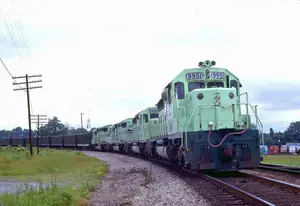
An Illinois Central publicity photo featuring a pair of its new C-636s, #1101 and #1102, posed swinging off a coal spur at Grand Rivers, Kentucky in the summer of 1968. The six IC C636s (1100–1105) were assigned to the Kentucky Division and kept close to the Paducah shops because of reliability issues; they regularly worked coal trains in this territory. They were retired in 1979. American-Rails.com collection.
On this page: At a glance · In the Century catalog · Design · Why it sold so few · U.S. owners · The three demonstrators · Data sheet · Production rosters · M636, related not identical · What still runs
At a Glance
| Item | Detail |
|---|---|
| Builder | American Locomotive Company, Schenectady, N.Y. (licensee: A.E. Goodwin, Australia) |
| Model | Century 636 (C636); specification DL636 |
| Type | Six-axle (C-C) diesel-electric road-switcher |
| Horsepower | 3,600 hp |
| Prime mover | Alco 16-251F (V-16), turbocharged, 1,100 rpm |
| Schenectady production | December 21, 1967 – November 21, 1968 |
| Alco-built total | 34 (3 demonstrators + 31 railroad units) |
| U.S. railroad buyers | SP&S 10, Penn Central 15, Illinois Central 6 |
| First production | Spokane, Portland & Seattle #330–335 (December 1967; #331 dated December 21) |
| Last Alco C636s | SP&S #340–343 and demonstrators 636-1/2/3 (November 1968) |
| A.E. Goodwin C636s | 35 for Hamersley Iron, Mt. Newman Mining, and Cliffs Robe River (1968–72) |
| Worldwide C636 total | 69 |
| Related MLW model | M636 (111 built at Montreal, 1969–75)—not a C636 |
| Predecessor in line | C630 (3,000 hp, 16-251E) |
| Electrical | GE GTA-11 main generator (AC); six GE 752 traction motors |
| Last unrebuilt Alco C636 | Delaware-Lackawanna #3642 (ex-Penn Central 6342), Scranton, Pa. |
Where the C636 Fit in Alco’s Catalog
Alco launched the Century line in 1963 to replace the RS/RSD road-switchers after the mixed reputation of the 244-series engine years. Six-axle Centuries stepped up in a straight horsepower ladder: the C628 (2,750 hp, 16-251C, 1963), the C630 (3,000 hp, 16-251E, 1965), then the C636 at 3,600 hp. The naming was the usual Century code: C for Century, 6 for six axles, 36 for the 3,600-horsepower rating.
Visually the C636 is a C630 with a different intercooler box. The C630 has two grilles stacked on the box behind the cab; the C636 keeps only the upper grille. Both ride Alco Hi-Ad (high-adhesion) three-axle trucks rather than the older Trimounts of early C628s. Length between coupler pulling faces is the six-axle Century standard, 69 feet 6 inches.
The 3,600 hp rating put the C636 against Electro-Motive’s SD45 (20-cylinder 645, 3,600 hp, in production since 1965) and General Electric’s emerging U33C/U36C. EMD built more than 1,200 SD45s through 1971 while GE outshopped nearly 600 U33Cs and U36Cs. Alco simply did not get the orders.
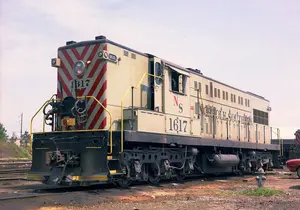
The C636 was builder's last six-axle Century from Schenectady although not the final Alco locomotive ever built. After the November 1968 C636s, the plant still finished C415s and, in January 1969, Newburgh & South Shore T-6 switchers #1016 and #1017—the last units out the door.
Design
Under the hood sat Alco’s last high-output 251 variant, the 16-251F: four-cycle, 9-inch bore, 10½-inch stroke, turbocharged, rated 3,600 hp at 1,100 rpm. Some secondary sheets still print “251E” on the C636. The 251E is the 3,000 hp engine in the C630 and C430. The 3,600 hp jump is the 251F.
Electrical gear remained General Electric even though GE had been a full locomotive competitor since the U25B of 1959. The C636 used a GTA-11 AC main generator and six GE 752 traction motors. Dynamic braking was optional. Illinois Central’s six were built without it. Gear ratios in Alco-oriented tables used on this site are 81:22 (about 75 mph) and 77:26 (about 93 mph). Other mechanical summaries list the more common six-axle freight 74:18. Treat those as catalog options, not a single fleet standard.
Published weight is the item that used to overstate the case. Alco listed about 372,000 pounds with optional ballast up to 420,000 pounds. Heavy ore and some Australian units sat at the high end. A typical EMD SD40 of the period was in the high 360,000s to about 390,000 depending on ballast; an SD45 was in the same neighborhood. The C636 could be a heavy locomotive. It was not uniquely 420,000 pounds in every application, and it did not uniquely destroy track. What railroads did dislike, from the earlier C628/C630 onward, was Alco’s combination of high axle loading, Hi-Ad geometry, and a builder already on thin ice for reliability and parts.
Starting tractive effort on the Jean-Denis Bachand / Railroad Model Craftsman-style sheet is about 81,150 pounds at 25 percent adhesion. The olderdata sheet on this page listed 100,000 pounds at 7 mph. Those are different ratings (starting vs. a continuous/speed point). Both appear below so a reader can see the published range rather than a single rounded claim.

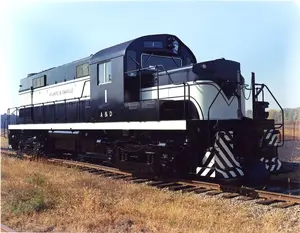
An American Locomotive builder's photo featuring new Illinois Central C636 #1100 in May, 1968 at Schenectady, New York.
Why It Sold So Few
Alco spent on the order of $5.5 million to build three demonstrators—636-1, 636-2, and 636-3—completed in November 1968, after most of the production run had already been delivered. The set was meant to tour Class I railroads and close the sale that the catalog had not. It did the opposite. Demonstrator 636-2 was the unit that actually went out. On a Santa Fe evaluation the same traction-motor blower failed and was replaced on three of four runs; the prime mover would shut down with it. Southern Pacific’s test was no better. Railfan & Railroad later called the C636 Alco’s “most notorious failure” of the late Century years: a 3,600 hp advertisement for how far build quality had slipped.
Alco's blower problem was real; it was not a 244-engine hangover. The 251F was a different machine from the 244s of the late 1940s and 1950s. What the 244 (and to a lesser extent the 539) had already done was spend Alco’s reputation. Mechanical departments that remembered early 244 crankshafts and turbo lag did not give the 251 a clean sheet, even when the later engine was the better product.
Two market facts finished the model. First, Alco was still buying its electrical cabinet from the company that was now its rival. GE’s own six-axle Universals were on the same bid lists. Second, EMD already had a 3,600 hp six-axle locomotive that worked. Railroads that wanted that horsepower bought SD45s in fleet numbers. Penn Central’s fifteen C636s arrived because the Pennsylvania Railroad had already been an Alco six-axle customer (C628, C630) and had the order in before the merger. Illinois Central wanted coal-drag horsepower on the Kentucky Division. SP&S, always Alco-friendly in the Pacific Northwest, took ten. Nobody else in the United States signed.
Alco announced it would leave the locomotive business as 1968 ended. U.S. diesel deliveries that year had fallen below 1,000 in a market that had once seen 4,500. The C636 did not cause the shutdown by itself. It was the last high-horsepower pitch from a builder that had already lost the argument.
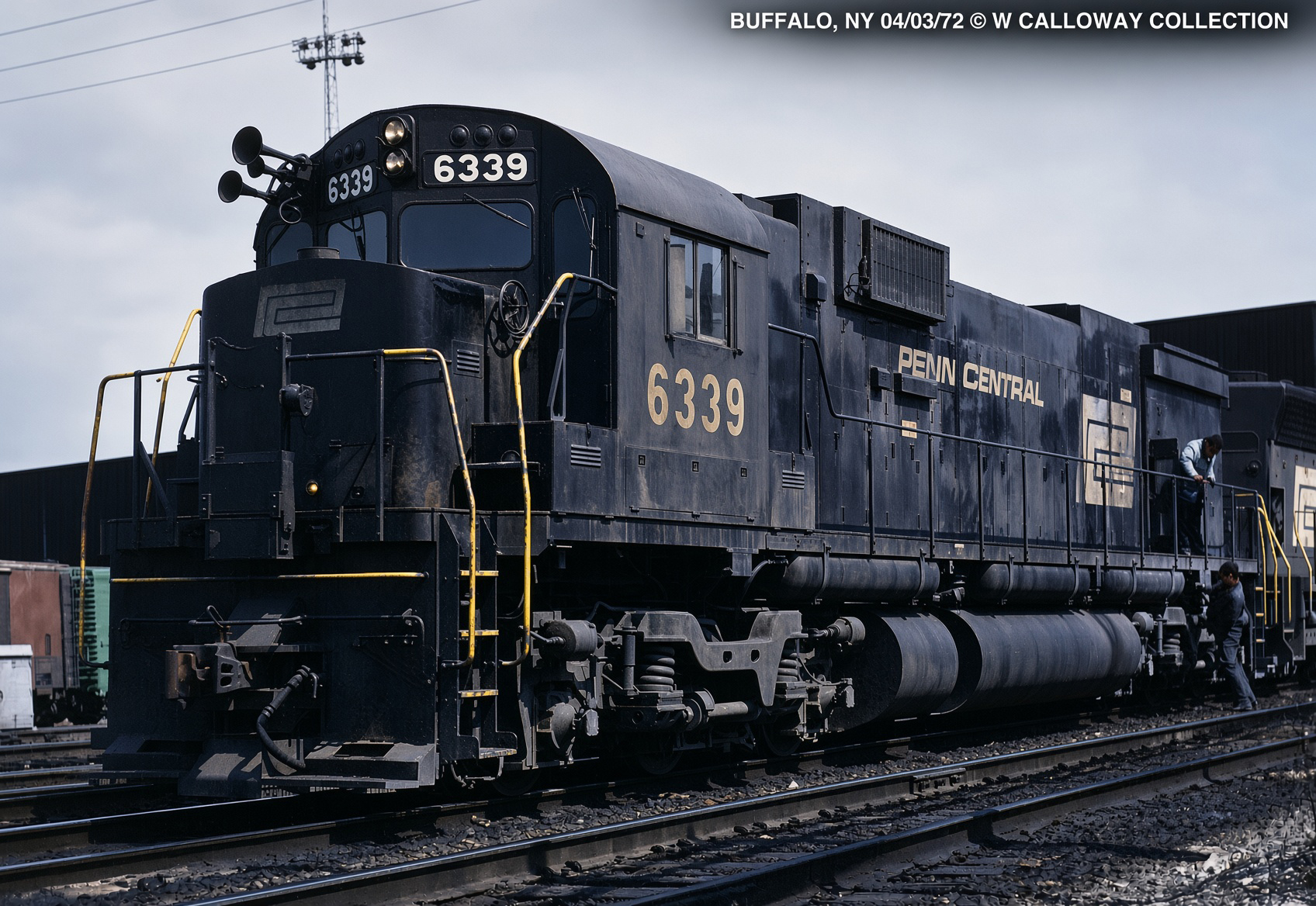
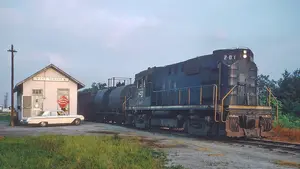
One of Penn Central's huge C636s, #6339, at Buffalo, New York on April 3, 1972. Warren Calloway collection.
U.S. Owners
Spokane, Portland & Seattle (10)
SP&S took the first production C636s: #330–335 in December 1967 (builder numbers S-3488-01 through -06) and #340–343 in November 1968 (S-6010-01 through -04). They were Northwest forest and drag power on a road that had bought Alco six-axles for years. At the March 1970 Burlington Northern merger they became BN #4360–4369. BN retired the group around 1980. None are known to survive.
Penn Central (15)
The Pennsylvania Railroad ordered fifteen C636s as the next step after its C628s (#6300–6314) and C630s (#6315–6329). Delivery was March–April 1968, after February 1, so they were lettered Penn Central #6330–6344 (S-3499-01 through -15) from new. PC put them on heavy freight, including Appalachian coal. Conrail inherited them as #6780–6794. Most were off the roster in the early 1980s. One unit, PC #6342 / CR #6792, went to Delta Terminal as #1001, then to Delaware-Lackawanna, where it still runs as #3642.
Illinois Central (6)
#1100–1105 (S-6000-01 through -06), May 1968, were coal power on the Kentucky Division. They had no dynamic brakes. They became Illinois Central Gulf engines at the 1972 GM&O merger, same numbers, and were retired about 1979. All six were later scrapped (reports put the cuts in the early 1980s after a pass through used-power dealers such as PNCX). No IC C636 survives.
The Three Demonstrators
636-1, 636-2, and 636-3 (S-6008-01 through -03) were completed in November 1968. After the failed Class I tour they were sold to Morrison-Knudsen as 5401–5403. MK used them as contractor power: Libby Dam construction in Montana, a period on Pacific Great Eastern, Black Mesa & Lake Powell construction in Arizona, and a well-photographed lease to the Clinchfield at Erwin, Tennessee, in November 1971 during a CRR power shortage. In 1973–74 they went to Québec Cartier Mining as #77–79 and spent years on heavy ore trains in Quebec.
Cartier later disposed of them. 5401 / QCM 79 was reported scrapped in 2002 after a crankshaft failure. The other two passed through New York, Susquehanna & Western and Western New York & Pennsylvania; both of those Alco-built C636s have been cut up. They are not the M636s still moving on Genesee Valley Transportation properties.
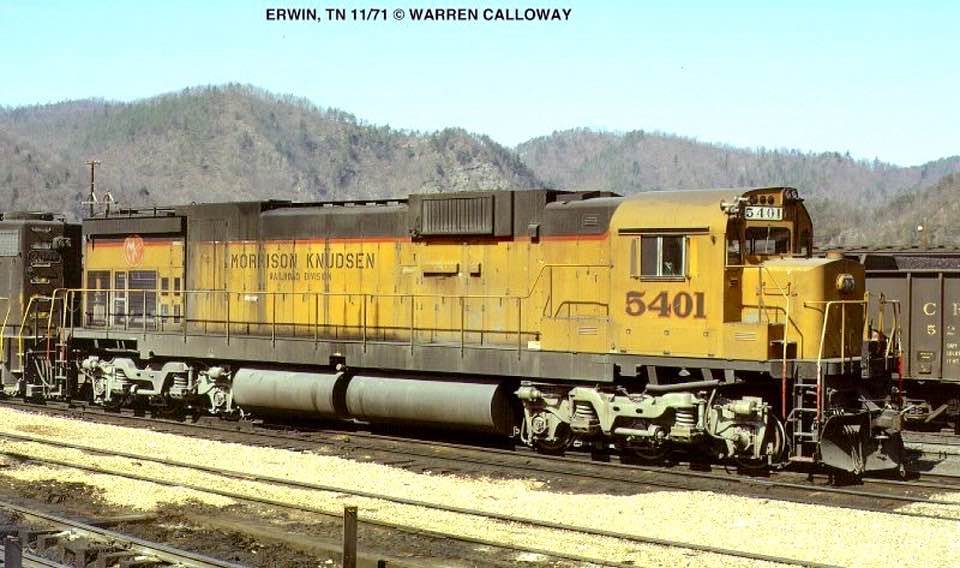
Morrison-Knudsen C636 #5401 (formerly demonstrator 636-1) is seen here on the Clinchfield at Erwin, Tennessee in November, 1971. The CRR was leasing the unit during a power shortage. MK wound up purchasing all three demonstrators, which were later sold to Cartier Mining. Warren Calloway photo.
Data Sheet and Specifications
Figures below follow the Kirkland-era American-Rails compilation long used on this page, with the engine letter corrected to 251F and weight expressed as the catalog range rather than a single 420,000-pound figure. Alternate mechanical-digest numbers are noted underneath.
| Specification | Value |
|---|---|
| Entered production | December 21, 1967 (Spokane, Portland & Seattle #331) |
| Years produced (Alco) | December 21, 1967 – November 21, 1968 |
| Model specification | DL636 |
| Engine | Alco 16-251F, V-16 (some secondary sheets still print 251E; 3,600 hp is the F rating) |
| Horsepower | 3,600 |
| Engine speed (rated) | 1,100 rpm |
| Carbody | Alco Century road-switcher |
| Length (coupler pulling faces) | 69 ft 6 in |
| Weight | 372,000 lbs catalog; optional ballast to 420,000 lbs |
| Dynamic brakes | Optional (IC built without) |
| Trucks | C-C |
| Truck type | Alco Hi-Ad (high adhesion) |
| Truck wheelbase | 12 ft 6 in |
| Wheel diameter | 40 in |
| Traction motors | GE 752 (6) |
| Main generator | GE GTA-11 (AC) |
| Gear ratio (as listed this site) | 81:22 (75 mph), 77:26 (93 mph) |
| Tractive effort (as listed this site) | 100,000 lbs at 7 mph |
| Top speed (as listed this site) | 93 mph |
Alternate published package (Diesel Shop / RMC-style summaries, often mixed with later M636 geometry): 74:18 gearing, ~65 mph, starting TE about 81,150 lbs at 25% adhesion, continuous about 79,500 lbs at 12 mph, fuel ~3,200 gallons, Westinghouse 26L brake. Some of those dimensional lines (13 ft 7 in truck wheelbase, Dofasco trucks) describe the Montreal M636, not the Schenectady C636. Prefer a builder order sheet or railroad diagram when documenting a specific unit.
Production Rosters
Alco, Schenectady
Total built = 34
| Owner | Road number(s) | Construction numbers | Completion | Notes |
|---|---|---|---|---|
| Spokane, Portland & Seattle | 330–335 | S-3488-01 thru S-3488-06 | December 1967 | First production; to BN 4360–4365 |
| Penn Central | 6330–6344 | S-3499-01 thru S-3499-15 | March–April 1968 | PRR order; to Conrail 6780–6794. PC 6342 survives as DL 3642 |
| Illinois Central | 1100–1105 | S-6000-01 thru S-6000-06 | May 1968 | No dynamic brakes; all later scrapped |
| Alco (demonstrators) | 636-1, 636-2, 636-3 | S-6008-01 thru S-6008-03 | November 1968 | To Morrison-Knudsen 5401–5403; then Cartier 77–79. All subsequently scrapped |
| Spokane, Portland & Seattle | 340–343 | S-6010-01 thru S-6010-04 | November 1968 | Last railroad C636s from Schenectady; to BN 4366–4369 |
Owner totals: SP&S 10, Penn Central 15, Illinois Central 6, Alco 3 = 34. Serial blocks and months match Extra 2200 South / Diesel Shop / Kirkland-style lists used on this site.
A.E. Goodwin, Australia
Goodwin built C636s under license for three Pilbara iron-ore operators. As-delivered numbers below follow Extra 2200 South. Hamersley units are often later cited in the 3000 series after renumbering; the table keeps the as-built 2006–2017 block. Robe River’s first five were constructed for Bechtel as 262.001–262.005; Mt. Newman’s 5452–5456 were Bechtel 100.0001–100.0005.
Total built = 35
| Owner | Road number(s) | Construction numbers | Completion |
|---|---|---|---|
| Hamersley Iron | 2006–2007 | G-6011-01 thru G-6011-02 | April 1968 |
| Hamersley Iron | 2008–2011 | G-6014-01 thru G-6014-04 | December 1968 |
| Hamersley Iron | 2012 | G-6028-01 | July 1969 |
| Mt. Newman Mining | 5457–5459 | G-6027-01 thru G-6027-03 | June–August 1969 |
| Mt. Newman Mining | 5460–5464 | G-6035-01 thru G-6035-05 | December 1969–April 1970 |
| Hamersley Iron | 2013 | G-6040-01 | July 1970 |
| Mt. Newman Mining | 5465–5468 | G-6041-01 thru G-6041-04 | July–August 1970 |
| Hamersley Iron | 2014–2017 | G-6043-01 thru G-6043-04 | October–November 1970 |
| Cliffs Robe River Iron Associates | 262.001–262.005 | G-6060-01 thru G-6060-05 | February 1971 |
| Cliffs Robe River Iron Associates | 1715 | G-6060-06 | February 1972 |
| Mt. Newman Mining | 5452–5456 | G-6012-01 thru G-6012-05 | June 1972 |
Hamersley 12 + Mt. Newman 17 + Robe River 6 = 35. Wikipedia’s older “29 Australian C636s” omits the Robe River six. Goodwin and later Comeng also built M636 copies for the same mines; those are not C636s and are not in this table.
M636: Related, Not Identical
Montreal Locomotive Works introduced the M636 in 1969, after Schenectady had stopped. It is the C636’s Canadian successor: still 3,600 hp and a 16-251F, but riding Dofasco trucks instead of Alco Hi-Ads, with the M-line carbody refinements MLW had already applied to the M630. British Columbia Railway later took wide-cab M630s; the M636s for CN and CP were conventional cabs. CN’s forty were ordered without dynamic brakes.
Montreal production, from Extra 2200 South / Diesel Shop:
| Owner | Road number(s) | Qty | Construction numbers | Completion |
|---|---|---|---|---|
| Canadian Pacific | 4700–4728 | 29 | M6031-01 thru M6031-29 | November 1969–October 1970 |
| Canadian National | 2300–2319 | 20 | M6037-01 thru M6037-20 | April–September 1970 |
| Canadian Pacific | 4729–4743 | 15 | M6038-01 thru M6038-15 | October–December 1970 |
| Canadian National | 2320–2339 | 20 | M6052-01 thru M6052-20 | January–April 1971 |
| Québec Cartier Mining | 71–73 | 3 | M6058-01 thru M6058-03 | January 1972 |
| Ferrocarril del Pacífico | 651–658 | 8 | M6062-01 thru M6062-08 | June 1972 |
| Québec Cartier Mining | 74–76 | 3 | M6072-01 thru M6072-03 | October 1973 |
| Ferrocarril del Pacífico | 659–666 | 8 | M6073-01 thru M6073-08 | December 1973 |
| Québec Cartier Mining | 81–85 | 5 | M6085-01 thru M6085-05 | March 1975 |
Montreal M636 total = 111 (CP 44 + CN 40 + Cartier 11 + Ferrocarril del Pacífico 16). The older roster on this page listed only the first CN twenty and the CP 4700s, misspelled the Mexican road as “Ferrocaril del Pacfico,” and then added C636 + M636 into an “83 units” total that does not match either model. CP also took one M640 (#4744, 4,000 hp, 18-251F) in March 1971—the only M640, not a C636.
Cartier later bought used CN M636s. Those ore-haulers, plus CP 4743, are why M636s still appear on U.S. short lines next to DL’s one remaining C636. They are cousins, not the same locomotive.
What Still Runs
As of 2025–26 the only unrebuilt Alco-built C636 in existence is Genesee Valley Transportation’s Delaware-Lackawanna #3642 (Alco 3499-13, April 1968, nee PC 6342). It works the Pocono grades out of Scranton with GVT’s MLW M630s and M636s. RailPictures and roster sites logged it on PO75 and Taylor Yard transfers as recently as November 2025. Diesel Shop’s Delaware-Lackawanna list, revised July 22, 2026, still carries 3642 as active.
Legacy
The C636 is Alco’s last high-horsepower argument in a market that had already chosen EMD and GE. Thirty-four units from Schenectady, thirty-five more from Goodwin, and a much larger Montreal M636 afterlife. The U.S. story is three railroads, a failed demonstrator tour, and one locomotive still climbing out of the Lackawanna valley. That is a thinner commercial record than the 2008 copy implied, and a clearer one.
Related Reading on American-Rails.com
- Alco Century diesel locomotives
- Alco C628
- Alco C630
- Alco C430
- Alco 251 engine
- American Locomotive Company
- Delaware-Lackawanna Railroad
- Diesel locomotives
Sources
- Kirkland, John F. The Diesel Builders, Volume Two: American Locomotive Company and Montreal Locomotive Works. Glendale: Interurban Press, 1989. (Production/specification tradition for this page; Australian C636s are Goodwin, not the three Schenectady demonstrators.)
- Solomon, Brian. Alco Locomotives. Minneapolis: Voyageur Press, 2009.
- Foster, Gerald. A Field Guide to Trains. New York: Houghton Mifflin, 1996.
- Pinkepank, Jerry A. Diesel Spotter’s Guide. Milwaukee: Kalmbach, 1967. (Too early for C636 production; useful for Century context only.)
- The Diesel Shop, Alco C636 / A.E. Goodwin and MLW M630/M636/M640 production rosters (Extra 2200 South tradition; updated lists)
- Diesel Era staff, “Penn Central’s Alco C-636 and GE U33C” (PC/PRR order history)
- TrainWeb / Old Time Trains, Alco demonstrator 636-1/2/3 to Morrison-Knudsen 5401–5403 and Cartier (North American construction-lease chain)
- The Diesel Shop, Delaware-Lackawanna roster, revised July 22, 2026 (DL 3642 active)
- Trains News Wire, Scott A. Hartley, August 20, 2023 (GVT six-motor purchases; WNY&P C636s already gone)
Production serials and owner totals are the Extra 2200 South / Kirkland compilation long used on American-Rails. Engine letter, demonstrator history, M636 counts, and 2026 survivors are corrected.
Recent Articles


-
Akron, Canton and Youngstown Railroad: Map, History, Rosters
Oct 17, 26 05:49 PM
 Akron, Canton and Youngstown Railroad, Mogadore to Delphos. The rails never reached Canton or Youngstown. Norfolk & Western control on October 16, 1964. Twenty-six diesels and the historical society's…
 -
Georgia Railroad: Map, History, Logo, Rosters
Oct 17, 26 12:59 PM
 Georgia Railroad, the Georgia Railroad and Banking Company, Augusta to Atlanta, with the Athens branch and the Macon Road. Mark GA. The railroad properties were sold on November 4, 1982.
 -
West Point Route (Railroad): Map, History, Logo
Oct 16, 26 11:26 PM
 The West Point Route was a trademarked name comprising the Atlanta & West Point and Western Railway of Alabama, which were controlled by the Georgia Railroad.
 -
Virginian Railway Diesel Roster (All-Time)
Oct 16, 26 11:11 PM
 All-time diesel roster of the Virginian Railway. 40 Fairbanks-Morse H16-44s, 25 H24-66 Train Masters, and one GE 44-tonner. Serials included.
 -
Virginian Railway Steam Roster (Post 1900)
Oct 16, 26 10:55 PM
 Virginian Railway steam locomotives built since 1900. Mikados, 2-8-8-2s, the Triplex, class AE 2-10-10-2s, and the 1945 2-6-6-6s.
 -
Virginian Railway: Map, Rosters, History, Electrification
Oct 16, 26 10:51 PM
 Virginian Railway, Deepwater to Norfolk. Combined in 1907 and completed in 1909. Electrified from Roanoke to Elmore. Absorbed by the Norfolk & Western on December 1, 1959.
 -
Baldwin "Centipede" Locomotives: Specs, Roster, Photos
Oct 16, 26 03:58 PM
 Baldwin DR-12-8-1500/2 Centipede—2-D+D-2, two 608SC engines, 3,000 hp. SAL 4500 from the 1943 test bed. 54 on the serial list, 52 sold. PRR BP60 then BH50. None preserved.
 -
Louisville & Nashville Class M-1 2-8-4s: The Big Emmas
Oct 16, 26 03:52 PM
 Louisville & Nashville class M-1, 42 Big Emma 2-8-4s. Baldwin in 1942 and 1944, Lima in 1949. Coal trains from Neon to DeCoursey. No locomotive survives.
 -
Tennessee, Alabama and Georgia Railway: Map, History, Rosters
Oct 16, 26 03:21 PM
 Tennessee, Alabama and Georgia Railway, Chattanooga to Gadsden. The May 1929 card is 91.7 miles. Southern stock control closed on a January 1, 1971 schedule. Five diesels and Prince's steam list.
 -
Railroad Museums In The USA (2026): State Guides & Collections
Oct 16, 26 02:29 PM
 U.S. railroad museums—what they are vs tourist railroads, preservation history (R&LHS, NRHS, IRM, Steamtown), state guides, and destination collections. Confirm hours on each museum’s site.
 -
Wyoming Railroad Museums (2026): A Complete Guide
Oct 16, 26 02:26 PM
 Wyoming railroad museums—the Cheyenne Depot, Burlington 5633 at Douglas, Big Boy 4004, and the Laramie depot. Confirm hours and which locomotive is on the property.
 -
West Virginia Railroad Museums (2026): A Complete Guide
Oct 16, 26 12:52 PM
 West Virginia railroad museums—Cass Scenic’s geared steam, the Hinton C&O collection, and the Martinsburg B&O roundhouse. Confirm hours and which locomotive is assigned.
 -
Washington Railroad Museums (2026): A Complete Guide
Oct 16, 26 12:46 PM
 Washington railroad museums—Snoqualmie, Elbe, Chehalis, Reardan, and the Northern Pacific depot at Toppenish. Confirm hours and which locomotive is assigned.
 -
Vermont Railroad Museums (2026): A Complete Guide
Oct 16, 26 12:42 PM
 Vermont railroad museums—the Shelburne Museum’s 1890 station, Central Vermont No. 220, and the private car Grand Isle. Confirm hours on the site.
 -
Tennessee Central Railway: Map, Logo, Rosters, History
Oct 16, 26 11:32 AM
 Tennessee Central Railway, Harriman to Hopkinsville. Reorganized January 26, 1922. Last day August 31, 1968. Thirty-one diesels and the railroad's steam roster.
 -
Southern Railway Steam Roster (Post 1900)
Oct 16, 26 09:40 AM
Southern Railway steam locomotives built since 1900. Ps-4 Pacifics, Ts Mountains, USRA Santa Fes, and the subsidiary grids for the CNO&TP, Alabama Great Southern, and New Orleans and Northeastern. -
Southern Railway (USA): Map, Locomotives, Logo, History
Oct 16, 26 09:28 AM
 The Southern Railway, formed July 1, 1894 from the Richmond and Danville and the East Tennessee, Virginia and Georgia. Washington. Norfolk Southern Railway on December 31, 1990.
 -
Seaboard Coast Line Diesel Roster (All-Time)
Oct 15, 26 04:21 PM
 All-time diesel roster of the Seaboard Coast Line. Inherited Coast Line and Seaboard locomotives, then 623 new locomotives in the printed orders, plus 28 acquired from other railroads.
 -
Seaboard Coast Line Railroad: Map, History, Photos
Oct 15, 26 04:17 PM
 The Seaboard Coast Line, formed July 1, 1967 from the Atlantic Coast Line and the Seaboard Air Line. Jacksonville. Family Lines, then the Seaboard System on December 29, 1982.
 -
South Carolina Railroad Museums (2026): A Complete Guide
Oct 15, 26 02:54 PM
 South Carolina railroad museums—Winnsboro’s Rockton & Rion line, Spartanburg’s Hub City depot, Greenwood’s Baldwin No. 19, and the Best Friend replica. Confirm hours on each site.
 -
South Dakota Railroad Museums (2026): A Complete Guide
Oct 15, 26 10:55 AM
 South Dakota railroad museums—the Hill City museum beside the 1880 Train, and Prairie Village at Madison. Confirm hours, and confirm whether Hill City is still open.
 -
Seaboard Air Line Diesel Roster (All-Time)
Oct 15, 26 10:46 AM
 All-time diesel roster of the Seaboard Air Line. 734 locomotives: E4s in 1938, Centipedes, Alco road switchers, and GP40s through February 1967. Serials included.
 -
Seaboard Air Line Steam Roster (Post 1900)
Oct 15, 26 10:39 AM
 Seaboard Air Line steam locomotives built since 1900. Mikados, Russian Decapods, 2-10-2s, and the 2-6-6-4s sold to the Baltimore and Ohio in 1947. Drury's class grid.
 -
Seaboard Air Line Railroad: Map, Rosters, History
Oct 15, 26 10:34 AM
 The Seaboard Air Line, chartered in the Portsmouth and Roanoke of 1832 and formed July 1, 1900. Inland route to Florida. Merged into the Seaboard Coast Line on July 1, 1967.
 -
Utah Railroad Museums (2026): A Complete Guide
Oct 15, 26 12:04 AM
 Utah railroad museums—Ogden Union Station, Golden Spike at Promontory, the Helper mining museum, and the Heber Valley Railroad. Confirm hours on each site.
 -
Escanaba & Lake Superior Diesel Roster (All-Time)
Oct 14, 26 10:44 PM
All-time diesel roster of the Escanaba & Lake Superior. 30 locomotives: Baldwin switchers and RS-12s, two RF16s, three GP38s, three SD40-2s, and the Reserve Mining units. Serials and order numbers. -
Escanaba & Lake Superior Railroad: In Service Since 1898
Oct 14, 26 09:04 PM
 Escanaba & Lake Superior Railroad, chartered November 17, 1898, and still operating from Wells, Michigan. Logging line to Channing, the Milwaukee Road lines, and the diesel roster.
 -
Richmond, Fredericksburg & Potomac Diesel Roster (All-Time)
Oct 14, 26 08:49 PM
 All-time diesel roster of the Richmond, Fredericksburg and Potomac. 107 locomotives: 22 Alco S2s, one SW1, and an Electro-Motive road fleet from E8s to GP40-2s. Serials and order numbers.
 -
Richmond, Fredericksburg & Potomac Steam Roster (Since 1900)
Oct 14, 26 08:46 PM
 Richmond, Fredericksburg and Potomac steam locomotives built since 1900. Pacifics, Mountains, Berkshire-type 2-8-4s, and the named 4-8-4s. Last revenue run December 17, 1954.
 -
Richmond, Fredericksburg and Potomac Railroad: Map, Rosters, Logo
Oct 14, 26 08:36 PM
 The Richmond, Fredericksburg and Potomac, chartered February 25, 1834. A 113-mile Richmond–Washington bridge line. Named 4-8-4s, Potomac Yard, and the CSX sale of October 10, 1991.
 -
North Dakota Railroad Museums (2026): A Complete Guide
Oct 14, 26 08:29 PM
North Dakota railroad museums—Mandan’s state museum, the Railroad Museum of Minot, and Bonanzaville’s Northern Pacific 684. Confirm hours on each site. -
Oklahoma Railroad Museums (2026): A Complete Guide
Oct 14, 26 08:02 PM
Oklahoma railroad museums—the Oklahoma Railway Museum, Enid’s Frisco 1519, Waynoka’s Harvey House, and El Reno’s Rock Island depot. Confirm hours on each site. -
Oneida & Western Railroad: Map, History, Timetable
Oct 14, 26 06:47 PM
Oneida & Western Railroad, a Tennessee short line from Oneida to Jamestown. Chartered in 1912, opened to East Jamestown in 1921, and to Jamestown on December 10, 1930. Last revenue train March 4, 1954… -
Oneida and Western Railroad (Shamrock Coal Company)
Oct 14, 26 03:20 PM
 Shamrock Coal's mint-green coal trains, 1979–1987. Eight EMD SD40-2s, OWTX 9950–9957, order 786246. Two 72-car gondola sets. Louisville & Nashville, then CSX. Sold to BC Rail.
 -
Rhode Island Railroad Museums (2026): A Complete Guide
Oct 14, 26 03:03 PM
 Rhode Island railroad museums—the Friends’ museum in the 1875 Kingston depot, on the old New York, Providence and Boston. Confirm what is on view.
 -
Original Norfolk Southern Diesel Roster (All-Time)
Oct 14, 26 12:40 PM
 All-time diesel roster of the original Norfolk Southern Railway. 59 locomotives: Baldwin switchers and AS-416s, three GE 70-tonners, 17 GP18s, and seven GP38s. Serials and order numbers.
 -
Original Norfolk Southern Railway: Map, Rosters, History
Oct 14, 26 10:09 AM
 The original Norfolk Southern Railway, chartered in 1870 as the Elizabeth City & Norfolk. Norfolk to Charlotte. Merged into the Southern Railway on January 1, 1974. Baldwin diesels and the GP18s and G…
 -
Nebraska Railroad Museums (2026): A Complete Guide
Oct 14, 26 10:00 AM
 Nebraska railroad museums—the Durham Museum, Kenefick Park, Cody Park, and the Golden Spike Tower over Bailey Yard. Confirm hours on each site.
 -
Nevada Railroad Museums (2026): A Complete Guide
Oct 14, 26 09:51 AM
 Nevada railroad museums—Carson City, Boulder City, the Nevada Northern at East Ely, and the Virginia City depot. Confirm hours on each site.
 -
Montana Railroad Museums (2026): A Complete Guide
Oct 14, 26 12:17 AM
 Montana railroad museums—the Livingston depot, Fort Missoula’s Willamette, the Harlowton Milwaukee depot, and the Whitefish station. Confirm hours on each site.
 -
"Jawn Henry" Locomotive: Specs, Diagram, Photos
Oct 14, 26 12:03 AM
 Norfolk & Western No. 2300, class TE-1, the steam turbine-electric Jawn Henry. Baldwin-Lima-Hamilton, Westinghouse, and Babcock & Wilcox, May 1954. Specifications, the road tests, and the Dece…
 -
Atlantic and Danville Railway: Serving Southern VA
Oct 13, 26 04:32 PM
 Atlantic and Danville Railway, chartered in 1882, incorporated September 1883. Three-foot line to Claremont, then Norfolk to Danville. Southern lease from September 1, 1899, to July 1, 1949. Alco RS2s…
 -
Norfolk, Franklin and Danville Railroad: Map, Roster, History
Oct 13, 26 04:26 PM
 Norfolk, Franklin and Danville Railway, chartered October 2, 1962, and operating from November 1, 1962. Norfolk to Danville, 210.8 miles. Two Alco RS36s and four RS11s. Merged into the N&W on December…
 -
Norfolk & Western Diesel Roster (All-Time)
Oct 12, 26 11:59 PM
 Norfolk & Western diesel roster, all-time. 1,464 locomotives built new for the railroad, from the 1955 GP9s and RS-3s through the C36-7s, plus the merger fleets.
 -
Norfolk & Western Steam Roster (Post 1900)
Oct 12, 26 11:52 PM
 Norfolk & Western steam since 1898. The Roanoke grid: 1,266 locomotives, the J, the A, and the Y, and the last road steam on May 7, 1960.
 -
Norfolk & Western Railway: Map, Logo, Rosters, History
Oct 12, 26 11:45 PM
 The Norfolk & Western, from the City Point Railroad of 1838 to Norfolk Southern. Pocahontas coal, Roanoke steam, and the 1964 expansion.
 -
Louisiana Railroad Museums (2026): A Complete Guide
Oct 12, 26 11:24 PM
 Louisiana railroad museums—the DeQuincy depot, the Long Leaf sawmill, Jackson’s model railroad, and Southern Pacific 745. Confirm hours on each site.
 -
Michigan Railroad Museums (2026): A Complete Guide
Oct 12, 26 11:14 PM
 Michigan railroad museums—Pere Marquette 1225 at Owosso, Durand Union Station, The Henry Ford, and the Mount Clemens depot. Confirm hours on each site.
 -
Mississippi Railroad Museums (2026): A Complete Guide
Oct 12, 26 10:52 PM
Mississippi railroad museums—McComb’s rebuilt Illinois Central depot and Illinois Central 2542, and the Casey Jones museum at Water Valley. Confirm hours on each site. -
The "E2b": PRR's Experimental Freight Electrics
Oct 12, 26 10:33 PM
 PRR class E2b: six GE B-B freight electrics, 4939–4944, 2,500 hp, 11 kV AC. Specifications, roster, and the 1964 scrap.