Great Railroad Strike Of 1877: Martinsburg, Pittsburgh, Chicago & St. Louis
Last revised: September 6, 2026
By: Adam Burns
The Great Railroad Strike of 1877 was an uprising against pay cuts the country’s largest railroads stacked on after the Panic of 1873. The cut that finally broke it was another 10 percent, coming on top of several others in four years. In an industry with almost no job protection, firing and a blacklist were the usual answer to a walkout. This time the walkout ran the length of the map.
On Monday, July 16, 1877—the day the Baltimore & Ohio’s latest 10 percent took effect—the fireman of engine No. 32 left his freight at Camden Junction, just west of Baltimore. That evening firemen at Martinsburg, West Virginia, a B&O division point about 90 miles out, uncoupled engines and said no freight would move until the cut was restored. Passenger and mail trains, as a rule, they let through. Freight was the railroad’s money. Within two weeks the stoppage had jumped the B&O onto the Pennsylvania, the Reading, the Erie, the New York Central, the Lake Shore, and yards from Buffalo to Chicago and St. Louis. Militia fired into crowds. Federal regulars followed. About 100 people were killed, many of them not strikers. The strike won almost no immediate concessions. It showed, for the first time, that a railroad walkout could become a national industrial strike.
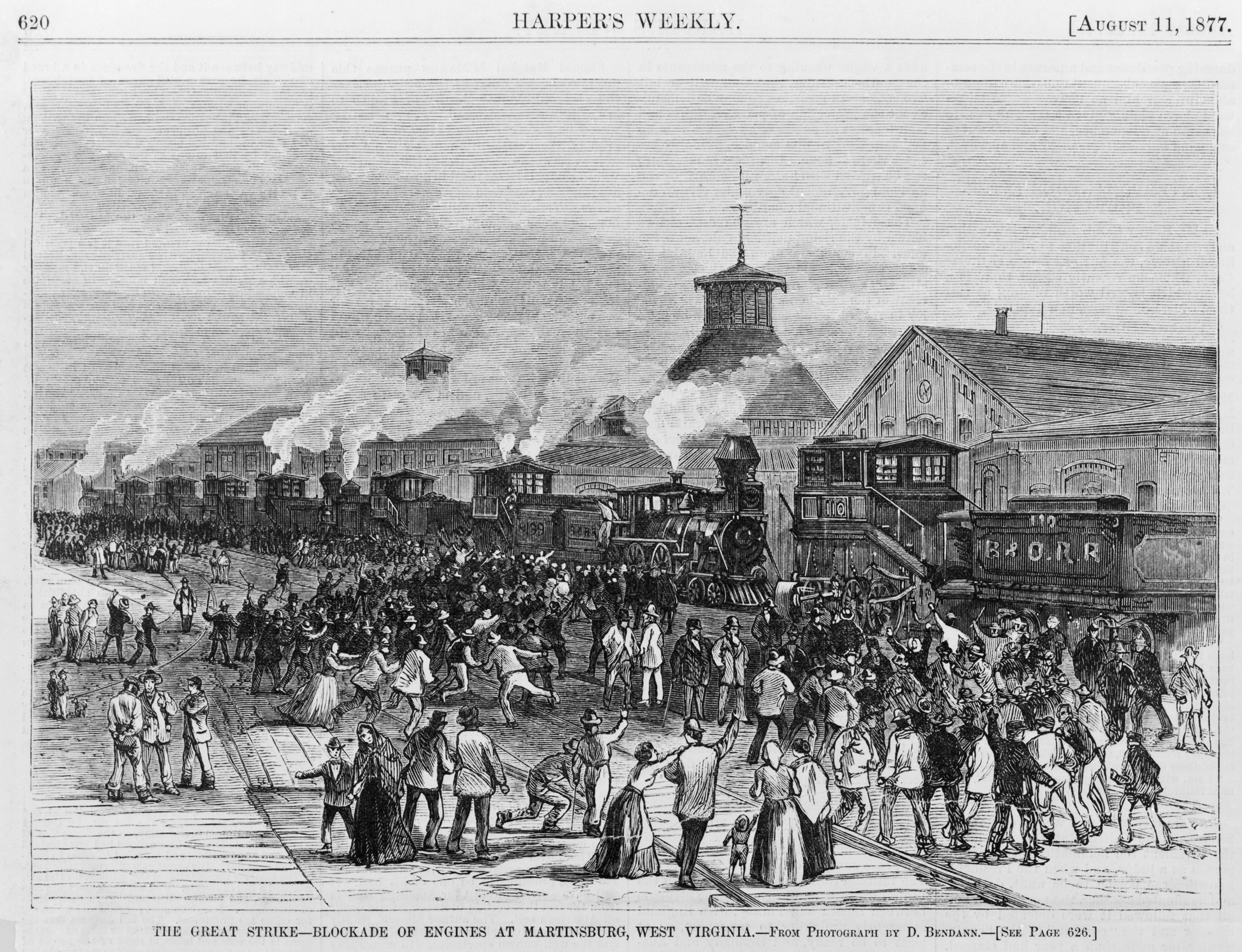
The Great Railroad Strike of 1877. Period illustration. American-Rails.com collection.
On this page: At a glance · Panic and the cuts · B&O: Camden Junction and Martinsburg · Baltimore, July 20 · Pennsylvania Railroad and Pittsburgh · Reading and Scranton · Erie, Central, Lake Shore · Chicago · St. Louis · Elsewhere · What it did and did not do
At a glance
| Item | Detail |
|---|---|
| Dates | July 16 (Camden Junction / Martinsburg) through early August 1877. Hayes diary, August 5: the strikes “have been put down by force” |
| Spark | B&O 10% cut effective July 16 (John W. Garrett), on top of earlier cuts. PRR Pittsburgh “double-headers” announced the same week |
| First walkouts | Camden Junction, Md. (noon, July 16); Martinsburg, W.Va. (evening, July 16) |
| Roads in the thick of it | Baltimore & Ohio; Pennsylvania; Philadelphia & Reading; Erie; New York Central & Hudson River; Lake Shore & Michigan Southern; DL&W; Delaware & Hudson; plus terminals at Chicago, St. Louis, Buffalo, Columbus, Indianapolis |
| Dead | On the order of 100 nationwide. Baltimore ~10–11 (July 20); Pittsburgh ~20 in the first militia volley (July 21), more in the roundhouse fight; Reading 10–16 (July 23); Chicago ~14–30 (July 25–26); Scranton 4 (August 1) |
| Property | Worst at Pittsburgh: PRR listed 39 buildings, 104 locomotives, 46 passenger cars, ~1,200 freight cars; about $4.1 million (period dollars), much of it insured |
| Federal troops | Hayes proclamations from July 18 (West Virginia) onward. Regulars to Martinsburg, Baltimore, Pittsburgh, Chicago, St. Louis, and other points. Reconstruction troops had just come out of the South |
| Immediate result | Strike broken. Almost no wage restoration. Brotherhood chiefs had not called it |
| Not a 1877 statute | ICC February 4, 1887; Safety Appliance Act March 2, 1893. Those are later. See 1870s |
City death counts vary among newspapers, coroners, and later syntheses (Foner, Stowell, Bruce). The order-of-magnitude national figure of about 100 is the one to keep. Information compiled September 6, 2026.
The Panic, the unions, the 10 percent
Life as a railroader in the 1870s meant long hours, link-and-pin, hand brakes, and almost no safety law. The Panic of 1873 made it worse. David O. Stowell, in The Great Strikes of 1877, puts about 30 national and international trade unions in the United States just before the crash, and about nine still functioning when July 1877 opened. John Stover’s atlas, the same series used on the history hub, has the country adding more than 40,000 miles between 1870 and 1880—but the hot years were the boom. Roughly 34,000 miles were spiked from 1865 through 1873; only about 6,000 followed in 1873–77. Railroads were already the country’s second-largest employer after farming. A lot of that new track had been built on easy money.
Jay Cooke & Company failed on September 18, 1873, trying to sell Northern Pacific bonds. That is the Panic. The Northern Pacific itself did not vanish that afternoon; construction stalled and the road later went into receivership. The Coinage Act of 1873 (ending silver as a monetary standard for new coin) sat in the same season; it is context, not the whole cause. What the men felt was simpler. Philip S. Foner, in The Great Labor Uprising of 1877, put average railroad wage cuts at about 21–37 percent while food prices had fallen only about 5 percent. Dividends, on more than one road, kept being paid. The B&O was among the hardest: Foner has cuts approaching 50 percent on some jobs, then Garrett’s July circular taking another 10 percent from anyone making more than a dollar a day. Firemen who had been at $1.75 were looking at $1.58, and fewer trips.
Between November 1873 and July 1874, men struck on eighteen roads over the first round of cuts. The walkouts lasted a week or two. The companies fired and blacklisted. That usually worked. A B&O construction-labor stoppage in June 1831 is often called the first American railroad strike; it was not the first strike in the country. The brotherhoods of 1877 were still craft societies, not industrial unions: the Machinists’ and Blacksmiths’ International Union, the Brotherhood of Locomotive Firemen (1873), the Order of Railway Conductors, and the Brotherhood of Locomotive Engineers. Only the engineers, about 10,000 members, had real weight. Grand Chief Engineer Charles Wilson would not strike and would not stand with men outside the BLE. When July came, the chiefs of the major railway fraternities were as frightened of a general uprising as the governors were. They did not call this strike. Shopmen, firemen, and brakemen did.
Away from home, men still paid railroad hotels, return tickets, and meals out of the reduced check. That bill sat on top of the percentage.
Camden Junction and Martinsburg
Garrett’s cut went into effect Monday, July 16. Shortly before noon the fireman on B&O freight engine No. 32 walked off at Camden Junction, the throat west of Baltimore through which Washington and western trains had to pass. Other firemen followed. Mayor Ferdinand C. Latrobe—his family had long been tied to the B&O—sent police. A show of force usually ended it. It did not. By the next day engineers were out, and so were Baltimore boxmakers, sawyers, and tin-can makers who had their own cuts. The strikers, Foner stresses, kept hands off passenger and mail trains. Stopping the mails would have been a federal offense. They wanted the freight.
That evening, at Martinsburg, twenty-five or thirty firemen left their trains, ran engines into the roundhouse, and told officers nothing would leave until the 10 percent came back. Most of the local men were in a Trainmen’s Union. Newspapers reached for “rioter” and, in some sheets, “communist.” The Paris Commune was six years old; that word did a lot of work in 1877 that the Martinsburg firemen had not asked it to do.
West Virginia governor Henry M. Mathews called the militia. On July 17 a strikebreaker tried to take a freight out under guard. Striker William P. Vandergriff exchanged fire with militiamen, was hit three times, and later died. The militia did not restore the road. Mathews asked President Rutherford B. Hayes for regulars. Hayes’s proclamation of July 18 ordered the combinations to disperse by noon the 19th. Army troops reached Martinsburg on the morning of July 19 and found, as the live account here has long said, almost nothing out of place: no general wrecking, no burning shops. Replacements and arrests, with the Army behind them, broke Martinsburg. The B&O’s problem had already left town.
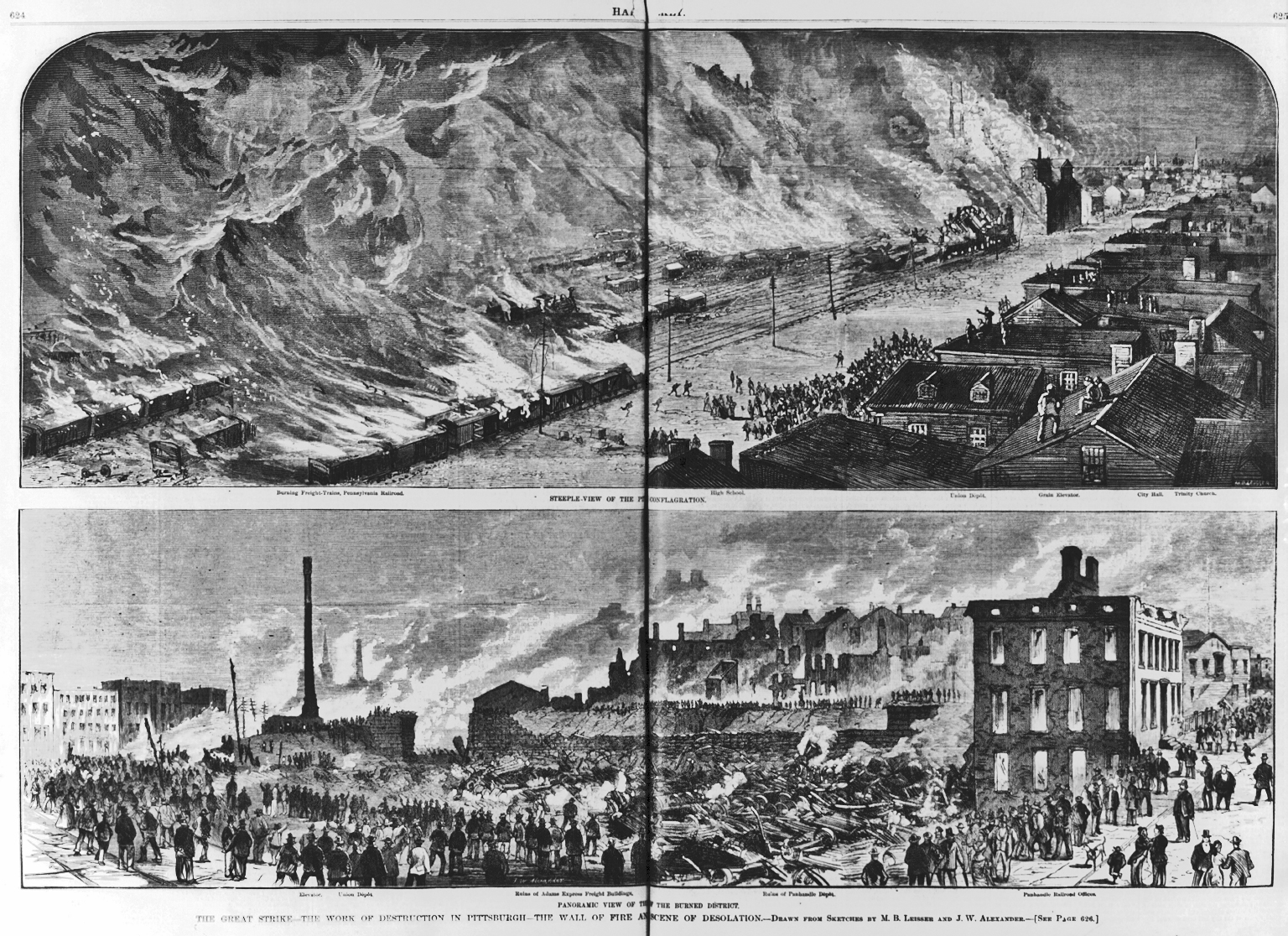
Great Railroad Strike of 1877. Period illustration. American-Rails.com collection.
Baltimore, July 20
The quiet in Baltimore did not last. On the night of July 20 the state tried to move militia to Cumberland, where strikers had blocked the B&O. The Sixth Maryland Regiment had to fight its way from the armory toward Camden Station. Stones, then rifle fire. About 10 or 11 people died—among them a newsboy and a sixteen-year-old student in the Baltimore accounting—and about 40 were wounded. Contemporary papers reached for “Second Battle of Bunker Hill.” The crowd, swelling toward 15,000, drove the soldiers into the Camden train sheds and tried to burn the station. They did not take it. Over the weekend, 1,200 to 2,000 federal troops, some from Fort McHenry, restored the city. That was the last large B&O bloodletting. The strike was no longer a B&O story.
The Pennsylvania, Pittsburgh, and the double-header
On the same July 16 the Pennsylvania Railroad told Western Division men that as of July 19 eastbound trains to Altoona would be double-headed: two locomotives, longer consists, not two full crews. More work, same pay, after the cuts. The PRR had heard complaints before. It had not installed Janney knuckles or Westinghouse air as a system standard; link-and-pin and hand brakes were still the freight railroad. With Martinsburg in the papers, two brakemen and a flagman on an eastbound Pittsburgh freight due out at 8:40 a.m. on July 19 refused to go. Pittsburgh, a major PRR terminal, stopped.
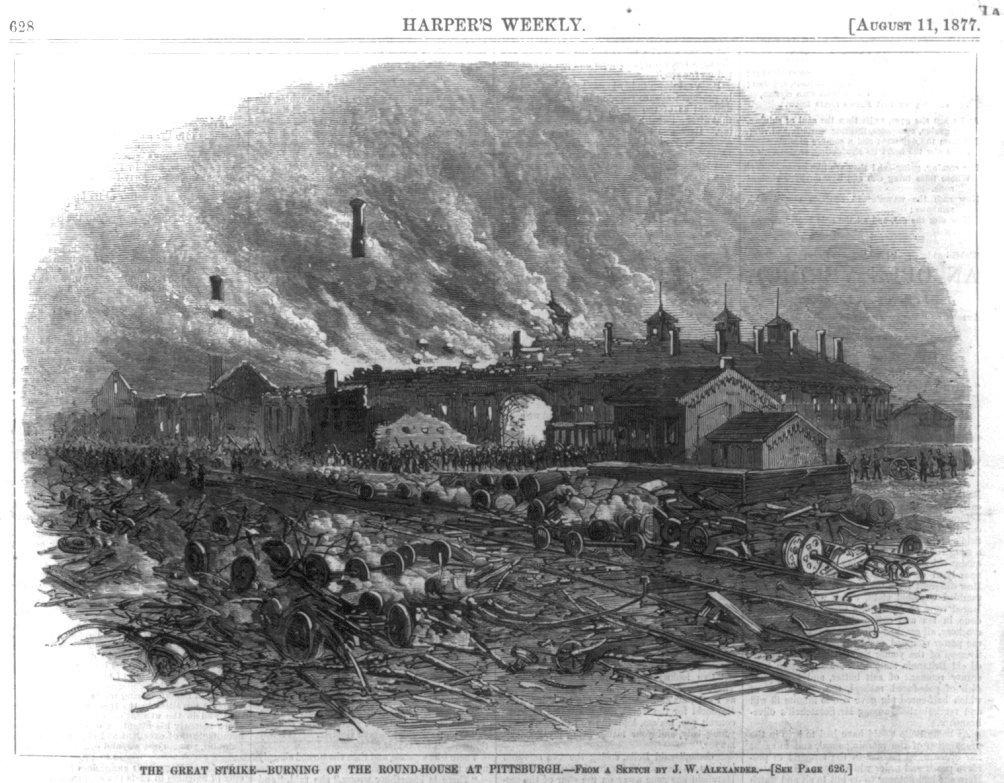
Governor John F. Hartranft was in Wyoming Territory. Adjutant General James W. Latta called the militia. The local Sixth Division was too close to the men. Philadelphia’s First Division came instead—about 600 soldiers, picking up Gatling guns and ammunition at Harrisburg. On the afternoon of July 21 they charged with fixed bayonets, then opened fire. About 20 people died in that first collision, including a woman and three children; about 29 were injured. The soldiers retreated into the roundhouse. The crowd burned what the PRR owned from there toward 28th Street (period inventories run from the roundhouse to 23rd or 28th depending on the clerk). The railroad’s own count, the one Foner and later writers repeat, is 39 buildings, 104 locomotives, 46 passenger cars, and about 1,200 freight cars, some $4.1 million, with insurance covering about $3 million. Militiamen held the roundhouse with a water hose and shot their way out the next morning. More people died in that fighting. Pittsburgh, not Martinsburg, is why 1877 is remembered as a burning.
Tom Scott ran the Pennsylvania. He wanted troops, and he got them. Across the river in Allegheny City, a Fort Wayne brakeman named Robert M. Ammon organized a disciplined halt on the Pittsburgh, Fort Wayne & Chicago, the Allegheny Valley, and the Panhandle, with the B&O’s Connellsville line in reach. For a few days he ran a strike that actually stopped long-distance freight. When he tried to hand operations back on July 24, his own people overruled him and he resigned. After that the PRR walkouts came apart even where the public was still with the men.
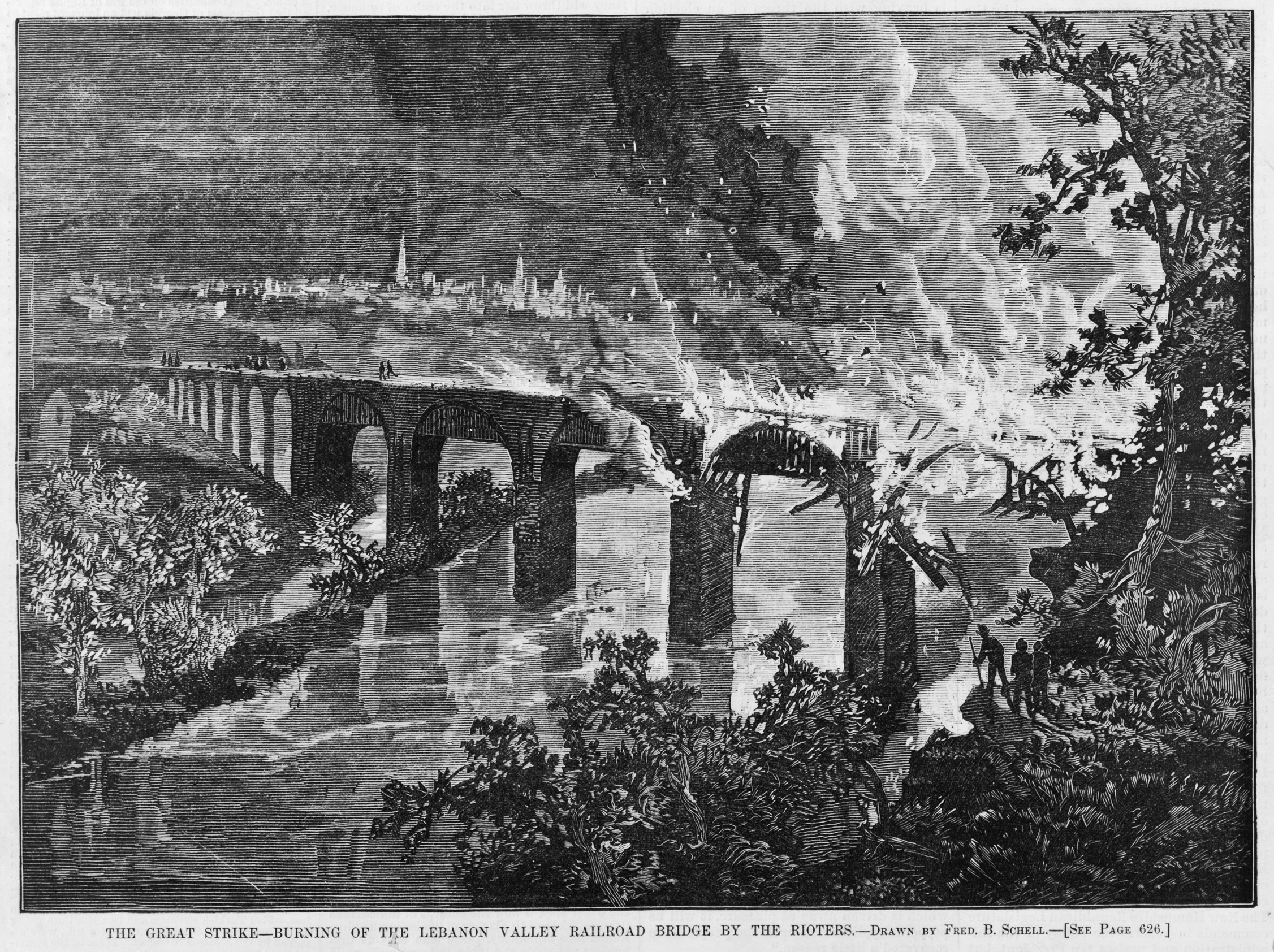
Great Railroad Strike of 1877. Period engraving. American-Rails.com collection.
Reading, July 23, and Scranton
Franklin B. Gowen’s Philadelphia & Reading was the anthracite road. Reading men struck on July 22 after Pittsburgh. Gowen refused arbitration and took Pennsylvania’s 4th Regiment / Second Division. On the evening of July 23, in the Seventh Street Cut, militia fired into a crowd that had been throwing stones. The Reading Railroad Massacre killed 10 to 16 people—period sheets print both ends of that range—and wounded several dozen, including policemen. It was not a pitched battle between two armed camps. It was a volley into a street.
On July 24 about 1,500 men at the Lackawanna Iron & Coal Company, with DL&W and Delaware & Hudson firemen and brakemen, went out in Scranton. By the 29th some 35,000 people in that coal-and-iron basin were idle. Mayor Robert H. McKune leaned on a hastily armed Scranton Citizens’ Corps, stiffened by company men under W. W. Scranton. Railroaders were already going back when, on August 1, a crowd met the Corps. The mayor was knocked down. The Corps fired. Four men were killed (some period counts print six) and scores wounded. State and federal troops followed. Miners stayed out, in places, into October. The railroad strike in Scranton was already over.
Hornellsville, Buffalo, and Vanderbilt
The Erie Railway had been in bankruptcy since the Panic. Hugh Jewett cut 10 percent as of July 1. The men waited. After Pittsburgh they did not. Hornellsville, New York—junction of Erie’s Buffalo, Susquehanna, and Allegheny divisions—went out about 1:00 p.m. on July 20 (some accounts the 21st). The stoppage spread to other Erie points. Governor Lucius Robinson called militia. In Hornellsville the first troops did little. Brooklyn’s 23rd Regiment later broke the halt. Erie’s nerve center reopened about July 26, and the rest of the road followed.
Buffalo was a different machine: Erie, Lackawanna, Lehigh Valley, New York Central & Hudson River, Lake Shore & Michigan Southern. After Erie went out, Central and Lake Shore men followed their own 10 percent. William H. Vanderbilt—the Commodore had died January 4, 1877—did not play Garrett or Scott. He stopped the trains and waited. Robinson’s force plus that refusal to bargain ended it. The Central called it over by July 30; Lake Shore men quit the same day. No concession.
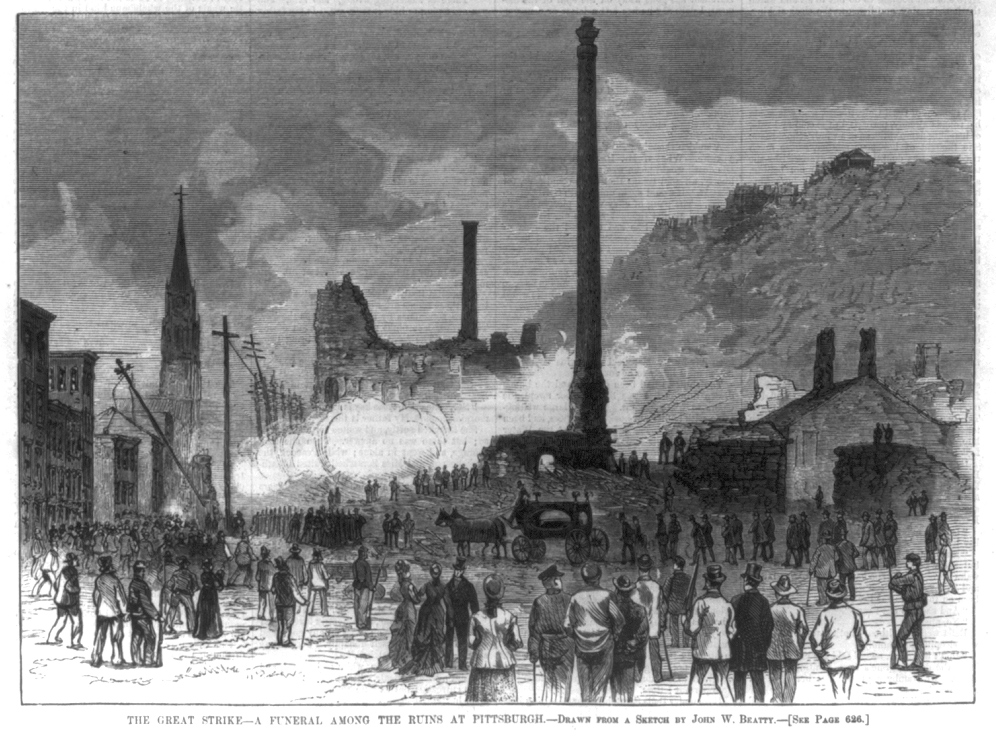
Great Railroad Strike of 1877. Period print. American-Rails.com collection.
Chicago: the viaduct
The live copy on this page once filed Chicago with cities that “never enjoyed national coverage.” That was the hole. Chicago was on every front page that last week of July. The Workingmen’s Party and men such as Albert Parsons gave the crowds more structure than Martinsburg had had. On July 24–25 strikers and sympathizers shut roundhouses, including Burlington. Police fired into gatherings at the yards.
The worst day was July 25–26 at the Halsted Street viaduct—the Battle of the Viaduct. A crowd of thousands met police and militia. Stones, pistol shots, then volleys. Death counts run from about 14 to 30; many of the dead were boys. A hundred or more were wounded. Order returned that evening. Chicago did not burn like Pittsburgh. It did kill like Baltimore, and then some.
St. Louis: a general strike
St. Louis, with East St. Louis across the river, is the other theater this page underplayed. Beginning July 22, railroaders stopped freight. The Workingmen’s Party of the United States’ executive committee then pulled in other trades. For several days almost all industry in the city halted. Historians call it the first true general strike in the United States. Demands ran past railroad wages to an eight-hour day and a ban on child labor. City fathers reached for the Paris Commune; the press said “St. Louis Commune.” Inside the city the halt was largely bloodless compared with Pittsburgh. East St. Louis and the approaches were not. Federal soldiers and thousands of deputized special police broke the committee by July 28. Period tallies around the two cities run up toward 18 dead. The general strike ended without the wage restoration the railroaders had started for.
Columbus to San Francisco
The same ten days hit Columbus and Newark, Ohio; Indianapolis; Louisville; Albany and the West Albany yards; Kansas City; and smaller B&O towns from Cumberland and Keyser to Grafton. Some were quiet blockades. Some shot people. San Francisco’s street fighting mixed labor anger with anti-Chinese attacks—a different, uglier strain, and not a railroad operating story. Add it all up and more than 100,000 workers were idle at the peak, across industries, and more than half the country’s freight sat still. About 1,000 people went to jail. About 100 were dead.
Virtually every walkout began as a wage protest. The shootings, in Baltimore, Pittsburgh, Reading, Chicago, and Scranton, were militia, police, or a citizens’ corps firing into crowds. Calling the whole two weeks a “riot” was the newspapers’ word. It was not the firemen’s at Camden Junction.
Great Railroad Strike of 1877. Period illustration. American-Rails.com collection.
August 5, and what 1877 actually changed
On August 5, 1877, Hayes wrote in his diary: “The strikes have been put down by force; but now for the real remedy.” He thought the railroaders, as a rule, were “good men, sober, intelligent, and industrious,” and that the mischief was stopping other men from working and holding the companies’ property. That is the president who had just used the Army. It is also the president who, months earlier, had pulled the last Reconstruction troops out of the South. Ulysses S. Grant noticed the contrast: newspapers that had howled about soldiers protecting Black citizens in the South did not howl when the same government put regulars on a railroad platform.
The strike failed on its own terms. Wages stayed cut. The BLE had not led it. Blacklists thickened. Companies built or expanded private militias and looked harder at the Pinkertons. Cities that had watched militia melt into the crowd built armories and reorganized the National Guard so the next call-up would not be the neighbors. That is a real consequence, and it is not a labor victory.
The other consequence is memory. Working people had seen a national stoppage. The Workingmen’s Party and, later, the Knights of Labor grew in that shadow. Greenback-Labor politics took the eight-hour day and an end to company scrip into elections. The Washington Capital, reprinted in the Martinsburg Statesman on September 4, 1877, called it “not the work of a mob nor the working of a riot, but a revolution that is making itself felt throughout the land.” America was not the same. That does not mean Congress answered with the ICC.
The Interstate Commerce Act of February 4, 1887, and the Elkins, Hepburn, and Mann-Elkins acts after it, are the Granger-and-rebate story: state rate laws, Munn (1877, grain elevators), Wabash (1886), then a federal commission on interstate charges. Railroad labor is not why those statutes exist. The Safety Appliance Act of March 2, 1893, with a delayed effective date, put Westinghouse automatic brakes (straight-air patent 1869, automatic 1872) and Janney knuckles (patent 1868, not 1873) on cars by force of law. Angola (1867) and Ashtabula (1876) belong on that chain. So do the dead switchmen of the 1880s. 1877 belongs on the labor chain: the first national industrial strike, broken by militia and regulars, remembered by everyone who later tried to organize a railroad.
Related Reading on American-Rails.com
- Railroads in the 1870s — Panic, mileage, air brake, Granger; this strike as a pointer
- Railroad history hub
- Baltimore & Ohio · Pennsylvania Railroad · Erie · New York Central
- Ashtabula · Angola Horror · Westinghouse air brake
- Railroad jobs · Tycoons
Sources
- Foner, Philip S. The Great Labor Uprising of 1877. New York: Monad / Pathfinder, 1977. Camden Junction engine 32; wage-cut percentages; Martinsburg, Baltimore, Pittsburgh, Ammon; national frame.
- Stowell, David O. The Great Strikes of 1877. Urbana: University of Illinois Press, 2008 (and Stowell’s related essays). Union counts before and after the Panic; urban crowd actions.
- Bruce, Robert V. 1877: Year of Violence. Indianapolis: Bobbs-Merrill, 1959. Still the standard narrative synthesis for city-by-city violence.
- B&O 10% circular effective July 16, 1877 (Garrett); firemen $1.75 to $1.58 as reported in Dacus and the Baltimore press. Mayor Ferdinand C. Latrobe.
- Baltimore American / Sun, July 16–17, 1877: Camden Junction day; Martinsburg evening of the 16th. Vandergriff shooting July 17.
- Hayes proclamation, July 18, 1877 (West Virginia). Diary, August 5, 1877, “The strikes have been put down by force; but now for the real remedy” (Charles Richard Williams edition).
- Pittsburgh, July 19–22: PRR double-headers; Latta and the Philadelphia militia; roundhouse; PRR property inventory (39 buildings, 104 locomotives, 46 passenger cars, ~1,200 freight cars).
- Reading Railroad Massacre, July 23, 1877. Scranton Citizens’ Corps shooting, August 1, 1877 (4 killed in the modern count; some period reports 6).
- Chicago, Battle of the Viaduct, July 25–26, 1877. St. Louis general strike / Workingmen’s Party executive committee, July 22–28, 1877.
- Stover, John F. The Routledge Historical Atlas of the American Railroads. Mileage 1870–80 and the 1865–73 vs 1873–77 construction contrast.
- Jay Cooke & Co., September 18, 1873. NP receivership is later; see /1870s.html and /np.html.
- Janney coupler patent 1868; Westinghouse straight-air 1869, automatic March 5, 1872; Safety Appliance Act March 2, 1893. ICC February 4, 1887, is not a 1877 labor statute.
- Washington Capital, as reprinted in the Martinsburg Statesman, September 4, 1877.
- American-Rails.com: 1870s decade leaf; B&O; Pennsylvania; Erie; New York Central; jobs; Westinghouse; Ashtabula; Angola.
Recent Articles


-
Pennsylvania Railroad Museums (2026): A Complete Guide
Oct 06, 26 12:09 AM
 Pennsylvania railroad museums—Strasburg, Steamtown, the Horseshoe Curve, the East Broad Top, and the depots and towers in between. Confirm hours on each site.
 -
Maryland Railroad Museums (2026): A Complete Guide
Oct 05, 26 11:53 PM
 Maryland railroad museums—the Baltimore roundhouse, Ellicott City station, Bowie, Gaithersburg’s Buffalo Creek & Gauley 14, and the Western Maryland collections.
 -
Ohio Railroad Museums (2026): A Complete Guide
Oct 05, 26 05:51 PM
 Ohio railroad museums—the Age of Steam Roundhouse, Bellevue, Worthington, Conneaut’s Nickel Plate 755, and the Dennison depot. Confirm hours on each site.
 -
Delaware Railroad Museums (2026): A Complete Guide
Oct 05, 26 02:43 PM
 Delaware railroad museums—Wilmington & Western at Greenbank, the Harrington tower and N5 caboose, Felton's 1868 depot, and the Selbyville station museum.
 -
C&O's M-1 Steam Turbine Locomotives: Specs, Roster, History
Oct 05, 26 12:13 PM
 Chesapeake & Ohio Class M-1 steam-turbine-electrics. Three Baldwin-Westinghouse locomotives, 500–502, built 1947–48 for The Chessie. Specs, the 2-C1+2-C1-B arrangement, and a roster. All scrapped…
 -
N&W 2-6-6-2 Locomotives (Class Z): Specs, Roster, History
Oct 05, 26 11:44 AM
 Norfolk & Western Class Z 2-6-6-2s. One hundred ninety compound Mallets, 1300–1489, from Richmond, Baldwin, and Schenectady, 1912–1918. Diagram specs, the Z-1b rebuilds, Z-2 1399, and a roster. No…
 -
Scenic Train Rides (USA 2026): State Guide to Tourist Railroads
Oct 04, 26 12:17 AM
 Scenic and tourist train rides in all 50 states for 2026. Colorado narrow gauge, Pennsylvania steam, Alaska’s White Pass, and the states with no full-size ride this month. Confirm on the railroad.
 -
Wyoming Scenic Train Rides (2026): A Complete Guide
Oct 03, 26 12:07 AM
 Wyoming has no full-size tourist railroad on the calendar in October 2026. Cheyenne Depot Museum and Douglas Railroad Museum are static. Union Pacific 4014’s posted public trip is a November run to De…
 -
Washington Scenic Train Rides (2026): A Complete Guide
Oct 02, 26 11:53 PM
 Washington tourist trains in 2026—Mount Rainier Scenic at Elbe, the Northwest Railway Museum, and Chehalis-Centralia. Lake Whatcom has no 2026 date on its ticket page.
 -
Wisconsin Scenic Train Rides (2026): A Complete Guide
Oct 02, 26 11:48 PM
 Wisconsin tourist trains in 2026—Wisconsin Great Northern, Osceola & St. Croix Valley, Mid-Continent, East Troy, and the National Railroad Museum.
 -
Pennsylvania Railroad Class Q2 4-4-6-4: Specs, Roster, History
Oct 02, 26 11:28 PM
 Pennsylvania Railroad Class Q2 4-4-6-4 duplexes. Twenty-six engines, 6131 and 6175–6199, Altoona 1944–45. Form 109-J specs, the 7,987 hp test of 6175, and a roster. All scrapped.
 -
Utah Scenic Train Rides (2026): A Complete Guide
Oct 02, 26 11:18 PM
 Utah tourist trains in 2026—Heber Valley Railroad from Heber City. Golden Spike at Promontory is a locomotive demonstration, not a line-haul ride.
 -
South Dakota Scenic Train Rides (2026): A Complete Guide
Oct 02, 26 11:06 PM
 South Dakota’s 2026 scenic train is the Black Hills Central 1880 Train, Hill City to Keystone. Steam is the summer assignment. Confirm the engine.
 -
Oregon Scenic Train Rides (2026): A Complete Guide
Oct 02, 26 11:04 PM
 Oregon tourist trains in 2026—Oregon Coast Scenic from Rockaway Beach, Mount Hood at Hood River, Eagle Cap from Elgin, and the Oregon Rail Heritage Center in Portland.
 -
Oklahoma Scenic Train Rides (2026): A Complete Guide
Oct 02, 26 10:36 PM
 Oklahoma has no full-size scenic railroad on an October 2026 calendar. Oklahoma Railway Museum Halloween and Polar trains, the El Reno trolley, and the Heartland Flyer.
 -
North Dakota Scenic Train Rides (2026): A Complete Guide
Oct 02, 26 01:14 PM
North Dakota has no tourist railroad on a 2026 calendar. Ride Amtrak’s daily Empire Builder. The Fort Lincoln Trolley in Mandan is not a current ticket. -
Nebraska Scenic Train Rides (2026): A Complete Guide
Oct 02, 26 10:11 AM
 Nebraska has no full-size scenic railroad in 2026. The Omaha Zoo Railroad runs weekends through October 4. Ride Amtrak’s California Zephyr across the state.
 -
Missouri Scenic Train Rides (2026): A Complete Guide
Oct 02, 26 09:56 AM
 Missouri tourist trains in 2026—Branson Scenic Railway and the St. Louis, Iron Mountain & Southern at Jackson. Belton has no 2026 schedule posted.
 -
Minnesota Scenic Train Rides (2026): A Complete Guide
Oct 02, 26 09:52 AM
 Minnesota tourist trains in 2026—North Shore Scenic Railroad in Duluth, the Duluth River Train, and the Como-Harriet streetcar.
 -
Kansas Scenic Train Rides (2026): A Complete Guide
Oct 02, 26 09:32 AM
 Kansas tourist trains in 2026—the Abilene & Smoky Valley Railroad. Santa Fe 3415 is in overhaul. Midland Railway at Baldwin City is closed.
 -
Iowa Scenic Train Rides (2026): A Complete Guide
Oct 02, 26 08:41 AM
 Iowa tourist trains in 2026—Boone & Scenic Valley across the Bass Point Creek High Bridge, and Midwest Central’s December North Pole trains
 -
Indiana Scenic Train Rides (2026): A Complete Guide
Oct 02, 26 08:35 AM
 Indiana tourist trains in 2026—French Lick Scenic Railway, Nickel Plate Express, Hoosier Valley, and Hesston. Whitewater Valley is suspended.
 -
Illinois Scenic Train Rides (2026): A Complete Guide
Oct 02, 26 12:28 AM
 Illinois tourist trains in 2026—Illinois Railway Museum, Monticello Railway Museum, Fox River Trolley, and Silver Creek & Stephenson.
 -
Texas Scenic Train Rides (2026): A Complete Guide
Oct 02, 26 12:14 AM
 Texas tourist trains in 2026—Texas State Railroad, Grapevine Vintage Railroad, Austin Steam Train's Hill Country Flyer, and the Galveston Railroad Museum.
 -
Tennessee Scenic Train Rides (2026): A Complete Guide
Oct 02, 26 12:03 AM
Tennessee tourist trains in 2026—Tennessee Valley Railroad Museum, Dollywood Express, Three Rivers Rambler Christmas trains, and the Tennessee Central Railway Museum. -
South Carolina Scenic Train Rides (2026): A Complete Guide
Oct 01, 26 11:52 PM
 South Carolina's tourist train is the South Carolina Railroad Museum in Winnsboro—Blue Granite Express, pumpkin trains, and Santa trains on the old Rockton & Rion.
 -
Mississippi Scenic Train Rides (2026): A Complete Guide
Oct 01, 26 11:38 PM
 Mississippi has no regular tourist railroad in 2026. Ride Amtrak through the state, or book the excursion lines in Alabama, Tennessee, Louisiana, or Arkansas.
 -
Louisiana Scenic Train Rides (2026): A Complete Guide
Oct 01, 26 02:52 PM
 Louisiana has no regular full-size tourist railroad in 2026. New Orleans Polar Express returns December 11–31. Museums at Long Leaf, DeQuincy, and Jackson.
 -
Kentucky Scenic Train Rides (2026): A Complete Guide
Oct 01, 26 02:45 PM
 Kentucky tourist trains in 2026—Big South Fork Scenic Railway, Bluegrass Scenic Railroad, Kentucky Railway Museum, and My Old Kentucky Dinner Train.
 -
Georgia Scenic Train Rides (2026): A Complete Guide
Oct 01, 26 02:27 PM
 Georgia tourist trains in 2026—Blue Ridge Scenic Railway, SAM Shortline, Azalea Sprinter, Savannah shop rides, and what to confirm at Stone Mountain.
 -
Arkansas Scenic Train Rides (2026): A Complete Guide
Oct 01, 26 01:02 PM
 Arkansas tourist trains in 2026—Arkansas & Missouri through the Boston Mountains, and the Eureka Springs & North Arkansas dinner and excursion trains.
 -
Alabama Scenic Train Rides (2026): A Complete Guide
Oct 01, 26 12:59 PM
Alabama tourist trains in 2026—Heart of Dixie Railroad Museum at Calera, North Alabama Railroad Museum at Chase, and the Wales West Light Railway at Silverhill. -
The Circus Train: How Such Attractions Reached Distant Cities
Oct 01, 26 12:22 PM
 How circuses moved by rail: Coup's 1872 flats, the Ringling train's sections and car counts, the 1918 Hammond wreck, and the last show on May 21, 2017.
 -
West Virginia Halloween Train Rides (2026)
Oct 01, 26 12:19 PM
 2026 West Virginia Halloween train. Cass Scenic Halloween Train, October 30 and 31, steam, 5:00 p.m. from Cass Depot. Adult $75. About two hours to Whittaker. Family ride.
 -
Wisconsin Halloween Train Rides (2026)
Oct 01, 26 12:11 PM
2026 Wisconsin Halloween trains. Mid-Continent Pumpkin Special October 24–25, adult $24, pumpkins extra. Halloween Flyer October 24 at 4:30 p.m., adult $30. Osceola Pumpkin Express boards in Osceola… -
Utah Halloween Train Rides (2026)
Oct 01, 26 12:00 PM
 2026 Utah Halloween trains at Heber Valley Railroad. Pumpkin Train, about 40 minutes, with a cookie and a pumpkin. Halloween Express, about 90 minutes to Grim Hollow, Monday, Thursday, and Friday even…
 -
Texas Halloween Train Rides (2026)
Oct 01, 26 11:28 AM
 2026 Texas Halloween train. Texas State Railroad Spooky Special, adult-only, October 24. Boards Palestine at 5:00 p.m. About five hours to Rusk and back. Dinner on the grounds. Not steam. No fare on t…
 -
Tennessee Halloween Train Rides (2026)
Oct 01, 26 12:15 AM
 2026 Tennessee Halloween trains. Tennessee Valley Railroad Museum Rails, Wizards & Spells, selected days September 18 through October 25, from $35, about 2.5 hours. Spells & Potions tea from $60. The…
 -
Frisco's "Firefly" (Train): Consist, Route, Timetable
Sep 30, 26 11:37 PM
 Frisco Firefly—daylight streamliner, Kansas City to Tulsa and Oklahoma City. Trains 117 and 118. Pacifics 1018, 1026, and 1031. Last run May 22, 1960.
 -
South Carolina Halloween Train Rides (2026)
Sep 30, 26 11:29 PM
 2026 South Carolina Halloween train. South Carolina Railroad Museum Pumpkin Patch Express, the two Saturdays before Halloween. About three miles to the Greenbriar pavilion. Pumpkin for children 12 and…
 -
Oregon Halloween Train Rides (2026)
Sep 30, 26 08:10 PM
2026 Oregon Halloween train. Sumpter Valley Railroad Halloween Express at the Sumpter Depot, calendar window October 31 at 11:00 a.m. through November 1 at 12:30 p.m. Fare and the individual clocks ar… -
Oklahoma Halloween Train Rides (2026)
Sep 30, 26 03:45 PM
2026 Oklahoma Halloween train. Oklahoma Railway Museum, October 30 and 31, from Oakwood Station in Oklahoma City. Adults $15, children 3–12 $8. A candy bag with the ride. -
McCloud River Railroad: Serving The Timber Industry (1897-2009)
Sep 30, 26 03:37 PM
 McCloud River Railroad—Mount Shasta City to McCloud, Hambone, and Burney. Opened August 1, 1897. Alco No. 25 and EMD SD38s. Dinner train through January 2010. Railbikes in 2026; a dinner train is stil…
 -
Nevada Halloween Train Rides (2026)
Sep 30, 26 03:30 PM
2026 Nevada Halloween trains in Ely. Nevada Northern Pumpkin Patch Caper and Haunted Ghost Train. Adult tickets start at $45. Dates are on the railroad’s ticket calendar. Boulder City stays off until… -
Missouri Halloween Train Rides (2026)
Sep 30, 26 11:12 AM
 2026 Missouri Halloween trains. St. Louis Iron Mountain & Southern Pumpkin Patch Train on October 3, 4, 10, and 11, and Halloween Express on October 31 at 1:00 p.m. Jackson depot. No fare on the sched…
 -
Minnesota Halloween Train Rides (2026)
Sep 30, 26 11:06 AM
 2026 Minnesota Halloween trains. North Shore Scenic Great Pumpkin Train in Duluth, October 15–18. Everyone gets a pumpkin. Terror Train is October 30, an adult costume party, about three hours. Fares…
 -
Maryland Halloween Train Rides (2026)
Sep 30, 26 10:42 AM
 2026 Maryland Halloween trains. Western Maryland Scenic Pumpkin Patch Limited, October 17, 18, 24, and 25, $14. Colesville Trolleyween October 24, 25, and 31.
 -
West Side Lumber Company Railroad: Roster, History, Lines
Sep 30, 26 09:45 AM
 West Side Lumber at Tuolumne, California. Three-foot Shay and Heisler logging railroad. Lima shop numbers, builder specs, and where the engines are in 2026.
 -
Kansas Halloween Train Rides (2026)
Sep 30, 26 09:41 AM
 2026 Kansas Halloween train. Abilene & Smoky Valley Pumpkin Harvest Express, October 17 through 31. About one hour. Shop prices $35.56 to $41.02. Everyone picks a pumpkin.
 -
Iowa Halloween Train Rides (2026)
Sep 29, 26 11:58 PM
2026 Iowa Halloween train. Boone & Scenic Valley Pumpkin Express, October 10, 10:00 a.m. from 225 10th Street. About 1 hour 15 minutes. Children pick a pumpkin.