Burlington #4960: Still Running To The Grand Canyon!
Last revised: September 27, 2026
By: Adam Burns
Chicago, Burlington & Quincy 4960 is a class O-1A Mikado, one of sixty Baldwin built in 1923 and numbered 4940–4999 because the 5100s were already full. Baldwin’s construction number is 56809, in the July 1923 serial block 56804–56818. The engine has 64-inch drivers, 27-by-30-inch cylinders, and a 200-pound boiler. The class rating is 58,090 pounds of tractive effort. It spent its Burlington years on freight, most of the last of them on the Beardstown Division, and its public years on fan trips. The last of those was the Denrock Zephyr on July 17, 1966.
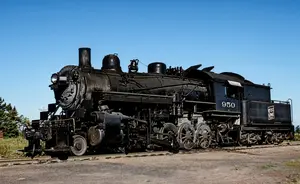
It is still a working locomotive. The Grand Canyon Railway bought it on September 16, 1989, rebuilt it, and has used it between Williams, Arizona, and the South Rim since July 27, 1996. Since 2009 the fire has been waste vegetable oil. Of the Burlington steam locomotives that were not cut up, 4960 is the one that still pulls a train. The other excursion engine of those years, 4-8-4 5632, was scrapped.

CB&Q 2-8-2 #4960 leaves Baraboo, Wisconsin, with the Schlitz Circus Train in June 1966, on Chicago & North Western rails. This was the second of those circus moves. The Burlington’s own steam program had three weeks left. American-Rails.com collection.
On this page: At a glance · Specifications · The O-1A, and the other Mikes · Beardstown · December 28, 1958 · Casper, and the last trip · Wisconsin, then Bristol · Williams · 4963 and 4978
At a glance
| Item | Detail |
|---|---|
| Railroad | Chicago, Burlington & Quincy. Class O-1A. Number 4960, one of 4940–4999 |
| Builder | Baldwin Locomotive Works, Philadelphia. Construction number 56809. July 1923 serial block; the engine is a 1923 locomotive |
| Wheel arrangement | 2-8-2. Leading wheels 33 in. Drivers 64 in. Trailing wheels 42½ in. Driver wheelbase 16 ft 9 in. Engine wheelbase 33 ft 9½ in |
| Cylinders and valves | Two outside cylinders, 27 × 30 in. Fourteen-inch piston valves, outside admission. Walschaerts gear |
| Boiler | 200 psi. Worthington or Elesco feedwater heater on this batch; 4960’s was a Worthington. Radially stayed firebox, combustion chamber, arch tubes or thermic syphons |
| Heating surface | Firebox 325 sq ft. Evaporative 3,409 sq ft. Superheater 769 sq ft. Combined 4,178 sq ft. Grate about 58.8 sq ft |
| Tractive effort | 58,090 lb as published for the class. The usual 0.85 formula gives 58,092 |
| Weight, as built | About 310,780 lb for the engine, about 233,850 lb on the drivers, tender about 195,300 lb. Engine and Burlington tender together on the order of 506,000–512,000 lb |
| Tender, as built | 10,000 gallons of water, about 19 tons of coal |
| Tender now | A Soo Line 4-8-2 tank. 18,000 gallons of water. Fuel is waste vegetable oil, about 3,600–3,800 gallons |
| Revenue steam | Freight, Chicago Division, then the Beardstown Division out of Herrin Junction. Last commercial work in 1958. Burlington commercial steam ended in January 1959 |
| Excursions | First trip December 28, 1958, Chicago–Galesburg. Last CB&Q trip July 17, 1966 |
| Where it is | Grand Canyon Railway, Williams, Arizona. In service there since July 27, 1996. Still the operating Mikado |
Class dimensions follow Bernard Corbin and William Kerka, Steam Locomotives of the Burlington Route (1960), as digested by Steve Llanso on steamlocomotive.com (Locobase 10), and the builder’s serial list in the DeGolyer Library’s Baldwin specifications, Volume 67. Information compiled September 27, 2026.
What Baldwin delivered
The 1923 O-1As were the last new Mikados the Burlington bought, and they were a step up from the O-1s of 1910–11. Those first sixty, 5000–5059, had the same 64-inch drivers and the same 27-by-30-inch cylinders, but the boiler was pressed to 170 pounds and the tractive effort was 49,378 pounds. They carried Emerson superheaters, which the Burlington kept on that class to the end. In 1917 the railroad asked for a radially stayed firebox, a short combustion chamber, and more superheater flues. That engine was the O-1A. The first eighty-eight, 5060–5147, came in 1917–22 at 180 pounds. The 1923 sixty were built at 200 pounds from the start.
The heating surface on the 1923 card is a firebox of 325 square feet, of which 33 are arch tubes and 59 are the combustion chamber, an evaporative surface of 3,409 square feet, and 769 square feet of superheater. Some engines in the batch were fitted with thermic syphons instead of the arch tubes. Direct heating surface of that order, on a grate of about 59 square feet, is what let a 64-inch Mikado walk away with a coal train and still be trusted above 60 miles an hour on the Burlington’s flatter divisions. The piston valves were 14 inches, outside admission. The valve gear was Walschaerts. A Worthington No. 3 or an Elesco feedwater heater went on with the boiler. The 4960’s heater was a Worthington.
Baldwin’s 1923 serials for 4940–4999 are not one unbroken run of numbers. They fall in blocks: 56572–56576 in May, 56704–56713 and 56804–56818 in July, then August, September, and October numbers through 57245–57248. Number 4960 is 56809. The next survivors in the same July block are 4963, construction 56812, and, later in the year’s order, 4978. Sixty engines, one railroad, one year, and three of them are still in one piece.
Where 4960 sits in the fleet
The Burlington’s own 2-8-2s, not counting the Colorado & Southern engines it later leased, come to 383.
| Class | Numbers | Qty. | Built | What they were |
|---|---|---|---|---|
| O-1 | 5000–5059 | 60 | 1910–11, Baldwin | 64 in, 27×30, 170 psi, 49,378 lb. Emerson superheater |
| O-1A | 5060–5147 | 88 | 1917–22, Baldwin | Same cylinders and drivers. 180 psi, 52,283 lb. Later some raised to 200 |
| O-1A | 4940–4999 | 60 | 1923, Baldwin | 4960’s batch. 200 psi, 58,090 lb. Numbered in the 4900s because the 5200s belonged to the O-2 |
| O-2 | 5200–5299 | 100 | 1912–13, Baldwin | Larger boiler. 28×32, 64 in, 180 psi, about 60,000 lb |
| O-2A / O-2B | from the O-2s | 43 + 12 | CB&Q shops, mid-1920s | Rebuilds. New frames and cylinders, combustion chamber, more superheater. Not a second hundred engines |
| O-3 | 5300–5359 | 60 | 1915–19, Baldwin | First Burlington Mikes delivered with a combustion chamber. Later engines at 200 psi |
| O-4 | 5500–5514 | 15 | 1919, Baldwin | USRA heavy Mikados. 63 in drivers, 27×32, 190 psi |
Five more 2-8-2s, Colorado & Southern 800–804, class E-4, were Baldwin engines of 1911 with 57-inch drivers. The Burlington leased them from 1933 to 1947. They are not part of the 383. The O-1s replaced the road’s 2-6-2 Prairies on the heavier freights. The O-1A of 1923 is the engine the Q kept buying after it already knew what a Mike could do on its own profile: a fast freight locomotive for a railroad that was mostly river grade and prairie, not a mountain helper.
Herrin Junction
In ordinary service 4960 was a Chicago Division freight engine. After the war the Burlington put $140 million into diesels, and the steam that was left got shoved onto the divisions that still burned coal. The last of those was Beardstown. There 4960 worked as a mine switcher at Herrin Junction, in southern Illinois, pulled coal extras between Herrin Junction, Beardstown, and Centralia, and handled locals down to Metropolis. Between Centralia and St. Louis it ran on Southern Railway trackage rights. By late 1958 it was one of the last O-1As still fired at Herrin Junction. Its last commercial trips were that year. The Burlington dropped commercial steam in January 1959.
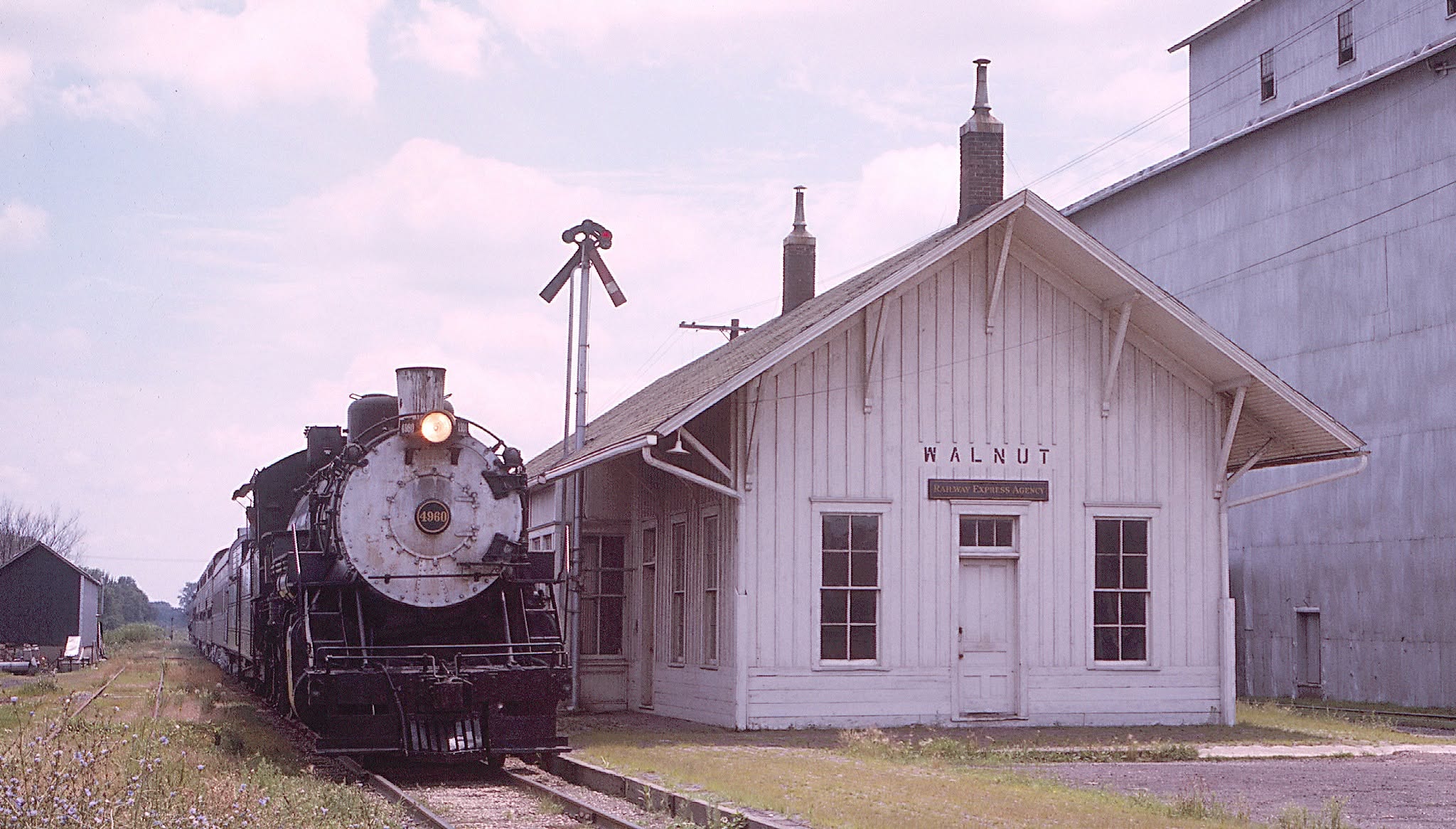
CB&Q 2-8-2 #4960 has a fan trip passing the depot at Walnut, Illinois in August, 1965. Roger Puta photo.
The fan-trip engine
Railfan clubs had been chartering Burlington steam since 1955, with a long list of engines. Number 4960 came north from Herrin Junction in December 1958 for its own first one. On December 28, 1958 it ran from Chicago to Galesburg and back with 490 people aboard, for the Illinois Railroad Club. President Harry C. Murphy wanted the trips to continue after the freight engines were cold, and they did. From 1960 on, the steam program was two locomotives: this Mikado, and Northern 5632.
On May 21, 1961, 4960 went into the Galesburg roundhouse for a Class 3 overhaul. It came out on August 1, with the firebox and the running gear gone through, arch tubes and flues among the new parts. In 1962 the passenger department took the trips over from the clubs and started the Steam Choo-Choo school trains. David P. Morgan, in Trains, called 4960 “The Great Teacher.” The school trains had carried more than 45,000 students by the end of 1962 and more than 75,000 in 1963. The railroad dropped that program in 1964. The fan trips continued, on fewer dates.

Number 4960 passes the depot at Ohio, Illinois, on a fan trip in June 1965. Roger Puta photo.

A fan trip behind 4960 waits at Meriden, Illinois, in March 1966, while train 11, the Nebraska Zephyr, goes by. Rick Burn photo.
Gold paint, a flood, and July 17, 1966
The trip people remember is Casper. The Burlington’s line into that city was fifty years old in 1963. On October 18, 4960 was deadheading the equipment west and ran into the rear car of a passenger train at Douglas, Wyoming. The damage was superficial. The Casper shop replaced the bent headlight bracket on the smokebox door with a temporary platform. On October 20 the engine was sprayed gold and pulled the anniversary excursion, 58 miles from Casper out to Arminto and back. Trains called the gold engine the Tenshodo Mikado, after the importer whose brass models were the color of that paint.
In April 1965, with the Mississippi out of its banks, 4960 was stationed at Savanna and pulled revenue passenger and freight trains through the flood, because the diesels could not get at the work. On July 1 of that year it took the first Schlitz Circus World train from Baraboo to Milwaukee on the North Western. The same day, Harry Murphy retired. Louis W. Menk succeeded him and began cutting what the steam program cost. Number 5632 was already out of service for an overhaul that it would not come back from as a Burlington excursion engine. Number 4960’s flue time ran out on August 1, 1966. An extension for another season was the usual next step. Menk did not take it.

Galesburg, June 19, 1966. Number 4960 is on an excursion. SD9 #366 is on a freight at the left. Hudson #3006, class S-4, is on display at the right. Roger Puta photo.
The 1966 season was a farewell. On June 30 the Mikado pulled the circus train again, Baraboo to Milwaukee. On July 17, 1966 it pulled the Burlington’s last steam excursion, billed the Denrock Zephyr, from Chicago out to Denrock, Illinois, and back. That was the end of the program.
A bridge that would not hold it
The Burlington gave 4960 to the State Historical Society of Wisconsin, which owns the Circus World Museum in Baraboo, on the condition that the engine keep its Burlington paint. A light bridge kept it out of the museum grounds. On July 29, 1966, it moved under its own steam to the Mid-Continent Railway Museum at North Freedom. The next day it was fired and shifted in the yard. That was the only time it ran there. The museum’s track was too light for an O-1A. In October 1970 the society gave the title to Mid-Continent, again with the paint clause, and the engine sat.
In 1979 Harold Keene’s Lonesome Pine Recreation Corporation took a 29.6-mile piece of former Southern, Bristol to Moccasin Gap, Virginia, and called it the Bristol & North Western. Mid-Continent leased 4960 for ten years, paint clause included. Gary Bensman overhauled it inside the old Jackson Iron and Steel mill at Jackson, Ohio. The work was finished March 1, 1981, and the engine was held at 150 pounds instead of 200. It pulled a three-car train on summer weekends between Bristol and Benham, up a 3 percent grade out of Bristol toward Haskell. More than 10,000 people rode in 1981. The next two summers were thin. A few weekends in the fall of 1984 were the last Bristol trips. The lease ended, and in March 1985 the engine went to New Haven, Indiana, to Bensman’s shop at Casad Industrial Park, next to the work being done on Nickel Plate 765. A Quad Cities group that had offered to lease it disappeared. Mid-Continent had an engine and no railroad that could use it.
Sixty-four miles, and a different fire
Max and Thelma Biegert were rebuilding the Santa Fe’s 64-mile line from Williams to the South Rim as the Grand Canyon Railway. Gary Bensman, their first chief mechanical officer, told them 4960 was available. The railway bought it from Mid-Continent on September 16, 1989, the day before ex-Lake Superior & Ishpeming 2-8-0 No. 18 pulled the new company’s first train. The plan was a quick return in Burlington paint. Norfolk Southern would not move the engine: the axles were pitted. The wheels went to Irondale, Alabama. The shop at New Haven then told the railway to get the rest of the locomotive off the property. The boiler was cut off the frame and shipped on flatcars. The original smokebox did not survive the cut.
The real rebuild started in the fall of 1993, under Robert Franzen. It cost $1.6 million and took thirty months. Flues, tubes, both flue sheets, parts of the firebox, and nearly the whole cab were new. Eight transverse arch tubes went into the firebox. The smokebox was smaller than the Burlington one. The Burlington tender, 10,000 gallons and worn out, was replaced by a Soo Line 4-8-2 tender holding 18,000 gallons. The engine was converted from coal to oil, with a fuel tank of about 3,800 gallons, and it was painted for the Grand Canyon rather than for the Q. It was test-fired in May 1996, made a test run on July 9, and pulled its first Williams–Grand Canyon Village train on July 27, 1996. Nine coaches, without a diesel, was the load it was trusted with on the 3 percent into the canyon. More cars were possible. They were harder on the engine at that speed on that grade.
Later changes were about the draft and the fuel. In 2005 a Lempor exhaust replaced the six-jet Kiesel star the front end had been using. In 2007 a Worthington SA feedwater heater, built for a Chinese QJ 2-10-2, went on in place of the old type. The Biegerts sold the railway to Xanterra in late 2006. In September 2008 Xanterra stopped the steam. Each round trip was burning on the order of 1,450 gallons of oil, more than twice a diesel’s fuel on the same run. The engine came back on September 19, 2009, the railway’s twentieth anniversary, burning waste vegetable oil collected from restaurants. The shop’s name for it was the French Fry Express. The stack does not smell like a kitchen. A Trains account of a 2023 round trip put the vegetable oil at about 1,200 gallons and the water at about 12,000.
As of 2026 it is still the Grand Canyon Railway’s operating Mikado, alongside 2-8-0 No. 29, and it is the only former Burlington steam locomotive in service. The paint is the railway’s. The boiler pressure, the 64-inch drivers, and the 27-by-30-inch cylinders are still the 1923 engine.
The other two
Two classmates from the same 1923 order were not scrapped.
4963, Baldwin 56812, also August’s neighborhood of that order, went to the Illinois Railway Museum at Union, Illinois, in 1991. It had been a parts source for the excursion program, then Richard Jensen’s engine, then a long resident of a Chicago scrapyard after Jensen was put out of the Chicago & Western Indiana roundhouse. The museum traded five ex-Grand Trunk Western 0-8-0s for it. It is a static display, cosmetically restored. It has not run since the Burlington days.
4978 was given to the LaSalle County Historical Society in 1965 and is displayed at the Union Depot Railroad Museum in Mendota, Illinois, where it was moved on November 16, 1997. Mendota was on its old division. It is a complete O-1A to look at, rods on, and it is not a candidate for a fire.
Those two, and 4960, are the Burlington Mikados that were kept. The one that still runs is 4960.
Sources
- Corbin, Bernard G., and William F. Kerka. Steam Locomotives of the Burlington Route. 1960. Class O-1, O-1A, O-2, O-3, and O-4 dimensions, as carried in Steve Llanso’s Locobase entries 474, 10, 11020, 2902, 5441, and 9462 on steamlocomotive.com, with the DeGolyer Library’s Baldwin specification volumes (Vol. 67 for the 1923 order).
- Baldwin works numbers for 4940–4999, 1923, including 56804–56818 in July. Number 4960 is construction 56809. Number 4963 is 56812.
- Stagner, Lloyd E., and the excursion chronology summarized from his Burlington steam accounts: last commercial work at Herrin Junction in 1958; December 28, 1958, Chicago–Galesburg, 490 passengers; Class 3 overhaul at Galesburg, May 21–August 1, 1961; Casper deadhead and the Douglas collision, October 18, 1963; gold excursion Casper–Arminto, October 20.
- Trains. David P. Morgan on the school trains (“The Great Teacher”); the October 20, 1963, gold engine as the Tenshodo Mikado. Carl Swanson, “Grand Canyon Railway’s 4960,” September 11, 2023: waste vegetable oil, and a 2023 round trip at about 1,200 gallons of oil and 12,000 gallons of water.
- Bianchi, Curt, and John Moungovan, in the Grand Canyon Railway mechanical accounts: purchase September 16, 1989; rebuild from the fall of 1993, $1.6 million; first revenue trip July 27, 1996; Soo Line tender; Lempor exhaust, 2005; Xanterra and the September 19, 2009 return on waste vegetable oil.
- Bristol & North Western: Harold Keene’s lease of the former Southern between Bristol and Moccasin Gap; Gary Bensman’s overhaul at Jackson, Ohio, finished March 1, 1981; operation at 150 psi, Bristol–Benham; move to New Haven, Indiana, March 1985.
- Circus World and Mid-Continent: donation to the State Historical Society of Wisconsin; move under steam to North Freedom, July 29, 1966; title to Mid-Continent, October 1970.
- Sister engines: 4963 at the Illinois Railway Museum, Union, Illinois, since 1991. 4978 at the Union Depot Railroad Museum, Mendota, moved November 16, 1997.
Related pages: Chicago, Burlington & Quincy · Mikado type · Baldwin · CB&Q 5632 · 4-8-4 type · Steam locomotives
Recent Articles


-
Wabash Diesel Roster (All-Time)
Oct 31, 26 12:35 AM
 Wabash diesel locomotives, each frame once, through the lease at 12:01 a.m. on October 16, 1964.
-
Wabash Steam Roster (Built Since 1900)
Oct 31, 26 12:30 AM
 Wabash steam locomotives built since 1900. Moguls, Mikados, Mountains, and the O-1 Northerns.
-
Wabash Railroad: Map, Rosters, History, Logo
Oct 31, 26 12:28 AM
 History of the Wabash Railroad, from the Northern Cross of 1838 to the Norfolk & Western lease at 12:01 a.m. on October 16, 1964. Follow the Flag. Steam and diesel rosters are separate pages.
-
Court Clears $257.7 Million in Notes for Brightline Florida
Oct 31, 26 12:18 AM
 A New Jersey bankruptcy court on October 29, 2026 authorized $257.7 million in notes for Brightline Trains Florida. The operating company is not one of the 17 debtor holding companies.
-
Brightline West Still Waiting on a $6 Billion Federal Loan
Oct 31, 26 12:11 AM
 Brightline West said October 27, 2026 that it is still working through a $6 billion federal loan and still talks about opening in 2029. The Florida restructuring is a separate company.
-
BNSF Reopens the Gallup Subdivision After New Mexico Flooding
Oct 31, 26 12:06 AM
 BNSF said October 28, 2026 that both Gallup Subdivision main tracks are back after flooding near Laguna, New Mexico. The El Paso Subdivision was still out of service.
-
CSX Says Interchange Is Moving Again After a Technology Outage
Oct 31, 26 12:01 AM
 CSX said October 29, 2026 that interchange with other Class I railroads is moving again after a technology outage that began October 27. Dispatching and positive train control stayed up.
-
Baldwin "Baby Face" Locomotives: Specs, Photos, Roster
Oct 30, 26 11:01 PM
 Baldwin's Babyface cab on the early road diesels: 50 short-cab units, 1946-1948, plus the related Centipede. Construction numbers, specs, and the sharknose that followed.
-
California High-Speed Rail Chief Resigns
Oct 30, 26 08:36 PM
 Ian Choudri resigned October 28, 2026 as chief executive of the California High-Speed Rail Authority. The board named Joe Stephenshaw interim chief executive.
-
The 1910 Portal Bridge Is Handed Over for Demolition
Oct 30, 26 04:03 PM
 Amtrak handed the 1910 Portal Bridge over for demolition on October 29, 2026, during the final cutover to Portal North. Regular NJ Transit and Amtrak schedules are expected November 15.
-
Union Pacific-Norfolk Southern Merger Review Runs to 2027
Oct 30, 26 03:59 PM
 Union Pacific says the Surface Transportation Board's review of the Norfolk Southern merger gathers information through May 28, 2027. A closing still depends on board approval.
-
Amtrak Board Will Hear Restructuring Comments on November 10
Oct 30, 26 03:41 PM
 Amtrak's board will hear public comments on its restructuring on November 10, 2026, from 2 to 3 p.m. Eastern. Written comments were due October 30. A proposal goes to the board in December.
-
Canadian Pacific Selkirk 5931 Restored in Calgary
Oct 30, 26 01:36 PM
 Heritage Park in Calgary unveiled a cosmetic restoration of Canadian Pacific 2-10-4 No. 5931 on October 27, 2026. One of two surviving Selkirks. It stays on display.
-
Gettysburg Railway to Host Steam for Lincoln
Oct 30, 26 01:18 PM
 Northern Central Railway of York No. 17 will recreate Lincoln's arrival at Gettysburg on November 18, 2026, with public steam trips November 19-21.
-
NC&StL No. 576 to Steam for the Public in Nashville
Oct 30, 26 01:00 PM
 Nashville Steam will fire NC&StL 4-8-4 No. 576 for the public on November 7, 2026, 9 a.m. to 3 p.m., at 220 Willow Street. Admission is free.
-
Pennsylvania Railroad E8s Join the T1 Trust
Oct 30, 26 12:38 PM
 The T1 Trust has acquired former Pennsylvania Railroad E8A diesels 5702A and 5761A from the Fort Wayne Railroad Historical Society. They are bound for Cumberland.
-
Ligonier Valley Railroad: History, Roster, Timetable
Oct 30, 26 12:03 PM
 The Ligonier Valley Railroad ran 10.5 miles from Latrobe to Ligonier, Pennsylvania. Opened December 1, 1877. Last day August 31, 1952.
-
Toledo, Peoria & Western Diesel Roster (All-Time)
Oct 30, 26 10:25 AM
 Toledo, Peoria & Western diesel locomotives, each frame once. Thirteen Alcos, three Lima-Hamilton switchers, and 26 Electro-Motive units.
-
Toledo, Peoria & Western Steam Roster
Oct 30, 26 09:14 AM
 Toledo, Peoria & Western steam locomotives from the Rogers Consolidations of 1895 through the 4-8-4s of 1937
-
Toledo, Peoria & Western Railway: Map, Roster, History
Oct 29, 26 11:12 PM
 History of the Toledo, Peoria & Western. The Peoria & Oquawka, George P. McNear, the Santa Fe and Pennsylvania years, and the railroad that came back in 1989.
-
Cotton Belt Diesel Roster (All-Time)
Oct 29, 26 07:58 PM
 St. Louis Southwestern diesel locomotives, each frame once. Baldwin switchers, F units, and new Cotton Belt-lettered power through the GP60s of May 1990.
-
Cotton Belt Steam Roster (Built Since 1900)
Oct 29, 26 06:52 PM
 St. Louis Southwestern steam locomotives built since 1900. Consolidations, Ten-Wheelers, and twenty class L-1 4-8-4s. The quantity column is 297.
-
Cotton Belt Railroad: Map, Logo, History, Rosters
Oct 29, 26 10:56 AM
 History of the St. Louis Southwestern, the Cotton Belt Route. The Tyler Tap, Paramore's silver spike, the Thebes Bridge, the Blue Streak, and Southern Pacific control. Steam and diesel rosters are sep…
-
Pere Marquette Steam Roster (Built Since 1900)
Oct 28, 26 11:54 PM
 Pere Marquette steam locomotives built since 1900. Consolidations, Mikados, Pacifics, and 39 Berkshires. The quantity column is 503.
-
Pere Marquette Diesel Roster (All-Time)
Oct 28, 26 11:48 PM
 Pere Marquette diesel locomotives, each frame once. Two SW1s, 14 NW2s, three GE 70-tonners, eight E7As, and six BL2s delivered lettered Chesapeake and Ohio. The quantity column is 33.
-
Pere Marquette Railway: Map, Logo, Rosters, History
Oct 28, 26 11:44 PM
 History of the Pere Marquette Railway. Timber roads, the Prince years, the Van Sweringens, the Ludington car ferries, and the Chesapeake and Ohio merger of June 6, 1947.
-
Nickel Plate Road (Railroad): Map, History, Rosters
Oct 28, 26 10:51 PM
 History of the Nickel Plate Road, the New York, Chicago and St. Louis. The Seney syndicate, the Van Sweringens, the Berkshires, and the Norfolk and Western absorption at 12:01 a.m. on October 16, 1964…
-
Nickel Plate Diesel Roster (All-Time)
Oct 28, 26 10:48 PM
 Nickel Plate diesel locomotives, each frame once. Alco switchers and PAs, GP7s and GP9s, and the GP30s. The quantity column is 440. The 1950 fleet was 117.
-
Nickel Plate Steam Roster (Built Since 1900)
Oct 28, 26 10:43 PM
 Nickel Plate steam locomotives built since 1900, including the Lake Erie and Western, the Clover Leaf, and the Wheeling engines that took Nickel Plate numbers. The quantity column is 786.
-
EMD "E9" Locomotives: Specs, Roster, History
Oct 28, 26 10:37 PM
 EMD E9 cab units and boosters, 2,400 horsepower, built April 1954 through January 1964. Gear ratios, specifications, and the production roster by owner, serial, and order.
-
NYC 4-6-4 #5344, "Commodore Vanderbilt"
Oct 28, 26 04:31 PM
 NYC J-1e Hudson 5344, the Commodore Vanderbilt. Alco, November 1931. Carl Kantola’s shroud, December 1934, then a Dreyfuss bullet nose in 1939. Scrapped at Collinwood in 1954.
-
New Jersey, Indiana & Illinois Railroad: A South Bend Shortline
Oct 28, 26 11:05 AM
 The New Jersey, Indiana & Illinois, the Jersey Line, ran from South Bend to Pine. Singer built it in 1905. Wabash stock control came in 1926. Two diesels, and the steam the record names.
-
Monon Diesel Roster (All-Time)
Oct 28, 26 10:13 AM
 Monon diesel locomotives, each frame once. F3s, nine BL2s, the C420s, and eight U23Bs. The quantity column is 96. The 1951 fleet was 57.
-
Monon Steam Roster (Built Since 1900)
Oct 28, 26 10:09 AM
 Monon steam locomotives built since 1900. Twelve-Wheelers, Mikados, light Pacifics, and thirteen six-wheel switchers. The quantity column is 148.
-
Monon Railroad: Map, Photos, History, Logo
Oct 28, 26 09:55 AM
 History of the Monon, the Hoosier Line. The New Albany & Salem, the X at Monon, Barriger's streamliners, and the Louisville & Nashville merger of July 31, 1971.
-
Missouri-Kansas-Texas Diesel Roster (All-Time)
Oct 28, 26 09:48 AM
 All-time diesel roster of the Missouri-Kansas-Texas. 406 locomotives, each frame once. Baldwin switchers, Alco cab units, F units, Geeps, and the SD40-2s.
-
Missouri-Kansas-Texas Steam Roster (Built Since 1900)
Oct 28, 26 09:43 AM
 Missouri-Kansas-Texas steam locomotives built since 1900. Moguls, Mikados, Pacifics, and the narrow-gauge shop tanks. The quantity column is 715.
-
Missouri-Kansas-Texas Railroad (Katy): Map, History, Rosters
Oct 27, 26 11:02 PM
 History of the Missouri-Kansas-Texas, the Katy. The race into Indian Territory, Gould, the 1923 railroad, the Texas Special, and the 1988 sale. Steam and diesel rosters are linked.
-
Soo Line Diesel Roster (All-Time)
Oct 27, 26 10:55 PM
 All-time diesel roster of the Soo Line and the Wisconsin Central. 786 locomotives, each frame once. Cab units, Geeps, the Milwaukee Road engines, and the SD60s. The South Shore's 24 stay on that page.
-
Soo Line Steam Roster (Built Since 1900)
Oct 27, 26 10:49 PM
 Soo Line and Wisconsin Central steam locomotives built since 1900. Consolidations, Mikados, Pacifics, 21 Mountains, and four Lima 4-8-4s.
-
Soo Line Railroad: Map, Logo, History, Rosters
Oct 27, 26 10:24 PM
 The Soo Line, from the flour millers' railroad around Chicago to the Sault, the Wisconsin Central, and the Milwaukee Road. Steam quantity 422. Diesels 786. Canadian Pacific took full control in 1990.
-
Minneapolis, Northfield and Southern Railway: Map, History, Rosters
Oct 27, 26 10:32 AM
 The Minneapolis, Northfield & Southern, the Dan Patch Line that became a Twin Cities belt. Steam, gas-electric mules, motor cars, and the 22 diesels, through the Soo Line.
-
Minneapolis & St. Louis Diesel Roster (All-Time)
Oct 27, 26 10:27 AM
 All-time diesel roster of the Minneapolis & St. Louis. 97 locomotives, each frame once. Switchers from 1938, 35 RS-1s, the FT and F-unit cabs, two SD7s, and 23 GP9s. Builder numbers included.
-
Minneapolis & St. Louis Steam Roster (Post 1900)
Oct 27, 26 10:25 AM
Minneapolis & St. Louis steam locomotives built since 1900. Moguls, Consolidations, 35 Mikados, and five Pacifics. -
Minneapolis and St Louis Railway: "The Peoria Gateway"
Oct 27, 26 09:52 AM
 The Minneapolis & St. Louis, the Tootin' Louie, from the 1870 charter to the Peoria Gateway and the Chicago & North Western sale on November 1, 1960.
-
Alco "PA" Locomotives: Restoration, Specs, Engine, Rosters
Oct 27, 26 12:12 AM
 Alco's PA passenger cab, 297 locomotives built from 1946 to 1953. The 244 engine, the production roster, the Delaware & Hudson PA-4s, and Nickel Plate Road 190.
-
Milwaukee Road Diesel Roster: (All Time)
Oct 26, 26 01:44 PM
 All-time diesel roster of the Milwaukee Road. 1,208 locomotives, each frame once. Alco, Baldwin, Davenport, EMD, Fairbanks-Morse, General Electric, and Whitcomb, with builder numbers.
-
Milwaukee Road Steam Roster (All-Time): Post-1900
Oct 26, 26 01:38 PM
 Milwaukee Road steam locomotives built since 1900. Prairies, Mikados, the N-class articulateds, the S-class 4-8-4s, and the Hiawatha Atlantics and Hudsons. Quantity column 1,974. Unique frames 1,951.
-
Milwaukee Road: Map, Electrification, Logo, History
Oct 26, 26 01:20 PM
 The Milwaukee Road, from the Milwaukee & Mississippi of 1850 to the Pacific Coast Extension, the Hiawathas, and the Soo Line sale. Why Lines West should have stayed.
-
Lake Superior & Ishpeming Railroad: Map, Roster, History
Oct 25, 26 11:38 PM
 Lake Superior & Ishpeming Railroad, reporting mark LSI, from the Marquette Range to the Presque Isle ore dock. The 1954 steam list and the diesels the railroad owned.