
"ACE 3000" Steam Locomotive: Prototype, History, Horsepower
Last revised: February 22, 2025
By: Adam Burns
The most ambitious attempt to see main line steam locomotives return to regular freight service was the ACE 3000 project of the 1980s. It was first conceived by Ross Rowland, Jr. during the 1970s as the United States saw gas and petroleum prices skyrocket due to an oil embargo.
Rowland, which had overseen the restoration of steam for use on the American Freedom Train, Chessie Steam Special, and other events during that time period was convinced the motive power could be reborn for use in road service.
He formed a new company, the American Coal Enterprises and set about soliciting his idea to railroads, engineers, steam professionals, and other companies in the field of steam/boiler technology.
The idea picked up significant traction during the early 1980s with several backers lined up. Sadly, bickering and a lack of funding doomed the project, which had withered away by the middle of the decade.
By 1980 Ross Rowland was a well-known figure that had made numerous connections within the railroad industry thanks to his efforts in restoring Southern Pacific 4-8-4 #4449 and Reading 4-8-4 #2101 for use on the American Freedom Train.
He was also popular within the railfan community for this reason as well as other steam restorations including Nickel Plate Road #759 and Chesapeake & Ohio #614 (used on Chessie System's Chessie Safety Express).
History
Using these contacts and a belief that steam could not only be a cheaper and more practical means of powering freight trains (again) but also more environmentally friendly Rowland gathered a small team of experts and formed the American Coal Enterprises (ACE) in December of 1980.
Much of Rowland's belief of a revived steam renaissance stemmed from more than just the economics. As he correctly stated, steam manufacturers during the 1940s had never, truly taken the technology to its greatest level of efficiency due to the very fast development of the diesel during the 1930s and 1940s.
Additionally, as Bill Withuhn had pointed out in a long, 13-page article/thesis "Did We Scrap Steam Too Soon?" from the June, 1974 issue of Trains builders had also become lazy and complacent in advancing steam power to effectively compete against the diesel.
With the new motive power's inherent advantages, the industry gave up on research and development by the end of World War II, offering virtually no advertising for steam locomotive products, and doing little more than criticizing General Motors' new FT model.
For instance, during exhaustive tests by the New York Central during 1946, between a 4,000 horsepower set of diesels and a Class S-1 Niagara, the cost-per-mile margin between the two was actually quite small.
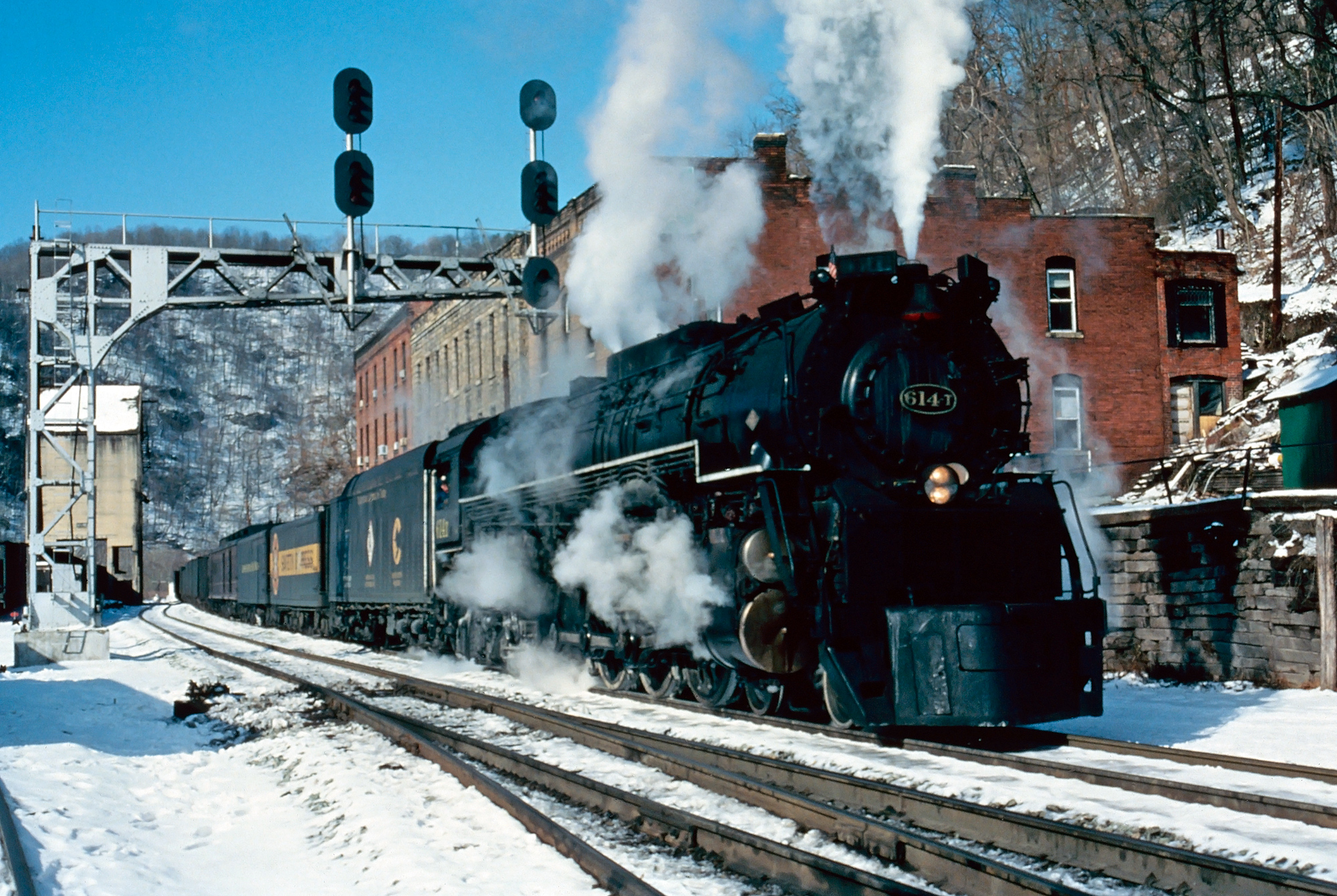 Chesapeake & Ohio 4-8-4 #614-T is eastbound at Thurmond, West Virginia during the "ACE 3000" tests in January, 1985. Mike Bledsoe photo. American-Rails.com collection.
It was also argued that the NYC's 4-8-4s, in this instance, offered "more horsepower per dollar of total expense than the diesel." However, by that time the diesel had an added advantage of perception; it was seen as the wave of the future while steam was looked at as outdated.
Overall, Withuhn's article is quite fascinating and highly recommended although far too long and detailed to cover further here. Of course, diesels had another advantage; less need of infrastructure (water towers, an army of workers to maintain the locomotives, terminals every few hundred miles, etc.) that hampered many railroads' desire to continue running steam.
However, by the 1980s technology had advanced to the point that Rowland and his team believed all of this could be bypassed and that a new steam design could function very similar to the diesel in this regard.
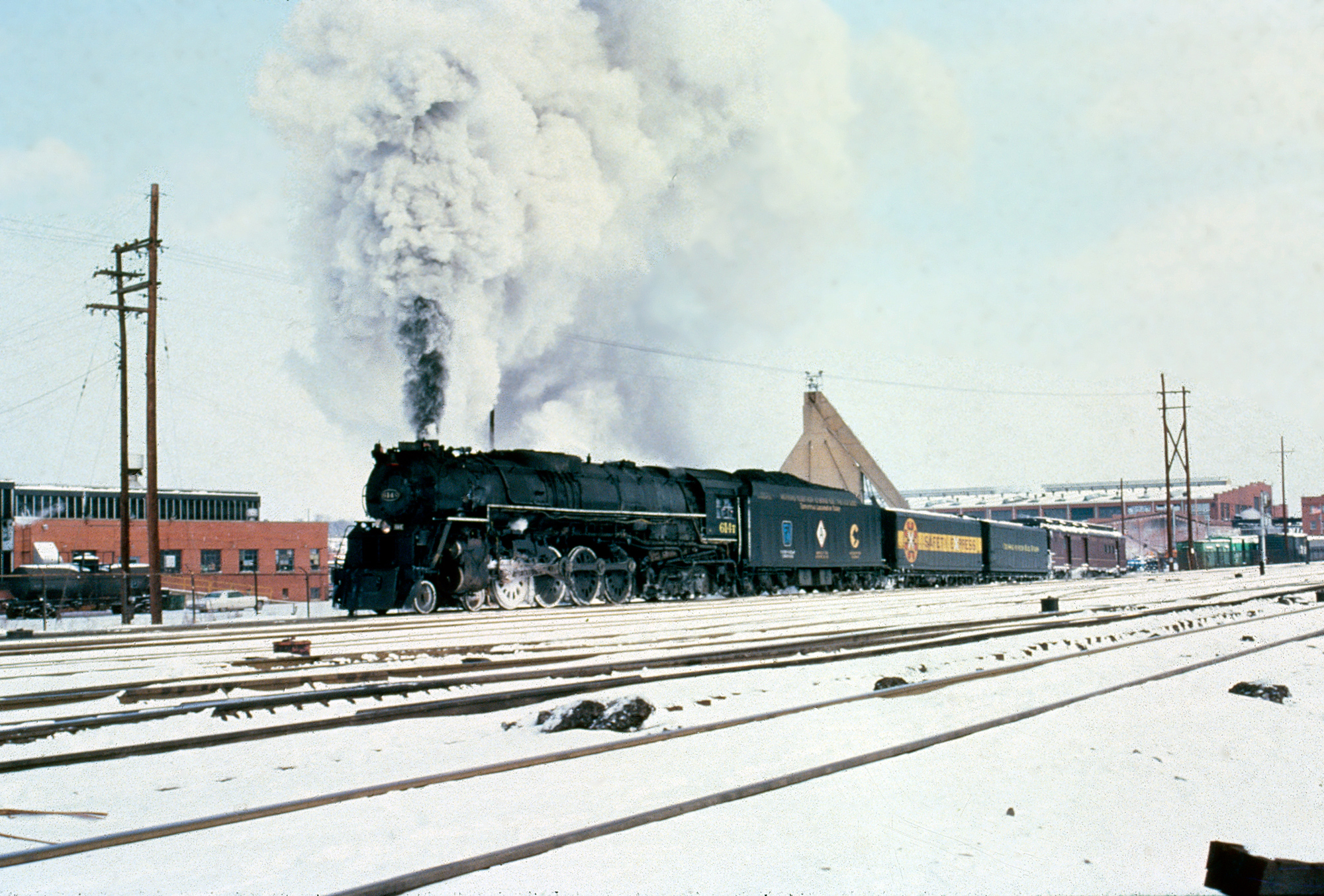 Chesapeake & Ohio 4-8-4 #614T steams through the yard in Huntington, West Virginia during her "ACE 3000" tests in late January, 1985. Mike Bledsoe photo. American-Rails.com collection.
Rowland's team consisted of some of the best names in the business of steam technology including:
- Livio Dante Porta (an Argentine mechanical engineer who studied under noted French steam designer Andre Chapelon)
- Physicist David Berkowitz
- Bill Withuhn mentioned above who was also an industrial engineer
- Babcock & Wilcox Company, founded in 1867 that helped design the Norfolk & Western's Jawn Henry
- Dr. John T. Harding whose background was in physics and had worked in the FRA's High Speed Ground Transportation program
- And more than a dozen other associates with exemplary backgrounds in transportation or related fields.
As the team began brainstorming the ACE 3000 concept they ultimately concluded that it was practical and a low-maintenance, economical competitor to the diesel could be built.
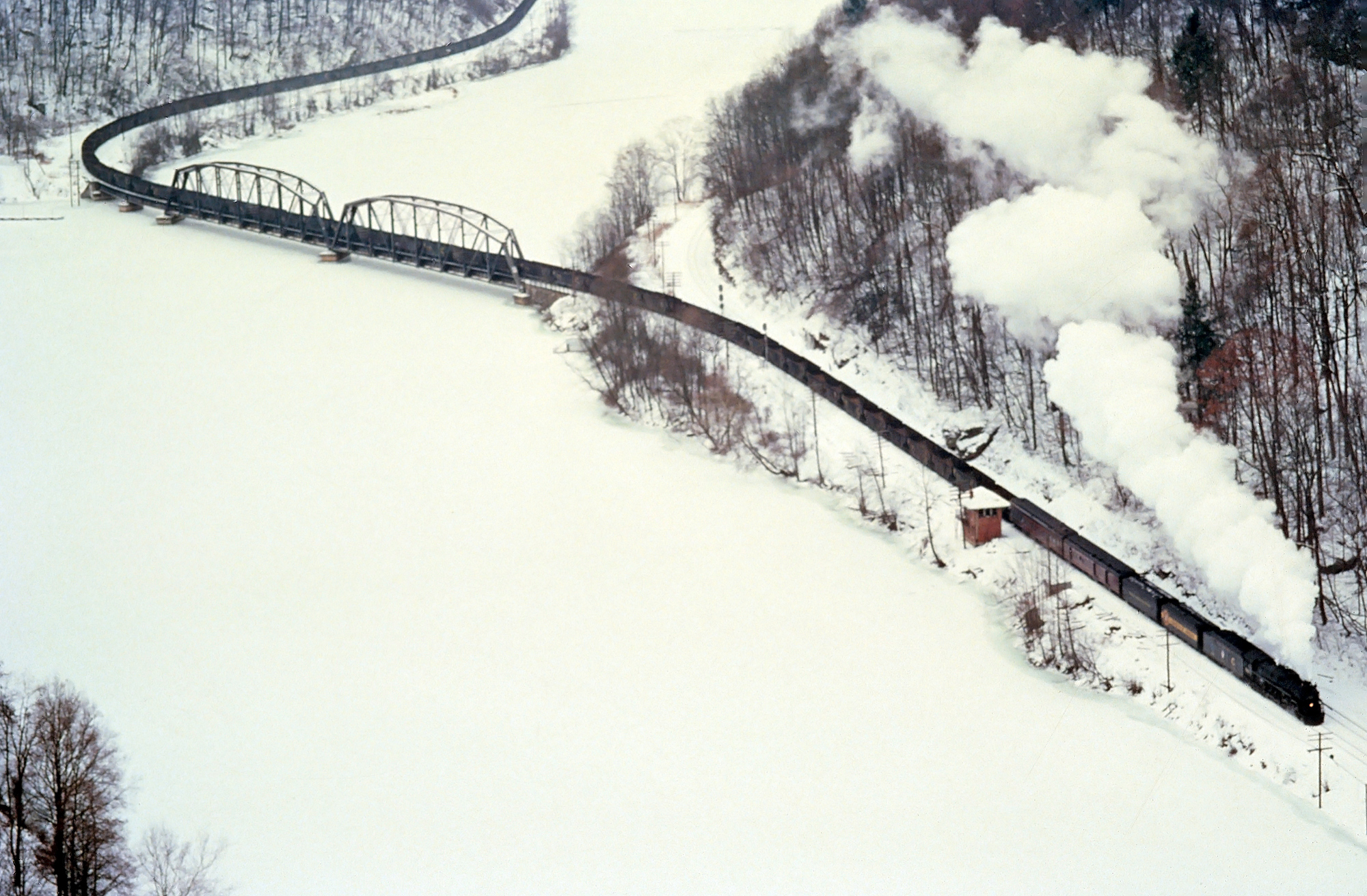 Chesapeake & Ohio 4-8-4 #614-T leads westbound empties over the New River at Hawks Nest, West Virginia during the ACE 3000 tests in January, 1985. Mike Bledsoe photo. American-Rails.com collection.
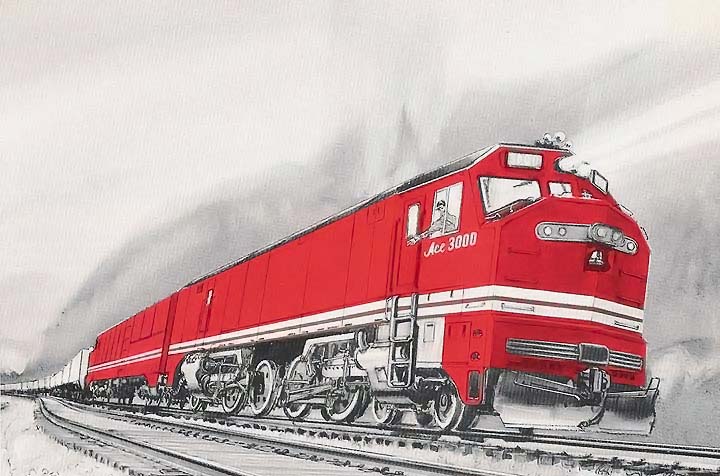
It was Porta, himself, that drafted the first concept that became known as the original ACE 3000, or Second Generation Steam (SGS) locomotive.
The general consensus of the locomotive's design was that it would:
- Feature a 2-10-0 wheel arrangement, burn coal, operate at high speeds in freight service (15 to 70 mph)
- Carry a look not unlike a conventional diesel with a semi-streamlined cab design
- Feature 3,000 nominal drawbar horsepower and 4,000 at its peak (based from the, then standard GP40 series)
- Use the latest in advanced computer technology to still allow the standard crew size of the day
A drawing of the locomotive was done by Gil Reid showing it pulling an intermodal freight at speed and it was from that point interest within the railroad community began to seriously gain traction, at first by Burlington Northern.
However, BN was looking for something a little different than Porta's original 2-10-0. Instead, the parties worked together and came up with what was termed the ACE 3000-8, a 4-8-4+4-8-4 trainset that was a double-ended, streamlined design. Between the locomotives the design called for a small car which would be used to haul the coal (similar to a tender).
Just like with the original ACE 3000, the 3000-8 would use compound expansion, which offered more efficient applications of steam and water if designed correctly (as believed was possible by the 1980s). This type of steam technology was first developed in the U.S. in 1904 with the B&O's "Old Maude" 0-6-6-0 #2400.
However, most railroads shied away from compound expansion at the time since it was too complicated and offered little advantages over simple expansion.
With Burlington Northern's interest growing other major backers began to appear including the C&O/Chessie System and Babcock & Wilcox (B&W). By November of 1982 prototypes were in the works, which were to be ready for service by 1985.
Unfortunately, while no one realized it, this proved the pinnacle of the project. A year later during the spring of 1983 the Coal Oriented Advanced Locomotive Systems (COALS) group was formed with BN, Chessie, and B&W primary stakeholders since ACE simply did not have the resources to fund the multimillion endeavor.
This setback left the company essentially on the outside looking in and only providing the locomotive design itself. As quickly as the project had progressed it fell apart just as rapidly; during the fall of that year it was announced COALS would break up since the parties could not agree on the project's financing.
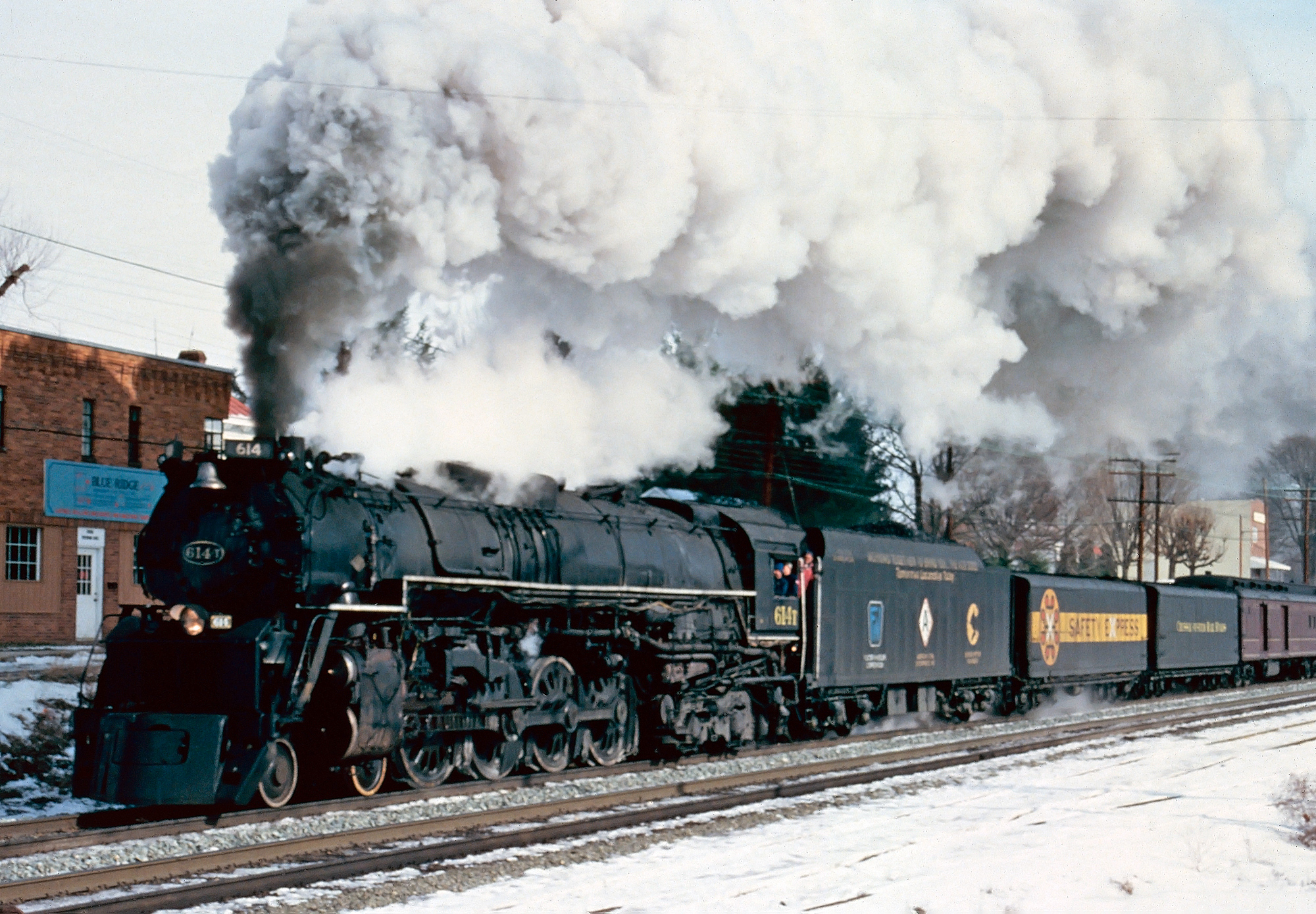 Chesapeake & Ohio 4-8-4 #614T stretchers her legs during the "ACE 3000" tests in late January, 1985. Mike Bledsoe photo. American-Rails.com collection.
This put the ACE 3000 endeavor back, squarely on the shoulders of Rowland and his team. While they believed a working prototype could sell the new steam technology the small company just did not have the millions of dollars in funding necessary to do so.
In any event, Rowland was able to put something on the rails for testing in an effort to gain publicity and hopefully fund the project; his own C&O 4-8-4 #614T.
On January 2, 1985 armed with an army of gadgets and technical equipment to gather data concerning the efficiency of the Greenbrier in service it left the C&O main line at Huntington, West Virginia heading east towards Hinton. The bitterly cold temperatures during the trials and issues with the #614T made the tests somewhat inconclusive but the big 4-8-4 overall ran relatively well.
Ultimately, the results of those trials were never published but Rowland and his team did determine, incredibly, that the steamer used less fuel than a comparable Electro-Motive diesel from that era (the GP40).One of American Coal Enterprises' final designs was the most attractive, visually, referred to as the ACE Mark I or ACE 6000.
The locomotive's design was primarily the work of Porta, once again, and it was intended for use in fast-freight service. The steamer was to be a 2-10-2 semi-articulated, double-ended setup capable of producing 6,000 horsepower.
With streamlined shrouding the locomotive it actually more closely resembled an EMD locomotive according to an artists' rendition of the design.
Further refinements, though, to the Mark I saw it converted into a Garratt configuration (an articulated steamer with three parts whereby the boiler sits between a pair of axles on each end of the locomotive).
With this latest change the Chessie System began losing interest in the project, the only remaining railroad still on-board with the concept.
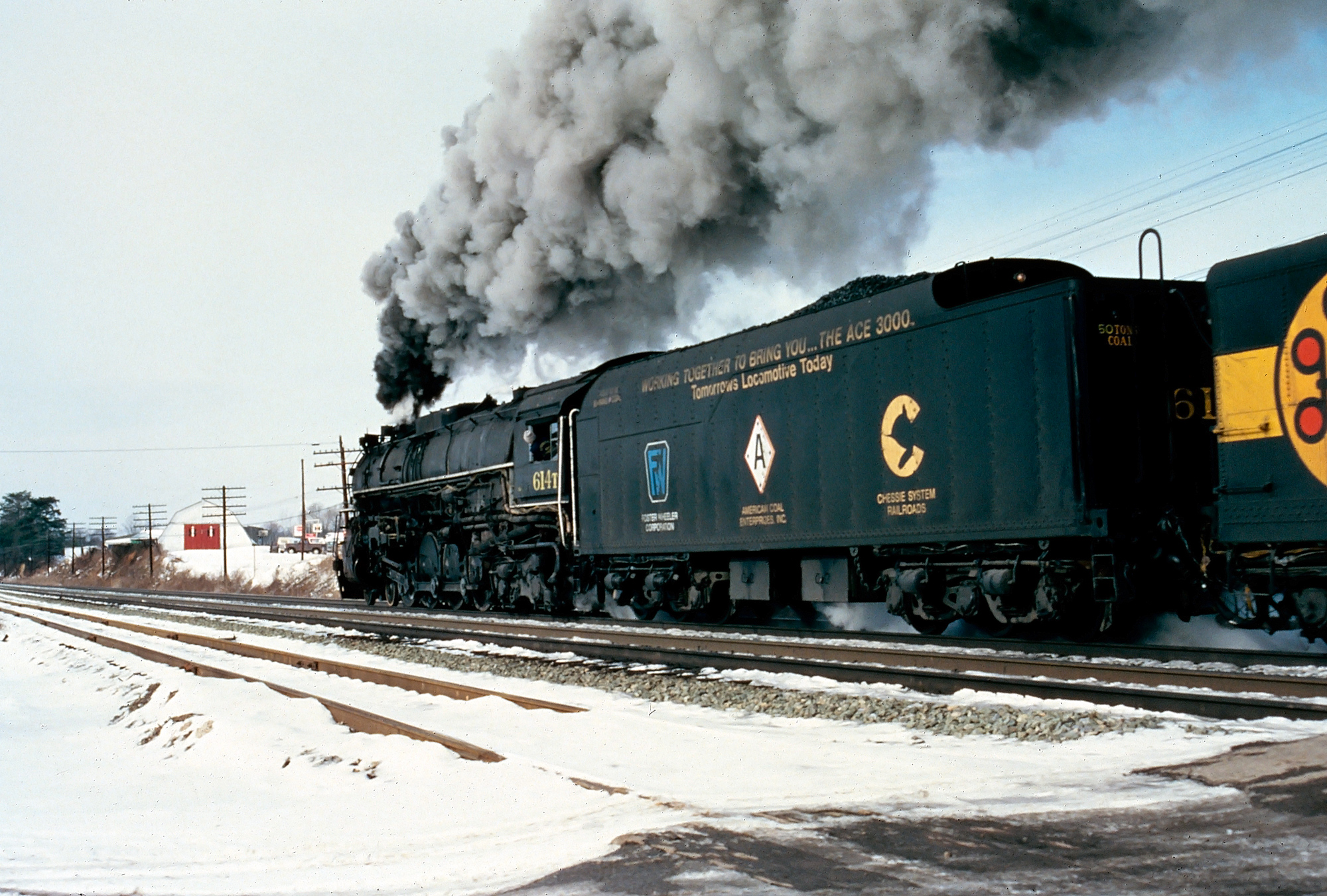 Chesapeake & Ohio 4-8-4 #614T hustles away from the photographer on the Chesapeake & Ohio main line during the "ACE 3000" tests outside of Huntington, West Virginia in late January, 1985. Mike Bledsoe photo. American-Rails.com collection.
By the mid-1980s oil prices had began falling, which sealed the fate of the ACE 3000. Soon after, Chessie pulled the plug of its financial support and having never received public money to finance the concept American Coal Enterprises foundered.
It was ultimately never able to put a working prototype into service, which was estimated to cost $1.25 million per unit. The ACE had the data on their side, enough so anyway to at least push forward in producing an example of their concept.
However, with limited funds, a small design team, and lack of support/interest from most of the railroad industry they were never able to show the world their idea. Since the 1980s it is said Rowland still hasn't given up on his ACE 3000 project but has also never been able to draw renewed interest.
Recent Articles


-
Delaware Railroad Museums (2026): A Complete Guide
Oct 05, 26 02:43 PM
 Delaware railroad museums—Wilmington & Western at Greenbank, the Harrington tower and N5 caboose, Felton's 1868 depot, and the Selbyville station museum.
 -
C&O's M-1 Steam Turbine Locomotives: Specs, Roster, History
Oct 05, 26 12:13 PM
 Chesapeake & Ohio Class M-1 steam-turbine-electrics. Three Baldwin-Westinghouse locomotives, 500–502, built 1947–48 for The Chessie. Specs, the 2-C1+2-C1-B arrangement, and a roster. All scrapped…
 -
N&W 2-6-6-2 Locomotives (Class Z): Specs, Roster, History
Oct 05, 26 11:44 AM
 Norfolk & Western Class Z 2-6-6-2s. One hundred ninety compound Mallets, 1300–1489, from Richmond, Baldwin, and Schenectady, 1912–1918. Diagram specs, the Z-1b rebuilds, Z-2 1399, and a roster. No…
 -
Scenic Train Rides (USA 2026): State Guide to Tourist Railroads
Oct 04, 26 12:17 AM
 Scenic and tourist train rides in all 50 states for 2026. Colorado narrow gauge, Pennsylvania steam, Alaska’s White Pass, and the states with no full-size ride this month. Confirm on the railroad.
 -
Wyoming Scenic Train Rides (2026): A Complete Guide
Oct 03, 26 12:07 AM
 Wyoming has no full-size tourist railroad on the calendar in October 2026. Cheyenne Depot Museum and Douglas Railroad Museum are static. Union Pacific 4014’s posted public trip is a November run to De…
 -
Washington Scenic Train Rides (2026): A Complete Guide
Oct 02, 26 11:53 PM
 Washington tourist trains in 2026—Mount Rainier Scenic at Elbe, the Northwest Railway Museum, and Chehalis-Centralia. Lake Whatcom has no 2026 date on its ticket page.
 -
Wisconsin Scenic Train Rides (2026): A Complete Guide
Oct 02, 26 11:48 PM
 Wisconsin tourist trains in 2026—Wisconsin Great Northern, Osceola & St. Croix Valley, Mid-Continent, East Troy, and the National Railroad Museum.
 -
Pennsylvania Railroad Class Q2 4-4-6-4: Specs, Roster, History
Oct 02, 26 11:28 PM
 Pennsylvania Railroad Class Q2 4-4-6-4 duplexes. Twenty-six engines, 6131 and 6175–6199, Altoona 1944–45. Form 109-J specs, the 7,987 hp test of 6175, and a roster. All scrapped.
 -
Utah Scenic Train Rides (2026): A Complete Guide
Oct 02, 26 11:18 PM
 Utah tourist trains in 2026—Heber Valley Railroad from Heber City. Golden Spike at Promontory is a locomotive demonstration, not a line-haul ride.
 -
South Dakota Scenic Train Rides (2026): A Complete Guide
Oct 02, 26 11:06 PM
 South Dakota’s 2026 scenic train is the Black Hills Central 1880 Train, Hill City to Keystone. Steam is the summer assignment. Confirm the engine.
 -
Oregon Scenic Train Rides (2026): A Complete Guide
Oct 02, 26 11:04 PM
 Oregon tourist trains in 2026—Oregon Coast Scenic from Rockaway Beach, Mount Hood at Hood River, Eagle Cap from Elgin, and the Oregon Rail Heritage Center in Portland.
 -
Oklahoma Scenic Train Rides (2026): A Complete Guide
Oct 02, 26 10:36 PM
 Oklahoma has no full-size scenic railroad on an October 2026 calendar. Oklahoma Railway Museum Halloween and Polar trains, the El Reno trolley, and the Heartland Flyer.
 -
North Dakota Scenic Train Rides (2026): A Complete Guide
Oct 02, 26 01:14 PM
North Dakota has no tourist railroad on a 2026 calendar. Ride Amtrak’s daily Empire Builder. The Fort Lincoln Trolley in Mandan is not a current ticket. -
Nebraska Scenic Train Rides (2026): A Complete Guide
Oct 02, 26 10:11 AM
 Nebraska has no full-size scenic railroad in 2026. The Omaha Zoo Railroad runs weekends through October 4. Ride Amtrak’s California Zephyr across the state.
 -
Missouri Scenic Train Rides (2026): A Complete Guide
Oct 02, 26 09:56 AM
 Missouri tourist trains in 2026—Branson Scenic Railway and the St. Louis, Iron Mountain & Southern at Jackson. Belton has no 2026 schedule posted.
 -
Minnesota Scenic Train Rides (2026): A Complete Guide
Oct 02, 26 09:52 AM
 Minnesota tourist trains in 2026—North Shore Scenic Railroad in Duluth, the Duluth River Train, and the Como-Harriet streetcar.
 -
Kansas Scenic Train Rides (2026): A Complete Guide
Oct 02, 26 09:32 AM
 Kansas tourist trains in 2026—the Abilene & Smoky Valley Railroad. Santa Fe 3415 is in overhaul. Midland Railway at Baldwin City is closed.
 -
Iowa Scenic Train Rides (2026): A Complete Guide
Oct 02, 26 08:41 AM
 Iowa tourist trains in 2026—Boone & Scenic Valley across the Bass Point Creek High Bridge, and Midwest Central’s December North Pole trains
 -
Indiana Scenic Train Rides (2026): A Complete Guide
Oct 02, 26 08:35 AM
 Indiana tourist trains in 2026—French Lick Scenic Railway, Nickel Plate Express, Hoosier Valley, and Hesston. Whitewater Valley is suspended.
 -
Illinois Scenic Train Rides (2026): A Complete Guide
Oct 02, 26 12:28 AM
 Illinois tourist trains in 2026—Illinois Railway Museum, Monticello Railway Museum, Fox River Trolley, and Silver Creek & Stephenson.
 -
Texas Scenic Train Rides (2026): A Complete Guide
Oct 02, 26 12:14 AM
 Texas tourist trains in 2026—Texas State Railroad, Grapevine Vintage Railroad, Austin Steam Train's Hill Country Flyer, and the Galveston Railroad Museum.
 -
Tennessee Scenic Train Rides (2026): A Complete Guide
Oct 02, 26 12:03 AM
Tennessee tourist trains in 2026—Tennessee Valley Railroad Museum, Dollywood Express, Three Rivers Rambler Christmas trains, and the Tennessee Central Railway Museum. -
South Carolina Scenic Train Rides (2026): A Complete Guide
Oct 01, 26 11:52 PM
 South Carolina's tourist train is the South Carolina Railroad Museum in Winnsboro—Blue Granite Express, pumpkin trains, and Santa trains on the old Rockton & Rion.
 -
Mississippi Scenic Train Rides (2026): A Complete Guide
Oct 01, 26 11:38 PM
 Mississippi has no regular tourist railroad in 2026. Ride Amtrak through the state, or book the excursion lines in Alabama, Tennessee, Louisiana, or Arkansas.
 -
Louisiana Scenic Train Rides (2026): A Complete Guide
Oct 01, 26 02:52 PM
 Louisiana has no regular full-size tourist railroad in 2026. New Orleans Polar Express returns December 11–31. Museums at Long Leaf, DeQuincy, and Jackson.
 -
Kentucky Scenic Train Rides (2026): A Complete Guide
Oct 01, 26 02:45 PM
 Kentucky tourist trains in 2026—Big South Fork Scenic Railway, Bluegrass Scenic Railroad, Kentucky Railway Museum, and My Old Kentucky Dinner Train.
 -
Georgia Scenic Train Rides (2026): A Complete Guide
Oct 01, 26 02:27 PM
 Georgia tourist trains in 2026—Blue Ridge Scenic Railway, SAM Shortline, Azalea Sprinter, Savannah shop rides, and what to confirm at Stone Mountain.
 -
Arkansas Scenic Train Rides (2026): A Complete Guide
Oct 01, 26 01:02 PM
 Arkansas tourist trains in 2026—Arkansas & Missouri through the Boston Mountains, and the Eureka Springs & North Arkansas dinner and excursion trains.
 -
Alabama Scenic Train Rides (2026): A Complete Guide
Oct 01, 26 12:59 PM
Alabama tourist trains in 2026—Heart of Dixie Railroad Museum at Calera, North Alabama Railroad Museum at Chase, and the Wales West Light Railway at Silverhill. -
The Circus Train: How Such Attractions Reached Distant Cities
Oct 01, 26 12:22 PM
 How circuses moved by rail: Coup's 1872 flats, the Ringling train's sections and car counts, the 1918 Hammond wreck, and the last show on May 21, 2017.
 -
West Virginia Halloween Train Rides (2026)
Oct 01, 26 12:19 PM
 2026 West Virginia Halloween train. Cass Scenic Halloween Train, October 30 and 31, steam, 5:00 p.m. from Cass Depot. Adult $75. About two hours to Whittaker. Family ride.
 -
Wisconsin Halloween Train Rides (2026)
Oct 01, 26 12:11 PM
2026 Wisconsin Halloween trains. Mid-Continent Pumpkin Special October 24–25, adult $24, pumpkins extra. Halloween Flyer October 24 at 4:30 p.m., adult $30. Osceola Pumpkin Express boards in Osceola… -
Utah Halloween Train Rides (2026)
Oct 01, 26 12:00 PM
 2026 Utah Halloween trains at Heber Valley Railroad. Pumpkin Train, about 40 minutes, with a cookie and a pumpkin. Halloween Express, about 90 minutes to Grim Hollow, Monday, Thursday, and Friday even…
 -
Texas Halloween Train Rides (2026)
Oct 01, 26 11:28 AM
 2026 Texas Halloween train. Texas State Railroad Spooky Special, adult-only, October 24. Boards Palestine at 5:00 p.m. About five hours to Rusk and back. Dinner on the grounds. Not steam. No fare on t…
 -
Tennessee Halloween Train Rides (2026)
Oct 01, 26 12:15 AM
 2026 Tennessee Halloween trains. Tennessee Valley Railroad Museum Rails, Wizards & Spells, selected days September 18 through October 25, from $35, about 2.5 hours. Spells & Potions tea from $60. The…
 -
Frisco's "Firefly" (Train): Consist, Route, Timetable
Sep 30, 26 11:37 PM
 Frisco Firefly—daylight streamliner, Kansas City to Tulsa and Oklahoma City. Trains 117 and 118. Pacifics 1018, 1026, and 1031. Last run May 22, 1960.
 -
South Carolina Halloween Train Rides (2026)
Sep 30, 26 11:29 PM
 2026 South Carolina Halloween train. South Carolina Railroad Museum Pumpkin Patch Express, the two Saturdays before Halloween. About three miles to the Greenbriar pavilion. Pumpkin for children 12 and…
 -
Oregon Halloween Train Rides (2026)
Sep 30, 26 08:10 PM
2026 Oregon Halloween train. Sumpter Valley Railroad Halloween Express at the Sumpter Depot, calendar window October 31 at 11:00 a.m. through November 1 at 12:30 p.m. Fare and the individual clocks ar… -
Oklahoma Halloween Train Rides (2026)
Sep 30, 26 03:45 PM
2026 Oklahoma Halloween train. Oklahoma Railway Museum, October 30 and 31, from Oakwood Station in Oklahoma City. Adults $15, children 3–12 $8. A candy bag with the ride. -
McCloud River Railroad: Serving The Timber Industry (1897-2009)
Sep 30, 26 03:37 PM
 McCloud River Railroad—Mount Shasta City to McCloud, Hambone, and Burney. Opened August 1, 1897. Alco No. 25 and EMD SD38s. Dinner train through January 2010. Railbikes in 2026; a dinner train is stil…
 -
Nevada Halloween Train Rides (2026)
Sep 30, 26 03:30 PM
2026 Nevada Halloween trains in Ely. Nevada Northern Pumpkin Patch Caper and Haunted Ghost Train. Adult tickets start at $45. Dates are on the railroad’s ticket calendar. Boulder City stays off until… -
Missouri Halloween Train Rides (2026)
Sep 30, 26 11:12 AM
 2026 Missouri Halloween trains. St. Louis Iron Mountain & Southern Pumpkin Patch Train on October 3, 4, 10, and 11, and Halloween Express on October 31 at 1:00 p.m. Jackson depot. No fare on the sched…
 -
Minnesota Halloween Train Rides (2026)
Sep 30, 26 11:06 AM
 2026 Minnesota Halloween trains. North Shore Scenic Great Pumpkin Train in Duluth, October 15–18. Everyone gets a pumpkin. Terror Train is October 30, an adult costume party, about three hours. Fares…
 -
Maryland Halloween Train Rides (2026)
Sep 30, 26 10:42 AM
 2026 Maryland Halloween trains. Western Maryland Scenic Pumpkin Patch Limited, October 17, 18, 24, and 25, $14. Colesville Trolleyween October 24, 25, and 31.
 -
West Side Lumber Company Railroad: Roster, History, Lines
Sep 30, 26 09:45 AM
 West Side Lumber at Tuolumne, California. Three-foot Shay and Heisler logging railroad. Lima shop numbers, builder specs, and where the engines are in 2026.
 -
Kansas Halloween Train Rides (2026)
Sep 30, 26 09:41 AM
 2026 Kansas Halloween train. Abilene & Smoky Valley Pumpkin Harvest Express, October 17 through 31. About one hour. Shop prices $35.56 to $41.02. Everyone picks a pumpkin.
 -
Iowa Halloween Train Rides (2026)
Sep 29, 26 11:58 PM
2026 Iowa Halloween train. Boone & Scenic Valley Pumpkin Express, October 10, 10:00 a.m. from 225 10th Street. About 1 hour 15 minutes. Children pick a pumpkin. -
Arizona Halloween Train Rides (2026)
Sep 29, 26 11:43 PM
 2026 Arizona Halloween train. Grand Canyon Railway Pumpkin Patch Train from Williams, $39 with a pumpkin included. Select October dates on the ticket calendar. Haunted train cars are optional.
 -
Nevada Northern Halloween Trains (2026)
Sep 29, 26 06:18 PM
Nevada Northern 2026 Halloween trains in Ely. Pumpkin Patch Caper to Keystone Gulch and the Haunted Ghost Train. Adult tickets start at $45. Dates are on the railroad’s calendar. Confirm on nnry.com. -
Grand Canyon Railway Pumpkin Patch Train (2026)
Sep 29, 26 02:42 PM
Grand Canyon Railway Pumpkin Patch Train—select October 2026 dates from Williams, $39 with a pumpkin included. Haunted train cars are optional. Days are on the ticket calendar. Confirm on thetrain.com…






- Home ›
- Locomotives ›
- ACE 3000