Ashtabula Bridge Disaster (1876): The Pacific Express and the Iron Howe Truss Collapse
Last revised: August 11, 2026
By: Adam Burns
On the night of Friday, December 29, 1876, in a howling Lake Erie blizzard, the Lake Shore and Michigan Southern Railway’s westbound Pacific Express approached the iron bridge over the Ashtabula River just east of the station at Ashtabula, Ohio. As the train moved onto the span, the structure failed. The lead locomotive, Socrates, clawed onto solid ground. Everything behind it—second engine Columbia, express and baggage cars, coaches, parlor and sleepers—went into the ravine roughly 65 to 76 feet below. Oil lamps and coal-fired heating stoves set the wooden cars ablaze. Approximately 92 of about 160 people aboard died; roughly 64 were injured. It was the deadliest U.S. rail accident of the nineteenth century and remains among the worst in American history.
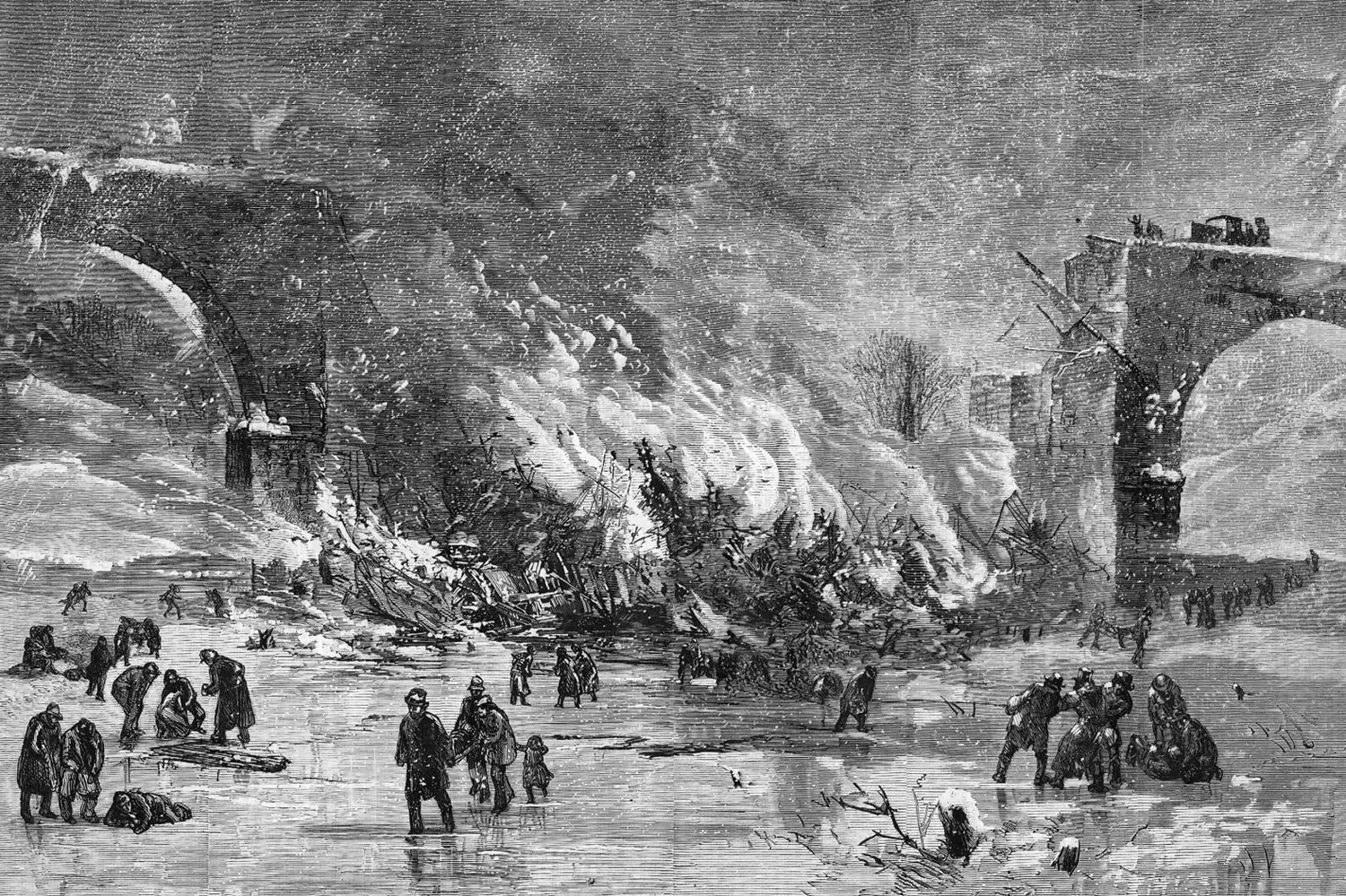
Wood engraving of the Ashtabula River railroad disaster published in Harper’s Weekly, January 20, 1877. Lead locomotive Socrates is shown at upper right after clearing the western abutment as the rest of the Pacific Express falls into the gorge. American-Rails.com collection.
The wreck is remembered as the Ashtabula Horror, the Ashtabula Bridge disaster, and the Ashtabula train disaster. It was not a simple derailment. It was the catastrophic failure of an experimental all-iron Howe truss designed under the personal direction of railroad president Amasa Stone, against the advice of professional engineers—followed by a fire that finished what the fall began. Nine years earlier, the same Lake Shore corridor family had already given the nation the Angola Horror. Ashtabula was worse, and far more damning of bridge engineering practice.
At a Glance
| Item | Detail |
|---|---|
| Date / time | December 29, 1876, about 7:30 p.m. |
| Location | Ashtabula River bridge, ~1,000 ft east of Ashtabula, Ohio, station |
| Railroad | Lake Shore and Michigan Southern Railway (LS&MS) |
| Train | No. 5, Pacific Express (Buffalo / Erie direction toward Cleveland–Chicago) |
| Power | Two locomotives: Socrates (lead) and Columbia |
| Weather | Severe blizzard; deep snow, high winds, near-zero visibility |
| Bridge | Experimental all-iron Howe truss, ~154–157 ft main span, ~11 years old (built 1865) |
| Designer | Amasa Stone (railroad president), overriding engineers Joseph Tomlinson and Charles Collins |
| Accident type | Bridge collapse under train; fall into river gorge; fire |
| Casualties | ~92 killed, ~64 injured (counts historically uncertain; many remains unidentifiable) |
| Notable victims | Gospel songwriter Philip P. Bliss and wife Lucy |
The Lake Shore Corridor in 1876
By the mid-1870s the Lake Shore and Michigan Southern was one of the principal passenger and freight routes between the East and Chicago, running the south shore of Lake Erie through Buffalo, Erie, Cleveland, and Toledo. Vanderbilt interests were tightly intertwined with the Lake Shore; later the road would become a core component of the New York Central System. In 1876, however, the corporate actor at Ashtabula was still the LS&MS itself—and the man who had shaped both the road and this bridge was Amasa Stone, railroad builder, Howe-truss patent holder (through family ties to William Howe), and company executive who treated the Ashtabula span as a personal engineering project.
That detail matters. Ashtabula was not an anonymous failure of “the industry.” Investigations would place responsibility squarely on the railroad and its chief executive for planning and erecting a defective structure and for failing to inspect it competently for eleven years.
Building an Experimental Bridge (1863–1865)
In the early 1860s the Cleveland, Painesville and Ashtabula Railroad (a Lake Shore predecessor) decided to replace a wooden bridge over the Ashtabula River just east of town with iron. Stone, who had purchased rights to the Howe truss and built many successful wooden Howe bridges, resolved to design an all-iron Howe truss himself. He had previously built only a short experimental all-iron Howe over the Ohio and Erie Canal in Cleveland. The Ashtabula span—roughly 154 feet long and on the order of 70-plus feet above the river—was a far larger leap.
Professional help did not last. Bridge designer Joseph Tomlinson developed drawings and a camber (upward curve) intended to settle under dead load. He objected to Stone’s all-iron plan, undersized members, and refusal to strengthen I-beams with plates. Stone fired him. Charles Collins, the railroad’s chief engineer (of bridges), also refused to endorse Stone’s changes and was removed from the design effort. Stone then altered the design himself. Collins later testified, in essence, that the finished structure was the president’s bridge, not his.
Key features of Stone’s experimental layout included:
- All-iron construction on a Howe geometry originally proven in wood—much higher dead load, different stiffness behavior
- Inverted / altered load paths relative to conventional Howe practice, increasing dependence on critical connections
- “Single Howe” end panels with fewer posts and braces than a standard Howe end—concentrating enormous stress on a small number of members and cast-iron angle blocks
- Cast-iron angle blocks with wrought-iron chords and diagonals; details that later investigators found poorly retained braces and weak lugs
Construction in 1865 was troubled. Camber fights with shop lengths, planed lugs, shims, buckled members when falsework was removed, added I-beams that worsened dead load, and rotation of diagonal beams that required cutting webs and weakening bearings all appear in later testimony and engineering studies. When the bridge finally stood, three locomotives were run over it as a crude proof test. Deflection looked acceptable. The span then carried main-line traffic for eleven years—long enough to breed false confidence, not long enough to prove the design sound.
Civil engineers looking back have been unsparing. The structure was widely described after 1876 as an experiment that should never have been accepted as a permanent main-line bridge, and one that careful expert inspection would have condemned in minutes.
The Pacific Express, December 29
Train No. 5, the Pacific Express, left Buffalo about 2:00 p.m., already late, into a multi-day blizzard that had dumped heavy snow and thrown drifts across the Lake Shore. A second locomotive was added to help fight the snow. From Erie the train left about 5:01 p.m., still more than an hour late, with Socrates and Columbia heading a consist that included baggage and express cars, day coaches, a smoking car, parlor car Yokohama, and sleepers such as Palatine, City of Buffalo, and Osceo—on the order of 150 to 200 people including crew, with ~160 often used as a working total.
An eastbound train had crossed the same bridge about half an hour earlier without incident. Weather does not excuse a defective bridge, but the blizzard matters for what happened next: snow six feet deep in places, winds in the tens of miles per hour, and visibility of only a car length or two. When the bridge failed, rescue would be almost as cruel as the fall.
Collapse Sequence
Around 7:30 p.m., roughly an hour and fifty minutes late into the Ashtabula approach, the train eased toward the station. Steam was shut off so the consist could glide in. Speed estimates from the locomotive crews are commonly given in the 10–15 mph range—an ordinary load, not a runaway.
As Socrates neared the western abutment, engineer Daniel McGuire felt the structure drop and heard cracking. He opened the throttle. The coupling to Columbia parted; Socrates made solid ground, tender trucks momentarily hanging, then pulled free. McGuire stopped down the track and blew the whistle in continuous alarm.
What followed was not instantaneous free-fall so much as a progressive unchaining of the span under the linked train:
- Columbia and the cars acted as a chain load; the bridge failed somewhat piecemeal.
- Express and baggage cars piled at and near the western abutment; Columbia ended inverted in the wreckage.
- Passenger coaches, smoker, parlor, and sleepers were pulled into the gap, stacking and crushing in the river bottom south of the centerline as well as midstream.
- Eyewitness and reconstruction accounts describe the smoking car smashing into the first coach, and sleeper City of Buffalo driving through other cars with catastrophic force.
Then came fire. Overturned coal and kerosene heating stoves and oil lamps ignited wooden cars almost at once. Flames moved through the pile with terrible speed. Survivors who could walk or crawl reached the shore in snow and darkness; those trapped burned, suffocated, or drowned. A brakeman later estimated that many still alive in the wreck were dead within about twenty minutes.
The parallel with Angola is deliberate history, not metaphor: same Lake Shore world, same wooden cars, same stove-and-lamp fire after mechanical catastrophe. Ashtabula simply killed more people and put bridge engineering on trial.
Rescue—and Failure to Fight the Fire
Townspeople and railroad employees heard the crash and scrambled into the gorge by steep snow-covered steps or by sliding the banks. Axes and bare hands pulled survivors free. The town had no hospital; wounded went to the engine house, hotels, and private homes. Doctors worked through the night; a special train later brought more surgeons from Cleveland.
The fire department’s performance became part of the scandal. Engines reached the scene, but fire chief G. W. Knapp did not mount an effective attack on the blaze; contemporary findings held that water might have saved lives and that the chief bore personal responsibility for the failure to fight the fire. Bucket brigades of citizens tried what the organized response did not. By morning the wreck was a field of ash, ice, and unrecognizable remains.
Looting of the dead and wounded occurred; the mayor eventually posted guards and offered amnesty for returned valuables. Much was never recovered. Identification of victims stretched for weeks—burned fragments, mixed remains, and fraudsters writing for “effects” all complicated the work. Unidentified dead were buried at Chestnut Grove Cemetery, later marked by a tall granite monument listing names of those who died.
Among the identified dead were Philip Paul Bliss (1838–1876), a leading gospel songwriter associated with hymns including the music to “It Is Well with My Soul,” and his wife Lucy. Their names became part of the public memory of the wreck, alongside the mass grave of the unknown.
Three Investigations
Ashtabula produced one of the most intensive post-wreck examinations of the era—not a modern NTSB report, but far more than a shrug.
1. Coroner’s jury (to March 1877)
With no local coroner, a justice of the peace convened a six-man jury that heard railroad officials, crew, firefighters, passengers, and engineers. Its core findings:
- The bridge was poorly designed for its span and service
- It was poorly constructed, with members acting independently rather than as a coherent structure; connections and details were defective
- The company failed to inspect for eleven years in a way that would have revealed those defects
- The railroad violated state requirements for safer heating apparatus
- The fire response failed to use available pumps effectively
The jury placed responsibility on the railway company and, through its chief executive, on Amasa Stone for planning and erecting the bridge.
2. Ohio legislative joint committee (report January 30, 1877)
The Ohio General Assembly appointed legislators and hired engineers. They concluded the bridge went down under an ordinary load because of original construction defects that careful inspection could have found at any time. Compression members were critically weak; braces and top chord details were defective; retention of braces on angle blocks was inadequate after construction changes. Factors of safety in compression were so low that failure was a matter of time.
3. Charles MacDonald / engineering profession
Engineer Charles MacDonald examined plans and wreckage and published a major analysis (ASCE orbit). He described progressive failure of the south truss near the west end, stressed industry-wide ignorance of strut behavior, and highlighted a defective cast-iron angle-block lug with a large air hole—halving strength at a critical point—as a trigger detail. He also insisted inspection had been inadequate: any competent bridge engineer of the day should have condemned the span on sight.
Stone denied design fault, floating theories of derailment, loose rail, or even wind. The railroad paid large settlements (on the order of half a million contemporary dollars) without a full public acceptance of blame. The engineering profession, however, treated Ashtabula as a textbook of what not to build.
Charles Collins and Amasa Stone
Two personal stories attach to the wreck and are often confused on shallow web summaries.
Charles Collins was the railroad’s chief engineer of bridges—not the locomotive engineer of the Pacific Express (that role for the lead engine is associated with Daniel McGuire). Collins had been sidelined during design, later oversaw inspections in a system the investigations found wanting, and testified before the coroner’s process. In early 1877 he died of a gunshot wound; the death was long recorded as suicide under the pressure of the disaster. Some later writers have raised questions about the circumstances; the conventional historical narrative remains one of a man broken by association with a bridge he had never claimed as his own.
Amasa Stone was publicly scorned as the author of the experiment. He continued to defend himself. In 1883 he died by suicide in Cleveland—another dark coda, years later, to a career that had once embodied midwestern railroad building power.
Neither death should obscure the structural lesson: the bridge failed because of design, detailing, construction improvisation, and neglected inspection—not because a locomotive crew chose a bad night to run.
Aftermath: What Changed
Ashtabula accelerated trends already underway and made them politically unavoidable:
- Bridge practice — The experimental all-iron Howe of Stone’s pattern was not repeated. American bridge engineering moved further toward proven iron and steel systems, better compression members, positive connections, and professional design responsibility separate from corporate fiat.
- Inspection culture — Investigators hammered the point that eleven years of main-line service without competent analytical inspection was itself a cause. Railroads could no longer treat novel iron spans as “good enough” because trains had not yet fallen through them.
- Passenger car fire risk — As at Angola, stoves and lamps in wooden cars turned a crash into a crematorium. Pressure continued for safer heating and, over decades, less flammable equipment.
- Local institutional legacy — Ashtabula’s lack of a hospital during the crisis helped spur founding of a local hospital; audio and interpretive materials later remembered the wreck at related sites.
- Public and professional accountability — Illustrated papers at home and abroad demanded to know who was responsible—engineer, contractor, president, or company. That public interrogation of technical authority is part of how industrial safety culture formed in the United States.
Wikipedia and local markers sometimes credit the disaster with helping establish more formal federal investigation of fatal railroad accidents. The full federal regulatory apparatus evolved over years (the Interstate Commerce Commission dates to 1887; later safety appliance and accident-investigation frameworks came in stages). Ashtabula is best understood as a major shock that fed that longer campaign—not as a single law that appeared the next morning.
Memory and Markers
The disaster site and cemetery remain places of remembrance. A historical marker near the scene (Ohio Bicentennial / local partners, 2003) summarizes the blizzard collapse, the loss of nearly one hundred lives, Philip and Lucy Bliss, the Chestnut Grove monument to the unidentified, the hospital founded in the wreck’s aftermath, and the reforms in bridge design and railroad safety. Modern visitors stand above a landscape that no longer shows Stone’s iron Howe; the lesson is in the story, not the surviving truss.
Photographs taken at dawn on December 30, 1876, by local resident Fred W. Blakeslee remain among the most important visual documents of the wreckage—bridges and trains reduced to iron and ash in the snow.
Ashtabula and Angola: One Corridor, Two Lessons
| Angola (1867) | Ashtabula (1876) | |
|---|---|---|
| Location | Big Sister Creek, N.Y. | Ashtabula River, Ohio |
| Railroad family | Lake Shore corridor predecessors | Lake Shore & Michigan Southern |
| Primary failure | Car derailment at bridge / frog | Bridge structural collapse under train |
| Fire | Stoves + kerosene in last coach | Stoves + lamps through whole consist |
| Deaths (approx.) | ~49 | ~92 |
| Core technical lesson | Compromise cars, stoves, hand-brake era | Experimental iron bridge, design/inspection failure |
Together they bookend a brutal decade on the Lake Shore: first the limits of passenger equipment, then the limits of executive-designed iron spans. Both burned their dead. Both made the illustrated weeklies. Both still instruct anyone who thinks nineteenth-century railroading was merely picturesque.
Legacy
The Ashtabula Bridge disaster endures because it is simultaneously a human tragedy, a case study in structural engineering failure, and a political event. Passengers who trusted a famous express on a famous road died because an experimental bridge had been forced into service over expert objection and then left unexamined in any serious sense for eleven years. When it finally failed, fire erased identities as thoroughly as impact erased the span.
Modern analyses still debate the precise trigger—fatigue and voids in cast angle-block lugs, understrength compression groups, construction shims, cold-weather brittleness—but they agree on the larger verdict of 1877: the bridge should never have been designed that way, built that way, or accepted that long. That is Ashtabula’s permanent contribution to American railroad history. Every later insistence that bridges be designed by competent engineers, detailed for compression as carefully as tension, positively connected, and inspected by people who understand what they are looking at, carries a faint echo of the night the Pacific Express went into the river.
Related Reading on American-Rails.com
- The Angola Horror (1867)
- Railroad History (USA)
- Lake Shore & Michigan Southern
- New York Central Railroad
- Passenger Train Guide
- Fallen Flags
Casualty totals, exact car order, and some construction details vary slightly among period newspapers, the coroner’s record, legislative reports, and later engineering studies. Narrative above follows the modern consensus synthesis (including Wikipedia’s sourced summary, Structure Magazine’s engineering review, and standard secondary accounts). For engineering or genealogical work, consult the 1877 Ohio joint committee report, MacDonald’s analysis, and primary local records.
Recent Articles


-
Gulf, Mobile & Northern Steam Roster (Post 1900)
Oct 09, 26 10:42 AM
 Gulf, Mobile & Northern steam since 1900. Drury's class grid: Ten-Wheelers, Mikados, Russian Decapods, Pacifics 425 and 426, and three light 4-8-2s. Last revenue steam October 7, 1949.
 -
Gulf, Mobile & Ohio Diesel Roster (All-Time)
Oct 09, 26 10:41 AM
 Gulf, Mobile & Ohio diesel roster, all-time. The 1935 boxcab, DL-107s, 55 FA-1s, F3s and F7s, the Ingalls 4-S, GP30s through GP38-2s, and 21 SD40s. Serials and order numbers.
 -
Gulf, Mobile & Northern Railroad: History, Rebel Route
Oct 09, 26 10:36 AM
 Gulf, Mobile & Northern, from the 1890 Mobile, Jackson & Kansas City to the Rebel and the September 13, 1940 merger into the Gulf, Mobile & Ohio. Steam roster is the companion page.
 -
Gulf, Mobile & Ohio Railroad: Map, Photos, Trains, History
Oct 08, 26 11:48 PM
 Gulf, Mobile & Ohio, chartered in 1938 and merged September 13, 1940. The Mobile & Ohio, the Alton on May 31, 1947, the Rebel Route, and Illinois Central Gulf on August 10, 1972.
 -
New Jersey Railroad Museums (2026): A Complete Guide
Oct 08, 26 11:37 PM
 New Jersey railroad museums—Whippany, Maywood, Pine Creek, Mahwah’s Erie depot, Phillipsburg, and Boonton. Confirm hours on each site.
 -
New Hampshire Railroad Museums (2026): A Complete Guide
Oct 08, 26 11:34 PM
 New Hampshire railroad museums—North Conway, the Flying Yankee, Ashland, Gorham, Raymond, and Sandown. Confirm hours on each site.
 -
Missouri Railroad Museums (2026): A Complete Guide
Oct 08, 26 11:00 PM
 Missouri railroad museums—the National Museum of Transportation, Patee House, Frisco 4524, the Chicago & Alton depot, and Marceline. Confirm hours on each site.
 -
Milwaukee Road X3800: Deer Lodge’s Shop Goat
Oct 08, 26 04:28 PM
 Milwaukee Road X3800, the a home-built shop goat that served the Deer Lodge, MT yard. It was a 220-volt DC switcher, powered through an extension cord that moved electrics into a roundhouse where the…
 -
Key West Extension (Overseas Railroad): History, Construction, Decline
Oct 08, 26 03:59 PM
 Henry Flagler's Overseas Railroad, Miami to Key West, 1905–1935. The Seven Mile Bridge, the 1935 Labor Day Hurricane, and the road that became U.S. 1.
 -
Florida East Coast Steam Roster (Post 1900)
Oct 08, 26 02:34 PM
 Florida East Coast steam since 1897. Seventeen Ten-Wheelers, twenty Atlantics, eighty-seven Pacifics, ninety Mountains, fifteen Mikados, and the switchers.
 -
Florida East Coast Diesel Roster (All-Time)
Oct 08, 26 02:12 PM
 Florida East Coast diesel roster, all-time. E units from 1939, F3s, BL2s, GP7s and GP9s, the GP40-2 orders, 22 SD40-2s, and 24 ES44C4s. Serials and EMD order numbers.
 -
Florida East Coast Railway: Map, History, Rosters
Oct 08, 26 01:46 PM
 Florida East Coast Railway, Henry Flagler's line from Jacksonville to Miami and Key West. Receivership in 1931, the 1963 strike, Grupo México in 2017, and Brightline on the same track.
 -
Minnesota Railroad Museums (2026): A Complete Guide
Oct 08, 26 10:32 AM
Minnesota railroad museums—the Lake Superior Railroad Museum, Two Harbors, Jackson Street, Willmar’s Great Northern 2523, and Currie. Confirm hours on each site. -
Maine Railroad Museums (2026): A Complete Guide
Oct 08, 26 09:24 AM
 Maine railroad museums—Seashore Trolley, the two-foot lines at Portland, Alna, and Phillips, Boothbay, and the Bangor & Aroostook depots. Confirm hours on each site.
 -
Massachusetts Railroad Museums (2026): A Complete Guide
Oct 08, 26 12:08 AM
 Massachusetts railroad museums—Berkshire Scenic at Lenox, Shelburne Falls trolley No. 10, Edaville, Chatham’s 1887 depot, and Lowell. Confirm hours on each site.
 -
Clinchfield Steam Roster (Post 1900)
Oct 07, 26 12:09 PM
 Clinchfield steam since 1900. Fifteen H-4 Consolidations, K-1 Mikados, M-2 and M-3 Mallets, L-class 2-8-8-2s, eighteen Challengers. Class grid after Drury. Last steam April 16, 1954.
 -
Clinchfield Diesel Roster (All-Time)
Oct 07, 26 12:05 PM
 Clinchfield diesel roster, all-time. F3A 800, FP7 200, the F7s, GP7s, 25 SD40s, 18 SD45-2s, seven U36Cs, and the Family Lines hoods. Serials and EMD order numbers.
 -
Clinchfield Railroad: Map, Steam Locomotives, Roster, Logo
Oct 07, 26 12:02 PM
 Clinchfield Railroad, Elkhorn City to Spartanburg. George L. Carter, the Carolina, Clinchfield & Ohio, the 1924 lease, coal, the loops, and CSX. Steam and diesel rosters are companion pages.
 -
Kentucky Railroad Museums (2026): A Complete Guide
Oct 07, 26 11:39 AM
 Kentucky railroad museums—the Kentucky Railway Museum, Bowling Green’s L&N depot, Paducah, Versailles, and Covington. Confirm hours on each site.
 -
Kansas Railroad Museums (2026): A Complete Guide
Oct 07, 26 11:26 AM
 Kansas railroad museums—Santa Fe 3768 at Wichita, Santa Fe 132 in Topeka, the Great Overland Station, and Abilene. Confirm hours on each site.
 -
Cincinnati, New Orleans and Texas Pacific Diesel Roster (All-Time)
Oct 07, 26 10:38 AM
 All-time diesel roster of Southern locomotives lettered for the Cincinnati, New Orleans and Texas Pacific. Serials, order numbers, and builder dates.
 -
Cincinnati, New Orleans and Texas Pacific Railway
Oct 07, 26 10:31 AM
 Cincinnati, New Orleans and Texas Pacific Railway, incorporated September 8, 1881, to lease Cincinnati’s railroad to Chattanooga. Queen and Crescent route, Rathole, and the 2024 sale to Norfolk Southe…
 -
Indiana Railroad Museums (2026): A Complete Guide
Oct 07, 26 12:26 AM
 Indiana railroad museums—Nickel Plate 765, Elkhart’s New York Central collection, French Lick, Linden’s junction depot, and Haley Tower. Confirm hours on each site.
 -
"Triplex" Steam Locomotive: Specs, History, Photos
Oct 06, 26 11:52 PM
 Erie class P-1 Triplex 2-8-8-8-2s. Three Baldwin compounds, 2603–2605, later 5014–5016, built 1914 and 1916. Matt H. Shay, the 1930 class card, and Virginian XA 700.
 -
Illinois Railroad Museums (2026): A Complete Guide
Oct 06, 26 11:47 PM
 Illinois railroad museums—the Illinois Railway Museum, Monticello, the Pioneer Zephyr, Galesburg’s Burlington 3006, and the depots. Confirm hours on each site.
 -
Iowa Railroad Museums (2026): A Complete Guide
Oct 06, 26 11:41 PM
 Iowa railroad museums—the Union Pacific Railroad Museum, RailsWest, Sioux City, Boone, and the National Hobo Museum in Britt. Confirm hours on each site.
 -
Charleston and Western Carolina Diesel Roster (All-Time)
Oct 06, 26 11:29 PM
Charleston and Western Carolina diesel roster. Twenty-one GP7s, two SW7s, two SW9s, and six F7As, all built 1950–1952. Serials, order numbers, and ACL and SCL numbers. -
Charleston and Western Carolina Railway: Map, History, Timetables
Oct 06, 26 11:18 PM
 Charleston and Western Carolina Railway, incorporated September 16, 1896. Port Royal to Spartanburg, with branches to Anderson and Greenville. Merged into the Atlantic Coast Line on December 31, 1959.
 -
Central of Georgia Steam Roster (Post 1900)
Oct 06, 26 04:00 PM
 Central of Georgia steam since 1900. Cooke Consolidations, Harriman Mikados, 32 Mountains, and eight Lima 4-8-4s. Class grid after Drury. Last steam May 1953.
 -
Central of Georgia Diesel Roster (All-Time)
Oct 06, 26 03:44 PM
 Central of Georgia diesel roster. SW1 No. 1 in 1939, E7s and E8s, nine F3As, 39 RS3s, GP7s through SD35s. Serials and order numbers.
 -
Central of Georgia Railway: Map, Logo, History, Rosters
Oct 06, 26 03:42 PM
 Central of Georgia Railway, from the 1833 Savannah charter to Southern control on June 17, 1963. Map, logos, Nancy Hanks II, and links to the steam and diesel rosters.
 -
Georgia Railroad Museums (2026): A Complete Guide
Oct 06, 26 03:33 PM
Georgia railroad museums—Savannah’s Central shops, Duluth, the General at Kennesaw, the Texas in Atlanta, Tifton, Waycross, and Albany. Confirm hours on each site. -
Florida Railroad Museums (2026): A Complete Guide
Oct 06, 26 03:18 PM
 Florida railroad museums—Boca Raton, Winter Garden, Whitehall, the Gold Coast, Parrish, Fort Myers, Milton, and Plant City. Confirm hours on each site.
 -
Connecticut Railroad Museums (2026): A Complete Guide
Oct 06, 26 01:05 PM
 Connecticut railroad museums—the Shore Line Trolley, East Windsor, the Naugatuck Railroad, Danbury Union Station, Willimantic, and the SoNo tower. Confirm hours on each site.
 -
Colorado Railroad Museums (2026): A Complete Guide
Oct 06, 26 12:47 PM
 Colorado railroad museums—Golden, the Forney’s Big Boy 4005, Pueblo’s Santa Fe 2912, and the depots at Castle Rock, Limon, and Ridgway. Confirm hours on each site.
 -
Atlantic Coast Line Steam Roster (Post 1900)
Oct 06, 26 12:44 PM
 Atlantic Coast Line steam since 1900. Copper Head Ten-Wheelers, 235 P-5 Pacifics, Q-1 Santa Fes, twelve R-1 4-8-4s. Class grid after Drury. Last steam June 30, 1955.
 -
Atlantic Coast Line Diesel Roster (All-Time)
Oct 06, 26 11:57 AM
 Atlantic Coast Line diesel roster. HH660 1900 in 1939, E3s for the Champion, FTs and F2s, GP7s 100–279, GP30s, U25Cs, and the 1967 SCL numbers. Serials and orders.
 -
Atlantic Coast Line Railroad: "Standard Railroad of the South"
Oct 06, 26 11:53 AM
 Atlantic Coast Line, the Standard Railroad of the South. April 21, 1900 to July 1, 1967. Plant System, L&N, Clinchfield, the Champion, and the Seaboard Coast Line merger.
 -
California Railroad Museums (2026): A Complete Guide
Oct 06, 26 09:50 AM
California railroad museums—the California State Railroad Museum, Perris, Portola, Railtown 1897, and the depots that still stand. Confirm hours on each site. -
Arizona Railroad Museums (2026): A Complete Guide
Oct 06, 26 09:46 AM
Arizona railroad museums—the Arizona Railway Museum in Chandler, Southern Pacific 1673 at Tucson, and the McCormick-Stillman park in Scottsdale. -
Arkansas Railroad Museums (2026): A Complete Guide
Oct 06, 26 09:07 AM
 Arkansas railroad museums—Cotton Belt 819 at Pine Bluff, the Fort Smith trolley, the Mammoth Spring depot, and the Eureka Springs railway.
 -
Alabama Railroad Museums (2026): A Complete Guide
Oct 06, 26 09:03 AM
Alabama railroad museums—Heart of Dixie at Calera, the North Alabama museum at Chase, Huntsville’s 1860 depot, and Fort Payne. Confirm hours on each site. -
Pennsylvania Railroad Museums (2026): A Complete Guide
Oct 06, 26 12:09 AM
 Pennsylvania railroad museums—Strasburg, Steamtown, the Horseshoe Curve, the East Broad Top, and the depots and towers in between. Confirm hours on each site.
 -
Maryland Railroad Museums (2026): A Complete Guide
Oct 05, 26 11:53 PM
 Maryland railroad museums—the Baltimore roundhouse, Ellicott City station, Bowie, Gaithersburg’s Buffalo Creek & Gauley 14, and the Western Maryland collections.
 -
Ohio Railroad Museums (2026): A Complete Guide
Oct 05, 26 05:51 PM
 Ohio railroad museums—the Age of Steam Roundhouse, Bellevue, Worthington, Conneaut’s Nickel Plate 755, and the Dennison depot. Confirm hours on each site.
 -
Delaware Railroad Museums (2026): A Complete Guide
Oct 05, 26 02:43 PM
 Delaware railroad museums—Wilmington & Western at Greenbank, the Harrington tower and N5 caboose, Felton's 1868 depot, and the Selbyville station museum.
 -
C&O's M-1 Steam Turbine Locomotives: Specs, Roster, History
Oct 05, 26 12:13 PM
 Chesapeake & Ohio Class M-1 steam-turbine-electrics. Three Baldwin-Westinghouse locomotives, 500–502, built 1947–48 for The Chessie. Specs, the 2-C1+2-C1-B arrangement, and a roster. All scrapped…
 -
N&W 2-6-6-2 Locomotives (Class Z): Specs, Roster, History
Oct 05, 26 11:44 AM
 Norfolk & Western Class Z 2-6-6-2s. One hundred ninety compound Mallets, 1300–1489, from Richmond, Baldwin, and Schenectady, 1912–1918. Diagram specs, the Z-1b rebuilds, Z-2 1399, and a roster. No…
 -
Scenic Train Rides (USA 2026): State Guide to Tourist Railroads
Oct 04, 26 12:17 AM
 Scenic and tourist train rides in all 50 states for 2026. Colorado narrow gauge, Pennsylvania steam, Alaska’s White Pass, and the states with no full-size ride this month. Confirm on the railroad.
 -
Wyoming Scenic Train Rides (2026): A Complete Guide
Oct 03, 26 12:07 AM
Wyoming has no full-size tourist railroad on the calendar in October 2026. Cheyenne Depot Museum and Douglas Railroad Museum are static. Union Pacific 4014’s posted public trip is a November run to De…