Wellington Avalanche (1910): Great Northern Disaster at Stevens Pass
Last revised: August 11, 2026
By: Adam Burns
In the early hours of March 1, 1910, a slab of snow broke loose from the side of Windy Mountain above the Great Northern Railway town of Wellington, Washington, at the west portal of the original Cascade Tunnel under Stevens Pass. The slide—roughly half a mile long, a quarter-mile wide, and many feet thick—struck two trains that had been stranded for days by blizzard and avalanches. Cars and equipment were thrown about 150 feet down into the Tye River valley and buried. Ninety-six people died: 35 passengers, 58 Great Northern employees on the trains, and three railroad men in the depot area. About twenty-three survivors were pulled out in the first desperate hours. It remains the deadliest avalanche in U.S. history and one of the worst train disasters the country has ever seen.
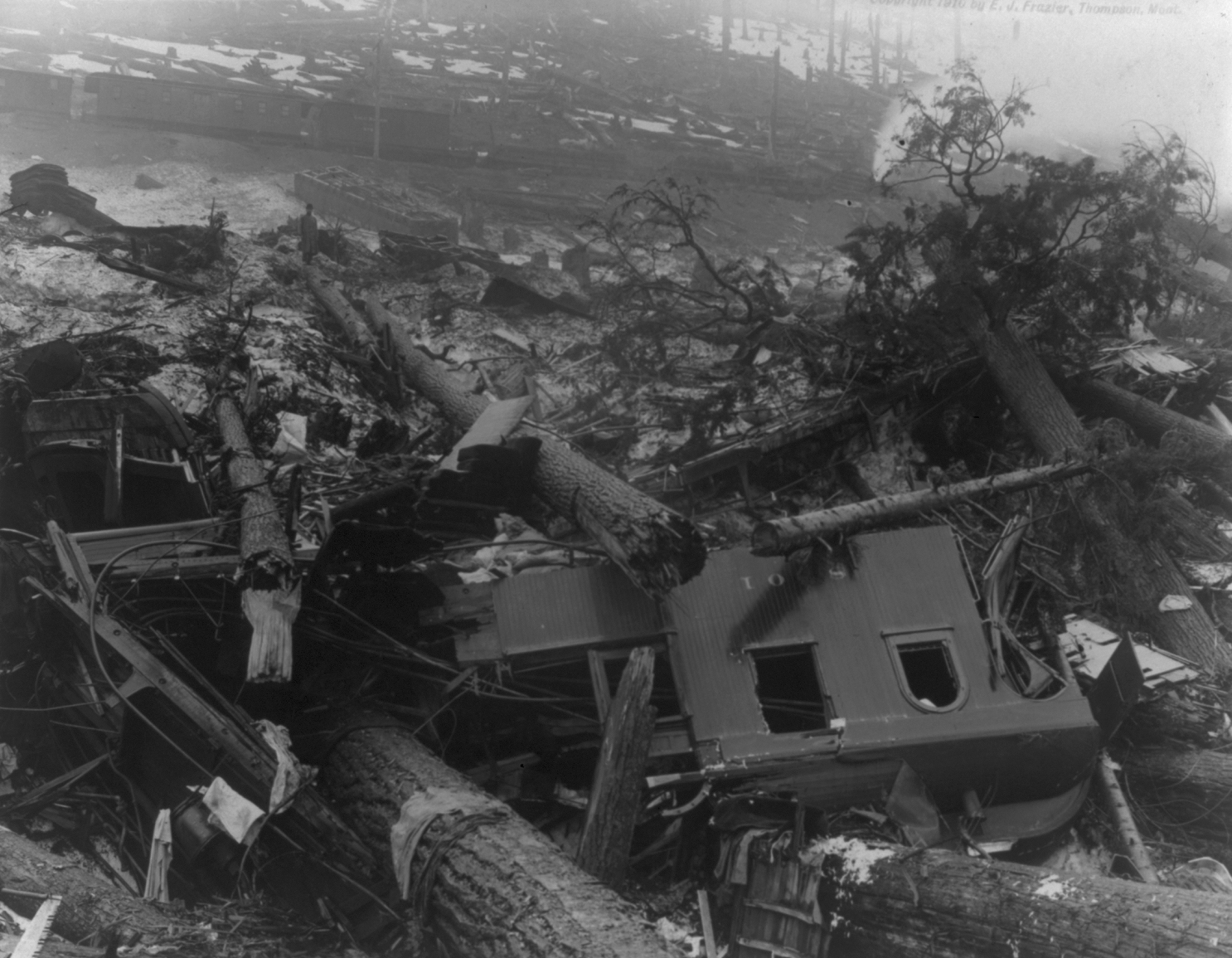
Wreckage of the Great Northern trains at Wellington, Washington, after the March 1, 1910, avalanche. Library of Congress / American-Rails.com collection.
The Wellington disaster was not pure chance. It was the collision of James J. Hill’s mountain railroad, a week-long Cascade storm, a warm rain-and-thunder shift that turned dry snow into a sliding slab, and slopes stripped of timber by logging and fire. What followed reshaped Great Northern’s Cascade Division: concrete snowsheds, a town renamed to escape the name “Wellington,” and ultimately the long second Cascade Tunnel that abandoned the old high line altogether. Today hikers on the Iron Goat Trail walk the grade where the trains once waited under Windy Mountain.
At a Glance
| Item | Detail |
|---|---|
| Date / time | March 1, 1910, shortly after midnight / early a.m. hours (period and secondary accounts cluster around 1 a.m.; some retellings differ by a few hours) |
| Location | Wellington (later Tye), King County, Washington—west portal of the first Cascade Tunnel, Stevens Pass |
| Railroad | Great Northern Railway |
| Trains | Westbound passenger No. 25 (Spokane Local / Seattle-bound) and Fast Mail No. 27 |
| Situation before slide | Stranded ~6–9 days by heavy snow and avalanches after clearing the Cascade Tunnel east-to-west |
| Immediate trigger | Warm rain, wind, and thunderstorm after prolonged blizzard; slab release from Windy Mountain |
| Contributing factors | Denuded slopes (logging / fire); trains parked on vulnerable ledge above Tye Creek; blocked tracks ahead and behind |
| Deaths / survivors | 96 killed; ~23 rescued alive from the wreckage |
| Aftermath works | Town renamed Tye (1910); extensive snowsheds by ~1913; second Cascade Tunnel opened 1929; old grade becomes Iron Goat Trail |
Great Northern, Stevens Pass, and Wellington
James J. Hill’s Great Northern completed its Pacific Coast connection in 1893 without the federal land grants that underwrote other northern transcontinentals. Efficiency and aggressive mountain engineering were the railroad’s trademark. The original Stevens Pass line used steep grades and switchbacks; snow, rock, and slides were constant operating problems.
In 1900 the company opened the first Cascade Tunnel—about 2.6 miles—to cut under the summit and ease the worst of the old climb. By 1909 the tunnel had been electrified to reduce the deadly coal-smoke problem in a long bore. That investment made the Cascade Division more modern than many contemporaries. It did not make the west portal safe.
Wellington, founded in the 1890s as a railroad town, sat at that west portal: depot, bunkhouses, hotel/store/post office, power plant, and a few homes, populated almost entirely by Great Northern people. Side tracks and main track ran along a narrow mountain ledge under Windy Mountain, with the Tye River canyon falling away below. Snowsheds existed in places on the Cascade Division, but the particular park of the stranded trains in late February 1910 lay exposed to a slope that had been opened by clear-cutting and by forest fires—some started by locomotive sparks. Without timber to hold snowpacks, the mountainside was primed for a major slide once weather conditions changed.
The Storm and the Stranding (February 1910)
A severe blizzard settled on the Cascades in the last week of February. Contemporary and secondary accounts describe snowfall rates of up to a foot an hour and, on the worst day, total accumulations measured in feet. Rotary plows and extra engines fought “Cascade cement”—wet, heavy snow mixed with timber and debris—but could not keep the railroad open between the east-side approaches and the west-side stations such as Scenic and beyond.
On February 23, after delay at Leavenworth on the east side, two westbound Great Northern trains moved toward Puget Sound:
- Passenger Train No. 25 — the Spokane Local / Seattle-bound passenger consist (coaches and sleepers; passenger count often given around fifty on board at stranding)
- Fast Mail Train No. 27 — mail cars and crew, high-priority postal traffic
Power was a mix of steam and electric locomotives appropriate to the electrified tunnel and mountain helper territory. The trains passed through the Cascade Tunnel from east to west and then were forced to stop near Wellington when slides and snow blocked the line both ahead and behind. For roughly a week they sat under Windy Mountain above Tye Creek while crews tried—and failed—to dig them out.
Conditions deteriorated into isolation. On February 26, telegraph lines went down; Wellington lost reliable communication with the outside. Supplies and coal were limited. Some passengers hiked roughly nine miles through the storm toward the safer station at Scenic. Most stayed—women and children in cars or town buildings, railroad men working plows and waiting shifts, the hotel and bunkhouses full of railroad families who lived with this mountain every winter.
Late on February 28 the weather flipped: snow gave way to rain and a warm wind, with thunder and lightning reported. That is a classic setup for a wet-slab avalanche—heavy new load, lubricating rain, and acoustic or mechanical disturbance from a storm. More slides rumbled in the distance. The box around the trains tightened.
The Slide: Early March 1, 1910
Sometime after midnight—commonly given as just after 1:00 a.m. on March 1—a slab released from Windy Mountain. Period and later narratives sometimes link the release to lightning or the crash of thunder during the storm. The mass that came down is typically described as on the order of ten feet thick (some popular accounts say more), half a mile long, and a quarter-mile wide, carrying snow, rock, and timber toward the railroad ledge.
The slide missed the Bailets Hotel (which also housed the general store and post office) but hit the railroad depot and, above all, the parked trains. Most passengers and many crew were asleep. The impact threw cars roughly 150 feet downhill into the Tye River valley. Survivors later described coaches lifted and rolled, mail cars torn open, bodies of equipment smashed against trees and buried under tens of feet of snow.
Great Northern employee Charles Andrews, walking toward a bunkhouse, saw the white wall come down. His later recollection became the disaster’s most famous testimony:
“White Death moving down the mountainside above the trains. Relentlessly it advanced, exploding, roaring, rumbling, grinding, snapping—a crescendo of sound that might have been the crashing of ten thousand freight trains. It descended to the ledge where the side tracks lay, picked up cars and equipment as though they were so many snow-draped toys, and swallowing them up, disappeared like a white, broad monster into the ravine below.”
Three railroad employees in cabins or depot structures were killed as the slide hit town. On the trains, passengers and sleeping employees bore the main toll. The official split long used by historians is:
- 35 passengers
- 58 Great Northern employees on the trains
- 3 railroad employees at the depot / cabins
- Total: 96
Early press counts swung wildly—from dozens feared dead to inflated totals above one hundred—as rescue news trickled out of the mountains. The settled figure of ninety-six remains the standard historical total.
Rescue and Recovery
Wellington residents and railroad people still on their feet rushed to the gorge within minutes. Working by hand and with improvised tools through snow and wreckage, they freed about twenty-three living people, many with serious injuries. The injured were moved by sled or toboggan to what remained of town and given care in limited facilities by local women and railroad employees.
Outside help was slow. The same storm that caused the slide had closed the railroad; news and volunteers had to fight their way in. By March 2, larger rescue parties and volunteers were at work. Bodies were recovered one by one, wrapped, and tobogganed down the west side of the Cascades to waiting trains for transport to Everett, Seattle, and elsewhere. The last remains were not recovered until late July, when summer melt finally exposed wreckage still buried under deep snow—about twenty-one weeks after the slide.
Among the dead were entire families and dozens of railroad men whose names filled newspaper columns for weeks. Cemeteries from Spokane to Seattle hold victims; a number of graves, including some unidentified, are associated with Seattle-area burial grounds such as Mount Pleasant. The disaster’s human geography was as wide as the Great Northern’s own: passengers from the Inland Empire and the coast, mail clerks, engineers, firemen, and mountain section hands who lived and died on the Cascade Division.
Causes: Weather, Terrain, and Railroad Choices
Investigations and later histories separate the immediate trigger from the setup.
Immediate trigger: After days of extreme snowfall, a warm rain and storm over a loaded, denuded slope released a wet slab. Thunder and lightning figure in contemporary survivor descriptions of the night. Courts and companies often framed the final release as an act of God.
Setup conditions:
- Denuded slopes — Clear-cutting and fires (including those associated with steam locomotive sparks) removed trees that once held snowpacks and broke slide paths.
- Operating location — Trains were forced to park on a ledge in a known slide zone because the railroad was closed both directions; there was no good alternative once the trap closed.
- Storm duration — A multi-day stranding turned a weather delay into a mass casualty exposure: more people asleep in cars night after night as the snow load grew.
- Limited snowshed cover — Protective sheds existed on parts of the division but not as a continuous armored shell for this particular park.
Critics at the time also argued about coal and supply decisions, crew conditions, and whether the company should have moved passengers out earlier. Great Northern faced lawsuits and public anger; many claims were settled. The railroad was not obliterated as a corporation—it was, however, forced into an expensive program of mountain defense and, later, a total re-route of the high line.
Aftermath: Tye, Snowsheds, and a New Tunnel
The name Wellington became synonymous with death. In October 1910 the settlement was quietly renamed Tye. That same season Great Northern began a major program of concrete snowsheds to armor the most dangerous miles of the Cascade Division. By about 1913, roughly nine miles of sheds protected the track between Scenic and Tye.
Even that was not enough for all time. On January 22, 1916, another avalanche near Corea, about seven rail miles west of Tye, struck a westbound Great Northern passenger train and killed eight people, shoving cars over a steep embankment. The mountain had not signed a truce.
The permanent solution was to leave the old grade. In 1929 Great Northern opened the second Cascade Tunnel—about 7.8 miles, still one of the great American railroad tunnels—on a new alignment that bypassed the old west-portal townsite and the worst of the high ledges. The 1929 tunnel remains in service today under BNSF. Wellington/Tye as a railroad town died with the old line; buildings burned or vanished. The community became a true Cascades ghost town.
The abandoned grade, portals, and snowshed ruins were later preserved as the Iron Goat Trail—named for the Great Northern’s mountain-goat symbol and the iron horses that once climbed the pass. Access from U.S. Highway 2 near Stevens Pass and near Scenic allows hikers to walk past interpretive signs, concrete sheds, and the landscape where the trains waited in February 1910.
A Cascade Winter of Avalanches
Wellington did not stand alone in the snow year of 1910. Three days later, on March 4, the Rogers Pass avalanche in British Columbia killed 62 Canadian Pacific workers—another reminder that the North American cordillera was punishing railroad builders and operators on both sides of the border that winter. Together the disasters fixed public attention on mountain railroading’s human cost at the height of the steam-and-electric transition era.
How Wellington Fits American Railroad Disaster History
| Disaster | Year | Primary failure mode | Approx. deaths |
|---|---|---|---|
| Angola Horror | 1867 | Derailment + car fire | ~49 |
| Ashtabula Bridge | 1876 | Bridge collapse + fire | ~92 |
| Wellington Avalanche | 1910 | Avalanche on stranded trains | 96 |
Angola and Ashtabula were largely failures of equipment and structures. Wellington was a failure of exposure: people and trains held still for days under a loaded mountain. The engineering answers—sheds, tunnels, re-alignment—were different, but the lesson was the same: main-line passenger and mail service cannot treat the landscape as scenery only.
Memory and Sources
The disaster lives in Asahel Curtis photographs of the recovery, in railroad archives, and in modern narrative history—most notably Gary Krist’s The White Cascade (2007) and earlier regional accounts such as JoAnn Roe’s Stevens Pass history. Local hiking and trail organizations keep the Iron Goat interpretation current for visitors who may know nothing of Great Northern but can still stand under a concrete snowshed and feel the weight of the place.
Washington State often ranks Wellington among its worst natural disasters by fatality count. For railroad history it is the definitive American avalanche wreck: not a single car off a grade, but two trains erased from a ledge in one white motion.
Legacy
The Wellington avalanche forced the Great Northern to spend heavily on snow defense and, within a generation, to rebuild its Cascade crossing from the ground up. It also left a darker, quieter legacy: a renamed town, graves across the Northwest, and a hiking trail that is also a long memorial.
Hill’s railroad had conquered the Cascades in the commercial sense. On March 1, 1910, the Cascades answered. The second tunnel and the abandoned high line are the corporate reply. The Iron Goat Trail is the public one. Between them lies the fact that still defines the story: ninety-six people died in their sleep, or in the seconds after waking, because two trains could not move and a mountain could.
Related Reading on American-Rails.com
- Great Northern Railway
- Fallen Flags
- Railroad History (USA)
- The Angola Horror (1867)
- Ashtabula Bridge Disaster (1876)
- Railroad Tycoons
Exact minute of the slide, passenger counts on No. 25, and some car-by-car details vary slightly among contemporary newspapers and later histories. Death totals and the 35/58/3 split follow the standard HistoryLink / modern consensus. For deeper narrative detail, see Krist, The White Cascade, and Great Northern archival collections.
Recent Articles


-
Pennsylvania Dinner Train Rides (2026): A Complete Guide
Sep 22, 26 04:48 PM
 2026 Pennsylvania dinner trains—Colebrookdale Dining Class in Boyertown and Strasburg Dinner on the Rails. Confirm on each railroad.
 -
New York, Ontario & Western Steam Locomotives: History & Roster
Sep 22, 26 04:40 PM
 NYO&W steam—camelback 2-8-0s and 2-6-0s, Class X Bull Moose 2-10-2s, Class Y and Y-2 Mountains. All-time class roster. Steam finished in the summer of 1948. None saved.
 -
New York, Ontario & Western Diesel Roster: All-Time
Sep 22, 26 04:36 PM
 NYO&W diesel—five GE 44-tonners 101-105, eighteen FTs, seven F3s, twenty-one NW2s. Serials and the NW2 order E824. Railroad liquidated March 29 1957.
 -
New York, Ontario & Western Railway: Map, Roster, History
Sep 22, 26 04:26 PM
 New York, Ontario & Western—New York & Oswego Midland chartered January 11 1866, O&W January 21 1880. Scranton coal, West Shore rights. Last train March 29 1957.
 -
Massachusetts Dinner Train Rides (2026): A Complete Guide
Sep 22, 26 04:16 PM
 2026 Cape Cod Dinner Train—Hyannis, Buzzards Bay, and North Falmouth. Four-course, 3–3½ hours, from $99.99. Confirm on capetrain.com.
 -
Colorado Dinner Train Rides (2026): A Complete Guide
Sep 22, 26 03:51 PM
 2026 Royal Gorge Route First Class Dinner and Lunch from Cañon City. About 2 hours, 12+, from $199+. Confirm on royalgorgeroute.com.
 -
New York and Long Branch Railroad: A PRR & CNJ Subsidiary
Sep 22, 26 03:11 PM
 New York & Long Branch—chartered April 8 1868, Perth Amboy–Long Branch July 1 1875, Bay Head Junction 1881. Jersey Central and Pennsylvania trains. Conrail April 1 1976. NJ Transit North Jersey Co…
 -
Monongahela Railway Steam Locomotives: History & Roster
Sep 22, 26 01:34 PM
 Monongahela steam—H-5 Consolidations, USRA light Mikados 170–179, Baldwin L-2s, ex-P&LE L-3s. All-time roster. Last steam May 26, 1954.
 -
Monongahela Railway Diesel Roster: All-Time
Sep 22, 26 01:16 PM
 Monongahela diesel—27 Baldwin S-12s, NYC RF-16 sharks, P&LE GP7s, GP38s 2000–2004, Super 7s 2300–2310. Serials and orders. Last steam May 26, 1954.
 -
Monongahela Railway: Map, Rosters, History
Sep 22, 26 01:14 PM
 Monongahela Railway—incorporated December 31 1900, Railway July 1 1915. Brownsville–Fairmont coal road. Last steam May 26 1954. Conrail May 1 1993.
 -
Virginia Scenic Railway Dining (2026)
Sep 22, 26 01:09 PM
 2026 Virginia Scenic Railway—Blue Ridge Flyer Dining Class from Staunton, about 3 hours, plated meal. Sunday Brunch from Louisa, about $132. Confirm on virginiascenicrailway.com.
 -
Virginia Dinner Train Rides (2026): A Complete Guide
Sep 22, 26 01:03 PM
 2026 Virginia Scenic Railway—Blue Ridge Flyer Dining Class from Staunton, Alleghany Special Dining Class, Sunday Brunch from Louisa. Confirm on virginiascenicrailway.com.
 -
Oregon Dinner Train Rides (2026): A Complete Guide
Sep 22, 26 12:51 PM
 2026 Oregon has no plated dinner train on the calendar. Mount Hood is scenic with snacks. Oregon Coast Scenic’s evening ride is the 21+ Moonlight with sandwiches.
 -
Maine Central Steam Locomotives: History & Roster
Sep 22, 26 12:33 PM
 Maine Central steam—Ten-Wheelers, W-class Consolidations, S-class Mikados, C-class Pacifics, Hudsons 701 and 702. Post-1900 roster after Drury. Last steam June 13, 1954.
 -
Maine Central Diesel Roster: All-Time
Sep 22, 26 12:04 PM
 Maine Central diesel—railcar 901, HH660s, GP7s, E7s, F3s, GP38s, U18Bs, ex-Rock Island U25Bs. All-time roster with serials and orders. Last steam June 13, 1954.
 -
Maine Central Railroad: Map, Logo, Rosters, History
Sep 22, 26 11:36 AM
 Maine Central—Androscoggin & Kennebec and Penobscot & Kennebec, October 28 1862. Pine Tree Route. Mountain Division, Portland–Bangor–Vanceboro. Last steam June 13 1954. Guilford June 1981.
 -
Maryland and Pennsylvania Railroad: Map, Roster, Logo
Sep 22, 26 12:14 AM
 Ma & Pa—Peach Bottom 1868, Maryland & Pennsylvania February 12 1901, Baltimore to York. Last steam November 29 1956. York Railway December 1 1999.
 -
New York Dinner Train Rides (2026): A Complete Guide
Sep 21, 26 11:59 PM
 2026 New York dinner train—Adirondack Dinner Train from Utica, 6 p.m., about 3 hours, First Class from $139. Arcade & Attica mystery dinner is served at Curriers. Confirm on the railroad.
 -
California Dinner Train Rides (2026): A Complete Guide
Sep 21, 26 11:49 PM
 2026 California dinner trains—Napa Valley Wine Train plated meals, River Fox brunch and mystery dinner, Roaring Camp barbecue at camp. Confirm on each railroad.
 -
Roaring Camp Starlight Dinner Party (2026)
Sep 21, 26 11:33 PM
 2026 Roaring Camp Starlight Dinner Party—Beach Train from the Santa Cruz Boardwalk, barbecue at Felton, ride back after dark. Confirm on roaringcamp.com.
 -
Long Island Rail Road Steam Locomotives: History, Roster & Photos
Sep 21, 26 11:29 PM
 Long Island steam—G5s 20–50, H10s 101–119, last steam at Hicksville October 8, 1955. Post-1898 class roster.
 -
Long Island Rail Road Diesel Roster: All-Time
Sep 21, 26 11:24 PM
 Long Island diesel—boxcab 401 in 1925, FM C-Liners, RS-3s, C-420s, GP38-2s, DE30AC and DM30AC. All-time roster with serials and orders.
 -
Long Island Rail Road: Map, History, Pictures, Logo
Sep 21, 26 08:27 PM
 Long Island Rail Road—Brooklyn & Jamaica 1836, Greenport 1844, Pennsylvania control 1900, Penn Station 1910. MTA since 1968. Steam and diesel rosters.
 -
Oregon Coast Scenic Railroad (2026): Sunset Dinner and Moonlight
Sep 21, 26 02:40 PM
 2026 Oregon Coast Scenic does not post the old four-course Sunset Dinner. The evening ride is the 21+ Moonlight Excursion from Garibaldi, with pre-ordered sandwiches. Confirm on oregoncoastscenic.org.
 -
Adirondack Dinner Train (2026): Dates, Tickets & What to Expect
Sep 21, 26 01:38 PM
 2026 Adirondack Dinner Train—Utica Union Station, 6 p.m., about 3 hours to Remsen. First Class from $139. Chef Patrick O’Connor. Confirm on adirondackrr.com.
 -
Lehigh Valley Steam Locomotives: History, Roster & Photos
Sep 21, 26 01:31 PM
 Lehigh Valley steam—Camelback Consolidations, 2-10-2s, K-class Pacifics, six Mountains, Wyoming 4-8-4s. Post-1900 roster after Drury. Last steam September 14, 1951.
 -
Lehigh Valley Diesel Roster: All-Time
Sep 21, 26 01:23 PM
 Lehigh Valley diesel—boxcabs 1926, FTs 1945, F3/F7, FA/PA, C628 Snowbirds, GP38-2s, U23Bs. All-time roster with serials and orders. Last steam September 14, 1951.
 -
Lehigh Valley Railroad: Map, Roster, Logo, History
Sep 21, 26 01:09 PM
 Lehigh Valley—DLS&S 1847, named January 7 1853, Mauch Chunk–Easton September 12 1855. Route of the Black Diamond. Jersey City–Buffalo. Conrail April 1 1976.
 -
Wisconsin Great Northern Dinner Train (2026)
Sep 21, 26 12:47 PM
2026 Wisconsin Great Northern dinner train—Trego, $105, Namekagon River. January 8–31 and May 5–December 17. Confirm on spoonertrainride.com. -
Lehigh and New England Railroad: Map, Rosters, History
Sep 21, 26 12:33 AM
 Lehigh & New England—South Mountain & Boston 1873, named April 2 1895. Anthracite, cement, Maybrook. Last Camelbacks, Alco FAs. Voluntary shutdown October 31 1961.
 -
TVRM Chattanooga Dinner Train (2026): Dates, Tickets & What to Expect
Sep 21, 26 12:20 AM
 2026 TVRM Chattanooga Dinner Train Experience—Grand Junction, select Fri/Sat March 6–October 24, three-course, 2–3 hours, from $110. Confirm on tvrail.com.
 -
Lehigh and Hudson River Railroad: Map, Rosters, History
Sep 20, 26 11:55 PM
 Lehigh & Hudson River—Warwick Valley 1860, Railway April 1 1882. Easton–Maybrook bridge road, Alphabet Route, Alco RS-3s and C420s. Conrail April 1 1976.
 -
Royal Gorge First Class Dinner Train (2026)
Sep 20, 26 11:47 PM
 2026 Royal Gorge Route First Class Lunch & Dinner—Cañon City, about 2 hours, from $199+, 12+. Confirm on royalgorgeroute.com.
 -
GE "44-Tonner" Locomotives: Roster, Specs, History
Sep 20, 26 11:09 PM
 GE 44-ton switcher—90,000-pound rule, Caterpillar D17000 center-cab, Sept 4 1940 CB&Q 9103 through Oct 1956 Dansville & Mount Morris 1. Phases, serial roster, PRR 46.
 -
Strasburg Rail Road Dining (2026): Dinner on the Rails & Elegant Expre
Sep 20, 26 11:00 PM
2026 Strasburg Rail Road seated meals—Dinner on the Rails, Elegant Express, Valentine dinner. Lee E. Brenner diner. Confirm on strasburgrailroad.com. -
International-Great Northern Railroad: Map, History, Timetables
Sep 20, 26 10:43 PM
 International–Great Northern—Houston & Great Northern 1866, International Railroad 1870, merged Sept 30 1873. Palestine, Longview–Laredo, Gould, Missouri Pacific March 1 1956.
 -
Nevada Northern Taste of Italy Dinner Train (2026)
Sep 20, 26 03:25 PM
2026 Nevada Northern Taste of Italy—adults-only multi-course Italian dinner, steam when healthy, East Ely. Sep. 19 gala listed. Confirm on nnry.com. -
Cape Cod Dinner Train (2026): Dates, Tickets & What to Expect
Sep 20, 26 02:53 PM
 Cape Cod Central Dinner Train—Hyannis, Buzzards Bay, and Falmouth. Four-course, 3–3½ hours, from $99.99. Confirm on capetrain.com.
 -
Erie Steam Locomotives: History, Roster & Photos
Sep 20, 26 11:55 AM
 Erie Railroad steam—Camelback 2-8-0s, 155 N-1 Mikados, 105 Berkshires, K-class Pacifics, Triplexes. Post-1900 roster after Drury. Last steam March 17, 1954.
 -
Erie Railroad Diesel Roster: All-Time
Sep 20, 26 11:47 AM
 Erie Railroad diesel—boxcabs 1926, FTs 1944, F3/F7, FA/PA, GP7/GP9, Baldwins, Limas. All-time roster with serials, orders, classes. Last steam March 17 1954. EL October 17 1960.
 -
Erie Railroad: Map, Passenger Trains, Logo, History
Sep 20, 26 11:44 AM
 Erie Railroad—New York & Erie 1832, Piermont–Dunkirk May 14 1851, six-foot then standard June 1880, Chicago 1883. High-and-wide fourth way. Erie Lackawanna October 17 1960.
 -
Colebrookdale Railroad Dining (2026): Secret Valley Dinner Train
Sep 20, 26 11:36 AM
 2026 Colebrookdale Railroad dinner in Boyertown—Secret Valley Dining Class, about 2 hours. Saturday evenings. Confirm on colebrookdalerailroad.com.
 -
Boone & Scenic Valley Wolf Dinner Train (2026)
Sep 19, 26 08:15 PM
 2026 Boone & Scenic Valley Wolf Dinner Train—Des Moines River valley, Bass Point Creek High Bridge, Union Pacific dining cars. Confirm on bsvrr.com.
 -
C&NW 4-6-2s 1617 & 1620: Minnesota 400 Yellow Jackets
Sep 19, 26 11:28 AM
 C&NW Class E Pacifics 1617 and 1620—Alco Schenectady 1917, yellow-and-green E-4-style shrouds 1941 for the Minnesota 400. Crews called them Yellow Jackets. Renumbered 617/620. Scrapped 1956.
 -
Erie Lackawanna Diesel Roster: All-Time
Sep 19, 26 10:13 AM
 Erie Lackawanna diesel—Erie and DL&W inheritance, GP35s, U25Bs, SD45/SDP45/SD45-2, U34CH. All-time roster with serials and orders. Conrail April 1 1976.
 -
Erie Lackawanna Railway: Map, History, Logo
Sep 19, 26 10:06 AM
 Erie Lackawanna Railway—Erie and DL&W, October 17 1960–March 31 1976. Von Willer, White revival, Dereco, Agnes, Conrail. High-and-wide Chicago main. Map, logo, what remains.
 -
"Empire State Express" (1941 Train): Timetables, Route, Consist
Sep 18, 26 10:59 PM
 NYC Empire State Express—George Daniels 1891 day train, 999’s 112.5 mph claim, Budd stainless streamliner December 7 1941, Cleveland and Detroit sections, diesels, 1967 name drop. Timetables, consist…
 -
New York Central 4-6-4s 5426 & 5429: Empire State Express Hudsons
Sep 18, 26 10:32 PM
NYC J-3a Hudsons 5426 and 5429—Alco 1937, Budd stainless shrouds 1941 for the Empire State Express. Pearl Harbor inaugural. Shrouds off by 1950. Neither preserved. -
"Stourbridge Lion" Locomotive: Facts, History, Photos
Sep 18, 26 10:27 PM
 Stourbridge Lion—Foster, Rastrick 0-4-0, first steam locomotive in the United States. Horatio Allen, Honesdale, August 8, 1829. Too heavy for D&H gravity track. Boiler in Baltimore; Colonie replic…
 -
Delaware & Hudson Steam Roster (Post 1900)
Sep 18, 26 10:01 PM
 Delaware & Hudson steam—Camelback 2-8-0s, Loree high-pressure compounds, Class K 4-8-4s, forty Challengers. Post-1900 class roster after Drury. Last steam July 21, 1953.