Canada Southern Railway: Map, History, Timetables
Published: January 30, 2025
By: Adam Burns
The Canada Southern Railway (CASO) stands as a historical testament to the ambitious infrastructure dreams of the 19th century. It became a vital component of the New York Central, acting as a more direct route between Detroit and Buffalo via southern Ontario.
It was originally founded as the Erie & Niagara Extension Railway on February 28, 1868. On December 24, 1869, its name was officially changed to Canada Southern Railway (CASO).
The initial act of 1868 mandated that the railroad be constructed with a broad gauge of 5 feet 6 inches. However, the act was revised in 1869 to allow construction at the standard gauge of 4 feet 8 ½ inches.
Subsequent management came from Penn Central, established in 1968, and later Conrail, formed in 1976, before the railway was sold to Canadian National Railway/Canadian Pacific Railway in 1985.
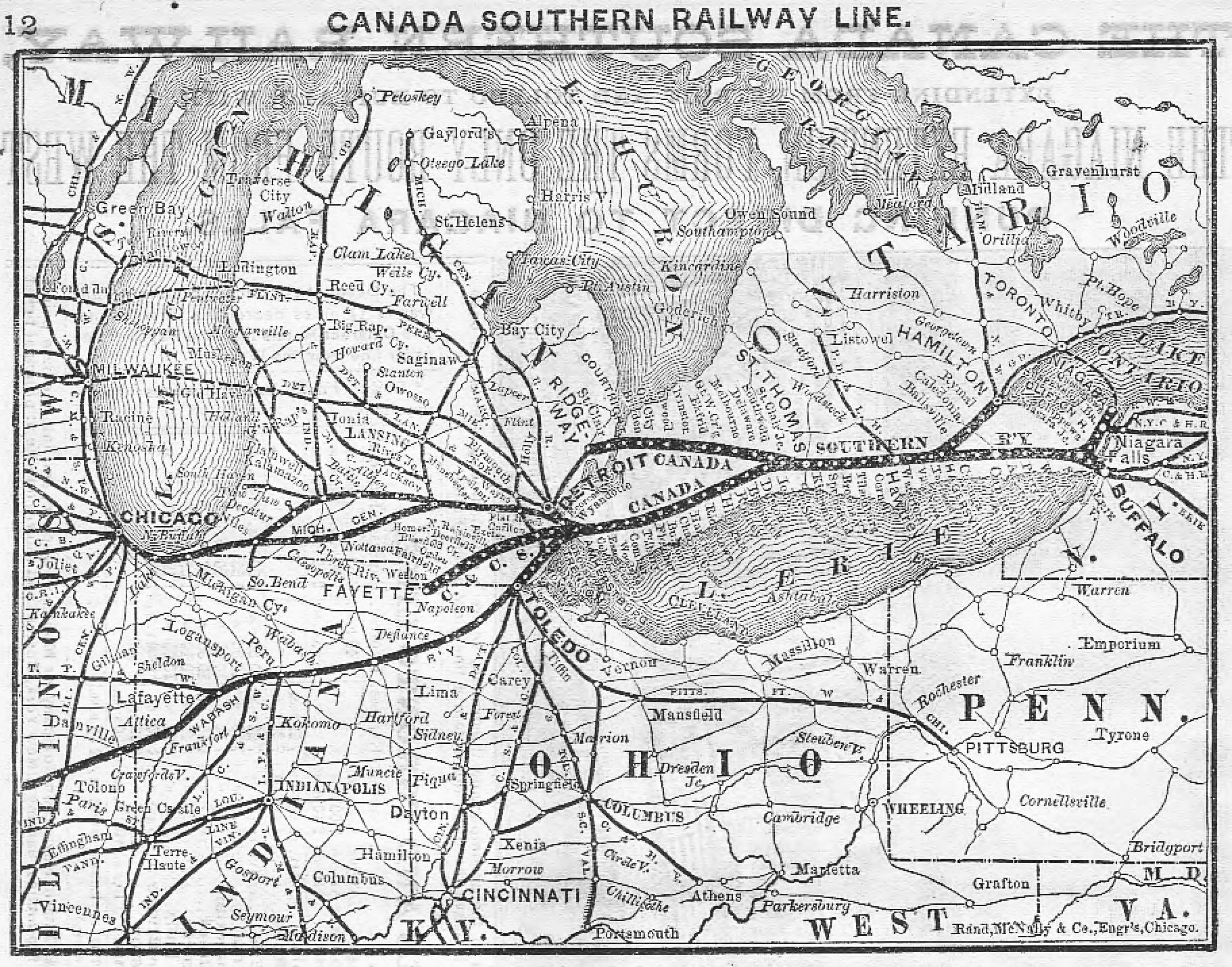
System Map (1881)
Early Years
The story of the Canada Southern Railway began in the mid-1800s, a period marked by a fervent railway boom across North America.
The origins of the CS can be traced back to a charter granted in 1868 by the Province of Canada to the Erie & Niagara Extension Railway Company. The project was soon rebranded as the Canada Southern Railway, with plans to build a new, efficient railway line spanning southern Ontario's fertile lands.
Construction began earnestly in 1869, with the primary aim of connecting Amherstburg on the Detroit River westward through southern Ontario to Fort Erie, near the bustling city of Buffalo, New York.
The strategic intent was clear: the Canada Southern sought to become a critical link for freight and passengers, providing a shorter and more direct route between Chicago and New York City, thereby capturing a segment of the lucrative Great Lakes transport market.
Economic Impact
The Canada Southern's initial rise was swift, fueled by the burgeoning demand for efficient transportation solutions across North America. Its tracks were meticulously laid out to maximize connectivity, intersecting with other major rail lines and seaports, thus maximizing its utility in the regional and continental transport network.
From its completion in the early 1870s, the railway facilitated the rapid movement of goods such as timber, coal, and agricultural products. Southern Ontario's rich agricultural regions, previously limited by inadequate transport options, could now access wider markets, resulting in an economic boom that attracted both settlers and businesses.
Acquisition and Expansion
As Cornelius Vanderbilt pursued the expansion of his railroad empire to create a comprehensive eastern trunk line, he turned his attention to the Michigan Central Railroad. However, as noted by Mike Schafer and Brian Solomon in their book, "New York Central Railroad", acquiring this asset proved to be more challenging than initially anticipated.
In order to secure a direct route to the Michigan Central through southern Ontario, Vanderbilt initially attempted to acquire the Great Western Railway. This effort was ultimately unsuccessful, as the Great Western was eventually absorbed by Canadian National Railway. Undeterred, Vanderbilt shifted his focus to the neighboring Canadian Southern Railway.
The completion of Vanderbilt's final significant acquisition occurred on January 1, 1876, when he successfully gained control of the CASO through stock ownership, just prior to his passing. In addition, acquisition of the nearby Michigan Central was completed two years later.
Innovations and Modernization
Throughout its operational life, the Canada Southern Railway remained at the forefront of railway innovation. By the turn of the 20th century, several key advancements were implemented to improve efficiency and service quality.
Double tracking some segments of the line facilitated increased traffic, improving the movement of freight and passengers alike. Enhanced signaling systems and the introduction of more powerful locomotives further propelled the railway into the modern era of transportation.
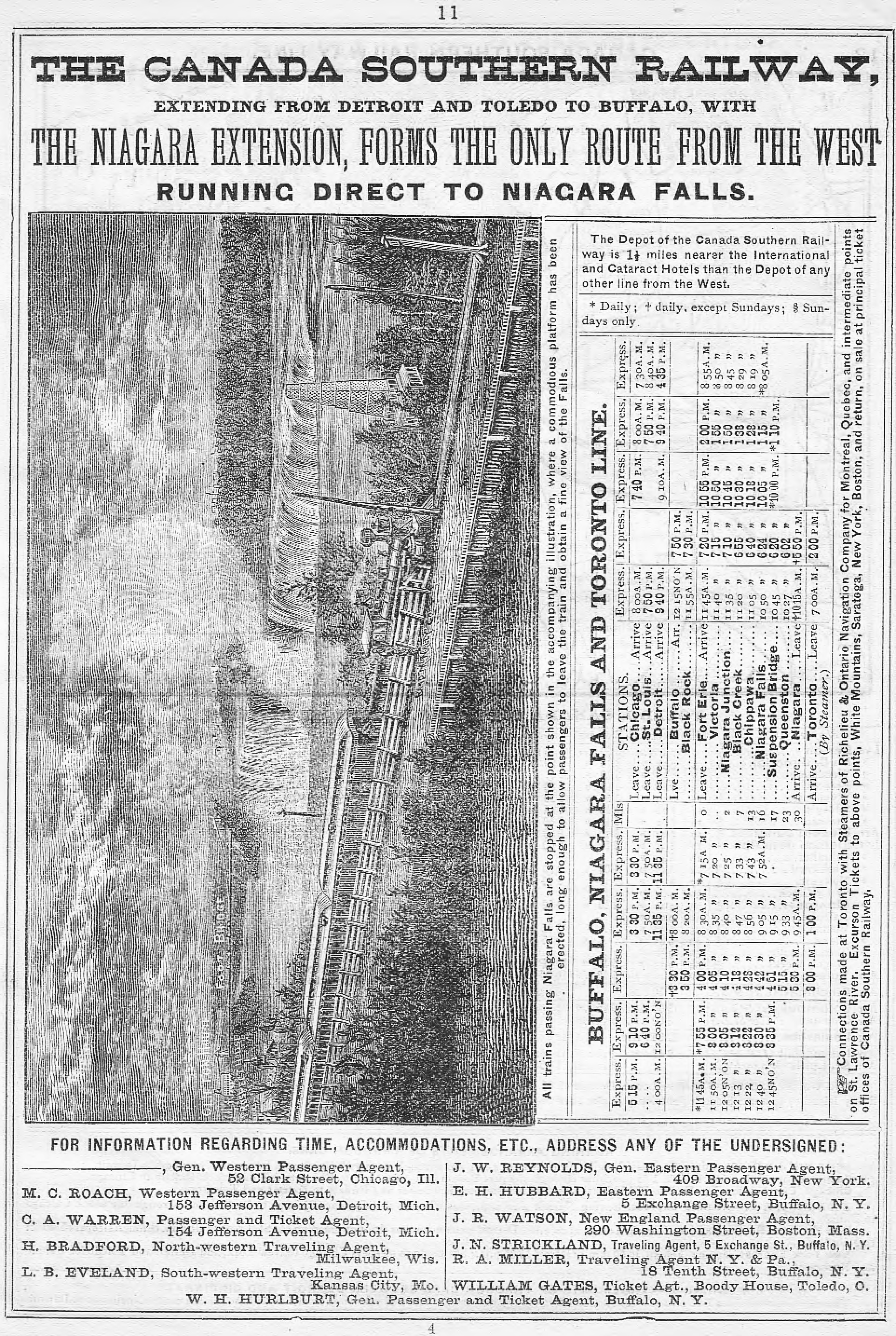
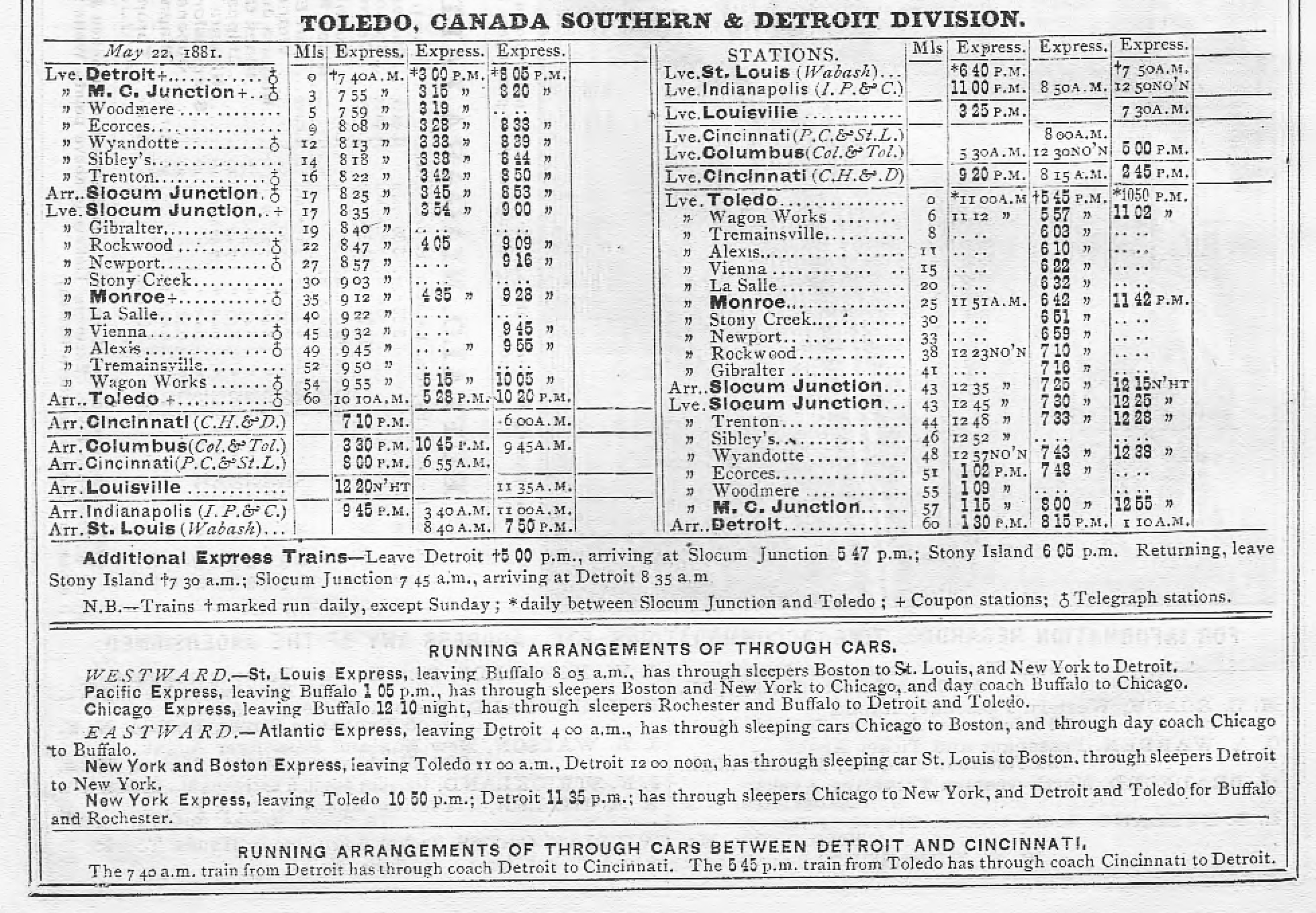
Timetables (1881)
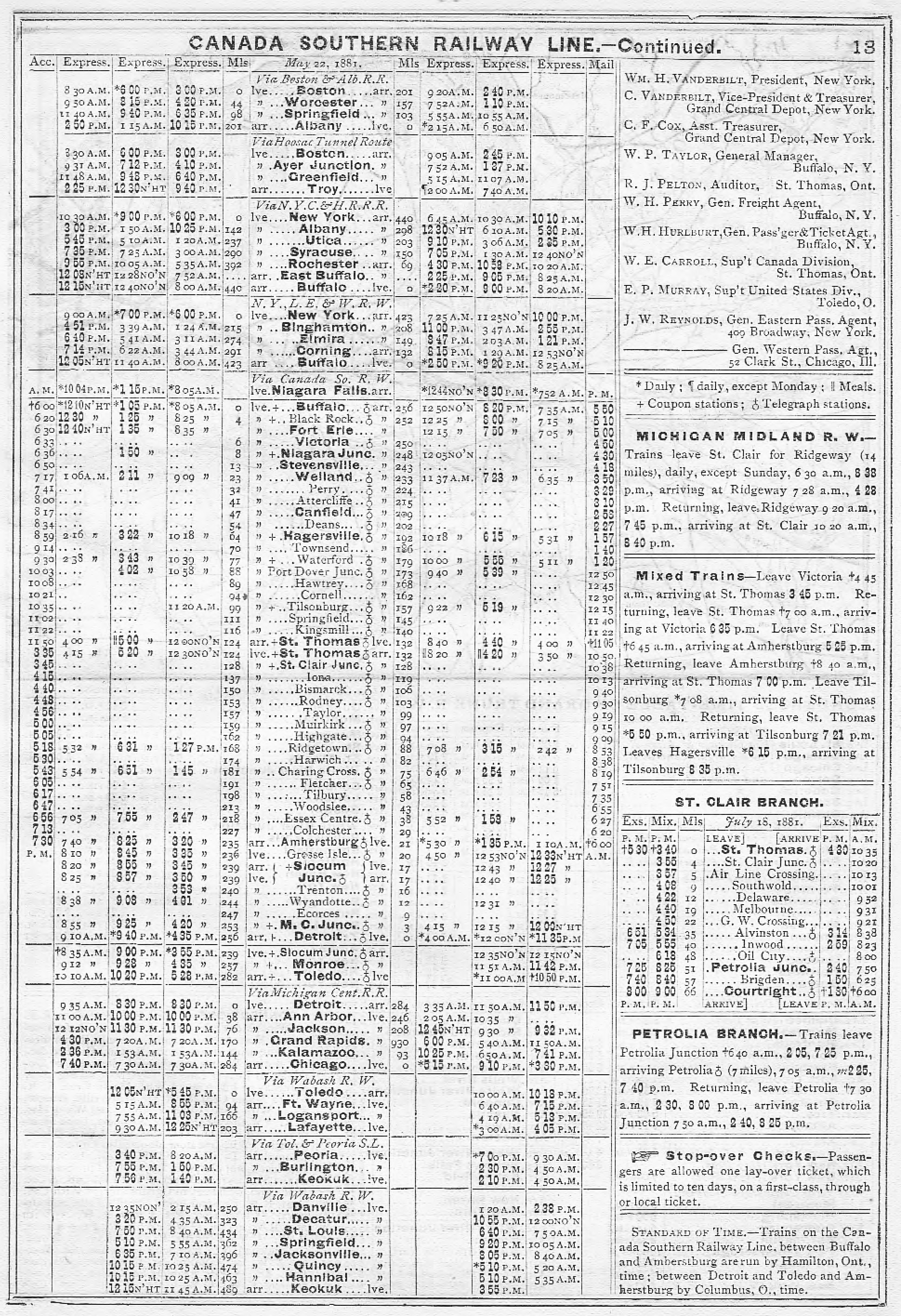
Legacy
As the 20th century progressed, the Canada Southern continued to play a vital role in regional transportation. However, like many railroads, it eventually faced competition from emerging modes of transport, such as automobiles and airplanes, which gradually eroded its traditional business base of passenger and freight transport.
Following the New York Central and Pennsylvania's 1968 merger to form Penn Central, the CASO the route's importance dwindled as the new conglomerate now owned three lines to Detroit and Chicago.
CASO was never fully controlled by the New York Central or subsidiary Michigan Central, as these entities collectively controlled merely 107,000 of the 150,000 shares outstanding, with the remainder being publicly traded.
Shareholders consistently received dividends annually starting in 1887, and a substantial extraordinary dividend disbursed in 1976 led to a legal dispute that persisted until 1983.
On April 30, 1985, the Canadian National and Canadian Pacific jointly acquired the former CASO from then Conrail following Penn Central's 1970 bankruptcy.
This acquisition was primarily motivated by the desire to secure the Detroit River Tunnels under the Detroit River and the Michigan Central Bridge at Niagara Falls.
Over the years, significant portions of the CASO have been downgraded, abandoned, or dismantled by CN and CP. Specifically, operations through Niagara Falls, including those over the MCRR bridge, were ceased, with the corresponding segment through the city being removed in 2001.
However, in contrast to the rest of the line, the tunnel under the Detroit River remains a vital conduit for freight traffic across the Canada-U.S. border and continues to accommodate a substantial volume of mainline traffic.
Conclusion
Today, while the name may no longer adorn rolling stock, the spirit and foresight of the Canada Southern remain integral to the economic narrative of southern Ontario and its role in the broader North American transportation network.
Its history is a testament to the ambition and resilience of early railway pioneers who reshaped landscapes, economies, and societies.
The CASO’s enduring influence is evident in the economic vitality it sowed and the technological standards it helped promulgate, cementing its place as a significant chapter in the annals of railway history.
Recent Articles


-
Greenbrier, Cheat & Elk Railroad: Western Maryland's Logging Line
Sep 26, 26 11:59 PM
 Greenbrier, Cheat and Elk—the logging railroad the Western Maryland bought in 1927. Cass to Spruce, Summit Cut at 4,066.6 feet, Elk River Branch, Laurel Bank.
 -
Elkins (Western Maryland): Yard, History, Operations
Sep 26, 26 11:56 PM
 Western Maryland at Elkins—the Elkins Division yard, roundhouse, and wash rack. Belington, Durbin, Black Fork, and the Elk River branches met here.
 -
B&O's "Cincinnatian" (Train): Route, Consist, Timetable
Sep 26, 26 11:51 PM
 B&O Cincinnatian—Mount Clare five-car streamliner, January 19, 1947, trains 75 and 76. P-7d Pacifics 5301–5304. Detroit–Cincinnati from June 25, 1950, trains 53 and 54. Last run April 30, 1971.
 -
The Semaphore: Railroading's Classic Signal
Sep 26, 26 11:51 AM
 Railroad semaphore signals: blade and spectacle, lower quadrant and upper quadrant, US&S Style B and GRS Model 2A, Robinson’s track circuit, and the last blades on the Raton Subdivision.
 -
Black Fork Grade (Western Maryland): History and Operations
Sep 26, 26 11:47 AM
 Black Fork Grade—the Western Maryland climb through Blackwater Canyon. Thomas to Hendricks, past 3 percent, an H-9 and ten loads, helpers off at Fairfax.
 -
Western Maryland Steam Locomotives: History & Roster
Sep 26, 26 11:39 AM
 Western Maryland steam—H-9 Consolidations, I-2 Decapods, Lima 2-8-8-2s, Baldwin Challengers, and twelve Baldwin Potomac 4-8-4s. Post-1900 roster.
 -
Western Maryland Diesel Roster: All-Time
Sep 26, 26 11:32 AM
 Western Maryland diesels—S1 102 in 1941, fourteen F7 boosters, BL2s, hammerhead RS3s, Circus SD40s, and Chessie GP40-2s. Serials and order numbers.
 -
The Dutch Line (Western Maryland): History, Map, Operations
Sep 25, 26 09:38 PM
 Western Maryland Dutch Line—the Hanover Subdivision. Emory Grove to Highfield via Hanover and Gettysburg, York branch 1893, stone trains, and the route CSX still runs.
 -
The Durbin Branch (Western Maryland): History, Map, Operations
Sep 25, 26 09:13 PM
 Western Maryland Durbin Branch—the Coal & Iron Railway, 46.9 miles Elkins to Durbin, opened July 27, 1903. Mixed train until April 10, 1959. H-7B Consolidations.
 -
Western Maryland Railway: Map, Rosters, Logo, History
Sep 25, 26 10:24 AM
 Western Maryland Railway—the Fast Freight Line. Baltimore, Carroll & Frederick, May 27, 1852. Connellsville Extension 1912. Chessie, then into the B&O May 1, 1983.
 -
Illinois Dinner Train Rides (2026): A Complete Guide
Sep 25, 26 09:52 AM
 2026 Monticello Railway Museum Murder Mystery Dinner Train—June 13, July 11, August 1, and September 5 have run. Three courses, about 2 hours, $112. Confirm on mrym.org.
 -
Georgia Dinner Train Rides (2026): A Complete Guide
Sep 25, 26 12:29 AM
 2026 Azalea Sprinter dinner train from Nashville and Willacoochee, Georgia—2½ hours. Club Car adult $147, Executive adult $177. Confirm on azaleasprinter.com.
 -
Baldwin "Centipede" Locomotives: Specs, Roster, Photos
Sep 25, 26 12:02 AM
 Baldwin DR-12-8-1500/2 Centipede—2-D+D-2, two 608SC engines, 3,000 hp. SAL 4500 from the 1943 test bed. 54 on the serial list, 52 sold. PRR BP60 then BH50. None preserved.
 -
Florida Dinner Train Rides (2026): A Complete Guide
Sep 24, 26 11:56 PM
 2026 Seminole Gulf Murder Mystery Dinner Train in Fort Myers—five courses cooked onboard, 3½ hours, $129 or $135 Saturday, plus tax and gratuity. Confirm on semgulf.com.
 -
West Virginia Northern Railroad: Map, Photos, History
Sep 24, 26 11:27 PM
 West Virginia Northern—Kingwood to Tunnelton, 11 miles of Preston County coal. Narrow gauge 1888, standard gauge 1895. Last freight February 19, 1991. Consolidations 8 and 9 survive.
 -
Rutland Railroad: Map, Rosters, History, Logo
Sep 24, 26 01:18 PM
 Rutland Railroad—Follett’s Champlain & Connecticut River, November 1, 1843. Bellows Falls–Burlington December 18, 1849. Green Mountain Gateway. Last train September 25, 1961. Vermont Railway Janua…
 -
Arkansas Dinner Train Rides (2026): A Complete Guide
Sep 24, 26 01:12 PM
 2026 Eureka Springs & North Arkansas Dinner Train—Eurekan dining car, about 2 hours, $53.62 tax included, opens May 9, Tuesday, Wednesday, Friday, and Saturday. Confirm on esnarailway.com.
 -
Arizona Dinner Train Rides (2026): A Complete Guide
Sep 24, 26 01:01 PM
 2026 Arizona has no plated dinner train. Grand Canyon Railway sells snacks in the cars and meals in Williams or at the rim. Verde Canyon includes a charcuterie tray.
 -
Rail News, The Latest
Sep 24, 26 12:36 PM
This page provides a portal to the latest in rail news, from preservation and restortation subjects to other notable topics. -
Cotton Belt 819 Moved Outside at Pine Bluff for Evaluation
Sep 24, 26 12:35 PM
 Cotton Belt 819 left the Pine Bluff shop on September 22, 2026, first time outside in about 30 years. RDG Steam Services is evaluating the engine. No donation link posted.
 -
Reading Steam Locomotives: History, Roster & Photos
Sep 24, 26 12:14 PM
 Reading steam—Wootten fireboxes, Camelback Consolidations, Mallets, K-1 Santa Fes, G-3 Pacifics, T-1 4-8-4s. Post-1900 roster after Drury. Rambles ended October 17, 1964.
 -
Reading Diesel Roster: All-Time
Sep 24, 26 12:10 PM
 Reading diesel roster—AGEIR boxcabs, FTs, FA-1s, RS-3s, Train Masters, GP30s through GP39-2s. Serials and order numbers. Conrail April 1, 1976.
 -
Reading Railroad: Map, Logo, History, Rosters
Sep 24, 26 12:08 PM
 Reading Company—Philadelphia & Reading, 1833. Anthracite, Port Richmond, Reading Terminal. Operating company January 1, 1924. Conrail April 1, 1976.
 -
Nevada Dinner Train Rides (2026): A Complete Guide
Sep 24, 26 12:02 PM
 2026 Nevada Northern Taste of Italy—adults-only gala from East Ely. The September 19 date has run. Confirm any later night on nnry.com.
 -
North Carolina Dinner Train Rides (2026): A Complete Guide
Sep 24, 26 11:24 AM
 2026 North Carolina dinner trains—NCTM Wine & Dine in Spencer sold out February 13–15. GSMR First Class is the plated meal on the Nantahala Gorge excursion. Confirm on the railroad.
 -
Railway Express Agency (REA): Signs, Trucks, Logo & History
Sep 24, 26 09:40 AM
 Railway Express Agency—railroad-owned express company. Incorporated December 7, 1928. Operations March 1, 1929. Red diamond, green trucks. Last regular express November 7, 1975.
 -
Michigan Dinner Train Rides (2026): A Complete Guide
Sep 24, 26 09:28 AM
 2026 Steam Railroading Institute dining in Owosso—select evenings, no public dinner dates posted. Confirm on michigansteamtrain.com.
 -
Pittsburgh and West Virginia Railway: Map, Rosters, History
Sep 24, 26 12:24 AM
 Pittsburgh & West Virginia—the Hi-Line. Wabash-Pittsburgh Terminal 1904. Railway January 29, 1917. Connellsville February 11, 1931. N&W lease October 16, 1964. Wheeling & Lake Erie from May 17, 1990.
 -
Indiana Dinner Train Rides (2026): A Complete Guide
Sep 24, 26 12:13 AM
2026 Spirit of Jasper Ride & Dine is paused. No public trains. Depot at 201 Mill Street stays open as a rental. Confirm on spiritofjaspertrain.com. -
New Jersey Dinner Train Rides (2026): A Complete Guide
Sep 24, 26 12:01 AM
2026 Woodstown Central Dining in Motion—private table of four from $190, about an hour, Salem County. Confirm on woodstowncentral.com. -
Maryland Dinner Train Rides (2026): A Complete Guide
Sep 23, 26 05:19 PM
 2026 Western Maryland Scenic Allegheny Mountain Dinner Train—Cumberland, 3 hours, 21+, Saturday 7 p.m. Confirm on wmsr.com.
 -
Pittsburgh and Lake Erie Railroad: Map, Rosters, Photos
Sep 23, 26 03:28 PM
 Pittsburgh & Lake Erie—the Little Giant. Chartered 1875, Pittsburgh to Youngstown February 10, 1879. New York Central from 1883. Independent May 15, 1979. Last day September 11, 1992.
 -
Kansas Dinner Train Rides (2026): A Complete Guide
Sep 23, 26 01:11 PM
 2026 Abilene & Smoky Valley Smoky Valley Limited—two hours from the Rock Island Depot, about $72–$110, dates into December 31. Confirm on asvrr.org.
 -
The Belpaire Firebox: Simplicity and Greater Power
Sep 23, 26 01:03 PM
 Belpaire firebox—Alfred Belpaire, 1864. Square crown, straight staybolts at right angles. Pennsylvania standard after the 1880s. Great Northern was the other big user.
 -
Pennsylvania Railroad (PRR) Electric Roster: All Classes
Sep 23, 26 12:57 PM
Pennsylvania Railroad electrics—DD1s into Penn Station, P5s, 139 GG1s, B1 switchers, and 66 E44s. Class roster, 1905–1963. No unit-by-unit GG1 list. -
Penn Central Diesel Roster: All-Time
Sep 23, 26 12:46 PM
 Penn Central diesel roster—PRR classes on NYC, PRR, and New Haven power. New orders carry serials. GP38-2s are 7940-8162. Conrail April 1, 1976.
 -
Penn Central Railroad: Map, History, Logo
Sep 23, 26 12:32 PM
 Penn Central—Pennsylvania and New York Central merged February 1, 1968. New Haven January 1, 1969. Section 77 bankruptcy June 21, 1970. Conrail April 1, 1976.
 -
Iowa Dinner Train Rides (2026): A Complete Guide
Sep 23, 26 11:42 AM
 2026 Boone & Scenic Valley Wolf Dinner Train—Saturdays May–October, Union Pacific dining cars, Bass Point Creek High Bridge. Confirm on bsvrr.com.
 -
Pennsylvania-Reading Seashore Lines: Map, Roster, History
Sep 23, 26 12:32 AM
 Pennsylvania-Reading Seashore Lines—Atlantic City Railroad renamed July 15, 1933. Pennsylvania two-thirds, Reading one-third. Camden to Atlantic City, Cape May, and Millville. Conrail April 1, 1976.
 -
Wisconsin Dinner Train Rides (2026): A Complete Guide
Sep 23, 26 12:28 AM
2026 Wisconsin Great Northern dinner train in Trego—$105, Namekagon River, January 8–31 and May 5–December 17. Mid-Continent’s remaining 2026 calendar is snack and scenic. Confirm on the railroad. -
New Hampshire Dinner Train Rides (2026): A Complete Guide
Sep 23, 26 12:21 AM
2026 Cafe Lafayette Dinner Train in North Woodstock—five courses, 2 hours, from $125. Children under 6 not allowed. Confirm on nhdinnertrain.com. -
PRR "GG-1" Locomotives: Roster, Photos, Specs
Sep 23, 26 12:13 AM
 PRR GG1 electric: 139 locomotives, 4800–4938, built 1934–1943. Specs, Loewy shell, Amtrak numbers, and the last revenue trip on October 28, 1983.
 -
Montana Dinner Train Rides (2026): A Complete Guide
Sep 23, 26 12:04 AM
2026 Charlie Russell Chew Choo from Hanover, near Lewistown—4.5 hours, prime rib, adult $151. Remaining listed dates sold out. Confirm on montanadinnertrain.com. -
Kentucky Dinner Train Rides (2026): A Complete Guide
Sep 22, 26 11:52 PM
2026 My Old Kentucky Dinner Train in Bardstown—four courses, 2.5 hours, adult $116. Confirm on kydinnertrain.com. -
Tennessee Dinner Train Rides (2026): A Complete Guide
Sep 22, 26 11:45 PM
2026 TVRM Chattanooga Dinner Train—Grand Junction, select Fri/Sat March 6–October 24, 6 p.m., from $110. Confirm on tvrail.com. -
The Trainphone: PRR's Wireless Radio System
Sep 22, 26 11:17 PM
 Pennsylvania Trainphone—Union Switch & Signal inductive telephone. Bel-Del trial 1941, Frenchtown November 29, 1943. Carriers at 88 kHz and 144 kHz. Out of service April 30, 1967.
 -
Pennsylvania (PRR) Steam Roster: Post 1906
Sep 22, 26 11:13 PM
 ennsylvania steam after 1906—H8, H9, and H10 Consolidations, 574 L1s Mikados, 598 I1s Decapods, 425 K4s Pacifics, 301 M1 Mountains. Drury’s grid. Last steam November 30, 1957.
 -
Pennsylvania Railroad (PRR) Diesel Roster: All-Time List
Sep 22, 26 10:59 PM
 Pennsylvania diesel roster—SW 3908 in June 1937, then Alco, Baldwin, EMD, Fairbanks-Morse, GE, and Lima. Serials and Alco order numbers. Penn Central February 1, 1968.
 -
Pennsylvania Railroad: Map, Logo, History, Rosters
Sep 22, 26 10:02 PM
 Pennsylvania Railroad—chartered April 13, 1846, Harrisburg–Pittsburgh, Horseshoe Curve 1854, Penn Station 1910. Standard Railroad of the World. Penn Central February 1, 1968.
 -
Pennsylvania Dinner Train Rides (2026): A Complete Guide
Sep 22, 26 04:48 PM
 2026 Pennsylvania dinner trains—Colebrookdale Dining Class in Boyertown and Strasburg Dinner on the Rails. Confirm on each railroad.