
The "Chippewa-Hiawatha": Chicago - Ontonagon, MI
Last revised: September 8, 2024
By: Adam Burns
The Milwaukee Road drew immediate acclaim and national media when it inaugurated the original Hiawatha streamliner on May 29, 1935.
Not only did the train offer virtually any on-board accommodation one could expect of a regional train but it was also blazing fast, clipping along at more than 100 mph and averaging 80 mph. The Hiawatha was uniquely Milwaukee Road and its success prompted the company to launch an entire fleet.
All were in service by 1940 and included the North Woods Hiawatha (also referred to as the Hiawatha-North Woods Service), Midwest Hiawatha, and Chippewa-Hiawatha (originally known as the Chippewa).
These secondary trains offered amenities closely aligned with the original Hiawatha flagship but their less populated corridors made them more susceptible to the automobile. As a result, all had either been canceled or lost their name by 1960.
When streamliner frenzy took hold in early 1934, introduced to the nation through Union Pacific's M-10000 and Burlington Zephyr 9900 passenger rail travel was forever changed.
After both roads successfully demonstrated not only the trains' capabilities but also their draw on the public (after all, who had ever seen a colorful, speeding steel tube before?) others soon scrambled to put their own versions in service.
The Milwaukee Road was slow to do so, lagging behind rivals Chicago & North Western and Burlington, but when the Hiawatha went on display during the spring of 1935 it was something to behold.
Photos
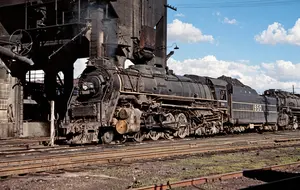
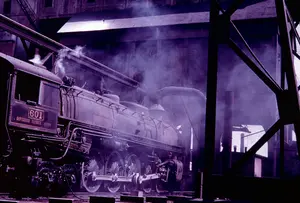
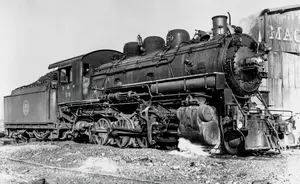
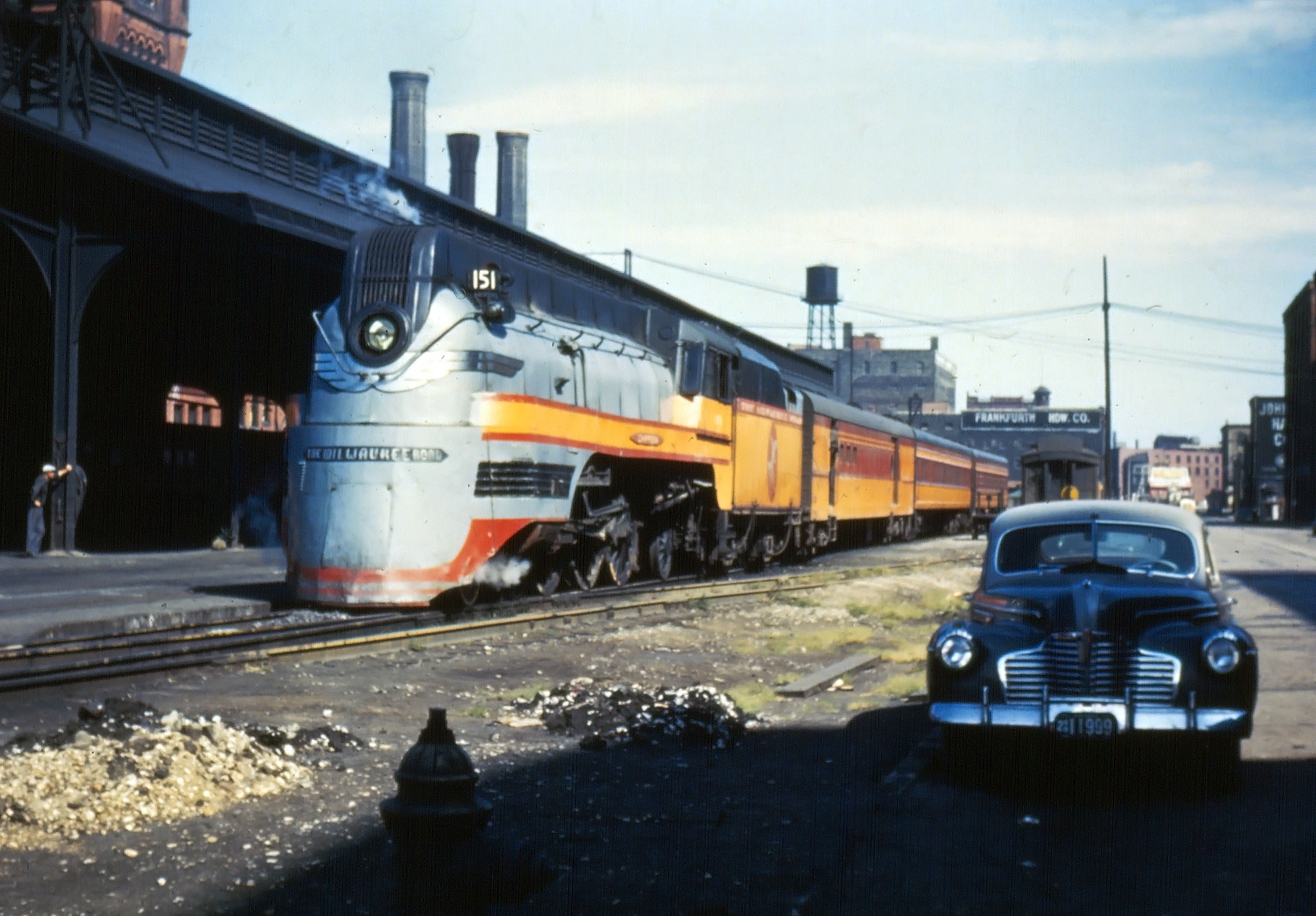 Milwaukee Road 4-6-2 #151 (F-1) is seen here with the "Chippewa" just off the train shed at the Everett Street Station in Milwaukee, Wisconsin circa 1950.
History
The train's styling was done by industrial designer Otto Kuhler from the speedy 4-4-2 Atlantics to the "Beaver Tail" parlor-observation. Its livery was an intricate and classy mix of maroon, grey, and orange with a winged-shield draped across the locomotive's nose.
Not surprisingly, the Hiawatha's quick schedule and exquisite accommodations saw it regularly sell out, averaging 758 daily passengers through March of 1937. Net earnings were also strong, coming in at $2.49 per mile once operating costs were subtracted according to Brian Solomon and John Gruber's book, "The Milwaukee Road's Hiawathas."
Its very name evoked speed, named after Henry Wadsworth Longfellow's "swift-of-foot" Native American chief, "Hiawatha."
Those credited with the idea include Milwaukee Road employees Clarence E. Trophy (mechanical engineer's office), Henry T Hooker (engineer), J.B. Ennis (American Locomotive Company vice president), E.O. Reeder (former assistant chief engineer), Kenneth D. Alleman (clerk), and Charles H. Bity (chief mechanical officer, for many years he remained anonymous).
At A Glance
10 Hours, 15 Minutes (Northbound) 11 Hours, 15 Minutes (Southbound) |
|
21 (Northbound) 14 (Southbound) | |
Brass Street Depot (Ontonagon) Union Station (Chicago) |
Realizing it was sitting on a gold mine the Milwaukee Road wasted little time adding other Hiawathas to its fleet, as soon as the equipment could be put into service (this was originally in the form of hand-me-downs as new cars were built or acquired for the Hiawatha).
The first to launch was the North Woods Hiawatha between New Lisbon and Minocqua, Wisconsin on April 1, 1937 and then the Chippewa on May 28, 1937 between Chicago and Michigan's Upper Peninsula (the Midwest Hiawatha began on December 11, 1940).
According to the railroad it was, "continuing its campaign to stimulate rail travel through the introduction of high speed passenger service in air-conditioned coaches in territory previously served principally by local trains." The Chippewa's service coverage was a stepped process, involving additional stops over the course of a year.
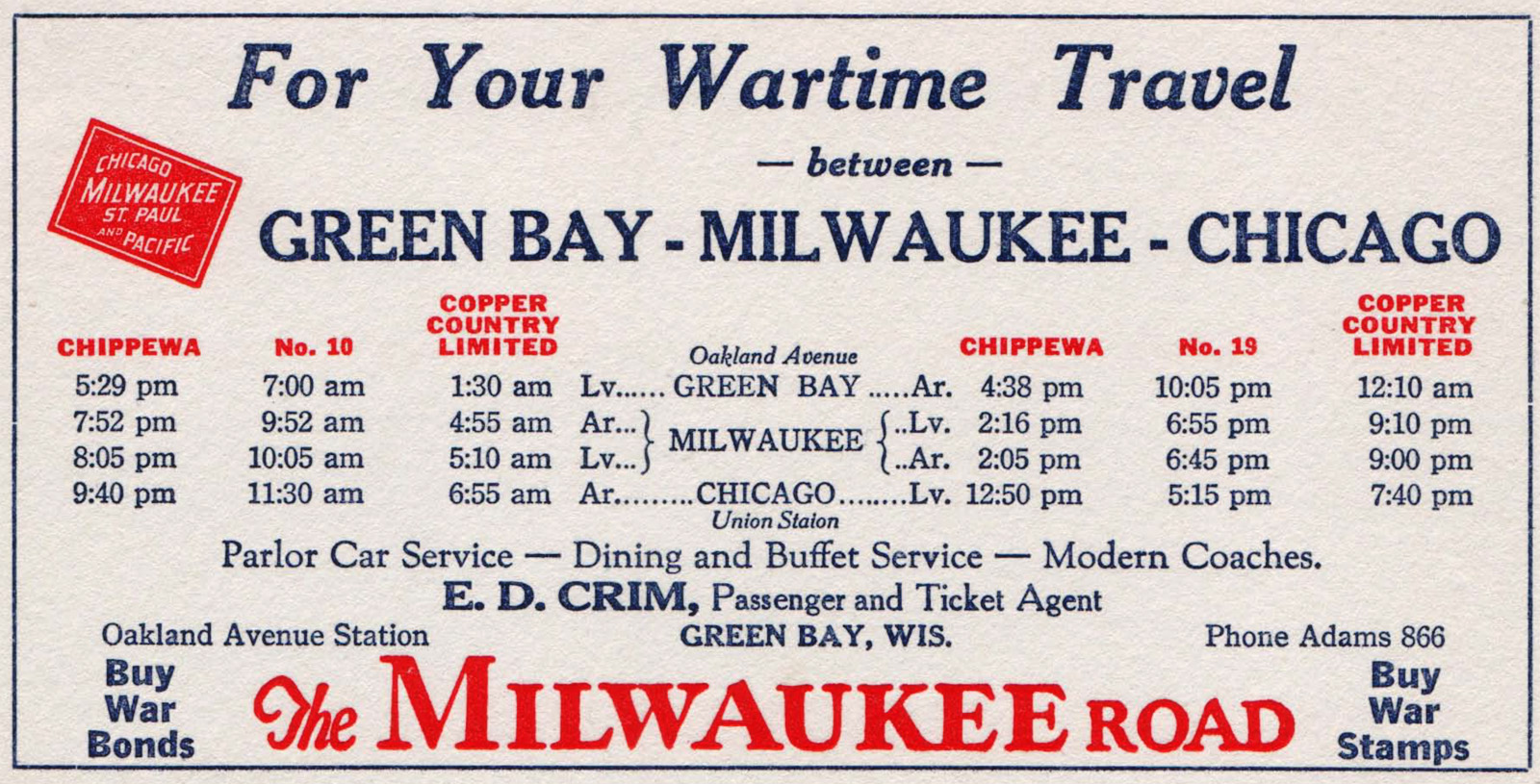
When it first began the Chippewa served Chicago and Iron Mountain, Michigan (via Green Bay, Wisconsin) but was soon extended to Channing by October.
Finally, the following March (1938) service was pushed to Ontonagon along the shores of Lake Superior, the Milwaukee's furthest reach into the Wolverine State. When rail travel was still the way to get around summer vacationers often used trains to relax in the U.P. and the Milwaukee competed against the Chicago & North Western for this passenger traffic.
The Chippewa was powered by Class F-3-a 4-6-2s. These locomotives wore streamlined shrouding that closely resembled their 4-4-2 and 4-6-4 brethren with a similar livery of grey, maroon, and orange. The work was done, of course, at the fabled shops in Milwaukee and improved upon over the years.
At first the locomotives showcased only streamlined touches but by 1941 they were completely sheathed in steel including "Chippewa" nameplates on the running boards and the sprinting Indian logo on the tender.
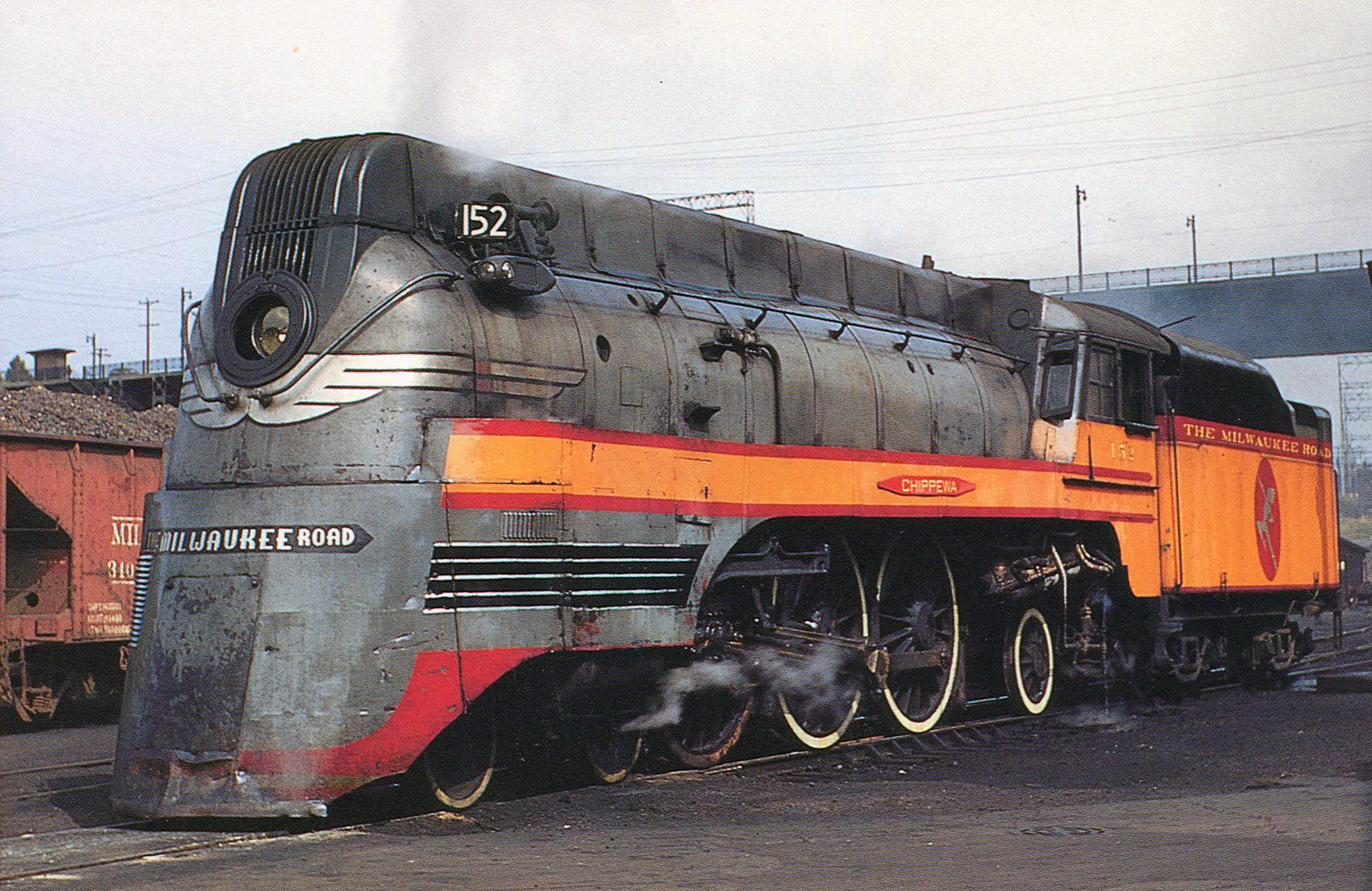
Only two Pacifics in all received these elegant touches, #151 and #152. Just like the Atlantics and Hudsons, both 4-6-2s were quite capable at zipping their train up to 100 mph.
One must keep in mind that unlike other railroads the Milwaukee was as much concerned with the incredibly fast speeds of their trains as they were with provided first-class service.
According to Jim Scribbins' book, "The Hiawatha Story," the company had initially chosen steam power on its streamliners for a number of reasons:
- It was best suited to pull the full-size streamlined cars.
- Had flexibility as a non-articulated trainset (when the concept was introduced such single-unit, streamlined diesels were not yet in wide-scale production).
- Existing facilities were already available.
- Proper proportions (as the railroad saw it) among the locomotives and cars
- Steam offered full-horsepower at top speed, was 25% cheaper than diesels, and the steam locomotive design was meant to provide improved grade-crossing protection for crews and passengers.
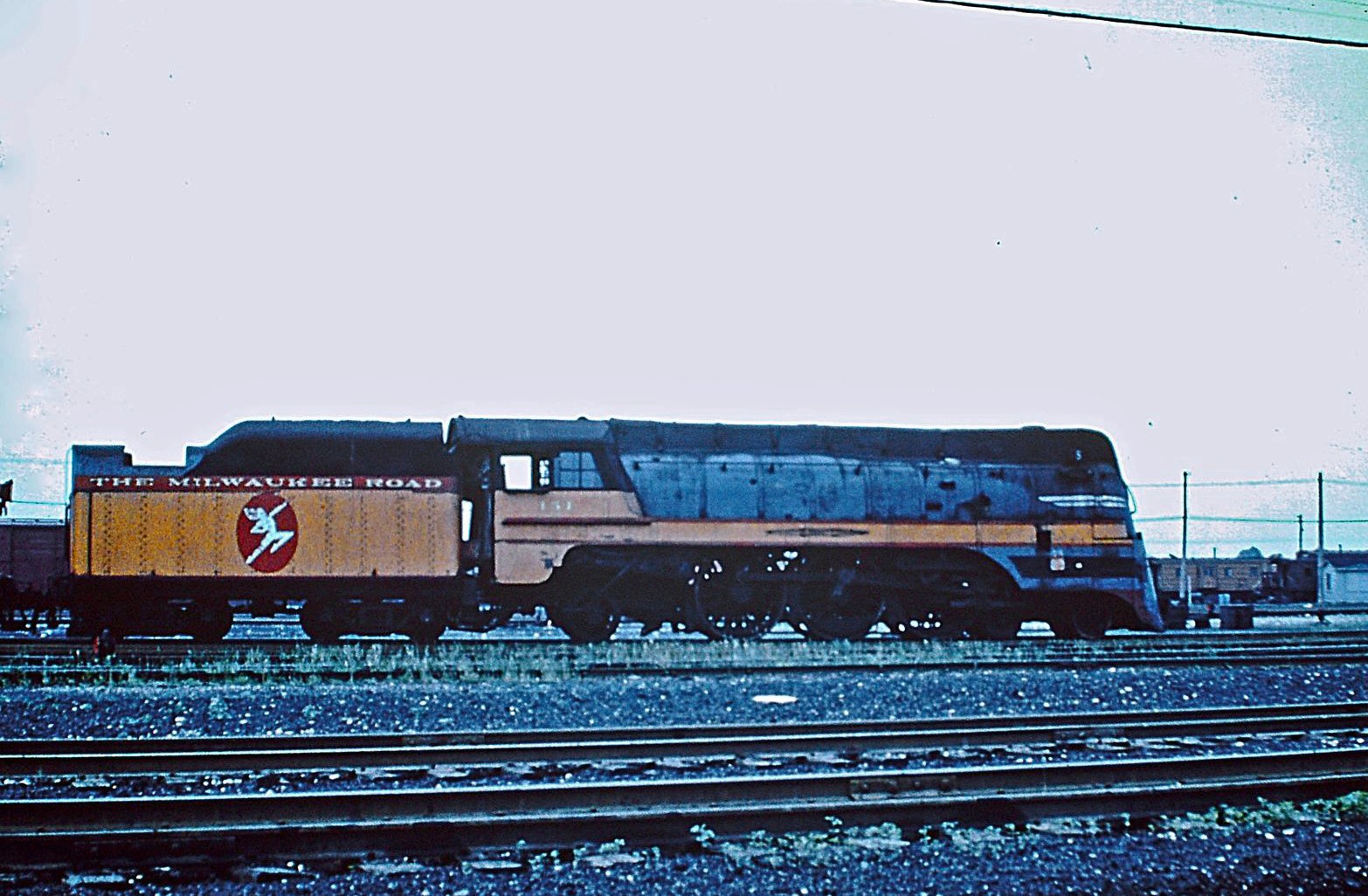 Milwaukee Road 4-6-2 #151 is seen here in Milwaukee, Wisconsin in 1954 following its retirement. The locomotive was originally #1539. It was later rebuilt and streamlined, in 1941, to handle the railroad's "Chippewa-Hiawatha" service.
The Chippewa was listed as trains #14 (southbound) and #21 (northbound). During its first ten years of service a parlor and buffet-diner were offered between Channing and Chicago while three, through reclining-seat coaches ran the entire route.
In 1948 the train officially joined the Hiawatha fleet becoming the Chippewa-Hiawatha. According to Tom Murray's, "The Milwaukee Road," upgrades included an RPO-express, three former Olympian Hiawatha reclining-seat coaches, a 1948 diner, and a 1938 "Beaver Tail" parlor car.
Consist (1952)
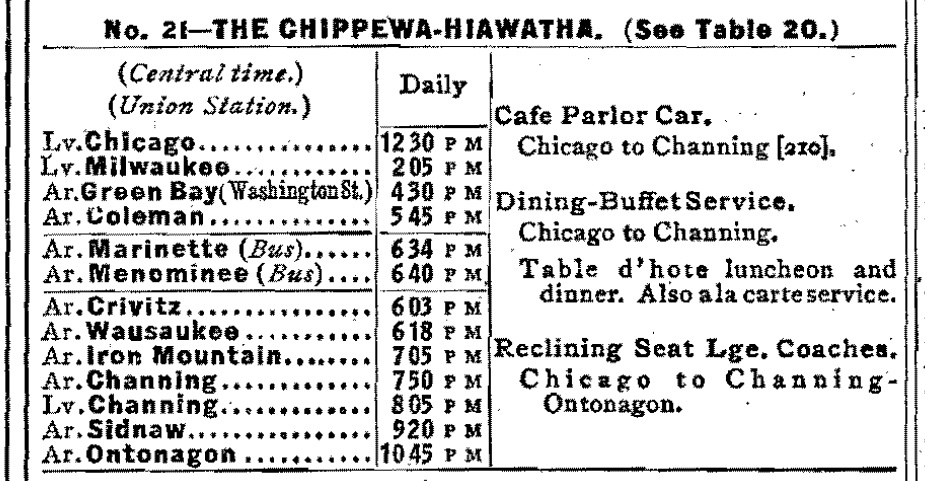
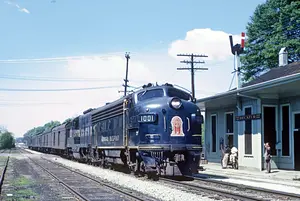
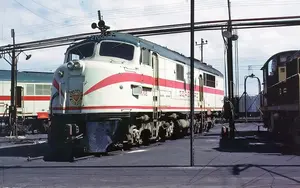
Interestingly, the Pacifics remained primary power for only two more years and the Chippewa witnessed a brief career between receiving this new equipment and the first changes/cutbacks. In 1950 diesels arrived in the form of Electro-Motive E7As and FP7s while in December of that year through service was truncated no further south than Milwaukee.
Timetable (1952)
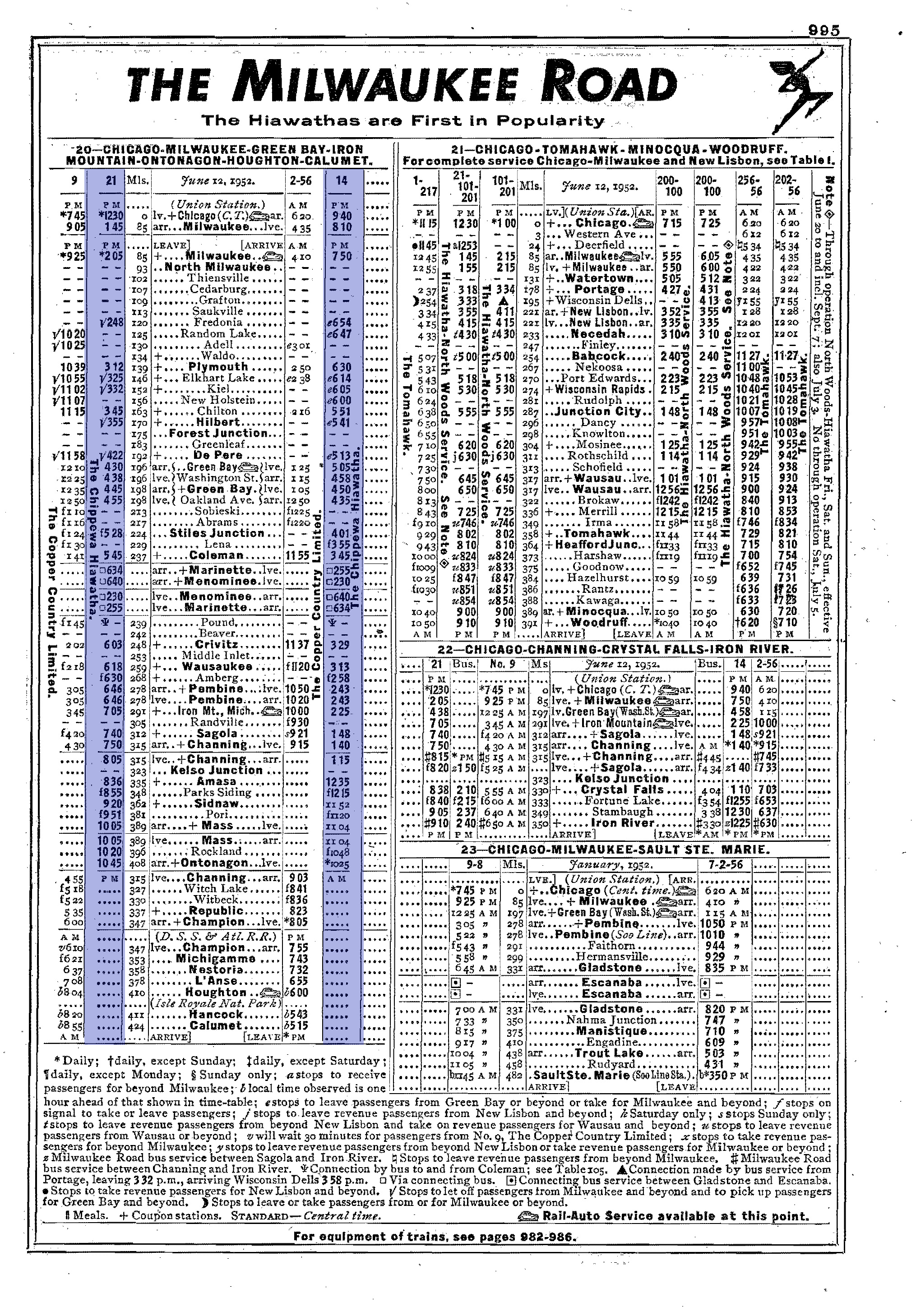
Final Years
As the public began abandoning trains for the open highway vacation trains like the Chippewa-Hiawatha were the first to feel the affects (the C&NW's trains fared no better).
During January of 1954 service was further reduced between only Milwaukee and Channing. Finally, the train made its final run on February 6, 1960 as the last secondary Hiawatha still in service when it was discontinued (the former North Woods Hiawatha lost its name in 1956 but carried on via its train numbers until 1970).
Perhaps more than most other roads, as Mr. Solomon and Mr. Gruber note, the Milwaukee invested incredible amounts of time, money, and energy into operating its Hiawathas in an effort to provide top-level, high-speed service. As a result, when traffic began its incessant decline the company pulled the plug on all but its most important corridors to reduce costs.
Sources
- Murray, Tom. Milwaukee Road, The. St. Paul: MBI Publishing, 2005.
- Scribbins, Jim. Hiawatha Story, The. Minneapolis: University of Minnesota Press, 2007.
- Scribbins, Jim. Milwaukee Road Remembered. Minneapolis: University Of Minnesota, 2008 (Second Edition).
- Solomon, Brian and Gruber, John. Milwaukee Road's Hiawatha's, The. St. Paul: Voyageur Press, 2006.
Recent Articles


-
Akron, Canton and Youngstown Railroad: Map, History, Rosters
Oct 17, 26 05:49 PM
 Akron, Canton and Youngstown Railroad, Mogadore to Delphos. The rails never reached Canton or Youngstown. Norfolk & Western control on October 16, 1964. Twenty-six diesels and the historical society's…
 -
Georgia Railroad: Map, History, Logo, Rosters
Oct 17, 26 12:59 PM
 Georgia Railroad, the Georgia Railroad and Banking Company, Augusta to Atlanta, with the Athens branch and the Macon Road. Mark GA. The railroad properties were sold on November 4, 1982.
 -
West Point Route (Railroad): Map, History, Logo
Oct 16, 26 11:26 PM
 The West Point Route was a trademarked name comprising the Atlanta & West Point and Western Railway of Alabama, which were controlled by the Georgia Railroad.
 -
Virginian Railway Diesel Roster (All-Time)
Oct 16, 26 11:11 PM
 All-time diesel roster of the Virginian Railway. 40 Fairbanks-Morse H16-44s, 25 H24-66 Train Masters, and one GE 44-tonner. Serials included.
 -
Virginian Railway Steam Roster (Post 1900)
Oct 16, 26 10:55 PM
 Virginian Railway steam locomotives built since 1900. Mikados, 2-8-8-2s, the Triplex, class AE 2-10-10-2s, and the 1945 2-6-6-6s.
 -
Virginian Railway: Map, Rosters, History, Electrification
Oct 16, 26 10:51 PM
 Virginian Railway, Deepwater to Norfolk. Combined in 1907 and completed in 1909. Electrified from Roanoke to Elmore. Absorbed by the Norfolk & Western on December 1, 1959.
 -
Baldwin "Centipede" Locomotives: Specs, Roster, Photos
Oct 16, 26 03:58 PM
 Baldwin DR-12-8-1500/2 Centipede—2-D+D-2, two 608SC engines, 3,000 hp. SAL 4500 from the 1943 test bed. 54 on the serial list, 52 sold. PRR BP60 then BH50. None preserved.
 -
Louisville & Nashville Class M-1 2-8-4s: The Big Emmas
Oct 16, 26 03:52 PM
 Louisville & Nashville class M-1, 42 Big Emma 2-8-4s. Baldwin in 1942 and 1944, Lima in 1949. Coal trains from Neon to DeCoursey. No locomotive survives.
 -
Tennessee, Alabama and Georgia Railway: Map, History, Rosters
Oct 16, 26 03:21 PM
 Tennessee, Alabama and Georgia Railway, Chattanooga to Gadsden. The May 1929 card is 91.7 miles. Southern stock control closed on a January 1, 1971 schedule. Five diesels and Prince's steam list.
 -
Railroad Museums In The USA (2026): State Guides & Collections
Oct 16, 26 02:29 PM
 U.S. railroad museums—what they are vs tourist railroads, preservation history (R&LHS, NRHS, IRM, Steamtown), state guides, and destination collections. Confirm hours on each museum’s site.
 -
Wyoming Railroad Museums (2026): A Complete Guide
Oct 16, 26 02:26 PM
 Wyoming railroad museums—the Cheyenne Depot, Burlington 5633 at Douglas, Big Boy 4004, and the Laramie depot. Confirm hours and which locomotive is on the property.
 -
West Virginia Railroad Museums (2026): A Complete Guide
Oct 16, 26 12:52 PM
 West Virginia railroad museums—Cass Scenic’s geared steam, the Hinton C&O collection, and the Martinsburg B&O roundhouse. Confirm hours and which locomotive is assigned.
 -
Washington Railroad Museums (2026): A Complete Guide
Oct 16, 26 12:46 PM
 Washington railroad museums—Snoqualmie, Elbe, Chehalis, Reardan, and the Northern Pacific depot at Toppenish. Confirm hours and which locomotive is assigned.
 -
Vermont Railroad Museums (2026): A Complete Guide
Oct 16, 26 12:42 PM
 Vermont railroad museums—the Shelburne Museum’s 1890 station, Central Vermont No. 220, and the private car Grand Isle. Confirm hours on the site.
 -
Tennessee Central Railway: Map, Logo, Rosters, History
Oct 16, 26 11:32 AM
 Tennessee Central Railway, Harriman to Hopkinsville. Reorganized January 26, 1922. Last day August 31, 1968. Thirty-one diesels and the railroad's steam roster.
 -
Southern Railway Steam Roster (Post 1900)
Oct 16, 26 09:40 AM
Southern Railway steam locomotives built since 1900. Ps-4 Pacifics, Ts Mountains, USRA Santa Fes, and the subsidiary grids for the CNO&TP, Alabama Great Southern, and New Orleans and Northeastern. -
Southern Railway (USA): Map, Locomotives, Logo, History
Oct 16, 26 09:28 AM
 The Southern Railway, formed July 1, 1894 from the Richmond and Danville and the East Tennessee, Virginia and Georgia. Washington. Norfolk Southern Railway on December 31, 1990.
 -
Seaboard Coast Line Diesel Roster (All-Time)
Oct 15, 26 04:21 PM
 All-time diesel roster of the Seaboard Coast Line. Inherited Coast Line and Seaboard locomotives, then 623 new locomotives in the printed orders, plus 28 acquired from other railroads.
 -
Seaboard Coast Line Railroad: Map, History, Photos
Oct 15, 26 04:17 PM
 The Seaboard Coast Line, formed July 1, 1967 from the Atlantic Coast Line and the Seaboard Air Line. Jacksonville. Family Lines, then the Seaboard System on December 29, 1982.
 -
South Carolina Railroad Museums (2026): A Complete Guide
Oct 15, 26 02:54 PM
 South Carolina railroad museums—Winnsboro’s Rockton & Rion line, Spartanburg’s Hub City depot, Greenwood’s Baldwin No. 19, and the Best Friend replica. Confirm hours on each site.
 -
South Dakota Railroad Museums (2026): A Complete Guide
Oct 15, 26 10:55 AM
 South Dakota railroad museums—the Hill City museum beside the 1880 Train, and Prairie Village at Madison. Confirm hours, and confirm whether Hill City is still open.
 -
Seaboard Air Line Diesel Roster (All-Time)
Oct 15, 26 10:46 AM
 All-time diesel roster of the Seaboard Air Line. 734 locomotives: E4s in 1938, Centipedes, Alco road switchers, and GP40s through February 1967. Serials included.
 -
Seaboard Air Line Steam Roster (Post 1900)
Oct 15, 26 10:39 AM
 Seaboard Air Line steam locomotives built since 1900. Mikados, Russian Decapods, 2-10-2s, and the 2-6-6-4s sold to the Baltimore and Ohio in 1947. Drury's class grid.
 -
Seaboard Air Line Railroad: Map, Rosters, History
Oct 15, 26 10:34 AM
 The Seaboard Air Line, chartered in the Portsmouth and Roanoke of 1832 and formed July 1, 1900. Inland route to Florida. Merged into the Seaboard Coast Line on July 1, 1967.
 -
Utah Railroad Museums (2026): A Complete Guide
Oct 15, 26 12:04 AM
 Utah railroad museums—Ogden Union Station, Golden Spike at Promontory, the Helper mining museum, and the Heber Valley Railroad. Confirm hours on each site.
 -
Escanaba & Lake Superior Diesel Roster (All-Time)
Oct 14, 26 10:44 PM
All-time diesel roster of the Escanaba & Lake Superior. 30 locomotives: Baldwin switchers and RS-12s, two RF16s, three GP38s, three SD40-2s, and the Reserve Mining units. Serials and order numbers. -
Escanaba & Lake Superior Railroad: In Service Since 1898
Oct 14, 26 09:04 PM
 Escanaba & Lake Superior Railroad, chartered November 17, 1898, and still operating from Wells, Michigan. Logging line to Channing, the Milwaukee Road lines, and the diesel roster.
 -
Richmond, Fredericksburg & Potomac Diesel Roster (All-Time)
Oct 14, 26 08:49 PM
 All-time diesel roster of the Richmond, Fredericksburg and Potomac. 107 locomotives: 22 Alco S2s, one SW1, and an Electro-Motive road fleet from E8s to GP40-2s. Serials and order numbers.
 -
Richmond, Fredericksburg & Potomac Steam Roster (Since 1900)
Oct 14, 26 08:46 PM
 Richmond, Fredericksburg and Potomac steam locomotives built since 1900. Pacifics, Mountains, Berkshire-type 2-8-4s, and the named 4-8-4s. Last revenue run December 17, 1954.
 -
Richmond, Fredericksburg and Potomac Railroad: Map, Rosters, Logo
Oct 14, 26 08:36 PM
 The Richmond, Fredericksburg and Potomac, chartered February 25, 1834. A 113-mile Richmond–Washington bridge line. Named 4-8-4s, Potomac Yard, and the CSX sale of October 10, 1991.
 -
North Dakota Railroad Museums (2026): A Complete Guide
Oct 14, 26 08:29 PM
North Dakota railroad museums—Mandan’s state museum, the Railroad Museum of Minot, and Bonanzaville’s Northern Pacific 684. Confirm hours on each site. -
Oklahoma Railroad Museums (2026): A Complete Guide
Oct 14, 26 08:02 PM
Oklahoma railroad museums—the Oklahoma Railway Museum, Enid’s Frisco 1519, Waynoka’s Harvey House, and El Reno’s Rock Island depot. Confirm hours on each site. -
Oneida & Western Railroad: Map, History, Timetable
Oct 14, 26 06:47 PM
Oneida & Western Railroad, a Tennessee short line from Oneida to Jamestown. Chartered in 1912, opened to East Jamestown in 1921, and to Jamestown on December 10, 1930. Last revenue train March 4, 1954… -
Oneida and Western Railroad (Shamrock Coal Company)
Oct 14, 26 03:20 PM
 Shamrock Coal's mint-green coal trains, 1979–1987. Eight EMD SD40-2s, OWTX 9950–9957, order 786246. Two 72-car gondola sets. Louisville & Nashville, then CSX. Sold to BC Rail.
 -
Rhode Island Railroad Museums (2026): A Complete Guide
Oct 14, 26 03:03 PM
 Rhode Island railroad museums—the Friends’ museum in the 1875 Kingston depot, on the old New York, Providence and Boston. Confirm what is on view.
 -
Original Norfolk Southern Diesel Roster (All-Time)
Oct 14, 26 12:40 PM
 All-time diesel roster of the original Norfolk Southern Railway. 59 locomotives: Baldwin switchers and AS-416s, three GE 70-tonners, 17 GP18s, and seven GP38s. Serials and order numbers.
 -
Original Norfolk Southern Railway: Map, Rosters, History
Oct 14, 26 10:09 AM
 The original Norfolk Southern Railway, chartered in 1870 as the Elizabeth City & Norfolk. Norfolk to Charlotte. Merged into the Southern Railway on January 1, 1974. Baldwin diesels and the GP18s and G…
 -
Nebraska Railroad Museums (2026): A Complete Guide
Oct 14, 26 10:00 AM
 Nebraska railroad museums—the Durham Museum, Kenefick Park, Cody Park, and the Golden Spike Tower over Bailey Yard. Confirm hours on each site.
 -
Nevada Railroad Museums (2026): A Complete Guide
Oct 14, 26 09:51 AM
 Nevada railroad museums—Carson City, Boulder City, the Nevada Northern at East Ely, and the Virginia City depot. Confirm hours on each site.
 -
Montana Railroad Museums (2026): A Complete Guide
Oct 14, 26 12:17 AM
 Montana railroad museums—the Livingston depot, Fort Missoula’s Willamette, the Harlowton Milwaukee depot, and the Whitefish station. Confirm hours on each site.
 -
"Jawn Henry" Locomotive: Specs, Diagram, Photos
Oct 14, 26 12:03 AM
 Norfolk & Western No. 2300, class TE-1, the steam turbine-electric Jawn Henry. Baldwin-Lima-Hamilton, Westinghouse, and Babcock & Wilcox, May 1954. Specifications, the road tests, and the Dece…
 -
Atlantic and Danville Railway: Serving Southern VA
Oct 13, 26 04:32 PM
 Atlantic and Danville Railway, chartered in 1882, incorporated September 1883. Three-foot line to Claremont, then Norfolk to Danville. Southern lease from September 1, 1899, to July 1, 1949. Alco RS2s…
 -
Norfolk, Franklin and Danville Railroad: Map, Roster, History
Oct 13, 26 04:26 PM
 Norfolk, Franklin and Danville Railway, chartered October 2, 1962, and operating from November 1, 1962. Norfolk to Danville, 210.8 miles. Two Alco RS36s and four RS11s. Merged into the N&W on December…
 -
Norfolk & Western Diesel Roster (All-Time)
Oct 12, 26 11:59 PM
 Norfolk & Western diesel roster, all-time. 1,464 locomotives built new for the railroad, from the 1955 GP9s and RS-3s through the C36-7s, plus the merger fleets.
 -
Norfolk & Western Steam Roster (Post 1900)
Oct 12, 26 11:52 PM
 Norfolk & Western steam since 1898. The Roanoke grid: 1,266 locomotives, the J, the A, and the Y, and the last road steam on May 7, 1960.
 -
Norfolk & Western Railway: Map, Logo, Rosters, History
Oct 12, 26 11:45 PM
 The Norfolk & Western, from the City Point Railroad of 1838 to Norfolk Southern. Pocahontas coal, Roanoke steam, and the 1964 expansion.
 -
Louisiana Railroad Museums (2026): A Complete Guide
Oct 12, 26 11:24 PM
 Louisiana railroad museums—the DeQuincy depot, the Long Leaf sawmill, Jackson’s model railroad, and Southern Pacific 745. Confirm hours on each site.
 -
Michigan Railroad Museums (2026): A Complete Guide
Oct 12, 26 11:14 PM
 Michigan railroad museums—Pere Marquette 1225 at Owosso, Durand Union Station, The Henry Ford, and the Mount Clemens depot. Confirm hours on each site.
 -
Mississippi Railroad Museums (2026): A Complete Guide
Oct 12, 26 10:52 PM
Mississippi railroad museums—McComb’s rebuilt Illinois Central depot and Illinois Central 2542, and the Casey Jones museum at Water Valley. Confirm hours on each site. -
The "E2b": PRR's Experimental Freight Electrics
Oct 12, 26 10:33 PM
 PRR class E2b: six GE B-B freight electrics, 4939–4944, 2,500 hp, 11 kV AC. Specifications, roster, and the 1964 scrap.
%20is%20seen%20here%20with%20the%20%22Chippewa%22%20just%20off%20the%20train%20shed%20at%20the%20Everett%20Street%20Station%20in%20Milwaukee%2C%20Wisconsin%20circa%201950.)
%20circa%201940s.)


.%20%20Author's%20collection.)