The Practice of Double-Heading: The Steam Era
Last revised: September 15, 2026
By: Adam Burns
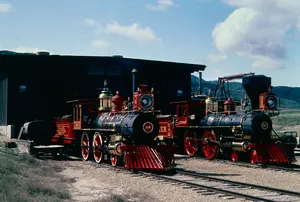
Doubleheading is two locomotives on the point of one train. In steam, that meant two engines, two engineers, two firemen, and no cable between the cabs. The lead engine faces the railroad. The second engine is coupled behind it, still ahead of the first car. Both pull. The short definition is in the glossary. This page is the practice: why steam roads did it, how the two crews kept the slack from tearing the train apart, and why diesel multiple-unit control ended the two-crew version without ending multiple locomotives.
It is not a rear helper, and it is not an MU lashup. A helper or pusher is extra power cut in to lift a train over a grade and then cut off. MU is jumpers and hoses so one engineer runs several diesels or electrics as one machine. Steam could not do that. When a K4 could not hold the Broadway’s time, the Pennsylvania put a second K4 on the point and paid a second engine crew. When a freight was too heavy for one Mike, the B&O put two on the head end out of Baltimore.
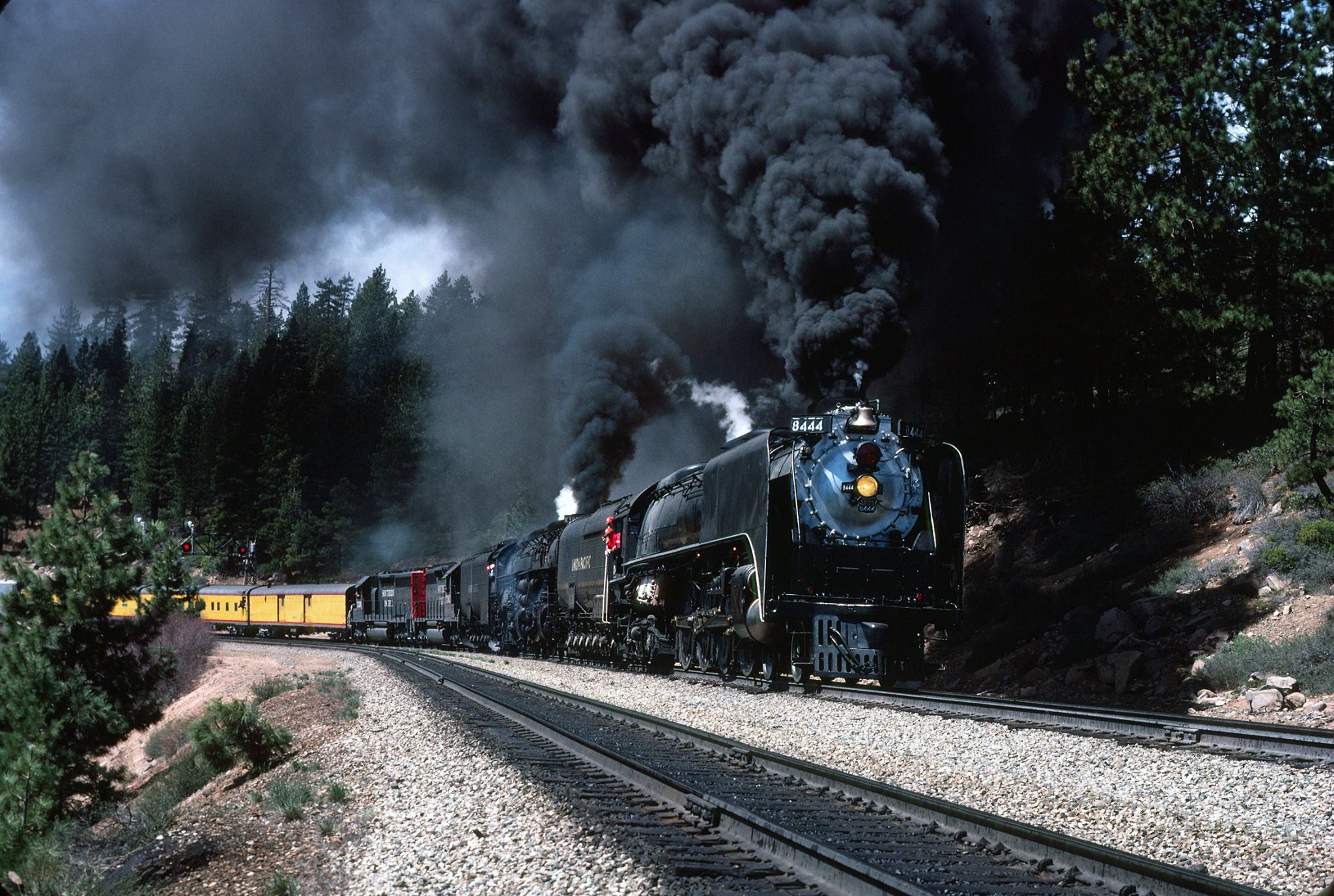
Union Pacific 4-8-4 #8444 and 4-6-6-4 #3985 (then still a coal-burner) charge upgrade at Cold Stream Canyon near Andover, California, along Southern Pacific’s Donner Pass, doubleheading a special to Railfair ’81 in April 1981. Trailing SD40s were in full dynamic brake to give the engines a real workout. Drew Jacksich photo.
On this page: At a glance · Two on the point · Helpers, doubling, and MU · Why steam needed it · Two cabs, one train · Passenger doubleheaders · Freight and the hill · The 1877 meaning · What MU changed · What remains
At a glance
| Item | Detail |
|---|---|
| What | Two locomotives coupled ahead of the train, both pulling |
| Where they sit | On the point. The second engine is between the lead locomotive and the first car—not on the rear, not mid-train |
| Steam crew | Engineer and fireman on each engine. No MU; each throttle is independent |
| Common steam practice | Lighter or helper engine often leading; road engine second, next to the train |
| Why | Tonnage the road engine cannot start or hold; passenger trains too long or too fast for one class; power to balance over a subdivision |
| Not the same as | A helper / pusher (extra power cut in, then cut off). Doubling the hill (taking the train up in two pieces). Diesel/electric MU (one engineer, several units) |
| Hardware date | Front coupler on the pilot for coupling engine to engine. Late steam often a drop coupler. See cowcatcher / pilot |
| Labor date | Pennsylvania Railroad, July 1877: “double-headers” as longer trains with two engines, not two full train crews. See 1877 |
| What ended the two-crew version | Multiple-unit control on electrics (Sprague, 1897) and then on diesels. One cab, as many units as the drawbar and the hill will take |
Definitions follow the American-Rails.com glossary. Information compiled September 15, 2026.
Two on the point
Railroad English is particular. A train is an engine or engines coupled, with or without cars. Doubleheading names the case of two engines on the head end. Tripleheading is three. The count is how many locomotives stand ahead of the cars, each a separate machine with its own crew in steam. Photographers love the stack talk. Operating officers loved the extra adhesion when a single engine’s starting tractive effort, or its boiler, could not do the job.
Both engines face forward in ordinary American practice. The lead engineer has the railroad: signals, train brake, the whistle that talks to the second cab and to the train crew. The second engineer cannot see as much. He works by the lead’s exhaust, by slack in the drawbar, and by whistle. If the second engine is a helper assigned only over a district, it may cut off at the summit and drift back. If both engines are assigned through, they stay on the point from terminal to terminal. Either way, until the cut-off they are a doubleheader. The cars are behind both of them.
Helpers, doubling, and MU
A helper, also called a pusher when it is on the rear, is extra power for a grade. It may couple ahead of the road engine (and then the train is a doubleheader for that district), it may cut in mid-train, or it may shove on the caboose or on the last cars with the caboose behind it. At the top it comes off and waits for the next train, or it runs light back to the foot. The point is the cut-off. Doubleheading that stays on for the whole run is assigned power, not a hill engine.
Passenger roads preferred the extra engine on the point. A pusher on coaches made buff and slack that threw people around and, in the link-and-pin years, killed brakemen. Freight could take a rear pusher. Western Maryland coal trains over the Alleghenies sometimes ran two or three on the head end, more mid-train, and more shoving. That is helper service with a doubleheader on the point, not a definition of doubleheading itself.
Doubling the hill is the admission that even extra power will not lift the train as one. The crew takes half the cars to the summit, comes back for the rest, and puts the train together on top. It is slower than a doubleheader and cheaper than a third engine when power is short.
MU is a different invention. Frank J. Sprague’s multiple-unit control, demonstrated on Chicago’s South Side Elevated in 1897, let one motorman run every car in a train. Diesels inherited the idea as jumper cables and air hoses. Two Geeps on the point of a modern freight are not a steam doubleheader. They are one locomotive that happens to have two carbodies. Distributed power is the radio cousin of the helper: unmanned units cut in or on the rear, still under the engineer on the point.
Why steam needed it
A steam locomotive is a boiler, a pair of cylinders, and as much adhesive weight as the rails and the bridge engineers will allow. Starting tractive effort is a function of cylinder power and weight on drivers. Boiler horsepower is a function of grate, heating surface, and how hard the fireman can fire. One number can run out before the other. A Pacific that will start twelve heavyweight cars may not keep 80 miles an hour with sixteen. A Consolidation that will drag a mine run on the flat may stall on 2 percent. The railroad then had three choices: cut the train, buy a bigger engine, or put a second engine on the point.
Bigger engines came. Articulateds, Super Power 2-8-4s and 4-8-4s, the Pennsylvania’s I1s Decapods, the N&W Ys, Union Pacific’s Challengers and Big Boys—all of them were, in part, answers to doubleheading and helper bills. The articulated story is articulated steam. Even then the practice did not die. The Pennsylvania kept doubleheading K4s Pacifics on passenger trains because it had hundreds of them and had not bought a true 4-8-4. Santa Fe mixed a 4-8-2 and a 4-8-4 on the point at Lamy when Glorieta asked for more than one Northern. Southern Pacific put cab-forwards in pairs, and sometimes in threes, over Donner and Tehachapi; that map is cab-forwards.
There was also a bookkeeping reason. Two assigned engines on a through freight could balance power over a subdivision so a terminal did not end the day with all the locomotives at one end. The second engine was not always there because the train was impossible. Sometimes it was there because tomorrow’s train would need it west of the next yard.
Two cabs, one train
Steam has no MU plug. Each engineer has a throttle, a reverse, an independent brake, and a fireman working a firedoor. Starting together without a run-in that breaks knuckles is a craft. The lead engineer eases out. The second engineer feeds steam as the slack comes out of his drawbar. If the second engine shoves too soon, it lifts weight off the lead’s drivers or slams the head car. If it lags, the lead does all the work and the second is a passenger. Stopping is the same problem in reverse: the train brake is one pipe, but two independents can fight.
Whistle signals carried the conversation. The lead spoke; the second answered. Seasoned men on a helper district could anticipate the grade by ear and by the way the stack talked, and they did not wait for a book whistle to open the throttle. The Pennsylvania later hung inductive-loop antennas on locomotive roofs and called the system Trainphone—tested in 1936, in service from 1943. Most of the country doubleheaded by whistle until the diesels came.
Roads often put the lighter engine in front. A helper assigned only to the hill would lead so it could cut off at the summit without a run-around. A smaller engine also took the curves more easily and left the heavier road engine’s mass next to the train, where the draft on the first car was a known quantity. It was common, not a law. Photographs show matched pairs and mixed wheel arrangements on the same point.
The hardware that made engine-to-engine coupling ordinary was the front coupler, carried on or through the pilot. A coupler hanging in the cowcatcher’s path snagged debris, so late steam used a drop or swing-out coupler that stowed when the engine ran alone. That assembly is a date on the pilot page. What it allowed was a second engine on the head end without a shop crane.
There is a limit. Two large locomotives pulling from the point put the whole train’s drawbar force through the first coupler and the first car’s draft gear. Beyond a certain tonnage the head car tears out. That is why rear pushers and, later, mid-train helpers and distributed power exist. Doubleheading is not free horsepower. It is horsepower applied at one end of a string of knuckles.
Passenger doubleheaders
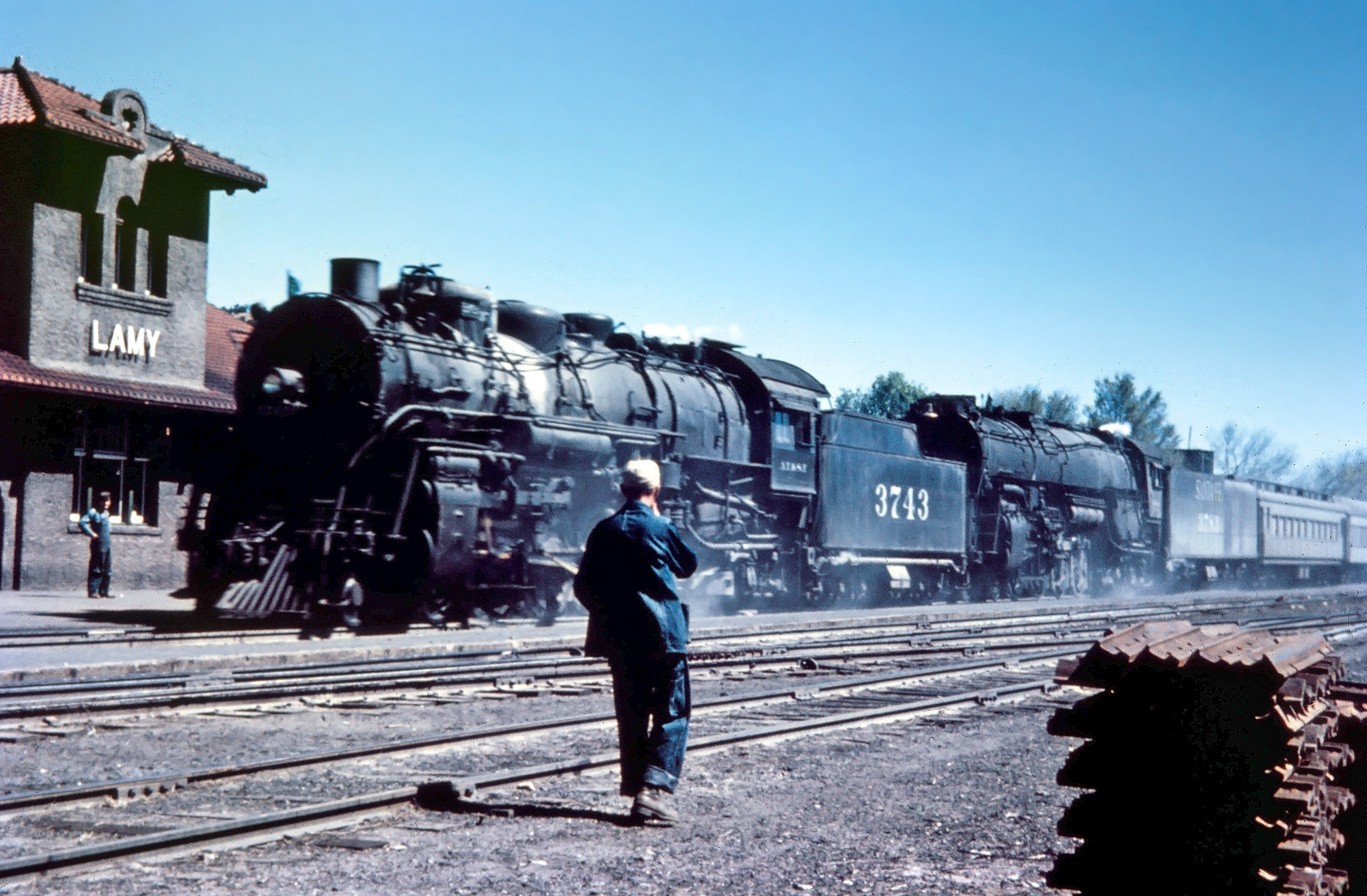
Santa Fe 4-8-2 #3743 and 4-8-4 #3783 doublehead a passenger consist at Lamy, New Mexico, circa 1950. Ed Olsen photo. American-Rails.com collection.
Passenger doubleheading was about time as much as tons. A train that a single Pacific could start might still lose minutes on the ruling grade or on a schedule written for a shorter consist. The Pennsylvania’s answer, for decades, was two K4s. The class was the road’s standard passenger engine; electrification and the Depression had left the company with a fleet instead of a 4-8-4. Two K4s on the New York & Long Branch, or on a Chicago train west of the wires, was everyday power, not a special move. Each engine had its crew. The company encyclopedia is the Pennsylvania.
Santa Fe mixed types. The Lamy photograph is a Mountain and a Northern on the same passenger train, the 4-8-2 leading, the 4-8-4 next to the cars—Glorieta and Raton in the miles ahead. Matching wheel arrangements was convenient. It was not required. What had to match well enough was speed range and braking, so one engine was not dragging the other or sliding wheels on a reduction.
Water and coal doubled. Two tenders meant two stops, or longer stops, unless the engines could take water together. Passenger doubleheaders were planned on the timetable, not improvised at the foot of the hill, because the advertised time did not allow a helper to hunt for a siding.
Freight and the hill
Freight doubleheading was the daily version. Baltimore & Ohio manifests leaving Baltimore behind two Mikados; coal extras with a pair of 2-10-2s; Western roads with a 2-8-0 ahead of a 2-10-2 so the Consolidation could cut off. The second engine might be a true through assignment or a district helper that happened to be standing on the point. The photograph that follows is the other geometry.
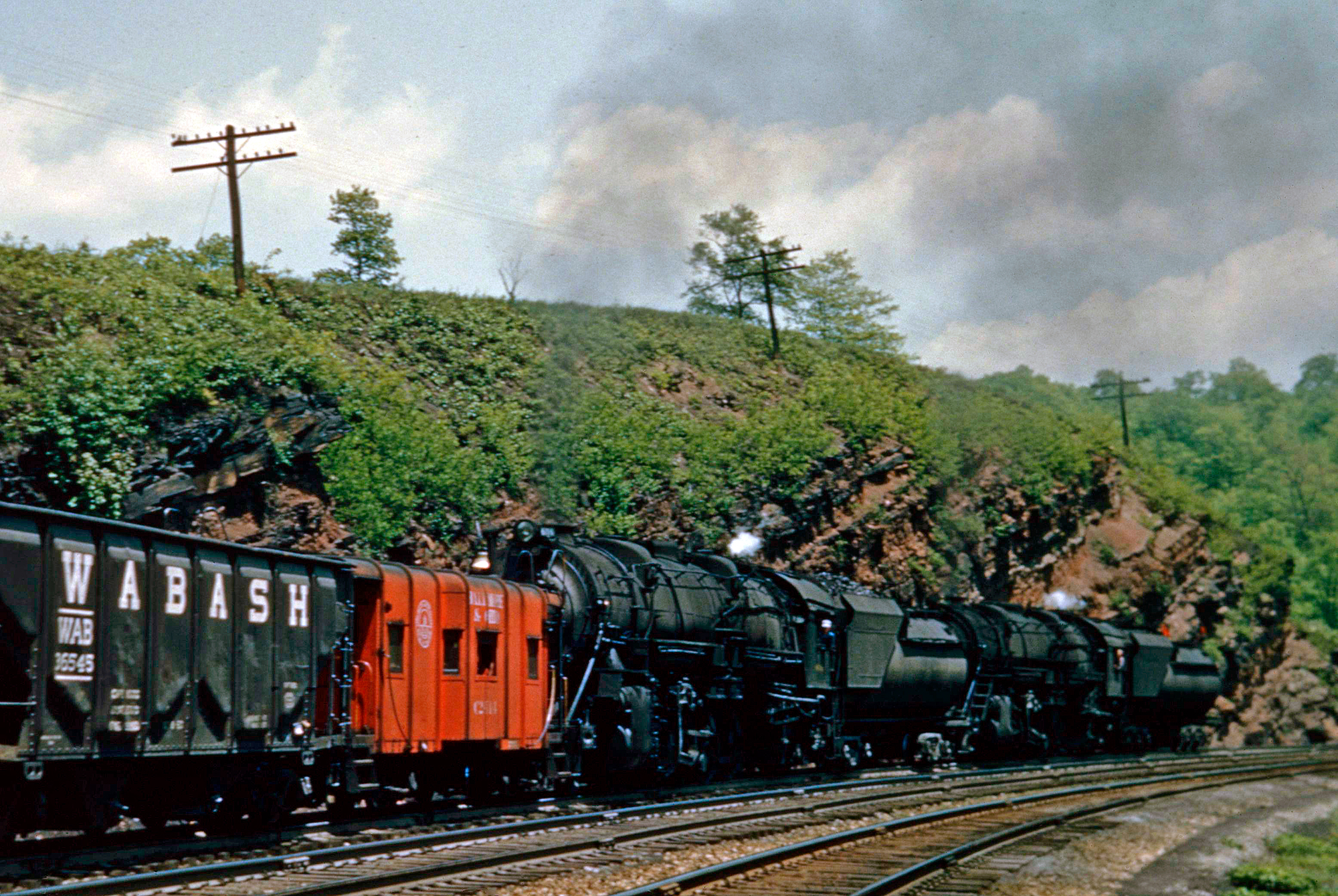
A pair of Baltimore & Ohio 2-10-2 “Big Sixes” in helper service with a westbound freight near Mance, Pennsylvania, on Sand Patch in May 1951. The train is led by FA-2 #805. Bill Price photo. American-Rails.com collection.
Sand Patch is a helper district. The FA-2 is the road power. The two Big Sixes are the hill engines—here shoving, not doubleheading on the point. B&O 2-10-2s as a type are Santa Fe types. The company is the Baltimore & Ohio. In the transition years the first diesels often took the helper job, not the road job: an A-B-B-A set could shove and then run back without turning, while steam still held the train. Mixed steam-and-diesel headers were common. Each steam cab still had a crew. The diesel cab, if MU’d, had one.
Donner, Tehachapi, Saluda, the C&O coal branches, the N&W west of Roanoke, the Pennsylvania over the Alleghenies—every road with a ruling grade wrote helper and doubleheading rules into the timetable. Snow, wet rail, and a heavier-than-billed train turned a single-engine assignment into a doubleheader on short notice. The extra engine came off the helper board or off a yard goat that could keep its feet.
The 1877 meaning
On July 16, 1877, the Pennsylvania told Western Division men that eastbound trains to Altoona would be double-headed as of July 19: two locomotives, longer consists, not two full train crews. More cars, the same conductor and brakemen, after wage cuts. Link-and-pin and hand brakes were still the freight railroad. Two brakemen and a flagman at Pittsburgh refused the 8:40 a.m. eastbound on the 19th. That walkout is why Pittsburgh burned. The strike encyclopedia is 1877.
The mechanical fact and the labor fact share a name. A doubleheader in the shop sense is two engines on the point. A doubleheader in the 1877 sense was also a longer train for the men who had to pin it, set the brakes, and walk it. The Pennsylvania was buying tonnage with engine crews and saving money on train crews. Both readings are true. This page is the engines. The dead are on the strike page.
What MU changed
Diesels did not make multiple locomotives rare. They made the second crew rare. Two F-units, then four, then six, then a distributed-power remote on the rear, are still many machines. They are one throttle. EMD’s FT of 1939 was sold as an A-B-B-A set for a reason: the horsepower of a steam doubleheader, the crew of a single engine, no water plug every hundred miles. Steam doubleheading as a two-cab craft faded with the last steam districts in the 1950s. What remained was the word, stretched over MU consists that a steam man would have called one locomotive.
Electrics had already shown the way. Sprague’s 1897 MU trains were doubleheaders in the count of carbodies and a single unit in the cab. Main-line motors on the Pennsylvania, New Haven, and Milwaukee could multiple as the builders wired them. That is the electric story. The operating idea is the same one that emptied the second steam cab.
What remains
True steam doubleheading still happens where two steam locomotives are under fire on the same train: Union Pacific’s 844 (numbered 8444 when the 1981 Donner photograph was made) with Challenger 3985, later 4014; tourist lines that own two engines and a grade; a Reading T-1 pair on an Iron Horse Ramble. Each engine still has a crew. The SD40s in dynamic brake behind 8444 and 3985 on Donner were there to make the steamers work. That is a doubleheader in the old sense, with a diesel load for a workout.
Class I freight with two units on the point is MU. Mid-train and rear-end power is distributed power. Helper districts remain—Cajon, Tehachapi, the former Pennsylvania over the mountain, CSX on Sand Patch—but the extra units cut in and cut out under radio, often without a second engineer in the helper cab. The glossary still draws the line the steam men drew: two locomotives on the point, each with its own crew in steam days; today usually MU’d as one consist.
Related reading on American-Rails.com
- Glossary · Helper / pusher · MU · Distributed power
- Steam locomotives · Diesel locomotives · Electric locomotives
- Cowcatcher / pilot · Articulated steam · 2-10-2 Santa Fe type
- Pennsylvania Railroad · Trainphone · Great Strike of 1877
- Baltimore & Ohio · Southern Pacific cab-forwards
- Union Pacific 844 · Union Pacific 3985 · Engineer
Sources
- American-Rails.com glossary: doubleheading; helper (pusher); double the hill; MU; distributed power; drawbar force
- Armstrong, John H. The Railroad: What It Is, What It Does. Omaha: Simmons-Boardman. Helper districts, head-end vs rear-end power, doubling a grade
- White, John H., Jr. The American Railroad Freight Car. Baltimore: Johns Hopkins University Press, 1993. Draft gear, knuckle limits, and why extra power is not always put on the point
- Solomon, Brian. The American Steam Locomotive and related operating surveys. Passenger and freight doubleheading; mixed steam-diesel transition
- Foner, Philip S. The Great Labor Uprising of 1877. New York: Monad Press, 1977. PRR Western Division double-headers, July 16–19, 1877
- Sprague, Frank J. Multiple-unit control, Chicago South Side Elevated, 1897. Electric MU as the ancestor of diesel jumper operation
- Pennsylvania Railroad Trainphone: tests 1936, service from 1943. See also Trainphone
- Photo credits on this page: Drew Jacksich (UP 8444 / 3985, Donner, April 1981); Ed Olsen (Santa Fe 3743 / 3783, Lamy, circa 1950); Bill Price (B&O 2-10-2 helpers, Mance, Pa., May 1951)
Recent Articles


-
Akron, Canton and Youngstown Railroad: Map, History, Rosters
Oct 17, 26 05:49 PM
 Akron, Canton and Youngstown Railroad, Mogadore to Delphos. The rails never reached Canton or Youngstown. Norfolk & Western control on October 16, 1964. Twenty-six diesels and the historical society's…
 -
Georgia Railroad: Map, History, Logo, Rosters
Oct 17, 26 12:59 PM
 Georgia Railroad, the Georgia Railroad and Banking Company, Augusta to Atlanta, with the Athens branch and the Macon Road. Mark GA. The railroad properties were sold on November 4, 1982.
 -
West Point Route (Railroad): Map, History, Logo
Oct 16, 26 11:26 PM
 The West Point Route was a trademarked name comprising the Atlanta & West Point and Western Railway of Alabama, which were controlled by the Georgia Railroad.
 -
Virginian Railway Diesel Roster (All-Time)
Oct 16, 26 11:11 PM
 All-time diesel roster of the Virginian Railway. 40 Fairbanks-Morse H16-44s, 25 H24-66 Train Masters, and one GE 44-tonner. Serials included.
 -
Virginian Railway Steam Roster (Post 1900)
Oct 16, 26 10:55 PM
 Virginian Railway steam locomotives built since 1900. Mikados, 2-8-8-2s, the Triplex, class AE 2-10-10-2s, and the 1945 2-6-6-6s.
 -
Virginian Railway: Map, Rosters, History, Electrification
Oct 16, 26 10:51 PM
 Virginian Railway, Deepwater to Norfolk. Combined in 1907 and completed in 1909. Electrified from Roanoke to Elmore. Absorbed by the Norfolk & Western on December 1, 1959.
 -
Baldwin "Centipede" Locomotives: Specs, Roster, Photos
Oct 16, 26 03:58 PM
 Baldwin DR-12-8-1500/2 Centipede—2-D+D-2, two 608SC engines, 3,000 hp. SAL 4500 from the 1943 test bed. 54 on the serial list, 52 sold. PRR BP60 then BH50. None preserved.
 -
Louisville & Nashville Class M-1 2-8-4s: The Big Emmas
Oct 16, 26 03:52 PM
 Louisville & Nashville class M-1, 42 Big Emma 2-8-4s. Baldwin in 1942 and 1944, Lima in 1949. Coal trains from Neon to DeCoursey. No locomotive survives.
 -
Tennessee, Alabama and Georgia Railway: Map, History, Rosters
Oct 16, 26 03:21 PM
 Tennessee, Alabama and Georgia Railway, Chattanooga to Gadsden. The May 1929 card is 91.7 miles. Southern stock control closed on a January 1, 1971 schedule. Five diesels and Prince's steam list.
 -
Railroad Museums In The USA (2026): State Guides & Collections
Oct 16, 26 02:29 PM
 U.S. railroad museums—what they are vs tourist railroads, preservation history (R&LHS, NRHS, IRM, Steamtown), state guides, and destination collections. Confirm hours on each museum’s site.
 -
Wyoming Railroad Museums (2026): A Complete Guide
Oct 16, 26 02:26 PM
 Wyoming railroad museums—the Cheyenne Depot, Burlington 5633 at Douglas, Big Boy 4004, and the Laramie depot. Confirm hours and which locomotive is on the property.
 -
West Virginia Railroad Museums (2026): A Complete Guide
Oct 16, 26 12:52 PM
 West Virginia railroad museums—Cass Scenic’s geared steam, the Hinton C&O collection, and the Martinsburg B&O roundhouse. Confirm hours and which locomotive is assigned.
 -
Washington Railroad Museums (2026): A Complete Guide
Oct 16, 26 12:46 PM
 Washington railroad museums—Snoqualmie, Elbe, Chehalis, Reardan, and the Northern Pacific depot at Toppenish. Confirm hours and which locomotive is assigned.
 -
Vermont Railroad Museums (2026): A Complete Guide
Oct 16, 26 12:42 PM
 Vermont railroad museums—the Shelburne Museum’s 1890 station, Central Vermont No. 220, and the private car Grand Isle. Confirm hours on the site.
 -
Tennessee Central Railway: Map, Logo, Rosters, History
Oct 16, 26 11:32 AM
 Tennessee Central Railway, Harriman to Hopkinsville. Reorganized January 26, 1922. Last day August 31, 1968. Thirty-one diesels and the railroad's steam roster.
 -
Southern Railway Steam Roster (Post 1900)
Oct 16, 26 09:40 AM
Southern Railway steam locomotives built since 1900. Ps-4 Pacifics, Ts Mountains, USRA Santa Fes, and the subsidiary grids for the CNO&TP, Alabama Great Southern, and New Orleans and Northeastern. -
Southern Railway (USA): Map, Locomotives, Logo, History
Oct 16, 26 09:28 AM
 The Southern Railway, formed July 1, 1894 from the Richmond and Danville and the East Tennessee, Virginia and Georgia. Washington. Norfolk Southern Railway on December 31, 1990.
 -
Seaboard Coast Line Diesel Roster (All-Time)
Oct 15, 26 04:21 PM
 All-time diesel roster of the Seaboard Coast Line. Inherited Coast Line and Seaboard locomotives, then 623 new locomotives in the printed orders, plus 28 acquired from other railroads.
 -
Seaboard Coast Line Railroad: Map, History, Photos
Oct 15, 26 04:17 PM
 The Seaboard Coast Line, formed July 1, 1967 from the Atlantic Coast Line and the Seaboard Air Line. Jacksonville. Family Lines, then the Seaboard System on December 29, 1982.
 -
South Carolina Railroad Museums (2026): A Complete Guide
Oct 15, 26 02:54 PM
 South Carolina railroad museums—Winnsboro’s Rockton & Rion line, Spartanburg’s Hub City depot, Greenwood’s Baldwin No. 19, and the Best Friend replica. Confirm hours on each site.
 -
South Dakota Railroad Museums (2026): A Complete Guide
Oct 15, 26 10:55 AM
 South Dakota railroad museums—the Hill City museum beside the 1880 Train, and Prairie Village at Madison. Confirm hours, and confirm whether Hill City is still open.
 -
Seaboard Air Line Diesel Roster (All-Time)
Oct 15, 26 10:46 AM
 All-time diesel roster of the Seaboard Air Line. 734 locomotives: E4s in 1938, Centipedes, Alco road switchers, and GP40s through February 1967. Serials included.
 -
Seaboard Air Line Steam Roster (Post 1900)
Oct 15, 26 10:39 AM
 Seaboard Air Line steam locomotives built since 1900. Mikados, Russian Decapods, 2-10-2s, and the 2-6-6-4s sold to the Baltimore and Ohio in 1947. Drury's class grid.
 -
Seaboard Air Line Railroad: Map, Rosters, History
Oct 15, 26 10:34 AM
 The Seaboard Air Line, chartered in the Portsmouth and Roanoke of 1832 and formed July 1, 1900. Inland route to Florida. Merged into the Seaboard Coast Line on July 1, 1967.
 -
Utah Railroad Museums (2026): A Complete Guide
Oct 15, 26 12:04 AM
 Utah railroad museums—Ogden Union Station, Golden Spike at Promontory, the Helper mining museum, and the Heber Valley Railroad. Confirm hours on each site.
 -
Escanaba & Lake Superior Diesel Roster (All-Time)
Oct 14, 26 10:44 PM
All-time diesel roster of the Escanaba & Lake Superior. 30 locomotives: Baldwin switchers and RS-12s, two RF16s, three GP38s, three SD40-2s, and the Reserve Mining units. Serials and order numbers. -
Escanaba & Lake Superior Railroad: In Service Since 1898
Oct 14, 26 09:04 PM
 Escanaba & Lake Superior Railroad, chartered November 17, 1898, and still operating from Wells, Michigan. Logging line to Channing, the Milwaukee Road lines, and the diesel roster.
 -
Richmond, Fredericksburg & Potomac Diesel Roster (All-Time)
Oct 14, 26 08:49 PM
 All-time diesel roster of the Richmond, Fredericksburg and Potomac. 107 locomotives: 22 Alco S2s, one SW1, and an Electro-Motive road fleet from E8s to GP40-2s. Serials and order numbers.
 -
Richmond, Fredericksburg & Potomac Steam Roster (Since 1900)
Oct 14, 26 08:46 PM
 Richmond, Fredericksburg and Potomac steam locomotives built since 1900. Pacifics, Mountains, Berkshire-type 2-8-4s, and the named 4-8-4s. Last revenue run December 17, 1954.
 -
Richmond, Fredericksburg and Potomac Railroad: Map, Rosters, Logo
Oct 14, 26 08:36 PM
 The Richmond, Fredericksburg and Potomac, chartered February 25, 1834. A 113-mile Richmond–Washington bridge line. Named 4-8-4s, Potomac Yard, and the CSX sale of October 10, 1991.
 -
North Dakota Railroad Museums (2026): A Complete Guide
Oct 14, 26 08:29 PM
North Dakota railroad museums—Mandan’s state museum, the Railroad Museum of Minot, and Bonanzaville’s Northern Pacific 684. Confirm hours on each site. -
Oklahoma Railroad Museums (2026): A Complete Guide
Oct 14, 26 08:02 PM
Oklahoma railroad museums—the Oklahoma Railway Museum, Enid’s Frisco 1519, Waynoka’s Harvey House, and El Reno’s Rock Island depot. Confirm hours on each site. -
Oneida & Western Railroad: Map, History, Timetable
Oct 14, 26 06:47 PM
Oneida & Western Railroad, a Tennessee short line from Oneida to Jamestown. Chartered in 1912, opened to East Jamestown in 1921, and to Jamestown on December 10, 1930. Last revenue train March 4, 1954… -
Oneida and Western Railroad (Shamrock Coal Company)
Oct 14, 26 03:20 PM
 Shamrock Coal's mint-green coal trains, 1979–1987. Eight EMD SD40-2s, OWTX 9950–9957, order 786246. Two 72-car gondola sets. Louisville & Nashville, then CSX. Sold to BC Rail.
 -
Rhode Island Railroad Museums (2026): A Complete Guide
Oct 14, 26 03:03 PM
 Rhode Island railroad museums—the Friends’ museum in the 1875 Kingston depot, on the old New York, Providence and Boston. Confirm what is on view.
 -
Original Norfolk Southern Diesel Roster (All-Time)
Oct 14, 26 12:40 PM
 All-time diesel roster of the original Norfolk Southern Railway. 59 locomotives: Baldwin switchers and AS-416s, three GE 70-tonners, 17 GP18s, and seven GP38s. Serials and order numbers.
 -
Original Norfolk Southern Railway: Map, Rosters, History
Oct 14, 26 10:09 AM
 The original Norfolk Southern Railway, chartered in 1870 as the Elizabeth City & Norfolk. Norfolk to Charlotte. Merged into the Southern Railway on January 1, 1974. Baldwin diesels and the GP18s and G…
 -
Nebraska Railroad Museums (2026): A Complete Guide
Oct 14, 26 10:00 AM
 Nebraska railroad museums—the Durham Museum, Kenefick Park, Cody Park, and the Golden Spike Tower over Bailey Yard. Confirm hours on each site.
 -
Nevada Railroad Museums (2026): A Complete Guide
Oct 14, 26 09:51 AM
 Nevada railroad museums—Carson City, Boulder City, the Nevada Northern at East Ely, and the Virginia City depot. Confirm hours on each site.
 -
Montana Railroad Museums (2026): A Complete Guide
Oct 14, 26 12:17 AM
 Montana railroad museums—the Livingston depot, Fort Missoula’s Willamette, the Harlowton Milwaukee depot, and the Whitefish station. Confirm hours on each site.
 -
"Jawn Henry" Locomotive: Specs, Diagram, Photos
Oct 14, 26 12:03 AM
 Norfolk & Western No. 2300, class TE-1, the steam turbine-electric Jawn Henry. Baldwin-Lima-Hamilton, Westinghouse, and Babcock & Wilcox, May 1954. Specifications, the road tests, and the Dece…
 -
Atlantic and Danville Railway: Serving Southern VA
Oct 13, 26 04:32 PM
 Atlantic and Danville Railway, chartered in 1882, incorporated September 1883. Three-foot line to Claremont, then Norfolk to Danville. Southern lease from September 1, 1899, to July 1, 1949. Alco RS2s…
 -
Norfolk, Franklin and Danville Railroad: Map, Roster, History
Oct 13, 26 04:26 PM
 Norfolk, Franklin and Danville Railway, chartered October 2, 1962, and operating from November 1, 1962. Norfolk to Danville, 210.8 miles. Two Alco RS36s and four RS11s. Merged into the N&W on December…
 -
Norfolk & Western Diesel Roster (All-Time)
Oct 12, 26 11:59 PM
 Norfolk & Western diesel roster, all-time. 1,464 locomotives built new for the railroad, from the 1955 GP9s and RS-3s through the C36-7s, plus the merger fleets.
 -
Norfolk & Western Steam Roster (Post 1900)
Oct 12, 26 11:52 PM
 Norfolk & Western steam since 1898. The Roanoke grid: 1,266 locomotives, the J, the A, and the Y, and the last road steam on May 7, 1960.
 -
Norfolk & Western Railway: Map, Logo, Rosters, History
Oct 12, 26 11:45 PM
 The Norfolk & Western, from the City Point Railroad of 1838 to Norfolk Southern. Pocahontas coal, Roanoke steam, and the 1964 expansion.
 -
Louisiana Railroad Museums (2026): A Complete Guide
Oct 12, 26 11:24 PM
 Louisiana railroad museums—the DeQuincy depot, the Long Leaf sawmill, Jackson’s model railroad, and Southern Pacific 745. Confirm hours on each site.
 -
Michigan Railroad Museums (2026): A Complete Guide
Oct 12, 26 11:14 PM
 Michigan railroad museums—Pere Marquette 1225 at Owosso, Durand Union Station, The Henry Ford, and the Mount Clemens depot. Confirm hours on each site.
 -
Mississippi Railroad Museums (2026): A Complete Guide
Oct 12, 26 10:52 PM
Mississippi railroad museums—McComb’s rebuilt Illinois Central depot and Illinois Central 2542, and the Casey Jones museum at Water Valley. Confirm hours on each site. -
The "E2b": PRR's Experimental Freight Electrics
Oct 12, 26 10:33 PM
 PRR class E2b: six GE B-B freight electrics, 4939–4944, 2,500 hp, 11 kV AC. Specifications, roster, and the 1964 scrap.