
Illinois Terminal Railroad: Map, Roster, Photos, History
Last revised: August 23, 2024
By: Adam Burns
The Illinois Terminal was a fascinating operation. Its earliest heritage was a small switching line of the same name which carried no interurban ties until its acquisition by the Illinois Traction.
The vision of William B. McKinley, the IT grew into the greatest and most successful interurban ever built linking St. Louis with central Illinois. It was comprised of many subsidiaries although all were under the parent's control.
The hope of opening a direct St. Louis to Chicago corridor ultimately failed and in most respects the IT resembled any other interurban with overhead catenary, rural operations, and considerable street running.
However, from an early period it, largely by accident, enjoyed a bountiful freight business. McKinley recognized this and tailored his operation accordingly.
As passenger traffic declined, freight tonnage grew in importance, eventually totaling several million dollars annually. What began as a hodgepodge of electrified lines had turned into a profitable freight carrier by the postwar years.
Over time the IT abandoned large segments of its property in favor of trackage rights via other railroads (explained in greater detail below). In 1982 it was acquired by Norfolk & Western and today little remains of the original network.
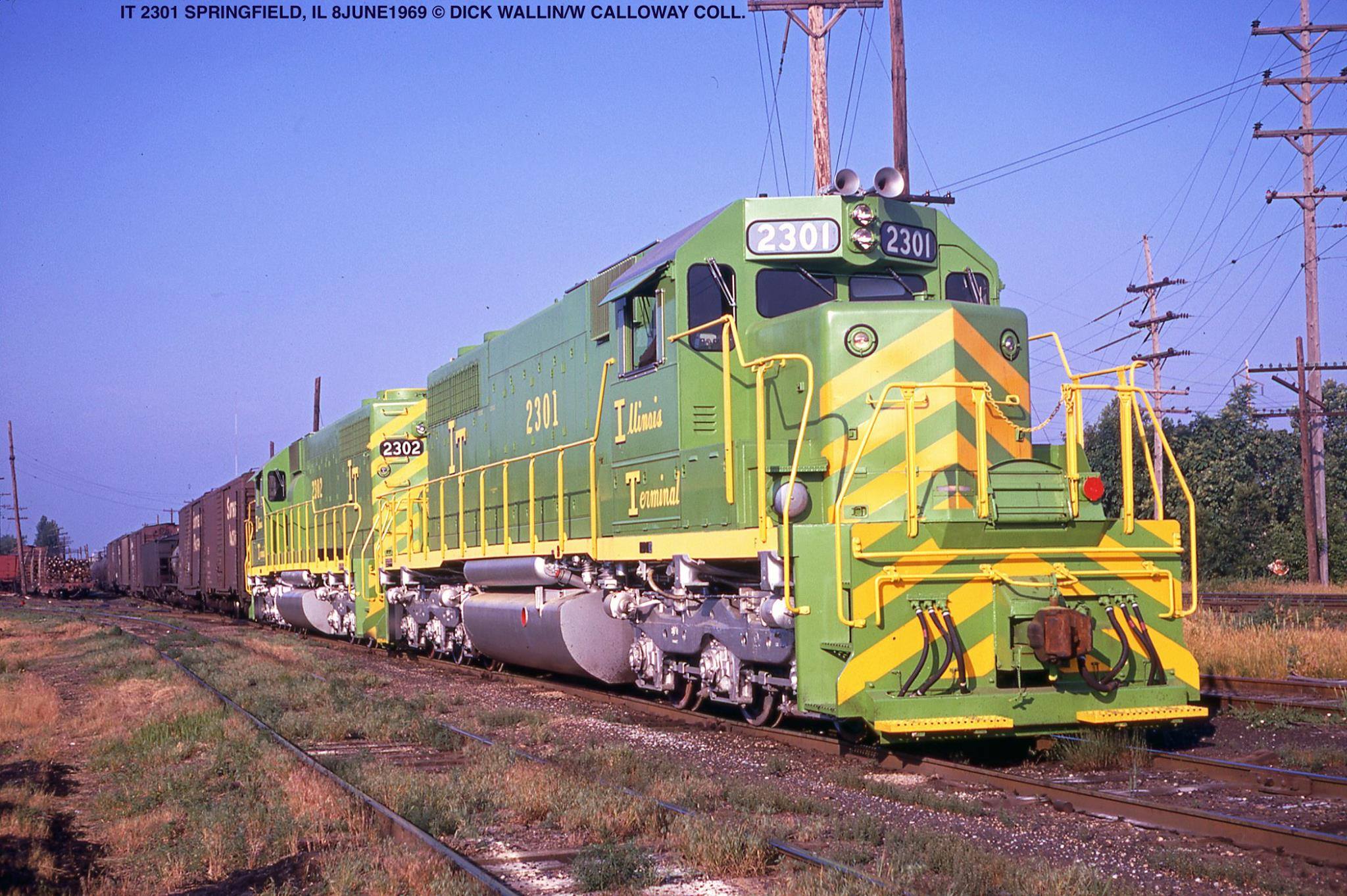 A pair of the Illinois Terminal's recently delivered SD39's, the biggest power the former interurban ever owned, sparkle in the sun at Springfield, Illinois on June 8, 1969. Dick Wallin photo/Warren Calloway collection.
History
The Road Of Personalized Services proved a good slogan for the Illinois Terminal, which worked hard over the years to develop its carload freight business while providing high quality service for customers.
As Dr. George Hilton and John Due note in their excellent title, "The Electric Interurban Railways In America," the IT blossomed into the largest, end-to-end, traction system in the country with a network of 462 route miles by 1950.
The McKinley Syndicate became involved with a handful of interurbans throughout the country (as well as public utilities) over the years although none reached IT's level of success.
McKinley was an investment broker from Champaign, Illinois and got his start in the growing interurban industry by acquiring the local Danville Street Railway & Light Company (DSR&L) on July 18, 1900.
The immediate history of the Illinois Terminal begins at this time. Shortly after purchasing the DSR&L, McKinley bought the defunct Danville, Paxton & Northern Railroad (DP&N). It was originally incorporated on December 2, 1899 to link Danville with Paxton, Illinois, a distance of more than 40 miles.
McKinley Syndicate
The original promoters envisioned it as just another steam road but later pivoted to the idea of an electrified interurban. Whatever the case, no work took place prior to McKinley's purchase. The first 6 miles opened to Westville on October 20, 1901, south of Danville.
Less than a year later, on May 29, 1902, a short branch was completed to nearby Catlin. A flurry of activity occurred following these events as McKinley began expanding prodigiously. The first involved reaching Georgetown, located slightly more than 4 miles south of Westville.
It was not built by his DP&N but rather local interests who wished to see service extended to their town, opening on August 27, 1902.
At A Glance
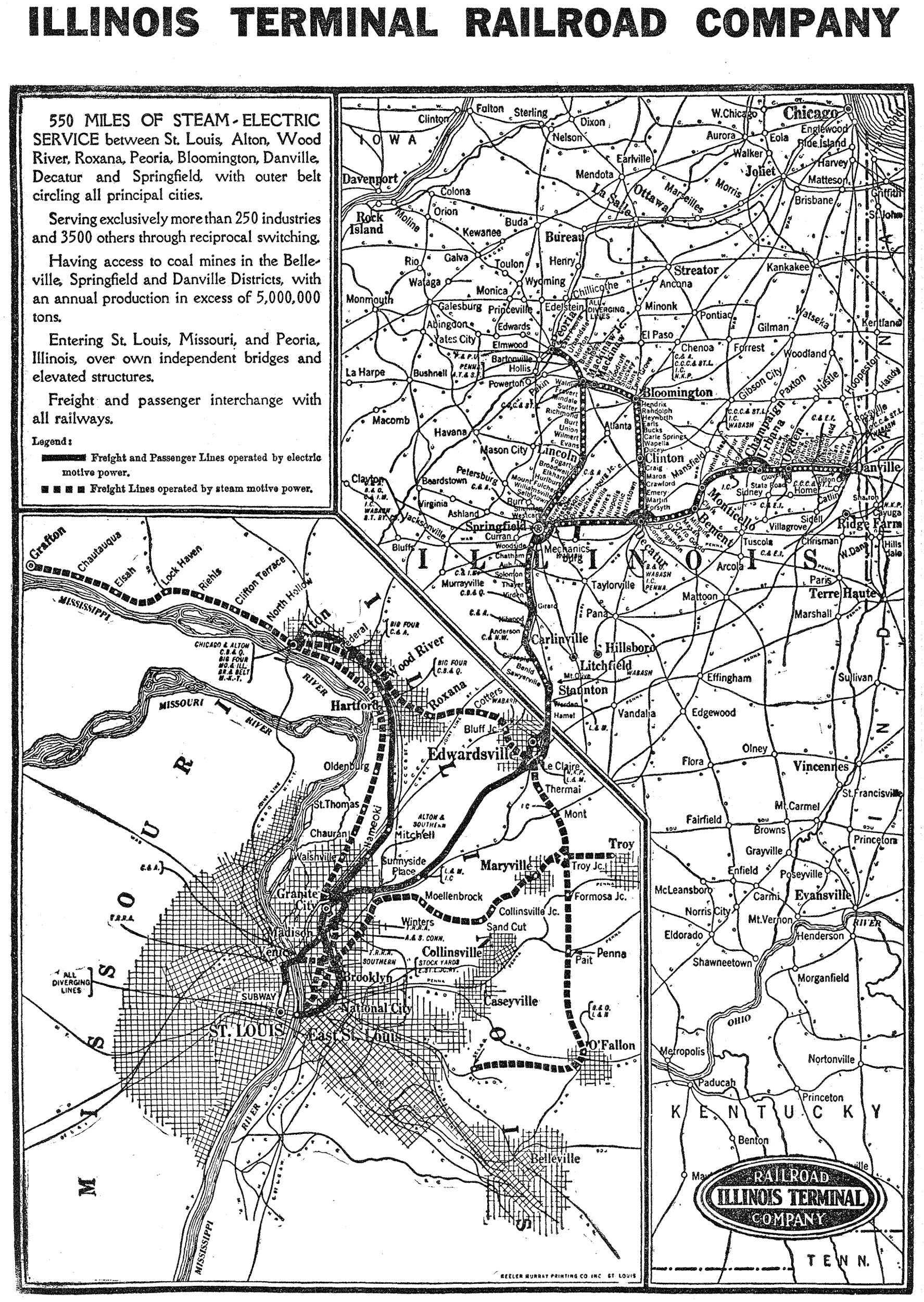
St. Louis - Peoria Springfield - Danville Decatur - Bloomington - Mackinaw Junction Alton - Edwardsville - East St. Louis Alton - Granite City - East St. Louis Venice - Mitchell - Grafton Troy Junction - O'Fallon |
|
Diesels: 18 Steam: 14 Electric: 38 Battery Diesel-Electric: 2 Battery Trolley: 1 Diesel Trolley: 1 | |
Freight Cars: 1,868 Passenger Cars: 63 | |
The next move occurred within his hometown of Champaign where the Danville, Urbana & Champaign Railway (DU&C) was incorporated on July 31, 1902 (it went on to acquire the DP&N's assets on April 24, 1903).
The DU&C was intended to head east by connecting St. Joseph with Urbana (about 12 miles, direct service into Champaign came via the small Urbana & Champaign Railway).
With funding in place and right-of-way acquired, work proceeded rapidly. This section was ready by November 9, 1902 as work continued into the following year for through Danville - Champaign operation.
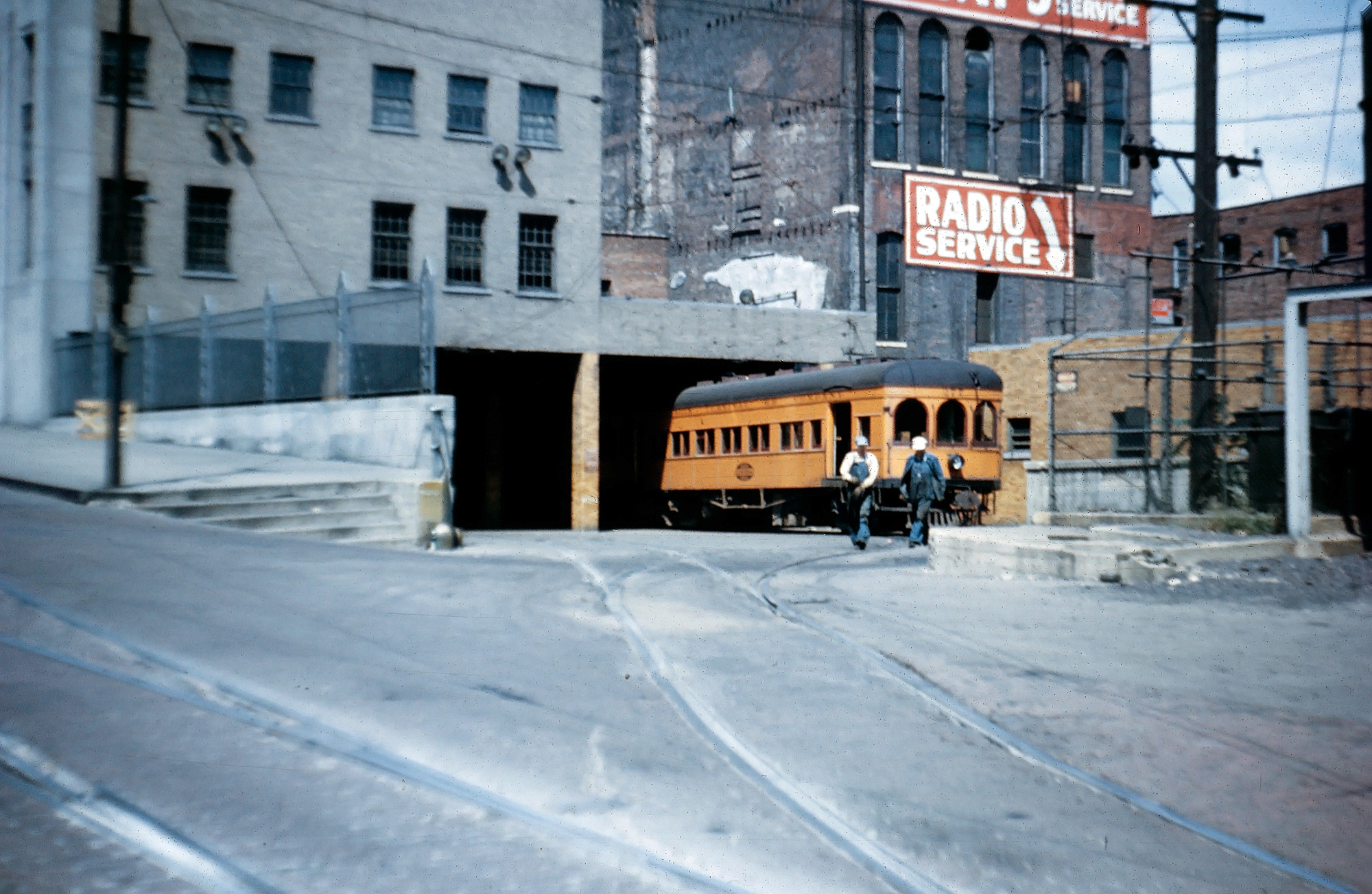 Illinois Terminal car #277 is seen here at the terminal in Peoria, Illinois in 1947. The car was manufactured by the St. Louis Car Company in 1913 and today is preserved at the Illinois Railway Museum. James Stitzel photo. American-Rails.com collection.
Expansion
It took a bit longer than expected due a substation under construction in Fithian (west of Danville) but finally opened on September 6, 1903.
The entire system utilized the standard 600-volt, direct-current system inherent of most interurbans, particularly in the Midwest (IT's northwestern lines, interestingly, carried alternating current technology, explained in more detail later on).
There were two final extensions on this eastern segment; the first included a short branch to Homer (via Ogden) opened on May 25, 1905 while later that year, on October 1st, service was extended from Georgetown to Ridge Farm. As all of this was ongoing, McKinley drew up plans to reach the country's second-busiest gateway, St. Louis.
It began with the incorporation of the Decatur, Springfield & St. Louis Railway (DS&StL) on May 28, 1903. Although disconnected from his eastern lines the DS&StL carried ambitious hopes of connecting all three of its namesake points. To get started, two initial moves were carried out.
For access into Decatur the small Decatur Street Railway & Light Company was acquired while purchase of a defunct right-of-way between Decatur and Springfield provided a ready-made corridor along the northern periphery.
As Hilton and Due's book poignantly notes, the final Illinois Terminal network was comprised of many subsidiaries. This was particularly true of the southwestern lines, mentioned only briefly here.
The Springfield - Decatur segment was built as the Illinois Central Traction Company (ICT). It opened on September 25, 1904 with direct entry into Springfield achieved via the Springfield Consolidated Railway.
In his book, "Illinois Terminal: The Electric Years," author Paul Stringham details the difficulties ITC encountered when attempting to install a crossing over the Illinois Central in Springfield at Capitol Avenue.
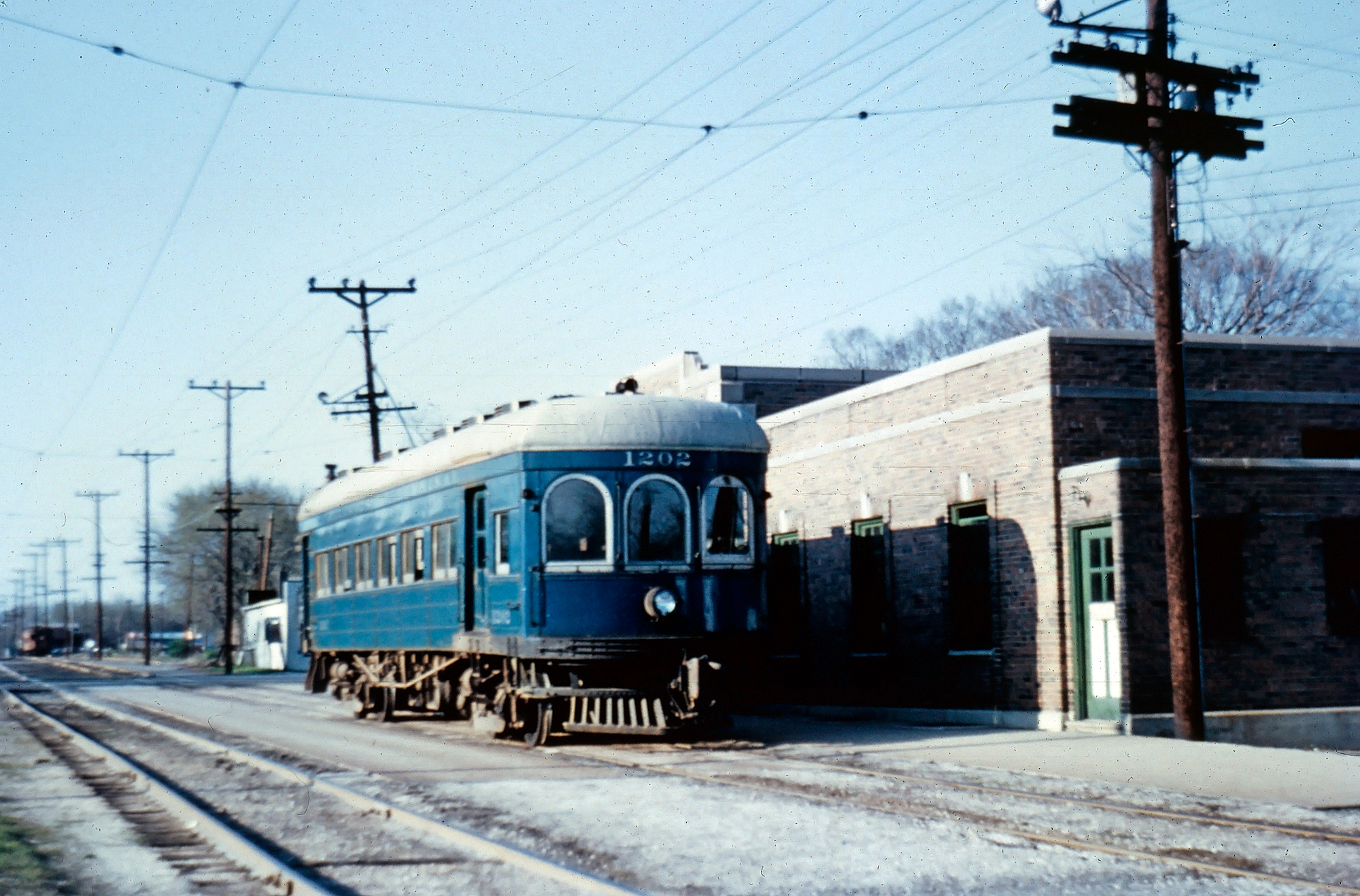 Illinois Terminal express car #1202 is seen here at the station in Decatur, Illinois, circa 1950. James Stitzel photo. American-Rails.com collection.
This issue became a recurring theme as McKinley experienced similar problems with other large railroads. Most viewed interurbans as a threat to their passenger traffic and, to a lesser extent, freight business. They were openly hostile and usually refused to work with the small electric lines in any way.
This was nearly universal east of the Mississippi River while Midwestern and western carriers were somewhat more receptive (the Chicago Great Western, in particular, openly welcomed interchange). It was an odd reaction considering most interurbans were less than 50 miles in length and carried no, true threat to the big carriers.
System Map (1940)
Reaching St. Louis
Looking south of Springfield, McKinley renamed the DS&StL as the St. Louis & Springfield (StL&S) on December 28, 1903 to build as far as Staunton. From that point, another system was incorporated known as the St. Louis & North Eastern (StL&NE).
It was formed on December 22, 1904 and would finish the line into Granite City along the east bank of the Mississippi River (directly across from downtown St. Louis).
Why McKinley changed tactics and elected to break up construction into several subsidiaries is unclear but by June of 1903 work on the StL&S had begun and the road launched full service on February 16, 1906.
While this project was underway, so too was the StL&NE building northward from Granite City, via Edwardsville. The completed line to Staunton was finished on October 31, 1905 but regular service was delayed until February 16, 1906 as a few construction issues were ironed out.
At the time, McKinley did not have a direct connection into St. Louis, relying instead upon an interchange with the Terminal Railroad Association of St. Louis's (TRRA).
Even this connection proved tumultuous and he also faced hostilities at East St. Louis (issues here were finally resolved, somewhat tentatively, in late 1906).
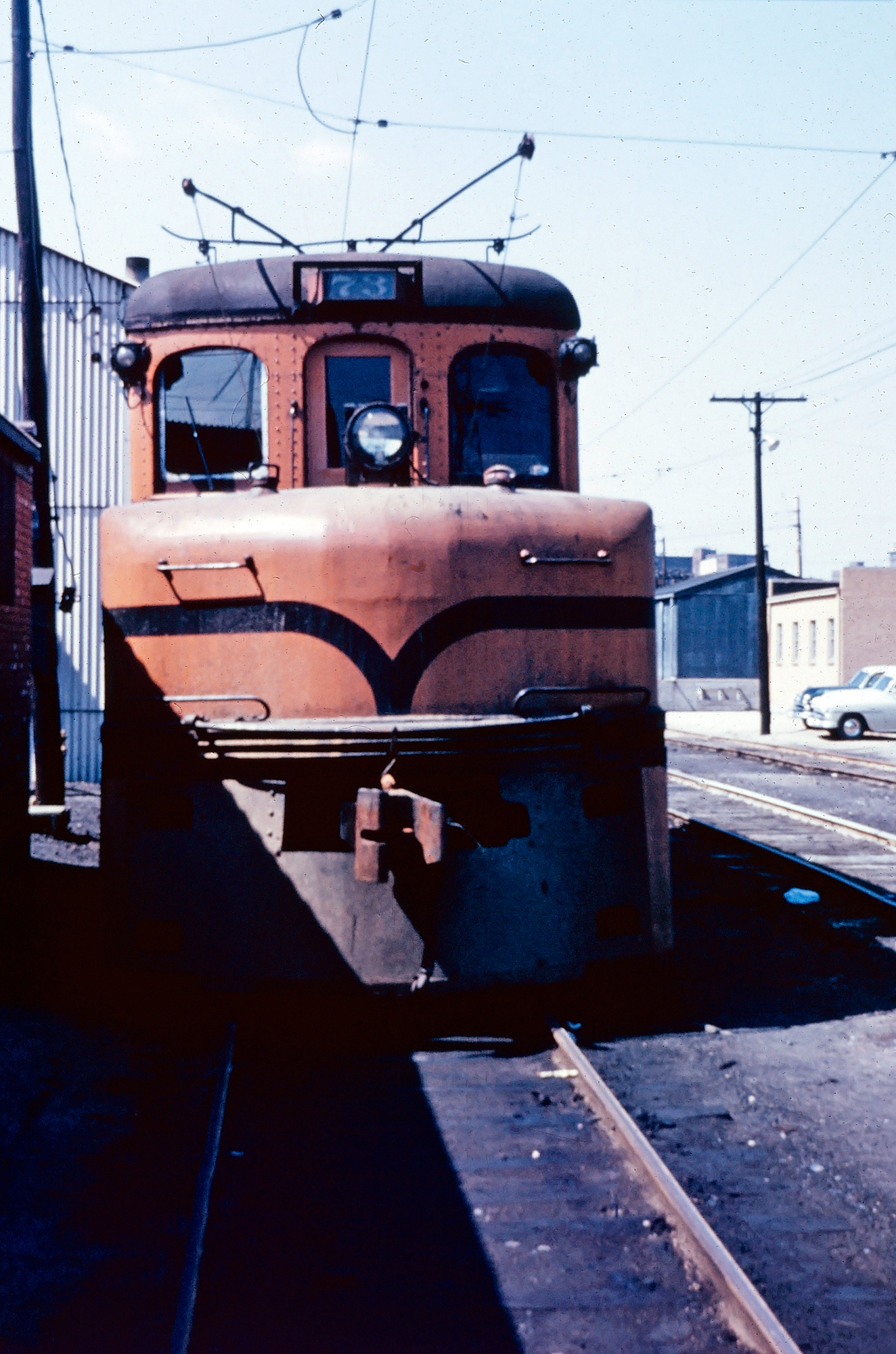 Illinois Terminal Class D freight motor #73 at the shops in East Peoria, Illinois, circa 1955. American-Rails.com collection.
Such problems surely convinced McKinley the only way to offer truly reliable, scheduled service was by maintaining his own line into the city. In the meantime he looked northward and streamlined operations through formation of the Illinois Traction Company in 1904.
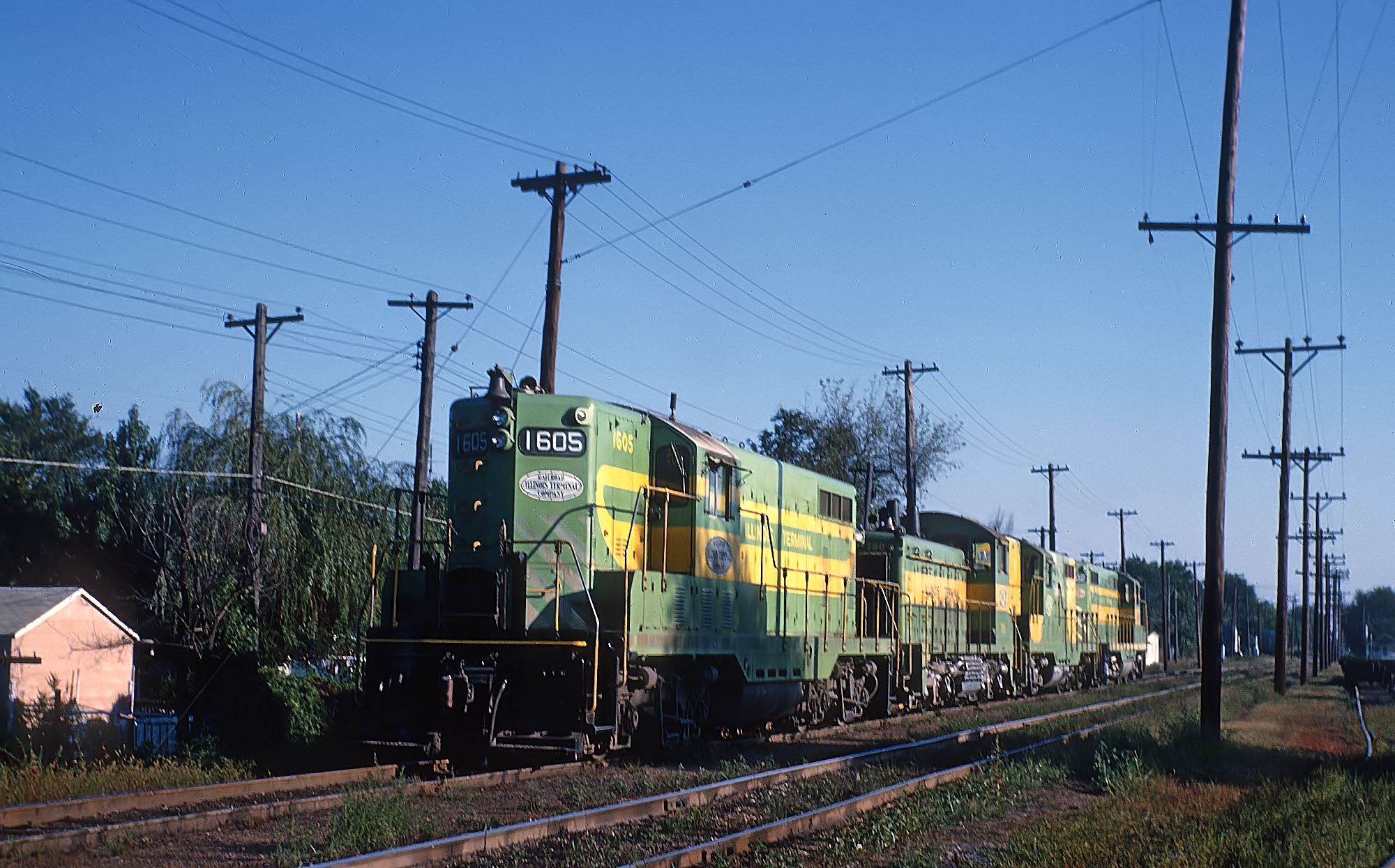 Illinois Terminal GP7s #1600, #1602, and #1605 along with an SW1200 running light at Springfield, Illinois in August, 1962. Rick Burn photo.
As Mike Schafer points out in his book, "Classic American Railroads: Volume III," Chicago was always the goal. This disconnected segment began as the Chicago, Ottawa & Peoria Railway (CO&P) incorporated on April 19, 1907 to acquire the Illinois Valley Railway's assets.
The CO&P slowly expanded east and west of Ottawa in the coming years reaching Joliet, Streator, and Princeton.
Unfortunately, five issues doomed the dream; overextended finances (in particular were costs associated with the massive Mississippi River bridge into downtown St. Louis), the Great Depression, declining ridership by the 1920's, lack of online carload freight, and no through connection.
Despite this setback, McKinley did achieve further expansion above Springfield and Decatur. Once again, a series of subsidiaries accomplished the task.
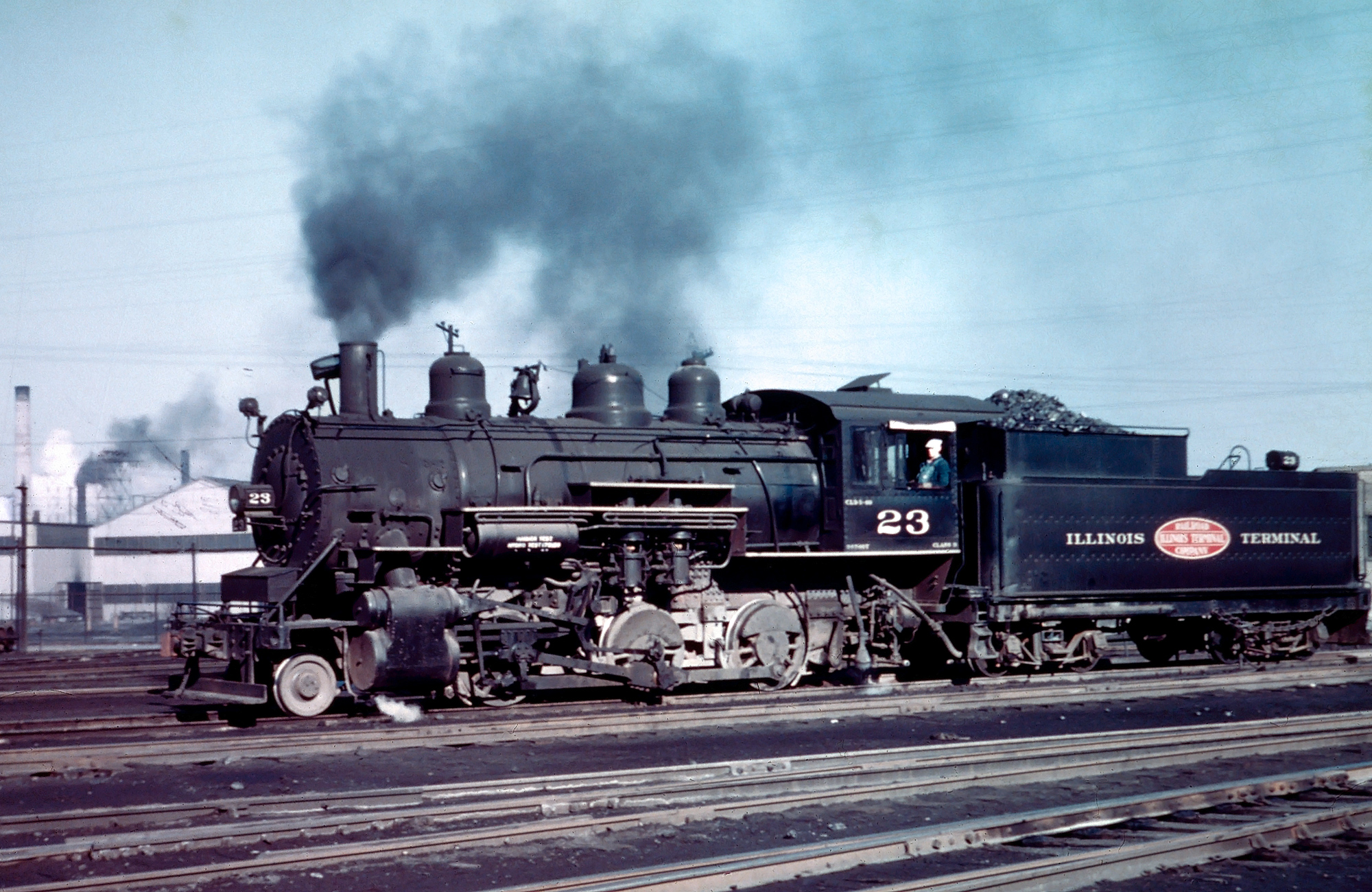 Illinois Terminal 2-6-0 #23 is seen here near the end of her career in Federal, Illinois, circa 1950. The IT used quite a few of this wheel arrangement but was quick to retire them with the diesel's arrival. This particular unit (produced by Baldwin in 1926) was scrapped soon after this photo was taken. Fred Byerly photo. American-Rails.com collection.
These corporate subsidiaries included the following:
- Springfield & North Eastern Traction (formed on April 28, 1906 from the Springfield & North Eastern Railroad's reorganization) completed the Springfield - Lincoln segment, launching regular service on December 15, 1906.
- Chicago, Bloomington & Decatur was created on August 19, 1905 to finish the Decatur-Bloomington line, which took about a year and fully opened on August 1, 1906.
- Peoria, Bloomington & Champaign Traction established on April 1905 was assigned the Bloomington - Peoria leg running via Mackinaw, opening on April 21, 1907.
- Peoria, Lincoln & Springfield Traction (PL&ST) which built the Lincoln - Mackinaw connector to provide through service from Peoria to East St. Louis via Springfield.
The PL&ST was incorporated on April 18, 1907, opening on New Year's Day, 1908. Interestingly, while nearly all McKinley's properties utilized the standard 600-volt, direct-current (DC) system the lines between Springfield - Peoria and Peoria - Bloomington were equipped with a 33,000-volt alternating current (AC) operation, stepped down to 3,300 volts at substations.
It was further brought down to just 250 volts by the cars themselves (carrying on-board transformers) for regular operation. The company found the AC system not to their liking and after just two years switched to standard DC power on July 8, 1909.
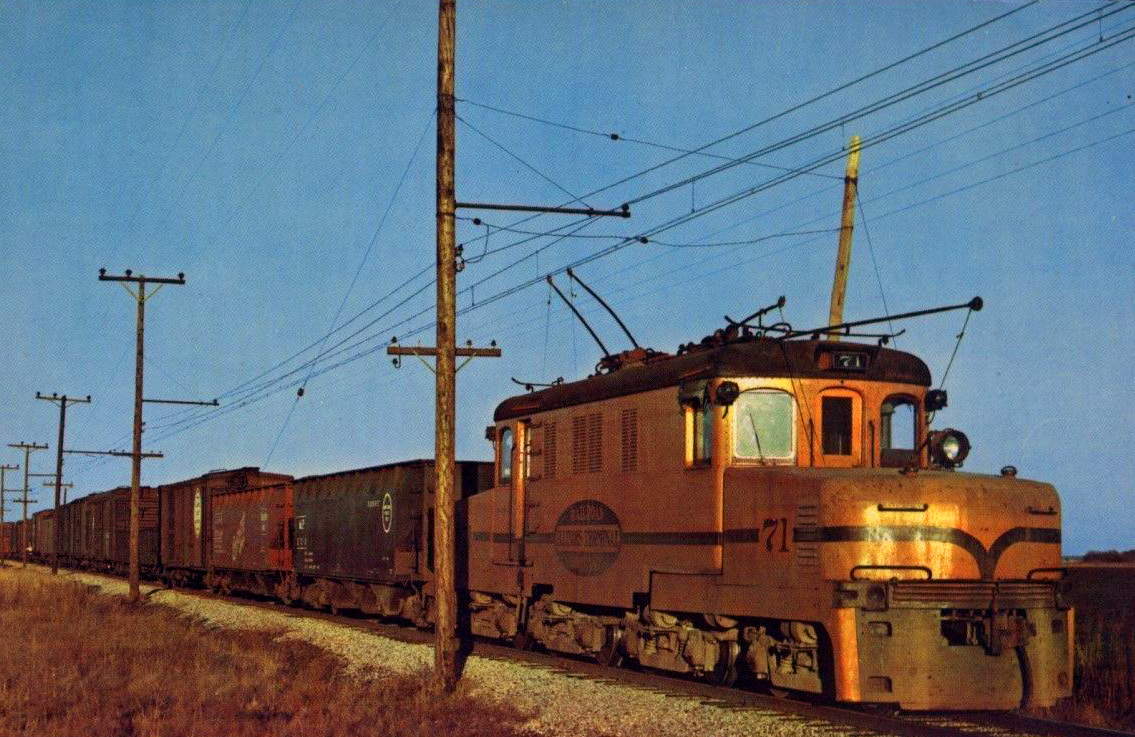 Illinois Terminal "Class D" motor #71 is ahead of Peoria-St. Louis freight #203 during the 1950's. Herbert Georg photo.
Two final important projects remained; linking the Champaign - Danville section and direct service into St. Louis. The former got underway in 1906 when, on May 26th, yet another subsidiary was formed known as the St. Louis, Decatur & Champaign Railway.
It would run east from Decatur to reach Champaign, linking Bement and Monticello along the way. Construction commenced that same spring and regular service launched on June 16, 1907.
The final endeavor proved the most costly, crossing the river into downtown St. Louis. To do so, McKinley formed a subsidiary known as the St. Louis Electric Terminal Railway on March 8, 1906.
By May of 1907 its line reached the east bank of the river at Venice. In addition, private land had been acquired on the west bank near Salisbury Street leaving only the bridge's construction to achieve downtown access. The incredible project began that August and required three years.
The double-tracked McKinley Bridge (flanked by single highway lanes) was quite a feat of engineering at 8,000 feet in length with a 2,700-foot western approach.
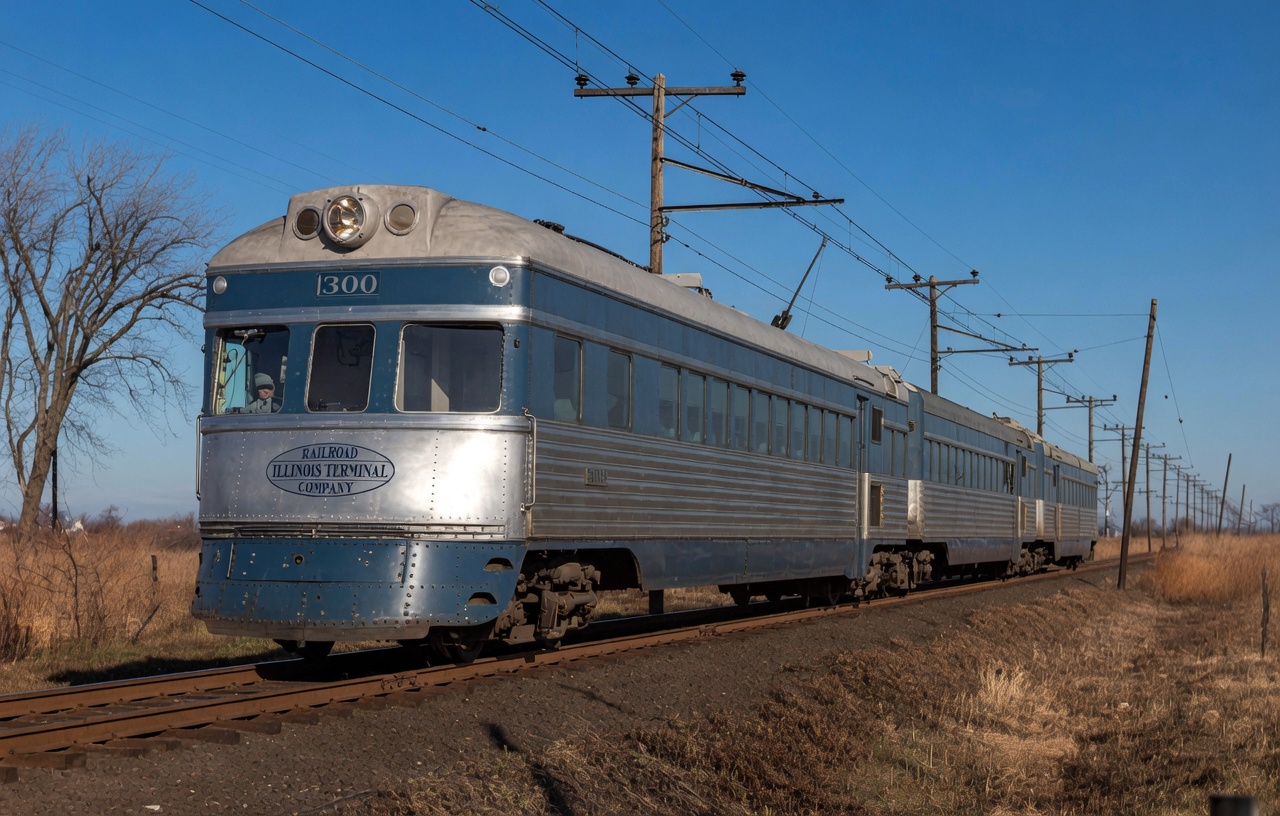 One of the Illinois Terminal "Streamliner" trainsets, #300, is seen here in service, circa 1950. Henry Georg photo.
The final price tag was $4.5 million and, ironically, was the greatest span in the city. Regular service launched on October 1, 1910 with trains terminating at Lucas Avenue (in 1933 street running was eliminated when a new facility opened).
While completion of this structure largely signaled the consummation of IT's modern network, a bit more expansion did occur during the 1920's through 1930. As Hilton and Due's book points out it was all situated near St. Louis along the river's heavily industrialized eastern bank.
These acquisitions included the St. Louis & Alton in 1930 for access to the latter town; St. Louis, Troy & Eastern in 1925 to reach Troy; and the Alton & Eastern in 1926 offered additional business between East St. Louis and Grafton. Along with these efforts, new construction provided access as far south as O'Fallon.
Modern Network
Finally, there was the small, steam-powered Illinois Terminal Railroad. This rather insignificant switching line wound up as the face of the entire network. It was formed on July 8, 1895 by Illinois Glass Company to serve its transportation needs in the Alton area.
Within a few years further expansion afforded access to LeClaire/Edwardsville (opened January 11, 1900). The IT was spun off as independent in 1907 and largely remained so for the next two decades, aside from a slight name change in 1922 as the Illinois Terminal Company.
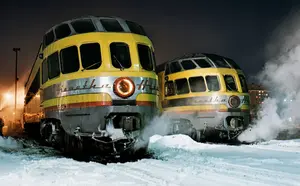
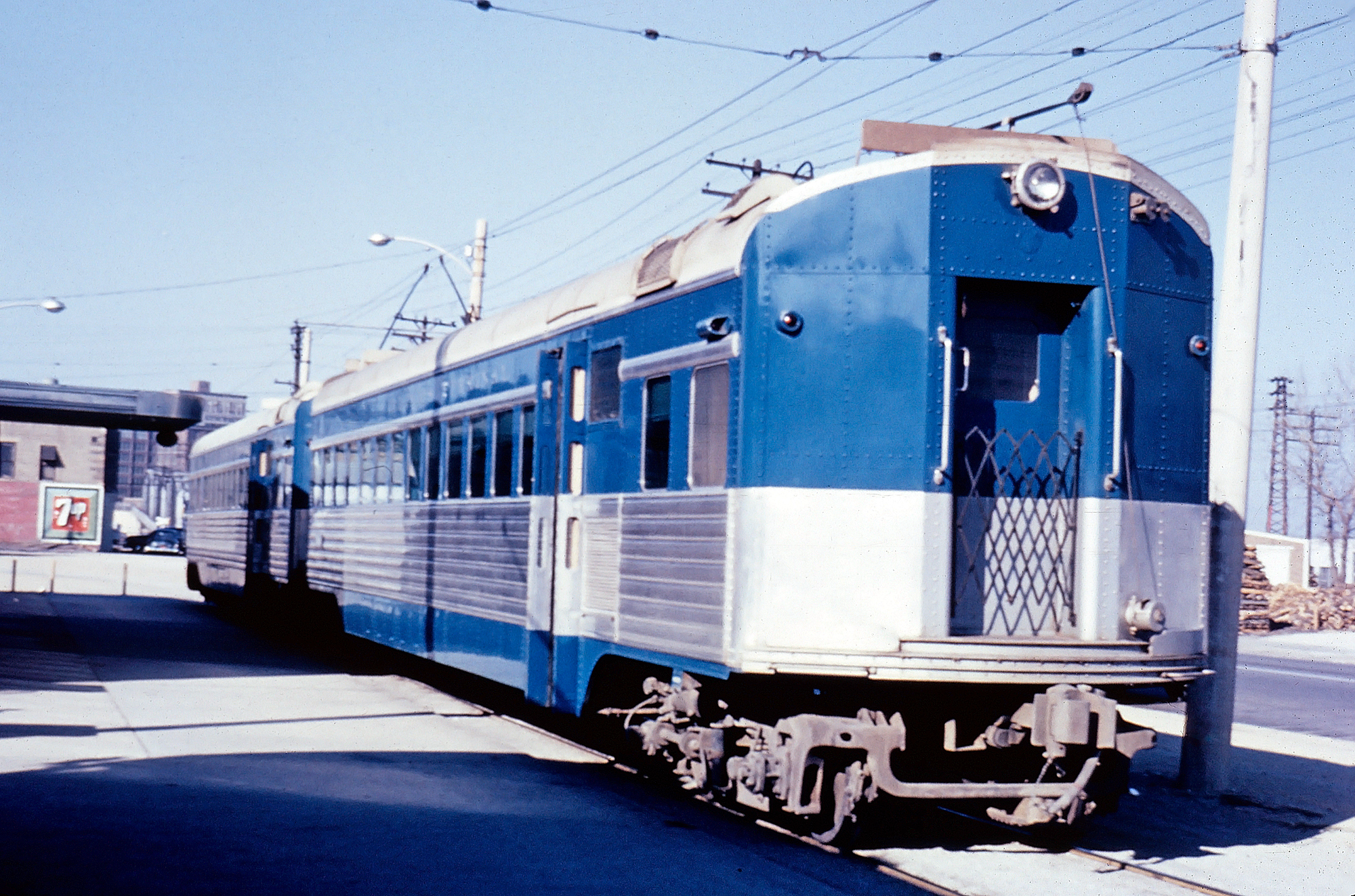 An Illinois Terminal "Streamliner" set at the new terminal in East Peoria, Illinois, circa 1950. There were three such sets manufactured by the St. Louis Car Company in the late 1940s, intended to resurrect the IT's declining passenger business. They were retired following the end of most intercity passenger services in 1956. None survive. James Stitzel photo. American-Rails.com collection.
Around this time a series of corporate changes took place; the Illinois Traction, Inc., a subsidiary of the Illinois Power & Light Company (IP&L), was formed in 1923 to maintain all rail services. Then, in 1928 the Illinois Terminal Company was acquired by IP&L with IT subsequently leasing all rail holdings.
In a further corporate simplification the Illinois Terminal Railroad was created on October 18, 1937 in a consolidation of the Illinois Terminal Company and all of its leased assets. From that point forward, the interurban operated as a unified system under one name.
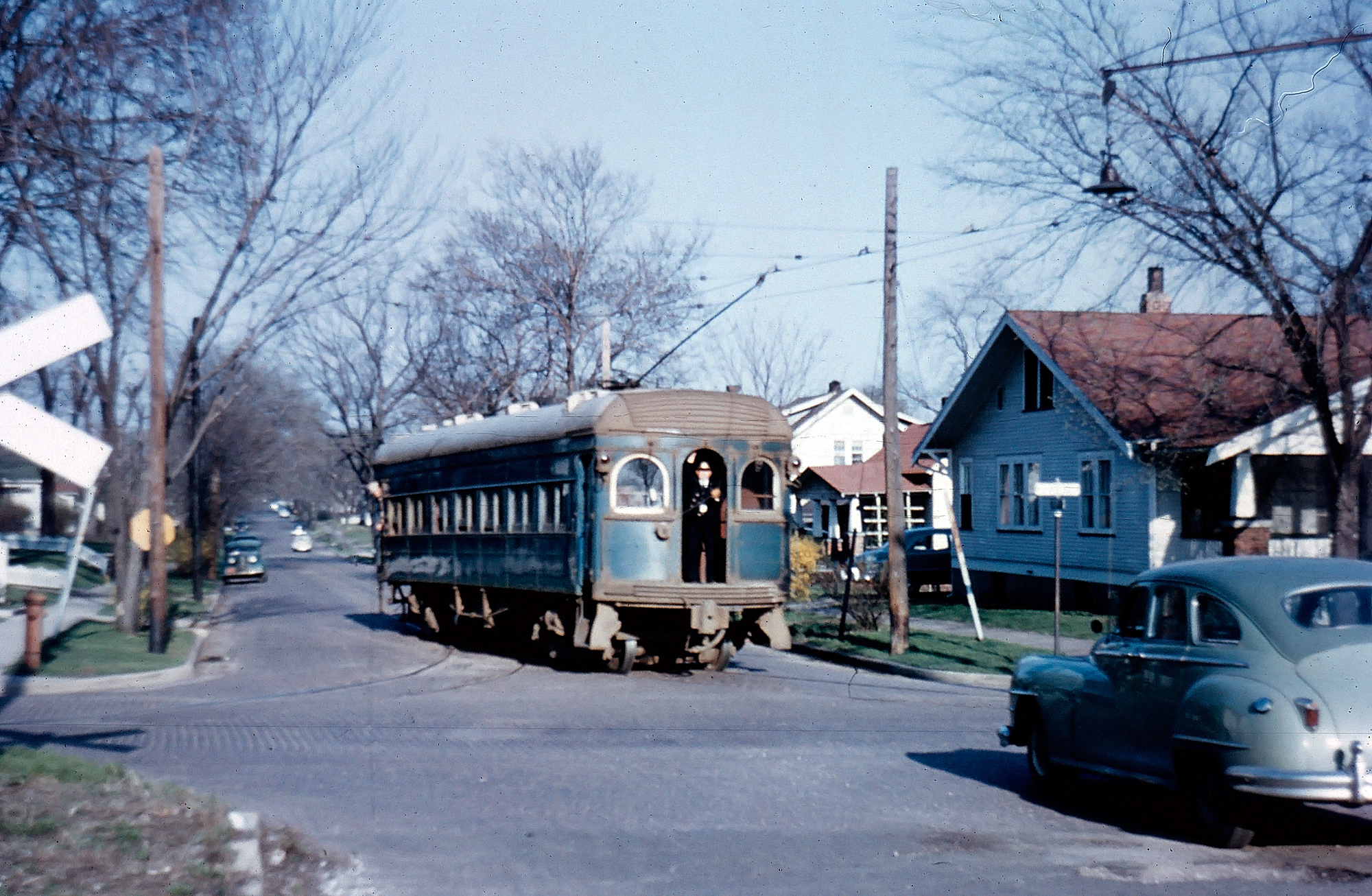 Illinois Terminal car #284 is seen here on the wye in Decatur, Illinois, circa 1950. James Stitzel photo. American-Rails.com collection.
By then, McKinley had left the company to pursue politics whereupon the IT passed through various owners including Clement Studebaker, Jr. (of the Studebaker Corporation, an automobile manufacturer), Samuel Insull, and finally the North American Company when Insull's empire collapsed during the Great Depression.
The IT returned to independence during the 1930's and spent the following two decades as such until its 1956 purchase by a consortium of large Class I's including the Baltimore & Ohio; Chicago & Eastern Illinois; Chicago, Rock Island & Pacific; Chicago, Burlington & Quincy; St. Louis-San Francisco; Gulf, Mobile & Ohio; Illinois Central; Litchfield & Madison; New York Central; Nickel Plate; and Wabash.
Passenger Trains
Capitol Limited: (St. Louis - Peoria)
City of Decatur: (St. Louis - Decatur)
Fort Crevecoeur: (St. Louis - Peoria)
Illini: (St. Louis - Champaign)
Illmo Limited: (St. Louis - Peoria)
Mound City: (St. Louis - Peoria)
Owl: (St. Louis - Peoria)
Peoria Flyer: (St. Louis - Peoria)
St. Louis Flyer: (Peoria - St. Louis)
Sangamon: (St. Louis - Peoria)
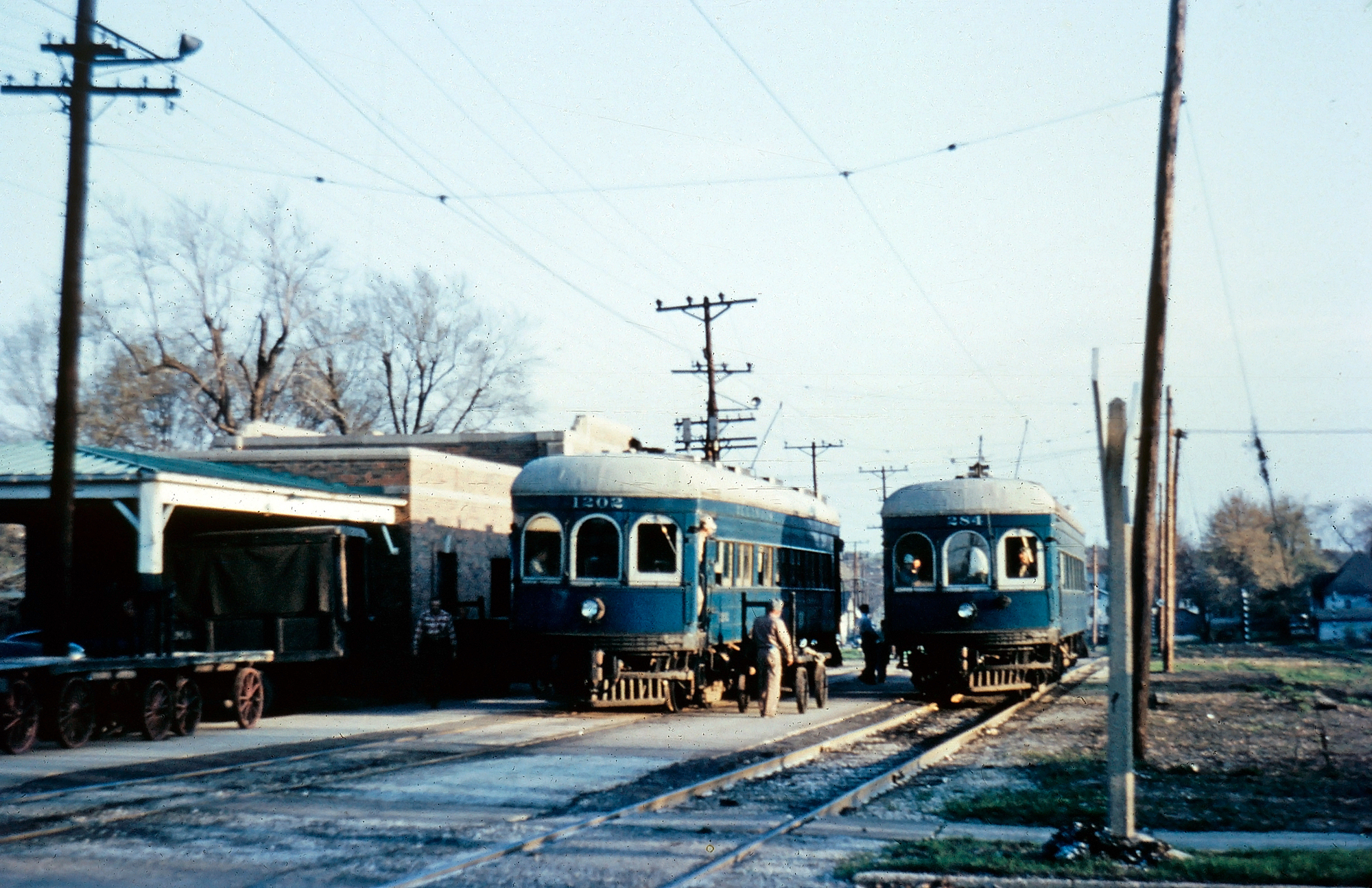 Illinois Terminal cars #1202 and #284 (both products of the St. Louis Car Company) stopped at the station in Decatur, Illinois, circa 1954. James Stitzel photo. American-Rails.com collection.
Aside from its heavy carload freight business and numerous interchange connections the modern Illinois Terminal varied only slightly from what you might expect of a typical interurban. As traffic increased the company was forced to employ ever larger boxcab motors.
It began with the small Class A "steeple cab" switchers, 800 horsepower machines which transitioned in the later years to beefier Class B's (1,000 horsepower). This motor was followed by Class C's and, finally, the hefty 1,800 horsepower Class D's.
While McKinley had designed his system as a passenger carrier its freight business became so dense focus shifted to meet this growing demand. The IT handled virtually everything imaginable from coal and merchandise to grain and perishables.
As tonnage grew, street operations became unbearable. To alleviate this issue a series of belt lines were constructed fairly early on to bypass Springfield, Decatur, and Edwardsville. The IT then convinced the Wabash and Illinois Central to electrify part of their trackage around Champaign and Urbana in 1927 to also circumvent these towns.
As the years passed, freight accounted for much of the carrier's gross revenues; $1.6 million in 1924, $2.2 million in 1926, and a whopping $11 million by 1954 (with $600,000 in passenger earnings that year).
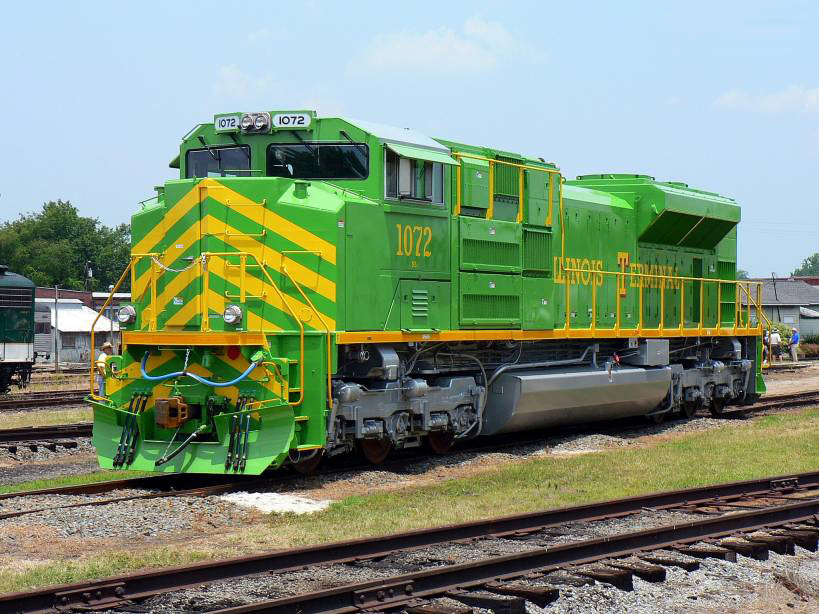 Norfolk Southern's nod to the Illinois Terminal, SD70ACe #1072 at the heritage celebration in Spencer, North Carolina during early July of 2012. Dan Robie photo.
For most interurbans, reaching the six figure mark was an accomplishment making the IT's numbers quite impressive. As Due and Hilton note, by the postwar period its gross revenues were comparable to the Chicago, Indianapolis & Louisville Railway's (Monon), Indiana's regional Class I.
After the large railroads took control many changes resulted including phasing out the electrification and abandoning corridors in favor of trackage rights (Danville - Ogden was let go in 1952 [cutback to Champaign a year later] and the Forsythe - Mackinaw and Alton - Grafton sections were removed in 1953).
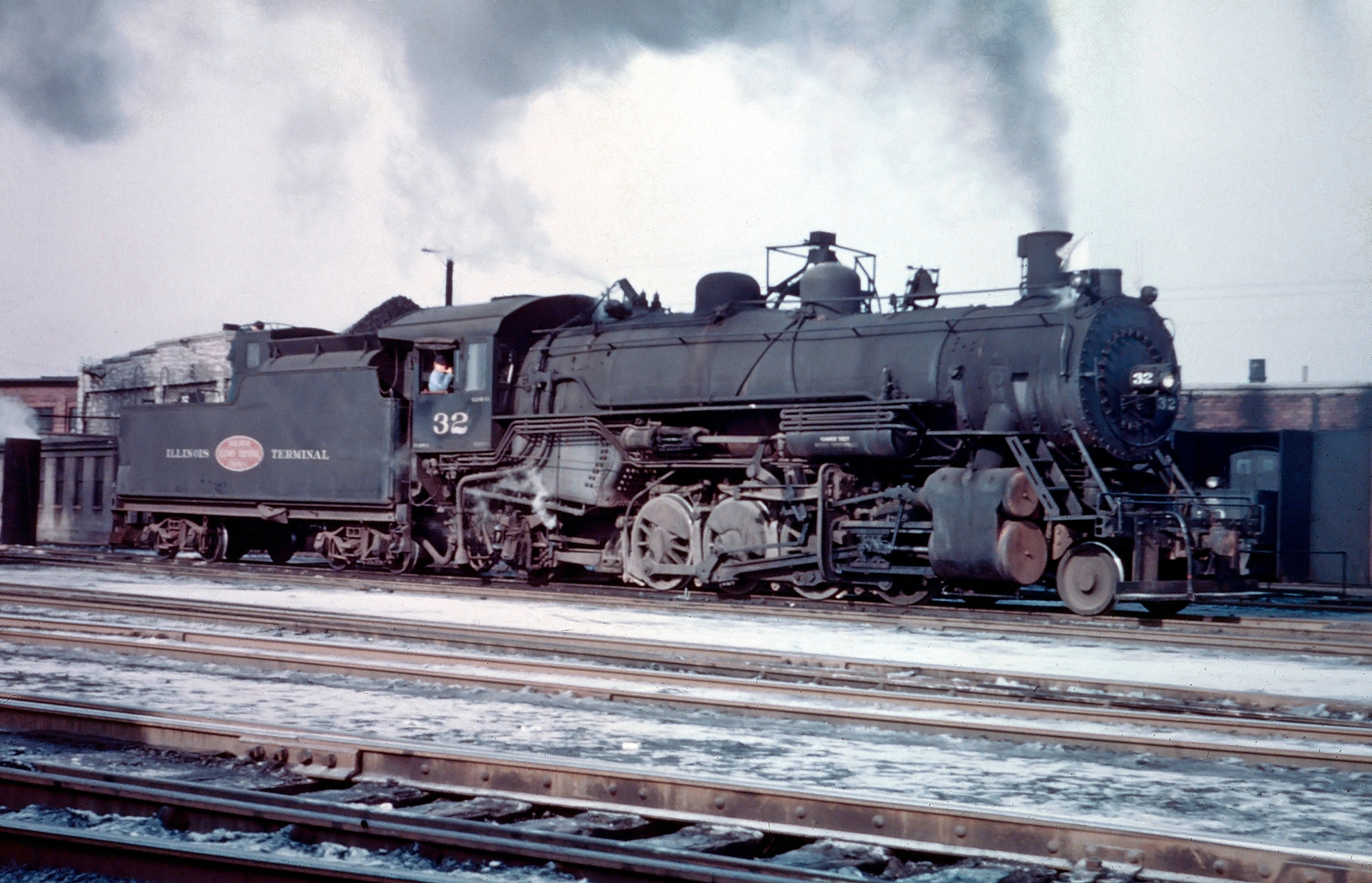 While the Illinois Terminal and its predecessors are widely recognized as an electrified interurban, it also operated a small fleet of steam locomotives, including three 2-8-2's, listed as Class 30. Seen here is #32 at Federal, Illinois in January, 1950, just a month before the unit was sold for scrap. Fred Byerly photo. American-Rails.com collection.
Steam ended on June 30, 1950 when 2-6-0 #21 dropped its fire. The final through passenger runs were carried out in 1956 while suburban service (St. Louis - Granite City) survived until June 21, 1958. At that point, the IT became a freight-only, entirely dieselized operation.
Interestingly, despite increasing freight tonnage its infrastructure never saw considerable improvements. It continued relying primarily on the 70-pound rail with which it was originally constructed.
As Mr. Stringham's book points out, the big Class D motors were too heavy for this track, weighing approximately the same as Electro-Motive's early GP7 road-switcher.
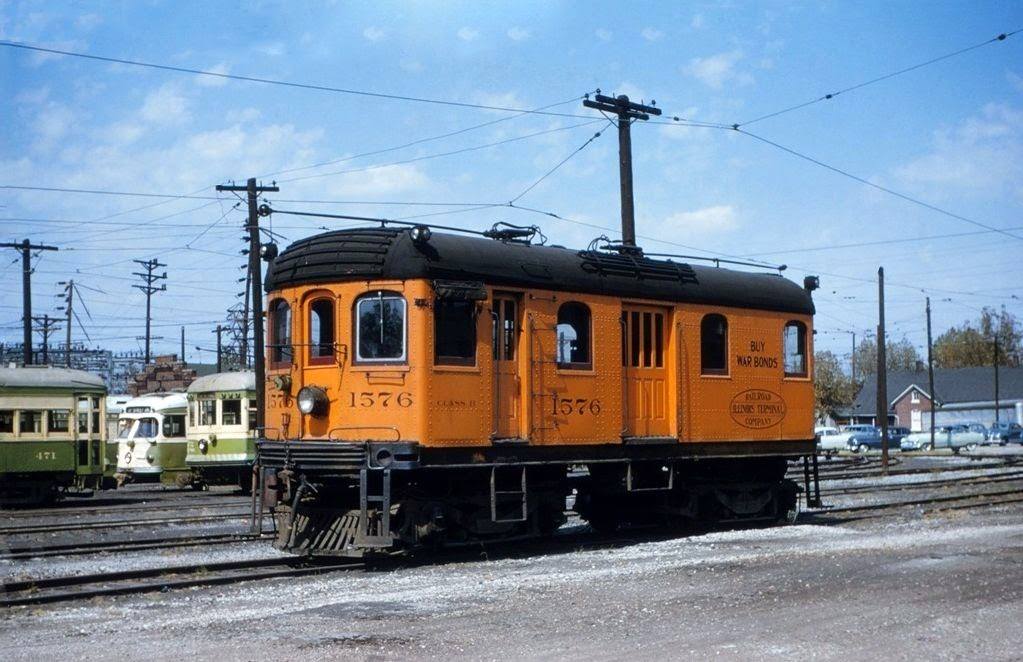 Illinois Terminal Class B box motor #1576 in September, 1954. This little motor was home-built by predecessor Illinois Traction in 1918 at the Decatur Shops. Soon after this photo was taken it was rebuilt as snow plow #021 and sold for scrap in 1959.
Diesel Roster
American Locomotive Company
| Model Type | Road Number | 1967-1968 Re-Numbering | Date Built | Quantity |
|---|---|---|---|---|
| S2 | 700-711 | 1001-1012 | 1948-1950 | 12 |
| RS1 | 751-756 | 1051-1056 | 1948-1950 | 6 |
Electro-Motive Division
| Model Type | Road Number | 1967-1968 Re-Numbering | Date Built | Quantity |
|---|---|---|---|---|
| SW8 | 725 | 801 | 1950 | 1 |
| SW1200 | 775-786 | 1201-1212 | 1955 | 12 |
| F7B | - | 1507-1508 (Ex-RF&P) | 1949-1959 | 2 |
| SW1500 | - | 1509-1515 | 1970 | 7 |
| GP7 | 1600-1605 | 1501-1506 | 1953 | 6 |
| GP7u | - | 1750 (Ex-Wabash) | 1952 | 1 |
| GP38-2 | - | 2001-2004 | 1977 | 4 |
| GP20 | - | 2008-2009 (Ex-UP) | 1960 | 4 |
| SD39 | - | 2301-2306 | 1969 | 6 |
Electric Roster
| Number(s) | Class | Builder | Type | Date Built |
|---|---|---|---|---|
| 51-52 | - | St. Louis | B-B | 1930 |
| 53 | - | Decatur Shops | B-B | 1942 |
| 61 | - | Decatur Shops | B-B | 1939 |
| 61 | - | Decatur Shops | B-B | 1939 |
| 70-74* | D | Decatur Shops | B-B+B-B | 1940-1942 |
| 1550 (1st) | A | Danville Car | B-B | 1907 |
| 1550 (2nd) | A | Danville Railway & Light | B-B | 1904 |
| 1551-1555 | A | Danville Car | B-B | 1904-1907 |
| 1556 (1st) | A | Danville Railway & Light | B-B | 1904 |
| 1556 (2nd) | A | Danville Car | B-B | 1907 |
| 1557 (1st) | A | Danville Railway & Light | B-B | 1904 |
| 1557 (2nd) | A | Danville Car | B-B | 1907 |
| 1558 | A | Danville Railway & Light | B-B | 1904 |
| 1559-1560 | A | Alco/GE | B-B | 1907 |
| 1561 (1st)** | B | Alco/GE | B-B | 1907 |
| 1561 (2nd)** | B | Decatur Shops | B-B | 1910 |
| 1562-1578** | B | Decatur Shops | B-B | 1910 |
| 1579-1581*** | C | Decatur Shops | B-B+B-B | 1924 |
| 1582-1584*** | C | Decatur Shops | B-B+B-B | 1925 |
| 1585-1586*** | C | Decatur Shops | B-B+B-B | 1926 |
| 1587-1598*** | C | Decatur Shops | B-B+B-B | Unknown |
* The Class D motors weighed an astonishing 217,000 pounds and with eight Westinghouse motors producing 225 horsepower offered an hourly rating of 1,800 horsepower.
Their lineage is as follows: #70 rebuilt from #1580 (9/10/40); #71 rebuilt from #1581 (3/27/41); #72 rebuilt from #1591 (12/12/42); #73 rebuilt from #1584 (1/2/42); and #74 rebuilt from #1588 (9/26/42).
** The Class B electrics carried four, 200 horsepower motors from General Electric offering 800 horsepower.
*** The Class C motors carried eight General Electric motors offering 125 horsepower, providing them an hourly rating of 1,000 horsepower.
The "Streamliners"
| Number(s) | Type | Builder | Date Built |
|---|---|---|---|
| 300-302 | Baggage/Coach Combine | St. Louis Car Company | 1948-1949 |
| 330-331 | Coach | St. Louis Car Company | 1948-1949 |
| 350, Louis Jolliet | Parlor-Diner-Observation | St. Louis Car Company | 1948-1949 |
| 351, Shadrach Bond | Parlor-Diner-Observation | St. Louis Car Company | 1948-1949 |
| 352, Pierre Laclede | Parlor-Diner-Observation | St. Louis Car Company | 1948-1949 |
All above roster information is thank to William Middleton's "Traction Classics: The Interurbans, Extra Fast And Extra Fare" and "Traction Classics: The Interurbans, Interurban Freight" as well as Paul Stringham's "Illinois Terminal: The Electric Years."
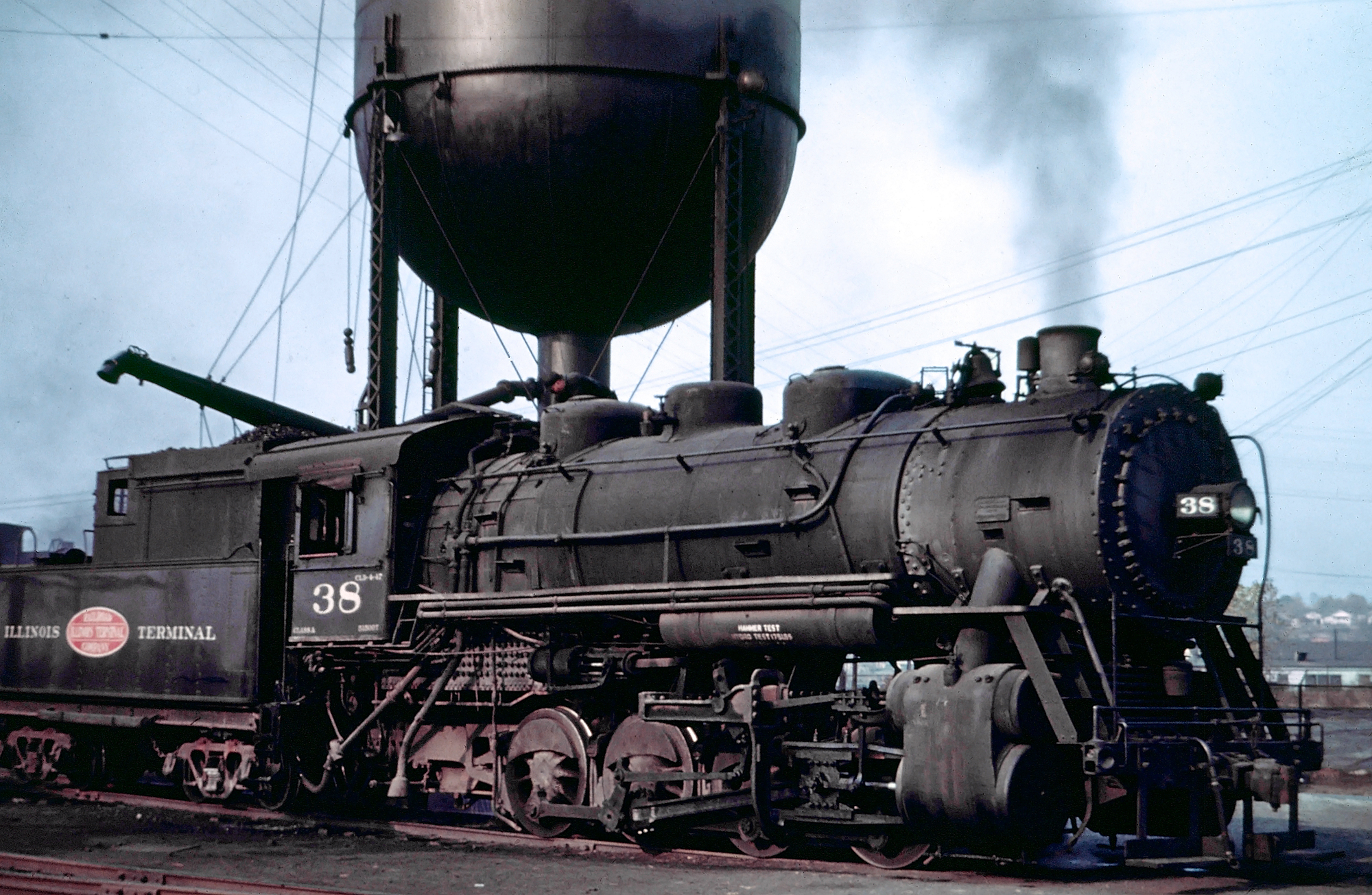 An Illinois Terminal 0-8-0 switcher, #38 (Class A), is seen here near the end of her career in Federal, Illinois, circa 1950. Fred Byerly photo. American-Rails.com collection.
Norfolk & Western
To help meet demand in the 1960's IT purchased the largest and most powerful diesels it would ever own, second-generation SD39's and GP38-2's.
By the early 1980's most of its principle owners were no longer interested in the property except for Norfolk & Western, which by then had absorbed the Wabash and Nickel Plate Road. This led to others selling out and N&W officially taking control on May 8, 1982.
At that time trackage still in service included Granite City - Alton, Madison - Edwardsville - Alton, and Maroa (Decatur) - Farmdale Junction (Peoria). The latter segment had originally been abandoned by IT years earlier.
However, when Conrail launched on April 1, 1976 it had no interest in a former Pennsylvania Railroad branch (57 miles) serving the same territory, allowing IT to purchase this trackage.
Today, while many of its former lines have been abandoned some continue to see use under N&W successor Norfolk Southern. Finally, many of IT's former substations still stand, although most are abandoned and in very poor condition.
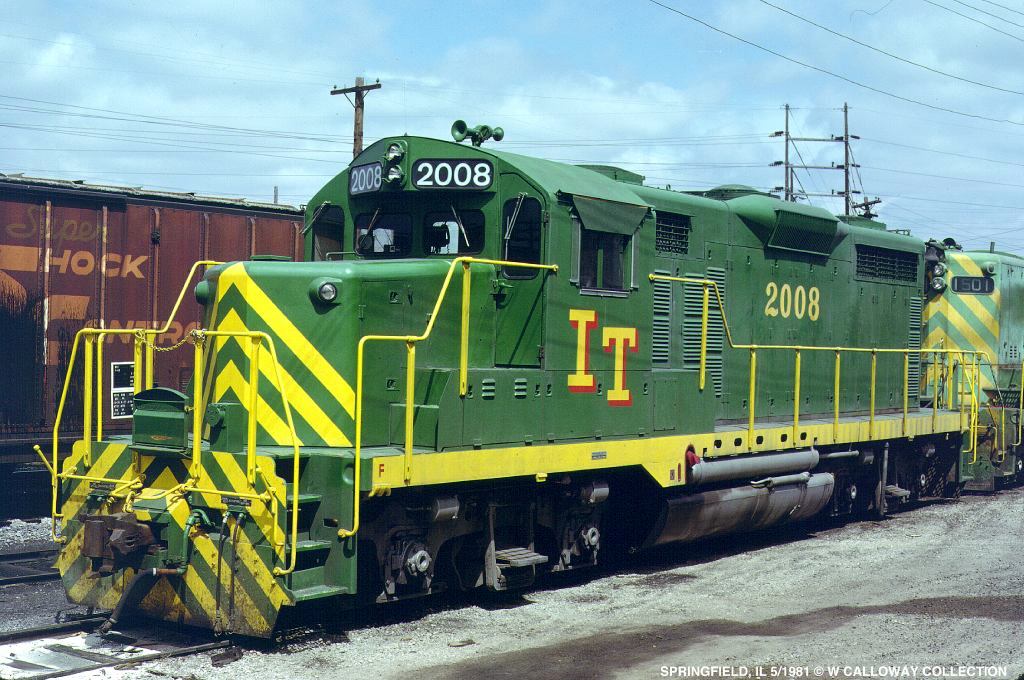 Illinois Terminal GP20 #2008 - a former Union Pacific unit - wearing the road's late era livery at the engine facility in Springfield, Illinois on September 1, 1981. Warren Calloway photo.
Recent Articles


-
Bessemer & Lake Erie Railroad: "The Bessemer Road"
Sep 15, 26 05:20 PM
 Bessemer & Lake Erie—Bear Creek 1865, Carnegie 1897, U.S. Steel 1901. Ore south from Conneaut, coal north. 2-10-4s, Missabe sister road. CN May 10, 2004. Complete corporate history.
 -
Bangor and Aroostook Railroad: "Serving Northern Maine"
Sep 15, 26 05:05 PM
 Bangor & Aroostook—chartered February 13, 1891, first trains January 1, 1894. Potatoes, paper, Searsport, State of Maine reefers. MM&A 2003, Lac-Mégantic 2013, CP 2020, CPKC today. Complete co…
 -
Baltimore & Ohio Chicago Terminal Railroad: Map and History
Sep 15, 26 03:11 PM
 B&OCT—formed January 6, 1910 to buy Chicago Terminal Transfer. Grand Central, Barr Yard, 78 route-miles. Assigned B&O steam. Complete diesel roster. CSX paper subsidiary, mark BOCT.
 -
The "Alphabet Route" (Railroad): Photos and History
Sep 15, 26 02:53 PM
 Alphabet Route—eight railroads, not one company. P&WV to Connellsville February 11, 1931. Alpha Jets Chicago/St. Louis–New York/Boston. NKP, W&LE, P&WV, WM, Reading, CNJ, L&HR, New Hav…
 -
Milwaukee Road Livestock Operations: Cattle, Dakotas & Montana
Sep 15, 26 02:36 PM
 Milwaukee Road livestock traffic—Dakota and Montana cattle, Iowa hogs, Chicago markets, 28-hour law, head-end stock cars. By 1974 mostly Montana. Rick Burn’s Helena speech. Operations history, not the…
 -
Spirit of Jasper Ride & Dine (2026): Season Pause
Sep 15, 26 02:29 PM
 Spirit of Jasper Ride & Dine in Jasper, Indiana—seated meal on board. Operator: not running public trains for 2026. Depot remains open as a rental. Confirm on spiritofjaspertrain.com.
 -
South Carolina Canal & Rail Road Company: Map and History
Sep 15, 26 01:59 PM
 South Carolina Canal & Rail Road—chartered December 19, 1827. Best Friend of Charleston, 136 miles Charleston–Hamburg October 1833, Aiken inclined plane. South Carolina Railroad 1844, Southern 189…
 -
The Practice of Double-Heading: The Steam Era
Sep 15, 26 01:43 PM
 Doubleheading—two locomotives on the point, each with its own steam crew. Not a rear helper, not diesel MU. How it worked, PRR 1877, mountain grades, and what MU ended.
 -
Mohawk and Hudson Railroad: Map, Pictures, Locomotives
Sep 15, 26 01:20 PM
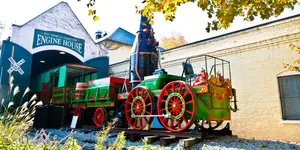
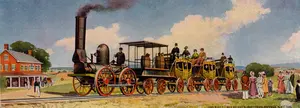
 Mohawk & Hudson Railroad—New York’s first railroad, chartered April 17, 1826. DeWitt Clinton, inclined planes, Albany & Schenectady 1847, first New York Central May 17, 1853. Complete corporat…
 -
Essex Clipper Dinner Train (2026): Dates, Tickets & What to Expect
Sep 15, 26 01:09 PM
 2026 Essex Clipper Dinner Train in Essex, CT—2.5 hours, four-course meal $129.99, 18+. Fall dates through Oct. 25. Confirm on essexsteamtrain.com.
 -
Camden & Amboy Railroad: Map, History, Photos
Sep 15, 26 12:53 PM
 Camden & Amboy Railroad—chartered February 4, 1830. Joint Companies monopoly with the Delaware & Raritan Canal, John Bull, T-rail. United New Jersey 1872, PRR 999-year lease 1871. Complete corpora…
 -
Cafe Lafayette Dinner Train (2026): Dates, Tickets & What to Expect
Sep 15, 26 12:47 PM
2026 Cafe Lafayette Dinner Train in North Woodstock, NH—2 hours, 20 miles, five-course meal from $125. May–October. Confirm on nhdinnertrain.com. -
Christmas Train Ride Locations (2026): A Complete Guide
Sep 15, 26 10:47 AM
 2026 Christmas train rides by state—Santa, North Pole Express, and holiday trains. Not Polar Express. State guides and product pages. Confirm dates on each railroad.
 -
Baltimore & Ohio Railroad: Linking 13 Great States With The Nation
Sep 15, 26 10:22 AM
 Baltimore & Ohio Railroad—first U.S. common carrier, chartered February 28, 1827. Wheeling 1853, Chicago 1874, C&O control 1963, Chessie 1973, into CSX April 30, 1987. Complete corporate history.
 -
Delaware & Hudson Railway: The Bridge Line
Sep 15, 26 09:59 AM
 Delaware & Hudson Railway—Wurts brothers canal 1823, gravity railroad 1829, Stourbridge Lion, Bridge Line to Montreal. Guilford 1984, CP 1991, NS south line 2015, CPKC north.
 -
Delaware & Hudson Diesel Roster (All-Time)
Sep 15, 26 12:17 AM
 All-time Delaware & Hudson diesel roster—Alco S-2s through C-628s and PA-4s, GE U-boats, Baldwin RF-16s, EMD SD45s and GP38-2/GP39-2s. Serials, dates, dispositions.
 -
Granite Railway, Our Country's First Railroad
Sep 14, 26 11:28 PM
 Granite Railway of Quincy, Massachusetts—chartered March 4, 1826, opened October 7, 1826. Gridley Bryant, 5-foot gauge, horses, Bunker Hill Monument stone. First commercial U.S. railroad.
 -
Milwaukee Road Skytop Lounges: History, Specs & Floor Plans
Sep 14, 26 11:09 PM
 Milwaukee Road Skytop observation cars—Brooks Stevens, 1948. Four Rapids parlor-lounges from Milwaukee Shops, six Creek sleeper-lounges from Pullman-Standard. Floor plans, roster, preservation.
 -
West Virginia Christmas Train Rides (2026): A Complete Guide
Sep 14, 26 11:02 PM
2026 West Virginia Christmas trains—Potomac Eagle North Pole Express in Romney and Christmas at Cass. Not Polar Express. Elkins Polar is not listed for 2026. -
Railroads Of Today: Class I Map, PSR & the 2026 Industry
Sep 14, 26 10:30 PM
 U.S. freight rail in 2026—six Class I railroads on a nearly 140,000-mile network. PSR as everyday practice, how the STB works, traffic mix, short lines and regionals.
 -
Railroad History (USA): Timeline, Facts & How the Network Was Built
Sep 14, 26 10:03 PM
 Full U.S. railroad history hub—origins and inventors, Golden Age peak mileage, Civil War and transcontinental, streamliners, ICC regulation, Penn Central and Conrail, Staggers Act, PSR, and today’s Cl…
 -
Railroads In The 2020s: CPKC, East Palestine & the UP–NS Case
Sep 14, 26 09:51 PM
 U.S. railroads 2020–2026—Class I mileage 91,773 in 2020. COVID traffic drop, CPKC April 14 2023, East Palestine Feb. 3 2023, UP–NS $85 billion case still before the STB.
 -
Railroads In The 2010s: PSR, Coal’s Decline & Positive Train Control
Sep 14, 26 03:51 PM
 U.S. railroads 2010–2020—Class I mileage 95,573 to 91,773. Buffett closed BNSF Feb. 12 2010, Harrison at CP June 29 2012 and CSX 2017, PTC deadline Dec. 31 2018.
 -
Virginia Christmas Train Rides (2026): A Complete Guide
Sep 14, 26 03:46 PM
 2026 Virginia Christmas trains—Virginia Scenic Railway Santa Express from Staunton, about 60 minutes. Confirm dates. Not Polar Express.
 -
MARC Train: Maryland Commuter Rail History, Lines & Roster
Sep 14, 26 01:16 PM
 MARC Train history—Maryland Rail Commuter 1984, B&O and PRR corridors, Penn/Camden/Brunswick lines, Silver Spring 1996, all-time locomotive roster.
 -
Railroads In The 2000s: Merger Freeze, Wisconsin Central & Buffett
Sep 13, 26 07:57 AM
 U.S. railroads 2000–2010—Class I mileage 99,250 to 95,573. STB merger freeze March 17 2000, CN–WC Oct. 9 2001, BNSF Railway Jan. 24 2005, Buffett Nov. 3 2009.
 -
Railroads In The 1990s: Mega-Mergers, Conrail’s Split & the STB
Sep 13, 26 12:13 AM
 U.S. railroads 1990–2000—Class I mileage 119,758 to 99,250. BNSF Sept. 22 1995, UP–SP Sept. 11 1996, Conrail split June 1 1999, ICC Termination Dec. 29 1995.
 -
Railroads In The 1980s: Staggers, Mega-Mergers & Conrail’s IPO
Sep 12, 26 11:12 PM
 U.S. railroads 1980–1990—Class I mileage 164,822 to 119,758. Staggers Oct. 14 1980, CSX and Norfolk Southern, UP–Missouri Pacific–Western Pacific, Conrail IPO March 26 1987.
 -
Wabash Class O-1 4-8-4s: History, Roster & Specifications
Sep 12, 26 11:01 PM
 Wabash Class O-1 4-8-4s—Baldwin 1930–31, twenty-five engines 2900–2924. Fast freight, complete roster, specifications. None preserved.
 -
Staggers Rail Act of 1980: Statute, Contract Rates & the ICC
Sep 10, 26 11:23 PM
 Staggers Rail Act, Pub. L. 96-448, signed October 14, 1980. Harley Staggers, S.1946, contract rates, 180% variable-cost test, abandonments, short lines.
 -
Rock Island E8A 652: Bicentennial Independence Paint & History
Sep 10, 26 10:42 PM
 Rock Island E8A 652—EMD March 1952, serial 15199. 20th Century Railroad Club Independence bicentennial scheme, Peoria and Quad Cities Rockets, Midland Railway, Manly Junction Museum.
 -
Vermont Christmas Train Rides (2026): A Complete Guide
Sep 10, 26 10:37 PM
2026 Vermont Christmas trains—Okemo Valley Holiday Express from Chester Depot Dec. 19–20. Polar is Burlington Dec. 5–6 only. -
Railroads In The 1970s: Penn Central, Amtrak & Conrail
Sep 10, 26 10:18 AM
 U.S. railroads 1970–1980—196,479 miles at the decade’s start. Penn Central bankruptcy June 21 1970, Amtrak May 1 1971, 3R/4R Acts, Conrail April 1 1976, Rock Island 1975, Milwaukee 1977.
 -
Railroads In The 1960s: Mergers, Passenger Collapse & Penn Central
Sep 10, 26 10:03 AM
 U.S. railroads 1960–1970—207,334 to 196,479 miles. Erie Lackawanna 1960, C&O–B&O 1963, N&W–Nickel Plate 1964, SCL 1967, Penn Central Feb. 1 1968.
 -
South Carolina Christmas Train Rides (2026): A Complete Guide
Sep 10, 26 08:36 AM
 2026 South Carolina Christmas trains—South Carolina Railroad Museum Santa Train in Winnsboro. Confirm December dates. Not Polar Express. Drop light-festival padding.
 -
Steam Locomotive Feedwater Heaters: Elesco, Coffin & Worthington
Sep 10, 26 08:29 AM
 Steam locomotive feedwater heaters—open Worthington vs closed Elesco and Coffin. How they work, how to identify them on a smokebox, and why not every engine had one.
 -
Oregon Christmas Train Rides (2026): A Complete Guide
Sep 10, 26 08:22 AM
2026 Oregon Christmas trains—Portland Holiday Express, Garibaldi Candy Cane Express, Sumpter Valley Christmas Trains Dec. 11–13. Polar is Mount Hood. -
Lake Shore & Michigan Southern: Map, History, Timetables
Sep 10, 26 08:12 AM
 Lake Shore & Michigan Southern Railway—Erie & Kalamazoo 1833, Michigan Southern to Chicago 1852, LS&MS April 6 1869, Vanderbilt, Ashtabula 1876, NYC merger Dec. 22 1914. 1910 map and Official Guide.
 -
Big Four Route (CCC&StL): Map, History
Sep 10, 26 12:19 AM
Cleveland, Cincinnati, Chicago & St. Louis Railway—Bee Line 1868, Ingalls’s first Big Four 1880, CCC&StL June 30, 1889, NYC lease Feb. 1, 1930. 1910 and 1930 maps, what still runs. -
Railroads In The 1950s: Diesel, the Interstate & Passenger Collapse
Sep 10, 26 12:15 AM
 U.S. railroads 1950–1960—223,779 to 211,459 miles. Interstate June 29, 1956, dieselization, passenger collapse, TOFC, 1957–58 recession, NYO&W 1957, N&W–Virginian 1959.
 -
New Jersey Christmas Train Rides (2026): A Complete Guide
Sep 10, 26 12:06 AM
 2026 New Jersey Christmas trains—Black River & Western Santa Express from Flemington and Pine Creek Christmas trains in Wall Township. Polar is Whippany and Phillipsburg.
 -
New Mexico Christmas Train Rides (2026): A Complete Guide
Sep 09, 26 11:57 PM
 2026 New Mexico Christmas trains—Cumbres & Toltec Santa’s Holiday Express from Chama Dec. 5–6 (and Antonito, Colo., Dec. 12–13). Coach $25/$15. Not Polar Express.
 -
Grand Trunk Railway: Map, History, Timetables
Sep 09, 26 11:47 PM
 Grand Trunk Railway of Canada—charter Nov. 10, 1852, Montreal–Toronto 1856, Portland, Sarnia, Victoria Bridge, St. Clair Tunnel 1891, Great Western 1882, GTPR, CN Jan. 20, 1923. 1893 map and Official…
 -
Troop Trains In World War II: Sleepers, Kitchen Cars & Movements
Sep 09, 26 11:42 PM
 WWII U.S. troop trains—almost 44 million armed-services passengers, Pullman troop sleepers, ACF kitchen cars, hospital trains, monthly movement tables 1942–45. Not the Military Railway Service. ODT an…
 -
Railroads In The 1940s: War Traffic, Last Steam & the Diesel Flood
Sep 09, 26 11:37 PM
 U.S. railroads 1940–1950—233,670 to 223,779 miles. World War II as the decade’s center, last new steam, diesel flood after V-J Day, 1945 car orders, California Zephyr 1949.
 -
Railroads In World War II: ODT, Record Traffic & Private Operation
Sep 09, 26 03:00 PM
 U.S. railroads in World War II—Lend-Lease freight, Pearl Harbor, Office of Defense Transportation, 1944 peak ~740 billion ton-miles, Dec. 1943–Jan. 1944 seizure. Private operation, not a USRA sequel.
 -
Montana Christmas Train Rides (2026): A Complete Guide
Sep 09, 26 02:54 PM
2026 Montana Christmas trains—Charlie Russell Chew Choo North Pole Adventure from Hanover/Lewistown, Nov. 27–Dec. 19, $71, about 1.5 hours. Not Polar Express. -
Railroads In The 1930s: Depression, Streamliners & the FT
Sep 09, 26 09:32 AM
 U.S. railroads 1930–1940—249,052 to 233,670 miles. Section 77, Eastman, Motor Carrier Act, M-10000 and Pioneer Zephyr 1934, EMC FT 1939. Decade frame, not the streamliner encyclopedia.
 -
Sugar Cane Train (Lahaina): LK&P History, Roster & 2026 End
Sep 09, 26 08:19 AM
 Lahaina, Kaanapali & Pacific Sugar Cane Train—3-foot tourist line 1970–2014. Anaka, Myrtle, 2023 and 2025 fires, September 2026 scrapping. Roster, Hahakea trestle, Pioneer Mill corridor.
 -
Massachusetts Christmas Train Rides (2026): A Complete Guide
Sep 09, 26 08:16 AM
 2026 Massachusetts Christmas trains—Shelburne Falls Moonlight Magic Friday Nov. 27; Edaville Festival of Lights in Carver. Polar is Cape Cod Central in Buzzards Bay.



%20was%20scrapped%20soon%20after%20this%20photo%20was%20taken.%20%20Fred%20Byerly%20photo.%20%20American-Rails.com%20collection.)


%20stopped%20at%20the%20station%20in%20Decatur%2C%20Illinois%2C%20circa%201954.%20%20James%20Stitzel%20photo.%20%20American-Rails.com%20collection.)


%2C%20is%20seen%20here%20near%20the%20end%20of%20her%20career%20in%20Federal%2C%20Illinois%2C%20circa%201950.%C2%A0%20Fred%20Byerly%20photo.%20American-Rails.com%20collection.)