King Street Station: A Seattle Landmark Still In Use Today
Last revised: September 9, 2024
By: Adam Burns
King Street Station is Seattle's last reminder of what once was regarding intercity passenger trains. At one time the city boasted two active terminals, which included Union Station located directly across the street.
This facility was served by Union Pacific and the Milwaukee Road until both lines stopped using it after Amtrak began service in 1971.
King Street held the honors of being the city's first large, modern terminal when it opened during the early 20th century, replacing an earlier structure for the Great Northern and Northern Pacific.
These two railroads were the first two transcontinental systems to the Puget Sound reaching there during the latter half of the 1800s.
Today, both buildings still stand and each has been graciously restored (thanks to the city's efforts in acquiring the former GN/NP facility from successor BNSF Railway in the mid-2000s) although only King Street still hosts trains.
Development
The completion of the Transcontinental Railroad in the spring of 1869 signaled the end of the American Frontier.
The project was carried out by the Union Pacific, building east, and Central Pacific, building west; once finished it offered a direct rail link across the western United States connecting Oakland/San Francisco, California with the rest of the country.
However, a great deal of work remained in opening new routes to other regions. Perhaps most notable was the Puget Sound with its growing timber economy and natural harbor to the Pacific Ocean.
The first railroad with intentions to reach the area was the Northern Pacific Railway Company, chartered by Congress and signed into law by President Abraham Lincoln on July 2, 1864.
The plan was straightforward, construct a new route connecting the Great Lakes with the Pacific Northwest. Of course, putting it into practice proved arduous and difficult.
To aid in its endeavor Congress allocated 60 million acres of undeveloped Frontier in exchange for the new railroad.
The most pressing concern was securing the necessary funding while the actual construction was challenging in its own right.
Since this region had no reliable transportation arteries and only a handful of small settlements dotting the landscape here and there surveyors, using little more than horses and their accompanying gear, were forced to hack their way through the underbrush to lay out a route.
According to Mike Schafer's, "More Classic American Railroads," rails were pushed from both the east and west; by 1873 a line connected Duluth, Minnesota with Bismarck, Dakota Territory while Tacoma (then the western rail head) was connected with Kalama, Washington to the south.
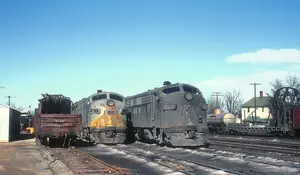
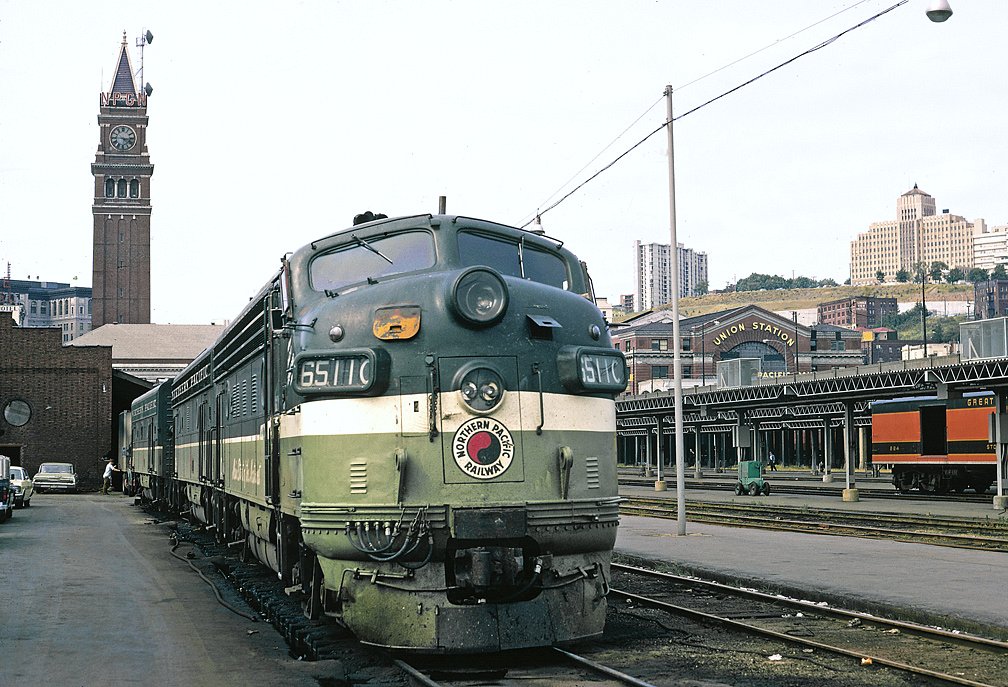 Northern Pacific F7A #6511-C and a mate sit beside Seattle's King Street Station during August of 1969. Behind the locomotives is Union Station, used by the Union Pacific and later Milwaukee Road. Drew Jacksich photo.
The railroads directors tapped Jay Cooke & Company and his financial connections to fund the project. Unfortunately, Cooke's bank not sell enough bonds to meet its obligations and went under in 1873, stalling further construction.
Under new ownership in 1878 the road's fortunes improved as new sources of revenue were achieved. After another decade of hard work the Northern Pacific was completed in 1883 with a ceremony held at Gold Creek, Montana on September 8th.
A little less than a year later, on July 1, 1884, grading commenced for direct NP service to Tacoma via the so-called Cascade Branch via Yakima and Ellensburg. This extension opened in the spring of 1888.
Finally, if it was not for the efforts of local Seattle citizens in the early 1870s its small hamlet of just 1,200 may have never been a part of Northern Pacific's network.
They successful petitioned then-president Henry Villard to push rails above Tacoma to their small town. The project began in the fall of 1882 and was completed by later September of 1883.
In the following years the Northern Pacific grew into a formidable western railroad, at its peak owning upwards of 7,000 route miles extending from Duluth to the Twin Cities and Spokane, Portland and Seattle via Helena, and Missoula, Montana.
It held a robust agricultural network of branch lines in the east and substantial timber holdings throughout the Pacific Northwest.
Its monopoly in the region, however, was short-lived. By the 1880s noted rail tycoon James J. Hill, the "Empire Builder," was eyeing his own Pacific Extension to the Puget Sound.
By the time he entered the railroad business Hill was already an accomplished entrepreneur having launched the successful Red River Transportation Company in 1870, which provided river-going services service between St. Paul and Winnipeg, Minnesota.
In 1878 he acquired the floundering St. Paul & Pacific along with business partners Norman Kittson (his steamboat company counterpart), Donald Smith, George Stephen and John Stewart Kennedy believing the bankrupt road had great potential.
Construction
A year later he formed the St. Paul, Minneapolis & Manitoba to push rails westward, reaching Great Falls, Montana in 1887.
Hill proved a very adept railroader. Understanding the region across northern Montana and North Dakota offered little freight potential he worked to build up local business while also realizing the need to establish the best possible route across the Pacific Northwest.
In 1889 he formed the Great Northern Railway and began the 800-mile extension from Havre, Montana to Seattle via Spokane and Everett, Washington.
The line was opened in 1893 and the railroad spent the next several years expanding its network, eventually owning a system covering more than 8,000 miles.
In time, the Great Northern; Northern Pacific; Chicago, Burlington & Quincy; and Spokane, Portland & Seattle came under common ownership to provide direct service from Chicago to Seattle/Portland.
With the arrival of the railroads, Seattle blossomed into the region's most important port city, which later included the Milwaukee Road and Union Pacific.
The NP and GN's first passenger terminal was located in downtown Seattle along the waterfront near Railroad Avenue (today's Alaskan Way).
As the Great Northern Historical Society points out this first facility was little more than a wooden shed and Seattle residents were rather embarrassed by its complete lack of architectural significance and facilities.
Interestingly, despite the city's growing stature, Hill remained indifferent to the problem. As a businessman he was focused on ways to make the Great Northern more money rather than worrying over a passenger facility. He is quoted as saying:
"It is more important for Seattle to have goods delivered cheaply rather than having a fancy depot."
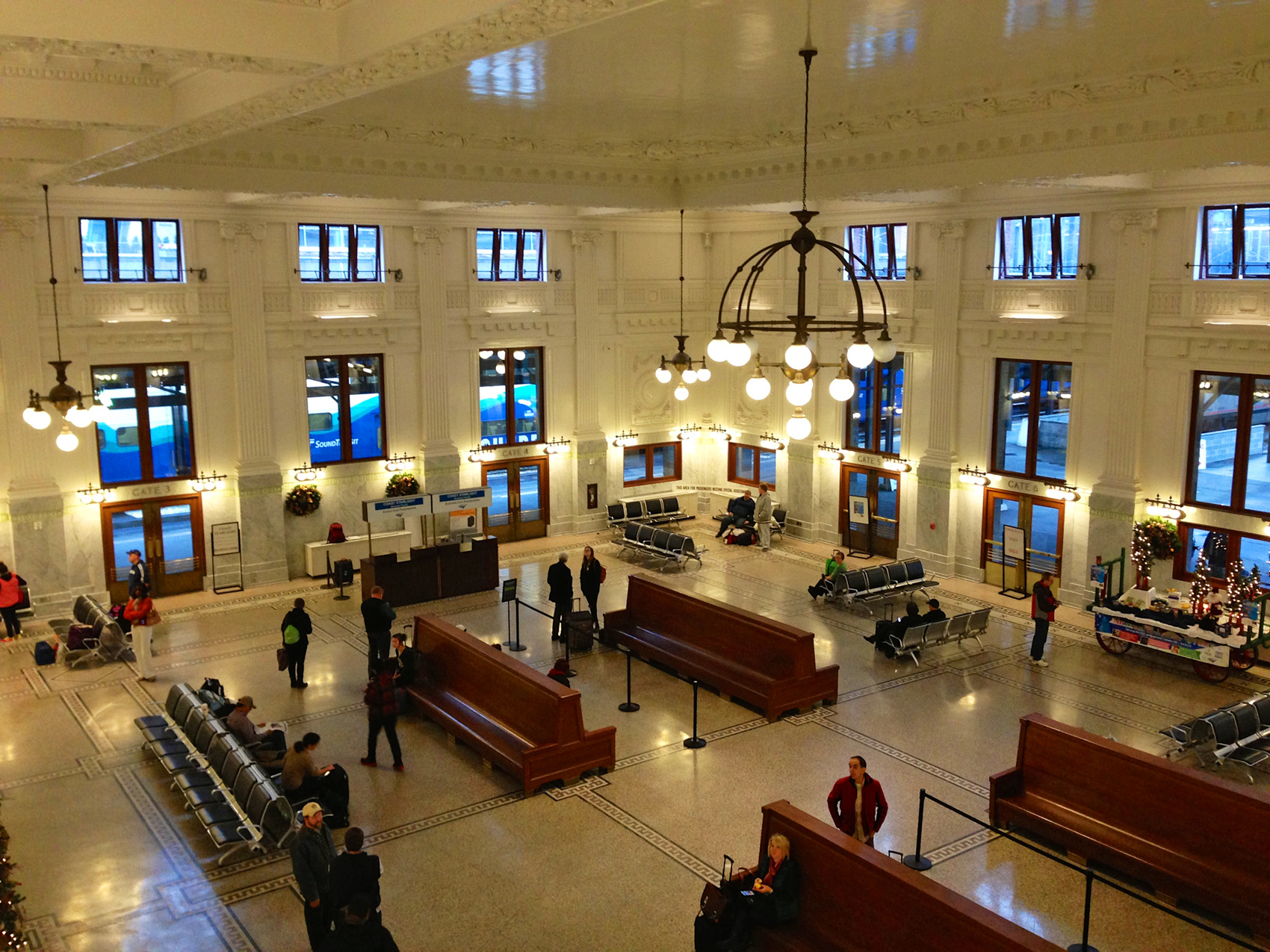 A present-day view of King Street Station's restored main waiting room as it appeared on December 14, 2014. Photo by Wikipedia user, "ZhengZhou."
But as Seattle continued to expand even Hill recognized a prominent terminal would be needed to meet demand.
In 1903 he hired the noted architect firm of Reed & Stem (the partnership of Charles A. Reed and Allen H. Stem) based in St. Paul, Minnesota.
Their most famous commission was New York Central's breathtaking Grand Central Terminal (New York), completed in 1913; other well known terminals included Detroit's Michigan Central Station and Tacoma Union Station.
In addition to growing passenger demand the new terminal allowed GN to move its main line slightly away from the waterfront.
There was also a joint project carried out with Northern Pacific to construct a new freight yard along the former Tide Flats next to Puget Sound. Interestingly, for years the NP/GN offered the only intercity railroad station available to passengers heading to and from Seattle.
However, things finally changed in May of 1911 when what became known as Seattle Union Station opened (originally referred to as the Oregon & Washington Depot), serving the Union Pacific and Chicago, Milwaukee, St. Paul & Pacific (Milwaukee Road).
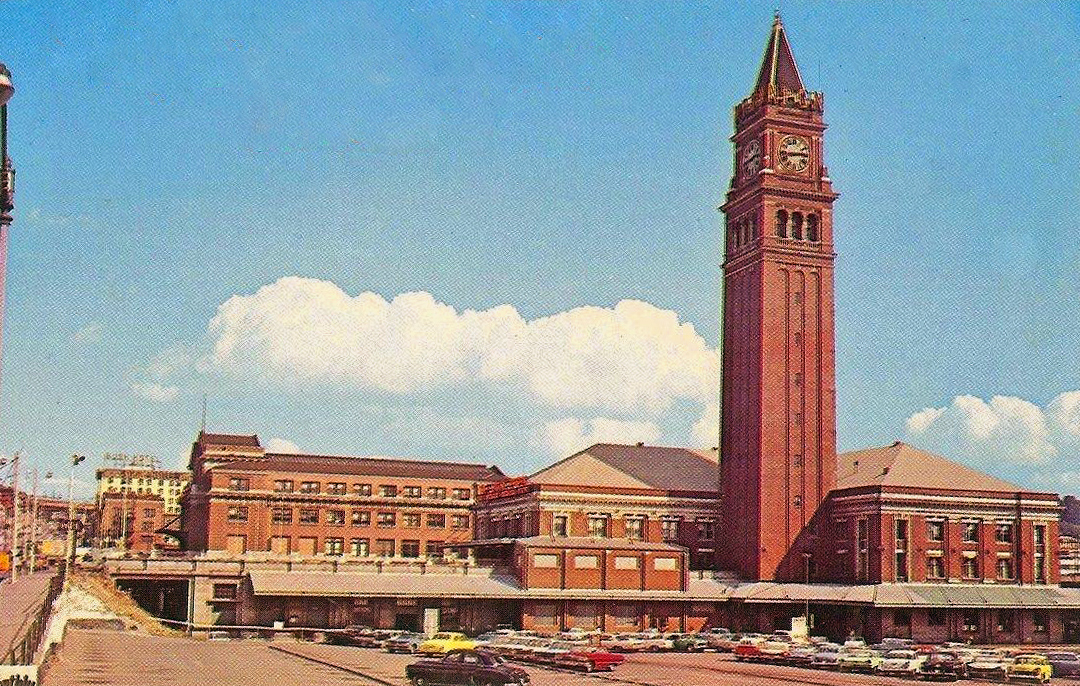
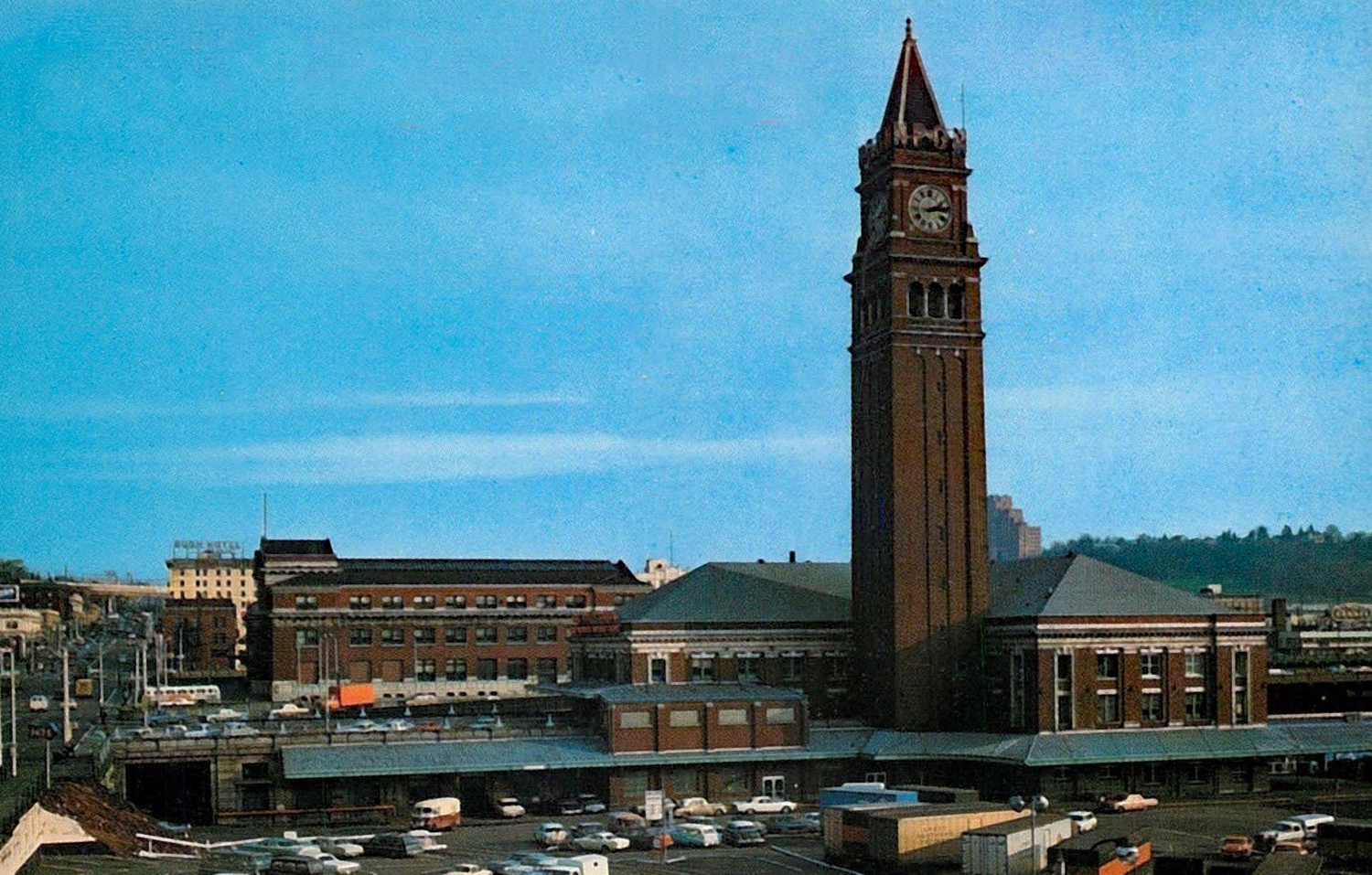
The construction of King Street Station began in 1904; designed in the Beaux Arts style, with Neo-Classical touches, it featured red brick masonry with cut-stone trim and terra cotta decoration.
This architecture dated back to the mid-18th century and employed elements once commonly found in ancient Greece and Italy during the times of Roman rule, carrying on through the Renaissance era.
Its most prominent feature was a magnificent 245-foot clock tower closely modeled after the Campanile di San Marco in Venice, Italy.
Each tower face featured ornate mechanical clocks designed by the E. Howard & Company of Boston, Massachusetts which were lit at night.
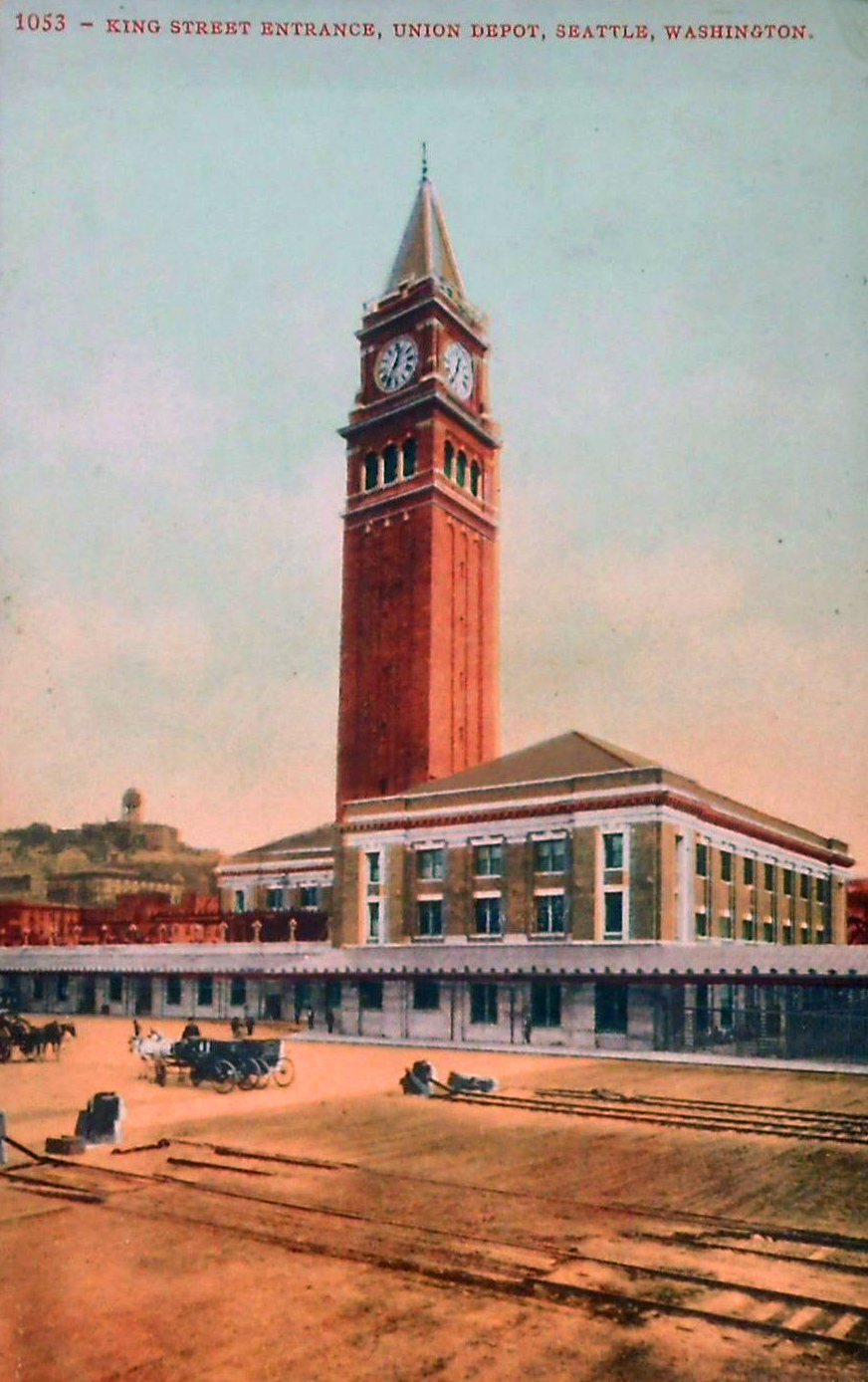
To allow trains to operate through the terminal and eliminate a cumbersome stub-end setup the builders constructed a nearly mile long tunnel (5,245 feet) beneath the city (nearby Union Station lacked this feature).
The building's interior was also impressive with elaborate ceiling designs and marble used throughout (the station also featured a beautiful compass on the entry hall's floor named, appropriately enough, the "Compass Room").
It may seem hard to believe in today's world of towering skyscrapers but King Street Station was once the tallest building in Seattle and the only structure on the West Coast to feature such an impressive time piece at the time.
During the height of rail travel King Street found itself home to several named trains like:
- Northern Pacific's North Coast Limited and Mainstreeter
- Great Northern's Empire Builder, Western Star, International, Oriental Limited, and Cascadian
- Spokane, Portland & Seattle's Columbia River Express
While King Street never lost direct rail service as train travel declined in the 1950s so too did the building's upkeep and general appearance.
By the time Amtrak took over most intercity passenger services on May 1, 1971 much of station's marble had been removed and a bland, unattractive false ceiling covered the original.
Amtrak had no capital available to restore most of the terminals it owned or utilized and many of which, like King Street, had been severely neglected by the 1970s.
In addition, owner Burlington Northern placed microwave dishes on the clock tower further scarring its architectural significance.
After years of this rundown appearance Seattle and BNSF Railway agreed in March of 2008 for the city to acquire the property for a mere $10.
The first process of restoration occurred that same year when the microwave towers were removed and the clocks restored to working condition.
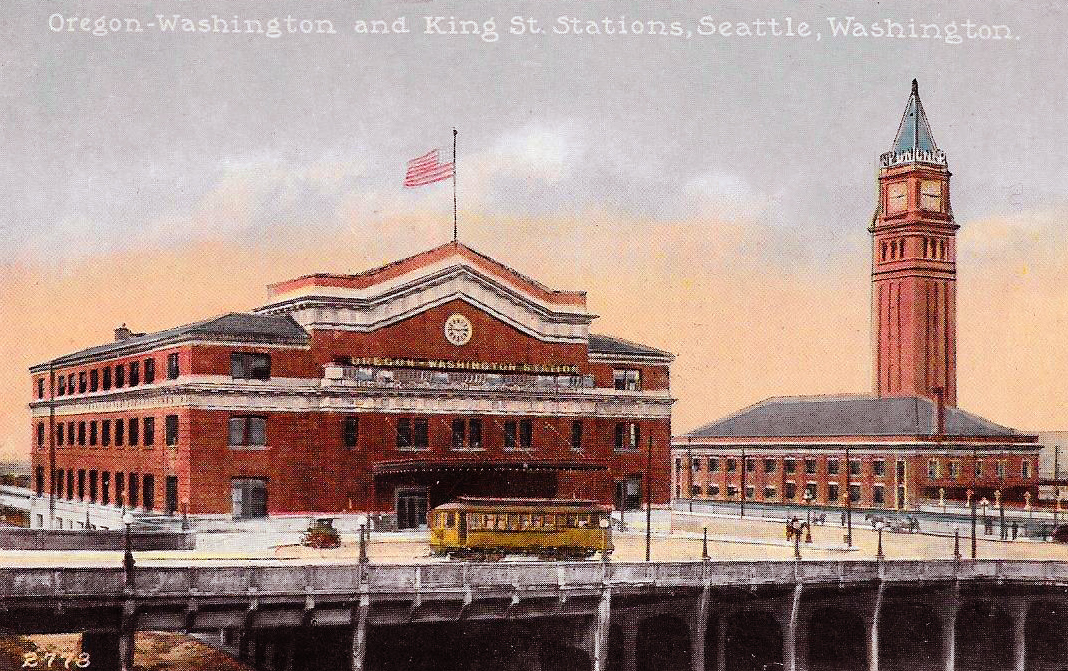
This ownership transfer also paved the way for nearly $30 million in restoration money; between 2010 and 2013 extensive work occurred on the building's interior and exterior to bring it up to modern standards (such as steps to help it survive an earthquake or seismic event, which is not uncommon in the Pacific Northwest) while also preserving as much of the original architecture as possible.
It was officially rededicated on April 24, 2013 and now appears largely as it did when it first opened in 1906. Today, the station is served by Amtrak and Sounder commuter trains, and one can still watch passing container/intermodal and other freight trains of the BNSF Railway.
Even better, King Street Station is now on the National Register of Historic Places, receiving that distinction in 1973, which will help preserve and secure its future.
Recent Articles


-
Wisconsin Railroad Museums (2026): A Complete Guide
Oct 10, 26 11:51 PM
Wisconsin railroad museums—Green Bay’s Big Boy 4017 and Eisenhower’s A4, Mid-Continent at North Freedom, East Troy’s interurban, and the Riverside & Great Northern. Confirm hours on each site. -
Interstate Railroad (Virginia): Map, Roster, Logo, History
Oct 10, 26 11:22 PM
 Interstate Railroad, a Virginia coal road chartered February 18, 1896. Andover shops. Ten Alco RS3s, 30–39. Southern control in 1961. The company ended October 31, 1985.
 -
North Carolina Railroad Museums (2026): A Complete Guide
Oct 10, 26 11:16 PM
 North Carolina railroad museums—Spencer Shops, Wilmington’s Atlantic Coast Line 250, Hamlet’s Seaboard depot, and the New Hope Valley Railway. Confirm hours on each site.
 -
New Mexico Railroad Museums (2026): A Complete Guide
Oct 10, 26 10:54 PM
 New Mexico railroad museums—Santa Fe 2926 in Albuquerque, the Clovis depot, Alamogordo’s Toy Train Depot, and Belen. Confirm hours on each site.
 -
New York Railroad Museums (2026): A Complete Guide
Oct 10, 26 09:33 PM
 New York railroad museums—Phoenicia, Medina’s New York Central freight house, the Transit Museum, Long Island 35 and 39, and GG1 4933. Confirm hours on each site.
 -
Columbia, Newberry & Laurens Railroad: History, Timetable, Roster
Oct 10, 26 09:08 PM
 Columbia, Newberry & Laurens Railroad, Columbia to Laurens, 75 miles. Chartered in 1885. Five Atlantic Coast Line GP7s, 100–104. Merged into the Seaboard System on April 30, 1984.
 -
New Haven Diesel Roster (All-Time)
Oct 10, 26 06:35 PM
 New Haven diesel roster, all-time. 558 road numbers: 60 DL-109s, 30 FA-1s, 27 PA-1s, 60 FL9s, and the switchers from HH600 0900. Serials and order numbers.
 -
New Haven Steam Roster (Post 1900)
Oct 10, 26 06:31 PM
 New Haven steam since 1900. Drury's class grid: 226 Moguls, 33 Mikados, 50 Santa Fes, 70 Mountains, 141 Pacifics, and 10 Hudsons. Last fan trip July 19, 1953.
 -
New Haven Railroad: Rosters, Map, Logo, History, Trains
Oct 10, 26 06:26 PM
 New York, New Haven and Hartford. The Shore Line, Hell Gate, the 1952 map at 1,838.89 miles, and the railroad Penn Central took at 11:59:59 p.m. on December 31, 1968.
 -
C&O's 4-6-4 "Hudson" Locomotives (Class L): Specs, Roster, History
Oct 10, 26 05:36 PM
 Chesapeake & Ohio Class L 4-6-4 Hudsons. Eight L-2s, five L-1 rebuilds, five L-2-As. Specs, Baldwin works numbers, and the roster. No. 490 survives.
 -
Alton Railroad: Map, History, Timetables
Oct 09, 26 10:31 PM
 Alton Railroad, chartered February 27, 1847 as the Alton & Sangamon. Chicago, St. Louis, and Kansas City, the 1937 Official Guide, and the May 31, 1947 merger into the Gulf, Mobile & Ohio.
 -
Mobile & Ohio Steam Roster (Post 1900)
Oct 09, 26 12:26 PM
 Mobile & Ohio steam since 1900. Drury's class grid: 48 six-wheel switchers, 107 Ten-Wheelers, 15 Consolidations, 58 Mikados, and 14 Pacifics. Last revenue steam October 7, 1949.
 -
Mobile & Ohio Railroad: History, Map, Timetable
Oct 09, 26 11:31 AM
 Mobile & Ohio Railroad, chartered in 1848. Columbus on April 22, 1861, the Cairo & St. Louis, the March 1940 Official Guide, and the September 13, 1940 merger into the Gulf, Mobile & Ohio.
 -
Gulf, Mobile & Northern Steam Roster (Post 1900)
Oct 09, 26 10:42 AM
 Gulf, Mobile & Northern steam since 1900. Drury's class grid: Ten-Wheelers, Mikados, Russian Decapods, Pacifics 425 and 426, and three light 4-8-2s. Last revenue steam October 7, 1949.
 -
Gulf, Mobile & Ohio Diesel Roster (All-Time)
Oct 09, 26 10:41 AM
 Gulf, Mobile & Ohio diesel roster, all-time. The 1935 boxcab, DL-107s, 55 FA-1s, F3s and F7s, the Ingalls 4-S, GP30s through GP38-2s, and 21 SD40s. Serials and order numbers.
 -
Gulf, Mobile & Northern Railroad: History, Rebel Route
Oct 09, 26 10:36 AM
 Gulf, Mobile & Northern, from the 1890 Mobile, Jackson & Kansas City to the Rebel and the September 13, 1940 merger into the Gulf, Mobile & Ohio. Steam roster is the companion page.
 -
Gulf, Mobile & Ohio Railroad: Map, Photos, Trains, History
Oct 08, 26 11:48 PM
 Gulf, Mobile & Ohio, chartered in 1938 and merged September 13, 1940. The Mobile & Ohio, the Alton on May 31, 1947, the Rebel Route, and Illinois Central Gulf on August 10, 1972.
 -
New Jersey Railroad Museums (2026): A Complete Guide
Oct 08, 26 11:37 PM
 New Jersey railroad museums—Whippany, Maywood, Pine Creek, Mahwah’s Erie depot, Phillipsburg, and Boonton. Confirm hours on each site.
 -
New Hampshire Railroad Museums (2026): A Complete Guide
Oct 08, 26 11:34 PM
 New Hampshire railroad museums—North Conway, the Flying Yankee, Ashland, Gorham, Raymond, and Sandown. Confirm hours on each site.
 -
Missouri Railroad Museums (2026): A Complete Guide
Oct 08, 26 11:00 PM
 Missouri railroad museums—the National Museum of Transportation, Patee House, Frisco 4524, the Chicago & Alton depot, and Marceline. Confirm hours on each site.
 -
Milwaukee Road X3800: Deer Lodge’s Shop Goat
Oct 08, 26 04:28 PM
 Milwaukee Road X3800, the a home-built shop goat that served the Deer Lodge, MT yard. It was a 220-volt DC switcher, powered through an extension cord that moved electrics into a roundhouse where the…
 -
Key West Extension (Overseas Railroad): History, Construction, Decline
Oct 08, 26 03:59 PM
 Henry Flagler's Overseas Railroad, Miami to Key West, 1905–1935. The Seven Mile Bridge, the 1935 Labor Day Hurricane, and the road that became U.S. 1.
 -
Florida East Coast Steam Roster (Post 1900)
Oct 08, 26 02:34 PM
 Florida East Coast steam since 1897. Seventeen Ten-Wheelers, twenty Atlantics, eighty-seven Pacifics, ninety Mountains, fifteen Mikados, and the switchers.
 -
Florida East Coast Diesel Roster (All-Time)
Oct 08, 26 02:12 PM
 Florida East Coast diesel roster, all-time. E units from 1939, F3s, BL2s, GP7s and GP9s, the GP40-2 orders, 22 SD40-2s, and 24 ES44C4s. Serials and EMD order numbers.
 -
Florida East Coast Railway: Map, History, Rosters
Oct 08, 26 01:46 PM
 Florida East Coast Railway, Henry Flagler's line from Jacksonville to Miami and Key West. Receivership in 1931, the 1963 strike, Grupo México in 2017, and Brightline on the same track.
 -
Minnesota Railroad Museums (2026): A Complete Guide
Oct 08, 26 10:32 AM
Minnesota railroad museums—the Lake Superior Railroad Museum, Two Harbors, Jackson Street, Willmar’s Great Northern 2523, and Currie. Confirm hours on each site. -
Maine Railroad Museums (2026): A Complete Guide
Oct 08, 26 09:24 AM
 Maine railroad museums—Seashore Trolley, the two-foot lines at Portland, Alna, and Phillips, Boothbay, and the Bangor & Aroostook depots. Confirm hours on each site.
 -
Massachusetts Railroad Museums (2026): A Complete Guide
Oct 08, 26 12:08 AM
 Massachusetts railroad museums—Berkshire Scenic at Lenox, Shelburne Falls trolley No. 10, Edaville, Chatham’s 1887 depot, and Lowell. Confirm hours on each site.
 -
Clinchfield Steam Roster (Post 1900)
Oct 07, 26 12:09 PM
 Clinchfield steam since 1900. Fifteen H-4 Consolidations, K-1 Mikados, M-2 and M-3 Mallets, L-class 2-8-8-2s, eighteen Challengers. Class grid after Drury. Last steam April 16, 1954.
 -
Clinchfield Diesel Roster (All-Time)
Oct 07, 26 12:05 PM
 Clinchfield diesel roster, all-time. F3A 800, FP7 200, the F7s, GP7s, 25 SD40s, 18 SD45-2s, seven U36Cs, and the Family Lines hoods. Serials and EMD order numbers.
 -
Clinchfield Railroad: Map, Steam Locomotives, Roster, Logo
Oct 07, 26 12:02 PM
 Clinchfield Railroad, Elkhorn City to Spartanburg. George L. Carter, the Carolina, Clinchfield & Ohio, the 1924 lease, coal, the loops, and CSX. Steam and diesel rosters are companion pages.
 -
Kentucky Railroad Museums (2026): A Complete Guide
Oct 07, 26 11:39 AM
 Kentucky railroad museums—the Kentucky Railway Museum, Bowling Green’s L&N depot, Paducah, Versailles, and Covington. Confirm hours on each site.
 -
Kansas Railroad Museums (2026): A Complete Guide
Oct 07, 26 11:26 AM
 Kansas railroad museums—Santa Fe 3768 at Wichita, Santa Fe 132 in Topeka, the Great Overland Station, and Abilene. Confirm hours on each site.
 -
Cincinnati, New Orleans and Texas Pacific Diesel Roster (All-Time)
Oct 07, 26 10:38 AM
 All-time diesel roster of Southern locomotives lettered for the Cincinnati, New Orleans and Texas Pacific. Serials, order numbers, and builder dates.
 -
Cincinnati, New Orleans and Texas Pacific Railway
Oct 07, 26 10:31 AM
 Cincinnati, New Orleans and Texas Pacific Railway, incorporated September 8, 1881, to lease Cincinnati’s railroad to Chattanooga. Queen and Crescent route, Rathole, and the 2024 sale to Norfolk Southe…
 -
Indiana Railroad Museums (2026): A Complete Guide
Oct 07, 26 12:26 AM
Indiana railroad museums—Nickel Plate 765, Elkhart’s New York Central collection, French Lick, Linden’s junction depot, and Haley Tower. Confirm hours on each site. -
"Triplex" Steam Locomotive: Specs, History, Photos
Oct 06, 26 11:52 PM
 Erie class P-1 Triplex 2-8-8-8-2s. Three Baldwin compounds, 2603–2605, later 5014–5016, built 1914 and 1916. Matt H. Shay, the 1930 class card, and Virginian XA 700.
 -
Illinois Railroad Museums (2026): A Complete Guide
Oct 06, 26 11:47 PM
 Illinois railroad museums—the Illinois Railway Museum, Monticello, the Pioneer Zephyr, Galesburg’s Burlington 3006, and the depots. Confirm hours on each site.
 -
Iowa Railroad Museums (2026): A Complete Guide
Oct 06, 26 11:41 PM
 Iowa railroad museums—the Union Pacific Railroad Museum, RailsWest, Sioux City, Boone, and the National Hobo Museum in Britt. Confirm hours on each site.
 -
Charleston and Western Carolina Diesel Roster (All-Time)
Oct 06, 26 11:29 PM
Charleston and Western Carolina diesel roster. Twenty-one GP7s, two SW7s, two SW9s, and six F7As, all built 1950–1952. Serials, order numbers, and ACL and SCL numbers. -
Charleston and Western Carolina Railway: Map, History, Timetables
Oct 06, 26 11:18 PM
 Charleston and Western Carolina Railway, incorporated September 16, 1896. Port Royal to Spartanburg, with branches to Anderson and Greenville. Merged into the Atlantic Coast Line on December 31, 1959.
 -
Central of Georgia Steam Roster (Post 1900)
Oct 06, 26 04:00 PM
 Central of Georgia steam since 1900. Cooke Consolidations, Harriman Mikados, 32 Mountains, and eight Lima 4-8-4s. Class grid after Drury. Last steam May 1953.
 -
Central of Georgia Diesel Roster (All-Time)
Oct 06, 26 03:44 PM
 Central of Georgia diesel roster. SW1 No. 1 in 1939, E7s and E8s, nine F3As, 39 RS3s, GP7s through SD35s. Serials and order numbers.
 -
Central of Georgia Railway: Map, Logo, History, Rosters
Oct 06, 26 03:42 PM
 Central of Georgia Railway, from the 1833 Savannah charter to Southern control on June 17, 1963. Map, logos, Nancy Hanks II, and links to the steam and diesel rosters.
 -
Georgia Railroad Museums (2026): A Complete Guide
Oct 06, 26 03:33 PM
Georgia railroad museums—Savannah’s Central shops, Duluth, the General at Kennesaw, the Texas in Atlanta, Tifton, Waycross, and Albany. Confirm hours on each site. -
Florida Railroad Museums (2026): A Complete Guide
Oct 06, 26 03:18 PM
 Florida railroad museums—Boca Raton, Winter Garden, Whitehall, the Gold Coast, Parrish, Fort Myers, Milton, and Plant City. Confirm hours on each site.
 -
Connecticut Railroad Museums (2026): A Complete Guide
Oct 06, 26 01:05 PM
 Connecticut railroad museums—the Shore Line Trolley, East Windsor, the Naugatuck Railroad, Danbury Union Station, Willimantic, and the SoNo tower. Confirm hours on each site.
 -
Colorado Railroad Museums (2026): A Complete Guide
Oct 06, 26 12:47 PM
 Colorado railroad museums—Golden, the Forney’s Big Boy 4005, Pueblo’s Santa Fe 2912, and the depots at Castle Rock, Limon, and Ridgway. Confirm hours on each site.
 -
Atlantic Coast Line Steam Roster (Post 1900)
Oct 06, 26 12:44 PM
 Atlantic Coast Line steam since 1900. Copper Head Ten-Wheelers, 235 P-5 Pacifics, Q-1 Santa Fes, twelve R-1 4-8-4s. Class grid after Drury. Last steam June 30, 1955.
 -
Atlantic Coast Line Diesel Roster (All-Time)
Oct 06, 26 11:57 AM
 Atlantic Coast Line diesel roster. HH660 1900 in 1939, E3s for the Champion, FTs and F2s, GP7s 100–279, GP30s, U25Cs, and the 1967 SCL numbers. Serials and orders.