Lehigh and New England Railroad: Map, Rosters, History
Last revised: September 21, 2026
By: Adam Burns
The Lehigh & New England was the anthracite road that quit while it was still paying dividends. Reporting mark LNE. Headquarters Philadelphia, 1421 Chestnut Street, in the Lehigh Coal & Navigation house. Shops and the operating headquarters sat at Pen Argyl, Pennsylvania. George H. Drury put it parallel to the Lehigh & Hudson River: eastern Pennsylvania coal and cement to the New Haven at Campbell Hall and the Poughkeepsie Bridge. It never reached Boston or Harrisburg, the towns on the 1873 charter. It ran about 200 miles of jumble—Tamaqua, Bath, Bethlehem, Pen Argyl, Campbell Hall—and it was still a going company on October 31, 1961, the day the board shut it down.
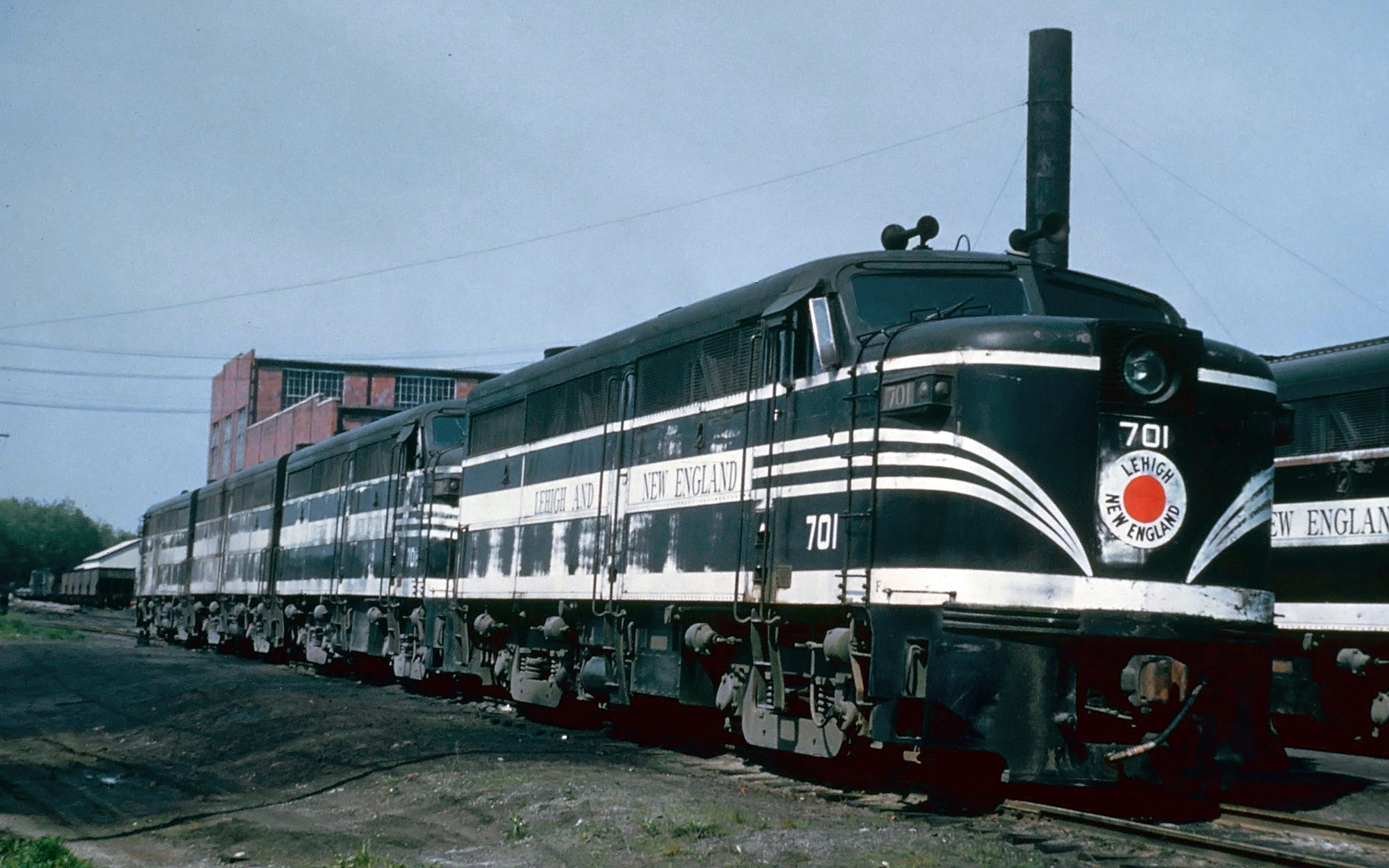
Lehigh & New England FA-1s at the engine house and shops in Pen Argyl, Pennsylvania, May 1961. American-Rails.com collection. Five months from the last day.
On this page: At a glance · South Mountain & Boston · April 2, 1895 · System map, 1940 · Coal, cement, Maybrook · Last Camelbacks and four Decapods · Whitcomb 601 and thirty-two Alcos · October 31, 1961 · The CNJ Railway · What remains
At a glance
| Item | Detail |
|---|---|
| Railroad | Lehigh & New England Railroad. Mark LNE. Controlled by Lehigh Coal & Navigation |
| Headquarters | Philadelphia (1421 Chestnut Street). Operating headquarters and shops: Pen Argyl, Pa. |
| Genesis | South Mountain & Boston Railroad, chartered March 13, 1873 |
| Named | April 2, 1895, after the Pennsylvania, Poughkeepsie & Boston receivership |
| Dates | April 2, 1895–October 31, 1961. Ancestors from 1873 |
| States | Pennsylvania, New Jersey, New York |
| Route-miles | 219 (1930). 177 (1950) |
| Gauge | 4 ft 8½ in |
| Principal lines | Campbell Hall, N.Y.–Pen Argyl–Tamaqua–Nesquehoning, Pa. Benders Junction–Allentown/Bethlehem. Clyde–Catasauqua. Bath–Martins Creek. Lansford–Summit Hill. Glenwood Junction–Empire Quarries, N.Y. |
| Last passenger | 1938. Most of the railroad never listed passenger service in the Official Guide |
| Dieselized | Complete by the end of 1949. Whitcomb 601 in 1947; 32 Alcos |
| Ended | Voluntary shutdown October 31, 1961, still profitable. Dividends from 1913 |
| After | CNJ Lehigh & New England Railway (~34 miles, $10 million). Lehigh Valley from January 1975. Conrail April 1, 1976 |
Steam classes follow Drury, Guide to North American Steam Locomotives, revised edition, p. 196. Diesel serials follow Extra 2200 South / The Diesel Shop. Information compiled September 21, 2026.
Boston, Harrisburg, and the Panic of 1873
If the first map had been built, three companies would have run Boston to Harrisburg by way of Poughkeepsie and the north tip of New Jersey. The piece that became the L&NE was the South Mountain & Boston, chartered March 13, 1873, Portland, Pennsylvania, on the Delaware to Boston Corners, New York, near the southwest corner of Massachusetts. South Mountain Railroad would have taken Harrisburg. Massachusetts Central would have taken Boston. Grading started. The Panic of 1873 stopped it. That was as close as the Boston–Harrisburg idea ever came.
What followed was a name chain and not much track: Pennsylvania, Poughkeepsie & New England (1879); Pennsylvania & New England (1880); Delaware & Slatington (1881); Pennsylvania, Slatington & New England (1882–87); Pennsylvania, Poughkeepsie & Boston (1887–95). The Poughkeepsie Bridge opened January 1, 1889, on the Central New England, later the New Haven. The bridge made a New England door for small Pennsylvania roads. The company that finally used it under this name was organized April 2, 1895, out of the PP&B receivership.
Slatington to Pine Island, then 200 miles
At birth the L&NE ran Slatington, Pennsylvania, to Pine Island, New York. No Boston. No Harrisburg. Allentown and Bethlehem were the large towns. Anthracite in the Panther Creek and Nesquehoning country paid the bills. Lehigh Coal & Navigation owned the railroad and sat it in Philadelphia. On June 4, 1926, the Reading tried to lease it. Other roads objected. The ICC said no, and preferred a New Haven lease that never happened. The L&NE stayed LC&N’s.
At its peak the map was a little over 200 miles: Tamaqua and the Reading at the west; Benders Junction south into Allentown, Bethlehem, Bath, and Martins Creek; northeast to Campbell Hall and Maybrook. Campbell Hall was the New York, Ontario & Western. The Erie was at Goshen and Pine Island. Other doors: NYS&W at Hainesburg and Swartswood; Pennsylvania at Martins Creek; Lehigh Valley at Stockertown, Catasauqua, and Lizard Creek Junction; Lackawanna at Portland and Bath Junction; Jersey Central at Bethlehem and Hauto/Nesquehoning; Chestnut Ridge at Palmerton. The “main line” was a set of branches with freight aimed at Bethlehem/Allentown, Tamaqua, and Maybrook.
System map, 1940
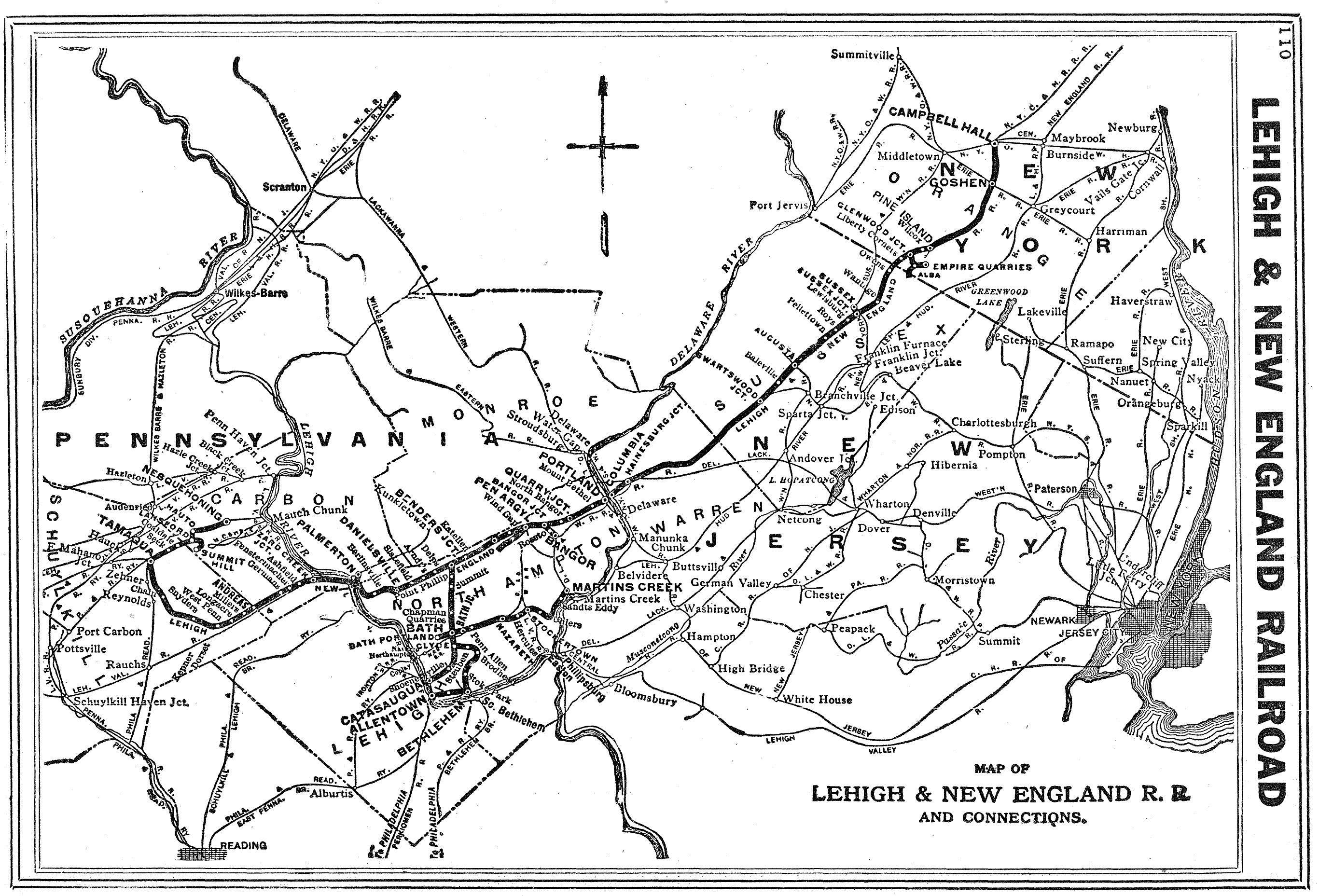
An official 1940 system map of the Lehigh & New England Railroad. Author’s collection. Tamaqua at the west, Pen Argyl in the middle, Campbell Hall at the northeast.
Forty-eight percent coal
Unlike the L&HR, the L&NE had mines and mills on the railroad. J. W. Swanberg, writing about Maybrook in 1953, put anthracite at 48 percent of annual carloads, cement at 28 percent, general freight 25 percent. That year about 31,000 cars went through Maybrook. Cement came off the Bath branches. Slate and stone sat in the Pen Argyl country. A 2.74 percent grade between Bath and Summit, Pennsylvania, is why the railroad bought four of the heaviest 2-10-0s in the country.
Passenger service was never the point. Drury: as early as 1930 it was local trains on ten miles at the Pennsylvania end and a single train in New York. The Official Guide said of most of the line, “Passenger service not established.” Three short runs survived into the gas-electric era: Tamaqua–Summit Hill–Hauto, Swartswood–Sussex–Goshen, Bethlehem–Pen Argyl. Two Brill cars, 90–91, came in 1927–30. All passenger service ended in 1938.
The Lehigh & New England Railroad logo. Author’s work.
Last Camelbacks in the United States
Early power was anthracite practice: Wootten fireboxes, Camelbacks, hard coal. The latter-day steam roster, Drury, was two 0-6-0s and nineteen 0-8-0s, thirteen of those Camelbacks. Three of the Camelbacks—0-8-0s 120–122, Baldwin 1927—were the last Camelbacks built in the United States. Conventional-cab 0-8-0s 131–136, Baldwin 1927 and 1931, kept the Wootten boxes and added trailing trucks large enough to justify the extra axle. The two 0-6-0s were late. Number 206, 1931, still had slide valves. Number 207 was odd enough for the 1938 Locomotive Cyclopedia.
Road freight was Camelback 2-8-0s, then Alco Schenectady 2-8-0s 301–307 of 1922: 61-inch drivers, 27-by-32-inch cylinders, 233,000 pounds, fireboxes as wide as the Wootten boxes on the older engines. The statement engines were Decapods 401–404, Baldwin 1927–31: about 400,000 pounds, tender booster, 106,200 pounds tractive effort—more than a USRA 2-8-2 working compound—61-inch drivers, 30-by-32 cylinders. Drury called them the most powerful 2-10-0s built. During World War II the railroad bought four Pennsylvania L1 2-8-2s, Juniata 1915, and numbered them 501–504. Last steam was 2-8-2 503, ex-PRR 1719. Dieselization was complete by the end of 1949.
| Type | Class | Numbers | Qty | Builder | Built | Retired | Notes |
|---|---|---|---|---|---|---|---|
| 0-6-0 | B-4 | 206 | 1 | Baldwin | 1931 | Slide valves | |
| 0-6-0 | B-5 | 207 | 1 | Baldwin | 1926 | Locomotive Cyclopedia 1938 | |
| 0-8-0 | I-1 | 101 | 1 | Baldwin | 1913 | Camelback | |
| 0-8-0 | I-2 | 111–115 | 5 | Baldwin | 1913 | Camelback | |
| 0-8-0 | I-3 | 116–119 | 4 | Baldwin | 1915 | Camelback | |
| 0-8-0 | I-4 | 120–122 | 3 | Baldwin | 1927 | Last Camelbacks built in the U.S. | |
| 0-8-0 | I-5 | 131–136 | 6 | Baldwin | 1927, 1931 | Wootten; large trailing trucks | |
| 2-8-0 | E-8 | 25, 27 | 2 | Baldwin | 1906 | 1927–1931 | Camelback |
| 2-8-0 | E-9 | 29 | 1 | Baldwin | 1909 | Camelback | |
| 2-8-0 | E-12 | 151, 152 | 2 | Baldwin | 1911 | Camelback | |
| 2-8-0 | E-13 | 153, 154 | 2 | Baldwin | 1915 | Camelback | |
| 2-8-0 | E-14 | 301–307 | 7 | Schenectady | 1922 | 61-inch drivers; 233,000 lb | |
| 2-8-2 | G-1 | 501–504 | 4 | Juniata | 1915 | Ex-PRR L1. 503 last steam | |
| 2-10-0 | F-1 | 401–404 | 4 | Baldwin | 1927–1931 | Most powerful 2-10-0s; Bath–Summit grade |
George H. Drury, Guide to North American Steam Locomotives, revised edition, p. 196. I-1 date follows builder records (January 1913). Dieselization complete by the end of 1949. Switchers 120–122, H. L. Broadbelt collection in Drury, were the last Camelbacks Baldwin built for service in North America.
A Whitcomb, then nothing but Alco
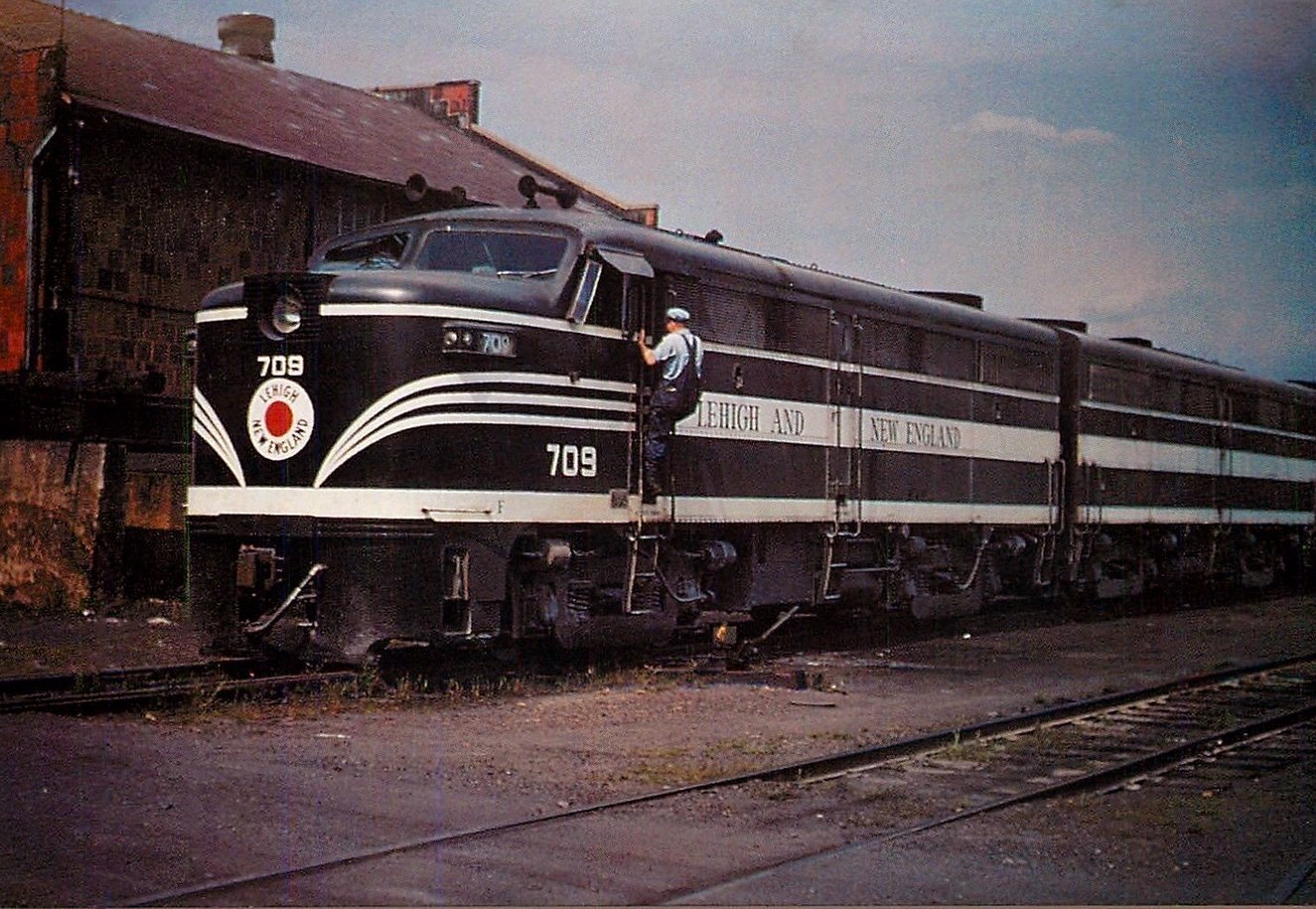
Lehigh & New England FA-1 #709 leaving the engine house at Pen Argyl, Pennsylvania, August 22, 1953. Joe Stark photo. Black with white pinstriping.
The first diesel was a war-surplus Whitcomb, 601, a 65DE19a, serial 60458, built June 1944 as U.S. Army 8452, Military Railway Service 1362, on the property in 1947. Then Alco filled the railroad: six S-2s 611–616, thirteen RS-2s 651–663, ten FA-1s 701–710, three FB-1s 751–753. Thirty-two Alcos by the end of 1949. Classic Trains put the predicted annual saving at $850,000. The paint was black with white pinstriping, later a slightly simplified stripe on repaints. After the shutdown, Louisville & Nashville took most of the FAs, FBs, S-2s, and several RS-2s. Raymond International took other RS-2s overseas.
S-2 611, serial 76174, September 1948, is the last L&NE diesel. It switched Ford, then a grain elevator in Emporia, Indiana. The Lehigh & New England group bought it in 2015–16 and moved it to Topton, Pennsylvania. As of 2025 the Railroad & Industrial Preservation Society is restoring it, traction motors out in October 2025, with the Allentown & Auburn at Kutztown the intended operating home. It is not in L&NE paint yet.
| Number | Model | Serial | Order | Built | Notes |
|---|---|---|---|---|---|
| 601 | Whitcomb 65DE19a | 60458 | 6/1944 | Ex-MRS 1362, nee USA 8452. On L&NE 1947. Panther Valley Coal | |
| 611 | S-2 | 76174 | 20226 | 9/1948 | Ford 10013; TLE&W; Emporia Grain; ADM. Last survivor. RIPS restoration |
| 612 | S-2 | 76612 | 3/1949 | L&N 2370; Naparano | |
| 613 | S-2 | 76613 | 3/1949 | L&N 2371; Precision National | |
| 614 | S-2 | 77127 | 9/1949 | L&N 2372; EMD trade-in 4/1971 | |
| 615 | S-2 | 77128 | 9/1949 | L&N 2373; Chrome Crankshaft | |
| 616 | S-2 | 77129 | 9/1949 | L&N 2374; GE trade-in | |
| 651 | RS-2 | 76647 | 4/1949 | Raymond International 1501, 9/1961; scrapped | |
| 652 | RS-2 | 77536 | 20269 | 10/1949 | L&N 265 (1st), 1963; GE trade-in |
| 653 | RS-2 | 77537 | 20269 | 10/1949 | Raymond 1502; Altos Hornos de Mexico 128 |
| 654 | RS-2 | 77556 | 11/1949 | L&N 266; GE trade-in | |
| 655 | RS-2 | 77557 | 11/1949 | L&N 267; GE trade-in | |
| 656 | RS-2 | 77857 | 11/1949 | L&N 268; GE trade-in | |
| 657 | RS-2 | 77858 | 11/1949 | Raymond 1503; scrapped | |
| 658 | RS-2 | 77867 | 12/1949 | L&N 269; GE trade-in | |
| 659 | RS-2 | 77868 | 20445 | 12/1949 | Raymond 1504; scrapped |
| 660 | RS-2 | 77873 | 20445 | 12/1949 | Raymond 1505; Bauxite & Northern 14; Point Comfort & Northern 9 |
| 661 | RS-2 | 77874 | 20445 | 12/1949 | L&N 270; GE trade-in |
| 662 | RS-2 | 77875 | 20445 | 12/1949 | L&N 271; GE trade-in |
| 663 | RS-2 | 77876 | 20445 | 12/1949 | Raymond 1506; Altos Hornos de Mexico 129 |
| 701 | FA-1 | 75739 | 20225 | 4/1948 | L&N 332; Alco trade-in |
| 702 | FA-1 | 75740 | 20225 | 4/1948 | L&N 333 (1st); EMD trade-in |
| 703 | FA-1 | 75983 | 6/1948 | L&N 334; EMD trade-in | |
| 704 | FA-1 | 75984 | 6/1948 | L&N 335; Alco trade-in | |
| 705 | FA-1 | 75985 | 20225 | 6/1948 | L&N 336; Alco trade-in |
| 706 | FA-1 | 75986 | 6/1948 | L&N 337; GE trade-in | |
| 707 | FA-1 | 76258 | 20284 | 10/1948 | L&N 338; Alco trade-in |
| 708 | FA-1 | 76259 | 20284 | 10/1948 | L&N 339; Alco trade-in |
| 709 | FA-1 | 76260 | 20284 | 10/1948 | L&N 340; GE trade-in. Photo: Pen Argyl, Aug. 22, 1953 |
| 710 | FA-1 | 76840 | 4/1949 | L&N 341 | |
| 751 | FB-1 | 76285 | 10/1948 | L&N with the FA fleet | |
| 752 | FB-1 | 76286 | 10/1948 | L&N with the FA fleet | |
| 753 | FB-1 | 76873 | 4/1949 | L&N with the FA fleet |
Serials and dates follow The Diesel Shop (John Komanesky; Extra 2200 South) and the Alco FA-1/FB-1 production roster. Order numbers from railroad picture archives where listed. Thirty-three new units: one Whitcomb, thirty-two Alcos. A second Whitcomb, 602, was not an original L&NE engine.

A pair of Lehigh & New England FA-1s and an FB-1 with hoppers on the bridge at Lehigh Gap, Pennsylvania, 1961. The bridge is gone.
Still paying, then gone
Dividends had run since 1913. After the war, on-line agriculture, LCL, some quarry traffic, and much of the anthracite fell away. By 1961 the main saw about one coal train a week, often Thursday. The board looked at a region already thick with railroads, a fuel that was dying, and a Maybrook gateway the New Haven still owned—and voted to stop. The ICC let a profitable railroad abandon. Last trains ran in October. Track came up the next year. The Delaware and Lehigh River bridges were down by 1969. As Classic Trains notes, the last crews were still working for a going company.
It looked shrewd a decade later. Penn Central took the New Haven in 1969 and starved Maybrook. The Poughkeepsie Bridge burned May 8, 1974.
Thirty-four miles for the Jersey Central
CNJ, with an ICC-guaranteed loan, paid about $10 million for the pieces that still had cement and a Tamaqua connection: Tadmor Yard at Bath, the Bethlehem Branch, the Martins Creek Branch, Catasauqua, and the former Panther Creek Railroad to Tamaqua so Greenwood Breaker could still reach the Reading. Walter Kraus, in the Allentown Morning Call of August 24, 1989, dates the sale to the October 31 shutdown. CNJ formed the Lehigh & New England Railway to run it. Erie Lackawanna took a bit of track near Pen Argyl. CNJ put GP7s, RS-3s, and an RSD-4 on the cement district. Those engines are the Jersey Central diesel page, not this roster.
The Railway lasted into January 1975, then the Lehigh Valley ran it until Conrail on April 1, 1976. Conrail had no use for a second Lehigh Valley. Most of what CNJ had saved went out with the Jersey Central.
What remains
Norfolk Southern still works cement country that was L&NE around Bath and the Lehigh Valley. The rest is grade, a missing bridge at Lehigh Gap, and S-2 611 in a shop at Topton. The railroad of April 2, 1895, ended October 31, 1961, on purpose. The Camelbacks of 1927 were already the last ones Baldwin built. The Alcos went to Kentucky and Liberia. The name on a CNJ subsidiary was a courtesy to the cement mills, not a second life.
Related reading on American-Rails.com
- Lehigh & Hudson River · L&NE timetables, January 1930 · Poughkeepsie Bridge
- New Haven · Central New England · Jersey Central · Lehigh Valley
- Reading · Erie · Lackawanna · Conrail
- Camelbacks · Alco FA · RS-2 · S-2
Sources
- Drury, George H. Guide to North American Steam Locomotives. Revised ed. Waukesha: Kalmbach, p. 196. Post-1900 class table; last Camelbacks 120–122; I-5 Wootten 0-8-0s; E-14 Schenectady 2-8-0s; PRR L1 2-8-2s; Decapods 401–404; passenger 1938; dieselization 1949. Anthracite Railroads Historical Society; Railroad magazine March 1933 p. 94, November 1946 p. 114
- Classic Trains. Lehigh & New England feature, June 2009. Dividends from 1913; Whitcomb 1947; 32 Alcos by end of 1949; $850,000 saving; last steam 503; CNJ 34 miles and covered hoppers; EL near Pen Argyl; last trains October 1961
- Swanberg, J. W. “Maybrook, New York: One Yard, Six Railroads, Cars By The Thousands.” 1953 traffic: coal 48 percent, cement 28, general 25; ~31,000 Maybrook carloads
- Kraus, Walter. “Real Demise Of Rail Line Trailed Coal’s Decline.” The Morning Call (Allentown), August 24, 1989. CNJ $10 million; Tadmor, Bethlehem, Martins Creek, Catasauqua, Panther Creek
- The Diesel Shop. John Komanesky, Lehigh & New England all-time roster. Extra 2200 South. Whitcomb 601; S-2 611–616; RS-2 651–663; FA-1/FB-1 serials as in the Alco FA-1 production roster (710 is 76840, April 1949; FB 751–752 76285–76286, 753 76873)
- Railroad & Industrial Preservation Society, riptrack.org. S-2 611 restoration, Topton / Kutztown, traction motors October 31, 2025
- Live American-Rails Lehigh & Hudson River, Poughkeepsie Bridge, New Haven, Jersey Central, Lehigh Valley, Reading, Erie, Lackawanna, Conrail, Camelback, and Alco FA / RS-2 / S-2 pages as linked above
Recent Articles


-
North Dakota Scenic Train Rides (2026): A Complete Guide
Oct 02, 26 01:14 PM
 North Dakota has no tourist railroad on a 2026 calendar. Ride Amtrak’s daily Empire Builder. The Fort Lincoln Trolley in Mandan is not a current ticket.
 -
Nebraska Scenic Train Rides (2026): A Complete Guide
Oct 02, 26 10:11 AM
 Nebraska has no full-size scenic railroad in 2026. The Omaha Zoo Railroad runs weekends through October 4. Ride Amtrak’s California Zephyr across the state.
 -
Missouri Scenic Train Rides (2026): A Complete Guide
Oct 02, 26 09:56 AM
 Missouri tourist trains in 2026—Branson Scenic Railway and the St. Louis, Iron Mountain & Southern at Jackson. Belton has no 2026 schedule posted.
 -
Minnesota Scenic Train Rides (2026): A Complete Guide
Oct 02, 26 09:52 AM
 Minnesota tourist trains in 2026—North Shore Scenic Railroad in Duluth, the Duluth River Train, and the Como-Harriet streetcar.
 -
Kansas Scenic Train Rides (2026): A Complete Guide
Oct 02, 26 09:32 AM
 Kansas tourist trains in 2026—the Abilene & Smoky Valley Railroad. Santa Fe 3415 is in overhaul. Midland Railway at Baldwin City is closed.
 -
Iowa Scenic Train Rides (2026): A Complete Guide
Oct 02, 26 08:41 AM
 Iowa tourist trains in 2026—Boone & Scenic Valley across the Bass Point Creek High Bridge, and Midwest Central’s December North Pole trains
 -
Indiana Scenic Train Rides (2026): A Complete Guide
Oct 02, 26 08:35 AM
 Indiana tourist trains in 2026—French Lick Scenic Railway, Nickel Plate Express, Hoosier Valley, and Hesston. Whitewater Valley is suspended.
 -
Illinois Scenic Train Rides (2026): A Complete Guide
Oct 02, 26 12:28 AM
 Illinois tourist trains in 2026—Illinois Railway Museum, Monticello Railway Museum, Fox River Trolley, and Silver Creek & Stephenson.
 -
Texas Scenic Train Rides (2026): A Complete Guide
Oct 02, 26 12:14 AM
 Texas tourist trains in 2026—Texas State Railroad, Grapevine Vintage Railroad, Austin Steam Train's Hill Country Flyer, and the Galveston Railroad Museum.
 -
Tennessee Scenic Train Rides (2026): A Complete Guide
Oct 02, 26 12:03 AM
Tennessee tourist trains in 2026—Tennessee Valley Railroad Museum, Dollywood Express, Three Rivers Rambler Christmas trains, and the Tennessee Central Railway Museum. -
South Carolina Scenic Train Rides (2026): A Complete Guide
Oct 01, 26 11:52 PM
 South Carolina's tourist train is the South Carolina Railroad Museum in Winnsboro—Blue Granite Express, pumpkin trains, and Santa trains on the old Rockton & Rion.
 -
Mississippi Scenic Train Rides (2026): A Complete Guide
Oct 01, 26 11:38 PM
 Mississippi has no regular tourist railroad in 2026. Ride Amtrak through the state, or book the excursion lines in Alabama, Tennessee, Louisiana, or Arkansas.
 -
Louisiana Scenic Train Rides (2026): A Complete Guide
Oct 01, 26 02:52 PM
 Louisiana has no regular full-size tourist railroad in 2026. New Orleans Polar Express returns December 11–31. Museums at Long Leaf, DeQuincy, and Jackson.
 -
Kentucky Scenic Train Rides (2026): A Complete Guide
Oct 01, 26 02:45 PM
 Kentucky tourist trains in 2026—Big South Fork Scenic Railway, Bluegrass Scenic Railroad, Kentucky Railway Museum, and My Old Kentucky Dinner Train.
 -
Georgia Scenic Train Rides (2026): A Complete Guide
Oct 01, 26 02:27 PM
 Georgia tourist trains in 2026—Blue Ridge Scenic Railway, SAM Shortline, Azalea Sprinter, Savannah shop rides, and what to confirm at Stone Mountain.
 -
Arkansas Scenic Train Rides (2026): A Complete Guide
Oct 01, 26 01:02 PM
 Arkansas tourist trains in 2026—Arkansas & Missouri through the Boston Mountains, and the Eureka Springs & North Arkansas dinner and excursion trains.
 -
Alabama Scenic Train Rides (2026): A Complete Guide
Oct 01, 26 12:59 PM
Alabama tourist trains in 2026—Heart of Dixie Railroad Museum at Calera, North Alabama Railroad Museum at Chase, and the Wales West Light Railway at Silverhill. -
The Circus Train: How Such Attractions Reached Distant Cities
Oct 01, 26 12:22 PM
 How circuses moved by rail: Coup's 1872 flats, the Ringling train's sections and car counts, the 1918 Hammond wreck, and the last show on May 21, 2017.
 -
West Virginia Halloween Train Rides (2026)
Oct 01, 26 12:19 PM
 2026 West Virginia Halloween train. Cass Scenic Halloween Train, October 30 and 31, steam, 5:00 p.m. from Cass Depot. Adult $75. About two hours to Whittaker. Family ride.
 -
Wisconsin Halloween Train Rides (2026)
Oct 01, 26 12:11 PM
2026 Wisconsin Halloween trains. Mid-Continent Pumpkin Special October 24–25, adult $24, pumpkins extra. Halloween Flyer October 24 at 4:30 p.m., adult $30. Osceola Pumpkin Express boards in Osceola… -
Utah Halloween Train Rides (2026)
Oct 01, 26 12:00 PM
 2026 Utah Halloween trains at Heber Valley Railroad. Pumpkin Train, about 40 minutes, with a cookie and a pumpkin. Halloween Express, about 90 minutes to Grim Hollow, Monday, Thursday, and Friday even…
 -
Texas Halloween Train Rides (2026)
Oct 01, 26 11:28 AM
 2026 Texas Halloween train. Texas State Railroad Spooky Special, adult-only, October 24. Boards Palestine at 5:00 p.m. About five hours to Rusk and back. Dinner on the grounds. Not steam. No fare on t…
 -
Tennessee Halloween Train Rides (2026)
Oct 01, 26 12:15 AM
 2026 Tennessee Halloween trains. Tennessee Valley Railroad Museum Rails, Wizards & Spells, selected days September 18 through October 25, from $35, about 2.5 hours. Spells & Potions tea from $60. The…
 -
Frisco's "Firefly" (Train): Consist, Route, Timetable
Sep 30, 26 11:37 PM
 Frisco Firefly—daylight streamliner, Kansas City to Tulsa and Oklahoma City. Trains 117 and 118. Pacifics 1018, 1026, and 1031. Last run May 22, 1960.
 -
South Carolina Halloween Train Rides (2026)
Sep 30, 26 11:29 PM
 2026 South Carolina Halloween train. South Carolina Railroad Museum Pumpkin Patch Express, the two Saturdays before Halloween. About three miles to the Greenbriar pavilion. Pumpkin for children 12 and…
 -
Oregon Halloween Train Rides (2026)
Sep 30, 26 08:10 PM
2026 Oregon Halloween train. Sumpter Valley Railroad Halloween Express at the Sumpter Depot, calendar window October 31 at 11:00 a.m. through November 1 at 12:30 p.m. Fare and the individual clocks ar… -
Oklahoma Halloween Train Rides (2026)
Sep 30, 26 03:45 PM
2026 Oklahoma Halloween train. Oklahoma Railway Museum, October 30 and 31, from Oakwood Station in Oklahoma City. Adults $15, children 3–12 $8. A candy bag with the ride. -
McCloud River Railroad: Serving The Timber Industry (1897-2009)
Sep 30, 26 03:37 PM
 McCloud River Railroad—Mount Shasta City to McCloud, Hambone, and Burney. Opened August 1, 1897. Alco No. 25 and EMD SD38s. Dinner train through January 2010. Railbikes in 2026; a dinner train is stil…
 -
Nevada Halloween Train Rides (2026)
Sep 30, 26 03:30 PM
2026 Nevada Halloween trains in Ely. Nevada Northern Pumpkin Patch Caper and Haunted Ghost Train. Adult tickets start at $45. Dates are on the railroad’s ticket calendar. Boulder City stays off until… -
Missouri Halloween Train Rides (2026)
Sep 30, 26 11:12 AM
 2026 Missouri Halloween trains. St. Louis Iron Mountain & Southern Pumpkin Patch Train on October 3, 4, 10, and 11, and Halloween Express on October 31 at 1:00 p.m. Jackson depot. No fare on the sched…
 -
Minnesota Halloween Train Rides (2026)
Sep 30, 26 11:06 AM
 2026 Minnesota Halloween trains. North Shore Scenic Great Pumpkin Train in Duluth, October 15–18. Everyone gets a pumpkin. Terror Train is October 30, an adult costume party, about three hours. Fares…
 -
Maryland Halloween Train Rides (2026)
Sep 30, 26 10:42 AM
 2026 Maryland Halloween trains. Western Maryland Scenic Pumpkin Patch Limited, October 17, 18, 24, and 25, $14. Colesville Trolleyween October 24, 25, and 31.
 -
West Side Lumber Company Railroad: Roster, History, Lines
Sep 30, 26 09:45 AM
 West Side Lumber at Tuolumne, California. Three-foot Shay and Heisler logging railroad. Lima shop numbers, builder specs, and where the engines are in 2026.
 -
Kansas Halloween Train Rides (2026)
Sep 30, 26 09:41 AM
 2026 Kansas Halloween train. Abilene & Smoky Valley Pumpkin Harvest Express, October 17 through 31. About one hour. Shop prices $35.56 to $41.02. Everyone picks a pumpkin.
 -
Iowa Halloween Train Rides (2026)
Sep 29, 26 11:58 PM
 2026 Iowa Halloween train. Boone & Scenic Valley Pumpkin Express, October 10, 10:00 a.m. from 225 10th Street. About 1 hour 15 minutes. Children pick a pumpkin.
 -
Arizona Halloween Train Rides (2026)
Sep 29, 26 11:43 PM
 2026 Arizona Halloween train. Grand Canyon Railway Pumpkin Patch Train from Williams, $39 with a pumpkin included. Select October dates on the ticket calendar. Haunted train cars are optional.
 -
Nevada Northern Halloween Trains (2026)
Sep 29, 26 06:18 PM
Nevada Northern 2026 Halloween trains in Ely. Pumpkin Patch Caper to Keystone Gulch and the Haunted Ghost Train. Adult tickets start at $45. Dates are on the railroad’s calendar. Confirm on nnry.com. -
Grand Canyon Railway Pumpkin Patch Train (2026)
Sep 29, 26 02:42 PM
 Grand Canyon Railway Pumpkin Patch Train—select October 2026 dates from Williams, $39 with a pumpkin included. Haunted train cars are optional. Days are on the ticket calendar. Confirm on thetrain.com…
 -
Cass Scenic Railroad Halloween Trains (2026)
Sep 29, 26 02:37 PM
 Cass Scenic Halloween Trains—October 30 and 31, 2026, steam, 5:00 p.m. from Cass Depot. About two hours to Whittaker. Adult $75. Candy for every child. Confirm on mountainrailwv.com.
 -
Halloween Train Rides (2026): Pumpkin Patch, Haunted & Spooky Trips
Sep 29, 26 11:26 AM
 2026 Halloween train rides in nine checked states. Conway Scenic Halloween Express October 24–25. Strasburg’s three fall tickets. Great Smoky Mountains Railroad’s October trains are the gorge and rive…
 -
Maine Halloween Train Rides (2026)
Sep 29, 26 11:08 AM
 2026 Maine Halloween trains. Seashore Pumpkin Patch Trolley through October 18, adult $17. Happy Trolleyween October 23–25 at $15. WW&F Pumpkin Pickin’ October 3, 12, 17, and 24. Downeast’s booking it…
 -
Kentucky Halloween Train Rides (2026)
Sep 29, 26 10:58 AM
 2026 Kentucky Halloween trains. Kentucky Railway Museum Trick and Track Express, October 24 and 31, from $17. Bluegrass Scenic pumpkin trains in Versailles. Confirm on the ticket shop.
 -
Connecticut Halloween Train Rides (2026)
Sep 29, 26 10:26 AM
 2026 Connecticut Halloween trains. East Windsor Pumpkin Patch Fridays through Sundays, October 2–31. Naugatuck coach $20. Shore Line Pumpkin Patch on nine October days. Confirm on each site.
 -
Pennsylvania Halloween Train Rides (2026)
Sep 29, 26 09:45 AM
 2026 Pennsylvania Halloween trains—Everett October 3, 4, 10, and 17, Strasburg’s three fall shows, Oil Creek on October 24, plus Kutztown, Kempton, Honesdale, Middletown, and West Chester.
 -
New York Halloween Train Rides (2026)
Sep 29, 26 12:08 AM
2026 New York Halloween trains—Catskill Pumpkin Express October 17–18 and 24–25, Adirondack pumpkin and family trains, Arcade & Attica haunt, Cooperstown patch and trick-or-treat, Tupper Lake triv… -
North Carolina Halloween Train Rides (2026)
Sep 28, 26 11:56 PM
 2026 North Carolina Halloween trains—New Hope Valley Track or Treat on October 10, 17, 23, and 24, and Tweetsie Ghost Train Friday and Saturday nights through October 31. GSMR’s October menu is the go…
 -
Tweetsie Railroad Ghost Train Halloween Festival (2026)
Sep 28, 26 11:44 PM
Tweetsie Ghost Train—Friday and Saturday nights September 25–October 31, 2026, in Blowing Rock. Adult $65, child $45. One reserved steam ride plus the park. Ages 8 and up for the haunt. -
Milwaukee Road Class A 4-4-2: Specs, Roster, History
Sep 28, 26 11:20 PM
 Milwaukee Road Class A Atlantics 1–4, Alco 1935–1937, for the Hiawatha. Order S-1740, 84-inch drivers, 19x28, 300 psi, 30,685 lb. Full builder specs, roster, and the May 15, 1935 run at 112.5 mph. All…
 -
Strasburg Rail Road Halloween Trains (2026)
Sep 28, 26 11:00 PM
 Strasburg’s 2026 Halloween tickets—Pumpkins in Paradise on October 3, The Haunting of Pumpkin Junction, and The Brakeman’s Curse through October 25. Three fares. Legacy of Sleepy Hollow is an earlier…
 -
GSMR Peanuts Pumpkin Train (2026): Not on This Year’s Ticket Menu
Sep 28, 26 10:50 PM
Great Smoky Mountains Railroad’s September 28, 2026 ticket menu lists Nantahala and Tuckasegee excursions. A Peanuts Great Pumpkin train is not on that menu. Polar Express is on the November calendar.