Lake Shore & Michigan Southern: Map, History, Timetables
Last revised: September 10, 2026
By: Adam Burns
The Lake Shore & Michigan Southern Railway was New York Central’s water-level path from Buffalo to Chicago: Dunkirk, Erie, Ashtabula, Cleveland, Toledo, Elkhart, South Bend. It was assembled on April 6, 1869, from the Lake Shore Railway and the Michigan Southern & Northern Indiana, then took the Buffalo & Erie on June 22. The oldest piece is the Erie & Kalamazoo, chartered April 22, 1833, horse cars Toledo–Adrian on November 2, 1836. Vanderbilt money was on the board from 1869 and held majority control by about 1877. On December 22, 1914, the Lake Shore merged with the New York Central & Hudson River to form the second New York Central Railroad. The name disappeared. The grade did not.
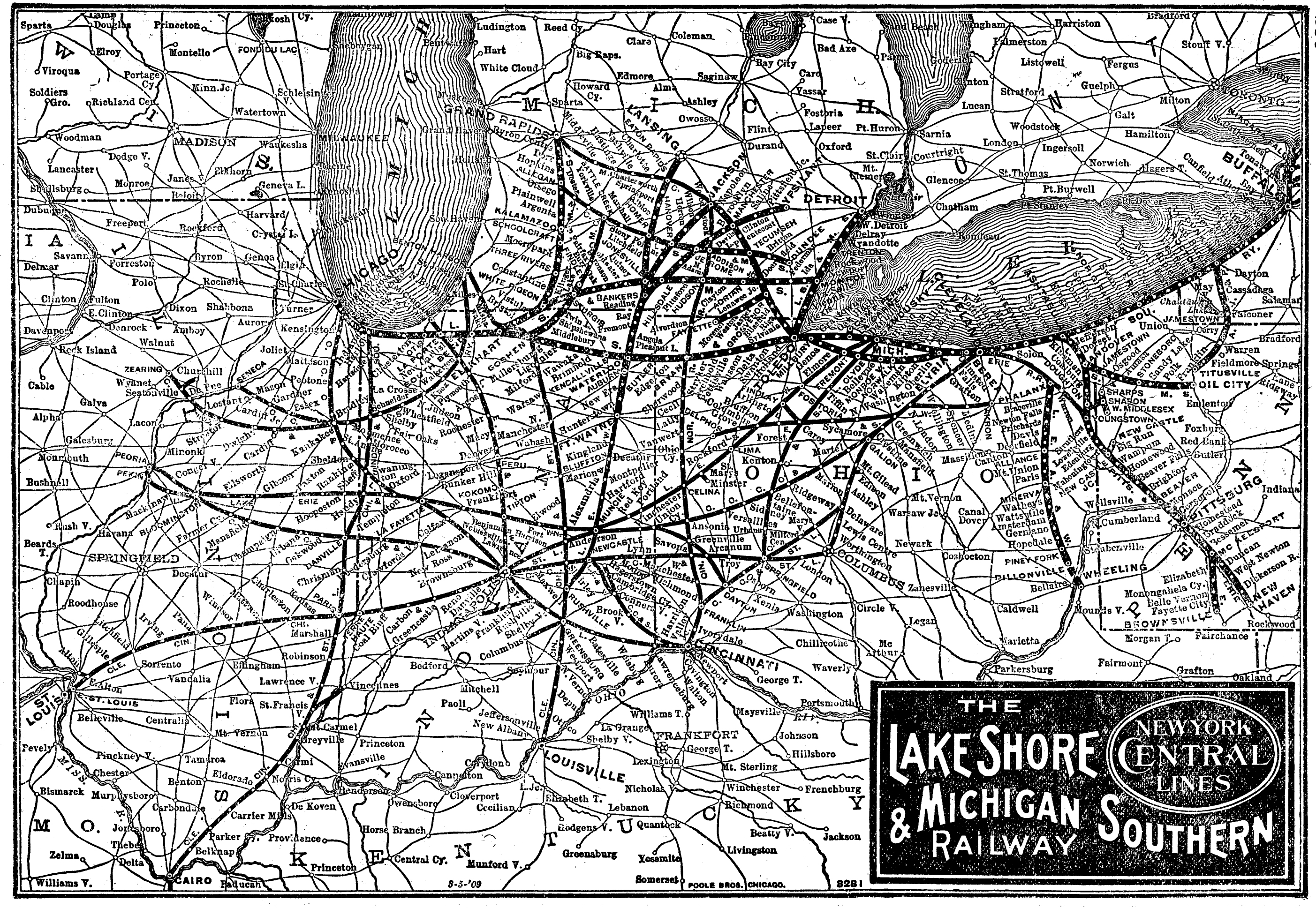
Lake Shore & Michigan Southern system map, 1910. Buffalo at the right, Chicago at the left, the lake shore in between. American-Rails.com collection.
On this page: At a glance · Erie & Kalamazoo · Michigan Southern · Lake Shore Railway · April 6, 1869 · Vanderbilt · Fast Mail and Ashtabula · Elkhart and Collinwood · December 22, 1914 · 1910 Official Guide · What still runs
At a glance
| Item | Detail |
|---|---|
| Legal name | Lake Shore and Michigan Southern Railway Company |
| Nickname | The Lake Shore |
| Headquarters | Cleveland, Ohio |
| States served | New York, Pennsylvania, Ohio, Michigan, Indiana, Illinois |
| Genesis | Erie & Kalamazoo Railroad, chartered April 22, 1833. Horse cars Port Lawrence (Toledo)–Adrian, November 2, 1836. Steam locomotive Adrian No. 1, August 1837 |
| Michigan Southern to Chicago | 1852. Joint LaSalle Street terminal with the Rock Island |
| LS&MS formed | April 6, 1869 (Lake Shore Railway + Michigan Southern & Northern Indiana). Buffalo & Erie, June 22, 1869 |
| Route miles | About 1,667 operated (ICC valuation). About 1,700 with branches in later compilations |
| Track gauge | 4 ft 8½ in (after the Ohio / Pennsylvania gauge fights of the 1850s) |
| Main line | Buffalo–Dunkirk–Erie–Ashtabula–Cleveland–Toledo–Elkhart–South Bend–Chicago. Sandusky Division (Elyria–Millbury) became the through freight main north of Sandusky Bay |
| NYC control | Board presence from 1869. Majority stock about 1877 |
| Into NYC | Merged December 22, 1914, with the New York Central & Hudson River. Unlike Michigan Central and the Big Four, the Lake Shore did not remain a leased shell |
| Successor | New York Central (1914). Penn Central 1968. Conrail 1976. CSX east of Cleveland and Norfolk Southern west of Cleveland after June 1, 1999 |
Dates follow the 1869 consolidations, the 1910 Official Guide map and tables on this page, and the 1914 NYC merger. Information compiled September 10, 2026.
Erie & Kalamazoo, 1833
Michigan Territory chartered the Erie & Kalamazoo on April 22, 1833, to run from Port Lawrence—today Toledo—northwest to Adrian on the River Raisin, then toward Kalamazoo. The Toledo War put about a third of the grade in Ohio. Horse cars started on November 2, 1836. That is the first railroad to operate in what became the state of Michigan. Steam arrived in August 1837 with the locomotive Adrian No. 1. The Detroit & St. Joseph, the other Michigan seed, is Michigan Central.
Michigan Southern to Chicago
The state of Michigan built a Southern Railroad across the lower tier toward New Buffalo on Lake Michigan, as it built a Central toward Detroit. Construction stalled at Hillsdale. Private capital took the Southern a few years after the 1846 Central sale, combined it with the Erie & Kalamazoo, and pushed west to meet the Northern Indiana Railroad. Monroe to South Bend opened in 1851. Chicago followed in 1852, using a joint terminal with the Chicago, Rock Island & Pacific at LaSalle Street. In 1855 the Michigan Southern, the Erie & Kalamazoo, and the Northern Indiana became the Michigan Southern & Northern Indiana. An Elkhart–Toledo route was finished the same stretch. Elkhart shops dated from 1851 on Mason Street.
Two Toledo–Elkhart alignments lived on the later map. The Old Road ran north through southern Michigan. The Air Line, or Northern Indiana Air Line, was the through freight cut across northern Indiana. Both were Lake Shore property after 1869.
The Lake Shore Railway
East of Toledo the problem was gauge. Ohio and Pennsylvania did not agree, and a through Buffalo–Cleveland–Toledo car was not a given in the early 1850s. The Cleveland, Painesville & Ashtabula—already nicknamed the Lake Shore—opened Cleveland–Erie in 1852. New York Central interests tied up the Buffalo & State Line and the Erie & Northeast; those became the Buffalo & Erie in 1867. In October 1867 the CP&A leased the Cleveland & Toledo. On March 31, 1868, it took the name Lake Shore Railway. On February 11, 1869, it absorbed the Cleveland & Toledo outright.
April 6, 1869
LeGrand Lockwood of the Lake Shore and Elijah B. Phillips of the Michigan Southern & Northern Indiana put the two companies together on April 6, 1869 (some later filings treat a June 2 consolidation agreement as the operating date). Phillips became the first president. Horace Clark and other Vanderbilt men were already on the board. The Buffalo & Erie came in on June 22. One company then owned Buffalo to Chicago along the lake: Dunkirk, Erie, Ashtabula, Cleveland, Toledo, Waterloo, South Bend.
An alternate Ohio line, the Sandusky Division, ran north of the original main between Elyria and Millbury. Not all of that track was in until 1872. In later NYC years it became the through freight main, leaving the older alignment south of Sandusky Bay as secondary. Branches included the Monroe Branch, Adrian to Monroe, connecting with the leased Detroit, Monroe & Toledo; the Kalamazoo, Allegan & Grand Rapids, leased 1868, White Pigeon toward Grand Rapids by March 1869; and later feeders toward Oil City and the coal country that the Central wanted in Pennsylvania.
Vanderbilt’s Chicago extension
Cornelius Vanderbilt had been buying Michigan Southern stock in early 1869 to keep Jay Gould and the Erie from taking the Chicago end. Majority control of the finished Lake Shore is usually dated about 1877—the year he died, January 4, and the year William H. Vanderbilt finished the job. The Commodore’s biography stays on the New York Central page. The Lake Shore fact is that Buffalo–Chicago along the water became the western half of the Water Level Route. Canada Southern (1876) and Michigan Central (1878) were the Ontario and Detroit alternative, not a duplicate of this grade.
Fast Mail, Angola, Ashtabula
The Railway Post Office Fast Mail, New York Central to Buffalo and Lake Shore the rest of the way, made its first New York–Chicago trip on September 16, 1875. About a day. Congress cut the original extra-fast appropriation in July 1876. The 1875 lithograph on the 1870s page is that train.
The Michigan Southern had already shown what a wooden coach and a stove did at Angola, New York, on December 18, 1867. That wreck is the Angola Horror. Nine years later the Lake Shore’s Pacific Express dropped through Amasa Stone’s iron Howe truss over the Ashtabula River on December 29, 1876. Cars burned. About ninety people died. Vanderbilt died five days later. The disaster is Ashtabula, not a footnote to the estate.
Elkhart, Collinwood, Ashtabula
Elkhart remained the western shop town. The Mason Street plant employed about 1,500 at its peak. Cleveland’s Collinwood yard and shops, northeast of downtown, opened a new facility in 1874. In 1901 the railroad spent $2 million on more Collinwood ground; by the 1920s more than 2,000 people worked there, one of the Central’s biggest terminals. Ashtabula opened a freight-car shop in 1913 for ore and coal cars at the port. After dieselization that work folded into Collinwood.
December 22, 1914
On December 22, 1914, the New York Central & Hudson River and the Lake Shore & Michigan Southern merged as the New York Central Railroad. The ICC valuation treats the accounts as running through December 31. Boston & Albany, Michigan Central, and the Big Four were left out of that combination; the Lake Shore was not. After 1914 the Buffalo–Chicago lake line was simply the Central’s Chicago Line. Equipment no longer needed LS&MS lettering. The 1910 Official Guide on this page is the company still listing itself.
1910 Official Guide
The plates below are the Lake Shore’s 1910 Official Guide listing: map, through trains, and the Buffalo–Chicago tables. They are why this page keeps the word timetables in the title. Named trains of the later Central—Lake Shore Limited, the 20th Century Limited on this grade—have their own pages. Amtrak’s present Lake Shore Limited is the 2026 guide.
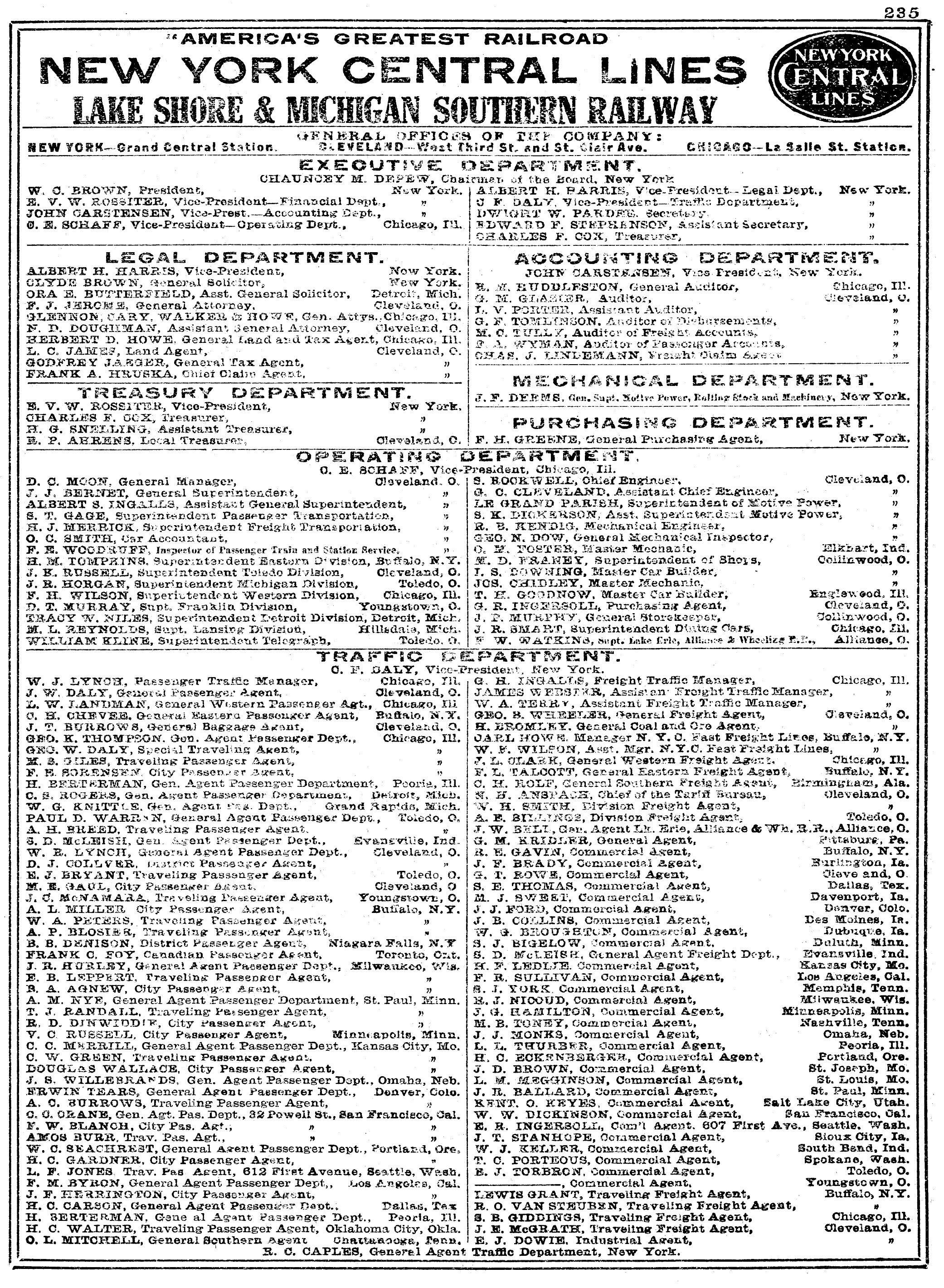
Lake Shore & Michigan Southern, Official Guide, 1910. American-Rails.com collection.
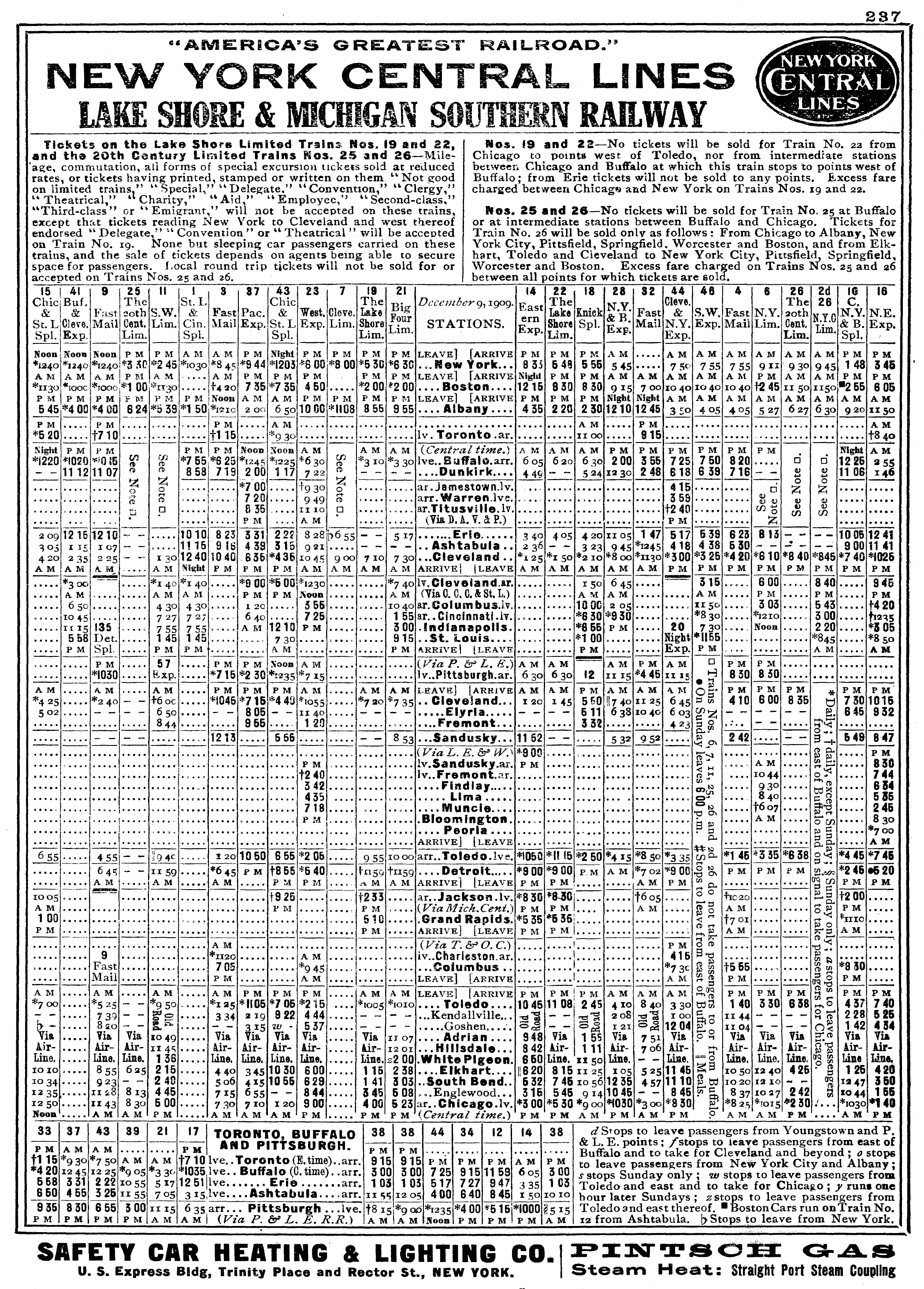
Lake Shore & Michigan Southern, Official Guide, 1910. American-Rails.com collection.
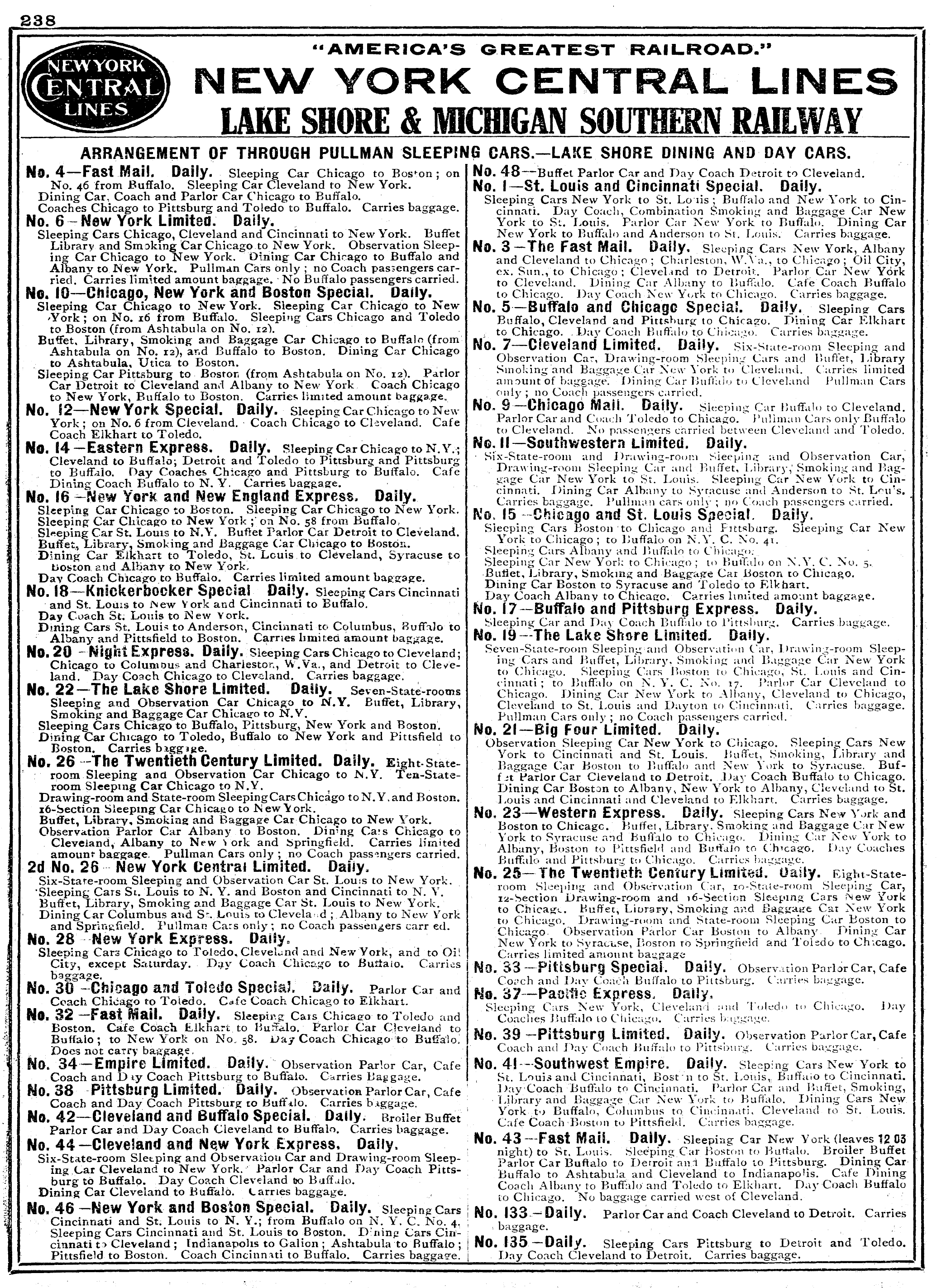
Lake Shore & Michigan Southern, Official Guide, 1910. American-Rails.com collection.
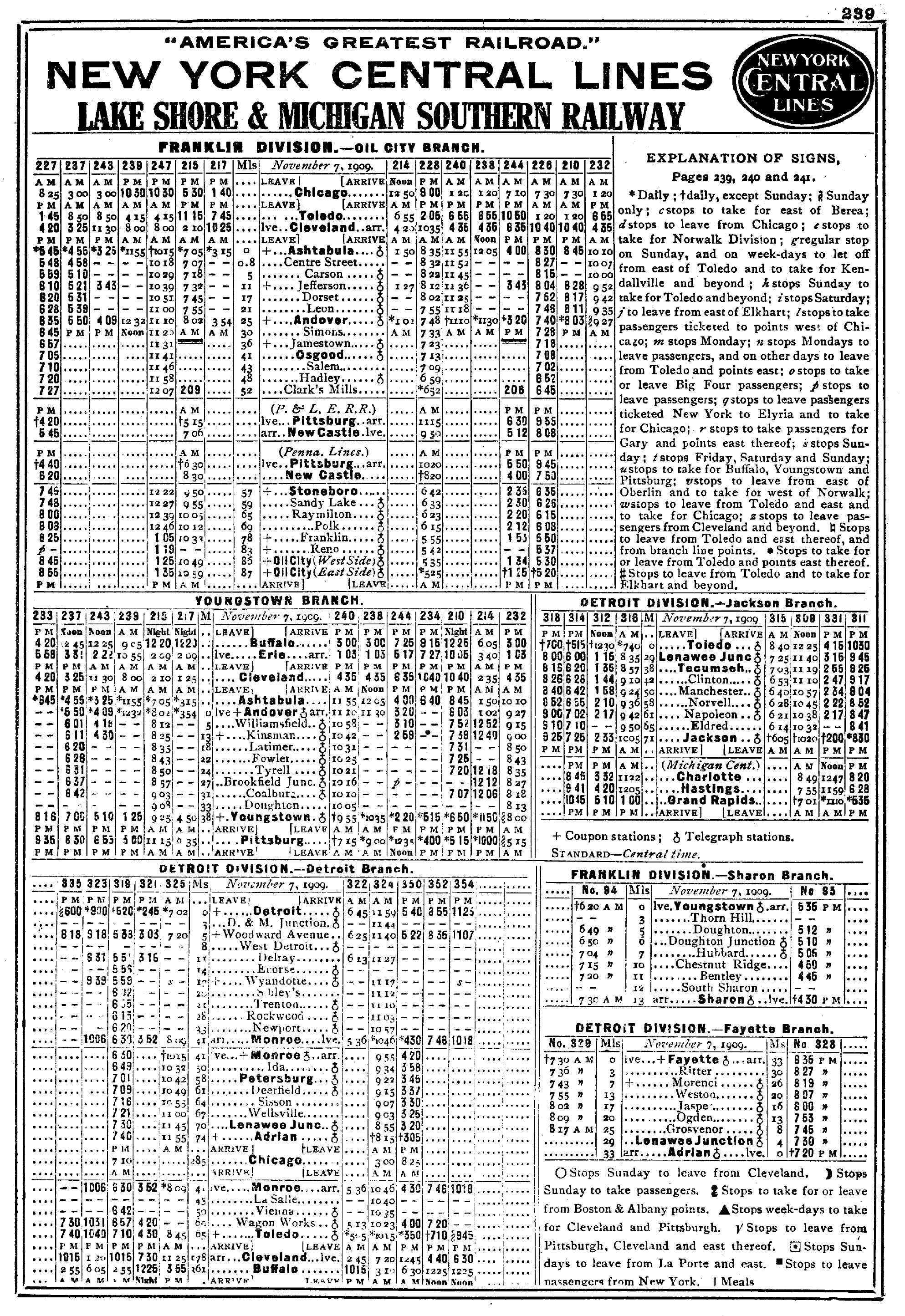
Lake Shore & Michigan Southern, Official Guide, 1910. American-Rails.com collection.
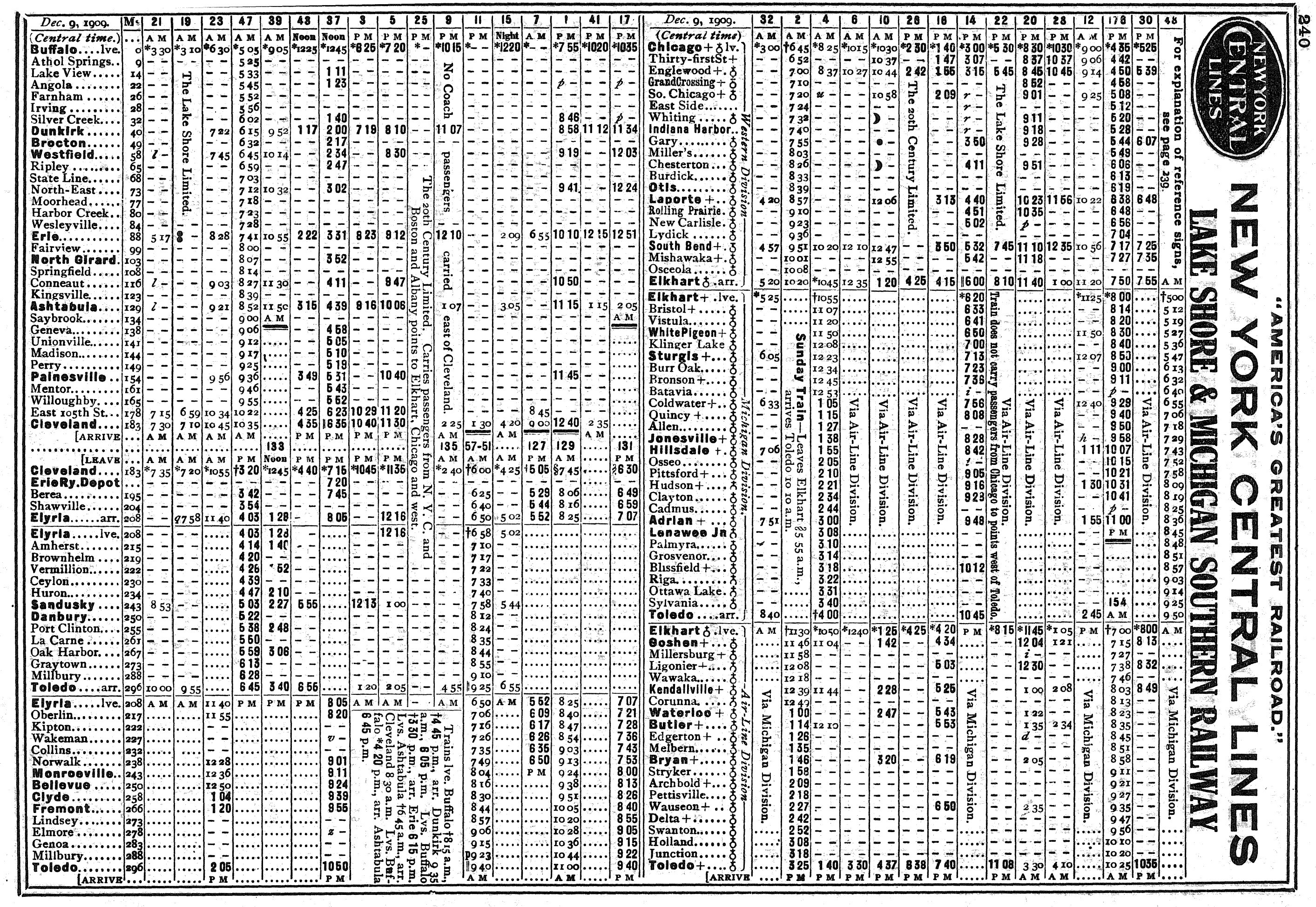
Lake Shore & Michigan Southern, Official Guide, 1910. American-Rails.com collection.
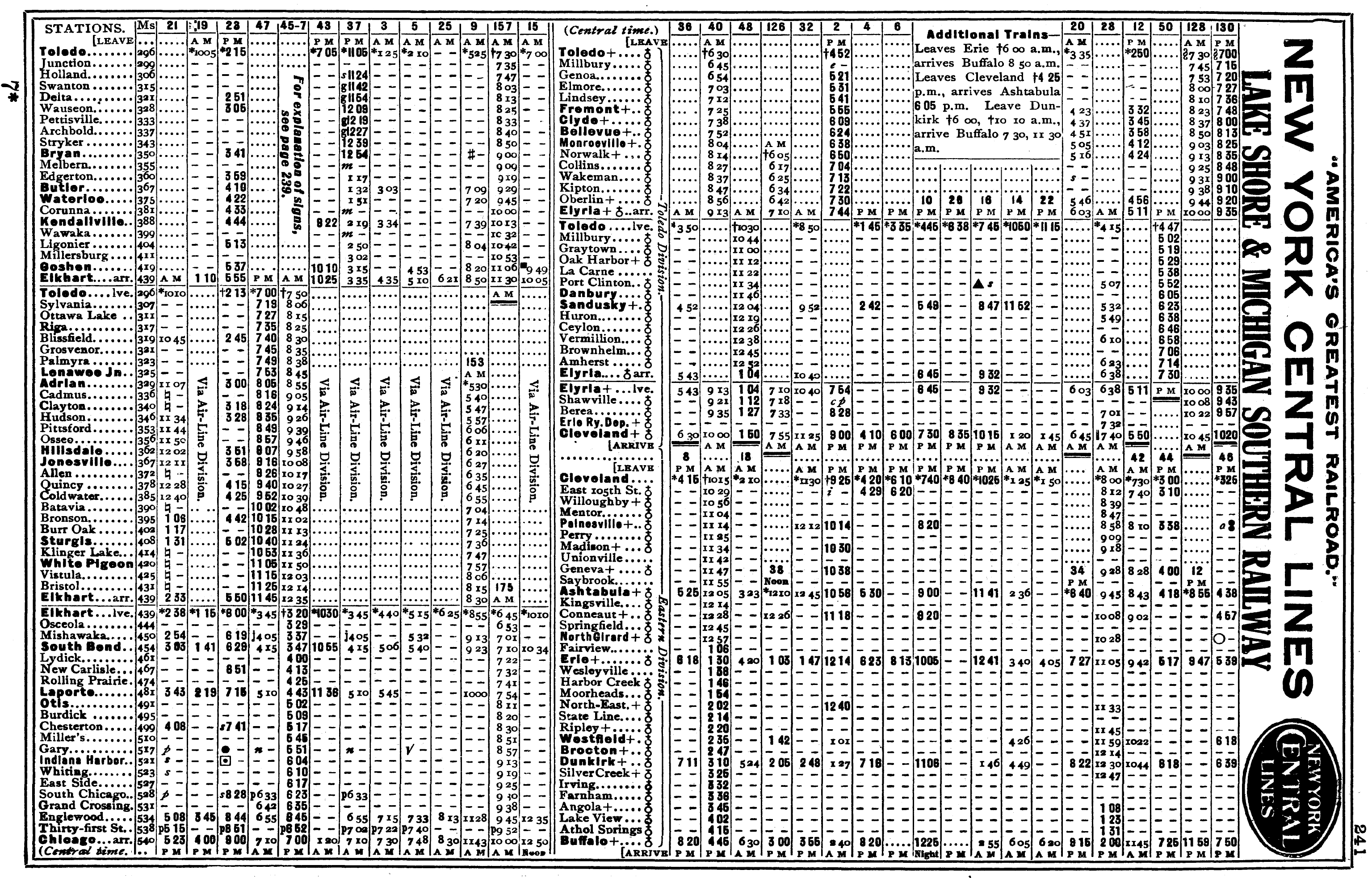
Lake Shore & Michigan Southern, Official Guide, 1910. American-Rails.com collection.
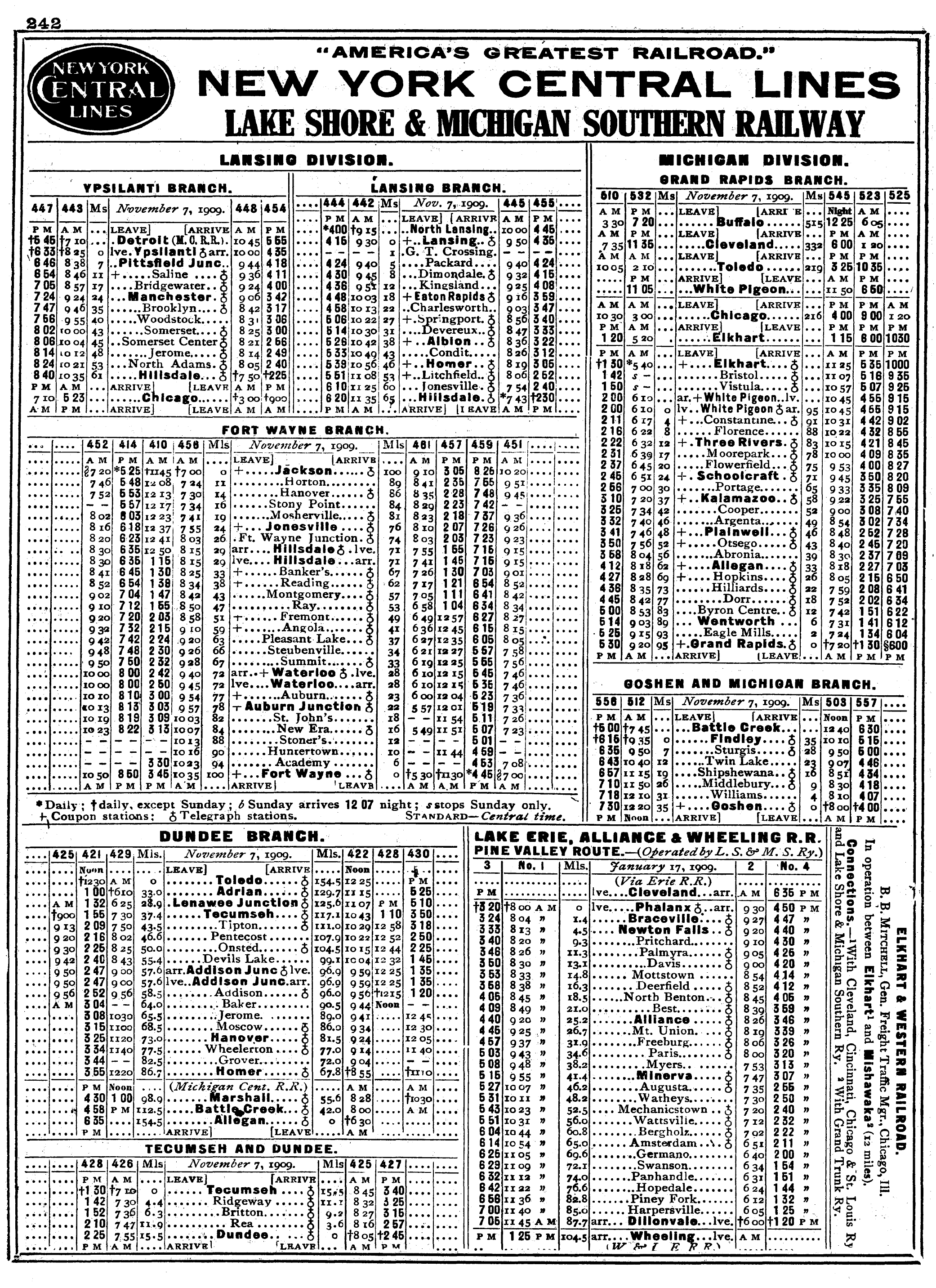
Lake Shore & Michigan Southern, Official Guide, 1910. American-Rails.com collection.
What still runs
Penn Central inherited the Chicago Line on February 1, 1968. Conrail took it April 1, 1976. The 1999 split of Conrail, effective June 1, 1999, cut the old Lake Shore at Cleveland:
- Norfolk Southern Chicago Line. Cleveland west through Toledo, Elkhart, and South Bend to Chicago. NS Elkhart Yard sits on the Lake Shore shop town. This is the heavy freight half of the old main, and Amtrak’s Lake Shore Limited uses it toward Chicago
- CSX Chicago Line / Short Line. Cleveland east through Ashtabula and Erie to Buffalo. Collinwood remains a CSX terminal on the old Lake Shore east end. Amtrak uses this half as well
- Berea, Ohio. The restored depot still watches NS and CSX within sight of each other, the old Lake Shore crossing the later Big Four / other NYC pieces
The Old Road across southern Michigan is mostly gone or short-line remnant. The Air Line through northern Indiana is still railroad. Sandusky Division geometry is the NS/CSX lakefront the freights actually use. This page does not invent an Amtrak 2026 timetable; that is the Lake Shore Limited guide.
Related Reading on American-Rails.com
- New York Central
- Michigan Central
- Big Four Route (CCC&StL)
- Canada Southern
- Ashtabula Bridge Disaster (1876)
- Angola Horror (1867)
- Railroads In The 1870s
- Lake Shore Limited (NYC era)
- Amtrak Lake Shore Limited (2026)
- Panhandle Route — the Pennsylvania’s competing Chicago arm
- Penn Central
- Conrail
Sources
- New York Central System Historical Society, Lake Shore & Michigan Southern summary. Michigan Southern charter 1837; Monroe–South Bend 1851; Chicago 1852; MS&NI 1855; CP&A Cleveland–Erie 1852; Buffalo & Erie 1867; LS&MS 1869; NYC merger 1914
- ICC valuation, The Lake Shore and Michigan Southern Railway Company. Consolidation agreement effective June 2, 1869; 1,666.86 miles operated; property to NYC under consolidation effective December 23, 1914, accounts through December 31
- Harlow, Alvin F. The Road of the Century. New York: Creative Age Press, 1947. Ch. 11: Lockwood, Phillips, February 11 and May 1869 combinations, Horace Clark, Buffalo & Erie
- Solomon, Brian, and Mike Schafer. New York Central Railroad. St. Paul: Andover Junction / MBI, 2007. Vanderbilt, Water Level Route, Lake Shore as Chicago extension
- Official Guide of the Railways, 1910. Map and tables on this page
- Erie & Kalamazoo: charter April 22, 1833; horse cars November 2, 1836; Adrian No. 1, August 1837
- Lake Shore Railway name, March 31, 1868. Cleveland & Toledo absorbed February 11, 1869. LS&MS April 6, 1869. Buffalo & Erie June 22, 1869
- Fast Mail, NYC and Lake Shore, first trip September 16, 1875. See 1870s
- Ashtabula, December 29, 1876. Angola, December 18, 1867
- Vanderbilt majority control about 1877. NYC&HR + LS&MS merger December 22, 1914
- Conrail split, CSX and Norfolk Southern, June 1, 1999. Cleveland as the cut. Amtrak Lake Shore Limited on the old main
Recent Articles


-
Missouri-Kansas-Texas Railroad (Katy): Map, History, Rosters
Oct 27, 26 11:02 PM
 History of the Missouri-Kansas-Texas, the Katy. The race into Indian Territory, Gould, the 1923 railroad, the Texas Special, and the 1988 sale. Steam and diesel rosters are linked.
-
Soo Line Diesel Roster (All-Time)
Oct 27, 26 10:55 PM
 All-time diesel roster of the Soo Line and the Wisconsin Central. 786 locomotives, each frame once. Cab units, Geeps, the Milwaukee Road engines, and the SD60s. The South Shore's 24 stay on that page.
-
Soo Line Steam Roster (Built Since 1900)
Oct 27, 26 10:49 PM
 Soo Line and Wisconsin Central steam locomotives built since 1900. Consolidations, Mikados, Pacifics, 21 Mountains, and four Lima 4-8-4s.
-
Soo Line Railroad: Map, Logo, History, Rosters
Oct 27, 26 10:24 PM
 The Soo Line, from the flour millers' railroad around Chicago to the Sault, the Wisconsin Central, and the Milwaukee Road. Steam quantity 422. Diesels 786. Canadian Pacific took full control in 1990.
-
Minneapolis, Northfield and Southern Railway: Map, History, Rosters
Oct 27, 26 10:32 AM
 The Minneapolis, Northfield & Southern, the Dan Patch Line that became a Twin Cities belt. Steam, gas-electric mules, motor cars, and the 22 diesels, through the Soo Line.
-
Minneapolis & St. Louis Diesel Roster (All-Time)
Oct 27, 26 10:27 AM
 All-time diesel roster of the Minneapolis & St. Louis. 97 locomotives, each frame once. Switchers from 1938, 35 RS-1s, the FT and F-unit cabs, two SD7s, and 23 GP9s. Builder numbers included.
-
Minneapolis & St. Louis Steam Roster (Post 1900)
Oct 27, 26 10:25 AM
 Minneapolis & St. Louis steam locomotives built since 1900. Moguls, Consolidations, 35 Mikados, and five Pacifics.
-
Minneapolis and St Louis Railway: "The Peoria Gateway"
Oct 27, 26 09:52 AM
 The Minneapolis & St. Louis, the Tootin' Louie, from the 1870 charter to the Peoria Gateway and the Chicago & North Western sale on November 1, 1960.
-
Alco "PA" Locomotives: Restoration, Specs, Engine, Rosters
Oct 27, 26 12:12 AM
 Alco's PA passenger cab, 297 locomotives built from 1946 to 1953. The 244 engine, the production roster, the Delaware & Hudson PA-4s, and Nickel Plate Road 190.
-
Milwaukee Road Diesel Roster: (All Time)
Oct 26, 26 01:44 PM
 All-time diesel roster of the Milwaukee Road. 1,208 locomotives, each frame once. Alco, Baldwin, Davenport, EMD, Fairbanks-Morse, General Electric, and Whitcomb, with builder numbers.
-
Milwaukee Road Steam Roster (All-Time): Post-1900
Oct 26, 26 01:38 PM
 Milwaukee Road steam locomotives built since 1900. Prairies, Mikados, the N-class articulateds, the S-class 4-8-4s, and the Hiawatha Atlantics and Hudsons. Quantity column 1,974. Unique frames 1,951.
-
Milwaukee Road: Map, Electrification, Logo, History
Oct 26, 26 01:20 PM
 The Milwaukee Road, from the Milwaukee & Mississippi of 1850 to the Pacific Coast Extension, the Hiawathas, and the Soo Line sale. Why Lines West should have stayed.
-
Lake Superior & Ishpeming Railroad: Map, Roster, History
Oct 25, 26 11:38 PM
 Lake Superior & Ishpeming Railroad, reporting mark LSI, from the Marquette Range to the Presque Isle ore dock. The 1954 steam list and the diesels the railroad owned.
-
Kansas City Southern Steam Roster (Built Since 1900)
Oct 25, 26 09:09 PM
 Steam locomotives of the Kansas City Southern built since 1900, with the Louisiana & Arkansas and the Texas company.
-
Kansas City Southern Diesel Roster (Built New)
Oct 25, 26 11:46 AM
All-time diesel roster of the Kansas City Southern. E units, F units, Geeps, SD40s through SD70ACes, Fairbanks-Morse, Baldwin, Alco, and General Electric, with serials and order numbers. -
Kansas City Southern Railway: Map, Photos, History
Oct 25, 26 12:24 AM
 The Kansas City Southern, from Arthur Stilwell's Gulf line to Canadian Pacific Kansas City on April 14, 2023. Steam and diesel rosters, the Southern Belle, and the Louisiana & Arkansas.
-
Indiana Harbor Belt Diesel Roster (All-Time)
Oct 25, 26 12:17 AM
 All-time diesel roster of the Indiana Harbor Belt. 202 locomotive frames, each counted once. NW2s, SW7s, SW1500s, road switchers, and gensets. Slugs and boosters are outside the count.
-
Indiana Harbor Belt Steam Roster (Built Since 1900)
Oct 25, 26 12:13 AM
 Steam locomotives of the Indiana Harbor Belt built since 1900. 182 engines, each counted once. 0-6-0s, 2-6-0s, 0-8-0s, and 2-8-2s. The three U-4a switchers are three-cylinder Brooks engines of 1927.
-
Indiana Harbor Belt Railroad: Map, Rosters, History
Oct 25, 26 12:00 AM
 Indiana Harbor Belt, the inner belt across the Calumet, from the East Chicago Belt of May 16, 1896. Renamed June 29, 1907. Still operating, headquarters Hammond. Steam roster is the companion, 182 loc…
-
NYC's "P Motor" Electric Locomotives
Oct 24, 26 11:43 PM
 New York Central P motors: 22 Alco-GE 2-C+C-2 electrics, Cleveland Union Terminal 1050–1071, class P-1a. 3,030 hp one-hour on 3,000-volt DC catenary, then 660-volt third rail as P-2a and P-2b.
-
Illinois Terminal Car Roster
Oct 24, 26 11:40 PM
 Illinois Terminal cars. Mainline motors, the 1948 streamliners, sleepers, Alton and Valley Division cars, express motors, and the line cars rebuilt from pull cars.
-
Illinois Terminal Diesel Roster
Oct 24, 26 09:31 PM
 All-time Illinois Terminal diesels, 62 frames. Alco S-2s and RS-1s, EMD switchers, GP7s, SD39s, GP38-2s, and the two GP20s. Serial numbers from the 1989 roster.
-
Illinois Terminal Electric Locomotives
Oct 24, 26 08:22 PM
 Illinois Terminal electric locomotives, 57 frames. Class A through Class D, the Decatur-built motors, and the battery locomotives. Class D is the same five Class C frames, rebuilt.
-
Illinois Terminal Steam Roster
Oct 24, 26 07:37 PM
 Illinois Terminal steam locomotives, 36 frames. Baldwin Moguls, three Class 30 Mikados, Florida East Coast 0-8-0s, and 2-6-0 No. 21, the last fire on June 30, 1950.
-
Illinois Terminal Railroad: Map, Roster, Photos, History
Oct 24, 26 07:32 PM
Illinois Terminal, McKinley's Illinois Traction System, from the Danville coal towns to St. Louis. The McKinley Bridge, the sleeping cars, the 1937 break with the power company, the 1948 streamliners… -
Southern Railway Diesel Roster (All-Time)
Oct 23, 26 11:00 PM
 All-time diesel roster of the Southern Railway. 2,505 locomotives in the system number series, from the 1939 demonstrator FT to GP50s and B30-7A1s. Serials included.
-
Illinois Central Diesel Roster (All-Time)
Oct 23, 26 04:06 PM
Illinois Central and Illinois Central Gulf diesel locomotives, each frame once. The quantity column is 886. Serials and order numbers from Electro-Motive's builder lists. Paducah rebuilds and Gulf, Mo… -
Illinois Central Gulf Diesel Roster
Oct 23, 26 04:02 PM
 Illinois Central Gulf operating numbers from August 10, 1972, to February 29, 1988. New frames stay on the Illinois Central diesel roster. Gulf, Mobile and Ohio frames stay on that roster. No Gulf fle…
-
Illinois Central Railroad: Map, Logo, History
Oct 23, 26 03:50 PM
Illinois Central, the Main Line of Mid-America, from the 1850 land grant to Canadian National control on July 1, 1999. Charter lines, Cairo bridge, Paducah, and the Illinois Central Gulf. Steam quanti… -
Grand Trunk Western Diesel Roster (All-Time)
Oct 23, 26 12:53 PM
 Grand Trunk Western diesel locomotives, each frame once. The quantity column is 377. Serials are filled for the Detroit, Toledo and Ironton and Detroit and Toledo Shore Line engines the railroad kept…
-
Grand Trunk Western Steam Roster
Oct 23, 26 12:14 PM
 Grand Trunk Western steam locomotives in service about 1937 to 1942, from Richard Leonard's class list. Drury has no chapter. The quantity column is the counted Grand Trunk Western rows. Two mixed Gra…
-
Grand Trunk Western Railroad: Map, Roster, History
Oct 23, 26 12:09 PM
 Grand Trunk Western, reporting mark GTW, Canadian National's railroad between Port Huron and Chicago. Trade name adopted in 1923. Steam class list quantity 232. Diesel quantity column 377. Identity in…
-
Green Bay and Western Railroad: Map, Rosters, History
Oct 22, 26 11:18 PM
 Green Bay & Western, the Green Bay Route, reporting mark GBW. From Kewaunee to Winona. Mailer's steam and diesel rosters, and the August 1993 sale to Fox Valley & Western.
-
Chicago & North Western Class E-4: Streamlined 4-6-4 Hudsons
Oct 22, 26 10:28 PM
 C&NW Class E-4, nine streamlined 4-6-4s, 4001–4009, Alco 1938. 84-inch drivers, 25-by-29 cylinders, 300 psi. Conventional Chicago–Omaha trains. Oil in 1947–48. Retired 1953–1956.
-
Gateway Western Railway: Map, Roster, History
Oct 22, 26 02:43 PM
 Gateway Western Railway, reporting mark GWWR. Class II from Kansas City to East St. Louis. Kansas City Southern control May 5, 1997. The 1992 diesel fleet, with serials and order numbers.