McKeen Motor Car Company
Published: February 3, 2025
By: Adam Burns
The dawn of the 20th century marked a period of transformative change across various sectors, and the transportation industry was not left behind.
Among the numerous innovations, one standout was the McKeen Motor Car Company, which emerged as a significant player in the development of self-propelled railcars.
Established by William McKeen, who served as the Superintendent of Motive Power and Machinery for Union Pacific, the company emerged as a UP subsidiary.
Initially, McKeen's early cars were constructed directly by the railroad before he transitioned to leasing workshop space at UP's Omaha Shops in Omaha, Nebraska.
Tasked by the railroad to devise a more cost-effective method for operating passenger service on secondary branch lines and lightly trafficked regions, McKeen developed an innovative design that was advanced for its era.
Unfortunately, the technology surrounding internal combustion engines had not yet matured, resulting in McKeen cars being somewhat unreliable and troubleprone.
The overwhelming majority of the cars were produced for Edward Henry Harriman's extensive network of railroads. Following his death in 1909, interest in the project waned and production was ultimately discontinued. During this time, from 1905 to 1917, the company manufactured a total of 152 railcars.
Inception and Development: The Formation of a Vision
William R. McKeen was the mechanical superintendent of the UP when he conceived the idea of a railcar propelled by an internal combustion engine.
This vision was spurred by the need to address specific challenges faced by railroads - even at that time - with the high operational costs of steam-powered trains on less populated branch lines.
McKeen sought to create a more economical option that would encourage rail travel in these areas, reduce costs, and preserve service.
The McKeen Motor Car Company was established in Omaha, a location that provided a strategic advantage due to its proximity to both manufacturing resources and a vast network of railroad lines. McKeen's vision was clear: develop a railcar that could operate independently, eliminate the need for a locomotive, and provide railroads with a cost-effective solution for service on less profitable routes.
 The restored McKeen Motor Car, Virginia & Truckee #22, at the Nevada State Railroad Museum in Carson City on June 26, 2011. Marty Bernard photo.
Innovative Design: Engineering Marvel or Misstep?
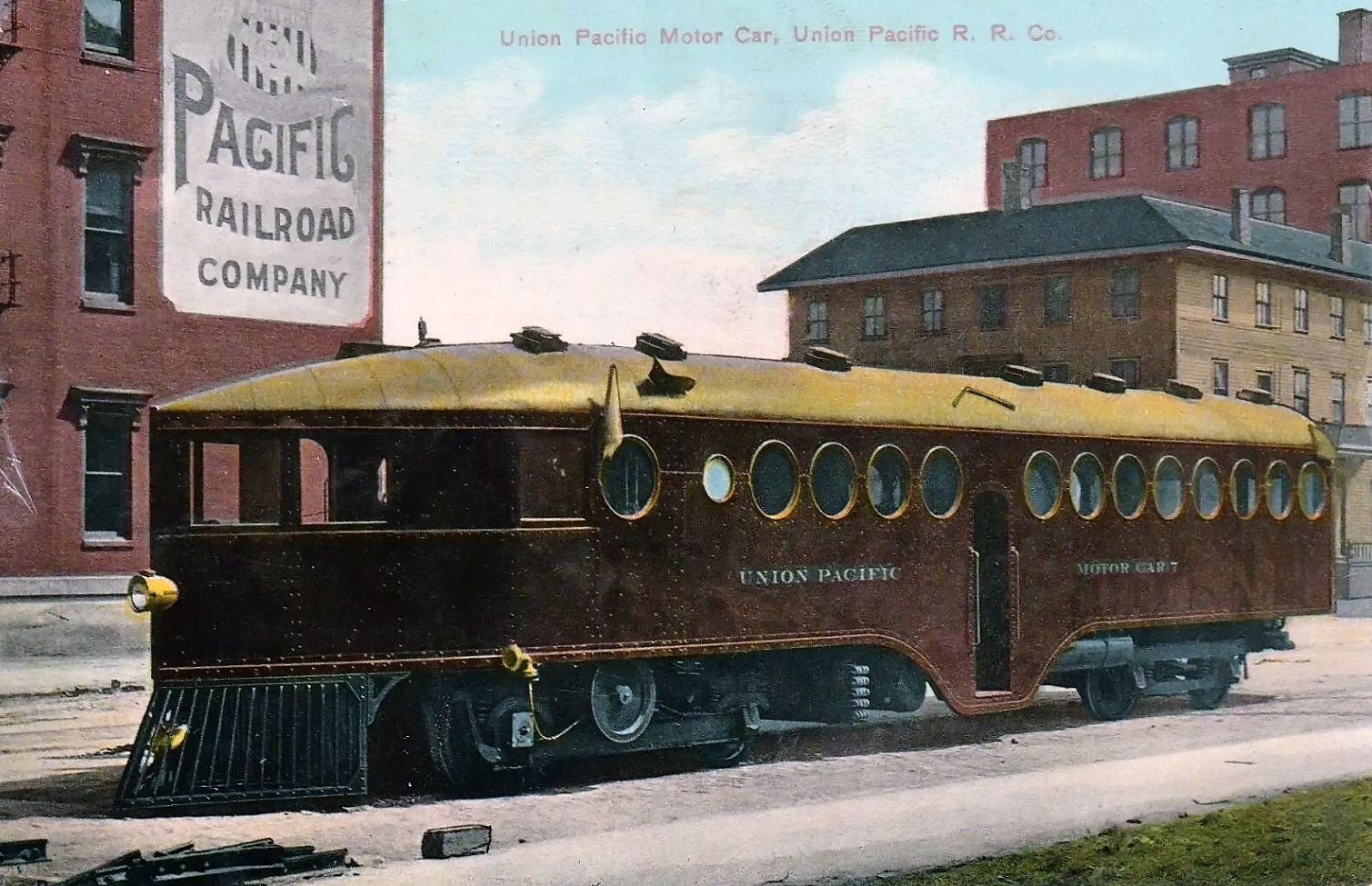
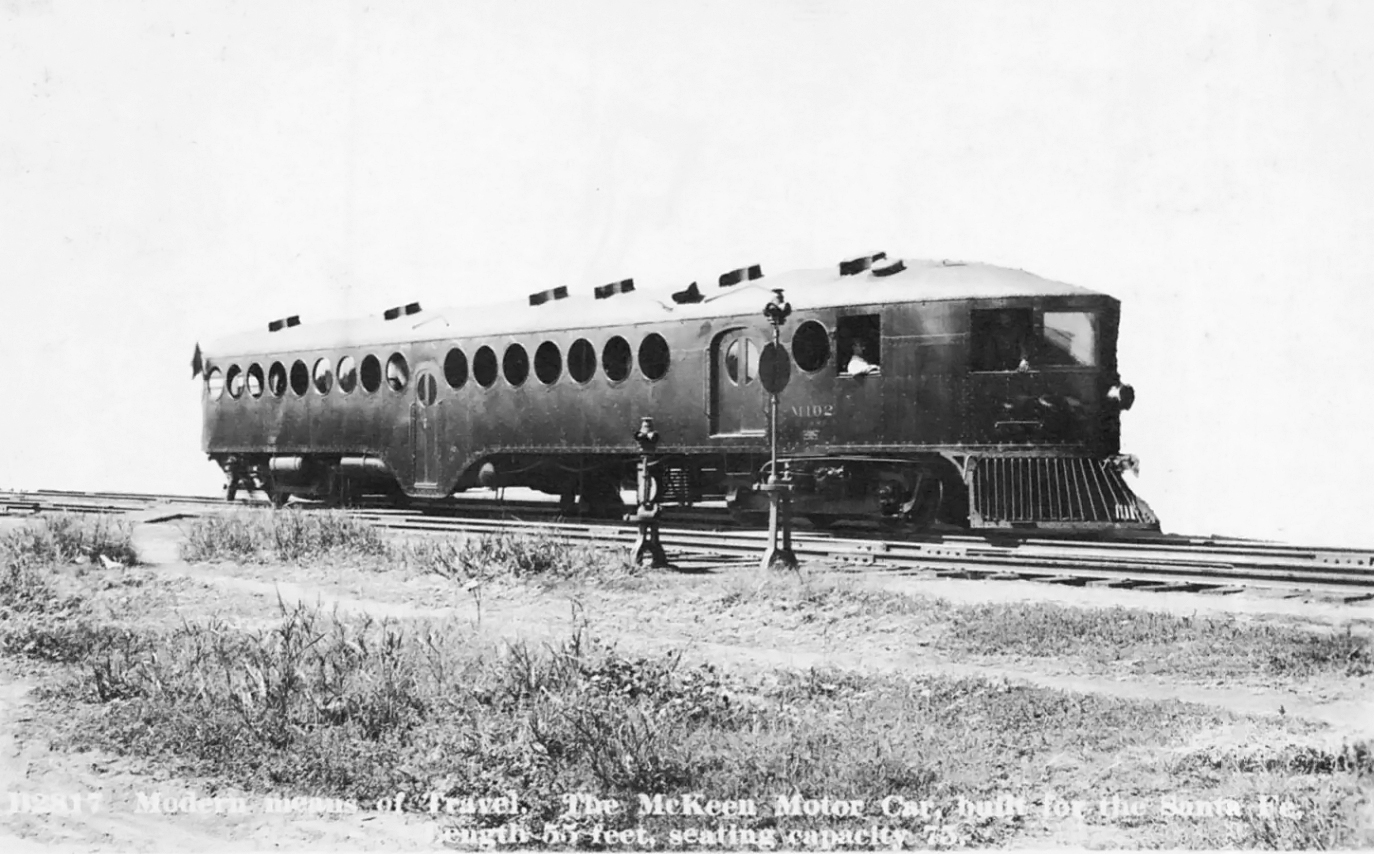
The McKeen railcars were distinctive, often recognized by their unique aerodynamic design characterized by a pointed "wind-splitter" front end, reminiscent of a boat's hull. This design was not merely for aesthetic appeal; it was intended to reduce air resistance and improve speed, making these railcars one of the earliest examples of streamlined vehicles.
The cars typically featured a riveted steel frame, setting them apart from the predominantly wooden railcars of the time. Most models were equipped with large porthole windows - a McKeen trademark -further emphasizing their nautical appearance. They varied in length, from 55 to 70 feet, accommodating up to 75 passengers.
Perhaps the most significant innovation was their power source: a gasoline-powered internal combustion engine. This engine, generally a six-cylinder, delivered power to the axles via a drivetrain similar to those used in automobiles.
Initially, McKeen cars were equipped with engines from Standard Motor Works, located in Jersey City, New Jersey. However, from the production of the eighth unit onward - designated 'M8' on UP - McKeen transitioned to utilizing engines of their own design.
These engines maintained a straight-6 configuration, with power outputs ranging from 100 horsepower in the earliest models to a maximum of 300 horsepower in later, more powerful iterations.
The cylinders were oriented vertically, and the engines were installed transversely within the car across all McKeen vehicles and locomotives. Most McKeen engines operated on distillate fuel.
The engines - featuring a compressed air starter - were engineered to operate bi-directionally, similar to marine engine systems, as they were devoid of a conventional reverse gear.
To reverse, the engine required shutdown, whereupon the motorman would adjust the camshaft to engage the reverse cam set before restarting the engine in the opposite direction.
A flywheel, positioned on the left side of the leading truck, rotated in alignment with the engine's operating direction regardless of the car's motion. This flywheel played a critical role in maintaining engine momentum and also powered the electric generator responsible for illumination.
The use of such technology in railcars was revolutionary and served to underscore McKeen's commitment to marrying mechanical innovation with practical rail solutions.
Navigating Operational Challenges: Realities of the Rail Line
While McKeen cars were pioneering, the transition from concept to functional reality was fraught with challenges. Though innovative, the design faced numerous operational issues.
The gasoline engines, while advanced for their time, were unreliable and required significant maintenance. This unreliability often led to service disruptions and increased operating costs, which contradicted the primary goal of cost-efficiency.
Additionally, the lack of reverse gears in early models posed practical challenges. Operators had to use turntables or wyes to change direction, complicating operations and limiting their practical deployment. Furthermore, the railcars struggled on steep grades due to their relatively low power output compared to steam locomotives. Despite these challenges, the McKeen produced 152 railcars over its lifespan.
While initially appealing, the practicality of operating the railcars led to dwindling enthusiasm from rail operators. Ultimately, the inability to sustain reliable service, coupled with advancements in diesel technology, contributed to the company's decline.
Pioneering Modern Rail Travel
Though McKeen's history was brief, its impact on rail travel and transport innovation was significant. The concept of a self-propelled railcar - which was also being tested by General Electric during the same period - set the stage for further developments in the industry and showcased the potential of internal combustion engines in transportation, paving the way for the diesel locomotives that would dominate mid-20th-century railroads.
During the 1920s, Electro-Motive Corporation proved quite successful with its "doodlebugs," producing roughly 500 between 1924-1936.
The streamlined design of McKeen railcars inspired future rolling stock designs - notably the classic streamlined passenger trains of the 1930s -emphasizing the importance of aerodynamics in transportation.
Preservation
A few McKeen railcars have survived into the modern era, preserved as historical artifacts and reminders of an innovative period in railroading history.
The Nevada State Railroad Museum has successfully restored a McKeen car, specifically Virginia & Truckee Railway #22. Constructed in 1910, it was a 70-foot car and is notable as one of the last still in operation with its original engine.
While the original engine was unfortunately lost, a contemporary diesel engine was installed, enabling the car to reach its initial maximum speed. The meticulously restored car was unveiled on May 9, 2010, coinciding with its 100th anniversary. Presently, it is showcased in Carson City and is utilized for select events.
The museum also possesses the remnants of a second McKeen car, which has undergone conversion into a diesel-electric switching locomotive.
In addition, another McKeen car body, identified by construction number 83/103, is extant in Ramona, California. Originating with the San Diego Cuyamaca & Eastern Railroad, it was subsequently sold to the Yuma Valley Railroad, and by 1921, had reached Alaska. Currently, this car, originally dubbed the "Cuyamaca," is undergoing restoration led by Madison Kirkman of the McKeen Motor Car Company Historical Society.
Additionally, two unpowered McKeen trailers have survived; one serves as a storage facility in St. Helena, California, and the other resides at the Illinois Railway Museum.
Legacy of a Pioneering Vision
The story of the McKeen Motor Car Company is one of relentless innovation in the face of adversity. The company's aspirations, symbolized by its unique railcars, captured the ambition of an era striving for progress and efficiency. McKeen's vision of self-propelled railcars anticipated future transportation trends, even if they did not achieve lasting commercial success in their time.
Recent Articles


-
C&NW 4-6-2s 1617 & 1620: Minnesota 400 Yellow Jackets
Sep 19, 26 11:28 AM
 C&NW Class E Pacifics 1617 and 1620—Alco Schenectady 1917, yellow-and-green E-4-style shrouds 1941 for the Minnesota 400. Crews called them Yellow Jackets. Renumbered 617/620. Scrapped 1956.
 -
Erie Lackawanna Diesel Roster: All-Time
Sep 19, 26 10:13 AM
 Erie Lackawanna diesel—Erie and DL&W inheritance, GP35s, U25Bs, SD45/SDP45/SD45-2, U34CH. All-time roster with serials and orders. Conrail April 1 1976.
 -
Erie Lackawanna Railway: Map, History, Logo
Sep 19, 26 10:06 AM
 Erie Lackawanna Railway—Erie and DL&W, October 17 1960–March 31 1976. Von Willer, White revival, Dereco, Agnes, Conrail. High-and-wide Chicago main. Map, logo, what remains.
 -
"Empire State Express" (1941 Train): Timetables, Route, Consist
Sep 18, 26 10:59 PM
 NYC Empire State Express—George Daniels 1891 day train, 999’s 112.5 mph claim, Budd stainless streamliner December 7 1941, Cleveland and Detroit sections, diesels, 1967 name drop. Timetables, consist…
 -
New York Central 4-6-4s 5426 & 5429: Empire State Express Hudsons
Sep 18, 26 10:32 PM
 NYC J-3a Hudsons 5426 and 5429—Alco 1937, Budd stainless shrouds 1941 for the Empire State Express. Pearl Harbor inaugural. Shrouds off by 1950. Neither preserved.
 -
"Stourbridge Lion" Locomotive: Facts, History, Photos
Sep 18, 26 10:27 PM
 Stourbridge Lion—Foster, Rastrick 0-4-0, first steam locomotive in the United States. Horatio Allen, Honesdale, August 8, 1829. Too heavy for D&H gravity track. Boiler in Baltimore; Colonie replic…
 -
Delaware & Hudson Steam Roster (Post 1900)
Sep 18, 26 10:01 PM
 Delaware & Hudson steam—Camelback 2-8-0s, Loree high-pressure compounds, Class K 4-8-4s, forty Challengers. Post-1900 class roster after Drury. Last steam July 21, 1953.
 -
Boston & Maine Steam Roster (Post 1900)
Sep 18, 26 02:57 PM
 Boston & Maine steam—B-15 Moguls, K-8 Consolidations, P-4 Lima Pacifics, T-1 Limas, R-1 Mountains. Post-1900 class roster after Drury. Last steam July 23, 1956.
 -
Boston & Maine Diesel Roster (All-Time)
Sep 18, 26 01:25 PM
 Boston & Maine diesel—boxcab 1100 1935, Flying Yankee 6000, FTs, E7s, BL2s, GP7/GP9, GP38-2s and GP40-2s. All-time roster. Last steam July 23, 1956.
 -
Mid-Continent Railway Museum Dining (2026)
Sep 18, 26 01:21 PM
 2026 Mid-Continent dining in North Freedom—select-date seated meals in luxury cars, reservations required. Pizza Limited June 28. Confirm on midcontinent.org.
 -
Bessemer & Lake Erie Steam Roster (Post 1900)
Sep 18, 26 12:11 PM
 Bessemer & Lake Erie steam—C3A 150–151, D1A/D2A Santa Fes, 47 H1 Texas types after Burlington. Post-1900 class roster after Drury. Last steam 2-8-0 156, May 14, 1953.
 -
Bessemer & Lake Erie Diesel Roster (All Time)
Sep 18, 26 12:09 PM
 Bessemer & Lake Erie diesel—Westinghouse 281 1936, Baldwin DRS-6-6-1500s, F7s 1950–53, SD7/SD9/SD18/SD38 family, RSD-15s. All-time roster. Last steam 2-8-0 156, May 14, 1953.
 -
Bangor & Aroostook Steam Roster (Post 1900)
Sep 18, 26 11:21 AM
 Bangor & Aroostook steam—Manchester Ten-Wheelers, Alco Mountains 100–109, G-2 Consolidations, Pacifics 250–254. Post-1900 class roster after Drury. Last steam Pacific 251, July 22, 1951.
 -
Bangor & Aroostook Diesel Roster (All Time)
Sep 18, 26 11:09 AM
 Bangor & Aroostook diesel—F3s 1947, eight BL2s, E7s, GP7s leased to the PRR, GP9s, GP38s. All-time roster. Last regular steam July 22, 1951.
 -
B&O Steam Locomotive Roster (Post 1900)
Sep 18, 26 10:33 AM
 Baltimore & Ohio steam—Old Maude, E-27 Consolidations, Q Mikados, Big Sixes, EM-1 Yellowstones, President Pacifics. Post-1900 class roster after Drury. Last public steam May 17, 1958.
 -
Baltimore & Ohio (B&O): Diesel Roster (All-Time)
Sep 18, 26 10:28 AM
 Baltimore & Ohio diesel—boxcab 1925, EMC 50 1935, EA 1937, FTs, F3s, F7s, FA-2s, sharks, GP7/GP9, GP30s after C&O 1963, SD50s 8576–8595 1984. All-time roster. Last steam 1958.
 -
Detroit & Toledo Shore Line Railroad: Map, Roster, History
Sep 18, 26 12:32 AM
 Detroit & Toledo Shore Line—Pleasant Bay 1898, named 1899, Detroit–Toledo freight bridge, GTW and Clover Leaf/NKP/N&W. Merged into Grand Trunk Western June 26, 1981.
 -
Lackawanna Steam Locomotives: History, Roster & Photos
Sep 18, 26 12:17 AM
 Delaware, Lackawanna & Western steam—Camelback 2-8-0s, Mikados, freight Pacifics, Poconos 4-8-4s, Hudsons. Post-1900 roster after Drury. Last steam July 13, 1953.
 -
Lackawanna (DL&W) Diesel Roster: All Time
Sep 18, 26 12:11 AM
Delaware, Lackawanna & Western diesel—boxcabs 1926, EMC SC 425–426 1935, FTs 1945, F3/F7/E8, GP7s, RS-3s, FM Train Masters. All-time roster. Last steam 1953. -
Lackawanna Railroad: Map, History, Viaducts, Rosters
Sep 18, 26 12:04 AM
 TDelaware, Lackawanna & Western—Liggett’s Gap 1832, named March 11 1853, Hoboken–Buffalo, anthracite, Phoebe Snow, Cutoff and Tunkhannock. It merged with the Erie to form Erie Lackawanna on Octobe…
 -
Rail News, The Latest
Sep 17, 26 11:56 PM
This page provides a portal to the latest in rail news, from preservation and restortation subjects to other notable topics. -
Union Pacific Big Boy 4014 Sets First Holiday Tour for Make-A-Wish
Sep 17, 26 11:54 PM
 Union Pacific Big Boy 4014’s first holiday tour: Cheyenne–Denver tickets, Nov. 21 Denver-area display, Make-A-Wish. Museum patrons Oct. 16; public Oct. 19.
 -
Conrail Diesel Roster (All Time)
Sep 17, 26 10:27 PM
Conrail diesel—~5,000 inherited 1976, Big Blue, GP15-1s, SD40-2s, SD50s, Dash-8s, SD60/60M/60I, SD80MACs. All-time CR-number roster. -
Chessie System (Railroad): The C&O, B&O, And WM
Sep 17, 26 09:38 PM
 Chessie System, Inc.—C&O, B&O, and Western Maryland. Kitten-C paint 1972, holding company February 26 1973, CSX November 1 1980, C&O into CSXT August 31 1987.
 -
Chesapeake & Ohio (C&O) Diesel Roster: All-Time
Sep 17, 26 06:01 PM
 Chesapeake & Ohio diesel—late steam, no Fairbanks-Morse, E7s 1946, GP7/GP9 flood, F7s, GP40-2s, B30-7s, SD50s 1984–85. All-time roster. Steam ended 1956.
 -
Chesapeake & Ohio (C&O) Steam Roster: Post-1900
Sep 17, 26 03:18 PM
 Chesapeake & Ohio steam—H-8 Alleghenies, K-4 Kanawhas, T-1 Texas, Greenbriers, H-6 1949 Mallets. Post-1900 class roster including Pere Marquette and Hocking Valley. Last steam 1956.
 -
Chesapeake and Ohio Railway: Map, Logo, History
Sep 17, 26 02:36 PM
 Chesapeake & Ohio Railway—Louisa Railroad 1836, named August 31 1868, Ohio River 1873. Coal, Chessie the kitten, Pere Marquette 1947, B&O control 1963, into CSX August 31 1987. Complete corporate…
 -
TVRM Valentine Train Ride (2026)
Sep 17, 26 02:31 PM
 2026 TVRM Valentine Train Ride in Chattanooga—Feb. 6–15, plated dinner, Grand Junction Depot. Confirm on tvrail.com.
 -
River Fox Train Dining (2026)
Sep 17, 26 02:29 PM
 2026 River Fox Train in West Sacramento—Brunch Train and Murder Mystery dinner. 18095 County Road 117. Confirm on riverfoxtrain.com.
 -
Weehawken Terminal, Serving The West Shore Railroad
Sep 17, 26 01:38 PM
 Weehawken Terminal—West Shore / New York Central Hudson waterfront station, opened 1884. Five ferry slips, sixteen tracks, Weehawken Tunnel 4,014 feet. Last ferry March 25, 1959. Port Imperial and HBL…
 -
West Shore Railroad: Map, History, Timetables
Sep 17, 26 01:32 PM
 West Shore Railroad—New York, West Shore & Buffalo 1880–83, Weehawken to Buffalo. PRR-backed rival to the Central. Morgan settlement, 475-year NYC lease January 1 1886. CSX River Sub today.
 -
Jersey Central Diesel Locomotives: History, Roster & Photos
Sep 17, 26 01:20 PM
 Central Railroad of New Jersey diesel—boxcab 1000, Baldwin double-enders, F3s, Train Masters, SD35s, GP40Ps. All-time roster. Steam ended July 1, 1954.
 -
Jersey Central Steam Locomotives: History, Roster & Photos
Sep 17, 26 01:17 PM
 Central Railroad of New Jersey steam—Camelback Ten-Wheelers, USRA Mikados, G-class Pacifics, suburban tanks. Post-1900 class roster after Drury. Dieselized July 1, 1954.
 -
Jersey Central Railroad (CNJ): Map, Rosters, History
Sep 17, 26 01:14 PM
 Central Railroad of New Jersey—Elizabethtown & Somerville 1831, named April 23 1849. Communipaw, anthracite, Blue Comet, Reading/B&O control. Conrail April 1 1976. Complete corporate history.
 -
Central Vermont Diesel Locomotives: History, Roster & Photos
Sep 17, 26 11:35 AM
 Central Vermont diesel—Alco S-2s 1942, RS-3s, RS-11s from DW&P, EMD GP9s 1956–57, GP38ACs 1971. All-time roster. Last steam April 4, 1957.
 -
Central Vermont Steam Locomotives: History, Roster & Photos
Sep 17, 26 11:19 AM
 Central Vermont steam—ten Alco 2-10-4s of 1928, four U-1-a Mountains, Consolidations. Post-1900 class roster after Drury. Last steam April 4, 1957.
 -
Central Vermont Railway: Map, Logo, Rosters
Sep 17, 26 11:03 AM
 Central Vermont Railway—Vermont Central charter October 1843, Bethel–White River Junction June 26, 1848. Grand Trunk 1898, CN 1923, RailTex/NECR 1995. Complete corporate history.
 -
Fitchburg Railroad: Map, History, Timetables
Sep 17, 26 10:40 AM
 Fitchburg Railroad—chartered March 3, 1842, Boston–Fitchburg March 5, 1845. Alvah Crocker, Hoosac west door, Vermont & Massachusetts, Cheshire. B&M 99-year lease July 1, 1900. Complete corpora…
 -
Steam Railroading Institute Dining (2026)
Sep 17, 26 10:30 AM
 2026 SRI Owosso dining—vintage dining cars, select evenings. 2026 dinner calendar not posted; 2025 Up In Smoke is the recent example. Confirm on michigansteamtrain.com.
 -
Canadian Pacific Railway: Map, History, Logo, Photos
Sep 17, 26 12:06 AM
 Canadian Pacific Railway—incorporated February 16, 1881. Last spike Craigellachie November 7, 1885. Soo, Milwaukee, D&H, DM&E. CPKC April 14, 2023. Complete corporate history.
 -
Canadian Pacific Diesel Locomotives: History, Roster & Photos
Sep 17, 26 12:03 AM
 Canadian Pacific diesel—E8A 1800 in 1949, FP7/FP9, FA-2, C424, SD40-2, SD40-2F Red Barns, AC4400CW, ES44AC, SD30C-ECO, SD70ACu heritage. All-time roster. Last steam November 6, 1960.
 -
Canadian Pacific Steam Locomotives: History, Roster & Photos
Sep 16, 26 11:35 PM
 Canadian Pacific steam—3,257 engines 1881–1949. D10 Ten-Wheelers, G3 Pacifics, Royal Hudsons, Selkirk 2-10-4s. Post-1900 class roster after Drury. Last steam November 6, 1960.
 -
Woodstown Central Dining in Motion (2026)
Sep 16, 26 11:31 PM
 2026 Woodstown Central Dining in Motion—Salem County table car, 50–60 minutes, private table of four from $190. Confirm on woodstowncentral.com.
 -
NCTM Wine & Dine on the Rails (2026)
Sep 16, 26 11:28 PM
 2026 NCTM Wine & Dine on the Rails in Spencer—Feb. 13–15, three-course dinner, 21+, $145/$140. Sold out. Confirm next season on nctransportationmuseum.org.
 -
Southern Railway 4-6-2 1380: The Streamlined Ps-4
Sep 16, 26 10:34 PM
 Southern Railway Ps-4 4-6-2 1380—Alco 1923, serial 64857. Otto Kuhler streamlining at Spencer 1940–41 for the Tennessean. Only streamlined steam locomotive on the Southern. Scrapped Baltimore 1953.
 -
Texas Mexican Railway: Serving The Border Since The 1880s
Sep 16, 26 09:58 PM
 Texas Mexican Railway—Corpus Christi, San Diego & Rio Grande March 1875, 3-foot. Tex-Mex June 1881, Laredo Sept 1881, Rio Grande bridge 1883. Standard gauge July 17 1902. Mexican government 1900–1…
 -
Mount Hood Railroad Dining (2026): No Plated Dinner Train This Season
Sep 16, 26 09:53 PM
 2026 Mount Hood Railroad in Hood River is scenic Fruit Loop trains with snacks and sandwiches—not a plated dinner train. Confirm on mthoodrr.com.
 -
Peoria and Eastern Railway: Map, Timetables, History
Sep 16, 26 09:39 PM
 Peoria & Eastern—Danville, Urbana, Bloomington & Pekin 1866, IB&W 1869, OI&W 1887. Incorporated Feb 21 1890, Big Four next day. NYC 1930, Conrail 1976. GP7s 5612–5625. Complete corporate history.
 -
Boston and Maine Railroad: "Route Of The Minute Man"
Sep 16, 26 11:30 AM
 Boston & Maine—Andover & Wilmington 1833, NH charter June 27 1835. Eastern, Boston & Lowell, Fitchburg/Hoosac, Concord & Montreal. Section 77 March 12 1970. Guilford June 30 1983. CSX June 1 2…
 -
Smoky Valley Limited Dinner Train (2026)
Sep 16, 26 11:24 AM
 2026 Abilene & Smoky Valley Smoky Valley Limited—two-hour dinner from the 1887 Rock Island Depot. Kansas catering, ~$72–$110. Confirm on asvrr.org.