Mohawk and Hudson Railroad: Map, Pictures, Locomotives
Last revised: September 15, 2026
By: Adam Burns
The Mohawk & Hudson was New York’s first railroad that actually ran. The legislature chartered the Mohawk and Hudson Rail Road Company on April 17, 1826—the second railroad corporation in the United States after the Granite Railway of Massachusetts, six weeks earlier. George William Featherstonhaugh of Duanesburg had put a notice in the Schenectady Cabinet on December 28, 1825. Stephen Van Rensselaer, the old patroon, was named president. The object was about sixteen miles of iron across the Pine Bush, a shortcut around the Erie Canal’s Cohoes lock flight between the Hudson at Albany and the Mohawk at Schenectady. Money was slow. John B. Jervis took the engineering after Peter Fleming. Van Rensselaer broke ground near Schenectady with a silver spade in late July 1830. The first steam passenger train ran August 9, 1831, behind the American-built 0-4-0 DeWitt Clinton. The company took the name Albany & Schenectady on April 19, 1847. On May 17, 1853 it was one of ten roads that became the first New York Central.
It was never a long railroad. About 16 miles, inclined planes at both ends until the 1840s, strap rail on stone blocks, and a legislature that had just finished the Erie Canal and did not want the water robbed of freight. Passengers were the business. The 1820s and 1830s as a founding era are the beginning. The national encyclopedia is railroad history. This page is the Mohawk & Hudson: the charter, the planes, the Clinton as equipment, the 1847 rename, and the iron CSX still runs between Albany and Schenectady.
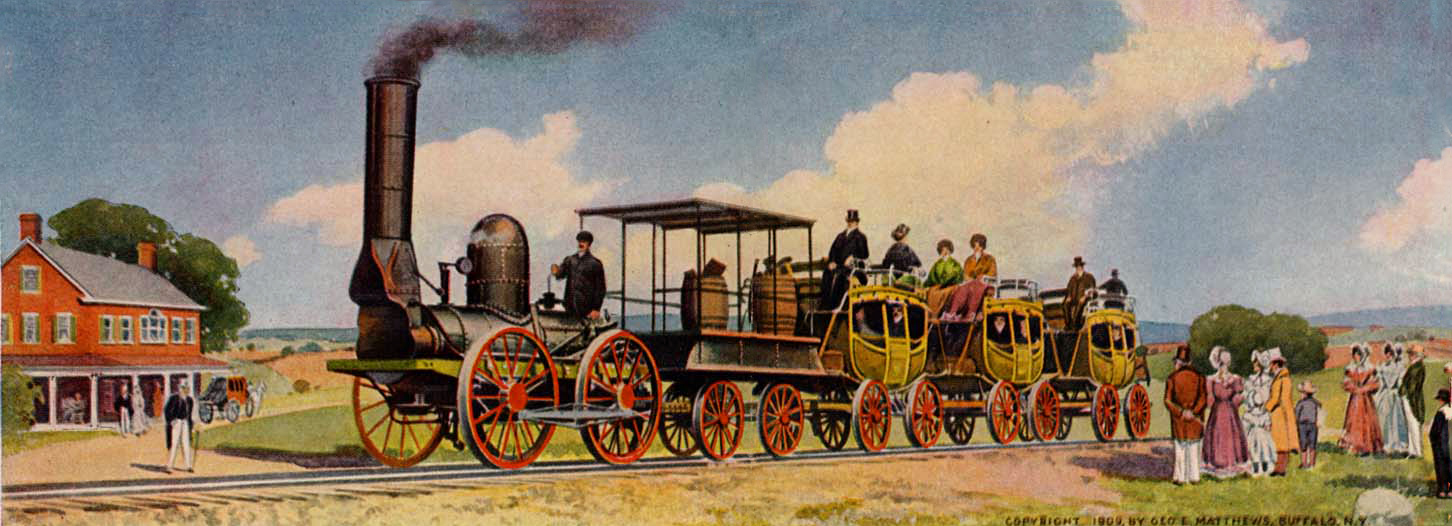
A 1909 lithograph by Geo. E. Matthews of Buffalo, showing the DeWitt Clinton and the Mohawk & Hudson’s stagecoach-body cars.
On this page: At a glance · Featherstonhaugh and the 1826 charter · Money, Fleming, and Jervis · Pine Bush and the planes · August 9, 1831 · September 24 and the Fulton · Freight, the canal, and Experiment · The planes come off · Albany & Schenectady, 1847 · The first New York Central · What remains
At a glance
| Item | Detail |
|---|---|
| Legal name | Mohawk and Hudson Rail Road Company. Named Albany & Schenectady Rail Road Company April 19, 1847 |
| Charter | New York, April 17, 1826. First railroad in the state; second U.S. railroad corporation after the Granite Railway (March 4, 1826) |
| First president | Stephen Van Rensselaer. George William Featherstonhaugh, the other director named in the charter |
| Headquarters | Albany, New York |
| First public steam | Albany–Schenectady, August 9, 1831, behind the DeWitt Clinton. Directors’ grand opening September 24 |
| Gauge | 4 feet 9 inches as built; later 4 feet 8½ inches |
| Route miles | About 16 (Appleton’s 16.92 in 1847; ICC 16.89 at the 1853 consolidation) |
| Principal line | Albany–Schenectady, across the Pine Bush. Inclined planes at both ends until the 1840s |
| Cost of construction | $1,473,253 (August 1830–January 1, 1848) |
| Passengers hauled (1847) | 229,401 |
| Interchange at Schenectady | Troy & Schenectady; Saratoga Railroad; Utica & Schenectady |
| New York Central | Articles of consolidation May 17, 1853, with nine other Albany–Buffalo roads |
| Successor | Albany & Schenectady Railroad, into the first New York Central, Penn Central, Conrail, and today’s CSX Hudson Subdivision / Amtrak Empire Corridor |
Construction and traffic figures follow Appleton’s Railroad and Steamboat Companion (1847). Corporate succession is the ICC valuation of the New York Central. Information compiled September 15, 2026.
Featherstonhaugh and the 1826 charter
George William Featherstonhaugh (the family said it fen-shaw) was a Duanesburg gentleman with a scientific streak and a low opinion of the Erie Canal’s eastern lock flight. Between Albany and Schenectady the canal wound some 30 miles around Cohoes Falls. The straight line across the Pine Bush was about 16. A railroad would cut hours to under an hour. On December 28, 1825 he ran a notice in the Schenectady Cabinet that he would ask the next legislature for a company to build it, capital $300,000, exclusive grant, tolls as the legislature saw fit.
Stephen Van Rensselaer of Albany, the old patroon, signed on. The Assembly passed the bill in late March 1826. The Senate was harder. The act became law on April 17, 1826: fifty years, six years to build, capital $300,000 with leave to go to $500,000. Van Rensselaer and Featherstonhaugh were the only directors named in the charter. Van Rensselaer was elected president, a post he held until 1832. He attended few meetings. Featherstonhaugh sailed for Europe that year in the company’s interest. His wife died in 1828; his Mohawk Valley house burned; he drifted. In 1833 he became the first United States geologist. Others finished the railroad he had put on the books.
It was New York’s first railroad charter. It was not the first railroad charter in the United States. The Granite Railway had been incorporated March 4, 1826, and that road was already hauling stone before the Mohawk & Hudson turned a spade. The Baltimore & Ohio, the first American common carrier, was still a year away. What the 1826 act gave Albany and Schenectady was a paper company and a six-year clock.
Money, Fleming, and Jervis
The clock nearly ran out. Stock was slow. Canal men did not want a railroad stealing the water’s traffic, and the charter was written so that railroad rates could not undercut the canal. Peter Fleming surveyed a line and put a cost on it. He resigned in 1830. The directors hired John B. Jervis at $2,000 a year for half his time. Jervis had come up as an axeman on the Erie Canal, then as chief engineer of the Delaware & Hudson, where he laid out the gravity railroad and specified the English engines that included the Stourbridge Lion. He did not like Fleming’s survey. He ran another line farther north.
Ground was broken near Schenectady in late July 1830. Van Rensselaer used a silver spade. Newspapers put the ceremony on the 20th, the 27th, or the 29th. Building began in August 1830. Stock jumped ten percent. The Albany papers promised Schenectady in a quarter of an hour. The road that opened a year later was slower than that, and better than the canal.
Pine Bush and the planes
Albany sits on a shelf. The Hudson waterfront is a few feet above tide; the western edge of town is more than 200 feet up. Between the two cities the Pine Bush plateau rises toward 300. Locomotives and horses could handle the plateau. They could not climb the steeps at either end. Jervis did what he had done on the D&H: inclined planes, stationary steam engines, and ropes.
The first iron did not reach the rivers. At Albany the line ended near the junction of the Western Turnpike and Lydius Street—today Madison and Western Avenues—and stages finished the trip downtown. At Schenectady it stopped on the brow of Prospect Hill, about a mile from the Mohawk. Strap rail on stone blocks, the English fashion, made the plateau. Wooden crossties were still a novelty on an American railroad. The planes, with engines at the heads and cars balanced against stone-loaded counterweights, were finished in 1832. A grand through-to-the-water excursion ran May 14, 1832. From the foot of the Schenectady plane, horses still drew the cars into town.
The Albany plane later sat at Gansevoort Street: horses down Broadway to the foot of what became Third Avenue, then a cable up the grade, the locomotive coupled at the top, and the train across Delaware Avenue onto the Pine Bush. A long fill and culvert on the west side of Delaware Avenue at Morton Street is still a piece of that original roadbed. Strap iron and stone sleepers are a date on infrastructure. The planes themselves were a D&H idea in miniature, and they were a nuisance from the day they opened.
August 9, 1831
Jervis ordered an American locomotive from the West Point Foundry at Cold Spring. David Matthew fitted it up and brought it to Albany. The railroad named it for DeWitt Clinton, the governor who had built the Erie Canal and had died in 1828. Tests in late July 1831 burned Lackawanna coal, then coke, then wood. Speed on coal was about seven miles an hour. Wood worked.
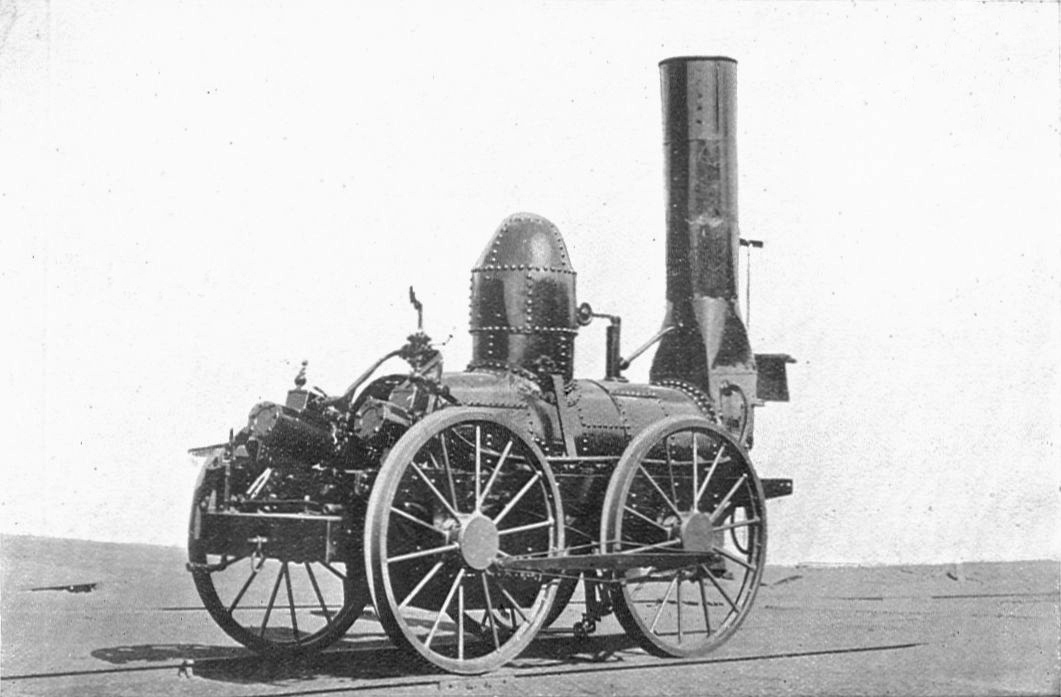
The DeWitt Clinton replica posed as the original 0-4-0 would have appeared, without the later tender and cars. Date unknown.
On Monday, August 9, 1831, the Clinton took a train of cars from plane to plane. The Albany Argus said the engine covered the route in less than an hour, including stops, and on part of the road ran at 30 miles an hour. John T. Clark rode as conductor. James Goold of Albany had built the cars on stagecoach bodies, seats inside and rumble seats on the roof. The resident engineer collected the first fifty cents of established passenger fare. It was the first steam passenger train in New York, and the first paying steam on the Mohawk & Hudson. The canal between the same two cities still took hours and more than a dozen locks.
Horses still worked the road. Steam was new, the planes were not finished, and the foundry engine was a light 0-4-0 on strap rail. Travelers who could pay rode it anyway. The plateau trip was about 40 minutes. That was the whole point of the charter.
September 24 and the Fulton
An English Stephenson engine arrived about the end of August on the Mary Howland. The company named it Robert Fulton. It was roughly twice the Clinton’s weight. Crews later called it John Bull. It is not the Camden & Amboy locomotive of that name; that story is the John Bull. Matthew put the English engine on the road in mid-September. For the directors’ grand opening on September 24, 1831 the Fulton was supposed to haul the official train. A feed-pipe failure put it back in the shed. The Clinton took three cars instead, about 47 minutes plane to plane, with the rest of the consist behind horses. Governor, judges, and legislators rode. The crowd got its celebration. Steam had already been in public service for six weeks.
The original Clinton did not last. The railroad scrapped it in 1833. A driving wheel turned up years later at West Albany. The New York Central built an operating replica, cars and all, for the 1893 Columbian Exposition. Henry Ford took that train in 1934. It is at The Henry Ford in Dearborn.
Freight, the canal, and Experiment
The Mohawk & Hudson was a passenger road with a canal looking over its shoulder. It hauled no freight in 1831 and had no cars for it. Demand showed up in 1832. In 1833 a directors’ committee grew lyrical about merchandise, Erastus Corning came on the board as vice-president, and the company ordered two new locomotives named Mohawk and Hudson, thirty freight wagons, and ten mixed cars. That same year it is credited with an early covered freight car—a covered gondola, ancestor of the boxcar. Car types can be found at freight cars.
Freight never paid the way the committee hoped. The road lost a little on it in 1834, made a little in 1835 and 1836, and dropped more than $5,000 in the panic year 1837. The Utica & Schenectady, chartered April 29, 1833, and opened in 1836, was forbidden by the state to carry freight at all, so it fed the Mohawk & Hudson no merchandise. In 1840 the directors voted to stop fighting the canal and to handle only local freight at rates that paid. Canal-style tolls on the Albany–Buffalo railroads came off in December 1851. That is a New York Central date. This company had already changed its name.
Jervis was not done with locomotives. In 1832 the West Point Foundry turned out his Experiment for the Mohawk & Hudson, a 4-2-0 with a swiveling four-wheel leading truck—the first of that American idea, built so the engine could take the road’s curves at speed. Matthew later wrote that he took it plane to plane, fourteen miles, in thirteen minutes with one water stop. The 4-2-0 type is sometimes called the Jervis.
The planes come off
The planes were slow, expensive, and in the way. Talk of removing them started in 1838. Schenectady relocated off Prospect Hill about 1841 so locomotives could run into town. Albany was harder. The company offered the city its State Street property and $150,000 in bonds if Albany would pay to kill both planes and bring the eastern terminus nearer the center. Troy was about to open its own railroad to Schenectady. That concentrated minds in Albany. The city guaranteed bonds. In September 1844 the Albany plane came out. New track climbed the glen of Patroon’s Creek—Tivoli Hollow—and terminated on Montgomery Street near Maiden Lane. The Broadway–Gansevoort–Third Avenue plane route was abandoned. The grade westward out of Albany is still the one the New York Central, Conrail, and CSX have been climbing ever since. In steam and early diesel years it was helper territory.
By 1833 the company already had about 15¾ miles of double track. The charter capital had long since been spent twice over. Appleton’s, adding construction from August 1830 through January 1, 1848, put the bill at $1,473,253. In 1847 the road carried 229,401 passengers. That is what a 16-mile shortcut around Cohoes was worth, even with the canal still full of boats.
Albany & Schenectady, 1847
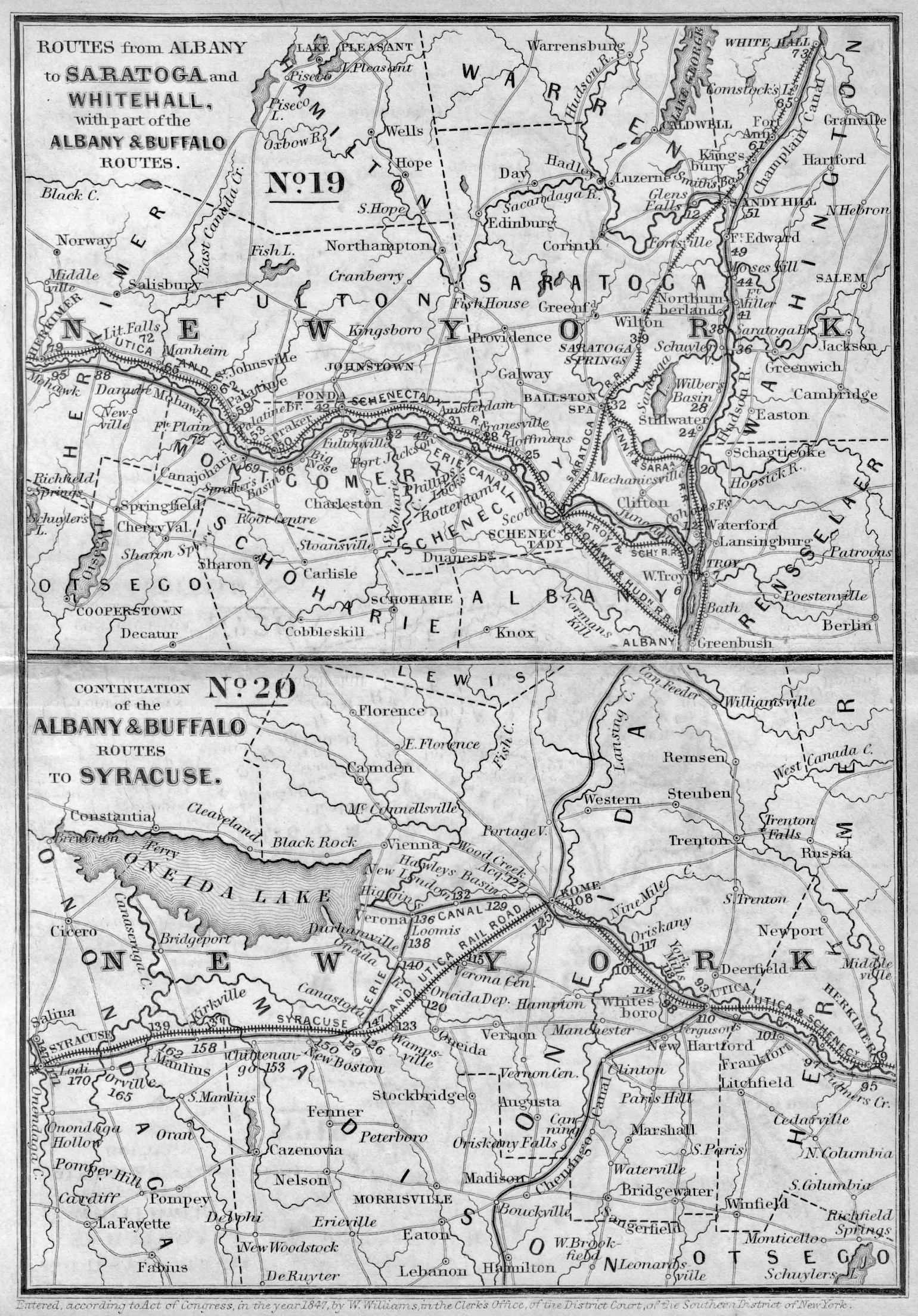
Albany & Schenectady Railroad system map, circa 1847, from W. Williams—the Albany–Schenectady line as a piece of the Albany & Buffalo routes. American-Rails.com collection.
On April 19, 1847 the Mohawk and Hudson Rail Road Company took the name Albany & Schenectady Rail Road Company. The rivers in the old title had been a promoter’s poetry. The cities were what the tickets said. Williams’s 1847 plates already draw the 16 miles as the eastern stub of an Albany–Buffalo chain, with the Saratoga road and the Utica & Schenectady heading west and north from the same Schenectady platform. The interchange Appleton’s listed that year was the Troy & Schenectady, the Saratoga Railroad, and the Utica & Schenectady. Those companies have their dates on the New York Central page. This page is the 16 miles that made Schenectady a junction.
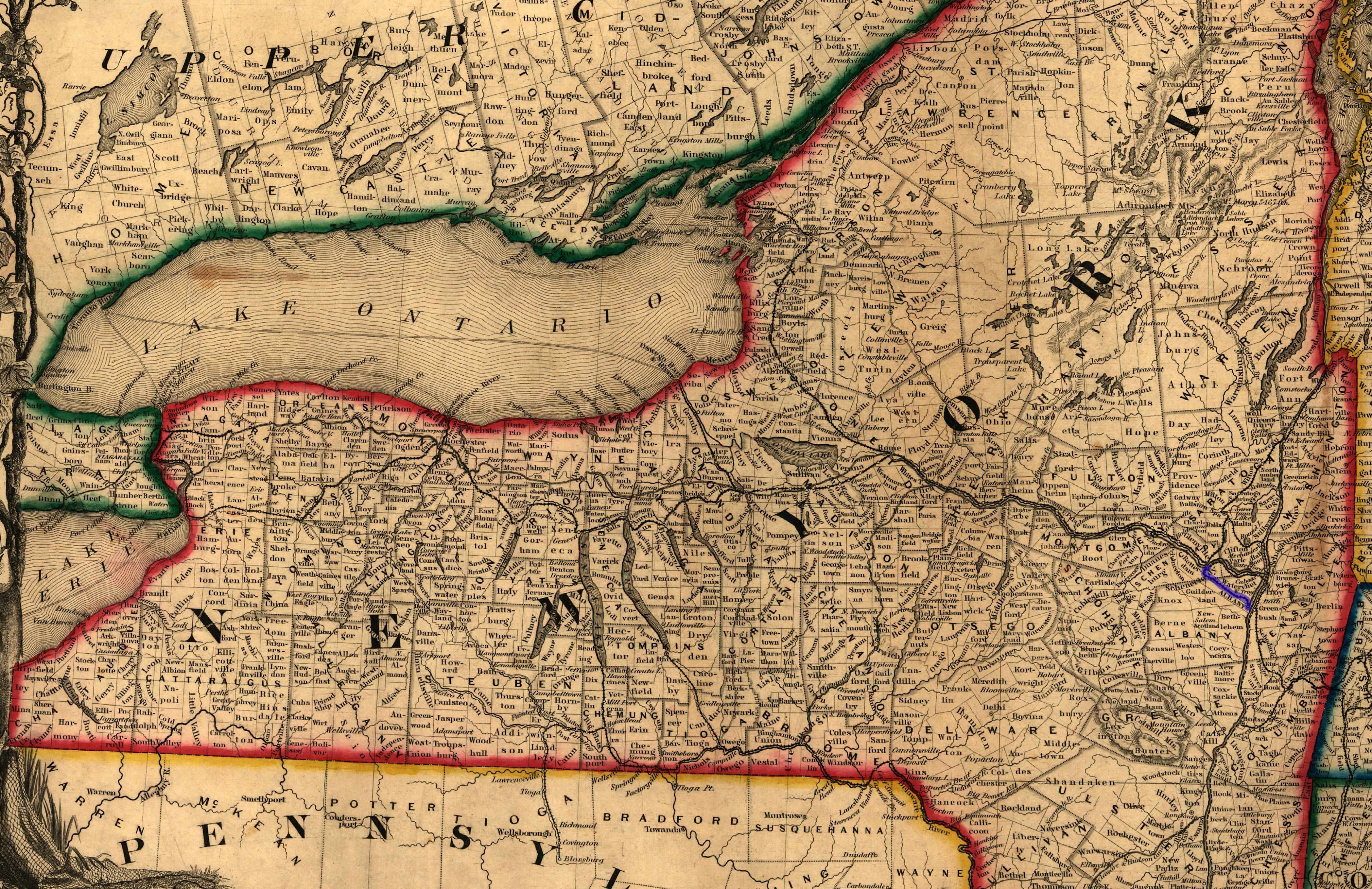
The Albany & Schenectady, highlighted in blue, circa 1850. Excerpt from Sherman & Smith’s Railroad, Steamboat & Stage Route Map of New England, New York, and Canada.
The first New York Central
By 1853 the plateau road was one short company in a line of short companies between the Hudson and Lake Erie. The Utica & Schenectady had opened in 1836. Syracuse, Auburn, Rochester, and Buffalo followed in pieces. Merger talk among the Albany–Buffalo roads hardened once the state dropped canal tolls on them in December 1851. On May 17, 1853 articles of consolidation joined ten companies as the original New York Central Railroad: the Albany & Schenectady; Utica & Schenectady; Syracuse & Utica; Rochester & Syracuse; Buffalo & Rochester; Rochester, Lockport & Niagara Falls; Buffalo & Lockport; Schenectady & Troy; Mohawk Valley; and Syracuse & Utica Direct.
Erastus Corning, who had sat on the Mohawk & Hudson board since 1833, became the first president of the consolidated company. For about a decade the first New York Central was an Albany–Buffalo railroad. Vanderbilt, the Hudson River entrance, and the Water Level Route as a New York–Chicago idea are later, and they are the Central’s story. The Mohawk & Hudson’s story ends when the Albany & Schenectady name is folded into that 1853 company.
What remains
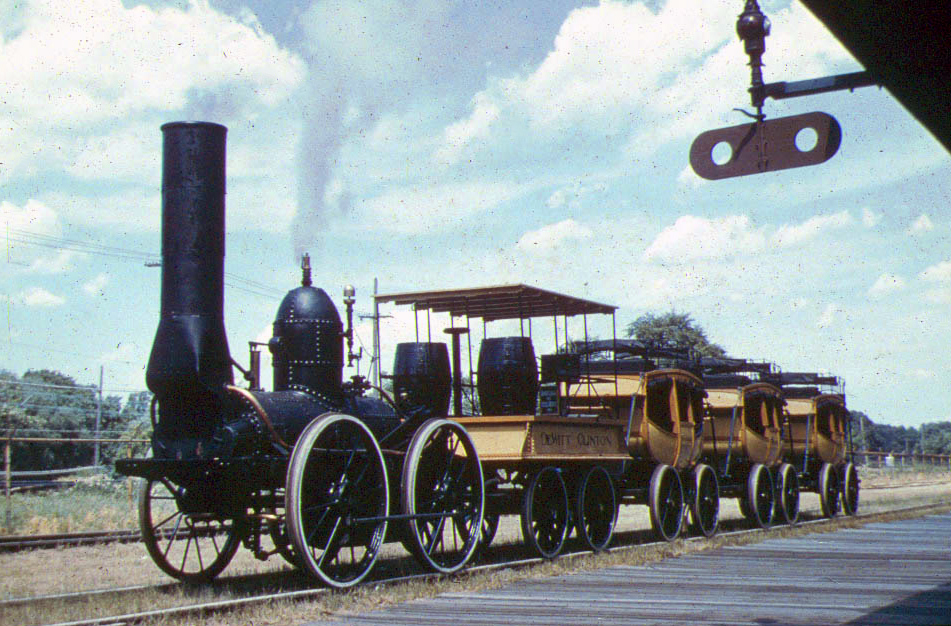
The New York Central replica of the DeWitt Clinton and its three stagecoach-body cars, later in the collection of The Henry Ford, Dearborn, Michigan.
The original Pine Bush alignment did not survive intact in the cities. Schenectady left Prospect Hill in the early 1840s. Albany left the Gansevoort plane in 1844 for Tivoli Hollow. Cuts and fills of the 1830s grade can still be read in Albany west of Delaware Avenue, and the 1844 creek-glen climb is the one heavy trains still use. Conrail, taking the bankrupt Penn Central on April 1, 1976, abandoned thousands of miles and kept this one. In the 1999 split it went to CSX as part of the Hudson Subdivision. Amtrak’s Empire Corridor—Empire Service, the Maple Leaf, the Lake Shore Limited—uses the same Albany–Schenectady miles. It is the oldest New York Central–heritage piece on that CSX subdivision. It is not the oldest iron on CSX. The Baltimore & Ohio, which CSX still runs, is older.
New York as a state is New York. The New York Central as a company is the New York Central. The founding decade is the 1820s and 1830s. The Mohawk & Hudson is the 16 miles, the planes, and a charter that beat every other railroad in the state onto the books—then waited five years for the money to catch up.
Related reading on American-Rails.com
- Railroad History (USA) · Railroads In The 1820s/1830s · New York
- DeWitt Clinton · Freight cars · Infrastructure
- New York Central · CSX · Amtrak
- Granite Railway · Baltimore & Ohio · Delaware & Hudson
- Camden & Amboy · South Carolina Canal & Rail Road · John Bull
- Stourbridge Lion · Best Friend of Charleston · Tom Thumb
Sources
- Interstate Commerce Commission, Valuation Docket, New York Central Railroad. Mohawk and Hudson Rail Road Company, special act of New York April 17, 1826; name changed to Albany and Schenectady Rail Road Company April 19, 1847; operated August 9, 1831, to consolidation; 16.89 miles; articles of consolidation dated May 17, 1853
- Harlow, Alvin F. The Road of the Century: The Story of the New York Central. New York: Creative Age Press, 1947. Chapter 1, the Mohawk & Hudson
- Brown, William H. The History of the First Locomotives in America. New York: D. Appleton, 1871. Chapter 37, letters of David Matthew and John T. Clark on the DeWitt Clinton and August 9, 1831
- Albany Argus, August 1831, first public steam trip plane to plane
- Schenectady Cabinet, December 28, 1825, Featherstonhaugh notice. Act of April 17, 1826, incorporating the Mohawk and Hudson Rail Road Company
- Williams, W. Appleton’s Railroad and Steamboat Companion. New York: D. Appleton & Company, 1847. Pages 190–192 (mileage, cost, passengers, interchange); 1847 route plates reproduced on this page
- Puffert, Douglas J. Tracks Across Continents, Paths Through History: The Economic Dynamics of Standardization in Railway Gauge. Chicago: University of Chicago Press, 2009. Original 4-foot-9-inch gauge
- Starr, Timothy. Early Railroads of New York’s Capital District. 2011
- Munsell, Joel. Annals of Albany. Groundbreaking and early operation
- The Henry Ford, Dearborn: DeWitt Clinton replica (New York Central, 1893 Columbian Exposition; acquired 1934–35)
Recent Articles


-
New York Halloween Train Rides (2026)
Sep 29, 26 12:08 AM
 2026 New York Halloween trains—Catskill Pumpkin Express October 17–18 and 24–25, Adirondack pumpkin and family trains, Arcade & Attica haunt, Cooperstown patch and trick-or-treat, Tupper Lake triv…
 -
North Carolina Halloween Train Rides (2026)
Sep 28, 26 11:56 PM
 2026 North Carolina Halloween trains—New Hope Valley Track or Treat on October 10, 17, 23, and 24, and Tweetsie Ghost Train Friday and Saturday nights through October 31. GSMR’s October menu is the go…
 -
Tweetsie Railroad Ghost Train Halloween Festival (2026)
Sep 28, 26 11:44 PM
 Tweetsie Ghost Train—Friday and Saturday nights September 25–October 31, 2026, in Blowing Rock. Adult $65, child $45. One reserved steam ride plus the park. Ages 8 and up for the haunt.
 -
Milwaukee Road Class A 4-4-2: Specs, Roster, History
Sep 28, 26 11:20 PM
 Milwaukee Road Class A Atlantics 1–4, Alco 1935–1937, for the Hiawatha. Order S-1740, 84-inch drivers, 19x28, 300 psi, 30,685 lb. Full builder specs, roster, and the May 15, 1935 run at 112.5 mph. All…
 -
Strasburg Rail Road Halloween Trains (2026)
Sep 28, 26 11:00 PM
 Strasburg’s 2026 Halloween tickets—Pumpkins in Paradise on October 3, The Haunting of Pumpkin Junction, and The Brakeman’s Curse through October 25. Three fares. Legacy of Sleepy Hollow is an earlier…
 -
GSMR Peanuts Pumpkin Train (2026): Not on This Year’s Ticket Menu
Sep 28, 26 10:50 PM
Great Smoky Mountains Railroad’s September 28, 2026 ticket menu lists Nantahala and Tuckasegee excursions. A Peanuts Great Pumpkin train is not on that menu. Polar Express is on the November calendar. -
New Jersey Halloween Train Rides (2026)
Sep 28, 26 06:45 PM
2026 New Jersey Halloween trains—Black River & Western to Everitt Farms through October 25, Delaware River Great Pumpkin through November 1, Whippany October 4, 10, and 11, Pine Creek night trains. -
New Hampshire Halloween Train Rides (2026)
Sep 28, 26 05:17 PM
 2026 New Hampshire Halloween train—Conway Scenic Halloween Express, October 24 and 25, about 1 hour from North Conway. Coach adult $30. Confirm on conwayscenic.com.
 -
Conway Scenic Pumpkin Patch Express (2026): Dates, Tickets & Tips
Sep 28, 26 05:09 PM
 Conway Scenic Halloween Express—October 24 and 25, 2026, about 1 hour from North Conway. Coach adult $30. A pumpkin after the ride while supplies last. Confirm on conwayscenic.com.
 -
Black River & Western Pumpkin Trains (2026): Dates, Tickets & Tips
Sep 28, 26 02:20 PM
 Suggested meta description: Black River & Western Pumpkin Train—Flemington to Everitt Farms, weekends September 26–October 25, 2026. Pumpkin patch, maze, and wagon rides. Confirm on blackriverrail…
 -
Scenic Dinner Train Rides (2026): A Complete Guide
Sep 28, 26 01:30 PM
 2026 scenic dinner trains by state—a seated meal on the train. Branson through October 30, Cincinnati Saturdays, Potomac Eagle, and the full state list. Confirm on the railroad.
 -
West Virginia Dinner Train Rides (2026): A Complete Guide
Sep 28, 26 11:58 AM
 2026 Potomac Eagle dining from Romney—about 3 hours in the Trough. Premium three courses $124. Superior four courses $159, ages 17 and older. Confirm on potomaceagle.com.
 -
Washington Dinner Train Rides (2026): A Complete Guide
Sep 28, 26 11:51 AM
 2026 Chehalis-Centralia dinner trains have run. The July 18 Roaring 20s dinner was $89. The planning calendar lists no later dinner. Confirm on steamtrainride.com.
 -
Texas Dinner Train Rides (2026): A Complete Guide
Sep 28, 26 11:27 AM
 2026 Texas has no plated dinner aboard the train. Grapevine sells snacks. The Texas State Railroad Dogwood lunch was served at the Rusk depot. Confirm on the railroad.
 -
Ohio Dinner Train Rides (2026): A Complete Guide
Sep 28, 26 10:15 AM
2026 Ohio dinner trains—Cincinnati Saturdays, $140, about 3 hours, ages 12 and up. Hocking Valley Elegant Dinner Train October 17 and November 7, from $95. -
Missouri Dinner Train Rides (2026): A Complete Guide
Sep 28, 26 10:09 AM
 2026 Branson Scenic Railway dinner train—three courses, about 2 hours, Fridays and Saturdays through October 30. Dome $123.50 plus tax. Confirm on bransontrain.com.
 -
Minnesota Dinner Train Rides (2026): A Complete Guide
Sep 28, 26 09:40 AM
 2026 North Shore Scenic Northwoods Dinner Train in Duluth—four courses in the SkyView dome, 2½ hours, $90, through September 26. Confirm on duluthtrains.com.
 -
Maine Dinner Train Rides (2026): A Complete Guide
Sep 28, 26 09:29 AM
 2026 Maine has no dining-car dinner. WW&F Pig Roast at SeaLyon Farm was June 13 and has run, $54.95. Sunset Express was a drink and ended September 5.
 -
Greenbrier, Cheat & Elk Railroad: Western Maryland's Logging Line
Sep 26, 26 11:59 PM
 Greenbrier, Cheat and Elk—the logging railroad the Western Maryland bought in 1927. Cass to Spruce, Summit Cut at 4,066.6 feet, Elk River Branch, Laurel Bank.
 -
Elkins (Western Maryland): Yard, History, Operations
Sep 26, 26 11:56 PM
 Western Maryland at Elkins—the Elkins Division yard, roundhouse, and wash rack. Belington, Durbin, Black Fork, and the Elk River branches met here.
 -
B&O's "Cincinnatian" (Train): Route, Consist, Timetable
Sep 26, 26 11:51 PM
 B&O Cincinnatian—Mount Clare five-car streamliner, January 19, 1947, trains 75 and 76. P-7d Pacifics 5301–5304. Detroit–Cincinnati from June 25, 1950, trains 53 and 54. Last run April 30, 1971.
 -
The Semaphore: Railroading's Classic Signal
Sep 26, 26 11:51 AM
 Railroad semaphore signals: blade and spectacle, lower quadrant and upper quadrant, US&S Style B and GRS Model 2A, Robinson’s track circuit, and the last blades on the Raton Subdivision.
 -
Black Fork Grade (Western Maryland): History and Operations
Sep 26, 26 11:47 AM
 Black Fork Grade—the Western Maryland climb through Blackwater Canyon. Thomas to Hendricks, past 3 percent, an H-9 and ten loads, helpers off at Fairfax.
 -
Western Maryland Steam Locomotives: History & Roster
Sep 26, 26 11:39 AM
 Western Maryland steam—H-9 Consolidations, I-2 Decapods, Lima 2-8-8-2s, Baldwin Challengers, and twelve Baldwin Potomac 4-8-4s. Post-1900 roster.
 -
Western Maryland Diesel Roster: All-Time
Sep 26, 26 11:32 AM
 Western Maryland diesels—S1 102 in 1941, fourteen F7 boosters, BL2s, hammerhead RS3s, Circus SD40s, and Chessie GP40-2s. Serials and order numbers.
 -
The Dutch Line (Western Maryland): History, Map, Operations
Sep 25, 26 09:38 PM
 Western Maryland Dutch Line—the Hanover Subdivision. Emory Grove to Highfield via Hanover and Gettysburg, York branch 1893, stone trains, and the route CSX still runs.
 -
The Durbin Branch (Western Maryland): History, Map, Operations
Sep 25, 26 09:13 PM
 Western Maryland Durbin Branch—the Coal & Iron Railway, 46.9 miles Elkins to Durbin, opened July 27, 1903. Mixed train until April 10, 1959. H-7B Consolidations.
 -
Western Maryland Railway: Map, Rosters, Logo, History
Sep 25, 26 10:24 AM
 Western Maryland Railway—the Fast Freight Line. Baltimore, Carroll & Frederick, May 27, 1852. Connellsville Extension 1912. Chessie, then into the B&O May 1, 1983.
 -
Illinois Dinner Train Rides (2026): A Complete Guide
Sep 25, 26 09:52 AM
2026 Monticello Railway Museum Murder Mystery Dinner Train—June 13, July 11, August 1, and September 5 have run. Three courses, about 2 hours, $112. Confirm on mrym.org. -
Georgia Dinner Train Rides (2026): A Complete Guide
Sep 25, 26 12:29 AM
 2026 Azalea Sprinter dinner train from Nashville and Willacoochee, Georgia—2½ hours. Club Car adult $147, Executive adult $177. Confirm on azaleasprinter.com.
 -
Baldwin "Centipede" Locomotives: Specs, Roster, Photos
Sep 25, 26 12:02 AM
 Baldwin DR-12-8-1500/2 Centipede—2-D+D-2, two 608SC engines, 3,000 hp. SAL 4500 from the 1943 test bed. 54 on the serial list, 52 sold. PRR BP60 then BH50. None preserved.
 -
Florida Dinner Train Rides (2026): A Complete Guide
Sep 24, 26 11:56 PM
 2026 Seminole Gulf Murder Mystery Dinner Train in Fort Myers—five courses cooked onboard, 3½ hours, $129 or $135 Saturday, plus tax and gratuity. Confirm on semgulf.com.
 -
West Virginia Northern Railroad: Map, Photos, History
Sep 24, 26 11:27 PM
 West Virginia Northern—Kingwood to Tunnelton, 11 miles of Preston County coal. Narrow gauge 1888, standard gauge 1895. Last freight February 19, 1991. Consolidations 8 and 9 survive.
 -
Rutland Railroad: Map, Rosters, History, Logo
Sep 24, 26 01:18 PM
 Rutland Railroad—Follett’s Champlain & Connecticut River, November 1, 1843. Bellows Falls–Burlington December 18, 1849. Green Mountain Gateway. Last train September 25, 1961. Vermont Railway Janua…
 -
Arkansas Dinner Train Rides (2026): A Complete Guide
Sep 24, 26 01:12 PM
 2026 Eureka Springs & North Arkansas Dinner Train—Eurekan dining car, about 2 hours, $53.62 tax included, opens May 9, Tuesday, Wednesday, Friday, and Saturday. Confirm on esnarailway.com.
 -
Arizona Dinner Train Rides (2026): A Complete Guide
Sep 24, 26 01:01 PM
 2026 Arizona has no plated dinner train. Grand Canyon Railway sells snacks in the cars and meals in Williams or at the rim. Verde Canyon includes a charcuterie tray.
 -
Rail News, The Latest
Sep 24, 26 12:36 PM
This page provides a portal to the latest in rail news, from preservation and restortation subjects to other notable topics. -
Cotton Belt 819 Moved Outside at Pine Bluff for Evaluation
Sep 24, 26 12:35 PM
Cotton Belt 819 left the Pine Bluff shop on September 22, 2026, first time outside in about 30 years. RDG Steam Services is evaluating the engine. No donation link posted. -
Reading Steam Locomotives: History, Roster & Photos
Sep 24, 26 12:14 PM
 Reading steam—Wootten fireboxes, Camelback Consolidations, Mallets, K-1 Santa Fes, G-3 Pacifics, T-1 4-8-4s. Post-1900 roster after Drury. Rambles ended October 17, 1964.
 -
Reading Diesel Roster: All-Time
Sep 24, 26 12:10 PM
 Reading diesel roster—AGEIR boxcabs, FTs, FA-1s, RS-3s, Train Masters, GP30s through GP39-2s. Serials and order numbers. Conrail April 1, 1976.
 -
Reading Railroad: Map, Logo, History, Rosters
Sep 24, 26 12:08 PM
 Reading Company—Philadelphia & Reading, 1833. Anthracite, Port Richmond, Reading Terminal. Operating company January 1, 1924. Conrail April 1, 1976.
 -
Nevada Dinner Train Rides (2026): A Complete Guide
Sep 24, 26 12:02 PM
 2026 Nevada Northern Taste of Italy—adults-only gala from East Ely. The September 19 date has run. Confirm any later night on nnry.com.
 -
North Carolina Dinner Train Rides (2026): A Complete Guide
Sep 24, 26 11:24 AM
 2026 North Carolina dinner trains—NCTM Wine & Dine in Spencer sold out February 13–15. GSMR First Class is the plated meal on the Nantahala Gorge excursion. Confirm on the railroad.
 -
Railway Express Agency (REA): Signs, Trucks, Logo & History
Sep 24, 26 09:40 AM
 Railway Express Agency—railroad-owned express company. Incorporated December 7, 1928. Operations March 1, 1929. Red diamond, green trucks. Last regular express November 7, 1975.
 -
Michigan Dinner Train Rides (2026): A Complete Guide
Sep 24, 26 09:28 AM
 2026 Steam Railroading Institute dining in Owosso—select evenings, no public dinner dates posted. Confirm on michigansteamtrain.com.
 -
Pittsburgh and West Virginia Railway: Map, Rosters, History
Sep 24, 26 12:24 AM
 Pittsburgh & West Virginia—the Hi-Line. Wabash-Pittsburgh Terminal 1904. Railway January 29, 1917. Connellsville February 11, 1931. N&W lease October 16, 1964. Wheeling & Lake Erie from May 17, 1990.
 -
Indiana Dinner Train Rides (2026): A Complete Guide
Sep 24, 26 12:13 AM
2026 Spirit of Jasper Ride & Dine is paused. No public trains. Depot at 201 Mill Street stays open as a rental. Confirm on spiritofjaspertrain.com. -
New Jersey Dinner Train Rides (2026): A Complete Guide
Sep 24, 26 12:01 AM
2026 Woodstown Central Dining in Motion—private table of four from $190, about an hour, Salem County. Confirm on woodstowncentral.com. -
Maryland Dinner Train Rides (2026): A Complete Guide
Sep 23, 26 05:19 PM
 2026 Western Maryland Scenic Allegheny Mountain Dinner Train—Cumberland, 3 hours, 21+, Saturday 7 p.m. Confirm on wmsr.com.
 -
Pittsburgh and Lake Erie Railroad: Map, Rosters, Photos
Sep 23, 26 03:28 PM
 Pittsburgh & Lake Erie—the Little Giant. Chartered 1875, Pittsburgh to Youngstown February 10, 1879. New York Central from 1883. Independent May 15, 1979. Last day September 11, 1992.