
Road-Switcher Locomotives: Definition, Purpose, History
Last revised: November 5, 2024
By: Adam Burns
Road-switchers are the modern all-around locomotives of the diesel age. The newest models are most often employed as main line power with older examples used in secondary, branch, and various yard duties (a setup that has been used since second-generation diesels appeared in the 1960s).
History
The term road-switcher describes a locomotive that can handle both road and switching chores, offering comparable horsepower for either. The design first appeared in the early 1940s by one of the early diesel pioneers, the American Locomotive Company (Alco).
Railroads liked what the manufacturer offered and for nearly a decade Alco led the market in this area. However, eventually Electro-Motive caught up and cataloged some of the best remembered road-switchers of all time.
Today, General Electric (which sold its locomotive division to Wabtec in 2019) holds the title as top builder continuing to sell thousands of its modern, high-horsepower Evolution Series (ES).
The future of EMD will be interesting to watch; hopefully the builder can maintain a foothold in the market.
Photos
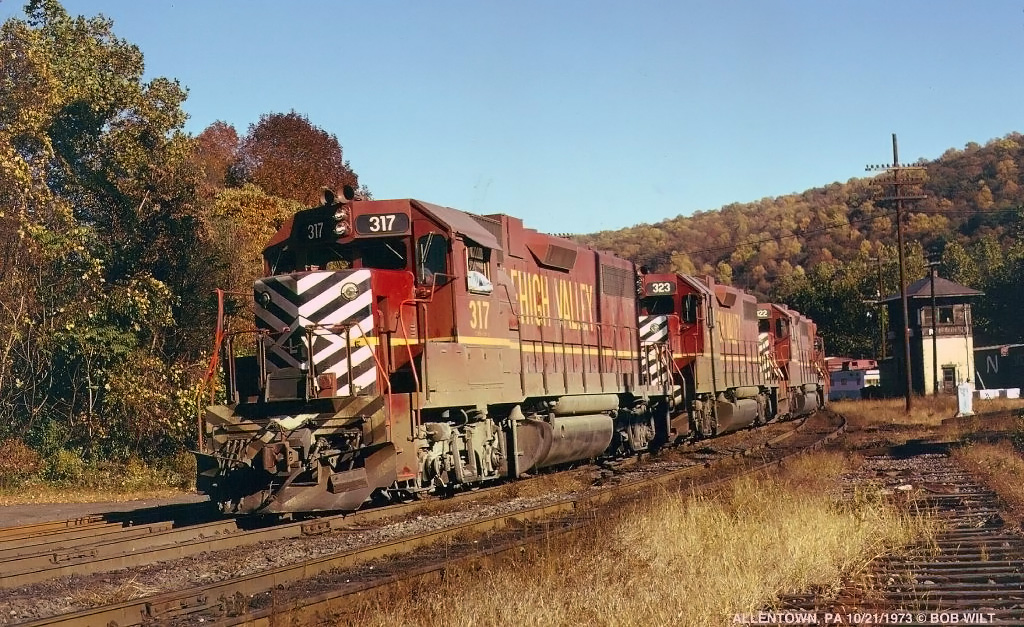 A trio of Lehigh Valley GP38-2s - #317, #323, and #322 - are seen here in service at Allentown, Pennsylvania on October 21, 1973. Bob Wilt photo. Warren Calloway collection.
Alco RS1
The first diesel locomotives put into service were switchers, boxcab designs first developed by General Electric, Inger-Soll Rand, and Alco in the 1920s.
Roughly a decade later Alco, GE, and the new Electro-Motive Corporation all began marketing their own versions. For Alco the builder first cataloged its new S1 in 1940, which led to an entire series.
This little switcher was small and compact with a cab on one end, capable to producing 600 horsepower. It was well-received and in the end Alco produced more than 3,000 examples among seven models.
Soon after the release of the S1 the manufacturer cataloged another curious creature in 1941 that it dubbed the "RS1." Short for Road-Switcher this locomotive was essentially an elongated switcher with a stretched hood and off-set cab, leaving a short hood on the other end.
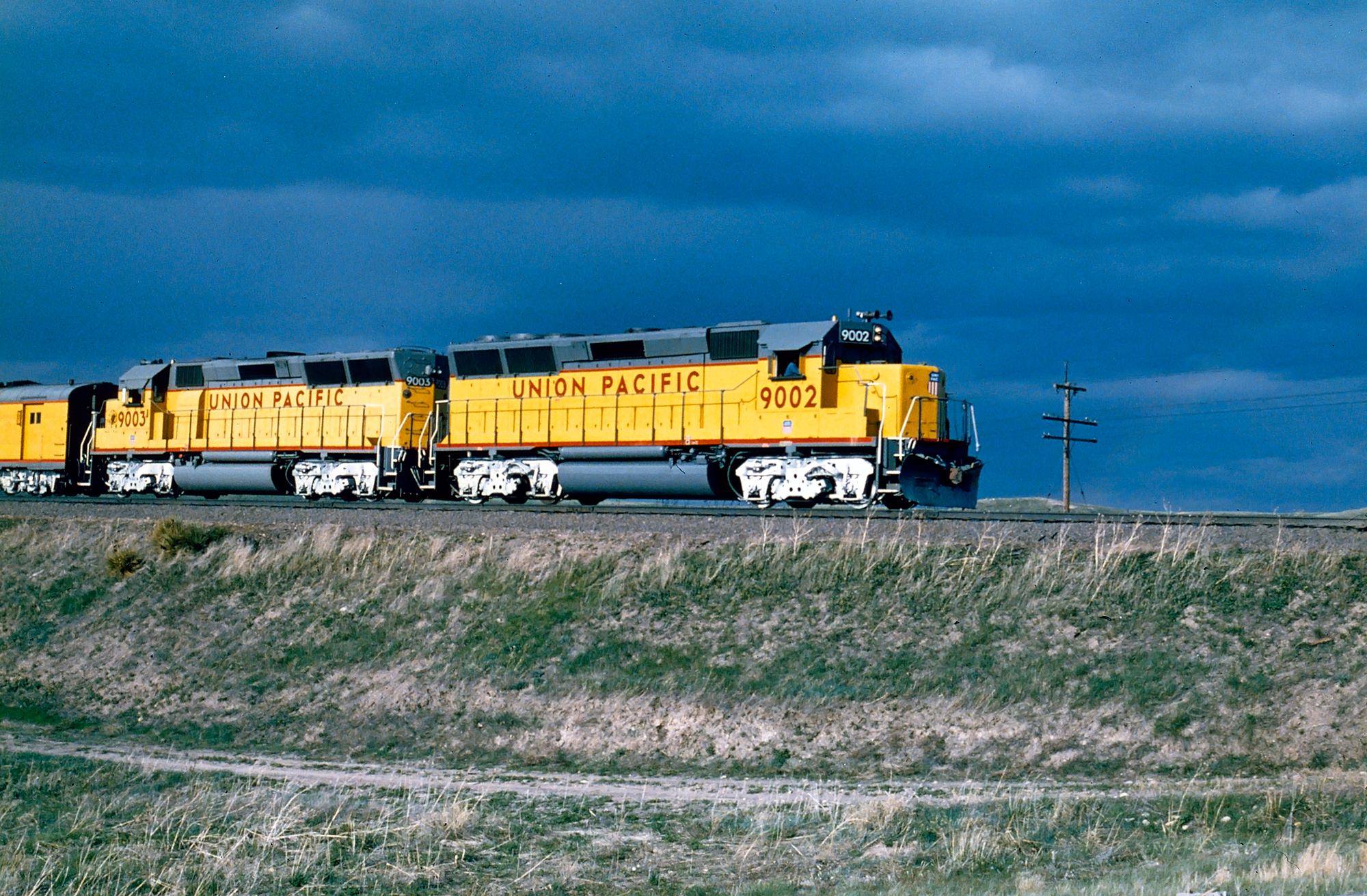 Union Pacific GP40X's #9002 and #9003 have the company business train west of Cheyenne, Wyoming, circa 1983. Mike Bledsoe photo. American-Rails.com collection.
FT Model
The cab rose far above the hood giving the engineer and other crewmen clear visibility and sight-lines. At the time many railroads were already enamored with Electro-Motive's revolutionary FT cab design after a demonstrator toured coast-to-coast in 1939 leaving a lasting impression. In the end, more than 1,000 examples were manufactured through 1945.
However, interest in the new RS1 was also growing since it offered the ability to either act as a switcher or pull standard freight trains. It is quite likely that Electro-Motive was caught off guard by Alco's new design; not only had someone else launched a completely new concept but it was also successful selling more than 400 examples.
Alco would catalog the RS1 through 1960 although just after World War II it offered more powerful types like the RS2 and RS3, which themselves sold impressively (nearly 2,000 units, combined).
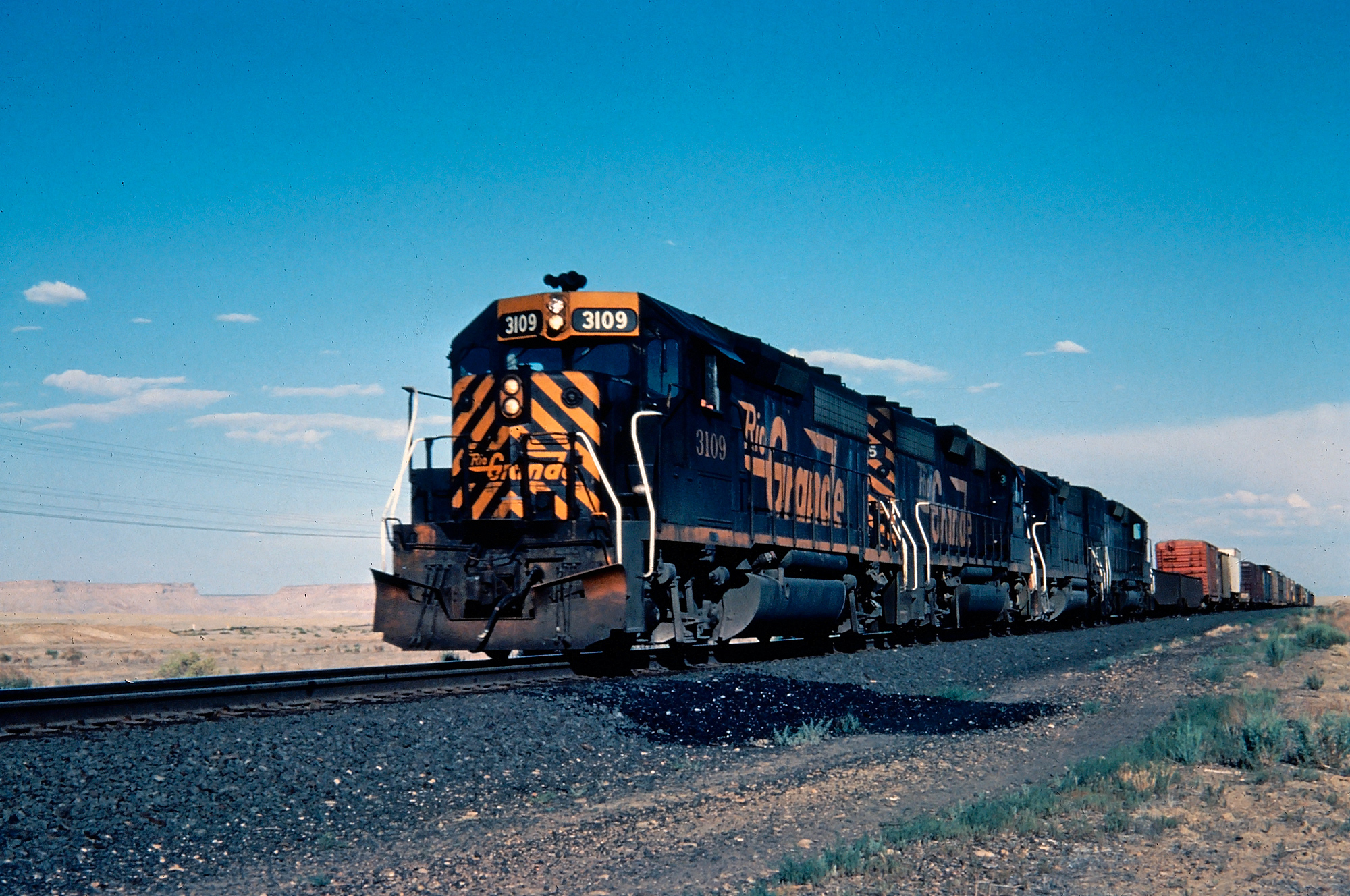 Rio Grande GP40-2 #3109 leads a westbound through eastern Utah, circa 1975. America-Rails.com collection.
By the late 1940s Electro-Motive was a full division of General Motors and realized that it needed its own road-switcher model not only due to the success Alco had displayed but also because virtually every other competing manufacturer already offered one; Baldwin began with the DRS-4-4-1500 in 1946 and Fairbanks Morse released its H15-44 in 1947.
Neither of these two companies would become major threats to EMD although FM would later offer the revolutionary Train Master and Baldwin began cataloging more reliable models by the 1950s (as sales were trending up no less) when new owner Westinghouse pulled the plug on its locomotive division.
In 1948 EMD released the ill-fated BL2, a fascinating contraption that appeared to be half-cab unit, half true road-switcher. It was intended to offer crews better visibility but ultimately wasn't very successful selling less than 60 examples.
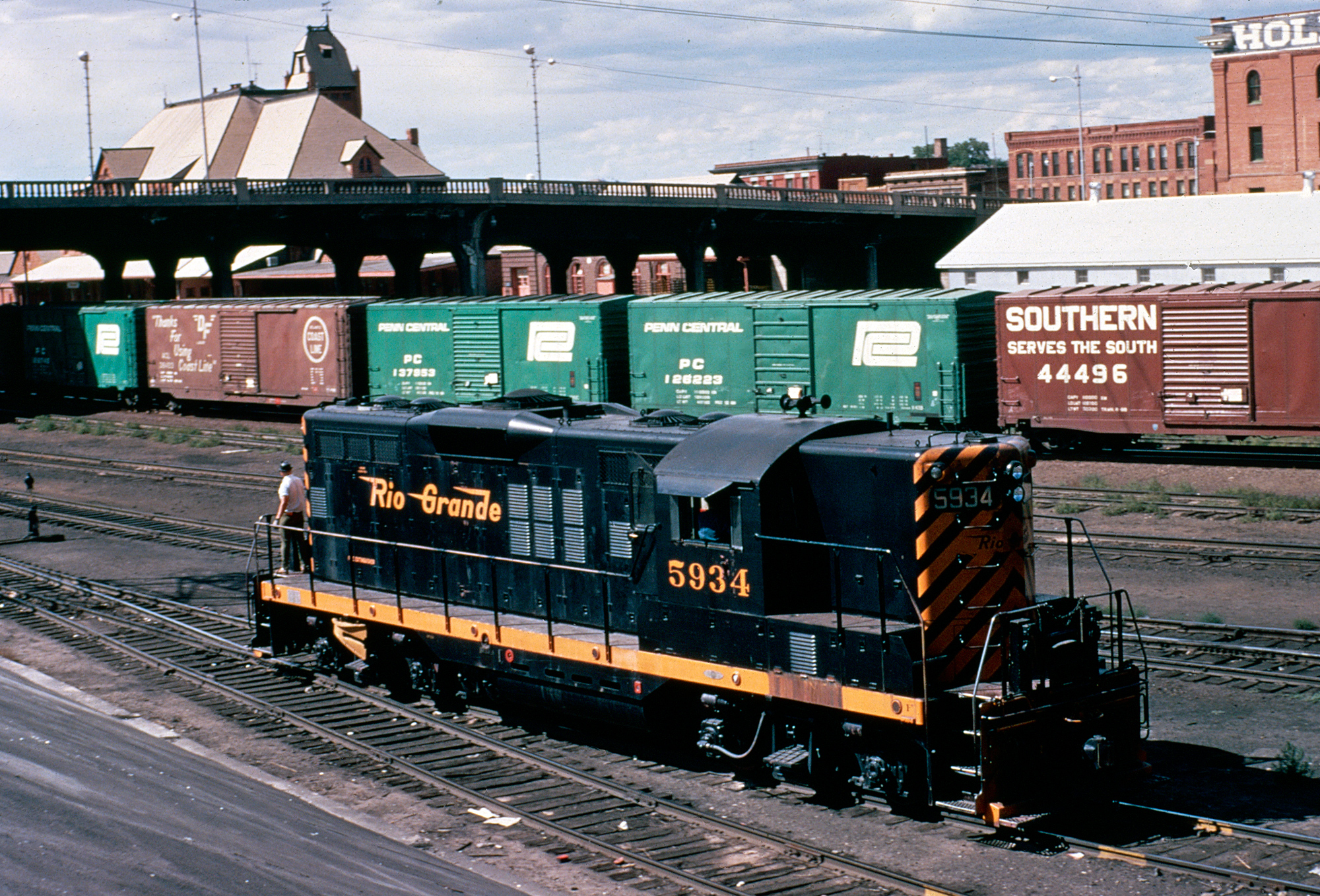
GP7 Model
Undaunted, EMD engineers returned to the drawing board and in short order had a new model within a year, the GP7. The "GP" was short for General Purpose and these initials also gained the series its own nickname, Geeps.
With upwards of 3,000 units sold the success of this locomotive was unprecedented as it is credited with finishing off the reign of steam, an effort kicked off by the FT.
The later GP9 of 1954 was even more successful and between the two, along with EMD's already popular E and F series cab units, the builder now dominated every level of the locomotive marketplace.
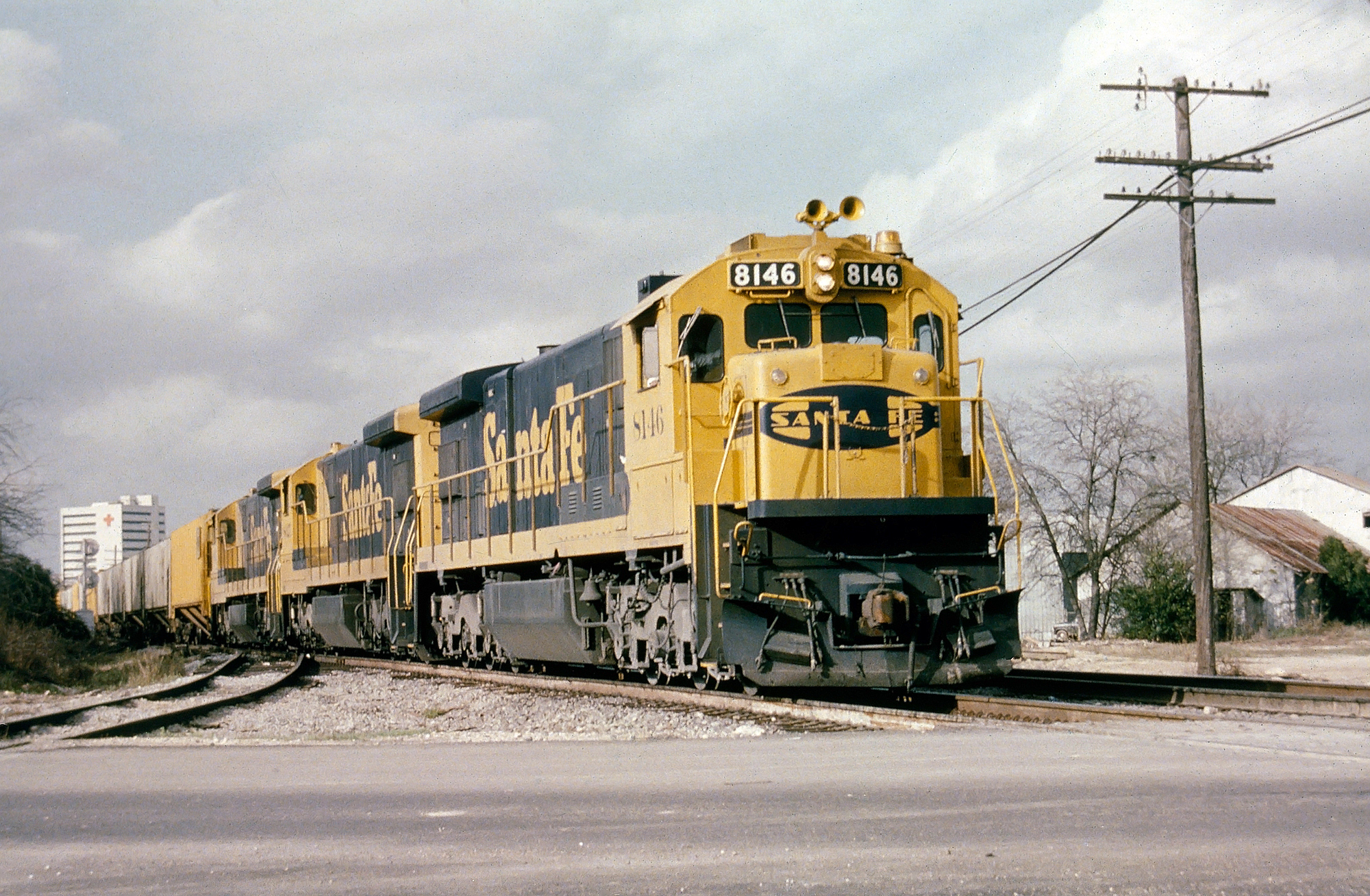
As successful as the GP series was its four-axle, B-B design would eventually fall out of favor by the 1970s. For more than two decades such a setup proved satisfactory to railroads although they came realize the benefits of six-axle, C-C models by the 1970s.
Universal Series
By the time second-generation units arrived in the early 1960s much more robust 2,500 horsepower units were commonplace and before the decade ended this number had reached 3,000+.
The '60s also witnessed a major manufacturer shutting down its plant in Schenectady, New York (Alco) and another becoming a major player, General Electric. GE's original "U-boats," starting with the U25B of 1959-1960 were boxy and troublesome.
However, they were also cheaper than comparable EMD products while still offering easy maintenance. Most U-boats didn't sell more than a few-hundred examples although that changed by the mid-1960s when the U30C, U33C, and U36C sold more than 1,200 units combined.
GE was becoming a better builder and its models continued to sell well through the 1970s even through Electro-Motive still dominated with the SD40/-2 and other variants.
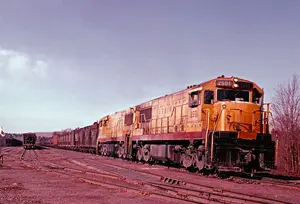
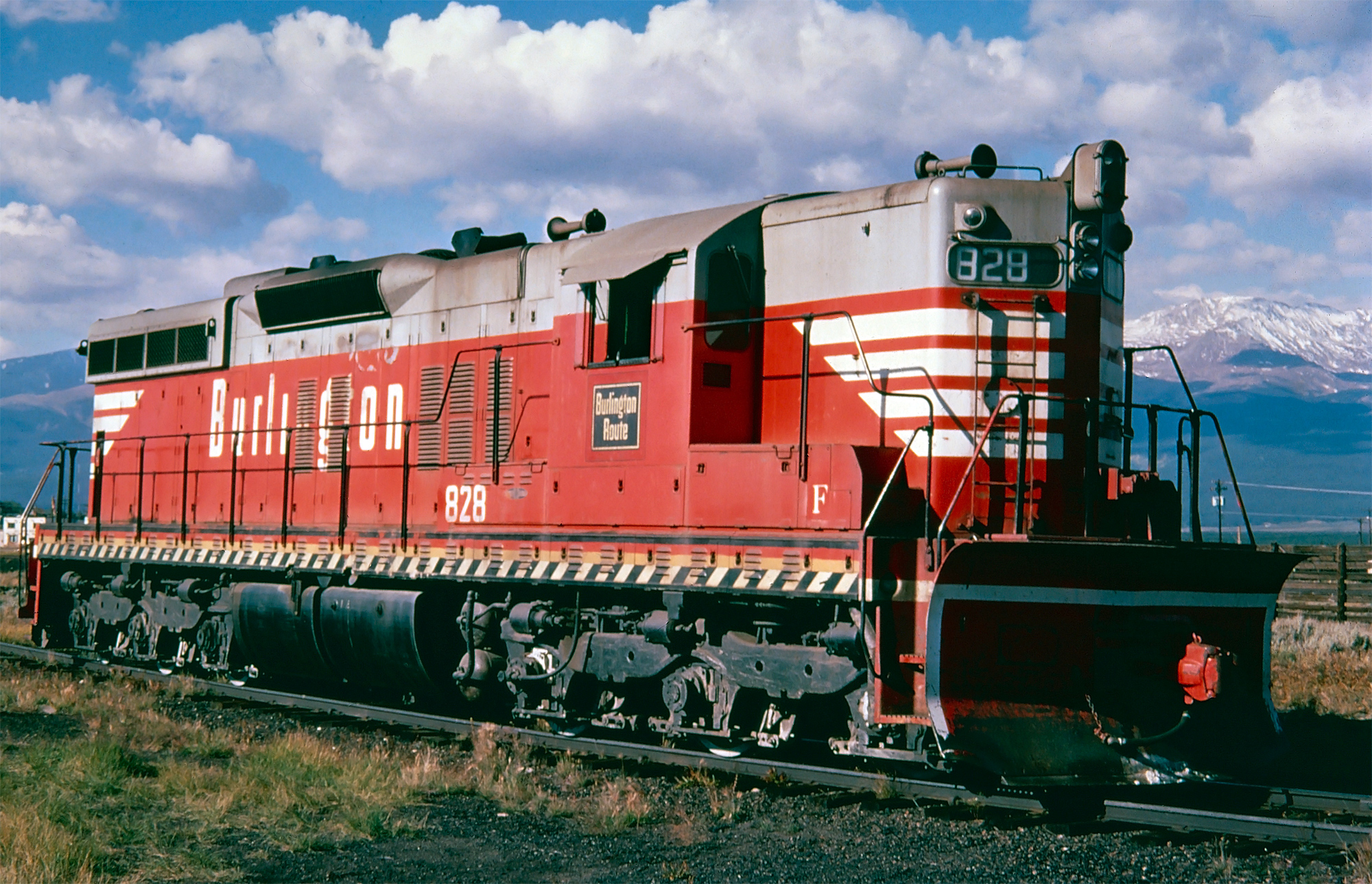 Burlington (Colorado & Southern) SD9 #828 at Leadville, Colorado, circa 1967. The unit was assigned here to serve the Henderson Mine. American-Rails.com collection.
Today
During the 1980s General Electric would grab the top sales spot for good after EMD stumbled with the SD50 of 1981, something which has remained unchanged to this day.
Later that decade and through the 1990s GE began selling thousands of units within its "Dash 7," "Dash 8," and "Dash 9" series. This continues to hold true with its latest Evolution Series. Today, EMD is no longer a division of General Motors and has slipped far behind its rival although it still holds its own with its SD70 series.
In addition, General Electric is no longer in the locomotive manufacturing market; in 2019 it sold out to Wabtec Freight which now produces the GE brand.
Road-switchers of the current generation, models like the SD70ACe-T4 and ET44AC, are far more advanced than the first RS1s and GP7s that rolled off the assembly line more than 70 years ago; they are far longer and feature things like steerable trucks, AC traction motors, self-loading, high-tech electronics, and a horsepower rating exceeding 4,000 that has become the industry standard.
Sources
- Kirkland, John F. Diesel Builders, The: Volume One, Fairbanks-Morse And Lima-Hamilton. Glendale: Interurban Press, 1985.
- Kirkland, John F. Diesel Builders, The: Volume Two, American Locomotive Company And Montreal Locomotive Works. Glendale: Interurban Press, 1989.
- Kirkland, John F. Diesel Builders, The: Volume Three, Baldwin Locomotive Works. Pasadena: Interurban Press, 1994.
- Marre, Louis A. and Pinkepank, Jerry A. Contemporary Diesel Spotter's Guide, The: A Comprehensive Reference Manual To Locomotives Since 1972. Milwaukee: Kalmbach Publishing Company, 1989.
- Marre, Louis A. Contemporary Diesel Spotter's Guide, The: A Comprehensive Reference Manual To Locomotives Since 1972, Including Rebuilding, Upgrading, And Leasing Programs (2nd Edition). Milwaukee: Kalmbach Publishing Company, 1995.
- Marre, Louis A. Diesel Locomotives: The First 50 Years, A Guide To Diesels Built Before 1972. Milwaukee: Kalmbach Publishing Company, 1995.
- McDonnell, Greg. Locomotives: The Modern Diesel & Electric Reference, 2nd Edition. Buffalo: Boston Mills Press/Firefly Books, 2015.
- Schafer, Mike. Vintage Diesel Locomotives. Osceola: MBI Publishing, 1998.
- Solomon, Brian. American Diesel Locomotive, The. Osceola: MBI Publishing, 2000.
Recent Articles


-
Alco "PA" Locomotives: Restoration, Specs, Engine, Rosters
Oct 27, 26 12:12 AM
 Alco's PA passenger cab, 297 locomotives built from 1946 to 1953. The 244 engine, the production roster, the Delaware & Hudson PA-4s, and Nickel Plate Road 190.
 -
Milwaukee Road Diesel Roster: (All Time)
Oct 26, 26 01:44 PM
 All-time diesel roster of the Milwaukee Road. 1,208 locomotives, each frame once. Alco, Baldwin, Davenport, EMD, Fairbanks-Morse, General Electric, and Whitcomb, with builder numbers.
 -
Milwaukee Road Steam Roster (All-Time): Post-1900
Oct 26, 26 01:38 PM
 Milwaukee Road steam locomotives built since 1900. Prairies, Mikados, the N-class articulateds, the S-class 4-8-4s, and the Hiawatha Atlantics and Hudsons. Quantity column 1,974. Unique frames 1,951.
 -
Milwaukee Road: Map, Electrification, Logo, History
Oct 26, 26 01:20 PM
 The Milwaukee Road, from the Milwaukee & Mississippi of 1850 to the Pacific Coast Extension, the Hiawathas, and the Soo Line sale. Why Lines West should have stayed.
 -
Lake Superior & Ishpeming Railroad: Map, Roster, History
Oct 25, 26 11:38 PM
 Lake Superior & Ishpeming Railroad, reporting mark LSI, from the Marquette Range to the Presque Isle ore dock. The 1954 steam list and the diesels the railroad owned.
 -
Kansas City Southern Steam Roster (Built Since 1900)
Oct 25, 26 09:09 PM
 Steam locomotives of the Kansas City Southern built since 1900, with the Louisiana & Arkansas and the Texas company.
 -
Kansas City Southern Diesel Roster (Built New)
Oct 25, 26 11:46 AM
All-time diesel roster of the Kansas City Southern. E units, F units, Geeps, SD40s through SD70ACes, Fairbanks-Morse, Baldwin, Alco, and General Electric, with serials and order numbers. -
Kansas City Southern Railway: Map, Photos, History
Oct 25, 26 12:24 AM
 The Kansas City Southern, from Arthur Stilwell's Gulf line to Canadian Pacific Kansas City on April 14, 2023. Steam and diesel rosters, the Southern Belle, and the Louisiana & Arkansas.
 -
Indiana Harbor Belt Diesel Roster (All-Time)
Oct 25, 26 12:17 AM
 All-time diesel roster of the Indiana Harbor Belt. 202 locomotive frames, each counted once. NW2s, SW7s, SW1500s, road switchers, and gensets. Slugs and boosters are outside the count.
 -
Indiana Harbor Belt Steam Roster (Built Since 1900)
Oct 25, 26 12:13 AM
 Steam locomotives of the Indiana Harbor Belt built since 1900. 182 engines, each counted once. 0-6-0s, 2-6-0s, 0-8-0s, and 2-8-2s. The three U-4a switchers are three-cylinder Brooks engines of 1927.
 -
Indiana Harbor Belt Railroad: Map, Rosters, History
Oct 25, 26 12:00 AM
 Indiana Harbor Belt, the inner belt across the Calumet, from the East Chicago Belt of May 16, 1896. Renamed June 29, 1907. Still operating, headquarters Hammond. Steam roster is the companion, 182 loc…
 -
NYC's "P Motor" Electric Locomotives
Oct 24, 26 11:43 PM
 New York Central P motors: 22 Alco-GE 2-C+C-2 electrics, Cleveland Union Terminal 1050–1071, class P-1a. 3,030 hp one-hour on 3,000-volt DC catenary, then 660-volt third rail as P-2a and P-2b.
 -
Illinois Terminal Car Roster
Oct 24, 26 11:40 PM
 Illinois Terminal cars. Mainline motors, the 1948 streamliners, sleepers, Alton and Valley Division cars, express motors, and the line cars rebuilt from pull cars.
 -
Illinois Terminal Diesel Roster
Oct 24, 26 09:31 PM
 All-time Illinois Terminal diesels, 62 frames. Alco S-2s and RS-1s, EMD switchers, GP7s, SD39s, GP38-2s, and the two GP20s. Serial numbers from the 1989 roster.
 -
Illinois Terminal Electric Locomotives
Oct 24, 26 08:22 PM
 Illinois Terminal electric locomotives, 57 frames. Class A through Class D, the Decatur-built motors, and the battery locomotives. Class D is the same five Class C frames, rebuilt.
 -
Illinois Terminal Steam Roster
Oct 24, 26 07:37 PM
 Illinois Terminal steam locomotives, 36 frames. Baldwin Moguls, three Class 30 Mikados, Florida East Coast 0-8-0s, and 2-6-0 No. 21, the last fire on June 30, 1950.
 -
Illinois Terminal Railroad: Map, Roster, Photos, History
Oct 24, 26 07:32 PM
Illinois Terminal, McKinley's Illinois Traction System, from the Danville coal towns to St. Louis. The McKinley Bridge, the sleeping cars, the 1937 break with the power company, the 1948 streamliners… -
Southern Railway Diesel Roster (All-Time)
Oct 23, 26 11:00 PM
 All-time diesel roster of the Southern Railway. 2,505 locomotives in the system number series, from the 1939 demonstrator FT to GP50s and B30-7A1s. Serials included.
 -
Illinois Central Diesel Roster (All-Time)
Oct 23, 26 04:06 PM
 Illinois Central and Illinois Central Gulf diesel locomotives, each frame once. The quantity column is 886. Serials and order numbers from Electro-Motive's builder lists. Paducah rebuilds and Gulf, Mo…
 -
Illinois Central Gulf Diesel Roster
Oct 23, 26 04:02 PM
 Illinois Central Gulf operating numbers from August 10, 1972, to February 29, 1988. New frames stay on the Illinois Central diesel roster. Gulf, Mobile and Ohio frames stay on that roster. No Gulf fle…
 -
Illinois Central Railroad: Map, Logo, History
Oct 23, 26 03:50 PM
Illinois Central, the Main Line of Mid-America, from the 1850 land grant to Canadian National control on July 1, 1999. Charter lines, Cairo bridge, Paducah, and the Illinois Central Gulf. Steam quanti… -
Grand Trunk Western Diesel Roster (All-Time)
Oct 23, 26 12:53 PM
 Grand Trunk Western diesel locomotives, each frame once. The quantity column is 377. Serials are filled for the Detroit, Toledo and Ironton and Detroit and Toledo Shore Line engines the railroad kept…
 -
Grand Trunk Western Steam Roster
Oct 23, 26 12:14 PM
 Grand Trunk Western steam locomotives in service about 1937 to 1942, from Richard Leonard's class list. Drury has no chapter. The quantity column is the counted Grand Trunk Western rows. Two mixed Gra…
 -
Grand Trunk Western Railroad: Map, Roster, History
Oct 23, 26 12:09 PM
 Grand Trunk Western, reporting mark GTW, Canadian National's railroad between Port Huron and Chicago. Trade name adopted in 1923. Steam class list quantity 232. Diesel quantity column 377. Identity in…
 -
Green Bay and Western Railroad: Map, Rosters, History
Oct 22, 26 11:18 PM
 Green Bay & Western, the Green Bay Route, reporting mark GBW. From Kewaunee to Winona. Mailer's steam and diesel rosters, and the August 1993 sale to Fox Valley & Western.
 -
Chicago & North Western Class E-4: Streamlined 4-6-4 Hudsons
Oct 22, 26 10:28 PM
 C&NW Class E-4, nine streamlined 4-6-4s, 4001–4009, Alco 1938. 84-inch drivers, 25-by-29 cylinders, 300 psi. Conventional Chicago–Omaha trains. Oil in 1947–48. Retired 1953–1956.
 -
Gateway Western Railway: Map, Roster, History
Oct 22, 26 02:43 PM
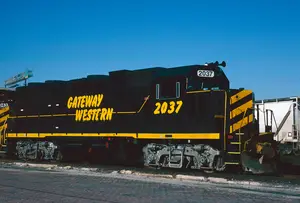
 Gateway Western Railway, reporting mark GWWR. Class II from Kansas City to East St. Louis. Kansas City Southern control May 5, 1997. The 1992 diesel fleet, with serials and order numbers.


%20SD9%20%23828%20at%20Leadville%2C%20Colorado%2C%20circa%201967.%20%20The%20unit%20was%20assigned%20here%20to%20serve%20the%20Henderson%20Mine.%20%20American-Rails.com%20collection.)