Tracking Green: Environmental Benefits of Rail vs. Air and Road Travel
Published: January 22, 2025
By: Adam Burns
The transportation sector is a significant contributor to global greenhouse gas emissions, accounting for approximately 14% of worldwide emissions, according to the Intergovernmental Panel on Climate Change (IPCC).
As nations seek to curb climate change, understanding the environmental impact of different modes of travel—specifically rail, air, and road—is critical.
This article explores the environmental benefits of rail travel compared to air and road travel, highlighting the potential for rail to play a pivotal role in a sustainable future.
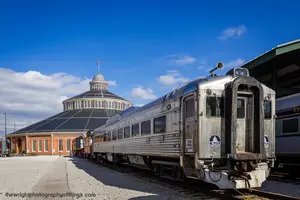
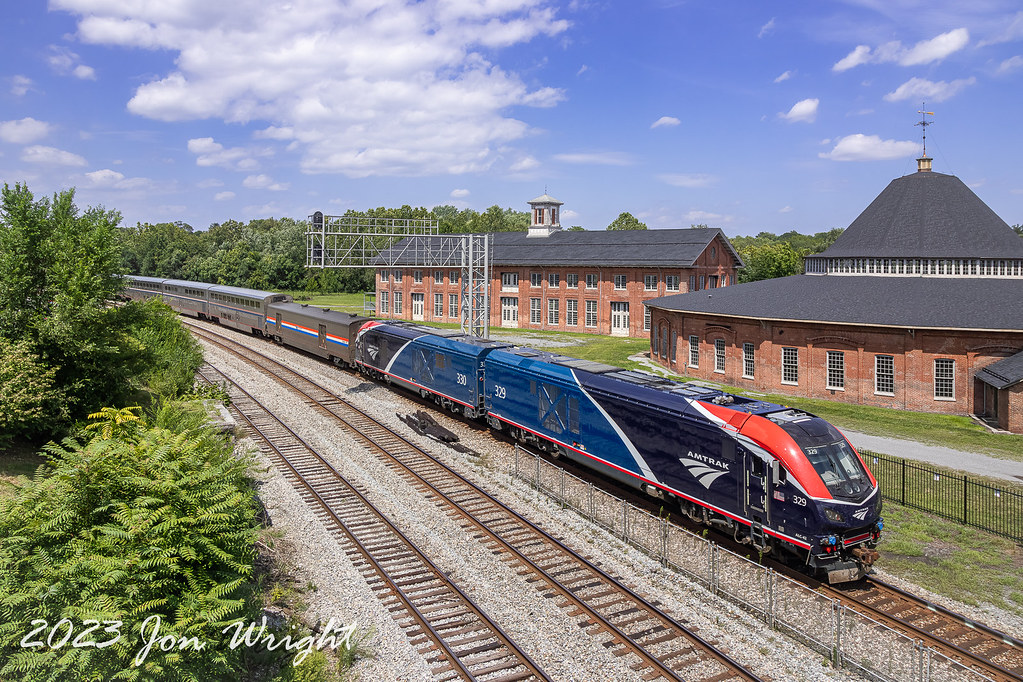 A pair of Amtrak's new ALC-42's, #329 and #330, roll by the historic B&O shops in Martinsburg, West Virginia with the eastbound "Capitol Limited" on August 11, 2023. Jon Wright photo.
Energy Efficiency and Emissions
One of the primary reasons rail travel is considered more environmentally friendly than other forms of transportation is its superior energy efficiency.
Trains are notoriously better at converting energy into forward momentum than cars and planes, primarily because steel wheels on steel tracks encounter less friction than rubber tires on pavement or air resistance at altitude.
1. **Rail Travel**: Trains, particularly electric trains, are the most energy-efficient land transport option. According to the International Energy Agency (IEA), rail transports around 8% of the world’s passengers and 7% of freight but accounts for only 2% of total transport energy demand.
Electric trains, which can be powered by renewable energy sources, emit little to no direct pollutants. Even diesel-powered trains are more efficient than cars or planes in terms of fuel consumption per passenger or ton of freight moved.
2. **Air Travel**: Airplanes are one of the least energy-efficient means of travel due to high fuel consumption and significant emissions during takeoff and landing.
The IPCC estimates that aviation is responsible for 2.5% of global CO2 emissions but has a more substantial total impact when accounting for other greenhouse gases and the effects of high-altitude emissions.
3. **Road Travel**: Road vehicles, including cars and buses, dominate the transportation sector, contributing over 70% of the sector’s emissions.
While fuel economy standards and electric vehicle adoption are improving, individual cars remain less efficient compared to rail, particularly in urban settings where congestion further reduces efficiency.
Land Use and Impact on Ecosystems
Land use is another environmental aspect where rail, air, and road travel differ significantly. The construction and maintenance of transport infrastructure can lead to habitat destruction, biodiversity loss, and changes in land use patterns.
1. **Rail**: Railways require relatively narrow strips of land compared to highways and airports. Once constructed, tracks can last for decades with minimal land impact, and rail lines often feature less fragmentation of ecosystems compared to roads.
2. **Air**: Airports occupy extensive areas of land and necessitate large buffer zones due to noise pollution. However, the actual 'path' planes take—sky corridors—do not impact terrestrial ecosystems, thus slightly offsetting the large land footprint of airport infrastructure.
3. **Road**: Roads and highways cover vast areas worldwide, required wherever road vehicles are used, leading to habitat fragmentation and significant ecosystem changes. Roads can disrupt wildlife corridors and lead to urban sprawl, as cities expand along highways.
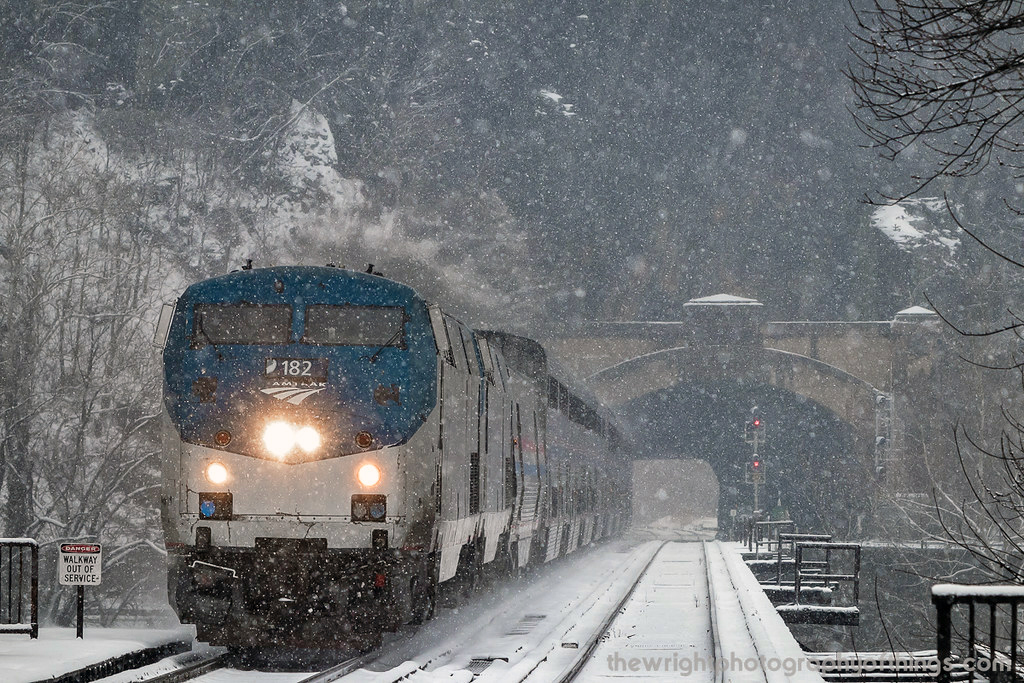 Amtrak's westbound "Capitol Limited" prepares to make its daily stop at Harpers Ferry, West Virginia on March 20, 2018. Jon Wright photo.
Noise Pollution and Community Impact
Noise pollution is a growing concern, especially in densely populated areas. It affects both human communities and wildlife, impacting health and behavior.
1. **Rail**: Modern trains are increasingly designed to minimize noise, although high-speed trains can be loud. Unlike road vehicles, the noise from trains is typically concentrated in specific corridors, making it easier to manage and mitigate.
2. **Air**: Airplanes contribute significantly to noise pollution, particularly around airports. The combination of takeoff and landing noise with the continuous operation of large airports can have a severe impact on nearby communities.
3. **Road**: Traffic noise is a persistent issue in urban areas, where constant traffic contributes to ongoing noise pollution. Moreover, road construction and maintenance can amplify noise concerns.
The Role of Technology and Innovation
Technological advancements and innovation play significant roles in determining the overall environmental impact of transportation modes.
1. **Rail**: Innovations such as high-speed rail and magnetic levitation trains promise further efficiency gains. The shift towards fully electric rail networks, powered by renewable energy, is crucial for reducing rail's carbon footprint even further.
2. **Air**: The aviation industry is working on more fuel-efficient aircraft and sustainable aviation fuels, aiming to cut emissions. However, the pace of technological advances may be insufficient to significantly reduce environmental impact compared to the near-term potential of expanding rail capacity.
3. **Road**: The rise of electric and hybrid vehicles offers potential reductions in emissions from road transport. However, this transition depends heavily on the energy mix used to produce electricity and the life cycle emissions of vehicle production.
Scalability and Infrastructure Investment
The future of environmentally sustainable travel lies not only in technology but also in policies and investments that prioritize scalable and sustainable transport networks.
1. **Rail**: Rail systems require significant up-front investment in infrastructure, but they offer substantial long-term benefits, including decreased road congestion and reduced emissions. National and cross-border rail networks can enhance accessibility while promoting sustainable economic growth.
2. **Air**: Expanding airport infrastructure can meet growing demand but at significant environmental costs. Air travel remains essential for long-distance and international travel, but compensatory environmental measures, like carbon offsetting, are necessary to mitigate impacts.
3. **Road**: Investment in public transit systems, particularly in urban areas, can lessen reliance on personal vehicles and reduce emissions. However, maintaining extensive road networks remains necessary regardless of personal vehicle use due to freight and public transport needs.
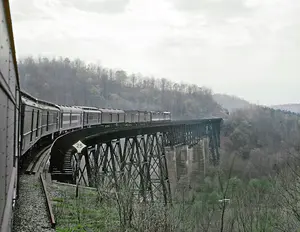
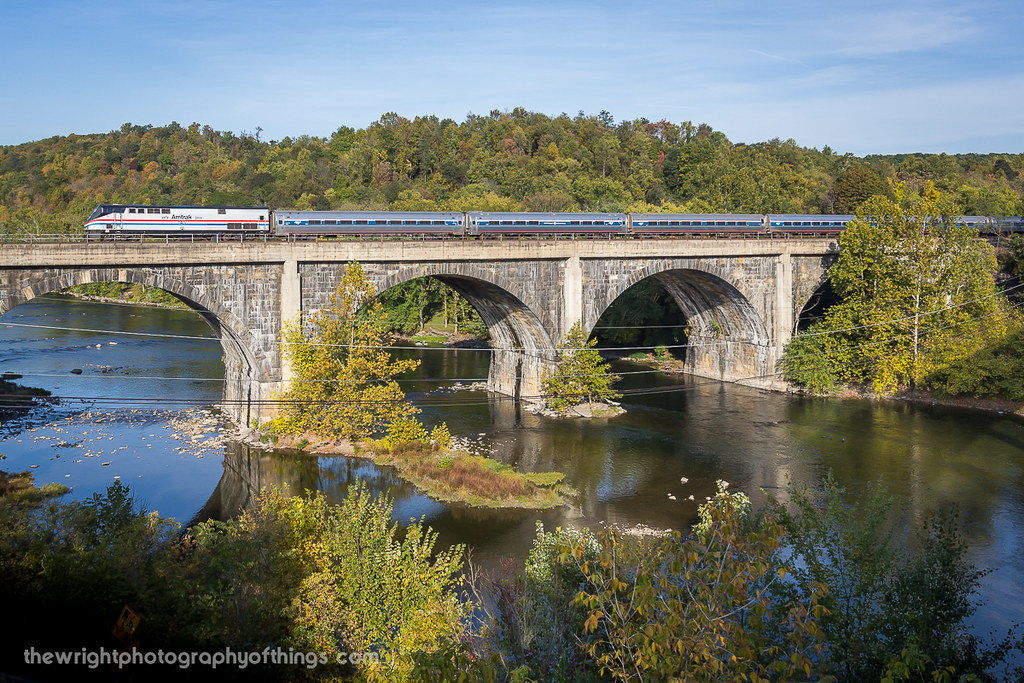 Amtrak's westbound "Pennsylvanian" crosses over Juniata River via the Kistler Viaduct on October 15, 2016. Jon Wright photo.
Looking Ahead
Rail travel offers numerous environmental benefits over air and road travel, including superior energy efficiency, reduced emissions, and minimized land use impacts.
As nations strive for carbon neutrality, expanding and modernizing rail infrastructure should be a priority. While technological advancements are vital across all modes of travel, the inherent efficiency and scalability of rail present it as a cornerstone of sustainable transportation.
The challenge moving forward is to balance the benefits and limitations of each transport mode, integrating them into a comprehensive and sustainable global transport strategy.
Enhanced investments in rail alongside innovations in road and air travel can foster cooperative strategies that align global mobility with environmental stewardship—significantly contributing to a greener and more sustainable future.
Recent Articles


-
Gulf, Mobile & Northern Steam Roster (Post 1900)
Oct 09, 26 12:14 AM
 Gulf, Mobile & Northern steam since 1900. Drury's class grid: Ten-Wheelers, Mikados, Russian Decapods, Pacifics 425 and 426, and three light 4-8-2s. Last revenue steam October 7, 1949.
 -
Gulf, Mobile & Ohio Diesel Roster (All-Time)
Oct 08, 26 11:55 PM
 Gulf, Mobile & Ohio diesel roster, all-time. The 1935 boxcab, DL-107s, 55 FA-1s, F3s and F7s, the Ingalls 4-S, GP30s through GP38-2s, and 21 SD40s. Serials and order numbers.
 -
Gulf, Mobile & Ohio Railroad: Map, Photos, Trains, History
Oct 08, 26 11:48 PM
 Gulf, Mobile & Ohio, chartered in 1938 and merged September 13, 1940. The Mobile & Ohio, the Alton on May 31, 1947, the Rebel Route, and Illinois Central Gulf on August 10, 1972.
 -
New Jersey Railroad Museums (2026): A Complete Guide
Oct 08, 26 11:37 PM
 New Jersey railroad museums—Whippany, Maywood, Pine Creek, Mahwah’s Erie depot, Phillipsburg, and Boonton. Confirm hours on each site.
 -
New Hampshire Railroad Museums (2026): A Complete Guide
Oct 08, 26 11:34 PM
 New Hampshire railroad museums—North Conway, the Flying Yankee, Ashland, Gorham, Raymond, and Sandown. Confirm hours on each site.
 -
Missouri Railroad Museums (2026): A Complete Guide
Oct 08, 26 11:00 PM
 Missouri railroad museums—the National Museum of Transportation, Patee House, Frisco 4524, the Chicago & Alton depot, and Marceline. Confirm hours on each site.
 -
Milwaukee Road X3800: Deer Lodge’s Shop Goat
Oct 08, 26 04:28 PM
 Milwaukee Road X3800, the a home-built shop goat that served the Deer Lodge, MT yard. It was a 220-volt DC switcher, powered through an extension cord that moved electrics into a roundhouse where the…
 -
Key West Extension (Overseas Railroad): History, Construction, Decline
Oct 08, 26 03:59 PM
 Henry Flagler's Overseas Railroad, Miami to Key West, 1905–1935. The Seven Mile Bridge, the 1935 Labor Day Hurricane, and the road that became U.S. 1.
 -
Florida East Coast Steam Roster (Post 1900)
Oct 08, 26 02:34 PM
 Florida East Coast steam since 1897. Seventeen Ten-Wheelers, twenty Atlantics, eighty-seven Pacifics, ninety Mountains, fifteen Mikados, and the switchers.
 -
Florida East Coast Diesel Roster (All-Time)
Oct 08, 26 02:12 PM
 Florida East Coast diesel roster, all-time. E units from 1939, F3s, BL2s, GP7s and GP9s, the GP40-2 orders, 22 SD40-2s, and 24 ES44C4s. Serials and EMD order numbers.
 -
Florida East Coast Railway: Map, History, Rosters
Oct 08, 26 01:46 PM
 Florida East Coast Railway, Henry Flagler's line from Jacksonville to Miami and Key West. Receivership in 1931, the 1963 strike, Grupo México in 2017, and Brightline on the same track.
 -
Minnesota Railroad Museums (2026): A Complete Guide
Oct 08, 26 10:32 AM
Minnesota railroad museums—the Lake Superior Railroad Museum, Two Harbors, Jackson Street, Willmar’s Great Northern 2523, and Currie. Confirm hours on each site. -
Maine Railroad Museums (2026): A Complete Guide
Oct 08, 26 09:24 AM
 Maine railroad museums—Seashore Trolley, the two-foot lines at Portland, Alna, and Phillips, Boothbay, and the Bangor & Aroostook depots. Confirm hours on each site.
 -
Massachusetts Railroad Museums (2026): A Complete Guide
Oct 08, 26 12:08 AM
 Massachusetts railroad museums—Berkshire Scenic at Lenox, Shelburne Falls trolley No. 10, Edaville, Chatham’s 1887 depot, and Lowell. Confirm hours on each site.
 -
Clinchfield Steam Roster (Post 1900)
Oct 07, 26 12:09 PM
 Clinchfield steam since 1900. Fifteen H-4 Consolidations, K-1 Mikados, M-2 and M-3 Mallets, L-class 2-8-8-2s, eighteen Challengers. Class grid after Drury. Last steam April 16, 1954.
 -
Clinchfield Diesel Roster (All-Time)
Oct 07, 26 12:05 PM
 Clinchfield diesel roster, all-time. F3A 800, FP7 200, the F7s, GP7s, 25 SD40s, 18 SD45-2s, seven U36Cs, and the Family Lines hoods. Serials and EMD order numbers.
 -
Clinchfield Railroad: Map, Steam Locomotives, Roster, Logo
Oct 07, 26 12:02 PM
 Clinchfield Railroad, Elkhorn City to Spartanburg. George L. Carter, the Carolina, Clinchfield & Ohio, the 1924 lease, coal, the loops, and CSX. Steam and diesel rosters are companion pages.
 -
Kentucky Railroad Museums (2026): A Complete Guide
Oct 07, 26 11:39 AM
 Kentucky railroad museums—the Kentucky Railway Museum, Bowling Green’s L&N depot, Paducah, Versailles, and Covington. Confirm hours on each site.
 -
Kansas Railroad Museums (2026): A Complete Guide
Oct 07, 26 11:26 AM
 Kansas railroad museums—Santa Fe 3768 at Wichita, Santa Fe 132 in Topeka, the Great Overland Station, and Abilene. Confirm hours on each site.
 -
Cincinnati, New Orleans and Texas Pacific Diesel Roster (All-Time)
Oct 07, 26 10:38 AM
 All-time diesel roster of Southern locomotives lettered for the Cincinnati, New Orleans and Texas Pacific. Serials, order numbers, and builder dates.
 -
Cincinnati, New Orleans and Texas Pacific Railway
Oct 07, 26 10:31 AM
 Cincinnati, New Orleans and Texas Pacific Railway, incorporated September 8, 1881, to lease Cincinnati’s railroad to Chattanooga. Queen and Crescent route, Rathole, and the 2024 sale to Norfolk Southe…
 -
Indiana Railroad Museums (2026): A Complete Guide
Oct 07, 26 12:26 AM
 Indiana railroad museums—Nickel Plate 765, Elkhart’s New York Central collection, French Lick, Linden’s junction depot, and Haley Tower. Confirm hours on each site.
 -
"Triplex" Steam Locomotive: Specs, History, Photos
Oct 06, 26 11:52 PM
 Erie class P-1 Triplex 2-8-8-8-2s. Three Baldwin compounds, 2603–2605, later 5014–5016, built 1914 and 1916. Matt H. Shay, the 1930 class card, and Virginian XA 700.
 -
Illinois Railroad Museums (2026): A Complete Guide
Oct 06, 26 11:47 PM
 Illinois railroad museums—the Illinois Railway Museum, Monticello, the Pioneer Zephyr, Galesburg’s Burlington 3006, and the depots. Confirm hours on each site.
 -
Iowa Railroad Museums (2026): A Complete Guide
Oct 06, 26 11:41 PM
 Iowa railroad museums—the Union Pacific Railroad Museum, RailsWest, Sioux City, Boone, and the National Hobo Museum in Britt. Confirm hours on each site.
 -
Charleston and Western Carolina Diesel Roster (All-Time)
Oct 06, 26 11:29 PM
Charleston and Western Carolina diesel roster. Twenty-one GP7s, two SW7s, two SW9s, and six F7As, all built 1950–1952. Serials, order numbers, and ACL and SCL numbers. -
Charleston and Western Carolina Railway: Map, History, Timetables
Oct 06, 26 11:18 PM
 Charleston and Western Carolina Railway, incorporated September 16, 1896. Port Royal to Spartanburg, with branches to Anderson and Greenville. Merged into the Atlantic Coast Line on December 31, 1959.
 -
Central of Georgia Steam Roster (Post 1900)
Oct 06, 26 04:00 PM
 Central of Georgia steam since 1900. Cooke Consolidations, Harriman Mikados, 32 Mountains, and eight Lima 4-8-4s. Class grid after Drury. Last steam May 1953.
 -
Central of Georgia Diesel Roster (All-Time)
Oct 06, 26 03:44 PM
 Central of Georgia diesel roster. SW1 No. 1 in 1939, E7s and E8s, nine F3As, 39 RS3s, GP7s through SD35s. Serials and order numbers.
 -
Central of Georgia Railway: Map, Logo, History, Rosters
Oct 06, 26 03:42 PM
 Central of Georgia Railway, from the 1833 Savannah charter to Southern control on June 17, 1963. Map, logos, Nancy Hanks II, and links to the steam and diesel rosters.
 -
Georgia Railroad Museums (2026): A Complete Guide
Oct 06, 26 03:33 PM
Georgia railroad museums—Savannah’s Central shops, Duluth, the General at Kennesaw, the Texas in Atlanta, Tifton, Waycross, and Albany. Confirm hours on each site. -
Florida Railroad Museums (2026): A Complete Guide
Oct 06, 26 03:18 PM
 Florida railroad museums—Boca Raton, Winter Garden, Whitehall, the Gold Coast, Parrish, Fort Myers, Milton, and Plant City. Confirm hours on each site.
 -
Connecticut Railroad Museums (2026): A Complete Guide
Oct 06, 26 01:05 PM
 Connecticut railroad museums—the Shore Line Trolley, East Windsor, the Naugatuck Railroad, Danbury Union Station, Willimantic, and the SoNo tower. Confirm hours on each site.
 -
Colorado Railroad Museums (2026): A Complete Guide
Oct 06, 26 12:47 PM
 Colorado railroad museums—Golden, the Forney’s Big Boy 4005, Pueblo’s Santa Fe 2912, and the depots at Castle Rock, Limon, and Ridgway. Confirm hours on each site.
 -
Atlantic Coast Line Steam Roster (Post 1900)
Oct 06, 26 12:44 PM
 Atlantic Coast Line steam since 1900. Copper Head Ten-Wheelers, 235 P-5 Pacifics, Q-1 Santa Fes, twelve R-1 4-8-4s. Class grid after Drury. Last steam June 30, 1955.
 -
Atlantic Coast Line Diesel Roster (All-Time)
Oct 06, 26 11:57 AM
 Atlantic Coast Line diesel roster. HH660 1900 in 1939, E3s for the Champion, FTs and F2s, GP7s 100–279, GP30s, U25Cs, and the 1967 SCL numbers. Serials and orders.
 -
Atlantic Coast Line Railroad: "Standard Railroad of the South"
Oct 06, 26 11:53 AM
 Atlantic Coast Line, the Standard Railroad of the South. April 21, 1900 to July 1, 1967. Plant System, L&N, Clinchfield, the Champion, and the Seaboard Coast Line merger.
 -
California Railroad Museums (2026): A Complete Guide
Oct 06, 26 09:50 AM
California railroad museums—the California State Railroad Museum, Perris, Portola, Railtown 1897, and the depots that still stand. Confirm hours on each site. -
Arizona Railroad Museums (2026): A Complete Guide
Oct 06, 26 09:46 AM
Arizona railroad museums—the Arizona Railway Museum in Chandler, Southern Pacific 1673 at Tucson, and the McCormick-Stillman park in Scottsdale. -
Arkansas Railroad Museums (2026): A Complete Guide
Oct 06, 26 09:07 AM
 Arkansas railroad museums—Cotton Belt 819 at Pine Bluff, the Fort Smith trolley, the Mammoth Spring depot, and the Eureka Springs railway.
 -
Alabama Railroad Museums (2026): A Complete Guide
Oct 06, 26 09:03 AM
Alabama railroad museums—Heart of Dixie at Calera, the North Alabama museum at Chase, Huntsville’s 1860 depot, and Fort Payne. Confirm hours on each site. -
Pennsylvania Railroad Museums (2026): A Complete Guide
Oct 06, 26 12:09 AM
 Pennsylvania railroad museums—Strasburg, Steamtown, the Horseshoe Curve, the East Broad Top, and the depots and towers in between. Confirm hours on each site.
 -
Maryland Railroad Museums (2026): A Complete Guide
Oct 05, 26 11:53 PM
 Maryland railroad museums—the Baltimore roundhouse, Ellicott City station, Bowie, Gaithersburg’s Buffalo Creek & Gauley 14, and the Western Maryland collections.
 -
Ohio Railroad Museums (2026): A Complete Guide
Oct 05, 26 05:51 PM
 Ohio railroad museums—the Age of Steam Roundhouse, Bellevue, Worthington, Conneaut’s Nickel Plate 755, and the Dennison depot. Confirm hours on each site.
 -
Delaware Railroad Museums (2026): A Complete Guide
Oct 05, 26 02:43 PM
 Delaware railroad museums—Wilmington & Western at Greenbank, the Harrington tower and N5 caboose, Felton's 1868 depot, and the Selbyville station museum.
 -
C&O's M-1 Steam Turbine Locomotives: Specs, Roster, History
Oct 05, 26 12:13 PM
 Chesapeake & Ohio Class M-1 steam-turbine-electrics. Three Baldwin-Westinghouse locomotives, 500–502, built 1947–48 for The Chessie. Specs, the 2-C1+2-C1-B arrangement, and a roster. All scrapped…
 -
N&W 2-6-6-2 Locomotives (Class Z): Specs, Roster, History
Oct 05, 26 11:44 AM
 Norfolk & Western Class Z 2-6-6-2s. One hundred ninety compound Mallets, 1300–1489, from Richmond, Baldwin, and Schenectady, 1912–1918. Diagram specs, the Z-1b rebuilds, Z-2 1399, and a roster. No…
 -
Scenic Train Rides (USA 2026): State Guide to Tourist Railroads
Oct 04, 26 12:17 AM
 Scenic and tourist train rides in all 50 states for 2026. Colorado narrow gauge, Pennsylvania steam, Alaska’s White Pass, and the states with no full-size ride this month. Confirm on the railroad.
 -
Wyoming Scenic Train Rides (2026): A Complete Guide
Oct 03, 26 12:07 AM
Wyoming has no full-size tourist railroad on the calendar in October 2026. Cheyenne Depot Museum and Douglas Railroad Museum are static. Union Pacific 4014’s posted public trip is a November run to De… -
Washington Scenic Train Rides (2026): A Complete Guide
Oct 02, 26 11:53 PM
 Washington tourist trains in 2026—Mount Rainier Scenic at Elbe, the Northwest Railway Museum, and Chehalis-Centralia. Lake Whatcom has no 2026 date on its ticket page.