The Angola Horror: The 1867 Train Wreck That Shocked the Nation
Last revised: August 11, 2026
By: Adam Burns
On a cold Wednesday afternoon—December 18, 1867, just after 3:00 p.m.—the last coach of a Buffalo-bound passenger train left the rails as it approached a truss bridge over Big Sister Creek at Angola, New York, about twenty miles southwest of Buffalo. The car broke free, slid into the icy gorge, and erupted in fire. Roughly forty-nine people died, most of them burned beyond recognition. Newspapers across the country fixed on the name that stuck within days: the Angola Horror.
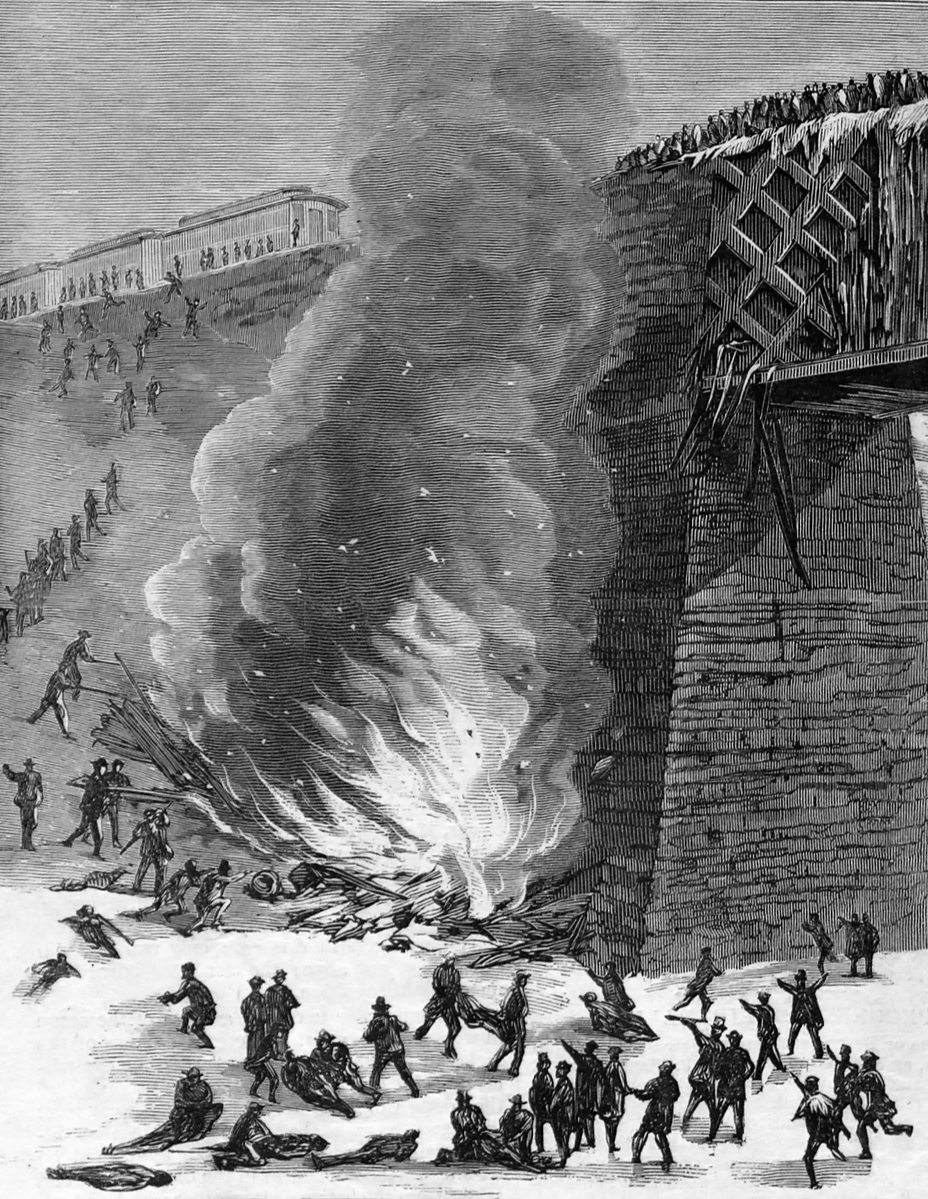
Within weeks of December 18, 1867, the wreck at Angola, New York, was already branded in the national press as the “Angola Horror.” Illustrated weeklies filled pages with the scene at Big Sister Creek—derailed coaches, fire, and the grim work of identifying the dead.
It was not, as some later summaries imply, a New York Central train of the Vanderbilt empire in the form that company later became famous. In 1867 the corridor was part of the fragmented Lake Shore system—the line that would soon consolidate into the Lake Shore Railway / Lake Shore & Michigan Southern and, decades later, into the New York Central System. The wreck sits at the intersection of three mid-nineteenth-century railroad problems: unstable “compromise” equipment built to run on mismatched track gauges, wooden cars heated by coal stoves and lit by kerosene, and a public that was only beginning to demand that passenger safety keep pace with speed and traffic.
This article reconstructs the train, the sequence of the accident, the causes investigators and later historians emphasized, the national reaction, and the reforms and memorials that followed.
At a Glance
| Item | Detail |
|---|---|
| Date / time | Wednesday, December 18, 1867, about 3:11 p.m. |
| Location | Angola, Erie County, New York (Big Sister Creek truss bridge, east of the village station) |
| Train | Eastbound / Buffalo-bound New York Express (Cleveland–Buffalo) |
| Line / operators (1867) | Lake Shore corridor; operated under the Cleveland, Painesville & Ashtabula / Lake Shore Railway family of companies (not yet the consolidated Lake Shore & Michigan Southern of later fame) |
| Type of accident | Derailment at bridge; rear car into gorge; fire |
| Immediate mechanical trigger | Defective / bent front axle on rear car; wheel climbed off rail at a frog east of the depot |
| Contributing factors | “Compromise” cars with lateral play for dual gauge; speed while late; stove/kerosene fire after impact |
| Deaths | About 49 (exact count historically uncertain; many remains unidentified) |
| Notable near miss | John D. Rockefeller missed the train at Cleveland; his baggage did not |
The Railroad Context: Lake Shore, Not Yet “the Central”
By 1867 the rail route along Lake Erie from Cleveland toward Buffalo was one of the busiest passenger corridors in the United States—a commercial spine for Great Lakes cities and for through travel between the Midwest and New York. Corporate names on that corridor shifted through the 1850s and 1860s as Ohio and New York roads consolidated. Histories of the wreck commonly place the train on the Lake Shore Railway / related Lake Shore properties, with operating connection to the Cleveland, Painesville and Ashtabula Railroad. Charity Vogel’s modern book-length study frames the service in the Buffalo & Erie / Lake Shore world of western New York.
What matters for the story is less the exact letterhead on the timetable than the physical plant: wood passenger cars, hand brakes, iron rails and frogs, and—critically—mixed track gauges between regions. The New York Central of Cornelius Vanderbilt was already a power in New York State, but the Angola wreck belongs first to the Lake Shore lineage that later became a cornerstone of the Central’s Chicago–New York main line.
The Train: New York Express, December 18
On the morning of the 18th the New York Express left Cleveland Union Depot about 6:40 a.m., scheduled into Buffalo around 1:30 p.m. It ran late. By Angola it was roughly two hours and forty-five minutes behind, moving with purpose to make up time. Last passenger stop before the wreck was Dunkirk; at Silver Creek the train stopped only for wood and water.
Consist that day (as reconstructed in standard secondary accounts):
- Four baggage cars
- One second-class passenger car
- Three first-class passenger cars
Each wooden coach carried pot-bellied stoves at the ends for heat and kerosene lamps for light—ordinary American practice in 1867, and lethal when a car overturned with a fire still burning inside.
One of the most often-retold footnotes is the near miss of John D. Rockefeller. Then a rising Cleveland oil man, he planned to ride the train but arrived minutes late. His baggage made the consist; he did not. The anecdote survived because the wreck made everyone who almost boarded feel the lottery of railroad travel in the post–Civil War years.
“Compromise Cars” and Dual Gauge
A technical detail that separates Angola from a simple “broken wheel” story is the equipment type. The train used so-called compromise cars—passenger equipment designed to run both on the 4 ft 8½ in standard gauge of roads such as the New York Central and on the slightly broader 4 ft 10 in “Ohio gauge” still found on parts of the Lake Shore system. That arrangement allowed about three-quarters of an inch of lateral play on the broader gauge. Play meant flexibility for interchange; it also meant instability when a wheel or axle was already defective.
In other words, the wreck was not only a failure of one axle. It was a failure that dual-gauge compromise design made more likely: a slightly bent axle, a frog that jarred the wheel, and a car that could wander enough to climb the rail.
Sequence at Big Sister Creek
East of the Angola depot, roughly two hundred yards beyond the station in contemporary reconstructions, the train passed over a frog—the point where rails of a switch or crossing diverge. The rear car’s forward axle was already slightly bent. At the frog, a wheel on that axle jumped the rail. Passengers felt the lurch; the last car began to sway as iron wheels pounded ties.
Brakes were applied—hand brakes of the period, slow and dependent on trainmen—but the train still carried substantial speed onto the truss bridge over Big Sister Creek. What followed, condensed from period reporting and modern synthesis:
- The last car uncoupled (or parted) from the train and left the bridge structure, plunging into the gorge—on the order of thirty to forty feet down the ice-covered slope—and came to rest at a severe angle.
- The second-to-last car also derailed. It reached the far side of the gorge before sliding down the embankment (accounts often give about thirty feet). That car’s passenger death toll was far smaller than the last coach’s; some sources state a single fatality associated with that car.
- In the last coach, passengers were thrown toward one end, onto and under the overturned stove. The stove from the other end of the car fell among them. Hot coals spilled. Kerosene from smashed lamps fed the flames.
- The wooden car burned with terrible speed. Witnesses recalled screams lasting minutes. Only a handful of people—commonly given as two—escaped the last car alive. Many victims were burned beyond identification.
That combination—derailment into a gorge plus an immediate stove fire—is why the wreck became the “Horror” rather than another winter derailment. Impact killed some; fire and smoke killed most of the rest in the last car.
Rescue, Identification, and the Unidentified Dead
Villagers, train crew, and passengers from cars that remained on the rails worked in bitter cold against fire and wreckage. The isolation of the creek bottom and the intensity of the blaze limited what could be done for those trapped inside the last coach.
In the days that followed, the horror deepened at the morgue and in the newspapers. Families tried to identify relatives from fragments of clothing, jewelry, or paper. Contemporary and later accounts stress that a substantial number of bodies—often cited as on the order of seventeen to nineteen or more unidentified—could not be named with certainty. Some of the unidentified were later buried at Forest Lawn Cemetery in Buffalo. The uncertainty of the death count (about forty-nine is the figure most often used; period estimates varied) was itself part of the trauma: the railroad had not only killed passengers, it had erased their identities.
The Nation Watches: Press and Public Imagination
The Angola wreck arrived in a culture already familiar with Civil War mass death and increasingly dependent on railroads for everyday mobility. Illustrated papers such as Frank Leslie’s Illustrated Newspaper published sketches of the scene and the aftermath. One Leslie summary called the disaster accompanied by “more horrible circumstances than ever before known in this country.” The phrase Angola Horror entered newspaper English within weeks; other accidents were soon compared to it as a shorthand for the worst kind of passenger railroad catastrophe.
That media intensity mattered. Mid-nineteenth-century railroad regulation in the United States was weak by modern standards. Public outrage after high-profile wrecks was one of the few forces that could push companies and legislatures toward change. Angola joined a grim chain of famous disasters—later including the 1876 Ashtabula bridge collapse on related Lake Shore territory—that made passenger safety a national subject rather than a private corporate detail.
Causes: More Than One Failure
No single sentence explains Angola. The durable factors are:
- Defective running gear on the rear car — a bent or irregular axle/wheel assembly that could not hold the rail through a frog at speed
- Compromise-car geometry — dual-gauge lateral play that amplified instability
- Bridge location — derailment timing put the free car into a gorge rather than onto level roadbed
- Wooden construction + stoves + kerosene — converted a derailment into a mass fire death
- Era braking and operating practice — hand brakes and late running limited the ability to stop short once the car was in distress
- Maintenance and component quality — period investigations and later histories point to inadequate attention to wheel and axle condition on a hard-worked express
Angola is therefore both a mechanical story and a systems story. Fixing only the frog, or only the stove, would not have been enough; the industry needed better cars, better brakes, more uniform gauge, and a culture that treated inspection as non-negotiable.
Aftermath and Reform
The wreck did not invent railroad safety reform overnight. It did, however, accelerate arguments that were already forming:
- Safer car heating — Loose pot-bellied stoves in wooden coaches were recognized as death traps. Over the following decades railroads moved toward more secure heating arrangements and, eventually, away from open stoves in mainline passenger service.
- Better brakes — George Westinghouse’s air brake (patented 1869, commercially proven in the 1870s) offered controlled stops from the locomotive—something Angola’s world of hand brakes lacked. Public pressure after wrecks helped create a climate in which such inventions were adopted.
- Gauge standardization — Compromise cars and mixed gauges were transitional evils. The long campaign for standard gauge reduced the need for loose-fitting dual-gauge equipment that could wander on the rail.
- Stronger cars and, later, steel — The shift from all-wood to steel underframes and bodies was multi-decade, but disasters like Angola and Ashtabula made the flammability and fragility of wooden coaches impossible to ignore.
Historians caution against treating any one wreck as the sole origin of a technology. Air brakes, automatic couplers, block signals, and steel cars each have their own inventors, patents, and adoption curves. Angola’s place in that history is as a national shock that made the human cost of delay in those reforms vivid and political.
Memory and Memorials
For more than a century the Angola Horror lived mainly in old newspapers, local lore, and comparative lists of famous wrecks. In the twenty-first century the community and historians returned to the site more deliberately:
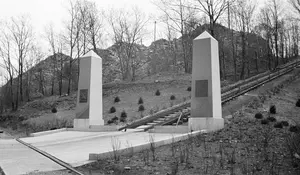
- In 2008, the village of Angola set aside a small parcel along Commercial Street and dedicated a sign marking the disaster and its victims.
- In 2015, a memorial was erected at Forest Lawn Cemetery in Buffalo for unidentified victims of the wreck.
- Charity Vogel’s 2013 book, The Angola Horror: The 1867 Train Wreck That Shocked the Nation and Transformed American Railroads (Cornell University Press), remains the fullest modern narrative treatment and is the standard starting point for anyone who wants more depth than a single article can hold.
The Big Sister Creek location is no longer a lonely 1867 creek crossing in the same sense; the corridor is still railroad country in the broader Lake Shore / Conrail / CSX succession story. What remains of the Horror is less a scenic overlook than an obligation to remember why passenger safety standards exist.
How Angola Fits American Railroad History
Place the wreck on a short timeline of famous American passenger disasters and its role becomes clearer:
| Year | Event | Why it pairs with Angola |
|---|---|---|
| 1867 | Angola Horror | Derailment + stove fire; dual-gauge compromise cars; national press trauma |
| 1876 | Ashtabula bridge disaster (Lake Shore) | Same general corridor family; bridge failure + fire; further pressure for safer design |
| 1887+ | Interstate Commerce Commission era intensifies | Federal oversight grows; wrecks fuel political demand for rules |
| 1893+ | Safety Appliance Act and successors | Air brakes and automatic couplers become federal requirements on many roads |
Angola is early in that sequence—too early for federal safety appliance law, too early for steel cars as standard, too early for air brakes as universal. That is precisely why it still matters. It shows the passenger railroad of 1867 at its most dangerous: fast enough to kill in numbers, not yet engineered to survive its own failures.
Legacy
The Angola Horror endures for three reasons. First, the manner of death—fire after a plunge into a gorge—made it unforgettable in an age of wood and coal. Second, the unidentified dead turned a local wreck into a national meditation on industrial anonymity. Third, the wreck became a reference point for later disasters and for historians of technology who track how public trauma helps drive safer equipment.
Correcting the popular shorthand matters too. This was a Lake Shore corridor tragedy of 1867, later absorbed into the corporate memory of the Lake Shore & Michigan Southern and the New York Central System—not a simple Vanderbilt Central mainline anecdote. The passengers who died at Big Sister Creek were riding the future Chicago–New York trunk in an earlier, more dangerous form. Remembering them accurately is part of remembering how that trunk became safe enough that most travelers never have to think about stoves, kerosene, or compromise wheels at all.
Related Reading on American-Rails.com
- Railroad History (USA)
- Lake Shore & Michigan Southern
- New York Central Railroad
- Ashtabula Bridge Disaster
- Passenger Train Guide
- Fallen Flags
Death tolls, exact corporate lettering on the 1867 consist, and some car-by-car details vary slightly among period newspapers and later histories. Figures and sequence above follow the modern consensus synthesis (including Vogel and standard reference summaries). For genealogical or legal work, consult primary newspaper files, coroner records, and company archives.
Recent Articles


-
Bessemer & Lake Erie Railroad: "The Bessemer Road"
Sep 15, 26 05:20 PM
 Bessemer & Lake Erie—Bear Creek 1865, Carnegie 1897, U.S. Steel 1901. Ore south from Conneaut, coal north. 2-10-4s, Missabe sister road. CN May 10, 2004. Complete corporate history.
 -
Bangor and Aroostook Railroad: "Serving Northern Maine"
Sep 15, 26 05:05 PM
 Bangor & Aroostook—chartered February 13, 1891, first trains January 1, 1894. Potatoes, paper, Searsport, State of Maine reefers. MM&A 2003, Lac-Mégantic 2013, CP 2020, CPKC today. Complete co…
 -
Baltimore & Ohio Chicago Terminal Railroad: Map and History
Sep 15, 26 03:11 PM
 B&OCT—formed January 6, 1910 to buy Chicago Terminal Transfer. Grand Central, Barr Yard, 78 route-miles. Assigned B&O steam. Complete diesel roster. CSX paper subsidiary, mark BOCT.
 -
The "Alphabet Route" (Railroad): Photos and History
Sep 15, 26 02:53 PM
 Alphabet Route—eight railroads, not one company. P&WV to Connellsville February 11, 1931. Alpha Jets Chicago/St. Louis–New York/Boston. NKP, W&LE, P&WV, WM, Reading, CNJ, L&HR, New Hav…
 -
Milwaukee Road Livestock Operations: Cattle, Dakotas & Montana
Sep 15, 26 02:36 PM
 Milwaukee Road livestock traffic—Dakota and Montana cattle, Iowa hogs, Chicago markets, 28-hour law, head-end stock cars. By 1974 mostly Montana. Rick Burn’s Helena speech. Operations history, not the…
 -
Spirit of Jasper Ride & Dine (2026): Season Pause
Sep 15, 26 02:29 PM
 Spirit of Jasper Ride & Dine in Jasper, Indiana—seated meal on board. Operator: not running public trains for 2026. Depot remains open as a rental. Confirm on spiritofjaspertrain.com.
 -
South Carolina Canal & Rail Road Company: Map and History
Sep 15, 26 01:59 PM
 South Carolina Canal & Rail Road—chartered December 19, 1827. Best Friend of Charleston, 136 miles Charleston–Hamburg October 1833, Aiken inclined plane. South Carolina Railroad 1844, Southern 189…
 -
The Practice of Double-Heading: The Steam Era
Sep 15, 26 01:43 PM
 Doubleheading—two locomotives on the point, each with its own steam crew. Not a rear helper, not diesel MU. How it worked, PRR 1877, mountain grades, and what MU ended.
 -
Mohawk and Hudson Railroad: Map, Pictures, Locomotives
Sep 15, 26 01:20 PM
 Mohawk & Hudson Railroad—New York’s first railroad, chartered April 17, 1826. DeWitt Clinton, inclined planes, Albany & Schenectady 1847, first New York Central May 17, 1853. Complete corporat…
 -
Essex Clipper Dinner Train (2026): Dates, Tickets & What to Expect
Sep 15, 26 01:09 PM
 2026 Essex Clipper Dinner Train in Essex, CT—2.5 hours, four-course meal $129.99, 18+. Fall dates through Oct. 25. Confirm on essexsteamtrain.com.
 -
Camden & Amboy Railroad: Map, History, Photos
Sep 15, 26 12:53 PM
 Camden & Amboy Railroad—chartered February 4, 1830. Joint Companies monopoly with the Delaware & Raritan Canal, John Bull, T-rail. United New Jersey 1872, PRR 999-year lease 1871. Complete corpora…
 -
Cafe Lafayette Dinner Train (2026): Dates, Tickets & What to Expect
Sep 15, 26 12:47 PM
2026 Cafe Lafayette Dinner Train in North Woodstock, NH—2 hours, 20 miles, five-course meal from $125. May–October. Confirm on nhdinnertrain.com. -
Christmas Train Ride Locations (2026): A Complete Guide
Sep 15, 26 10:47 AM
 2026 Christmas train rides by state—Santa, North Pole Express, and holiday trains. Not Polar Express. State guides and product pages. Confirm dates on each railroad.
 -
Baltimore & Ohio Railroad: Linking 13 Great States With The Nation
Sep 15, 26 10:22 AM
 Baltimore & Ohio Railroad—first U.S. common carrier, chartered February 28, 1827. Wheeling 1853, Chicago 1874, C&O control 1963, Chessie 1973, into CSX April 30, 1987. Complete corporate history.
 -
Delaware & Hudson Railway: The Bridge Line
Sep 15, 26 09:59 AM
 Delaware & Hudson Railway—Wurts brothers canal 1823, gravity railroad 1829, Stourbridge Lion, Bridge Line to Montreal. Guilford 1984, CP 1991, NS south line 2015, CPKC north.
 -
Delaware & Hudson Diesel Roster (All-Time)
Sep 15, 26 12:17 AM
 All-time Delaware & Hudson diesel roster—Alco S-2s through C-628s and PA-4s, GE U-boats, Baldwin RF-16s, EMD SD45s and GP38-2/GP39-2s. Serials, dates, dispositions.
 -
Granite Railway, Our Country's First Railroad
Sep 14, 26 11:28 PM
 Granite Railway of Quincy, Massachusetts—chartered March 4, 1826, opened October 7, 1826. Gridley Bryant, 5-foot gauge, horses, Bunker Hill Monument stone. First commercial U.S. railroad.
 -
Milwaukee Road Skytop Lounges: History, Specs & Floor Plans
Sep 14, 26 11:09 PM
 Milwaukee Road Skytop observation cars—Brooks Stevens, 1948. Four Rapids parlor-lounges from Milwaukee Shops, six Creek sleeper-lounges from Pullman-Standard. Floor plans, roster, preservation.
 -
West Virginia Christmas Train Rides (2026): A Complete Guide
Sep 14, 26 11:02 PM
2026 West Virginia Christmas trains—Potomac Eagle North Pole Express in Romney and Christmas at Cass. Not Polar Express. Elkins Polar is not listed for 2026. -
Railroads Of Today: Class I Map, PSR & the 2026 Industry
Sep 14, 26 10:30 PM
 U.S. freight rail in 2026—six Class I railroads on a nearly 140,000-mile network. PSR as everyday practice, how the STB works, traffic mix, short lines and regionals.
 -
Railroad History (USA): Timeline, Facts & How the Network Was Built
Sep 14, 26 10:03 PM
 Full U.S. railroad history hub—origins and inventors, Golden Age peak mileage, Civil War and transcontinental, streamliners, ICC regulation, Penn Central and Conrail, Staggers Act, PSR, and today’s Cl…
 -
Railroads In The 2020s: CPKC, East Palestine & the UP–NS Case
Sep 14, 26 09:51 PM
 U.S. railroads 2020–2026—Class I mileage 91,773 in 2020. COVID traffic drop, CPKC April 14 2023, East Palestine Feb. 3 2023, UP–NS $85 billion case still before the STB.
 -
Railroads In The 2010s: PSR, Coal’s Decline & Positive Train Control
Sep 14, 26 03:51 PM
 U.S. railroads 2010–2020—Class I mileage 95,573 to 91,773. Buffett closed BNSF Feb. 12 2010, Harrison at CP June 29 2012 and CSX 2017, PTC deadline Dec. 31 2018.
 -
Virginia Christmas Train Rides (2026): A Complete Guide
Sep 14, 26 03:46 PM
 2026 Virginia Christmas trains—Virginia Scenic Railway Santa Express from Staunton, about 60 minutes. Confirm dates. Not Polar Express.
 -
MARC Train: Maryland Commuter Rail History, Lines & Roster
Sep 14, 26 01:16 PM
 MARC Train history—Maryland Rail Commuter 1984, B&O and PRR corridors, Penn/Camden/Brunswick lines, Silver Spring 1996, all-time locomotive roster.
 -
Railroads In The 2000s: Merger Freeze, Wisconsin Central & Buffett
Sep 13, 26 07:57 AM
 U.S. railroads 2000–2010—Class I mileage 99,250 to 95,573. STB merger freeze March 17 2000, CN–WC Oct. 9 2001, BNSF Railway Jan. 24 2005, Buffett Nov. 3 2009.
 -
Railroads In The 1990s: Mega-Mergers, Conrail’s Split & the STB
Sep 13, 26 12:13 AM
 U.S. railroads 1990–2000—Class I mileage 119,758 to 99,250. BNSF Sept. 22 1995, UP–SP Sept. 11 1996, Conrail split June 1 1999, ICC Termination Dec. 29 1995.
 -
Railroads In The 1980s: Staggers, Mega-Mergers & Conrail’s IPO
Sep 12, 26 11:12 PM
 U.S. railroads 1980–1990—Class I mileage 164,822 to 119,758. Staggers Oct. 14 1980, CSX and Norfolk Southern, UP–Missouri Pacific–Western Pacific, Conrail IPO March 26 1987.
 -
Wabash Class O-1 4-8-4s: History, Roster & Specifications
Sep 12, 26 11:01 PM
 Wabash Class O-1 4-8-4s—Baldwin 1930–31, twenty-five engines 2900–2924. Fast freight, complete roster, specifications. None preserved.
 -
Staggers Rail Act of 1980: Statute, Contract Rates & the ICC
Sep 10, 26 11:23 PM
 Staggers Rail Act, Pub. L. 96-448, signed October 14, 1980. Harley Staggers, S.1946, contract rates, 180% variable-cost test, abandonments, short lines.
 -
Rock Island E8A 652: Bicentennial Independence Paint & History
Sep 10, 26 10:42 PM
 Rock Island E8A 652—EMD March 1952, serial 15199. 20th Century Railroad Club Independence bicentennial scheme, Peoria and Quad Cities Rockets, Midland Railway, Manly Junction Museum.
 -
Vermont Christmas Train Rides (2026): A Complete Guide
Sep 10, 26 10:37 PM
2026 Vermont Christmas trains—Okemo Valley Holiday Express from Chester Depot Dec. 19–20. Polar is Burlington Dec. 5–6 only. -
Railroads In The 1970s: Penn Central, Amtrak & Conrail
Sep 10, 26 10:18 AM
 U.S. railroads 1970–1980—196,479 miles at the decade’s start. Penn Central bankruptcy June 21 1970, Amtrak May 1 1971, 3R/4R Acts, Conrail April 1 1976, Rock Island 1975, Milwaukee 1977.
 -
Railroads In The 1960s: Mergers, Passenger Collapse & Penn Central
Sep 10, 26 10:03 AM
 U.S. railroads 1960–1970—207,334 to 196,479 miles. Erie Lackawanna 1960, C&O–B&O 1963, N&W–Nickel Plate 1964, SCL 1967, Penn Central Feb. 1 1968.
 -
South Carolina Christmas Train Rides (2026): A Complete Guide
Sep 10, 26 08:36 AM
 2026 South Carolina Christmas trains—South Carolina Railroad Museum Santa Train in Winnsboro. Confirm December dates. Not Polar Express. Drop light-festival padding.
 -
Steam Locomotive Feedwater Heaters: Elesco, Coffin & Worthington
Sep 10, 26 08:29 AM
 Steam locomotive feedwater heaters—open Worthington vs closed Elesco and Coffin. How they work, how to identify them on a smokebox, and why not every engine had one.
 -
Oregon Christmas Train Rides (2026): A Complete Guide
Sep 10, 26 08:22 AM
2026 Oregon Christmas trains—Portland Holiday Express, Garibaldi Candy Cane Express, Sumpter Valley Christmas Trains Dec. 11–13. Polar is Mount Hood. -
Lake Shore & Michigan Southern: Map, History, Timetables
Sep 10, 26 08:12 AM
 Lake Shore & Michigan Southern Railway—Erie & Kalamazoo 1833, Michigan Southern to Chicago 1852, LS&MS April 6 1869, Vanderbilt, Ashtabula 1876, NYC merger Dec. 22 1914. 1910 map and Official Guide.
 -
Big Four Route (CCC&StL): Map, History
Sep 10, 26 12:19 AM
Cleveland, Cincinnati, Chicago & St. Louis Railway—Bee Line 1868, Ingalls’s first Big Four 1880, CCC&StL June 30, 1889, NYC lease Feb. 1, 1930. 1910 and 1930 maps, what still runs. -
Railroads In The 1950s: Diesel, the Interstate & Passenger Collapse
Sep 10, 26 12:15 AM
 U.S. railroads 1950–1960—223,779 to 211,459 miles. Interstate June 29, 1956, dieselization, passenger collapse, TOFC, 1957–58 recession, NYO&W 1957, N&W–Virginian 1959.
 -
New Jersey Christmas Train Rides (2026): A Complete Guide
Sep 10, 26 12:06 AM
 2026 New Jersey Christmas trains—Black River & Western Santa Express from Flemington and Pine Creek Christmas trains in Wall Township. Polar is Whippany and Phillipsburg.
 -
New Mexico Christmas Train Rides (2026): A Complete Guide
Sep 09, 26 11:57 PM
 2026 New Mexico Christmas trains—Cumbres & Toltec Santa’s Holiday Express from Chama Dec. 5–6 (and Antonito, Colo., Dec. 12–13). Coach $25/$15. Not Polar Express.
 -
Grand Trunk Railway: Map, History, Timetables
Sep 09, 26 11:47 PM
 Grand Trunk Railway of Canada—charter Nov. 10, 1852, Montreal–Toronto 1856, Portland, Sarnia, Victoria Bridge, St. Clair Tunnel 1891, Great Western 1882, GTPR, CN Jan. 20, 1923. 1893 map and Official…
 -
Troop Trains In World War II: Sleepers, Kitchen Cars & Movements
Sep 09, 26 11:42 PM
 WWII U.S. troop trains—almost 44 million armed-services passengers, Pullman troop sleepers, ACF kitchen cars, hospital trains, monthly movement tables 1942–45. Not the Military Railway Service. ODT an…
 -
Railroads In The 1940s: War Traffic, Last Steam & the Diesel Flood
Sep 09, 26 11:37 PM
 U.S. railroads 1940–1950—233,670 to 223,779 miles. World War II as the decade’s center, last new steam, diesel flood after V-J Day, 1945 car orders, California Zephyr 1949.
 -
Railroads In World War II: ODT, Record Traffic & Private Operation
Sep 09, 26 03:00 PM
 U.S. railroads in World War II—Lend-Lease freight, Pearl Harbor, Office of Defense Transportation, 1944 peak ~740 billion ton-miles, Dec. 1943–Jan. 1944 seizure. Private operation, not a USRA sequel.
 -
Montana Christmas Train Rides (2026): A Complete Guide
Sep 09, 26 02:54 PM
2026 Montana Christmas trains—Charlie Russell Chew Choo North Pole Adventure from Hanover/Lewistown, Nov. 27–Dec. 19, $71, about 1.5 hours. Not Polar Express. -
Railroads In The 1930s: Depression, Streamliners & the FT
Sep 09, 26 09:32 AM
 U.S. railroads 1930–1940—249,052 to 233,670 miles. Section 77, Eastman, Motor Carrier Act, M-10000 and Pioneer Zephyr 1934, EMC FT 1939. Decade frame, not the streamliner encyclopedia.
 -
Sugar Cane Train (Lahaina): LK&P History, Roster & 2026 End
Sep 09, 26 08:19 AM
 Lahaina, Kaanapali & Pacific Sugar Cane Train—3-foot tourist line 1970–2014. Anaka, Myrtle, 2023 and 2025 fires, September 2026 scrapping. Roster, Hahakea trestle, Pioneer Mill corridor.
 -
Massachusetts Christmas Train Rides (2026): A Complete Guide
Sep 09, 26 08:16 AM
 2026 Massachusetts Christmas trains—Shelburne Falls Moonlight Magic Friday Nov. 27; Edaville Festival of Lights in Carver. Polar is Cape Cod Central in Buzzards Bay.