- Home ›
- Museums ›
- California
California Railroad Museums (2026): A Complete Guide
Last revised: October 6, 2026
By: Adam Burns
California kept the railroad that built it, and a great deal of everything that came after. In Old Sacramento the state museum has the Central Pacific’s Gov. Stanford, the C.P. Huntington, and the last Southern Pacific cab-forward, 4-8-8-2 No. 4294, under one roof, with a short railroad along the river. Perris kept the Pacific Electric Red Cars and the Los Angeles Railway Yellow Cars. Portola kept a Western Pacific diesel shop and the California Zephyr locomotive 805-A. Jamestown kept the Sierra Railway roundhouse. The Owens Valley kept a three-foot depot and the Slim Princess. San Francisco kept a cable-car barn that still pulls the cables.
Hours, ride days, and which locomotive is fired move with the season, the shop, and the weather. Confirm the day before you drive.
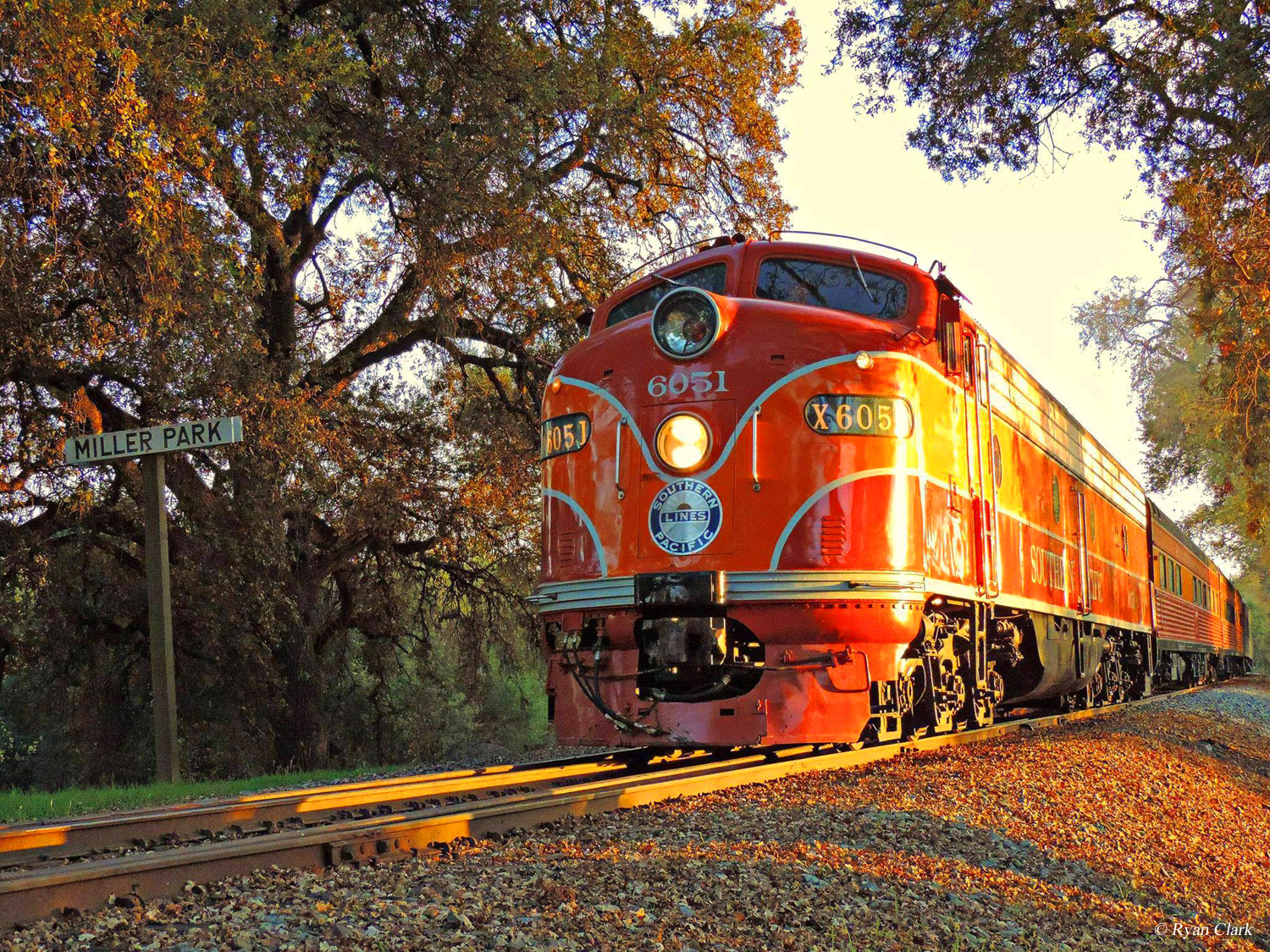
Southern Pacific E9A #6051 leads a short excursion through Miller Park in Sacramento, fall 2014. Electro-Motive built the locomotive in 1954. Ryan Clark photo.
On this page: At a glance · California railroads · Sacramento · Perris · Portola · Rio Vista Junction · Jamestown and Niles Canyon · Los Angeles · Campo · Owens Valley and the north coast · Depots and cable cars · Related reading
At a glance
| Place | Town | What it is known for | Site |
|---|---|---|---|
| California State Railroad Museum | Sacramento | Gov. Stanford, the C.P. Huntington, and cab-forward #4294 in 225,000 square feet. Weekend trains on the Sacramento Southern | californiarailroad.museum · profile |
| Southern California Railway Museum | Perris | Pacific Electric Red Cars and Los Angeles Railway Yellow Cars on more than 100 acres. Once the Orange Empire Railway Museum | socalrailway.org |
| Western Pacific Railroad Museum | Portola | Former WP diesel shop. FP7 #805-A, built for the California Zephyr. Supervised Run-A-Locomotive | wplives.org · profile |
| Western Railway Museum | Suisun City | Sacramento Northern interurban cars and an 11-mile round trip on the old main line at Rio Vista Junction | wrm.org |
| Railtown 1897 State Historic Park | Jamestown | Sierra Railway roundhouse and shops. Rogers 4-6-0 #3, the movie engine, built in 1891 | Railtown · rides |
| Travel Town | Griffith Park | City collection opened December 14, 1952. Southern Pacific Atlantic #3025 was the first engine on the grounds | traveltown.org |
| RailGiants Train Museum | Pomona | Southern Pacific 4-10-2 #5021, Union Pacific 4-12-2 #9000, and Centennial #6915, at the Fairplex. Big Boy #4014 returned to Union Pacific | railgiants.org |
| Pacific Southwest Railway Museum | Campo | San Diego & Arizona equipment and the Golden State weekend train from the Campo depot. La Mesa depot is the same association | psrm.org |
| Laws Railroad Museum | Laws, near Bishop | Carson & Colorado depot of 1883 and narrow-gauge Baldwin #9, the Slim Princess | lawsmuseum.org |
| San Francisco Cable Car Museum | San Francisco | Working Washington-Mason barn. Clay Street Hill grip car #8, from the line that opened September 1, 1873 | cablecarmuseum.org |
American-Rails.com does not operate these places and does not sell tickets. Confirm hours before you travel.
California railroads
The Sacramento Valley Railroad opened from Sacramento to Folsom on February 22, 1856, the first railroad in the state. The road that changed the map came next. The Central Pacific was incorporated on June 28, 1861. Leland Stanford turned a shovel at Front and K Streets on January 8, 1863, and the company’s first locomotive, the Norris 4-4-0 Governor Stanford, made its first run that November. The transcontinental railroad was finished at Promontory on May 10, 1869. Out of that company grew the Southern Pacific, which built over the Tehachapi Mountains in 1874–76 and later shared the Tehachapi Loop with the Santa Fe. The Western Pacific opened a rival line through the Feather River Canyon in the first decade of the twentieth century. Electric railways filled the cities: Pacific Electric and the Los Angeles Railway in the south, the Key System and the Sacramento Northern in the north, and Andrew Hallidie’s cable on Clay Street from 1873.
Union Pacific and BNSF hold most of the through freight now. Amtrak’s California corridors and the Coast Starlight and Southwest Chief still use pieces of the old passenger map. What the museums hold is the equipment and the buildings: a state collection in Old Sacramento, an electric-railway campus at Perris, a diesel shop at Portola, a Sierra roundhouse at Jamestown, and depots from Goleta to Laws. The Skunk Train, Roaring Camp, the Yosemite Mountain Sugar Pine Railroad, the Napa Valley Wine Train, and the park railroads are rides. Their calendars are on the scenic-train page.
California State Railroad Museum
The museum’s own account begins in 1937, with the Pacific Coast Chapter of the Railway & Locomotive Historical Society. That chapter’s locomotives and cars, given to the state in 1969, became the core of the collection. The first building visitors could walk through was the reconstructed Central Pacific Railroad Passenger Station, opened in 1976. The Railroad History Museum building was finished for Railfair in May 1981. The complex sits in Old Sacramento at 111 I Street, inside a district the museum describes as a National Historic Landmark. The visit page counts more than 225,000 square feet of exhibit space and more than 500,000 visitors a year. Twenty-one restored locomotives and cars are interpreted in the main hall. The locomotive collection includes nineteen steam locomotives built from 1862 to 1944, and the museum notes that it holds eight of the fewer than forty-five American steam locomotives built before 1880 that still exist. The museum profile is the longer portrait. This page is the place on the state list.
Three engines carry the story of the building of the state. Central Pacific No. 1, the Gov. Stanford, is a wood-burning 4-4-0 built by Norris in Philadelphia in 1862 and shipped in pieces around Cape Horn. The 4-2-4T C.P. Huntington, later Southern Pacific No. 1, was built by Danforth, Cooke & Company in 1863. Their pages are the Central Pacific history and the C.P. Huntington note. At the other end of the hall is Southern Pacific No. 4294, the last cab-forward, an AC-12 4-8-8-2 built by Baldwin in March 1944 and placed in the museum in May 1981. It is the surviving member of a fleet of 256. The cab-forward page has the classes. Western Pacific F7A No. 913 came to the opening Railfair in May 1981, still lettered for a railroad that was about to disappear into Union Pacific.
The operating railroad is the Sacramento Southern, on the old Walnut Grove branch along the river. Commemorative trains ran in 1982 and 1983. The first regular season opened on June 2, 1984, from the Central Pacific station at 930 Front Street, and the museum now counts more than a million passengers since that year. Weekend excursions run from spring into mid-October. The steam locomotive on those trains, when steam is assigned, has been Granite Rock No. 10 since 1999, an oil-burning Porter built for the U.S. Army in 1942. Southern Pacific E9A No. 6051, the Daylight-painted diesel in the photograph, is an Electro-Motive locomotive of 1954 and still part of the same collection. The day’s power, the departure times, and the separate holiday trains are on the museum’s calendar. The same foundation is the nonprofit partner of Railtown 1897 in Jamestown.
Southern California Railway Museum
Fourteen members of the Southern California Division of the Electric Railroaders’ Association met at Ronald Longworth’s house on March 23, 1956, and chose the name Orange Empire Traction Company, after a Pacific Electric excursion through the inland citrus towns. California chartered the nonprofit on July 20, 1956. The first equipment stood at Travel Town in Griffith Park. By 1958 the group was the Orange Empire Trolley Museum, and in 1959 it took an abandoned right-of-way outside Perris. In 1975 it merged with the California Southern Railroad Museum, which had been sharing the site, and the public name became the Orange Empire Railway Museum. On April 7, 2019 the museum announced the name it uses now, the Southern California Railway Museum, at 2201 South A Street. The grounds cover more than 100 acres. The museum has posted free admission to the grounds. The streetcar and the mainline train are a separate ticket, on a weekend calendar the site publishes. Summertime heat in Perris is serious. Check the day.
The collection was built to save the Red Cars and the Yellow Cars as those lines were replaced by buses. The Santa Fe gave the museum the 1892 Perris depot in 1971. The narrow-gauge barn is the Grizzly Flats Railroad, the backyard line Walt Disney animator Ward Kimball began in 1938 around Nevada Central 2-6-0 No. 2. Kimball renamed that Baldwin of 1881 Emma Nevada. Ventura County Railway No. 2, a Baldwin 2-6-2 of 1922, is the steam locomotive the museum schedules when the shop has it ready. Newer diesel power is on the property as well. In the fall of 2026 the museum listed a one-day throttle session on North County Transit District Coaster locomotive 2105. The weekend ride, the trolley, and the special events belong on socalrailway.org.
Western Pacific Railroad Museum
The Feather River Rail Society was formed in 1983, the year after Union Pacific absorbed the Western Pacific. Union Pacific gave the society the use of the former WP locomotive facility at Portola, a 37-acre yard with a 16,000-square-foot diesel shop that had been in daily use from 1954 until 1974, and about two and a half miles of track. The address is 700 Western Pacific Way. The society’s about page describes a collection of more than thirty locomotives and 128 pieces of rolling stock, aimed at one railroad family: the Western Pacific and the lines it absorbed. Visitors are expected to climb into cabs. The Portola profile is the longer page. Admission is charged. The season, the caboose trains, and the weather closures are on the museum’s calendar.
The locomotive the society treats as the center of the collection is Western Pacific 805-A, an Electro-Motive FP7 of January 1950, builder number 9004, built to lead the California Zephyr. The society calls it the last Western Pacific locomotive built for that train. Its own locomotive page currently lists 805-A out of service for air-brake and oil-pump work, after a restoration that took the engine back to the main line for a 2004 trip to Reno. A Union Pacific Centennial, No. 6946, is among the diesels visitors can sit in. The other thing Portola is known for is Run-A-Locomotive: a supervised rental of a vintage diesel on the museum’s own track, with an instructor in the cab. The rental is scheduled through the museum store, which has the current locomotive and the current rate.
Western Railway Museum
In 1946 a group in the East Bay learned that an Oakland streetcar they had chartered was due to be scrapped within a week. They bought it, and that purchase became the Bay Area Electric Railroad Association. By 1960 the association had chosen Rio Vista Junction, a real stop on the Sacramento Northern, and began turning 22 vacant acres into a museum. The operating name Western Railway Museum was adopted in 1985. The address is 5848 State Highway 12, Suisun City. The visit page counts more than fifty historic cars. Trains in the carbarns come from San Francisco, Oakland, Sacramento, and the electric lines of the North Bay.
The Sacramento Northern was two interurbans made into one. The Northern Electric started building from Chico toward Sacramento in 1905. The Oakland, Antioch & Eastern reached Sacramento in 1913. The Western Pacific bought both and merged them into the Sacramento Northern at the end of 1928. The result ran from San Francisco to Chico, 183 miles, with a change to a motor coach at this junction for Rio Vista and Isleton. Freight on the track past the museum ended in the summer of 1993. On July 15, 1993 the association bought the remaining track, about twenty-one miles, after Union Pacific gave the right-of-way. About five and a half miles have been re-electrified. The public trip is an 11-mile round trip through Solano County farmland behind Sacramento Northern and other interurban cars. One car with a longer story is Sacramento Northern Birney No. 62, built by the American Car Company in 1920 as San Diego Electric Railway No. 301, sold to the Sacramento Northern in 1923, and bought by the association out of Chico service in 1947. It is the surviving Birney from that railroad. Ride days are on wrm.org.
Railtown 1897 and Niles Canyon
The Sierra Railway of California was organized on February 1, 1897, by Thomas S. Bullock, Prince Andre Poniatowski, and William H. Crocker, to reach the mines and then the timber of Tuolumne County. The shops and roundhouse at Jamestown are now Railtown 1897 State Historic Park, a unit tied to the California State Railroad Museum by the same foundation. The engine the park is known for is Sierra No. 3, a Rogers 4-6-0 built in 1891 for the Prescott & Arizona Central. It stayed with the Sierra, went into the movies, and is still the locomotive visitors come to see. Freight on the surviving railroad is the Sierra Northern. Public excursion days, and the steam dates when the park schedules them, are on the Railtown page, the Sierra Railroad history, and the scenic-train guide.
The Niles Canyon Railway is the Pacific Locomotive Association’s operating museum on the old transcontinental approach between Sunol and Niles, in Alameda County. Regular trains use the association’s historic passenger cars, with steam on the days the calendar names a steam locomotive. The canyon’s own history and the current season are on the Niles Canyon page and the scenic-train guide. This list only needs to say that the trains are a museum operation, on a railroad that was here before the museums were.
Travel Town and RailGiants
Travel Town opened in Griffith Park on December 14, 1952, a project of Charley Atkins and the City of Los Angeles Department of Recreation and Parks. The first locomotive on the ground was Southern Pacific No. 3025, an Alco-Schenectady 4-4-2 of 1904 with 81-inch drivers, delivered to the park on October 10, 1952. The museum’s address on its hours page is 5200 Zoo Drive. Admission is posted as free. The museum describes the steam collection as one of the largest static displays of steam locomotives west of the Mississippi. Among the other engines are Consolidated Rock Products No. 1, an Alco-Cooke 0-6-0T of 1925, the last steam locomotive to work commercially in Los Angeles, and the Mariposa, a Norris 4-4-0 of 1864 built for the first Western Pacific and later a Central Pacific engine. Southern Pacific No. 219, a Baldwin of 1880, is in a restoration the museum hopes will be the first steam to run on the grounds since 1964. A separate miniature railroad circles the park. Griffith Park Train Rides posts its own tickets and hours.
RailGiants Train Museum is the Southern California Chapter of the Railway & Locomotive Historical Society, inside the Los Angeles County Fairgrounds at 1101 West McKinley Avenue in Pomona. The national society dates from 1921. The chapter opens the exhibit one weekend a month and during the Los Angeles County Fair, and it posts those dates. Admission to the RailGiants exhibit is free. On fair days the exhibit sits inside the fair, which has its own ticket. The chapter describes two of its steam locomotives, Southern Pacific 4-10-2 No. 5021 and Union Pacific 4-12-2 No. 9000, as two of the four three-cylinder steam locomotives still in existence. Union Pacific DDA40X No. 6915, a Centennial, was built by Electro-Motive in October 1969, builder number 34541, retired in 1984, and given to the chapter in 1985.
Union Pacific 4-8-8-4 No. 4014 lived at the fairgrounds from January 8, 1962, until the chapter returned it to the railroad in the summer of 2013. It left Pomona in January 2014, was restored at Cheyenne, and made its first trip of the new career from Cheyenne to Ogden on May 4–8, 2019. It is a Union Pacific heritage locomotive now. The same exchange brought the chapter Union Pacific caboose No. 24567, which arrived at the fairgrounds on January 26, 2014. A visit built around a Big Boy follows Union Pacific’s heritage schedule. Pomona’s open weekend is the Fairplex collection.
Pacific Southwest Railway Museum
The association that became the Pacific Southwest Railway Museum began in San Diego in 1961 as the San Diego County Railroad Museum. The equipment spent years on a spur at Naval Air Station Miramar. In 1980 the museum bought land at Campo, beside the San Diego & Arizona, and in 1983 the collection arrived over that railroad, some of it by way of the line through Mexico. The restored Campo depot, at 750 Depot Street, is the boarding point. The display yards hold more than a hundred pieces of equipment. The regular ride is the Golden State, a weekend trip on the old San Diego & Arizona that the museum has operated since 1986. The museum’s 2026 calendar pauses the Golden State after September 27 and fills the rest of the year with the museum’s own specials. Dates and tickets are on psrm.org and on the scenic-train page.
The same association keeps the La Mesa depot, at 4695 Nebo Drive. It is the surviving station of the San Diego & Cuyamaca Railway, built in 1894 as Allison station. The building was sold off, used hard, and bought back by the museum for a dollar in 1974. It was returned to La Mesa and restored to its 1915 appearance, and it opened to the public in 1983. The trains board at Campo.
Owens Valley, Nevada City, and Fort Humboldt
The Laws Railroad Museum occupies the Carson & Colorado yard a few miles north of Bishop, eleven acres that include the original 1883 depot and the agent’s house. The Carson & Colorado was incorporated on May 10, 1880, to build a three-foot railroad from Mound House, Nevada, toward the Colorado River. It reached Laws in April 1883, the first train on April 1, and it stopped at Keeler. The Southern Pacific bought the railroad in 1900. The station took the name Laws for R. J. Laws, a superintendent. The last train arrived at the depot on April 30, 1960, behind Baldwin No. 9, the Slim Princess, which the museum’s own history calls a fifty-one-year-old engine that day. The boiler had been condemned in 1959. Inyo County accepted the depot, the tanks, the turntable, and eleven acres in July 1964. The Bishop Museum and Historical Society, incorporated on February 26, 1964, opened the museum on April 1, 1966. No. 9 is in the train barn, in a restoration back to its 1960 appearance. Caboose No. 401 and a 1927 Death Valley Railroad Brill car, No. 5, are on the grounds with the depot. The yard is California Historical Landmark No. 953.
The Nevada County Narrow Gauge Railroad Museum, at 5 Kidder Court in Nevada City, exhibits the railroad’s 2-6-0 No. 5. Baldwin built it in 1875 for the Carson & Tahoe Lumber & Fluming Company, which named it Tahoe. John F. Kidder’s Nevada County Narrow Gauge bought it in 1899. The three-foot railroad ran from Colfax through Grass Valley to Nevada City from 1876 until 1942. No. 5 then went to the movies, including work for Universal Studios, which leased it back to the museum in 1984 and gave the museum full ownership in 2018. A new boiler and a return to steam followed. Over the Fourth of July weekend in 2022 the engine appeared in Carson City beside its sister, the Glenbrook, which lives at the Nevada State Railroad Museum. The yard also has a second narrow-gauge steam locomotive on loan, an Argent engine of 1910 from the Northern Queen. Ask the museum which one is in steam before you go.
Fort Humboldt State Historic Park, at 3431 Fort Avenue in Eureka, is the 1853 Army post on the bluff above Humboldt Bay. The post was abandoned in 1870. The hospital is the surviving original building, and the park’s open-air logging display stands on the parade ground. The state’s own description of that display names the Dolbeer steam donkey, the Bear Harbor Lumber Company’s Gypsy locomotive No. 1, Lucy, and Elk River Mill and Lumber Company No. 1, Falk. The fort’s history includes the military occupation of Wiyot, Hoopa, and Yurok country, which the park tells alongside the logging machinery. Hours are the park’s.
Depots, a barn, and the cable cars
The Lomita Railroad Museum stands on West 250th Street in a residential block, a replica of the Boston & Maine’s Greenwood station at Wakefield, Massachusetts. Irene Lewis broke ground on January 13, 1966, as a memorial to her husband, Martin, and the Martin S. Lewis Railroad Museum opened on June 23, 1967. The engine beside the depot is Southern Pacific 2-6-0 No. 1765, a Baldwin Mogul. A full-size water tank, a Union Pacific caboose, and a small group of freight cars fill out the lot. The city posts the days.
The South Coast Railroad Museum is the Southern Pacific depot at Goleta, a two-story Combination Station No. 22 built in 1901 as the Coast Line was finished between San Francisco and Los Angeles. The railroad closed the station in the 1970s. Goleta Beautiful moved the building to Lake Los Carneros County Park in November 1981, and it was dedicated on October 10, 1982, as Santa Barbara County Historical Landmark No. 22. It is on the National Register. The address is 300 North Los Carneros Road. A Southern Pacific bay-window caboose and the 7½-inch-gauge Goleta Short Line, a miniature railroad from 1987, share the grounds. The museum posts a weekend schedule.
The Tehachapi Depot Railroad Museum is the Southern Pacific depot at 101 West Tehachapi Boulevard, on the railroad the Southern Pacific finished in 1876 and that Union Pacific and BNSF still share. The standing story of the building is a 1904 station. On the night of June 12, 2008, with the museum about two weeks from opening, a fire started in the roof. The depot burned on June 13. The city rebuilt it from the Southern Pacific Type 23 plans, and the ribbon was cut on June 5, 2010. Admission is posted as free. The Loop is a few miles west of town, on a railroad still in daily freight service. The depot is the place to read the grade. The trains outside the platform are that afternoon’s freight.
The Western America Railroad Museum opened in 2001 inside the Casa del Desierto in Barstow, the Fred Harvey hotel and Santa Fe station that opened on February 22, 1911, after an 1885 depot on the site burned in 1908. The building is on the National Register, listed in 1975, at 685 North First Avenue. Amtrak’s Southwest Chief still stops at the platform, and the Route 66 Mother Road Museum shares the house. Outside, the railroad museum’s own list of what it is known for includes Santa Fe’s one-of-a-kind BEEP No. 1460, Santa Fe FP45 No. 95 in warbonnet paint, and Arizona & California business car No. 58. Admission is posted as free. The indoor days are short. The yard can be seen for more of the day than the galleries are open, and the museum’s site has both.
The San Francisco Cable Car Museum occupies the Washington-Mason cable barn and powerhouse, and the machinery visitors look down on is the machinery that pulls today’s cables. The Friends of the Cable Car Museum have run it as a nonprofit museum since 1974. Andrew Smith Hallidie tried the first car at four in the morning on August 2, 1873, on Clay Street, a day past the deadline in the city’s contract. The Clay Street Hill Railroad began public service on September 1, 1873, and ran until it was sold to the Ferries & Cliff House Railway in 1888. The car at the top of the stairs is Clay Street Hill grip car No. 8, the surviving car from that first company. Sutter Street grip car No. 46 and trailer No. 54, both from the 1870s, are in the same room.
Walt Disney’s barn is a smaller museum inside a larger one. In 1950 he built the Carolwood Pacific, a one-eighth-scale live-steam railroad, in the yard of his house on Carolwood Drive in Holmby Hills. The first run was May 7, 1950, on 2,615 feet of track, and the barn was the workshop and the place the switches were controlled. He ran the railroad until 1953, when the same interest turned into Disneyland. The family moved the barn to Griffith Park, inside the Los Angeles Live Steamers Railroad Museum, and it opened there on July 19, 1999. The Carolwood Foundation operates it for the Walt Disney Family Foundation, at 5202 Zoo Drive. The foundation generally opens the barn one Sunday a month and asks visitors to check which Sunday that is.
Related reading
- Railroad museums in the United States
- California State Railroad Museum · Western Pacific Railroad Museum · Railtown 1897 · Niles Canyon Railway
- Southern Pacific cab-forwards · C.P. Huntington · Central Pacific · Southern Pacific · Western Pacific · Tehachapi Loop · Sierra Railroad
- California scenic train rides
- Tourist trains · U.S. railroad history
- Neighbors: Arizona museums · Oregon museums · Nevada State Railroad Museum
Sources
- California State Railroad Museum, californiarailroad.museum: visitor address 111 I Street; complex first opened 1976; Railroad History Museum 1981; more than 225,000 square feet; more than 500,000 visitors a year; nineteen steam locomotives, 1862–1944; twenty-one restored locomotives and cars in the main hall. Scope of collections, 2026: Pacific Coast Chapter gift, 1969. Sacramento Southern: first regular season June 2, 1984, from 930 Front Street; more than one million passengers since 1984. Granite Rock No. 10, Porter, 1942, for the U.S. Army, steam locomotive on the excursion railroad since 1999. Southern Pacific No. 6051, Electro-Motive E9, 1954. Western Pacific F7A No. 913 at Railfair, May 1981. Cab-forward No. 4294 follows the American-Rails cab-forward page: Baldwin, March 1944, into the museum May 1981
- Southern California Railway Museum, socalrailway.org: meeting March 23, 1956; charter July 20, 1956, as the Orange Empire Traction Company; Perris site 1959; Santa Fe depot of 1892 given in 1971; grounds of more than 100 acres at 2201 South A Street. Press-Enterprise, April 7, 2019: public name Southern California Railway Museum; 1975 merger with the California Southern Railroad Museum produced the Orange Empire Railway Museum name. Grizzly Flats page: Nevada Central No. 2, Baldwin, 1881, renamed Emma Nevada by Ward Kimball. Ventura County Railway No. 2, Baldwin 2-6-2, 1922. Museum events list, October 2026: throttle session on Coaster locomotive 2105
- Feather River Rail Society and the Western Pacific Railroad Museum, wplives.org: society formed 1983; 700 Western Pacific Way, Portola; 37 acres; diesel shop of 16,000 square feet, in use 1954–1974; about two and a half miles of track; more than 30 locomotives and 128 pieces of rolling stock. FP7 No. 805-A, Electro-Motive, January 1950, builder number 9004; locomotive page lists it out of service for air-brake and oil-pump work. Run-A-Locomotive is a supervised rental on the museum railroad. Union Pacific Centennial No. 6946 is on the property
- Western Railway Museum, wrm.org: Bay Area Electric Railroad Association, 1946; Rio Vista Junction chosen by 1960; name Western Railway Museum adopted 1985; 5848 State Highway 12, Suisun City. Sacramento Northern history page: track purchased July 15, 1993, about twenty-one miles; about 5.5 miles re-electrified; 11-mile round trip. Birney No. 62, American Car Company, 1920, former San Diego Electric No. 301, acquired 1947. Northern Electric from 1905; Oakland, Antioch & Eastern into Sacramento, 1913; Western Pacific merger into the Sacramento Northern, end of 1928; San Francisco to Chico, 183 miles
- Railtown 1897 and the Sierra Railroad, American-Rails pages last revised in 2024 and the California State Railroad Museum foundation page, 2026: Sierra Railway organized February 1, 1897; No. 3, Rogers, 1891, former Prescott & Arizona Central, at the Jamestown park. Niles Canyon Railway: Pacific Locomotive Association, on the former transcontinental approach between Sunol and Niles. Ride dates on the operators’ calendars and on the California scenic-train guide
- Travel Town Museum, traveltown.org: dedicated December 14, 1952, Charley Atkins and the City of Los Angeles; 5200 Zoo Drive; Southern Pacific No. 3025, Alco-Schenectady, 1904, 4-4-2, delivered October 10, 1952. Consolidated Rock Products No. 1, Alco-Cooke, 1925, 0-6-0T. Mariposa, Norris, 1864, 4-4-0. Southern Pacific No. 219, Baldwin, 1880, in a restoration aimed at the first steam operation on the grounds since 1964. Admission posted as free
- RailGiants Train Museum, railgiants.org, Southern California Chapter, Railway & Locomotive Historical Society: 1101 West McKinley Avenue, Pomona. Chapter descriptions of Southern Pacific No. 5021 and Union Pacific No. 9000 as two of the four surviving three-cylinder steam locomotives. Union Pacific No. 6915, DDA40X, Electro-Motive, October 1969, builder number 34541, donated 1985. No. 4014 at the fairgrounds from January 8, 1962; returned to Union Pacific in the summer of 2013; left in January 2014; Cheyenne-to-Ogden trip May 4–8, 2019. Caboose No. 24567 arrived January 26, 2014
- Pacific Southwest Railway Museum, psrm.org: San Diego County Railroad Museum, 1961; Campo property, 1980; collection moved in 1983; 750 Depot Street. Golden State excursions since 1986. La Mesa depot, 4695 Nebo Drive, built 1894, bought back in 1974, opened 1983. San Diego & Arizona reached Campo in 1916
- Laws Railroad Museum, lawsmuseum.org: Carson & Colorado incorporated May 10, 1880; first train April 1, 1883; Southern Pacific purchase, 1900; last train April 30, 1960, behind Baldwin No. 9, described by the museum as fifty-one years old that day; boiler condemned 1959. Bishop Museum and Historical Society incorporated February 26, 1964; museum opened April 1, 1966. Eleven acres. California Historical Landmark No. 953. Death Valley Railroad Brill car No. 5, 1927
- Nevada County Narrow Gauge Railroad Museum, ncngrrmuseum.org: 5 Kidder Court, Nevada City. Baldwin 2-6-0 No. 5, 1875, built as Tahoe for the Carson & Tahoe Lumber & Fluming Company, to the Nevada County Narrow Gauge in 1899, full museum ownership 2018, under steam for the July 2022 Great Western Steam-Up in Carson City. Argent engine of 1910 on loan from the Northern Queen. Railroad: Colfax–Grass Valley–Nevada City, 1876–1942
- California State Parks, Fort Humboldt State Historic Park: 3431 Fort Avenue, Eureka; post established 1853, abandoned 1870. Logging display: Dolbeer steam donkey; Bear Harbor Lumber Company Gypsy locomotive No. 1, Lucy; Elk River Mill and Lumber Company No. 1, Falk
- Lomita: South Bay History, March 13, 2015, and the Daily Breeze, September 17, 2003. Ground broken January 13, 1966; opened June 23, 1967, as the Martin S. Lewis Railroad Museum; replica of the Boston & Maine Greenwood station at Wakefield. Southern Pacific 2-6-0 No. 1765, a Baldwin Mogul. Published accounts disagree on a 1901 or 1902 build date; the year is not printed above
- South Coast Railroad Museum, goletadepot.org: Goleta depot, Southern Pacific Combination Station No. 22, 1901; moved to 300 North Los Carneros Road in November 1981; dedicated October 10, 1982, Santa Barbara County Historical Landmark No. 22; National Register. Goleta Short Line, 7½-inch gauge, 1987
- Tehachapi Depot Railroad Museum, tehachapidepot.com: 101 West Tehachapi Boulevard; 1904 Southern Pacific depot; fire the night of June 12–13, 2008; rebuilt to Type 23 plans; ribbon-cutting June 5, 2010. Admission posted as free. Loop history on the American-Rails Tehachapi page
- Western America Railroad Museum, barstowrailmuseums.com: opened 2001. Casa del Desierto, Great American Stations and the National Park Service: Harvey House station opened February 22, 1911, after the 1885 depot burned in 1908; National Register, 1975; 685 North First Avenue. Museum highlights: Santa Fe BEEP No. 1460, Santa Fe FP45 No. 95, Arizona & California business car No. 58. Admission posted as free. Amtrak Southwest Chief still stops
- San Francisco Cable Car Museum, cablecarmuseum.org: museum established 1974 in the Washington-Mason barn. Hallidie trial, 4 a.m., August 2, 1873. Clay Street Hill Railroad public service from September 1, 1873, to the 1888 sale to the Ferries & Cliff House Railway. Grip car No. 8. Sutter Street No. 46 and trailer No. 54
- Carolwood Foundation and the Carolwood Society, carolwood.org and carolwood.com: Carolwood Pacific first run May 7, 1950; 2,615 feet; barn moved to Griffith Park and opened July 19, 1999, at 5202 Zoo Drive, inside the Los Angeles Live Steamers. Carolwood Foundation operates the barn for the Walt Disney Family Foundation. Public day is generally one Sunday a month
Confirm hours, admission, and which locomotive is on the property before you travel.
Recent Articles


-
Kansas City Southern Steam Roster (Built Since 1900)
Oct 25, 26 11:50 AM
Steam locomotives of the Kansas City Southern built since 1900, with the Louisiana & Arkansas and the Texas company. -
Kansas City Southern Diesel Roster (Built New)
Oct 25, 26 11:46 AM
 All-time diesel roster of the Kansas City Southern. E units, F units, Geeps, SD40s through SD70ACes, Fairbanks-Morse, Baldwin, Alco, and General Electric, with serials and order numbers.
-
Kansas City Southern Railway: Map, Photos, History
Oct 25, 26 12:24 AM
 The Kansas City Southern, from Arthur Stilwell's Gulf line to Canadian Pacific Kansas City on April 14, 2023. Steam and diesel rosters, the Southern Belle, and the Louisiana & Arkansas.
-
Indiana Harbor Belt Diesel Roster (All-Time)
Oct 25, 26 12:17 AM
 All-time diesel roster of the Indiana Harbor Belt. 202 locomotive frames, each counted once. NW2s, SW7s, SW1500s, road switchers, and gensets. Slugs and boosters are outside the count.
-
Indiana Harbor Belt Steam Roster (Built Since 1900)
Oct 25, 26 12:13 AM
 Steam locomotives of the Indiana Harbor Belt built since 1900. 182 engines, each counted once. 0-6-0s, 2-6-0s, 0-8-0s, and 2-8-2s. The three U-4a switchers are three-cylinder Brooks engines of 1927.
-
Indiana Harbor Belt Railroad: Map, Rosters, History
Oct 25, 26 12:00 AM
 Indiana Harbor Belt, the inner belt across the Calumet, from the East Chicago Belt of May 16, 1896. Renamed June 29, 1907. Still operating, headquarters Hammond. Steam roster is the companion, 182 loc…
-
NYC's "P Motor" Electric Locomotives
Oct 24, 26 11:43 PM
 New York Central P motors: 22 Alco-GE 2-C+C-2 electrics, Cleveland Union Terminal 1050–1071, class P-1a. 3,030 hp one-hour on 3,000-volt DC catenary, then 660-volt third rail as P-2a and P-2b.
-
Illinois Terminal Car Roster
Oct 24, 26 11:40 PM
 Illinois Terminal cars. Mainline motors, the 1948 streamliners, sleepers, Alton and Valley Division cars, express motors, and the line cars rebuilt from pull cars.
-
Illinois Terminal Diesel Roster
Oct 24, 26 09:31 PM
 All-time Illinois Terminal diesels, 62 frames. Alco S-2s and RS-1s, EMD switchers, GP7s, SD39s, GP38-2s, and the two GP20s. Serial numbers from the 1989 roster.
-
Illinois Terminal Electric Locomotives
Oct 24, 26 08:22 PM
 Illinois Terminal electric locomotives, 57 frames. Class A through Class D, the Decatur-built motors, and the battery locomotives. Class D is the same five Class C frames, rebuilt.
-
Illinois Terminal Steam Roster
Oct 24, 26 07:37 PM
 Illinois Terminal steam locomotives, 36 frames. Baldwin Moguls, three Class 30 Mikados, Florida East Coast 0-8-0s, and 2-6-0 No. 21, the last fire on June 30, 1950.
-
Illinois Terminal Railroad: Map, Roster, Photos, History
Oct 24, 26 07:32 PM
 Illinois Terminal, McKinley's Illinois Traction System, from the Danville coal towns to St. Louis. The McKinley Bridge, the sleeping cars, the 1937 break with the power company, the 1948 streamliners…
-
Southern Railway Diesel Roster (All-Time)
Oct 23, 26 11:00 PM
 All-time diesel roster of the Southern Railway. 2,505 locomotives in the system number series, from the 1939 demonstrator FT to GP50s and B30-7A1s. Serials included.
-
Illinois Central Diesel Roster (All-Time)
Oct 23, 26 04:06 PM
 Illinois Central and Illinois Central Gulf diesel locomotives, each frame once. The quantity column is 886. Serials and order numbers from Electro-Motive's builder lists. Paducah rebuilds and Gulf, Mo…
-
Illinois Central Gulf Diesel Roster
Oct 23, 26 04:02 PM
 Illinois Central Gulf operating numbers from August 10, 1972, to February 29, 1988. New frames stay on the Illinois Central diesel roster. Gulf, Mobile and Ohio frames stay on that roster. No Gulf fle…
-
Illinois Central Railroad: Map, Logo, History
Oct 23, 26 03:50 PM
Illinois Central, the Main Line of Mid-America, from the 1850 land grant to Canadian National control on July 1, 1999. Charter lines, Cairo bridge, Paducah, and the Illinois Central Gulf. Steam quanti… -
Grand Trunk Western Diesel Roster (All-Time)
Oct 23, 26 12:53 PM
 Grand Trunk Western diesel locomotives, each frame once. The quantity column is 377. Serials are filled for the Detroit, Toledo and Ironton and Detroit and Toledo Shore Line engines the railroad kept…
-
Grand Trunk Western Steam Roster
Oct 23, 26 12:14 PM
 Grand Trunk Western steam locomotives in service about 1937 to 1942, from Richard Leonard's class list. Drury has no chapter. The quantity column is the counted Grand Trunk Western rows. Two mixed Gra…
-
Grand Trunk Western Railroad: Map, Roster, History
Oct 23, 26 12:09 PM
 Grand Trunk Western, reporting mark GTW, Canadian National's railroad between Port Huron and Chicago. Trade name adopted in 1923. Steam class list quantity 232. Diesel quantity column 377. Identity in…
-
Green Bay and Western Railroad: Map, Rosters, History
Oct 22, 26 11:18 PM
 Green Bay & Western, the Green Bay Route, reporting mark GBW. From Kewaunee to Winona. Mailer's steam and diesel rosters, and the August 1993 sale to Fox Valley & Western.
-
Chicago & North Western Class E-4: Streamlined 4-6-4 Hudsons
Oct 22, 26 10:28 PM
 C&NW Class E-4, nine streamlined 4-6-4s, 4001–4009, Alco 1938. 84-inch drivers, 25-by-29 cylinders, 300 psi. Conventional Chicago–Omaha trains. Oil in 1947–48. Retired 1953–1956.
-
Gateway Western Railway: Map, Roster, History
Oct 22, 26 02:43 PM
 Gateway Western Railway, reporting mark GWWR. Class II from Kansas City to East St. Louis. Kansas City Southern control May 5, 1997. The 1992 diesel fleet, with serials and order numbers.
-
Duluth, Winnipeg & Pacific Railway: Roster, Map, History
Oct 22, 26 01:51 PM
 Duluth, Winnipeg & Pacific, the Peg, reporting mark DWP. From the Rainy River to Duluth. CNRHA steam list 36. Fifteen RS-11s. Merged into Wisconsin Central Ltd. on December 31, 2011.
-
Elgin, Joliet and Eastern Diesel Roster (All-Time)
Oct 22, 26 01:35 PM
 All-time diesel roster of the Elgin, Joliet and Eastern.
-
Elgin, Joliet and Eastern Steam Roster
Oct 22, 26 01:25 PM
 Elgin, Joliet and Eastern steam locomotives of the final decade, which largely comprised switcher types, 2-8-0s, and a large fleet of Mikados.
-
Elgin, Joliet and Eastern Railway: Map, Roster, History
Oct 22, 26 12:32 PM
 Elgin, Joliet & Eastern, the outer arc around Chicago, from the Joliet, Aurora & Northern of April 30, 1884. Illinois company March 18, 1887. Merged December 4, 1888. Principal lines sold Janu…
-
Denver and Salt Lake Railway: History, Roster, Timetable
Oct 22, 26 09:47 AM
 Denver & Salt Lake, the Moffat Road, from Denver to Craig. Tunnel opened February 26, 1928. Dotsero Cutoff dedicated June 16, 1934. Merged April 11, 1947. Steam locomotives 59.
-
Duluth, Missabe and Iron Range Diesel Roster (All-Time)
Oct 22, 26 09:43 AM
 All-time diesel roster of the Duluth, Missabe and Iron Range. 148 owned frames, each counted once. SW9s, SD9s, SD18s, SD38s, RSD-15s, and C630s. Serials and builder order numbers included. Helm SD40-3…
-
Duluth, Missabe and Iron Range Steam Locomotives (Since 1900)
Oct 22, 26 09:22 AM
 Duluth, Missabe & Iron Range steam locomotives built since 1900. Duluth & Iron Range, Duluth, Missabe & Northern, and later DM&IR acquisitions. Quantity column 252. Yellowstones 220-23…
-
Duluth, Missabe and Iron Range Railway: Roster, Map, Logo
Oct 22, 26 09:17 AM
Duluth, Missabe & Iron Range, reporting mark DMIR, from the Mesabi and the Vermilion to the Lake Superior docks. Formed July 1, 1937. Steam quantity 252. Owned diesels 148. On paper through Decemb… -
Duluth, South Shore, and Atlantic Railway: Map, Roster, Timetables
Oct 21, 26 11:21 PM
 Duluth, South Shore & Atlantic Railway, the South Shore. Marquette to the Sault, St. Ignace, Houghton, and Duluth-Superior. Soo Line on January 1, 1961. Twenty-four diesels.
-
Detroit, Toledo and Ironton Diesel Roster (All-Time)
Oct 21, 26 02:55 PM
 All-time diesel roster of the Detroit, Toledo and Ironton. 119 frames, each counted once. Serials and builder order numbers included. Last steam was December 24, 1955.
-
Detroit, Toledo and Ironton Steam Roster (Post 1900)
Oct 21, 26 02:49 PM
 Detroit, Toledo and Ironton steam locomotives built after 1900. Drury's class grid. The quantity column prints 141. Counted once, the frames are 137. Last steam was Mikado 805 on December 24, 1955.
-
Detroit, Toledo and Ironton Railroad: Map, Roster, History
Oct 21, 26 02:40 PM
 Detroit, Toledo & Ironton, reporting mark DTI, from Detroit to Ironton, Ohio. Railway organized May 2, 1905. Railroad articles filed February 21, 1914. Henry Ford, 1920 to 1929. Steam and diesel r…
-
Iowa, Chicago and Eastern Railroad: Roster, Map, History
Oct 21, 26 01:04 PM
 Iowa, Chicago & Eastern Railroad Corporation, reporting mark ICE. About 1,125 miles and about 275 miles of trackage rights from the I&M Rail Link. Operations at 12:01 a.m. July 30, 2002. Canad…
-
Rapid City, Pierre & Eastern Railroad: Route, Roster, Overview
Oct 21, 26 10:16 AM
 Rapid City, Pierre & Eastern Railroad, reporting mark RCPE. Genesee & Wyoming Class II. Agreement of January 2, 2014, Finance Docket 35799. Freight service from June 1, 2014, on the Dakota, Mi…
-
Dakota, Minnesota & Eastern Railroad: Roster, Map, History
Oct 21, 26 12:26 AM
 Dakota, Minnesota & Eastern Railroad, reporting mark DME. The July 2, 1986 Chicago & North Western sale, 826 miles and 139 miles of trackage rights. Canadian Pacific control October 30, 2008…
-
Detroit and Mackinac Railway: Map, Roster, History
Oct 20, 26 11:58 PM
 Detroit & Mackinac Railway, the Turtle Line. Bay City to Cheboygan along Lake Huron. Incorporated December 29, 1894. Lake State Railway leased the operation in 1992 and bought the lines in 1997. E…
-
Davenport, Rock Island and Northwestern Railroad
Oct 20, 26 11:22 PM
 Davenport, Rock Island and North Western Railway, the DRI Line. Clinton to East Moline across the Crescent Bridge. Burlington and Milwaukee. Merged into the Soo Line on June 29, 1995. Eighteen diesels…
-
Chicago Great Western Steam Roster (Post 1900)
Oct 20, 26 11:17 PM
Chicago Great Western steam locomotives built or rebuilt since 1900. Drury's class grid. 320 frames, each once. The quantity column prints 376 because a rebuild is listed again. Last steam in the reti… -
Chicago Great Western Diesel Roster (All-Time)
Oct 20, 26 10:47 PM
All-time diesel roster of the Chicago Great Western. 157 frames, each counted once. Serials and builder order numbers included. Steam was gone by 1950. The 1963 glance figure of 141 is one year's flee… -
Chicago Great Western Railway: Map, Photos, History, Rosters
Oct 20, 26 10:43 PM
 The Chicago Great Western, the Corn Belt Route, linked Chicago, the Twin Cities, Omaha, and Kansas City from September 27, 1885, until the Chicago & North Western merger at 12:01 a.m. on July 1, 1968…
-
Chicago, South Shore & South Bend Railroad: "The South Shore Line"
Oct 20, 26 05:48 PM
 Chicago South Shore & South Bend, the South Shore Line, from the 1901 Air Line through Samuel Insull's 1925 rebuild, the orange cars, the 800s, and the railroad NICTD and Anacostia still run.
-
Northwestern Virginia Railroad: Map, History, Timetable
Oct 20, 26 04:18 PM
 Northwestern Virginia Railroad, chartered February 14, 1851, Grafton to Parkersburg, 104 miles. Opened May 1, 1857. Foreclosure sale February 15, 1865, as the Parkersburg Branch. Twenty-three tunnels…
-
"Exposition Flyer" (Train): Consist, Timetable, History
Oct 20, 26 03:29 PM
 Exposition Flyer, Chicago to Oakland, June 10, 1939 to March 20, 1949. Burlington, Rio Grande, and Western Pacific. Heavyweight cars, then diesels and a vista-dome. Replaced by the California Zephyr.
-
Chicago, St. Paul, Minneapolis & Omaha Railway, "The Omaha Road"
Oct 20, 26 02:13 PM
 The Omaha Road, reporting mark CMO. Formed May 26, 1880. North Western management on December 16, 1882. Leased January 1, 1957. Class K-1 No. 183 and the sublettered diesels.
-
Chicago and Western Indiana Railroad: Map, Rosters, History
Oct 20, 26 01:17 PM
 Chicago and Western Indiana, chartered June 5, 1879. Five equal owners, Dearborn Station, and two main lines. Dolton suburban mile 16.6. Fifteen diesels. Railroad service ended in 1994. The Illinois c…
-
Railroad Tell-Tales: Protecting The Brakeman
Oct 20, 26 12:58 PM
 Railroad tell-tales: hanging ropes that warned a man on a freight-car roof of a low bridge or tunnel. The 1897 bridge-warning report, the 1905 Wisconsin statute, retainers, and why the roof walk outla…
-
Chicago & North Western Steam Roster (Post 1900)
Oct 20, 26 12:54 PM
 Chicago & North Western steam locomotives built since 1900, and the Omaha Road list beside it. Drury's parent quantity column sums to 1,445, with four rows left blank. The Omaha Road column sums to 24…
-
Chicago & North Western Diesel Roster (All-Time)
Oct 20, 26 12:49 PM
 All-time diesel roster of the Chicago & North Western. 2,494 frames, each counted once, including Chicago Great Western, Minneapolis & St. Louis, and Omaha Road units that received North Western numbe…