B&O Color Position Light (CPL) Signals: History, How They Work & Legacy
Last revised: August 11, 2026
By: Adam Burns
Among classic American railroad signals, few look as distinctively “home road” as the Baltimore & Ohio’s Color Position Light (CPL). For roughly three-quarters of a century, engineers rolling over B&O rails—and those of close affiliates—read a language of light that combined the geometry of an upper-quadrant semaphore with colored lamps and a carefully thought-out set of marker lights. Position told one story; color confirmed it; the markers refined speed for the move at hand and the signal ahead.
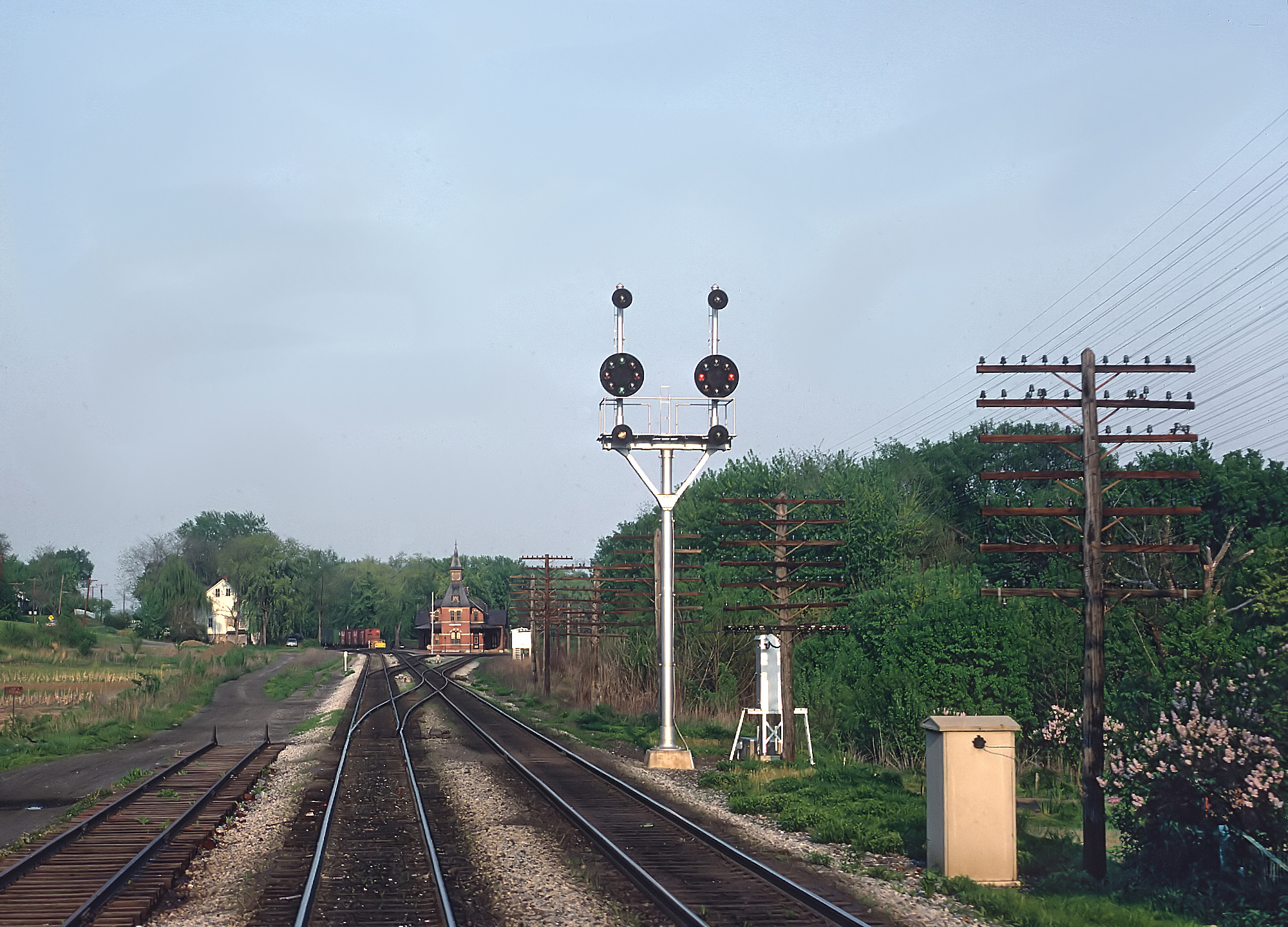
A classic Baltimore & Ohio Color Position Light installation protects the interlocking at Point of Rocks, Maryland, on May 3, 1969. The circular main head and surrounding marker lamps are the visual signature of the B&O system. Roger Puta photo.
The live page that long sat on this site was too thin for a system that rich. What follows is a fuller account: who designed the CPL, how the main head and markers actually work together, how dwarfs and high signals relate, how the B&O scheme differed from the Pennsylvania Railroad’s famous Position Lights, where CPLs were used, and why successor CSX Transportation finally retired most of them in favor of modern three-light LED heads—the ones railfans nicknamed “Darth Vaders.”
At a Glance
| Topic | Summary |
|---|---|
| Full name | Color Position Light (CPL) signal |
| Home road | Baltimore & Ohio; also SIRT, B&O Chicago Terminal, former Chicago & Alton territory, and related affiliates |
| Principal designer | Frank Patenall (ex–Union Switch & Signal; B&O signaling, from 1891; CPL circa mid-1920s) |
| First main-line territory | Deshler–Hamlet, Ohio |
| Early affiliate order | December 1924: B&O ordered CPL equipment for Staten Island Rapid Transit |
| Design idea | Mimic upper-quadrant semaphore positions and add color for redundant reading |
| Main head | Circular target; dual-lamp pairs for vertical green (clear), diagonal yellow (approach), horizontal red (stop), opposite diagonal lunar white (restricting) |
| Markers (“orbitals”) | White and amber lamps above/below/beside the head that encode Normal / Medium / Slow speeds for this signal and/or the next |
| Makers | Hall originally; later General Railway Signal and Union Switch & Signal (US&S Type G high; Type VA dwarf among common designations) |
| Notable trait | Properly equipped dwarf CPLs can display the same aspect set as high signals |
| CSX successor speeds (typical rulebook) | Limited ~45 mph; Medium ~30 mph; Slow ~20 mph |
| Status | CSX continued installing CPLs on former B&O into the early 1990s, then systematically replaced them with modern color-light / LED heads |
Semaphore Thinking in an Age of Electric Light
By the early twentieth century, American railroads were moving from mechanical semaphores toward electric light signals that could be controlled remotely, approach-lit, and maintained as part of automatic block and interlocking plants. Two major Eastern roads took related but different paths.
The Pennsylvania Railroad standardized on Position Light (PL) signals: amber (later amber/lunar-white) lamps arranged to recreate semaphore blade positions without relying on color. The Baltimore & Ohio went a step further. Its Color Position Light kept the positional idea—vertical, diagonal, horizontal—but painted those positions with standard railroad colors and then layered an elegant marker-lamp system on top. The result was not a random constellation of bulbs. It was a deliberate algorithm: main head for block/route occupancy logic, markers for speed.
That dual coding is why longtime railroaders often called CPLs among the most readable of the classic systems. If fog or snow washed out color perception, the geometry of the lighted pair still said clear, approach, stop, or restricting. If one lamp in a dual-lamp pair burned out, the mate remained lit. Red, reserved for the most restrictive horizontal indication, appeared only when the plant needed a true stop or restricted-speed discipline tied to occupancy or route risk—not as casual decoration.
Frank Patenall and the Birth of the CPL
The engineering credit for the B&O CPL belongs primarily to Frank Patenall. Born abroad, he came to the United States in the 1880s, worked for Union Switch & Signal, and joined the Baltimore & Ohio’s signaling organization in 1891. By the mid-1920s he had shaped the Color Position Light as the road’s standard language of wayside indication.
Chronology matters when comparing B&O and Pennsy. The PRR had already fielded early Position Light hardware (the familiar “tombstone” PL era begins around 1915). Some accounts describe Patenall as developing the CPL concurrently with PL practice; others treat the B&O design as a conscious improvement that retained position and added color for fail-safe redundancy. Either way, the CPL was not a copy of a traffic light. It was a semaphore in electric form, tuned for B&O operating rules and interlocking culture.
Patenall’s name also attaches to approach lighting—the practice of darkening signals until a train occupies the approach circuit, then lighting them for the crew that needs them. Brian Solomon’s Railroad Signaling is among the secondary sources that credit him with that refinement. Approach lighting saved lamp life and power on long ABS territories and remains a familiar trait in period photographs: a CPL mast standing dark beside the main until steel is near enough to wake it.
Hardware manufacture began with the Hall Signal Company and later shifted heavily to General Railway Signal (GRS) and Union Switch & Signal. High signals are commonly associated with US&S Type G construction (a designation that confuses modern readers because “Type G” also labels certain triangular three-light color signals). Dwarf CPLs are widely known as US&S Type VA. Catalog drawings from the 1930s show the same family still in production decades after first installation.
Territory came quickly. The first main-line CPL installation is generally cited between Deshler and Hamlet, Ohio. In December 1924 the B&O announced an order for dozens of CPL sets for the Staten Island Rapid Transit—an early, high-visibility affiliate application that kept the circular heads in the public eye long after steam left the B&O heartland. Over the following decades the system spread across B&O mains, branches that warranted absolute or automatic signals, the B&O Chicago Terminal property, and former Chicago & Alton lines that fell under B&O influence (later GM&O territory carried CPLs as a recognizable inheritance).
How to Read a CPL: Main Head First
Forget the idea of a single “central bulb with random radials.” A standard high CPL uses a circular stamped background—originally heavy steel with a stiffening lip, later aluminum in some replacements—with lamp units bolted into fixed clock positions. Each aspect on the main head is normally a pair of lamps of the same color, aimed and focused with colored Fresnel inner lenses and clear outer lenses. There is no rear reflector in the classic design; that choice reduces false indications from external light.
The four primary main-head geometries (the semaphore mimic) are:
- Vertical green — Clear / Proceed for the block and route selected (speed still depends on markers)
- Diagonal yellow (one diagonal) — Approach: prepare to stop at the next signal; reduce as the rule requires
- Horizontal red — Stop (or, with number plate / rule context, stop-and-proceed / restricted proceed under later CSX practice)
- Opposite diagonal lunar white — Restricting: proceed at restricted speed, prepared to stop short of train, obstruction, or switch not properly lined
B&O practice was essentially a two-block reading of occupancy on the head: green when the controlled route ahead was clear through the relevant blocks; yellow when the next signal would require a stop or reduced authority; red when the immediate block/route demanded stop or restricted movement. Lunar white for restricting covered moves onto unsignaled tracks, through certain interlocking routes, or other situations where the rulebook demanded restricted-speed running rather than a pure absolute stop.
Crucially, a main-head indication without markers is a slow-speed story (except for absolute stop). Vertical green alone is not “track speed clear” in the full CPL language; it is a slow clear unless upgraded by markers. That single rule unlocks the rest of the system.
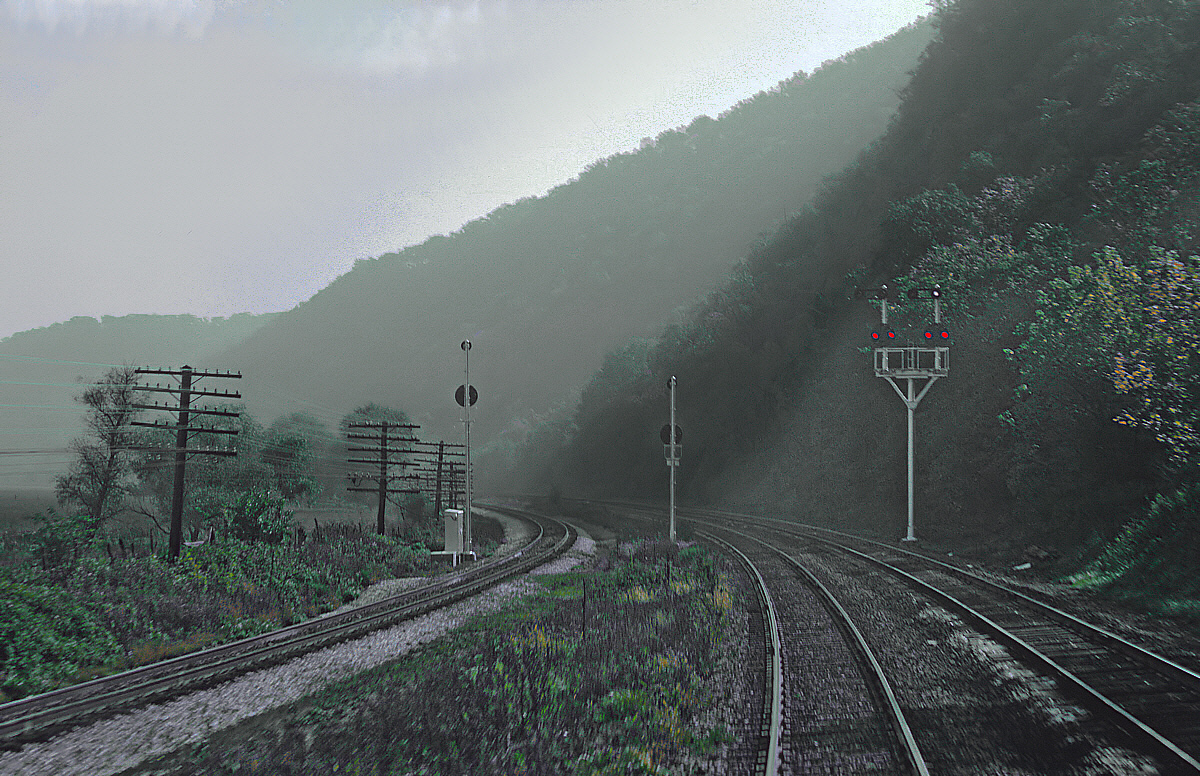
Color Position Lights protecting the main line near Cumberland, Maryland, on October 4, 1969. Marker lamps above and below the circular head refine speed for the route and the signal ahead. Roger Puta photo.
Marker Lamps: The Speed Code
The six common marker positions—sometimes called orbitals by fans—sit above and below the main head, offset from the mast. A fully populated high CPL can carry fourteen lamp assemblies (eight on the main head as four dual pairs, plus six markers), but most field signals were partial: only the markers needed for that interlocking or ABS location were installed. Unused main-head sockets received blanking plates.
Color of the markers is part of the code:
- White markers (left and center positions) relate to normal- and medium-speed upgrades
- Yellow (amber) markers (right-side positions) relate to slow-speed expectations at the next signal
A practical reading used by generations of B&O and CSX crews (wording varies by rulebook edition, but the geometry is stable) runs roughly as follows:
- No markers lit — treat the main head as a slow-speed indication through the turnout or restricted route (stop remains stop)
- Any marker above the head — upgrade for normal (high) speed past this signal when the head permits (the classic high green with upper white marker is the familiar track-speed clear)
- Markers below the head — medium-speed moves through the interlocking or crossover, with left/center/right markers further saying whether the next signal is to be approached at medium, unspecified proceed, or slow
- Left-side white markers — expect medium at the next signal
- Right-side yellow markers — expect slow at the next signal
In other words: markers answer two questions the head does not fully answer alone—How fast past this signal? and How should I shape speed for the next one? That is why a CPL can pack more operational information into one mast than a simple three-light color signal without intermediate heads or number plates.
Common Aspects (Simplified Overview)
Rule numbers shifted between B&O books and later CSX books; flashing upgrades and “limited” speeds were largely a later layer. The table below is a reader’s guide, not a substitute for a current employee timetable or rulebook.
| What you see (simplified) | Typical meaning |
|---|---|
| Vertical green + upper white marker | Clear / proceed at normal speed (subject to timetable) |
| Vertical green, no markers | Slow clear (or related slow proceed) through the route |
| Diagonal yellow + appropriate markers | Approach or medium approach variants: prepare to stop or reduce for next signal |
| Horizontal red, absolute (no number plate context) | Stop |
| Horizontal red with number plate / automatic context | Historically stop-and-proceed on B&O; under CSX often restricted proceed without a full stop |
| Lunar white diagonal | Restricting: restricted speed, prepared to stop short of trouble |
| Green or markers flashing (CSX-era) | Upgrade selected aspects (e.g., limited clear / approach limited / slow clear variants) |
Under modern CSX rule language that inherited B&O CPL territory, published speeds have commonly been on the order of Limited 45 mph, Medium 30 mph, and Slow about 20 mph (slow was 15 mph in earlier practice on some properties). A full catalog can list on the order of sixteen or seventeen named aspects in the rulebook even though the hardware could theoretically combine into more patterns—many combinations would be operational nonsense (a “slow stop” is not useful), so rulebooks and circuits only implement what dispatchers and interlockings need.
Later refinements included:
- Flashing green without markers for certain slow-clear upgrades (displacing older solid-green slow aspects in numbering)
- Flashing markers or a fixed yellow triangle plate for limited-speed aspects (approach limited, limited clear)
- Rule changes in the energy-crisis era that, on some automatic reds, allowed continued movement at restricted speed rather than a full stop-and-proceed pause—saving fuel while still demanding eyes-out running
High Signals, Dwarfs, and Hardware Details
High CPLs typically sat on five-inch (or larger) masts, with the main head often about seventeen feet above the rail on standard drawings, markers spaced roughly seven feet above and below the head center, and the mast set well clear of the track centerline. Taller installations, bracket posts, cantilevers, and signal bridges carried the same heads where sight lines demanded. Unlike some PRR PL practices, CPLs were not commonly perched on relay cases; they wanted a proper mast or bridge.
Each lamp unit is a simple, rugged assembly: a low-voltage bulb, colored inner Fresnel, clear outer lens, three-bolt spring mount for aiming, and a sighting hole in the background for maintainers. Early installations sometimes put step-down transformers in the rear junction box; later practice moved high-voltage gear for safety and economy. Maintainers lived by those lamps—every dual pair and marker was another bulb, another lock, another alignment check. Cost of ownership is one blunt reason CSX eventually preferred multi-light LED heads with far fewer discrete units.
Dwarf CPLs are a B&O specialty. Where most roads limit dwarfs to slow-speed or low-headroom indications, a fully outfitted CPL dwarf can show the same aspect family as a high signal. Ground-mounted dwarfs protected sidings, reverse moves, and tight terminals; elevated dwarfs appeared on the approaches to Washington Union Station, replacing earlier semaphore practice with B&O language even where the signal sat on a bridge rather than the ground. Museum examples (notably associated with the B&O Railroad Museum in Baltimore) have shown dwarfs equipped with full marker sets for demonstration—whether every field dwarf was that complete is a separate question, but the capability is real and unusual in North American practice.
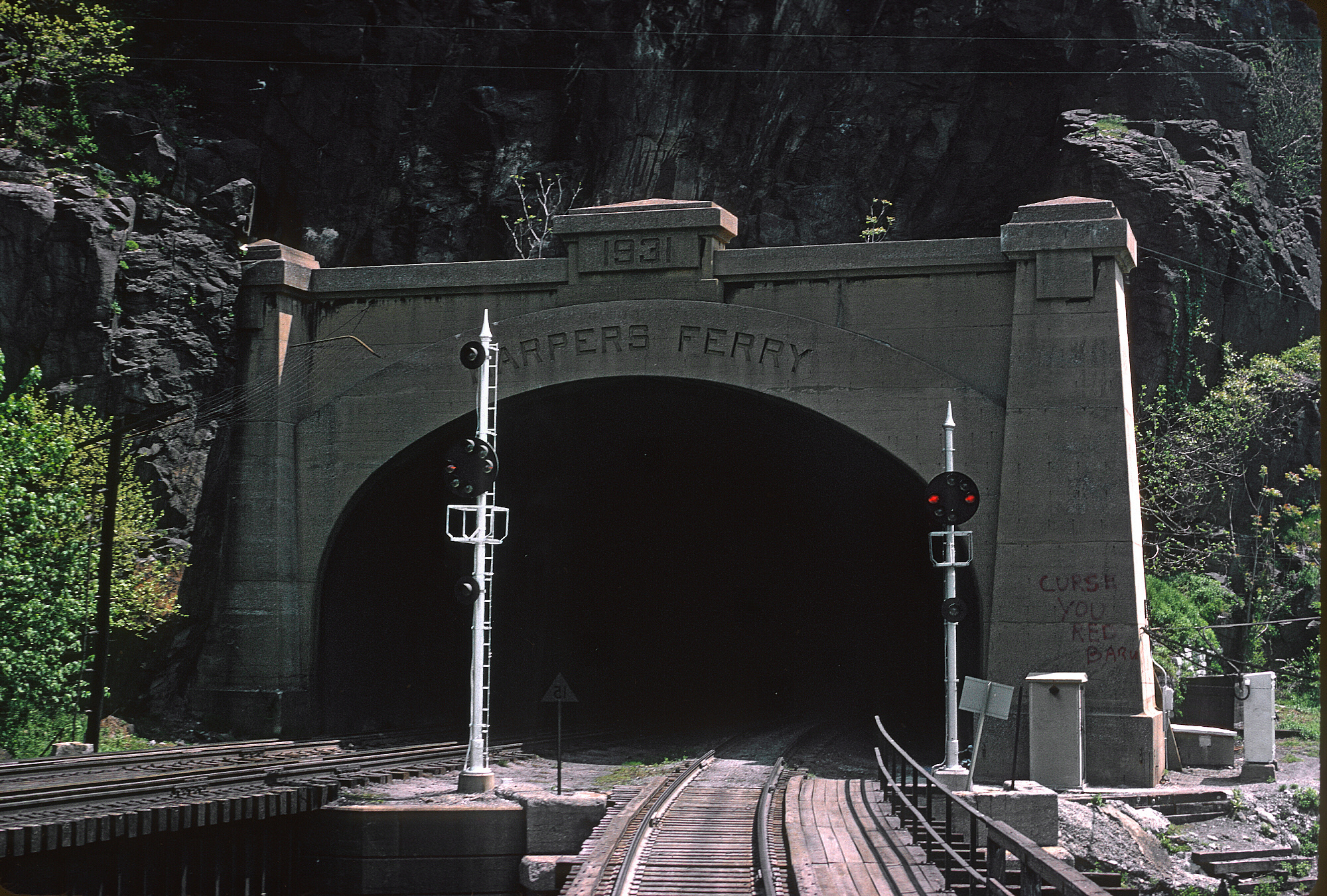
Single-mast CPLs on the B&O main near Harpers Ferry, West Virginia, May 3, 1969. The silhouette—round head, offset markers, five-inch mast—was once as much a part of the Mountain Subdivision landscape as the river and the tunnel. Roger Puta photo.
CPL vs. Pennsylvania Railroad Position Lights
Railfans often lump “position lights” together. The systems are cousins, not twins.
| Feature | B&O Color Position Light | PRR Position Light |
|---|---|---|
| Primary coding | Position and color | Position only (color largely uniform) |
| Typical lamp color | Green, yellow, red, lunar white on the head; white/amber markers | Amber / amber-white pairs |
| Red lamps | Used for stop (horizontal) | Not used as the main PL color language |
| Speed refinement | Dedicated marker/orbital lamps around the head | Additional heads, markers, and rule combinations in PL fashion |
| Dwarf capability | Can match high-signal aspect set when fully equipped | Dwarfs more limited relative to high PL plants |
| Visual identity | Circular target with colored pairs | Circular or tombstone PL face with amber geometry |
Both systems answered the same industrial problem: make semaphore logic electric, readable at speed, and compatible with automatic block and interlocking. The B&O answer simply trusted color as a second channel and then invented a marker grammar that many engineers found intuitive once taught.
Where CPLs Lived
If you found a circular CPL head, you were almost certainly on:
- Baltimore & Ohio main lines and signaled branches from the Mid-Atlantic through the Ohio Valley and Midwest
- Staten Island Rapid Transit (B&O affiliate; early 1920s order; CPLs long associated with the island’s rail operations)
- B&O Chicago Terminal and related terminal trackage
- Former Chicago & Alton / later GM&O corridors that retained B&O-style plant
- Washington Union Station approaches, where dwarf CPLs (sometimes mounted high) spoke B&O to trains threading the terminal district
They did not become a continental standard. Outside the B&O family, other roads kept three-light color signals, searchlights, PRR-style PLs, or hybrid plants. That exclusivity is why a photo of a CPL instantly says “B&O country” the way a tombstone PL says “Pennsy” and a Southern Railway target says Dixie.
Famous photo locations for the classic era include Point of Rocks, the Cumberland approaches, Harpers Ferry and the Potomac crossings, the Baltimore terminal district (Carroll, Bailey’s Wye, Riverside, and the DC main), Brunswick, and Ohio junctions such as Deshler and Fostoria—places where interlocking density justified full marker sets and where railfans could still, into the twenty-first century, chase survivors before cutovers.
Chessie, CSX, and the Long Goodbye
The B&O entered the Chessie System era and then CSX Transportation without an overnight purge of CPLs. On the contrary, CSX continued to install new CPLs on former B&O lines into the early 1990s when interlocking renewals still followed legacy standards. Rulebooks absorbed limited-speed flashing aspects, renumbered slow clears, and adjusted automatic red procedures, but the circular heads remained the face of many Mountain, Cumberland, Baltimore, and Midwest districts.
Eventually economics and standardization won. A CPL can require a dozen or more lamp units, individual locks, junction-box wiring, and aimable optics. A modern three-light LED head with long hoods—railfans’ “Darth Vader” silhouette—uses fewer modules, simpler spares, and fits CSX’s system-wide color-light practice inherited from C&O and other components of the merger family. Through the 2000s and 2010s, major plants at places like Carroll interlocking in Baltimore, Gaithersburg, and countless intermediate ABS locations went dark as CPL and rose as LED. By the mid-2020s, working main-line CPLs on CSX were rare survivors rather than the default landscape.
Preservation is partial. Hardware exists in museums, private collections, and a few non-Class I settings. Model railroaders still build accurate CPLs because the B&O scene is incomplete without them. Signal historians and sites such as railroad signaling reference pages have documented lamp counts, catalog cuts, and aspect charts so the reading skill does not die with the last maintainer who aligned a Type G head by the sighting hole.
Why the System Still Matters
Color Position Lights matter for three reasons that outlast any single mast on the Old Main Line.
First, they are a master class in human-factors design from the 1920s: two independent visual channels (color and position), dual lamps against burnout, and markers that encode speed without requiring a second full signal head for every combination.
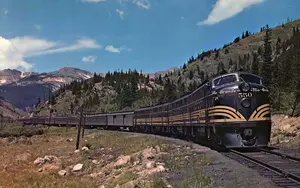
Second, they are B&O identity. Streamlined EA diesels, Capitol Dome heralds, and CPL masts form one visual culture. When CSX replaced the signals, it replaced more than hardware; it muted a regional dialect of the railroad landscape.
Third, they teach modern readers how rulebooks and iron fit together. An aspect is not a pretty light. It is a contract between the interlocking, the track circuit, and the engineer’s throttle hand. Learning the CPL grammar—head for occupancy, markers for speed—is learning how the B&O thought about moving trains safely at scale.
If you stand at Point of Rocks today, the interlocking may speak a different electrical language than it did when Roger Puta tripped the shutter in 1969. The photograph still does. Vertical green, diagonal yellow, horizontal red, lunar restricting, white and amber markers in their clock positions: that was the Baltimore & Ohio telling the engineman, clearly and twice over, what the railroad needed him to do next.
Sources & Further Reading
- Railroad Signals of the U.S. — B&O CPL technical overview, primer material (incl. Michael Watnoski / John Engleman notes), and field documentation
- Brian Solomon, Railroad Signaling (Patenall and approach lighting context)
- Period US&S catalog drawings of CPL high and dwarf equipment
- B&O and CSX employee timetables / signal aspect charts (rule numbers and speeds vary by era)
- B&O Railroad Historical Society and museum collections for surviving hardware and drawings
This article replaces an earlier short overview of CPL signals with a deeper operational and historical treatment of the Baltimore & Ohio Color Position Light system.
Recent Articles


-
Lake Superior & Ishpeming Railroad: Map, Roster, History
Oct 25, 26 11:38 PM
 Lake Superior & Ishpeming Railroad, reporting mark LSI, from the Marquette Range to the Presque Isle ore dock. The 1954 steam list and the diesels the railroad owned.
 -
Kansas City Southern Steam Roster (Built Since 1900)
Oct 25, 26 09:09 PM
 Steam locomotives of the Kansas City Southern built since 1900, with the Louisiana & Arkansas and the Texas company.
 -
Kansas City Southern Diesel Roster (Built New)
Oct 25, 26 11:46 AM
All-time diesel roster of the Kansas City Southern. E units, F units, Geeps, SD40s through SD70ACes, Fairbanks-Morse, Baldwin, Alco, and General Electric, with serials and order numbers. -
Kansas City Southern Railway: Map, Photos, History
Oct 25, 26 12:24 AM
 The Kansas City Southern, from Arthur Stilwell's Gulf line to Canadian Pacific Kansas City on April 14, 2023. Steam and diesel rosters, the Southern Belle, and the Louisiana & Arkansas.
 -
Indiana Harbor Belt Diesel Roster (All-Time)
Oct 25, 26 12:17 AM
 All-time diesel roster of the Indiana Harbor Belt. 202 locomotive frames, each counted once. NW2s, SW7s, SW1500s, road switchers, and gensets. Slugs and boosters are outside the count.
 -
Indiana Harbor Belt Steam Roster (Built Since 1900)
Oct 25, 26 12:13 AM
 Steam locomotives of the Indiana Harbor Belt built since 1900. 182 engines, each counted once. 0-6-0s, 2-6-0s, 0-8-0s, and 2-8-2s. The three U-4a switchers are three-cylinder Brooks engines of 1927.
 -
Indiana Harbor Belt Railroad: Map, Rosters, History
Oct 25, 26 12:00 AM
 Indiana Harbor Belt, the inner belt across the Calumet, from the East Chicago Belt of May 16, 1896. Renamed June 29, 1907. Still operating, headquarters Hammond. Steam roster is the companion, 182 loc…
 -
NYC's "P Motor" Electric Locomotives
Oct 24, 26 11:43 PM
 New York Central P motors: 22 Alco-GE 2-C+C-2 electrics, Cleveland Union Terminal 1050–1071, class P-1a. 3,030 hp one-hour on 3,000-volt DC catenary, then 660-volt third rail as P-2a and P-2b.
 -
Illinois Terminal Car Roster
Oct 24, 26 11:40 PM
 Illinois Terminal cars. Mainline motors, the 1948 streamliners, sleepers, Alton and Valley Division cars, express motors, and the line cars rebuilt from pull cars.
 -
Illinois Terminal Diesel Roster
Oct 24, 26 09:31 PM
 All-time Illinois Terminal diesels, 62 frames. Alco S-2s and RS-1s, EMD switchers, GP7s, SD39s, GP38-2s, and the two GP20s. Serial numbers from the 1989 roster.
 -
Illinois Terminal Electric Locomotives
Oct 24, 26 08:22 PM
 Illinois Terminal electric locomotives, 57 frames. Class A through Class D, the Decatur-built motors, and the battery locomotives. Class D is the same five Class C frames, rebuilt.
 -
Illinois Terminal Steam Roster
Oct 24, 26 07:37 PM
 Illinois Terminal steam locomotives, 36 frames. Baldwin Moguls, three Class 30 Mikados, Florida East Coast 0-8-0s, and 2-6-0 No. 21, the last fire on June 30, 1950.
 -
Illinois Terminal Railroad: Map, Roster, Photos, History
Oct 24, 26 07:32 PM
 Illinois Terminal, McKinley's Illinois Traction System, from the Danville coal towns to St. Louis. The McKinley Bridge, the sleeping cars, the 1937 break with the power company, the 1948 streamliners…
 -
Southern Railway Diesel Roster (All-Time)
Oct 23, 26 11:00 PM
 All-time diesel roster of the Southern Railway. 2,505 locomotives in the system number series, from the 1939 demonstrator FT to GP50s and B30-7A1s. Serials included.
 -
Illinois Central Diesel Roster (All-Time)
Oct 23, 26 04:06 PM
 Illinois Central and Illinois Central Gulf diesel locomotives, each frame once. The quantity column is 886. Serials and order numbers from Electro-Motive's builder lists. Paducah rebuilds and Gulf, Mo…
 -
Illinois Central Gulf Diesel Roster
Oct 23, 26 04:02 PM
 Illinois Central Gulf operating numbers from August 10, 1972, to February 29, 1988. New frames stay on the Illinois Central diesel roster. Gulf, Mobile and Ohio frames stay on that roster. No Gulf fle…
 -
Illinois Central Railroad: Map, Logo, History
Oct 23, 26 03:50 PM
Illinois Central, the Main Line of Mid-America, from the 1850 land grant to Canadian National control on July 1, 1999. Charter lines, Cairo bridge, Paducah, and the Illinois Central Gulf. Steam quanti… -
Grand Trunk Western Diesel Roster (All-Time)
Oct 23, 26 12:53 PM
 Grand Trunk Western diesel locomotives, each frame once. The quantity column is 377. Serials are filled for the Detroit, Toledo and Ironton and Detroit and Toledo Shore Line engines the railroad kept…
 -
Grand Trunk Western Steam Roster
Oct 23, 26 12:14 PM
 Grand Trunk Western steam locomotives in service about 1937 to 1942, from Richard Leonard's class list. Drury has no chapter. The quantity column is the counted Grand Trunk Western rows. Two mixed Gra…
 -
Grand Trunk Western Railroad: Map, Roster, History
Oct 23, 26 12:09 PM
 Grand Trunk Western, reporting mark GTW, Canadian National's railroad between Port Huron and Chicago. Trade name adopted in 1923. Steam class list quantity 232. Diesel quantity column 377. Identity in…
 -
Green Bay and Western Railroad: Map, Rosters, History
Oct 22, 26 11:18 PM
 Green Bay & Western, the Green Bay Route, reporting mark GBW. From Kewaunee to Winona. Mailer's steam and diesel rosters, and the August 1993 sale to Fox Valley & Western.
 -
Chicago & North Western Class E-4: Streamlined 4-6-4 Hudsons
Oct 22, 26 10:28 PM
 C&NW Class E-4, nine streamlined 4-6-4s, 4001–4009, Alco 1938. 84-inch drivers, 25-by-29 cylinders, 300 psi. Conventional Chicago–Omaha trains. Oil in 1947–48. Retired 1953–1956.
 -
Gateway Western Railway: Map, Roster, History
Oct 22, 26 02:43 PM
 Gateway Western Railway, reporting mark GWWR. Class II from Kansas City to East St. Louis. Kansas City Southern control May 5, 1997. The 1992 diesel fleet, with serials and order numbers.
 -
Duluth, Winnipeg & Pacific Railway: Roster, Map, History
Oct 22, 26 01:51 PM
 Duluth, Winnipeg & Pacific, the Peg, reporting mark DWP. From the Rainy River to Duluth. CNRHA steam list 36. Fifteen RS-11s. Merged into Wisconsin Central Ltd. on December 31, 2011.
 -
Elgin, Joliet and Eastern Diesel Roster (All-Time)
Oct 22, 26 01:35 PM
 All-time diesel roster of the Elgin, Joliet and Eastern.
 -
Elgin, Joliet and Eastern Steam Roster
Oct 22, 26 01:25 PM
 Elgin, Joliet and Eastern steam locomotives of the final decade, which largely comprised switcher types, 2-8-0s, and a large fleet of Mikados.
 -
Elgin, Joliet and Eastern Railway: Map, Roster, History
Oct 22, 26 12:32 PM
 Elgin, Joliet & Eastern, the outer arc around Chicago, from the Joliet, Aurora & Northern of April 30, 1884. Illinois company March 18, 1887. Merged December 4, 1888. Principal lines sold Janu…
 -
Denver and Salt Lake Railway: History, Roster, Timetable
Oct 22, 26 09:47 AM
 Denver & Salt Lake, the Moffat Road, from Denver to Craig. Tunnel opened February 26, 1928. Dotsero Cutoff dedicated June 16, 1934. Merged April 11, 1947. Steam locomotives 59.
 -
Duluth, Missabe and Iron Range Diesel Roster (All-Time)
Oct 22, 26 09:43 AM
 All-time diesel roster of the Duluth, Missabe and Iron Range. 148 owned frames, each counted once. SW9s, SD9s, SD18s, SD38s, RSD-15s, and C630s. Serials and builder order numbers included. Helm SD40-3…
 -
Duluth, Missabe and Iron Range Steam Locomotives (Since 1900)
Oct 22, 26 09:22 AM
 Duluth, Missabe & Iron Range steam locomotives built since 1900. Duluth & Iron Range, Duluth, Missabe & Northern, and later DM&IR acquisitions. Quantity column 252. Yellowstones 220-23…
 -
Duluth, Missabe and Iron Range Railway: Roster, Map, Logo
Oct 22, 26 09:17 AM
Duluth, Missabe & Iron Range, reporting mark DMIR, from the Mesabi and the Vermilion to the Lake Superior docks. Formed July 1, 1937. Steam quantity 252. Owned diesels 148. On paper through Decemb… -
Duluth, South Shore, and Atlantic Railway: Map, Roster, Timetables
Oct 21, 26 11:21 PM
 Duluth, South Shore & Atlantic Railway, the South Shore. Marquette to the Sault, St. Ignace, Houghton, and Duluth-Superior. Soo Line on January 1, 1961. Twenty-four diesels.
 -
Detroit, Toledo and Ironton Diesel Roster (All-Time)
Oct 21, 26 02:55 PM
 All-time diesel roster of the Detroit, Toledo and Ironton. 119 frames, each counted once. Serials and builder order numbers included. Last steam was December 24, 1955.
 -
Detroit, Toledo and Ironton Steam Roster (Post 1900)
Oct 21, 26 02:49 PM
 Detroit, Toledo and Ironton steam locomotives built after 1900. Drury's class grid. The quantity column prints 141. Counted once, the frames are 137. Last steam was Mikado 805 on December 24, 1955.
 -
Detroit, Toledo and Ironton Railroad: Map, Roster, History
Oct 21, 26 02:40 PM
 Detroit, Toledo & Ironton, reporting mark DTI, from Detroit to Ironton, Ohio. Railway organized May 2, 1905. Railroad articles filed February 21, 1914. Henry Ford, 1920 to 1929. Steam and diesel r…
 -
Iowa, Chicago and Eastern Railroad: Roster, Map, History
Oct 21, 26 01:04 PM
 Iowa, Chicago & Eastern Railroad Corporation, reporting mark ICE. About 1,125 miles and about 275 miles of trackage rights from the I&M Rail Link. Operations at 12:01 a.m. July 30, 2002. Canad…
 -
Rapid City, Pierre & Eastern Railroad: Route, Roster, Overview
Oct 21, 26 10:16 AM
 Rapid City, Pierre & Eastern Railroad, reporting mark RCPE. Genesee & Wyoming Class II. Agreement of January 2, 2014, Finance Docket 35799. Freight service from June 1, 2014, on the Dakota, Mi…
 -
Dakota, Minnesota & Eastern Railroad: Roster, Map, History
Oct 21, 26 12:26 AM
 Dakota, Minnesota & Eastern Railroad, reporting mark DME. The July 2, 1986 Chicago & North Western sale, 826 miles and 139 miles of trackage rights. Canadian Pacific control October 30, 2008…
 -
Detroit and Mackinac Railway: Map, Roster, History
Oct 20, 26 11:58 PM
 Detroit & Mackinac Railway, the Turtle Line. Bay City to Cheboygan along Lake Huron. Incorporated December 29, 1894. Lake State Railway leased the operation in 1992 and bought the lines in 1997. E…
 -
Davenport, Rock Island and Northwestern Railroad
Oct 20, 26 11:22 PM
 Davenport, Rock Island and North Western Railway, the DRI Line. Clinton to East Moline across the Crescent Bridge. Burlington and Milwaukee. Merged into the Soo Line on June 29, 1995. Eighteen diesels…
 -
Chicago Great Western Steam Roster (Post 1900)
Oct 20, 26 11:17 PM
Chicago Great Western steam locomotives built or rebuilt since 1900. Drury's class grid. 320 frames, each once. The quantity column prints 376 because a rebuild is listed again. Last steam in the reti… -
Chicago Great Western Diesel Roster (All-Time)
Oct 20, 26 10:47 PM
All-time diesel roster of the Chicago Great Western. 157 frames, each counted once. Serials and builder order numbers included. Steam was gone by 1950. The 1963 glance figure of 141 is one year's flee… -
Chicago Great Western Railway: Map, Photos, History, Rosters
Oct 20, 26 10:43 PM
 The Chicago Great Western, the Corn Belt Route, linked Chicago, the Twin Cities, Omaha, and Kansas City from September 27, 1885, until the Chicago & North Western merger at 12:01 a.m. on July 1, 1968…
 -
Chicago, South Shore & South Bend Railroad: "The South Shore Line"
Oct 20, 26 05:48 PM
 Chicago South Shore & South Bend, the South Shore Line, from the 1901 Air Line through Samuel Insull's 1925 rebuild, the orange cars, the 800s, and the railroad NICTD and Anacostia still run.
 -
Northwestern Virginia Railroad: Map, History, Timetable
Oct 20, 26 04:18 PM
 Northwestern Virginia Railroad, chartered February 14, 1851, Grafton to Parkersburg, 104 miles. Opened May 1, 1857. Foreclosure sale February 15, 1865, as the Parkersburg Branch. Twenty-three tunnels…
 -
"Exposition Flyer" (Train): Consist, Timetable, History
Oct 20, 26 03:29 PM
 Exposition Flyer, Chicago to Oakland, June 10, 1939 to March 20, 1949. Burlington, Rio Grande, and Western Pacific. Heavyweight cars, then diesels and a vista-dome. Replaced by the California Zephyr.
 -
Chicago, St. Paul, Minneapolis & Omaha Railway, "The Omaha Road"
Oct 20, 26 02:13 PM
 The Omaha Road, reporting mark CMO. Formed May 26, 1880. North Western management on December 16, 1882. Leased January 1, 1957. Class K-1 No. 183 and the sublettered diesels.
 -
Chicago and Western Indiana Railroad: Map, Rosters, History
Oct 20, 26 01:17 PM
 Chicago and Western Indiana, chartered June 5, 1879. Five equal owners, Dearborn Station, and two main lines. Dolton suburban mile 16.6. Fifteen diesels. Railroad service ended in 1994. The Illinois c…
 -
Railroad Tell-Tales: Protecting The Brakeman
Oct 20, 26 12:58 PM
 Railroad tell-tales: hanging ropes that warned a man on a freight-car roof of a low bridge or tunnel. The 1897 bridge-warning report, the 1905 Wisconsin statute, retainers, and why the roof walk outla…
 -
Chicago & North Western Steam Roster (Post 1900)
Oct 20, 26 12:54 PM
 Chicago & North Western steam locomotives built since 1900, and the Omaha Road list beside it. Drury's parent quantity column sums to 1,445, with four rows left blank. The Omaha Road column sums to 24…