
Railroad Signals: Providing Safety And Efficiency
Last revised: September 4, 2024
By: Adam Burns
Railroad signals are an integral part of railroading, without them there is absolutely no way trains could safely operate, particularly on single track lines.
However, more than just for safety signals allow for the efficient and steady flow of trains, enabling several to operate over a single-tracked line.
Signals have their beginnings dating back to the industry's infancy itself with the famed ball-type signal.
Perhaps, though, the most famous signal-type of all was the semaphore, which came into use in the mid-19th century and even today can still be found in regular service!
While signal displays and meanings often varied from railroad to railroad some of the most common types were the color-light signals (or tri-lights), searchlights, position-lights, and color-position lights with the tri-light the most popular today.
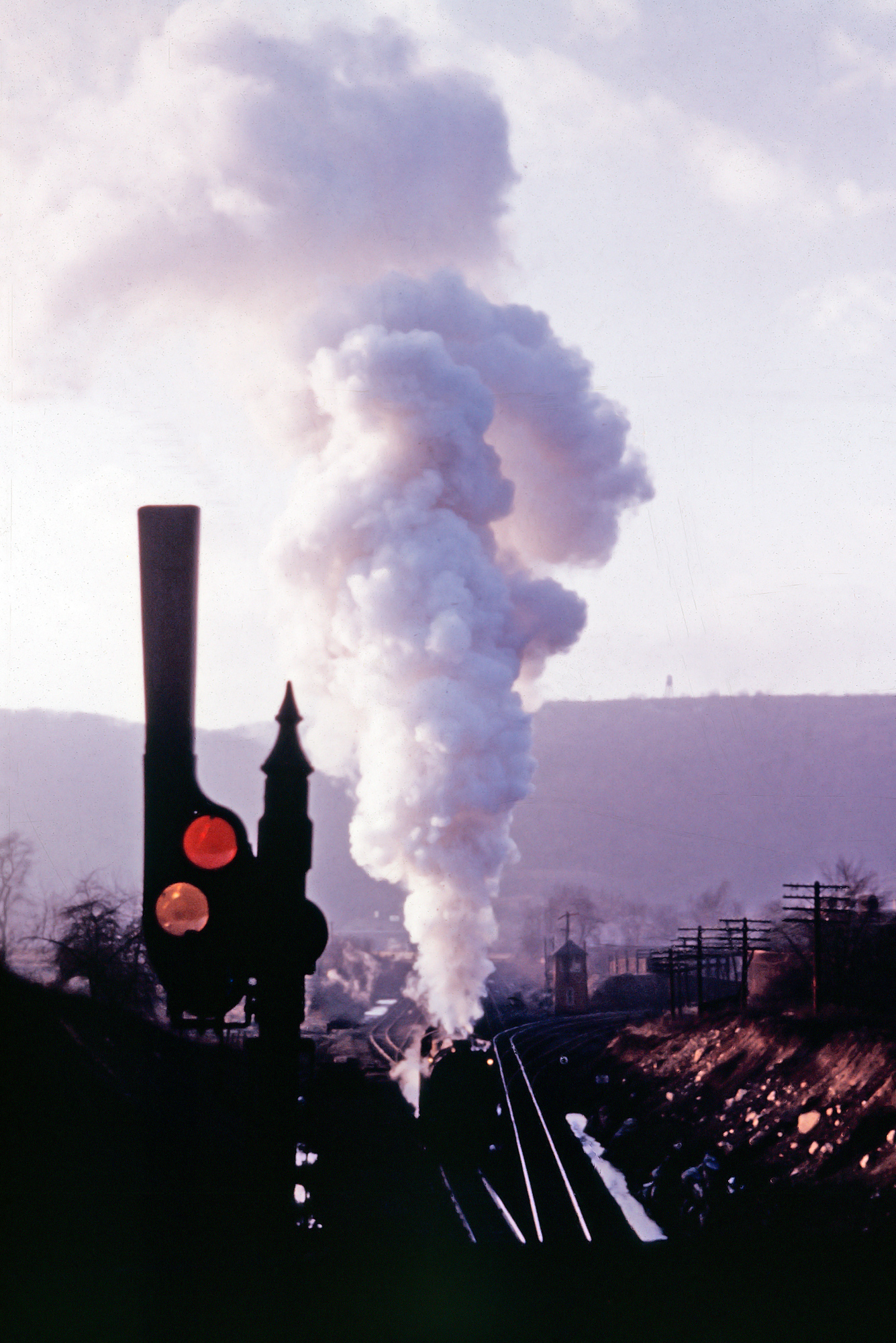 A semaphore protects the Western Maryland main line at Maryland Junction as an eastbound freight departs Ridgely, West Virginia, circa 1950. The train is about to enter Knobley Tunnel while MY Tower can be seen in the background. The line straight ahead, behind the train, heads for Knobmount Yard and Elkins while the tracks diverging to the right are bound for Connellsville. A.C. Kalmbach photo. American-Rails.com collection.
The first railroad signals came into use in 1832 on the New Castle & Frenchtown Railroad but really came of age in 1872 with the invention of the track circuit by William Robinson.
This circuitry allowed for the steel rail's natural conductivity to be employed thus giving birth to automatic block signaling systems, the leader of which remains Union Switch & Signal created by George Westinghouse in 1881.
Today US&S is part of Ansaldo STS, an Italian company. The NC&F's original signaling system, way before electricity itself, used a ball (hence its name, the ball-type) that operated on a vertical pole and pulley system with the high, center and low position displaying various means (with the ball itself also usually both black and white coloring).
If the ball was high this was a clear-to-proceed display giving way to the now common railroad term "highball". Naturally, a the ball system required an operator at each location thus proving to be a rather expensive operation.
Semaphores
The first electrified railroad signaling system was the semaphore . When the semaphore came into use in the 1860s it was still an unpowered system.
Basically the semaphore worked on a blade system whereby the indication was dependent on the position of the blade.
During the semaphore's infancy having proper sight of the signal during the nighttime hours proved, obviously to be a problem so later versions were equipped with red, yellow and green lenses so that railroad engineers could clearly see the indication being given.
The earliest semaphores known as lower-quadrant semaphores operated below the horizontal position with a downward-vertical blade (on about a 60 degree radius) meant proceed while a horizontal blade meant stop.
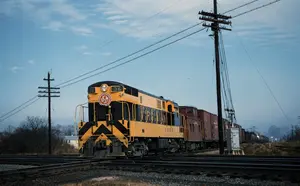
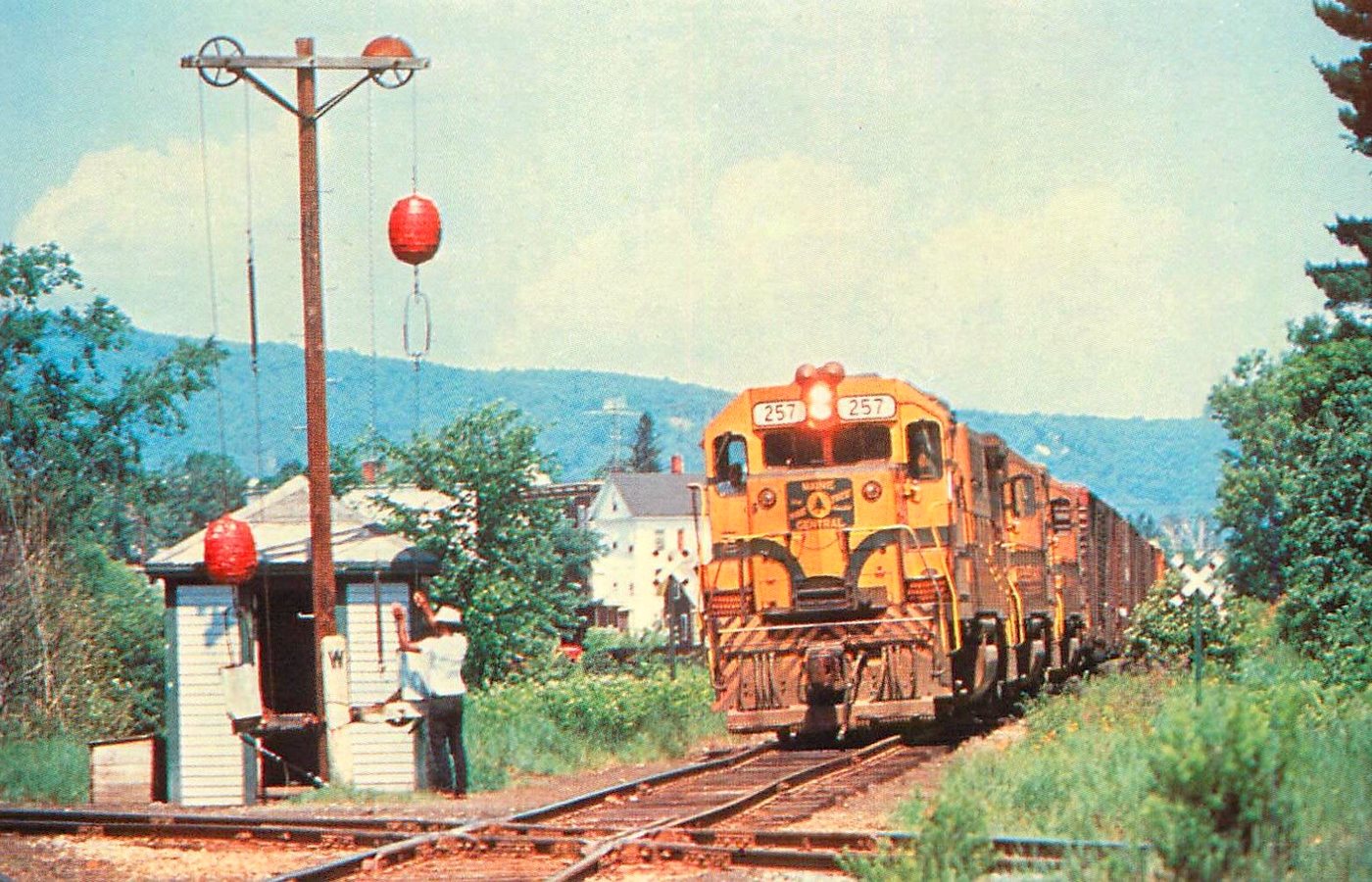 Maine Central GP38 #257 is ahead of freight 1/R-1 as it waits to cross the Boston & Maine diamond at Whitefield, New Hampshire protected by the last active set of ball signals (where the term "High Ball" originated) during the 1970s. Ronald Johnson photo.
The most common semaphore type was the three-position, upper-quadrant signal that was introduced around the beginning of the 20th century.
It operated above the horizontal position with an upward-vertical blade meaning proceed, horizontal blade meaning stop, and a 45-degree position meaning caution.
This type of semaphore can amazing still be found in use today, over 100 years since it became the standard semaphore type in 1908 (although be sure and get your photos of these structures while you can, many railroads are rapidly replacing them).
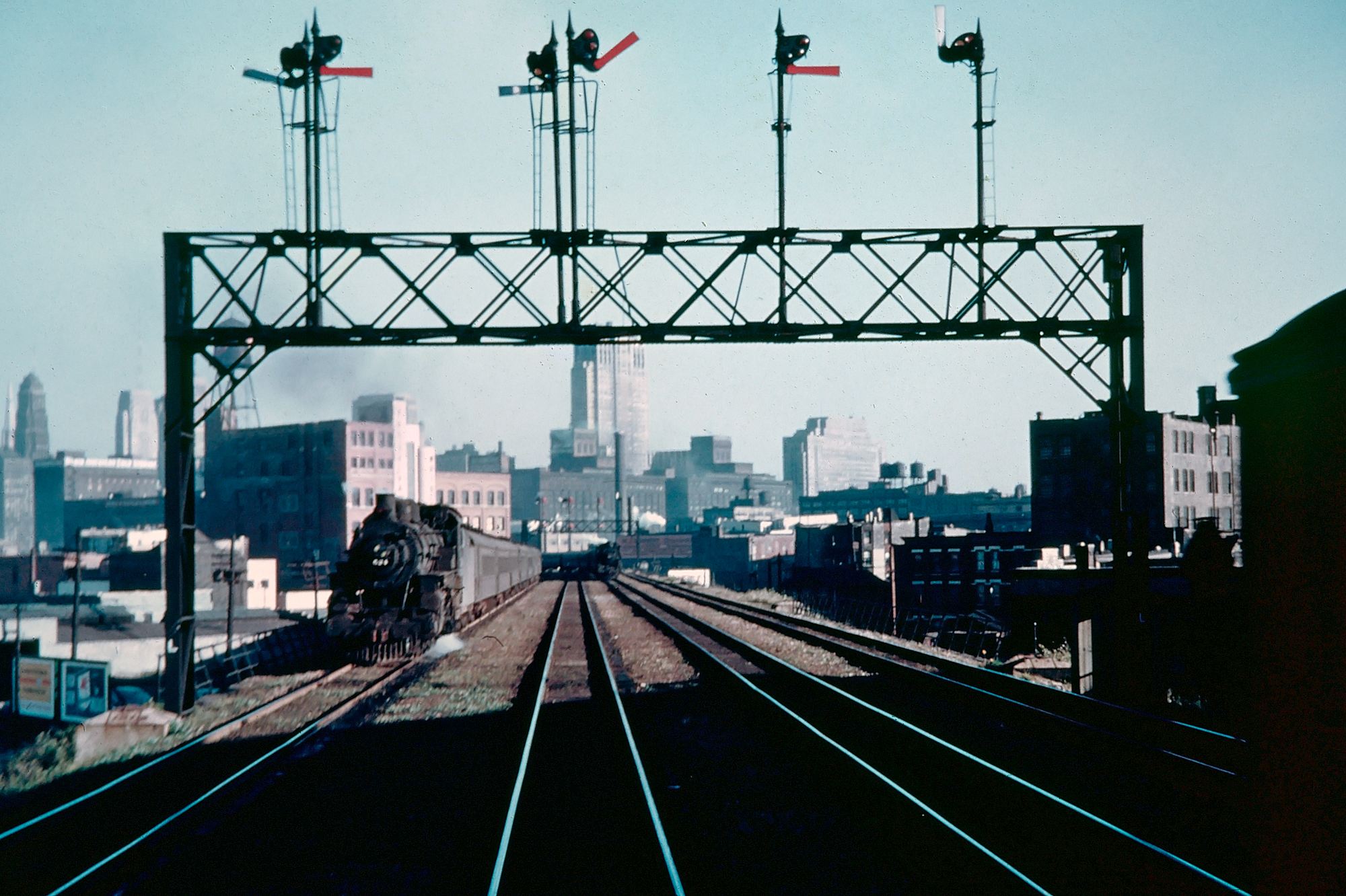 Semaphore blades protect the approach to C&NW's Northwestern Terminal in Chicago, circa 1953. Even by this date, semaphores were an antiquated technology although still widely employed across the country. A.C. Kalmbach photo. American-Rails.com collection.
Position-Light Signals
Position-lights were the chosen railroad signals for use on the Pennsylvania Railroad and Norfolk & Western Railway.
The system used a standard yellow light usually with three lights arranged in a semicircle to the upper right and three to the lower left with one in the center.
Depending on what type of indication the three-aligned lenses were giving (i.e., vertical, horizontal or diagonal) the train would either proceed, stop or some other cautionary measure (such as stop and proceed).
Position-light signals can still be found on former PRR and N&W routes by current owner Norfolk Southern is slowly replacing them with the redundant tri-light for easier maintenance.
Searchlight Signals
The searchlight would become one of the most popular railroad signals during the classic era of the 20th century.
It was introduced in 1920 and used only one lamp that displayed a green, yellow and red indication by way of rotating color lenses.
found use on dozens of classic railroads such as the Rock Island, Union Pacific and Atlantic Coast Line but the high amount of maintenance required to keep the colored lens system functioning caused it to fall out of favor for the much easier maintained tri-light signal.
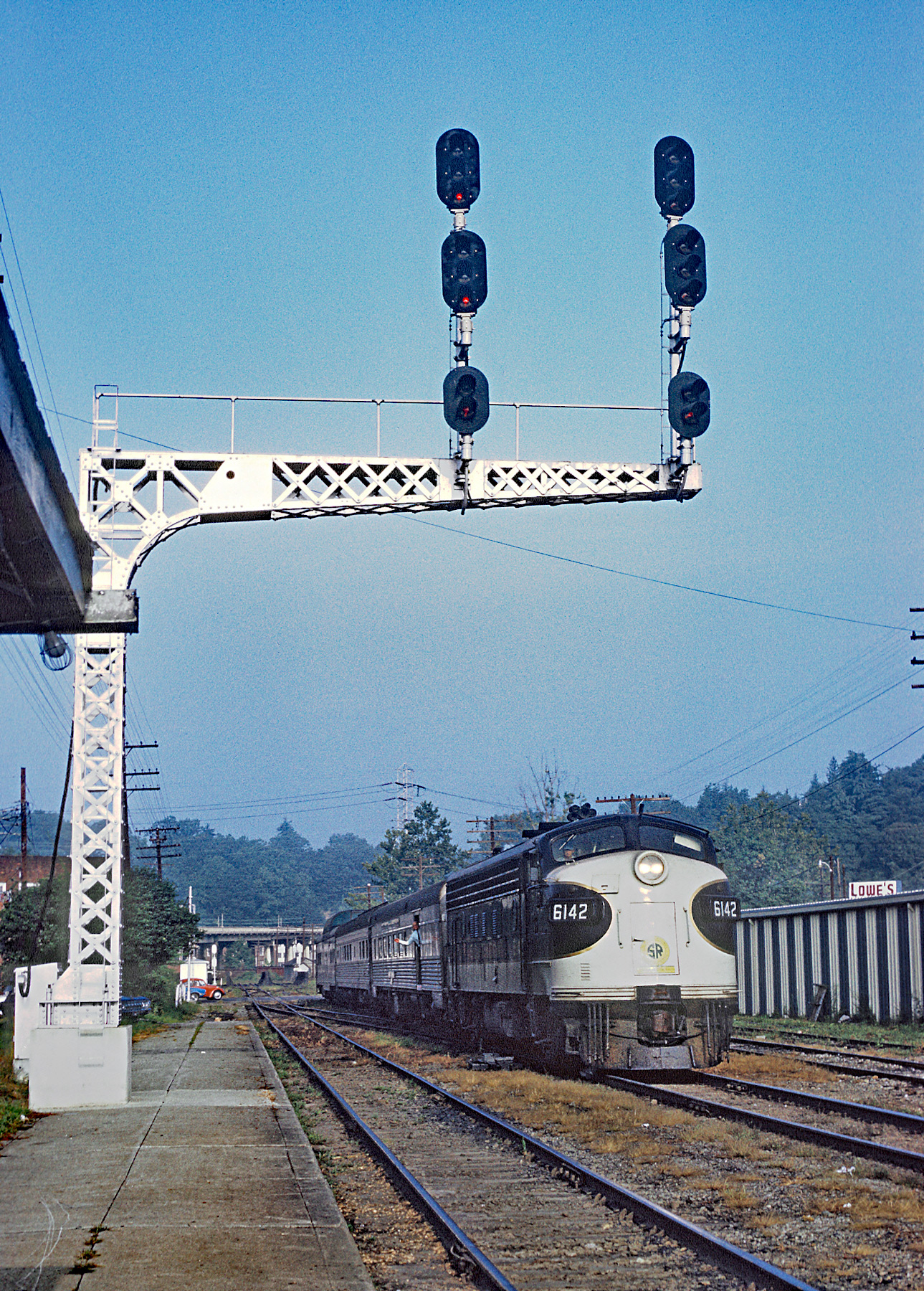 A classic Southern Railway cantilevered signal protects the small freight yard at the Biltmore Station near Asheville, North Carolina in August, 1971. Pictured is the eastbound "Asheville Special." The line nearest the photographer heads to Spartanburg, North Carolina which contained the torturous Saluda Grade. Roger Puta photo.
Color Position-Light Railroad Signals (CPLs)
Color position-light signals, or CPLs, are virtually synonymous with the Baltimore & Ohio Railroad.
The B&O's is a simplified version of the PRR position-light in that it has no center lens but essentially functions in the same way as the PRR version save that it uses different colors to project its meaning and not the standard yellow.
For instance, two vertical green lens is a clear and proceed indication whereby a yellow diagonal indicates caution and a red horizontal means restricted (stop).
The B&O also used a white light above the signal for further instructions (sometimes cantilevered).
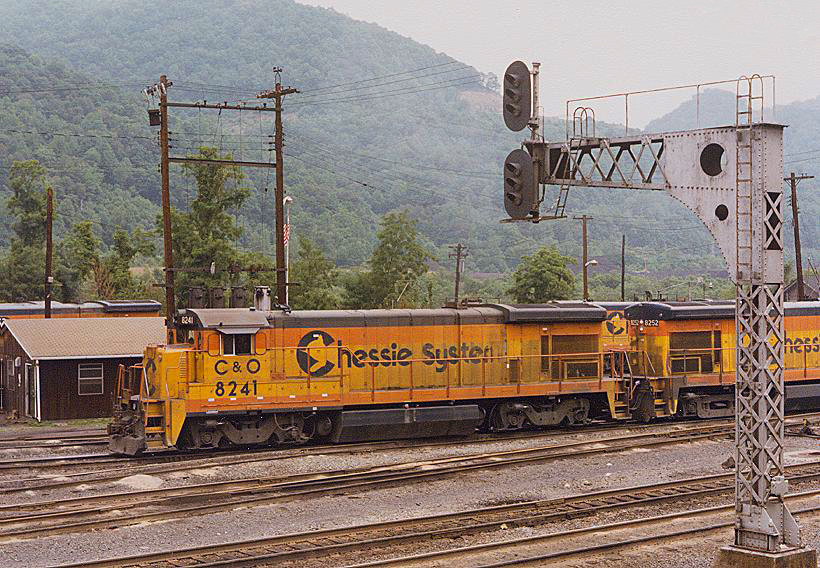 Chessie System/C&O B30-7 #8241 and #825 roll past the unique Chesapeake & Ohio cantilever signals protecting the main line at Handley, West Virginia on May 29, 1982. Doug Kroll photo.
Color-Light Signals
Color-light signals came into use around 1914 and are essentially an inverted highway stoplight with green above (proceed), centered-yellow (caution) and restricted below.
However, other versions of this railroad signal include the triangle design, which operates basically in the same fashion just with a different layout.
Also known as tri-lights they are, today, the favorite among Class I railroads with lines like CSX and Norfolk Southern Railway replacing their historic B&O and PRR versions with color-lights for ease of maintenance.
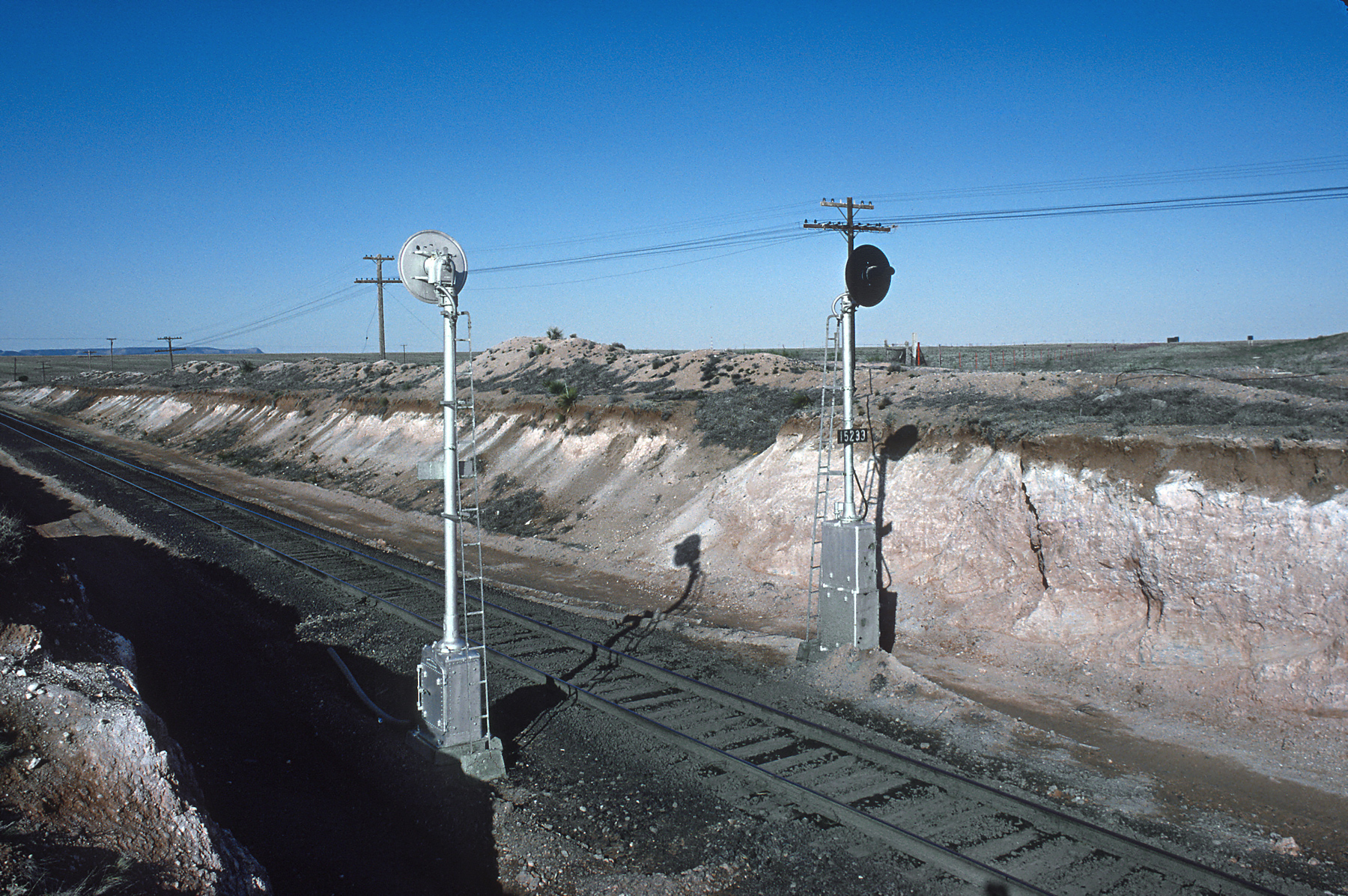 Classic search-light signals protect Southern Pacific's "Golden State Route" near Vaughn, New Mexico in April, 1983. Roger Puta photo.
Signals, How They Function
Railroad signals, historically and even today are a lot more complicated, in terms of their meaning than your basic highway stoplight.
To begin railroad signals serve to functions, protection and control and there are two different types; permissive and absolute.
A permissive signal provides only protection within a given block (meaning a section of signaled track along a rail line having several blocks between Point A and Point B, each protected by a set of signals) while an absolute signal provides both protection and control (i.e., meaning it protects the block while also giving a train ruling instructions).
For instance, when a permissive signal gives a red indication this means stop and proceed while an absolute signal displaying a red indication means stop and do not proceed without further dispatcher instructions.
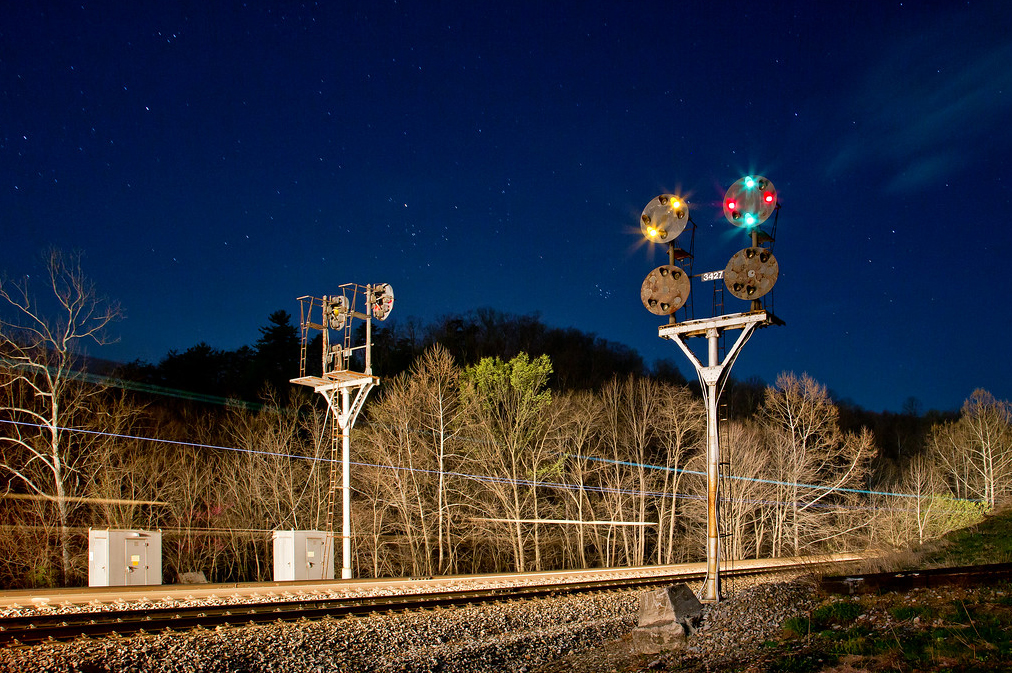 Classic designs like these Norfolk & Western position lights are still active throughout the country but dwindling in numbers. These particular sentinels are found near Willowton, West Virginia along Norfolk Southern. Loyd Lowry photo.
After William Robinson's invention of the track circuit in 1872 this gave railroads the ability to signal blocks of rail lines.
The first system was the Automatic Block Signal which used a masted-signal illuminating red, yellow or green to give an indication.
It worked by using low-voltage batteries along the block and as long as the rails were clear of trains a green, proceed indication was shown but when a train entered the block it broke the circuit with both signals then displaying red, or restricted.
Centralized Traffic Control, the most commonly used signaling system today uses both ABS and dispatchers to control the movement of trains as an extra measure of safety.
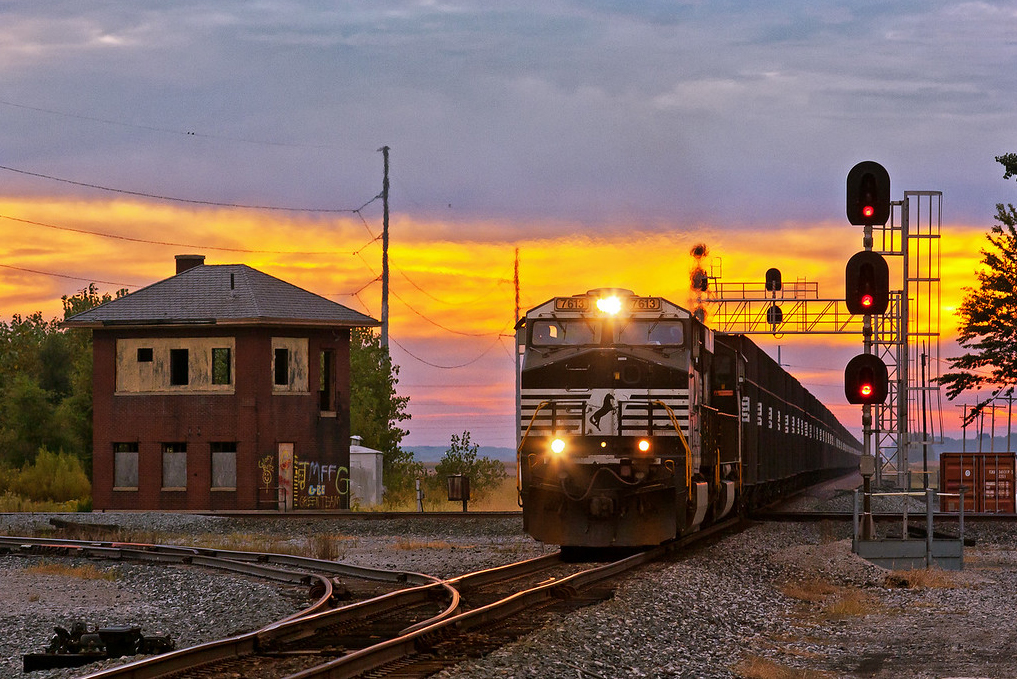 In the modern era Class I's have transitioned to a simplified stop or tri-light type signal, as seen here at Leipsic, Ohio. Pictured is a Norfolk Southern coke train heading westbound past the old XN/RO Tower on the morning of September 18, 2013. The train is running the old Nickel Plate Road and crossing the former Baltimore & Ohio. Loyd Lowry photo.
So, just because a signal may display a green, proceed indication the train cannot move without verbal permission from the dispatcher (unless it has already been given permission beforehand to pass through the upcoming block).
Other signaling systems that were once or are still in use include Direct Traffic Control (DTC), Form D Control System (DCS) and Track Warrrant Control (TWC).
Although it has been mentioned several times above railroad signal displays (green, yellow, and red) mean three things:
- First, aspect is what the signal is displaying such as clear to proceed (green) or restricted to stop (red).
- Second, indication is the instruction the display is giving.
- Third, the name of the display given (i.e., restricted, proceed, diverging clear).
Types
Recent Articles


-
Akron, Canton and Youngstown Railroad: Map, History, Rosters
Oct 17, 26 05:49 PM
 Akron, Canton and Youngstown Railroad, Mogadore to Delphos. The rails never reached Canton or Youngstown. Norfolk & Western control on October 16, 1964. Twenty-six diesels and the historical society's…
 -
Georgia Railroad: Map, History, Logo, Rosters
Oct 17, 26 12:59 PM
 Georgia Railroad, the Georgia Railroad and Banking Company, Augusta to Atlanta, with the Athens branch and the Macon Road. Mark GA. The railroad properties were sold on November 4, 1982.
 -
West Point Route (Railroad): Map, History, Logo
Oct 16, 26 11:26 PM
 The West Point Route was a trademarked name comprising the Atlanta & West Point and Western Railway of Alabama, which were controlled by the Georgia Railroad.
 -
Virginian Railway Diesel Roster (All-Time)
Oct 16, 26 11:11 PM
 All-time diesel roster of the Virginian Railway. 40 Fairbanks-Morse H16-44s, 25 H24-66 Train Masters, and one GE 44-tonner. Serials included.
 -
Virginian Railway Steam Roster (Post 1900)
Oct 16, 26 10:55 PM
 Virginian Railway steam locomotives built since 1900. Mikados, 2-8-8-2s, the Triplex, class AE 2-10-10-2s, and the 1945 2-6-6-6s.
 -
Virginian Railway: Map, Rosters, History, Electrification
Oct 16, 26 10:51 PM
 Virginian Railway, Deepwater to Norfolk. Combined in 1907 and completed in 1909. Electrified from Roanoke to Elmore. Absorbed by the Norfolk & Western on December 1, 1959.
 -
Baldwin "Centipede" Locomotives: Specs, Roster, Photos
Oct 16, 26 03:58 PM
 Baldwin DR-12-8-1500/2 Centipede—2-D+D-2, two 608SC engines, 3,000 hp. SAL 4500 from the 1943 test bed. 54 on the serial list, 52 sold. PRR BP60 then BH50. None preserved.
 -
Louisville & Nashville Class M-1 2-8-4s: The Big Emmas
Oct 16, 26 03:52 PM
 Louisville & Nashville class M-1, 42 Big Emma 2-8-4s. Baldwin in 1942 and 1944, Lima in 1949. Coal trains from Neon to DeCoursey. No locomotive survives.
 -
Tennessee, Alabama and Georgia Railway: Map, History, Rosters
Oct 16, 26 03:21 PM
 Tennessee, Alabama and Georgia Railway, Chattanooga to Gadsden. The May 1929 card is 91.7 miles. Southern stock control closed on a January 1, 1971 schedule. Five diesels and Prince's steam list.
 -
Railroad Museums In The USA (2026): State Guides & Collections
Oct 16, 26 02:29 PM
 U.S. railroad museums—what they are vs tourist railroads, preservation history (R&LHS, NRHS, IRM, Steamtown), state guides, and destination collections. Confirm hours on each museum’s site.
 -
Wyoming Railroad Museums (2026): A Complete Guide
Oct 16, 26 02:26 PM
 Wyoming railroad museums—the Cheyenne Depot, Burlington 5633 at Douglas, Big Boy 4004, and the Laramie depot. Confirm hours and which locomotive is on the property.
 -
West Virginia Railroad Museums (2026): A Complete Guide
Oct 16, 26 12:52 PM
 West Virginia railroad museums—Cass Scenic’s geared steam, the Hinton C&O collection, and the Martinsburg B&O roundhouse. Confirm hours and which locomotive is assigned.
 -
Washington Railroad Museums (2026): A Complete Guide
Oct 16, 26 12:46 PM
 Washington railroad museums—Snoqualmie, Elbe, Chehalis, Reardan, and the Northern Pacific depot at Toppenish. Confirm hours and which locomotive is assigned.
 -
Vermont Railroad Museums (2026): A Complete Guide
Oct 16, 26 12:42 PM
 Vermont railroad museums—the Shelburne Museum’s 1890 station, Central Vermont No. 220, and the private car Grand Isle. Confirm hours on the site.
 -
Tennessee Central Railway: Map, Logo, Rosters, History
Oct 16, 26 11:32 AM
 Tennessee Central Railway, Harriman to Hopkinsville. Reorganized January 26, 1922. Last day August 31, 1968. Thirty-one diesels and the railroad's steam roster.
 -
Southern Railway Steam Roster (Post 1900)
Oct 16, 26 09:40 AM
Southern Railway steam locomotives built since 1900. Ps-4 Pacifics, Ts Mountains, USRA Santa Fes, and the subsidiary grids for the CNO&TP, Alabama Great Southern, and New Orleans and Northeastern. -
Southern Railway (USA): Map, Locomotives, Logo, History
Oct 16, 26 09:28 AM
 The Southern Railway, formed July 1, 1894 from the Richmond and Danville and the East Tennessee, Virginia and Georgia. Washington. Norfolk Southern Railway on December 31, 1990.
 -
Seaboard Coast Line Diesel Roster (All-Time)
Oct 15, 26 04:21 PM
 All-time diesel roster of the Seaboard Coast Line. Inherited Coast Line and Seaboard locomotives, then 623 new locomotives in the printed orders, plus 28 acquired from other railroads.
 -
Seaboard Coast Line Railroad: Map, History, Photos
Oct 15, 26 04:17 PM
 The Seaboard Coast Line, formed July 1, 1967 from the Atlantic Coast Line and the Seaboard Air Line. Jacksonville. Family Lines, then the Seaboard System on December 29, 1982.
 -
South Carolina Railroad Museums (2026): A Complete Guide
Oct 15, 26 02:54 PM
 South Carolina railroad museums—Winnsboro’s Rockton & Rion line, Spartanburg’s Hub City depot, Greenwood’s Baldwin No. 19, and the Best Friend replica. Confirm hours on each site.
 -
South Dakota Railroad Museums (2026): A Complete Guide
Oct 15, 26 10:55 AM
 South Dakota railroad museums—the Hill City museum beside the 1880 Train, and Prairie Village at Madison. Confirm hours, and confirm whether Hill City is still open.
 -
Seaboard Air Line Diesel Roster (All-Time)
Oct 15, 26 10:46 AM
 All-time diesel roster of the Seaboard Air Line. 734 locomotives: E4s in 1938, Centipedes, Alco road switchers, and GP40s through February 1967. Serials included.
 -
Seaboard Air Line Steam Roster (Post 1900)
Oct 15, 26 10:39 AM
 Seaboard Air Line steam locomotives built since 1900. Mikados, Russian Decapods, 2-10-2s, and the 2-6-6-4s sold to the Baltimore and Ohio in 1947. Drury's class grid.
 -
Seaboard Air Line Railroad: Map, Rosters, History
Oct 15, 26 10:34 AM
 The Seaboard Air Line, chartered in the Portsmouth and Roanoke of 1832 and formed July 1, 1900. Inland route to Florida. Merged into the Seaboard Coast Line on July 1, 1967.
 -
Utah Railroad Museums (2026): A Complete Guide
Oct 15, 26 12:04 AM
 Utah railroad museums—Ogden Union Station, Golden Spike at Promontory, the Helper mining museum, and the Heber Valley Railroad. Confirm hours on each site.
 -
Escanaba & Lake Superior Diesel Roster (All-Time)
Oct 14, 26 10:44 PM
All-time diesel roster of the Escanaba & Lake Superior. 30 locomotives: Baldwin switchers and RS-12s, two RF16s, three GP38s, three SD40-2s, and the Reserve Mining units. Serials and order numbers. -
Escanaba & Lake Superior Railroad: In Service Since 1898
Oct 14, 26 09:04 PM
 Escanaba & Lake Superior Railroad, chartered November 17, 1898, and still operating from Wells, Michigan. Logging line to Channing, the Milwaukee Road lines, and the diesel roster.
 -
Richmond, Fredericksburg & Potomac Diesel Roster (All-Time)
Oct 14, 26 08:49 PM
 All-time diesel roster of the Richmond, Fredericksburg and Potomac. 107 locomotives: 22 Alco S2s, one SW1, and an Electro-Motive road fleet from E8s to GP40-2s. Serials and order numbers.
 -
Richmond, Fredericksburg & Potomac Steam Roster (Since 1900)
Oct 14, 26 08:46 PM
 Richmond, Fredericksburg and Potomac steam locomotives built since 1900. Pacifics, Mountains, Berkshire-type 2-8-4s, and the named 4-8-4s. Last revenue run December 17, 1954.
 -
Richmond, Fredericksburg and Potomac Railroad: Map, Rosters, Logo
Oct 14, 26 08:36 PM
 The Richmond, Fredericksburg and Potomac, chartered February 25, 1834. A 113-mile Richmond–Washington bridge line. Named 4-8-4s, Potomac Yard, and the CSX sale of October 10, 1991.
 -
North Dakota Railroad Museums (2026): A Complete Guide
Oct 14, 26 08:29 PM
North Dakota railroad museums—Mandan’s state museum, the Railroad Museum of Minot, and Bonanzaville’s Northern Pacific 684. Confirm hours on each site. -
Oklahoma Railroad Museums (2026): A Complete Guide
Oct 14, 26 08:02 PM
Oklahoma railroad museums—the Oklahoma Railway Museum, Enid’s Frisco 1519, Waynoka’s Harvey House, and El Reno’s Rock Island depot. Confirm hours on each site. -
Oneida & Western Railroad: Map, History, Timetable
Oct 14, 26 06:47 PM
Oneida & Western Railroad, a Tennessee short line from Oneida to Jamestown. Chartered in 1912, opened to East Jamestown in 1921, and to Jamestown on December 10, 1930. Last revenue train March 4, 1954… -
Oneida and Western Railroad (Shamrock Coal Company)
Oct 14, 26 03:20 PM
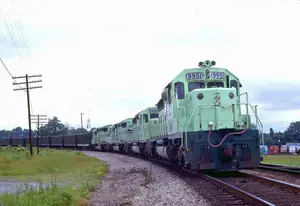
 Shamrock Coal's mint-green coal trains, 1979–1987. Eight EMD SD40-2s, OWTX 9950–9957, order 786246. Two 72-car gondola sets. Louisville & Nashville, then CSX. Sold to BC Rail.
 -
Rhode Island Railroad Museums (2026): A Complete Guide
Oct 14, 26 03:03 PM
 Rhode Island railroad museums—the Friends’ museum in the 1875 Kingston depot, on the old New York, Providence and Boston. Confirm what is on view.
 -
Original Norfolk Southern Diesel Roster (All-Time)
Oct 14, 26 12:40 PM
 All-time diesel roster of the original Norfolk Southern Railway. 59 locomotives: Baldwin switchers and AS-416s, three GE 70-tonners, 17 GP18s, and seven GP38s. Serials and order numbers.
 -
Original Norfolk Southern Railway: Map, Rosters, History
Oct 14, 26 10:09 AM
 The original Norfolk Southern Railway, chartered in 1870 as the Elizabeth City & Norfolk. Norfolk to Charlotte. Merged into the Southern Railway on January 1, 1974. Baldwin diesels and the GP18s and G…
 -
Nebraska Railroad Museums (2026): A Complete Guide
Oct 14, 26 10:00 AM
 Nebraska railroad museums—the Durham Museum, Kenefick Park, Cody Park, and the Golden Spike Tower over Bailey Yard. Confirm hours on each site.
 -
Nevada Railroad Museums (2026): A Complete Guide
Oct 14, 26 09:51 AM
 Nevada railroad museums—Carson City, Boulder City, the Nevada Northern at East Ely, and the Virginia City depot. Confirm hours on each site.
 -
Montana Railroad Museums (2026): A Complete Guide
Oct 14, 26 12:17 AM
 Montana railroad museums—the Livingston depot, Fort Missoula’s Willamette, the Harlowton Milwaukee depot, and the Whitefish station. Confirm hours on each site.
 -
"Jawn Henry" Locomotive: Specs, Diagram, Photos
Oct 14, 26 12:03 AM
 Norfolk & Western No. 2300, class TE-1, the steam turbine-electric Jawn Henry. Baldwin-Lima-Hamilton, Westinghouse, and Babcock & Wilcox, May 1954. Specifications, the road tests, and the Dece…
 -
Atlantic and Danville Railway: Serving Southern VA
Oct 13, 26 04:32 PM
 Atlantic and Danville Railway, chartered in 1882, incorporated September 1883. Three-foot line to Claremont, then Norfolk to Danville. Southern lease from September 1, 1899, to July 1, 1949. Alco RS2s…
 -
Norfolk, Franklin and Danville Railroad: Map, Roster, History
Oct 13, 26 04:26 PM
 Norfolk, Franklin and Danville Railway, chartered October 2, 1962, and operating from November 1, 1962. Norfolk to Danville, 210.8 miles. Two Alco RS36s and four RS11s. Merged into the N&W on December…
 -
Norfolk & Western Diesel Roster (All-Time)
Oct 12, 26 11:59 PM
 Norfolk & Western diesel roster, all-time. 1,464 locomotives built new for the railroad, from the 1955 GP9s and RS-3s through the C36-7s, plus the merger fleets.
 -
Norfolk & Western Steam Roster (Post 1900)
Oct 12, 26 11:52 PM
 Norfolk & Western steam since 1898. The Roanoke grid: 1,266 locomotives, the J, the A, and the Y, and the last road steam on May 7, 1960.
 -
Norfolk & Western Railway: Map, Logo, Rosters, History
Oct 12, 26 11:45 PM
 The Norfolk & Western, from the City Point Railroad of 1838 to Norfolk Southern. Pocahontas coal, Roanoke steam, and the 1964 expansion.
 -
Louisiana Railroad Museums (2026): A Complete Guide
Oct 12, 26 11:24 PM
 Louisiana railroad museums—the DeQuincy depot, the Long Leaf sawmill, Jackson’s model railroad, and Southern Pacific 745. Confirm hours on each site.
 -
Michigan Railroad Museums (2026): A Complete Guide
Oct 12, 26 11:14 PM
 Michigan railroad museums—Pere Marquette 1225 at Owosso, Durand Union Station, The Henry Ford, and the Mount Clemens depot. Confirm hours on each site.
 -
Mississippi Railroad Museums (2026): A Complete Guide
Oct 12, 26 10:52 PM
Mississippi railroad museums—McComb’s rebuilt Illinois Central depot and Illinois Central 2542, and the Casey Jones museum at Water Valley. Confirm hours on each site. -
The "E2b": PRR's Experimental Freight Electrics
Oct 12, 26 10:33 PM
 PRR class E2b: six GE B-B freight electrics, 4939–4944, 2,500 hp, 11 kV AC. Specifications, roster, and the 1964 scrap.

%20during%20the%201970s.%20Ronald%20Johnson%20photo.)


