PRR Position Light (PL) Signals: History, How to Read Them & Legacy
Last revised: August 19, 2026
By: Adam Burns
If one signal silhouette says “Pennsylvania Railroad” to generations of railroaders and railfans, it is the Position Light (PL): a circular black target with rows of pale amber lamps that recreate the geometry of an upper-quadrant semaphore—vertical for proceed, diagonal for approach, horizontal for stop—without depending on red-yellow-green color coding for the basic story. For more than a century after experimental hardware appeared in 1915, that language governed huge stretches of Pennsy iron and then the successor networks that inherited it: Penn Central, Conrail, Amtrak’s Northeast Corridor and Keystone routes, Norfolk Southern on former N&W and PRR lines, and the Long Island Rail Road.
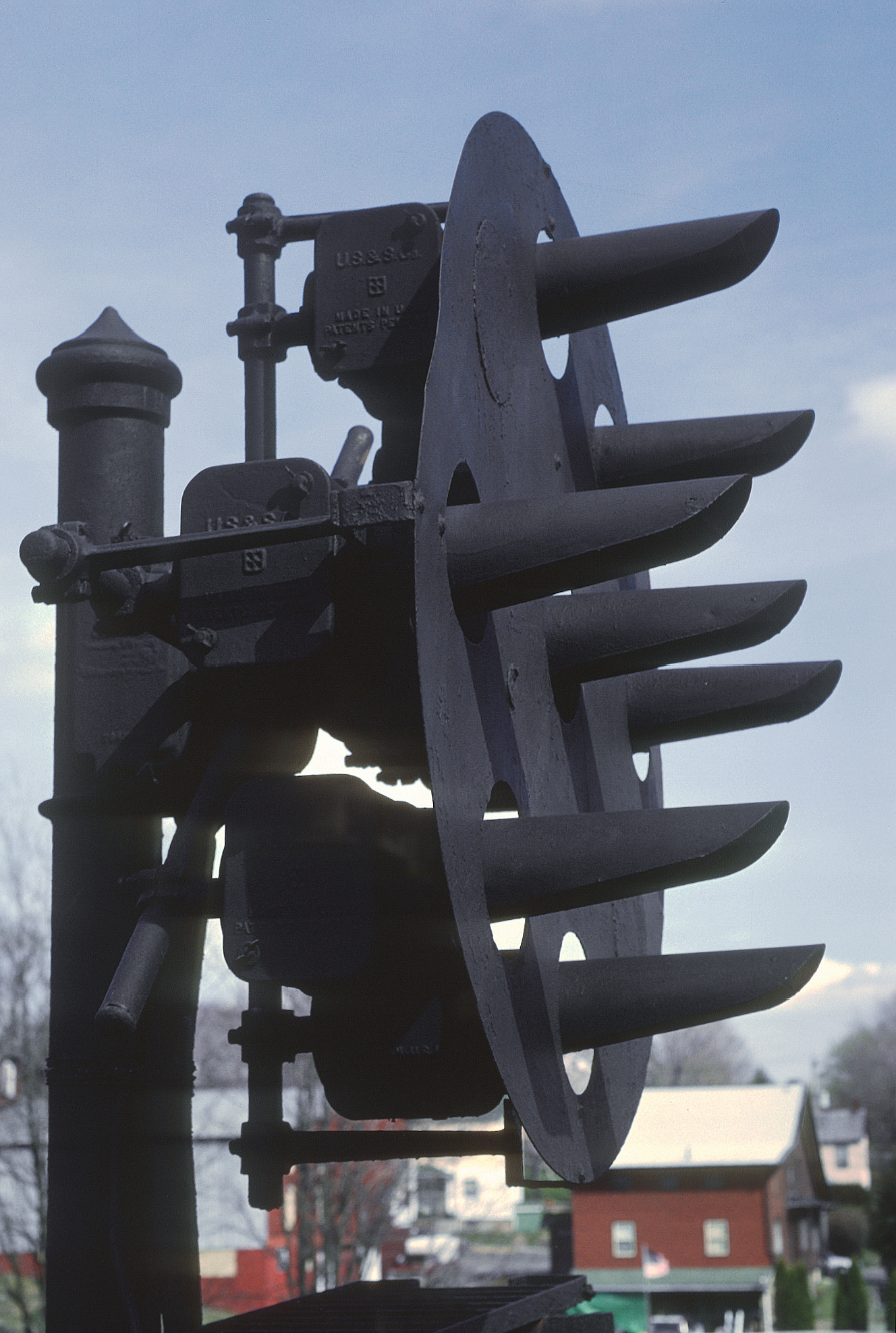
A classic Pennsylvania Railroad–style Position Light stands at Cresson, Pennsylvania, on April 21, 1988, still speaking amber semaphore language long after the Pennsy nameplate had vanished into Conrail. Roger Puta photo.
Featured here is a complete history of the PL system: origins under signal chief A.H. Rudd, the “tombstone” prototypes, the classic three-lamp-per-row head, how a two-head PL plant encodes speed and route, dwarfs and pedestals, the mid-century red-eye / position-color variant, affiliate roads, and why so many pure amber forests are finally giving way to modern color-light and LED heads.
Naming note: Railfans sometimes say “PRR color position lights.” Strictly speaking, the Pennsy’s standard PL is a position system in fog-penetrating amber. Color entered the story later via red stop lenses (“red-eyes”) and Amtrak’s later position-color practice. The Baltimore & Ohio’s contemporary cousin—the Color Position Light (CPL)—is a different design; see the dedicated CPL article for that road.
At a Glance
| Topic | Summary |
|---|---|
| Full name | Position Light (PL) signal |
| Home road | Pennsylvania Railroad; also LIRR (subsidiary), Norfolk & Western (PRR-affiliated), and some Lehigh Valley applications |
| Principal figure | A.H. Rudd, PRR Superintendent of Signaling (speed signaling + PL development) |
| Why invented | Replace / supplement semaphores; improve night and foul-weather reading; maintain readability under new catenary (electrification from 1913) |
| Lens color | Pale yellow / amber “fog-penetrating” glass (Corning / Churchill work circa 1915)—not a traffic-light trio |
| Prototype | 1915 “tombstone” signals: four lamps per row; large sheet-iron backgrounds |
| Classic form | By ~1918–1921: three lamps per row around a common center (“spider”), circular target |
| Reading rule | Lamp positions mimic semaphore blades; normally two heads encode block occupancy + route/speed |
| Small forms | Dwarf PL-4; pedestal PL-5 (stacked dwarfs); rare “domino” compressed heads |
| Colorized stop | From mid-1950s: “red-eye” / position-color lights—red horizontal stop lenses, center often dark for Stop |
| Status | Still present in pockets; wholesale replacement ongoing under Amtrak, NS, and others with modern color-light / LED signals |
Semaphore Thinking in an Age of Electric Light
By the early twentieth century the Pennsylvania already lived by semaphore language. Upper-quadrant blades—vertical clear, 45-degree approach, horizontal stop—were burned into enginemen’s habits. Night indications on many roads still leaned on colored spectacle glasses, but early electric color-light signals needed bright lamps and reliable power. Position lights took a different path: keep the geometry of the blade, paint it in a single highly visible hue, and drive low-wattage lamps that could run for long periods even when local AC was scarce and battery plants mattered.
Electrification sharpened the problem. When the PRR began stringing catenary (notably the Philadelphia–Paoli project era beginning 1913), semaphore blades became harder to read through wires and hangers. The New Haven could keep living with semaphores; the Pennsy chose to invent around the problem. Concurrent Corning research under Dr. William Churchill produced a pale yellow fog-penetrating glass that the PL program adopted—the same optical idea that later made “real” automotive fog lamps amber rather than harsh white.
The PL was also bound up with Pennsy speed signaling philosophy associated with Rudd: aspects that tell not only “stop or go” but how fast to take a route and what to expect at the next signal. That is why a mature PL plant is almost never a single lonely vertical row. It is a conversation between heads.
A.H. Rudd, Tombstones, and the Classic Head
Contemporary and secondary accounts credit A.H. Rudd, the PRR’s Superintendent of Signaling, as the intellectual driver of the Position Light program and of the road’s broader speed-signaling framework. Experimental PL hardware appears in 1915. Fans nicknamed the early targets “tombstones” because of their large, rounded sheet-iron backgrounds—literally rows of four lamps translating semaphore positions into light, with one lamp common to multiple rows.
Those first heads worked optically but paid a mechanical price. The huge backgrounds acted like sails in wind, stressing masts and bridges. By 1917–1918 the railroad refined shapes to cut wind loading and simplified the lamp count. By about 1918 the design dropped to three lamps per aspect row sharing a center pivot lamp; by 1921 the circular target and “spider” mounting familiar from every Midwestern and Mid-Atlantic right-of-way photograph had crystallized. Rudd himself discussed background practice in technical literature of the period (including a frequently cited Railway Signal Engineer treatment around July 1921): lower-head backgrounds were applied selectively because some aspects were only approached at slow speed and did not need long-range contrast.
Hardware manufacture centered on the usual signal-industry giants—Union Switch & Signal foremost in Pennsy territory—with standardized lamp assemblies (PL-1 / PL-2 / PL-3 heads in common talk; PL-5 optics with reflector, yellow outer lens, and “phankill” honeycomb to kill phantom indications from locomotive headlights). Approach lighting, where used, kept dark signals dark until a train needed them—lamp life and power both mattered on a system the size of the PRR.
Installation followed need and capital. Early tests and first territories rode the electrified Philadelphia approaches; systemwide replacement of semaphores rolled through the 1920s and 1930s until Position Lights were as much a Pennsy trademark as Tuscan Red passenger cars and the keystone herald. Main lines, interlocking plants, yards, and branch approaches all spoke amber.
How to Read a Classic PL
Forget traffic-light habits for a moment. On a standard high PL, position is the primary code:
- Vertical row — Clear / Proceed (block and route permitting track speed unless a lower head or rule modifies it)
- Diagonal row — Approach: prepare to stop at the next signal; reduce as the timetable and rules require
- Horizontal row — Stop (absolute or stop-and-proceed depending on number plate, interlocking vs. automatic, and the era’s rulebook)
A full high signal commonly mounts two heads. The upper head carries the basic block story; the lower head modifies for diverging routes and speed—Medium Clear, Approach Medium, Slow Approach, Restricting, and related names that evolved across PRR rulebooks into Penn Central, Conrail, and NORAC language. That two-head thrift was deliberate: the Standard Railroad of the World did not sprinkle three-head stacks everywhere the New York Central might. Slow-speed work often used dwarf or subsidiary indications rather than a third full head.
Key combinations engineers lived by (names vary slightly by rulebook year, but the geometry is stable):
- Clear — vertical on the upper head
- Approach — diagonal on the upper head
- Stop — horizontal on the upper head
- Approach Medium — Approach over Clear (diagonal over vertical): prepare for a medium-speed move at the next signal
- Medium Clear — Stop over Clear (horizontal over vertical): take the diverging route at medium speed
- Restricting / Slow Approach — typically lower-head geometries (often without full round backgrounds on early practice), requiring restricted or slow speed prepared to stop short of train, obstruction, or switch
Two evolutionary wrinkles matter to historians. Early PL practice, following semaphore night-color limitations, long lacked a clean Medium Approach; that indication returned when flashing relays were trusted enough for safety-critical use (mid-1950s)—flashing the lower diagonal to upgrade slow to medium. And from the 1930s–40s onward, higher-speed turnouts in electrified multi-track territory drove the Limited Speed triangle marker, letting 45 mph class routes exist without rebuilding every signal plant for a third head.
Cab signals on the PRR often simplified wayside PL stories into fewer cab aspects—another reason period charts show wayside-to-cab translation tables rather than one-for-one copies.
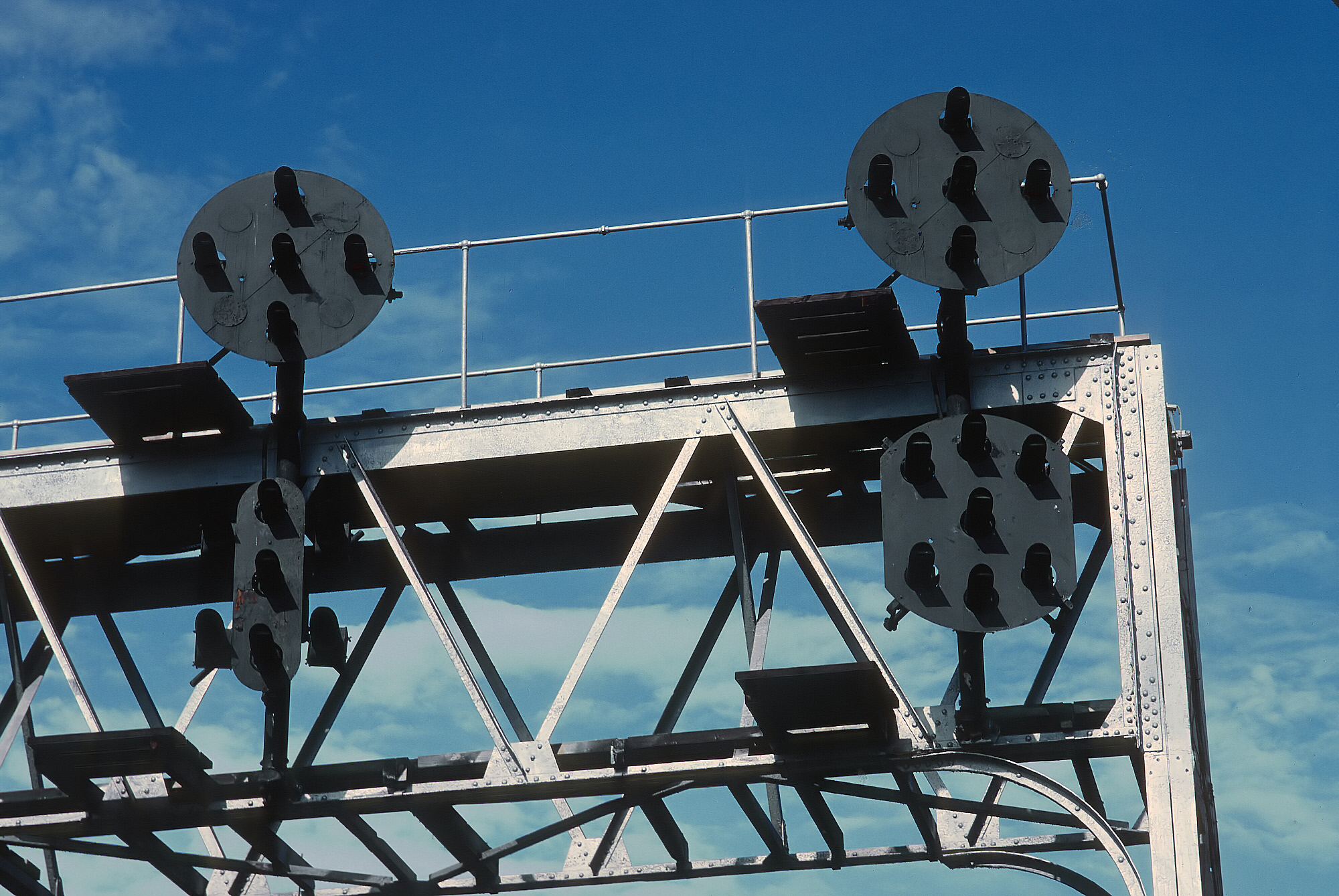
Position Lights along the ex-PRR main at South Fork, Pennsylvania, April 22, 1988. Two-head amber geometry—upper story, lower speed/route modifier—was still the everyday language of the old Pennsy spine under Conrail. Roger Puta photo.
Upper Heads, Lower Heads, and Backgrounds
Field PL plants are full of “incomplete” looking heads that are actually correct. If a location never needed a particular aspect, the unused lamp sockets received blanking plates. Upper heads may show one, two, or three aspect rows populated. Lower heads are even more varied: full round backgrounds, flat-sided partial rounds, a background only behind the vertical row, a lone diagonal stalk with no disk at all, or a naked single lamp for stop-and-proceed on intermediate automatics.
Rudd-era logic explains much of that thrift. Aspects approached at speed (notably Approach Medium and Medium Clear on the lower head) deserved contrast backgrounds for long-range reading. Slow Approach and Restricting, approached already at low speed, often ran without full disks—cutting wind load and mast cost. When Approach Slow and Medium Approach proliferated in later decades, fuller lower backgrounds became more common because those indications might now be sighted at higher approach speeds.
Bridge and cantilever practice usually hung the upper head above the structure and the lower head in the plane of the bridge—though exceptions exist (both heads above the bridge, odd Northumberland-area specials, and other local puzzles that delight signal fans and terrify anyone writing a “one size fits all” caption).
Dwarfs, Pedestals, and Dominoes
Dwarf PLs (often called PL-4s) use smaller (~4-inch) lenses, historically frosted or lunar white to limit range so they would not be mistaken for high signals. Housings came in left- and right-hand rounded forms; mounting legs and rear access covers evolved between early and later production. Pennsy used them for yard moves, reverse moves, and slow exits onto mains; later users pressed the same silhouette into transit route indicators (notably Baltimore Light Rail) and even shove indicators on other roads. Unlike B&O’s fully aspected CPL dwarfs, PRR dwarfs live in the slow-speed world.
Pedestal signals (PL-5) stack two dwarf-scale heads in one housing. They are medium-speed tools—even a “clear” pedestal reading does not grant mainline track speed the way a high Clear does. Pedestals appear at interlocking ends of sidings, tight terminal approaches (Wilmington is a textbook overhead-bridge pedestal site), and similar constrained locations. Some later pedestals received red-eye stop lenses.
Domino signals compress the lamp geometry so top and bottom rows sit in straight lines—born of terrible sight lines under Chicago Union Station overpasses and a few tight New Jersey clearances. Same PL language; different packing.
Red-Eyes and Position-Color Lights
Beginning with tests at Overbrook, Philadelphia, in September–October 1954, the PRR experimented with replacing the horizontal amber stop lenses with red lenses and extinguishing the center pivot for the Stop aspect. After trials, the practice spread—especially west of Harrisburg in the mid-to-late 1950s—and entered the 1956 rulebook. Fans call them red-eyes or red snake-eyes; proper terminology in later writing is often position-color light (PCL) for the hybrid.
Why bother? Fog on lines such as the Buffalo route, and the desire for a stop aspect that reads unmistakably as stop at distance, dominate the oral history. Red-eyes were generally applied where a signal could display absolute Stop (home interlocking signals), not casually on every automatic. Pedestal red-eyes followed in Penn Central years on selected Buffalo Line and Chautauqua Branch sidings. Amtrak’s later Northeast Corridor “colorizing” of PL territory—sometimes eliminating the center lamp entirely—is a related but distinct modernization thread from the 1980s onward.
Do not confuse these Pennsy/Amtrak hybrids with B&O Color Position Lights, which were designed from the start as colored positional pairs plus marker lamps. Cousins, not twins.
PL vs. B&O CPL
| PRR Position Light | B&O Color Position Light | |
|---|---|---|
| Primary code | Lamp position (amber) | Position and color on the main head |
| Typical color | Fog-penetrating amber (later red stop on red-eyes) | Green / yellow / red / lunar white pairs |
| Speed refinement | Second head + limited-speed markers / flashing | Marker (“orbital”) lamps above and below the round head |
| Era of adoption | Experiments 1915; classic form ~1921 | Mid-1920s (Patenall); first main-line Ohio territory |
| Dwarfs | Slow-speed PL-4 language | Can carry the full high-signal aspect family when fully equipped |
| Successor story | Amtrak / NS / others replacing with color-light & LED | CSX replaced most CPLs with “Darth Vader” LED heads |
Full CPL treatment: B&O Color Position Light signals.
Beyond the Pennsy: LIRR, N&W, and Lehigh Valley
As a PRR subsidiary, the Long Island Rail Road absorbed Position Light practice deeply—training rooms once displayed high PL, dwarf, and pedestal teaching aids that signal fans still drool over in period photos. Parts of LIRR signaling culture still echo the older PRR two-head logic (including operating theories about how Approach Medium and Approach work together through diverging moves).
The Norfolk & Western, long under PRR financial influence, likewise blanketed much of its property with Pennsy-style PLs. In the mid-1960s N&W began its own colorization program, often deleting the center lamp—different from Conrail’s red-eye horizontal treatment west of Harrisburg, but the same instinct: make stop read as stop in color.
The Lehigh Valley, another PRR-connected property, used PL hardware in places because of that affiliation. When writing captions, it is safer to say “PRR-style Position Light” than to assume every amber circular head west of New York was lettered Pennsylvania.
Successors, Removals, and What Remains
Penn Central inherited the forest; Conrail maintained and selectively red-eyed it; Amtrak and Norfolk Southern became the long-term caretakers on the highest-profile routes. Altoona’s famous PL stands came down in the early 2010s. Columbia, Lancaster approaches, Mapleton, Huntingdon, Perryville, Halethorpe, and dozens of other classic photo locations have seen pure amber heads give way to Safetran/US&S color lights or LED modules—sometimes leaving a Safetran PL-lookalike head as a transitional oddity.
Yet the system is not extinct. Pockets of classic and red-eye PLs remain on secondary mains, connectors, and terminal tracks; museum and tourist lines display restored heads (the Railroad Museum of Pennsylvania’s example is well known, lens accuracy debates included). For photographers, the rule is the same as for B&O CPLs: shoot them while the circular targets still own the skyline.
Modern replacements are safer to maintain and easier to stock, but they erase a visual language that trained three generations of enginemen to read geometry before color. That loss is why PL pages—and CPL pages—belong in the infrastructure library beside bridges, interlocking towers, and catenary.
Related Reading on American-Rails.com
- B&O Color Position Light (CPL) Signals
- Railroad Signals hub
- Rail Infrastructure
- Pennsylvania Railroad
- Norfolk & Western
Signal rules and aspect names vary by railroad, rulebook year, and special instruction. This article is a historical and technical overview for enthusiasts and researchers—not an operating document. Always defer to the carrier’s current timetable and rules.
Recent Articles


-
Central of Georgia Steam Roster (Post 1900)
Oct 06, 26 04:00 PM
 Central of Georgia steam since 1900. Cooke Consolidations, Harriman Mikados, 32 Mountains, and eight Lima 4-8-4s. Class grid after Drury. Last steam May 1953.
 -
Central of Georgia Diesel Roster (All-Time)
Oct 06, 26 03:44 PM
 Central of Georgia diesel roster. SW1 No. 1 in 1939, E7s and E8s, nine F3As, 39 RS3s, GP7s through SD35s. Serials and order numbers.
 -
Central of Georgia Railway: Map, Logo, History, Rosters
Oct 06, 26 03:42 PM
 Central of Georgia Railway, from the 1833 Savannah charter to Southern control on June 17, 1963. Map, logos, Nancy Hanks II, and links to the steam and diesel rosters.
 -
Georgia Railroad Museums (2026): A Complete Guide
Oct 06, 26 03:33 PM
 Georgia railroad museums—Savannah’s Central shops, Duluth, the General at Kennesaw, the Texas in Atlanta, Tifton, Waycross, and Albany. Confirm hours on each site.
 -
Florida Railroad Museums (2026): A Complete Guide
Oct 06, 26 03:18 PM
 Florida railroad museums—Boca Raton, Winter Garden, Whitehall, the Gold Coast, Parrish, Fort Myers, Milton, and Plant City. Confirm hours on each site.
 -
Connecticut Railroad Museums (2026): A Complete Guide
Oct 06, 26 01:05 PM
 Connecticut railroad museums—the Shore Line Trolley, East Windsor, the Naugatuck Railroad, Danbury Union Station, Willimantic, and the SoNo tower. Confirm hours on each site.
 -
Colorado Railroad Museums (2026): A Complete Guide
Oct 06, 26 12:47 PM
 Colorado railroad museums—Golden, the Forney’s Big Boy 4005, Pueblo’s Santa Fe 2912, and the depots at Castle Rock, Limon, and Ridgway. Confirm hours on each site.
 -
Atlantic Coast Line Steam Roster (Post 1900)
Oct 06, 26 12:44 PM
 Atlantic Coast Line steam since 1900. Copper Head Ten-Wheelers, 235 P-5 Pacifics, Q-1 Santa Fes, twelve R-1 4-8-4s. Class grid after Drury. Last steam June 30, 1955.
 -
Atlantic Coast Line Diesel Roster (All-Time)
Oct 06, 26 11:57 AM
 Atlantic Coast Line diesel roster. HH660 1900 in 1939, E3s for the Champion, FTs and F2s, GP7s 100–279, GP30s, U25Cs, and the 1967 SCL numbers. Serials and orders.
 -
Atlantic Coast Line Railroad: "Standard Railroad of the South"
Oct 06, 26 11:53 AM
 Atlantic Coast Line, the Standard Railroad of the South. April 21, 1900 to July 1, 1967. Plant System, L&N, Clinchfield, the Champion, and the Seaboard Coast Line merger.
 -
California Railroad Museums (2026): A Complete Guide
Oct 06, 26 09:50 AM
 California railroad museums—the California State Railroad Museum, Perris, Portola, Railtown 1897, and the depots that still stand. Confirm hours on each site.
 -
Arizona Railroad Museums (2026): A Complete Guide
Oct 06, 26 09:46 AM
Arizona railroad museums—the Arizona Railway Museum in Chandler, Southern Pacific 1673 at Tucson, and the McCormick-Stillman park in Scottsdale. -
Arkansas Railroad Museums (2026): A Complete Guide
Oct 06, 26 09:07 AM
 Arkansas railroad museums—Cotton Belt 819 at Pine Bluff, the Fort Smith trolley, the Mammoth Spring depot, and the Eureka Springs railway.
 -
Alabama Railroad Museums (2026): A Complete Guide
Oct 06, 26 09:03 AM
Alabama railroad museums—Heart of Dixie at Calera, the North Alabama museum at Chase, Huntsville’s 1860 depot, and Fort Payne. Confirm hours on each site. -
Pennsylvania Railroad Museums (2026): A Complete Guide
Oct 06, 26 12:09 AM
 Pennsylvania railroad museums—Strasburg, Steamtown, the Horseshoe Curve, the East Broad Top, and the depots and towers in between. Confirm hours on each site.
 -
Maryland Railroad Museums (2026): A Complete Guide
Oct 05, 26 11:53 PM
 Maryland railroad museums—the Baltimore roundhouse, Ellicott City station, Bowie, Gaithersburg’s Buffalo Creek & Gauley 14, and the Western Maryland collections.
 -
Ohio Railroad Museums (2026): A Complete Guide
Oct 05, 26 05:51 PM
 Ohio railroad museums—the Age of Steam Roundhouse, Bellevue, Worthington, Conneaut’s Nickel Plate 755, and the Dennison depot. Confirm hours on each site.
 -
Delaware Railroad Museums (2026): A Complete Guide
Oct 05, 26 02:43 PM
 Delaware railroad museums—Wilmington & Western at Greenbank, the Harrington tower and N5 caboose, Felton's 1868 depot, and the Selbyville station museum.
 -
C&O's M-1 Steam Turbine Locomotives: Specs, Roster, History
Oct 05, 26 12:13 PM
 Chesapeake & Ohio Class M-1 steam-turbine-electrics. Three Baldwin-Westinghouse locomotives, 500–502, built 1947–48 for The Chessie. Specs, the 2-C1+2-C1-B arrangement, and a roster. All scrapped…
 -
N&W 2-6-6-2 Locomotives (Class Z): Specs, Roster, History
Oct 05, 26 11:44 AM
 Norfolk & Western Class Z 2-6-6-2s. One hundred ninety compound Mallets, 1300–1489, from Richmond, Baldwin, and Schenectady, 1912–1918. Diagram specs, the Z-1b rebuilds, Z-2 1399, and a roster. No…
 -
Scenic Train Rides (USA 2026): State Guide to Tourist Railroads
Oct 04, 26 12:17 AM
 Scenic and tourist train rides in all 50 states for 2026. Colorado narrow gauge, Pennsylvania steam, Alaska’s White Pass, and the states with no full-size ride this month. Confirm on the railroad.
 -
Wyoming Scenic Train Rides (2026): A Complete Guide
Oct 03, 26 12:07 AM
 Wyoming has no full-size tourist railroad on the calendar in October 2026. Cheyenne Depot Museum and Douglas Railroad Museum are static. Union Pacific 4014’s posted public trip is a November run to De…
 -
Washington Scenic Train Rides (2026): A Complete Guide
Oct 02, 26 11:53 PM
 Washington tourist trains in 2026—Mount Rainier Scenic at Elbe, the Northwest Railway Museum, and Chehalis-Centralia. Lake Whatcom has no 2026 date on its ticket page.
 -
Wisconsin Scenic Train Rides (2026): A Complete Guide
Oct 02, 26 11:48 PM
 Wisconsin tourist trains in 2026—Wisconsin Great Northern, Osceola & St. Croix Valley, Mid-Continent, East Troy, and the National Railroad Museum.
 -
Pennsylvania Railroad Class Q2 4-4-6-4: Specs, Roster, History
Oct 02, 26 11:28 PM
 Pennsylvania Railroad Class Q2 4-4-6-4 duplexes. Twenty-six engines, 6131 and 6175–6199, Altoona 1944–45. Form 109-J specs, the 7,987 hp test of 6175, and a roster. All scrapped.
 -
Utah Scenic Train Rides (2026): A Complete Guide
Oct 02, 26 11:18 PM
 Utah tourist trains in 2026—Heber Valley Railroad from Heber City. Golden Spike at Promontory is a locomotive demonstration, not a line-haul ride.
 -
South Dakota Scenic Train Rides (2026): A Complete Guide
Oct 02, 26 11:06 PM
 South Dakota’s 2026 scenic train is the Black Hills Central 1880 Train, Hill City to Keystone. Steam is the summer assignment. Confirm the engine.
 -
Oregon Scenic Train Rides (2026): A Complete Guide
Oct 02, 26 11:04 PM
 Oregon tourist trains in 2026—Oregon Coast Scenic from Rockaway Beach, Mount Hood at Hood River, Eagle Cap from Elgin, and the Oregon Rail Heritage Center in Portland.
 -
Oklahoma Scenic Train Rides (2026): A Complete Guide
Oct 02, 26 10:36 PM
Oklahoma has no full-size scenic railroad on an October 2026 calendar. Oklahoma Railway Museum Halloween and Polar trains, the El Reno trolley, and the Heartland Flyer. -
North Dakota Scenic Train Rides (2026): A Complete Guide
Oct 02, 26 01:14 PM
North Dakota has no tourist railroad on a 2026 calendar. Ride Amtrak’s daily Empire Builder. The Fort Lincoln Trolley in Mandan is not a current ticket. -
Nebraska Scenic Train Rides (2026): A Complete Guide
Oct 02, 26 10:11 AM
 Nebraska has no full-size scenic railroad in 2026. The Omaha Zoo Railroad runs weekends through October 4. Ride Amtrak’s California Zephyr across the state.
 -
Missouri Scenic Train Rides (2026): A Complete Guide
Oct 02, 26 09:56 AM
 Missouri tourist trains in 2026—Branson Scenic Railway and the St. Louis, Iron Mountain & Southern at Jackson. Belton has no 2026 schedule posted.
 -
Minnesota Scenic Train Rides (2026): A Complete Guide
Oct 02, 26 09:52 AM
 Minnesota tourist trains in 2026—North Shore Scenic Railroad in Duluth, the Duluth River Train, and the Como-Harriet streetcar.
 -
Kansas Scenic Train Rides (2026): A Complete Guide
Oct 02, 26 09:32 AM
 Kansas tourist trains in 2026—the Abilene & Smoky Valley Railroad. Santa Fe 3415 is in overhaul. Midland Railway at Baldwin City is closed.
 -
Iowa Scenic Train Rides (2026): A Complete Guide
Oct 02, 26 08:41 AM
 Iowa tourist trains in 2026—Boone & Scenic Valley across the Bass Point Creek High Bridge, and Midwest Central’s December North Pole trains
 -
Indiana Scenic Train Rides (2026): A Complete Guide
Oct 02, 26 08:35 AM
 Indiana tourist trains in 2026—French Lick Scenic Railway, Nickel Plate Express, Hoosier Valley, and Hesston. Whitewater Valley is suspended.
 -
Illinois Scenic Train Rides (2026): A Complete Guide
Oct 02, 26 12:28 AM
 Illinois tourist trains in 2026—Illinois Railway Museum, Monticello Railway Museum, Fox River Trolley, and Silver Creek & Stephenson.
 -
Texas Scenic Train Rides (2026): A Complete Guide
Oct 02, 26 12:14 AM
 Texas tourist trains in 2026—Texas State Railroad, Grapevine Vintage Railroad, Austin Steam Train's Hill Country Flyer, and the Galveston Railroad Museum.
 -
Tennessee Scenic Train Rides (2026): A Complete Guide
Oct 02, 26 12:03 AM
Tennessee tourist trains in 2026—Tennessee Valley Railroad Museum, Dollywood Express, Three Rivers Rambler Christmas trains, and the Tennessee Central Railway Museum. -
South Carolina Scenic Train Rides (2026): A Complete Guide
Oct 01, 26 11:52 PM
 South Carolina's tourist train is the South Carolina Railroad Museum in Winnsboro—Blue Granite Express, pumpkin trains, and Santa trains on the old Rockton & Rion.
 -
Mississippi Scenic Train Rides (2026): A Complete Guide
Oct 01, 26 11:38 PM
 Mississippi has no regular tourist railroad in 2026. Ride Amtrak through the state, or book the excursion lines in Alabama, Tennessee, Louisiana, or Arkansas.
 -
Louisiana Scenic Train Rides (2026): A Complete Guide
Oct 01, 26 02:52 PM
 Louisiana has no regular full-size tourist railroad in 2026. New Orleans Polar Express returns December 11–31. Museums at Long Leaf, DeQuincy, and Jackson.
 -
Kentucky Scenic Train Rides (2026): A Complete Guide
Oct 01, 26 02:45 PM
Kentucky tourist trains in 2026—Big South Fork Scenic Railway, Bluegrass Scenic Railroad, Kentucky Railway Museum, and My Old Kentucky Dinner Train. -
Georgia Scenic Train Rides (2026): A Complete Guide
Oct 01, 26 02:27 PM
Georgia tourist trains in 2026—Blue Ridge Scenic Railway, SAM Shortline, Azalea Sprinter, Savannah shop rides, and what to confirm at Stone Mountain. -
Arkansas Scenic Train Rides (2026): A Complete Guide
Oct 01, 26 01:02 PM
 Arkansas tourist trains in 2026—Arkansas & Missouri through the Boston Mountains, and the Eureka Springs & North Arkansas dinner and excursion trains.
 -
Alabama Scenic Train Rides (2026): A Complete Guide
Oct 01, 26 12:59 PM
Alabama tourist trains in 2026—Heart of Dixie Railroad Museum at Calera, North Alabama Railroad Museum at Chase, and the Wales West Light Railway at Silverhill. -
The Circus Train: How Such Attractions Reached Distant Cities
Oct 01, 26 12:22 PM
 How circuses moved by rail: Coup's 1872 flats, the Ringling train's sections and car counts, the 1918 Hammond wreck, and the last show on May 21, 2017.
 -
West Virginia Halloween Train Rides (2026)
Oct 01, 26 12:19 PM
 2026 West Virginia Halloween train. Cass Scenic Halloween Train, October 30 and 31, steam, 5:00 p.m. from Cass Depot. Adult $75. About two hours to Whittaker. Family ride.
 -
Wisconsin Halloween Train Rides (2026)
Oct 01, 26 12:11 PM
2026 Wisconsin Halloween trains. Mid-Continent Pumpkin Special October 24–25, adult $24, pumpkins extra. Halloween Flyer October 24 at 4:30 p.m., adult $30. Osceola Pumpkin Express boards in Osceola… -
Utah Halloween Train Rides (2026)
Oct 01, 26 12:00 PM
 2026 Utah Halloween trains at Heber Valley Railroad. Pumpkin Train, about 40 minutes, with a cookie and a pumpkin. Halloween Express, about 90 minutes to Grim Hollow, Monday, Thursday, and Friday even…