Sugar Cane Train (Lahaina): The Lahaina, Kaanapali & Pacific Railroad
Last revised: September 9, 2026
By: Adam Burns
The Lahaina, Kaanapali & Pacific Railroad, marketed as the Sugar Cane Train, was West Maui’s 3-foot tourist line. For forty-four seasons a pair of restyled Porter steam locomotives hauled open-air coaches between Lahaina, Kaanapali, and Puukolii—about 6 miles, a forty-minute ride, across the curved Hahakea trestle with the West Maui Mountains on one side and the channel toward Lanai and Molokai on the other. A.W. “Mac” McKelvey and the Makai Corporation laid it out in 1969 on the old Pioneer Mill cane corridor. Regular public trains ran from 1970 until August 1, 2014.
It was never a surviving mill railroad. Pioneer Mill had already given cane to the trucks. The LK&P was built as a tourist attraction that used that right-of-way, and it became one of Lahaina’s most familiar sights. After the 2014 shutdown came a local purchase, a few seasons of Holiday Express trains on a shortened Kaanapali stretch, a 2021 listing that required the buyer to take the railroad apart, the August 8, 2023 Lahaina fire, and an August 4, 2025 brush fire that consumed the shops and the two Porters. On September 8, 2026, on-the-ground reports said Anaka, Myrtle, and the coaches were being cut up and remaining track was coming out. As of September 9 the Sugar Cane Train as a railroad is finished.
The plantation and common-carrier story for the islands is on Hawaii’s railroads. What still runs for visitors is on Hawaii scenic train rides. This page is the Maui tourist line only.
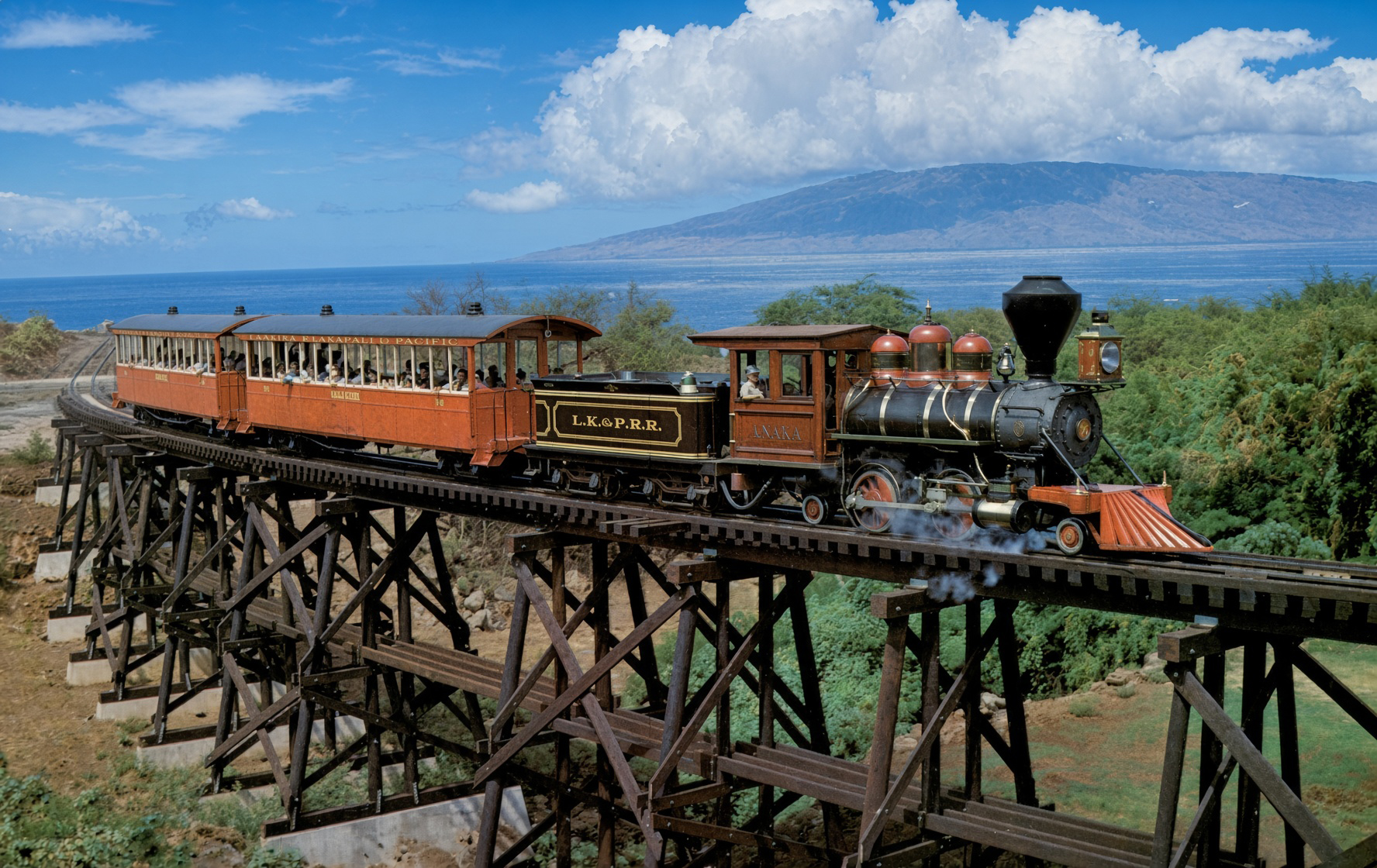
0-4-0 Anaka crosses the Kaanapali trestle enroute through the green mountains and along the emerald seashore of West Maui.
On this page: At a glance · Pioneer Mill corridor · 1969–70 · The ride · Locomotives · Ownership · August 1, 2014 · Holiday Express and the 2021 listing · 2023 and 2025 fires · September 2026
At a glance
| Item | Detail |
|---|---|
| Railroad | Lahaina, Kaanapali & Pacific Railroad (LKPRR). Marketing name: Sugar Cane Train. Corporate name in later years: Railroads of Hawaii |
| Reporting mark | LK&P |
| Gauge | 3 ft (914 mm) |
| Route | About 6 miles (9.7 km), Lahaina–Kaanapali–Puukolii, West Maui |
| Ride | About 40 minutes each way. Open-air coaches, on-board narrator. Typical speed 8–10 mph; 6–8 mph at crossings |
| Landmark | Hahakea trestle, about 325 feet, curved wood. Wooden turntable at Lahaina (destroyed 2023) |
| Founded | 1969, A.W. “Mac” McKelvey and the Makai Corporation. Trains 1970 |
| Regular service | 1970–August 1, 2014 |
| Last public trains | Holiday Express on a shortened Kaanapali–Puukolii stretch, through December 2018 |
| Steam | No. 1 Anaka and No. 3 Myrtle, H.K. Porter, February 1943, ex-Carbon Limestone. Both scrapped September 2026 |
| Other power | Oahu Sugar 0-6-2ST No. 5 (display). Plymouth MDT No. 45 Oahu (diesel, damaged 2025) |
| Lahaina fire | August 8, 2023. Station, turntable, and the eastern half of the track |
| Kaanapali fire | August 4, 2025. Shops, both Porters, numerous coaches; diesel damaged |
| Scrapping reports | September 8, 2026. Anaka, Myrtle, and coaches being cut up; remaining track coming out |
A tourist railroad on a mill corridor
West Maui once had a working cane railroad. Pioneer Mill, the James Campbell plantation at Lahaina, used narrow-gauge track to bring cane in from the Kaanapali fields. Maui as a whole was said to have had more than 200 miles of plantation rail at the peak. Trucks took that traffic by the middle of the twentieth century. Pioneer Mill poured its last sugar in 1999. Hawaii’s last commercial cane harvest, Hawaiian Commercial & Sugar at Puunene, came in December 2016. That mill-and-common-carrier history belongs on the Hawaii railroads page, not here.
What the public rode after 1970 was a new 3-foot tourist railroad on that corridor. It was not the Pioneer Mill railroad continuing under another name. The LK&P built stations at Lahaina, Kaanapali, and Puukolii, a wooden turntable at the Lahaina end, and the Hahakea trestle that became the photograph everyone took home. The coaches were fiberglass, aluminum, and plastic, scribed to look like Kalakaua-era cars, because tiger termites on Maui made wooden bodies a short career. A narrator pointed out the mill, the cane (and later the coffee and empty fields), the golf-course greens, and, on a lucky day, humpbacks in the channel.
McKelvey, Makai, and 1970
A.W. “Mac” McKelvey (1914–1994) was an Amfac man involved in the Kaanapali resort development north of Lahaina. In 1969 he and the Makai Corporation put together a tourist railroad on the mill right-of-way. A Historic American Engineering Record note on the old Pioneer Mill power station records that the LK&P leased the site in 1969 and commenced operations the following year. Wikipedia and most later accounts date public trains to 1970. McKelvey’s widow, Joan, speaking to the Lahaina News in 2014, still dated the founding to 1969.
Two H.K. Porter industrial tanks came from the Carbon Limestone Company in Ohio, rebuilt for 3-foot tourist service and restyled to look older than 1943. Anaka was named for the Hawaiian rendering of Angus, McKelvey’s son. Myrtle took the name of an old Hawaiian field engine. A stubby Plymouth diesel, No. 45 Oahu, came over from the Oahu Railway & Land Company as the shop goat. Pacific Business News, covering the 2001 RailAmerica purchase, put the ridership at more than 5 million since 1970. The Maui News, looking back after the shutdown, recalled a 1990s peak of about 4,000 passengers a day.
Lahaina, Kaanapali, and Puukolii
The published ride was simple. Trains ran year-round in the West Maui climate, typically several round trips a day from the three stations. The line climbed out of Lahaina, crossed the Honoapiilani Highway at grade, rolled behind the Kaanapali hotels and the golf course, and finished at Puukolii just north of the resort. The Hahakea trestle—about 325 feet of curved wood—was the scenic high point: West Maui Mountains inland, the channel and the neighbor islands seaward. At Lahaina a wooden turntable turned the locomotive for the trip back.
Speed was a walk. General manager Barbara Allen told the Honolulu Advertiser in 2006 that the train made 6 to 8 mph at crossings and 8 to 10 mph on the rest of the six miles. That was slow enough that a loaded dump truck could still beat the train to a crossing and lose. On September 7, 2006, at 4:05 p.m., Myrtle hit a Honokahua Trucking dirt truck at Kapunakea Street after the driver tried to clear the flashing lights. Myrtle lost her headlight and took front-end damage. One of the twenty passengers, Katsuko Sasaki of Osaka, was taken to Maui Memorial with back pain. The railroad kept running.
It was never Strasburg. It was a short, narrated, steam-hauled ride through a landscape that still looked like plantation Hawaii even after the mill had gone, and for a generation of Maui visitors that was enough.
Locomotives
The working steam was a pair of Pittsburgh Porters, both February 1943, both built for Carbon Limestone as 38-inch 0-4-0 tanks, both rebuilt to 3-foot tourist engines with tenders, larger stacks, and period cabs. In Maui service they ran as 2-4-0s. The user photograph on this page still calls Anaka an 0-4-0, which is how the railroad itself often billed her and how the as-built Whyte reads. The roster below is the as-operated story.
| No. | Name | Type | Builder | Notes |
|---|---|---|---|---|
| 1 | Anaka | 2-4-0 (built 0-4-0T) | H.K. Porter, Feb. 1943, c/n 7398 | Ex-Carbon Limestone. Saddle tanks off; tender, wood cab, oil-lamp-style headlight, 19th-century look. Named for Angus McKelvey. Scrapped September 2026 |
| 3 | Myrtle | 2-4-0 (built 0-4-0T) | H.K. Porter, Feb. 1943, c/n 7397 | Sister engine. Steel cab, whaleback tender, darker gray/brown, early-20th-century look. Named for a historic Hawaiian field engine. Kapunakea Street collision Sept. 7, 2006. Scrapped September 2026 |
| 5 | Waikakalua | 0-6-2ST | Baldwin (Oahu Sugar Co.) | The only LK&P steamer with Hawaiian mill ancestry. Travel Town, Griffith Park, from 1954. Traded to Maui about 1993. Display at Lahaina; heavy damage in the 2023 fire. Builder’s number reported as 32816 (1908) or 54719 (1921) |
| 45 | Oahu | Plymouth MDT diesel | Plymouth Locomotive Works, about 1959 | Ex-Oahu Railway & Land. Shop switcher and backup. Damaged in the August 4, 2025 fire |
Anaka wore the brighter red-and-green tourist paint and the wooden cab. Myrtle was the everyday engine for much of the line’s life: gray and brown, whaleback tender, a slightly more modern silhouette. Both had been industrial tanks. The rebuild—tenders in place of saddle tanks, cabs, stacks, headlights—was the whole point of the attraction. A 2004 note on steamlocomotive.info records that Arthur LaSalle’s American Railroad Equipment rebuilt the pair, converted them from 38-inch to 36-inch gauge, and test-ran them on the East Broad Top before they were shipped to Maui. Rear engine trucks came off later, leaving the 2-4-0 arrangement the public saw.
No. 5 was the Hawaiian engine. She is Oahu Sugar Company Waikakalua, a 3-foot outside-frame 0-6-2 saddle tank, not an Oahu Railway & Land road locomotive. Travel Town in Griffith Park had her from 1954. About 1993 the LK&P traded Travel Town a Baldwin RS-12 and two sleeping cars for Oahu Railway & Land 4-6-0 No. 85, Oahu Sugar No. 5, and a cane car. No. 5 sat on display at the Lahaina station. A 2015 Stone Consulting appraisal, later bundled with the Ozark Mountain Railcar listing, called her a display hulk with a defective replacement boiler still on the property. She was never a regular tourist steamer. No. 85, taken apart on Maui and never steamed there, went to the Hawaiian Railway Society at Ewa in November 2010.
No. 45 Oahu was the Plymouth. The Chicago Tribune in 1989 dated her to 1959. She switched the yard, covered steam failures, and survived in the Kaanapali shed after 2014. Trains reported her damaged, not destroyed, in the August 2025 fire.
StatesRail, RailAmerica, and the Butlers
McKelvey’s railroad changed hands more than once. From 1999 it belonged to StatesRail of Dallas, a short-line group that also ran mainland freight. In October 2001 RailAmerica agreed to buy StatesRail—cash, assumed debt, and stock, reported at the time as a $90 million transaction—and the Sugar Cane Train went with the package. The Honolulu Star-Bulletin noted the oddity of a six-mile tourist road in a short-line empire, and that Pioneer Mill had already closed. The train kept the sugar name because the name was the attraction.
By the 2014 shutdown the owner of record was Railroads of Hawaii, Robert and Kimberly Butler of Nebraska. The Maui News later wrote that the operation had been losing money for two years, with derailments in the mix, and that monthly ridership at the end was under 4,000—the old daily peak, stretched across a month.
August 1, 2014
On July 24, 2014, the company said it would close. General manager Iolani Kaniho told the Lahaina News that regular trips would run through Friday, August 1, with the last round trip held as a private charter. Meetings with prospective buyers were still on the calendar that week. Joan McKelvey, then 88, remembered her husband’s 1969 idea. The Butlers had listed the company. No last-minute going-concern sale closed before the trains stopped.
Holiday Express, May 2019 that never came, and a $400,000 listing
In October 2014 Napili businessman Craig Hill, of Maui Concierge Services, and Lahaina businessman Todd Domeck bought the railroad. Hill wanted the Lahaina attraction kept. They could not put trains over the whole six miles. What they did run was a seasonal Holiday Express on a short stretch between Puukolii and Kaanapali, first advertised for Fridays through Sundays from late November to December 25, 2016. Lights covered the cars. The website and later interviews talked about new rail, rebuilt locomotives, grade crossings, weddings, and an evening train. Co-owner Domeck told the Maui News in 2018 the aim was a full return in May 2019. The full return did not happen. Trains, writing after the 2025 fire, dated the last operations to the Holiday Express of November–December 2018.
In July 2021 Ozark Mountain Railcar listed the railroad for $400,000: track and rolling stock, no land. The buyer would have to dismantle and remove the materials. The Stone Consulting appraisal behind that listing had already treated No. 5 as scrap-value historic metal and had flagged defects in No. 45’s torque converter. Nobody restored the line from that offering.
Two fires
On August 8, 2023, the Lahaina fire destroyed the town. It also took the Sugar Cane Train’s Lahaina station, the wooden turntable, and the eastern half of the track. Most of the locomotives and cars were stored north of the fire’s path, at Kaanapali and Puukolii, and they survived that day. No. 5, on display at the Lahaina station, took heavy damage. The railroad had been dormant for years; after the fire it sat abandoned, with no serious prospect of a Lahaina terminal to run back to.
On August 4, 2025, a brush fire at Kaanapali and Puukolii burned the rest of the working artifacts. Bob Lettenberger in Trains (August 7, 2025) reported the shops consumed, No. 1 Anaka and No. 3 Myrtle lost, numerous passenger cars gone, and the diesel damaged. Maui County put the fire at about 90 acres, with road closures and a Kaanapali evacuation. A later Kaanapali Land 10-Q described the same fire on about 30 acres of company land: grassland, the former Sugar Cane Train repair shop and storage outbuildings, and several train cars. The two figures describe the same event from county and landowner angles. Either way the shops and the two Porters were finished as railroad equipment.
September 2026
On September 8, 2026, Lahaina resident Jason Ganis reported on Facebook that remaining equipment, including the two steam locomotives, was being scrapped. The railroad’s Wikipedia page recorded that post the same day. Independent notes posted that morning on steamlocomotive.info, including one timestamped 06:09 by a contributor signed Chuk, said both Anaka and Myrtle had been scrapped as of September 8, and that while the 2025 fire had damaged them, both engines had still been salvageable. Later the same day other notes added that the coaches were gone as well. Those are on-the-ground reports, not a company press release. They match what visitors and local posts described: track coming up, shops already razed or burned, the Porters cut.
Facebook posts in the same stretch said the Hawaiian Railway Society hoped to acquire Plymouth No. 45 and Oahu Sugar No. 5. As of September 9, 2026, the society had not announced a completed transfer. HRS already holds OR&L No. 85 from the old Travel Town trade. If 45 and 5 do leave Maui, that story will belong on the Oahu operation’s page once it is confirmed.
The Sugar Cane Train is over. What it was, for forty-four regular seasons and a handful of Christmas stretches after that, was a 3-foot tourist railroad on a West Maui mill corridor: two restyled Porters, open-air cars, a wooden trestle, and a narrator talking about cane. The mill railroad that actually hauled that cane is a different, older story, and it is on Hawaii’s railroads. The rides that remain in the islands are on Hawaii scenic train rides. For other 3-foot tourist lines, see narrow gauge and the national tourist trains hub.
Sources
- Chicago Tribune, December 10, 1989. Anaka named for Angus McKelvey; Myrtle named for an old Hawaiian field engine; Plymouth No. 45 dated 1959; fiberglass and aluminum coaches against tiger termites
- Honolulu Advertiser, September 8–9, 2006. Myrtle–dump truck collision, Kapunakea Street, 4:05 p.m. September 7, 2006. Speeds 6–8 mph at crossings, 8–10 mph otherwise
- Honolulu Star-Bulletin, October 17, 2001 (Russ Lynch). StatesRail ownership from 1999; RailAmerica acquisition of StatesRail; McKelvey and Makai; more than 5 million riders since 1970; Pioneer Mill already closed
- Pacific Business News, October 16, 2001. RailAmerica–StatesRail; Sugar Cane Train as a six-mile tourist road in the package
- Lahaina News, July 31, 2014 (Louis Rockett). Close of August 1, 2014; Iolani Kaniho; Joan McKelvey on the 1969 founding; Robert and Kimberly Butler listing Railroads of Hawaii
- Maui News, November 24, 2016 (Chris Sugidono). Craig Hill and Todd Domeck purchase, October 2014; Holiday Express 2016; 1990s peak about 4,000 passengers a day; ridership under 4,000 a month at shutdown
- Maui News, November 2018. Todd Domeck on a hoped-for May 2019 full return
- Ozark Mountain Railcar listing, July 2021, item 3264. Track and rolling stock $400,000; no land; buyer to dismantle and remove
- Stone Consulting, Inc., fair-market appraisal for Lahaina Railroad LLC, April 16, 2015 (bundled with the Ozark listing). Porters as 38-inch 0-4-0T rebuilds; No. 5 identified as Oahu Sugar Baldwin 1908, c/n 32816; No. 45 torque-converter defects
- Historic American Engineering Record, Pioneer Mill / Central Power Station. LK&P lease 1969; operations the following year
- NPR, August 12, 2023. Lahaina fire of August 8, 2023
- Bob Lettenberger, “Maui fire destroys Sugar Cane Train rolling stock,” Trains, August 7, 2025. Kaanapali fire of August 4, 2025; shops, Anaka, Myrtle, passenger cars; diesel damaged; about 90 acres (county)
- Kaanapali Land, LLC, Form 10-Q, 2026. August 4, 2025 fire on about 30 acres of KLMC land; former Sugar Cane Train repair shop and storage; train cars damaged
- steamlocomotive.info, Carbon Limestone No. 1 Anaka (display 390) and No. 3 Myrtle (display 391). Builder’s numbers 7398 (Anaka) and 7397 (Myrtle); notes of September 8, 2026, on scrapping
- Wikipedia, “Lahaina, Kaanapali and Pacific Railroad,” including the September 8, 2026, Jason Ganis Facebook report that equipment was being scrapped
- Honolulu Star-Advertiser, November 11, 2010. OR&L No. 85 barged to Oahu for the Hawaiian Railway Society
- Jeff Livingston, Hawaiian Railway Society, on the circa-1993 Travel Town trade (OR&L 85, Oahu Sugar 5, and a cane car for an RS-12 and two sleepers)
- Clark, John R. K. The Beaches of Maui County. Honolulu: University of Hawaii Press, 1989. Pioneer Mill cane railroad corridor
Recent Articles


-
Maryland Dinner Train Rides (2026): A Complete Guide
Sep 23, 26 05:19 PM
 2026 Western Maryland Scenic Allegheny Mountain Dinner Train—Cumberland, 3 hours, 21+, Saturday 7 p.m. Confirm on wmsr.com.
 -
Pittsburgh and Lake Erie Railroad: Map, Rosters, Photos
Sep 23, 26 03:28 PM
 Pittsburgh & Lake Erie—the Little Giant. Chartered 1875, Pittsburgh to Youngstown February 10, 1879. New York Central from 1883. Independent May 15, 1979. Last day September 11, 1992.
 -
Kansas Dinner Train Rides (2026): A Complete Guide
Sep 23, 26 01:11 PM
 2026 Abilene & Smoky Valley Smoky Valley Limited—two hours from the Rock Island Depot, about $72–$110, dates into December 31. Confirm on asvrr.org.
 -
The Belpaire Firebox: Simplicity and Greater Power
Sep 23, 26 01:03 PM
 Belpaire firebox—Alfred Belpaire, 1864. Square crown, straight staybolts at right angles. Pennsylvania standard after the 1880s. Great Northern was the other big user.
 -
Pennsylvania Railroad (PRR) Electric Roster: All Classes
Sep 23, 26 12:57 PM
 Pennsylvania Railroad electrics—DD1s into Penn Station, P5s, 139 GG1s, B1 switchers, and 66 E44s. Class roster, 1905–1963. No unit-by-unit GG1 list.
 -
Penn Central Diesel Roster: All-Time
Sep 23, 26 12:46 PM
 Penn Central diesel roster—PRR classes on NYC, PRR, and New Haven power. New orders carry serials. GP38-2s are 7940-8162. Conrail April 1, 1976.
 -
Penn Central Railroad: Map, History, Logo
Sep 23, 26 12:32 PM
 Penn Central—Pennsylvania and New York Central merged February 1, 1968. New Haven January 1, 1969. Section 77 bankruptcy June 21, 1970. Conrail April 1, 1976.
 -
Iowa Dinner Train Rides (2026): A Complete Guide
Sep 23, 26 11:42 AM
 2026 Boone & Scenic Valley Wolf Dinner Train—Saturdays May–October, Union Pacific dining cars, Bass Point Creek High Bridge. Confirm on bsvrr.com.
 -
Pennsylvania-Reading Seashore Lines: Map, Roster, History
Sep 23, 26 12:32 AM
 Pennsylvania-Reading Seashore Lines—Atlantic City Railroad renamed July 15, 1933. Pennsylvania two-thirds, Reading one-third. Camden to Atlantic City, Cape May, and Millville. Conrail April 1, 1976.
 -
Wisconsin Dinner Train Rides (2026): A Complete Guide
Sep 23, 26 12:28 AM
 2026 Wisconsin Great Northern dinner train in Trego—$105, Namekagon River, January 8–31 and May 5–December 17. Mid-Continent’s remaining 2026 calendar is snack and scenic. Confirm on the railroad.
 -
New Hampshire Dinner Train Rides (2026): A Complete Guide
Sep 23, 26 12:21 AM
2026 Cafe Lafayette Dinner Train in North Woodstock—five courses, 2 hours, from $125. Children under 6 not allowed. Confirm on nhdinnertrain.com. -
PRR "GG-1" Locomotives: Roster, Photos, Specs
Sep 23, 26 12:13 AM
 PRR GG1 electric: 139 locomotives, 4800–4938, built 1934–1943. Specs, Loewy shell, Amtrak numbers, and the last revenue trip on October 28, 1983.
 -
Montana Dinner Train Rides (2026): A Complete Guide
Sep 23, 26 12:04 AM
2026 Charlie Russell Chew Choo from Hanover, near Lewistown—4.5 hours, prime rib, adult $151. Remaining listed dates sold out. Confirm on montanadinnertrain.com. -
Kentucky Dinner Train Rides (2026): A Complete Guide
Sep 22, 26 11:52 PM
2026 My Old Kentucky Dinner Train in Bardstown—four courses, 2.5 hours, adult $116. Confirm on kydinnertrain.com. -
Tennessee Dinner Train Rides (2026): A Complete Guide
Sep 22, 26 11:45 PM
2026 TVRM Chattanooga Dinner Train—Grand Junction, select Fri/Sat March 6–October 24, 6 p.m., from $110. Confirm on tvrail.com. -
The Trainphone: PRR's Wireless Radio System
Sep 22, 26 11:17 PM
 Pennsylvania Trainphone—Union Switch & Signal inductive telephone. Bel-Del trial 1941, Frenchtown November 29, 1943. Carriers at 88 kHz and 144 kHz. Out of service April 30, 1967.
 -
Pennsylvania (PRR) Steam Roster: Post 1906
Sep 22, 26 11:13 PM
 ennsylvania steam after 1906—H8, H9, and H10 Consolidations, 574 L1s Mikados, 598 I1s Decapods, 425 K4s Pacifics, 301 M1 Mountains. Drury’s grid. Last steam November 30, 1957.
 -
Pennsylvania Railroad (PRR) Diesel Roster: All-Time List
Sep 22, 26 10:59 PM
 Pennsylvania diesel roster—SW 3908 in June 1937, then Alco, Baldwin, EMD, Fairbanks-Morse, GE, and Lima. Serials and Alco order numbers. Penn Central February 1, 1968.
 -
Pennsylvania Railroad: Map, Logo, History, Rosters
Sep 22, 26 10:02 PM
 Pennsylvania Railroad—chartered April 13, 1846, Harrisburg–Pittsburgh, Horseshoe Curve 1854, Penn Station 1910. Standard Railroad of the World. Penn Central February 1, 1968.
 -
Pennsylvania Dinner Train Rides (2026): A Complete Guide
Sep 22, 26 04:48 PM
 2026 Pennsylvania dinner trains—Colebrookdale Dining Class in Boyertown and Strasburg Dinner on the Rails. Confirm on each railroad.
 -
New York, Ontario & Western Steam Locomotives: History & Roster
Sep 22, 26 04:40 PM
 NYO&W steam—camelback 2-8-0s and 2-6-0s, Class X Bull Moose 2-10-2s, Class Y and Y-2 Mountains. All-time class roster. Steam finished in the summer of 1948. None saved.
 -
New York, Ontario & Western Diesel Roster: All-Time
Sep 22, 26 04:36 PM
 NYO&W diesel—five GE 44-tonners 101-105, eighteen FTs, seven F3s, twenty-one NW2s. Serials and the NW2 order E824. Railroad liquidated March 29 1957.
 -
New York, Ontario & Western Railway: Map, Roster, History
Sep 22, 26 04:26 PM
 New York, Ontario & Western—New York & Oswego Midland chartered January 11 1866, O&W January 21 1880. Scranton coal, West Shore rights. Last train March 29 1957.
 -
Massachusetts Dinner Train Rides (2026): A Complete Guide
Sep 22, 26 04:16 PM
 2026 Cape Cod Dinner Train—Hyannis, Buzzards Bay, and North Falmouth. Four-course, 3–3½ hours, from $99.99. Confirm on capetrain.com.
 -
Colorado Dinner Train Rides (2026): A Complete Guide
Sep 22, 26 03:51 PM
 2026 Royal Gorge Route First Class Dinner and Lunch from Cañon City. About 2 hours, 12+, from $199+. Confirm on royalgorgeroute.com.
 -
New York and Long Branch Railroad: A PRR & CNJ Subsidiary
Sep 22, 26 03:11 PM
 New York & Long Branch—chartered April 8 1868, Perth Amboy–Long Branch July 1 1875, Bay Head Junction 1881. Jersey Central and Pennsylvania trains. Conrail April 1 1976. NJ Transit North Jersey Co…
 -
Monongahela Railway Steam Locomotives: History & Roster
Sep 22, 26 01:34 PM
 Monongahela steam—H-5 Consolidations, USRA light Mikados 170–179, Baldwin L-2s, ex-P&LE L-3s. All-time roster. Last steam May 26, 1954.
 -
Monongahela Railway Diesel Roster: All-Time
Sep 22, 26 01:16 PM
 Monongahela diesel—27 Baldwin S-12s, NYC RF-16 sharks, P&LE GP7s, GP38s 2000–2004, Super 7s 2300–2310. Serials and orders. Last steam May 26, 1954.
 -
Monongahela Railway: Map, Rosters, History
Sep 22, 26 01:14 PM
 Monongahela Railway—incorporated December 31 1900, Railway July 1 1915. Brownsville–Fairmont coal road. Last steam May 26 1954. Conrail May 1 1993.
 -
Virginia Scenic Railway Dining (2026)
Sep 22, 26 01:09 PM
 2026 Virginia Scenic Railway—Blue Ridge Flyer Dining Class from Staunton, about 3 hours, plated meal. Sunday Brunch from Louisa, about $132. Confirm on virginiascenicrailway.com.
 -
Virginia Dinner Train Rides (2026): A Complete Guide
Sep 22, 26 01:03 PM
 2026 Virginia Scenic Railway—Blue Ridge Flyer Dining Class from Staunton, Alleghany Special Dining Class, Sunday Brunch from Louisa. Confirm on virginiascenicrailway.com.
 -
Oregon Dinner Train Rides (2026): A Complete Guide
Sep 22, 26 12:51 PM
 2026 Oregon has no plated dinner train on the calendar. Mount Hood is scenic with snacks. Oregon Coast Scenic’s evening ride is the 21+ Moonlight with sandwiches.
 -
Maine Central Steam Locomotives: History & Roster
Sep 22, 26 12:33 PM
Maine Central steam—Ten-Wheelers, W-class Consolidations, S-class Mikados, C-class Pacifics, Hudsons 701 and 702. Post-1900 roster after Drury. Last steam June 13, 1954. -
Maine Central Diesel Roster: All-Time
Sep 22, 26 12:04 PM
 Maine Central diesel—railcar 901, HH660s, GP7s, E7s, F3s, GP38s, U18Bs, ex-Rock Island U25Bs. All-time roster with serials and orders. Last steam June 13, 1954.
 -
Maine Central Railroad: Map, Logo, Rosters, History
Sep 22, 26 11:36 AM
 Maine Central—Androscoggin & Kennebec and Penobscot & Kennebec, October 28 1862. Pine Tree Route. Mountain Division, Portland–Bangor–Vanceboro. Last steam June 13 1954. Guilford June 1981.
 -
Maryland and Pennsylvania Railroad: Map, Roster, Logo
Sep 22, 26 12:14 AM
 Ma & Pa—Peach Bottom 1868, Maryland & Pennsylvania February 12 1901, Baltimore to York. Last steam November 29 1956. York Railway December 1 1999.
 -
New York Dinner Train Rides (2026): A Complete Guide
Sep 21, 26 11:59 PM
2026 New York dinner train—Adirondack Dinner Train from Utica, 6 p.m., about 3 hours, First Class from $139. Arcade & Attica mystery dinner is served at Curriers. Confirm on the railroad. -
California Dinner Train Rides (2026): A Complete Guide
Sep 21, 26 11:49 PM
 2026 California dinner trains—Napa Valley Wine Train plated meals, River Fox brunch and mystery dinner, Roaring Camp barbecue at camp. Confirm on each railroad.
 -
Roaring Camp Starlight Dinner Party (2026)
Sep 21, 26 11:33 PM
 2026 Roaring Camp Starlight Dinner Party—Beach Train from the Santa Cruz Boardwalk, barbecue at Felton, ride back after dark. Confirm on roaringcamp.com.
 -
Long Island Rail Road Steam Locomotives: History, Roster & Photos
Sep 21, 26 11:29 PM
 Long Island steam—G5s 20–50, H10s 101–119, last steam at Hicksville October 8, 1955. Post-1898 class roster.
 -
Long Island Rail Road Diesel Roster: All-Time
Sep 21, 26 11:24 PM
 Long Island diesel—boxcab 401 in 1925, FM C-Liners, RS-3s, C-420s, GP38-2s, DE30AC and DM30AC. All-time roster with serials and orders.
 -
Long Island Rail Road: Map, History, Pictures, Logo
Sep 21, 26 08:27 PM
 Long Island Rail Road—Brooklyn & Jamaica 1836, Greenport 1844, Pennsylvania control 1900, Penn Station 1910. MTA since 1968. Steam and diesel rosters.
 -
Oregon Coast Scenic Railroad (2026): Sunset Dinner and Moonlight
Sep 21, 26 02:40 PM
 2026 Oregon Coast Scenic does not post the old four-course Sunset Dinner. The evening ride is the 21+ Moonlight Excursion from Garibaldi, with pre-ordered sandwiches. Confirm on oregoncoastscenic.org.
 -
Adirondack Dinner Train (2026): Dates, Tickets & What to Expect
Sep 21, 26 01:38 PM
 2026 Adirondack Dinner Train—Utica Union Station, 6 p.m., about 3 hours to Remsen. First Class from $139. Chef Patrick O’Connor. Confirm on adirondackrr.com.
 -
Lehigh Valley Steam Locomotives: History, Roster & Photos
Sep 21, 26 01:31 PM
 Lehigh Valley steam—Camelback Consolidations, 2-10-2s, K-class Pacifics, six Mountains, Wyoming 4-8-4s. Post-1900 roster after Drury. Last steam September 14, 1951.
 -
Lehigh Valley Diesel Roster: All-Time
Sep 21, 26 01:23 PM
 Lehigh Valley diesel—boxcabs 1926, FTs 1945, F3/F7, FA/PA, C628 Snowbirds, GP38-2s, U23Bs. All-time roster with serials and orders. Last steam September 14, 1951.
 -
Lehigh Valley Railroad: Map, Roster, Logo, History
Sep 21, 26 01:09 PM
 Lehigh Valley—DLS&S 1847, named January 7 1853, Mauch Chunk–Easton September 12 1855. Route of the Black Diamond. Jersey City–Buffalo. Conrail April 1 1976.
 -
Wisconsin Great Northern Dinner Train (2026)
Sep 21, 26 12:47 PM
2026 Wisconsin Great Northern dinner train—Trego, $105, Namekagon River. January 8–31 and May 5–December 17. Confirm on spoonertrainride.com. -
Lehigh and New England Railroad: Map, Rosters, History
Sep 21, 26 12:33 AM
 Lehigh & New England—South Mountain & Boston 1873, named April 2 1895. Anthracite, cement, Maybrook. Last Camelbacks, Alco FAs. Voluntary shutdown October 31 1961.
 -
TVRM Chattanooga Dinner Train (2026): Dates, Tickets & What to Expect
Sep 21, 26 12:20 AM
 2026 TVRM Chattanooga Dinner Train Experience—Grand Junction, select Fri/Sat March 6–October 24, three-course, 2–3 hours, from $110. Confirm on tvrail.com.