Arizona Dinner Train Rides At The Grand Canyon!
Published: January 13, 2026
By: Adam Burns
For more than a century, the Grand Canyon Railway has offered one of America’s most memorable approaches to Grand Canyon National Park: not by traffic-choked highway, but by steel rails threading through Arizona’s high-country forests. Today’s experience blends Old West showmanship, historic depots, and a comfortable round-trip journey from Williams to the South Rim—while also giving travelers a surprisingly convenient mix of onboard snacks and off-train dining options (even if it isn’t a traditional “dinner train”).
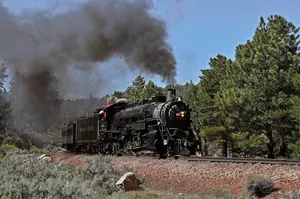
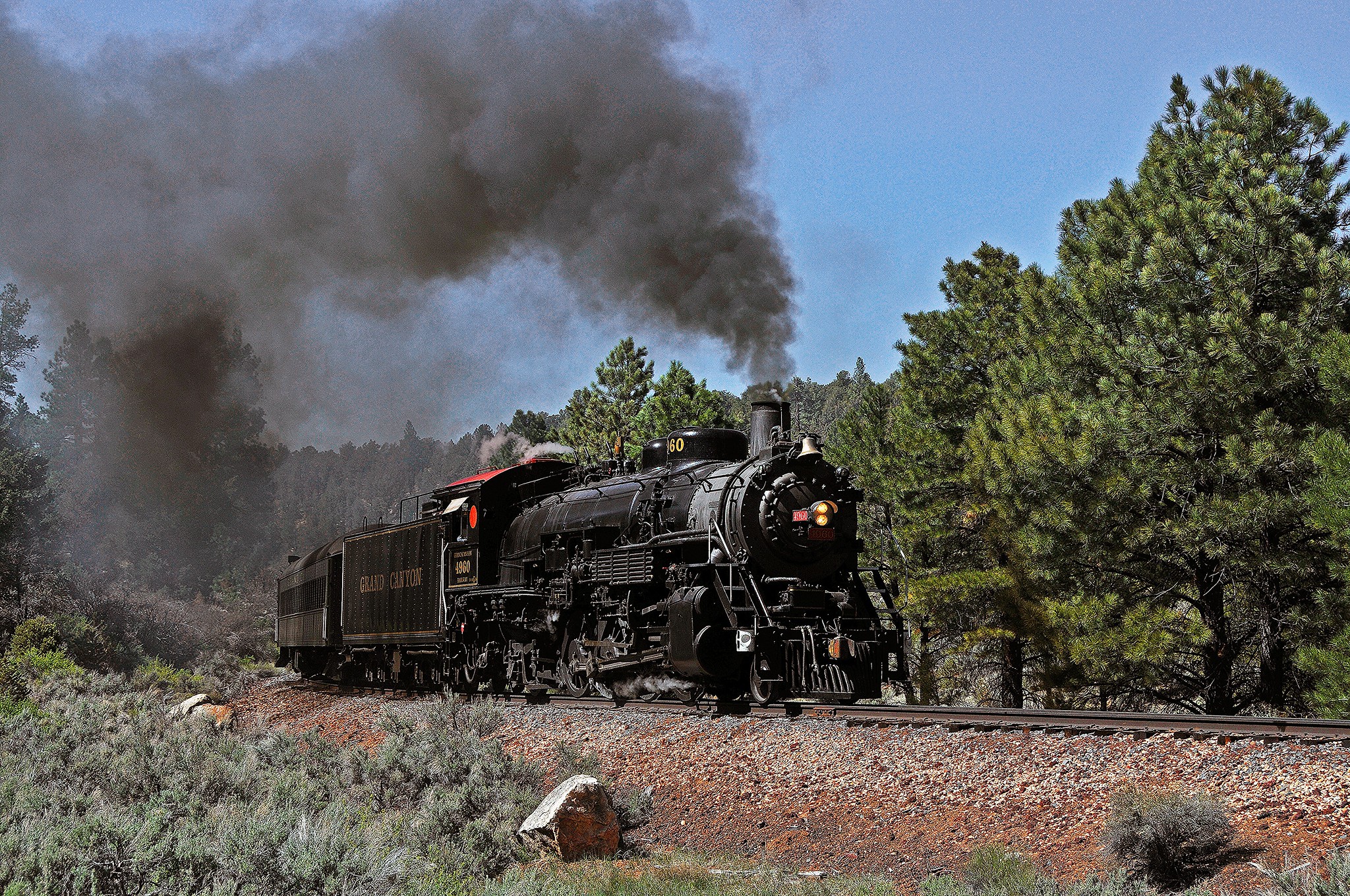 Grand Canyon Railway 2-8-2 #4960 - a former CB&Q engine -leads a photo special in the Coconino Canyon on May 15, 2011. Drew Jacksich photo.
A railroad born from boomtown ambitions
The story starts in the late 1890s, when promoters saw opportunity in northern Arizona’s timber and mining prospects—and in the growing national fascination with the Grand Canyon. The Santa Fe and Grand Canyon Railroad (SF&GC) was incorporated in 1897 and built south of the canyon’s rim with dreams of serving both minerals and tourists. Financial troubles arrived quickly; the line went into receivership and, in 1901, was sold under foreclosure to the Atchison, Topeka & Santa Fe Railway (Santa Fe).
Santa Fe’s involvement proved decisive. Where the earlier venture had stalled short of the canyon, Santa Fe pushed the remaining miles to reach the South Rim. The branch to the Grand Canyon Village was completed in September 1901. Under AT&SF this 64-mile line was long known as simply the Williams Branch where it veered north from the Santa Fe's main line.
From the beginning, this was more than a “track-to-nowhere” built for freight. Santa Fe understood something timeless: the canyon wasn’t merely a place to visit; it was an experience to be curated. Trains made the canyon accessible to travelers who might never attempt a rugged wagon road or early automobile journey. The rail link helped turn Grand Canyon tourism into a national phenomenon and anchored the South Rim as the park’s primary visitor gateway.
Depots, a sense of place, and the classic arrival
Part of the current railroad's charm is that it still feels like a proper railroad journey—starting at a historic depot, rolling through changing scenery, and concluding at another classic station where the landscape suddenly becomes the main attraction.
In Williams, the railroad’s home base, the historic depot dates to the Santa Fe era (built in 1908) and remains a focal point for the modern operation.
At the north end of the line, the Grand Canyon Depot—built in 1910—welcomes passengers right in Grand Canyon Village, a short walk from the rim viewpoints and key village amenities.
That “arrival at the depot” moment is part of what the railway does best. Instead of stepping out of a car into a parking lot, you step off a train into the historic core of the South Rim—an arrival style that feels both vintage and remarkably convenient.
The AT&SF Bows Out
Like many American passenger services, especially on branch lines, faced stiff competition after World War II. As highways improved and car travel became the default vacation mode, ridership weakened. Santa Fe ultimately ceased passenger service to the canyon in 1968, and the line later fell quiet.
For railfans and preservationists, it was an all-too-familiar arc: a beloved branch line, a world-class destination, and then silence—despite the canyon’s popularity. But the railway’s story wasn’t over.
Revival
The line’s return is one of the great American railroad revival stories. In the late 1980s, private investors Max and Thelma Biegert took on the challenge of restoring service. The railway officially reopened on September 17, 1989—intentionally timed to align with the anniversary of the original 1901-era service.
That relaunch wasn’t just a symbolic ribbon-cutting. It created a sustainable tourism railroad that could carry large volumes of visitors to the South Rim—an alternative to adding more cars, more parking, and more congestion at one of the nation’s most treasured landscapes.
In the 2000s, the operation entered another chapter when Xanterra Travel Collection took ownership (announced in connection with the mid-2000s sale of the railroad and its associated properties).
Present Day
Today’s Grand Canyon Railway is, first and foremost, an easy way to do a South Rim day trip (or start a longer stay) without driving. The railroad operates a regular schedule and emphasizes an “experience journey,” with onboard entertainment and multiple classes of service.
A typical operating-day pattern looks like this:
- Depart Williams in the morning (commonly 9:30 a.m., with seasonal exceptions in November/December when departures are earlier).
- Arrive at Grand Canyon Depot late morning (commonly 11:45 a.m., with seasonal timing shifts).
- Enjoy several hours at the South Rim, then return to Williams in the afternoon.
The route itself is part of the appeal. You’re traveling through northern Arizona’s high plateau country—open meadows and Ponderosa pine forests—rather than staring at a steering wheel and brake lights. In Williams, the experience is often kicked off with a bit of Wild West flair near the depot before departure, setting the tone for a “vacation ride,” not mere transportation.
Onboard Food Service
While the Grand Canyon Railway doesn’t position itself as a classic white-tablecloth dinner train, it does offer practical—and enjoyable—ways to snack and sip during the ride.
The core offering is the Café Car, available to passengers across classes, where you can purchase snacks, sandwiches, refreshments, and alcoholic beverages (with rules around outside alcohol).
Depending on your class of service, there can also be complimentary snacks and non-alcoholic beverages provided as part of the experience. In other words: you can keep it simple with a coffee and a snack, or you can ride in a higher-service car where the “treats included” vibe becomes part of the day.
This is worth highlighting for families and first-timers: even if you plan to eat your main meal at the canyon (or in Williams), the onboard options are a big part of comfort—especially for a round trip that spans a good portion of the day.
Off-Train Dining
If you want to pair the rail journey with a more substantial meal, the easiest way is to do it off the train, either before departure or after you return.
The signature option tied directly to the railway is the Fred Harvey Restaurant in Williams—located near the depot and adjacent to the Grand Canyon Railway Hotel campus. The restaurant is known for buffet-style service and is positioned as a convenient start or finish to your rail day.
Also on the hotel property is Spencer’s Pub, which (as part of the hotel’s evolution) has been renovated over the years and functions as another casual dining and drinks option for overnight guests or post-trip unwinding.
Put together, the experience becomes a flexible “rail day” itinerary:
- Morning: breakfast buffet (or a quick bite) in Williams
- Midday: ride to the South Rim with Café Car snacks available
- Afternoon: explore Grand Canyon Village and viewpoints
- Evening: return to Williams and cap the day with a buffet dinner or pub meal nearby
It isn’t a “dinner train” in the classic sense—but for many travelers, it’s actually more relaxing: you get your dining experience without balancing plates on a moving train, and you still get the romance of rail travel for the canyon itself.
Final Thoughts
Plenty of heritage railroads offer scenic rides. Fewer provide a genuine transport-to-a-wonder-of-the-world function the way this one does. The Grand Canyon Railway is part transportation, part performance, part preservation story—an operation that brings people to the South Rim with a lighter footprint than adding thousands of additional vehicles to the park’s roads each day.
For rail enthusiasts, it’s an opportunity to experience classic depots and vintage-inspired passenger travel in a setting that feels historically appropriate. For families and vacationers, it’s one of the easiest ways to turn “we went to the canyon” into “we arrived at the canyon”—with a built-in sense of occasion, plus straightforward food options both onboard and steps from the platform in Williams. To learn more about the Grand Canyon Railway and planning your trip please click here to visit their website.
Recent Articles


-
Kansas Dinner Train Rides In Abilene!
Jan 13, 26 12:44 PM
 If you’re looking for a heritage railroad that feels authentically Kansas—equal parts prairie scenery, small-town history, and hands-on railroading—the Abilene & Smoky Valley Railroad (A&SV) delivers.
 -
Michigan ~ Murder Mystery ~ Dinner Train Rides
Jan 13, 26 11:24 AM
 Among the lesser-known treasures of this state are the intriguing murder mystery dinner train rides—a perfect blend of suspense, dining, and scenic exploration.
 -
Virginia's - Murder Mystery - Dinner Train Rides
Jan 13, 26 11:11 AM
 Among the state's railroad attractions, murder mystery dinner trains stand out as a captivating fusion of theatrical entertainment, fine dining, and scenic travel.
 -
Arizona Dinner Train Rides At The Grand Canyon!
Jan 13, 26 10:59 AM
 While the Grand Canyon Railway does not offer a true, onboard dinner train experience it does offer several upscale options and off-train dining.
 -
Georgia Dinner Train Rides In Nashville!
Jan 13, 26 10:27 AM
 If you’ve ever wished you could slow down, trade traffic for jointed rail, and let a small-town landscape roll by your window while a hot meal is served at your table, the Azalea Sprinter delivers tha…
 -
Indiana Valentine's Train Rides
Jan 12, 26 04:27 PM
 If you’ve ever wished you could step into a time when passenger trains were a Saturday-night treat and a whistle echoing across farm fields meant “adventure,” the Nickel Plate Express delivers that fe…
 -
Ohio Valentine's Train Rides!
Jan 12, 26 04:20 PM
 The Hocking Valley Scenic Railway offers one of the region’s most atmospheric ways to experience the Hocking Hills area: from the rhythmic click of jointed rail to the glow of vintage coaches rolling…
 -
Wisconsin's - Wine Tasting - Train Rides
Jan 12, 26 03:10 PM
 Wisconsin might not be the first state that comes to mind when one thinks of wine, but this scenic region is increasingly gaining recognition for its unique offerings in viticulture.
 -
California's - Wine Tasting - Train Rides
Jan 12, 26 02:34 PM
 This article explores the charm, routes, and offerings of these unique wine tasting trains that traverse California’s picturesque landscapes.
 -
Wisconsin Scenic Train Rides In North Freedom!
Jan 12, 26 02:20 PM
 The Mid-Continent Railway Museum is a living-history museum built around the sights, sounds, and everyday rhythms of small-town and shortline railroading in the early 20th century, what the museum cal…
 -
Vermont Scenic Train Rides In Burlington!
Jan 12, 26 01:18 PM
 Today, GMRC is best known by many travelers for its Burlington-based passenger experiences—most famously the Champlain Valley Dinner Train and the sleek, limited-capacity Cocktails on the Rails.
 -
Maryland's - Murder Mystery - Dinner Train Rides
Jan 12, 26 01:03 PM
 Maryland is known for its scenic landscapes, historical landmarks, and vibrant culture, but did you know that it’s also home to some of the most thrilling murder mystery dinner trains?
 -
Minnesota's - Murder Mystery - Dinner Train Rides
Jan 12, 26 12:17 PM
 Murder mystery dinner trains offer an enticing blend of suspense, culinary delight, and perpetual motion, where passengers become both detectives and dining companions on an unforgettable journey.
 -
Vermont Dinner Train Rides In Burlington!
Jan 12, 26 12:09 PM
 There is one location in Vermont hosting a dedicated dinner train experience at the Green Mountain Railroad.
 -
Connecticut Dinner Train Rides In Essex!
Jan 12, 26 10:39 AM
 Connecticut's rail heritage can be traced back to the industry's earliest days and a few organizations preserve this rich history by offering train rides. The Essex Steam Train also hosts dinner-theme…
 -
Florida Scenic Train Rides In Parrish!
Jan 11, 26 10:26 PM
 The Florida Railroad Museum (FRRM) in Parrish offers something increasingly rare in today’s rail landscape: a chance to ride historic equipment over a surviving fragment of an early-20th-century mainl…
 -
California's - Wine Tasting - Train Rides
Jan 11, 26 02:28 PM
This article explores the charm, routes, and offerings of these unique wine tasting trains that traverse California’s picturesque landscapes. -
Georgia's - Murder Mystery - Dinner Train Rides
Jan 11, 26 02:07 PM
 In the heart of the Peach State, a unique form of entertainment combines the thrill of a murder mystery with the charm of a historic train ride.
 -
Colorado ~ Murder Mystery ~ Dinner Train Rides
Jan 11, 26 01:43 PM
 Nestled among the breathtaking vistas and rugged terrains of Colorado lies a unique fusion of theater, gastronomy, and travel—a murder mystery dinner train ride.
 -
Minnesota Dinner Train Rides In Duluth!
Jan 11, 26 01:32 PM
 One of the best ways to feel the region's history in motion today is aboard the North Shore Scenic Railroad (NSSR), which operates out of Duluth’s historic depot.