Cascadia High-Speed Rail Corridor: Connecting the PNW
Published: January 13, 2025
By: Adam Burns
The Cascadia High-Speed Rail Corridor is an ambitious infrastructure proposal that aims to revolutionize transportation along the Pacific Northwest coastline.
Spanning approximately 466 miles, this proposed route seeks to establish a high-speed connection from Eugene, Oregon to Vancouver, British Columbia, with key stops in Portland, Oregon and Seattle, Washington.
There are even long range ambitions of opening extensions to Spokane via three different routes over the Cascades linking Ellensburg, Yakima, and Tri-City.
This initiative, an embodiment of modern transportation innovation, promises to enhance economic development, reduce carbon emissions, and improve regional connectivity.
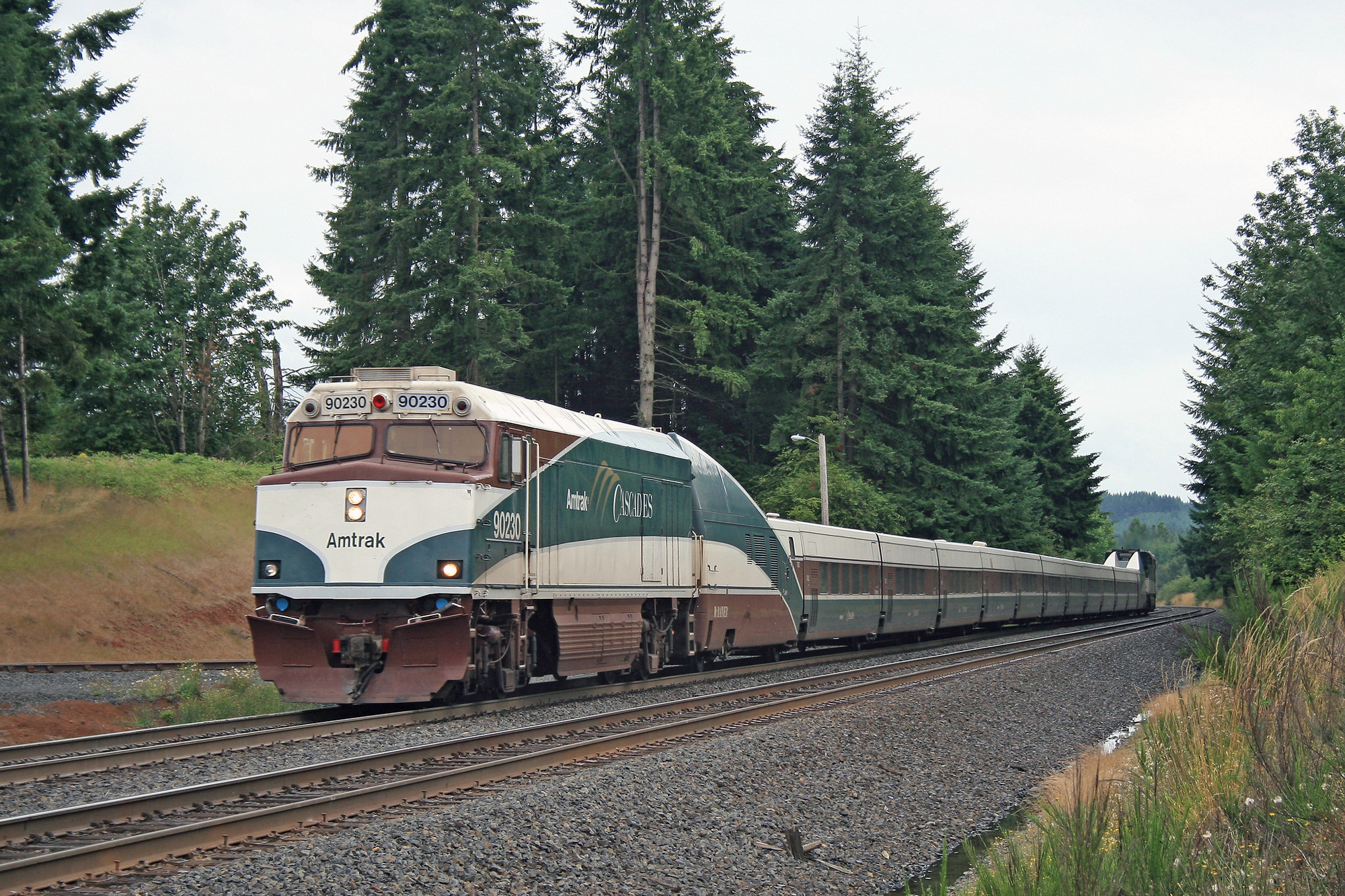 Amtrak Cascades train #516 is at Napavine, Washington on July 21, 2007. This particular service is one of the current commuter/regional trains provided in the PNW utilizing low slung Talgo equipment. Doug Kroll photo.
Historical Context and Need for the Project
The concept of a high-speed rail corridor in the Cascadia region has been discussed for decades, driven by the need to address increasing population growth (with a current population of around 14 million), urban congestion, and climate change.
Major population centers like Seattle, Portland, and Vancouver face significant traffic challenges, with road congestion leading to longer commutes and economic inefficiencies.
Moreover, the current modes of intercity travel, such as air travel and buses, face limitations due to weather dependency, airport congestion, and longer travel times.
High-speed rail presents a viable alternative, offering a sustainable, efficient, and rapid mode of transportation that can address these regional challenges.
Route and Design
The proposed Cascadia rail line would start in Eugene, Oregon, and extend north toward Vancouver, British Columbia. Major cities along the route include:
- **Eugene, Oregon**: A cultural and educational hub, home to the University of Oregon.
- **Portland, Oregon**: Known for its vibrant arts scene and strong technology sector.
- **Seattle, Washington**: A major economic center with global tech, retail, and aerospace industries.
- **Vancouver, British Columbia**: An international city with a diverse economy and large tourism sector.
The rail line is expected to utilize state-of-the-art train technology, capable of speeds of up to 220 mph. This would reduce travel time dramatically, with travel between Seattle and Portland estimated at approximately one hour, a trip that can currently take over three hours by car.
Economic Impact and Benefits
1. **Job Creation and Economic Growth**: The construction and operation of the high-speed rail are projected to create thousands of jobs in engineering, construction, and manufacturing. Additionally, it could bolster economic development in corridor cities by improving access to regional markets.
2. **Transit-Oriented Development (TOD)**: The new rail line could spur transit-oriented developments around the stations, revitalizing neighborhoods and encouraging sustainable urban growth. TOD initiatives typically lead to increased property values and economic vibrancy.
3. **Tourism Enhancement**: High-speed rail would promote tourism by making travel between cities more accessible and convenient. This would potentially increase tourism revenue for cities on the corridor.
Environmental Benefits
1. **Reduction in Carbon Emissions**: With a capacity to transport large numbers of passengers efficiently, high-speed trains offer a more sustainable alternative to car travel and short-haul flights. This shift can significantly reduce the carbon footprint of transportation in the region.
2. **Conservation of Natural Resources**: By minimizing reliance on fossil fuels and utilizing electrical power sources, potentially renewable, high-speed rail aligns with environmental conservation goals.
3. **Land Use**: High-speed rail requires less land area compared to highways, preserving natural landscapes and ecosystems.
Technological and Design Considerations
The design of the rail system - intended to reach speeds up to 220 mph - will incorporate the latest in high-speed rail technology borrowed from existing systems in countries like Japan (Shinkansen), France (TGV), and China. This includes:
- **Advanced Signaling and Communication Systems**: To ensure safe operations with minimal delays.
- **Energy Efficiency**: Including regenerative braking systems and aerodynamic train designs.
- **Passenger Comfort and Accessibility**: Spacious seating, Wi-Fi, and dining facilities to enhance the travel experience.
Funding and Challenges
The financing for the Cascadia High-Speed Rail Corridor will likely comprise a mix of public and private funding. This could involve federal and local government investments, public-private partnerships, and potential funding from international investors.
Key challenges include:
- **Funding and Cost Overruns**: Securing sufficient initial funding and managing costs are critical to project feasibility.
- **Community Opposition and Land Acquisition**: Ensuring community support and addressing concerns related to land use and environmental impact.
- **Regulatory Hurdles**: Navigating the inter-jurisdictional regulations across three U.S. states and Canada.
International Collaboration
The presence of the corridor across international borders necessitates robust collaboration between U.S. and Canadian authorities. This includes synchronized regulatory measures, shared standards for rail operations, and bilateral agreements on border security for rail passengers.
Key Goals
Imagine zipping between the cities of Portland, Seattle, and Vancouver in under an hour at speeds of around 220 mph (354 kph). Picture a schedule featuring 21 to 30 round trips each day, with express options that halt only at key stops and others making more frequent stops along the way.
The system is designed to theoretically move 32,000 passengers per hour, allowing for a dense train schedule. It's projected that 12 to 20 percent of existing intercity travelers would opt for this high-speed service. At launch, it's estimated to draw between 1.7 and 3.1 million riders annually, generating $160 to $250 million a year in revenue.
Construction could be completed for between $24 billion and $42 billion, as per 2017 estimates. The economic impact is expected to be significant, with a projected $355 billion boost in economic growth and the creation of 200,000 jobs connected to its construction and operation.
Environmental benefits are notable, too, with an anticipated reduction of 6 million metric tons of CO2 over 40 years. By harnessing clean energy sources like hydro, wind, and solar power, there is potential for the service to operate with zero emissions.
Conclusion
The Cascadia corridor is more than a transportation project; it is a forward-thinking initiative poised to redefine travel in the Pacific Northwest.
By offering an efficient, eco-friendly alternative to traditional travel methods, it holds the promise of increased economic prosperity, substantial environmental benefits, and enhanced regional connectivity. However, its successful implementation will depend on overcoming financial, regulatory, and community-related challenges.
The vision of a high-speed rail corridor connecting Eugene to Vancouver reflects a broader commitment to sustainable regional development and global leadership in transportation innovation.
As the debate and planning continue, the focus will remain on striking a balance between technological advancement, economic growth, and environmental stewardship.
Recent Articles


-
Chesapeake and Ohio Railway: Map, Logo, History
Sep 17, 26 02:36 PM
 Chesapeake & Ohio Railway—Louisa Railroad 1836, named August 31 1868, Ohio River 1873. Coal, Chessie the kitten, Pere Marquette 1947, B&O control 1963, into CSX August 31 1987. Complete corporate…
 -
TVRM Valentine Train Ride (2026)
Sep 17, 26 02:31 PM
 2026 TVRM Valentine Train Ride in Chattanooga—Feb. 6–15, plated dinner, Grand Junction Depot. Confirm on tvrail.com.
 -
River Fox Train Dining (2026)
Sep 17, 26 02:29 PM
 2026 River Fox Train in West Sacramento—Brunch Train and Murder Mystery dinner. 18095 County Road 117. Confirm on riverfoxtrain.com.
 -
Weehawken Terminal, Serving The West Shore Railroad
Sep 17, 26 01:38 PM
 Weehawken Terminal—West Shore / New York Central Hudson waterfront station, opened 1884. Five ferry slips, sixteen tracks, Weehawken Tunnel 4,014 feet. Last ferry March 25, 1959. Port Imperial and HBL…
 -
West Shore Railroad: Map, History, Timetables
Sep 17, 26 01:32 PM
 West Shore Railroad—New York, West Shore & Buffalo 1880–83, Weehawken to Buffalo. PRR-backed rival to the Central. Morgan settlement, 475-year NYC lease January 1 1886. CSX River Sub today.
 -
Jersey Central Diesel Locomotives: History, Roster & Photos
Sep 17, 26 01:20 PM
 Central Railroad of New Jersey diesel—boxcab 1000, Baldwin double-enders, F3s, Train Masters, SD35s, GP40Ps. All-time roster. Steam ended July 1, 1954.
 -
Jersey Central Steam Locomotives: History, Roster & Photos
Sep 17, 26 01:17 PM
 Central Railroad of New Jersey steam—Camelback Ten-Wheelers, USRA Mikados, G-class Pacifics, suburban tanks. Post-1900 class roster after Drury. Dieselized July 1, 1954.
 -
Jersey Central Railroad (CNJ): Map, Rosters, History
Sep 17, 26 01:14 PM
 Central Railroad of New Jersey—Elizabethtown & Somerville 1831, named April 23 1849. Communipaw, anthracite, Blue Comet, Reading/B&O control. Conrail April 1 1976. Complete corporate history.
 -
Central Vermont Diesel Locomotives: History, Roster & Photos
Sep 17, 26 11:35 AM
 Central Vermont diesel—Alco S-2s 1942, RS-3s, RS-11s from DW&P, EMD GP9s 1956–57, GP38ACs 1971. All-time roster. Last steam April 4, 1957.
 -
Central Vermont Steam Locomotives: History, Roster & Photos
Sep 17, 26 11:19 AM
 Central Vermont steam—ten Alco 2-10-4s of 1928, four U-1-a Mountains, Consolidations. Post-1900 class roster after Drury. Last steam April 4, 1957.
 -
Central Vermont Railway: Map, Logo, Rosters
Sep 17, 26 11:03 AM
 Central Vermont Railway—Vermont Central charter October 1843, Bethel–White River Junction June 26, 1848. Grand Trunk 1898, CN 1923, RailTex/NECR 1995. Complete corporate history.
 -
Fitchburg Railroad: Map, History, Timetables
Sep 17, 26 10:40 AM
 Fitchburg Railroad—chartered March 3, 1842, Boston–Fitchburg March 5, 1845. Alvah Crocker, Hoosac west door, Vermont & Massachusetts, Cheshire. B&M 99-year lease July 1, 1900. Complete corpora…
 -
Steam Railroading Institute Dining (2026)
Sep 17, 26 10:30 AM
 2026 SRI Owosso dining—vintage dining cars, select evenings. 2026 dinner calendar not posted; 2025 Up In Smoke is the recent example. Confirm on michigansteamtrain.com.
 -
Canadian Pacific Railway: Map, History, Logo, Photos
Sep 17, 26 12:06 AM
 Canadian Pacific Railway—incorporated February 16, 1881. Last spike Craigellachie November 7, 1885. Soo, Milwaukee, D&H, DM&E. CPKC April 14, 2023. Complete corporate history.
 -
Canadian Pacific Diesel Locomotives: History, Roster & Photos
Sep 17, 26 12:03 AM
 Canadian Pacific diesel—E8A 1800 in 1949, FP7/FP9, FA-2, C424, SD40-2, SD40-2F Red Barns, AC4400CW, ES44AC, SD30C-ECO, SD70ACu heritage. All-time roster. Last steam November 6, 1960.
 -
Canadian Pacific Steam Locomotives: History, Roster & Photos
Sep 16, 26 11:35 PM
 Canadian Pacific steam—3,257 engines 1881–1949. D10 Ten-Wheelers, G3 Pacifics, Royal Hudsons, Selkirk 2-10-4s. Post-1900 class roster after Drury. Last steam November 6, 1960.
 -
Woodstown Central Dining in Motion (2026)
Sep 16, 26 11:31 PM
 2026 Woodstown Central Dining in Motion—Salem County table car, 50–60 minutes, private table of four from $190. Confirm on woodstowncentral.com.
 -
NCTM Wine & Dine on the Rails (2026)
Sep 16, 26 11:28 PM
 2026 NCTM Wine & Dine on the Rails in Spencer—Feb. 13–15, three-course dinner, 21+, $145/$140. Sold out. Confirm next season on nctransportationmuseum.org.
 -
Southern Railway 4-6-2 1380: The Streamlined Ps-4
Sep 16, 26 10:34 PM
 Southern Railway Ps-4 4-6-2 1380—Alco 1923, serial 64857. Otto Kuhler streamlining at Spencer 1940–41 for the Tennessean. Only streamlined steam locomotive on the Southern. Scrapped Baltimore 1953.
 -
Texas Mexican Railway: Serving The Border Since The 1880s
Sep 16, 26 09:58 PM
 Texas Mexican Railway—Corpus Christi, San Diego & Rio Grande March 1875, 3-foot. Tex-Mex June 1881, Laredo Sept 1881, Rio Grande bridge 1883. Standard gauge July 17 1902. Mexican government 1900–1…
 -
Mount Hood Railroad Dining (2026): No Plated Dinner Train This Season
Sep 16, 26 09:53 PM
 2026 Mount Hood Railroad in Hood River is scenic Fruit Loop trains with snacks and sandwiches—not a plated dinner train. Confirm on mthoodrr.com.
 -
Peoria and Eastern Railway: Map, Timetables, History
Sep 16, 26 09:39 PM
 Peoria & Eastern—Danville, Urbana, Bloomington & Pekin 1866, IB&W 1869, OI&W 1887. Incorporated Feb 21 1890, Big Four next day. NYC 1930, Conrail 1976. GP7s 5612–5625. Complete corporate history.
 -
Boston and Maine Railroad: "Route Of The Minute Man"
Sep 16, 26 11:30 AM
 Boston & Maine—Andover & Wilmington 1833, NH charter June 27 1835. Eastern, Boston & Lowell, Fitchburg/Hoosac, Concord & Montreal. Section 77 March 12 1970. Guilford June 30 1983. CSX June 1 2…
 -
Smoky Valley Limited Dinner Train (2026)
Sep 16, 26 11:24 AM
 2026 Abilene & Smoky Valley Smoky Valley Limited—two-hour dinner from the 1887 Rock Island Depot. Kansas catering, ~$72–$110. Confirm on asvrr.org.
 -
Canadian National Diesel Locomotives: History, Roster & Photos
Sep 16, 26 11:14 AM
 Canadian National diesel—CLC boxcabs 1929, GMD FP9 and GP9, MLW FPA-4 and RS-18, GMD1, wide-cab SD40-2W, Dash-9s, ES44AC and ET44AC. All-time roster.
 -
Canadian National Steam Locomotives: History, Roster & Photos
Sep 16, 26 10:07 AM
 Canadian National steam—CGR, Canadian Northern, Grand Trunk, GTP. 4-8-4 Confederations, U-1 Mountains, J and K Pacifics. Post-1900 class roster. Last scheduled steam April 25, 1960.
 -
Canadian National Railway: Map, Logo, History, Photos
Sep 16, 26 08:55 AM
 Canadian National—name Dec 20 1918, incorporated June 6 1919, Grand Trunk Jan 20 1923. Crown corporation, IPO Nov 17 1995. IC, Wisconsin Central, BC Rail, EJ&E. Class I, mark CN.
 -
Buffalo, Rochester and Pittsburgh Railway: "Safety and Service"
Sep 16, 26 12:12 AM
 Buffalo, Rochester & Pittsburgh—Rochester & State Line 1869, BR&P March 12 1887. Pennsylvania coal to Buffalo and Rochester. B&O January 1 1932. All-time steam roster, LL 2-6-6-2s, XX…
 -
Buffalo Creek & Gauley Railroad: Map, Roster, Logo, Photos
Sep 15, 26 11:55 PM
 Buffalo Creek & Gauley—Elk River Coal & Lumber, April 1 1904, Dundon–Widen. Last all-steam WV coal road, February 27 1965. All-time steam roster, #4 Baldwin 59472, Majestic and Elk River diesels…
 -
Buffalo and Susquehanna Railroad: Map & History
Sep 15, 26 11:42 PM
 Buffalo & Susquehanna—Goodyear hemlock railroad, Sinnemahoning Valley December 14 1885, 1893 merger, coal to Sagamore, Buffalo extension, bankruptcy May 6 1910, B&O 1932, WAG 1956.
 -
WMSR Allegheny Mountain Dinner Train (2026): Dates & Tickets
Sep 15, 26 11:36 PM
 2026 Western Maryland Scenic Allegheny Mountain Dinner Train—Cumberland, 3 hours, 21+, Saturday 7 p.m. Confirm on wmsr.com.
 -
Boston and Albany Railroad: Map & History
Sep 15, 26 11:28 PM
 Boston & Albany Railroad—Boston & Worcester June 23 1831, Western Railroad across the Berkshires, merger 1867–70. NYC 99-year lease July 1 1900. Berkshires, New England States, CSX and MBTA today.
 -
Grand Bellevue Dinner Train (2026): Portsmouth, Rhode Island
Sep 15, 26 11:14 PM
 2026 Grand Bellevue Rail Dining in Portsmouth, RI—2.5-hour seated dinner on Narragansett Bay. Fall/winter TBA after Aug. 29. Confirm on thegrandbell.com.
 -
The "John Bull": The C&A's First Locomotive (1831)
Sep 15, 26 11:01 PM
 John Bull locomotive—Stephenson Planet-type 0-4-0, 1831. Dripps assembly, 4-2-0 rebuild, cowcatcher. Specs, Camden & Amboy career, Smithsonian 1884, 1981 steam-up, 1939 replica.
 -
Napa Valley Wine Train Dining (2026): Lunch, Dinner & Vista Dome
Sep 15, 26 10:56 PM
 2026 Napa Valley Wine Train dining—downtown Napa, 36-mile round trip, gourmet lunch and dinner, Vista Dome. Confirm packages on winetrain.com.
 -
My Old Kentucky Dinner Train (2026): Dates, Tickets & What to Expect
Sep 15, 26 10:50 PM
 2026 My Old Kentucky Dinner Train in Bardstown—2.5 hours, 35-mile round trip, four-course dinner from $116. Confirm on kydinnertrain.com.
 -
LaSalle Street Station: One Of Chicago's Great Terminals
Sep 15, 26 10:42 PM
 LaSalle Street Station—Rock Island October 10, 1852. Frost & Granger July 1, 1903. 20th Century Limited, Rockets, Golden State. Headhouse razed 1981. Metra Rock Island District today.
 -
Charlie Russell Chew Choo (2026): Montana Dinner Train from Lewistown
Sep 15, 26 10:39 PM
 2026 Charlie Russell Chew Choo dinner train—Hanover/Lewistown, 4.5 hours, 56-mile round trip, prime rib. Adult $151. Remaining listed dates sold out. Confirm on montanadinnertrain.com.
 -
Central Pacific Railroad: Map, History, Facts, Logo
Sep 15, 26 10:30 PM
 Central Pacific—Judah, Big Four, June 28 1861. Sierra, Chinese labor, Donner Summit Tunnel. Ten-mile day April 28 1869. Promontory May 10. Southern Pacific lease April 1 1885. Dissolved June 30 1959…
 -
Bessemer & Lake Erie Railroad: "The Bessemer Road"
Sep 15, 26 05:20 PM
 Bessemer & Lake Erie—Bear Creek 1865, Carnegie 1897, U.S. Steel 1901. Ore south from Conneaut, coal north. 2-10-4s, Missabe sister road. CN May 10, 2004. Complete corporate history.
 -
Bangor and Aroostook Railroad: "Serving Northern Maine"
Sep 15, 26 05:05 PM
 Bangor & Aroostook—chartered February 13, 1891, first trains January 1, 1894. Potatoes, paper, Searsport, State of Maine reefers. MM&A 2003, Lac-Mégantic 2013, CP 2020, CPKC today. Complete co…
 -
Baltimore & Ohio Chicago Terminal Railroad: Map and History
Sep 15, 26 03:11 PM
 B&OCT—formed January 6, 1910 to buy Chicago Terminal Transfer. Grand Central, Barr Yard, 78 route-miles. Assigned B&O steam. Complete diesel roster. CSX paper subsidiary, mark BOCT.
 -
The "Alphabet Route" (Railroad): Photos and History
Sep 15, 26 02:53 PM
 Alphabet Route—eight railroads, not one company. P&WV to Connellsville February 11, 1931. Alpha Jets Chicago/St. Louis–New York/Boston. NKP, W&LE, P&WV, WM, Reading, CNJ, L&HR, New Hav…
 -
Milwaukee Road Livestock Operations: Cattle, Dakotas & Montana
Sep 15, 26 02:36 PM
 Milwaukee Road livestock traffic—Dakota and Montana cattle, Iowa hogs, Chicago markets, 28-hour law, head-end stock cars. By 1974 mostly Montana. Rick Burn’s Helena speech. Operations history, not the…
 -
Spirit of Jasper Ride & Dine (2026): Season Pause
Sep 15, 26 02:29 PM
 Spirit of Jasper Ride & Dine in Jasper, Indiana—seated meal on board. Operator: not running public trains for 2026. Depot remains open as a rental. Confirm on spiritofjaspertrain.com.
 -
South Carolina Canal & Rail Road Company: Map and History
Sep 15, 26 01:59 PM
 South Carolina Canal & Rail Road—chartered December 19, 1827. Best Friend of Charleston, 136 miles Charleston–Hamburg October 1833, Aiken inclined plane. South Carolina Railroad 1844, Southern 189…
 -
The Practice of Double-Heading: The Steam Era
Sep 15, 26 01:43 PM
 Doubleheading—two locomotives on the point, each with its own steam crew. Not a rear helper, not diesel MU. How it worked, PRR 1877, mountain grades, and what MU ended.
 -
Mohawk and Hudson Railroad: Map, Pictures, Locomotives
Sep 15, 26 01:20 PM
 Mohawk & Hudson Railroad—New York’s first railroad, chartered April 17, 1826. DeWitt Clinton, inclined planes, Albany & Schenectady 1847, first New York Central May 17, 1853. Complete corporat…
 -
Essex Clipper Dinner Train (2026): Dates, Tickets & What to Expect
Sep 15, 26 01:09 PM
 2026 Essex Clipper Dinner Train in Essex, CT—2.5 hours, four-course meal $129.99, 18+. Fall dates through Oct. 25. Confirm on essexsteamtrain.com.
 -
Camden & Amboy Railroad: Map, History, Photos
Sep 15, 26 12:53 PM
 Camden & Amboy Railroad—chartered February 4, 1830. Joint Companies monopoly with the Delaware & Raritan Canal, John Bull, T-rail. United New Jersey 1872, PRR 999-year lease 1871. Complete corpora…