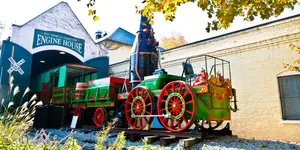
New York & New England Railroad: Map, Ghost Train & History
Last revised: September 4, 2026
By: Adam Burns
The New York & New England Railroad was southern New England’s inland railroad: Boston and Providence west through Willimantic and Hartford to the Hudson at Beacon, with a car float across to the Erie at Newburgh. It never owned a rail into Manhattan. The high-speed Shore Line between New York and Boston belonged to its rival, the New York, New Haven & Hartford. What the NY&NE did own was a freight path around New York harbor, a leased steamer connection at Norwich, and, for a few seasons, the most photographed passenger train in New England—the white-and-gold New England Limited that people along the line called the Ghost Train.
The corporate name lasted from a Massachusetts special act of April 17, 1873, until bankruptcy on December 27, 1893. The property had been the Boston, Hartford & Erie, a Civil War–era scheme with Erie Railroad men on the board and a badly soiled Massachusetts state loan. After 1893 it ran briefly as the New England Railroad (reorganized August 26, 1895). The New Haven took a 99-year lease on July 1, 1898, and folded the company in 1908. Most of the map is gone. What still moves trains is the MBTA Franklin/Foxboro Line into Boston and a Connecticut Southern freight stub through Manchester. The rest is trail, brush, or New Haven secondary that died with Penn Central.
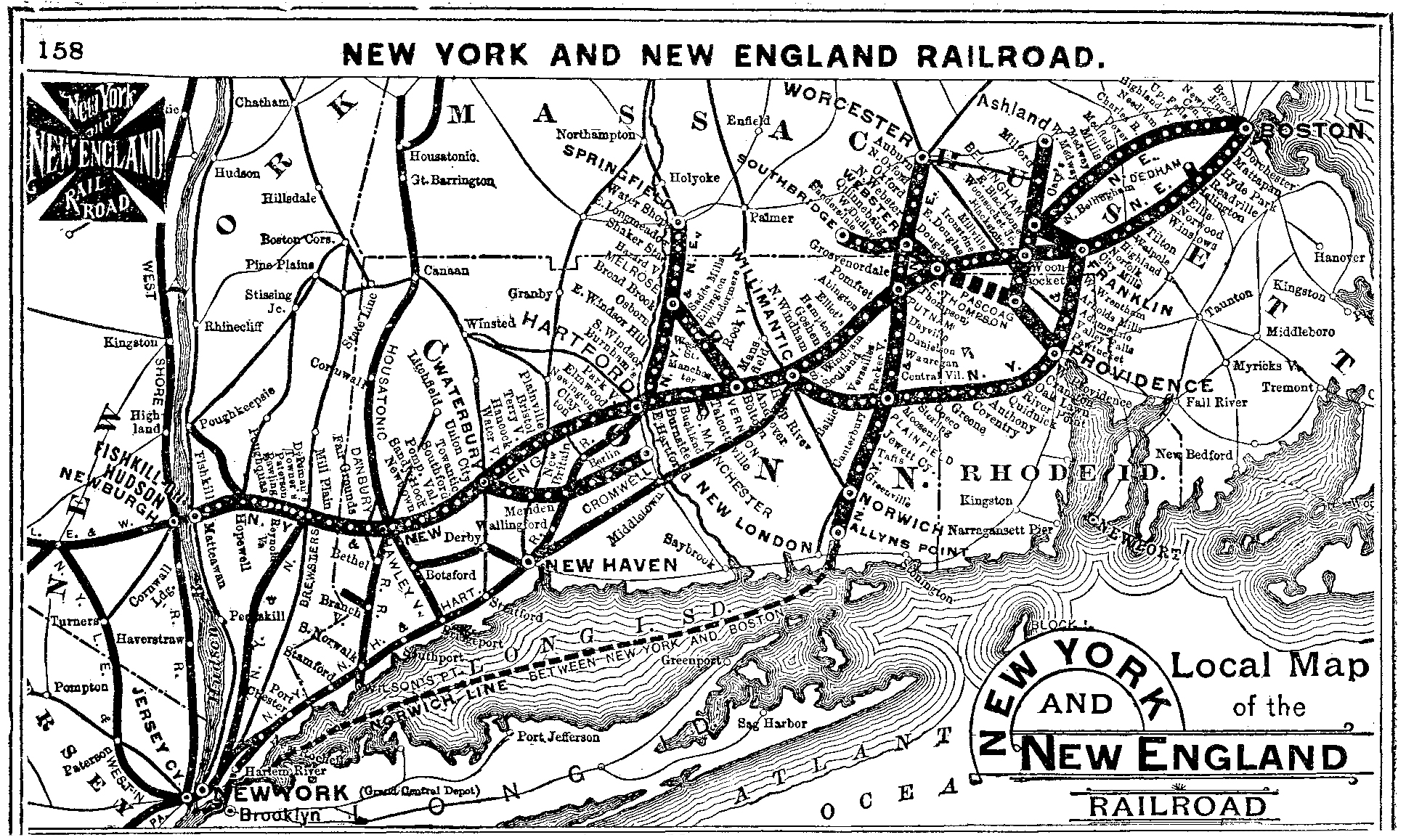
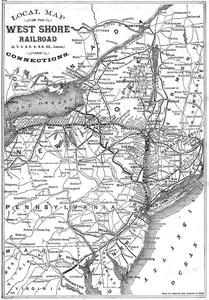
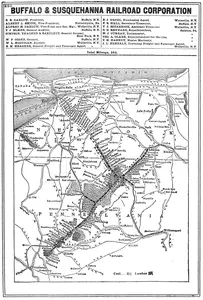
New York & New England system map, 1893—Boston and Providence west to the Hudson, with the Norwich & Worcester lease running north–south through eastern Connecticut. American-Rails.com collection.
On this page: At a glance · Hartford, Providence & Fishkill · Norfolk County and Boston · Boston, Hartford & Erie · Hudson River, 1881 · White Train / Ghost Train · East Thompson, 1891 · Poughkeepsie Bridge · Bankruptcy and the New Haven · What still runs · 1893 timetables · Related reading · Sources
At a glance
| Item | Detail |
|---|---|
| Common name | New York & New England (NY&NE) |
| Predecessor | Boston, Hartford & Erie (chartered May 1863). NY&NE chartered April 17, 1873; took possession of BH&E property about 1875 |
| Successor name | New England Railroad, August 26, 1895 |
| States | Massachusetts, Rhode Island, Connecticut, New York |
| Gauge | 4 ft 8½ in |
| Peak size | On the order of 500 miles owned; about 659 miles in early-1890s listings that include leased roads (notably the Norwich & Worcester) |
| Principal freight idea | Boston / Providence / Hartford to Fishkill Landing (Beacon), then car float to the Erie at Newburgh—New England freight without a New York harbor terminal of its own |
| Passenger idea | Inland Boston–New York via Willimantic and (after 1879) the New Haven’s Air Line into New Haven, then the Shore Line into Grand Central. Not a substitute for the Shore Line itself |
| Famous train | New England Limited (from 1884); Pullman white-and-gold “White Train,” March 16, 1891–October 20, 1895. Called the Ghost Train along the line |
| New Haven lease | 99 years from July 1, 1898; merged into NYNH&H, 1908 (conveyance often dated April 1) |
| What still moves trains | MBTA Franklin/Foxboro Line (Boston–Forge Park/495 and Foxboro); Connecticut Southern freight, East Hartford–Manchester. Much of the rest is abandoned or rail-trail |
The New Haven story—McGinnis orange, FL9s, Penn Central, Metro-North—lives on /nynhh.html. This page is the inland company the New Haven bought so it would not have to compete with it.
West from Providence: Hartford, Providence & Fishkill
Three charters in the 1840s sketched a railroad from Providence to the Hudson. The New York & Hartford (May 1845) aimed at the New York & Harlem at Brewster. The Providence & Plainfield (June 1846) would reach the Rhode Island–Connecticut line. The Hartford & Providence (May 1847) would close the gap to Hartford. In 1849 the two Connecticut companies became the Hartford, Providence & Fishkill, with the charter rewritten to Fishkill on the Hudson. The Rhode Island company came in in 1851.
The first iron was Hartford–Willimantic, 1851. East to Providence opened 1854; west to Waterbury, 1855. That was as far as the money went. The HP&F failed on January 1, 1858, and ran under trustees until the new Boston, Hartford & Erie leased it in 1863. The Hudson remained a line on a map.
Southwest from Boston: Norfolk County and the Midland
At the Boston end the earliest piece was the Norfolk County Railroad, chartered April 24, 1847. Dedham (on a Boston & Providence branch) to Walpole opened April 23, 1849; Blackstone, on the Providence & Worcester, May 16. The company failed almost immediately. A Medway branch opened in 1852 and was later abandoned (1864).
The Southbridge & Blackstone (1849) and the Midland Railroad (1850)—a new Boston entry south of Dedham—consolidated with Norfolk County on December 12, 1853, as the Boston & New York Central, which talked of reaching New York City. The East Thompson Railroad was the Connecticut piece of that extension. Blackstone to Mechanicsville, Connecticut, on the Norwich & Worcester, opened in 1853. A new main into Boston, to a terminal at the foot of Summer Street via South Boston, opened in January 1855, then shut for six months on a grade-crossing injunction, then failed again. For years only Dedham–Blackstone stayed open, sometimes as a Boston & Providence branch. The rest sat unused until the BH&E era.
A separate competitor, the New York & Boston / Charles River line, built Brookline to Woonsocket. The BH&E absorbed it on January 4, 1865, as the Woonsocket Division.
Boston, Hartford & Erie
The Boston, Hartford & Erie was chartered in May 1863 to pick up the wreckage and finish the railroad to Fishkill, with a car float to the Erie at Newburgh. That was the whole idea: a New England partner for the Erie that did not have to buy a Manhattan terminal. Erie men sat on the BH&E board by December 1865. The company leased the HP&F (Providence–Waterbury) at once and bought the old Boston & New York Central in September 1863, though it did not run that Boston line until it leased Norfolk County on February 11, 1867. A Southbridge branch opened the same year. The Norwich & Worcester lease in 1869 gave it a paying north–south road and the Norwich Line steamers. Direct Willimantic–Mechanicsville track in August 1872 finally made a Boston–Providence–Hartford railroad that did not have to detour on the N&W.
It was also a financial mess. Massachusetts put public money into BH&E “Berdell bonds”—on the order of $3 million of state-held paper in a $20 million issue. The NY&NE’s later common stock was, in law, the successor to those bonds; $1,000 of bonds were never issued, so the railroad carried $19.999 million of common for years. Land titles stayed cloudy into the NY&NE period. Alvin F. Harlow, in Steelways of New England, notes that the NY&NE did not even get the HP&F until 1877. The BH&E leased the Dutchess & Columbia in 1869, meaning to meet it at the future Hopewell Junction, then lost the lease in 1870 without building the connection. It leased the New Haven, Middletown & Willimantic in 1873—the future Air Line—and forfeited that lease the same year, before the line opened. The Air Line became New Haven property in 1879. That matters later for the Ghost Train: the white cars used NY&NE rails to Willimantic and New Haven rails the rest of the way to Grand Central.
The Panic of 1873 finished the BH&E. Massachusetts chartered the New York & New England on April 17, 1873. Possession of the BH&E system followed about 1875. The N&W lease was the prop that kept the new company breathing: the steamers and the Worcester–Norwich line actually made money (8 percent on N&W stock after a reduction from 10 percent around 1885).
To the Hudson, 1881
The NY&NE finally did what the BH&E had promised. In 1881 the railroad opened Waterbury west to Hopewell Junction on the Newburgh, Dutchess & Connecticut. Trackage rights over the ND&C to Beacon, plus a short NY&NE-built piece to the river, put Boston and Providence cars on the Hudson. A train ferry carried them to the Erie’s Newburgh Branch. Part of the New York grade had been graded for the failed Putnam & Dutchess and never used. Fishkill Landing (today’s Beacon) was the west end of the idea, not Grand Central.
The same year the New York, Westchester & Putnam opened from New York City to the NY&NE at Brewster. For a time that gave a traffic arrangement into the city from the east. The Putnam later went to the New York Central (1894). It was never a substitute for the New Haven Shore Line.
A “midnight receivership” at the turn of 1883–84—officers hunting a federal judge before the year ended—was over by 1886. Cyrus W. Field was a major holder until Massachusetts refused to sell him the state’s $3 million of stock (the Commonwealth was getting out of railroad ownership; the Hoosac Tunnel sale to the Fitchburg in 1887 was the same policy). Jabez A. Bostwick, a Standard Oil partner, became president in 1887. William Rockefeller sat on the New Haven board. Whether that was a Rockefeller squeeze on both southern New England roads is a story writers have liked; the documented fact is simpler. The NY&NE was always the weaker of the two Boston–New York inland/shore pair, and the New Haven had the capital to wait it out.
The White Train, or Ghost Train
The NY&NE put on a fast Boston–New York train, the New England Limited, in November 1884. By the late 1880s the New Haven’s Shore Line flyers (Gilt Edge, Shore Line Flyer) were taking the business. Pullman rebuilt the Limited in white and gold. The first of those cars left the NY&NE’s Summer Street station in Boston at 3 p.m. on March 16, 1891. The advertising department called it the White Train. People in the villages after dark called it the Ghost Train. Two consists, one each way, left Boston and New York at 3 p.m. and were due at 9 p.m.—six hours, no stop Boston to Willimantic on NY&NE rail, engine change there, then Middletown and New Haven on the Air Line and into Grand Central on the New Haven.
Lucius Beebe later made a meal of it, and Rudyard Kipling’s jingle (“Without a jar, or roll, or antic, / Without a stop to Willimantic”) still turns up in New England railroad writing. The railroad found that keeping Pullman white clean cost more than the publicity was worth. The last Ghost Train ran October 20, 1895. The Air Line Limited succeeded it; passenger service on the old Air Line was gone by 1937. The white train is the image that survived. It was a joint NY&NE–New Haven operation, not a NY&NE railroad from end to end.
East Thompson, December 4, 1891
On December 4, 1891, four trains piled up at East Thompson, Connecticut, on the NY&NE—among the rare four-train collisions in American practice. The Southbridge branch left the main there. The wreck is a fixture of Connecticut railroad memory and of the later Air Line trail interpretation. It does not need a novelized retelling here; it is enough that the inland main was busy, fast, and not especially forgiving.
The Poughkeepsie Bridge and Hopewell Junction
The Poughkeepsie Bridge opened for railroad service at the start of 1889 (the live CNE page uses January 1, 1889). It was a fixed Hudson crossing north of the NY&NE float at Beacon. The Central New England & Western, which owned the bridge, chartered the Dutchess County Railroad in 1890 and opened it in 1892 from the east end of the bridge to the NY&NE at Hopewell Junction. That gave the NY&NE a path onto the bridge without the ferry—and it gave the future New Haven Maybrook gateway its eastern connection over NY&NE iron toward Derby and New Haven. The Central New England is that story. After the New Haven absorbed both companies, Hopewell Junction was where the old NY&NE west end and the bridge route met. Penn Central still used the Maybrook–Hopewell–Derby piece until the bridge fire of May 8, 1974, killed the crossing. Walkway Over the Hudson is what remains of the span.
1893, the New England Railroad, and the New Haven lease
The NY&NE failed on December 27, 1893, in the same panic that wrecked a long list of American railroads. Reorganization as the New England Railroad on August 26, 1895, included a heavy assessment on common (Stuart Daggett, in Railroad Reorganization, cites 20 percent). George Pierce Baker and others describe a 1894 scramble for NY&NE common that looked a little like the Northern Pacific corner: parties friendly to the Boston & Albany and the New Haven both bought, and together they may have bought more stock than existed. The New Haven paid high prices for paper that was nearly worthless—and then it did not have to compete with the inland road anymore.
The New Haven leased the New England Railroad for 99 years from July 1, 1898, at 3 percent on the stock, and merged it in 1908. Charles Mellen’s New Haven was in the middle of buying everything in southern New England that was not the Boston & Albany. The NY&NE was the inland half of that monopoly. Under New Haven lettering the old main became secondary. Double-tracking appeared on pieces (Danbury–Hawleyville, Waterbury–Bristol) in the 1910s; the Pequabuck Tunnel at Forestville opened in 1910. Boston–Waterbury passenger service, including the weekday Nutmeg, lasted until 1955 on the Putnam–Willimantic routing. A Hartford–Waterbury remnant died in the 1960s. Bristol spent on a GM Chippens Hill spur in 1965, partly on the pre-tunnel alignment. Penn Central inherited what was left on January 1, 1969.
What still runs
Most of the 1893 map is abandoned. The pieces that still see trains are not a system; they are fragments:
- MBTA Franklin/Foxboro Line uses the old Norfolk County / NY&NE Boston entry from Readville and Forest Hills out through Franklin to Forge Park/495, with Foxboro service on the former industrial branch. That is the Summer Street railroad’s living descendant, now into South Station.
- Connecticut Southern Railroad (Genesee & Wyoming) still handles freight on the former NY&NE through East Hartford and Manchester.
- Short freight remnants survive elsewhere in Massachusetts (Forge Park toward Milford) and on connecting roads. Do not treat every G&W or P&W branch in eastern Connecticut as NY&NE without a map in hand; the Norwich & Worcester is its own company’s story even though the NY&NE leased it.
- Much of the inland Connecticut main and the Air Line is rail-trail (Air Line State Park Trail and related paths). Those trails are on mixed NY&NE and New Haven Air Line grades; the Ghost Train used both.
The New Haven Shore Line—today Amtrak’s Northeast Corridor and Metro-North’s New Haven Line—was never this railroad. If a caption says NY&NE and the train is on the water at Stamford, the caption is wrong.
Timetables, 1893
The four plates below are the NY&NE as it advertised itself the year it failed: through schedules, branches, and the leased Norwich & Worcester. They are the document. Read them against the map at the top of the page rather than against later New Haven employee timetables, which had already begun to treat the inland main as a collection of locals.
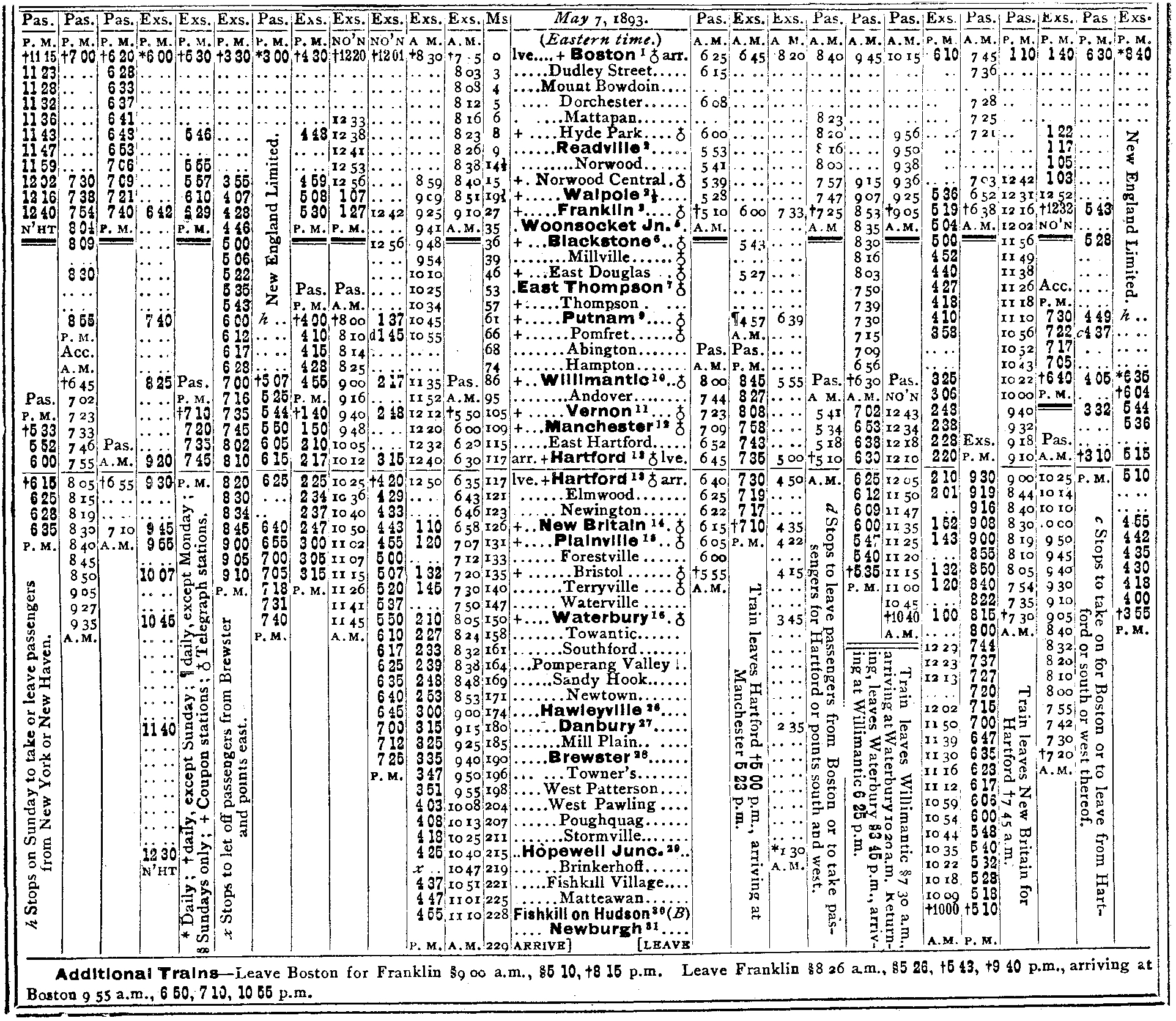
New York & New England timetable, 1893. American-Rails.com collection.
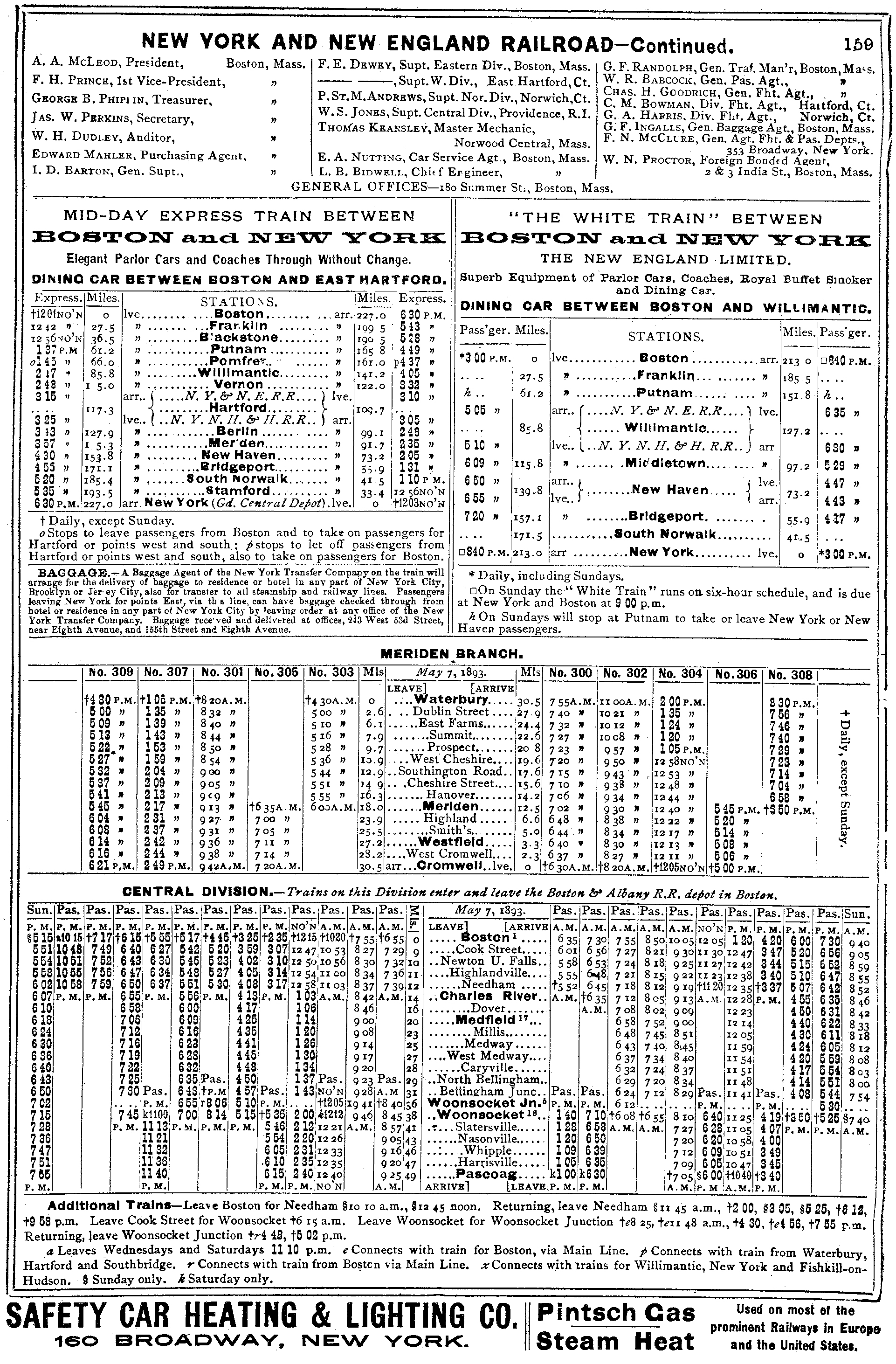
New York & New England timetable, 1893. American-Rails.com collection.
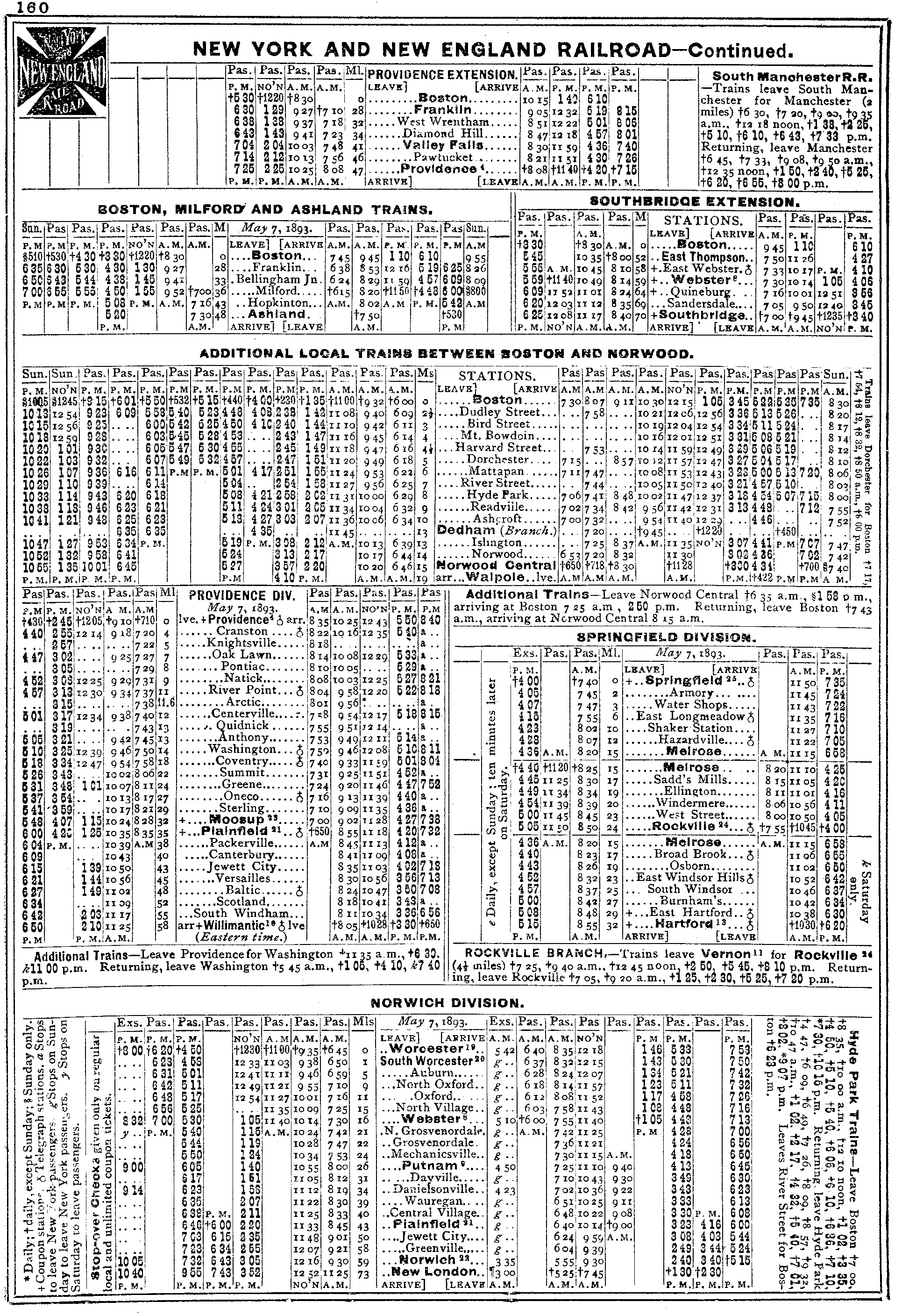
New York & New England timetable, 1893. American-Rails.com collection.
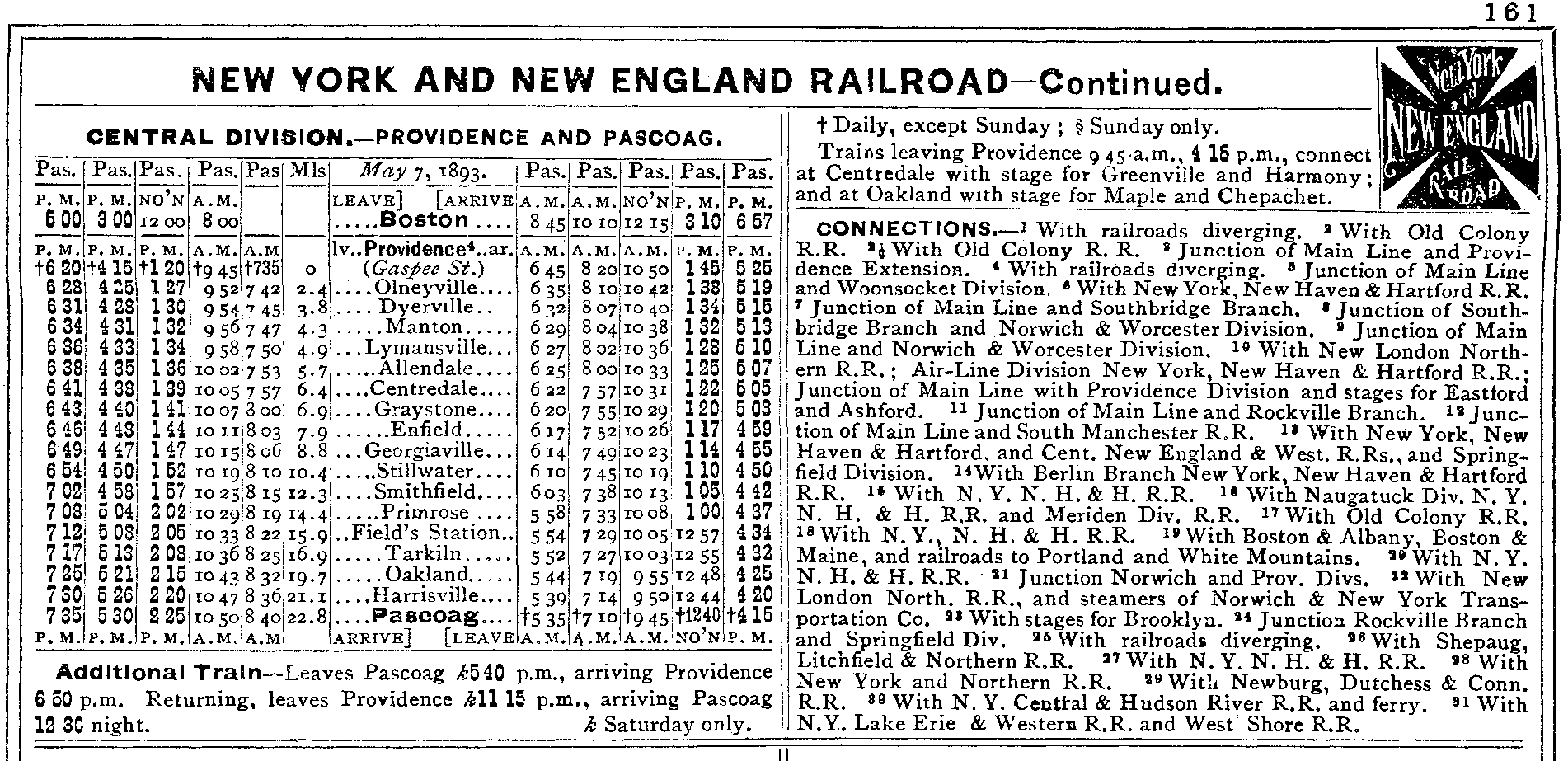
New York & New England timetable, 1893. American-Rails.com collection.
Related reading
- New York, New Haven & Hartford (the company that leased and then merged the NY&NE)
- Central New England Railway · Poughkeepsie Bridge
- Housatonic Railroad (another inland Connecticut property the New Haven absorbed)
- Lehigh & Hudson River (Maybrook gateway after the New Haven era)
- Connecticut railroads · Fallen flags
Sources
- American-Rails.com NY&NE page (February 14, 2025): 1893 system map, timetable plates, and the 659-mile peak listing
- Massachusetts special-act chronology: NY&NE April 17, 1873; New England Railroad August 26, 1895; New Haven lease July 1, 1898; merger 1908
- Alvin F. Harlow, Steelways of New England: HP&F possession, 1877
- Stuart Daggett, Railroad Reorganization: 1895 common-stock assessment
- UConn Archives, “The Famous Ghost Train of the New York and New England Railroad”: White Train first run March 16, 1891; last run October 20, 1895; Boston–Willimantic on NY&NE, Air Line and Shore Line on the New Haven
- American-Rails.com, Central New England and Poughkeepsie Bridge: 1889 span and 1892 Dutchess County connection at Hopewell Junction
Recent Articles


-
Conrail Diesel Roster (All Time)
Sep 17, 26 10:27 PM
 Conrail diesel—~5,000 inherited 1976, Big Blue, GP15-1s, SD40-2s, SD50s, Dash-8s, SD60/60M/60I, SD80MACs. All-time CR-number roster.
 -
Chessie System (Railroad): The C&O, B&O, And WM
Sep 17, 26 09:38 PM
 Chessie System, Inc.—C&O, B&O, and Western Maryland. Kitten-C paint 1972, holding company February 26 1973, CSX November 1 1980, C&O into CSXT August 31 1987.
 -
Chesapeake & Ohio (C&O) Diesel Roster: All-Time
Sep 17, 26 06:01 PM
 Chesapeake & Ohio diesel—late steam, no Fairbanks-Morse, E7s 1946, GP7/GP9 flood, F7s, GP40-2s, B30-7s, SD50s 1984–85. All-time roster. Steam ended 1956.
 -
Chesapeake & Ohio (C&O) Steam Roster: Post-1900
Sep 17, 26 03:18 PM
 Chesapeake & Ohio steam—H-8 Alleghenies, K-4 Kanawhas, T-1 Texas, Greenbriers, H-6 1949 Mallets. Post-1900 class roster including Pere Marquette and Hocking Valley. Last steam 1956.
 -
Chesapeake and Ohio Railway: Map, Logo, History
Sep 17, 26 02:36 PM
 Chesapeake & Ohio Railway—Louisa Railroad 1836, named August 31 1868, Ohio River 1873. Coal, Chessie the kitten, Pere Marquette 1947, B&O control 1963, into CSX August 31 1987. Complete corporate…
 -
TVRM Valentine Train Ride (2026)
Sep 17, 26 02:31 PM
 2026 TVRM Valentine Train Ride in Chattanooga—Feb. 6–15, plated dinner, Grand Junction Depot. Confirm on tvrail.com.
 -
River Fox Train Dining (2026)
Sep 17, 26 02:29 PM
 2026 River Fox Train in West Sacramento—Brunch Train and Murder Mystery dinner. 18095 County Road 117. Confirm on riverfoxtrain.com.
 -
Weehawken Terminal, Serving The West Shore Railroad
Sep 17, 26 01:38 PM
 Weehawken Terminal—West Shore / New York Central Hudson waterfront station, opened 1884. Five ferry slips, sixteen tracks, Weehawken Tunnel 4,014 feet. Last ferry March 25, 1959. Port Imperial and HBL…
 -
West Shore Railroad: Map, History, Timetables
Sep 17, 26 01:32 PM
 West Shore Railroad—New York, West Shore & Buffalo 1880–83, Weehawken to Buffalo. PRR-backed rival to the Central. Morgan settlement, 475-year NYC lease January 1 1886. CSX River Sub today.
 -
Jersey Central Diesel Locomotives: History, Roster & Photos
Sep 17, 26 01:20 PM
 Central Railroad of New Jersey diesel—boxcab 1000, Baldwin double-enders, F3s, Train Masters, SD35s, GP40Ps. All-time roster. Steam ended July 1, 1954.
 -
Jersey Central Steam Locomotives: History, Roster & Photos
Sep 17, 26 01:17 PM
 Central Railroad of New Jersey steam—Camelback Ten-Wheelers, USRA Mikados, G-class Pacifics, suburban tanks. Post-1900 class roster after Drury. Dieselized July 1, 1954.
 -
Jersey Central Railroad (CNJ): Map, Rosters, History
Sep 17, 26 01:14 PM
 Central Railroad of New Jersey—Elizabethtown & Somerville 1831, named April 23 1849. Communipaw, anthracite, Blue Comet, Reading/B&O control. Conrail April 1 1976. Complete corporate history.
 -
Central Vermont Diesel Locomotives: History, Roster & Photos
Sep 17, 26 11:35 AM
 Central Vermont diesel—Alco S-2s 1942, RS-3s, RS-11s from DW&P, EMD GP9s 1956–57, GP38ACs 1971. All-time roster. Last steam April 4, 1957.
 -
Central Vermont Steam Locomotives: History, Roster & Photos
Sep 17, 26 11:19 AM
 Central Vermont steam—ten Alco 2-10-4s of 1928, four U-1-a Mountains, Consolidations. Post-1900 class roster after Drury. Last steam April 4, 1957.
 -
Central Vermont Railway: Map, Logo, Rosters
Sep 17, 26 11:03 AM
 Central Vermont Railway—Vermont Central charter October 1843, Bethel–White River Junction June 26, 1848. Grand Trunk 1898, CN 1923, RailTex/NECR 1995. Complete corporate history.
 -
Fitchburg Railroad: Map, History, Timetables
Sep 17, 26 10:40 AM
 Fitchburg Railroad—chartered March 3, 1842, Boston–Fitchburg March 5, 1845. Alvah Crocker, Hoosac west door, Vermont & Massachusetts, Cheshire. B&M 99-year lease July 1, 1900. Complete corpora…
 -
Steam Railroading Institute Dining (2026)
Sep 17, 26 10:30 AM
 2026 SRI Owosso dining—vintage dining cars, select evenings. 2026 dinner calendar not posted; 2025 Up In Smoke is the recent example. Confirm on michigansteamtrain.com.
 -
Canadian Pacific Railway: Map, History, Logo, Photos
Sep 17, 26 12:06 AM
 Canadian Pacific Railway—incorporated February 16, 1881. Last spike Craigellachie November 7, 1885. Soo, Milwaukee, D&H, DM&E. CPKC April 14, 2023. Complete corporate history.
 -
Canadian Pacific Diesel Locomotives: History, Roster & Photos
Sep 17, 26 12:03 AM
 Canadian Pacific diesel—E8A 1800 in 1949, FP7/FP9, FA-2, C424, SD40-2, SD40-2F Red Barns, AC4400CW, ES44AC, SD30C-ECO, SD70ACu heritage. All-time roster. Last steam November 6, 1960.
 -
Canadian Pacific Steam Locomotives: History, Roster & Photos
Sep 16, 26 11:35 PM
 Canadian Pacific steam—3,257 engines 1881–1949. D10 Ten-Wheelers, G3 Pacifics, Royal Hudsons, Selkirk 2-10-4s. Post-1900 class roster after Drury. Last steam November 6, 1960.
 -
Woodstown Central Dining in Motion (2026)
Sep 16, 26 11:31 PM
 2026 Woodstown Central Dining in Motion—Salem County table car, 50–60 minutes, private table of four from $190. Confirm on woodstowncentral.com.
 -
NCTM Wine & Dine on the Rails (2026)
Sep 16, 26 11:28 PM
 2026 NCTM Wine & Dine on the Rails in Spencer—Feb. 13–15, three-course dinner, 21+, $145/$140. Sold out. Confirm next season on nctransportationmuseum.org.
 -
Southern Railway 4-6-2 1380: The Streamlined Ps-4
Sep 16, 26 10:34 PM
 Southern Railway Ps-4 4-6-2 1380—Alco 1923, serial 64857. Otto Kuhler streamlining at Spencer 1940–41 for the Tennessean. Only streamlined steam locomotive on the Southern. Scrapped Baltimore 1953.
 -
Texas Mexican Railway: Serving The Border Since The 1880s
Sep 16, 26 09:58 PM
 Texas Mexican Railway—Corpus Christi, San Diego & Rio Grande March 1875, 3-foot. Tex-Mex June 1881, Laredo Sept 1881, Rio Grande bridge 1883. Standard gauge July 17 1902. Mexican government 1900–1…
 -
Mount Hood Railroad Dining (2026): No Plated Dinner Train This Season
Sep 16, 26 09:53 PM
 2026 Mount Hood Railroad in Hood River is scenic Fruit Loop trains with snacks and sandwiches—not a plated dinner train. Confirm on mthoodrr.com.
 -
Peoria and Eastern Railway: Map, Timetables, History
Sep 16, 26 09:39 PM
 Peoria & Eastern—Danville, Urbana, Bloomington & Pekin 1866, IB&W 1869, OI&W 1887. Incorporated Feb 21 1890, Big Four next day. NYC 1930, Conrail 1976. GP7s 5612–5625. Complete corporate history.
 -
Boston and Maine Railroad: "Route Of The Minute Man"
Sep 16, 26 11:30 AM
 Boston & Maine—Andover & Wilmington 1833, NH charter June 27 1835. Eastern, Boston & Lowell, Fitchburg/Hoosac, Concord & Montreal. Section 77 March 12 1970. Guilford June 30 1983. CSX June 1 2…
 -
Smoky Valley Limited Dinner Train (2026)
Sep 16, 26 11:24 AM
 2026 Abilene & Smoky Valley Smoky Valley Limited—two-hour dinner from the 1887 Rock Island Depot. Kansas catering, ~$72–$110. Confirm on asvrr.org.
 -
Canadian National Diesel Locomotives: History, Roster & Photos
Sep 16, 26 11:14 AM
 Canadian National diesel—CLC boxcabs 1929, GMD FP9 and GP9, MLW FPA-4 and RS-18, GMD1, wide-cab SD40-2W, Dash-9s, ES44AC and ET44AC. All-time roster.
 -
Canadian National Steam Locomotives: History, Roster & Photos
Sep 16, 26 10:07 AM
 Canadian National steam—CGR, Canadian Northern, Grand Trunk, GTP. 4-8-4 Confederations, U-1 Mountains, J and K Pacifics. Post-1900 class roster. Last scheduled steam April 25, 1960.
 -
Canadian National Railway: Map, Logo, History, Photos
Sep 16, 26 08:55 AM
 Canadian National—name Dec 20 1918, incorporated June 6 1919, Grand Trunk Jan 20 1923. Crown corporation, IPO Nov 17 1995. IC, Wisconsin Central, BC Rail, EJ&E. Class I, mark CN.
 -
Buffalo, Rochester and Pittsburgh Railway: "Safety and Service"
Sep 16, 26 12:12 AM
 Buffalo, Rochester & Pittsburgh—Rochester & State Line 1869, BR&P March 12 1887. Pennsylvania coal to Buffalo and Rochester. B&O January 1 1932. All-time steam roster, LL 2-6-6-2s, XX…
 -
Buffalo Creek & Gauley Railroad: Map, Roster, Logo, Photos
Sep 15, 26 11:55 PM
 Buffalo Creek & Gauley—Elk River Coal & Lumber, April 1 1904, Dundon–Widen. Last all-steam WV coal road, February 27 1965. All-time steam roster, #4 Baldwin 59472, Majestic and Elk River diesels…
 -
Buffalo and Susquehanna Railroad: Map & History
Sep 15, 26 11:42 PM
 Buffalo & Susquehanna—Goodyear hemlock railroad, Sinnemahoning Valley December 14 1885, 1893 merger, coal to Sagamore, Buffalo extension, bankruptcy May 6 1910, B&O 1932, WAG 1956.
 -
WMSR Allegheny Mountain Dinner Train (2026): Dates & Tickets
Sep 15, 26 11:36 PM
 2026 Western Maryland Scenic Allegheny Mountain Dinner Train—Cumberland, 3 hours, 21+, Saturday 7 p.m. Confirm on wmsr.com.
 -
Boston and Albany Railroad: Map & History
Sep 15, 26 11:28 PM
 Boston & Albany Railroad—Boston & Worcester June 23 1831, Western Railroad across the Berkshires, merger 1867–70. NYC 99-year lease July 1 1900. Berkshires, New England States, CSX and MBTA today.
 -
Grand Bellevue Dinner Train (2026): Portsmouth, Rhode Island
Sep 15, 26 11:14 PM
 2026 Grand Bellevue Rail Dining in Portsmouth, RI—2.5-hour seated dinner on Narragansett Bay. Fall/winter TBA after Aug. 29. Confirm on thegrandbell.com.
 -
The "John Bull": The C&A's First Locomotive (1831)
Sep 15, 26 11:01 PM
 John Bull locomotive—Stephenson Planet-type 0-4-0, 1831. Dripps assembly, 4-2-0 rebuild, cowcatcher. Specs, Camden & Amboy career, Smithsonian 1884, 1981 steam-up, 1939 replica.
 -
Napa Valley Wine Train Dining (2026): Lunch, Dinner & Vista Dome
Sep 15, 26 10:56 PM
 2026 Napa Valley Wine Train dining—downtown Napa, 36-mile round trip, gourmet lunch and dinner, Vista Dome. Confirm packages on winetrain.com.
 -
My Old Kentucky Dinner Train (2026): Dates, Tickets & What to Expect
Sep 15, 26 10:50 PM
 2026 My Old Kentucky Dinner Train in Bardstown—2.5 hours, 35-mile round trip, four-course dinner from $116. Confirm on kydinnertrain.com.
 -
LaSalle Street Station: One Of Chicago's Great Terminals
Sep 15, 26 10:42 PM
 LaSalle Street Station—Rock Island October 10, 1852. Frost & Granger July 1, 1903. 20th Century Limited, Rockets, Golden State. Headhouse razed 1981. Metra Rock Island District today.
 -
Charlie Russell Chew Choo (2026): Montana Dinner Train from Lewistown
Sep 15, 26 10:39 PM
 2026 Charlie Russell Chew Choo dinner train—Hanover/Lewistown, 4.5 hours, 56-mile round trip, prime rib. Adult $151. Remaining listed dates sold out. Confirm on montanadinnertrain.com.
 -
Central Pacific Railroad: Map, History, Facts, Logo
Sep 15, 26 10:30 PM
 Central Pacific—Judah, Big Four, June 28 1861. Sierra, Chinese labor, Donner Summit Tunnel. Ten-mile day April 28 1869. Promontory May 10. Southern Pacific lease April 1 1885. Dissolved June 30 1959…
 -
Bessemer & Lake Erie Railroad: "The Bessemer Road"
Sep 15, 26 05:20 PM
 Bessemer & Lake Erie—Bear Creek 1865, Carnegie 1897, U.S. Steel 1901. Ore south from Conneaut, coal north. 2-10-4s, Missabe sister road. CN May 10, 2004. Complete corporate history.
 -
Bangor and Aroostook Railroad: "Serving Northern Maine"
Sep 15, 26 05:05 PM
 Bangor & Aroostook—chartered February 13, 1891, first trains January 1, 1894. Potatoes, paper, Searsport, State of Maine reefers. MM&A 2003, Lac-Mégantic 2013, CP 2020, CPKC today. Complete co…
 -
Baltimore & Ohio Chicago Terminal Railroad: Map and History
Sep 15, 26 03:11 PM
 B&OCT—formed January 6, 1910 to buy Chicago Terminal Transfer. Grand Central, Barr Yard, 78 route-miles. Assigned B&O steam. Complete diesel roster. CSX paper subsidiary, mark BOCT.
 -
The "Alphabet Route" (Railroad): Photos and History
Sep 15, 26 02:53 PM
 Alphabet Route—eight railroads, not one company. P&WV to Connellsville February 11, 1931. Alpha Jets Chicago/St. Louis–New York/Boston. NKP, W&LE, P&WV, WM, Reading, CNJ, L&HR, New Hav…
 -
Milwaukee Road Livestock Operations: Cattle, Dakotas & Montana
Sep 15, 26 02:36 PM
 Milwaukee Road livestock traffic—Dakota and Montana cattle, Iowa hogs, Chicago markets, 28-hour law, head-end stock cars. By 1974 mostly Montana. Rick Burn’s Helena speech. Operations history, not the…
 -
Spirit of Jasper Ride & Dine (2026): Season Pause
Sep 15, 26 02:29 PM
 Spirit of Jasper Ride & Dine in Jasper, Indiana—seated meal on board. Operator: not running public trains for 2026. Depot remains open as a rental. Confirm on spiritofjaspertrain.com.
 -
South Carolina Canal & Rail Road Company: Map and History
Sep 15, 26 01:59 PM
 South Carolina Canal & Rail Road—chartered December 19, 1827. Best Friend of Charleston, 136 miles Charleston–Hamburg October 1833, Aiken inclined plane. South Carolina Railroad 1844, Southern 189…