
Pittsburgh Railways: History, Lines, Photos
Published: January 23, 2025
By: Adam Burns
The Pittsburgh Railways Company (PRC) holds a significant place in the history of mass transit systems. Its journey from the late 19th century into the latter 20th century encapsulates the era’s technological advancements and societal changes.
The PRC was one the largest and most prosperous streetcar lines in the nation. At its peak it boasted 68 routes as well as two separate interurban lines.
It also operated 666 PCC cars, making it the third largest fleet in North America, following closely behind Toronto Transportation Commission's 745 and Chicago Transit Authority's 683.
PRC began in 1902 by consolidating a collection of smaller streetcar operations which included the Pittsburgh and Castle Shannon Railroad; Consolidated Traction Company; Southern Traction Company; and United Traction Company of Pittsburgh. Today, just three of the original lines remain in service under Pittsburgh Regional Transit.
Within the railfan community the system was unique for its interesting mix of bucolic interurban operations, urban streetcar lines, and far reaching suburban operations where cars often had to navigate sharp curves and steep grades. PRC even utilized the Mt. Washington Tunnel, which opened in 1904 and is still in use today for light rail transit.
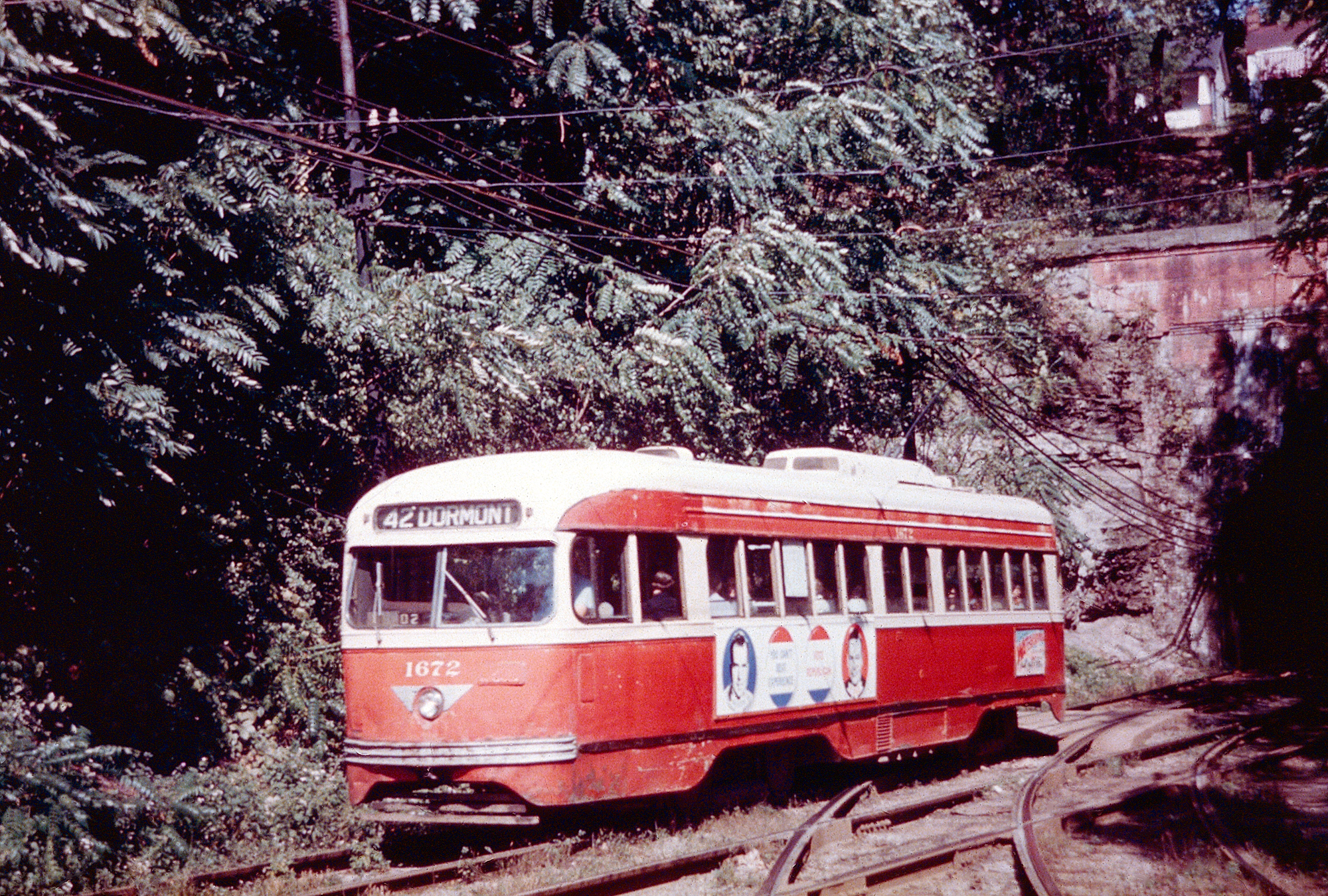 Pittsburgh Railways PCC #1672 (manufactured by the St. Louis Car Company in 1944) exits south from the Mt. Washington Tunnel during the early 1960s. American-Rails.com collection.
History
The origins of Pittsburgh Railways can be traced back to the 1850s and 1860s, a period in which horse-drawn streetcars began modestly revolutionizing urban transport across the U.S.
In Pittsburgh, these systems laid the groundwork for the electrified streetcar networks that later became emblematic of the Industrial Era. The move towards electrification marked a significant transition, with Pittsburgh following the national trend by adopting electric streetcars in the late 1880s and early 1890s, making it an early adopter of electric traction technology.
By the early 20th century, the landscape of street railways in Pittsburgh was highly fragmented, with numerous small companies competing for space and riders.
Between 1895 and 1905, these systems saw a period of consolidation. It was on July 24, 1895, that the Consolidated Traction Company (CTC) was established, and by the following year, it expanded its network by purchasing the Central Traction Company, Citizens Traction Company, Duquesne Traction Company, and Pittsburgh Traction Company, all transitioning to electric operation.
Just days later, on July 27, 1896, the United Traction Company (UTC) was founded and promptly absorbed the Second Avenue Traction Company, known for its electric cars since 1890.
Another key player, the Southern Traction Company (STC), secured control of the West End Traction Company on October 1, 1900. By January 1, 1902, Pittsburgh Railway Company (PRC) emerged, with STC managing operations for both CTC and UTC.
This new entity operated a large fleet of 1,100 trolleys over a sprawling 400 miles of track. In a year, it served 178.7 million passengers, earning $6.7 million. Back then, PRC had over 20 car barns alongside power stations in Pittsburgh. The company's operations peaked in 1918, with 99 routes covering 606 miles.
During its peak era in the 1920s, PRC operated one of the largest streetcar networks in the nation. The extensive network linked the city's residential areas to business districts, thereby facilitating the city's economic growth. Known for its distinctive yellow and red streetcars, PRC became a staple of daily commuting for thousands of residents.
The early 1900s brought rising costs, exacerbated by persistent demands from the city to upgrade services and equipment. Labor unrest also became an issue when wage increases were denied.
A notable development happened on July 26, 1936, when PRC welcomed PCC streetcar No. 100, crafted by the St. Louis Car Company. By August that year, it was operational, marking the world's first revenue-generating PCC.
As with many streetcar systems across North America, PRC faced numerous challenges as the 20th century progressed. The growing popularity of personal automobiles, combined with the expansion of bus services, began to erode the streetcar’s dominance as the primary mode of urban transportation.
Despite these challenges, PRC continued to be a major player, attempting to modernize its fleet and services to compete with the changing transit landscape.
However, the leasing and operating model struggled financially and led to two bankruptcies: once in 1918 with a six-year recovery period and again in 1938, lingering until January 1, 1951. The late 1950s ushered in widespread abandonment of lines, largely tied to construction related to highways or bridges.
Interurban Lines
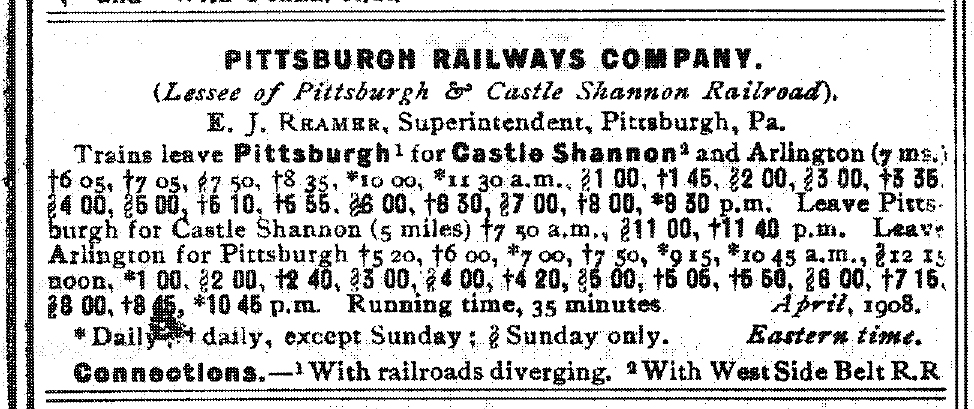
In addition to its streetcar operations, PRC operated two notable interurban routes: one stretching 29 miles to Washington and another extending 35 miles to Roscoe, just beyond Charleroi.
A shorter branch, measuring 3.5 miles, diverged from Black Diamond on the Charleroi line to reach Donora. Construction of the Washington line started in 1903 and concluded in 1909, mostly built on its own right-of-way with substantial grading for a street railway.
South of Pittsburgh, its track followed the route of the former narrow-gauge Pittsburgh & Castle Shannon Railroad. The Charleroi line, branching off 7.8 miles south of Pittsburgh from the Washington line, was completed in 1910, although parts of it had operated since 1895. The Donora addition came in 1911.
These lines were distinguished by the diverse equipment used throughout their operation, ranging from heavy wooden interurban cars to standard streetcars with multiple unit control, single-ended center-door interurban cars, and eventually PCC cars.
The company modified some standard PCCs for interurban travel in 1946 and acquired 25 specifically for these routes in 1949.
Despite enjoying significant patronage and offering frequent half-hourly services, the lines ultimately couldn't sustain themselves and were reduced to city car lines by 1952. The freight services had already ceased in 1941 when Pittsburgh city authorities condemned the company's LCL house.
Final Years
Post-war optimism saw a brief resurgence in patronage, but by the 1950s, the system faced mounting financial difficulties. In 1964, Pittsburgh Railways was formally absorbed into the Port Authority of Allegheny County (PAT), which had been established to oversee public transportation in the Pittsburgh metropolitan area.
Under PAT management, many of the former streetcar lines were either abandoned or converted to bus routes to better align with contemporary commuting patterns. Yet, some sections of the streetcar network were preserved, leading to the development of what is now known as the Pittsburgh Light Rail, or "The T," which continues to serve the area today.
The evolution of Pittsburgh Railways from horse-drawn carriages to modern light rail reflects the broader historical shifts in urban transportation.
Its legacy endures in Pittsburgh’s commitment to maintaining an efficient and adaptable public transit system, demonstrating the crucial role of transit networks in shaping metropolitan growth and development. This history highlights the dynamic between past innovations and current needs in fostering sustainable urban environments.
Recent Articles


-
Canadian National Steam Locomotives: History, Roster & Photos
Sep 16, 26 10:07 AM
 Canadian National steam—CGR, Canadian Northern, Grand Trunk, GTP. 4-8-4 Confederations, U-1 Mountains, J and K Pacifics. Post-1900 class roster. Last scheduled steam April 25, 1960.
 -
Canadian National Railway: Map, Logo, History, Photos
Sep 16, 26 08:55 AM
 Canadian National—name Dec 20 1918, incorporated June 6 1919, Grand Trunk Jan 20 1923. Crown corporation, IPO Nov 17 1995. IC, Wisconsin Central, BC Rail, EJ&E. Class I, mark CN.
 -
Buffalo, Rochester and Pittsburgh Railway: "Safety and Service"
Sep 16, 26 12:12 AM
 Buffalo, Rochester & Pittsburgh—Rochester & State Line 1869, BR&P March 12 1887. Pennsylvania coal to Buffalo and Rochester. B&O January 1 1932. All-time steam roster, LL 2-6-6-2s, XX…
 -
Buffalo Creek & Gauley Railroad: Map, Roster, Logo, Photos
Sep 15, 26 11:55 PM
 Buffalo Creek & Gauley—Elk River Coal & Lumber, April 1 1904, Dundon–Widen. Last all-steam WV coal road, February 27 1965. All-time steam roster, #4 Baldwin 59472, Majestic and Elk River diesels…
 -
Buffalo and Susquehanna Railroad: Map & History
Sep 15, 26 11:42 PM
 Buffalo & Susquehanna—Goodyear hemlock railroad, Sinnemahoning Valley December 14 1885, 1893 merger, coal to Sagamore, Buffalo extension, bankruptcy May 6 1910, B&O 1932, WAG 1956.
 -
WMSR Allegheny Mountain Dinner Train (2026): Dates & Tickets
Sep 15, 26 11:36 PM
 2026 Western Maryland Scenic Allegheny Mountain Dinner Train—Cumberland, 3 hours, 21+, Saturday 7 p.m. Confirm on wmsr.com.
 -
Boston and Albany Railroad: Map & History
Sep 15, 26 11:28 PM
 Boston & Albany Railroad—Boston & Worcester June 23 1831, Western Railroad across the Berkshires, merger 1867–70. NYC 99-year lease July 1 1900. Berkshires, New England States, CSX and MBTA today.
 -
Grand Bellevue Dinner Train (2026): Portsmouth, Rhode Island
Sep 15, 26 11:14 PM
 2026 Grand Bellevue Rail Dining in Portsmouth, RI—2.5-hour seated dinner on Narragansett Bay. Fall/winter TBA after Aug. 29. Confirm on thegrandbell.com.
 -
The "John Bull": The C&A's First Locomotive (1831)
Sep 15, 26 11:01 PM
 John Bull locomotive—Stephenson Planet-type 0-4-0, 1831. Dripps assembly, 4-2-0 rebuild, cowcatcher. Specs, Camden & Amboy career, Smithsonian 1884, 1981 steam-up, 1939 replica.
 -
Napa Valley Wine Train Dining (2026): Lunch, Dinner & Vista Dome
Sep 15, 26 10:56 PM
 2026 Napa Valley Wine Train dining—downtown Napa, 36-mile round trip, gourmet lunch and dinner, Vista Dome. Confirm packages on winetrain.com.
 -
My Old Kentucky Dinner Train (2026): Dates, Tickets & What to Expect
Sep 15, 26 10:50 PM
 2026 My Old Kentucky Dinner Train in Bardstown—2.5 hours, 35-mile round trip, four-course dinner from $116. Confirm on kydinnertrain.com.
 -
LaSalle Street Station: One Of Chicago's Great Terminals
Sep 15, 26 10:42 PM
 LaSalle Street Station—Rock Island October 10, 1852. Frost & Granger July 1, 1903. 20th Century Limited, Rockets, Golden State. Headhouse razed 1981. Metra Rock Island District today.
 -
Charlie Russell Chew Choo (2026): Montana Dinner Train from Lewistown
Sep 15, 26 10:39 PM
 2026 Charlie Russell Chew Choo dinner train—Hanover/Lewistown, 4.5 hours, 56-mile round trip, prime rib. Adult $151. Remaining listed dates sold out. Confirm on montanadinnertrain.com.
 -
Central Pacific Railroad: Map, History, Facts, Logo
Sep 15, 26 10:30 PM
 Central Pacific—Judah, Big Four, June 28 1861. Sierra, Chinese labor, Donner Summit Tunnel. Ten-mile day April 28 1869. Promontory May 10. Southern Pacific lease April 1 1885. Dissolved June 30 1959…
 -
Bessemer & Lake Erie Railroad: "The Bessemer Road"
Sep 15, 26 05:20 PM
 Bessemer & Lake Erie—Bear Creek 1865, Carnegie 1897, U.S. Steel 1901. Ore south from Conneaut, coal north. 2-10-4s, Missabe sister road. CN May 10, 2004. Complete corporate history.
 -
Bangor and Aroostook Railroad: "Serving Northern Maine"
Sep 15, 26 05:05 PM
 Bangor & Aroostook—chartered February 13, 1891, first trains January 1, 1894. Potatoes, paper, Searsport, State of Maine reefers. MM&A 2003, Lac-Mégantic 2013, CP 2020, CPKC today. Complete co…
 -
Baltimore & Ohio Chicago Terminal Railroad: Map and History
Sep 15, 26 03:11 PM
 B&OCT—formed January 6, 1910 to buy Chicago Terminal Transfer. Grand Central, Barr Yard, 78 route-miles. Assigned B&O steam. Complete diesel roster. CSX paper subsidiary, mark BOCT.
 -
The "Alphabet Route" (Railroad): Photos and History
Sep 15, 26 02:53 PM
 Alphabet Route—eight railroads, not one company. P&WV to Connellsville February 11, 1931. Alpha Jets Chicago/St. Louis–New York/Boston. NKP, W&LE, P&WV, WM, Reading, CNJ, L&HR, New Hav…
 -
Milwaukee Road Livestock Operations: Cattle, Dakotas & Montana
Sep 15, 26 02:36 PM
 Milwaukee Road livestock traffic—Dakota and Montana cattle, Iowa hogs, Chicago markets, 28-hour law, head-end stock cars. By 1974 mostly Montana. Rick Burn’s Helena speech. Operations history, not the…
 -
Spirit of Jasper Ride & Dine (2026): Season Pause
Sep 15, 26 02:29 PM
 Spirit of Jasper Ride & Dine in Jasper, Indiana—seated meal on board. Operator: not running public trains for 2026. Depot remains open as a rental. Confirm on spiritofjaspertrain.com.
 -
South Carolina Canal & Rail Road Company: Map and History
Sep 15, 26 01:59 PM
 South Carolina Canal & Rail Road—chartered December 19, 1827. Best Friend of Charleston, 136 miles Charleston–Hamburg October 1833, Aiken inclined plane. South Carolina Railroad 1844, Southern 189…
 -
The Practice of Double-Heading: The Steam Era
Sep 15, 26 01:43 PM
 Doubleheading—two locomotives on the point, each with its own steam crew. Not a rear helper, not diesel MU. How it worked, PRR 1877, mountain grades, and what MU ended.
 -
Mohawk and Hudson Railroad: Map, Pictures, Locomotives
Sep 15, 26 01:20 PM
 Mohawk & Hudson Railroad—New York’s first railroad, chartered April 17, 1826. DeWitt Clinton, inclined planes, Albany & Schenectady 1847, first New York Central May 17, 1853. Complete corporat…
 -
Essex Clipper Dinner Train (2026): Dates, Tickets & What to Expect
Sep 15, 26 01:09 PM
 2026 Essex Clipper Dinner Train in Essex, CT—2.5 hours, four-course meal $129.99, 18+. Fall dates through Oct. 25. Confirm on essexsteamtrain.com.
 -
Camden & Amboy Railroad: Map, History, Photos
Sep 15, 26 12:53 PM
 Camden & Amboy Railroad—chartered February 4, 1830. Joint Companies monopoly with the Delaware & Raritan Canal, John Bull, T-rail. United New Jersey 1872, PRR 999-year lease 1871. Complete corpora…
 -
Cafe Lafayette Dinner Train (2026): Dates, Tickets & What to Expect
Sep 15, 26 12:47 PM
2026 Cafe Lafayette Dinner Train in North Woodstock, NH—2 hours, 20 miles, five-course meal from $125. May–October. Confirm on nhdinnertrain.com. -
Christmas Train Ride Locations (2026): A Complete Guide
Sep 15, 26 10:47 AM
 2026 Christmas train rides by state—Santa, North Pole Express, and holiday trains. Not Polar Express. State guides and product pages. Confirm dates on each railroad.
 -
Baltimore & Ohio Railroad: Linking 13 Great States With The Nation
Sep 15, 26 10:22 AM
 Baltimore & Ohio Railroad—first U.S. common carrier, chartered February 28, 1827. Wheeling 1853, Chicago 1874, C&O control 1963, Chessie 1973, into CSX April 30, 1987. Complete corporate history.
 -
Delaware & Hudson Railway: The Bridge Line
Sep 15, 26 09:59 AM
 Delaware & Hudson Railway—Wurts brothers canal 1823, gravity railroad 1829, Stourbridge Lion, Bridge Line to Montreal. Guilford 1984, CP 1991, NS south line 2015, CPKC north.
 -
Delaware & Hudson Diesel Roster (All-Time)
Sep 15, 26 12:17 AM
 All-time Delaware & Hudson diesel roster—Alco S-2s through C-628s and PA-4s, GE U-boats, Baldwin RF-16s, EMD SD45s and GP38-2/GP39-2s. Serials, dates, dispositions.
 -
Granite Railway, Our Country's First Railroad
Sep 14, 26 11:28 PM
 Granite Railway of Quincy, Massachusetts—chartered March 4, 1826, opened October 7, 1826. Gridley Bryant, 5-foot gauge, horses, Bunker Hill Monument stone. First commercial U.S. railroad.
 -
Milwaukee Road Skytop Lounges: History, Specs & Floor Plans
Sep 14, 26 11:09 PM
 Milwaukee Road Skytop observation cars—Brooks Stevens, 1948. Four Rapids parlor-lounges from Milwaukee Shops, six Creek sleeper-lounges from Pullman-Standard. Floor plans, roster, preservation.
 -
West Virginia Christmas Train Rides (2026): A Complete Guide
Sep 14, 26 11:02 PM
2026 West Virginia Christmas trains—Potomac Eagle North Pole Express in Romney and Christmas at Cass. Not Polar Express. Elkins Polar is not listed for 2026. -
Railroads Of Today: Class I Map, PSR & the 2026 Industry
Sep 14, 26 10:30 PM
 U.S. freight rail in 2026—six Class I railroads on a nearly 140,000-mile network. PSR as everyday practice, how the STB works, traffic mix, short lines and regionals.
 -
Railroad History (USA): Timeline, Facts & How the Network Was Built
Sep 14, 26 10:03 PM
 Full U.S. railroad history hub—origins and inventors, Golden Age peak mileage, Civil War and transcontinental, streamliners, ICC regulation, Penn Central and Conrail, Staggers Act, PSR, and today’s Cl…
 -
Railroads In The 2020s: CPKC, East Palestine & the UP–NS Case
Sep 14, 26 09:51 PM
 U.S. railroads 2020–2026—Class I mileage 91,773 in 2020. COVID traffic drop, CPKC April 14 2023, East Palestine Feb. 3 2023, UP–NS $85 billion case still before the STB.
 -
Railroads In The 2010s: PSR, Coal’s Decline & Positive Train Control
Sep 14, 26 03:51 PM
 U.S. railroads 2010–2020—Class I mileage 95,573 to 91,773. Buffett closed BNSF Feb. 12 2010, Harrison at CP June 29 2012 and CSX 2017, PTC deadline Dec. 31 2018.
 -
Virginia Christmas Train Rides (2026): A Complete Guide
Sep 14, 26 03:46 PM
 2026 Virginia Christmas trains—Virginia Scenic Railway Santa Express from Staunton, about 60 minutes. Confirm dates. Not Polar Express.
 -
MARC Train: Maryland Commuter Rail History, Lines & Roster
Sep 14, 26 01:16 PM
 MARC Train history—Maryland Rail Commuter 1984, B&O and PRR corridors, Penn/Camden/Brunswick lines, Silver Spring 1996, all-time locomotive roster.
 -
Railroads In The 2000s: Merger Freeze, Wisconsin Central & Buffett
Sep 13, 26 07:57 AM
 U.S. railroads 2000–2010—Class I mileage 99,250 to 95,573. STB merger freeze March 17 2000, CN–WC Oct. 9 2001, BNSF Railway Jan. 24 2005, Buffett Nov. 3 2009.
 -
Railroads In The 1990s: Mega-Mergers, Conrail’s Split & the STB
Sep 13, 26 12:13 AM
 U.S. railroads 1990–2000—Class I mileage 119,758 to 99,250. BNSF Sept. 22 1995, UP–SP Sept. 11 1996, Conrail split June 1 1999, ICC Termination Dec. 29 1995.
 -
Railroads In The 1980s: Staggers, Mega-Mergers & Conrail’s IPO
Sep 12, 26 11:12 PM
 U.S. railroads 1980–1990—Class I mileage 164,822 to 119,758. Staggers Oct. 14 1980, CSX and Norfolk Southern, UP–Missouri Pacific–Western Pacific, Conrail IPO March 26 1987.
 -
Wabash Class O-1 4-8-4s: History, Roster & Specifications
Sep 12, 26 11:01 PM
 Wabash Class O-1 4-8-4s—Baldwin 1930–31, twenty-five engines 2900–2924. Fast freight, complete roster, specifications. None preserved.
 -
Staggers Rail Act of 1980: Statute, Contract Rates & the ICC
Sep 10, 26 11:23 PM
 Staggers Rail Act, Pub. L. 96-448, signed October 14, 1980. Harley Staggers, S.1946, contract rates, 180% variable-cost test, abandonments, short lines.
 -
Rock Island E8A 652: Bicentennial Independence Paint & History
Sep 10, 26 10:42 PM
 Rock Island E8A 652—EMD March 1952, serial 15199. 20th Century Railroad Club Independence bicentennial scheme, Peoria and Quad Cities Rockets, Midland Railway, Manly Junction Museum.
 -
Vermont Christmas Train Rides (2026): A Complete Guide
Sep 10, 26 10:37 PM
2026 Vermont Christmas trains—Okemo Valley Holiday Express from Chester Depot Dec. 19–20. Polar is Burlington Dec. 5–6 only. -
Railroads In The 1970s: Penn Central, Amtrak & Conrail
Sep 10, 26 10:18 AM
 U.S. railroads 1970–1980—196,479 miles at the decade’s start. Penn Central bankruptcy June 21 1970, Amtrak May 1 1971, 3R/4R Acts, Conrail April 1 1976, Rock Island 1975, Milwaukee 1977.
 -
Railroads In The 1960s: Mergers, Passenger Collapse & Penn Central
Sep 10, 26 10:03 AM
U.S. railroads 1960–1970—207,334 to 196,479 miles. Erie Lackawanna 1960, C&O–B&O 1963, N&W–Nickel Plate 1964, SCL 1967, Penn Central Feb. 1 1968. -
South Carolina Christmas Train Rides (2026): A Complete Guide
Sep 10, 26 08:36 AM
 2026 South Carolina Christmas trains—South Carolina Railroad Museum Santa Train in Winnsboro. Confirm December dates. Not Polar Express. Drop light-festival padding.
 -
Steam Locomotive Feedwater Heaters: Elesco, Coffin & Worthington
Sep 10, 26 08:29 AM
 Steam locomotive feedwater heaters—open Worthington vs closed Elesco and Coffin. How they work, how to identify them on a smokebox, and why not every engine had one.



%20exits%20south%20from%20the%20Mt.%20Washington%20Tunnel%20during%20the%20early%201960s.%20American-Rails.com%20collection.)
