The Semaphore: Railroading’s Classic Signal
Last revised: September 26, 2026
By: Adam Burns
A semaphore is a blade on a mast. In daylight the engineman reads the angle of the blade. At night he reads the color in the spectacle, the frame of glass roundels that swings with the blade across a lamp fixed to the mast. The blade pivots there, beside the mast. The long arm, about four to four and a half feet of it, is the part he is meant to see.
American roads settled on two families. A lower-quadrant blade drops to give the clearer aspect, and one arm has two positions, so a third aspect takes a second arm. An upper-quadrant blade rises: horizontal for stop, forty-five degrees for approach, straight up for proceed, three aspects on one arm. Ice is why the rising blade became the recommended one. Sleet on the arm pulls an upper-quadrant signal toward stop. The same ice can hold a lower-quadrant arm down in the proceed position, which is the failure nobody wanted. The Southern Pacific kept the dropping blade anyway. Union Switch & Signal Style B signals of that pattern were still working on the old Siskiyou Line in 2007, and Santa Fe upper-quadrant blades were still governing the Raton Subdivision in 2024.
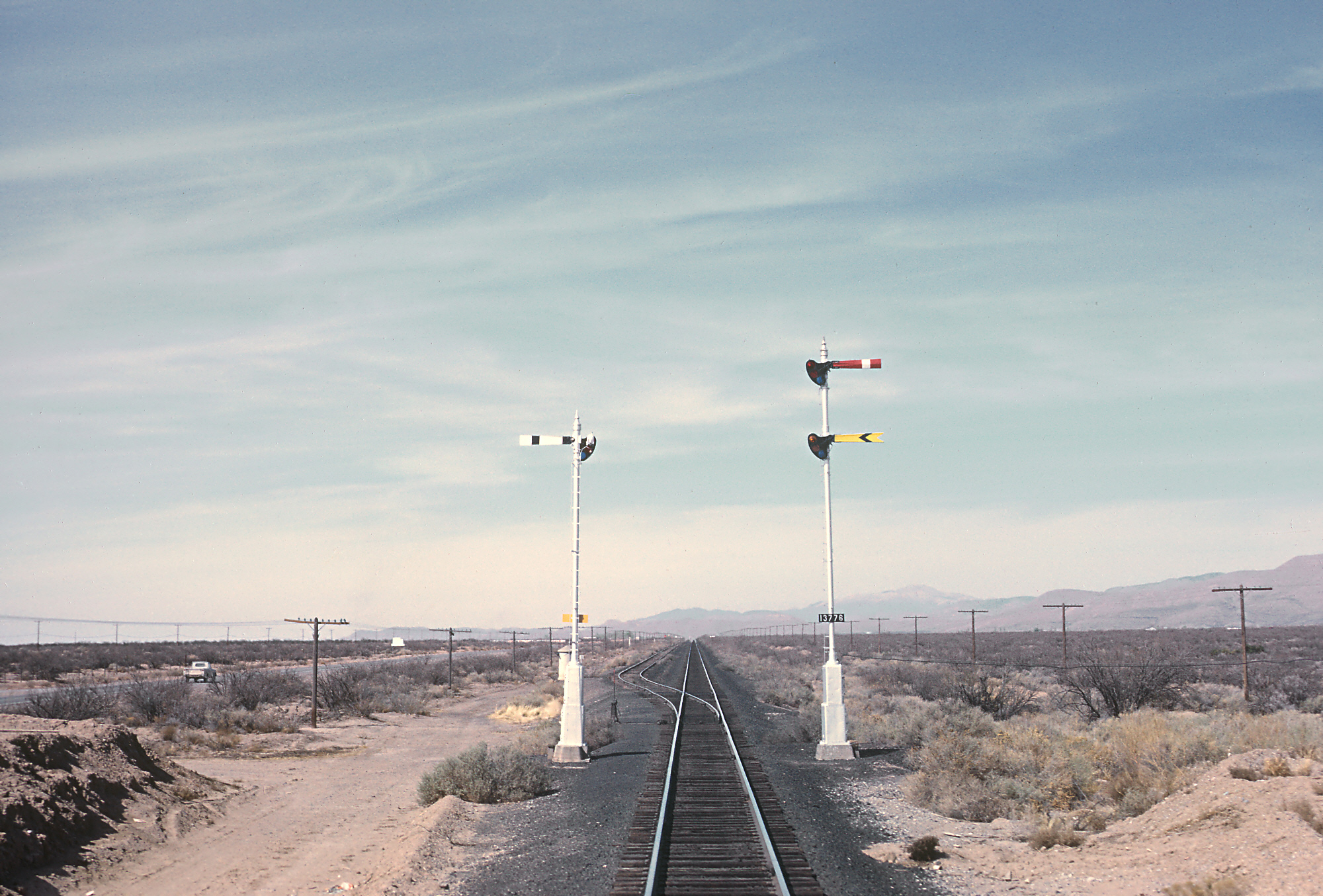
Southern Pacific lower-quadrant semaphores near Orogrande, New Mexico, on March 20, 1967, from the rear of Train 3, the Golden State. The nearer mast carries a red blade and a yellow blade. The mechanism is a Union Switch & Signal Style B, in the case at the foot of the mast. The farther mast shows the back of its blade, black with a white stripe, the signal that governs the other direction. Roger Puta photo.
On this page: At a glance · Blade and lamp · New Cross, 1841 · Lower quadrant · Upper quadrant · Pipe, air, and the track circuit · Home, distant, and the order board · The last blades
At a glance
| Item | Detail |
|---|---|
| What he reads | By day, the angle of the blade. By night, the roundel the spectacle has set in front of the lamp. The two are on one casting, so they are supposed to agree |
| Where it pivots | At the spectacle, beside the mast. The arm extends to the right of the mast as the engineman approaches. American Railway Association, Signal Section, 1903 |
| Lower quadrant | Two positions on one arm. Horizontal is stop (red). The blade drops, commonly on the order of 60 degrees, for proceed (green). A third aspect needs a second arm |
| Upper quadrant | Three positions on one arm. Horizontal stop (red). 45° up, approach (yellow). Vertical, proceed (green). Signal Section recommended principles, 1907 |
| Why the rising blade won | The arm’s own weight returns it to stop. Ice on the blade adds to that weight. Ice on a lower-quadrant blade can hold it in the proceed position |
| First railway semaphore | Charles Hutton Gregory, New Cross, London & Croydon Railway, 1841. Three-position lower quadrant. “Line clear” hid the arm inside the post |
| Spectacle patent | Leonor F. Loree and Frank P. J. Patenall, U.S. patent 733,981, July 21, 1903 |
| Mechanisms | Pipe from an interlocking lever. Electro-pneumatic, air under an electric valve. Electric motor: Union Switch & Signal Style B (base of the mast; more than 26,500 sold before April 1908) and General Railway Signal Model 2A (upper quadrant, 1908). Santa Fe’s late blades are US&S T-2 |
| What makes it automatic | William Robinson’s closed track circuit, U.S. patent 130,661, August 20, 1872. A train, a broken rail, or a broken wire drops the relay. The blade is allowed to fall to stop |
| First U.S. motor automatic | Central Railroad of New Jersey, Black Dan’s Cut, east of Phillipsburg, 1893. High-voltage. The Style B is the later low-voltage machine |
| Where they lasted | SP Style B lower quadrant on the Siskiyou Line until March 24, 2007. Ex-Monon GRS blades at Crawfordsville, Indiana, until December 2010. Santa Fe T-2s between Lamy and Cerrillos until August 17, 2024. Eleven then remained between Colmor and Wagon Mound |
Blade, spectacle, and lamp
The parts have plain names. The mast is the post, wood in the early plants, iron pipe or a lattice later, tall enough to put the arm against the sky. The blade is the arm. The spectacle is the casting at the pivot, drilled for two or three colored glasses, the roundels. The lamp sits fixed on the mast, and the spectacle swings the proper roundel in front of it. A two-position home signal carries red and green. A three-position signal carries red, yellow, and green, set on an arc so that each angle of the blade parks a different color on the lamp.
The stripe is there so the angle reads against a cluttered background. Everett Edgar King, whose Railway Signaling of 1921 was written for students from the Signal Section’s own practice, gives the paint that had settled by then. The front of a three-position blade is red with a white stripe, or yellow with a black stripe, the stripe parallel to the end of the arm. The back is white with a black stripe, or black with or without a white one. The back matters. A blade facing the other way is the signal for the opposite movement, and the engineman is not supposed to take his indication from it.
A home blade is the red arm. It can display stop. A distant blade is the yellow arm, and the end is notched, a fishtail, so it cannot be mistaken for a home blade. A distant cannot tell a train to stop. Its restrictive aspect means the next home signal is at stop. On a mechanical plant the distant often stood far enough out that the engineman met it before he met the home signal. On an automatic mast the two arms were stacked, home above distant.
The lamp behind the roundels was a kerosene long-time burner for years, a font that a lampman filled on his rounds, and an electric lamp after the power was there to feed it. A small opening, the back light, let a man behind the signal see that the lamp was burning. Early night practice used a white light for clear. A broken red roundel then showed white, which is a false clear. The Signal Section’s 1907 principles put red on stop, yellow on caution, and green on clear, and white-as-clear went out of the recommendation.
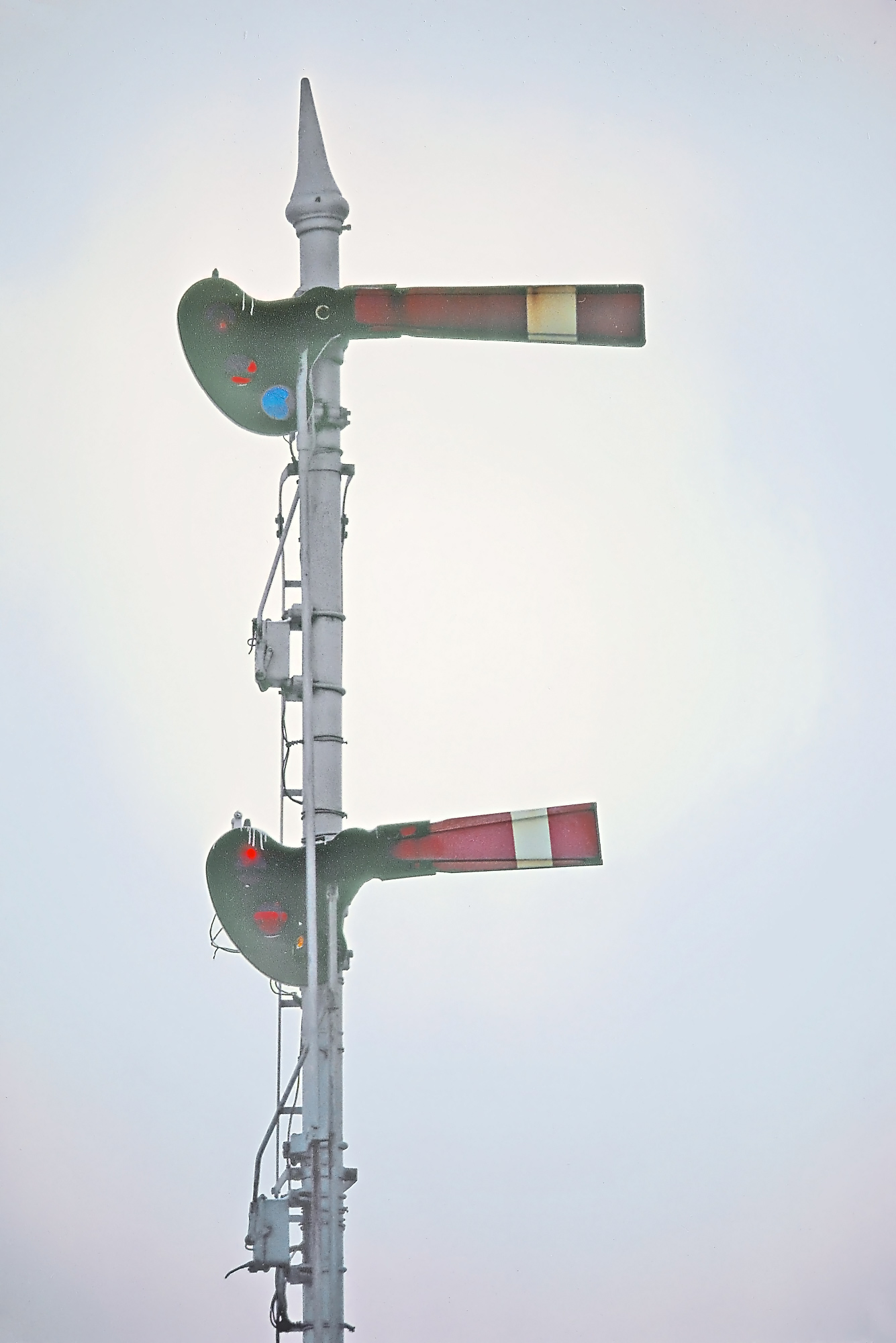
Upper-quadrant semaphores at Mendota, Illinois, in January 1979, on the former Illinois Central, by then Illinois Central Gulf. Two blades on one mast, each with a three-roundel spectacle. The upper arm is horizontal. The lower arm is raised about forty-five degrees. The blades stand to the right of the mast. Roger Puta photo.
New Cross, 1841
The first semaphore on a railway went up at New Cross, on the London & Croydon Railway, in 1841. Charles Hutton Gregory erected it. The spot was the enlarged junction the South Eastern Railway also used, which is why later accounts sometimes give the signal to the South Eastern and to “the 1840s” without a place. Major-General Charles Pasley, the Board of Trade’s inspecting officer, is the man usually credited with pressing a semaphore on Gregory in place of flags and discs. He had designed an optical telegraph for the Army, and a railway post was that telegraph cut down to a few positions a driver could read at speed. John Urpeth Rastrick also claimed the suggestion. Gregory is the man who put the post in the ground.
It was a three-position lower-quadrant signal. Horizontal meant danger. Forty-five degrees down meant caution. For line clear the arm dropped into a slot in the post, out of sight. At first the lamp, with red, green, and white lenses, had its own handle. Bevel gears were added so one lever worked blade and lamp together, and a counterweight was added so a released signal returned to danger. Joseph James Stevens patented a semaphore signal in the same decade. Stevens & Sons later built the lattice iron posts. The idea spread through Britain because a blade against the sky can be read farther than a disc turned edge-on.
The slotted “clear” did not last. On January 21, 1876, at Abbots Ripton on the Great Northern Railway in England, snow left slotted-post signals showing clear when the men who worked them could not get the arms back out to danger. A positive aspect for clear replaced the invisible one. In Britain the old caution angle, the arm lowered about forty-five degrees, became clear, and a separate distant signal carried the warning. Two-position lower quadrant, arm to the left of the post, became the British standard. American roads bought the blade and then built a different quadrant.
The blade that drops
A lower-quadrant home signal stands horizontal for stop and drops for proceed. The night colors, once green had replaced white, are red and green. One arm tells two stories. King’s textbook puts the three-position angles at forty-five and ninety degrees in either quadrant. On the ordinary American two-position lower-quadrant signal the clear position sits up from the vertical, often around sixty degrees down, so the blade remains a blade and does not hang straight down against the mast.
The weight of that blade wants to fall. Stop, the horizontal, is uphill from where the iron wants to go. The spectacle on the other side of the pivot has to be heavy enough to hold the arm up. The wire, the pipe, or the motor pulls the arm down to clear against that weight. If the wire breaks, the spectacle should lift the arm back to stop. That is a safe failure until the weather changes. Ice on the blade adds weight on the wrong side of the pivot. Enough of it and the arm stays down, displaying proceed, while the mechanism that was supposed to restore it has lost the argument. King states it directly: sleet tends to pull an upper-quadrant signal to stop, and to hold a lower-quadrant signal in the proceed position.
Three aspects on a lower-quadrant railroad took two arms. The upper arm is the home signal for this block. The lower arm, yellow and fishtailed, is the distant for the next signal. Read as a pair, the usual indications are:
| Upper arm (home) | Lower arm (distant) | Indication |
|---|---|---|
| Horizontal | Horizontal | Stop. On a permissive automatic, stop and proceed at restricted speed |
| Dropped | Horizontal | Approach. This block is clear. The next signal is at stop |
| Dropped | Dropped | Clear. This block is clear, and so is the next signal |
A single-arm lower-quadrant automatic could show only stop and proceed. That is why so many Southern Pacific intermediate signals carry one blade, and why the masts that had to display approach carry two. The Orogrande photograph is that hardware in the desert: Style B cases at the foot of the masts, a two-arm signal on the near post, and the back of the opposing blade on the far one. The pole line beside the track carried the line circuits between the signals. Occupancy itself was read through the rails.
Union Switch & Signal’s Style B is the mechanism in those base cases. A direct-current motor drives an endless chain and moves one arm or two. The company’s advertisement in the 1908 Railroad Signal Dictionary said the design had eleven years of service behind it and that more than 26,500 had been sold before April 1908. It was the enclosed low-voltage machine, the one that could sit at the foot of a mast in automatic-block territory and run off a battery. Southern Pacific and the Harriman lines bought it by the district and left it in the lower quadrant. So did the Lackawanna and the Boston & Maine, among others. The Style B is a mechanism. The quadrant was the railroad’s choice. On the Southern Pacific the choice stayed down.
It stayed down for a long time. In 1994 the Southern Pacific was the last Class I still operating Style B lower-quadrant signals, on the order of two hundred of them: the Siskiyou Line between Eugene and Ashland, the Carrizozo District between Tucumcari and El Paso, the Lordsburg District between Tucson and Mescal, and the Phoenix Line between Wellton and Picacho. The Carrizozo blades, the family in the Orogrande photograph, came down mostly in 1988, when that line was reworked and welded for heavier traffic. A few between Carrizozo and Three Rivers were still standing in 1995. The Siskiyou Line passed to the Central Oregon & Pacific on January 1, 1995, and the new operator began replacing the semaphores in 1998. The last working set came out on March 24, 2007, between Safley and Drain, Oregon, at milepost 610.3.
The blade that rises
An upper-quadrant blade uses the weight of the arm the other way. Horizontal is still stop. The motor lifts the arm, to forty-five degrees and then to the vertical, and it has to hold the arm there. Anything that takes the power away — a dead motor, an open control, a broken rod — lets the blade fall back to the stop. King notes that this blade does not need a counterweight to reach stop. Its own iron does the work. Sleet on the arm helps it. A vertical “proceed” also reads farther against the sky than an arm dropped toward the ballast.
The spectacle that made three positions practical on that rising arm is a Baltimore & Ohio patent. Leonor F. Loree and Frank P. J. Patenall, both of Baltimore, filed on March 11, 1903, and received U.S. patent 733,981 on July 21, 1903. The claim is a semaphore that can show more than two conditions and that snow, sleet, and a broken part will not leave in the wrong one. Patenall was the B&O’s signal engineer. Two decades later he drew the same three angles in colored lamps and the road had the Color Position Light.
The Signal Section wrote the arrangement into its recommended principles in the 1907 manual, building on actions recorded from 1903. The day indication belongs in the upper right-hand quadrant. Horizontal means stop, forty-five degrees up means caution, ninety degrees up means proceed. At night those are red, yellow, and green. The arm is displayed to the right of the mast, a rule the section had adopted in 1903. The manual was careful about what a recommendation is. It did not condemn the lower-quadrant plants already in the ground. Roads that wanted to keep them kept them. By 1921 a Signal Section paper could still say the upper quadrant was the preferred type and the one most commonly used, and in the same breath record that plenty of officers could give reasons for leaving the old quadrant alone.
| Blade | Night | Signal Section, 1907 | Later rulebook name |
|---|---|---|---|
| Horizontal | Red | Stop | Stop, or Stop and Proceed if the mast carries a number plate |
| 45° up | Yellow | Caution | Approach. Prepared to stop at the next signal |
| Vertical | Green | Proceed | Clear |
The mechanism that put this on masts by the thousand was General Railway Signal’s Model 2A, brought out in 1908 and built at Rochester. A sales figure kept in the trade is 24,500 mechanisms by November 1, 1918, and the list of buyers runs through the New York Central, the Baltimore & Ohio, the New Haven, the Southern, the Buffalo, Rochester & Pittsburgh, the Monon, and the Chicago & North Western. The 2A is an upper-quadrant machine, mechanism and motor arranged for a three-position arm, and the same family covered dwarf signals for the slow moves inside an interlocking. Union Switch & Signal’s answer for a top-of-mast upper-quadrant signal was the T-2. The Santa Fe’s late New Mexico blades are T-2s.
Two or three arms on one upper-quadrant mast did a different job than the Southern Pacific’s home-and-distant pair. At an interlocking, the top arm governed the principal route and a lower arm governed a diverging route. The Mendota mast, with the upper arm horizontal and the lower arm at about forty-five degrees, is that kind of two-arm upper-quadrant plant: each spectacle has three roundels, so each arm can show stop, approach, or proceed on its own. The indication is the combination, and the combination belongs to the railroad’s rulebook.
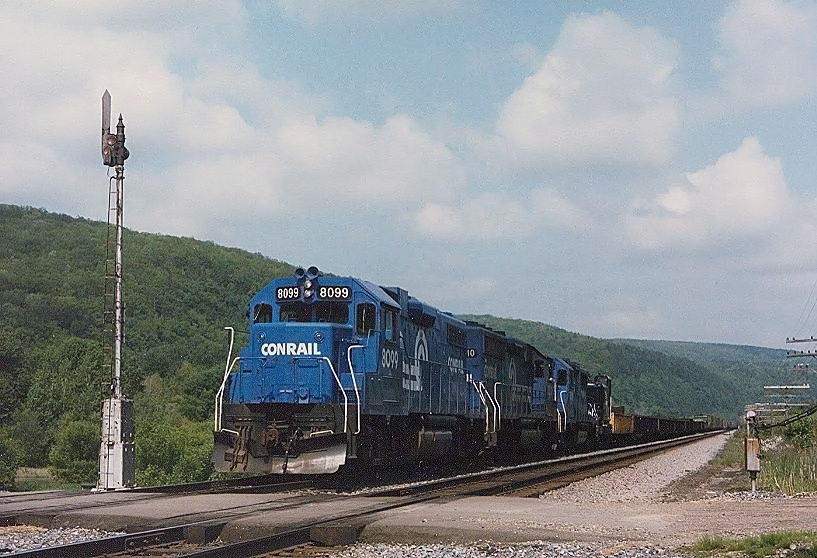
Conrail GP38-2 #8099 leads freight ELOI past an upper-quadrant semaphore on the former Erie Southern Tier near Addison, New York, on May 24, 1986. The blade is vertical, the clear position. The mast stands to the engineman’s right. Doug Kroll photo.
Pipe, air, and the track circuit
The earliest American blades that a tower worked were pipe-connected. A lever in the interlocking machine moved a run of one-inch pipe on carriers, through cranks where the line changed direction, and through compensators that took up the expansion of the pipe between a cold morning and a hot afternoon. The run was only as long as a leverman could pull. Beyond that distance the distant signal had to be worked another way, often with an electric slot so the tower still had to agree before the arm would clear. A dwarf semaphore is the same idea cut down and set near the ground, for a slow move over a crossover or out of a yard throat where a high mast does not belong.
Busy plants went to air. An electro-pneumatic semaphore uses a compressed-air cylinder to move the blade and an electric valve to tell the cylinder when. A 1921 Signal Section paper names the first track-circuit-controlled installation of that automatic block on the Fitchburg. The Pennsylvania used electro-pneumatic semaphores heavily at interlockings in the years before position lights. The air did the work. The electricity decided.
The motor came next, and it is the machine in the photographs on this page. In 1893 a high-voltage electric motor drove an automatic semaphore on the Central Railroad of New Jersey at Black Dan’s Cut, east of Phillipsburg. That is the first automatic motor-operated semaphore in the country. The Style B, a few years later, put a low-voltage enclosed mechanism at the base of the mast and made the motor signal something a railroad could install down a whole division. The 2A and the T-2 did the same job for the upper quadrant. A maintainer’s work, then as later, was to keep that machine trustworthy. The craft has its own page: the signal maintainer.
None of those mechanisms knows whether a train is in the block. The track circuit knows. William Robinson had an automatic block on the Philadelphia & Erie at Kinzua, Pennsylvania, in 1870, an open-circuit arrangement. The invention that matters is the one he patented on August 20, 1872, U.S. patent 130,661, and put in on that railroad at Kinzua and at Irvineton. A battery feeds a relay through the rails. The circuit is normally closed, and the relay is normally up. A train’s wheels short the rails and the relay drops. A broken rail, a broken bond wire, or a broken line wire does the same thing. Relay down means the signal has no permission to clear, and the blade goes to stop. The Signal Section, in a resolution at Chicago in June 1921, called Robinson the father of automatic block signaling for that patent. He also devised the bond wire that jumps the current across a rail joint. Every automatic semaphore after him, and every light signal after the semaphore, sits on that circuit.
The enclosed disc was the automatic signal the blade replaced. Thomas Hall patented a two-aspect electric signal in 1869, a cloth disc in a round wooden case, the banjo. With Robinson’s circuit behind it, the Hall disc became the common automatic signal. It could show two aspects. A second case hung under the first when a railroad wanted a third. The Railroad Signal Dictionary could already say that semaphores had superseded discs for yards and terminals, while a few roads still liked the disc for automatic block. A blade simply reads farther. By the 1910s the new work was semaphore.
A number plate on an automatic mast changed what red meant. The blade still went horizontal, and the roundel was still red, but the plate told the engineman this was a permissive signal: stop, then proceed at restricted speed, prepared to stop short of a train or an obstruction. An absolute signal, the home signal at an interlocking, carried no such permission. Red there meant stop and stay. The plate is a small thing in a photograph and a large thing in the rule.
Three different jobs, and the lights that took them
A blade did three jobs that later hardware split apart, and it helps to keep them split.
A block signal tells the engineman whether the section ahead is his. Automatic block does it with the track circuit and a motor. Manual block does it with an operator, who holds the arm until he has the block from the next office. On the Pennsylvania a manual-block semaphore was marked so a crew would not read it as an automatic: an upper-quadrant blade, a pair of red lights under it, and no number plate.
A distant tells him what the next home signal is doing, in time to act. Stacked under a home arm, or standing on its own mast a braking distance out, the fishtail is that warning. It has no stop aspect of its own.
A train-order signal is a message, not a block. It stands at a station or an office, and its position tells a crew whether the operator has orders for them: stop and sign, or catch them on the hoop, or nothing today. Early American train-order signals were two-position lower-quadrant blades. Some roads later worked them in three positions, and a few in four to six, one angle for each way of delivering the tissue. A train-order board in a photograph is not an automatic signal with its blade stuck. The rules for it lived in the timetable, the way a ball signal’s rules did.
Light signals took the work because a blade is a moving piece of iron in the weather, and because its day aspect and its night aspect can, if the spectacle slips, disagree. A searchlight puts three miniature roundels on a relay behind one lamp. Red, yellow, or green shows from the same housing at noon and at midnight, and there is no arm for ice to load. General Railway Signal and Union Switch & Signal both built them. Color-light heads did the same thing with a separate lamp for each color. Centralized traffic control, as it went in from the 1920s onward, was installed with those lights more often than with new semaphores.
Two eastern roads stopped waiting for that and redrew the semaphore in lamps. The Pennsylvania’s Position Light, A. H. Rudd’s system, experimental hardware in 1915, sets rows of amber lamps on the same angles as an upper-quadrant blade. Catenary had made an arm hard to pick out, and the Pennsy was writing speed signaling into the aspect. The Baltimore & Ohio’s Color Position Light, Patenall’s, keeps those angles and paints them green, yellow, and red, then adds marker lamps for speed. Both are semaphores with the iron arm left on the ground. The signals hub is the wider map of aspects, blocks, and what came after.
Where a blade outlasted the timetable
The replacement was a long one, which is why a 1967 photograph in the New Mexico desert, a 1979 close-up at Mendota, and a 1986 Conrail freight at Addison are all the same subject. Roads that had bought Style B and 2A hardware in the first decades of the century maintained it. A motor semaphore is heavy, simple, and visible at a mile. It loses, eventually, to parts, to pole-line wire, and to a signal system that has to speak to a computer.
The Southern Pacific’s lower quadrant went last among the big Style B plants, the final Siskiyou set on March 24, 2007. The Monon’s upper quadrant outlasted the Monon. Those were GRS blades, some of them in place since 1917, on what became CSX. The railroad took the signals out in stretches. The last working blades on the north end, at Crawfordsville, Indiana, came out of service in December 2010. A work notice that month set the deactivation for December 14, at nine in the morning. Blades left standing farther south, on the Hoosier Subdivision, were dark after CSX stopped regular moves there in 2009. A blade spiked at stop over an unused track is a relic. It is not a signal.
The last mainline semaphores in regular service were Santa Fe T-2s in New Mexico, upper quadrant, more than a century old, on a railroad that sees Amtrak’s Southwest Chief and very little else. Five of them stood on state-owned track between Lamy and Cerrillos, at mileposts 840, 846, 847, 849, and 850. The New Mexico Department of Transportation replaced them with color-light signals on August 17, 2024. The last train past the old blades was the day before. Trains counted what remained: eleven operating semaphores between Colmor and East Wagon Mound, on BNSF’s Raton Subdivision, about 105 miles northeast of Lamy. No date was set for those. Early in 2026 the same eleven were still the number being given. They are the last of the type on an American main line, and they come down when the mechanism fails or when that segment is rebuilt. Museums and a few tourist railroads still move a blade for the visitors. The Raton Subdivision is the place where a vertical arm still means the next block is the Chief’s.
Sources
- Science Museum Group. Model of Gregory’s semaphore, London & Croydon Railway, New Cross, 1841. Three-position lower quadrant: horizontal danger, 45° caution, arm slotted in the post for line clear. The 1876 Abbots Ripton collision as the end of that “clear.”
- Rapier, Richard Christopher. “On the Fixed Signals of Railways.” Minutes of the Proceedings of the Institution of Civil Engineers 38 (1874). Gregory at New Cross about 1841; one lever geared to blade and lamp; counterweight to danger.
- U.S. patent 733,981. Leonor F. Loree and Frank P. J. Patenall, Baltimore. Application March 11, 1903. Patented July 21, 1903.
- American Railway Association, Signal Section. Manual of Recommended Practice, 1907. Upper right-hand quadrant; horizontal, 45° up, 90° up; red, yellow, and green at night. Arm displayed to the right of the mast, adopted 1903.
- King, Everett Edgar. Railway Signaling. New York: McGraw-Hill, 1921. Blade paint; sleet; the upper-quadrant arm and the stop position; home and distant; pipe-connected interlocking signals.
- Railroad Signal Dictionary, 1908. Union Switch & Signal Style B advertisement: eleven years in service, more than 26,500 sold before April 1908. Semaphores superseding disc signals at yards and terminals.
- “Progress of Railroad Signaling in America.” Railway Signaling, 1921. Paper to the New York Signal Sectional Committee, October 20. Style B mechanism; first electro-pneumatic automatic block on the Fitchburg; train-order semaphores; upper quadrant as the preferred type.
- American Railway Association, Signal Section. Resolution, Chicago, June 1921, on the death of William Robinson. Open-circuit installation at Kinzua, Pa., 1870. Closed track circuit, U.S. patent 130,661, August 20, 1872.
- Hall, Thomas. Enclosed-disc electric signal, patented 1869. The banjo signal, the common automatic until motor semaphores.
- “Jersey Central: Coal, Commuters, and a Comet.” Classic Trains, Winter 2011. First automatic motor-operated semaphore, CNJ, Black Dan’s Cut, east of Phillipsburg, 1893.
- General Railway Signal history. Model 2A upper-quadrant semaphore, 1908. Eric Schmelz, Bull Sheet, August 1994: 24,500 Model 2A units sold by November 1, 1918, and the roads that bought them. August 1994 and August 1995: where Southern Pacific Style B lower-quadrant signals still stood, and what remained on the Carrizozo District after 1988.
- Sheets, Dan. Tribute to the Siskiyou semaphores, Railfan & Railroad. Central Oregon & Pacific operation from January 1, 1995. Replacement begun 1998. Last working US&S Style B set removed March 24, 2007, between Safley and Drain, milepost 610.3.
- Schneider, Dorothy. Journal & Courier (Lafayette, Ind.), March 25, 2009. CSX spokesman Gary Sease on ex-Monon semaphores in place since 1917. Contemporary notice of the Crawfordsville work window, December 11, 2010: deactivation December 14, 2010. Akron Railroad Club, October 3, 2020: last working north-end blades replaced in December 2010.
- Gunnoe, Chase. “More semaphores fall on Southwest Chief route.” Trains, August 19, 2024. Five Santa Fe T-2 semaphores, mileposts 840, 846, 847, 849, and 850, between Lamy and Cerrillos, replaced August 17, 2024. Eleven then remained between Colmor and East Wagon Mound on BNSF’s Raton Subdivision.
- Solomon, Brian. Classic Railroad Signals. Minneapolis: Voyageur Press, 2015. Pennsylvania manual-block semaphore: upper-quadrant blade, two red lights below, no number plate.
Related pages: Railroad signals · Highball · B&O color-position lights · PRR position lights · Interlocking · Signal maintainer · Pole lines · Jersey Central · Southern Pacific · Santa Fe · Monon · Illinois Central · Erie · Pennsylvania Railroad · Baltimore & Ohio
Recent Articles


-
Chicago & Illinois Midland Steam Roster (Post 1900)
Oct 20, 26 12:30 AM
 Chicago & Illinois Midland steam locomotives built since 1900. Drury's class grid, 57 engines. Twenty-six 2-10-2s, including nine from the Wabash and nine from the Atlantic Coast Line. Last road steam…
 -
Chicago & Illinois Midland Diesel Roster (All-Time)
Oct 20, 26 12:20 AM
 All-time diesel roster of the Chicago & Illinois Midland. 28 frames, each counted once. Six SW1200s, five SD9s, the only two RS1325s, two SD18s, six SD38-2s, and four SD20s. Serials included.
 -
Chicago and Illinois Midland Railroad: Map, Rosters, History
Oct 20, 26 12:17 AM
 The Chicago & Illinois Midland moved Illinois coal for Commonwealth Edison, Taylorville and Springfield to Pekin, with Peoria over the Peoria & Pekin Union. The 1906 railway began operating February 1…
 -
Chicago & Eastern Illinois Diesel Roster (All-Time)
Oct 19, 26 04:23 PM
 All-time diesel roster of the Chicago & Eastern Illinois. 143 frames, each counted once. Switchers, F3s, FP7s, E7s, the BL1, and the GP7s through GP35s. Serials included.
 -
Chicago & Eastern Illinois Steam Roster (Post 1900)
Oct 19, 26 04:19 PM
Chicago & Eastern Illinois steam locomotives built or rebuilt since 1900. 146 Consolidations, 60 Mikados, and 24 Pacifics. Drury's class grid. Last steam was Mikado 1944 at Vincennes on May 5, 1950. -
Chicago and Eastern Illinois Railroad: Map, Rosters, History
Oct 19, 26 03:57 PM
 The Chicago & Eastern Illinois ran from Chicago to Evansville, St. Louis, and Thebes. First company of the name, August 28, 1877. The remainder merged into the Missouri Pacific on October 15, 1976. St…
 -
Rock Island Diesel Roser: All-Time
Oct 19, 26 11:05 AM
 Chicago, Rock Island and Pacific diesel locomotives, 1,029 frames counted once. Switchers, cab units, road-switchers, two acquired slugs, five RDCs, and bi-power 10000. Serial and order are separate c…
 -
Rock Island Steam Roster: Post 1900
Oct 19, 26 11:01 AM
 Chicago, Rock Island and Pacific steam locomotives built or rebuilt since 1900. Drury's class grid, 1,482 frames counted once, including 85 4-8-4s. Last revenue steam was July 1953.
 -
Rock Island Railroad: Map, Pictures, Logo, History
Oct 19, 26 10:51 AM
 The Chicago, Rock Island and Pacific ran from Chicago to the Twin Cities, Denver, Tucumcari, and the Gulf. First train October 10, 1852. Directed service ended March 23, 1980. Steam and diesel rosters…
 -
EMD "F7" Locomotives: Cab, Top Speed, Specs, Rosters
Oct 19, 26 12:27 AM
 EMD F7 cab units and boosters, 1,500 horsepower, built February 1949 through December 1953. Gear ratios, specifications, and the production roster by owner, serial, and order.
 -
Harlem Transfer Company: An NYC Terminal System
Oct 19, 26 12:01 AM
 Harlem Transfer Company, the Lackawanna's offline freight terminal on the Bronx side of the Harlem River at East 135th Street. Carfloats to Hoboken, boxcab No. 2, and GE 44-tonner 53.
 -
Belpre Industrial Parkersburg Railroad: Roster, History, Photos
Oct 18, 26 11:44 PM
 Belpre Industrial Parkersburg Railroad, a Class III short line leasing about 46.9 miles of CSX track at Parkersburg since 2020. The Ohio River bridge, the Marietta Subdivision, and five GP38-3s.
 -
Chicago, Peoria & St. Louis Railroad: Map, Timetables, History
Oct 18, 26 10:57 PM
 Chicago, Peoria & St. Louis Railroad, an Illinois line from Pekin and Peoria through Springfield to Madison. Chartered in 1853. Sold in parcels on November 20, 1924. The Pekin line is today the Illino…
 -
Chicago, Burlington & Quincy Diesel Roster (All-Time)
Oct 18, 26 10:54 PM
 All-time diesel roster of the Chicago, Burlington & Quincy. 951 parent frames, 72 Colorado & Southern, and 36 Fort Worth & Denver, each counted once. Serials included.
 -
Burlington Railroad (CB&Q): Map, History, Rosters, Photos
Oct 18, 26 10:49 PM
 The Chicago, Burlington & Quincy, the Burlington Route, ran from Chicago to Denver, the Twin Cities, and the Gulf. Steam built since 1900 and the diesel fleets are companion rosters. Burlington Northe…
 -
Chicago, Burlington & Quincy Steam Roster (Post 1900)
Oct 18, 26 10:33 PM
 Chicago, Burlington & Quincy steam locomotives built or rebuilt since 1900. 429 Prairies, 383 Mikados, the Hudsons, and the O-5 4-8-4s. Drury's class grid.
 -
Virginian Railway's 2-6-6-6 Locomotives (Class AG)
Oct 18, 26 01:38 PM
 Virginian Railway class AG. Eight Lima 2-6-6-6s, Nos. 900-907, built in 1945 for the east end. Billed at 753,000 pounds. Scrapped in 1960.
 -
Pennsylvania (PRR) Steam Roster: Post 1906
Oct 18, 26 01:05 PM
 ennsylvania steam after 1906—H8, H9, and H10 Consolidations, 574 L1s Mikados, 598 I1s Decapods, 425 K4s Pacifics, 301 M1 Mountains. Drury’s grid. Last steam November 30, 1957.
 -
Chicago, Aurora and Elgin Railroad: The "Roarin' Elgin"
Oct 18, 26 10:54 AM
 The Chicago, Aurora & Elgin, the Roarin' Elgin, ran 600-volt third-rail trains from Chicago to Aurora, Batavia, and Elgin. Passenger service ended at noon on July 3, 1957. Freight ended June 11, 1959.
 -
Algoma Central Railway: Map, Logo, Rosters
Oct 17, 26 10:49 PM
 Algoma Central Railway, Sault Ste. Marie to Hearst. Wisconsin Central on February 1, 1995. Fifty-nine steam locomotives and forty-two diesels.
 -
Akron, Canton and Youngstown Railroad: Map, History, Rosters
Oct 17, 26 05:49 PM
 Akron, Canton and Youngstown Railroad, Mogadore to Delphos. The rails never reached Canton or Youngstown. Norfolk & Western control on October 16, 1964. Twenty-six diesels and the historical society's…
 -
Georgia Railroad: Map, History, Logo, Rosters
Oct 17, 26 12:59 PM
 Georgia Railroad, the Georgia Railroad and Banking Company, Augusta to Atlanta, with the Athens branch and the Macon Road. Mark GA. The railroad properties were sold on November 4, 1982.
 -
West Point Route (Railroad): Map, History, Logo
Oct 16, 26 11:26 PM
 The West Point Route was a trademarked name comprising the Atlanta & West Point and Western Railway of Alabama, which were controlled by the Georgia Railroad.
 -
Virginian Railway Diesel Roster (All-Time)
Oct 16, 26 11:11 PM
 All-time diesel roster of the Virginian Railway. 40 Fairbanks-Morse H16-44s, 25 H24-66 Train Masters, and one GE 44-tonner. Serials included.
 -
Virginian Railway Steam Roster (Post 1900)
Oct 16, 26 10:55 PM
 Virginian Railway steam locomotives built since 1900. Mikados, 2-8-8-2s, the Triplex, class AE 2-10-10-2s, and the 1945 2-6-6-6s.
 -
Virginian Railway: Map, Rosters, History, Electrification
Oct 16, 26 10:51 PM
 Virginian Railway, Deepwater to Norfolk. Combined in 1907 and completed in 1909. Electrified from Roanoke to Elmore. Absorbed by the Norfolk & Western on December 1, 1959.
 -
Baldwin "Centipede" Locomotives: Specs, Roster, Photos
Oct 16, 26 03:58 PM
 Baldwin DR-12-8-1500/2 Centipede—2-D+D-2, two 608SC engines, 3,000 hp. SAL 4500 from the 1943 test bed. 54 on the serial list, 52 sold. PRR BP60 then BH50. None preserved.
 -
Louisville & Nashville Class M-1 2-8-4s: The Big Emmas
Oct 16, 26 03:52 PM
Louisville & Nashville class M-1, 42 Big Emma 2-8-4s. Baldwin in 1942 and 1944, Lima in 1949. Coal trains from Neon to DeCoursey. No locomotive survives. -
Tennessee, Alabama and Georgia Railway: Map, History, Rosters
Oct 16, 26 03:21 PM
 Tennessee, Alabama and Georgia Railway, Chattanooga to Gadsden. The May 1929 card is 91.7 miles. Southern stock control closed on a January 1, 1971 schedule. Five diesels and Prince's steam list.
 -
Railroad Museums In The USA (2026): State Guides & Collections
Oct 16, 26 02:29 PM
 U.S. railroad museums—what they are vs tourist railroads, preservation history (R&LHS, NRHS, IRM, Steamtown), state guides, and destination collections. Confirm hours on each museum’s site.
 -
Wyoming Railroad Museums (2026): A Complete Guide
Oct 16, 26 02:26 PM
 Wyoming railroad museums—the Cheyenne Depot, Burlington 5633 at Douglas, Big Boy 4004, and the Laramie depot. Confirm hours and which locomotive is on the property.
 -
West Virginia Railroad Museums (2026): A Complete Guide
Oct 16, 26 12:52 PM
 West Virginia railroad museums—Cass Scenic’s geared steam, the Hinton C&O collection, and the Martinsburg B&O roundhouse. Confirm hours and which locomotive is assigned.
 -
Washington Railroad Museums (2026): A Complete Guide
Oct 16, 26 12:46 PM
 Washington railroad museums—Snoqualmie, Elbe, Chehalis, Reardan, and the Northern Pacific depot at Toppenish. Confirm hours and which locomotive is assigned.
 -
Vermont Railroad Museums (2026): A Complete Guide
Oct 16, 26 12:42 PM
 Vermont railroad museums—the Shelburne Museum’s 1890 station, Central Vermont No. 220, and the private car Grand Isle. Confirm hours on the site.
 -
Tennessee Central Railway: Map, Logo, Rosters, History
Oct 16, 26 11:32 AM
 Tennessee Central Railway, Harriman to Hopkinsville. Reorganized January 26, 1922. Last day August 31, 1968. Thirty-one diesels and the railroad's steam roster.
 -
Southern Railway Steam Roster (Post 1900)
Oct 16, 26 09:40 AM
Southern Railway steam locomotives built since 1900. Ps-4 Pacifics, Ts Mountains, USRA Santa Fes, and the subsidiary grids for the CNO&TP, Alabama Great Southern, and New Orleans and Northeastern. -
Southern Railway (USA): Map, Locomotives, Logo, History
Oct 16, 26 09:28 AM
 The Southern Railway, formed July 1, 1894 from the Richmond and Danville and the East Tennessee, Virginia and Georgia. Washington. Norfolk Southern Railway on December 31, 1990.
 -
Seaboard Coast Line Diesel Roster (All-Time)
Oct 15, 26 04:21 PM
 All-time diesel roster of the Seaboard Coast Line. Inherited Coast Line and Seaboard locomotives, then 623 new locomotives in the printed orders, plus 28 acquired from other railroads.
 -
Seaboard Coast Line Railroad: Map, History, Photos
Oct 15, 26 04:17 PM
 The Seaboard Coast Line, formed July 1, 1967 from the Atlantic Coast Line and the Seaboard Air Line. Jacksonville. Family Lines, then the Seaboard System on December 29, 1982.
 -
South Carolina Railroad Museums (2026): A Complete Guide
Oct 15, 26 02:54 PM
 South Carolina railroad museums—Winnsboro’s Rockton & Rion line, Spartanburg’s Hub City depot, Greenwood’s Baldwin No. 19, and the Best Friend replica. Confirm hours on each site.
 -
South Dakota Railroad Museums (2026): A Complete Guide
Oct 15, 26 10:55 AM
 South Dakota railroad museums—the Hill City museum beside the 1880 Train, and Prairie Village at Madison. Confirm hours, and confirm whether Hill City is still open.
 -
Seaboard Air Line Diesel Roster (All-Time)
Oct 15, 26 10:46 AM
 All-time diesel roster of the Seaboard Air Line. 734 locomotives: E4s in 1938, Centipedes, Alco road switchers, and GP40s through February 1967. Serials included.
 -
Seaboard Air Line Steam Roster (Post 1900)
Oct 15, 26 10:39 AM
 Seaboard Air Line steam locomotives built since 1900. Mikados, Russian Decapods, 2-10-2s, and the 2-6-6-4s sold to the Baltimore and Ohio in 1947. Drury's class grid.
 -
Seaboard Air Line Railroad: Map, Rosters, History
Oct 15, 26 10:34 AM
 The Seaboard Air Line, chartered in the Portsmouth and Roanoke of 1832 and formed July 1, 1900. Inland route to Florida. Merged into the Seaboard Coast Line on July 1, 1967.
 -
Utah Railroad Museums (2026): A Complete Guide
Oct 15, 26 12:04 AM
 Utah railroad museums—Ogden Union Station, Golden Spike at Promontory, the Helper mining museum, and the Heber Valley Railroad. Confirm hours on each site.
 -
Escanaba & Lake Superior Diesel Roster (All-Time)
Oct 14, 26 10:44 PM
All-time diesel roster of the Escanaba & Lake Superior. 30 locomotives: Baldwin switchers and RS-12s, two RF16s, three GP38s, three SD40-2s, and the Reserve Mining units. Serials and order numbers. -
Escanaba & Lake Superior Railroad: In Service Since 1898
Oct 14, 26 09:04 PM
 Escanaba & Lake Superior Railroad, chartered November 17, 1898, and still operating from Wells, Michigan. Logging line to Channing, the Milwaukee Road lines, and the diesel roster.
 -
Richmond, Fredericksburg & Potomac Diesel Roster (All-Time)
Oct 14, 26 08:49 PM
All-time diesel roster of the Richmond, Fredericksburg and Potomac. 107 locomotives: 22 Alco S2s, one SW1, and an Electro-Motive road fleet from E8s to GP40-2s. Serials and order numbers. -
Richmond, Fredericksburg & Potomac Steam Roster (Since 1900)
Oct 14, 26 08:46 PM
 Richmond, Fredericksburg and Potomac steam locomotives built since 1900. Pacifics, Mountains, Berkshire-type 2-8-4s, and the named 4-8-4s. Last revenue run December 17, 1954.
 -
Richmond, Fredericksburg and Potomac Railroad: Map, Rosters, Logo
Oct 14, 26 08:36 PM
 The Richmond, Fredericksburg and Potomac, chartered February 25, 1834. A 113-mile Richmond–Washington bridge line. Named 4-8-4s, Potomac Yard, and the CSX sale of October 10, 1991.