Weehawken Terminal, Serving The West Shore Railroad
Last revised: September 17, 2026
By: Adam Burns
Weehawken Terminal was the New York Central’s Hudson River face that was not Grand Central. It sat on fill at the foot of the Palisades in Weehawken, New Jersey, opposite midtown Manhattan, and it was built so the West Shore Railroad could put trains on a ferry without using someone else’s Jersey City station. The New York, West Shore & Buffalo bored a 4,014-foot tunnel through Bergen Hill in 1881–83. The waterfront plant opened in 1884: five ferry slips, sixteen passenger tracks, car floats, and yards. Ferries ran to West 42nd Street and to Cortlandt Street. The New York, Ontario & Western used the same tunnel and the same slips. The last boat, named Weehawken, left at 1:10 a.m. on March 25, 1959. West Shore coaches had already stopped. The site is now known as the Weehawken Port Imperial: Hudson-Bergen Light Rail through the old tunnel, New York Waterway at a new slip, New Jersey Transit buses on the fill.
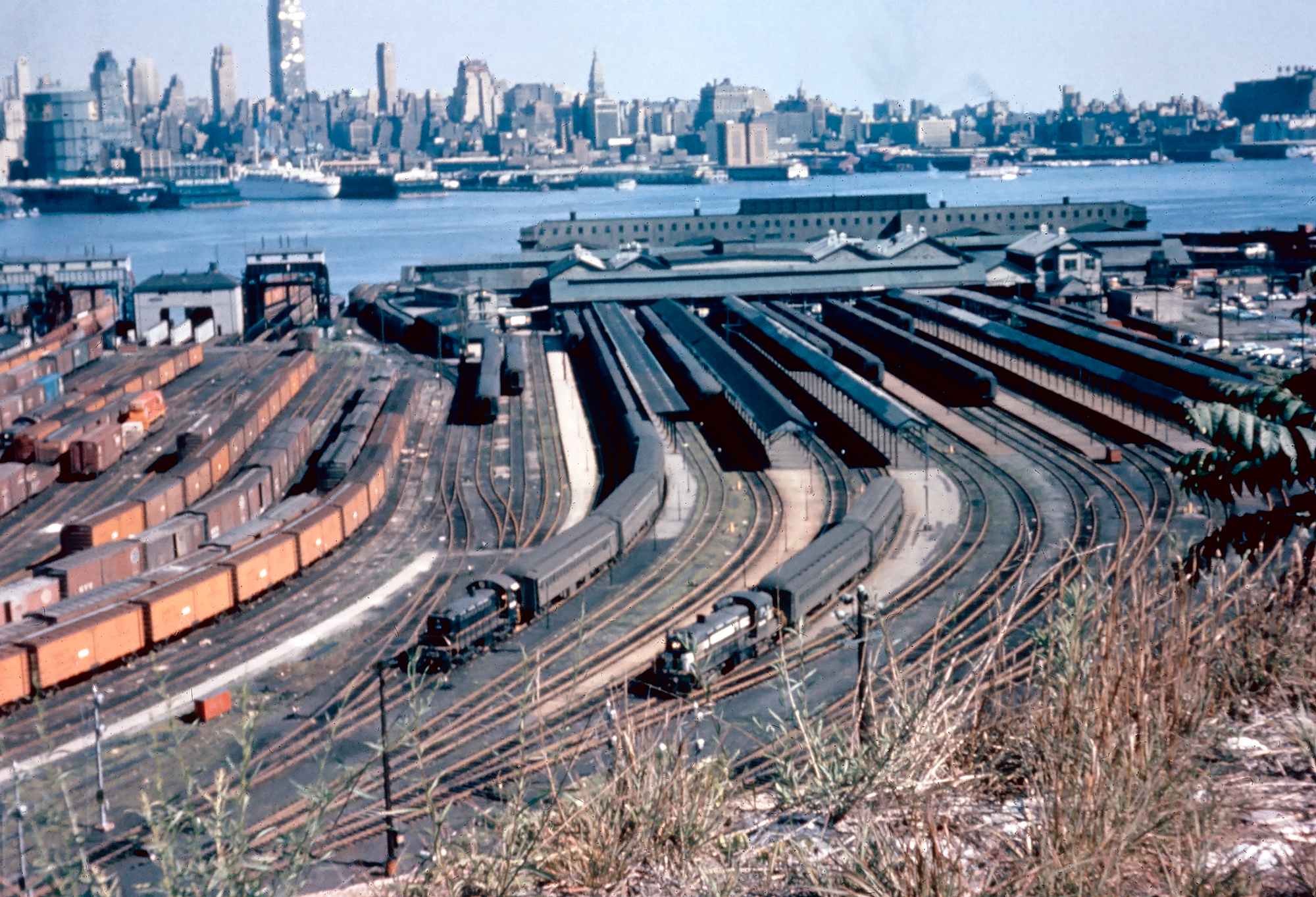
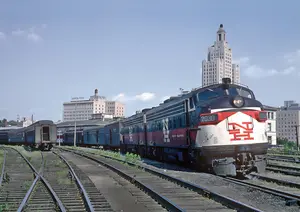
New York Central’s Weehawken Terminal, Weehawken, New Jersey, circa 1955, Manhattan across the river. The plant served the West Shore Division and Ontario & Western trains until 1953. Passenger service ended in 1959. Meyer Pearlman photo. American-Rails.com collection.
On this page: At a glance · Five terminals · Slough’s Meadow · Weehawken Tunnel · 1884 · Ferries and the Lincoln Highway · Streetcars · Ontario & Western · March 25, 1959 · Port Imperial
At a glance
| Item | Detail |
|---|---|
| Location | Weehawken, New Jersey. Foot of Pershing Road, north of Weehawken Cove, on filled estuary once called Slough’s Meadow. About 40°46′18″ N, 74°00′46″ W |
| Opened | 1884. West Shore trains had used the Pennsylvania’s Exchange Place from June 4, 1883, while this plant finished |
| Closed to passengers | 1959. Last ferry 1:10 a.m., March 25, 1959, boat Weehawken |
| Owner / operator | New York, West Shore & Buffalo; West Shore Railroad from December 5, 1885; New York Central (475-year lease from January 1, 1886). Penn Central 1968. Conrail 1976 |
| Railroad tenants | West Shore / NYC. Ontario & Western (to September 10, 1953). New Jersey Junction Railroad south along the waterfront |
| Plant | Five ferry slips. Sixteen passenger tracks. Car-float bridges. Freight yards. Passenger station at the slips |
| Tunnel | Weehawken Tunnel, 4,014 feet, 1881–83. Two tracks as built, 27 feet wide, 21 feet high. Chief engineer Walter Katte. HAER NJ-109-A |
| Ferries | West 42nd Street (midtown) and Cortlandt Street (downtown). A Weehawken–Manhattan franchise dated to 1700 |
| Streetcars | Pershing Road, 1892–1949. North Hudson County Railway, later Public Service Railway |
| Today | Weehawken Port Imperial. Hudson-Bergen Light Rail in the tunnel (full service October 29, 2006). New York Waterway ferry terminal (new building May 2006; service restored 1986). NJ Transit buses |
Tunnel dimensions follow Historic American Engineering Record NJ-109-A (Lynn Drobbin). Last-ferry time is Arthur G. Adams, The Hudson Through the Years. Information compiled September 17, 2026.
The northernmost of five
From the 1880s until the 1950s five railroad ferry terminals lined the New Jersey Hudson, north to south: Weehawken (West Shore / New York Central), Hoboken (Lackawanna), Pavonia (Erie), Exchange Place (Pennsylvania), and Communipaw (Central Railroad of New Jersey). Hoboken is the one that still takes trains. Weehawken was the northern plant, aimed at 42nd Street rather than the downtown slips the Pennsy and the Jersey Central used. The Central already had Grand Central on the east bank. Weehawken was how it reached Manhattan from a railroad that never crossed the Hudson.
Slough’s Meadow
The waterfront was a tidal meadow, Slough’s Meadow, a narrow strip between the Palisades and the river north of Weehawken Cove. The West Shore filled it. Tracks from the east portal of the tunnel fanned toward piers and slips. The company talked of twelve deep-water piers; what it built was a working mix of passenger slips, car floats, and freight yard. United Fruit later kept what was then the largest banana warehouse in the United States beside the berths. Pershing Road climbed the cliff from the fill to the top of the Palisades, the only highway grade off the property.
The New Jersey Junction Railroad, a Central waterfront line, ran south from the terminal toward Jersey City and connected the West Shore to the rest of the harbor. After passenger service died that right-of-way became Penn Central’s River Division, then Conrail’s River Line, then—south of the tunnel—Hudson-Bergen Light Rail.
Walter Katte’s hole in the Palisades
A railroad on the west bank still had to get through Bergen Hill. Walter Katte (1830–1917), chief engineer of the New York, West Shore & Buffalo, designed and built the Weehawken Tunnel in 1881–83. Historic American Engineering Record NJ-109-A is the survey: 4,014 feet from the west portal in North Bergen to the east portal in Weehawken, under 48th Street through Weehawken, Union City, and West New York. Two tracks, centerlines 13 feet apart. Semi-elliptical arch, nearly vertical walls, 27 feet wide, 21 feet high (19 feet rail to crown). About three-quarters of the length was left as Palisades diabase, unlined. Eight brick-lined sections covered the weaker ground. Crews worked from both portals and from five shafts, about 450 men in 12-hour shifts. The east portal flared to about 100 feet so tracks could split toward the slips.
Harvey L. Berliner and colleagues, writing for the Transportation Research Board when NJ Transit rebuilt the bore for light rail, used the same HAER numbers. The original two-track freight-and-passenger hole is the one light rail still occupies, enlarged by blasting for a mid-tunnel station about 160 feet under Union City (Bergenline Avenue).
June 4, 1883, then 1884
West Shore passenger trains began June 4, 1883, Jersey City to Newburgh. Weehawken was not finished. Alvin F. Harlow, in The Road of the Century, has them using the Pennsylvania’s Exchange Place station and ferries. The tunnel had been driven. The slips, the sixteen tracks, and the station opened in 1884. Buffalo service was proclaimed January 1, 1884. The company that owned the plant went into receivership that June. J. P. Morgan’s settlement put the West Shore under the Central: foreclosure November 24, 1885, West Shore Railroad December 5, 475-year lease from January 1, 1886. That corporate story is the West Shore page. From 1886 the terminal was a New York Central machine that still said West Shore on the timetables.
Named trains later in the Central era included the Storm King Limited and the West Pointer, Weehawken to Albany. Commuters filled the south end: Ridgefield Park, Bogota, Teaneck, Dumont, Tappan, Orangeburg, West Nyack, Congers, Haverstraw. Those names are a 1948 public timetable and the December 1954 Official Guide, not a second station list.
The 42nd Street boat, and a 1700 patent
Governor Richard Coote of New York patented a Weehawken–Manhattan ferry in 1700. Sail and oars, then steamboats. The New Jersey Midland bought the route in 1871. When the West Shore opened, the railroad ferry became the reason the terminal existed. The main boat ran to West 42nd Street. Another ran to the Cortlandt Street Ferry Depot downtown. Raymond J. Baxter and Arthur G. Adams, Railroad Ferries of the Hudson, is the book for the slips.
From 1913 until the Holland Tunnel opened in 1927, the 42nd Street ferry was a piece of two early transcontinental auto roads, the National Old Trails Road and the Lincoln Highway. Both began at Times Square, crossed on the boat, and climbed Pershing Road. The George Washington Bridge (1931) and the Lincoln Tunnel (1937)—the tunnel almost parallel to the 42nd Street crossing—took that traffic. HAER notes West Shore annual commuter ridership down to about 15,000 after the bridge. The Tappan Zee Bridge and the New York State Thruway in the 1950s finished the argument.
The last railroad ferry was the Weehawken, 1:10 a.m., March 25, 1959. Adams counts 259 years from Coote’s patent. New York Waterway put boats back on the Weehawken waterfront in 1986, first from a converted ferry moored south of the old slips. NJ Transit’s new ferry building, leased to NY Waterway, opened in May 2006. Boats now run to Pier 79 (West Midtown), Battery Park City, and Pier 11 / Wall Street. That is not the 1959 railroad ferry. It is the same river.
Pershing Road cars, and a brief elevator
Streetcars tied the cliff-top towns to the slips. From 1892 to 1949 cars of the North Hudson County Railway, later Public Service Railway, ran Pershing Road: lines 19 Union City, 21 West New York, 23 Palisade, 25 Weehawken. For a few years in the 1890s a large elevator, the so-called Colossus of Weehawken, lifted passengers to a trestle that served amusement grounds—Eldorado, a pleasure garden, Nungesser’s Guttenberg racetrack. The trestle died with the fads. The Pershing Road cars lasted until buses took the hill.
Ontario & Western at the slips
The Ontario & Western never owned the Palisades. It held trackage rights on the West Shore from Cornwall, a connection built in 1883, and used Weehawken as its New York ferry without building one. About 52 miles of West Shore iron, plus the tunnel and the slips. O&W passenger trains last ran into Weehawken on September 10, 1953. The company was abandoned March 29, 1957. That railroad is the Ontario & Western page. This page keeps the tenant.
1958, 1959
West Shore passenger service to Albany ended in 1958. The last trains to West Haverstraw ran in 1959. That was the end of Central coaches on the west side of the Hudson, and the end of the terminal as a station. Freight on the New Jersey Junction and the yards lasted longer, through Penn Central and into Conrail. The passenger headhouse, the slips, and the sixteen tracks came down for waterfront redevelopment. There was no 1960s last-train ceremony of the Pavonia sort that left a road number and a minute on the clock. The clock that is on the record is the ferry: 1:10 a.m., March 25, 1959.
Port Imperial, not a station
The fill is Weehawken Port Imperial, not Lincoln Harbor. Lincoln Harbor is the cove neighborhood to the south. NJ Transit rebuilt and waterproofed Katte’s tunnel for Hudson-Bergen Light Rail. A mid-tunnel station at Bergenline Avenue opened with the light-rail extension. Port Imperial station ran weekends from November 2005 and full service from October 29, 2006. The light rail comes out of the east portal onto the old waterfront and continues south on the former Junction alignment. CSX’s River Subdivision, the old West Shore freight main, starts west of the Palisades at North Bergen Yard and does not use the tunnel.
The Hudson River Waterfront Walkway crosses the bulkhead. The banana warehouse is commercial space. On January 15, 2009, US Airways Flight 1549 went into the river off this shore; the ferries that still work here helped take people off the wings. That is not a railroad story. It is what the slips became: boats, light rail, buses, apartments, and a view of 42nd Street that the West Shore built the plant to reach.
Related reading on American-Rails.com
- West Shore Railroad · New York Central · Grand Central Terminal
- New York, Ontario & Western · New York, Susquehanna & Western
- Hoboken Terminal · Pavonia Terminal · Exchange Place · Communipaw Terminal
- Pennsylvania Station · Stations · NJ Transit
Sources
- Historic American Engineering Record NJ-109-A. Lynn Drobbin, historian. Weehawken Tunnel 1881–83, Walter Katte, 4,014 feet, 27 × 21 feet, two tracks; ridership after the George Washington Bridge; four main tracks Ridgefield Park to the state line
- Berliner, Harvey L., David W. Campo, Charles N. Dickerson, and Glenn Mack. “Design and Construction of the Weehawken Tunnel and Bergenline Avenue Station for the Hudson–Bergen Light Rail Transit System.” Transportation Research Circular E-C058, November 2003. Original bore; HBLR enlargement and mid-tunnel station
- Adams, Arthur G. The Hudson Through the Years. Fordham University Press, 1996. Last ferry Weehawken, March 25, 1959, 1:10 a.m.
- Baxter, Raymond J., and Arthur G. Adams. Railroad Ferries of the Hudson. Fordham University Press, 1999, p. 124
- Harlow, Alvin F. The Road of the Century. June 4, 1883 via Exchange Place; Weehawken not yet complete
- Sherman, Lauren, and Ellen Robb Gaulkin. Weehawken (Images of America). Arcadia, 2009
- New York Central public timetable, April 25, 1948; Official Guide, December 1954, Table 80. West Shore stations out of Weehawken
- American-Rails.com: West Shore Railroad; New York Central; Ontario & Western; Hoboken, Pavonia, Exchange Place, Communipaw; Grand Central
Recent Articles


-
Virginian Railway's 2-6-6-6 Locomotives (Class AG)
Oct 18, 26 01:38 PM
 Virginian Railway class AG. Eight Lima 2-6-6-6s, Nos. 900-907, built in 1945 for the east end. Billed at 753,000 pounds. Scrapped in 1960.
 -
Pennsylvania (PRR) Steam Roster: Post 1906
Oct 18, 26 01:05 PM
 ennsylvania steam after 1906—H8, H9, and H10 Consolidations, 574 L1s Mikados, 598 I1s Decapods, 425 K4s Pacifics, 301 M1 Mountains. Drury’s grid. Last steam November 30, 1957.
 -
Chicago, Aurora and Elgin Railroad: The "Roarin' Elgin"
Oct 18, 26 10:54 AM
 The Chicago, Aurora & Elgin, the Roarin' Elgin, ran 600-volt third-rail trains from Chicago to Aurora, Batavia, and Elgin. Passenger service ended at noon on July 3, 1957. Freight ended June 11, 1959.
 -
Algoma Central Railway: Map, Logo, Rosters
Oct 17, 26 10:49 PM
 Algoma Central Railway, Sault Ste. Marie to Hearst. Wisconsin Central on February 1, 1995. Fifty-nine steam locomotives and forty-two diesels.
 -
Akron, Canton and Youngstown Railroad: Map, History, Rosters
Oct 17, 26 05:49 PM
 Akron, Canton and Youngstown Railroad, Mogadore to Delphos. The rails never reached Canton or Youngstown. Norfolk & Western control on October 16, 1964. Twenty-six diesels and the historical society's…
 -
Georgia Railroad: Map, History, Logo, Rosters
Oct 17, 26 12:59 PM
 Georgia Railroad, the Georgia Railroad and Banking Company, Augusta to Atlanta, with the Athens branch and the Macon Road. Mark GA. The railroad properties were sold on November 4, 1982.
 -
West Point Route (Railroad): Map, History, Logo
Oct 16, 26 11:26 PM
 The West Point Route was a trademarked name comprising the Atlanta & West Point and Western Railway of Alabama, which were controlled by the Georgia Railroad.
 -
Virginian Railway Diesel Roster (All-Time)
Oct 16, 26 11:11 PM
 All-time diesel roster of the Virginian Railway. 40 Fairbanks-Morse H16-44s, 25 H24-66 Train Masters, and one GE 44-tonner. Serials included.
 -
Virginian Railway Steam Roster (Post 1900)
Oct 16, 26 10:55 PM
 Virginian Railway steam locomotives built since 1900. Mikados, 2-8-8-2s, the Triplex, class AE 2-10-10-2s, and the 1945 2-6-6-6s.
 -
Virginian Railway: Map, Rosters, History, Electrification
Oct 16, 26 10:51 PM
 Virginian Railway, Deepwater to Norfolk. Combined in 1907 and completed in 1909. Electrified from Roanoke to Elmore. Absorbed by the Norfolk & Western on December 1, 1959.
 -
Baldwin "Centipede" Locomotives: Specs, Roster, Photos
Oct 16, 26 03:58 PM
 Baldwin DR-12-8-1500/2 Centipede—2-D+D-2, two 608SC engines, 3,000 hp. SAL 4500 from the 1943 test bed. 54 on the serial list, 52 sold. PRR BP60 then BH50. None preserved.
 -
Louisville & Nashville Class M-1 2-8-4s: The Big Emmas
Oct 16, 26 03:52 PM
Louisville & Nashville class M-1, 42 Big Emma 2-8-4s. Baldwin in 1942 and 1944, Lima in 1949. Coal trains from Neon to DeCoursey. No locomotive survives. -
Tennessee, Alabama and Georgia Railway: Map, History, Rosters
Oct 16, 26 03:21 PM
 Tennessee, Alabama and Georgia Railway, Chattanooga to Gadsden. The May 1929 card is 91.7 miles. Southern stock control closed on a January 1, 1971 schedule. Five diesels and Prince's steam list.
 -
Railroad Museums In The USA (2026): State Guides & Collections
Oct 16, 26 02:29 PM
 U.S. railroad museums—what they are vs tourist railroads, preservation history (R&LHS, NRHS, IRM, Steamtown), state guides, and destination collections. Confirm hours on each museum’s site.
 -
Wyoming Railroad Museums (2026): A Complete Guide
Oct 16, 26 02:26 PM
 Wyoming railroad museums—the Cheyenne Depot, Burlington 5633 at Douglas, Big Boy 4004, and the Laramie depot. Confirm hours and which locomotive is on the property.
 -
West Virginia Railroad Museums (2026): A Complete Guide
Oct 16, 26 12:52 PM
 West Virginia railroad museums—Cass Scenic’s geared steam, the Hinton C&O collection, and the Martinsburg B&O roundhouse. Confirm hours and which locomotive is assigned.
 -
Washington Railroad Museums (2026): A Complete Guide
Oct 16, 26 12:46 PM
 Washington railroad museums—Snoqualmie, Elbe, Chehalis, Reardan, and the Northern Pacific depot at Toppenish. Confirm hours and which locomotive is assigned.
 -
Vermont Railroad Museums (2026): A Complete Guide
Oct 16, 26 12:42 PM
 Vermont railroad museums—the Shelburne Museum’s 1890 station, Central Vermont No. 220, and the private car Grand Isle. Confirm hours on the site.
 -
Tennessee Central Railway: Map, Logo, Rosters, History
Oct 16, 26 11:32 AM
 Tennessee Central Railway, Harriman to Hopkinsville. Reorganized January 26, 1922. Last day August 31, 1968. Thirty-one diesels and the railroad's steam roster.
 -
Southern Railway Steam Roster (Post 1900)
Oct 16, 26 09:40 AM
Southern Railway steam locomotives built since 1900. Ps-4 Pacifics, Ts Mountains, USRA Santa Fes, and the subsidiary grids for the CNO&TP, Alabama Great Southern, and New Orleans and Northeastern. -
Southern Railway (USA): Map, Locomotives, Logo, History
Oct 16, 26 09:28 AM
 The Southern Railway, formed July 1, 1894 from the Richmond and Danville and the East Tennessee, Virginia and Georgia. Washington. Norfolk Southern Railway on December 31, 1990.
 -
Seaboard Coast Line Diesel Roster (All-Time)
Oct 15, 26 04:21 PM
 All-time diesel roster of the Seaboard Coast Line. Inherited Coast Line and Seaboard locomotives, then 623 new locomotives in the printed orders, plus 28 acquired from other railroads.
 -
Seaboard Coast Line Railroad: Map, History, Photos
Oct 15, 26 04:17 PM
 The Seaboard Coast Line, formed July 1, 1967 from the Atlantic Coast Line and the Seaboard Air Line. Jacksonville. Family Lines, then the Seaboard System on December 29, 1982.
 -
South Carolina Railroad Museums (2026): A Complete Guide
Oct 15, 26 02:54 PM
 South Carolina railroad museums—Winnsboro’s Rockton & Rion line, Spartanburg’s Hub City depot, Greenwood’s Baldwin No. 19, and the Best Friend replica. Confirm hours on each site.
 -
South Dakota Railroad Museums (2026): A Complete Guide
Oct 15, 26 10:55 AM
 South Dakota railroad museums—the Hill City museum beside the 1880 Train, and Prairie Village at Madison. Confirm hours, and confirm whether Hill City is still open.
 -
Seaboard Air Line Diesel Roster (All-Time)
Oct 15, 26 10:46 AM
 All-time diesel roster of the Seaboard Air Line. 734 locomotives: E4s in 1938, Centipedes, Alco road switchers, and GP40s through February 1967. Serials included.
 -
Seaboard Air Line Steam Roster (Post 1900)
Oct 15, 26 10:39 AM
 Seaboard Air Line steam locomotives built since 1900. Mikados, Russian Decapods, 2-10-2s, and the 2-6-6-4s sold to the Baltimore and Ohio in 1947. Drury's class grid.
 -
Seaboard Air Line Railroad: Map, Rosters, History
Oct 15, 26 10:34 AM
 The Seaboard Air Line, chartered in the Portsmouth and Roanoke of 1832 and formed July 1, 1900. Inland route to Florida. Merged into the Seaboard Coast Line on July 1, 1967.
 -
Utah Railroad Museums (2026): A Complete Guide
Oct 15, 26 12:04 AM
 Utah railroad museums—Ogden Union Station, Golden Spike at Promontory, the Helper mining museum, and the Heber Valley Railroad. Confirm hours on each site.
 -
Escanaba & Lake Superior Diesel Roster (All-Time)
Oct 14, 26 10:44 PM
All-time diesel roster of the Escanaba & Lake Superior. 30 locomotives: Baldwin switchers and RS-12s, two RF16s, three GP38s, three SD40-2s, and the Reserve Mining units. Serials and order numbers. -
Escanaba & Lake Superior Railroad: In Service Since 1898
Oct 14, 26 09:04 PM
 Escanaba & Lake Superior Railroad, chartered November 17, 1898, and still operating from Wells, Michigan. Logging line to Channing, the Milwaukee Road lines, and the diesel roster.
 -
Richmond, Fredericksburg & Potomac Diesel Roster (All-Time)
Oct 14, 26 08:49 PM
 All-time diesel roster of the Richmond, Fredericksburg and Potomac. 107 locomotives: 22 Alco S2s, one SW1, and an Electro-Motive road fleet from E8s to GP40-2s. Serials and order numbers.
 -
Richmond, Fredericksburg & Potomac Steam Roster (Since 1900)
Oct 14, 26 08:46 PM
 Richmond, Fredericksburg and Potomac steam locomotives built since 1900. Pacifics, Mountains, Berkshire-type 2-8-4s, and the named 4-8-4s. Last revenue run December 17, 1954.
 -
Richmond, Fredericksburg and Potomac Railroad: Map, Rosters, Logo
Oct 14, 26 08:36 PM
 The Richmond, Fredericksburg and Potomac, chartered February 25, 1834. A 113-mile Richmond–Washington bridge line. Named 4-8-4s, Potomac Yard, and the CSX sale of October 10, 1991.
 -
North Dakota Railroad Museums (2026): A Complete Guide
Oct 14, 26 08:29 PM
North Dakota railroad museums—Mandan’s state museum, the Railroad Museum of Minot, and Bonanzaville’s Northern Pacific 684. Confirm hours on each site. -
Oklahoma Railroad Museums (2026): A Complete Guide
Oct 14, 26 08:02 PM
Oklahoma railroad museums—the Oklahoma Railway Museum, Enid’s Frisco 1519, Waynoka’s Harvey House, and El Reno’s Rock Island depot. Confirm hours on each site. -
Oneida & Western Railroad: Map, History, Timetable
Oct 14, 26 06:47 PM
Oneida & Western Railroad, a Tennessee short line from Oneida to Jamestown. Chartered in 1912, opened to East Jamestown in 1921, and to Jamestown on December 10, 1930. Last revenue train March 4, 1954… -
Oneida and Western Railroad (Shamrock Coal Company)
Oct 14, 26 03:20 PM
 Shamrock Coal's mint-green coal trains, 1979–1987. Eight EMD SD40-2s, OWTX 9950–9957, order 786246. Two 72-car gondola sets. Louisville & Nashville, then CSX. Sold to BC Rail.
 -
Rhode Island Railroad Museums (2026): A Complete Guide
Oct 14, 26 03:03 PM
 Rhode Island railroad museums—the Friends’ museum in the 1875 Kingston depot, on the old New York, Providence and Boston. Confirm what is on view.
 -
Original Norfolk Southern Diesel Roster (All-Time)
Oct 14, 26 12:40 PM
 All-time diesel roster of the original Norfolk Southern Railway. 59 locomotives: Baldwin switchers and AS-416s, three GE 70-tonners, 17 GP18s, and seven GP38s. Serials and order numbers.
 -
Original Norfolk Southern Railway: Map, Rosters, History
Oct 14, 26 10:09 AM
 The original Norfolk Southern Railway, chartered in 1870 as the Elizabeth City & Norfolk. Norfolk to Charlotte. Merged into the Southern Railway on January 1, 1974. Baldwin diesels and the GP18s and G…
 -
Nebraska Railroad Museums (2026): A Complete Guide
Oct 14, 26 10:00 AM
 Nebraska railroad museums—the Durham Museum, Kenefick Park, Cody Park, and the Golden Spike Tower over Bailey Yard. Confirm hours on each site.
 -
Nevada Railroad Museums (2026): A Complete Guide
Oct 14, 26 09:51 AM
 Nevada railroad museums—Carson City, Boulder City, the Nevada Northern at East Ely, and the Virginia City depot. Confirm hours on each site.
 -
Montana Railroad Museums (2026): A Complete Guide
Oct 14, 26 12:17 AM
 Montana railroad museums—the Livingston depot, Fort Missoula’s Willamette, the Harlowton Milwaukee depot, and the Whitefish station. Confirm hours on each site.
 -
"Jawn Henry" Locomotive: Specs, Diagram, Photos
Oct 14, 26 12:03 AM
 Norfolk & Western No. 2300, class TE-1, the steam turbine-electric Jawn Henry. Baldwin-Lima-Hamilton, Westinghouse, and Babcock & Wilcox, May 1954. Specifications, the road tests, and the Dece…
 -
Atlantic and Danville Railway: Serving Southern VA
Oct 13, 26 04:32 PM
 Atlantic and Danville Railway, chartered in 1882, incorporated September 1883. Three-foot line to Claremont, then Norfolk to Danville. Southern lease from September 1, 1899, to July 1, 1949. Alco RS2s…
 -
Norfolk, Franklin and Danville Railroad: Map, Roster, History
Oct 13, 26 04:26 PM
 Norfolk, Franklin and Danville Railway, chartered October 2, 1962, and operating from November 1, 1962. Norfolk to Danville, 210.8 miles. Two Alco RS36s and four RS11s. Merged into the N&W on December…
 -
Norfolk & Western Diesel Roster (All-Time)
Oct 12, 26 11:59 PM
 Norfolk & Western diesel roster, all-time. 1,464 locomotives built new for the railroad, from the 1955 GP9s and RS-3s through the C36-7s, plus the merger fleets.
 -
Norfolk & Western Steam Roster (Post 1900)
Oct 12, 26 11:52 PM
 Norfolk & Western steam since 1898. The Roanoke grid: 1,266 locomotives, the J, the A, and the Y, and the last road steam on May 7, 1960.
 -
Norfolk & Western Railway: Map, Logo, Rosters, History
Oct 12, 26 11:45 PM
 The Norfolk & Western, from the City Point Railroad of 1838 to Norfolk Southern. Pocahontas coal, Roanoke steam, and the 1964 expansion.