- Home ›
- Glossary ›
- Pole Lines
Railroad Pole Lines: History, Purpose, Construction & Decline
Last revised: August 11, 2026
By: Adam Burns
For more than a century, American rail corridors were framed by a second, quieter network: pole lines. Rows of wooden poles marched beside the right-of-way, their crossarms heavy with copper and iron wire. Those lines did not merely carry “messages.” They were the nervous system of train dispatching, block signaling, centralized traffic control (CTC) code circuits, company telephone systems, and—on many properties—Western Union commercial telegraphy that shared railroad land.
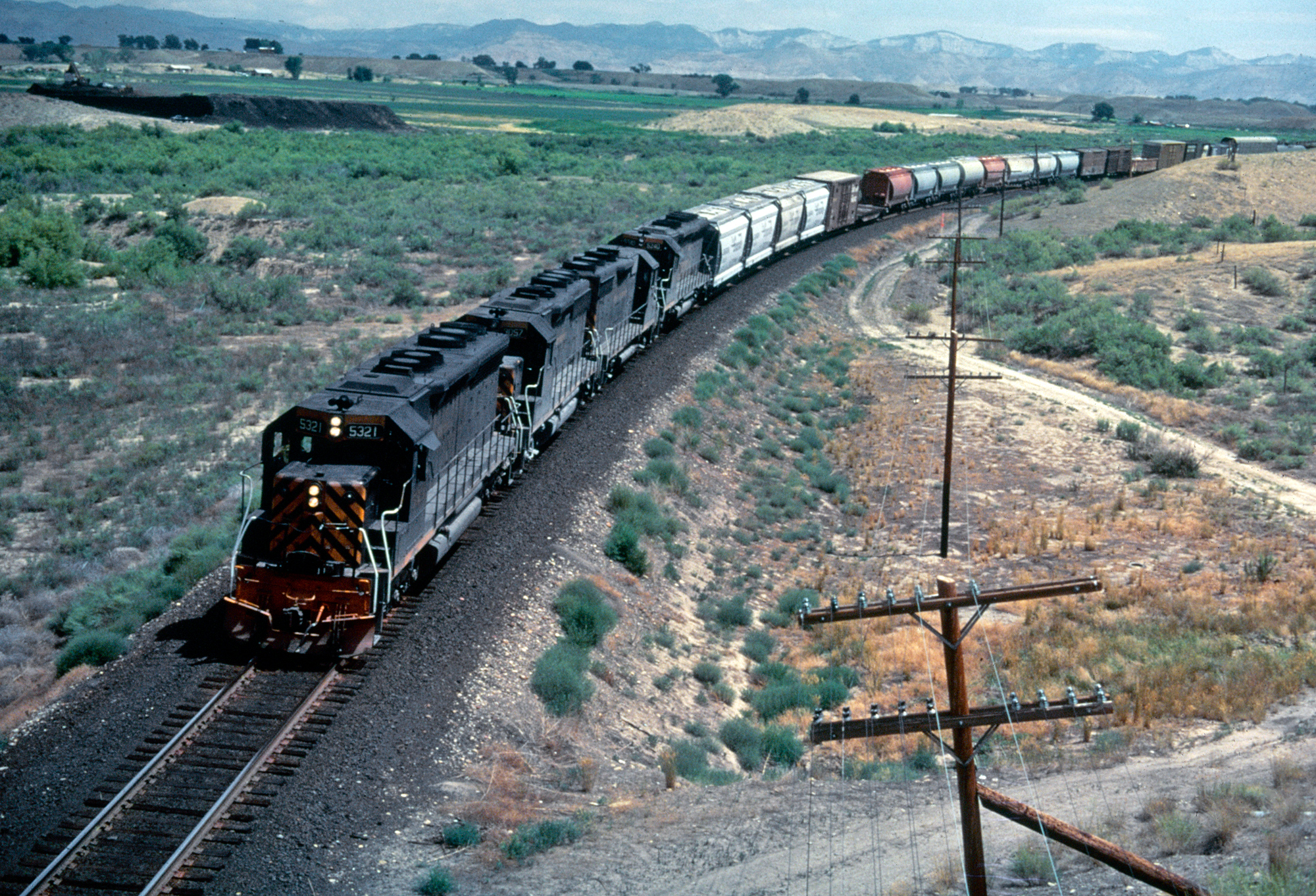
Rio Grande SD45 #5321 leads a westbound through open country west of Mack, Colorado, in the late 1960s. The wooden pole line paralleling the main—crossarms, insulators, and open wire—was once as much a part of the railroad landscape as the rail and ties. American-Rails.com collection.
If you learned to read a railroad photograph from the steam or early diesel era, you already knew how to grade a route without a map. A single-arm, sparsely wired branch line told one story. A multi-arm, multi-wire main line—especially on double track with automatic signals or CTC—told another. This article explains what pole lines were, what the wires actually did, how they were built and maintained, and why they largely vanished from Class I rights-of-way after World War II.
What Is a Railroad Pole Line?
A railroad pole line is an open-wire (or, later, partly cable) communications and signal plant erected on poles along the company’s right-of-way. Typical components included:
- Poles — usually wood (cedar, chestnut, pine, fir, and later treated southern yellow pine), set at regular intervals along the ROW
- Crossarms — horizontal timber arms carrying insulator pins; one arm or many stacked vertically
- Insulators — glass or porcelain (ceramic) units that held and insulated the line wire
- Line wire — open copper, copper-clad, iron, or steel conductors for telegraph, telephone, signal, code, and sometimes power circuits
- Guys, braces, and dead-ends — hardware that kept the plant upright at curves, angles, and long spans
Pole lines should not be confused with high-voltage electric-traction catenary or with the modern fiber-optic cables many railroads bury or hang today. Classic pole lines were low-voltage open wire for messages and control—ugly, vulnerable to weather, and indispensable before radio and buried cable became reliable at scale.
Telegraph Meets the Railroad (1840s)
Samuel F. B. Morse’s practical electromagnetic telegraph of the late 1830s needed a place to run. Railroads already owned long, continuous strips of land connecting cities—perfect rights-of-way for wire. The first major American demonstration linked Washington, D.C., and Baltimore. After early attempts to bury insulated cable in pipe failed (moisture and poor insulation ruined the circuit), builders switched to poles and trees, using glass insulation at support points. The famous first public message over the completed line—“What hath God wrought?”—was sent on May 24, 1844.
The Baltimore & Ohio allowed that experimental wire along its property. From that marriage of iron and copper grew a national habit: telegraph lines followed the railroad, and railroads learned to dispatch trains with real-time information instead of pure timetable guesswork and flagmen.
Early railroad telegraphy was not instantly universal. Many roads adopted it slowly, and historians of technology note that the full integration of telegraphy into everyday train control took decades of practice, rulebooks, and hardware. Still, by the late nineteenth century the pole line and the main line were inseparable in the public mind—and in the operating department.
Western Union, Commercial Wire, and Shared Rights-of-Way
Not every wire on a railroad pole belonged solely to the railroad. Western Union and other commercial telegraph companies often built, leased, or jointly used pole plant on railroad land. Railroads gained rent, maintenance help, or free railroad circuits; telegraph companies gained continuous corridors across the continent.
That relationship left physical clues. Railfans and linemen long remarked that Western Union construction sometimes used distinctive practices (including, on some routes, square poles and heavy multi-arm commercial plants), while pure railroad plant used round poles and fewer arms—though practices varied by era and company. When commercial telegraph traffic collapsed in the mid-twentieth century, many railroads bought or inherited plant that had once been jointly used, then faced the cost of maintaining it alone until microwave and fiber made open wire obsolete.
The 1861 transcontinental telegraph, completed between the Missouri River country and California, was itself a precursor to the rail-and-wire landscape of the West. When the first transcontinental railroad opened in 1869, multi-wire systems along the Union Pacific and Central Pacific corridors quickly became the permanent commercial and railroad communication spine—again, poles and wire following steel.
What the Wires Actually Did
A crowded crossarm was not decoration. Different pairs (or single wires with ground return in early practice) served different jobs. Over time a mature main-line pole plant might carry some combination of:
1. Railroad telegraph circuits
Station agents and operators exchanged train orders, OS (on sheet / train reporting) information, and commercial railroad messages in Morse. The classic American operating culture of timetable and train order depended on the operator, the wire, and the dispatcher. A broken pole line was not merely inconvenient; it could force trains to run under more restrictive rules until communication was restored.
2. Railroad telephone circuits
From the late nineteenth century into the twentieth, telephones supplemented and then largely replaced Morse for many company communications. Dispatchers spoke to operators and, later, to crews via wayside phones and caboose / locomotive connections. “Dispatcher’s phone” and local block phones were everyday tools long before radio became standard on every locomotive.
3. Signal and “code” circuits
As automatic block signals (ABS), interlocking plants, and especially centralized traffic control (CTC) spread, pole lines carried more than talk. They carried control and indication circuits—often called code lines in railroad slang—that linked field locations to towers and dispatch offices. Early CTC installations used many line wires; later systems reduced wire count with improved coding, but open-wire signal plant remained common for decades.
Pole lines also carried circuits for switch machines, approach locking, track circuits tied into signal logic, and, on some properties, limited AC or DC power feeds for signal apparatus. The denser the signal system, the denser the pole line—one reason busy multiple-track corridors often looked like a forest of crossarms.
4. Commercial and miscellaneous circuits
Western Union and similar tenants, railroad express company circuits, special circuits for yards or terminals, and temporary construction phones all might appear on the same poles. Reading a pole line was reading a diagram of how important that stretch of railroad was to both the company and the commercial world.
Reading the Landscape: Arms, Wires, and Corridor Importance
Photographers and modelers still use a simple rule of thumb that holds for much of North America:
- Primary main lines — multiple crossarms, many wires, frequent poles, often associated with ABS/CTC and heavy traffic
- Secondary mains and branches — one or two arms, fewer pairs, lighter plant
- Dark territory or light branches — sparse wire, single arm, or no railroad pole line at all once radio and local phones sufficed
The rule is not absolute. A lightly trafficked branch might still host a heavy commercial Western Union plant. A modernized main might already have cut open wire to a single cable long before the poles came down. But as a first cut at “how busy was this railroad?” the pole line remains one of the best visual clues in period photographs.
How Pole Lines Were Built
Spacing and alignment
Poles were typically spaced on the order of 60 to 100 feet (roughly 18 to 30 meters), closer on curves, in ice-prone regions, or where heavy multi-wire loads demanded shorter spans. The line usually followed one side of the right-of-way for miles, jumping sides at bridges, stations, or property constraints. Clearances from track, stations, and overhead structures were a constant engineering concern.
Poles and treatment
Untreated timber rotted quickly. Railroads and telegraph companies turned to creosote and other preservatives, longer poles for multi-arm construction, and careful setting of butts. Storms, floods, fire, and grade-crossing accidents made poles consumable infrastructure—budgeted and replaced like ties and rail.
Crossarms, pins, and insulators
Crossarms carried wooden or metal pins topped with glass or porcelain insulators. Insulator collecting became a hobby precisely because the hardware was ubiquitous and varied by maker, voltage class, and era. Good insulation mattered: wet weather and leakage to ground could kill a circuit as surely as a broken wire.
Wire and transposition
Open telephone circuits especially required careful design to limit crosstalk and noise. Transpositions (periodic crossing of wire positions) and the choice of wire size and material were part of the plant engineering. Signal circuits had their own voltage, polarity, and reliability rules. None of this was casual; a Class I communications and signals department lived by the pole line.
Maintenance: The Lineman’s Railroad
Pole-line work was hard outdoor labor. Railroad and Western Union linemen climbed poles, replaced crossarms, spliced wire, and restored circuits after ice storms, wind, lightning, and washouts. Section forces might report broken poles; specialist linemen made the repairs. Winter ice storms could pull down miles of plant in a night, isolating stations and forcing the operating department onto emergency procedures.
That maintenance burden became a major argument for replacement technologies. Every pole, arm, insulator, and mile of open wire was a future repair ticket. Microwave towers, buried cable, and later fiber still required maintainers—but not a continuous wooden army marching the entire railroad.
Technological Evolution Along the Same Corridor
Pole lines did not freeze in 1880. They evolved in place:
- Telegraph era — Morse, operators, train orders, commercial traffic
- Telephone overlay — clearer voice circuits; Morse slowly retreats from everyday use
- Signal / code densification — ABS, interlockings, CTC add control and indication wire
- Selective modernization — cable replaces some open wire; fewer circuits on remaining poles
- Radio, microwave, and fiber — pole lines decommissioned in stages from the mid-twentieth century onward
End-of-train devices, locomotive radio, and solid-state wayside electronics further reduced the need for continuous open-wire plants. By the late twentieth and early twenty-first centuries, many Class I corridors that once bristled with multi-arm poles carried only occasional remnants—stub poles, abandoned arms, or short leftover segments near yards and secondary trackage.
Why Pole Lines Declined
Radio and wireless
Two-way radio gave dispatchers and crews a channel that did not depend on a wire every hundred feet along the track. As radio became standard equipment, the urgency of maintaining every local phone circuit faded.
Microwave and other backbone systems
From the mid-twentieth century, railroads invested in microwave and other multi-channel systems that carried dispatch circuits and administrative traffic without open wire. A handful of towers could replace hundreds of miles of poles for backbone purposes.
Fiber optics and buried cable
Fiber offered bandwidth open wire could never match, plus better immunity to weather-related opens and grounds. Cable in conduit or buried plant along the ROW could serve signal houses and communications nodes without a continuous aerial plant. Many modern rights-of-way still host fiber—sometimes railroad-owned, sometimes a telecom tenant—but the visual signature of stacked crossarms is gone.
Cost, safety, and right-of-way housekeeping
Open wire was expensive to maintain and vulnerable to trespass, fire, and vehicle strikes. Clearing obsolete poles improved sight lines, reduced hazard, and simplified track and signal work. Once the circuits moved, the poles became liability without purpose.
Decline was uneven. Secondary lines and short lines sometimes retained sparse plant longer. Museums and tourist railroads occasionally keep a short cosmetic or educational pole line. But as a defining feature of the American main line, the multi-arm pole plant belongs to history.
Legacy: What Still Matters
Pole lines matter to more than nostalgia:
- Operating history — You cannot understand train-order railroading, early ABS, or first-generation CTC without the wire plant that made them work.
- Photo interpretation — Arms and wire density remain a practical clue to a corridor’s status in any given decade.
- Model railroading — Correct pole-line density is one of the fastest ways to make a layout’s main line look like a main line.
- Preservation — Museums that interpret communications and signals (including preserved towers, dispatch offices, and wayside phones) are preserving the human end of the pole line even when the poles themselves are gone.
The next time you see a late-1960s photo of a freight train in open country—SD45 on the point, desert or prairie horizon, a thin brown fence of poles receding into the distance—remember that those poles were not background. They were how the railroad spoke to itself, mile after mile, in the decades before microwave, fiber, and radio made silence along the right-of-way possible.
Pole Lines at a Glance
| Topic | Summary |
|---|---|
| Primary era | c. 1844–1970s as dominant ROW communications plant (lingering remnants later) |
| Core jobs | Telegraph, company telephone, signal/code circuits, commercial tenant circuits |
| Typical structure | Wooden poles, crossarms, glass/porcelain insulators, open wire |
| Spacing (typical) | Often ~60–100 ft between poles; tighter on curves / heavy plant |
| Visual cue | More arms and wires → usually busier / more signalized corridor |
| Key partners | Railroad C&S departments; often Western Union and other telegraph companies |
| Replaced by | Radio, microwave, buried cable, fiber optics, solid-state wayside systems |
| Why gone | Maintenance cost, weather vulnerability, better bandwidth and reliability alternatives |
Related Reading on American-Rails.com
- Railroad Glossary & Terms
- Railroad History (USA)
- Rail Infrastructure
- Rail Maintenance
- Famous Railroad Landmarks
Pole-line practices varied by railroad, region, and decade. Spacing, wire counts, and circuit assignments were company standards, not universal law. For engineering or restoration work, consult the specific railroad’s communications and signals standards and period photographs of the corridor in question.
Recent Articles


-
Illinois Scenic Train Rides (2026): A Complete Guide
Oct 02, 26 12:28 AM
 Illinois tourist trains in 2026—Illinois Railway Museum, Monticello Railway Museum, Fox River Trolley, and Silver Creek & Stephenson.
 -
Texas Scenic Train Rides (2026): A Complete Guide
Oct 02, 26 12:14 AM
 Texas tourist trains in 2026—Texas State Railroad, Grapevine Vintage Railroad, Austin Steam Train's Hill Country Flyer, and the Galveston Railroad Museum.
 -
Tennessee Scenic Train Rides (2026): A Complete Guide
Oct 02, 26 12:03 AM
 Tennessee tourist trains in 2026—Tennessee Valley Railroad Museum, Dollywood Express, Three Rivers Rambler Christmas trains, and the Tennessee Central Railway Museum.
 -
South Carolina Scenic Train Rides (2026): A Complete Guide
Oct 01, 26 11:52 PM
 South Carolina's tourist train is the South Carolina Railroad Museum in Winnsboro—Blue Granite Express, pumpkin trains, and Santa trains on the old Rockton & Rion.
 -
Mississippi Scenic Train Rides (2026): A Complete Guide
Oct 01, 26 11:38 PM
 Mississippi has no regular tourist railroad in 2026. Ride Amtrak through the state, or book the excursion lines in Alabama, Tennessee, Louisiana, or Arkansas.
 -
Louisiana Scenic Train Rides (2026): A Complete Guide
Oct 01, 26 02:52 PM
 Louisiana has no regular full-size tourist railroad in 2026. New Orleans Polar Express returns December 11–31. Museums at Long Leaf, DeQuincy, and Jackson.
 -
Kentucky Scenic Train Rides (2026): A Complete Guide
Oct 01, 26 02:45 PM
 Kentucky tourist trains in 2026—Big South Fork Scenic Railway, Bluegrass Scenic Railroad, Kentucky Railway Museum, and My Old Kentucky Dinner Train.
 -
Georgia Scenic Train Rides (2026): A Complete Guide
Oct 01, 26 02:27 PM
 Georgia tourist trains in 2026—Blue Ridge Scenic Railway, SAM Shortline, Azalea Sprinter, Savannah shop rides, and what to confirm at Stone Mountain.
 -
Arkansas Scenic Train Rides (2026): A Complete Guide
Oct 01, 26 01:02 PM
 Arkansas tourist trains in 2026—Arkansas & Missouri through the Boston Mountains, and the Eureka Springs & North Arkansas dinner and excursion trains.
 -
Alabama Scenic Train Rides (2026): A Complete Guide
Oct 01, 26 12:59 PM
Alabama tourist trains in 2026—Heart of Dixie Railroad Museum at Calera, North Alabama Railroad Museum at Chase, and the Wales West Light Railway at Silverhill. -
The Circus Train: How Such Attractions Reached Distant Cities
Oct 01, 26 12:22 PM
 How circuses moved by rail: Coup's 1872 flats, the Ringling train's sections and car counts, the 1918 Hammond wreck, and the last show on May 21, 2017.
 -
West Virginia Halloween Train Rides (2026)
Oct 01, 26 12:19 PM
 2026 West Virginia Halloween train. Cass Scenic Halloween Train, October 30 and 31, steam, 5:00 p.m. from Cass Depot. Adult $75. About two hours to Whittaker. Family ride.
 -
Wisconsin Halloween Train Rides (2026)
Oct 01, 26 12:11 PM
2026 Wisconsin Halloween trains. Mid-Continent Pumpkin Special October 24–25, adult $24, pumpkins extra. Halloween Flyer October 24 at 4:30 p.m., adult $30. Osceola Pumpkin Express boards in Osceola… -
Utah Halloween Train Rides (2026)
Oct 01, 26 12:00 PM
 2026 Utah Halloween trains at Heber Valley Railroad. Pumpkin Train, about 40 minutes, with a cookie and a pumpkin. Halloween Express, about 90 minutes to Grim Hollow, Monday, Thursday, and Friday even…
 -
Texas Halloween Train Rides (2026)
Oct 01, 26 11:28 AM
 2026 Texas Halloween train. Texas State Railroad Spooky Special, adult-only, October 24. Boards Palestine at 5:00 p.m. About five hours to Rusk and back. Dinner on the grounds. Not steam. No fare on t…
 -
Tennessee Halloween Train Rides (2026)
Oct 01, 26 12:15 AM
 2026 Tennessee Halloween trains. Tennessee Valley Railroad Museum Rails, Wizards & Spells, selected days September 18 through October 25, from $35, about 2.5 hours. Spells & Potions tea from $60. The…
 -
Frisco's "Firefly" (Train): Consist, Route, Timetable
Sep 30, 26 11:37 PM
 Frisco Firefly—daylight streamliner, Kansas City to Tulsa and Oklahoma City. Trains 117 and 118. Pacifics 1018, 1026, and 1031. Last run May 22, 1960.
 -
South Carolina Halloween Train Rides (2026)
Sep 30, 26 11:29 PM
 2026 South Carolina Halloween train. South Carolina Railroad Museum Pumpkin Patch Express, the two Saturdays before Halloween. About three miles to the Greenbriar pavilion. Pumpkin for children 12 and…
 -
Oregon Halloween Train Rides (2026)
Sep 30, 26 08:10 PM
2026 Oregon Halloween train. Sumpter Valley Railroad Halloween Express at the Sumpter Depot, calendar window October 31 at 11:00 a.m. through November 1 at 12:30 p.m. Fare and the individual clocks ar… -
Oklahoma Halloween Train Rides (2026)
Sep 30, 26 03:45 PM
2026 Oklahoma Halloween train. Oklahoma Railway Museum, October 30 and 31, from Oakwood Station in Oklahoma City. Adults $15, children 3–12 $8. A candy bag with the ride. -
McCloud River Railroad: Serving The Timber Industry (1897-2009)
Sep 30, 26 03:37 PM
 McCloud River Railroad—Mount Shasta City to McCloud, Hambone, and Burney. Opened August 1, 1897. Alco No. 25 and EMD SD38s. Dinner train through January 2010. Railbikes in 2026; a dinner train is stil…
 -
Nevada Halloween Train Rides (2026)
Sep 30, 26 03:30 PM
2026 Nevada Halloween trains in Ely. Nevada Northern Pumpkin Patch Caper and Haunted Ghost Train. Adult tickets start at $45. Dates are on the railroad’s ticket calendar. Boulder City stays off until… -
Missouri Halloween Train Rides (2026)
Sep 30, 26 11:12 AM
 2026 Missouri Halloween trains. St. Louis Iron Mountain & Southern Pumpkin Patch Train on October 3, 4, 10, and 11, and Halloween Express on October 31 at 1:00 p.m. Jackson depot. No fare on the sched…
 -
Minnesota Halloween Train Rides (2026)
Sep 30, 26 11:06 AM
 2026 Minnesota Halloween trains. North Shore Scenic Great Pumpkin Train in Duluth, October 15–18. Everyone gets a pumpkin. Terror Train is October 30, an adult costume party, about three hours. Fares…
 -
Maryland Halloween Train Rides (2026)
Sep 30, 26 10:42 AM
 2026 Maryland Halloween trains. Western Maryland Scenic Pumpkin Patch Limited, October 17, 18, 24, and 25, $14. Colesville Trolleyween October 24, 25, and 31.
 -
West Side Lumber Company Railroad: Roster, History, Lines
Sep 30, 26 09:45 AM
 West Side Lumber at Tuolumne, California. Three-foot Shay and Heisler logging railroad. Lima shop numbers, builder specs, and where the engines are in 2026.
 -
Kansas Halloween Train Rides (2026)
Sep 30, 26 09:41 AM
 2026 Kansas Halloween train. Abilene & Smoky Valley Pumpkin Harvest Express, October 17 through 31. About one hour. Shop prices $35.56 to $41.02. Everyone picks a pumpkin.
 -
Iowa Halloween Train Rides (2026)
Sep 29, 26 11:58 PM
 2026 Iowa Halloween train. Boone & Scenic Valley Pumpkin Express, October 10, 10:00 a.m. from 225 10th Street. About 1 hour 15 minutes. Children pick a pumpkin.
 -
Arizona Halloween Train Rides (2026)
Sep 29, 26 11:43 PM
 2026 Arizona Halloween train. Grand Canyon Railway Pumpkin Patch Train from Williams, $39 with a pumpkin included. Select October dates on the ticket calendar. Haunted train cars are optional.
 -
Nevada Northern Halloween Trains (2026)
Sep 29, 26 06:18 PM
Nevada Northern 2026 Halloween trains in Ely. Pumpkin Patch Caper to Keystone Gulch and the Haunted Ghost Train. Adult tickets start at $45. Dates are on the railroad’s calendar. Confirm on nnry.com. -
Grand Canyon Railway Pumpkin Patch Train (2026)
Sep 29, 26 02:42 PM
 Grand Canyon Railway Pumpkin Patch Train—select October 2026 dates from Williams, $39 with a pumpkin included. Haunted train cars are optional. Days are on the ticket calendar. Confirm on thetrain.com…
 -
Cass Scenic Railroad Halloween Trains (2026)
Sep 29, 26 02:37 PM
 Cass Scenic Halloween Trains—October 30 and 31, 2026, steam, 5:00 p.m. from Cass Depot. About two hours to Whittaker. Adult $75. Candy for every child. Confirm on mountainrailwv.com.
 -
Halloween Train Rides (2026): Pumpkin Patch, Haunted & Spooky Trips
Sep 29, 26 11:26 AM
 2026 Halloween train rides in nine checked states. Conway Scenic Halloween Express October 24–25. Strasburg’s three fall tickets. Great Smoky Mountains Railroad’s October trains are the gorge and rive…
 -
Maine Halloween Train Rides (2026)
Sep 29, 26 11:08 AM
 2026 Maine Halloween trains. Seashore Pumpkin Patch Trolley through October 18, adult $17. Happy Trolleyween October 23–25 at $15. WW&F Pumpkin Pickin’ October 3, 12, 17, and 24. Downeast’s booking it…
 -
Kentucky Halloween Train Rides (2026)
Sep 29, 26 10:58 AM
 2026 Kentucky Halloween trains. Kentucky Railway Museum Trick and Track Express, October 24 and 31, from $17. Bluegrass Scenic pumpkin trains in Versailles. Confirm on the ticket shop.
 -
Connecticut Halloween Train Rides (2026)
Sep 29, 26 10:26 AM
 2026 Connecticut Halloween trains. East Windsor Pumpkin Patch Fridays through Sundays, October 2–31. Naugatuck coach $20. Shore Line Pumpkin Patch on nine October days. Confirm on each site.
 -
Pennsylvania Halloween Train Rides (2026)
Sep 29, 26 09:45 AM
 2026 Pennsylvania Halloween trains—Everett October 3, 4, 10, and 17, Strasburg’s three fall shows, Oil Creek on October 24, plus Kutztown, Kempton, Honesdale, Middletown, and West Chester.
 -
New York Halloween Train Rides (2026)
Sep 29, 26 12:08 AM
2026 New York Halloween trains—Catskill Pumpkin Express October 17–18 and 24–25, Adirondack pumpkin and family trains, Arcade & Attica haunt, Cooperstown patch and trick-or-treat, Tupper Lake triv… -
North Carolina Halloween Train Rides (2026)
Sep 28, 26 11:56 PM
 2026 North Carolina Halloween trains—New Hope Valley Track or Treat on October 10, 17, 23, and 24, and Tweetsie Ghost Train Friday and Saturday nights through October 31. GSMR’s October menu is the go…
 -
Tweetsie Railroad Ghost Train Halloween Festival (2026)
Sep 28, 26 11:44 PM
Tweetsie Ghost Train—Friday and Saturday nights September 25–October 31, 2026, in Blowing Rock. Adult $65, child $45. One reserved steam ride plus the park. Ages 8 and up for the haunt. -
Milwaukee Road Class A 4-4-2: Specs, Roster, History
Sep 28, 26 11:20 PM
 Milwaukee Road Class A Atlantics 1–4, Alco 1935–1937, for the Hiawatha. Order S-1740, 84-inch drivers, 19x28, 300 psi, 30,685 lb. Full builder specs, roster, and the May 15, 1935 run at 112.5 mph. All…
 -
Strasburg Rail Road Halloween Trains (2026)
Sep 28, 26 11:00 PM
 Strasburg’s 2026 Halloween tickets—Pumpkins in Paradise on October 3, The Haunting of Pumpkin Junction, and The Brakeman’s Curse through October 25. Three fares. Legacy of Sleepy Hollow is an earlier…
 -
GSMR Peanuts Pumpkin Train (2026): Not on This Year’s Ticket Menu
Sep 28, 26 10:50 PM
Great Smoky Mountains Railroad’s September 28, 2026 ticket menu lists Nantahala and Tuckasegee excursions. A Peanuts Great Pumpkin train is not on that menu. Polar Express is on the November calendar. -
New Jersey Halloween Train Rides (2026)
Sep 28, 26 06:45 PM
2026 New Jersey Halloween trains—Black River & Western to Everitt Farms through October 25, Delaware River Great Pumpkin through November 1, Whippany October 4, 10, and 11, Pine Creek night trains. -
New Hampshire Halloween Train Rides (2026)
Sep 28, 26 05:17 PM
2026 New Hampshire Halloween train—Conway Scenic Halloween Express, October 24 and 25, about 1 hour from North Conway. Coach adult $30. Confirm on conwayscenic.com. -
Conway Scenic Pumpkin Patch Express (2026): Dates, Tickets & Tips
Sep 28, 26 05:09 PM
 Conway Scenic Halloween Express—October 24 and 25, 2026, about 1 hour from North Conway. Coach adult $30. A pumpkin after the ride while supplies last. Confirm on conwayscenic.com.
 -
Black River & Western Pumpkin Trains (2026): Dates, Tickets & Tips
Sep 28, 26 02:20 PM
 Suggested meta description: Black River & Western Pumpkin Train—Flemington to Everitt Farms, weekends September 26–October 25, 2026. Pumpkin patch, maze, and wagon rides. Confirm on blackriverrail…
 -
Scenic Dinner Train Rides (2026): A Complete Guide
Sep 28, 26 01:30 PM
 2026 scenic dinner trains by state—a seated meal on the train. Branson through October 30, Cincinnati Saturdays, Potomac Eagle, and the full state list. Confirm on the railroad.
 -
West Virginia Dinner Train Rides (2026): A Complete Guide
Sep 28, 26 11:58 AM
 2026 Potomac Eagle dining from Romney—about 3 hours in the Trough. Premium three courses $124. Superior four courses $159, ages 17 and older. Confirm on potomaceagle.com.
 -
Washington Dinner Train Rides (2026): A Complete Guide
Sep 28, 26 11:51 AM
 2026 Chehalis-Centralia dinner trains have run. The July 18 Roaring 20s dinner was $89. The planning calendar lists no later dinner. Confirm on steamtrainride.com.