
Railroad Stations Across The USA
Last revised: February 27, 2025
By: Adam Burns
American railroad stations used to be an all too common sight throughout the country as nearly every town, large or small, contained at least one.
During a bygone era when trains handled virtually all interstate and intrastate transportation these facilities were a vital need.
Before the days of UPS and FedEx, the best way to ship parcels was through the Railway Express Agency, which provided door-to-door service throughout the continental U.S. Once packages arrived at local depots (or large terminals) the on-duty agent would personally deliver it.
Station construction culminated between 1910 and 1913 when arguably the two most spectacular opened on New York City's Manhattan Island, Pennsylvania Station and Grand Central Terminal.
Background
As rail travel waned and the shipping industry turned to other modes many stations met the wrecking ball while REA quietly disappeared.
It culminated with the loss of a Penn Station's above-ground terminal during the 1960's. Perhaps architect Vincent Scully articulated it best when he famously stated after the station's demise, "One entered the city like a god. One scuttles in now like a rat."
Photos
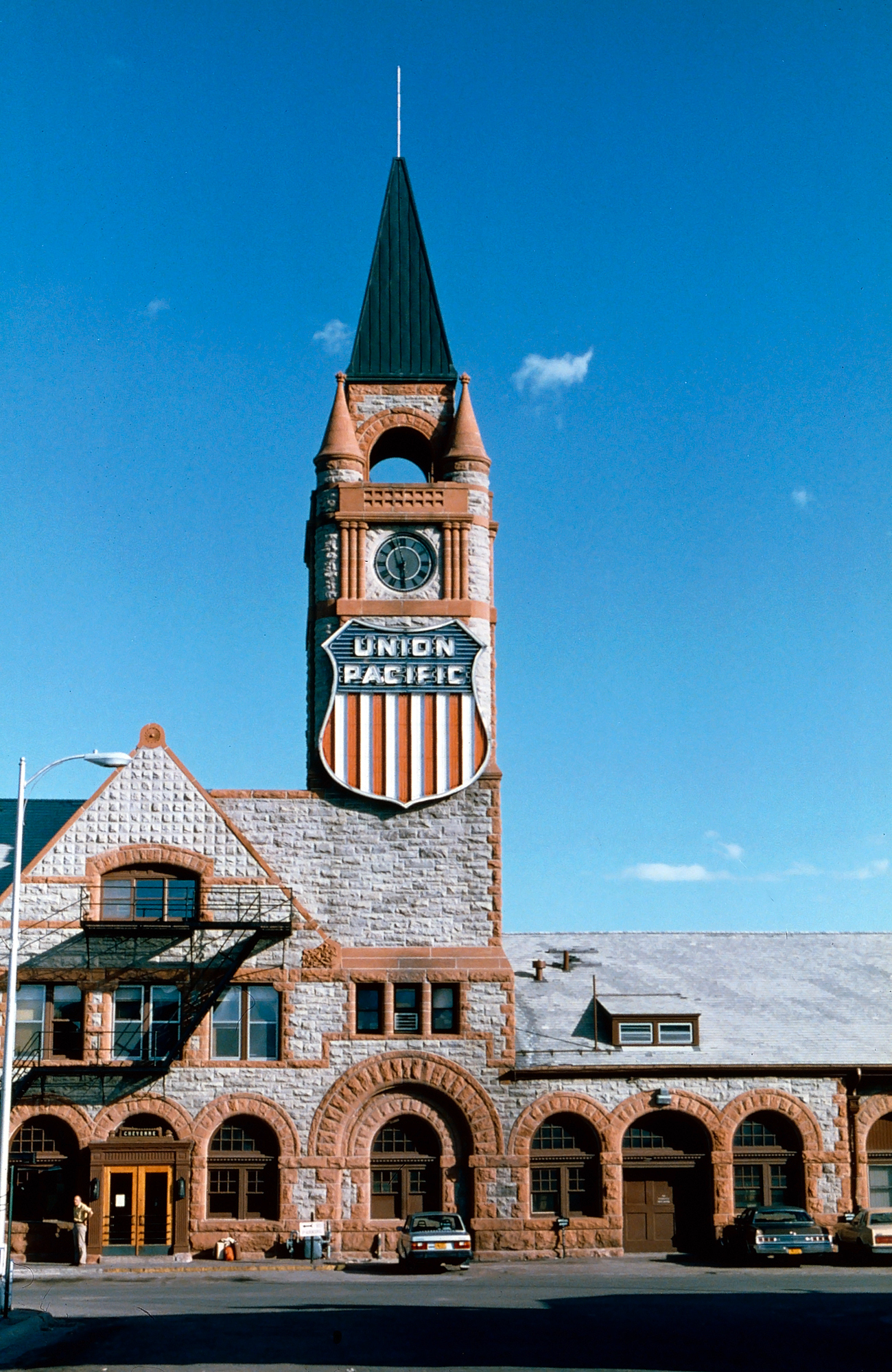 Union Pacific's beautiful station in Cheyenne, Wyoming, circa 1984. The facility was built in the Richardsonian Romanesque style during the 1880s featuring sandstone quarried near Fort Collins, Colorado. Mike Bledsoe photo. American-Rails.com collection.
History
Our country's first common-carrier, the Baltimore & Ohio, is also credited with establishing two of the earliest known train stations in this country.
In May of 1830 it inaugurated service between a small depot at Ellicott's Mills, Maryland (now known as Ellicott City) and its then-primary stop in Baltimore, Mount Clare.
Both structures are preserved today, recognized as National Historic Landmark's due to their age and economic importance.
The classic train station was a true work of art, crafted in a variety of mediums (brick, wood, stone, marble, etc.) as architects maintained a constant eye towards opulence and beauty.
There were several styles utilized, depending upon the region (Victorian, for instance, was often found in the Northeast/New England while Spanish Revival normally appeared in the Southwest). Many are covered in more detail below.
As Brian Solomon notes in his book, "Railway Depots, Stations & Terminals," during the industry's "Golden Age" (through World War I) it is estimated 80,000 depots or terminals were in service!
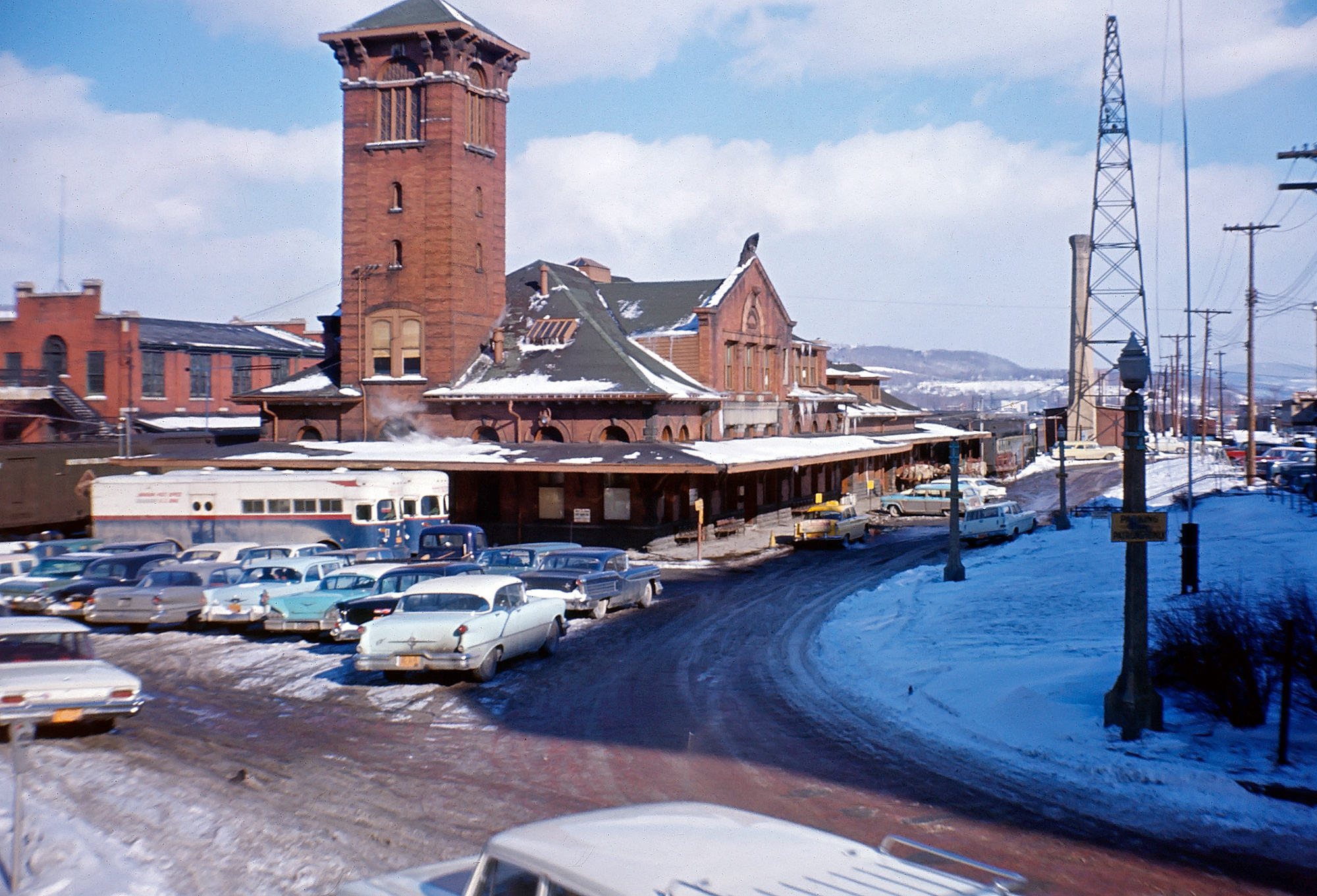 The former Lackawanna station in Binghamton, New York during the early Erie Lackawanna era, circa 1960. The building, completed in 1901 in the Italian Renaissance style featuring a campanile (bell tower), still stands today, restored. American-Rails.com collection.
The grand buildings we remember so well today, places like Los Angeles Union Passenger Terminal, Chicago Union Station, Grand Central Terminal, Boston's South Station, and Seattle's King Street Station often receive the greatest attention in literally circles.
However, it was the small town depot that truly kept America humming. Until the age of the automobile, widespread use of the household telephone, and development of the airliner the depot was a town's lifeline; for so many communities these facilities provided the only connection to the outside world.
It was quite common to see folks mingling around a local train station at all hours of the day awaiting incoming news. As Hans and April Halberstadt point out in their book, "The American Train Depot And Roundhouse," the physical building was not only used for passengers but also staffed an agent/operator.
In an age before telephones or wireless communication this person was essential in keeping train movements safe and efficient.
In such territory not protected by centralized traffic control (CTC) or some other type of signaling system, trains operated by the so-called "Timetable Authority" method whereby a dispatcher held direct control over a particular segment of track.
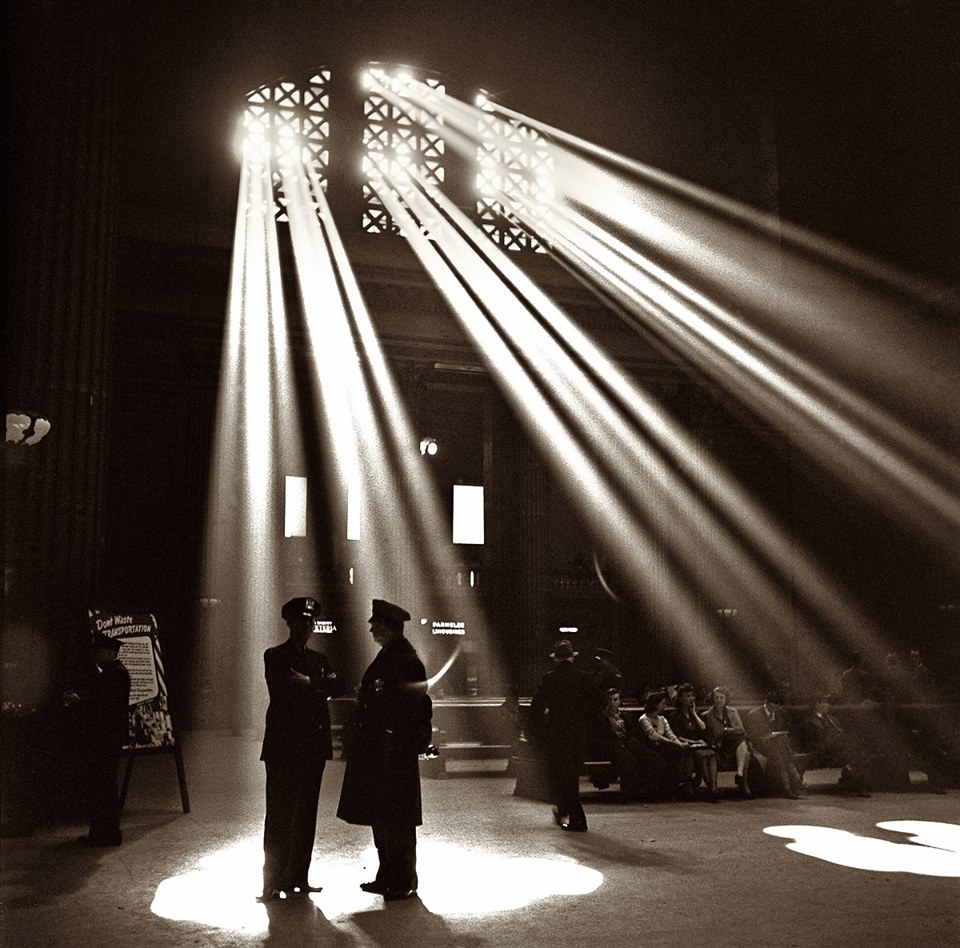 In another fabulous use of shadow and light, legendary photographer Jack Delano captured sunbeams filtering into Chicago Union Station's waiting room during the height of World War II in January of 1943.
While a dispatcher knew where a train should be at any particular time the train station operators/agents would report (via telegraph, and later telephone) when trains had reached their location using a two-letter identification specific to each depot (the so-called "OS" or "On Sheet" report).
In addition, if orders were required the agent/operator would write these down (received by a telegraph from the dispatcher) then hand them up on the fly using a large hoop (sometimes permanently mounted near the tracks).
Both the head-end crew (usually the fireman) and those in the caboose (typically the flagman) received these "nineteen" orders, often referred to as "flimsies" (there were also "thirty-one" orders which required the train to physically stop and the engineer sign off on the directive). The operator always made at least three copies (office, engineer [head-end], and conductor [caboose]).
This helped ensure redundancy, safety, and that the orders were clearly understood. It became a true skill for crewmen to grab these, at-speed (misses were rare but did occur!). Within an industry that sometimes changes little over many decades issuing orders in this manner survived well into the 1980's.
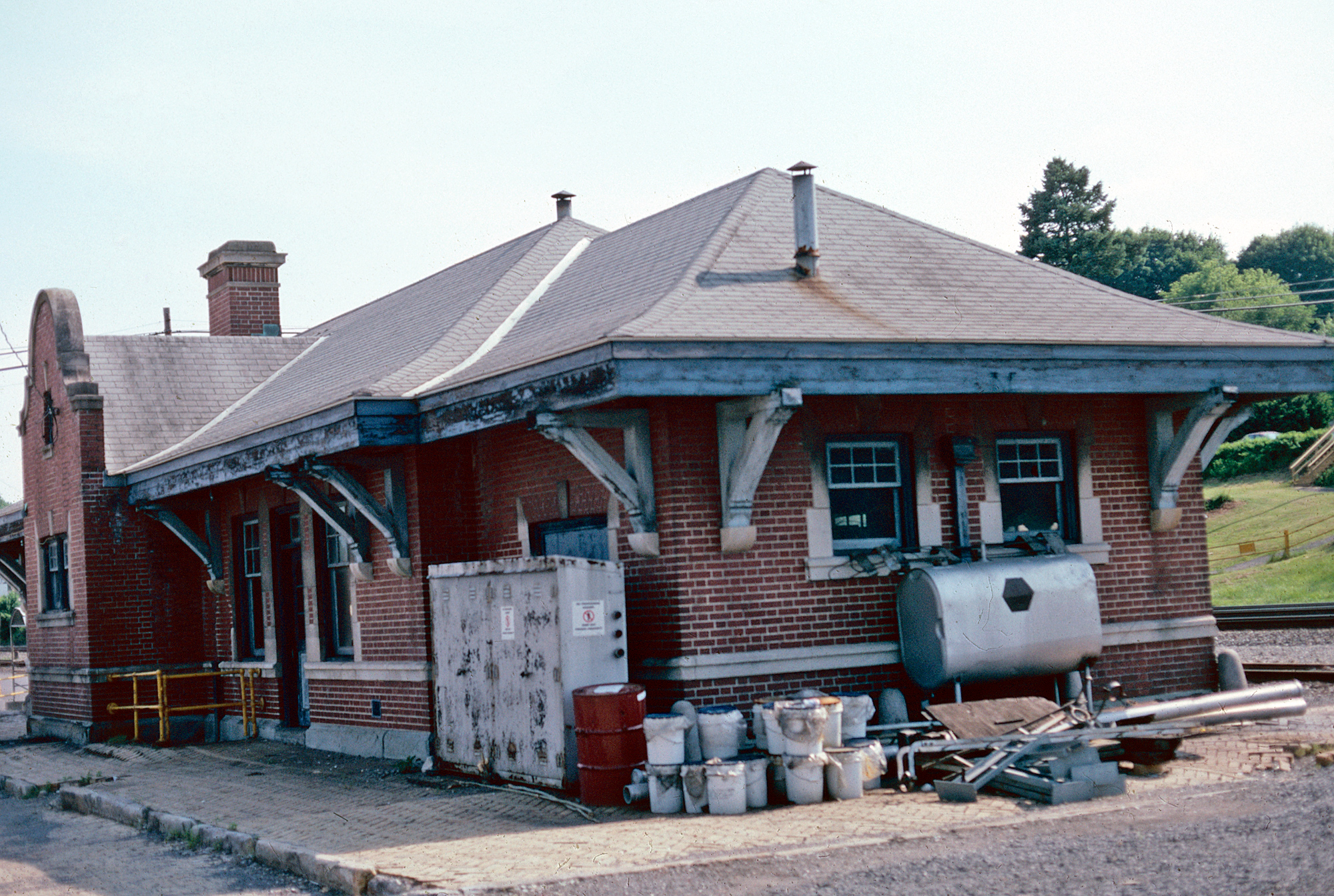 The former Pennsylvania Railroad depot in Mifflin, Pennsylvania is seen here in June, 1996. American-Rails.com collection.
In the Halberstadt's book they interviewed former Southern Pacific station agent Dick Maurer who described in more detail the hoop system:
"'Originally, train orders were passed up on a bamboo hoop,' Dick says, 'then later, on a Y-shaped bracket on a pole beside the track.
The order was attached to a loop of string clipped to the bracket; the fireman put his arm out of the cab of the locomotive and snagged the loop as they went by. Sometimes they missed, and then the train had to stop and he'd have to walk back to get the order.'"
Depots were also equipped with a semaphore system, controlled by the operator, which informed the inbound crew if orders were to be received. Each railroad had their own system but, generally, if the blade was in the vertical position a train could proceed.
However, if horizontal orders were in order! As the 20th century progressed some depots updated this with a modern, lit system featuring green, yellow, or red lights. To learn more about these train order signals please click here.
Aside from an operator a depot almost always held offices for the Railway Express Agency. In his book, "Ten Turtles To Tucumcari," Klink Garrett describes what it was like to work as an agent at REA where he was employed from 1935 until 1972, witnessing both its greatest prosperity and final days.
The company's red diamond logo could be found on nearly every depot, which always included its own delivery truck (decorated in deep forest green) for local shipments.
Even depots in extremely rural locations, such as the Chicago, Burlington & Quincy's facility at Hot Springs, South Dakota were staffed.
In some extremely out-of-the-way communities, such as Shoshoni, Wyoming there was not even a depot but nevertheless one could find an REA agent. In this case they were holed up in Burlington's local section house and even had a delivery truck (with an accompanying garage) to pick up packages from nearby rail sidings.
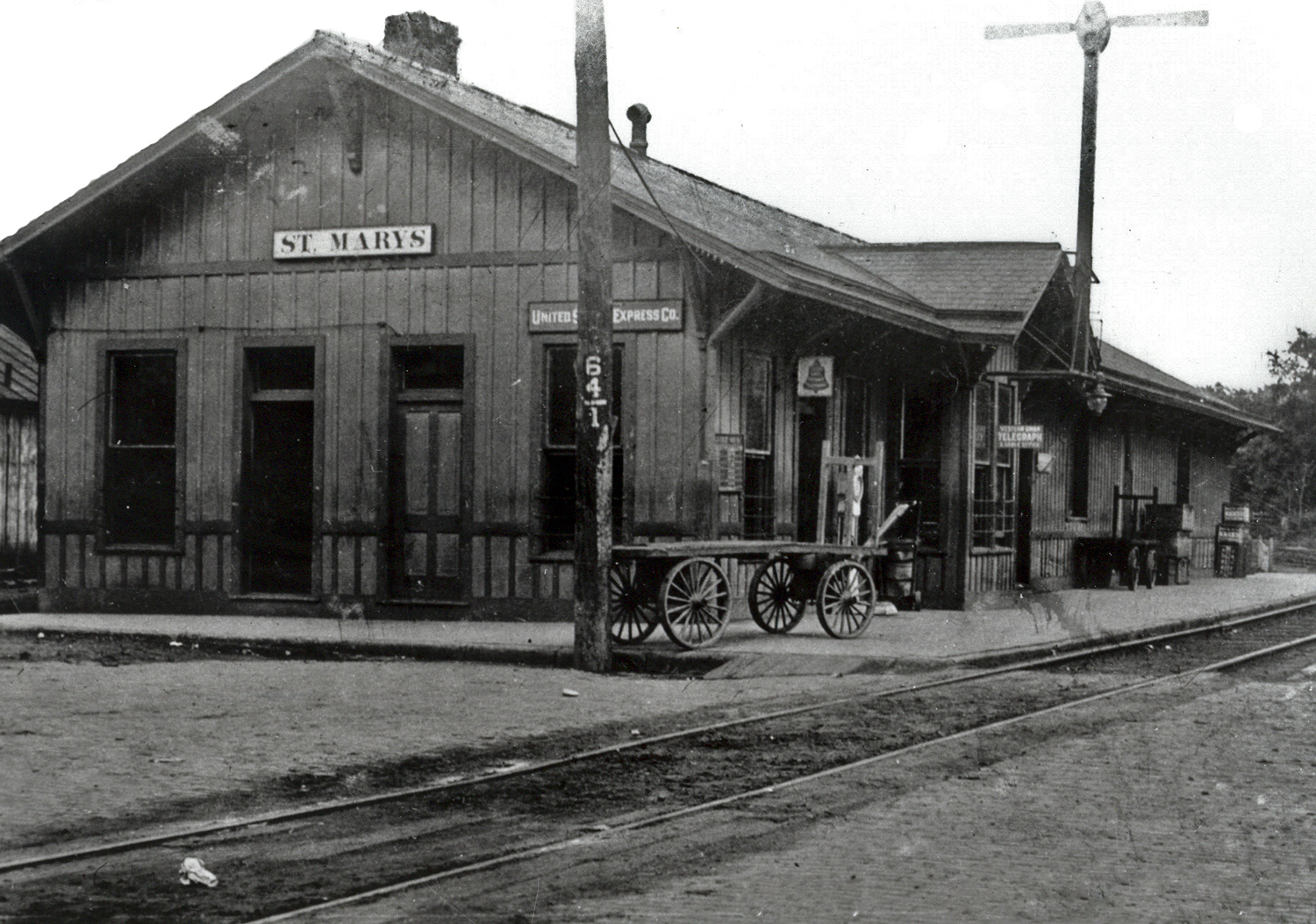 Seen here is the small town depot in St. Marys, West Virginia during the early 1900s. The building was razed in the 1960s. Author's collection.
Depots, Train Stations Or Terminals?
The term "train station" is generally described as the physical building where passengers boarded and departed from their train. However, the railroad actually defined a "station" as a stopping point that may, or may not, contain a building.
These locations could feature anything from a customer or water tank to a siding or simply a sign. The "depot" was the nomenclature regularly reserved for small facilities while "terminal" often described the very large structures such as Grand Central Terminal, Boston's South Station, or Chicago's Dearborn Station.
There was also the term "union station," detailing those buildings used/shared by at least two or more railroads. It ranged from one no larger than a typical depot to Chicago's grand Union Station.
Architecture
During the 19th and early 20th centuries architecture was very different from today's largely geometric buildings. Back then style, elegance, and appearance were as equally important as the building's function and purpose.
This was especially true with railroad stations, both large and small The largest and most spectacular also boasted a company's wealth and power, often found in the biggest metropolitan areas such as New York, Buffalo, Philadelphia, Washington, Seattle, and Los Angeles.
Alas, many would meet the wrecking ball while a few have been beautifully restored to their original appearance. Included here are many of the common architectural styles used in their construction.
Beaux Arts
Perhaps the most common style was the Beaux Arts design, which could be found employed within many large terminals, including New York's Pennsylvania Station and Grand Central Terminal. After its unveiling at the 1893 World's Colombian Exposition in Chicago it remained popular through the early 20th century.
According to Hans and April Halberstadt's book, "The American Train Depot And Roundhouse," the style was named for the French School of Design, once known as the Nationale Ecole des Beaux Arts (National School Of Fine Art).
Train stations built in the Beaux Arts style featured enormous arches, colonnades, domes, and columns to draw attention and awe.
Chateau
This style dates back to the Medieval period of France when many castles and stately buildings were erected with ornate stonework, steeply pitched roofs, and spiral peaks.
In terms of railroad architecture it was often employed as an addition or auxiliary feature, not as the primary design. The preeminent terminal built in the Chateau style was St. Louis Union Station, the work of firm Link & Cameron. It still stands today, one of the city's featured attractions.
Colonial
The Colonial design is a general designation usually referring to depots which had some type of intricate woodwork or decoration.
Historians technically refer to Colonial styles (French, Spanish, American, Dutch, German, etc.) as those built before 1800 but are occasionally used to describe small stations dressed in this manner, usually found in New England or the Northeast.
Gothic
Another style borrowed from the Medieval period stations built in Gothic Revival resembled grand, fortified castles and cathedrals with steeples, sharp roof lines, spiraling peaks, and towers.
The larger facilities were constructed in stone while smaller depots carried decorative woodwork. It was most often used in the 19th century.
Greek Revival
In large stations this style could usually be found as an addition incorporated into an overall design, such as Beaux Arts. However, many small depots carried the architecture throughout. It was meant to evoke the importance of Greek architecture, such as the magnificent Parthenon, and endures today.
Italianate
The true Italianate style has largely disappeared as no railroad structures featuring it survive. However, those of the Victorian Italianate style have persevered, providing a glimpse of this subtle but ornate architecture.
The Italianate style was first used by English architect John Nash in 1802 and borrowed from the designs of the 16th-century Italian Renaissance style. Its prominent features included an overall rectangular appearance with a flat roof line.
However, the windows were normally arched with beautiful trim highlights, including the roof. It first gained appeal in the United States prior to the Civil War and again at the turn of the 20th century (then classified as Victorian Italianate).
Mission/Mission Revival
This style was exclusive to the West and Southwest calling upon the region's history with Mexico and Central America.
Specifically, stations carrying this architecture were modeled after the California missions built along the El Camino Real by Franciscan missionaries between 1769 and 1823.
Their prominent features included a stucco, plaster, or adobe exterior with roofing made from curved tiling. In addition, prominent archways adorn all aspects of the building and include at least one quatrefoil window.
The interior usually featured some type of ceramic tiling and, on occasion, wood trim. Finally, the more prominent terminals employed a grand bell tower, such as the Santa Fe's gorgeous facility in San Diego (adorned in two), opened in 1915. The AT&SF and Southern Pacific most often constructed mission style depots.
Revival
A very general term, "Revival" often describes a reused architectural style many decades or centuries after it was first employed. Most styles mentioned here are technically revivals from an earlier period.
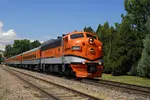
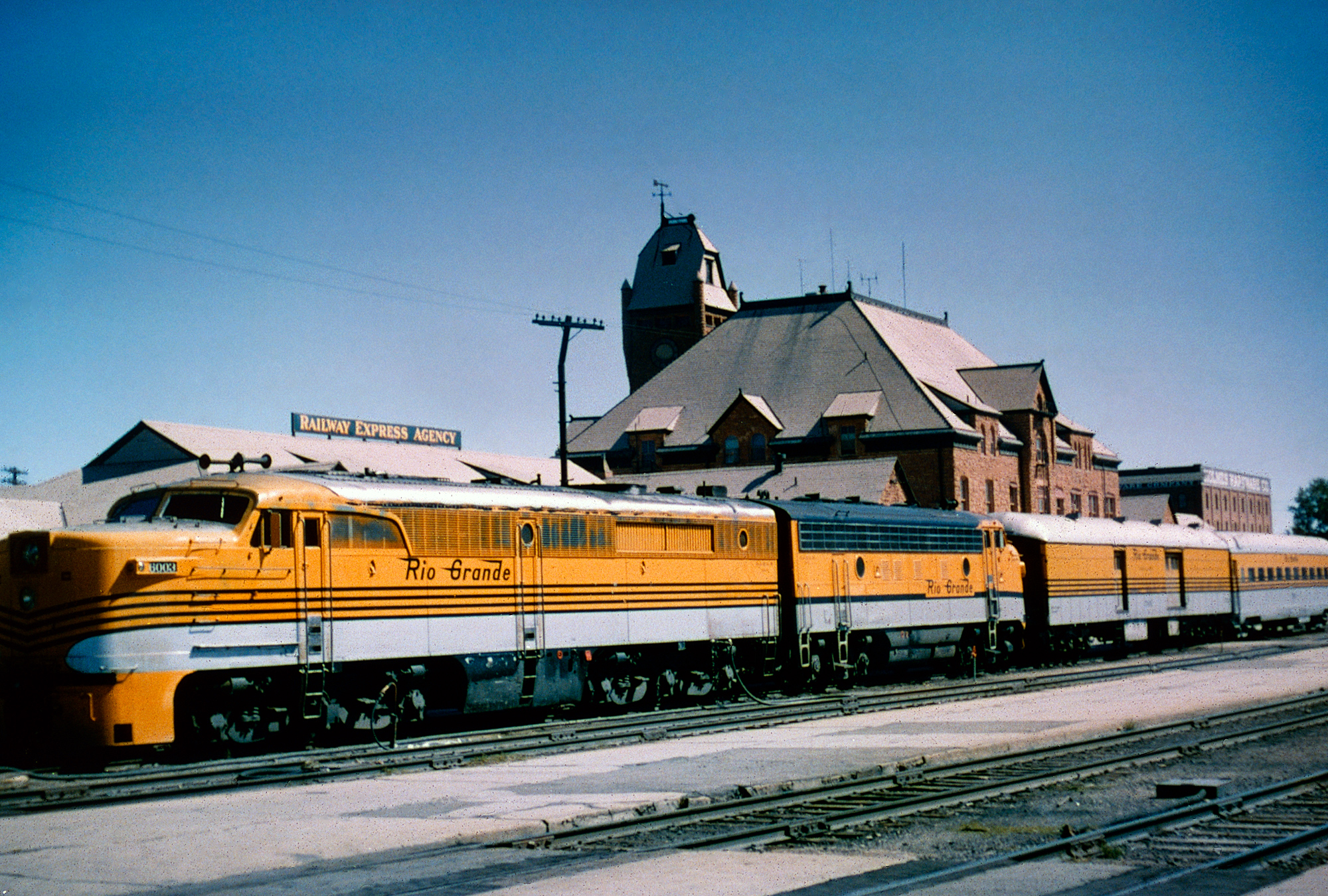 Rio Grande PA-1 #6003 and F7A #5551 are stopped in front of the beautiful Union Depot at Pueblo, Colorado with the "Royal Gorge" on October 2, 1965. This building was contracted in the Richardsonian Romanesque style in 1889–1890. It still stands today. Ed Fulcomer photo. American-Rails.com collection.
Romanesque
Another popular style during the heyday of train station construction was Romanesque, sometimes referred to as Romanesque Revival.
It called upon the ancient Roman's stonework architecture that often carried arches adorned by a centered keystone at the top; domes were also widely used and everything was clad in grand stonework as the base material.
Henry H. Richardson was usually commissioned by railroads for smaller depots but he employed the Romanesque theme so often a variant style was named after him, Richard Romanesque.
Victorian
The last great architectural style was the Victorian theme, named after England's Queen Victoria when she ruled from 1837 to 1901. These depots were characterized by their grand peaks, tall clock towers, arched windows, and stone/brick masonry.
The style was similar to Gothic and also hailed from the Medieval period of great castles and cathedrals. Smaller depots were often built partially or entirely of wood while also carrying the steep roof lines and beautiful decorative touches that defined Victorian designs; the so-called "Gingerbread House" look.
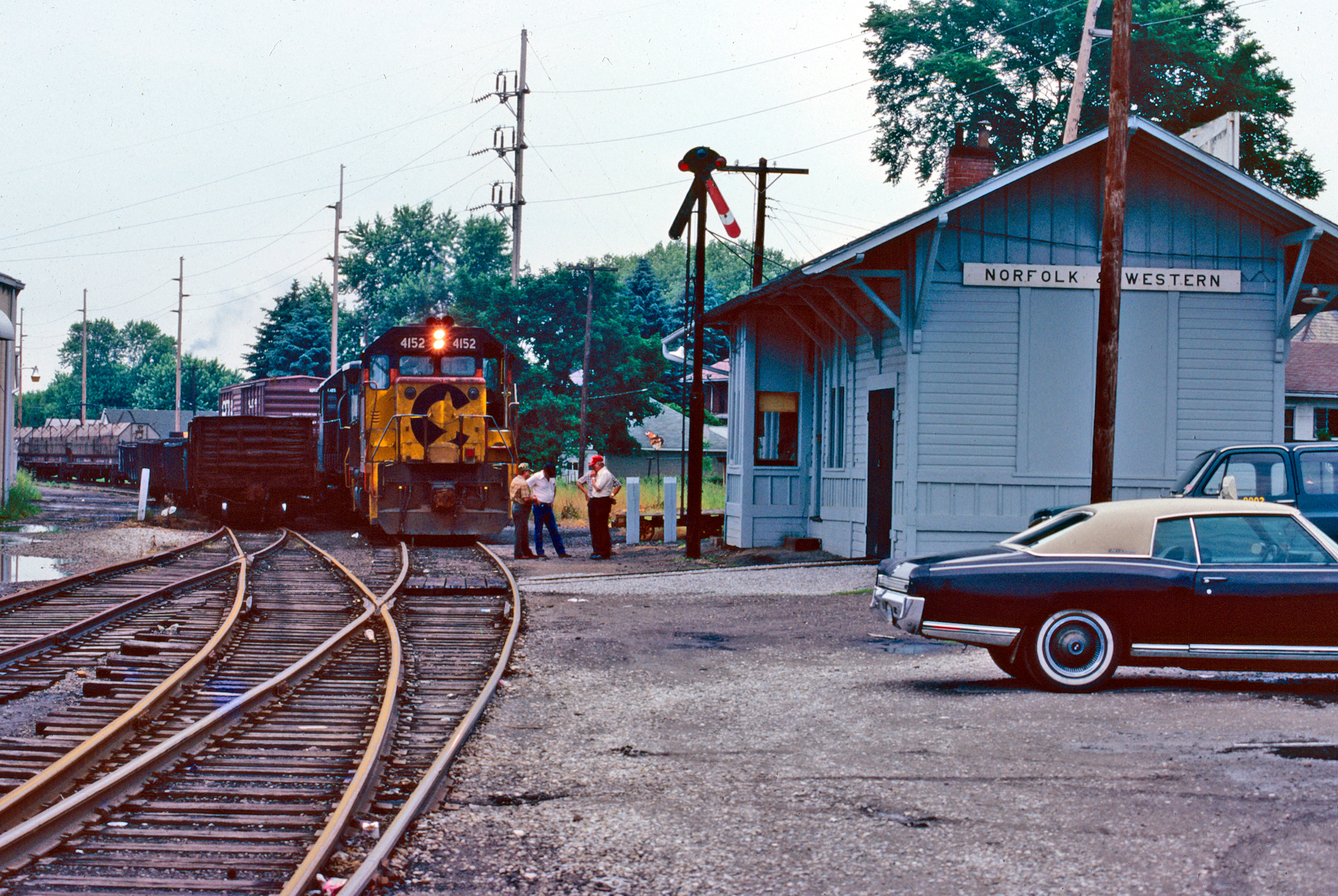 Baltimore & Ohio GP40-2 #4152 is stopped at the Norfolk & Western depot (ex-Nickel Plate) in Coshocton, Ohio as the crew chat with the agent while working local service; June, 1983. American-Rails.com collection.
As the automobile came of age the local depot fell from importance, declining with each passing decade after World War II. Finally, by the 1970's most small-town facilities still in use held only the local operator. As maintenance waned the buildings became dilapidated and rundown.
Even large terminals like Penn Station showed significant signs of neglect in its final years. The information listed above is a compilation of many such buildings which survive in some form across the country, broken down by state. Please by aware that unless otherwise noted the buildings highlighted describe only passenger facilities.
If interested, the Railroad Station Historical Society provides detailed information concerning all known extant structures (roundhouses, water tanks, section houses, etc.). I realize there may be corrections/additions to any of the above lists.
If you may know of any please let me know (either through e-mail or simply make a post below to the Facebook comments) and I will work to get the information up-to-date. Many thanks in advance for any bit of help you may have!
Noted Architects
There were several architects or firms that designed train stations during the 19th and early 20th centuries.
Individuals such as E. Francis Baldwin were known for smaller facilities while Mead, McKim & White conceived arguably the greatest terminal ever built, Pennsylvania Railroad's spectacular Pennsylvania Station on Manhattan Island.
Included here is a brief look at many and the prevailing styles they employed, ranging from the classic Beaux Arts to the opulent Romanesque Revival.
Bradford Lee Gilbert (1853-1911)
Gilbert was a native of Watertown, New York and held a solo practice in New York City. He is credited with scores of depots, large terminals, and related facilities.
Two of his most notable projects included redesigning New York Central's Grand Central Station in Manhattan (before it was replaced by Central Terminal) as well as drawing up Illinois Central's gorgeous Central Station in Chicago.
He began his railroad work at the age of 23 when hired as the New York, Lake Erie & Western's (Erie Railroad) chief architect in 1876. Over the years he was commissioned by many companies such as the New Haven, Reading, Boston & Maine, Jersey Central, Ontario & Western, and Pere Marquette among others.
Daniel Hudson Burnham (1846 - 1912)
An accomplished architect, Burnham predominantly designed buildings outside of the railroad industry such as Chicago's Masonic Temple Building, one of the country's first true skyscrapers.
He became partners with John Wellburn Root as part of the firm, Burnham & Root. After Root's death in 1891 the business was renamed D.H. Burnham & Company. Burnham largely worked in the Beaux Arts style with Greek and Roman themes.
His most famous work was collaborating with William Pierce Anderson in designing Washington Union Station which opened in 1908. The facility remains an important passenger terminal today.
Ephraim Francis Baldwin (1837 – 1916)
The Baltimore & Ohio hired Baldwin in 1872 as its head architect and he went on to design numerous depots, shops, and related buildings for the railroad over the next few decades across Maryland, West Virginia, and southwestern Pennsylvania.
Arguably his most famous work was at Point of Rocks, Maryland where he conceived a stunning Victorian/Gothic train station located at the point where the B&O's new and old main lines met.
With its high bell tower, decorative trim, and ornate windows it held the appearance of a bucolic church. The building still stands today.
Graham, Anderson, Probst & White
This Chicago firm was the successor to D.H. Burnham & Company through Burnham's surviving partner, Ernest R. Graham, and his sons, Hubert Burnham and Daniel Burnham, Jr.
It was originally founded in 1912 as Graham, Burnham & Company and changed to Graham, Anderson, Probst & White in 1917 when Burnham's sons left to form their own practice.
They are best known for working in the Beaux Arts style and designing Chicago Union Station. However, they were also commissioned by other railroads such as the Burlington and Chesapeake & Ohio.
Fellheimer & Wagner
Based in New York City this firm was the partnership of Alfred T. Fellheimer and Steward Wagner.
The two are credited with designing Cincinnati Union Terminal and New York Central's Buffalo Central Terminal, both designed with Art Deco touches during the last years of terminal construction.
They, and/or other partners, conceived a number of additional facilities such as Utica Union Station, Erie Union Station (Pennsylvania), Macon Terminal Station (Georgia), and Burlington Union Station (Vermont).
Francis Hatch Kimball (1845–1919)
Kimball studied architecture in England and his best known works were in New York City where he designed Fifth Avenue Theatre, the Montauk Club, and Corbin Building among others.
His one notable rail project was designing the Philadelphia & Reading's largest passenger facility, Reading Terminal in downtown Philadelphia. It still stands today, beautifully restored although no longer handles trains.
Frank Furness (1839 - 1912)
Frank Furness had a prolific career in architecture and life itself; he is credited with more than 600 building designs and was a captain in the Civil War during which time he earned the Medal of Honor.
He attended the École des Beaux-Arts-inspired atelier of Richard Morris Hunt in New York between the years of 1859 and 1861, returning to finish his studies in 1865 after the war.
He was the longtime chief architect of the Philadelphia & Reading designing some 130 train stations and buildings for that company alone. He also designed facilities for the Baltimore & Ohio in Wilmington,
Delaware; Frenchtown, Maryland; Pittsburgh; Chester; Morrisville; Edgewood; and its beautiful facility at Chestnut Street in Philadelphia.
Finally, the Pennsylvania Railroad often hired Furness for its depots with his most notable project being the redesign and upgrade of Philadelphia's Broad Street Station before it was later demolished and replaced by 30th Street Station
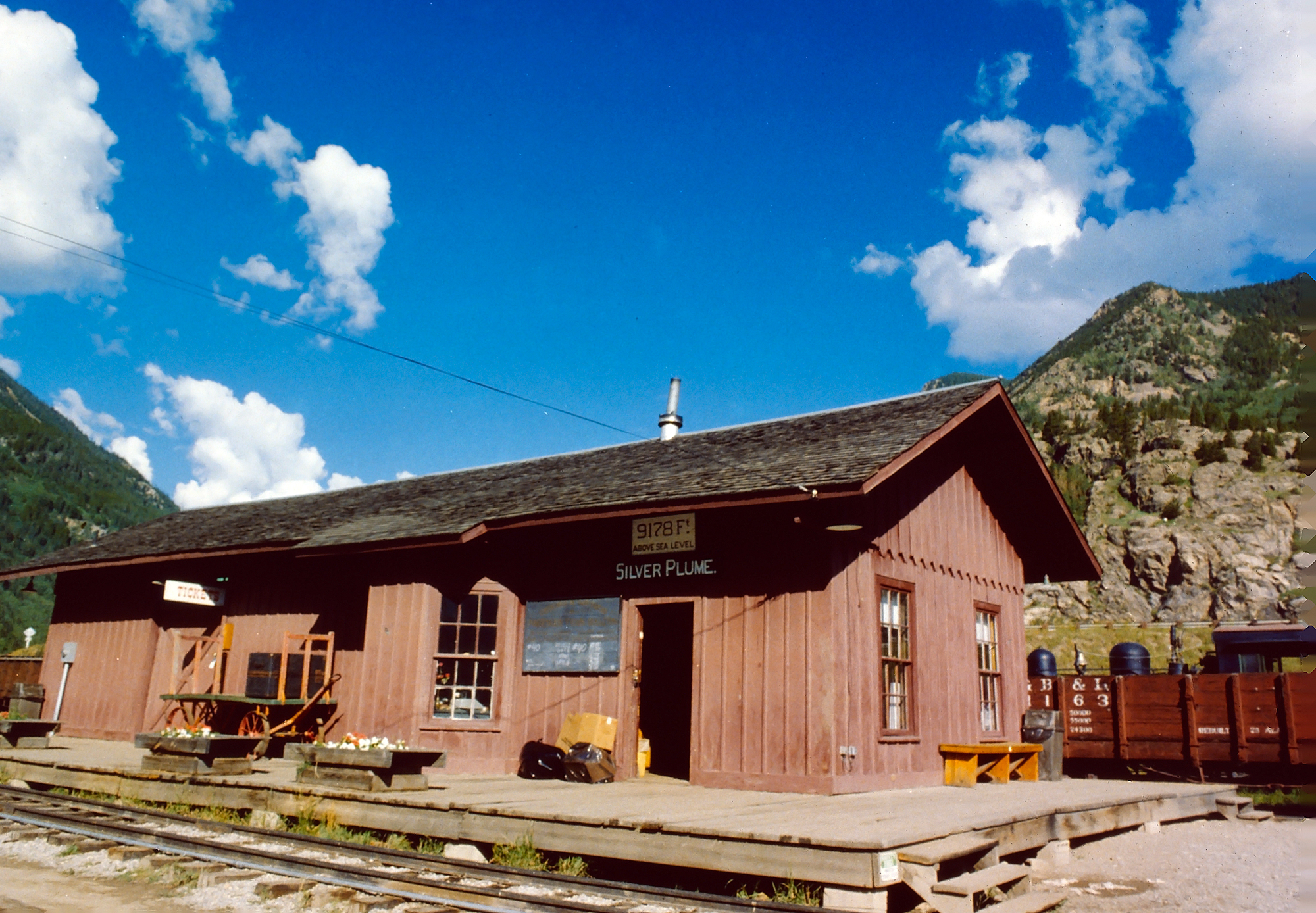 The historic Colorado Central depot in Silver Plume, Colorado; now part of the popular Georgetown Loop Railroad excursion. The structure was built in 1883-1884, and later became part of the Colorado & Southern. American-Rails.com collection.
Henry Hobson Richardson (1838-1886)
Richardson was a prominent architect who studied at Harvard College and Tulane University, later attending the École des Beaux Arts in Paris. He designed many buildings in the U.S. ranging from libraries and homes to churches and commercial structures.
His train stations were largely concentrated in the Northeast where he was commissioned by the Boston & Albany. The architect worked so often in the Romanesque style that a version was named after him, Richardsonian Romanesque.
Jarvis Hunt (1863 - 1941)
While Hunt designed many buildings outside of the railroad industry he has several terminals credited to his name such as Kansas City Union Station, Joliet Union Station, Dallas Union Station, and Union Pacific's headquarters in Omaha, Nebraska.
He often worked in the Beaux Arts style and trained at Harvard University as well as the Massachusetts Institute of Technology' school of architecture.
Link & Cameron
A firm based in St. Louis it included the team of Thomas C. Link and Edward B. Cameron.
Their most famous terminal was the beautiful St. Louis Union Station designed in the French Romanesque style meant to resemble a stunning chateau along the Loire River in France. The facility is fully restored today and a popular city landmark.
Mead, McKim & White
One of the most successful firms throughout the early 20th century, the group was headed by Charles Follen McKim (1847–1909), William Rutherford Mead (1846–1928) and Stanford White (1853–1906).
They are credited with designing numerous buildings across New England, usually centralized around New York City where their business was based.
They were also commissioned for projects across the country and even performed work in Cuba, Italy, and Canada. Their most famous project was Pennsylvania Railroad's iconic Pennsylvania Station in downtown Manhattan.
Reed & Stem
This firm, based in St. Paul, was the partnership of Charles A. Reed (1858–1911) and Allen H. Stem (1856–1931).
They designed numerous passenger terminals, many quite famous and were often commissioned by the Northern Pacific. Notable facilities include Grand Central Terminal (New York), King Street Station (Seattle), Michigan Central Station (Detroit), and Tacoma Union Station.
Renowned Terminals
Main Street Station (Richmond)
Terminal Station (Chattanooga Choo Choo)
Union Stations
Depots
Surviving
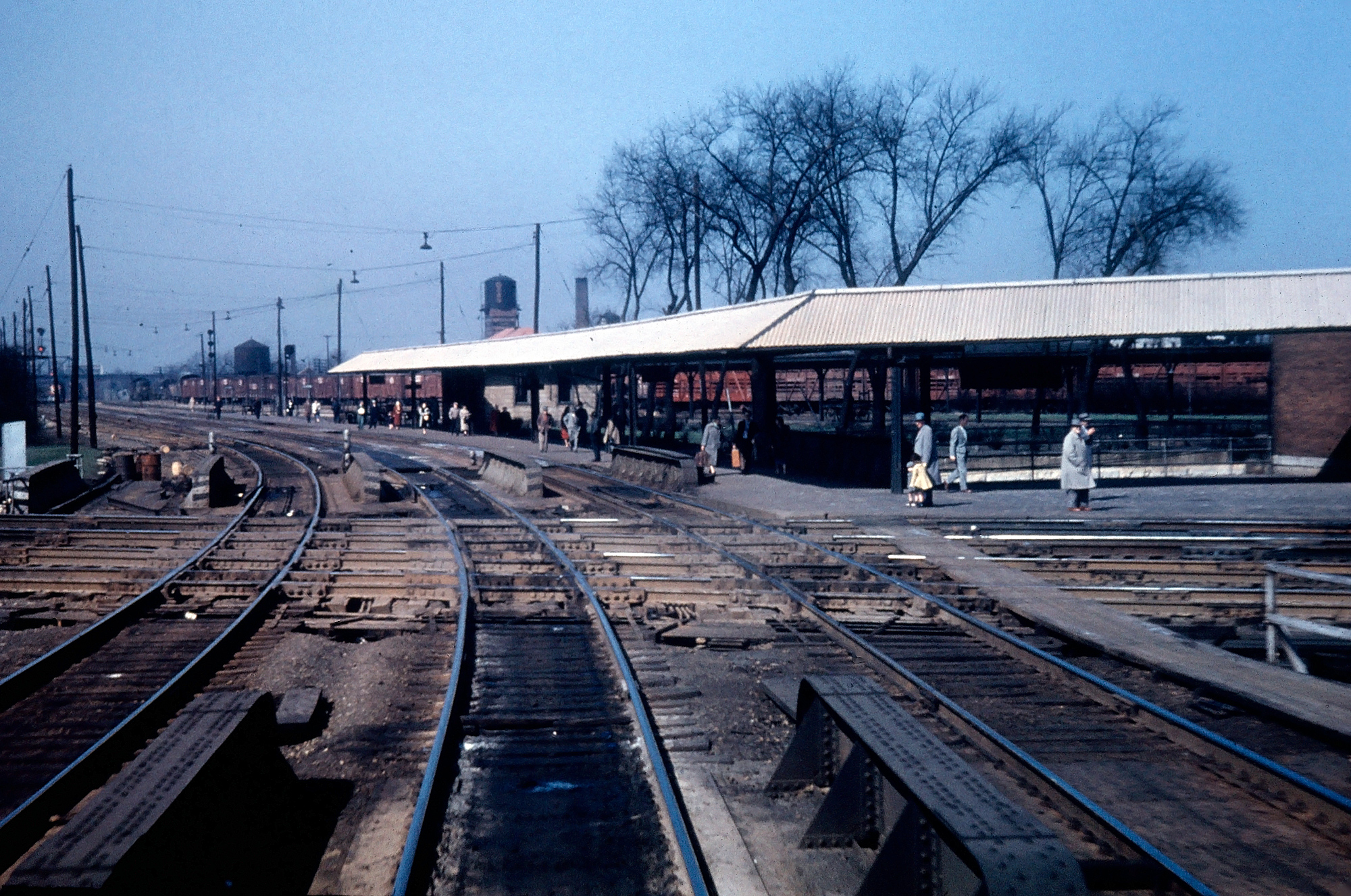 A 1950s view of Englewood Union Station in Chicago. Looking ahead is the Rock Island main line while the Pennsylvania can be seen crossing from left to right. Despite its small size this was a very busy facility for both commuter and long distance trains. It was also used by the Nickel Plate Road and New York Central. A.C. Kalmbach photo. American-Rails.com collection.
As rail travel faded the demolition of New York's landmark, Pennsylvania Station, truly marked its collapse.
The amazing terminal survived a mere 53 years before a struggling PRR sold the facility's above-ground air rights in 1962; dismantling of the structure began a year later on an overcast October 28, 1963.
While the loss of Penn Station was a significant blow it signaled a poignant change to future preservation efforts; a similar move under Penn Central (PRR's successor) to raze Grand Central Terminal was blocked. The New York City Landmarks Preservation Commission was created by Mayor Robert F. Wagner, Jr. in April of 1965.
It was charged with administering the city's Landmarks Preservation Law and overseeing the protection of historic buildings.
One of its first acts designated nearby Grand Central Terminal a city landmark, sparing it a similar fate. Today, the facility is one of the city's most treasured and visited sites and it still serves as a functioning passenger terminal.
Recent Articles


-
Massachusetts Dinner Train Rides On Cape Cod
Feb 02, 26 12:22 PM
 The Cape Cod Central Railroad (CCCR) has carved out a special niche by pairing classic New England scenery with old-school hospitality, including some of the best-known dining train experiences in the…
 -
Maine's Dinner Train Rides In Portland!
Feb 02, 26 12:18 PM
 While this isn’t generally a “dinner train” railroad in the traditional sense—no multi-course meal served en route—Maine Narrow Gauge does offer several popular ride experiences where food and drink a…
 -
Oregon St. Patrick's Day Train Rides
Feb 02, 26 12:16 PM
 One of the Oregon Coast Scenic's most popular—and most festive—is the St. Patrick’s Pub Train, a once-a-year celebration that combines live Irish folk music with local beer and wine as the train glide…
 -
Connecticut Wine Tasting Train Rides
Feb 02, 26 12:13 PM
 If you’re looking for a signature “special occasion” experience, the Essex Steam Train's Wine & Chocolate Dinner Train stands out as a decadent, social, and distinctly memorable take on dinner on the…
 -
Massachusetts St. Patrick's Day Train Rides
Feb 02, 26 12:12 PM
 Among Cape Cod Central's themed events, the St. Patrick’s Day Brunch Train stands out as one of the most fun ways to welcome late winter’s last stretch.
 -
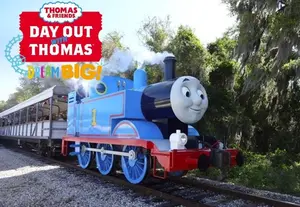
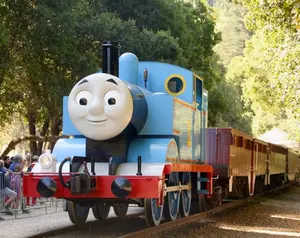
Florida's Thomas The Train Rides
Feb 02, 26 11:53 AM
 Each year, Day Out With Thomas™ turns the Florida Railroad Museum in Parrish into a full-on family festival built around one big moment: stepping aboard a real train pulled by a life-size Thomas the T…
 -
California's Thomas The Train Rides
Feb 02, 26 11:45 AM
 Held at various railroad museums and heritage railways across California, these events provide a unique opportunity for children and their families to engage with their favorite blue engine in real-li…
 -
Nevada Dinner Train Rides At Ely!
Feb 02, 26 09:52 AM
 If you’ve ever wished you could step through a time portal into the hard-working world of a 1900s short line the Nevada Northern Railway in Ely is about as close as it gets.
 -
Michigan Dinner Train Rides At Owosso!
Feb 02, 26 09:35 AM
 The Steam Railroading Institute is best known as the home of Pere Marquette #1225 and even occasionally hosts a dinner train!
 -
Virginia ~ Murder Mystery ~ Dinner Train Rides
Feb 01, 26 01:08 PM
 Among the state's railroad attractions, murder mystery dinner trains stand out as a captivating fusion of theatrical entertainment, fine dining, and scenic travel.
 -
Maryland ~ Murder Mystery ~ Dinner Train Rides
Feb 01, 26 12:29 PM
 Maryland is known for its scenic landscapes, historical landmarks, and vibrant culture, but did you know that it’s also home to some of the most thrilling murder mystery dinner trains?
 -
North Carolina St. Patrick's Day Train Rides
Feb 01, 26 12:21 PM
 If you’re looking for a single, standout experience to plan around, NCTM's St. Patrick’s Day Train is built for it: a lively, evening dinner-train-style ride that pairs Irish-inspired food and drink w…
 -
Connecticut St. Patrick's Day Train Rides
Feb 01, 26 12:19 PM
 Among RMNE’s lineup of themed trains, the Leprechaun Express has become a signature “grown-ups night out” built around Irish cheer, onboard tastings, and a destination stop that turns the excursion in…
 -
Alabama's Valentine's Train Rides
Feb 01, 26 12:17 PM
 The Heart of Dixie Railroad Museum (HoDRM) is the kind of place where history isn’t parked behind ropes—it moves. This includes Valentine's Day weekend, where the museum hosts a wine pairing special.
 -
Florida's Valentine's Train Rides
Feb 01, 26 11:25 AM
 For couples looking for something different this Valentine’s Day, the museum’s signature romantic event is back: the Valentine Limited, returning February 14, 2026—a festive evening built around a tra…
 -
Connecticut's Valentine's Train Rides
Feb 01, 26 11:03 AM
 Operated by the Valley Railroad Company, the attraction has been welcoming visitors to the lower Connecticut River Valley for decades, preserving the feel of classic rail travel while packaging it int…
 -
Virginia's Valentine's Train Rides
Feb 01, 26 11:00 AM
 If you’ve ever wanted to slow life down to the rhythm of jointed rail—coffee in hand, wide windows framing pastureland, forests, and mountain ridges—the Virginia Scenic Railway (VSR) is built for exac…
 -
Maryland's Valentine's Train Rides
Feb 01, 26 10:54 AM
 The Western Maryland Scenic Railroad (WMSR) delivers one of the East’s most “complete” heritage-rail experiences: and also offer their popular dinner train during the Valentine's Day weekend.
 -
Massachusetts ~ Wine Tasting ~ Train Rides
Feb 01, 26 10:27 AM
 This article dives into some of the alluring aspects of wine by rail in Massachusetts, currently offered by the Cape Cod Central Railroad.
 -
Kentucky Dinner Train Rides At Bardstown
Jan 31, 26 02:29 PM
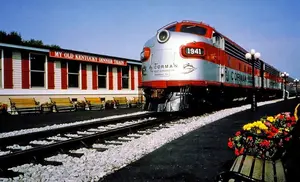
 The essence of My Old Kentucky Dinner Train is part restaurant, part scenic excursion, and part living piece of Kentucky rail history.
 -
Arizona Dinner Train Rides From Williams!
Jan 31, 26 01:29 PM
 While the Grand Canyon Railway does not offer a true, onboard dinner train experience it does offer several upscale options and off-train dining.
 -
Washington "Valentine's" Train Rides
Jan 31, 26 12:02 PM
Whether you’re a dedicated railfan chasing preserved equipment or a couple looking for a memorable night out, CCR&M offers a “small railroad, big experience” vibe—one that shines brightest on its spec… -
Georgia "Valentine's" Train Rides
Jan 31, 26 11:55 AM
 If you’ve ridden the SAM Shortline, it’s easy to think of it purely as a modern-day pleasure train—vintage cars, wide South Georgia skies, and a relaxed pace that feels worlds away from interstates an…
 -
Maryland ~ Wine Tasting ~ Train Rides
Jan 31, 26 11:49 AM
 This article delves into the enchanting world of wine tasting train experiences in Maryland, providing a detailed exploration of their offerings, history, and allure.
 -
Colorado ~ Wine Tasting ~ Train Rides
Jan 31, 26 11:40 AM
 To truly savor these local flavors while soaking in the scenic beauty of Colorado, the concept of wine tasting trains has emerged, offering both locals and tourists a luxurious and immersive indulgenc…
 -
Iowa's ~ Wine Tasting ~ Train Rides
Jan 31, 26 11:34 AM
 The state not only boasts a burgeoning wine industry but also offers unique experiences such as wine by rail aboard the Boone & Scenic Valley Railroad.
 -
Minnesota ~ Murder Mystery ~ Dinner Train Rides
Jan 31, 26 11:24 AM
 Murder mystery dinner trains offer an enticing blend of suspense, culinary delight, and perpetual motion, where passengers become both detectives and dining companions on an unforgettable journey.
 -
Georgia ~ Murder Mystery ~ Dinner Train Rides
Jan 31, 26 11:23 AM
 In the heart of the Peach State, a unique form of entertainment combines the thrill of a murder mystery with the charm of a historic train ride.
 -
Colorado's ~ Murder Mystery ~ Dinner Train Rides
Jan 31, 26 11:15 AM
 Nestled among the breathtaking vistas and rugged terrains of Colorado lies a unique fusion of theater, gastronomy, and travel—a murder mystery dinner train ride.
 -
Colorado "Valentine's" Train Rides
Jan 30, 26 11:02 AM
 The Royal Gorge Route Railroad is the kind of trip that feels tailor-made for railfans and casual travelers alike, including during Valentine's weekend.
 -
Massachusetts "Valentine's" Train Rides
Jan 30, 26 10:37 AM
 The Cape Cod Central Railroad (CCCR) blends classic New England scenery with heritage equipment, narrated sightseeing, and some of the region’s best-known “rails-and-meals” experiences.
 -
California "Valentine's" Train Rides
Jan 30, 26 10:34 AM
 Operating out of West Sacramento, this excursion railroad has built a calendar that blends scenery with experiences—wine pours, themed parties, dinner-and-entertainment outings, and seasonal specials…
 -
Kansas Dinner Train Rides In Abilene
Jan 30, 26 10:27 AM
 If you’re looking for a heritage railroad that feels authentically Kansas—equal parts prairie scenery, small-town history, and hands-on railroading—the Abilene & Smoky Valley Railroad delivers.
 -
Georgia's Dinner Train Rides In Nashville!
Jan 30, 26 10:23 AM
 If you’ve ever wished you could slow down, trade traffic for jointed rail, and let a small-town landscape roll by your window while a hot meal is served at your table, the Azalea Sprinter delivers tha…
 -
Georgia "Wine Tasting" Train Rides In Cordele
Jan 30, 26 10:20 AM
 While the railroad offers a range of themed trips throughout the year, one of its most crowd-pleasing special events is the Wine & Cheese Train—a short, scenic round trip designed to feel like…
 -
Arizona ~ Wine Tasting ~ Train Rides
Jan 30, 26 10:18 AM
 For those who want to experience the charm of Arizona's wine scene while embracing the romance of rail travel, wine tasting train rides offer a memorable journey through the state's picturesque landsc…
 -
Arkansas ~ Wine Tasting ~ Train Rides
Jan 30, 26 10:17 AM
 This article takes you through the experience of wine tasting train rides in Arkansas, highlighting their offerings, routes, and the delightful blend of history, scenery, and flavor that makes them so…
 -
Wisconsin ~ Wine Tasting ~ Train Rides
Jan 29, 26 11:26 PM
 Wisconsin might not be the first state that comes to mind when one thinks of wine, but this scenic region is increasingly gaining recognition for its unique offerings in viticulture.
 -
Illinois Dinner Train Rides At Monticello
Jan 29, 26 02:21 PM
 The Monticello Railway Museum (MRM) is one of those places that quietly does a lot: it preserves a sizable collection, maintains its own operating railroad, and—most importantly for visitors—puts hist…
 -
Vermont "Dinner Train" Rides In Burlington!
Jan 29, 26 01:00 PM
 There is one location in Vermont hosting a dedicated dinner train experience at the Green Mountain Railroad.
 -
California ~ Wine Tasting ~ Train Rides
Jan 29, 26 12:50 PM
This article explores the charm, routes, and offerings of these unique wine tasting trains that traverse California’s picturesque landscapes. -
Alabama ~ Wine Tasting ~ Train Rides
Jan 29, 26 12:46 PM
 While the state might not be the first to come to mind when one thinks of wine or train travel, the unique concept of wine tasting trains adds a refreshing twist to the Alabama tourism scene.
 -
Washington's "Wine Tasting" Train Rides
Jan 29, 26 12:39 PM
 Here’s a detailed look at where and how to ride, what to expect, and practical tips to make the most of wine tasting by rail in Washington.
 -
Kentucky ~ Wine Tasting ~ Train Rides
Jan 29, 26 11:12 AM
 Kentucky, often celebrated for its rolling pastures, thoroughbred horses, and bourbon legacy, has been cultivating another gem in its storied landscapes; enjoying wine by rail.
 -
Duffy's Cut: A Forgotten Railroad Tragedy
Jan 29, 26 11:05 AM
Duffy's Cut is an unfortunate incident which occurred during the early railroad industry when 57 Irish immigrants died of cholera during the second cholera pandemic. -
Wisconsin Passenger Rail
Jan 28, 26 11:47 PM
This article delves deep into the passenger and commuter train services available throughout Wisconsin, exploring their history, current state, and future potential. -
Connecticut Passenger Rail
Jan 28, 26 11:30 PM
 Connecticut's passenger and commuter train network offers an array of options for both local residents and visitors alike. Learn more about these services here.
 -
South Dakota ~ Murder Mystery ~ Dinner Train Rides
Jan 28, 26 12:29 PM
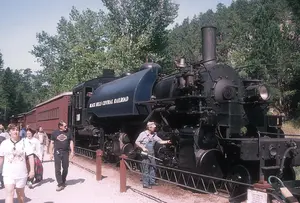
 While the state currently does not offer any murder mystery dinner train rides, the popular 1880 Train at the Black Hills Central recently hosted these popular trips!
 -
Wisconsin ~ Murder Mystery ~ Dinner Train Rides
Jan 28, 26 12:23 PM
 Whether you're a fan of mystery novels or simply relish a night of theatrical entertainment, Wisconsin's murder mystery dinner trains promise an unforgettable adventure.
 -
Florida ~ Wine Tasting ~ Train Rides
Jan 28, 26 11:18 AM
 Wine by train not only showcases the beauty of Florida's lesser-known regions but also celebrate the growing importance of local wineries and vineyards.

%2C%20still%20stands%20today%2C%20restored.%20%20American-Rails.com%20collection.)


%20in%20Coshocton%2C%20Ohio%20as%20the%20crew%20chat%20with%20the%20agent%20while%20working%20local%20service%3B%20June%2C%201983.%20%20American-Rails.com%20collection.)


Contents
Depots, Train Stations Or Terminals?
- Beaux Arts
- Chateau
- Colonial
- Gothic
- Greek Revival
- Italianate
- Mission/Mission Revival
- Revival
- Romanesque
- Victorian
- Bradford Lee Gilbert (1853-1911)
- Daniel Hudson Burnham (1846 - 1912)
- Ephraim Francis Baldwin (1837 – 1916)
- Graham, Anderson, Probst & White
- Fellheimer & Wagner
- Francis Hatch Kimball (1845–1919)
- Frank Furness (1839 - 1912)
- Henry Hobson Richardson (1838-1886)
- Jarvis Hunt (1863 - 1941)
- Link & Cameron
- Mead, McKim & White
- Reed & Stem