
- Home ›
- Freight Cars ›
- Caboose
Caboose (Train): Definition, Types, Photos
Last revised: February 22, 2025
By: Adam Burns
Perhaps no other symbol of American railroading has defined the industry as the simple caboose. An endearing piece of equipment, even to the general public, the car was an all too common sight that many folks anticipated watching pass as the end of the train went by.
First reportedly developed just a few decades after the Baltimore & Ohio Railroad was chartered the caboose became a vital part of a freight train for over a century.
There were several different types and versions of the car developed during that time, mostly in regards to how a particular railroad designed theirs (such as the Pennsylvania, Reading, B&O, and others).
While the car no longer graces the end of a freight train, it has found a new life in other types of settings; many tourist railroads use them for excursions while some folks have even purchased retired cars and fully restored them. You can also find countless examples on display at various parks and railroad museums around the country.
Photos
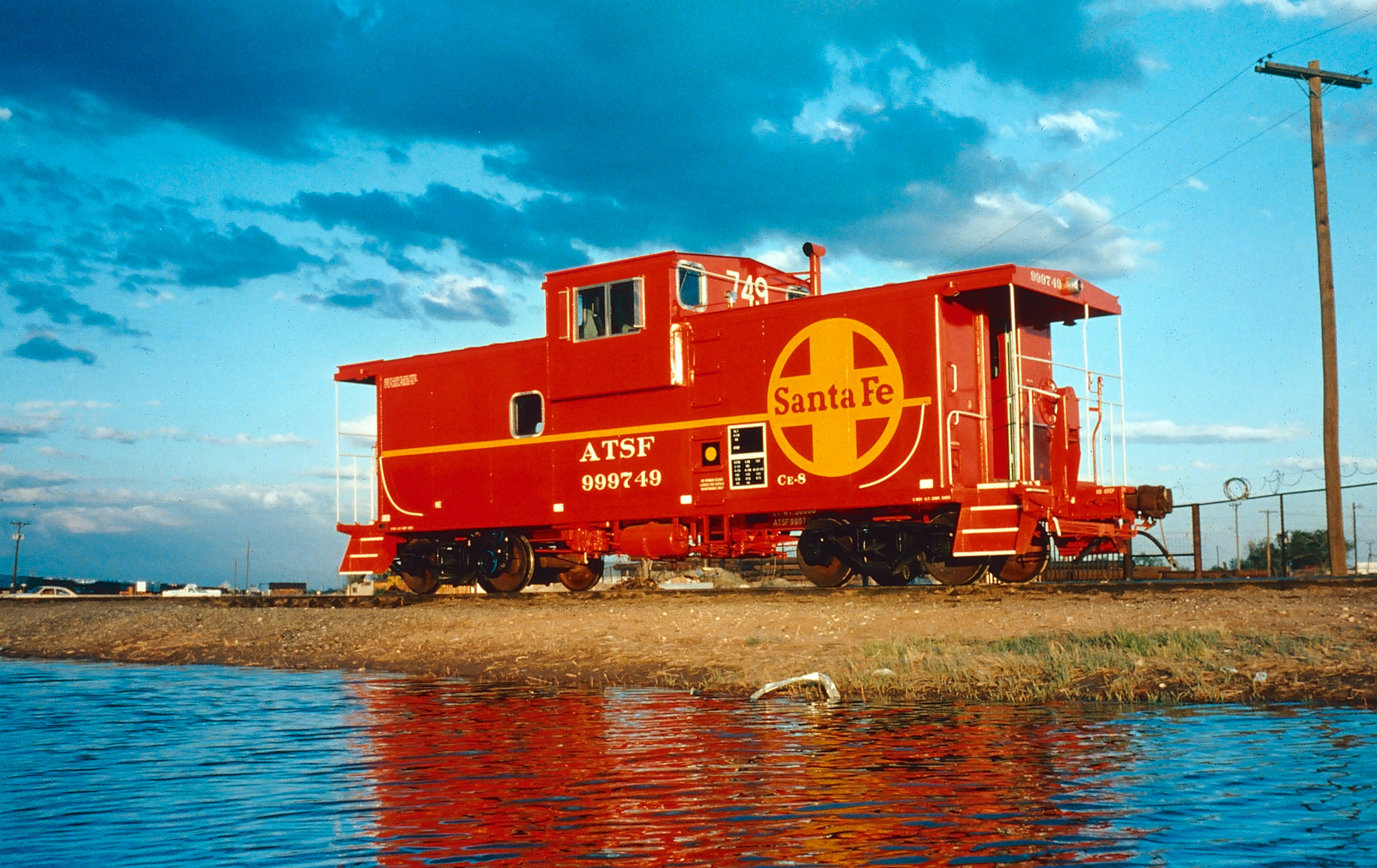 One of the Santa Fe's modern Class CE-8 cabooses, #999749, is seen here in Clovis, New Mexico in 1982. This class was manufactured by the International Car Company in 1978. Mike Bledsoe photo. American-Rails.com collection.
History
The origins of the caboose appear to date back to the 1840s when Nat Williams, a conductor of the Auburn & Syracuse Railroad (a later affiliate of the New York Central).
He became fed up with cramped and uncomfortable quarters to do paperwork (a common job of the conductor, whose responsibility is general oversight and control of a train, passenger or freight). This was usually done within either a free space on a passenger car or combine/baggage car.
To fix this problem, Williams found an unused boxcar and, using a simple box and barrel as a seat and desk, set up shop to do his duties. Not only did he find there was plenty of room to work but also figured he could use the unused space to store tools (flags, lanterns, spare parts, etc.) and other essentials when needed.
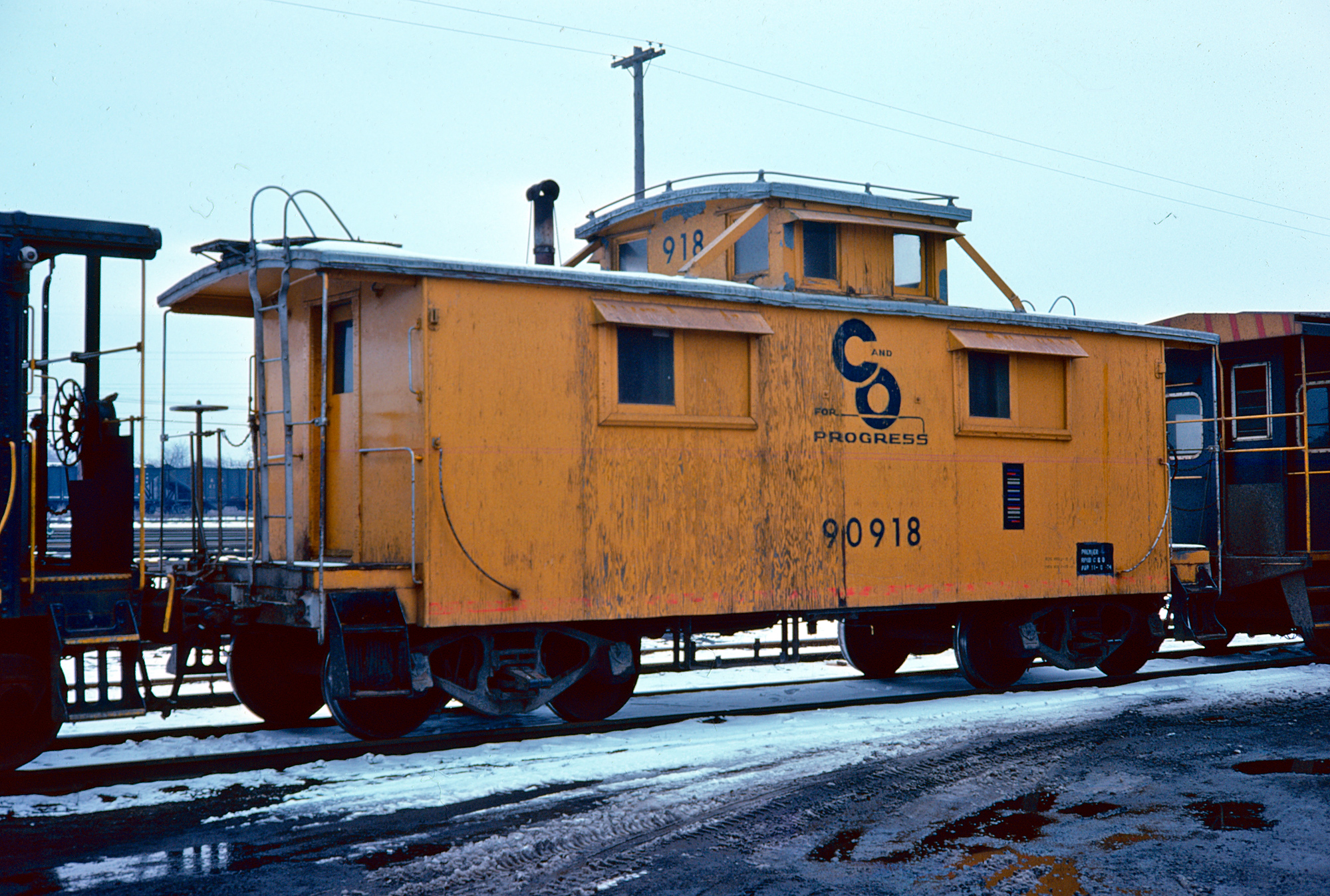 Chesapeake & Ohio wooden caboose #90918 lays over at Parsons Yard in Columbus, Ohio during March of 1975. American-Rails.com collection.
Definition
Since non-locomotive personnel on freight trains did not have assigned quarters (space in the locomotive in those days was at a premium) the “conductor’s car,” as it was originally called, quickly caught on all across the industry.
At some point, an exact date is unknown, the term "caboose" was applied to the car. At first these cars looked like short, stubby boxcars (or were boxcars) called bobbers, with just two axles and no truck assembly. Eventually, as railroads realized the car’s potential, upgrades and additions appeared over the years.
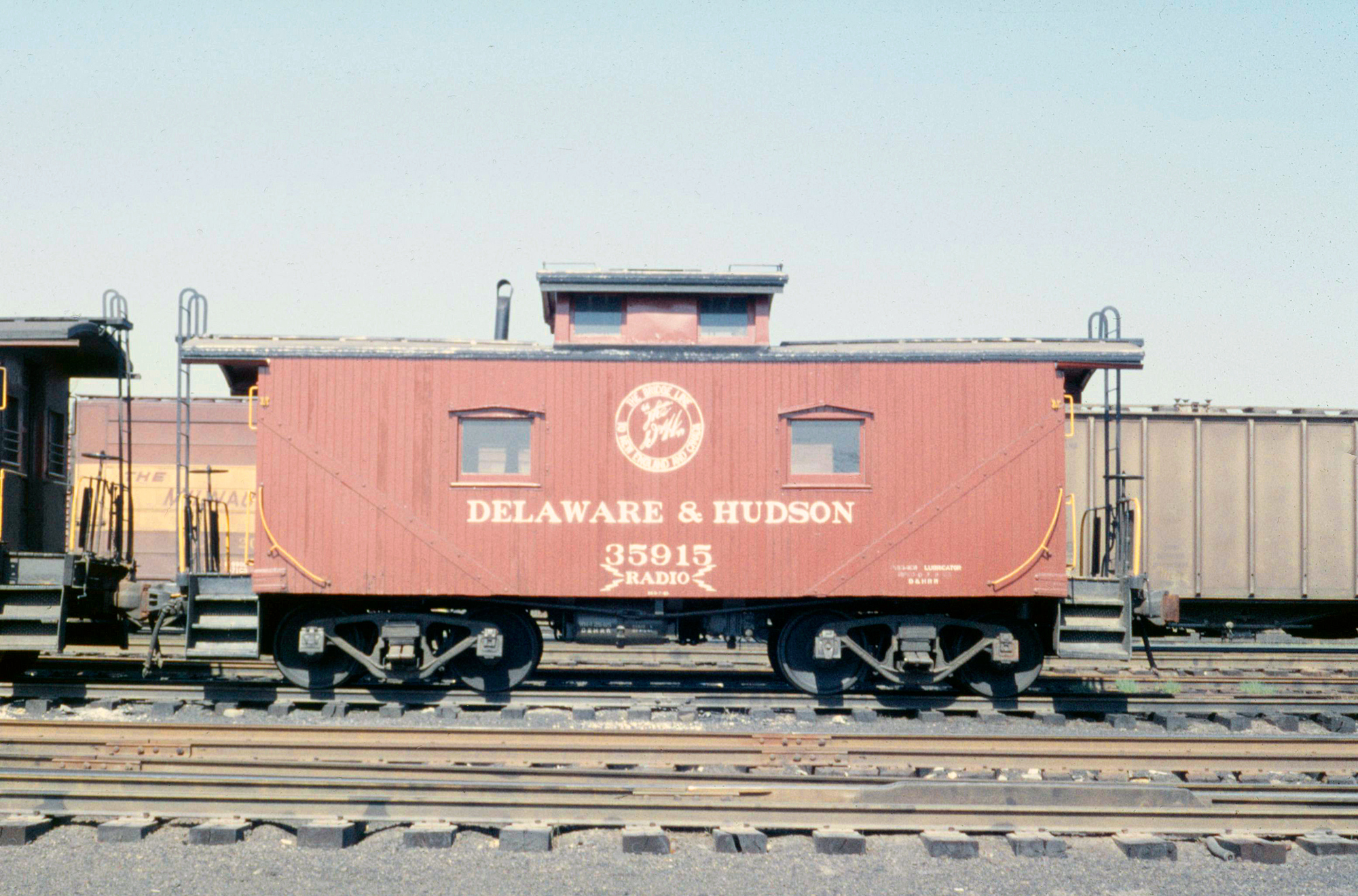 A classic Delaware & Hudson wooden caboose, #35915, was photographed here at Oneonta, New York in April of 1966. Author's collection.
Cupola
Perhaps the most striking feature was the cupola. According to the story, during the 1860s conductor T.B. Watson of the Chicago & North Western reportedly used a hole in a boxcar’s roof (being used as his caboose) to get a better vantage point of the train ahead.
Watson was amazed by the view afforded from this position as he could not only see the train ahead but also from all sides and the rear; a true 360-degree spectacle. In terms of safety it was a gamechanger.
He apparently convinced C&NW shop forces to construct a type of open observation box onto an existing singe-level caboose with windows all around where one could sit and view their surroundings. The rest, as they say, is history and the common cupola was born.
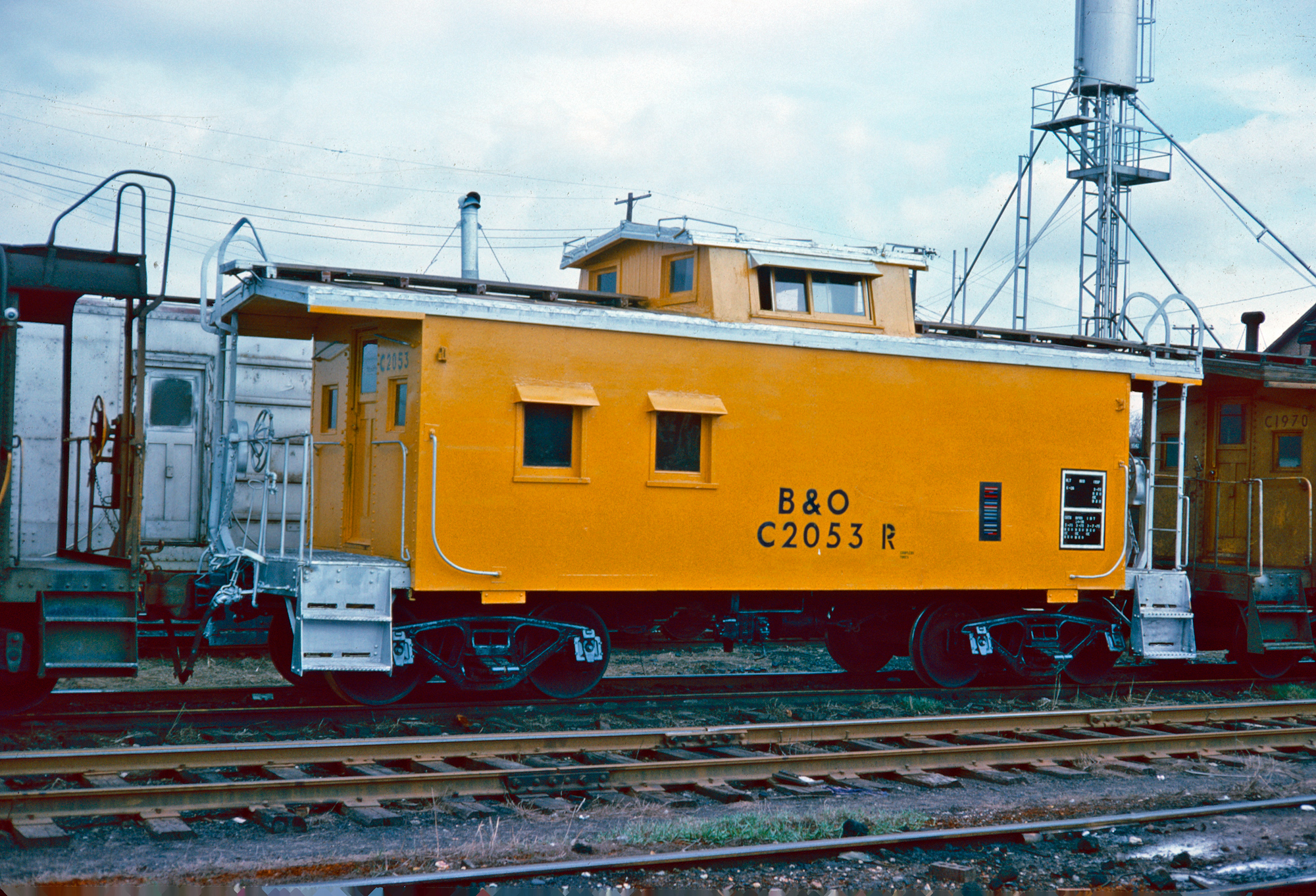 One of the Baltimore & Ohio's wood-sided cabooses, a Class I-5D, is seen here at Chillicothe, Ohio in March, 1975. American-Rails.com collection.
Cupolas were not the only upgrades added; other features included extended porches on both ends of the car with doors, which offered increased flexibility and movement. In addition, ladders were later added to the end of the "porches" for access to the roof.
Railroads quickly discovered that by placing a crewman in the cupola safety was vastly improved as a set of eyes from above could watch for a possible derailment (hot box) or, in the unfortunate event, another train approaching from the rear. To further improve safety, and help prevent the latter, a rear brakeman was assigned to the car.
In the early days, before automatic air brakes, the rear brakeman also helped apply freight car brakes, a dangerous task that involved navigating rooftop catwalks; he worked from the back towards the front while the head brakeman worked from the front towards the back.
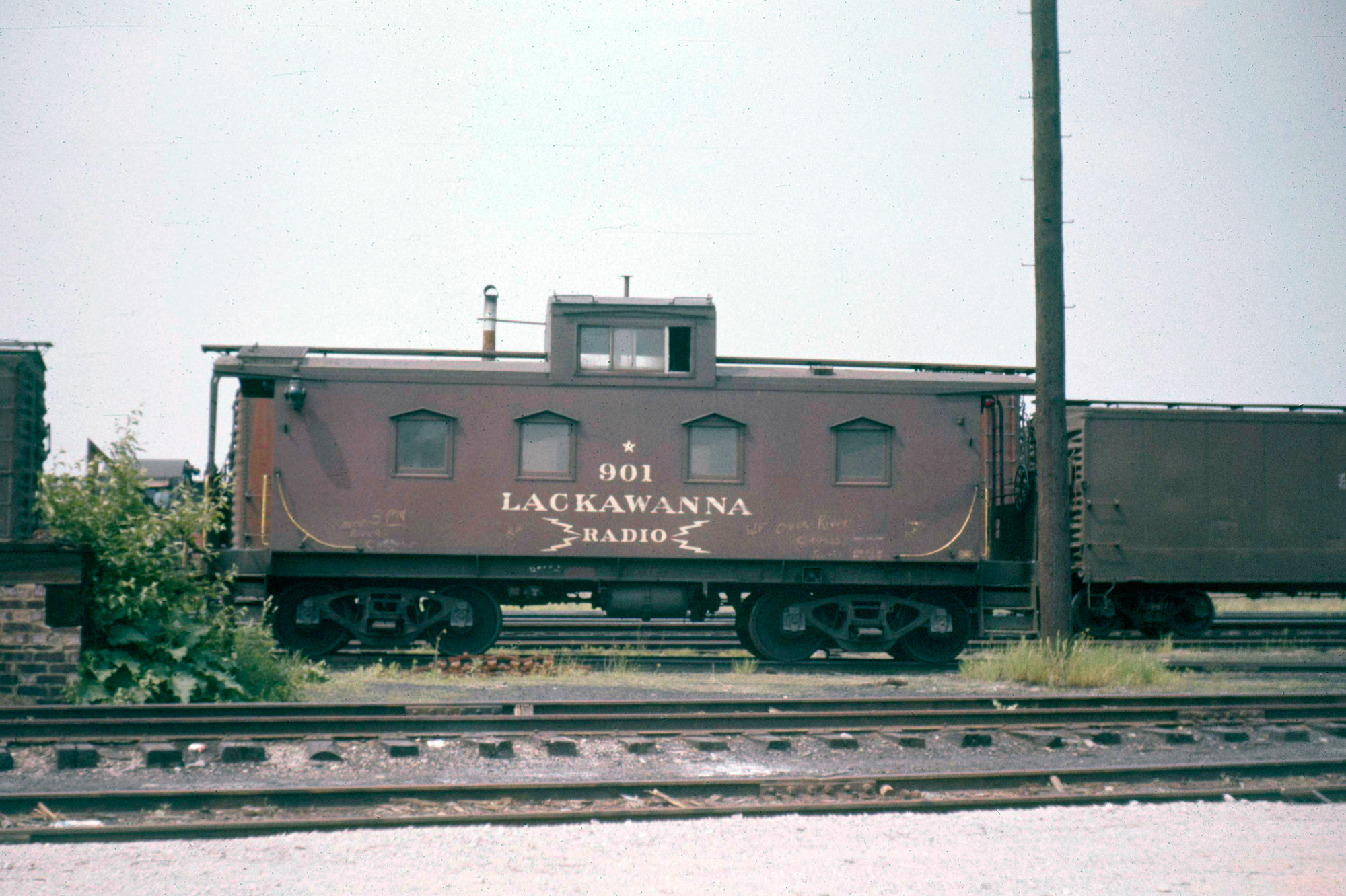 This former Delaware, Lackawanna & Western caboose features stylized gables above the windows. The feature, though, was excluded on the cupola window. The car was photographed at Binghamton, New York during the early Erie Lackawanna era in June, 1963. Author's collection.
By the late 19th century the caboose was a staple of the freight train and its basic shape and design, for the most part, was in place. By the early 20th century the car was being constructed of the much stronger material, steel, in place of wood.
Interestingly, wood or partial-wood cabooses remained in service throughout the industry until the 1970s when federal laws overseeing interstate commerce banned the interchange of wood-constructed cars.
As the 20th century progressed caboose upgrades included things like better crew quarters for the conductor, brakeman, and flagman (whose primary job, before the days of two-way radio, was to watch the rear of the train for other trains approaching). Some late-era designs even included air-conditioning!
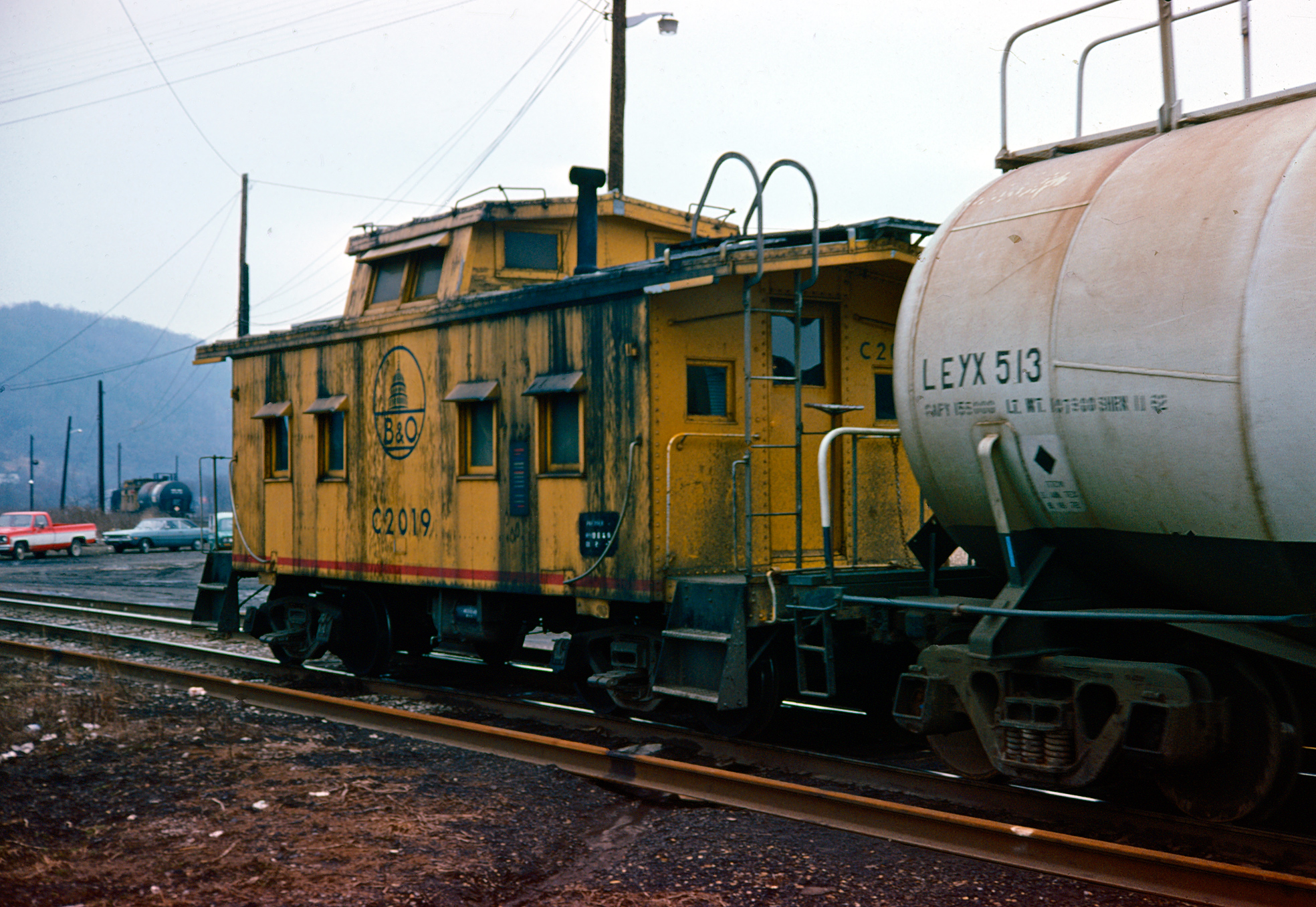 An aging Baltimore & Ohio caboose, C-2019, is on the north leg of the wye at Brooklyn Junction, West Virginia (New Martinsville); March, 1975. American-Rails.com collection.
Types
Another distinguishing caboose feature first appeared in the late 1930s, side protrusions; more commonly known as the bay-window. They were first tested on the Baltimore & Ohio and Milwaukee Road.
Bay Window
These cars were custom built on the B&O and Milwaukee Road; they were not only cheaper but also, in some respects, offered better vantage points. In addition, an unintended safety aspect of the bay window was the elimination of slack action issues.
Slack action is the result of play between car couplers, usually an inch or two, that is removed as a train begins to move. By the mid-20th century freight trains were sometimes 100 cars, or more, resulting in several feet of slack action by the time it had reached the caboose.
For an unaware crewman in the cupola they could be violently tossed about, sometimes falling to the floor below that could be as far as 10 feet down. The other advantage of the bay-window was its low clearance, a particular problem on eastern railroads, which contained many tunnels.
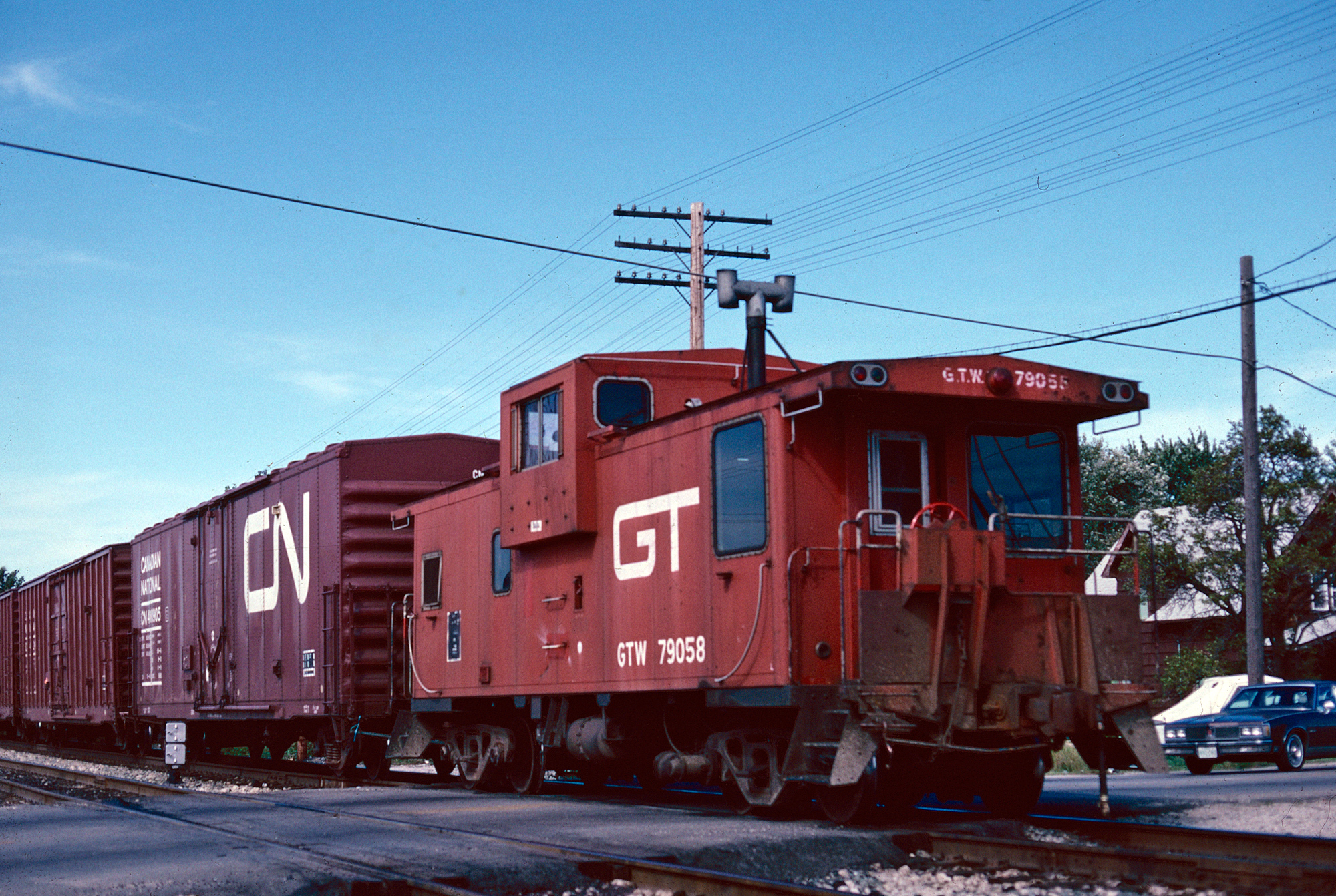 Grand Trunk Western caboose #79058 has just crossed Pickle Road in East Toledo, Ohio as it brings up the tail end of a northbound freight on the Toledo Terminal in August, 1989. American-Rails.com collection.
While almost all railroads built, at least, a few of their own designs, most purchased cabooses directly from freight car manufacturers, which by the 20th century included them in their catalogs. Of these, the International Car Company was the most well known and by the peak of caboose use was widely regarded as the industry leader.
Interestingly, the caboose was perhaps the only car-type that never had a truly uniform, utopian design. Yes, the cupola and bay-window became standard features of the caboose.
However, the cupola's placement varied from centered, off-centered, or placed at one end entirely to better utilize space. Some railroads also developed their own cupola or bay-window designs.
One of the final cupola designs to improve visibility was the extended vision cupola, or EVC. This featured added a protruding window, similar to a bay-window, which gave a crewman the best of both worlds (cupola and bay-window).
Transfer
Likely the very last specific car-type ever developed was the transfer caboose. Used primarily on terminal or transfer railroads (usually found in big cities where many cars or entire trains are transferred between many different railroads) this caboose was used over short distances that did not cover more than a few dozen miles.
As a result, the car carried only the bare essentials with large open porches to either end and a scaled-down “shack” structure in the middle for protection from the elements (none of the essentials found on over-the-road cabooses, like bunks and refrigerators, where workdays on the car lasted for 12-14 hours were available on transfer cabooses).
You might be wondering, “Why in the heck were cabooses almost always painted red?” The simple answer is that red was a warning color; bright, noticeable and easy to see from afar marking the end of a train for approaching trains from the rear.
Sometimes, the car’s ends were painted a bright yellow for even better visibility. In later years, as technology improved and the two-way radio found widespread use, the bright colors became less of a priority.
For instance, many railroads began painting their cabooses in their respective liveries, which among other things added color, uniqueness, and interest to freight trains.
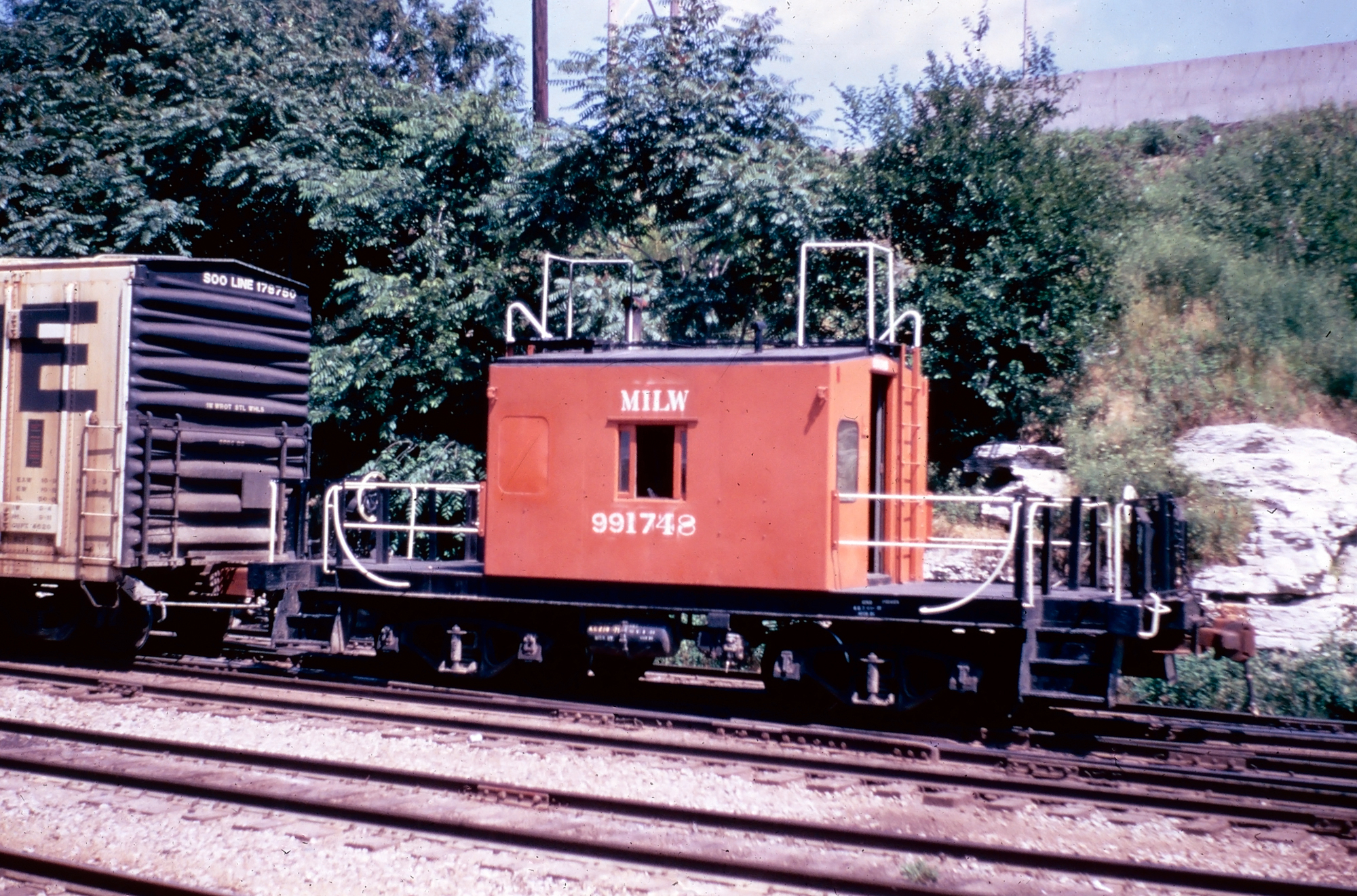 Milwaukee Road transfer caboose #991748 was photographed here in Kansas City during June of 1973. Photographer unknown. American-Rails.com collection.
The caboose had dozens of different names over its lifetime with different railroads calling it by a different name; on the Pennsylvania Railroad the car was known as "cabins", the B&O's homebuilt bay-window cars were often referred to as "wagontops," or generally as "cabeese," and the "Northeastern."
The latter was developed by the Reading Railroad and later used by several Northeastern railroads; it featured a slanted cupola design with two windows to each side of both the cupola and the car itself. Other names given included crummy, bobber, brain box, monkey box and the intelligence department.
By the 1980s the caboose was on the decline. New technologies were making the car, and most of its occupants (save for the conductor), obsolete.
Final Years
Computers made long hours of paperwork on board trains almost redundant.
Likewise, with the development of the two-way radio, EOTs (End-Of-Train devices, also known as FREDs, Flashing Rear-End Devices, which were first developed by the Florida East Coast Railway in 1969.
These monitored, among other things, a train’s air pressure for its brakes) and automatic hotbox detectors (which detected car journal bearing hotboxes, without the need of human eyes) made for brakeman and flagman virtually unneeded.
To make matters worse, the caboose served no profitable value for railroads. Labeled “non-revenue” equipment they earned nothing and were merely a cost of doing business.
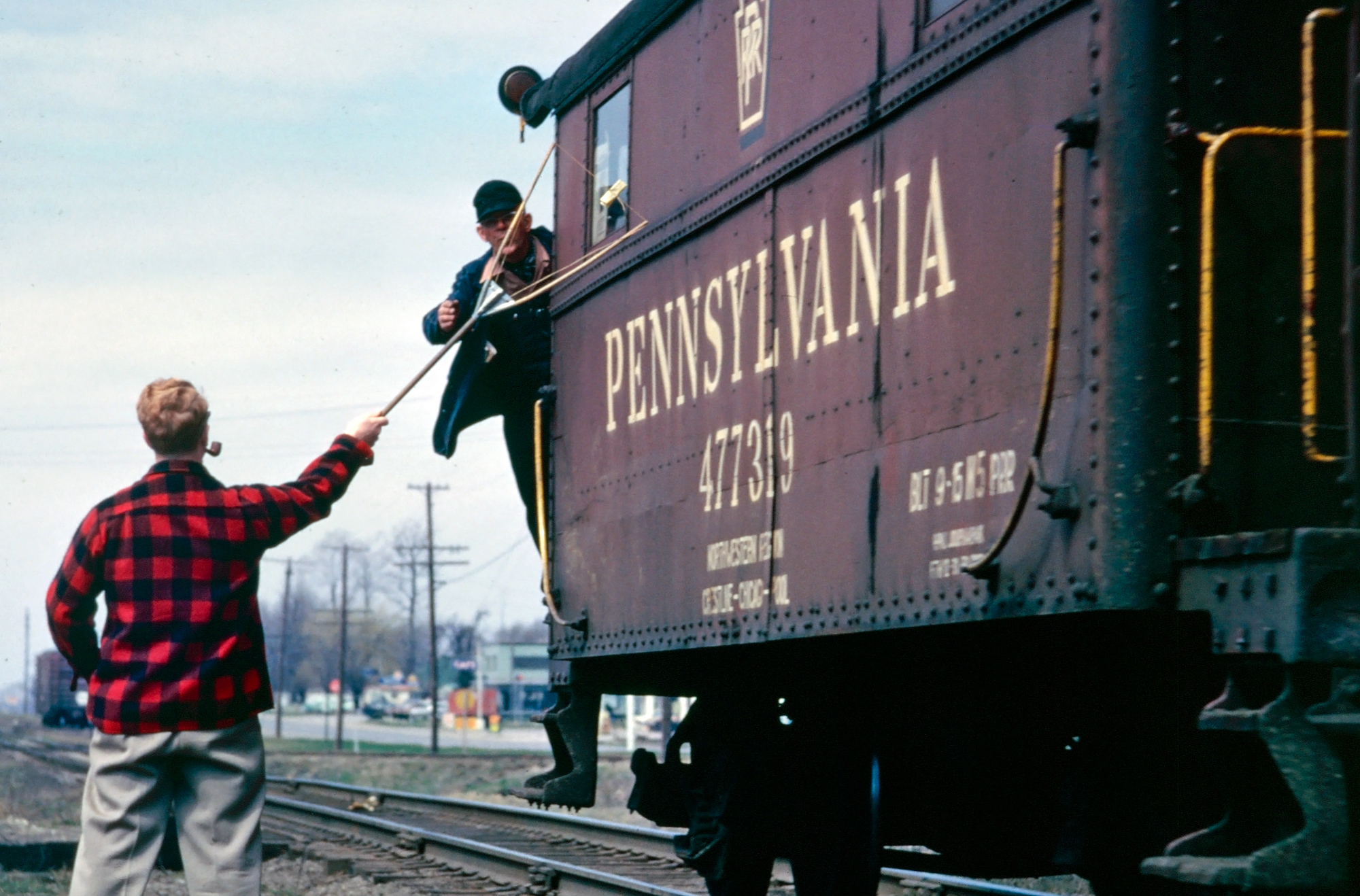 The conductor grabs train orders from Pennsylvania cabin #477319 attached to an eastbound freight at Kentland, Indiana in April, 1962. American-Rails.com collection.
Because of this, it was clear, even to railroad unions, the car was outdated. In 1982 the United Transportation Union (UTU), and most railroads, reached an agreement to begin phasing out the car from active service. For instance, by the 1980s a new caboose could cost as much as $80,000 and $1,300 per train movement.
While still in use today for minor jobs like transfer operations and back-up moves (where it is safer for crewmen/women to be planted on a solid, sturdy surface than dangling from the rear of a freight car), the caboose has been virtually relegated to the history books.
It’s charm and appealing legacy, however, among many railroaders and especially the general public, will likely never be lost.
Thanks to Butch Rausch for help with the information on this page.
Gallery
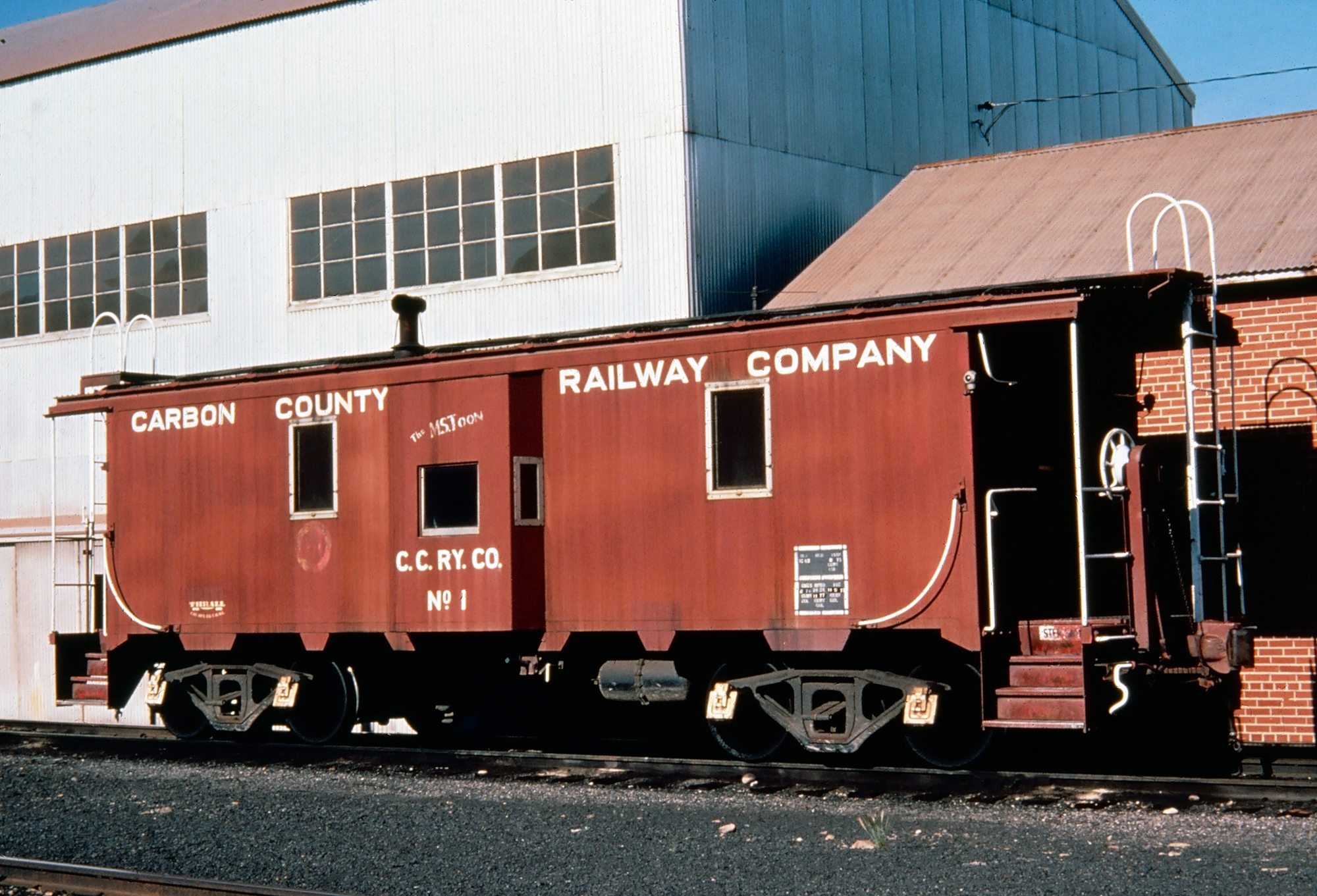 Carbon County Railway bay-window caboose #1 at the shops in East Carbon, Utah, circa 1970. American-Rails.com collection.
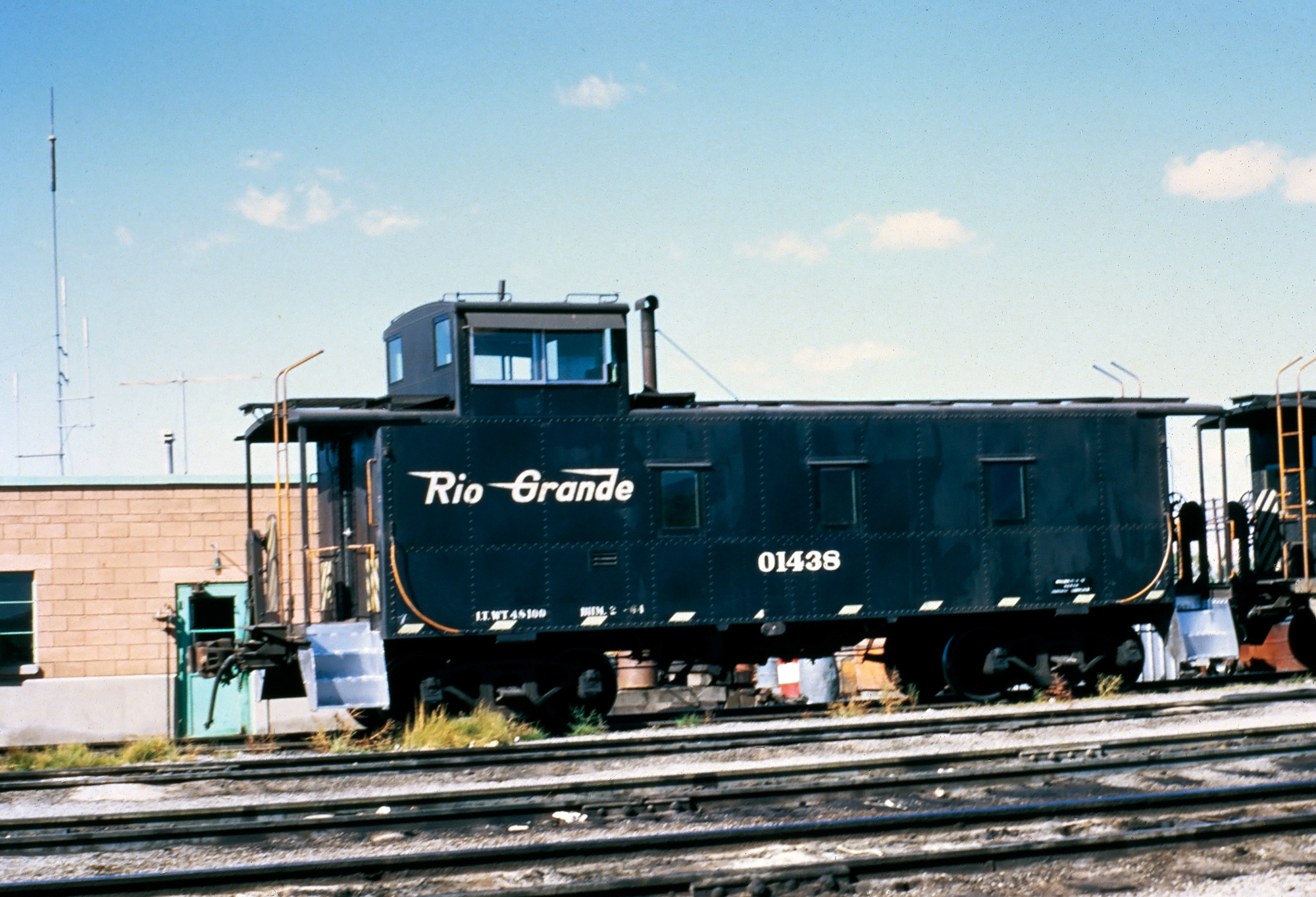 Rio Grande end-cupola steel caboose #01438 is seen here late in its career at Grand Junction, Colorado circa 1975. Robert Eastwood, Jr. photo. American-Rails.com collection.
Sources
- Boyd, Jim. American Freight Train, The. Osceola: MBI Publishing, 2001.
- White Jr., John H. American Railroad Freight Car, The: From The Wood-Car Era To The Coming Of Steel. Baltimore: The John Hopkins University Press, 1993.
- Schafer, Mike. Caboose. Osceola: MBI Publishing, 1997.
- Schafer, Mike and McBride, Mike. Freight Train Cars. Osceola: MBI Publishing, 1999.
Recent Articles


-
Illinois Passenger Rail
Jan 27, 26 02:49 PM
 Learn more about Illinois's current passenger rail options, ranging from Amtrak to the Twin Cities' light rail service.
 -
Pennsylvania Passenger Rail
Jan 27, 26 02:40 PM
 Here is a detailed, statewide look at the passenger rail services you can use today—focusing on intercity (long-distance and regional) options, primarily operated by Amtrak—plus the major commuter and…
 -
New Mexico ~ Wine Tasting ~ Train Rides
Jan 27, 26 01:19 PM
 For oenophiles and adventure seekers alike, wine tasting train rides in New Mexico provide a unique opportunity to explore the region's vineyards in comfort and style.
 -
Ohio ~ Wine Tasting ~ Train Rides
Jan 27, 26 01:10 PM
 Among the intriguing ways to experience Ohio's splendor is aboard the wine tasting trains that journey through some of Ohio's most picturesque vineyards and wineries.
 -
Pennsylvania ~ Wine Tasting ~ Train Rides
Jan 27, 26 12:05 PM
Wine tasting trains are a unique and enchanting way to explore the state’s burgeoning wine scene while enjoying a leisurely ride through picturesque landscapes. -
West Virginia's - Wine Tasting - Train Rides
Jan 27, 26 11:57 AM
 West Virginia, often celebrated for its breathtaking landscapes and rich history, offers visitors a unique way to explore its rolling hills and picturesque vineyards: wine tasting trains.
 -
Iowa Valentine's Train Rides
Jan 27, 26 10:22 AM
 While the Boone & Scenic Valley's calendar is packed with seasonal events, few are as popular—or as tailor-made for couples—as the Valentine Dinner Train.
 -
Texas Valentine's Train Rides
Jan 27, 26 09:44 AM
 On Valentine's Day, the Grapevine Vintage Railroad has become one of the Dallas–Fort Worth area’s most charming "micro-adventures" - and, on Valentine’s Day, one of the region’s most memorable date ni…
 -
Missouri ~ Murder Mystery ~ Dinner Train Rides
Jan 26, 26 01:21 PM
 Missouri, with its rich history and scenic landscapes, is home to one location hosting these unique excursion experiences.
 -
Washington's ~ Murder Mystery ~ Dinner Train Rides
Jan 26, 26 01:15 PM
 This article delves into what makes murder mystery dinner train rides in Washington State such a captivating experience.
 -
Utah's - Wine Tasting - Train Rides
Jan 26, 26 12:48 PM
 Utah, a state widely celebrated for its breathtaking natural beauty and dramatic landscapes, is also gaining recognition for an unexpected yet delightful experience: wine tasting trains.
 -
Vermont's - Wine Tasting - Train Rides
Jan 26, 26 12:40 PM
 Known for its stunning green mountains, charming small towns, and burgeoning wine industry, Vermont offers a unique experience that seamlessly blends all these elements: wine tasting train rides.
 -
Rhode Island's - Wine Tasting - Train Rides
Jan 26, 26 12:36 PM
 It may the smallest state but Rhode Island is home to a unique and upscale train excursion offering wide aboard their trips, the Newport & Narragansett Bay Railroad.
 -
Oregon's - Wine Tasting - Train Rides
Jan 26, 26 12:25 PM
 For those looking to explore this wine paradise in style and comfort, Oregon's wine tasting trains offer a unique and enjoyable way to experience the region's offerings.
 -
Virginia's - Wine Tasting - Train Rides
Jan 26, 26 12:07 PM
 Wine tasting trains in Virginia provide just that—a unique experience that marries the romance of rail travel with the sensory delights of wine exploration.
 -
Tennessee's - Wine Tasting - Train Rides
Jan 26, 26 12:44 AM
 One of the most unique and enjoyable ways to savor the flavors of Tennessee’s vineyards is by train aboard the Tennessee Central Railway Museum.
 -
Texas's Thomas The Train Rides
Jan 25, 26 01:41 PM
 In the heart of Texas, where everything is said to be bigger and bolder, lies an event that captures the imagination of children and families alike - A Day Out With Thomas.
 -
New York's Thomas The Train Rides
Jan 25, 26 01:37 PM
 These events, part of a national tour, are crafted for young Thomas fans and their families to enjoy an immersive experience filled with adventure, nostalgia, and sheer joy.
 -
Connecticut's Dinner Train Rides In Essex!
Jan 25, 26 01:34 PM
 Connecticut's rail heritage can be traced back to the industry's earliest days and a few organizations preserve this rich history by offering train rides. The Essex Steam Train also hosts dinner-theme…
 -
Minnesota's Dinner Train Rides In Duluth!
Jan 25, 26 01:25 PM
 One of the best ways to feel the region's history in motion today is aboard the North Shore Scenic Railroad (NSSR), which operates out of Duluth’s historic depot.
 -
North Carolina's - Wine Tasting - Train Rides
Jan 25, 26 01:18 PM
 A noteworthy way to explore North Carolina's beauty is by hopping aboard the Great Smoky Mountains Railroad and sipping fine wine!
 -
Nevada's - Wine Tasting - Train Rides
Jan 25, 26 01:13 PM
 While it may not be the first place that comes to mind when you think of wine, you can sip this delight by train in Nevada at the Nevada Northern Railway.
 -
New Hampshire's - Wine Tasting - Train Rides
Jan 25, 26 01:02 PM
 This article details New Hampshire's most enchanting wine tasting trains, where every sip is paired with breathtaking views and a touch of adventure.
 -
Front Range Passenger Rail [Fort Collins-Pueblo, CO]
Jan 25, 26 12:59 PM
 Front Range Passenger Rail is a proposed project to link Fort Collins to Pueblo, Colorado by rail via Denver and Boulder. It hopes to be operational by the early 2030s.
 -
Indiana "Valentine's" Train Rides
Jan 24, 26 12:53 PM
 If you’ve ever wished you could step into a time when passenger trains were a Saturday-night treat and a whistle echoing across farm fields meant “adventure,” the Nickel Plate Express delivers that fe…
 -
Ohio "Valentine's" Train Rides!
Jan 24, 26 12:46 PM
 The Hocking Valley Scenic Railway offers one of the region’s most atmospheric ways to experience the Hocking Hills area: from the rhythmic click of jointed rail to the glow of vintage coaches rolling…
 -
Arkansas "Dinner Train" Rides On The A&M!
Jan 24, 26 12:40 PM
 If you want a railroad experience that feels equal parts “working short line” and “time machine,” the Arkansas & Missouri Railroad delivers in a way few modern operations can.
 -
North Carolina's Dinner Train Rides At NCTM!
Jan 24, 26 12:34 PM
 Tucked into the Piedmont town of Spencer, the North Carolina Transportation Museum is the kind of place that feels less like a typical museum and more like a living rail yard that never quite stopped…
 -
Colorado's Thomas The Train Rides
Jan 24, 26 12:30 PM
One of the most picturesque locations to see the beloved Thomas the Tank Engine is Colorado at the Colorado Railroad Museum in Golden. -
Iowa's Thomas The Train Rides
Jan 24, 26 12:26 PM
This article explores the magical journey of spending a day with Thomas and what families can expect from this unforgettable experience in Iowa. -
New Jersey's - Wine Tasting - Train Rides
Jan 24, 26 12:21 PM
 If you're seeking a unique outing or a memorable way to celebrate a special occasion, wine tasting train rides in New Jersey offer an experience unlike any other.
 -
Missouri's - Wine Tasting - Train Rides
Jan 24, 26 12:19 PM
 The fusion of scenic vistas, historical charm, and exquisite wines is beautifully encapsulated in Missouri's wine tasting train experiences.
 -
Minnesota's - Wine Tasting - Train Rides
Jan 24, 26 12:17 PM
 This article takes you on a journey through Minnesota's wine tasting trains, offering a unique perspective on this novel adventure.
 -
Massachusetts's - Wine Tasting - Train Rides
Jan 24, 26 12:17 PM
 This article dives into some of the alluring aspects of wine by rail in Massachusetts, currently offered by the Cape Cod Central Railroad.
 -
Kentucky ~ Murder Mystery ~ Dinner Train Rides
Jan 24, 26 12:13 PM
 In the realm of unique travel experiences, Kentucky offers an enchanting twist that entices both locals and tourists alike: murder mystery dinner train rides.
 -
Utah ~ Murder Mystery ~ Dinner Train Rides
Jan 24, 26 12:12 PM
 This article highlights the murder mystery dinner trains currently avaliable in the state of Utah!
 -
North Carolina Scenic Train Rides At The GSMR!
Jan 23, 26 11:47 AM
 The Great Smoky Mountains Railroad (GSMR) has become one of the flagship heritage rail experiences in the Southeast.
 -
Ohio Scenic Train Rides In Nelsonville!
Jan 23, 26 11:42 AM
 The Hocking Valley Scenic Railway (HVSR) offers something rare in today’s world: the chance to experience a working slice of 19th- and 20th-century railroading on an historic right-of-way.
 -
Tennessee "Dinner Train Rides" At The TVRM!
Jan 23, 26 10:59 AM
 Tucked into East Chattanooga, the Tennessee Valley Railroad Museum (TVRM) is less a “museum you walk through” and more a railroad you step aboard.
 -
California "Dinner Train Rides" In Sacramento!
Jan 23, 26 10:36 AM
 Just minutes from downtown Sacramento, the River Fox Train has carved out a niche that’s equal parts scenic railroad, social outing, and “pick-your-own-adventure” evening on the rails.



%3B%20March%2C%201975.%20%20American-Rails.com%20collection.)


