- Home ›
- Fallen Flags ›
- Chesapeake & Ohio ›
- M-1
C&O’s M-1 Steam Turbine Locomotives: Specs, Roster, History
Last revised: October 5, 2026
By: Adam Burns
The Chesapeake & Ohio’s Class M-1 was three steam-turbine-electric locomotives, 500–502, built by the Baldwin Locomotive Works with Westinghouse electrical equipment in 1947 and 1948. They were ordered for The Chessie, a daylight streamliner between Washington and Cincinnati that never entered revenue service. A coal-fired firetube boiler supplied a Westinghouse turbine rated at 6,000 horsepower. The turbine turned four generators, and the generators fed eight traction motors. The axle arrangement is 2-C1+2-C1-B.
Number 500 was the 1947 engine. Numbers 501 and 502 followed early in 1948. The class was out of service in 1949 and scrapped in 1950. None was saved. The company is the Chesapeake & Ohio, and the steam roster is the C&O steam locomotives page. The train they were built for is The Chessie. The other American steam-turbine experiments are the Union Pacific–General Electric pair of 1938, the Pennsylvania Railroad’s S2 on the Pennsylvania steam roster, and the Norfolk & Western’s Jawn Henry.
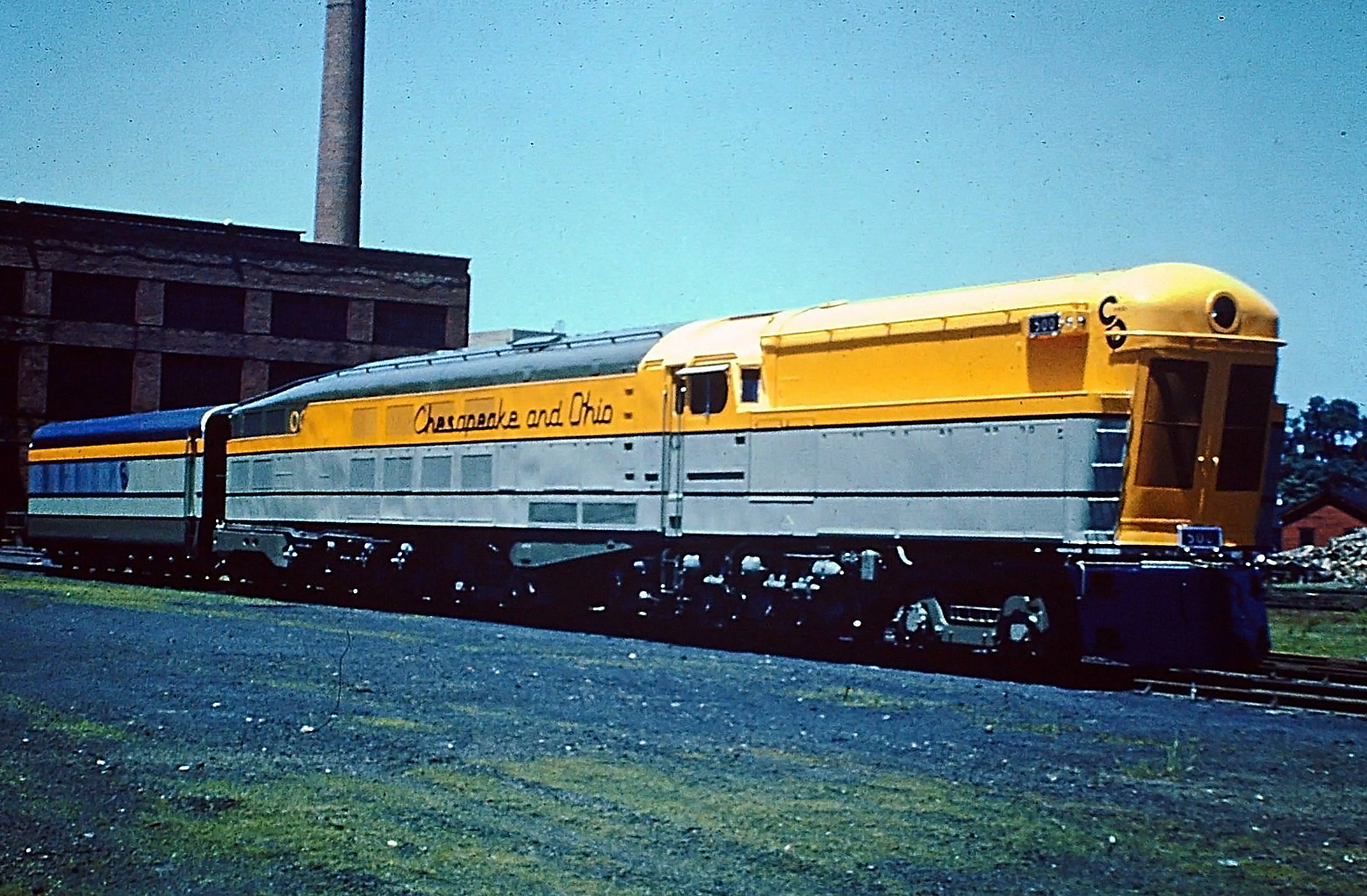
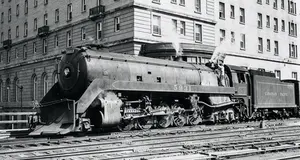
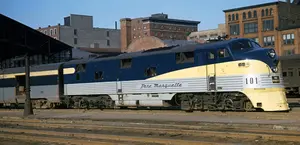
Chesapeake & Ohio M-1 No. 500 in May 1948. The nose and the belt are yellow, the flanks gray, and a blue stripe runs along the bottom. The Chessie cat is on the nose, the road name is in script on the belt, and 500 is in the number boards. A blue-striped car is coupled behind. Baldwin–Westinghouse, 1947. Photographer unknown.
On this page: At a glance · An order placed in 1944 · The machine · Coal in the nose · Forty-six Budd cars · On the road · Roster
At a glance
| Item | Detail |
|---|---|
| Railroad | Chesapeake & Ohio. Letter classes. This one is M-1 |
| Type | Coal-fired steam-turbine-electric. Firetube boiler, Westinghouse turbine, four generators, eight traction motors |
| Quantity | Three. Numbers 500, 501, and 502 |
| Builder | Baldwin, Eddystone, mechanical. Westinghouse, electrical. Works 73079–73081 |
| Built | 500 in 1947. 501 and 502 early in 1948 |
| Arrangement | 2-C1+2-C1-B. Eight motored axles. Baldwin’s construction list entered the same engines as 4-8-0-4-8-4 TE |
| Drivers | 40 in |
| Boiler | Firetube, 310 psi, superheated. Exhaust to atmosphere |
| Power | Turbine 6,000 hp. Generators 4,960 hp combined. Design speed 100 mph |
| Weight and length | Engine 856,000 lb (428 tons), 106 ft. Water tender 48 ft, 25,000 gallons. Over the couplers, 154 ft ¾ in |
| Coal | 29.25 tons, in a bunker ahead of the cab |
| Retired | Out of service in 1949. Scrapped in 1950. All three |
Engine length, tender length, the 428-ton engine weight, and the 6,000-horsepower turbine are Geoffrey H. George’s account in Trains for July 1968. Driver diameter, boiler pressure, coal, water, the 154-foot coupler length, and the 4,960-horsepower generator figure are the published class specification, including Arthur R. Railton’s Popular Mechanics article of March 1948 and J. Parker Lamb’s class table. Information compiled October 5, 2026.
An order placed in 1944
Robert R. Young took the chair of the Chesapeake & Ohio in 1942, and he wanted a new daylight train from Washington to Cincinnati as soon as the war was over. The railroad’s freight business was coal. Its mechanical men were also on record, in the March 1948 Popular Mechanics account, that the oil supply they could see might be gone in 25 or 30 years. A coal-burning passenger locomotive was the brief they gave the builders.
In 1944 a group of coal producers and railroads had started a longer research program on a coal-fired turbine. Alongside that program, the railroad’s own research office, under the aeronautical engineer K. A. Browne, went to Baldwin and Westinghouse for a locomotive that could be built from parts already in production: a firetube boiler, a steam turbine, and an electric transmission. Three were ordered late in 1944. Baldwin’s construction numbers for the three are 73079–73081. The list called the wheel arrangement 4-8-0-4-8-4 TE. The axles, counted the way the motors were applied, are the 2-C1+2-C1-B below.
The price of the three locomotives was $1.6 million, research and development aside. Number 500 was finished in 1947. On Saturday, December 13, 1947, it stood for a day in the Columbus freight yards at Dennison and Dublin Avenues, and the Columbus Dispatch of the next morning said 501 and 502 were still on the floor at Baldwin. They came early in 1948. The railroad called the class the largest single-unit passenger locomotives in the world.
The machine
The turbine was a Westinghouse machine rated at 6,000 horsepower. It drove four direct-current generators, mounted in pairs, each of 1,000 kilowatts. Together the generators were rated at 4,960 horsepower, and they fed eight axle-hung traction motors. Uberto Bajocchi’s 1949 technical account of the same locomotive puts the turbine’s top speed at 6,000 revolutions per minute, with a 6-to-1 reduction gear between the turbine and the generators, and treats 2,400 revolutions as the floor for ordinary running. Exhaust steam went to the atmosphere. The boiler was a conventional firetube boiler pressed to 310 pounds, and the steam was superheated.
The throttle had eleven positions. Railton rode a trial and wrote that 70 miles an hour was notch 7. The engineer, held to a local limit of 75, told him he would like to pull the handle back to eleven. The design speed was 100 miles an hour. Railton’s figures for the train the engines were meant to run are 666 miles, Washington to Cincinnati, in 11 hours 45 minutes, and the designers’ prediction was a round trip over that route with no servicing stop.
| Specification | Class M-1, 500–502 |
|---|---|
| Type | Steam-turbine-electric. Coal fired. Non-condensing |
| Builder | Baldwin Locomotive Works, works 73079–73081. Westinghouse electrical equipment |
| Arrangement | 2-C1+2-C1-B. Eight motored axles, six idle axles on the locomotive, six axles under the water tender |
| Driver diameter | 40 in |
| Boiler | Firetube, 310 psi, superheated |
| Turbine | Westinghouse, 6,000 hp |
| Generators | Four, 1,000 kW each, 4,960 hp combined |
| Traction motors | Eight |
| Design speed | 100 mph. Railton’s cruise notch, 70 mph |
| Engine length | 106 ft |
| Engine weight | 856,000 lb (428 tons) |
| Coal | 29.25 tons, in the nose bunker |
| Water tender | 48 ft. 25,000 gallons. Two six-wheel trucks |
| Length over couplers | 154 ft ¾ in |
The forward frame carries a four-wheel idle truck, three motored axles, and one idle axle. The frame behind it carries a four-wheel idle truck, three motored axles, one idle axle, and a four-wheel truck with both axles motored. That is the B at the end of 2-C1+2-C1-B. Fourteen axles under the locomotive and six under the tender are twenty pairs of wheels, which is the count the Dispatch printed while 500 was in Columbus.
Coal in the nose
The crew sat ahead of the boiler. The coal bunker was in the nose, in front of the cab. The firebox was immediately behind the cab, and a stoker carried coal from the bunker through the cab to the fire. The boiler barrel ran rearward from that firebox. The turbine and the generators sat at the rear of the locomotive body, and the water tender coupled on behind them. The tender held 25,000 gallons and was styled to run with passenger cars. From the outside the shrouding covered the joints, which is why a side view reads as one long carbody with a yellow nose.
On 500, as photographed in May 1948, that nose and the belt are yellow, the flanks are gray, and a blue stripe runs along the bottom. The Chessie cat is on the nose. The Dispatch, looking at the same engine in December 1947, called the jacket orange, the apron aluminum, and the striping blue. The yellow in the photograph is the color that newspaper was describing.
Forty-six Budd cars
The cars were a Budd order, placed in 1944: 46 stainless-steel cars, baggage, coaches, domes, lounges, and diners, lettered for The Chessie. They arrived in August 1948. George’s figure for the bill is $6.1 million. The train they were meant to make up was an all-coach daylight run, Washington to Cincinnati, with the M-1 as its road power. The conventional engines rebuilt for the same service were five Class L-1 Hudsons, 490–494, rebuilt from F-19 Pacifics in 1947. Number 490 is the one that survives, at the B&O Railroad Museum.
The railroad ran a test train. The fall 1948 folder still showed the George Washington, the Sportsman, and the F.F.V. The 1948 annual report passed over the new equipment. By October 1948 the consists had been broken up. Most of the cars went to the Pere Marquette streamliners between Chicago and Grand Rapids. The train itself is The Chessie page. Passenger traffic was already falling, and the Chesapeake & Ohio Historical Society’s account of the cancellation adds a coal strike against the railroad’s revenue that year.
What the three turbines then did is on the steam roster as a closed experiment. The later coal-fired turbine, a different machine with a Babcock & Wilcox water-tube boiler, was the Norfolk & Western’s 2300 of 1954. The direct-drive turbine, with no electric transmission, was the Pennsylvania’s S2, engine 6200, a Baldwin 6-8-6 of 1944. Both of those stories sit with the steam-turbine locomotives overview.
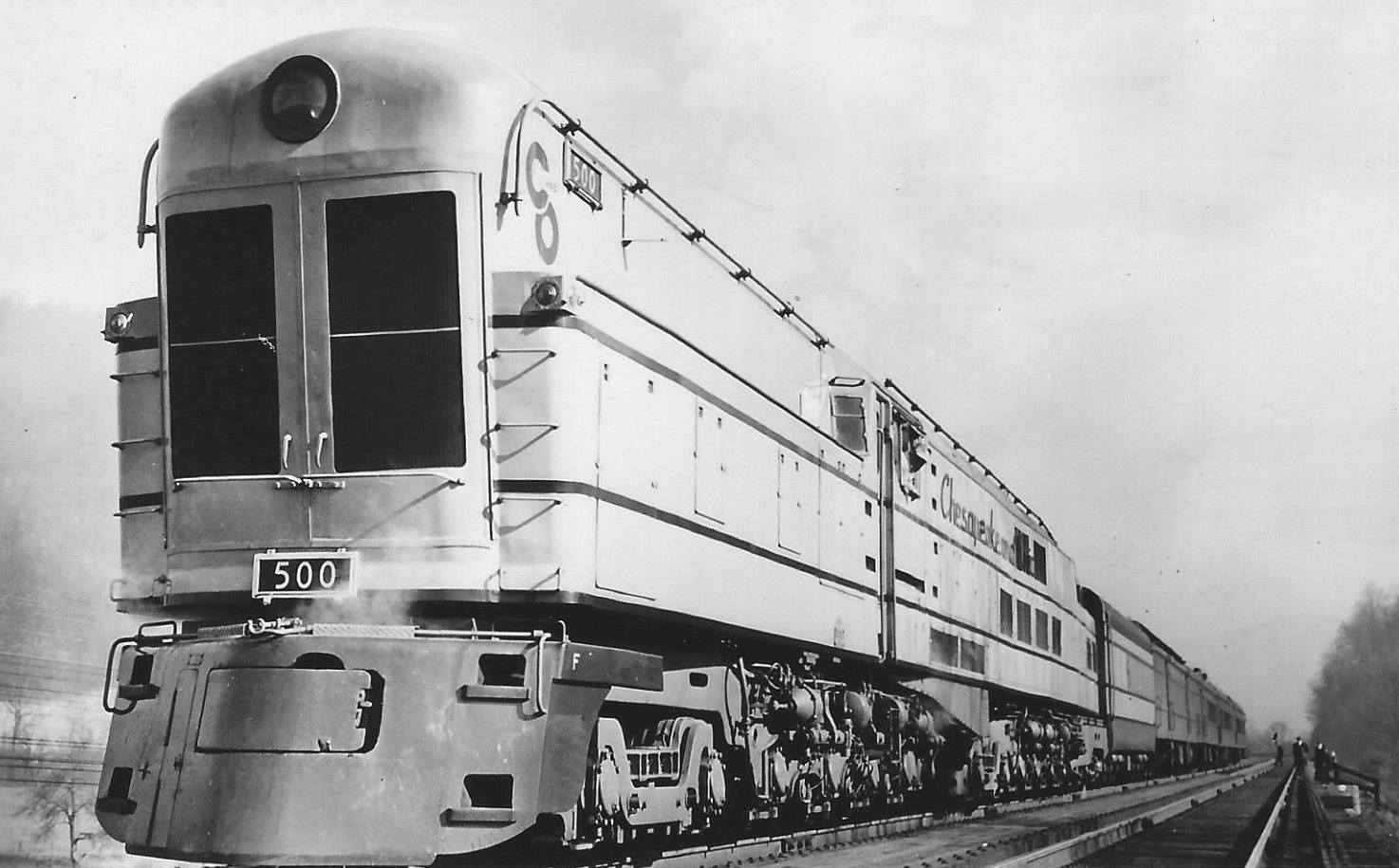
Chesapeake & Ohio steam-turbine #500 (Class M-1) during trials near Covington, Virginia in late 1947. Three of these Baldwin–Westinghouse machines, 500–502, were meant to power the streamliner The Chessie, which was never launched. They were scrapped in 1950.
On the road
While the cars were still expected, the railroad showed the locomotives off. Number 500 and one of the new Chessie diners went to the Chicago Railroad Fair in 1948 and again in 1949. In service the assignments were ordinary passenger trains, and they were short. William J. Sparkmon’s account gives one of them in detail. Train 47, the Norfolk section of the Sportsman, carried a turbine from Clifton Forge to Hinton, West Virginia, and the engine came off at Hinton because the westbound track there had no coaling station. Another trip, a photo train from Clifton Forge to Charlottesville over the Mountain Subdivision, came home with cracked wheels. That engine was in the shop for two weeks.
The same territory, Clifton Forge to Charlottesville, is where James E. Casto places the class once The Chessie was gone. The mechanical record is the one Thomas W. Dixon, Jr. and the later technical summaries agree on. Coal dust worked into the forward traction motors. Water leaks from the boiler and the piping shorted motors farther back. The turbine, built up from stationary and marine practice, shook hard enough to be felt in the train. The railroad never got 500, 501, or 502 through from Washington to Cincinnati. The cost of keeping them running sat above the cost of a modern reciprocating engine, and above a diesel.
All three were out of use in 1949. All three were scrapped in 1950.
Roster
| No. | Builder | Built | Disposition | Notes |
|---|---|---|---|---|
| 500 | Baldwin–Westinghouse | 1947 | Scrapped 1950 | First of the class. On display at Columbus, December 13, 1947. Chicago Railroad Fair, 1948 and 1949. The engine in the photograph |
| 501 | Baldwin–Westinghouse | Early 1948 | Scrapped 1950 | Still under construction when 500 was shown at Columbus |
| 502 | Baldwin–Westinghouse | Early 1948 | Scrapped 1950 | Still under construction in December 1947 |
Baldwin’s three construction numbers are 73079–73081. The class is the whole of the C&O steam-turbine roster. Nothing of the three survives.
Where they were seen
| When | What the record shows |
|---|---|
| Late 1944 | Three locomotives ordered from Baldwin and Westinghouse |
| 1947 | No. 500 delivered. Trials based at Clifton Forge |
| December 13, 1947 | No. 500 on display at Columbus. Nos. 501 and 502 still at Baldwin |
| Early 1948 | Nos. 501 and 502 delivered |
| 1948 and 1949 | No. 500 and a Chessie diner at the Chicago Railroad Fair |
| August 1948 | Forty-six Budd cars for The Chessie on the property |
| October 1948 | Chessie consists broken up. Cars reassigned, most of them to the Pere Marquette trains |
| In service, 1948–49 | Train 47, Clifton Forge to Hinton, cut off for lack of a westbound coaling station. A Mountain Subdivision photo train, Clifton Forge to Charlottesville, returned with cracked wheels |
| 1949 | All three out of use |
| 1950 | All three scrapped |
Sources
- George, Geoffrey H. “This Was The Train That Was (But Never Was).” Trains, Vol. 28, No. 9 (July 1968). The order of late 1944, K. A. Browne’s office with Baldwin and Westinghouse, the firetube boiler and electric drive, the 106-foot engine and 48-foot water tender, the 428-ton engine weight, the 6,000-horsepower turbine, eight motors on a 2-C1+2-C1-B, coal in the nose and the turbine at the rear, $1.6 million for the three locomotives excluding research, and $6.1 million for the 46 Budd cars that arrived in August 1948. The 1948 annual report’s silence, and the fall 1948 timetable with no Chessie.
- Railton, Arthur R. “Chessie Has That New Look.” Popular Mechanics (March 1948), pp. 107–111 and 252. The oil-supply concern, the eleven-notch throttle, 70 miles an hour on notch 7, the 75-mile trial, the designers’ 666-mile Washington–Cincinnati schedule in 11 hours 45 minutes, and the prediction of a round trip with no servicing stop. Baldwin’s construction entry of the class as 4-8-0-4-8-4 TE, works 73079–73081.
- Lamb, J. Parker. Perfecting the American Steam Locomotive. Bloomington: Indiana University Press, 2003. P. 161. Locomotive weight, and the class specification that carries 40-inch drivers, 310 psi, 29.25 tons of coal, 25,000 gallons, a 154-foot ¾-inch length over couplers, and eight traction motors. The generator rating of 4,960 horsepower is the figure paired with that specification and with Railton, p. 109.
- Columbus Dispatch, December 14, 1947. No. 500 on display the previous day at Dennison and Dublin Avenues. Boiler behind the cab, coal bunker in front of the cab, 25,000-gallon water tender, 20 pairs of wheels, geared for 100 miles an hour. Nos. 501 and 502 still under construction. The jacket described as orange, with an aluminum apron and blue striping.
- Bajocchi, Uberto. Technical account of the M-1, 1949, as reported in the later engineering summary of the class. Turbine speed of 6,000 revolutions per minute, a 6-to-1 reduction, and 2,400 revolutions as the floor in ordinary service. A stoker from the nose bunker through the cab to a firebox behind the crew.
- Sparkmon, William J. “Previewing a Future That Never Was.” Classic Trains (March 16, 2012). No. 500 and a Chessie diner at the Chicago Railroad Fair in 1948 and 1949. Train 47, the Norfolk section of the Sportsman, Clifton Forge to Hinton, cut off where the westbound track had no coaling station. The Mountain Subdivision photo train and the cracked wheels. The decision that the turbines cost more to run than a modern steam locomotive, and more than a diesel, and the scrapping.
- Dixon, Thomas W., Jr. Chesapeake & Ohio Railway: A Concise History and Fact Book. Clifton Forge, Va.: Chesapeake & Ohio Historical Society, 2012. The class as a coal-fired boiler driving traction motors, the Clifton Forge trials, and the service failures: coal dust in the motors, water on the electrical equipment, and vibration. The same failure modes, and the unbroken Washington–Cincinnati trip, are Douglas Self’s summary of the class.
- Casto, James E. The Chesapeake and Ohio Railway. Charleston, S.C.: Arcadia, 2006. P. 62. The M-1s in service between Clifton Forge and Charlottesville, and the scrapping in 1950.
- Wayner, Robert J., ed. Car Names, Numbers and Consists. New York: Wayner Publications, 1972. The 46-car Budd order. The Chesapeake & Ohio Historical Society’s account of the train adds the coal strike and the drop in passengers to the cancellation, and records that the cars were used on other trains. Reassignment of the consists by October 1948, most of them to the Pere Marquette Chicago–Grand Rapids streamliners, is the Chessie article on this site and the standard equipment account.
- Solomon, Brian. American Steam Locomotive. Osceola, Wis.: Motorbooks International, 1998. P. 141. The 6,000-horsepower turbine rating and the end of the class in scrap. The Pennsylvania S2 and the Norfolk & Western 2300 are named here only as the other two machines. Their specifications stay on the Pennsylvania steam roster and on the Jawn Henry page.
Recent Articles


-
Baldwin "Baby Face" Locomotives: Specs, Photos, Roster
Oct 30, 26 11:01 PM
 Baldwin's Babyface cab on the early road diesels: 50 short-cab units, 1946-1948, plus the related Centipede. Construction numbers, specs, and the sharknose that followed.
-
California High-Speed Rail Chief Resigns
Oct 30, 26 08:36 PM
 Ian Choudri resigned October 28, 2026 as chief executive of the California High-Speed Rail Authority. The board named Joe Stephenshaw interim chief executive.
-
The 1910 Portal Bridge Is Handed Over for Demolition
Oct 30, 26 04:03 PM
 Amtrak handed the 1910 Portal Bridge over for demolition on October 29, 2026, during the final cutover to Portal North. Regular NJ Transit and Amtrak schedules are expected November 15.
-
Union Pacific-Norfolk Southern Merger Review Runs to 2027
Oct 30, 26 03:59 PM
 Union Pacific says the Surface Transportation Board's review of the Norfolk Southern merger gathers information through May 28, 2027. A closing still depends on board approval.
-
Amtrak Board Will Hear Restructuring Comments on November 10
Oct 30, 26 03:41 PM
 Amtrak's board will hear public comments on its restructuring on November 10, 2026, from 2 to 3 p.m. Eastern. Written comments were due October 30. A proposal goes to the board in December.
-
Canadian Pacific Selkirk 5931 Restored in Calgary
Oct 30, 26 01:36 PM
 Heritage Park in Calgary unveiled a cosmetic restoration of Canadian Pacific 2-10-4 No. 5931 on October 27, 2026. One of two surviving Selkirks. It stays on display.
-
Gettysburg Railway to Host Steam for Lincoln
Oct 30, 26 01:18 PM
 Northern Central Railway of York No. 17 will recreate Lincoln's arrival at Gettysburg on November 18, 2026, with public steam trips November 19-21.
-
NC&StL No. 576 to Steam for the Public in Nashville
Oct 30, 26 01:00 PM
 Nashville Steam will fire NC&StL 4-8-4 No. 576 for the public on November 7, 2026, 9 a.m. to 3 p.m., at 220 Willow Street. Admission is free.
-
Pennsylvania Railroad E8s Join the T1 Trust
Oct 30, 26 12:38 PM
 The T1 Trust has acquired former Pennsylvania Railroad E8A diesels 5702A and 5761A from the Fort Wayne Railroad Historical Society. They are bound for Cumberland.
-
Ligonier Valley Railroad: History, Roster, Timetable
Oct 30, 26 12:03 PM
 The Ligonier Valley Railroad ran 10.5 miles from Latrobe to Ligonier, Pennsylvania. Opened December 1, 1877. Last day August 31, 1952.
-
Toledo, Peoria & Western Diesel Roster (All-Time)
Oct 30, 26 10:25 AM
 Toledo, Peoria & Western diesel locomotives, each frame once. Thirteen Alcos, three Lima-Hamilton switchers, and 26 Electro-Motive units.
-
Toledo, Peoria & Western Steam Roster
Oct 30, 26 09:14 AM
 Toledo, Peoria & Western steam locomotives from the Rogers Consolidations of 1895 through the 4-8-4s of 1937
-
Toledo, Peoria & Western Railway: Map, Roster, History
Oct 29, 26 11:12 PM
 History of the Toledo, Peoria & Western. The Peoria & Oquawka, George P. McNear, the Santa Fe and Pennsylvania years, and the railroad that came back in 1989.
-
Cotton Belt Diesel Roster (All-Time)
Oct 29, 26 07:58 PM
 St. Louis Southwestern diesel locomotives, each frame once. Baldwin switchers, F units, and new Cotton Belt-lettered power through the GP60s of May 1990.
-
Cotton Belt Steam Roster (Built Since 1900)
Oct 29, 26 06:52 PM
 St. Louis Southwestern steam locomotives built since 1900. Consolidations, Ten-Wheelers, and twenty class L-1 4-8-4s. The quantity column is 297.
-
Cotton Belt Railroad: Map, Logo, History, Rosters
Oct 29, 26 10:56 AM
 History of the St. Louis Southwestern, the Cotton Belt Route. The Tyler Tap, Paramore's silver spike, the Thebes Bridge, the Blue Streak, and Southern Pacific control. Steam and diesel rosters are sep…
-
Pere Marquette Steam Roster (Built Since 1900)
Oct 28, 26 11:54 PM
 Pere Marquette steam locomotives built since 1900. Consolidations, Mikados, Pacifics, and 39 Berkshires. The quantity column is 503.
-
Pere Marquette Diesel Roster (All-Time)
Oct 28, 26 11:48 PM
 Pere Marquette diesel locomotives, each frame once. Two SW1s, 14 NW2s, three GE 70-tonners, eight E7As, and six BL2s delivered lettered Chesapeake and Ohio. The quantity column is 33.
-
Pere Marquette Railway: Map, Logo, Rosters, History
Oct 28, 26 11:44 PM
 History of the Pere Marquette Railway. Timber roads, the Prince years, the Van Sweringens, the Ludington car ferries, and the Chesapeake and Ohio merger of June 6, 1947.
-
Nickel Plate Road (Railroad): Map, History, Rosters
Oct 28, 26 10:51 PM
 History of the Nickel Plate Road, the New York, Chicago and St. Louis. The Seney syndicate, the Van Sweringens, the Berkshires, and the Norfolk and Western absorption at 12:01 a.m. on October 16, 1964…
-
Nickel Plate Diesel Roster (All-Time)
Oct 28, 26 10:48 PM
 Nickel Plate diesel locomotives, each frame once. Alco switchers and PAs, GP7s and GP9s, and the GP30s. The quantity column is 440. The 1950 fleet was 117.
-
Nickel Plate Steam Roster (Built Since 1900)
Oct 28, 26 10:43 PM
 Nickel Plate steam locomotives built since 1900, including the Lake Erie and Western, the Clover Leaf, and the Wheeling engines that took Nickel Plate numbers. The quantity column is 786.
-
EMD "E9" Locomotives: Specs, Roster, History
Oct 28, 26 10:37 PM
 EMD E9 cab units and boosters, 2,400 horsepower, built April 1954 through January 1964. Gear ratios, specifications, and the production roster by owner, serial, and order.
-
NYC 4-6-4 #5344, "Commodore Vanderbilt"
Oct 28, 26 04:31 PM
 NYC J-1e Hudson 5344, the Commodore Vanderbilt. Alco, November 1931. Carl Kantola’s shroud, December 1934, then a Dreyfuss bullet nose in 1939. Scrapped at Collinwood in 1954.
-
New Jersey, Indiana & Illinois Railroad: A South Bend Shortline
Oct 28, 26 11:05 AM
 The New Jersey, Indiana & Illinois, the Jersey Line, ran from South Bend to Pine. Singer built it in 1905. Wabash stock control came in 1926. Two diesels, and the steam the record names.
-
Monon Diesel Roster (All-Time)
Oct 28, 26 10:13 AM
 Monon diesel locomotives, each frame once. F3s, nine BL2s, the C420s, and eight U23Bs. The quantity column is 96. The 1951 fleet was 57.
-
Monon Steam Roster (Built Since 1900)
Oct 28, 26 10:09 AM
 Monon steam locomotives built since 1900. Twelve-Wheelers, Mikados, light Pacifics, and thirteen six-wheel switchers. The quantity column is 148.
-
Monon Railroad: Map, Photos, History, Logo
Oct 28, 26 09:55 AM
 History of the Monon, the Hoosier Line. The New Albany & Salem, the X at Monon, Barriger's streamliners, and the Louisville & Nashville merger of July 31, 1971.
-
Missouri-Kansas-Texas Diesel Roster (All-Time)
Oct 28, 26 09:48 AM
 All-time diesel roster of the Missouri-Kansas-Texas. 406 locomotives, each frame once. Baldwin switchers, Alco cab units, F units, Geeps, and the SD40-2s.
-
Missouri-Kansas-Texas Steam Roster (Built Since 1900)
Oct 28, 26 09:43 AM
 Missouri-Kansas-Texas steam locomotives built since 1900. Moguls, Mikados, Pacifics, and the narrow-gauge shop tanks. The quantity column is 715.
-
Missouri-Kansas-Texas Railroad (Katy): Map, History, Rosters
Oct 27, 26 11:02 PM
 History of the Missouri-Kansas-Texas, the Katy. The race into Indian Territory, Gould, the 1923 railroad, the Texas Special, and the 1988 sale. Steam and diesel rosters are linked.
-
Soo Line Diesel Roster (All-Time)
Oct 27, 26 10:55 PM
 All-time diesel roster of the Soo Line and the Wisconsin Central. 786 locomotives, each frame once. Cab units, Geeps, the Milwaukee Road engines, and the SD60s. The South Shore's 24 stay on that page.
-
Soo Line Steam Roster (Built Since 1900)
Oct 27, 26 10:49 PM
 Soo Line and Wisconsin Central steam locomotives built since 1900. Consolidations, Mikados, Pacifics, 21 Mountains, and four Lima 4-8-4s.
-
Soo Line Railroad: Map, Logo, History, Rosters
Oct 27, 26 10:24 PM
 The Soo Line, from the flour millers' railroad around Chicago to the Sault, the Wisconsin Central, and the Milwaukee Road. Steam quantity 422. Diesels 786. Canadian Pacific took full control in 1990.
-
Minneapolis, Northfield and Southern Railway: Map, History, Rosters
Oct 27, 26 10:32 AM
 The Minneapolis, Northfield & Southern, the Dan Patch Line that became a Twin Cities belt. Steam, gas-electric mules, motor cars, and the 22 diesels, through the Soo Line.
-
Minneapolis & St. Louis Diesel Roster (All-Time)
Oct 27, 26 10:27 AM
 All-time diesel roster of the Minneapolis & St. Louis. 97 locomotives, each frame once. Switchers from 1938, 35 RS-1s, the FT and F-unit cabs, two SD7s, and 23 GP9s. Builder numbers included.
-
Minneapolis & St. Louis Steam Roster (Post 1900)
Oct 27, 26 10:25 AM
Minneapolis & St. Louis steam locomotives built since 1900. Moguls, Consolidations, 35 Mikados, and five Pacifics. -
Minneapolis and St Louis Railway: "The Peoria Gateway"
Oct 27, 26 09:52 AM
 The Minneapolis & St. Louis, the Tootin' Louie, from the 1870 charter to the Peoria Gateway and the Chicago & North Western sale on November 1, 1960.
-
Alco "PA" Locomotives: Restoration, Specs, Engine, Rosters
Oct 27, 26 12:12 AM
 Alco's PA passenger cab, 297 locomotives built from 1946 to 1953. The 244 engine, the production roster, the Delaware & Hudson PA-4s, and Nickel Plate Road 190.
-
Milwaukee Road Diesel Roster: (All Time)
Oct 26, 26 01:44 PM
 All-time diesel roster of the Milwaukee Road. 1,208 locomotives, each frame once. Alco, Baldwin, Davenport, EMD, Fairbanks-Morse, General Electric, and Whitcomb, with builder numbers.
-
Milwaukee Road Steam Roster (All-Time): Post-1900
Oct 26, 26 01:38 PM
 Milwaukee Road steam locomotives built since 1900. Prairies, Mikados, the N-class articulateds, the S-class 4-8-4s, and the Hiawatha Atlantics and Hudsons. Quantity column 1,974. Unique frames 1,951.
-
Milwaukee Road: Map, Electrification, Logo, History
Oct 26, 26 01:20 PM
 The Milwaukee Road, from the Milwaukee & Mississippi of 1850 to the Pacific Coast Extension, the Hiawathas, and the Soo Line sale. Why Lines West should have stayed.
-
Lake Superior & Ishpeming Railroad: Map, Roster, History
Oct 25, 26 11:38 PM
 Lake Superior & Ishpeming Railroad, reporting mark LSI, from the Marquette Range to the Presque Isle ore dock. The 1954 steam list and the diesels the railroad owned.
-
Kansas City Southern Steam Roster (Built Since 1900)
Oct 25, 26 09:09 PM
 Steam locomotives of the Kansas City Southern built since 1900, with the Louisiana & Arkansas and the Texas company.
-
Kansas City Southern Diesel Roster (Built New)
Oct 25, 26 11:46 AM
All-time diesel roster of the Kansas City Southern. E units, F units, Geeps, SD40s through SD70ACes, Fairbanks-Morse, Baldwin, Alco, and General Electric, with serials and order numbers. -
Kansas City Southern Railway: Map, Photos, History
Oct 25, 26 12:24 AM
The Kansas City Southern, from Arthur Stilwell's Gulf line to Canadian Pacific Kansas City on April 14, 2023. Steam and diesel rosters, the Southern Belle, and the Louisiana & Arkansas. -
Indiana Harbor Belt Diesel Roster (All-Time)
Oct 25, 26 12:17 AM
 All-time diesel roster of the Indiana Harbor Belt. 202 locomotive frames, each counted once. NW2s, SW7s, SW1500s, road switchers, and gensets. Slugs and boosters are outside the count.
-
Indiana Harbor Belt Steam Roster (Built Since 1900)
Oct 25, 26 12:13 AM
 Steam locomotives of the Indiana Harbor Belt built since 1900. 182 engines, each counted once. 0-6-0s, 2-6-0s, 0-8-0s, and 2-8-2s. The three U-4a switchers are three-cylinder Brooks engines of 1927.
-
Indiana Harbor Belt Railroad: Map, Rosters, History
Oct 25, 26 12:00 AM
 Indiana Harbor Belt, the inner belt across the Calumet, from the East Chicago Belt of May 16, 1896. Renamed June 29, 1907. Still operating, headquarters Hammond. Steam roster is the companion, 182 loc…
-
NYC's "P Motor" Electric Locomotives
Oct 24, 26 11:43 PM
 New York Central P motors: 22 Alco-GE 2-C+C-2 electrics, Cleveland Union Terminal 1050–1071, class P-1a. 3,030 hp one-hour on 3,000-volt DC catenary, then 660-volt third rail as P-2a and P-2b.