The Wreck of "The Federal": The January 15, 1953 Runaway Train Disaster at Washington Union Station
Published: May 15, 2026
By: Adam Burns
On the morning of January 15, 1953—just five days before President-elect Dwight D. Eisenhower’s inauguration—Washington Union Station, the grand Beaux-Arts gateway to the nation’s capital, became the scene of one of the most spectacular yet miraculously non-fatal train wrecks in American railroad history. The Pennsylvania Railroad’s overnight express, Train No. 173, known as The Federal, thundered uncontrollably down Track 16, smashed through a buffer stop and the stationmaster’s office, demolished a newsstand, plowed across the concourse, and finally plunged through the floor into the baggage and mail rooms below. At the head of the train was GG1 electric locomotive No. 4876, a 475,000-pound masterpiece of streamlined Art Deco engineering. No one died, but 43 people were injured, and the event left an indelible mark on railroad safety, station architecture, and popular culture.
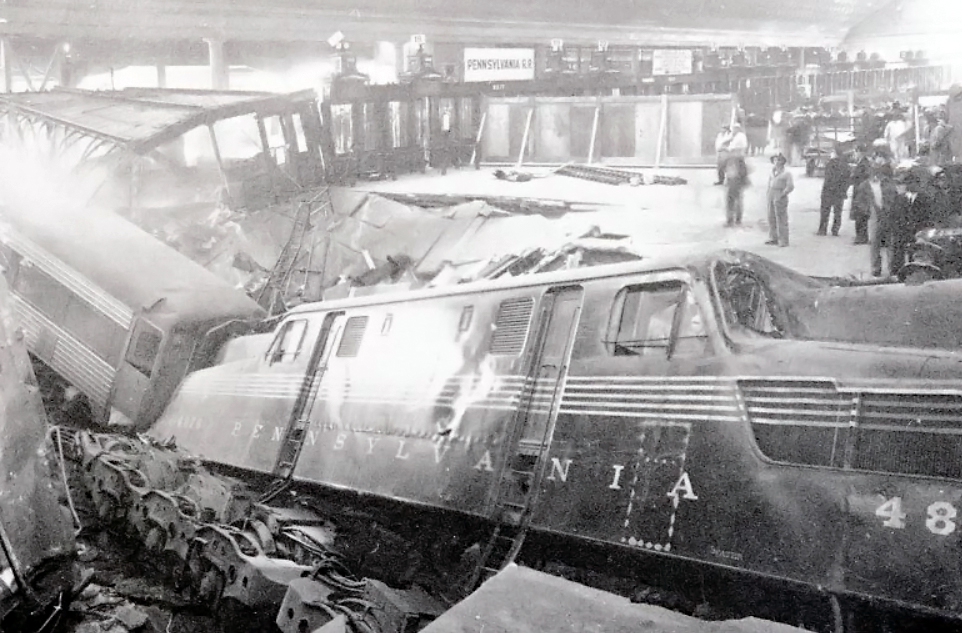 The famous photo of Pennsylvania Railroad GG1 #4876 laying in the the baggage and mail rooms in Washington Union Station's basement.
The Federal was a joint operation involving the New Haven Railroad and the Pennsylvania Railroad, running daily from Boston’s South Station to Washington, D.C. It carried passengers, mail, and express freight, and on this trip it was heavily loaded with 400 people—many of them travelers heading to the capital for the upcoming presidential ceremonies. The consist was substantial: 16 cars, including coaches and Pullman sleeping cars, totaling well over 1,100 tons. Locomotive changes were routine on the multi-railroad route. A diesel hauled the train from Boston; at New Haven, Connecticut, a New Haven electric took over, and additional cars from Springfield, Massachusetts, were added. At New York’s Pennsylvania Station, PRR GG1 No. 4876—built in January 1939 at the Altoona Works—was coupled on for the final leg south. Engineer Harry W. Brower, a 65-year-old veteran with more than 40 years on the PRR, and his fireman John W. Moyer were in the cab. Conductor T.J. Murphy oversaw the train.
The trouble began the night before, during the run from Boston. At Kingston, Rhode Island—about 70 miles south of Boston—the brakes were sticking. A 45-minute (some accounts say 57½-minute) inspection revealed a closed “angle cock,” an air shutoff valve at the rear of the third car (New Haven coach No. 8665). Angle cocks are critical components of the train’s pneumatic brake system. Each car has compressed-air reservoirs; the locomotive supplies a continuous “train line” of pressurized air that keeps the brakes released. When the engineer reduces pressure in the train line, valves on each car release air from the car’s own reservoir into brake cylinders, applying the shoes to the wheels. If the line is severed or pressure is dumped in an emergency, brakes apply automatically—a fail-safe design dating back to George Westinghouse in the 1860s.
A closed angle cock anywhere in the train isolates the cars behind it. Brakes on those rear cars cannot be applied from the locomotive, and the fail-safe is disabled. At Kingston, the crew corrected the problem, and the train continued. In New York, inspectors confirmed the angle cock on car 8665 was open. No one suspected lingering danger. The train left New York at 4:38 a.m., already running late but making up time. It stopped normally at Philadelphia, Wilmington, Delaware, and Baltimore (departing the last at 7:50 a.m.), with no reported braking issues.
South of Baltimore the track descended gently toward Washington. Near Landover, Maryland—roughly six miles from Union Station—Brower applied the brakes to begin slowing for the stub-end terminal. The train slowed only from 80 mph (130 km/h) to about 60 mph (97 km/h). He tried the emergency brake; speed dropped to 50 mph (80 km/h). Realizing something was catastrophically wrong, Brower “plugged” the locomotive—reversing the traction motors to use them as generators for dynamic braking. Sparks flew from the wheels of the engine and first three cars as they alone fought the momentum of 1,100 tons. The electrical system began to fail under the stress. The train was now on a 5,500-foot (1,700 m) downhill stretch with a 0.73% grade, accelerating again. Brower sounded the air horn in a desperate distress signal.
In the interlocking tower (“K Tower”) at the Union Station yard, operator John Feeney saw the runaway and lined the switches for Track 16. He phoned the stationmaster’s office. Clerk Ray Klopp answered on the first or second ring—unusually quick, perhaps because inauguration crowds had already swollen passenger traffic. Feeney yelled, “Runaway on Track 16!” Klopp looked up, saw the headlight bearing down, and screamed, “Run for your lives!” He and his clerks fled with about 20 seconds to spare. Conductor Murphy raced through the cars shouting for passengers to hit the floor. The train rocketed past Florida Avenue far faster than the usual crawl.
At 8:38 a.m. the Federal hit the buffer stop at an estimated 35–50 mph (56–80 km/h). The steel barrier offered no resistance. The locomotive obliterated the stationmaster’s office—its clock froze forever at 8:38—then smashed the newsstand. It skidded rightward, shearing a steel pillar and gouging the concrete concourse floor. The floor, never designed to support a 215-ton locomotive, collapsed. The GG1’s rear plunged into the basement baggage and mail rooms. Two coaches broke loose: one slid onto the concourse beside the engine; the other nosed downward into the hole. Six more cars derailed but stayed on the platform level. The locomotive’s nose stopped inches from the doors to the crowded main waiting room, actually pushing them open. A Life magazine photograph captured the surreal sight.
Miracles prevented catastrophe. The basement workers had just left for coffee break eight minutes earlier. Four employees were briefly trapped but freed unharmed. Engineer Brower and Fireman Moyer climbed out unscathed; Brower even asked Moyer to retrieve his timetables from the cab before helping others. Passengers evacuated via firefighters’ ladders. NBC broadcast live from the scene just 67 minutes later—one of the fastest nationwide live TV feeds of its era.
Injuries totaled 43; six were serious enough for overnight hospitalization. Most were cuts, bruises, and shock from the sudden stop and flying debris. No one was killed—a testament to the train’s relatively low speed at impact, the quick warning, and sheer luck.The Interstate Commerce Commission (ICC) investigation pinpointed the cause: a design flaw in certain New Haven coaches, including No. 8665. The angle-cock handle could strike the bottom cross-member of the buffer pocket when coupled to a car with a slightly different (but compatible) coupler design. Between Baltimore and Washington the handle had rotated, closing the valve. Only the locomotive and first three cars had working brakes. The ICC recommended immediate inspection of all similar cars and removal from service until corrected. The flaw had appeared earlier at Kingston but was not communicated through crew changes at New Haven and New York.
Despite the damage, train service continued with minimal disruption. Steiner Construction Co. of Baltimore worked around the clock. Derailed cars were removed; the locomotive was lowered fully into the basement; a temporary wooden floor was built over the hole and covered with quick-drying asphalt. A makeshift stationmaster’s office and newsstand were erected. The station reopened in time for inauguration crowds on January 20. Permanent repairs followed later.
GG1 No. 4876’s story continued. The locomotive was too heavy and awkwardly positioned to lift out easily. After the inauguration, workers cut it into sections (accounts vary between two or three major pieces, later further disassembled) and hauled the parts up the baggage ramp into gondola cars for shipment to PRR’s Altoona shops. There, new frames and superstructure were fabricated. Reusable components—traction motors, wheels, brakes, and much of the electrical gear—were refurbished and installed. Essentially a new locomotive built around salvaged parts, 4876 returned to service in October 1953, repainted in the PRR’s striking Tuscan Red (it had previously been Brunswick Green). It continued hauling passengers for the PRR, later Penn Central, Conrail, and finally New Jersey Transit until retirement in 1983—one of the last GG1s in active duty.
Today, Pennsylvania No. 4876 resides at the Baltimore & Ohio Railroad Museum in Baltimore. It is not on public display and awaits full restoration; it remains in its later dark green livery, a silent witness to that chaotic morning. The wreck inspired the climactic runaway-train scene in the 1976 comedy Silver Streak, starring Gene Wilder and Richard Pryor.
The 1953 wreck of The Federal highlighted vulnerabilities in pre-digital rail technology even as the industry entered its post-war decline. It underscored the critical importance of consistent communication across crew changes, the need for foolproof brake-system design, and the resilience of Union Station’s staff and passengers. In an era when trains still dominated long-distance travel and the nation prepared to inaugurate a new president, a potential tragedy was averted by seconds, quick thinking, and good fortune. The hole in the floor was patched, the locomotive rebuilt, and rail service resumed—yet the frozen clock, the sparks on the rails, and the image of a GG1 half-buried in the basement remain etched in railroad lore. The event stands as a dramatic reminder that even the mightiest machines are only as safe as the systems—and people—keeping them under control.
Recent Articles


-
Bessemer & Lake Erie Railroad: "The Bessemer Road"
Sep 15, 26 05:20 PM
 Bessemer & Lake Erie—Bear Creek 1865, Carnegie 1897, U.S. Steel 1901. Ore south from Conneaut, coal north. 2-10-4s, Missabe sister road. CN May 10, 2004. Complete corporate history.
 -
Bangor and Aroostook Railroad: "Serving Northern Maine"
Sep 15, 26 05:05 PM
 Bangor & Aroostook—chartered February 13, 1891, first trains January 1, 1894. Potatoes, paper, Searsport, State of Maine reefers. MM&A 2003, Lac-Mégantic 2013, CP 2020, CPKC today. Complete co…
 -
Baltimore & Ohio Chicago Terminal Railroad: Map and History
Sep 15, 26 03:11 PM
 B&OCT—formed January 6, 1910 to buy Chicago Terminal Transfer. Grand Central, Barr Yard, 78 route-miles. Assigned B&O steam. Complete diesel roster. CSX paper subsidiary, mark BOCT.
 -
The "Alphabet Route" (Railroad): Photos and History
Sep 15, 26 02:53 PM
 Alphabet Route—eight railroads, not one company. P&WV to Connellsville February 11, 1931. Alpha Jets Chicago/St. Louis–New York/Boston. NKP, W&LE, P&WV, WM, Reading, CNJ, L&HR, New Hav…
 -
Milwaukee Road Livestock Operations: Cattle, Dakotas & Montana
Sep 15, 26 02:36 PM
 Milwaukee Road livestock traffic—Dakota and Montana cattle, Iowa hogs, Chicago markets, 28-hour law, head-end stock cars. By 1974 mostly Montana. Rick Burn’s Helena speech. Operations history, not the…
 -
Spirit of Jasper Ride & Dine (2026): Season Pause
Sep 15, 26 02:29 PM
 Spirit of Jasper Ride & Dine in Jasper, Indiana—seated meal on board. Operator: not running public trains for 2026. Depot remains open as a rental. Confirm on spiritofjaspertrain.com.
 -
South Carolina Canal & Rail Road Company: Map and History
Sep 15, 26 01:59 PM
 South Carolina Canal & Rail Road—chartered December 19, 1827. Best Friend of Charleston, 136 miles Charleston–Hamburg October 1833, Aiken inclined plane. South Carolina Railroad 1844, Southern 189…
 -
The Practice of Double-Heading: The Steam Era
Sep 15, 26 01:43 PM
 Doubleheading—two locomotives on the point, each with its own steam crew. Not a rear helper, not diesel MU. How it worked, PRR 1877, mountain grades, and what MU ended.
 -
Mohawk and Hudson Railroad: Map, Pictures, Locomotives
Sep 15, 26 01:20 PM
 Mohawk & Hudson Railroad—New York’s first railroad, chartered April 17, 1826. DeWitt Clinton, inclined planes, Albany & Schenectady 1847, first New York Central May 17, 1853. Complete corporat…
 -
Essex Clipper Dinner Train (2026): Dates, Tickets & What to Expect
Sep 15, 26 01:09 PM
 2026 Essex Clipper Dinner Train in Essex, CT—2.5 hours, four-course meal $129.99, 18+. Fall dates through Oct. 25. Confirm on essexsteamtrain.com.
 -
Camden & Amboy Railroad: Map, History, Photos
Sep 15, 26 12:53 PM
 Camden & Amboy Railroad—chartered February 4, 1830. Joint Companies monopoly with the Delaware & Raritan Canal, John Bull, T-rail. United New Jersey 1872, PRR 999-year lease 1871. Complete corpora…
 -
Cafe Lafayette Dinner Train (2026): Dates, Tickets & What to Expect
Sep 15, 26 12:47 PM
2026 Cafe Lafayette Dinner Train in North Woodstock, NH—2 hours, 20 miles, five-course meal from $125. May–October. Confirm on nhdinnertrain.com. -
Christmas Train Ride Locations (2026): A Complete Guide
Sep 15, 26 10:47 AM
 2026 Christmas train rides by state—Santa, North Pole Express, and holiday trains. Not Polar Express. State guides and product pages. Confirm dates on each railroad.
 -
Baltimore & Ohio Railroad: Linking 13 Great States With The Nation
Sep 15, 26 10:22 AM
 Baltimore & Ohio Railroad—first U.S. common carrier, chartered February 28, 1827. Wheeling 1853, Chicago 1874, C&O control 1963, Chessie 1973, into CSX April 30, 1987. Complete corporate history.
 -
Delaware & Hudson Railway: The Bridge Line
Sep 15, 26 09:59 AM
 Delaware & Hudson Railway—Wurts brothers canal 1823, gravity railroad 1829, Stourbridge Lion, Bridge Line to Montreal. Guilford 1984, CP 1991, NS south line 2015, CPKC north.
 -
Delaware & Hudson Diesel Roster (All-Time)
Sep 15, 26 12:17 AM
 All-time Delaware & Hudson diesel roster—Alco S-2s through C-628s and PA-4s, GE U-boats, Baldwin RF-16s, EMD SD45s and GP38-2/GP39-2s. Serials, dates, dispositions.
 -
Granite Railway, Our Country's First Railroad
Sep 14, 26 11:28 PM
 Granite Railway of Quincy, Massachusetts—chartered March 4, 1826, opened October 7, 1826. Gridley Bryant, 5-foot gauge, horses, Bunker Hill Monument stone. First commercial U.S. railroad.
 -
Milwaukee Road Skytop Lounges: History, Specs & Floor Plans
Sep 14, 26 11:09 PM
 Milwaukee Road Skytop observation cars—Brooks Stevens, 1948. Four Rapids parlor-lounges from Milwaukee Shops, six Creek sleeper-lounges from Pullman-Standard. Floor plans, roster, preservation.
 -
West Virginia Christmas Train Rides (2026): A Complete Guide
Sep 14, 26 11:02 PM
2026 West Virginia Christmas trains—Potomac Eagle North Pole Express in Romney and Christmas at Cass. Not Polar Express. Elkins Polar is not listed for 2026. -
Railroads Of Today: Class I Map, PSR & the 2026 Industry
Sep 14, 26 10:30 PM
 U.S. freight rail in 2026—six Class I railroads on a nearly 140,000-mile network. PSR as everyday practice, how the STB works, traffic mix, short lines and regionals.
 -
Railroad History (USA): Timeline, Facts & How the Network Was Built
Sep 14, 26 10:03 PM
 Full U.S. railroad history hub—origins and inventors, Golden Age peak mileage, Civil War and transcontinental, streamliners, ICC regulation, Penn Central and Conrail, Staggers Act, PSR, and today’s Cl…
 -
Railroads In The 2020s: CPKC, East Palestine & the UP–NS Case
Sep 14, 26 09:51 PM
 U.S. railroads 2020–2026—Class I mileage 91,773 in 2020. COVID traffic drop, CPKC April 14 2023, East Palestine Feb. 3 2023, UP–NS $85 billion case still before the STB.
 -
Railroads In The 2010s: PSR, Coal’s Decline & Positive Train Control
Sep 14, 26 03:51 PM
 U.S. railroads 2010–2020—Class I mileage 95,573 to 91,773. Buffett closed BNSF Feb. 12 2010, Harrison at CP June 29 2012 and CSX 2017, PTC deadline Dec. 31 2018.
 -
Virginia Christmas Train Rides (2026): A Complete Guide
Sep 14, 26 03:46 PM
 2026 Virginia Christmas trains—Virginia Scenic Railway Santa Express from Staunton, about 60 minutes. Confirm dates. Not Polar Express.
 -
MARC Train: Maryland Commuter Rail History, Lines & Roster
Sep 14, 26 01:16 PM
 MARC Train history—Maryland Rail Commuter 1984, B&O and PRR corridors, Penn/Camden/Brunswick lines, Silver Spring 1996, all-time locomotive roster.
 -
Railroads In The 2000s: Merger Freeze, Wisconsin Central & Buffett
Sep 13, 26 07:57 AM
 U.S. railroads 2000–2010—Class I mileage 99,250 to 95,573. STB merger freeze March 17 2000, CN–WC Oct. 9 2001, BNSF Railway Jan. 24 2005, Buffett Nov. 3 2009.
 -
Railroads In The 1990s: Mega-Mergers, Conrail’s Split & the STB
Sep 13, 26 12:13 AM
 U.S. railroads 1990–2000—Class I mileage 119,758 to 99,250. BNSF Sept. 22 1995, UP–SP Sept. 11 1996, Conrail split June 1 1999, ICC Termination Dec. 29 1995.
 -
Railroads In The 1980s: Staggers, Mega-Mergers & Conrail’s IPO
Sep 12, 26 11:12 PM
 U.S. railroads 1980–1990—Class I mileage 164,822 to 119,758. Staggers Oct. 14 1980, CSX and Norfolk Southern, UP–Missouri Pacific–Western Pacific, Conrail IPO March 26 1987.
 -
Wabash Class O-1 4-8-4s: History, Roster & Specifications
Sep 12, 26 11:01 PM
 Wabash Class O-1 4-8-4s—Baldwin 1930–31, twenty-five engines 2900–2924. Fast freight, complete roster, specifications. None preserved.
 -
Staggers Rail Act of 1980: Statute, Contract Rates & the ICC
Sep 10, 26 11:23 PM
 Staggers Rail Act, Pub. L. 96-448, signed October 14, 1980. Harley Staggers, S.1946, contract rates, 180% variable-cost test, abandonments, short lines.
 -
Rock Island E8A 652: Bicentennial Independence Paint & History
Sep 10, 26 10:42 PM
 Rock Island E8A 652—EMD March 1952, serial 15199. 20th Century Railroad Club Independence bicentennial scheme, Peoria and Quad Cities Rockets, Midland Railway, Manly Junction Museum.
 -
Vermont Christmas Train Rides (2026): A Complete Guide
Sep 10, 26 10:37 PM
2026 Vermont Christmas trains—Okemo Valley Holiday Express from Chester Depot Dec. 19–20. Polar is Burlington Dec. 5–6 only. -
Railroads In The 1970s: Penn Central, Amtrak & Conrail
Sep 10, 26 10:18 AM
 U.S. railroads 1970–1980—196,479 miles at the decade’s start. Penn Central bankruptcy June 21 1970, Amtrak May 1 1971, 3R/4R Acts, Conrail April 1 1976, Rock Island 1975, Milwaukee 1977.
 -
Railroads In The 1960s: Mergers, Passenger Collapse & Penn Central
Sep 10, 26 10:03 AM
 U.S. railroads 1960–1970—207,334 to 196,479 miles. Erie Lackawanna 1960, C&O–B&O 1963, N&W–Nickel Plate 1964, SCL 1967, Penn Central Feb. 1 1968.
 -
South Carolina Christmas Train Rides (2026): A Complete Guide
Sep 10, 26 08:36 AM
 2026 South Carolina Christmas trains—South Carolina Railroad Museum Santa Train in Winnsboro. Confirm December dates. Not Polar Express. Drop light-festival padding.
 -
Steam Locomotive Feedwater Heaters: Elesco, Coffin & Worthington
Sep 10, 26 08:29 AM
 Steam locomotive feedwater heaters—open Worthington vs closed Elesco and Coffin. How they work, how to identify them on a smokebox, and why not every engine had one.
 -
Oregon Christmas Train Rides (2026): A Complete Guide
Sep 10, 26 08:22 AM
2026 Oregon Christmas trains—Portland Holiday Express, Garibaldi Candy Cane Express, Sumpter Valley Christmas Trains Dec. 11–13. Polar is Mount Hood. -
Lake Shore & Michigan Southern: Map, History, Timetables
Sep 10, 26 08:12 AM
 Lake Shore & Michigan Southern Railway—Erie & Kalamazoo 1833, Michigan Southern to Chicago 1852, LS&MS April 6 1869, Vanderbilt, Ashtabula 1876, NYC merger Dec. 22 1914. 1910 map and Official Guide.
 -
Big Four Route (CCC&StL): Map, History
Sep 10, 26 12:19 AM
Cleveland, Cincinnati, Chicago & St. Louis Railway—Bee Line 1868, Ingalls’s first Big Four 1880, CCC&StL June 30, 1889, NYC lease Feb. 1, 1930. 1910 and 1930 maps, what still runs. -
Railroads In The 1950s: Diesel, the Interstate & Passenger Collapse
Sep 10, 26 12:15 AM
 U.S. railroads 1950–1960—223,779 to 211,459 miles. Interstate June 29, 1956, dieselization, passenger collapse, TOFC, 1957–58 recession, NYO&W 1957, N&W–Virginian 1959.
 -
New Jersey Christmas Train Rides (2026): A Complete Guide
Sep 10, 26 12:06 AM
 2026 New Jersey Christmas trains—Black River & Western Santa Express from Flemington and Pine Creek Christmas trains in Wall Township. Polar is Whippany and Phillipsburg.
 -
New Mexico Christmas Train Rides (2026): A Complete Guide
Sep 09, 26 11:57 PM
 2026 New Mexico Christmas trains—Cumbres & Toltec Santa’s Holiday Express from Chama Dec. 5–6 (and Antonito, Colo., Dec. 12–13). Coach $25/$15. Not Polar Express.
 -
Grand Trunk Railway: Map, History, Timetables
Sep 09, 26 11:47 PM
 Grand Trunk Railway of Canada—charter Nov. 10, 1852, Montreal–Toronto 1856, Portland, Sarnia, Victoria Bridge, St. Clair Tunnel 1891, Great Western 1882, GTPR, CN Jan. 20, 1923. 1893 map and Official…
 -
Troop Trains In World War II: Sleepers, Kitchen Cars & Movements
Sep 09, 26 11:42 PM
 WWII U.S. troop trains—almost 44 million armed-services passengers, Pullman troop sleepers, ACF kitchen cars, hospital trains, monthly movement tables 1942–45. Not the Military Railway Service. ODT an…
 -
Railroads In The 1940s: War Traffic, Last Steam & the Diesel Flood
Sep 09, 26 11:37 PM
 U.S. railroads 1940–1950—233,670 to 223,779 miles. World War II as the decade’s center, last new steam, diesel flood after V-J Day, 1945 car orders, California Zephyr 1949.
 -
Railroads In World War II: ODT, Record Traffic & Private Operation
Sep 09, 26 03:00 PM
 U.S. railroads in World War II—Lend-Lease freight, Pearl Harbor, Office of Defense Transportation, 1944 peak ~740 billion ton-miles, Dec. 1943–Jan. 1944 seizure. Private operation, not a USRA sequel.
 -
Montana Christmas Train Rides (2026): A Complete Guide
Sep 09, 26 02:54 PM
2026 Montana Christmas trains—Charlie Russell Chew Choo North Pole Adventure from Hanover/Lewistown, Nov. 27–Dec. 19, $71, about 1.5 hours. Not Polar Express. -
Railroads In The 1930s: Depression, Streamliners & the FT
Sep 09, 26 09:32 AM
 U.S. railroads 1930–1940—249,052 to 233,670 miles. Section 77, Eastman, Motor Carrier Act, M-10000 and Pioneer Zephyr 1934, EMC FT 1939. Decade frame, not the streamliner encyclopedia.
 -
Sugar Cane Train (Lahaina): LK&P History, Roster & 2026 End
Sep 09, 26 08:19 AM
 Lahaina, Kaanapali & Pacific Sugar Cane Train—3-foot tourist line 1970–2014. Anaka, Myrtle, 2023 and 2025 fires, September 2026 scrapping. Roster, Hahakea trestle, Pioneer Mill corridor.
 -
Massachusetts Christmas Train Rides (2026): A Complete Guide
Sep 09, 26 08:16 AM
 2026 Massachusetts Christmas trains—Shelburne Falls Moonlight Magic Friday Nov. 27; Edaville Festival of Lights in Carver. Polar is Cape Cod Central in Buzzards Bay.