Flexi-Van: New York Central’s Super Van Container Service
Last revised: August 11, 2026
By: Adam Burns
Flexi-Van was the New York Central’s answer to the postwar truck—and a deliberate alternative to ordinary trailer-on-flatcar (TOFC) “piggyback.” Instead of hauling a complete highway trailer (wheels and all) on a flatcar, Flexi-Van used a detachable van body that rode a truck chassis on the highway and a special low-profile railcar on the railroad. Loading and unloading happened at right angles via a turntable on the car, without a gantry crane. Dedicated Super Van freights moved the traffic on passenger-train schedules across the Water Level Route and connecting corridors.
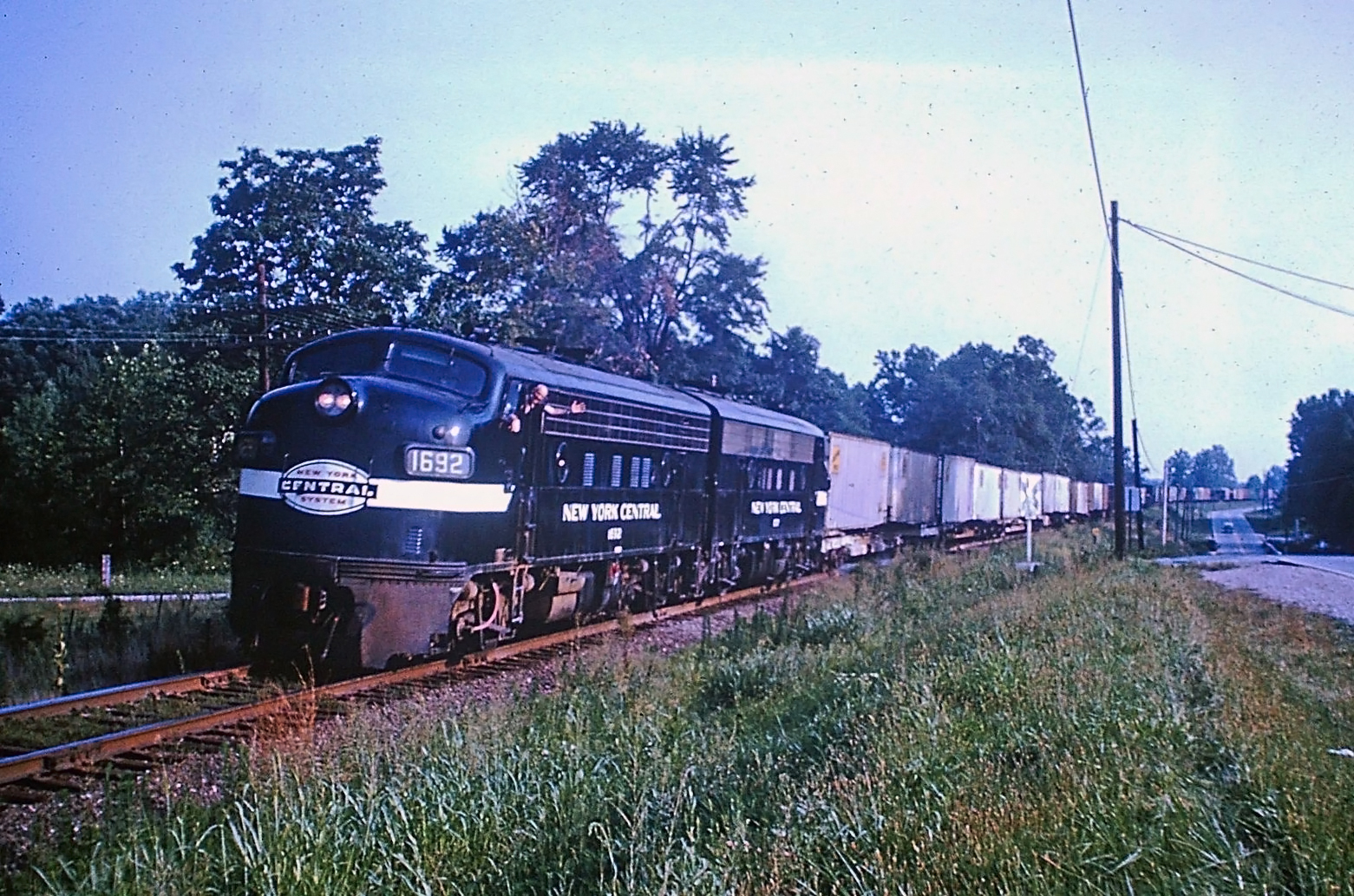
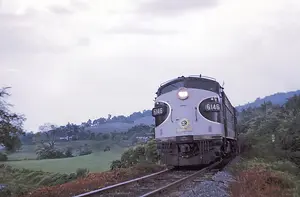
New York Central F7s led by #1692 with a long freight near Greensburg, Indiana, July 1966. Immediately behind the power is a cut of the railroad’s trademark Flexi-Van equipment—low-profile cars carrying detachable vans, not conventional highway trailers on flatcars. Photographer unknown.
Under president Alfred E. Perlman, Flexi-Van grew from 1957 tests into a large proprietary fleet—hundreds of cars and thousands of vans—and a genuine commercial success for the Central. What it never became was the industry standard. By the mid-1960s most North American railroads standardized on conventional TOFC and the Trailer Train (later TTX) car pool. NYC itself added piggyback and joined Trailer Train while Flexi-Van was still running. Penn Central inherited the leftover equipment; the distinctive system then faded. Flexi-Van’s importance is real, but it is best understood as a brilliant proprietary COFC experiment—not as a ChatGPT-style claim that it single-handedly invented modern global containerization.
At a Glance
| Topic | Summary |
|---|---|
| What it was | Detachable freight van (container-like body) + highway chassis + specialized rail flatcars with turntables |
| What it was not | Ordinary TOFC/piggyback (complete trailer with wheels on a flatcar) |
| Champion | Alfred E. Perlman’s New York Central (late 1950s–1960s) |
| Hardware partner | Strick Division of Fruehauf (experimental turntable car, 1957) |
| Service start | Tests 1957; revenue Flexi-Van from spring 1958 (NY–Chicago corridor service that April; mail applications same year) |
| Brand name for trains | Super Van (e.g., SV-1, SV-4, SV-6 and related symbols) |
| Why NYC loved it | Lower center of gravity / lower profile for restricted clearances; no circus ramps or large cranes; door-to-door with highway tractor |
| Scale (mid-1960s NYC) | On the order of ~850+ Flexi-Van flatcars and 7,000+ vans/containers (period fleet figures commonly cited) |
| Growth marker | Roughly 42,000 van loadings in 1960; on the order of 150,000+ by 1966 (period industry/railfan tallies) |
| Outside NYC | Limited regular use (notably Milwaukee Road and Illinois Central among freerighters); most roads stuck with TOFC |
| Industry path not taken | Trailer Train / conventional TOFC became the North American standard; ISO marine containers later dominated true COFC |
| Endgame | NYC added TOFC (early 1960s) and joined Trailer Train (mid-1960s); PC used remaining Flexi-Van gear (including mail); system discontinued |
Piggyback Before Flexi-Van
Trailer-on-flatcar was not new in 1958. The Chicago Great Western tested TOFC ideas in the 1930s; the New Haven and others followed. After World War II a long list of roads—Burlington, B&O, Santa Fe, Southern Pacific, Erie, Lackawanna, Nickel Plate, and many more—experimented with or adopted piggyback as trucks ate short- and medium-haul less-than-carload and merchandise traffic.
Standard TOFC had obvious problems on a railroad like the Central. A highway trailer on a flatcar is tall and heavy. End-loading (circus-style ramps) or side-loading with heavy lift equipment takes space and time. Clearance envelopes on older eastern lines—especially approaches into New York—punished high loads. And every railroad’s trailers and hitches were not automatically interchangeable. Perlman’s operating team wanted something faster at the terminal, lower on the rail, and better suited to NYC’s physical plant.
How Flexi-Van Actually Worked
Flexi-Van split the highway trailer into two pieces:
- The van — a weatherproof cargo body (the “container” in modern language, though dimensions and fittings were proprietary, not ISO boxes)
- The highway chassis — wheels, landing gear, and fifth-wheel connection for a tractor
At a rail terminal, a tractor backed the van at roughly right angles to a special flatcar. The car’s motor-driven turntable (or related transfer gear) lined up with rails or guides on the van’s underside. The driver unlocked the van from its chassis; the body was pulled or guided onto the turntable and rotated parallel to the car, then secured for the rail journey. At destination the sequence reversed: van swung out, chassis backed under, lock pins engaged, and the load rolled away as a highway trailer again.
No overhead crane was required for the classic operation. That mattered for cost and for sites that were little more than a paved pad beside a track. The railcars themselves were low-profile skeleton or spine-type designs compared with a trailer-on-flatcar stack—important for Hudson Division and other restricted clearances. Modelers and mechanical writers often note converted or purpose-built flats (early experiments included cut-down equipment nicknamed things like “iron sleds” in fan lore) evolving into purpose-built Flexi-Van cars.
Mike Schafer and Brian Solomon, in New York Central Railroad, credit the Strick Division of Fruehauf with testing an experimental flatcar and motor-driven turntable in 1957: a van loaded or unloaded by highway tractor at right angles. That experiment is the hardware birth of the system NYC then scaled.
Language note: NYC marketing sometimes blurred “trailer” and “van.” Technically Flexi-Van is closer to early container-on-flatcar (COFC) than to classic TOFC.
Service Begins: 1958 and the Super Van Idea
Revenue Flexi-Van service started in 1958. Contemporary coverage (including New York Times reporting that summer) described the method as highway trailers whose bodies left their wheels and rode the rail—already in operation between Chicago and New York from April of that year. On July 21, 1958, the Central began carrying mail between Chicago and Detroit in Flexi-Van containers, an early proof that the vans could take scheduled, time-sensitive traffic as well as general merchandise.
Terminals grew with the business: New York area facilities (including Hudson River–side and inland yards as the network matured), Chicago, Detroit, Boston/Selkirk connections, St. Louis gateway traffic, and other industrial hubs on or connecting to the Water Level Route. Not every point needed a huge intermodal lift complex; the system was designed around tractor-and-turntable geometry.
The operating crown jewels were the Super Van trains—symbol freights such as SV-1, SV-3, SV-4, SV-6 and related sections—carded as hot merchandise runs. SV-4, for example, is remembered among fans as a Selkirk–Boston (and related) Flexi-Van speedster; SV-6 and other symbols stitched St. Louis, Ohio, and eastern gateways into the network. Consists could be short by bulk-commodity standards but ran at passenger-train pace. In an era when boxcars still dominated, a solid or near-solid Flexi-Van train behind F units or Geeps was the Central advertising modern railroading in steel.
Why It Made Sense for the Central
Perlman’s NYC was fighting for its life against trucks, regulation, and passenger losses. Flexi-Van attacked several problems at once:
- Door-to-door marketing — Shippers saw a highway pickup and delivery with a long rail line-haul in the middle, closer to pure truck logistics than a traditional carload.
- Terminal speed — Right-angle transfer without circus ramps could turn vans faster than many early TOFC terminals.
- Clearance and stability — Lower profile and lower center of gravity than a trailer on a standard flat suited eastern bridges and high-speed running.
- Labor and handling cost — Less rehandling of individual packages than LCL; less heavy lift than some intermodal schemes.
- Mail and premium freight — Scheduled vans fit Postal Service and time-freight contracts that paid better than bulk.
Period business press occasionally tied Flexi-Van (and multi-level auto racks) to Central profit swings in good years—evidence that management saw the product as strategic, not a side show. Fleet size grew accordingly: commonly cited mid-1960s figures put the railroad in the neighborhood of 859 Flexi-Van flatcars and more than 7,000 vans. Loadings rose from tens of thousands of vans annually at the start of the decade toward the mid-six-figures by the mid-1960s.
The Interchange Problem: Why the Industry Said No
Flexi-Van worked inside the New York Central’s commercial empire. Off-line, it was awkward.
A Flexi-Van car and van were a closed technical ecosystem. A Santa Fe or Southern Pacific TOFC terminal set up for standard trailers and hitches could not casually accept a Strick/NYC turntable car and proprietary van as if it were just another piggyback load. Connecting roads had little incentive to invest in unique terminals, chassis pools, and car types for one eastern partner’s design. Milwaukee Road and Illinois Central are the freerighters most often named as regular participants; a few other roads appeared in photos or secondary roles, but the network never became continental the way Trailer Train piggyback did.
Meanwhile, conventional TOFC improved. The industry coalesced around the Trailer Train Company (founded earlier in the 1950s by major roads as a flatcar pool—later TTX), which let railroads share standardized piggyback cars and interchange trailers more easily. The Central, pragmatic under pressure, began broader conventional TOFC operations in the early 1960s and joined Trailer Train around 1964 even while Super Vans still ran. That was not hypocrisy; it was recognition that interline freight demanded a common denominator.
ISO marine containers and pure COFC/double-stack railroading of the 1980s–2000s followed a different standardization path (international container dimensions, cellular ships, well cars). Flexi-Van anticipated the idea of separating the box from the wheels, but it did not invent the global container system, and overstating that lineage does the real history a disservice. Its correct place is in the North American intermodal evolutionary tree: between early piggyback experiments and the Trailer Train / stack-train world.
Penn Central and After
Penn Central inherited Flexi-Van cars and vans along with the rest of the NYC freight plant. Remnants of the fleet saw continued use—bulk mail service is often cited—sometimes behind passenger-style power on tight schedules, a ghost of the Super Van concept in a bankrupt railroad’s wardrobe. Without a proprietary system-wide commitment, and with TOFC/TTX already the interline standard, there was little reason to perpetuate unique turntable cars. Equipment aged out, was converted, or was retired. The Flexi-Van brand left the timetable.
Corporate successors of the hardware and the idea are diffuse. Modern chassis-leasing firms and intermodal marketers sometimes echo the “Flexi-Van” name in other businesses; those should not be confused with NYC’s 1958–1960s railroad product without careful checking. The operating legacy that matters for rail historians is simpler: Perlman-era NYC proved premium intermodal could work on eastern freights—then the industry standardized on a different kit of parts.
How to Spot Flexi-Van in Photographs
- Low, skeletal or specialized flats rather than a full highway trailer sitting high on a standard TOFC flat
- Van bodies without highway duals visible under the load (wheels are on the chassis left at the terminal, or the van is clearly a body-only load)
- NYC (or PC) reporting marks on cars and often distinctive van paint/lettering in period color shots
- Short, fast freights with a high ratio of Flexi-Van cars near the engines on Water Level Route or Midwest main-line scenes—classic Super Van look
- Contrast with neighboring trains: conventional TOFC shows trailer noses, landing gear, and full tire sets on the car
Legacy
Flexi-Van deserves a clear, unsentimental verdict:
- As a NYC product, it was a success—high-speed merchandise and mail, large fleet, rising loadings, a visible symbol of Perlman modernization alongside new yards and dieselization.
- As an industry standard, it failed—too proprietary, too few connecting believers, overtaken by Trailer Train TOFC and later by international container standards.
- As history, it remains one of the most interesting North American intermodal chapters: a railroad that refused to accept that trucks owned the door-to-door future, and that designed steel and schedules to prove the point.
Related Reading
- New York Central Railroad — system history and Perlman-era context
- Penn Central — merger years when Flexi-Van equipment lingered
- Freight Car Types — broader rolling-stock context
- Class I Railroads — the industry structure Flexi-Van tried to serve
Sources
- Schafer, Mike, and Brian Solomon. New York Central Railroad (Strick/Fruehauf 1957 turntable experiment and system context)
- Loving, Rush, Jr. The Men Who Loved Trains (Perlman-era NYC culture and strategy)
- New York Times contemporary coverage of Flexi-Van inauguration and 1958 mail service
- Period NYC Super Van symbols and fan/operating summaries (SV-series hotshots; loading tallies for 1960 and mid-1960s)
- Industry intermodal timelines (TOFC pioneers; Trailer Train/TTX standardization)
This article replaces an earlier short overview of Flexi-Van with a fuller operational and technical history of New York Central’s Super Van / detachable-van system.
Recent Articles


-
Milwaukee Road X3800: Deer Lodge’s Shop Goat
Oct 08, 26 04:28 PM
 Milwaukee Road X3800, the a home-built shop goat that served the Deer Lodge, MT yard. It was a 220-volt DC switcher, powered through an extension cord that moved electrics into a roundhouse where the…
 -
Key West Extension (Overseas Railroad): History, Construction, Decline
Oct 08, 26 03:59 PM
 Henry Flagler's Overseas Railroad, Miami to Key West, 1905–1935. The Seven Mile Bridge, the 1935 Labor Day Hurricane, and the road that became U.S. 1.
 -
Florida East Coast Steam Roster (Post 1900)
Oct 08, 26 02:34 PM
 Florida East Coast steam since 1897. Seventeen Ten-Wheelers, twenty Atlantics, eighty-seven Pacifics, ninety Mountains, fifteen Mikados, and the switchers.
 -
Florida East Coast Diesel Roster (All-Time)
Oct 08, 26 02:12 PM
 Florida East Coast diesel roster, all-time. E units from 1939, F3s, BL2s, GP7s and GP9s, the GP40-2 orders, 22 SD40-2s, and 24 ES44C4s. Serials and EMD order numbers.
 -
Florida East Coast Railway: Map, History, Rosters
Oct 08, 26 01:46 PM
 Florida East Coast Railway, Henry Flagler's line from Jacksonville to Miami and Key West. Receivership in 1931, the 1963 strike, Grupo México in 2017, and Brightline on the same track.
 -
Minnesota Railroad Museums (2026): A Complete Guide
Oct 08, 26 10:32 AM
 Minnesota railroad museums—the Lake Superior Railroad Museum, Two Harbors, Jackson Street, Willmar’s Great Northern 2523, and Currie. Confirm hours on each site.
 -
Maine Railroad Museums (2026): A Complete Guide
Oct 08, 26 09:24 AM
 Maine railroad museums—Seashore Trolley, the two-foot lines at Portland, Alna, and Phillips, Boothbay, and the Bangor & Aroostook depots. Confirm hours on each site.
 -
Massachusetts Railroad Museums (2026): A Complete Guide
Oct 08, 26 12:08 AM
 Massachusetts railroad museums—Berkshire Scenic at Lenox, Shelburne Falls trolley No. 10, Edaville, Chatham’s 1887 depot, and Lowell. Confirm hours on each site.
 -
Clinchfield Steam Roster (Post 1900)
Oct 07, 26 12:09 PM
 Clinchfield steam since 1900. Fifteen H-4 Consolidations, K-1 Mikados, M-2 and M-3 Mallets, L-class 2-8-8-2s, eighteen Challengers. Class grid after Drury. Last steam April 16, 1954.
 -
Clinchfield Diesel Roster (All-Time)
Oct 07, 26 12:05 PM
 Clinchfield diesel roster, all-time. F3A 800, FP7 200, the F7s, GP7s, 25 SD40s, 18 SD45-2s, seven U36Cs, and the Family Lines hoods. Serials and EMD order numbers.
 -
Clinchfield Railroad: Map, Steam Locomotives, Roster, Logo
Oct 07, 26 12:02 PM
 Clinchfield Railroad, Elkhorn City to Spartanburg. George L. Carter, the Carolina, Clinchfield & Ohio, the 1924 lease, coal, the loops, and CSX. Steam and diesel rosters are companion pages.
 -
Kentucky Railroad Museums (2026): A Complete Guide
Oct 07, 26 11:39 AM
 Kentucky railroad museums—the Kentucky Railway Museum, Bowling Green’s L&N depot, Paducah, Versailles, and Covington. Confirm hours on each site.
 -
Kansas Railroad Museums (2026): A Complete Guide
Oct 07, 26 11:26 AM
 Kansas railroad museums—Santa Fe 3768 at Wichita, Santa Fe 132 in Topeka, the Great Overland Station, and Abilene. Confirm hours on each site.
 -
Cincinnati, New Orleans and Texas Pacific Diesel Roster (All-Time)
Oct 07, 26 10:38 AM
 All-time diesel roster of Southern locomotives lettered for the Cincinnati, New Orleans and Texas Pacific. Serials, order numbers, and builder dates.
 -
Cincinnati, New Orleans and Texas Pacific Railway
Oct 07, 26 10:31 AM
 Cincinnati, New Orleans and Texas Pacific Railway, incorporated September 8, 1881, to lease Cincinnati’s railroad to Chattanooga. Queen and Crescent route, Rathole, and the 2024 sale to Norfolk Southe…
 -
Indiana Railroad Museums (2026): A Complete Guide
Oct 07, 26 12:26 AM
 Indiana railroad museums—Nickel Plate 765, Elkhart’s New York Central collection, French Lick, Linden’s junction depot, and Haley Tower. Confirm hours on each site.
 -
"Triplex" Steam Locomotive: Specs, History, Photos
Oct 06, 26 11:52 PM
 Erie class P-1 Triplex 2-8-8-8-2s. Three Baldwin compounds, 2603–2605, later 5014–5016, built 1914 and 1916. Matt H. Shay, the 1930 class card, and Virginian XA 700.
 -
Illinois Railroad Museums (2026): A Complete Guide
Oct 06, 26 11:47 PM
 Illinois railroad museums—the Illinois Railway Museum, Monticello, the Pioneer Zephyr, Galesburg’s Burlington 3006, and the depots. Confirm hours on each site.
 -
Iowa Railroad Museums (2026): A Complete Guide
Oct 06, 26 11:41 PM
 Iowa railroad museums—the Union Pacific Railroad Museum, RailsWest, Sioux City, Boone, and the National Hobo Museum in Britt. Confirm hours on each site.
 -
Charleston and Western Carolina Diesel Roster (All-Time)
Oct 06, 26 11:29 PM
 Charleston and Western Carolina diesel roster. Twenty-one GP7s, two SW7s, two SW9s, and six F7As, all built 1950–1952. Serials, order numbers, and ACL and SCL numbers.
 -
Charleston and Western Carolina Railway: Map, History, Timetables
Oct 06, 26 11:18 PM
 Charleston and Western Carolina Railway, incorporated September 16, 1896. Port Royal to Spartanburg, with branches to Anderson and Greenville. Merged into the Atlantic Coast Line on December 31, 1959.
 -
Central of Georgia Steam Roster (Post 1900)
Oct 06, 26 04:00 PM
 Central of Georgia steam since 1900. Cooke Consolidations, Harriman Mikados, 32 Mountains, and eight Lima 4-8-4s. Class grid after Drury. Last steam May 1953.
 -
Central of Georgia Diesel Roster (All-Time)
Oct 06, 26 03:44 PM
 Central of Georgia diesel roster. SW1 No. 1 in 1939, E7s and E8s, nine F3As, 39 RS3s, GP7s through SD35s. Serials and order numbers.
 -
Central of Georgia Railway: Map, Logo, History, Rosters
Oct 06, 26 03:42 PM
 Central of Georgia Railway, from the 1833 Savannah charter to Southern control on June 17, 1963. Map, logos, Nancy Hanks II, and links to the steam and diesel rosters.
 -
Georgia Railroad Museums (2026): A Complete Guide
Oct 06, 26 03:33 PM
Georgia railroad museums—Savannah’s Central shops, Duluth, the General at Kennesaw, the Texas in Atlanta, Tifton, Waycross, and Albany. Confirm hours on each site. -
Florida Railroad Museums (2026): A Complete Guide
Oct 06, 26 03:18 PM
 Florida railroad museums—Boca Raton, Winter Garden, Whitehall, the Gold Coast, Parrish, Fort Myers, Milton, and Plant City. Confirm hours on each site.
 -
Connecticut Railroad Museums (2026): A Complete Guide
Oct 06, 26 01:05 PM
 Connecticut railroad museums—the Shore Line Trolley, East Windsor, the Naugatuck Railroad, Danbury Union Station, Willimantic, and the SoNo tower. Confirm hours on each site.
 -
Colorado Railroad Museums (2026): A Complete Guide
Oct 06, 26 12:47 PM
 Colorado railroad museums—Golden, the Forney’s Big Boy 4005, Pueblo’s Santa Fe 2912, and the depots at Castle Rock, Limon, and Ridgway. Confirm hours on each site.
 -
Atlantic Coast Line Steam Roster (Post 1900)
Oct 06, 26 12:44 PM
 Atlantic Coast Line steam since 1900. Copper Head Ten-Wheelers, 235 P-5 Pacifics, Q-1 Santa Fes, twelve R-1 4-8-4s. Class grid after Drury. Last steam June 30, 1955.
 -
Atlantic Coast Line Diesel Roster (All-Time)
Oct 06, 26 11:57 AM
 Atlantic Coast Line diesel roster. HH660 1900 in 1939, E3s for the Champion, FTs and F2s, GP7s 100–279, GP30s, U25Cs, and the 1967 SCL numbers. Serials and orders.
 -
Atlantic Coast Line Railroad: "Standard Railroad of the South"
Oct 06, 26 11:53 AM
 Atlantic Coast Line, the Standard Railroad of the South. April 21, 1900 to July 1, 1967. Plant System, L&N, Clinchfield, the Champion, and the Seaboard Coast Line merger.
 -
California Railroad Museums (2026): A Complete Guide
Oct 06, 26 09:50 AM
California railroad museums—the California State Railroad Museum, Perris, Portola, Railtown 1897, and the depots that still stand. Confirm hours on each site. -
Arizona Railroad Museums (2026): A Complete Guide
Oct 06, 26 09:46 AM
Arizona railroad museums—the Arizona Railway Museum in Chandler, Southern Pacific 1673 at Tucson, and the McCormick-Stillman park in Scottsdale. -
Arkansas Railroad Museums (2026): A Complete Guide
Oct 06, 26 09:07 AM
 Arkansas railroad museums—Cotton Belt 819 at Pine Bluff, the Fort Smith trolley, the Mammoth Spring depot, and the Eureka Springs railway.
 -
Alabama Railroad Museums (2026): A Complete Guide
Oct 06, 26 09:03 AM
Alabama railroad museums—Heart of Dixie at Calera, the North Alabama museum at Chase, Huntsville’s 1860 depot, and Fort Payne. Confirm hours on each site. -
Pennsylvania Railroad Museums (2026): A Complete Guide
Oct 06, 26 12:09 AM
 Pennsylvania railroad museums—Strasburg, Steamtown, the Horseshoe Curve, the East Broad Top, and the depots and towers in between. Confirm hours on each site.
 -
Maryland Railroad Museums (2026): A Complete Guide
Oct 05, 26 11:53 PM
 Maryland railroad museums—the Baltimore roundhouse, Ellicott City station, Bowie, Gaithersburg’s Buffalo Creek & Gauley 14, and the Western Maryland collections.
 -
Ohio Railroad Museums (2026): A Complete Guide
Oct 05, 26 05:51 PM
 Ohio railroad museums—the Age of Steam Roundhouse, Bellevue, Worthington, Conneaut’s Nickel Plate 755, and the Dennison depot. Confirm hours on each site.
 -
Delaware Railroad Museums (2026): A Complete Guide
Oct 05, 26 02:43 PM
 Delaware railroad museums—Wilmington & Western at Greenbank, the Harrington tower and N5 caboose, Felton's 1868 depot, and the Selbyville station museum.
 -
C&O's M-1 Steam Turbine Locomotives: Specs, Roster, History
Oct 05, 26 12:13 PM
 Chesapeake & Ohio Class M-1 steam-turbine-electrics. Three Baldwin-Westinghouse locomotives, 500–502, built 1947–48 for The Chessie. Specs, the 2-C1+2-C1-B arrangement, and a roster. All scrapped…
 -
N&W 2-6-6-2 Locomotives (Class Z): Specs, Roster, History
Oct 05, 26 11:44 AM
 Norfolk & Western Class Z 2-6-6-2s. One hundred ninety compound Mallets, 1300–1489, from Richmond, Baldwin, and Schenectady, 1912–1918. Diagram specs, the Z-1b rebuilds, Z-2 1399, and a roster. No…
 -
Scenic Train Rides (USA 2026): State Guide to Tourist Railroads
Oct 04, 26 12:17 AM
 Scenic and tourist train rides in all 50 states for 2026. Colorado narrow gauge, Pennsylvania steam, Alaska’s White Pass, and the states with no full-size ride this month. Confirm on the railroad.
 -
Wyoming Scenic Train Rides (2026): A Complete Guide
Oct 03, 26 12:07 AM
Wyoming has no full-size tourist railroad on the calendar in October 2026. Cheyenne Depot Museum and Douglas Railroad Museum are static. Union Pacific 4014’s posted public trip is a November run to De… -
Washington Scenic Train Rides (2026): A Complete Guide
Oct 02, 26 11:53 PM
 Washington tourist trains in 2026—Mount Rainier Scenic at Elbe, the Northwest Railway Museum, and Chehalis-Centralia. Lake Whatcom has no 2026 date on its ticket page.
 -
Wisconsin Scenic Train Rides (2026): A Complete Guide
Oct 02, 26 11:48 PM
 Wisconsin tourist trains in 2026—Wisconsin Great Northern, Osceola & St. Croix Valley, Mid-Continent, East Troy, and the National Railroad Museum.
 -
Pennsylvania Railroad Class Q2 4-4-6-4: Specs, Roster, History
Oct 02, 26 11:28 PM
Pennsylvania Railroad Class Q2 4-4-6-4 duplexes. Twenty-six engines, 6131 and 6175–6199, Altoona 1944–45. Form 109-J specs, the 7,987 hp test of 6175, and a roster. All scrapped. -
Utah Scenic Train Rides (2026): A Complete Guide
Oct 02, 26 11:18 PM
 Utah tourist trains in 2026—Heber Valley Railroad from Heber City. Golden Spike at Promontory is a locomotive demonstration, not a line-haul ride.
 -
South Dakota Scenic Train Rides (2026): A Complete Guide
Oct 02, 26 11:06 PM
 South Dakota’s 2026 scenic train is the Black Hills Central 1880 Train, Hill City to Keystone. Steam is the summer assignment. Confirm the engine.
 -
Oregon Scenic Train Rides (2026): A Complete Guide
Oct 02, 26 11:04 PM
 Oregon tourist trains in 2026—Oregon Coast Scenic from Rockaway Beach, Mount Hood at Hood River, Eagle Cap from Elgin, and the Oregon Rail Heritage Center in Portland.
 -
Oklahoma Scenic Train Rides (2026): A Complete Guide
Oct 02, 26 10:36 PM
Oklahoma has no full-size scenic railroad on an October 2026 calendar. Oklahoma Railway Museum Halloween and Polar trains, the El Reno trolley, and the Heartland Flyer.