Denver and Intermountain Railroad: Routes, History, Photos
Last revised: September 6, 2024
By: Adam Burns
The Denver and Intermountain Railroad (D&IM) has a storied past that intertwines with the growth of Colorado and the development of the region's transportation infrastructure.
It began in the late 19th century as an ambitious effort to connect Denver with its surrounding communities, aiding not only in passenger travel but also in economic exchanges that were vital during the times of rapid urban and industrial growth.
The line's ownership transferred to Associated Railroads after operations had ended in the early 1950s, which operated it for freight services up to the Denver Federal Center.
In the 1990s, the Regional Transportation District acquired the right-of-way and rehabilitated it, incorporating it into the W Line light rail system. Thus, the legacy of the Denver and Intermountain Railroad continues to influence Denver's modern transit landscape.
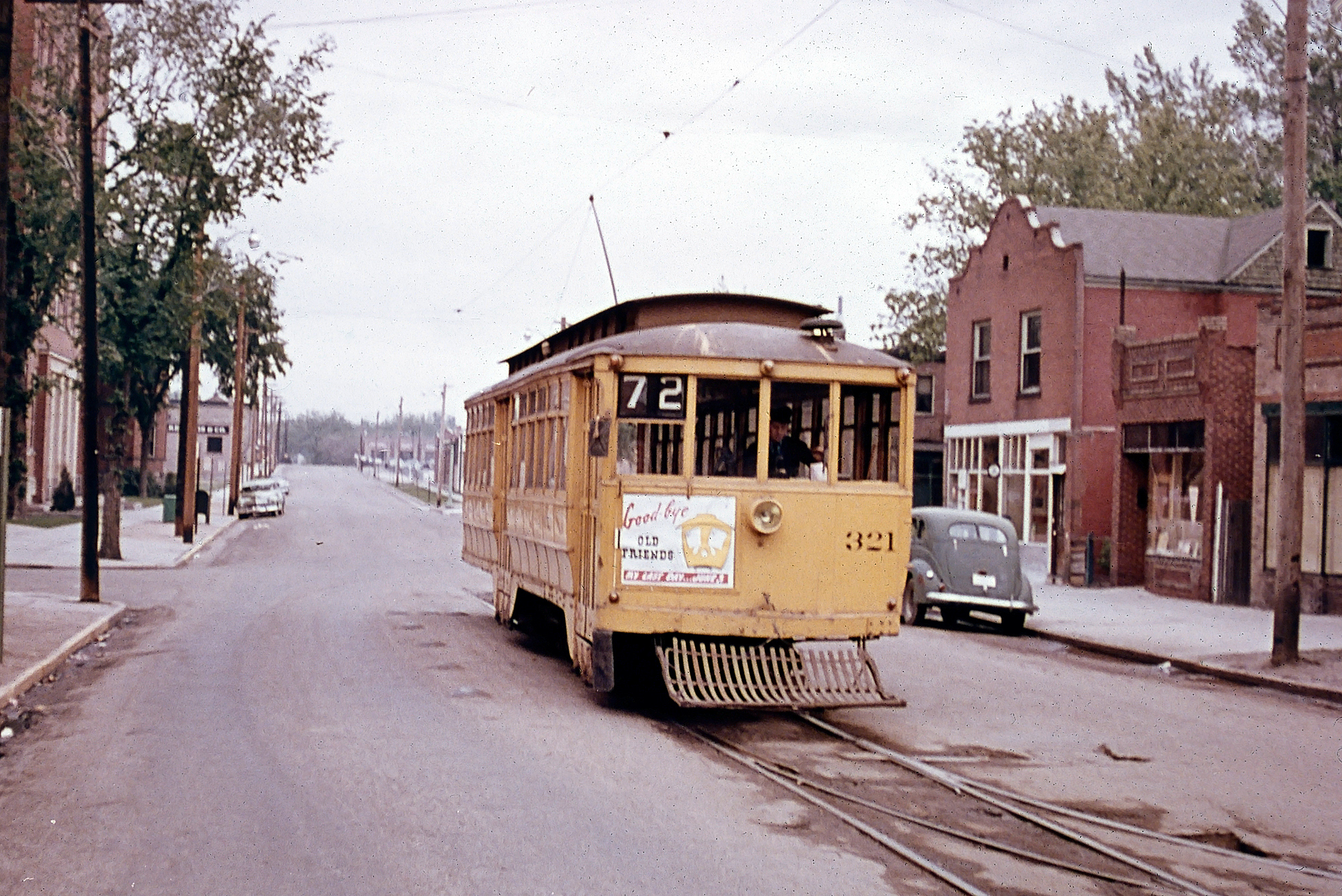 Denver & Intermountain car #321 runs Route 72 on Delaware Street in Denver, Colorado in the spring of 1950, just before passenger operations ended on the interurban. Freight service was retained to Golden until March 15, 1953. American-Rails.com collection.
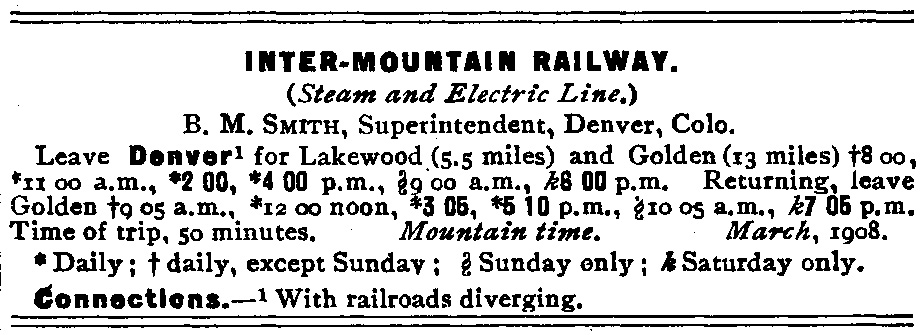
The Denver and Intermountain Railroad (D&IM), an interurban railway, spanned an 18-mile (29 km) route between Denver and Golden, Colorado.
Initially known as the Denver, Lakewood and Golden Railroad, this steam-powered line began operations in 1891 and completed an electrified spur into downtown Denver by 1893.
Facing financial difficulties, the company was placed into receivership and acquired by the Denver & Inter-Mountain Railway in 1904. It underwent several name changes, becoming simply the Intermountain in 1907 and finally the Denver & Intermountain Railroad (D&IM) in 1910.
In 1909, the line was fully electrified with 11,000 volts alternating current, facilitating direct trains to navigate city streets and reach downtown Denver's Interurban Loop.
The following year, the Denver Tramway acquired the company, integrating it into their system as Route 84. Passenger service continued until 1950, although the electrical infrastructure was maintained until 1953.
Origins and Early Years (1890-1900)
The seeds of the D&IM's creation were sown in the bustling era post-Reconstruction, as America pursued westward expansion and industrial progress.
In 1890, the Denver, Lakewood and Golden Railroad Company was formed. The endeavor aimed to link Denver with Golden, a burgeoning town known for its commercial significance and proximity to the Rocky Mountains.
With high hopes and considerable capital, tracks began being laid, and the company saw its first passenger service operation within the same year.
Using steam engines, the initial segments of the railroad catered to the suburban commuters traveling between Denver and Lakewood—catering to both urban workers and those seeking leisure in the less populated outskirts.
Despite the excitement and the promise of financial returns, the railroad company faced stark competition from other forms of transportation and stiff economic challenges.
Rebirth and Resilience (1901-1920)
Around the turn of the century, electric railways began to emerge as a more reliable and cost-efficient alternative to steam power.
The Denver, Lakewood and Golden Railroad adapted to these advances through a series of reorganizations and mergers, ultimately resulting in the formation of the Denver and Intermountain Railroad Company in 1904.
This renaissance was pivotal. With the transition to electric trolleys in 1909, the D&IM could offer more frequent services and lower operational costs, attracting a greater number of commuters and contributing to the growth of Denver's suburbs.
The electrified system gained popularity, connecting several key districts, and ultimately extending beyond Golden to include other small towns and communities.
One notable achievement during this period was the construction of the Jewell Avenue Line, a strategic extension that improved accessibility to areas south of Lakewood.
By integrating seamlessly with Denver's urban transit systems, the D&IM created a cohesive network that spurred urban development and economic growth in the region.
The Golden Age (1921-1940)
The 1920s and 1930s marked the peak of the D&IM's operations. These were the halcyon days of electric interurban railways in America, driven by an increased demand for efficient public transport systems amid the country's urban expansion.
D&IM's fleet of trolleys serviced both commuters and tourists, facilitating travel to scenic sights and recreational destinations, including connections to the Denver Tramway system.
D&IM's Golden Line was perhaps one of the most famous routes, offering picturesque views as it traversed the landscape between Denver and Golden. It was not merely a transit route but a link that symbolized the union of urban development with the natural beauty of Colorado.
At its zenith, the D&IM operated dozens of cars, and plans were continually drawn up to further extend the network.
Notably, the company pioneered several technological innovations to improve service quality, such as the introduction of larger passenger cars and the optimization of electric power systems.
Community fairs and events often saw special services chartered, making the D&IM an integral thread in the social fabric of the region.
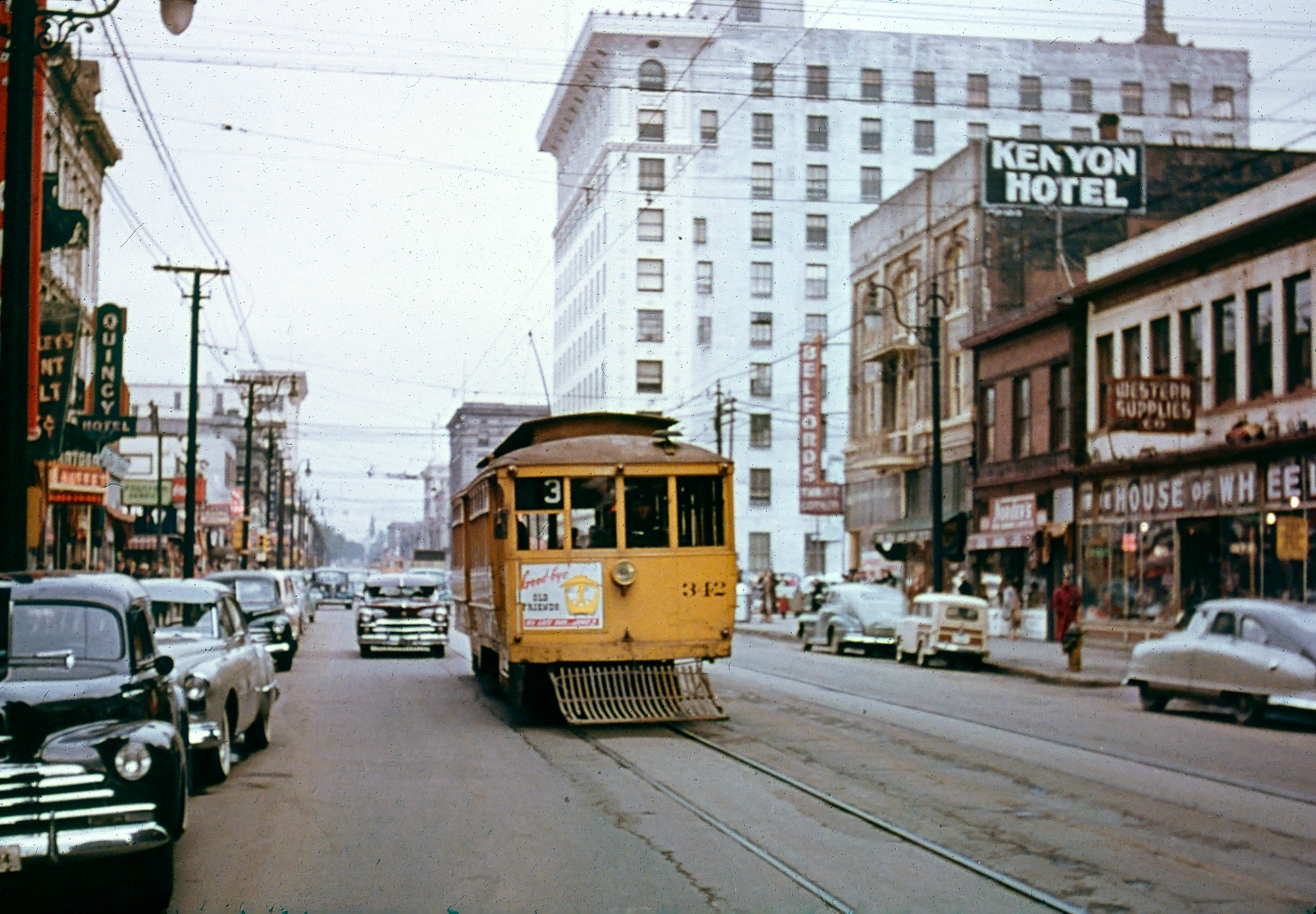 Denver & Intermountain car #342 is on 15th Street in Denver in the spring of 1950 shortly before the interurban ended passenger services. American-Rails.com collection.
Challenges and Competition (1941-1960)
World War II presented both opportunities and challenges for the D&IM. The war effort necessitated robust transport systems to ensure the mobility of workers and resources.
However, on the other hand, the company faced material shortages, increased operational costs, and competition from the rapidly expanding road transport system.
Post-war America entered an era characterized by widespread automobile ownership and the construction of extensive highway systems.
These societal shifts led to a steady decline in ridership for many interurban railways, including the D&IM. Despite strategic attempts to modernize the fleet and improve service conditions, the convenience and individualism of car travel began to overshadow the communal benefits of trolley systems.
Efforts to diversify services were met with mixed results. Cargo transport, a potential revenue booster, failed to compensate for the dwindling passenger numbers. Moreover, increasing suburban sprawl required infrastructure investments that the company struggled to meet.
Decline and Transition (1961-1980)
The latter half of the 20th century marked a period of tremendous change and eventual decline for D&IM.
By the early 1960s, operational costs had skyrocketed, and a significant portion of the infrastructure required critical repairs that were financially unfeasible.
The rail company's core service premise was being eroded by an entrenched preference for automobile travel and the convenience of domestic air travel for longer distances.
Faced with insurmountable competition, the D&IM ceased its passenger services in 1950, focusing on freight operations in a bid to stay relevant.
However, freight services also faced stiff competition from trucking companies leveraging the burgeoning highway network. Despite best efforts to repurpose assets, the decline was irreversible.
In the late 1970s, segments of the old D&IM infrastructure were abandoned. The increasing shift to more flexible and faster modes of transport underscored the limitations of the interurban railways formulated in an era predating such ubiquitous automotive culture.
Legacy and Preservation (1981-Present)
Though the D&IM ceased operations in the late 20th century, its legacy lives on. The history of this interurban railway is preserved through various historical societies and museums dedicated to Colorado’s rich transportation heritage.
Enthusiasts and preservationists have ensured that future generations comprehend the significance of the D&IM in fostering regional development and connecting communities.
Several initiatives have been undertaken to commemorate the D&IM’s contributions. Historical markers and restored trolley cars can be found in museums and along original service lines, providing educational insights and sparking nostalgia for a bygone era of transportation.
One such organization, the Colorado Railroad Museum, houses a wealth of artifacts, photographs, and restored railway cars that narrate the tale of the D&IM.
These preserved relics offer invaluable glimpses into the social and economic impact of the railway during its operational heyday, underlining the D&IM’s role in the broader narrative of American industrial progress.
Modern-day light rail and commuter rail systems in Denver owe a nod to their early predecessors like the D&IM. The knowledge gained and lessons learned from early interurban operations have indubitably informed contemporary urban rail transit planning and execution.
Today’s efficient, electrified urban and regional rail systems stand on the shoulders of the pioneering efforts of early 20th-century systems.
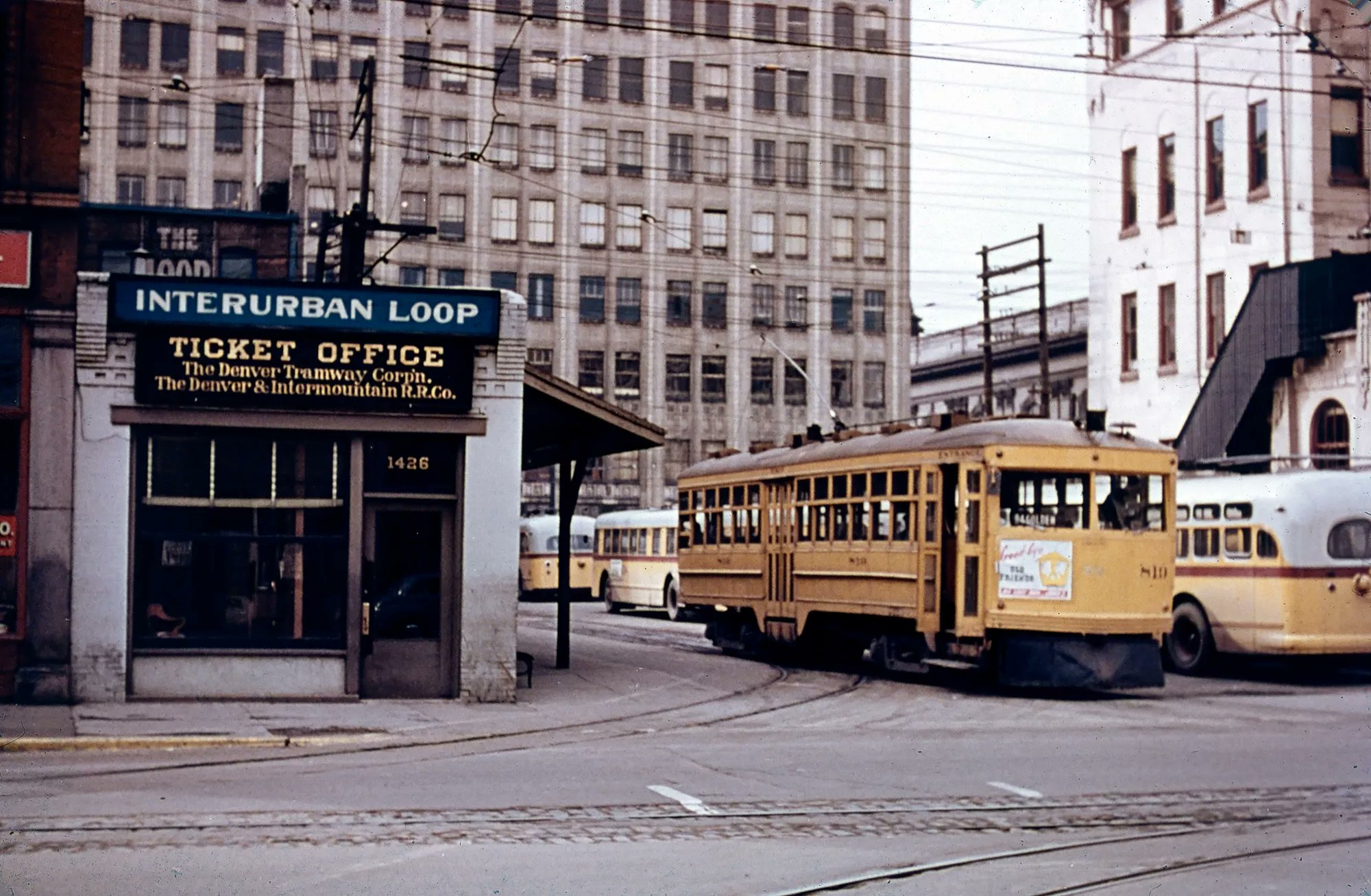 The Denver & Intermountain's ticket office and downtown loop in Denver, circa 1953. American-Rails.com collection.
Conclusion
The history of the Denver and Intermountain is a narrative of ambition, innovation, adaptation, and resilience. From its origins as the Denver, Lakewood, and Golden Railroad to its peak operations and eventual decline, the D&IM symbolizes a transformative era in American transportation history.
It connected urban centers with suburban and rural communities, aiding economic expansion and improving quality of life.
Though it ultimately succumbed to newer forms of transportation, its legacy is preserved and celebrated, ensuring that the D&IM remains an indelible chapter in the annals of Colorado and American railway history.
Recent Articles


-
Scenic Train Rides (USA 2026): State Guide to Tourist Railroads
Oct 04, 26 12:17 AM
 Scenic and tourist train rides in all 50 states for 2026. Colorado narrow gauge, Pennsylvania steam, Alaska’s White Pass, and the states with no full-size ride this month. Confirm on the railroad.
 -
Wyoming Scenic Train Rides (2026): A Complete Guide
Oct 03, 26 12:07 AM
 Wyoming has no full-size tourist railroad on the calendar in October 2026. Cheyenne Depot Museum and Douglas Railroad Museum are static. Union Pacific 4014’s posted public trip is a November run to De…
 -
Washington Scenic Train Rides (2026): A Complete Guide
Oct 02, 26 11:53 PM
 Washington tourist trains in 2026—Mount Rainier Scenic at Elbe, the Northwest Railway Museum, and Chehalis-Centralia. Lake Whatcom has no 2026 date on its ticket page.
 -
Wisconsin Scenic Train Rides (2026): A Complete Guide
Oct 02, 26 11:48 PM
 Wisconsin tourist trains in 2026—Wisconsin Great Northern, Osceola & St. Croix Valley, Mid-Continent, East Troy, and the National Railroad Museum.
 -
Pennsylvania Railroad Class Q2 4-4-6-4: Specs, Roster, History
Oct 02, 26 11:28 PM
 Pennsylvania Railroad Class Q2 4-4-6-4 duplexes. Twenty-six engines, 6131 and 6175–6199, Altoona 1944–45. Form 109-J specs, the 7,987 hp test of 6175, and a roster. All scrapped.
 -
Utah Scenic Train Rides (2026): A Complete Guide
Oct 02, 26 11:18 PM
 Utah tourist trains in 2026—Heber Valley Railroad from Heber City. Golden Spike at Promontory is a locomotive demonstration, not a line-haul ride.
 -
South Dakota Scenic Train Rides (2026): A Complete Guide
Oct 02, 26 11:06 PM
 South Dakota’s 2026 scenic train is the Black Hills Central 1880 Train, Hill City to Keystone. Steam is the summer assignment. Confirm the engine.
 -
Oregon Scenic Train Rides (2026): A Complete Guide
Oct 02, 26 11:04 PM
 Oregon tourist trains in 2026—Oregon Coast Scenic from Rockaway Beach, Mount Hood at Hood River, Eagle Cap from Elgin, and the Oregon Rail Heritage Center in Portland.
 -
Oklahoma Scenic Train Rides (2026): A Complete Guide
Oct 02, 26 10:36 PM
 Oklahoma has no full-size scenic railroad on an October 2026 calendar. Oklahoma Railway Museum Halloween and Polar trains, the El Reno trolley, and the Heartland Flyer.
 -
North Dakota Scenic Train Rides (2026): A Complete Guide
Oct 02, 26 01:14 PM
North Dakota has no tourist railroad on a 2026 calendar. Ride Amtrak’s daily Empire Builder. The Fort Lincoln Trolley in Mandan is not a current ticket. -
Nebraska Scenic Train Rides (2026): A Complete Guide
Oct 02, 26 10:11 AM
 Nebraska has no full-size scenic railroad in 2026. The Omaha Zoo Railroad runs weekends through October 4. Ride Amtrak’s California Zephyr across the state.
 -
Missouri Scenic Train Rides (2026): A Complete Guide
Oct 02, 26 09:56 AM
 Missouri tourist trains in 2026—Branson Scenic Railway and the St. Louis, Iron Mountain & Southern at Jackson. Belton has no 2026 schedule posted.
 -
Minnesota Scenic Train Rides (2026): A Complete Guide
Oct 02, 26 09:52 AM
 Minnesota tourist trains in 2026—North Shore Scenic Railroad in Duluth, the Duluth River Train, and the Como-Harriet streetcar.
 -
Kansas Scenic Train Rides (2026): A Complete Guide
Oct 02, 26 09:32 AM
 Kansas tourist trains in 2026—the Abilene & Smoky Valley Railroad. Santa Fe 3415 is in overhaul. Midland Railway at Baldwin City is closed.
 -
Iowa Scenic Train Rides (2026): A Complete Guide
Oct 02, 26 08:41 AM
 Iowa tourist trains in 2026—Boone & Scenic Valley across the Bass Point Creek High Bridge, and Midwest Central’s December North Pole trains
 -
Indiana Scenic Train Rides (2026): A Complete Guide
Oct 02, 26 08:35 AM
 Indiana tourist trains in 2026—French Lick Scenic Railway, Nickel Plate Express, Hoosier Valley, and Hesston. Whitewater Valley is suspended.
 -
Illinois Scenic Train Rides (2026): A Complete Guide
Oct 02, 26 12:28 AM
 Illinois tourist trains in 2026—Illinois Railway Museum, Monticello Railway Museum, Fox River Trolley, and Silver Creek & Stephenson.
 -
Texas Scenic Train Rides (2026): A Complete Guide
Oct 02, 26 12:14 AM
 Texas tourist trains in 2026—Texas State Railroad, Grapevine Vintage Railroad, Austin Steam Train's Hill Country Flyer, and the Galveston Railroad Museum.
 -
Tennessee Scenic Train Rides (2026): A Complete Guide
Oct 02, 26 12:03 AM
Tennessee tourist trains in 2026—Tennessee Valley Railroad Museum, Dollywood Express, Three Rivers Rambler Christmas trains, and the Tennessee Central Railway Museum. -
South Carolina Scenic Train Rides (2026): A Complete Guide
Oct 01, 26 11:52 PM
 South Carolina's tourist train is the South Carolina Railroad Museum in Winnsboro—Blue Granite Express, pumpkin trains, and Santa trains on the old Rockton & Rion.
 -
Mississippi Scenic Train Rides (2026): A Complete Guide
Oct 01, 26 11:38 PM
 Mississippi has no regular tourist railroad in 2026. Ride Amtrak through the state, or book the excursion lines in Alabama, Tennessee, Louisiana, or Arkansas.
 -
Louisiana Scenic Train Rides (2026): A Complete Guide
Oct 01, 26 02:52 PM
 Louisiana has no regular full-size tourist railroad in 2026. New Orleans Polar Express returns December 11–31. Museums at Long Leaf, DeQuincy, and Jackson.
 -
Kentucky Scenic Train Rides (2026): A Complete Guide
Oct 01, 26 02:45 PM
 Kentucky tourist trains in 2026—Big South Fork Scenic Railway, Bluegrass Scenic Railroad, Kentucky Railway Museum, and My Old Kentucky Dinner Train.
 -
Georgia Scenic Train Rides (2026): A Complete Guide
Oct 01, 26 02:27 PM
 Georgia tourist trains in 2026—Blue Ridge Scenic Railway, SAM Shortline, Azalea Sprinter, Savannah shop rides, and what to confirm at Stone Mountain.
 -
Arkansas Scenic Train Rides (2026): A Complete Guide
Oct 01, 26 01:02 PM
 Arkansas tourist trains in 2026—Arkansas & Missouri through the Boston Mountains, and the Eureka Springs & North Arkansas dinner and excursion trains.
 -
Alabama Scenic Train Rides (2026): A Complete Guide
Oct 01, 26 12:59 PM
Alabama tourist trains in 2026—Heart of Dixie Railroad Museum at Calera, North Alabama Railroad Museum at Chase, and the Wales West Light Railway at Silverhill. -
The Circus Train: How Such Attractions Reached Distant Cities
Oct 01, 26 12:22 PM
 How circuses moved by rail: Coup's 1872 flats, the Ringling train's sections and car counts, the 1918 Hammond wreck, and the last show on May 21, 2017.
 -
West Virginia Halloween Train Rides (2026)
Oct 01, 26 12:19 PM
 2026 West Virginia Halloween train. Cass Scenic Halloween Train, October 30 and 31, steam, 5:00 p.m. from Cass Depot. Adult $75. About two hours to Whittaker. Family ride.
 -
Wisconsin Halloween Train Rides (2026)
Oct 01, 26 12:11 PM
2026 Wisconsin Halloween trains. Mid-Continent Pumpkin Special October 24–25, adult $24, pumpkins extra. Halloween Flyer October 24 at 4:30 p.m., adult $30. Osceola Pumpkin Express boards in Osceola… -
Utah Halloween Train Rides (2026)
Oct 01, 26 12:00 PM
 2026 Utah Halloween trains at Heber Valley Railroad. Pumpkin Train, about 40 minutes, with a cookie and a pumpkin. Halloween Express, about 90 minutes to Grim Hollow, Monday, Thursday, and Friday even…
 -
Texas Halloween Train Rides (2026)
Oct 01, 26 11:28 AM
 2026 Texas Halloween train. Texas State Railroad Spooky Special, adult-only, October 24. Boards Palestine at 5:00 p.m. About five hours to Rusk and back. Dinner on the grounds. Not steam. No fare on t…
 -
Tennessee Halloween Train Rides (2026)
Oct 01, 26 12:15 AM
 2026 Tennessee Halloween trains. Tennessee Valley Railroad Museum Rails, Wizards & Spells, selected days September 18 through October 25, from $35, about 2.5 hours. Spells & Potions tea from $60. The…
 -
Frisco's "Firefly" (Train): Consist, Route, Timetable
Sep 30, 26 11:37 PM
 Frisco Firefly—daylight streamliner, Kansas City to Tulsa and Oklahoma City. Trains 117 and 118. Pacifics 1018, 1026, and 1031. Last run May 22, 1960.
 -
South Carolina Halloween Train Rides (2026)
Sep 30, 26 11:29 PM
 2026 South Carolina Halloween train. South Carolina Railroad Museum Pumpkin Patch Express, the two Saturdays before Halloween. About three miles to the Greenbriar pavilion. Pumpkin for children 12 and…
 -
Oregon Halloween Train Rides (2026)
Sep 30, 26 08:10 PM
2026 Oregon Halloween train. Sumpter Valley Railroad Halloween Express at the Sumpter Depot, calendar window October 31 at 11:00 a.m. through November 1 at 12:30 p.m. Fare and the individual clocks ar… -
Oklahoma Halloween Train Rides (2026)
Sep 30, 26 03:45 PM
2026 Oklahoma Halloween train. Oklahoma Railway Museum, October 30 and 31, from Oakwood Station in Oklahoma City. Adults $15, children 3–12 $8. A candy bag with the ride. -
McCloud River Railroad: Serving The Timber Industry (1897-2009)
Sep 30, 26 03:37 PM
 McCloud River Railroad—Mount Shasta City to McCloud, Hambone, and Burney. Opened August 1, 1897. Alco No. 25 and EMD SD38s. Dinner train through January 2010. Railbikes in 2026; a dinner train is stil…
 -
Nevada Halloween Train Rides (2026)
Sep 30, 26 03:30 PM
2026 Nevada Halloween trains in Ely. Nevada Northern Pumpkin Patch Caper and Haunted Ghost Train. Adult tickets start at $45. Dates are on the railroad’s ticket calendar. Boulder City stays off until… -
Missouri Halloween Train Rides (2026)
Sep 30, 26 11:12 AM
 2026 Missouri Halloween trains. St. Louis Iron Mountain & Southern Pumpkin Patch Train on October 3, 4, 10, and 11, and Halloween Express on October 31 at 1:00 p.m. Jackson depot. No fare on the sched…
 -
Minnesota Halloween Train Rides (2026)
Sep 30, 26 11:06 AM
 2026 Minnesota Halloween trains. North Shore Scenic Great Pumpkin Train in Duluth, October 15–18. Everyone gets a pumpkin. Terror Train is October 30, an adult costume party, about three hours. Fares…
 -
Maryland Halloween Train Rides (2026)
Sep 30, 26 10:42 AM
 2026 Maryland Halloween trains. Western Maryland Scenic Pumpkin Patch Limited, October 17, 18, 24, and 25, $14. Colesville Trolleyween October 24, 25, and 31.
 -
West Side Lumber Company Railroad: Roster, History, Lines
Sep 30, 26 09:45 AM
 West Side Lumber at Tuolumne, California. Three-foot Shay and Heisler logging railroad. Lima shop numbers, builder specs, and where the engines are in 2026.
 -
Kansas Halloween Train Rides (2026)
Sep 30, 26 09:41 AM
 2026 Kansas Halloween train. Abilene & Smoky Valley Pumpkin Harvest Express, October 17 through 31. About one hour. Shop prices $35.56 to $41.02. Everyone picks a pumpkin.
 -
Iowa Halloween Train Rides (2026)
Sep 29, 26 11:58 PM
2026 Iowa Halloween train. Boone & Scenic Valley Pumpkin Express, October 10, 10:00 a.m. from 225 10th Street. About 1 hour 15 minutes. Children pick a pumpkin. -
Arizona Halloween Train Rides (2026)
Sep 29, 26 11:43 PM
 2026 Arizona Halloween train. Grand Canyon Railway Pumpkin Patch Train from Williams, $39 with a pumpkin included. Select October dates on the ticket calendar. Haunted train cars are optional.
 -
Nevada Northern Halloween Trains (2026)
Sep 29, 26 06:18 PM
Nevada Northern 2026 Halloween trains in Ely. Pumpkin Patch Caper to Keystone Gulch and the Haunted Ghost Train. Adult tickets start at $45. Dates are on the railroad’s calendar. Confirm on nnry.com. -
Grand Canyon Railway Pumpkin Patch Train (2026)
Sep 29, 26 02:42 PM
Grand Canyon Railway Pumpkin Patch Train—select October 2026 dates from Williams, $39 with a pumpkin included. Haunted train cars are optional. Days are on the ticket calendar. Confirm on thetrain.com… -
Cass Scenic Railroad Halloween Trains (2026)
Sep 29, 26 02:37 PM
 Cass Scenic Halloween Trains—October 30 and 31, 2026, steam, 5:00 p.m. from Cass Depot. About two hours to Whittaker. Adult $75. Candy for every child. Confirm on mountainrailwv.com.
 -
Halloween Train Rides (2026): Pumpkin Patch, Haunted & Spooky Trips
Sep 29, 26 11:26 AM
 2026 Halloween train rides in nine checked states. Conway Scenic Halloween Express October 24–25. Strasburg’s three fall tickets. Great Smoky Mountains Railroad’s October trains are the gorge and rive…
 -
Maine Halloween Train Rides (2026)
Sep 29, 26 11:08 AM
 2026 Maine Halloween trains. Seashore Pumpkin Patch Trolley through October 18, adult $17. Happy Trolleyween October 23–25 at $15. WW&F Pumpkin Pickin’ October 3, 12, 17, and 24. Downeast’s booking it…