Kankakee Belt Route, NYC's Illinois Division
Published: December 8, 2025
By: Adam Burns
The Kankakee Belt Route was one of the Midwest’s most interesting “quiet” main lines—a strategic bypass around Chicago that never became a famous name in its own right, yet played an important role in moving grain, merchandise, and run-through freight between eastern and western carriers.
Its story weaves together several predecessor lines, New York Central’s efforts to avoid Chicago congestion, changing transportation economics on the Illinois River, and the slow retrenchment of the late 20th century that left much of the route abandoned while a core segment still works today as a freight artery.
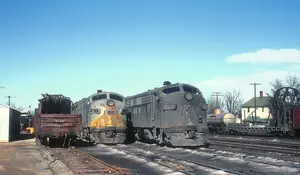
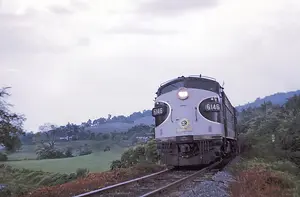
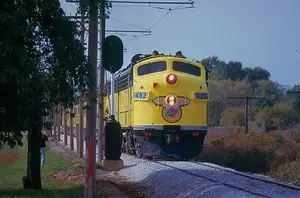
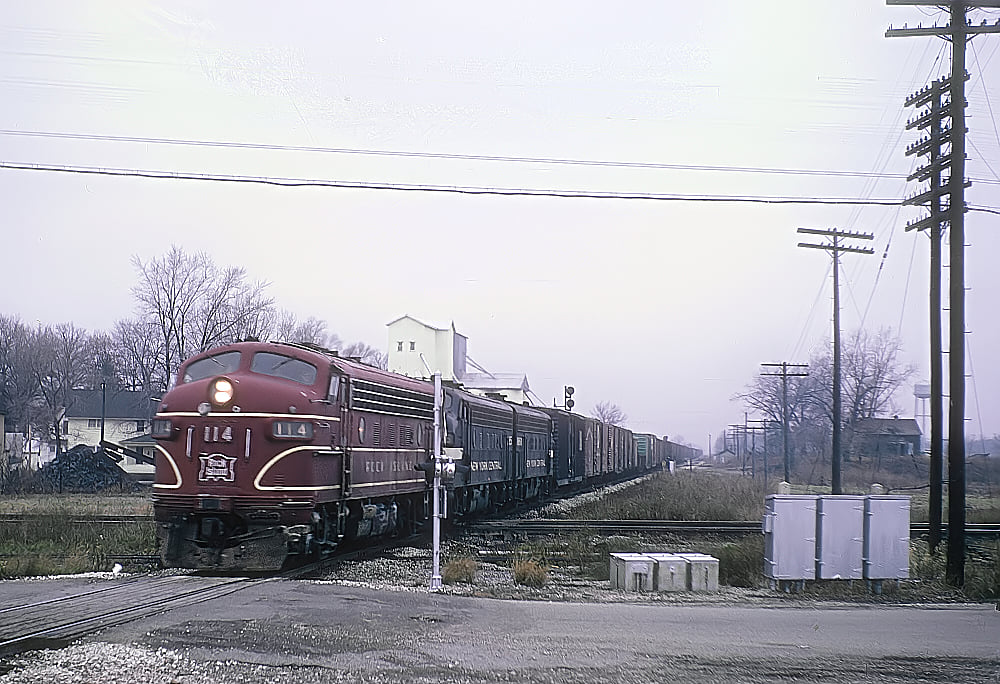 Rock Island F7A #114 leads an eastbound New York Central "Gemini" freight on the Kankakee Belt Line at the once very busy interlocking in North Judson, Indiana on November 27, 1966. These pool trains operated over the Kankakee Belt in August 1966 from Rock Island's Silvis Yard to Elkhart, Indiana via DePue, Illinois. The trains were short-lived and operated for only about a year. Rick Burn photo.
Origins: The “3 I” and the Kankakee River Valley
What later became known as the Kankakee Belt Route began life in the late 19th century under other names. The most important of these was the Indiana, Illinois & Iowa Railroad—commonly called the “3 I” route. Built westward from Streator, Illinois, to North Judson, Indiana, in 1881, and extended on to South Bend in 1894, the 3 I formed a roughly east-west corridor south of the Chicago region.
The line threaded the Kankakee River Valley, crossing a patchwork of farm towns and small industrial communities. In Illinois it touched places such as Kankakee, Dwight, Streator, Lostant, and Ladd before reaching Zearing, where it connected with Chicago, Burlington & Quincy. In Indiana it passed through or near communities like North Liberty, Walkerton, Hamlet, Knox, North Judson, San Pierre, Shelby, and Schneider, ultimately reaching South Bend.
Corporate control soon shifted. Through stock ownership by NYC affiliates Lake Shore & Michigan Southern and Michigan Central, the Indiana, Illinois & Iowa—and related properties such as the Chicago, Indiana & Southern (CI&S)—fell under NYC influence. As the system was rationalized in the early 20th century, this cross-country line was integrated into New York Central’s Illinois Division and promoted collectively as the Kankakee Belt Line, or Kankakee Belt Route, in reference both to the river valley it followed and the growing rail belt it formed around Chicago.
A Chicago Bypass for the New York Central
NYC’s primary main lines into Chicago—such as the Lake Shore & Michigan Southern main line along Lake Michiganf—were heavily congested. As freight interchanges with western carriers grew, NYC saw value in directing some traffic around the worst of the Chicago terminal tangle. The Kankakee Belt Route was ideally placed for that purpose.
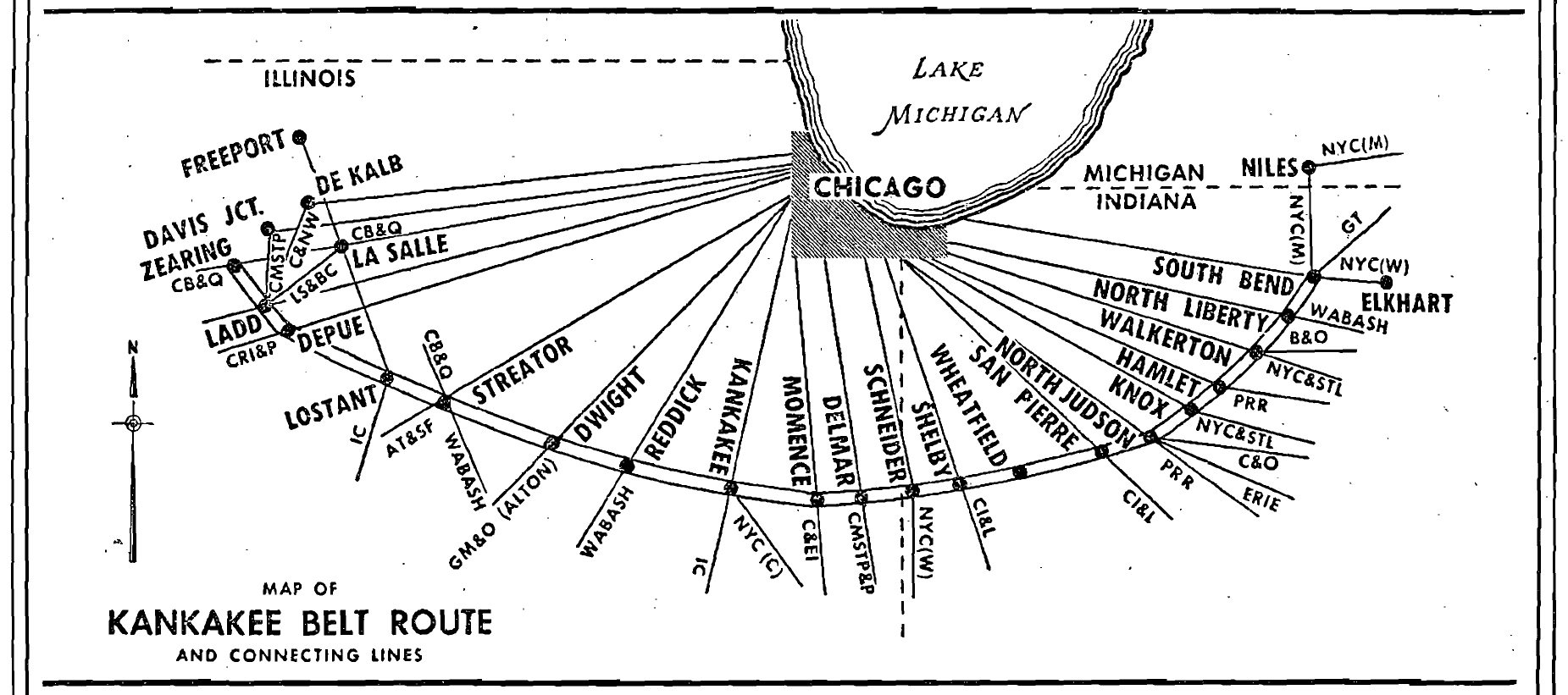
From South Bend on the east to Zearing on the west, the line formed an arc south of the city, with numerous junctions where NYC could hand traffic to or receive traffic from western roads. In 1964, for example, the Illinois section of the Kankakee Belt connected with:
- Milwaukee Road at places like Litchfield and Sun River Terrace
- Chicago & Eastern Illinois at Momence
- Illinois Central and NYC itself at Kankakee
- Wabash at Reddick
- Gulf, Mobile & Ohio (ex-Alton) at Dwight
- Santa Fe and CB&Q at Streator
- Illinois Central at Lostant
- Rock Island at De Pue
- Milwaukee Road, C&NW, and LaSalle & Bureau County (“The Bee”) at Ladd
- CB&Q at Zearing
Similarly, in Indiana it linked with Grand Trunk, B&O, Nickel Plate, Pennsylvania, Erie, C&O, and Monon at various towns between South Bend and Schneider.
This web of connections is why later commentators would call it one of the best potential Chicago bypass lines of its day—capable of funneling freight between practically every major western road and the New York Central without ever entering the Chicago terminal area.
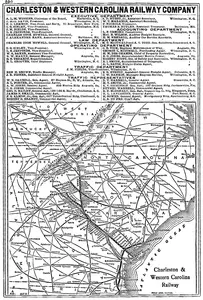
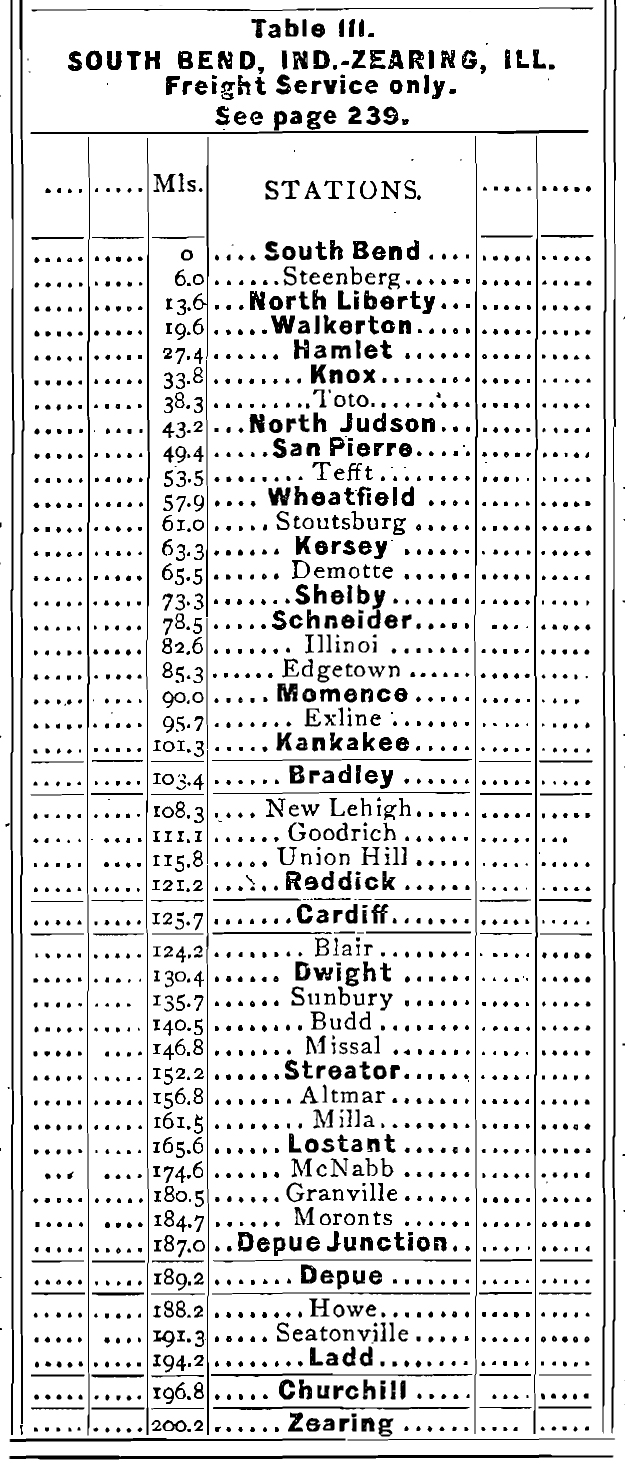 A timetable of the line from August, 1952. American-Rails.com collection.
Traffic and Operations: Grain, Merchandise, and Pool Freight
Although the Kankakee Belt Route never achieved the fame of NYC’s Water Level Route, it handled a mix of traffic that made it an important secondary main line.
Grain and the Illinois River
West of Kankakee, the route paralleled the Illinois River across northern Illinois. This placed it squarely in rich corn country, and the line became an outlet to eastern markets for grain elevators and small towns along its path. Grain moved eastward to NYC’s system and on to mills, elevators, and industrial users in the East.
For a time, this grain traffic helped justify heavy investment in the route, including bridges, yards, and interlocking plants. NYC advertised the Kankakee Belt as an efficient path for agricultural products, with the Illinois River valley providing a direct flow of grain from farm to railhead.
Merchandise and Through Freight
The line also handled merchandise freight, coal, and other commodities in both directions. While some historians question how much true overhead “bypass” traffic used the route before the Penn Central era, there were notable run-through arrangements. Rock Island and New York Central, for example, interchanged at Streator, and there is evidence of pool freight trains operating over the Belt to reach yards such as Argentine on the Santa Fe.
In addition, the NYC and Rock briefly operated the hotshot "Gemini" trains along the route for about a year in the mid-1960s.
The Kankakee yards, located west of the city, became a focal point for these operations, with classification work and interchange moves taking place alongside local switching. The yard, built prior to 1922, was busy enough to be a key feature of NYC’s presence in the area.
Passenger and Local Service
Passenger traffic over the Kankakee Belt was always secondary compared with NYC’s main lines. Local trains and gas-electric “doodlebugs” served small towns along the route, providing connections to larger cities. Period photographs show NYC doodlebugs at junction points, reflecting a time when even relatively remote branches had passenger service.
However, the populations of many intermediate towns were modest, and by mid-20th century most passenger services dwindled under competition from highways and buses. Freight, especially grain and interchange traffic, remained the primary reason for the line’s existence.
Competition from the River: The Mechling Barge Case
One of the most important turning points for the Kankakee Belt Route came not from another railroad but from improvements to the Illinois River waterway.
In the mid-1930s, major upgrades—deeper and wider locks at places like Lockport—allowed the river to handle larger tows and, later, even tank landing ships (LSTs) built by Chicago Bridge & Iron at Seneca during World War II. These improvements transformed the river into a powerful competitor for bulk traffic, especially grain.
By the 1950s, barge operators were undercutting rail rates. Prior to 1957, for example, combined barge-plus-rail movements (barge from Illinois River ports to Chicago, then rail east) offered significantly lower costs per hundredweight of corn than all-rail shipments originating on the Kankakee Belt and moving directly east on NYC.
The resulting rate disputes culminated in the Mechling Barge Lines v. United States case, decided by the U.S. Supreme Court in 1964. That decision became one episode in the long fight between railroads and inland waterways over rate structures and competitive parity. For the Kankakee Belt Route, the practical effect was clear: a portion of its traditional grain business was siphoned away by barges, weakening one of the line’s core traffic bases.
Penn Central, Conrail, and Contraction
The merger of New York Central and Pennsylvania Railroad into Penn Central in February, 1968 briefly gave the Kankakee Belt new visibility. Contemporary accounts suggest that Penn Central established a pair of dedicated through freights over the route around 1969 to better exploit its Chicago-bypass potential, though it is debatable how long these trains survived in Penn Central’s troubled early years.
When Conrail was created in 1976 to take over the operations of several bankrupt eastern carriers—including Penn Central—the Kankakee Belt found itself competing internally with other Conrail lines and routings. By this time:
- Passenger service was gone.
- Grain had alternatives via truck and barge.
- Many interchanges with now-struggling western roads had lost their former importance.
Conrail, under pressure to eliminate redundancy and focus on profitable corridors, began to trim. Portions of the old Kankakee network, especially those that overlapped with better-engineered or more heavily used lines, were downgraded or abandoned.
One major casualty was the north-south line from Gary, Indiana, through Schneider to Danville, Illinois. Under Conrail this became known as the Danville Secondary, and the segment from Schneider south to Danville—about 76 miles—was taken out of service and abandoned in 1994.
Bridges, Breaks, and Short Lines
The Illinois River crossing near DePue became a dramatic symbol of the route’s fragmentation. The swing bridge over the river was struck by a barge in the 1960s, caught fire, and the bridge tender was killed in the incident. While temporary repairs allowed continued use for a time, the bridge was ultimately removed in the early 1980s. Once the bridge was gone, the continuous east-west route was effectively severed.
West of the river, much of NYC’s former track toward Ladd was pulled up, though Illinois Railway later acquired portions between Depue and Ladd, and, in 2004, extended its holdings from a wye with BNSF at Zearing through Ladd and Spring Valley to LaSalle. Thus, fragments of the old Kankakee Belt lived on as short-line territory serving local customers and industrial sites along the Illinois River.
In Indiana and the eastern part of the route, similar fragmentation occurred. East of Schneider toward South Bend, the mainline was cut back. By the 1980s, the track between South Bend and the NIPSCO generating station at Wheatfield was removed, and what remained in South Bend itself was reduced to lightly used industrial trackage serving only a handful of customers, in conjunction with other ex-PRR and Wabash routes.
Norfolk Southern and the Modern Kankakee Belt
Despite all these losses, the Kankakee Belt did not disappear entirely. Conrail’s western segment between Streator, Illinois, and the Indiana state line survived as a valuable connector, and when Conrail was divided in 1999, Norfolk Southern inherited this portion. NS continues to operate the line today.
In modern times, this NS segment typically sees roughly eight to ten trains per day between the BNSF (ex-Santa Fe) main line at Streator and NS interchanges and facilities to the east. The line still functions as a Chicago bypass of sorts, handling:
- Run-through traffic between NS and BNSF or other western roads
- Grain and agricultural traffic from elevators and terminals along the line
- General merchandise and unit trains as traffic patterns demand
The western end now effectively terminates near the site of the former Illinois River bridge, east of DePue, while the eastern end is integrated into NS’s broader network in Indiana.
At Kankakee itself, the legacy of railroading remains visible. While the famous Illinois Central depot downtown is more directly associated with IC’s main line and Amtrak service, the broader city landscape—yards, industrial sidings, and remaining NS trackage—still reflects the days when the Kankakee Belt was a high-utility bypass line in the New York Central System.
Legacy and What Might Have Been
Rail historians occasionally point to the Kankakee Belt Route as one of those “what if” lines: a corridor that, had it been preserved intact, could have played a major role in 21st-century freight flows around Chicago.
Today’s railroads struggle with congestion in the region, and various bypass schemes—some involving new construction, others leveraging existing lines—have been proposed. A fully intact Kankakee Belt, with its web of junctions to western carriers, might have been an extremely valuable piece of that puzzle.
Instead, its story reflects the realities of mid- and late-20th-century railroading: competition from barges and trucks, regulatory battles over rates, the consolidation and bankruptcy of major carriers, and the ruthless cost-cutting of the Conrail era. Sections without strong local traffic or strategic value were trimmed away, leaving only those pieces that could still earn their keep.
Yet the route’s influence lives on. The surviving NS segment continues to move freight across the Midwest, honoring the original purpose of the line as a connector and bypass. Short lines and regional carriers work bits of the old alignment, serving elevators and industries that still depend on rail.
And in the collective memory of railfans—and in the landscapes of towns like North Judson, Streator, Kankakee, and Zearing—the Kankakee Belt Route remains a reminder of a time when railroads could bend around Chicago, linking east and west on a belt of steel along the Kankakee River Valley.
Recent Articles


-
Gulf, Mobile & Northern Steam Roster (Post 1900)
Oct 09, 26 12:14 AM
 Gulf, Mobile & Northern steam since 1900. Drury's class grid: Ten-Wheelers, Mikados, Russian Decapods, Pacifics 425 and 426, and three light 4-8-2s. Last revenue steam October 7, 1949.
 -
Gulf, Mobile & Ohio Diesel Roster (All-Time)
Oct 08, 26 11:55 PM
 Gulf, Mobile & Ohio diesel roster, all-time. The 1935 boxcab, DL-107s, 55 FA-1s, F3s and F7s, the Ingalls 4-S, GP30s through GP38-2s, and 21 SD40s. Serials and order numbers.
 -
Gulf, Mobile & Ohio Railroad: Map, Photos, Trains, History
Oct 08, 26 11:48 PM
 Gulf, Mobile & Ohio, chartered in 1938 and merged September 13, 1940. The Mobile & Ohio, the Alton on May 31, 1947, the Rebel Route, and Illinois Central Gulf on August 10, 1972.
 -
New Jersey Railroad Museums (2026): A Complete Guide
Oct 08, 26 11:37 PM
 New Jersey railroad museums—Whippany, Maywood, Pine Creek, Mahwah’s Erie depot, Phillipsburg, and Boonton. Confirm hours on each site.
 -
New Hampshire Railroad Museums (2026): A Complete Guide
Oct 08, 26 11:34 PM
 New Hampshire railroad museums—North Conway, the Flying Yankee, Ashland, Gorham, Raymond, and Sandown. Confirm hours on each site.
 -
Missouri Railroad Museums (2026): A Complete Guide
Oct 08, 26 11:00 PM
 Missouri railroad museums—the National Museum of Transportation, Patee House, Frisco 4524, the Chicago & Alton depot, and Marceline. Confirm hours on each site.
 -
Milwaukee Road X3800: Deer Lodge’s Shop Goat
Oct 08, 26 04:28 PM
 Milwaukee Road X3800, the a home-built shop goat that served the Deer Lodge, MT yard. It was a 220-volt DC switcher, powered through an extension cord that moved electrics into a roundhouse where the…
 -
Key West Extension (Overseas Railroad): History, Construction, Decline
Oct 08, 26 03:59 PM
 Henry Flagler's Overseas Railroad, Miami to Key West, 1905–1935. The Seven Mile Bridge, the 1935 Labor Day Hurricane, and the road that became U.S. 1.
 -
Florida East Coast Steam Roster (Post 1900)
Oct 08, 26 02:34 PM
 Florida East Coast steam since 1897. Seventeen Ten-Wheelers, twenty Atlantics, eighty-seven Pacifics, ninety Mountains, fifteen Mikados, and the switchers.
 -
Florida East Coast Diesel Roster (All-Time)
Oct 08, 26 02:12 PM
 Florida East Coast diesel roster, all-time. E units from 1939, F3s, BL2s, GP7s and GP9s, the GP40-2 orders, 22 SD40-2s, and 24 ES44C4s. Serials and EMD order numbers.
 -
Florida East Coast Railway: Map, History, Rosters
Oct 08, 26 01:46 PM
 Florida East Coast Railway, Henry Flagler's line from Jacksonville to Miami and Key West. Receivership in 1931, the 1963 strike, Grupo México in 2017, and Brightline on the same track.
 -
Minnesota Railroad Museums (2026): A Complete Guide
Oct 08, 26 10:32 AM
Minnesota railroad museums—the Lake Superior Railroad Museum, Two Harbors, Jackson Street, Willmar’s Great Northern 2523, and Currie. Confirm hours on each site. -
Maine Railroad Museums (2026): A Complete Guide
Oct 08, 26 09:24 AM
 Maine railroad museums—Seashore Trolley, the two-foot lines at Portland, Alna, and Phillips, Boothbay, and the Bangor & Aroostook depots. Confirm hours on each site.
 -
Massachusetts Railroad Museums (2026): A Complete Guide
Oct 08, 26 12:08 AM
 Massachusetts railroad museums—Berkshire Scenic at Lenox, Shelburne Falls trolley No. 10, Edaville, Chatham’s 1887 depot, and Lowell. Confirm hours on each site.
 -
Clinchfield Steam Roster (Post 1900)
Oct 07, 26 12:09 PM
 Clinchfield steam since 1900. Fifteen H-4 Consolidations, K-1 Mikados, M-2 and M-3 Mallets, L-class 2-8-8-2s, eighteen Challengers. Class grid after Drury. Last steam April 16, 1954.
 -
Clinchfield Diesel Roster (All-Time)
Oct 07, 26 12:05 PM
 Clinchfield diesel roster, all-time. F3A 800, FP7 200, the F7s, GP7s, 25 SD40s, 18 SD45-2s, seven U36Cs, and the Family Lines hoods. Serials and EMD order numbers.
 -
Clinchfield Railroad: Map, Steam Locomotives, Roster, Logo
Oct 07, 26 12:02 PM
 Clinchfield Railroad, Elkhorn City to Spartanburg. George L. Carter, the Carolina, Clinchfield & Ohio, the 1924 lease, coal, the loops, and CSX. Steam and diesel rosters are companion pages.
 -
Kentucky Railroad Museums (2026): A Complete Guide
Oct 07, 26 11:39 AM
 Kentucky railroad museums—the Kentucky Railway Museum, Bowling Green’s L&N depot, Paducah, Versailles, and Covington. Confirm hours on each site.
 -
Kansas Railroad Museums (2026): A Complete Guide
Oct 07, 26 11:26 AM
 Kansas railroad museums—Santa Fe 3768 at Wichita, Santa Fe 132 in Topeka, the Great Overland Station, and Abilene. Confirm hours on each site.
 -
Cincinnati, New Orleans and Texas Pacific Diesel Roster (All-Time)
Oct 07, 26 10:38 AM
 All-time diesel roster of Southern locomotives lettered for the Cincinnati, New Orleans and Texas Pacific. Serials, order numbers, and builder dates.
 -
Cincinnati, New Orleans and Texas Pacific Railway
Oct 07, 26 10:31 AM
 Cincinnati, New Orleans and Texas Pacific Railway, incorporated September 8, 1881, to lease Cincinnati’s railroad to Chattanooga. Queen and Crescent route, Rathole, and the 2024 sale to Norfolk Southe…
 -
Indiana Railroad Museums (2026): A Complete Guide
Oct 07, 26 12:26 AM
 Indiana railroad museums—Nickel Plate 765, Elkhart’s New York Central collection, French Lick, Linden’s junction depot, and Haley Tower. Confirm hours on each site.
 -
"Triplex" Steam Locomotive: Specs, History, Photos
Oct 06, 26 11:52 PM
 Erie class P-1 Triplex 2-8-8-8-2s. Three Baldwin compounds, 2603–2605, later 5014–5016, built 1914 and 1916. Matt H. Shay, the 1930 class card, and Virginian XA 700.
 -
Illinois Railroad Museums (2026): A Complete Guide
Oct 06, 26 11:47 PM
 Illinois railroad museums—the Illinois Railway Museum, Monticello, the Pioneer Zephyr, Galesburg’s Burlington 3006, and the depots. Confirm hours on each site.
 -
Iowa Railroad Museums (2026): A Complete Guide
Oct 06, 26 11:41 PM
 Iowa railroad museums—the Union Pacific Railroad Museum, RailsWest, Sioux City, Boone, and the National Hobo Museum in Britt. Confirm hours on each site.
 -
Charleston and Western Carolina Diesel Roster (All-Time)
Oct 06, 26 11:29 PM
Charleston and Western Carolina diesel roster. Twenty-one GP7s, two SW7s, two SW9s, and six F7As, all built 1950–1952. Serials, order numbers, and ACL and SCL numbers. -
Charleston and Western Carolina Railway: Map, History, Timetables
Oct 06, 26 11:18 PM
 Charleston and Western Carolina Railway, incorporated September 16, 1896. Port Royal to Spartanburg, with branches to Anderson and Greenville. Merged into the Atlantic Coast Line on December 31, 1959.
 -
Central of Georgia Steam Roster (Post 1900)
Oct 06, 26 04:00 PM
 Central of Georgia steam since 1900. Cooke Consolidations, Harriman Mikados, 32 Mountains, and eight Lima 4-8-4s. Class grid after Drury. Last steam May 1953.
 -
Central of Georgia Diesel Roster (All-Time)
Oct 06, 26 03:44 PM
 Central of Georgia diesel roster. SW1 No. 1 in 1939, E7s and E8s, nine F3As, 39 RS3s, GP7s through SD35s. Serials and order numbers.
 -
Central of Georgia Railway: Map, Logo, History, Rosters
Oct 06, 26 03:42 PM
 Central of Georgia Railway, from the 1833 Savannah charter to Southern control on June 17, 1963. Map, logos, Nancy Hanks II, and links to the steam and diesel rosters.
 -
Georgia Railroad Museums (2026): A Complete Guide
Oct 06, 26 03:33 PM
Georgia railroad museums—Savannah’s Central shops, Duluth, the General at Kennesaw, the Texas in Atlanta, Tifton, Waycross, and Albany. Confirm hours on each site. -
Florida Railroad Museums (2026): A Complete Guide
Oct 06, 26 03:18 PM
 Florida railroad museums—Boca Raton, Winter Garden, Whitehall, the Gold Coast, Parrish, Fort Myers, Milton, and Plant City. Confirm hours on each site.
 -
Connecticut Railroad Museums (2026): A Complete Guide
Oct 06, 26 01:05 PM
 Connecticut railroad museums—the Shore Line Trolley, East Windsor, the Naugatuck Railroad, Danbury Union Station, Willimantic, and the SoNo tower. Confirm hours on each site.
 -
Colorado Railroad Museums (2026): A Complete Guide
Oct 06, 26 12:47 PM
 Colorado railroad museums—Golden, the Forney’s Big Boy 4005, Pueblo’s Santa Fe 2912, and the depots at Castle Rock, Limon, and Ridgway. Confirm hours on each site.
 -
Atlantic Coast Line Steam Roster (Post 1900)
Oct 06, 26 12:44 PM
 Atlantic Coast Line steam since 1900. Copper Head Ten-Wheelers, 235 P-5 Pacifics, Q-1 Santa Fes, twelve R-1 4-8-4s. Class grid after Drury. Last steam June 30, 1955.
 -
Atlantic Coast Line Diesel Roster (All-Time)
Oct 06, 26 11:57 AM
 Atlantic Coast Line diesel roster. HH660 1900 in 1939, E3s for the Champion, FTs and F2s, GP7s 100–279, GP30s, U25Cs, and the 1967 SCL numbers. Serials and orders.
 -
Atlantic Coast Line Railroad: "Standard Railroad of the South"
Oct 06, 26 11:53 AM
 Atlantic Coast Line, the Standard Railroad of the South. April 21, 1900 to July 1, 1967. Plant System, L&N, Clinchfield, the Champion, and the Seaboard Coast Line merger.
 -
California Railroad Museums (2026): A Complete Guide
Oct 06, 26 09:50 AM
California railroad museums—the California State Railroad Museum, Perris, Portola, Railtown 1897, and the depots that still stand. Confirm hours on each site. -
Arizona Railroad Museums (2026): A Complete Guide
Oct 06, 26 09:46 AM
Arizona railroad museums—the Arizona Railway Museum in Chandler, Southern Pacific 1673 at Tucson, and the McCormick-Stillman park in Scottsdale. -
Arkansas Railroad Museums (2026): A Complete Guide
Oct 06, 26 09:07 AM
 Arkansas railroad museums—Cotton Belt 819 at Pine Bluff, the Fort Smith trolley, the Mammoth Spring depot, and the Eureka Springs railway.
 -
Alabama Railroad Museums (2026): A Complete Guide
Oct 06, 26 09:03 AM
Alabama railroad museums—Heart of Dixie at Calera, the North Alabama museum at Chase, Huntsville’s 1860 depot, and Fort Payne. Confirm hours on each site. -
Pennsylvania Railroad Museums (2026): A Complete Guide
Oct 06, 26 12:09 AM
 Pennsylvania railroad museums—Strasburg, Steamtown, the Horseshoe Curve, the East Broad Top, and the depots and towers in between. Confirm hours on each site.
 -
Maryland Railroad Museums (2026): A Complete Guide
Oct 05, 26 11:53 PM
 Maryland railroad museums—the Baltimore roundhouse, Ellicott City station, Bowie, Gaithersburg’s Buffalo Creek & Gauley 14, and the Western Maryland collections.
 -
Ohio Railroad Museums (2026): A Complete Guide
Oct 05, 26 05:51 PM
 Ohio railroad museums—the Age of Steam Roundhouse, Bellevue, Worthington, Conneaut’s Nickel Plate 755, and the Dennison depot. Confirm hours on each site.
 -
Delaware Railroad Museums (2026): A Complete Guide
Oct 05, 26 02:43 PM
 Delaware railroad museums—Wilmington & Western at Greenbank, the Harrington tower and N5 caboose, Felton's 1868 depot, and the Selbyville station museum.
 -
C&O's M-1 Steam Turbine Locomotives: Specs, Roster, History
Oct 05, 26 12:13 PM
 Chesapeake & Ohio Class M-1 steam-turbine-electrics. Three Baldwin-Westinghouse locomotives, 500–502, built 1947–48 for The Chessie. Specs, the 2-C1+2-C1-B arrangement, and a roster. All scrapped…
 -
N&W 2-6-6-2 Locomotives (Class Z): Specs, Roster, History
Oct 05, 26 11:44 AM
 Norfolk & Western Class Z 2-6-6-2s. One hundred ninety compound Mallets, 1300–1489, from Richmond, Baldwin, and Schenectady, 1912–1918. Diagram specs, the Z-1b rebuilds, Z-2 1399, and a roster. No…
 -
Scenic Train Rides (USA 2026): State Guide to Tourist Railroads
Oct 04, 26 12:17 AM
 Scenic and tourist train rides in all 50 states for 2026. Colorado narrow gauge, Pennsylvania steam, Alaska’s White Pass, and the states with no full-size ride this month. Confirm on the railroad.
 -
Wyoming Scenic Train Rides (2026): A Complete Guide
Oct 03, 26 12:07 AM
Wyoming has no full-size tourist railroad on the calendar in October 2026. Cheyenne Depot Museum and Douglas Railroad Museum are static. Union Pacific 4014’s posted public trip is a November run to De… -
Washington Scenic Train Rides (2026): A Complete Guide
Oct 02, 26 11:53 PM
 Washington tourist trains in 2026—Mount Rainier Scenic at Elbe, the Northwest Railway Museum, and Chehalis-Centralia. Lake Whatcom has no 2026 date on its ticket page.