West Virginia Christmas Train Rides In Cass!
Published: November 29, 2025
By: Adam Burns
Christmas at Cass transforms Cass Scenic Railroad State Park and its historic company town into a mountain holiday scene where century-old Shay steam locomotives wear wreaths and the aroma of wood smoke mingles with pine and cocoa.
Tucked along the Greenbrier River beneath Back Allegheny Mountain in Pocahontas County, West Virginia, Cass is a living museum of logging-era life—restored company houses, a classic depot, and an active shop yard.
During the season, lights trace the boardwalks, music drifts from porches, and the soft whoosh of steam sets the tempo for a celebration that feels both nostalgic and wonderfully alive.
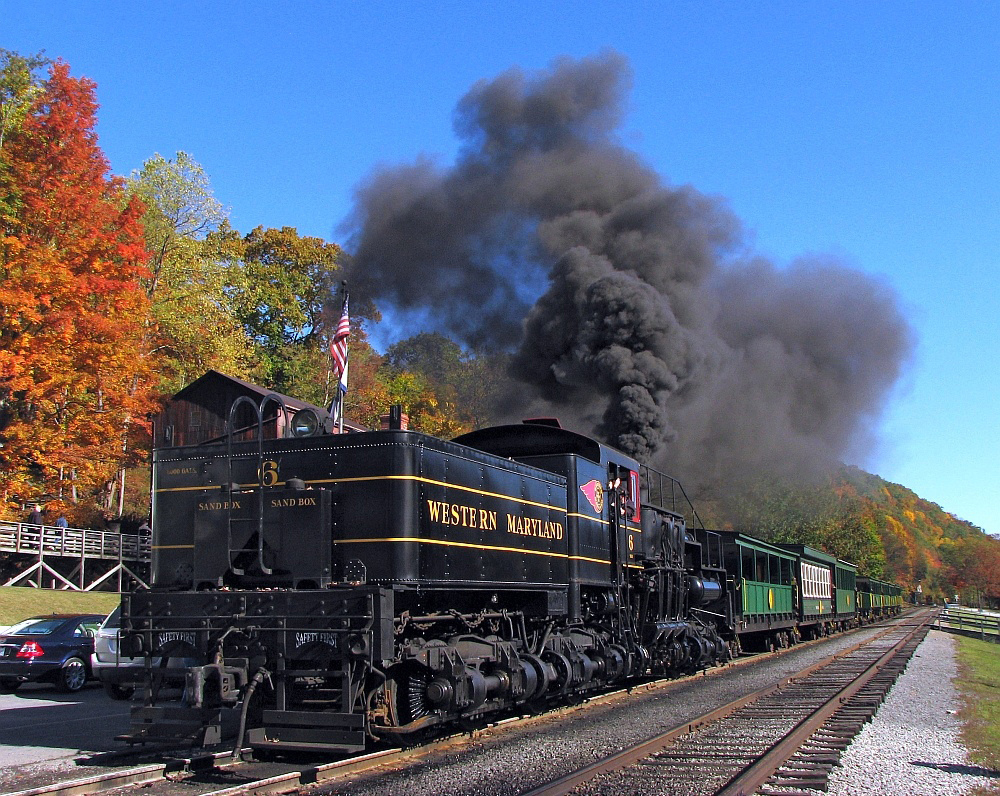 Western Maryland 3-truck Shay #6, nicknamed "Big Six," begins boarding at the depot to make another climb up the mountain on October 12, 2008. Loyd Lowry photo.
About Cass Scenic Railroad
The Cass Scenic Railroad is a living museum of Appalachian logging history, a rare place where original steam-powered technology, a preserved company town, and the rugged landscape that shaped them all continue to work together much as they did a century ago.
Set in Pocahontas County, West Virginia, Cass Scenic Railroad State Park tells the story of industrial America’s late timber boom, the communities it created, and the preservation effort that transformed a fading industry town into one of the nation’s most compelling heritage railroads.
A Brief History
Cass began as a company town owned by the West Virginia Pulp & Paper Company (later Mower Lumber Company) at the dawn of the 20th century, built to support large-scale timber operations tapping the vast red spruce and hardwood forests of the Allegheny Highlands.
In 1901 a logging railroad was laid up the steep flanks of Back Allegheny Mountain to bring logs down to a sawmill on the Greenbrier River. The mill and town took their identity from the business that developed them, and the railroad was designed for one task above all: to conquer steep grades, sharp curves, and rough track deep in the mountains.
Unlike mainline railroads that prioritized speed, logging lines prioritized power, flexibility, and sure-footedness. Cass’s builders chose geared steam locomotives—specifically Shay, Heisler, and Climax designs—whose drive shafts and gearboxes let them creep steadily up grades approaching 9 percent and snake through switchbacks and tight curves impossible for conventional rod engines.
That technology defined the railroad’s character and explains why Cass remains such a draw for enthusiasts: it is one of the world’s best places to see geared steam working in the environment that demanded it.
The original line climbed from the mill at Cass to camps and loading points on the mountain, including Whittaker and beyond. Over time the railroad reached even higher country toward a logging town called Spruce, perched above 4,000 feet and known for its harsh winters and extreme remoteness.
Cass connected with the Chesapeake & Ohio Railway’s Greenbrier Division at the valley floor, ensuring a steady flow of timber products to broader markets. In its heyday, the mill at Cass was a major producer, feeding the region’s booming demand for lumber, pulpwood, and wood chemicals. The operations fundamentally reshaped the landscape, as old-growth spruce stands were clear-cut and fires became a persistent hazard on cutover land.
Socially, Cass was a classic company town. The mill and railroad employed a workforce that included loggers, teamsters, sawyers, railroaders, and their families, all living in company-built houses along a tidy grid.
There was a company store, a depot, boardinghouses, and community institutions—school, church, and medical services—arranged in a way that reflected the hierarchy typical of such places. While life was often hard and the work dangerous, the town was a close-knit community with rhythms and traditions built around the mill whistle and the trains.
Decline
Ownership of the operation changed hands in the early years, and for decades the railroad expanded and contracted as new tracts were cut and exhausted. The Mower Lumber Company ran the mill through the mid-20th century, continuing to rely on geared steam power long after most American railroads had dieselized.
This was a matter of necessity: on Cass’s grades and curves, the geared engines were the right tool for the job. By the 1950s, however, easily accessible timber was largely gone, and changes in the timber industry pointed to the end of the old model.
The last log train rolled in 1960 and the mill closed, leaving the town’s future in doubt. What happened next was as important to Cass’s story as its logging years: a preservation movement, backed by local citizens, rail enthusiasts, and state leaders, pushed to save the railroad and town as a heritage attraction.
Cass Scenic Railroad State Park
In the early 1960s the State of West Virginia acquired the property and created Cass Scenic Railroad State Park. By 1963, tourist trains were running again—this time with passengers instead of logs—making Cass one of the earliest and most ambitious state-run heritage railroads in the United States.
From the outset, the park balanced preservation with operation. Cass did not just display locomotives; it ran them on the original logging line, giving visitors a visceral sense of how the technology worked and why it mattered. The route up the mountain, complete with switchbacks and water stops, remains largely the same.
Today's Excursions
Today, trains typically climb to Whittaker Station, a popular picnic area and site of a recreated logging camp exhibit, or continue higher to Bald Knob, at 4,842 feet, with sweeping views across the highlands, including the valley of the Greenbrier River and the great dish of the Green Bank Telescope in the National Radio Quiet Zone.
Over the decades, Cass built a reputation not just for the spectacle of geared steam but for the depth of its interpretation. The park preserves many of the original company houses, now restored as overnight rentals.
The depot, company store, museum displays, and interpretive signage give context to what visitors see and hear on the trains. Volunteers and partner organizations have been instrumental in this work, helping to restore equipment, build the Whittaker logging camp exhibit, and keep the railroad’s unique skillsets alive in the shop.
Cass’s locomotive roster has long been a point of pride. The railroad maintains one of the largest collections of operating geared steam locomotives anywhere, with Shays as the core of the fleet and representatives of the Heisler and Climax types highlighting the diversity of logging-era engineering.
These engines were built not for speed but for torque and adhesion, their geared drives delivering power evenly to all axles at walking speeds.
Coupled with steep grades and heavy trains, they provide an unforgettable sensory experience: the steady chuff of exhaust, the click of gears, the aroma of coal smoke and hot oil, and the sight of a locomotive leaning into a climb in the same forested hollows it has worked for generations.
Durbin & Greenbrier Valley Railroad
In recent years, Cass entered a new chapter of cooperation and connectivity. In 2015, operations of the state’s tourist railroads in the region were combined under the Durbin & Greenbrier Valley Railroad through an agreement with the West Virginia State Rail Authority.
That arrangement brought Cass into a broader network that includes excursions out of Elkins and Durbin, aligning marketing, maintenance, and long-term planning across multiple lines.
A major project under this umbrella has been the rebuilding of the washed-out Greenbrier River line between Cass and Durbin—severed by catastrophic flooding in 1985. With track restored, through service returned after a hiatus of nearly four decades, opening new itinerary options and reuniting communities along the river with the historic rail corridor.
Beyond its locomotives and trackage, Cass embodies an important chapter in Appalachian history. It preserves the material culture of the timber boom, from industrial ruins to worker housing, and it helps explain how industry, environment, and community intersected in the high country of West Virginia.
The surrounding Monongahela National Forest stands as a counterpoint and complement: a regrown landscape that once bore the scars of heavy logging now frames the trains with second-growth spruce and hardwood, an evolving story of use and restoration.
For visitors, the railroad delivers layered experiences. Families ride to Whittaker for a picnic and a hands-on feel of a logging camp; railfans book the longer run to Bald Knob to savor every switchback and vista; history-minded travelers rent a company house and walk the streets of a preserved mill town after the last train of the day drifts back down the mountain.
For West Virginia, Cass has been an economic and cultural anchor, drawing tens of thousands of visitors annually, supporting small businesses, and reinforcing a sense of place rooted in both work and wonder.
More than a century after the first rails were spiked down at the edge of the Greenbrier River, the Cass Scenic Railroad continues to do what it was built to do: climb mountains with determination and purpose.
The cargo has changed, but the essence has not. Each trip is a moving lesson in ingenuity, endurance, and the heritage of a region that helped fuel America’s growth—and found a way, decades later, to preserve and share that legacy.
Christmas At Cass
At the heart of the event are special holiday train rides. Depending on the year and weather, the railroad typically offers shorter winter excursions suitable for all ages, often to Whittaker Station or along gentler stretches of track. Coaches are trimmed with greenery, conductors share stories of mountain railroading, and the locomotive’s exhaust hangs like lace in the cold air. Many departures include a meet-and-greet with Santa—onboard or at the depot—for photos and wish-list whispers. Daylight trips reveal frosted forests and river views; when evening runs are scheduled, the experience shifts to twinkling lights and the glow of a steam plume against the winter sky.
On the ground, Cass leans into small-town cheer. The depot and Company Store are decked with garlands, with shelves of railroad ornaments, West Virginia–made crafts, and old-fashioned candy. Expect hot cocoa, cider, and fresh-baked treats; when open, the Last Run Restaurant serves hearty, seasonal fare. Live music and caroling often pop up, and families linger between activities. Children might write letters to Santa, join simple crafts, or watch volunteers tend the locomotives—a guaranteed crowd-pleaser when the whistle sounds and a cloud of steam rolls across Front Street.
For an immersive escape, the park’s historic company houses—once home to timber families—can be rented within walking distance of the depot, turning a train ride into a cozy weekend. Many guests pair the festivities with nearby Snowshoe Mountain or a side trip to Marlinton. Tickets and lodging sell out quickly, so book early. Mountain winters reward preparation: dress in warm layers, wear sturdy shoes, and allow extra time for curvy, possibly snowy roads. Cell service is spotty; save tickets and directions offline. For current dates, prices, accessibility details, and weather advisories, check the Durbin & Greenbrier Valley Railroad website.
What makes Christmas at Cass memorable is its blend of sparkle and authenticity. You’re not in a theme park—you’re in a real Appalachian company town where steam still works and neighbors volunteer to create something heartfelt.
The result is a holiday tradition that feels handcrafted: lights on clapboard porches, stories in the depot, and the rhythmic heartbeat of a Shay easing past the platform—an experience that lingers long after the last carol fades into the winter woods.
Recent Articles


-
Sunset Limited Derails in Louisiana After Hitting a Truck
Nov 23, 26 08:59 AM
The eastbound Sunset Limited struck a truck hauling a bulldozer at a Broussard crossing on Sunday evening, November 22, 2026. Amtrak said 95 customers were aboard and that the passenger cars stayed up… -
David H. Moffat: Net Worth, Railroads, Biography
Nov 23, 26 12:24 AM
 David H. Moffat was born July 23, 1839, in Washingtonville, New York. He led the First National Bank of Denver and built the Moffat Road toward Salt Lake City. He died March 18, 1911.
-
William Jackson Palmer: Net Worth, Railroads, Biography
Nov 23, 26 12:15 AM
 William Jackson Palmer was born September 17, 1836, in Leipsic, Delaware. He built the Denver & Rio Grande and founded Colorado Springs. He died March 13, 1909.
-
Thomas C. Durant: Net Worth, Railroads, Biography
Nov 23, 26 12:00 AM
 Thomas Clark Durant was born February 6, 1820, in Lee, Massachusetts. Vice president of the Union Pacific, he organized the Credit Mobilier. He died in 1885.
-
Henry H. Rogers: Net Worth, Railroads, Biography
Nov 22, 26 11:54 PM
 Henry Huttleston Rogers, born January 29, 1840, was a Standard Oil vice-president who built the Virginian Railway. He died in New York on May 19, 1909.
-
Van Sweringen Brothers: Net Worth, Railroads, Biography
Nov 22, 26 11:38 PM
 Oris Paxton Van Sweringen, born April 24, 1879, near Wooster, Ohio, and Mantis James Van Sweringen, born July 8, 1881, developed Shaker Heights and a railroad system around the Nickel Plate. Oris died…
-
Alfred E. Perlman: President, Railroads, Biography
Nov 22, 26 12:33 AM
 Alfred Edward Perlman, born November 22, 1902, in St. Paul, was executive vice president of the Denver and Rio Grande Western, president of the New York Central, and president of the Western Pacific.
-
Patrick B. McGinnis: Net Worth, Railroads, Biography
Nov 22, 26 12:04 AM
 Patrick Benedict McGinnis, born May 23, 1904, in Palmyra, New York, chaired the Norfolk Southern and the Central of Georgia and presided over the New Haven and the Boston and Maine.
-
George Westinghouse: Net Worth, Air Brake, Biography
Nov 21, 26 11:35 PM
 George Westinghouse was born at Central Bridge on October 6, 1846. He died in New York on March 12, 1914. He built the air brake the railroads came to use.
-
NYC's "Xplorer" (Train): Concept, Consist, Photos
Nov 21, 26 11:31 PM
New York Central Xplorer, the Ohio Xplorer, Cleveland to Cincinnati in 1956. Pullman-Standard Train X cars, Baldwin-Lima-Hamilton locomotive 20, trains 423 and 424, timetable, consist, and photographs… -
Frisco Diesel Roster (All-Time)
Nov 21, 26 10:27 PM
 St. Louis-San Francisco diesel locomotives, each frame once. From VO-1000 No. 200 in 1941 through the GP40-2s and SD38-2s of 1979.
-
Frisco Steam Roster (Built Since 1900)
Nov 21, 26 10:18 PM
 St. Louis-San Francisco steam locomotives built since 1900. Mikados, Mountains, and twenty-five 4-8-4s.
-
Robert R. Young: Net Worth, Railroads, Biography
Nov 21, 26 09:47 PM
 Robert Ralph Young, born February 14, 1897, in Canadian, Texas, chaired the Chesapeake and Ohio and, in 1954, the New York Central. He died on January 25, 1958, in Palm Beach.
-
St. Louis-San Francisco Railway (Frisco): Map, Rosters, History
Nov 21, 26 06:37 PM
 History of the St. Louis-San Francisco Railway, the Frisco. The Pacific Railroad, the coonskin, Yoakum, Pensacola, and the Burlington Northern merger of November 21, 1980. Steam and diesel rosters are…
-
Kuhn, Loeb and Company: Net Worth, Railroads, History
Nov 21, 26 01:34 PM
 Kuhn, Loeb and Company was the New York banking house in E. H. Harriman's circle. Abraham Kuhn and Solomon Loeb opened the banking partnership in 1867. Jacob H. Schiff joined on January 1, 1875.
-
Otto Kahn: Net Worth, Railroads, Biography
Nov 21, 26 01:22 PM
Otto Hermann Kahn was born in Mannheim on February 21, 1867. He died in New York on March 29, 1934. He was the Kuhn, Loeb partner in E. H. Harriman's railroad work. -
George Pullman: Net Worth, Palace Cars, Biography
Nov 21, 26 11:01 AM
 George M. Pullman was born at Brocton on March 3, 1831. He died in Chicago on October 19, 1897. He built the palace-car company that owned the sleeping cars.
-
Arthur E. Stilwell: Net Worth, Railroads, Biography
Nov 21, 26 12:33 AM
Arthur E. Stilwell was born in Rochester on October 21, 1859. He died in New York on September 26, 1928. He built the road to Port Arthur and the Kansas City, Mexico and Orient. -
Frederick Weyerhaeuser: Net Worth, Railroads, Biography
Nov 21, 26 12:22 AM
 Frederick Weyerhaeuser was born at Niedersaulheim on November 21, 1834. He died at Pasadena on April 4, 1914. He was a lumberman and a railroad director.
-
John Murray Forbes: Net Worth, CB&Q, Biography
Nov 21, 26 12:13 AM
 John Murray Forbes was born at Bordeaux on February 23, 1813. He died at Milton on October 12, 1898. He was chairman of the Chicago, Burlington and Quincy.
-
Henry B. Plant: Net Worth, Plant System, Biography
Nov 20, 26 10:27 PM
 Henry Bradley Plant was born at Branford, Connecticut, on October 27, 1819. He died at his home on Fifth Avenue on June 23, 1899. He was president of the Plant system and of the Southern Express Compa…
-
Henry Flagler: Net Worth, Florida East Coast, Biography
Nov 20, 26 10:00 PM
Henry Flagler was born at Canandaigua, New York. He died at Whitehall on May 20, 1913, at 83, and was buried at Memorial Presbyterian Church in St. Augustine. -
William Rockefeller: Net Worth, Railroads, Biography
Nov 20, 26 11:50 AM
 William Rockefeller was born in Richford, New York, on May 31, 1841. The Associated Press dates his death June 24, 1922, at Rockwood Hall. Redmond dates it June 23, at Pocantico Hills.
-
William H. Vanderbilt: Net Worth, Railroads, Biography
Nov 20, 26 10:08 AM
 William H. Vanderbilt was born in New Brunswick, New Jersey, on May 8, 1821. He died in New York City on December 8, 1885. His will names two blocks of $40,000,000 and states no total.
-
J. Edgar Thomson: Net Worth, Pennsylvania Railroad, Biography
Nov 20, 26 12:25 AM
 J. Edgar Thomson was born in Springfield, Delaware County, Pennsylvania, on February 10, 1808. He died in Philadelphia on May 27, 1874. No opened inventory states a total.
-
Thomas A. Scott: Net Worth, Railroads, Biography
Nov 20, 26 12:06 AM
Thomas A. Scott was born at Loudon, Pennsylvania, on December 28. The year is 1823 in one biography and 1824 on the funeral plate. He died near Darby on May 21, 1881. No opened inventory states a tota… -
Henry Villard: Net Worth, Railroads, Biography
Nov 19, 26 11:41 PM
 Henry Villard was born Ferdinand Heinrich Gustav Hilgard at Speyer on April 10, 1835, and died early on November 12, 1900, at Thorwood Park, near Dobbs Ferry. He was 65. A court recital put the person…
-
J.P. Morgan: Net Worth, Railroads, Biography
Nov 19, 26 07:03 PM
 John Pierpont Morgan was born in Hartford on April 17, 1837, and died in Rome on March 31, 1913, at 12:05 p.m. Rome time. He was 75. A 1916 New York appraisal put the gross estate at $78,149,024, excl…
-
Daniel Willard: Net Worth, Baltimore and Ohio, Biography
Nov 19, 26 06:51 PM
 Daniel Willard was born on January 28, 1861, and died on July 6, 1942. He was 81. He was president of the Baltimore and Ohio from January 15, 1910 until 1941. No opened record states a fortune. Time p…
-
Cyrus K. Holliday: Net Worth, Santa Fe, Biography
Nov 19, 26 06:03 PM
 Cyrus Kurtz Holliday was born April 3, 1826, and died in Topeka on March 29, 1900. He was 73. He founded Topeka, wrote the Atchison and Topeka charter, and was the railroad's first president. He l…
-
N&W 2-6-6-4 Locomotives (Class A): Specs, Roster, History
Nov 19, 26 05:39 PM
 Norfolk & Western Class A. Forty-three simple 2-6-6-4s, 1200 to 1242, built at Roanoke from 1936 to 1950 for time freight and used on passenger trains when assigned. Diagram specs, the 114,000-pou…
-
Jay Cooke: Net Worth, Civil War, Biography
Nov 19, 26 05:05 PM
 Jay Cooke was born at Sandusky on August 10, 1821, and died the night of February 16, 1905, at Ogontz. He was 83. Jay Cooke and Company opened January 1, 1861, and suspended September 18, 1873. He sol…
-
Daniel Drew: Net Worth, Erie Railroad, Biography
Nov 19, 26 04:44 PM
 Daniel Drew was born at Carmel on July 29, 1797, and died the night of September 18, 1879, age 82. He was Erie treasurer, not president. The settlement of July 2, 1868, put him out of that office.
-
James Fisk Jr.: Net Worth, Robber Baron, Biography
Nov 19, 26 02:47 PM
 James Fisk Jr. was born on April 1, 1835, and died the morning of January 7, 1872, at the Grand Central Hotel. He was 36. Edward S. Stokes shot him the afternoon before. He was an Erie director from O…
-
Chehalis-Centralia Polar Express Seats Are Sold Out
Nov 19, 26 02:43 PM
Chehalis-Centralia marks its Polar Express departures sold out. Diesel No. 6 is pulling while steam No. 15 is repaired. The business-car page still prints $260, $390, and $520. -
Cumbres & Toltec Lists Santa's Holiday Express
Nov 19, 26 02:38 PM
 Cumbres & Toltec lists Santa's Holiday Express for December 5-6 in Chama and December 12-13 in Antonito. Coach is $25. The Chama trip will not run to Dalton.
-
Florida Railroad Museum Lists the North Pole Express
Nov 19, 26 02:28 PM
 The Florida Railroad Museum lists the North Pole Express from November 27 through December 22, 2026. The trip is 3.75 hours. The museum will be closed November 21 and 22.
-
George Jay Gould: Net Worth, Railroads, Biography
Nov 19, 26 02:18 PM
 George Jay Gould was born in New York on February 6, 1864, and died on May 16, 1923, at his villa in France. The company pages date his father's portfolio to 1896. The Panic of 1907 broke the tran…
-
Jay Gould: Net Worth, Railroads, Biography
Nov 19, 26 01:43 PM
 Jason Gould, called Jay, was born at Roxbury on May 27, 1836, and died the morning of December 2, 1892. Erie president from October 1868 until 1872. From 1879 the Missouri Pacific was the center of th…
-
Mark Hopkins Jr.: Net Worth, Railroads, Biography
Nov 19, 26 11:53 AM
 Mark Hopkins Jr., born at Henderson on September 1, 1813, died at Fort Yuma on the night of March 29, 1878. Treasurer of the Central Pacific from June 28, 1861, until he died in that office. The 1881…
-
Leland Stanford: Net Worth, Railroads, Biography
Nov 19, 26 12:36 AM
 Amasa Leland Stanford, Watervliet 1824 to the Palo Alto house in June 1893, president of the Central Pacific and, until February 28, 1890, of the Southern Pacific. The 1893 inventory was about 17 mill…
-
Charles Crocker (Railroads): Robber Baron, Net Worth, Biography
Nov 19, 26 12:23 AM
 Charles Crocker, Troy 1822 to August 14, 1888, built the Central Pacific and drove the Siskiyou spike. He did not die president of the Southern Pacific. The opened biographies state no estate total.
-
Edward H. Harriman (Railroad): Facts, Robber Baron, Biography
Nov 19, 26 12:18 AM
 Edward Henry Harriman, February 25, 1848, to September 9, 1909, president of the Union Pacific from 1904 until he died in that office. The Courier-Journal put the known estate on the public record at…
-
Collis P. Huntington: Net Worth, Railroads, Biography
Nov 18, 26 11:26 PM
 Collis Potter Huntington, 1821 to 1900, vice president of the Central Pacific and president of the Southern Pacific from February 28, 1890, until he died in that office. The will stated no total. The…
-
Detroit Terminal Railroad: History, Roster
Nov 18, 26 10:47 PM
 The Detroit Terminal Railroad was a Detroit and Highland Park belt line, incorporated December 8, 1905. The November 1944 Guide listing gives 17.994 miles of first main track.
-
James J. Hill: Net Worth, Railroads, Robber Baron, Facts
Nov 18, 26 09:19 PM
 James J. Hill, 1838 to 1916, built the Great Northern from the St. Paul and Pacific to Puget Sound and left the chair in 1912. The fortune was estimated at $63 million. He left no will.
-
Cornelius Vanderbilt: Biography, Facts, Net Worth
Nov 18, 26 05:21 PM
 Cornelius Vanderbilt, 1794 to 1877, assembled the New York Central and Hudson River from the Harlem, the Hudson River Railroad, and the original New York Central, and died in office. The estate was ab…
-
Pacific Great Eastern Railway: All-Time Diesel Roster
Nov 18, 26 12:24 PM
 All-time diesel roster of the Pacific Great Eastern, the British Columbia Railway, and BC Rail. Classes, road numbers, and builder data from Paul Crozier Smith, Canadian Rail no. 547 (2012).
-
Pacific Great Eastern Railway: Map, History, Roster
Nov 18, 26 10:22 AM
 The Pacific Great Eastern, incorporated February 27, 1912, became the British Columbia Railway Company on March 30, 1972. On the October 26, 1969 Official Guide, 861.9 miles were under operation. Cana…
-
Northern Alberta Railways: Map, History, Timetables
Nov 17, 26 11:52 PM
 Northern Alberta Railways, reporting mark NAR, was incorporated June 14, 1929, and owned jointly by Canadian National and Canadian Pacific. On the October 27, 1968 freight timetable, Dawson Creek is 4…