O. Winston Link: Biography, N&W Night Photos & Sound Recordings
Last revised: September 5, 2026
By: Adam Burns
Ogle Winston Link (December 16, 1914 – January 30, 2001) was a Brooklyn civil engineer who became the photographer—and the sound recordist—of the last Class I steam railroad in the United States. Between January 1955 and the spring of 1960 he made about twenty trips from New York to the Norfolk & Western in Virginia, West Virginia, North Carolina, and Maryland. He came home with some 2,400 railroad negatives, most of them 4×5, most of them at night, and a parallel archive of tapes he issued himself as Sounds of Steam Railroading. The pictures were not famous until the 1980s. The records already were. Together they are how a large part of the public now imagines late steam: not a roster shot on a sunny day, but a J or an A or a Y6 in the dark, a town along the line still awake, and the whistle on the next ridge.
He did not invent railroad photography. He did something the railfan 4×5 crowd was not doing. He treated the N&W as a complete world—locomotives, stations, swimming holes, drive-ins, section shanties, the people who lived next to the track—and he built the light himself. N&W steam was worth that trouble. Roanoke Shops were still turning out Class J 4-8-4s and Class A 2-6-6-4s when every other big road had given up. The last main-line steam came off in May 1960. Link stopped a few weeks before. The museum that carries his name sits in the railroad’s own passenger station in Roanoke.
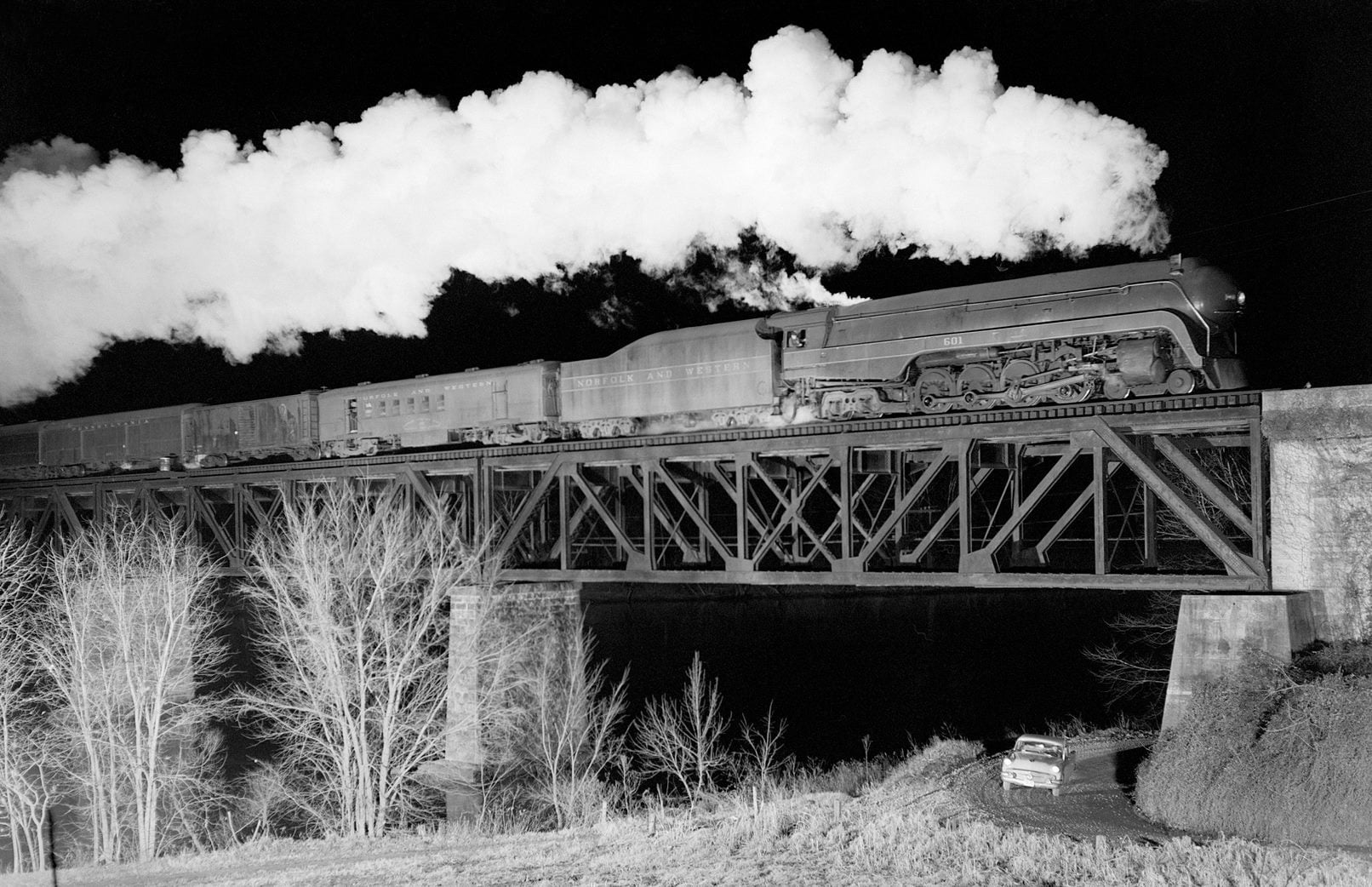
Norfolk & Western 4-8-4 #601 on Bridge 201 over the New River at Radford, Virginia, with Train 17, the first section of Southern’s southbound Birmingham Special, the night of December 17, 1957. O. Winston Link photo.
On this page: At a glance · Brooklyn and Byoir · Why the N&W · Night, flash, and the 4×5 · What the pictures are · The records · Fame, late · October Sky · Last years and the museum · Why he matters · Related reading · Sources
At a glance
| Item | Detail |
|---|---|
| Name | Ogle Winston Link (O. Winston Link; Winston to people who knew him) |
| Born / died | December 16, 1914, Brooklyn, N.Y. — January 30, 2001 (age 86). Buried Elmwood Cemetery, Shepherdstown, W.Va. |
| Training | Civil engineering, Polytechnic Institute of Brooklyn, 1937. Photo editor of the school paper; class president; hockey |
| Day job | Carl Byoir and Associates (public-relations photography); Airborne Instruments Laboratory in World War II; independent industrial studio in New York from 1946 (Alcoa, Texaco, Goodrich, Ethyl, Westinghouse) |
| N&W project | January 21, 1955 (first night negative, Waynesboro, Va.) through early 1960. About twenty trips. About 2,400 railroad negatives, mostly 4×5. Self-funded, on the order of $20,000 then |
| N&W steam ended | May 1960 (last main-line steam often dated May 7). Link’s last night work 1959; last railroad negatives 1960 |
| Method | Tripod view camera; synchronized flashbulbs in homemade reflectors (dozens of No. 2 lamps on a big setup); night preferred, not exclusive. Daylight and color exist |
| Sound | Self-published LPs, 1957–1977, issued as Sounds of Steam Railroading and sequels. National Recording Registry, 2003 |
| Signature still | Hotshot Eastbound, Iaeger, W.Va., August 2, 1956: N&W Class A 2-6-6-4 #1242 on time freight 78 past the Autoscope Drive-In. Two negatives printed as one |
| Books that made the pictures public | Steam, Steel & Stars (Harry N. Abrams, 1987, text by Tim Hensley); The Last Steam Railroad in America (1995, Thomas H. Garver); later Life Along the Line (2012, Tony Reevy) |
| Film | Cameo as the engineer in October Sky (1999). The engine is Southern Railway 2-8-2 #4501, lettered as N&W for the picture |
| Museum | O. Winston Link Museum, former N&W passenger station, Roanoke, Va. Opened January 10, 2004. Historical Society of Western Virginia |
The locomotives in the pictures have their own leaves: J class on /nwjc.html and /611.html, Class A on /1218.html, the railroad on /norfolk.html. This page is the man who photographed them at the end.
Brooklyn, engineering, and a PR camera
Link was born in Brooklyn. His mother’s people were Virginians; his father, Albert (Al) Link, had West Virginia roots and taught woodworking in the New York City schools. The boy printed photographs in a drugstore, played hockey, and was good at math. After a year of accounting he went to the Polytechnic Institute of Brooklyn (today the NYU Tandon School of Engineering) for civil engineering. He was class president all four years and photo editor of the paper. He graduated in 1937, in the Depression, with an engineer’s degree and no engineering job.
What he had was a banquet speech. An executive from Carl Byoir and Associates, the public-relations firm, heard him and hired him as a photographer. Byoir sold clients a story and a picture. Link learned to light a factory interior so every machine read, and to make a product look inevitable. Partial deafness kept him out of uniform in the Second World War. He spent those years at the Airborne Instruments Laboratory, a Columbia University wartime shop, on technical photography. Byoir asked him back in 1945. He declined. In 1946 he opened his own studio in New York. The account list was industrial America: Alcoa, Texaco, B.F. Goodrich, Ethyl, Westinghouse. Complicated interiors. Flash. Control. That is the same brain that later wired a mountainside for a Y6.
He had liked trains since childhood. The day job paid for the hobby until the hobby ate five years of the day job.
January 21, 1955, and why it had to be the N&W
In January 1955 Westinghouse sent him to Staunton, Virginia, to photograph window air conditioners. The N&W’s Shenandoah Division ran through Waynesboro, a few miles east. He knew it was the last large American railroad still in steam. He went to the station, waited for night, and made a negative of Train No. 2 with a streamlined K2a 4-8-2—number 130 on that first try. The picture already had the later grammar: flash, speed, depth of field, a station in the same frame as a locomotive. He reshot the scene months later with the waiting room lit, people on the platform, and more light on the engine. Negative NW-1 is the project’s birth certificate.
He sent prints to Roanoke and asked for permission to work on the property. N&W president Robert H. Smith said yes. Smith had been with the railroad for decades and still liked his steam. That access, from the president down, is why Link could put lanterns on a main track, string thousands of feet of wire, and not get arrested. It was not a company commission. He paid for the film, the flashbulbs, the motel rooms, and the assistants. Smithsonian later put the out-of-pocket figure above $20,000 in 1950s dollars.
The railroad was worth the money. N&W’s slogan was Precision Transportation. Its shops in Roanoke built the late steam that other roads bought from Alco, Baldwin, and Lima: J-class 4-8-4s for the Powhatan Arrow and the Pocahontas, simple articulated Class A 2-6-6-4s for time freight, compound Y6 and Y6b 2-8-8-2s for the coal. High-grade bituminous in southern West Virginia made steam cheap to fuel and expensive to give up. On May 29, 1955, four months after Link’s first night shot, the N&W announced its first diesel conversions. The project and the end of steam started in the same season. He had five years.
He made about twenty visits. George Thom was the regular assistant who ran wire and lamps. Thomas H. Garver later wrote the 1995 book; David Plowden, already a photographer, helped on sound in 1959. They worked Virginia (Shenandoah Division, Radford, Roanoke, Abingdon Branch), the West Virginia coalfields (Iaeger, Williamson, the Dry Fork), North Carolina, and a piece of Maryland. The Abingdon Branch—the Virginia Creeper—gave him mixed trains and a depot at Green Cove that still turns up whenever someone writes about the records.
Night, flash, and the 4×5
Interestingly, while most famous for his night photogrpaher, daylight negatives and color exist. Night is what he is famous for, and he had reasons. Steam exhaust reads white against a black sky and gray against a gray one. At night he owned the light: he could hold a station, a house, a swimming hole, and a locomotive in one exposure and let the rest of the world fall to black. He compared the engines to Garbo and Dietrich. He also said, more plainly, that he wanted to show how the railroad sat in the lives of the people along it.
The tool was a 4×5 view camera on a tripod, Graphic or similar, at a moment when 35 mm was eating the amateur market. He did not trust the small camera’s grab. He marked the train’s path with lanterns, placed flash reflectors, and ran his own battery-capacitor packs. A modest night setup used a dozen or two No. 2 flashbulbs. A large one used forty or more, fired together. Hotshot Eastbound took 42 No. 2s and a smaller lamp on the couple in the convertible. Some nights the wire ran 4,000 feet. He had one chance when the train hit the mark. Miss the sync and the bulbs were spent and the train was gone.
That is constructed photography, closer to a movie set than to a railfan at the fence. The old page called it “surreal.” The better word is staged—and then true. The locomotives were real. The towns were real. The light was his.
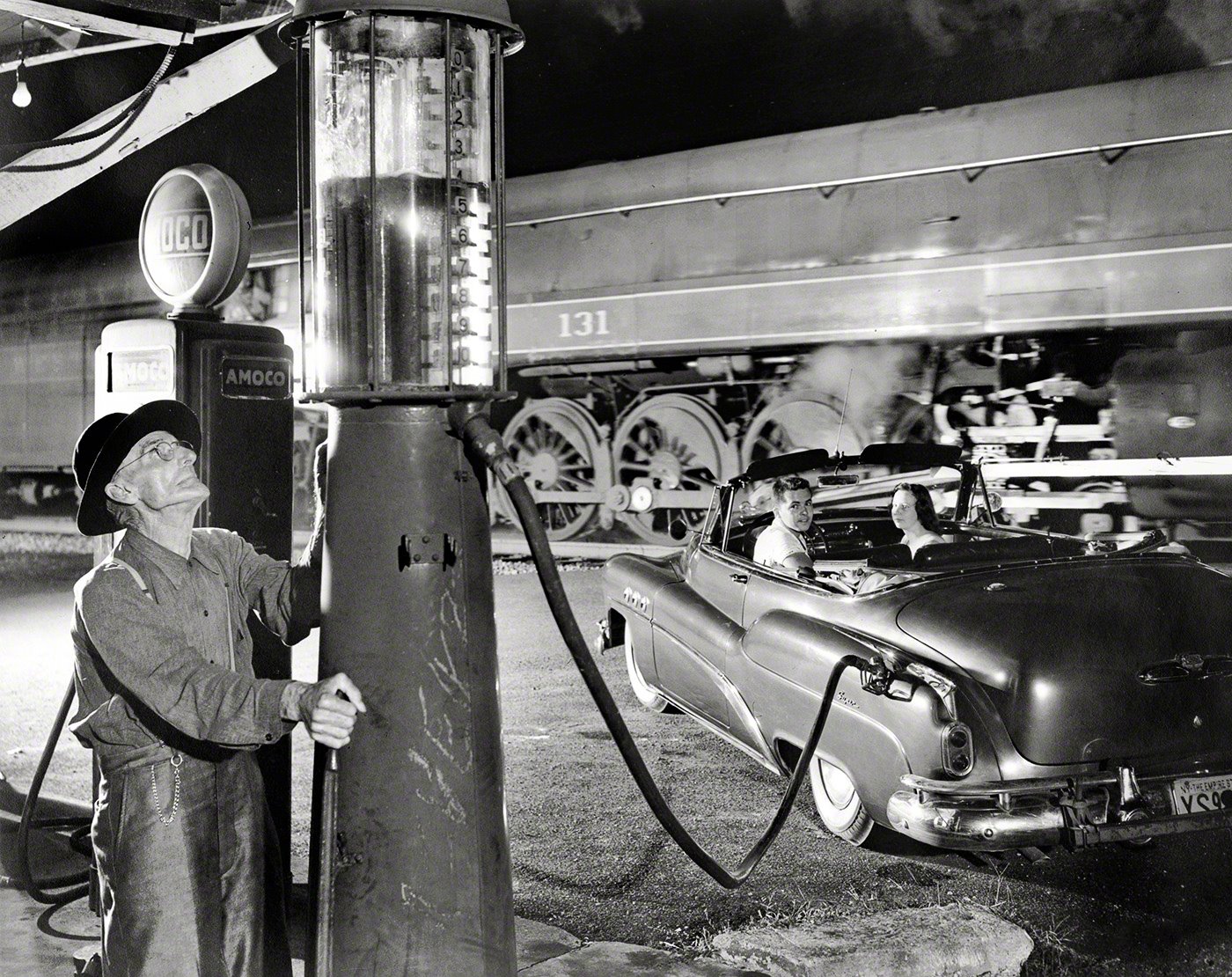
A 1952 Buick Super at a gravity-feed gas pump in Vesuvius, Virginia, as Norfolk & Western streamlined Class K-2a 4-8-2 #131 goes past on the Shenandoah Division with northbound Train 2, 1956. O. Winston Link photo.
What the pictures actually are
Look at Vesuvius before you look at a roster. The Buick and the pump are in the foreground. The K2a is the event that happens to a town. Link put his own 1952 Buick into more than one frame. He put children, station agents, section men, and families on porches into others. Hawksbill Creek swimming hole, Ghost Town at Stanley, the high bridges, the coal branches, a J on the Birmingham Special over the New River at Radford (the photograph at the top of this page, December 17, 1957, N&W 601 on Train 17)—the railroad is never only a locomotive.
The image everyone knows is Hotshot Eastbound (also titled Hot Shot, Eastbound), Iaeger, West Virginia, August 2, 1956. Negative NW 1103. Autoscope Drive-In, on the N&W main. Time freight No. 78 eastbound toward Petersburg, Class A 2-6-6-4 #1242—the caption on an early print called it a high-wheeled simple articulated on a 1 percent grade, “pride of the N&W.” Link set the view camera above his Buick. Willie Allen and Dorothy Christian sat in the convertible. Forty-two flashbulbs lit the lot and the train. The movie that night was Battle Taxi, a Korean War picture. Flash washed the screen white, so he made a second negative of the picture on the screen—an F-86 Sabre in the stock footage—and printed the two together. Cars, steam, and a jet in one frame. Past, present, and the thing that was replacing both. It is not a candid. It is not a fake. It is the N&W, a real drive-in, and a print assembled the way a commercial photographer assembled an industrial interior.
He numbered the railroad negatives and could still call them by number in old age. The N&W project is on the order of 2,400 of those sheets. Later museum counts of his whole life’s negatives run higher, because the studio work did not stop. Do not flatten him into a man who only photographed trains. The trains are why railroad history keeps him.
The records came first
In the railfan world of the 1950s and 1960s, Link was a sound man who also took pictures. He started taping in 1956. He issued the discs himself. Five twelve-inch LPs are N&W steam; a sixth collection belongs to the same series. The titles that stuck:
- Sounds of Steam Railroading (1957)
- The Fading Giant (1958)
- Thunder on Blue Ridge (1959)
- The Second Pigeon and the Mockingbird (1961)
- Mainline to Panther (1977)
Hi-fi magazines reviewed them when art museums did not hang the prints. Thunder on Blue Ridge used the night photograph of a Class A doubleheader at Boaz, Virginia (“Highball for the Doubleheader”) on the jacket. The tapes are not just stack talk. Green Cove on the Virginia Creeper—arrival, station stop, departure—is on The Fading Giant. So is Jimbo, the hound at Husk, answering a whistle. Tony Reevy’s essay for the National Recording Preservation Board is the place to start. In 2003 the Library of Congress put O. Winston Link’s steam locomotive recordings (1957–1977) on the National Recording Registry. That is a rail-history fact as hard as a builder’s plate. The pictures later outran the LPs in public. The LPs were how a generation of enthusiasts first knew his name.
1960 to 1987: the pictures wait
N&W steam was done in May 1960. Link went back to New York and the studio. He retired from commercial practice in 1983. For twenty-odd years the railroad work lived in rail magazines, on album covers, and in the heads of people who had bought the records. A traveling exhibition in 1983—Chrysler Museum of Art in Norfolk is the show usually named—took the prints into the art world. A Museum of Modern Art curator noticed. Paul Yule’s documentary Trains That Passed in the Night (1990) put Link back on the property, older, walking the same cuts.
Harry N. Abrams published Steam, Steel & Stars: America’s Last Steam Railroad in 1987, text by Tim Hensley. That is the book that made the night pictures a public monument. The Last Steam Railroad in America followed in 1995, text by Thomas H. Garver, with more of the people along the line. Tony Reevy’s Life Along the Line (2012) is the later synthesis. Collectors include people who do not otherwise buy railroad books. Stephen Spielberg and Diane Keaton have been named in the secondary literature. The point is not celebrity. The point is that a self-funded 4×5 project, ignored as art for a generation, now sits in the same sentence as the American photograph of the 1950s.
October Sky, 1999
Joe Johnston’s film October Sky (1999), from Homer Hickam’s memoir Rocket Boys, needed a coal-field steam train for a West Virginia story shot in East Tennessee. The Tennessee Valley Railroad Museum sent Southern Railway 2-8-2 #4501 to Emory Gap in March 1998, lettered it as a Norfolk & Western engine, and hung N&W hoppers behind it. The boys in the picture pull spike and rail off an unused branch; a whistle sends them scrambling; the train takes the other track. The "engineer" who waves is Link. He was in his eighties at this time and the cameo was just that as Mr. Link was never an actual engineer. The locomotive is still a Southern Mikado under the N&W paint.
Last years, Conchita, and Roanoke
Link’s second marriage, to Conchita Mendoza in the 1980s, ended in court. She had taken over the business of the prints. He accused her of stealing work and isolating him. A New York jury convicted her of grand larceny in the theft of some 1,500 prints. She served on the order of five years, then faced a later charge over an attempt to sell Link prints on eBay. Paul Yule’s 2006 film The Photographer, His Wife, Her Lover is the document of that mess. It is not the N&W story. It is why a public repository in Roanoke matters: the negatives and the railroad work needed a home that was not a disputed apartment.
In 2000 Link agreed to an O. Winston Link Museum in the former Norfolk & Western passenger station at Roanoke, the 1949 Raymond Loewy building. He died of a heart attack on January 30, 2001, at 86, before the doors opened. The museum opened January 10, 2004, under the Historical Society of Western Virginia. It holds the railroad negatives, prints, equipment, a caboose, and the sound work. It is still the only American museum devoted to a single photographer’s railroad archive. The Virginia Museum of Transportation, a short walk in the same city, has J 611 and A 1218—the engines in the pictures, in steel. Confirm hours on the museum’s own site before you plan a trip around either building.
Why he matters to rail history
Railroad photography did not begin in 1955. What Link did is still distinct.
- He got there in time. N&W was the last Class I to run a complete steam freight railroad. When he started, Roanoke was still a steam city. When he stopped, it was not. No other photographer has a comparably complete, intentional record of that five-year ending on that road.
- He treated steam as a culture, not a roster. The J, the A, and the Y6b are in the frame. So are the pump at Vesuvius, the drive-in at Iaeger, the creek, the depot, the kids. That is why people who do not know a Whyte system still know the pictures.
- He built the light. Night flash on a moving 4-8-4 is not a snapshot. The method is industrial photography applied to a railroad, and it is why the prints survive enlargement and museum light.
- He recorded the sound on purpose. The National Recording Registry listing is not a footnote. For a quarter century the LPs were the famous half of the work. Green Cove and the hound at Husk are as much N&W history as a builder’s photo.
- The fame lag is part of the story. Railfans had the records in the 1950s. Art museums got the prints in the 1980s. The delay means the images now carry a double load: they are documents of 1955–60, and they are how the 21st century pictures the end of steam.
He is not the only person who photographed N&W steam, and he is not the reason 611 exists in 2026. He is the reason a night at Iaeger and a night at Radford are part of American visual memory. That is enough.
Related Reading on American-Rails.com
- Norfolk & Western Railway
- N&W Class J 4-8-4s · N&W 611
- N&W 1218 (Class A)
- Powhatan Arrow
- Virginia Museum of Transportation
- Tennessee Valley Railroad Museum (Southern 4501 in October Sky)
- Steam locomotives
- Grif Teller (another artist who shaped how the public saw a railroad)
- Railroad museums
- Virginia railroads · West Virginia railroads
- Railroad history
Sources
- Encyclopedia Virginia, “O. Winston Link (1914–2001)”: Brooklyn, Poly 1937, Byoir, Staunton/Waynesboro, ~2,600 images cited in later book counts
- U.S. Department of State, ART in Embassies biography: class president; Byoir; R. H. Smith permission; January 21, 1955; twenty trips; 2,400 images; 4×5 Graphic; museum agreement 2000
- Smithsonian Magazine, “The Big Picture” (October 1995): Westinghouse air-conditioner job; $20,000; 4×5; last N&W steam May 7, 1960; Thomas Garver; flash method
- Tony Reevy, National Recording Preservation Board essay, “Steam Locomotive Recordings—O. Winston Link (1957–1977)”: Westinghouse at Staunton; LP titles and dates; Green Cove; Jimbo; Registry 2003
- Chrysler Museum of Art object label, Hotshot Eastbound: August 2, 1956; Autoscope Drive-In; Battle Taxi; Willie Allen and Dorothy Christian in Link’s 1952 Buick; two negatives; 42 No. 2 flashbulbs; time freight 78
- Historical Society of Western Virginia / Link Museum catalog: negative NW 1103; F-86 on the screen
- Early print caption (Joan Pharr Thomas provenance / Wright auction literature): N&W 1242 on hotshot 78 at Iaeger
- Tim Hensley, text for Steam, Steel & Stars (Harry N. Abrams, 1987)
- Thomas H. Garver, The Last Steam Railroad in America (1995) and “As Delicate as Air,” Railroad History (2010), on the tapes
- Classic Trains, David Plowden on assisting Link, spring 1959 (Boaz doubleheader / Thunder on Blue Ridge)
- Paul Yule, Trains That Passed in the Night (1990); The Photographer, His Wife, Her Lover (2006)
- Boston Globe, Mark Feeney, December 15, 2006: Conchita Mendoza conviction, ~1,500 prints, later eBay charge
- O. Winston Link Museum / Historical Society of Western Virginia: opened January 10, 2004, former N&W passenger station, Roanoke
- American-Rails.com, Norfolk & Western: Waynesboro January 21, 1955; Hotshot as a Class A at Iaeger
- Wikipedia, “O. Winston Link,” In popular culture: cameo as steam engineer in October Sky (1999), Southern 4501 lettered as N&W
- Wikipedia, October Sky cast list: Winston Link as a railroad engineer; production notes on 4501 and East Tennessee locations
- IMDb, October Sky (1999): Winston Link, railroad engineer
- Tennessee Valley Railroad Museum, “4501’s Role in October Sky” (August 25, 2023): 4501 to Emory Gap March 29, 1998; N&W lettering; Link in the cab on the rail-salvage scene
The O. Winston Link Museum is in Roanoke, Virginia, in the former N&W station. Confirm hours before you go. Prints and recordings remain under copyright of the Link estate and the museum.
Recent Articles


-
Ohio Railroad Museums (2026): A Complete Guide
Oct 05, 26 05:51 PM
 Ohio railroad museums—the Age of Steam Roundhouse, Bellevue, Worthington, Conneaut’s Nickel Plate 755, and the Dennison depot. Confirm hours on each site.
 -
Delaware Railroad Museums (2026): A Complete Guide
Oct 05, 26 02:43 PM
 Delaware railroad museums—Wilmington & Western at Greenbank, the Harrington tower and N5 caboose, Felton's 1868 depot, and the Selbyville station museum.
 -
C&O's M-1 Steam Turbine Locomotives: Specs, Roster, History
Oct 05, 26 12:13 PM
 Chesapeake & Ohio Class M-1 steam-turbine-electrics. Three Baldwin-Westinghouse locomotives, 500–502, built 1947–48 for The Chessie. Specs, the 2-C1+2-C1-B arrangement, and a roster. All scrapped…
 -
N&W 2-6-6-2 Locomotives (Class Z): Specs, Roster, History
Oct 05, 26 11:44 AM
 Norfolk & Western Class Z 2-6-6-2s. One hundred ninety compound Mallets, 1300–1489, from Richmond, Baldwin, and Schenectady, 1912–1918. Diagram specs, the Z-1b rebuilds, Z-2 1399, and a roster. No…
 -
Scenic Train Rides (USA 2026): State Guide to Tourist Railroads
Oct 04, 26 12:17 AM
 Scenic and tourist train rides in all 50 states for 2026. Colorado narrow gauge, Pennsylvania steam, Alaska’s White Pass, and the states with no full-size ride this month. Confirm on the railroad.
 -
Wyoming Scenic Train Rides (2026): A Complete Guide
Oct 03, 26 12:07 AM
 Wyoming has no full-size tourist railroad on the calendar in October 2026. Cheyenne Depot Museum and Douglas Railroad Museum are static. Union Pacific 4014’s posted public trip is a November run to De…
 -
Washington Scenic Train Rides (2026): A Complete Guide
Oct 02, 26 11:53 PM
 Washington tourist trains in 2026—Mount Rainier Scenic at Elbe, the Northwest Railway Museum, and Chehalis-Centralia. Lake Whatcom has no 2026 date on its ticket page.
 -
Wisconsin Scenic Train Rides (2026): A Complete Guide
Oct 02, 26 11:48 PM
 Wisconsin tourist trains in 2026—Wisconsin Great Northern, Osceola & St. Croix Valley, Mid-Continent, East Troy, and the National Railroad Museum.
 -
Pennsylvania Railroad Class Q2 4-4-6-4: Specs, Roster, History
Oct 02, 26 11:28 PM
 Pennsylvania Railroad Class Q2 4-4-6-4 duplexes. Twenty-six engines, 6131 and 6175–6199, Altoona 1944–45. Form 109-J specs, the 7,987 hp test of 6175, and a roster. All scrapped.
 -
Utah Scenic Train Rides (2026): A Complete Guide
Oct 02, 26 11:18 PM
 Utah tourist trains in 2026—Heber Valley Railroad from Heber City. Golden Spike at Promontory is a locomotive demonstration, not a line-haul ride.
 -
South Dakota Scenic Train Rides (2026): A Complete Guide
Oct 02, 26 11:06 PM
 South Dakota’s 2026 scenic train is the Black Hills Central 1880 Train, Hill City to Keystone. Steam is the summer assignment. Confirm the engine.
 -
Oregon Scenic Train Rides (2026): A Complete Guide
Oct 02, 26 11:04 PM
 Oregon tourist trains in 2026—Oregon Coast Scenic from Rockaway Beach, Mount Hood at Hood River, Eagle Cap from Elgin, and the Oregon Rail Heritage Center in Portland.
 -
Oklahoma Scenic Train Rides (2026): A Complete Guide
Oct 02, 26 10:36 PM
 Oklahoma has no full-size scenic railroad on an October 2026 calendar. Oklahoma Railway Museum Halloween and Polar trains, the El Reno trolley, and the Heartland Flyer.
 -
North Dakota Scenic Train Rides (2026): A Complete Guide
Oct 02, 26 01:14 PM
North Dakota has no tourist railroad on a 2026 calendar. Ride Amtrak’s daily Empire Builder. The Fort Lincoln Trolley in Mandan is not a current ticket. -
Nebraska Scenic Train Rides (2026): A Complete Guide
Oct 02, 26 10:11 AM
 Nebraska has no full-size scenic railroad in 2026. The Omaha Zoo Railroad runs weekends through October 4. Ride Amtrak’s California Zephyr across the state.
 -
Missouri Scenic Train Rides (2026): A Complete Guide
Oct 02, 26 09:56 AM
 Missouri tourist trains in 2026—Branson Scenic Railway and the St. Louis, Iron Mountain & Southern at Jackson. Belton has no 2026 schedule posted.
 -
Minnesota Scenic Train Rides (2026): A Complete Guide
Oct 02, 26 09:52 AM
 Minnesota tourist trains in 2026—North Shore Scenic Railroad in Duluth, the Duluth River Train, and the Como-Harriet streetcar.
 -
Kansas Scenic Train Rides (2026): A Complete Guide
Oct 02, 26 09:32 AM
 Kansas tourist trains in 2026—the Abilene & Smoky Valley Railroad. Santa Fe 3415 is in overhaul. Midland Railway at Baldwin City is closed.
 -
Iowa Scenic Train Rides (2026): A Complete Guide
Oct 02, 26 08:41 AM
 Iowa tourist trains in 2026—Boone & Scenic Valley across the Bass Point Creek High Bridge, and Midwest Central’s December North Pole trains
 -
Indiana Scenic Train Rides (2026): A Complete Guide
Oct 02, 26 08:35 AM
 Indiana tourist trains in 2026—French Lick Scenic Railway, Nickel Plate Express, Hoosier Valley, and Hesston. Whitewater Valley is suspended.
 -
Illinois Scenic Train Rides (2026): A Complete Guide
Oct 02, 26 12:28 AM
 Illinois tourist trains in 2026—Illinois Railway Museum, Monticello Railway Museum, Fox River Trolley, and Silver Creek & Stephenson.
 -
Texas Scenic Train Rides (2026): A Complete Guide
Oct 02, 26 12:14 AM
 Texas tourist trains in 2026—Texas State Railroad, Grapevine Vintage Railroad, Austin Steam Train's Hill Country Flyer, and the Galveston Railroad Museum.
 -
Tennessee Scenic Train Rides (2026): A Complete Guide
Oct 02, 26 12:03 AM
Tennessee tourist trains in 2026—Tennessee Valley Railroad Museum, Dollywood Express, Three Rivers Rambler Christmas trains, and the Tennessee Central Railway Museum. -
South Carolina Scenic Train Rides (2026): A Complete Guide
Oct 01, 26 11:52 PM
 South Carolina's tourist train is the South Carolina Railroad Museum in Winnsboro—Blue Granite Express, pumpkin trains, and Santa trains on the old Rockton & Rion.
 -
Mississippi Scenic Train Rides (2026): A Complete Guide
Oct 01, 26 11:38 PM
 Mississippi has no regular tourist railroad in 2026. Ride Amtrak through the state, or book the excursion lines in Alabama, Tennessee, Louisiana, or Arkansas.
 -
Louisiana Scenic Train Rides (2026): A Complete Guide
Oct 01, 26 02:52 PM
 Louisiana has no regular full-size tourist railroad in 2026. New Orleans Polar Express returns December 11–31. Museums at Long Leaf, DeQuincy, and Jackson.
 -
Kentucky Scenic Train Rides (2026): A Complete Guide
Oct 01, 26 02:45 PM
 Kentucky tourist trains in 2026—Big South Fork Scenic Railway, Bluegrass Scenic Railroad, Kentucky Railway Museum, and My Old Kentucky Dinner Train.
 -
Georgia Scenic Train Rides (2026): A Complete Guide
Oct 01, 26 02:27 PM
 Georgia tourist trains in 2026—Blue Ridge Scenic Railway, SAM Shortline, Azalea Sprinter, Savannah shop rides, and what to confirm at Stone Mountain.
 -
Arkansas Scenic Train Rides (2026): A Complete Guide
Oct 01, 26 01:02 PM
 Arkansas tourist trains in 2026—Arkansas & Missouri through the Boston Mountains, and the Eureka Springs & North Arkansas dinner and excursion trains.
 -
Alabama Scenic Train Rides (2026): A Complete Guide
Oct 01, 26 12:59 PM
Alabama tourist trains in 2026—Heart of Dixie Railroad Museum at Calera, North Alabama Railroad Museum at Chase, and the Wales West Light Railway at Silverhill. -
The Circus Train: How Such Attractions Reached Distant Cities
Oct 01, 26 12:22 PM
 How circuses moved by rail: Coup's 1872 flats, the Ringling train's sections and car counts, the 1918 Hammond wreck, and the last show on May 21, 2017.
 -
West Virginia Halloween Train Rides (2026)
Oct 01, 26 12:19 PM
 2026 West Virginia Halloween train. Cass Scenic Halloween Train, October 30 and 31, steam, 5:00 p.m. from Cass Depot. Adult $75. About two hours to Whittaker. Family ride.
 -
Wisconsin Halloween Train Rides (2026)
Oct 01, 26 12:11 PM
2026 Wisconsin Halloween trains. Mid-Continent Pumpkin Special October 24–25, adult $24, pumpkins extra. Halloween Flyer October 24 at 4:30 p.m., adult $30. Osceola Pumpkin Express boards in Osceola… -
Utah Halloween Train Rides (2026)
Oct 01, 26 12:00 PM
 2026 Utah Halloween trains at Heber Valley Railroad. Pumpkin Train, about 40 minutes, with a cookie and a pumpkin. Halloween Express, about 90 minutes to Grim Hollow, Monday, Thursday, and Friday even…
 -
Texas Halloween Train Rides (2026)
Oct 01, 26 11:28 AM
 2026 Texas Halloween train. Texas State Railroad Spooky Special, adult-only, October 24. Boards Palestine at 5:00 p.m. About five hours to Rusk and back. Dinner on the grounds. Not steam. No fare on t…
 -
Tennessee Halloween Train Rides (2026)
Oct 01, 26 12:15 AM
 2026 Tennessee Halloween trains. Tennessee Valley Railroad Museum Rails, Wizards & Spells, selected days September 18 through October 25, from $35, about 2.5 hours. Spells & Potions tea from $60. The…
 -
Frisco's "Firefly" (Train): Consist, Route, Timetable
Sep 30, 26 11:37 PM
 Frisco Firefly—daylight streamliner, Kansas City to Tulsa and Oklahoma City. Trains 117 and 118. Pacifics 1018, 1026, and 1031. Last run May 22, 1960.
 -
South Carolina Halloween Train Rides (2026)
Sep 30, 26 11:29 PM
 2026 South Carolina Halloween train. South Carolina Railroad Museum Pumpkin Patch Express, the two Saturdays before Halloween. About three miles to the Greenbriar pavilion. Pumpkin for children 12 and…
 -
Oregon Halloween Train Rides (2026)
Sep 30, 26 08:10 PM
2026 Oregon Halloween train. Sumpter Valley Railroad Halloween Express at the Sumpter Depot, calendar window October 31 at 11:00 a.m. through November 1 at 12:30 p.m. Fare and the individual clocks ar… -
Oklahoma Halloween Train Rides (2026)
Sep 30, 26 03:45 PM
2026 Oklahoma Halloween train. Oklahoma Railway Museum, October 30 and 31, from Oakwood Station in Oklahoma City. Adults $15, children 3–12 $8. A candy bag with the ride. -
McCloud River Railroad: Serving The Timber Industry (1897-2009)
Sep 30, 26 03:37 PM
 McCloud River Railroad—Mount Shasta City to McCloud, Hambone, and Burney. Opened August 1, 1897. Alco No. 25 and EMD SD38s. Dinner train through January 2010. Railbikes in 2026; a dinner train is stil…
 -
Nevada Halloween Train Rides (2026)
Sep 30, 26 03:30 PM
2026 Nevada Halloween trains in Ely. Nevada Northern Pumpkin Patch Caper and Haunted Ghost Train. Adult tickets start at $45. Dates are on the railroad’s ticket calendar. Boulder City stays off until… -
Missouri Halloween Train Rides (2026)
Sep 30, 26 11:12 AM
 2026 Missouri Halloween trains. St. Louis Iron Mountain & Southern Pumpkin Patch Train on October 3, 4, 10, and 11, and Halloween Express on October 31 at 1:00 p.m. Jackson depot. No fare on the sched…
 -
Minnesota Halloween Train Rides (2026)
Sep 30, 26 11:06 AM
 2026 Minnesota Halloween trains. North Shore Scenic Great Pumpkin Train in Duluth, October 15–18. Everyone gets a pumpkin. Terror Train is October 30, an adult costume party, about three hours. Fares…
 -
Maryland Halloween Train Rides (2026)
Sep 30, 26 10:42 AM
 2026 Maryland Halloween trains. Western Maryland Scenic Pumpkin Patch Limited, October 17, 18, 24, and 25, $14. Colesville Trolleyween October 24, 25, and 31.
 -
West Side Lumber Company Railroad: Roster, History, Lines
Sep 30, 26 09:45 AM
 West Side Lumber at Tuolumne, California. Three-foot Shay and Heisler logging railroad. Lima shop numbers, builder specs, and where the engines are in 2026.
 -
Kansas Halloween Train Rides (2026)
Sep 30, 26 09:41 AM
 2026 Kansas Halloween train. Abilene & Smoky Valley Pumpkin Harvest Express, October 17 through 31. About one hour. Shop prices $35.56 to $41.02. Everyone picks a pumpkin.
 -
Iowa Halloween Train Rides (2026)
Sep 29, 26 11:58 PM
2026 Iowa Halloween train. Boone & Scenic Valley Pumpkin Express, October 10, 10:00 a.m. from 225 10th Street. About 1 hour 15 minutes. Children pick a pumpkin. -
Arizona Halloween Train Rides (2026)
Sep 29, 26 11:43 PM
 2026 Arizona Halloween train. Grand Canyon Railway Pumpkin Patch Train from Williams, $39 with a pumpkin included. Select October dates on the ticket calendar. Haunted train cars are optional.
 -
Nevada Northern Halloween Trains (2026)
Sep 29, 26 06:18 PM
Nevada Northern 2026 Halloween trains in Ely. Pumpkin Patch Caper to Keystone Gulch and the Haunted Ghost Train. Adult tickets start at $45. Dates are on the railroad’s calendar. Confirm on nnry.com.