The Wrecking Derrick: Railroading's Unsung Hero
Published: November 20, 2024
By: Adam Burns
In the vast and rich history of railroads, several essential elements work in concert to ensure its smooth operation. Among these, the wrecking derrick holds a place of unique importance.
Often overlooked, this robust piece of machinery plays a crucial role in maintaining and restoring service in the aftermath of a derailment or accident.
Nicknamed the "big hook" most railroads of the classic era owned at least one, which were not only tasked with clearing a line but also rerailing cars and/or locomotives.
Today, most surviving wrecking derricks have been relegated to museums as the industry has outsourced cleanups to companies like RJ Corman, which utilize sidebooms to handle such tasks.
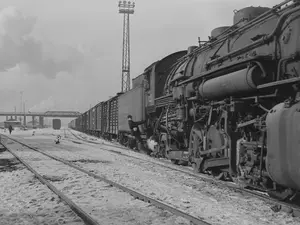
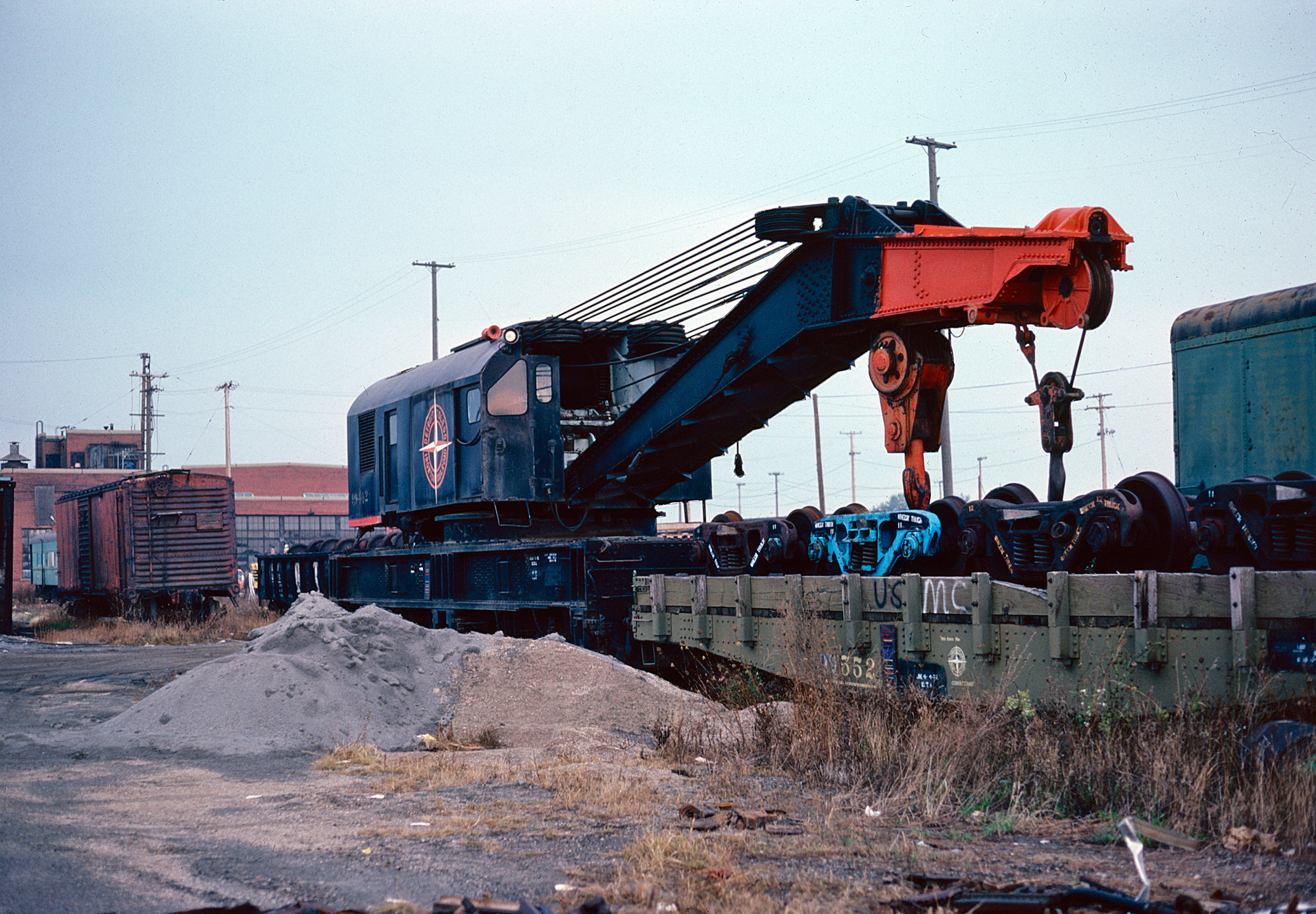 Detroit, Toledo & Ironton wrecking derrick #99402 is seen here stored in Flat Rock, Michigan in September, 1982. As their name suggest, these steam-powered machines were regularly used years ago to clean up derailments and wrecks. American-Rails.com collection.
Origins and Evolution
The inception of the wrecking derrick is deeply intertwined with the history of the railways themselves. As railroads expanded throughout the 19th century, the need for efficient recovery and repair operations became apparent.
Derailments and accidents, inevitable byproducts of burgeoning rail service, required an efficient solution for clearing tracks swiftly.
Early versions of the derrick were rudimentary, often relying on manpower, mules, and basic pulleys. However, as the complexity of rail networks increased, so did the sophistication of the cranes and crews.
To devise a quicker and safer method for wreck handling, railroads turned to the inventors of the first steam-powered lifting devices.
The Industrial Works of Bay City, Michigan, later known as Industrial Brownhoist Corporation, led the way in creating derricks, making the first steam wrecking crane in 1883 with a 20-ton lift capacity. By the early 20th century, these machines could handle between 40 and 100 tons.
In 1913, Industrial Brownhoist unveiled a 120-ton model and soon followed with 160- and 200-ton derricks, culminating in a 250-ton version in 1941. Bucyrus-Erie Co. of South Milwaukee, Wisconsin, also built a 250-ton model, while American Hoist & Derrick Co. of St. Paul, Minnesota, focused more on cranes for lighter maintenance and industrial tasks.
Technical Specifications and Design
At its core, the wrecking derrick is a specialized crane intended to lift and move heavy objects. The design typically includes a robust steel frame, a rotating superstructure, and a telescopic boom equipped with a hook or other lifting devices.
The derrick's setup takes into account its primary operational environment—beside long stretches of railroad tracks. The undercarriage was often mounted on specialized trucks, allowing it to travel directly on the tracks to the site of the incident. This mobility was a pivotal feature, ensuring that no matter how remote or inaccessible the location, help can be on its way swiftly.
Just like steam locomotives, steam derricks originally used coal or oil for fuel. As railroads transitioned to diesel locomotives in the late 1940s and 1950s, many coal-fired derricks were modified to burn oil instead.
Over time, numerous derricks had their steam boilers and engines swapped out for diesel-electric power plants, and some were even constructed as diesel-powered from the start. Before the diesel's widespread use, a few derricks operated with gas-electric or fully electric power systems.
Many models came equipped with propulsion systems enabling them to move at slow speeds of 4 mph or less. This feature was intended for minor adjustments in positioning, not for travel to job sites.
Typically, derricks were outfitted with two hoists: a main and an auxiliary. The latter, positioned at the boom’s tip, could lift less than the main hook—60 tons compared to 250 for the largest models—but offered a longer reach, making it ideal for moving debris and cars.
The primary role of the main hoist was to lift and reposition locomotives back onto the tracks. Instead of attaching the hook directly to a load, cable slings, chains, and spreader bars would be used with the main hoist.
Role in Accident Recovery and Rail Maintenance
In the event of a derailment or collision, the clock immediately starts ticking. Every moment a track is out of commission results in potential delays and financial losses.
Herein lies the crux of the wrecking derrick’s importance. These machines serve as the frontline warriors in accident recovery, meticulously removing obstacles so the railway network can be restored to service.
When a wreck happened and the call for the derrick went out, the crew quickly assembled at the special wreck train, which departed the terminal as swiftly as possible. With the potential for people to be trapped in the wreckage, every minute counted for the derrick's fast arrival.
The railroad also needed to clear the line to resume normal operations. Speedy handling of derricks was critical, especially with the imposed speed limits: typically 35 mph with the boom trailing and 25 mph with it leading.
Derricks came with a lot of support equipment and personnel needs. They were paired with special flatcars, known as boom cars, that carried the overhanging boom and essential equipment for cleaning up after the wreck.
Given that a wreck train might be deployed for several days, accommodations for feeding and resting the crew were necessary. Old passenger cars or converted boxcars were used, providing kitchen, dining, and sleeping areas. In addition, a tool and storage car carried torches, lights, generators, cables, and chains.
Flatcars loaded with sections of panel track were also part of the setup, ready to replace any track damaged in the wreck. Similar to fire engines, derricks and their support cars were rarely used, but needed to be in perfect condition when required, meaning they were well-maintained and frequently repainted.
As the wreck train neared the site, the derrick and boom car would be switched out. The locomotive then pushed the derrick up to the wreck. Often, two derricks would tackle a job, working from opposite ends.
To prepare the derrick, the crew would extend the outriggers to prevent tipping and minimize stress on the running gear, determine the proper boom angle, and choose the appropriate hoist for the task.
Conclusion
The wrecking derrick, though less glamourized than other railway components, stands as a testament to the resilience and adaptability inherent in the railroad industry. It is a critical cog in the wheel, ensuring that disruptions are met with swift and effective responses, thus maintaining the lifeline of commerce and connectivity that railways provide.
Recent Articles


-
Milwaukee Road Diesel Roster: (All Time)
Oct 26, 26 01:44 PM
 All-time diesel roster of the Milwaukee Road. 1,208 locomotives, each frame once. Alco, Baldwin, Davenport, EMD, Fairbanks-Morse, General Electric, and Whitcomb, with builder numbers.
 -
Milwaukee Road Steam Roster (All-Time): Post-1900
Oct 26, 26 01:38 PM
 Milwaukee Road steam locomotives built since 1900. Prairies, Mikados, the N-class articulateds, the S-class 4-8-4s, and the Hiawatha Atlantics and Hudsons. Quantity column 1,974. Unique frames 1,951.
 -
Milwaukee Road: Map, Electrification, Logo, History
Oct 26, 26 01:20 PM
 The Milwaukee Road, from the Milwaukee & Mississippi of 1850 to the Pacific Coast Extension, the Hiawathas, and the Soo Line sale. Why Lines West should have stayed.
 -
Lake Superior & Ishpeming Railroad: Map, Roster, History
Oct 25, 26 11:38 PM
 Lake Superior & Ishpeming Railroad, reporting mark LSI, from the Marquette Range to the Presque Isle ore dock. The 1954 steam list and the diesels the railroad owned.
 -
Kansas City Southern Steam Roster (Built Since 1900)
Oct 25, 26 09:09 PM
 Steam locomotives of the Kansas City Southern built since 1900, with the Louisiana & Arkansas and the Texas company.
 -
Kansas City Southern Diesel Roster (Built New)
Oct 25, 26 11:46 AM
All-time diesel roster of the Kansas City Southern. E units, F units, Geeps, SD40s through SD70ACes, Fairbanks-Morse, Baldwin, Alco, and General Electric, with serials and order numbers. -
Kansas City Southern Railway: Map, Photos, History
Oct 25, 26 12:24 AM
 The Kansas City Southern, from Arthur Stilwell's Gulf line to Canadian Pacific Kansas City on April 14, 2023. Steam and diesel rosters, the Southern Belle, and the Louisiana & Arkansas.
 -
Indiana Harbor Belt Diesel Roster (All-Time)
Oct 25, 26 12:17 AM
 All-time diesel roster of the Indiana Harbor Belt. 202 locomotive frames, each counted once. NW2s, SW7s, SW1500s, road switchers, and gensets. Slugs and boosters are outside the count.
 -
Indiana Harbor Belt Steam Roster (Built Since 1900)
Oct 25, 26 12:13 AM
 Steam locomotives of the Indiana Harbor Belt built since 1900. 182 engines, each counted once. 0-6-0s, 2-6-0s, 0-8-0s, and 2-8-2s. The three U-4a switchers are three-cylinder Brooks engines of 1927.
 -
Indiana Harbor Belt Railroad: Map, Rosters, History
Oct 25, 26 12:00 AM
 Indiana Harbor Belt, the inner belt across the Calumet, from the East Chicago Belt of May 16, 1896. Renamed June 29, 1907. Still operating, headquarters Hammond. Steam roster is the companion, 182 loc…
 -
NYC's "P Motor" Electric Locomotives
Oct 24, 26 11:43 PM
 New York Central P motors: 22 Alco-GE 2-C+C-2 electrics, Cleveland Union Terminal 1050–1071, class P-1a. 3,030 hp one-hour on 3,000-volt DC catenary, then 660-volt third rail as P-2a and P-2b.
 -
Illinois Terminal Car Roster
Oct 24, 26 11:40 PM
 Illinois Terminal cars. Mainline motors, the 1948 streamliners, sleepers, Alton and Valley Division cars, express motors, and the line cars rebuilt from pull cars.
 -
Illinois Terminal Diesel Roster
Oct 24, 26 09:31 PM
 All-time Illinois Terminal diesels, 62 frames. Alco S-2s and RS-1s, EMD switchers, GP7s, SD39s, GP38-2s, and the two GP20s. Serial numbers from the 1989 roster.
 -
Illinois Terminal Electric Locomotives
Oct 24, 26 08:22 PM
 Illinois Terminal electric locomotives, 57 frames. Class A through Class D, the Decatur-built motors, and the battery locomotives. Class D is the same five Class C frames, rebuilt.
 -
Illinois Terminal Steam Roster
Oct 24, 26 07:37 PM
 Illinois Terminal steam locomotives, 36 frames. Baldwin Moguls, three Class 30 Mikados, Florida East Coast 0-8-0s, and 2-6-0 No. 21, the last fire on June 30, 1950.
 -
Illinois Terminal Railroad: Map, Roster, Photos, History
Oct 24, 26 07:32 PM
Illinois Terminal, McKinley's Illinois Traction System, from the Danville coal towns to St. Louis. The McKinley Bridge, the sleeping cars, the 1937 break with the power company, the 1948 streamliners… -
Southern Railway Diesel Roster (All-Time)
Oct 23, 26 11:00 PM
 All-time diesel roster of the Southern Railway. 2,505 locomotives in the system number series, from the 1939 demonstrator FT to GP50s and B30-7A1s. Serials included.
 -
Illinois Central Diesel Roster (All-Time)
Oct 23, 26 04:06 PM
 Illinois Central and Illinois Central Gulf diesel locomotives, each frame once. The quantity column is 886. Serials and order numbers from Electro-Motive's builder lists. Paducah rebuilds and Gulf, Mo…
 -
Illinois Central Gulf Diesel Roster
Oct 23, 26 04:02 PM
 Illinois Central Gulf operating numbers from August 10, 1972, to February 29, 1988. New frames stay on the Illinois Central diesel roster. Gulf, Mobile and Ohio frames stay on that roster. No Gulf fle…
 -
Illinois Central Railroad: Map, Logo, History
Oct 23, 26 03:50 PM
Illinois Central, the Main Line of Mid-America, from the 1850 land grant to Canadian National control on July 1, 1999. Charter lines, Cairo bridge, Paducah, and the Illinois Central Gulf. Steam quanti… -
Grand Trunk Western Diesel Roster (All-Time)
Oct 23, 26 12:53 PM
 Grand Trunk Western diesel locomotives, each frame once. The quantity column is 377. Serials are filled for the Detroit, Toledo and Ironton and Detroit and Toledo Shore Line engines the railroad kept…
 -
Grand Trunk Western Steam Roster
Oct 23, 26 12:14 PM
 Grand Trunk Western steam locomotives in service about 1937 to 1942, from Richard Leonard's class list. Drury has no chapter. The quantity column is the counted Grand Trunk Western rows. Two mixed Gra…
 -
Grand Trunk Western Railroad: Map, Roster, History
Oct 23, 26 12:09 PM
 Grand Trunk Western, reporting mark GTW, Canadian National's railroad between Port Huron and Chicago. Trade name adopted in 1923. Steam class list quantity 232. Diesel quantity column 377. Identity in…
 -
Green Bay and Western Railroad: Map, Rosters, History
Oct 22, 26 11:18 PM
 Green Bay & Western, the Green Bay Route, reporting mark GBW. From Kewaunee to Winona. Mailer's steam and diesel rosters, and the August 1993 sale to Fox Valley & Western.
 -
Chicago & North Western Class E-4: Streamlined 4-6-4 Hudsons
Oct 22, 26 10:28 PM
 C&NW Class E-4, nine streamlined 4-6-4s, 4001–4009, Alco 1938. 84-inch drivers, 25-by-29 cylinders, 300 psi. Conventional Chicago–Omaha trains. Oil in 1947–48. Retired 1953–1956.
 -
Gateway Western Railway: Map, Roster, History
Oct 22, 26 02:43 PM
 Gateway Western Railway, reporting mark GWWR. Class II from Kansas City to East St. Louis. Kansas City Southern control May 5, 1997. The 1992 diesel fleet, with serials and order numbers.