Staten Island Rapid Transit
Published: January 6, 2026
By: Adam Burns
New York City’s rail-transit story is usually told through Manhattan subways, Brooklyn elevated lines, and the great commuter railroads that feed Grand Central and Penn Station. Yet across the harbor sits a system with a lineage every bit as old—and in some ways more unusual—than much of the subway: the Staten Island Rapid Transit (SIRT), today publicly branded as the Staten Island Railway (SIR).
It’s a rapid-transit operation with a railroad ancestry, once tied to a major trunk carrier (the Baltimore & Ohio), shaped by grand but unrealized ambitions (a Narrows tunnel to Brooklyn), and defined by a recurring theme in American transit history: service is rarely just about technology—it’s about politics, geography, money, and the changing patterns of where people live and work.
What follows is a detailed look at how Staten Island’s railway came to be, how it evolved from steam-era local railroad into an electrified rapid-transit line, how it lost two-thirds of its passenger network in a single day, and how it persisted into the modern MTA era—while also playing an underappreciated role in freight revival on the island.
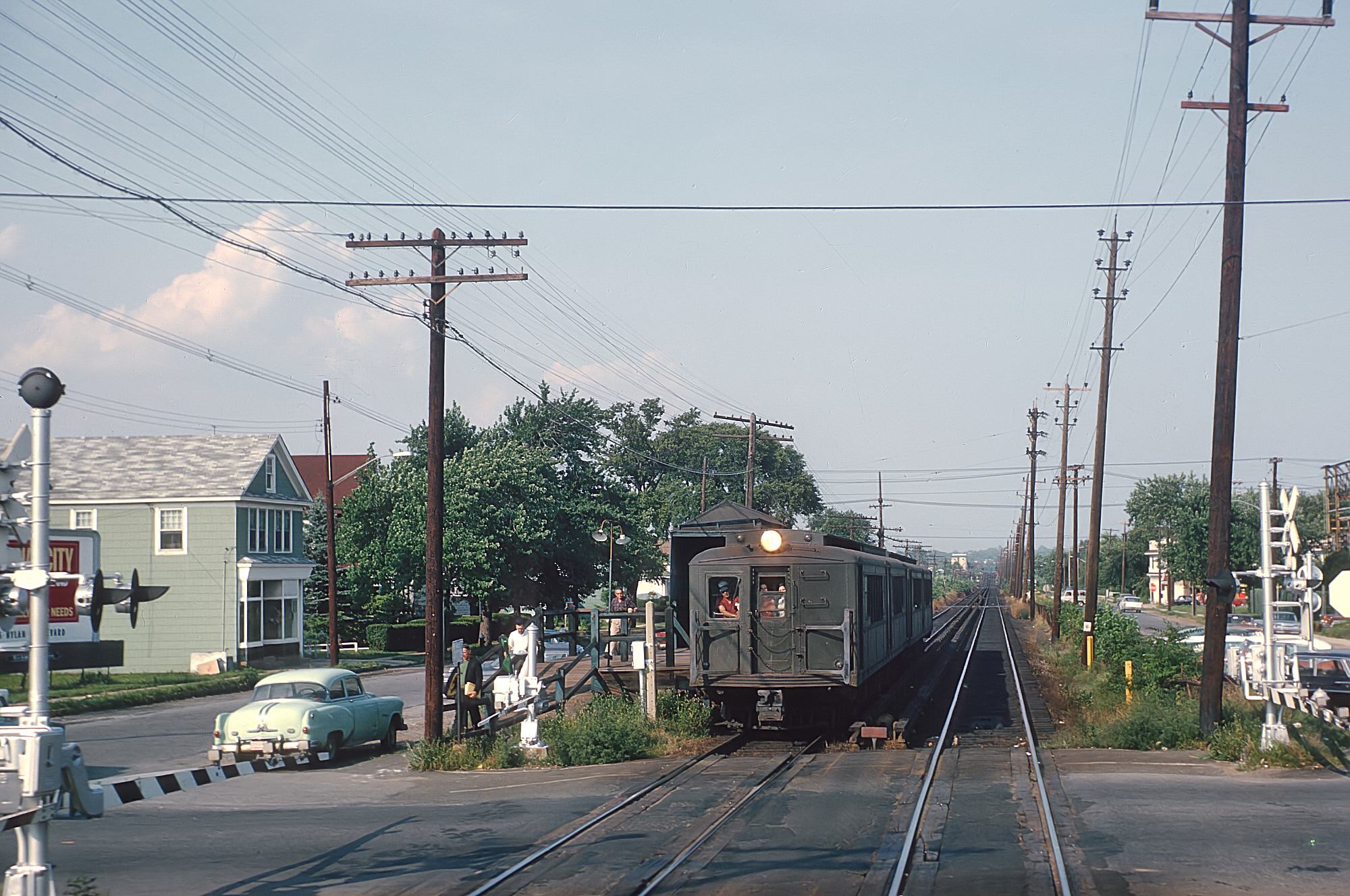 A Staten Island Rapid Transit train at Great Kills, New York in August, 1964. Rick Burn photo.
Beginnings: Staten Island’s Rail Dream Takes Shape (1850s–1870s)
Staten Island’s geography made it both close to New York City and oddly separate from it. The island’s shoreline offered natural ferry landings, while its interior and south shore were increasingly attractive for settlement—if transportation could keep pace. Early attempts to build a rail line on Staten Island date to the mid-19th century, culminating in a route that reached Tottenville by 1860—establishing the island’s first continuous north–south rail corridor.
Over time, control and corporate structure changed as financiers and operators reorganized the property into new companies, a common pattern in 19th-century American railroading. By the 1870s, the line had been reorganized again, reflecting both the financial instability and the still-emerging market for island-wide rail service.
But the truly transformative chapter—what made Staten Island’s line distinct from many other local railroads—arrived with a development-minded vision: a coordinated transportation hub tied to New York Harbor commerce, and an integrated system of passenger and freight connectivity.
The Rapid Transit Era: Expansion, Ambition, and the Birth of “SIRT” (1880s–1899)
In 1880, the Staten Island Rapid Transit Railroad Company was organized amid a push to develop the island and knit rail service into a broader harbor transportation network. The “Rapid Transit” label was more than marketing: the goal was frequent, reliable service linking neighborhoods to the St. George ferry terminal, where passengers could continue to Manhattan.
This period also saw the growth of a branching network. In addition to the main north–south route (eventually the line to Tottenville), Staten Island gained additional passenger corridors:
- North Shore Branch (west and north waterfront communities)
- South Beach Branch (east shore communities)
These branches opened in the late 1880s and turned the system into something more akin to a small metropolitan rail network than a single local line.
The North Shore line, for example, is documented as beginning construction in the 1880s and offering service that tied several waterfront communities into St. George. The South Beach Branch similarly created a second passenger spine on the island’s east side.
By the end of the 19th century, these operations consolidated into the corporate identity most people associate with the early system: the Staten Island Rapid Transit Railway Company—SIRT—which would become closely linked with a major mainland railroad.
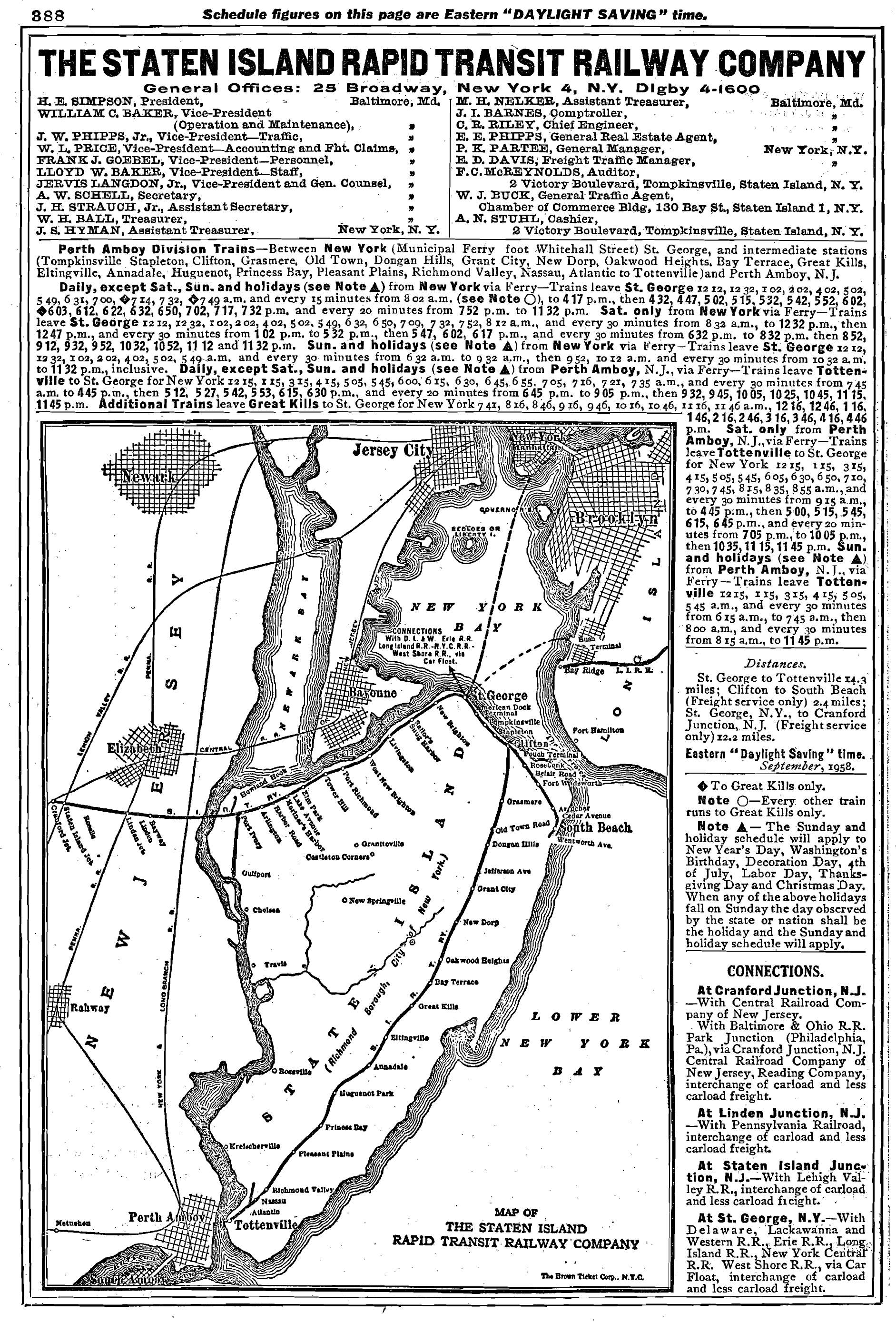
System Map (1958)
The Baltimore & Ohio Years: A Trunk Railroad on an Island (1899–1971)
From 1899 until 1971, the Staten Island Rapid Transit was operated as a subsidiary of the Baltimore & Ohio Railroad (B&O)—a startling fact if you’re used to thinking of the B&O in terms of the National Limited, the Capitol Limited, and coal trains threading Appalachia. Staten Island was a geographically isolated “appendix,” but the B&O’s interest wasn’t sentimental: it was strategic.
A major railroad saw value in Staten Island as a potential freight gateway—especially if it could secure reliable harbor crossings and connections to other rail networks. Over time, SIRT developed as a hybrid: a line that carried daily commuters and shoppers, but also served industries and yards, and remained embedded in the logic of railroad—not subway—operation.
This dual identity shaped everything that came next: electrification decisions, terminal design, rolling stock choices, and the constant tension between local passenger service (often money-losing) and freight operations (sometimes more promising, but dependent on wider economic forces).
Electrification and a “Subway That Might Have Been” (1920s)
One of the defining moments in Staten Island Rapid Transit history came not from the island itself, but from a broader policy movement: New York’s push to eliminate steam railroading within city limits. The Kaufman Act, signed in 1923, mandated electrification of rail operations within New York City by a deadline in the mid-1920s.
SIRT’s electrification was completed largely by the end of 1925, using 600 volt DC third rail, a choice that aligned with the city’s rapid-transit standards and anticipated a future that—at the time—seemed plausible: a direct rail tunnel under the Narrows to Brooklyn, linking Staten Island trains into the broader subway network.
That Narrows tunnel concept has echoed through New York planning debates for a century, but in the 1920s it was not merely a fantasy. Electrification “to subway compatibility” made sense only if a physical connection might be built. The dream: Staten Island trains running into Brooklyn’s BMT lines, creating a one-seat ride that would radically reshape the island’s development trajectory.
Electrification did deliver real improvements immediately:
- Faster acceleration and more frequent service potential
- A more “rapid transit” feel than the earlier steam and coach era
- A modernization of operations that suited commuter patterns to St. George
But the deeper significance was this: by electrifying to third-rail rapid-transit standards, SIRT became a rare example of a railroad-owned operation evolving toward subway-like identity—without ever fully joining the subway.
Three Branches, One Island Network: How the System Once Worked
For a brief mid-20th-century moment, Staten Island had something like a complete rapid-transit grid for its population patterns:
- Main Line (St. George–Tottenville) – the north–south backbone (and today’s surviving passenger route).
- North Shore Branch – serving the island’s north and west waterfront communities.
- South Beach Branch – serving east-shore communities from the Clifton area toward South Beach.
St. George terminal was the essential hinge—one of the country’s notable “boat-train” interchanges, where ferry and rail coordinated passenger movement. Modern descriptions still emphasize the terminal’s multi-track layout and the system’s role as Staten Island’s only rapid-transit line.
This three-branch structure matters because it reframes what was lost later: Staten Island didn’t simply “never get transit.” It had a real network—and then, in a single stroke, most of it vanished.
Crisis and Contraction: 1953 and the End of Two Branches
Postwar New York changed fast. Automobiles reshaped shopping and commuting, while bus networks expanded and competed directly with rail service. Staten Island was not immune; in fact, the island’s lower densities and dispersed development made it especially vulnerable to a shift toward road-based transit.
On March 31, 1953, passenger service on both the North Shore Branch and the South Beach Branch ended. The closure was a watershed moment. It reduced Staten Island’s passenger rail network from a branching system to essentially one surviving corridor: the St. George–Tottenville line. Freight lingered on portions of the North Shore line for decades longer, but the passenger-facing identity of a three-branch rapid-transit network was gone.
A key lesson here—one that resonates with transit histories nationwide—is that “ridership” is rarely just a matter of whether people like trains. It’s shaped by comparative price, service patterns, and the political choice of what to subsidize. By the early 1950s, the rail branches were competing with buses and a changing Staten Island commuting culture; the result was a strategic retreat.
And yet, the surviving Tottenville line endured—partly because it served the strongest continuous corridor of Staten Island communities, and partly because St. George remained a crucial ferry interface.
From Private Railroad to Public Transit: The MTA Takes Over (1968–1971)
The late 1960s brought a new turning point. With private railroad economics increasingly unfavorable for local passenger service, public control became the logical outcome. Plans and negotiations culminated in a transfer in which New York City purchased the line for $1 and the MTA paid the B&O for equipment, while freight rights and responsibilities were carefully structured around continued operations.
The Staten Island Rapid Transit Operating Authority (SIRTOA) was incorporated in 1970 and took over passenger operation in 1971 when the line was acquired.
This moment matters because it formally shifted Staten Island’s rail line from a railroad subsidiary to a transit authority operation—while still retaining railroad characteristics and freight entanglements. Unlike many subway lines, the Staten Island Railway’s modern governance and infrastructure were shaped by the terms of a railroad-to-public transfer, including requirements around grade crossings and track condition related to freight.
In other words: Staten Island’s rapid transit didn’t “grow up” inside the subway—it was adopted into the transit family after a long life as a railroad property.
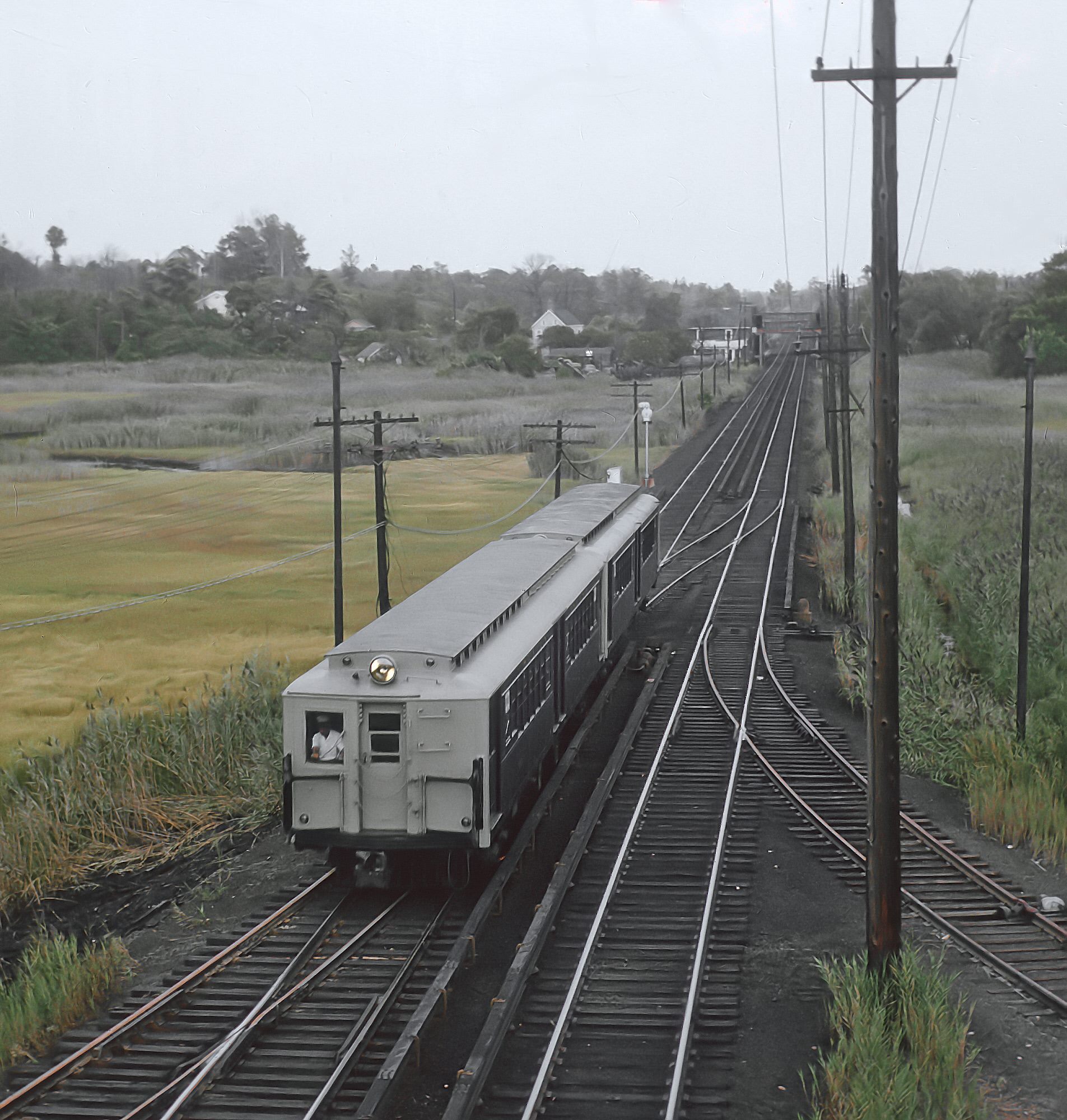 A SIRT train between Richmond Valley and Nassau, New York in August, 1964. Rick Burn photo.
Modern Identity: Rebranding, Fare Policy, and System Upgrades (1990s–2000s)
By the early 1990s, the line’s identity continued to evolve inside the MTA structure. Operational changes, repair projects, and modernization efforts reshaped both rider experience and the system’s public image. Historical summaries note major track replacement projects through the 1990s and organizational transfers within New York City Transit/MTA structures.
A highly visible milestone came in 1994, when the MTA rebranded the Staten Island Rapid Transit as the MTA Staten Island Railway (SIR)—a return to an earlier name and a clearer public-facing identity.
Fare policy also became central to the line’s modern story. Over time, Staten Island Railway service became closely integrated with the citywide fare system—especially at the St. George interface—reinforcing the idea that the line is part of New York’s rapid-transit ecosystem even if it remains physically separate from the subway.
The Freight Story: Decline, the Arthur Kill Bridge, and Reactivation
Many casual riders think of the Staten Island Railway purely as a passenger line. But freight has been a persistent undercurrent—sometimes dormant, sometimes central.
The Arthur Kill crossing is the critical infrastructure piece. The Arthur Kill Vertical Lift Bridge (opened in 1959, replacing an older swing bridge) provided a direct rail link between Staten Island and New Jersey.
Over decades, manufacturing shifts and a broader move toward trucking reduced rail freight volumes, and the connection eventually fell into disuse—freight service via the bridge ended around 1990, with the line effectively closed for years.
Then came the 2000s freight revival. A major rehabilitation project—often described at roughly $72 million—involved repairing the bridge and restoring the Staten Island rail freight connection, with the goal of improving port/intermodal capability and reducing truck traffic.
Regular service is documented as resuming in April 2007, tied to municipal solid waste movements and intermodal/container activity linked to Howland Hook and related facilities.
This freight dimension is more than a side plot: it illustrates why Staten Island’s rail corridor has remained valuable even when passenger expansion stalled. In a dense metro region where truck congestion and port logistics carry major economic and environmental costs, the rail link across the Arthur Kill became a tool for policy goals beyond transit ridership—namely, freight diversion and industrial access.
The North Shore Question: A Branch That Won’t Quite Die
Even after 1953, Staten Island’s “lost” passenger branches never fully disappeared from public imagination. The North Shore Branch is the clearest example—partly because its corridor still threads through communities that have periodically sought better transit access.
Notably, a small section of the line was briefly used for a ballpark-oriented passenger extension in the 2000s, illustrating how the right-of-way continues to invite reuse.
While broader restoration proposals have appeared in studies and political discussion, the persistent pattern has been this: Staten Island’s growth and travel needs keep generating interest, but the cost and complexity of building a true rapid-transit expansion remain formidable.
The larger implication is that SIRT/SIR is both a “finished” system—one surviving passenger trunk line—and an “unfinished” one, haunted by the alternate histories in which the Narrows tunnel is built, or the North Shore corridor returns as a modern rapid-transit or light-rail route.
Rolling Stock and the Rider Experience: A Subway Feel, Railroad DNA
SIRT/SIR’s passenger operations look and feel like rapid transit—third rail, multiple-unit trains, station spacing suited to neighborhood travel—yet the line’s railroad DNA shows up in subtle ways: the way it interfaces with ferry service at St. George, the presence of yards and shops tied to a legacy railroad corridor, and the long history of freight rights and shared infrastructure.
Enthusiast and historical documentation emphasizes that the line was operated by the B&O as a subsidiary for much of its life, and that St. George remains one of the most notable ferry-rail interfaces in the United States.
This “in-between” identity is why Staten Island Railway fascinates transit historians: it’s a rapid-transit line that never fully merged into the subway, and a railroad property that evolved into a transit utility without losing its freight-linked structure.
A Brief Timeline of Key Dates
- 1860: Line completed to Tottenville (early core of today’s main line).
- 1880: Staten Island Rapid Transit Railroad Company organized (rapid-transit era begins).
- 1886–1888: Branch-era growth (North Shore and South Beach corridors enter service in the late 1880s).
- 1923–1925: Kaufman Act era; electrification completed with third rail compatible with subway standards.
- March 31, 1953: Passenger service ends on North Shore and South Beach branches.
- 1971: MTA-era begins; SIRTOA takes over passenger operations after city acquisition.
- 1994: Rebranding as MTA Staten Island Railway (SIR).
- 2007: Freight service resumes across the Arthur Kill link (post-rehabilitation).
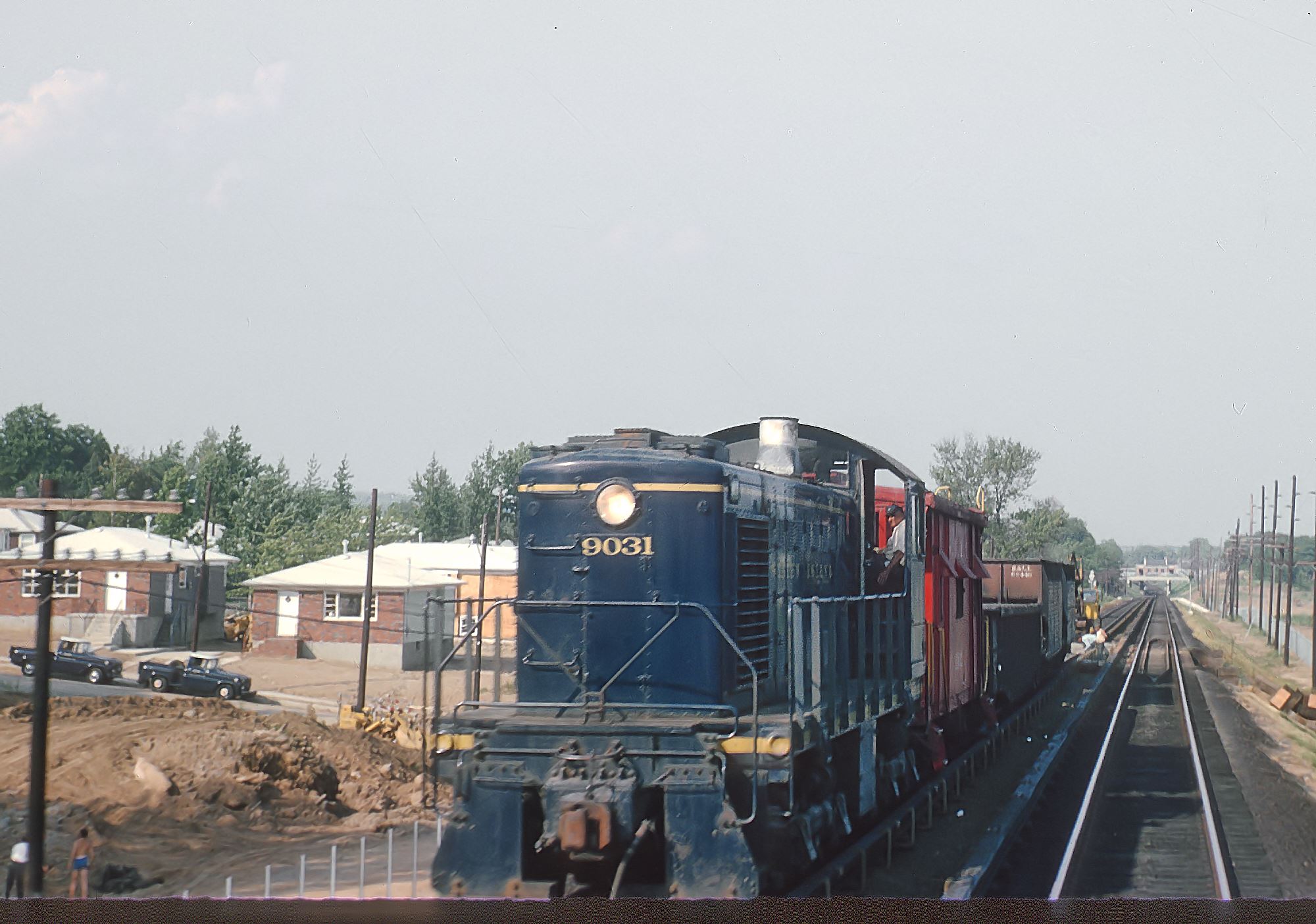 Staten Island Rapid Transit S2 #9031 (built as #487) works freight service at Bay Terrace, New York in August, 1964. Rick Burn photo.
Conclusion
The Staten Island Rapid Transit system is easy to overlook because it is physically separated from the subway map’s dense web. Yet its story is a concentrated version of New York’s broader transportation history: private railroad ambitions giving way to public transit realities; modernization driven by regulation and city planning; service contraction shaped by buses and automobiles; and a persistent tension between passenger needs and freight economics.
It also represents something rare: a rapid-transit line that is neither fully “subway” nor merely “commuter rail,” but a third category born from Staten Island’s geography and the B&O’s historic strategy. Today’s Staten Island Railway is the surviving spine of a once-larger network—an everyday commuter utility, a living artifact of railroad-era transit planning, and a reminder that New York’s transit future has always been shaped as much by what didn’t get built as by what did.
Recent Articles


-
Milwaukee Road X3800: Deer Lodge’s Shop Goat
Oct 08, 26 04:28 PM
 Milwaukee Road X3800, the a home-built shop goat that served the Deer Lodge, MT yard. It was a 220-volt DC switcher, powered through an extension cord that moved electrics into a roundhouse where the…
 -
Key West Extension (Overseas Railroad): History, Construction, Decline
Oct 08, 26 03:59 PM
 Henry Flagler's Overseas Railroad, Miami to Key West, 1905–1935. The Seven Mile Bridge, the 1935 Labor Day Hurricane, and the road that became U.S. 1.
 -
Florida East Coast Steam Roster (Post 1900)
Oct 08, 26 02:34 PM
 Florida East Coast steam since 1897. Seventeen Ten-Wheelers, twenty Atlantics, eighty-seven Pacifics, ninety Mountains, fifteen Mikados, and the switchers.
 -
Florida East Coast Diesel Roster (All-Time)
Oct 08, 26 02:12 PM
 Florida East Coast diesel roster, all-time. E units from 1939, F3s, BL2s, GP7s and GP9s, the GP40-2 orders, 22 SD40-2s, and 24 ES44C4s. Serials and EMD order numbers.
 -
Florida East Coast Railway: Map, History, Rosters
Oct 08, 26 01:46 PM
 Florida East Coast Railway, Henry Flagler's line from Jacksonville to Miami and Key West. Receivership in 1931, the 1963 strike, Grupo México in 2017, and Brightline on the same track.
 -
Minnesota Railroad Museums (2026): A Complete Guide
Oct 08, 26 10:32 AM
 Minnesota railroad museums—the Lake Superior Railroad Museum, Two Harbors, Jackson Street, Willmar’s Great Northern 2523, and Currie. Confirm hours on each site.
 -
Maine Railroad Museums (2026): A Complete Guide
Oct 08, 26 09:24 AM
 Maine railroad museums—Seashore Trolley, the two-foot lines at Portland, Alna, and Phillips, Boothbay, and the Bangor & Aroostook depots. Confirm hours on each site.
 -
Massachusetts Railroad Museums (2026): A Complete Guide
Oct 08, 26 12:08 AM
 Massachusetts railroad museums—Berkshire Scenic at Lenox, Shelburne Falls trolley No. 10, Edaville, Chatham’s 1887 depot, and Lowell. Confirm hours on each site.
 -
Clinchfield Steam Roster (Post 1900)
Oct 07, 26 12:09 PM
 Clinchfield steam since 1900. Fifteen H-4 Consolidations, K-1 Mikados, M-2 and M-3 Mallets, L-class 2-8-8-2s, eighteen Challengers. Class grid after Drury. Last steam April 16, 1954.
 -
Clinchfield Diesel Roster (All-Time)
Oct 07, 26 12:05 PM
 Clinchfield diesel roster, all-time. F3A 800, FP7 200, the F7s, GP7s, 25 SD40s, 18 SD45-2s, seven U36Cs, and the Family Lines hoods. Serials and EMD order numbers.
 -
Clinchfield Railroad: Map, Steam Locomotives, Roster, Logo
Oct 07, 26 12:02 PM
 Clinchfield Railroad, Elkhorn City to Spartanburg. George L. Carter, the Carolina, Clinchfield & Ohio, the 1924 lease, coal, the loops, and CSX. Steam and diesel rosters are companion pages.
 -
Kentucky Railroad Museums (2026): A Complete Guide
Oct 07, 26 11:39 AM
 Kentucky railroad museums—the Kentucky Railway Museum, Bowling Green’s L&N depot, Paducah, Versailles, and Covington. Confirm hours on each site.
 -
Kansas Railroad Museums (2026): A Complete Guide
Oct 07, 26 11:26 AM
 Kansas railroad museums—Santa Fe 3768 at Wichita, Santa Fe 132 in Topeka, the Great Overland Station, and Abilene. Confirm hours on each site.
 -
Cincinnati, New Orleans and Texas Pacific Diesel Roster (All-Time)
Oct 07, 26 10:38 AM
 All-time diesel roster of Southern locomotives lettered for the Cincinnati, New Orleans and Texas Pacific. Serials, order numbers, and builder dates.
 -
Cincinnati, New Orleans and Texas Pacific Railway
Oct 07, 26 10:31 AM
 Cincinnati, New Orleans and Texas Pacific Railway, incorporated September 8, 1881, to lease Cincinnati’s railroad to Chattanooga. Queen and Crescent route, Rathole, and the 2024 sale to Norfolk Southe…
 -
Indiana Railroad Museums (2026): A Complete Guide
Oct 07, 26 12:26 AM
 Indiana railroad museums—Nickel Plate 765, Elkhart’s New York Central collection, French Lick, Linden’s junction depot, and Haley Tower. Confirm hours on each site.
 -
"Triplex" Steam Locomotive: Specs, History, Photos
Oct 06, 26 11:52 PM
 Erie class P-1 Triplex 2-8-8-8-2s. Three Baldwin compounds, 2603–2605, later 5014–5016, built 1914 and 1916. Matt H. Shay, the 1930 class card, and Virginian XA 700.
 -
Illinois Railroad Museums (2026): A Complete Guide
Oct 06, 26 11:47 PM
 Illinois railroad museums—the Illinois Railway Museum, Monticello, the Pioneer Zephyr, Galesburg’s Burlington 3006, and the depots. Confirm hours on each site.
 -
Iowa Railroad Museums (2026): A Complete Guide
Oct 06, 26 11:41 PM
 Iowa railroad museums—the Union Pacific Railroad Museum, RailsWest, Sioux City, Boone, and the National Hobo Museum in Britt. Confirm hours on each site.
 -
Charleston and Western Carolina Diesel Roster (All-Time)
Oct 06, 26 11:29 PM
 Charleston and Western Carolina diesel roster. Twenty-one GP7s, two SW7s, two SW9s, and six F7As, all built 1950–1952. Serials, order numbers, and ACL and SCL numbers.
 -
Charleston and Western Carolina Railway: Map, History, Timetables
Oct 06, 26 11:18 PM
 Charleston and Western Carolina Railway, incorporated September 16, 1896. Port Royal to Spartanburg, with branches to Anderson and Greenville. Merged into the Atlantic Coast Line on December 31, 1959.
 -
Central of Georgia Steam Roster (Post 1900)
Oct 06, 26 04:00 PM
 Central of Georgia steam since 1900. Cooke Consolidations, Harriman Mikados, 32 Mountains, and eight Lima 4-8-4s. Class grid after Drury. Last steam May 1953.
 -
Central of Georgia Diesel Roster (All-Time)
Oct 06, 26 03:44 PM
 Central of Georgia diesel roster. SW1 No. 1 in 1939, E7s and E8s, nine F3As, 39 RS3s, GP7s through SD35s. Serials and order numbers.
 -
Central of Georgia Railway: Map, Logo, History, Rosters
Oct 06, 26 03:42 PM
 Central of Georgia Railway, from the 1833 Savannah charter to Southern control on June 17, 1963. Map, logos, Nancy Hanks II, and links to the steam and diesel rosters.
 -
Georgia Railroad Museums (2026): A Complete Guide
Oct 06, 26 03:33 PM
Georgia railroad museums—Savannah’s Central shops, Duluth, the General at Kennesaw, the Texas in Atlanta, Tifton, Waycross, and Albany. Confirm hours on each site. -
Florida Railroad Museums (2026): A Complete Guide
Oct 06, 26 03:18 PM
 Florida railroad museums—Boca Raton, Winter Garden, Whitehall, the Gold Coast, Parrish, Fort Myers, Milton, and Plant City. Confirm hours on each site.
 -
Connecticut Railroad Museums (2026): A Complete Guide
Oct 06, 26 01:05 PM
 Connecticut railroad museums—the Shore Line Trolley, East Windsor, the Naugatuck Railroad, Danbury Union Station, Willimantic, and the SoNo tower. Confirm hours on each site.
 -
Colorado Railroad Museums (2026): A Complete Guide
Oct 06, 26 12:47 PM
 Colorado railroad museums—Golden, the Forney’s Big Boy 4005, Pueblo’s Santa Fe 2912, and the depots at Castle Rock, Limon, and Ridgway. Confirm hours on each site.
 -
Atlantic Coast Line Steam Roster (Post 1900)
Oct 06, 26 12:44 PM
 Atlantic Coast Line steam since 1900. Copper Head Ten-Wheelers, 235 P-5 Pacifics, Q-1 Santa Fes, twelve R-1 4-8-4s. Class grid after Drury. Last steam June 30, 1955.
 -
Atlantic Coast Line Diesel Roster (All-Time)
Oct 06, 26 11:57 AM
 Atlantic Coast Line diesel roster. HH660 1900 in 1939, E3s for the Champion, FTs and F2s, GP7s 100–279, GP30s, U25Cs, and the 1967 SCL numbers. Serials and orders.
 -
Atlantic Coast Line Railroad: "Standard Railroad of the South"
Oct 06, 26 11:53 AM
 Atlantic Coast Line, the Standard Railroad of the South. April 21, 1900 to July 1, 1967. Plant System, L&N, Clinchfield, the Champion, and the Seaboard Coast Line merger.
 -
California Railroad Museums (2026): A Complete Guide
Oct 06, 26 09:50 AM
California railroad museums—the California State Railroad Museum, Perris, Portola, Railtown 1897, and the depots that still stand. Confirm hours on each site. -
Arizona Railroad Museums (2026): A Complete Guide
Oct 06, 26 09:46 AM
Arizona railroad museums—the Arizona Railway Museum in Chandler, Southern Pacific 1673 at Tucson, and the McCormick-Stillman park in Scottsdale. -
Arkansas Railroad Museums (2026): A Complete Guide
Oct 06, 26 09:07 AM
 Arkansas railroad museums—Cotton Belt 819 at Pine Bluff, the Fort Smith trolley, the Mammoth Spring depot, and the Eureka Springs railway.
 -
Alabama Railroad Museums (2026): A Complete Guide
Oct 06, 26 09:03 AM
Alabama railroad museums—Heart of Dixie at Calera, the North Alabama museum at Chase, Huntsville’s 1860 depot, and Fort Payne. Confirm hours on each site. -
Pennsylvania Railroad Museums (2026): A Complete Guide
Oct 06, 26 12:09 AM
 Pennsylvania railroad museums—Strasburg, Steamtown, the Horseshoe Curve, the East Broad Top, and the depots and towers in between. Confirm hours on each site.
 -
Maryland Railroad Museums (2026): A Complete Guide
Oct 05, 26 11:53 PM
 Maryland railroad museums—the Baltimore roundhouse, Ellicott City station, Bowie, Gaithersburg’s Buffalo Creek & Gauley 14, and the Western Maryland collections.
 -
Ohio Railroad Museums (2026): A Complete Guide
Oct 05, 26 05:51 PM
 Ohio railroad museums—the Age of Steam Roundhouse, Bellevue, Worthington, Conneaut’s Nickel Plate 755, and the Dennison depot. Confirm hours on each site.
 -
Delaware Railroad Museums (2026): A Complete Guide
Oct 05, 26 02:43 PM
 Delaware railroad museums—Wilmington & Western at Greenbank, the Harrington tower and N5 caboose, Felton's 1868 depot, and the Selbyville station museum.
 -
C&O's M-1 Steam Turbine Locomotives: Specs, Roster, History
Oct 05, 26 12:13 PM
 Chesapeake & Ohio Class M-1 steam-turbine-electrics. Three Baldwin-Westinghouse locomotives, 500–502, built 1947–48 for The Chessie. Specs, the 2-C1+2-C1-B arrangement, and a roster. All scrapped…
 -
N&W 2-6-6-2 Locomotives (Class Z): Specs, Roster, History
Oct 05, 26 11:44 AM
 Norfolk & Western Class Z 2-6-6-2s. One hundred ninety compound Mallets, 1300–1489, from Richmond, Baldwin, and Schenectady, 1912–1918. Diagram specs, the Z-1b rebuilds, Z-2 1399, and a roster. No…
 -
Scenic Train Rides (USA 2026): State Guide to Tourist Railroads
Oct 04, 26 12:17 AM
 Scenic and tourist train rides in all 50 states for 2026. Colorado narrow gauge, Pennsylvania steam, Alaska’s White Pass, and the states with no full-size ride this month. Confirm on the railroad.
 -
Wyoming Scenic Train Rides (2026): A Complete Guide
Oct 03, 26 12:07 AM
Wyoming has no full-size tourist railroad on the calendar in October 2026. Cheyenne Depot Museum and Douglas Railroad Museum are static. Union Pacific 4014’s posted public trip is a November run to De… -
Washington Scenic Train Rides (2026): A Complete Guide
Oct 02, 26 11:53 PM
 Washington tourist trains in 2026—Mount Rainier Scenic at Elbe, the Northwest Railway Museum, and Chehalis-Centralia. Lake Whatcom has no 2026 date on its ticket page.
 -
Wisconsin Scenic Train Rides (2026): A Complete Guide
Oct 02, 26 11:48 PM
 Wisconsin tourist trains in 2026—Wisconsin Great Northern, Osceola & St. Croix Valley, Mid-Continent, East Troy, and the National Railroad Museum.
 -
Pennsylvania Railroad Class Q2 4-4-6-4: Specs, Roster, History
Oct 02, 26 11:28 PM
Pennsylvania Railroad Class Q2 4-4-6-4 duplexes. Twenty-six engines, 6131 and 6175–6199, Altoona 1944–45. Form 109-J specs, the 7,987 hp test of 6175, and a roster. All scrapped. -
Utah Scenic Train Rides (2026): A Complete Guide
Oct 02, 26 11:18 PM
 Utah tourist trains in 2026—Heber Valley Railroad from Heber City. Golden Spike at Promontory is a locomotive demonstration, not a line-haul ride.
 -
South Dakota Scenic Train Rides (2026): A Complete Guide
Oct 02, 26 11:06 PM
 South Dakota’s 2026 scenic train is the Black Hills Central 1880 Train, Hill City to Keystone. Steam is the summer assignment. Confirm the engine.
 -
Oregon Scenic Train Rides (2026): A Complete Guide
Oct 02, 26 11:04 PM
 Oregon tourist trains in 2026—Oregon Coast Scenic from Rockaway Beach, Mount Hood at Hood River, Eagle Cap from Elgin, and the Oregon Rail Heritage Center in Portland.
 -
Oklahoma Scenic Train Rides (2026): A Complete Guide
Oct 02, 26 10:36 PM
Oklahoma has no full-size scenic railroad on an October 2026 calendar. Oklahoma Railway Museum Halloween and Polar trains, the El Reno trolley, and the Heartland Flyer.