Texas Electric Railway: Map, History, Timetables
Published: February 2, 2025
By: Adam Burns
The Texas Electric Railway (TER), often an overlooked component of the early 20th-century transportation revolution in the United States serves as a fascinating case study of the evolution and eventual decline of electric interurban railways.
Established against the backdrop of the Progressive Era, the TER was former in 1916 from two predecessor systems, a period marked by rapid technological advancements across America.
At its peak the Texas Electric operated a 230-mile system via three separate divisions. The system was generally profitable until the end of World War II when it declined steeply and was abandoned entirely in 1948.
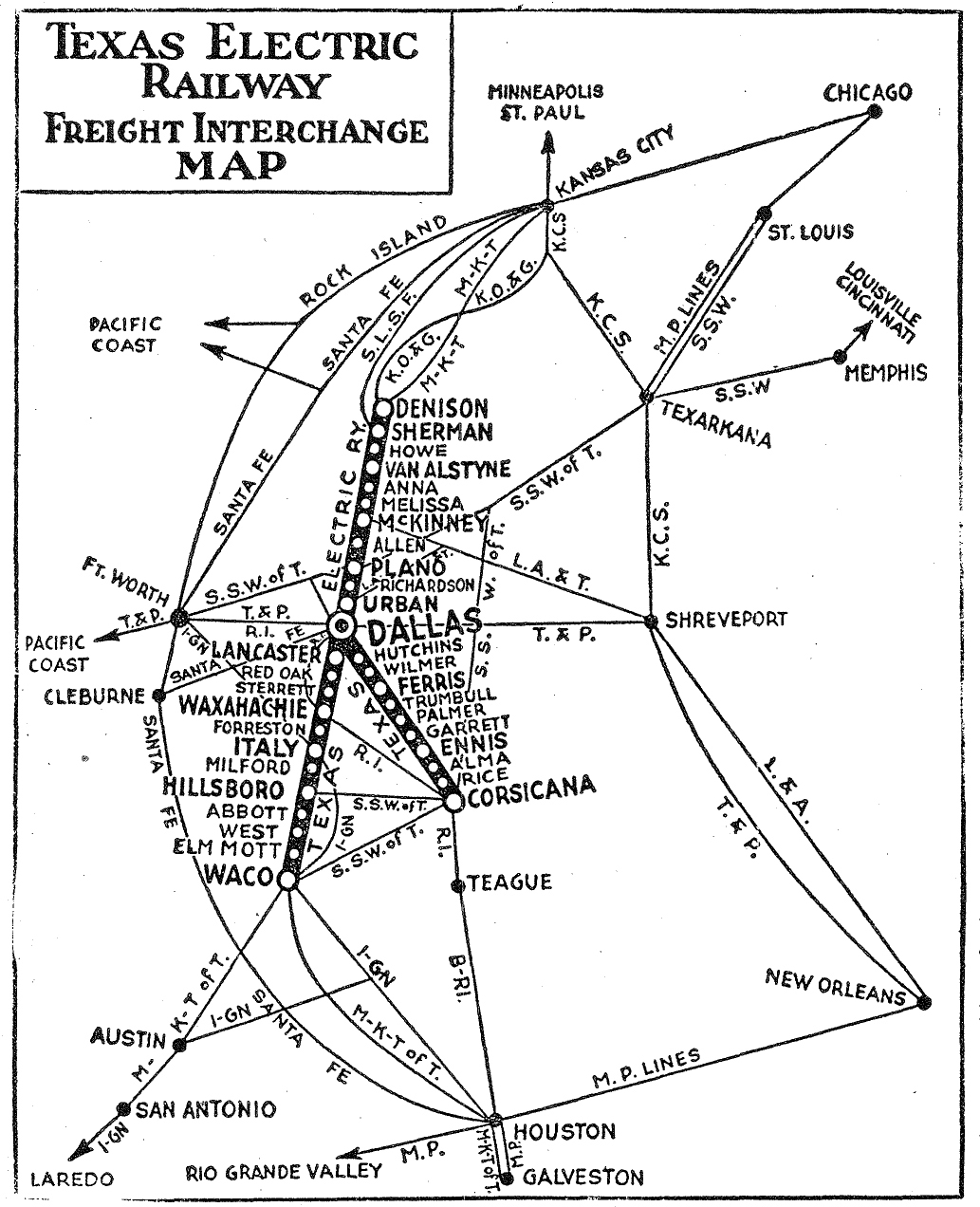
System Map (1940)
Origins
The origins of the TER are inexorably linked to the economic growth and burgeoning population of Texas. During the late 19th and early 20th centuries, Texas witnessed significant industrialization and urbanization, prompting the need for improved transportation infrastructure.
This demand was particularly pressing in the northern and central regions of the state, where cities like Dallas, Fort Worth, Waco, and Denison were experiencing rapid growth.
The Texas Electric property initially comprised two interconnected entities: the Texas Traction Company and the Southern Traction Company. The former completed its line on July 1, 1908, extending 66 miles north from Dallas to Sherman, with an additional 11-mile stretch connecting Sherman to Denison.
It was originally constructed in 1901 by the Denison & Sherman Railway and was incorporated into the Texas Traction system in 1909. The tracks were laid on private right-of-way and ran parallel to, and frequently adjacent to, the Houston & Texas Central (Southern Pacific) line.
Established in 1912, the Southern Traction Company constructed two lines: a 97-mile route to Waco via Waxahachie and Hillsboro and a 52-mile line to Corsicana through Ferris and Ennis. These lines were constructed between 1912 and 1913, commencing operations on January 1, 1914. The two companies consolidated in 1916, forming the Texas Electric Railway.
These systems were forerunners in deploying robust arched-roof steel cars, identified by their distinctive arched windows, which could attain speeds up to 60 mph and function in either single or multiple-unit (MU) configurations.
The trains typically operated as single units, except during peak travel periods. While the lines were constructed to rigorous specifications, the cars transitioned onto streetcar tracks to access the downtown Dallas terminal.
A new terminal was constructed for the interurban lines by the Dallas city system, which was not directly affiliated with the TER.
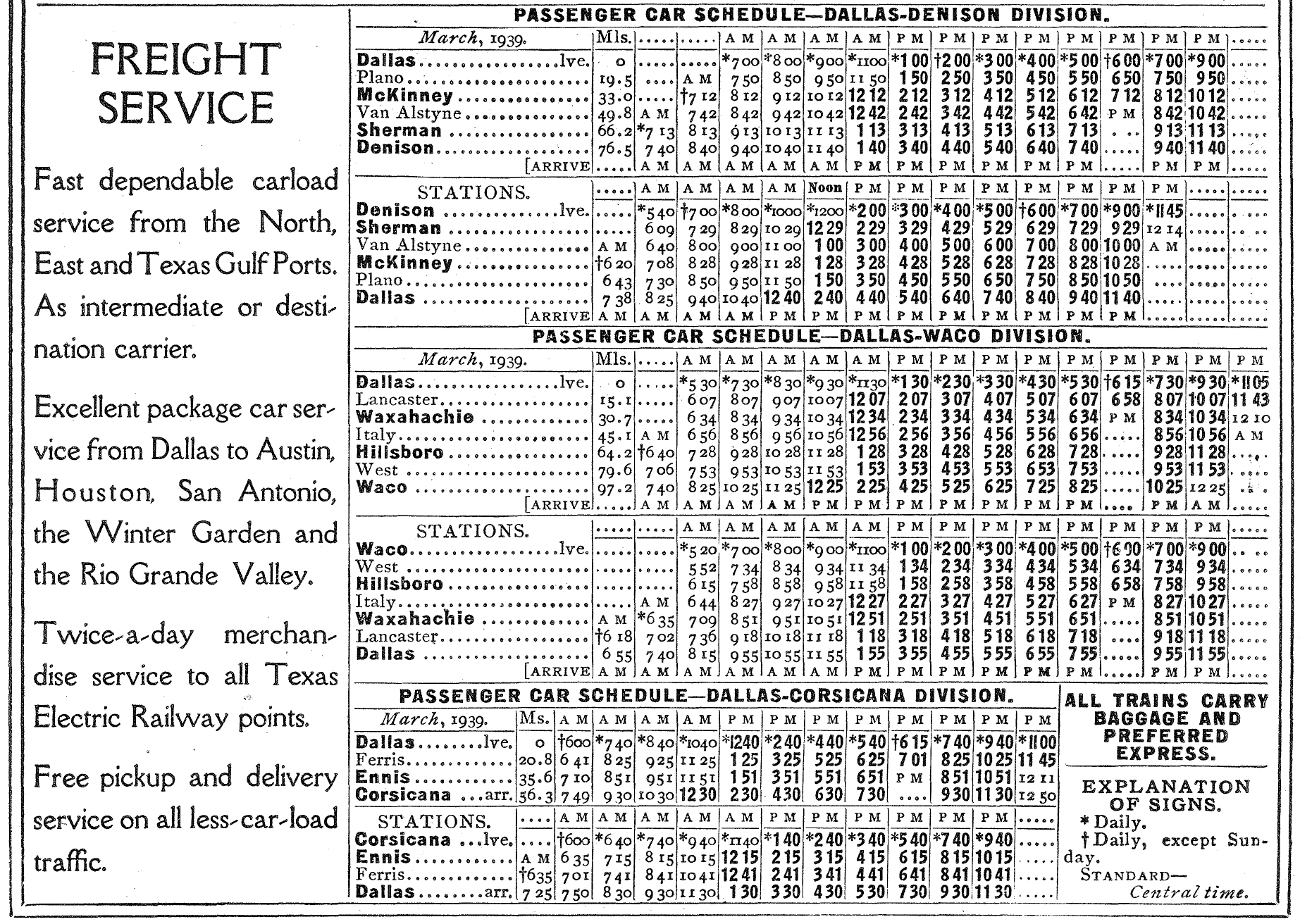
For many years, the railway maintained hourly train schedules across all three lines, in addition to providing extensive service between Sherman and Denison. Some of the routes were express services, known as Bluebonnets, which only stopped in towns and generally maintained speeds of 50 mph.
Although some trains were discontinued around 1930, the line continued to provide essentially hourly service post-World War II, with minimal omissions during midday.
Texas Electric was among the few interurbans to operate Railway Post Office (RPO) service, with the TER being one of the last to do so. While the company did not engage in the carload freight business until 1928, it effectively developed a substantial freight volume, which helped mitigate the decline in passenger traffic.
At its peak, the Texas Electric Railway operated 230 miles, linking Dallas with Denison to the north and Waco to the south, and spanning various smaller communities in between. The system was broken down into the following divisions:
- Dallas-Denison Division (76.5 miles)
- Dallas-Waco Division (97.2 miles)
- Dallas-Corsicana Division (36.3 miles)
The system originated as a local initiative in Dallas, orchestrated by the J. F. Strickland Company, and operated independently of any power, transit, or other utility organizations.
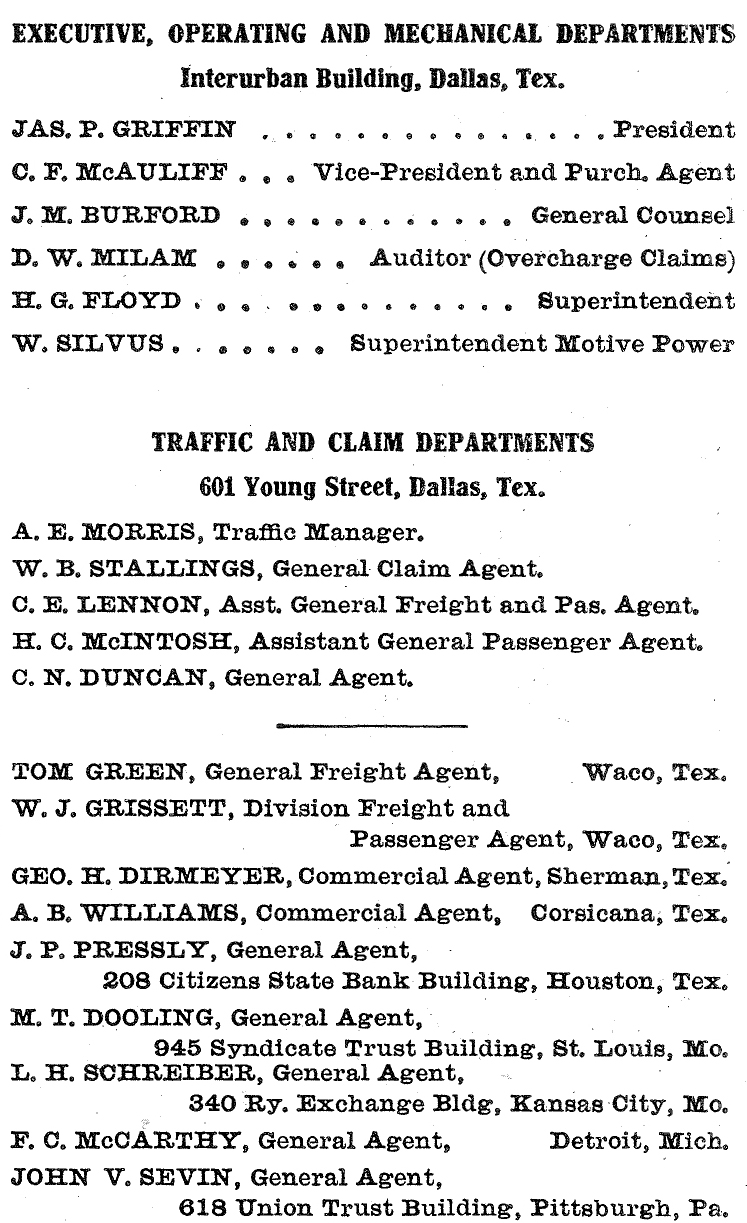
Leadership was maintained for numerous years by J. P. Griffin, a prominent figure within the American Electric Railway Association. Financially, the TE was notably one of the most prosperous interurbans, distinguished as one of the rare ventures that largely justified its investment.
Importance
The economic impact of the TER was profound. By facilitating the rapid movement of people and goods, it helped spur the growth of commerce and industry along its route.
Farmers and merchants could access larger markets, while urban residents could travel more easily for business or leisure. Furthermore, the TER played an essential role in democratizing travel, making it accessible to broader segments of the population.
Success
Despite a decline in gross revenue from a peak of over $3 million in 1921, the operating ratio remained approximately 60% throughout the 1920s, and the return on investment exceeded 4% - a number almost unheard of among interurbans.
Consequently, the company's financial status was decidedly stronger than that of the industry average. Fixed charges were sufficiently covered, preferred stock dividends were distributed up to 1926, and dividends for common stock were occasionally paid.
Decline
The rise of the automobile and the development of an extensive network of highways gradually rendered interurban lines less economically viable. Additionally, the Great Depression dramatically reduced passenger numbers and revenue, putting financial strain on these systems.
The depression led to a significant decrease in revenues, prompting the company to enter receivership in 1931, and subsequently reorganize on January 1, 1936.
Despite this, the TER avoided operating deficits, and with the advent of World War II, it experienced a revival; notably, in 1944, after-tax net income was recorded at $510,000, derived from a gross income of $2,216,000.
In 1941, the lightly trafficked Dallas-Corsicana Division was abandoned, as it was argued that its deficits undermined the financial health of the entire system.
World War II temporarily revitalized the TER, as gasoline rationing and increased industrial production brought renewed demand for public transportation. However, this resurgence was short-lived.
Following 1945, there was a marked decline in traffic as automobile and truck usage increased, resulting in the 1947 gross revenue being half of that in 1944.
In December 1948, the entire system was ultimately discontinued - in part, due to a tragic head-on collision between two passenger cars, which resulted in numerous fatalities.
Timetables (1940)
The TER's closure symbolized the broader decline of interurban rail across America, as it succumbed to the pressures of a rapidly changing transportation landscape. While the physical remnants of the Texas Electric have largely vanished, its legacy lives on in the historical memory of Texas transportation.
The TER's role in shaping regional development and contributing to the modernization of urban transit is recognized as a significant chapter in the narrative of American industrial innovation.
Ironically, rapid transit systems have made a small comeback in Lone Star State with systems like the TEXRail and commuter systems such as Trinity Railway Express.
Recent Articles


-
Adirondack Dinner Train (2026): Dates, Tickets & What to Expect
Sep 21, 26 01:38 PM
 2026 Adirondack Dinner Train—Utica Union Station, 6 p.m., about 3 hours to Remsen. First Class from $139. Chef Patrick O’Connor. Confirm on adirondackrr.com.
 -
Lehigh Valley Steam Locomotives: History, Roster & Photos
Sep 21, 26 01:31 PM
 Lehigh Valley steam—Camelback Consolidations, 2-10-2s, K-class Pacifics, six Mountains, Wyoming 4-8-4s. Post-1900 roster after Drury. Last steam September 14, 1951.
 -
Lehigh Valley Diesel Roster: All-Time
Sep 21, 26 01:23 PM
 Lehigh Valley diesel—boxcabs 1926, FTs 1945, F3/F7, FA/PA, C628 Snowbirds, GP38-2s, U23Bs. All-time roster with serials and orders. Last steam September 14, 1951.
 -
Lehigh Valley Railroad: Map, Roster, Logo, History
Sep 21, 26 01:09 PM
 Lehigh Valley—DLS&S 1847, named January 7 1853, Mauch Chunk–Easton September 12 1855. Route of the Black Diamond. Jersey City–Buffalo. Conrail April 1 1976.
 -
Wisconsin Great Northern Dinner Train (2026)
Sep 21, 26 12:47 PM
 2026 Wisconsin Great Northern dinner train—Trego, $105, Namekagon River. January 8–31 and May 5–December 17. Confirm on spoonertrainride.com.
 -
Lehigh and New England Railroad: Map, Rosters, History
Sep 21, 26 12:33 AM
 Lehigh & New England—South Mountain & Boston 1873, named April 2 1895. Anthracite, cement, Maybrook. Last Camelbacks, Alco FAs. Voluntary shutdown October 31 1961.
 -
TVRM Chattanooga Dinner Train (2026): Dates, Tickets & What to Expect
Sep 21, 26 12:20 AM
 2026 TVRM Chattanooga Dinner Train Experience—Grand Junction, select Fri/Sat March 6–October 24, three-course, 2–3 hours, from $110. Confirm on tvrail.com.
 -
Lehigh and Hudson River Railroad: Map, Rosters, History
Sep 20, 26 11:55 PM
 Lehigh & Hudson River—Warwick Valley 1860, Railway April 1 1882. Easton–Maybrook bridge road, Alphabet Route, Alco RS-3s and C420s. Conrail April 1 1976.
 -
Royal Gorge First Class Dinner Train (2026)
Sep 20, 26 11:47 PM
 2026 Royal Gorge Route First Class Lunch & Dinner—Cañon City, about 2 hours, from $199+, 12+. Confirm on royalgorgeroute.com.
 -
GE "44-Tonner" Locomotives: Roster, Specs, History
Sep 20, 26 11:09 PM
 GE 44-ton switcher—90,000-pound rule, Caterpillar D17000 center-cab, Sept 4 1940 CB&Q 9103 through Oct 1956 Dansville & Mount Morris 1. Phases, serial roster, PRR 46.
 -
Strasburg Rail Road Dining (2026): Dinner on the Rails & Elegant Expre
Sep 20, 26 11:00 PM
 2026 Strasburg Rail Road seated meals—Dinner on the Rails, Elegant Express, Valentine dinner. Lee E. Brenner diner. Confirm on strasburgrailroad.com.
 -
International-Great Northern Railroad: Map, History, Timetables
Sep 20, 26 10:43 PM
 International–Great Northern—Houston & Great Northern 1866, International Railroad 1870, merged Sept 30 1873. Palestine, Longview–Laredo, Gould, Missouri Pacific March 1 1956.
 -
Nevada Northern Taste of Italy Dinner Train (2026)
Sep 20, 26 03:25 PM
 2026 Nevada Northern Taste of Italy—adults-only multi-course Italian dinner, steam when healthy, East Ely. Sep. 19 gala listed. Confirm on nnry.com.
 -
Cape Cod Dinner Train (2026): Dates, Tickets & What to Expect
Sep 20, 26 02:53 PM
 Cape Cod Central Dinner Train—Hyannis, Buzzards Bay, and Falmouth. Four-course, 3–3½ hours, from $99.99. Confirm on capetrain.com.
 -
Erie Steam Locomotives: History, Roster & Photos
Sep 20, 26 11:55 AM
 Erie Railroad steam—Camelback 2-8-0s, 155 N-1 Mikados, 105 Berkshires, K-class Pacifics, Triplexes. Post-1900 roster after Drury. Last steam March 17, 1954.
 -
Erie Railroad Diesel Roster: All-Time
Sep 20, 26 11:47 AM
 Erie Railroad diesel—boxcabs 1926, FTs 1944, F3/F7, FA/PA, GP7/GP9, Baldwins, Limas. All-time roster with serials, orders, classes. Last steam March 17 1954. EL October 17 1960.
 -
Erie Railroad: Map, Passenger Trains, Logo, History
Sep 20, 26 11:44 AM
 Erie Railroad—New York & Erie 1832, Piermont–Dunkirk May 14 1851, six-foot then standard June 1880, Chicago 1883. High-and-wide fourth way. Erie Lackawanna October 17 1960.
 -
Colebrookdale Railroad Dining (2026): Secret Valley Dinner Train
Sep 20, 26 11:36 AM
 2026 Colebrookdale Railroad dinner in Boyertown—Secret Valley Dining Class, about 2 hours. Saturday evenings. Confirm on colebrookdalerailroad.com.
 -
Boone & Scenic Valley Wolf Dinner Train (2026)
Sep 19, 26 08:15 PM
 2026 Boone & Scenic Valley Wolf Dinner Train—Des Moines River valley, Bass Point Creek High Bridge, Union Pacific dining cars. Confirm on bsvrr.com.
 -
C&NW 4-6-2s 1617 & 1620: Minnesota 400 Yellow Jackets
Sep 19, 26 11:28 AM
 C&NW Class E Pacifics 1617 and 1620—Alco Schenectady 1917, yellow-and-green E-4-style shrouds 1941 for the Minnesota 400. Crews called them Yellow Jackets. Renumbered 617/620. Scrapped 1956.
 -
Erie Lackawanna Diesel Roster: All-Time
Sep 19, 26 10:13 AM
 Erie Lackawanna diesel—Erie and DL&W inheritance, GP35s, U25Bs, SD45/SDP45/SD45-2, U34CH. All-time roster with serials and orders. Conrail April 1 1976.
 -
Erie Lackawanna Railway: Map, History, Logo
Sep 19, 26 10:06 AM
 Erie Lackawanna Railway—Erie and DL&W, October 17 1960–March 31 1976. Von Willer, White revival, Dereco, Agnes, Conrail. High-and-wide Chicago main. Map, logo, what remains.
 -
"Empire State Express" (1941 Train): Timetables, Route, Consist
Sep 18, 26 10:59 PM
 NYC Empire State Express—George Daniels 1891 day train, 999’s 112.5 mph claim, Budd stainless streamliner December 7 1941, Cleveland and Detroit sections, diesels, 1967 name drop. Timetables, consist…
 -
New York Central 4-6-4s 5426 & 5429: Empire State Express Hudsons
Sep 18, 26 10:32 PM
NYC J-3a Hudsons 5426 and 5429—Alco 1937, Budd stainless shrouds 1941 for the Empire State Express. Pearl Harbor inaugural. Shrouds off by 1950. Neither preserved. -
"Stourbridge Lion" Locomotive: Facts, History, Photos
Sep 18, 26 10:27 PM
 Stourbridge Lion—Foster, Rastrick 0-4-0, first steam locomotive in the United States. Horatio Allen, Honesdale, August 8, 1829. Too heavy for D&H gravity track. Boiler in Baltimore; Colonie replic…
 -
Delaware & Hudson Steam Roster (Post 1900)
Sep 18, 26 10:01 PM
 Delaware & Hudson steam—Camelback 2-8-0s, Loree high-pressure compounds, Class K 4-8-4s, forty Challengers. Post-1900 class roster after Drury. Last steam July 21, 1953.
 -
Boston & Maine Steam Roster (Post 1900)
Sep 18, 26 02:57 PM
 Boston & Maine steam—B-15 Moguls, K-8 Consolidations, P-4 Lima Pacifics, T-1 Limas, R-1 Mountains. Post-1900 class roster after Drury. Last steam July 23, 1956.
 -
Boston & Maine Diesel Roster (All-Time)
Sep 18, 26 01:25 PM
 Boston & Maine diesel—boxcab 1100 1935, Flying Yankee 6000, FTs, E7s, BL2s, GP7/GP9, GP38-2s and GP40-2s. All-time roster. Last steam July 23, 1956.
 -
Mid-Continent Railway Museum Dining (2026)
Sep 18, 26 01:21 PM
 2026 Mid-Continent dining in North Freedom—select-date seated meals in luxury cars, reservations required. Pizza Limited June 28. Confirm on midcontinent.org.