Baltimore & Ohio Railroad: Linking 13 Great States With The Nation
Last revised: September 15, 2026
By: Adam Burns
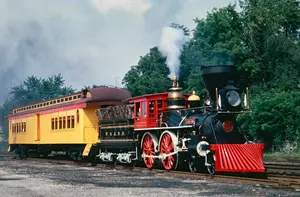
The Baltimore & Ohio, Linking 13 Great States With The Nation. The slogan was not advertising copy so much as a promise the railroad tried to keep for a century and a half. Maryland chartered it on February 28, 1827 as a common carrier for public use—the first railroad in the United States organized that way. Construction began on Independence Day 1828. Regular trains ran to Ellicott’s Mills on May 24, 1830. The first train from Baltimore rolled into Wheeling on January 1, 1853. Chicago opened November 23, 1874. The Chesapeake & Ohio took control on February 4, 1963. Chessie System, Inc. became the parent on June 15, 1973. The corporate name vanished into the C&O on April 30, 1987, a week after the company’s 160th birthday. Reporting mark BO.
It was never the richest of the three eastern trunks. Pennsylvania and New York Central had easier water-level routes and deeper pockets. The B&O had mountains, a stubborn shop culture at Mount Clare, and a reputation for treating passengers as if the dining car still mattered. Brian Solomon, in Amtrak, recalled his grandfather’s verdict from the early twentieth century: the B&O set the table better than anyone. When the charter finally died it had outlived both northern rivals by more than a decade.

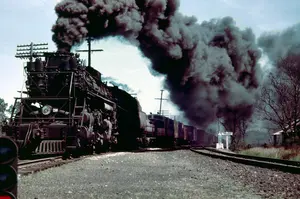
A busy scene in this Baltimore & Ohio publicity photo at Sir Johns Run, West Virginia, during the early 1950s: an A-B-B-A lash-up of FTs heads a westbound manifest at left while 2-6-6-4 #7705 (Class KB-1a), a former Seaboard Air Line engine, leads another at right. An eastbound coal drag sits in the background. American-Rails.com collection.
On this page: At a glance · Baltimore answers the Erie Canal · Horses, Tom Thumb, and Ellicott’s Mills · Cumberland and Wheeling · Civil War · Ohio, St. Louis, and Chicago · Philadelphia, New York, and the Royal Blue Line · Baltimore Belt · Willard and the passenger years · How the map was built · Postwar years · C&O, Chessie, and CSX · What remains
At a glance
The Baltimore & Ohio Railroad logo. Author’s work.
| Item | Detail |
|---|---|
| Headquarters | Baltimore, Maryland |
| Charter | Maryland, February 28, 1827. Virginia confirmed March 8, 1827 |
| Organized | April 23–24, 1827. First president Philip E. Thomas |
| Cornerstone | July 4, 1828, Charles Carroll of Carrollton |
| First regular service | Baltimore–Ellicott’s Mills, May 24, 1830 |
| Ohio River | Last spike December 24, 1852. First Baltimore–Wheeling train January 1, 1853 |
| Chicago | Baltimore, Pittsburgh & Chicago open November 23, 1874 |
| Route-miles (1930) | 5,468.50. Peak plant, including subsidiaries, on the order of 6,000 route-miles / 10,000 miles of track |
| States | Delaware, New York, New Jersey, Maryland, Virginia, Pennsylvania, West Virginia, Ohio, Michigan, Indiana, Kentucky (Louisville), Illinois, Missouri (Alton years) |
| Gauge | 4 feet 8½ inches (English practice adopted in the early 1830s) |
| Slogan / mark | Linking 13 Great States With The Nation / BO |
| Notable presidents | Philip E. Thomas; John W. Garrett (1858–84); Daniel Willard (1910–41) |
| C&O control | ICC December 31, 1962. Closed February 4, 1963 |
| Chessie System, Inc. | Incorporated February 26, 1973; parent of C&O, B&O, and Western Maryland June 15, 1973 |
| End of the name | Merged into C&O April 30, 1987. C&O into CSX Transportation August 31, 1987 |
| Rosters | Steam (post-1900) · All-time diesel |
Kirk Reynolds and David Oroszi, Baltimore & Ohio Railroad, is the company narrative used throughout. Early chronology follows Milton Reizenstein’s 1921 economic history and the Baltimore & Ohio Railroad Historical Society. Information compiled September 15, 2026.
Baltimore answers the Erie Canal
New York opened the Erie Canal in 1825 and stole the western trade. Philadelphia answered with a state system of canals and inclined planes toward Pittsburgh. Baltimore lived off the National Road and could see both cities pulling ahead. On February 12, 1827 about twenty-five merchants and bankers met to consider a railroad—an untried thing in America as a public highway. Philip E. Thomas, Alexander Brown, and William Patterson were in that room. Lawyer John V. L. McMahon took a charter to Annapolis. Maryland passed it February 28. Virginia followed March 8. Stock sold in a rush. The company organized in late April, Thomas as first president.
Canal men broke ground on the Fourth of July. The B&O did the same. On July 4, 1828 Charles Carroll of Carrollton, last living signer of the Declaration of Independence, turned the first spadeful at Baltimore. The object was the Ohio River at Wheeling, then in Virginia, with Cumberland on the way. Pennsylvania would not give an easy crossing. The railroad would have to climb Maryland and what became West Virginia, over the Alleghenies, guessing at grades and curves no American engineer had yet proven a train could take. Men sailed to England to watch railways already at work. They came home with 4 feet 8½ inches as the gauge that left room for inside-connected machinery, and with the knowledge that a proper guideway was still an experiment.
Horses, Tom Thumb, and Ellicott’s Mills
The first track used granite stringers and strap iron. Wooden beams on crossties came next. Strap rail worked until it wore loose and sprang up through car floors—snake-heads—and by the 1840s Robert L. Stevens’s solid iron T-rail, developed on the Camden & Amboy, was the way forward. Public riding began in January 1830 over the first mile and a half from Pratt Street. Regular service opened to Ellicott’s Mills, thirteen miles, on May 24, 1830. Horses pulled rebuilt carriages. The railroad put up a two-story stone depot and a turntable. Granite from Ellicott’s Quarries, farm produce, and less-than-carload freight paid the bills before passengers did.
That August Peter Cooper ran his little vertical-boiler engine, the Tom Thumb, on the line. The famous contest with a horse is dated August 28, 1830. Cooper did not mean to write a timetable. He meant to prove steam could take the B&O’s tight curves. In 1831 Phineas Davis of York, Pennsylvania, delivered the 0-4-0 York. The stable emptied. Steam took the railroad west.

The transition from steam to diesel: Baltimore & Ohio E7A #66, about a year old, and 4-6-2 #5086 (Class P-1a) await their next assignments in Cumberland, Maryland, during October 1946.
Frederick opened on a branch December 1, 1831. Point of Rocks, April 1, 1832. Harpers Ferry, still in Virginia, on December 1, 1834. A Potomac bridge followed. The Washington Branch, using Benjamin Henry Latrobe Jr.’s Thomas Viaduct at Relay, reached the capital on August 25, 1835. That is still, in the railroad sense, among the oldest passenger assignments in the country; MARC’s Camden Line uses the same iron.
Cumberland and Wheeling
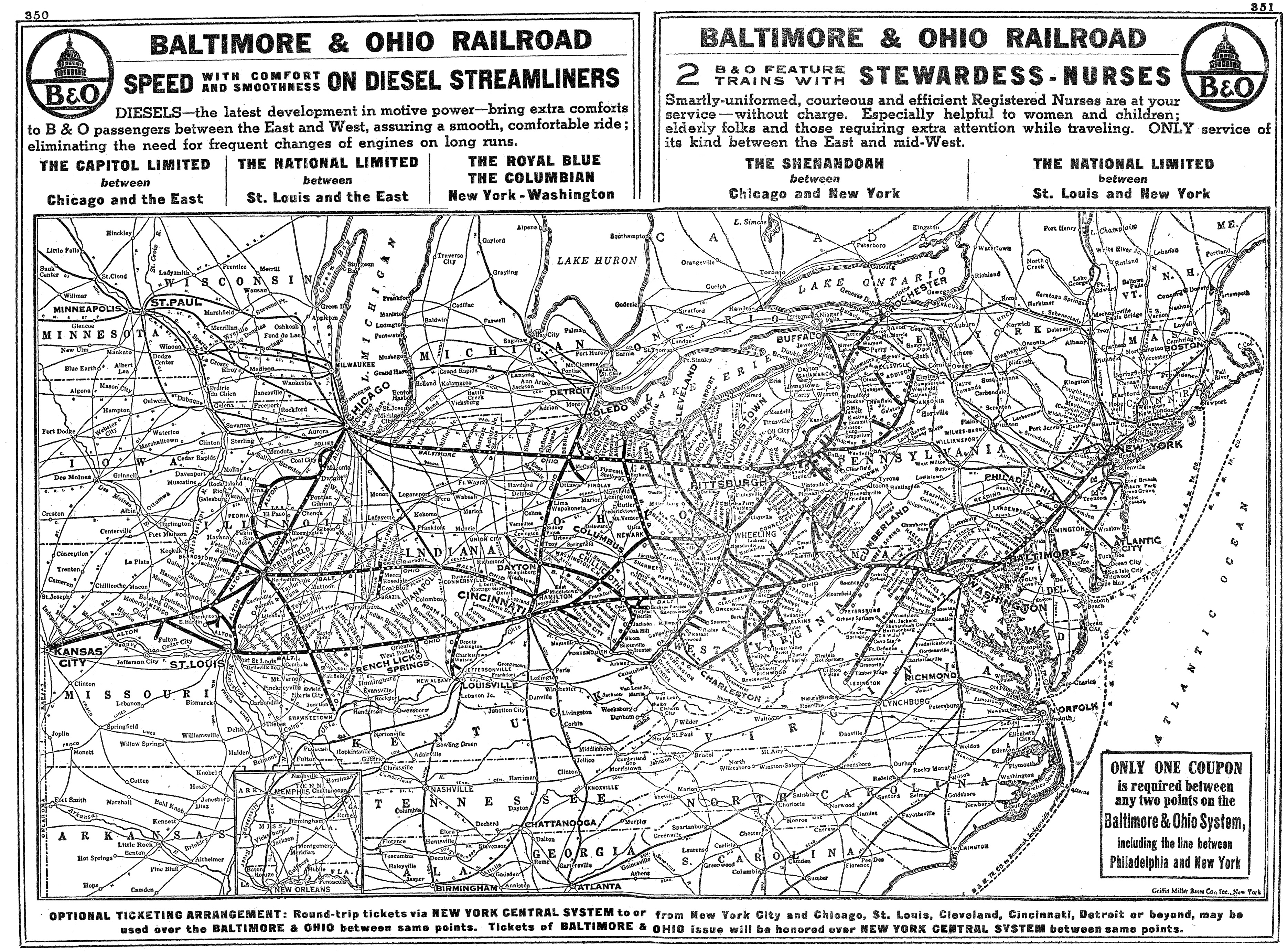
An official 1940 system map of the Baltimore & Ohio. Author’s collection.
West of Harpers Ferry the work slowed. Martinsburg, May 1842; Hancock, June 1; Cumberland on November 5, 1842, 178 miles from Baltimore and a division point for the rest of the company’s life. The Pennsylvania Railroad took a charter in 1846 and locked the easier Pittsburgh route. Thomas Swann became president October 11, 1848, and pushed construction again: southwest to Bridge Valley (later Grafton) and Fairmont, then northwest toward the Ohio. The last spike went down at Rosby’s Rock on Grave Creek at 6:05 p.m. on December 24, 1852, 379 miles from Baltimore. The first through train reached Wheeling on New Year’s Day 1853. Formal opening followed January 10. West Virginia was still nine years away.
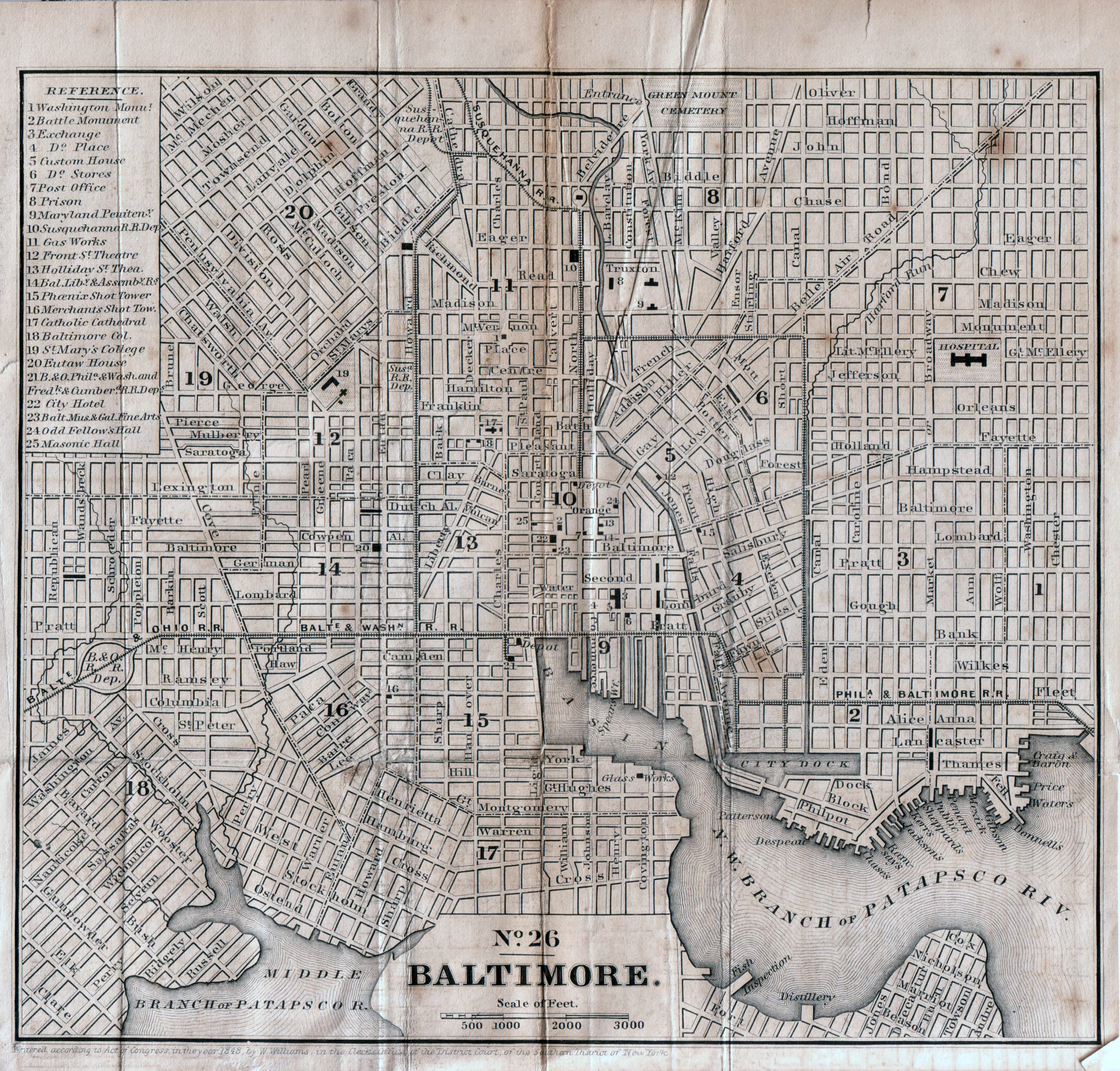
Downtown Baltimore, Maryland, as it appeared in 1848. From Appleton’s Railroad and Steamboat Companion. Author’s collection.
Grafton, named for engineer John Grafton and laid out in 1856, became the hinge. From there the Northwestern Virginia Railroad—chartered February 14, 1851, leased by the B&O in December 1856, opened May 1, 1857—ran the Parkersburg Branch to a better Ohio River port aimed at Cincinnati and St. Louis. Sharp curves, tunnels, and grades. It carried that name until CSX took it up in the 1980s.
Civil War
No American railroad sat closer to the fighting. The main line crossed the Potomac at Harpers Ferry, ran the border counties, and fed Washington. Confederate raiders cut it again and again. Stonewall Jackson wrecked shops at Martinsburg and rolled locomotives into the river. Bridges burned. John W. Garrett, president from 1858, kept the road running for the Union and made himself indispensable to Lincoln’s War Department. Troops, beef, and powder moved west from Baltimore and east from the Ohio. Camden Station saw Lincoln in and out of the city. When the war ended the B&O had a wrecked plant and a national reputation. Rebuilding was the 1860s. Expansion was the 1870s.
Ohio, St. Louis, and Chicago
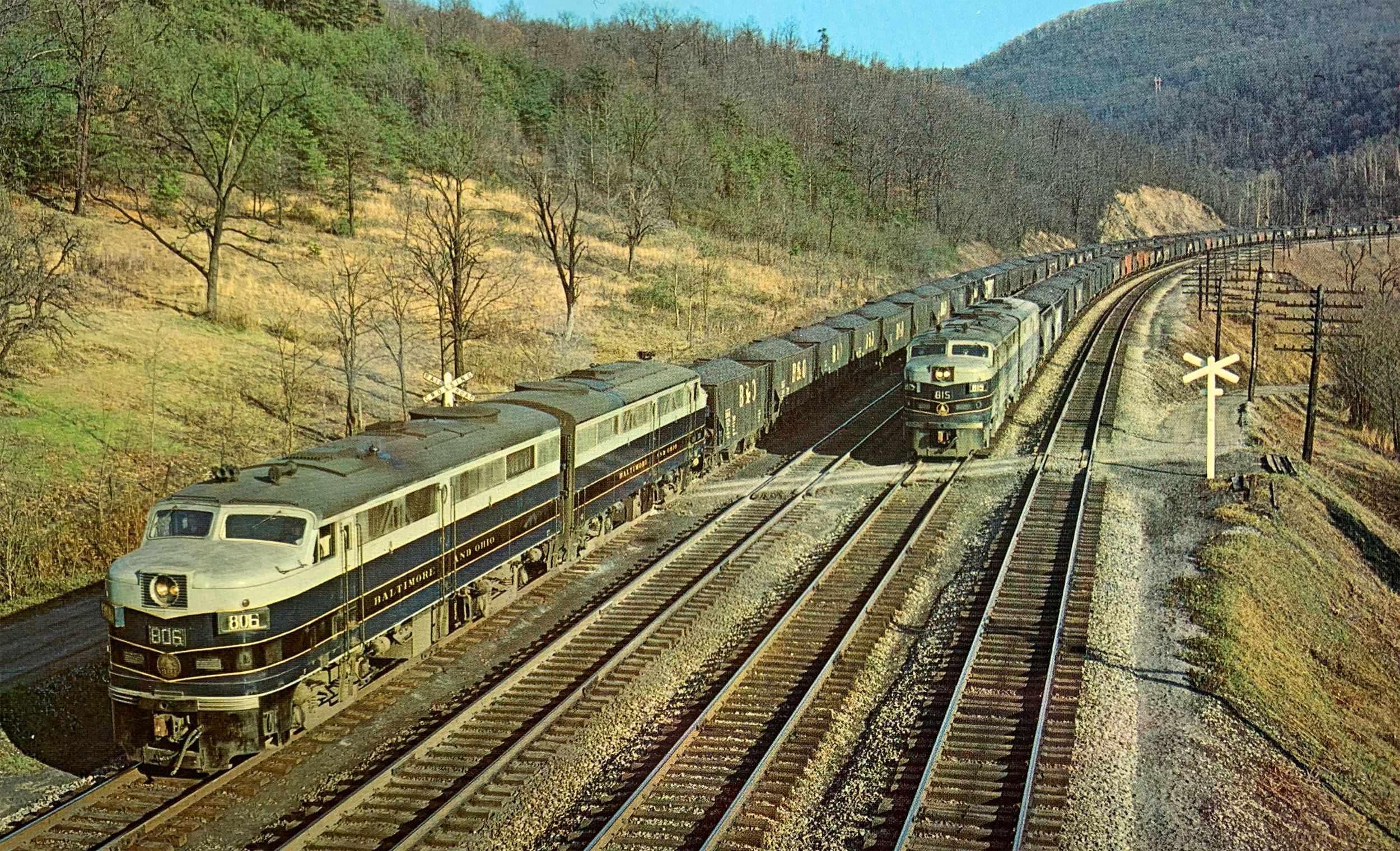
In this Baltimore & Ohio publicity photo, FA-2s have westbound coal drags at Orleans, West Virginia, during the early 1950s.
Parkersburg connected by carferry with the Marietta & Cincinnati. A 7,100-foot Ohio River bridge, Parkersburg to Belpre, opened January 7, 1871 and killed the ferry. The B&O took the M&C in 1882 and recast it as the Baltimore & Ohio Southwestern in 1889. Beyond Cincinnati the Ohio & Mississippi, built to six-foot gauge and opened 1857, reached St. Louis. It converted to standard gauge in July 1871. The B&O bought it in 1893 and folded it into the Southwestern in 1900. Eastern markets had a Mississippi River gateway twenty years after Wheeling.
Pittsburgh was the missing city. The Pittsburgh & Connellsville, organized 1837, started construction in 1847 with B&O money. The Pennsylvania fought it in court; the B&O won in 1868. Sand Patch Grade, Cumberland to Pittsburgh, opened in May 1871 and became the Chicago main in all but name. Additional Pittsburgh access came from Wheeling (Wheeling, Pittsburgh & Baltimore) and from Fairmont and Morgantown (the Fairmont, Morgantown & Pittsburgh, the Sheepskin Line).
Chicago itself arrived by a roundabout. The Central Ohio, leased 1866, ran from the river near Wheeling to Newark and Columbus. The Sandusky, Mansfield & Newark, leased 1869, ran Newark to Lake Erie. From a spot on that line called Chicago Junction—later Willard, for Daniel Willard—the Baltimore, Pittsburgh & Chicago built 260 miles west. Operations began November 23, 1874, at first using Illinois Central rights into town. Adams Street, then Monroe Street, then Grand Central Station in 1891. A true through route Baltimore–Pittsburgh–Chicago waited until the Akron & Chicago Junction opened August 1, 1891. Regular passenger and freight by that path followed in 1893.
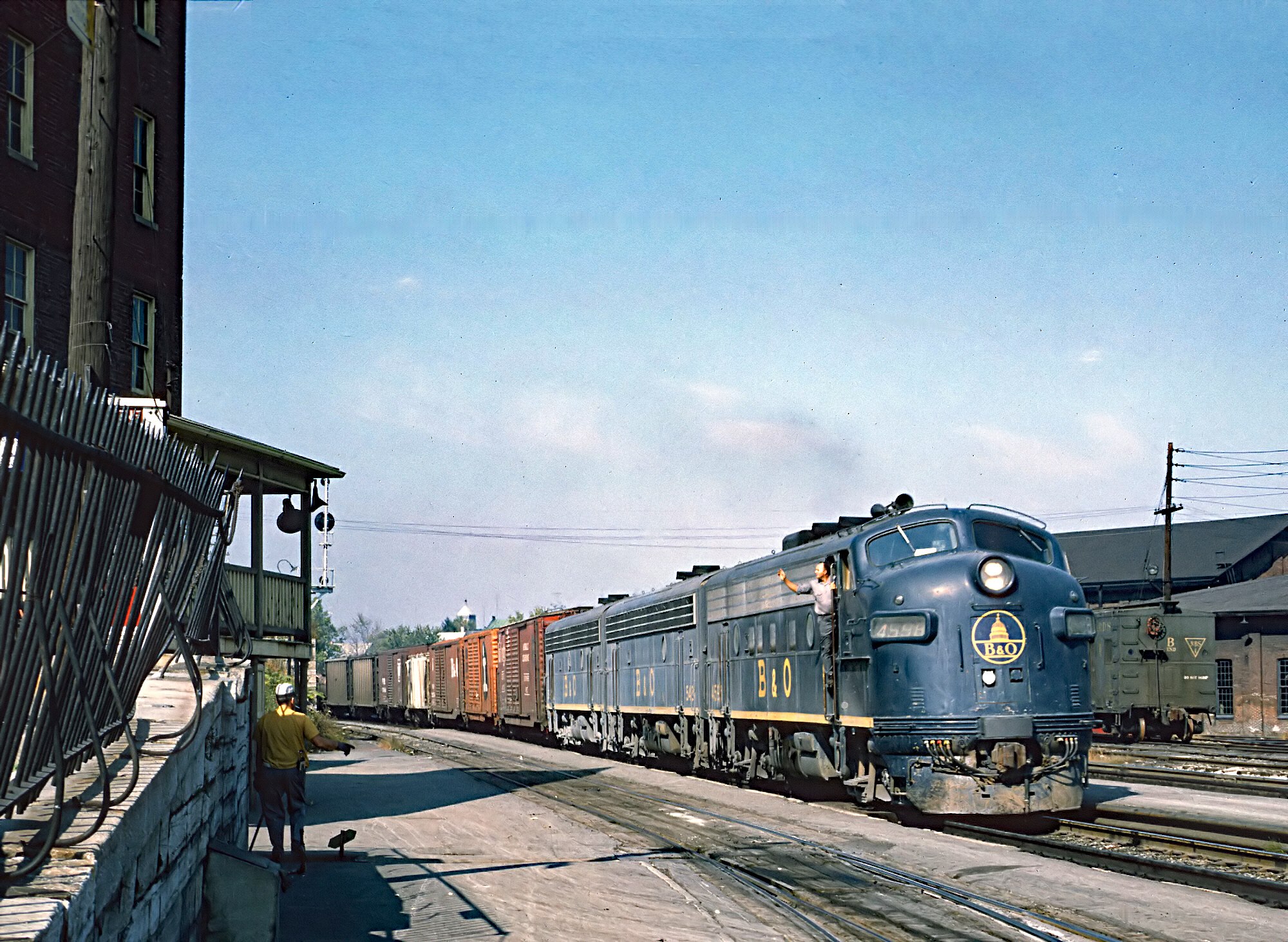
Baltimore & Ohio F7s lead their freight eastbound through the once-important division point of Martinsburg, West Virginia, on October 11, 1969. Roger Puta photo.
The Great Railroad Strike of 1877 started on this railroad. A pay cut at Martinsburg on July 16 spread to Baltimore on July 20. Militia fired. The country caught fire after that. The strike is a national story; the B&O was where it began.

Baltimore & Ohio FPA-2 #810 and FB-2s receive a bath at the wash rack in Willard, Ohio, on August 14, 1956. J. W. Swanberg photo. American-Rails.com collection.
Philadelphia, New York, and the Royal Blue Line
After Chicago the B&O wanted the eastern seaboard the Pennsylvania already owned. Subsidiary Delaware Western opened Baltimore–Philadelphia, 111 miles, in September 1886. New York was a friendly-connection job: Philadelphia & Reading to Bound Brook, Central Railroad of New Jersey to Jersey City, then a ferry to Manhattan. That patchwork was the Royal Blue Line. Passengers never rode a B&O locomotive into New York. The railroad still put its name on the Royal Blue and fought the Pennsylvania on service until it gave up the market in April 1958.

An A-B-A set of B&O F7s, led by #4553, heads a general manifest westbound through Garrett, Indiana, in March 1958. Richard Wallin photo.
Baltimore Belt
For decades the New York–Washington line and the Washington–Cumberland main did not meet in Baltimore except by car ferry across the harbor. The Baltimore Belt Railroad and the Howard Street Tunnel closed that gap. Official List No. 29 (January 1, 1948) put the territory at 7.2 miles, Bay View to Hamburg Street, four miles of it under wire. General Electric supplied 600-volt direct-current motors. Coke-fired steam ran first on May 1, 1895. An electric test came June 27. The public saw it on July 1, 1895—the first main-line railroad electrification in the United States. Overhead contact gave way by 1900 to a conventional third rail; coal smoke ate the original shoes. Mount Royal Station rose at the north portal. It still stands.
The project was expensive. Debt from the Belt and from western expansion helped put the company into receivership in 1896. The Pennsylvania took a controlling stock interest in the community-of-interest years after 1901 and sold down after 1906. The B&O came out independent, poorer, and still itself. Electric motors on the Belt were renewed in 1903–06, 1910–12, and 1923. Diesels made the wire unnecessary in the early 1950s. CSX still runs the Belt.
Electric locomotive classes
| Class | Years | Builder | Qty | Notes |
|---|---|---|---|---|
| LE-1 | 1895–96 | GE | 3 | Steeple-cab. First motors |
| LE-2 | 1903–06 | GE | 4 | Boxcab |
| OE-1 | 1910 | GE | 2 | Steeple-cab |
| OE-2 | 1912 | GE | 2 | Steeple-cab |
| OE-3 | 1923 | GE | 2 | Steeple-cab |
| OE-4 | 1923 | GE | 2 | Steeple-cab. Last class |
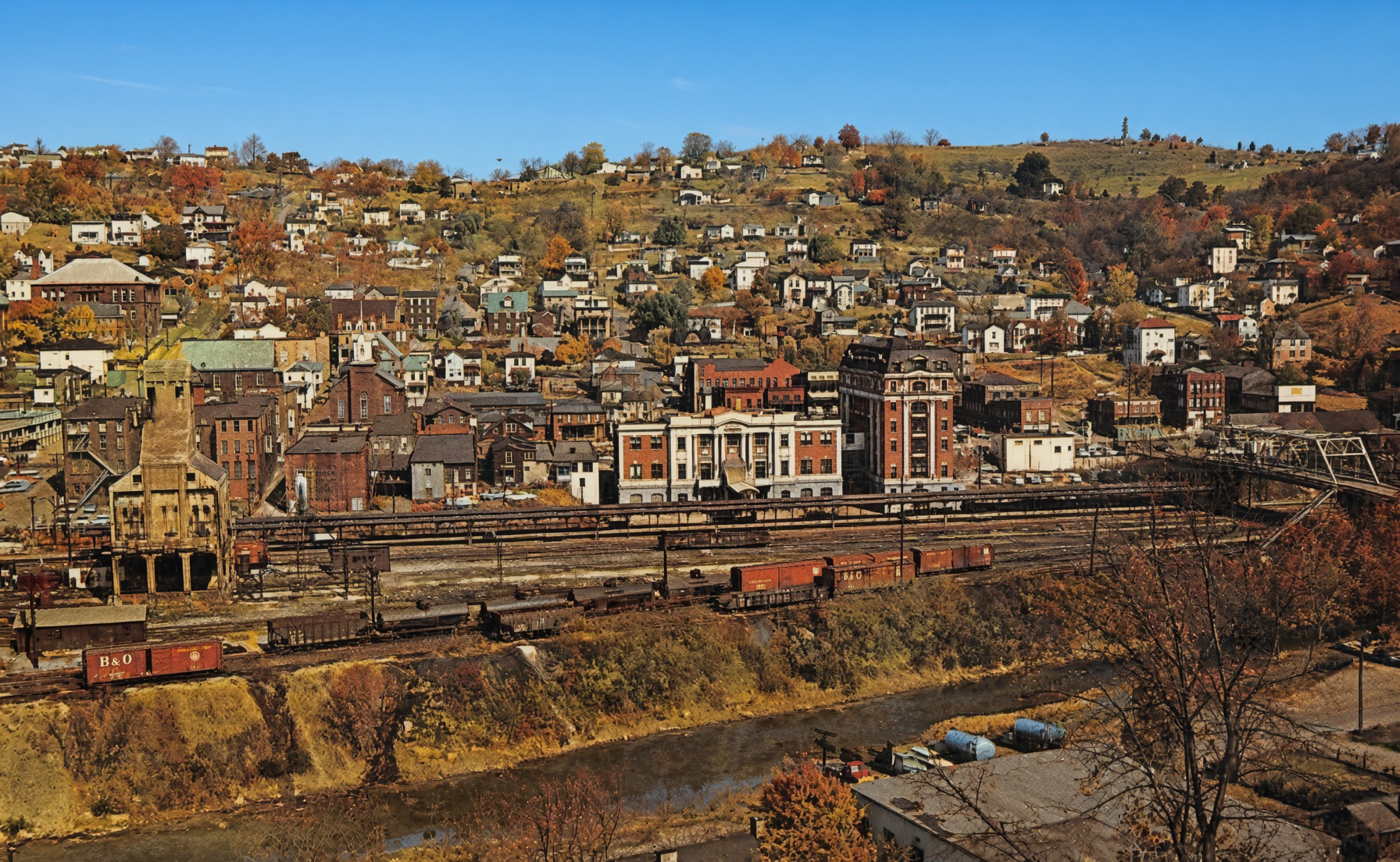
A bird’s-eye view of Baltimore & Ohio’s yard in Grafton, West Virginia, during a late fall afternoon, circa 1962. The long covered station platform came down a few years later. C. H. Ruth photo.
Willard and the passenger years
Daniel Willard took the presidency in 1910 and held it until June 1941. He steered the company through federal control in the First World War, the Depression, and the first years of the Second. Mount Clare Shops in Baltimore remained a place that rebuilt rather than bought when money was short. The Fair of the Iron Horse at Halethorpe, September 24–October 8, 1927, marked the centennial with a pageant of American locomotives. Willard’s railroad put passenger service at the center of its public face even when freight paid the bills.
The Capitol Limited began May 12, 1923, Washington/Baltimore to Chicago. The National Limited followed April 26, 1925, to St. Louis. After government control ended March 1, 1920, Willard even negotiated a short-lived deal to use Pennsylvania Station in New York. The Columbian, launched May 24, 1931 as an all-coach companion to the Royal Blue, was the first fully air-conditioned train in the United States. Electro-Motive’s EA/EB set of 1935 put a streamlined diesel on the Royal Blue; Mount Clare and Otto Kuhler then wrapped heavyweight cars to match. The Cincinnatian debuted January 19, 1947. Strata-Dome cars on the 1949 Columbian were the first domes in the East, where clearances had long forbidden them. The Shenandoah was the secondary Chicago train. A full passenger survey is B&O passenger trains.

An Electro-Motive builder’s photo of new Baltimore & Ohio F3s, #84 closest to the photographer, in July 1947. These units were steam-generator equipped for passenger service.
Diesels arrived earlier than the streamliner story admits. An Ingersoll-Rand boxcab, B&O 1, went to work in 1925 among the first commercially successful diesel switchers in the country. The 1930s brought the passenger cab units that made the publicity photographs. Freight followed with FTs, F3s, F7s, and Alco FAs. The steam roster after 1900 is B&O steam. The diesels are B&O diesels.
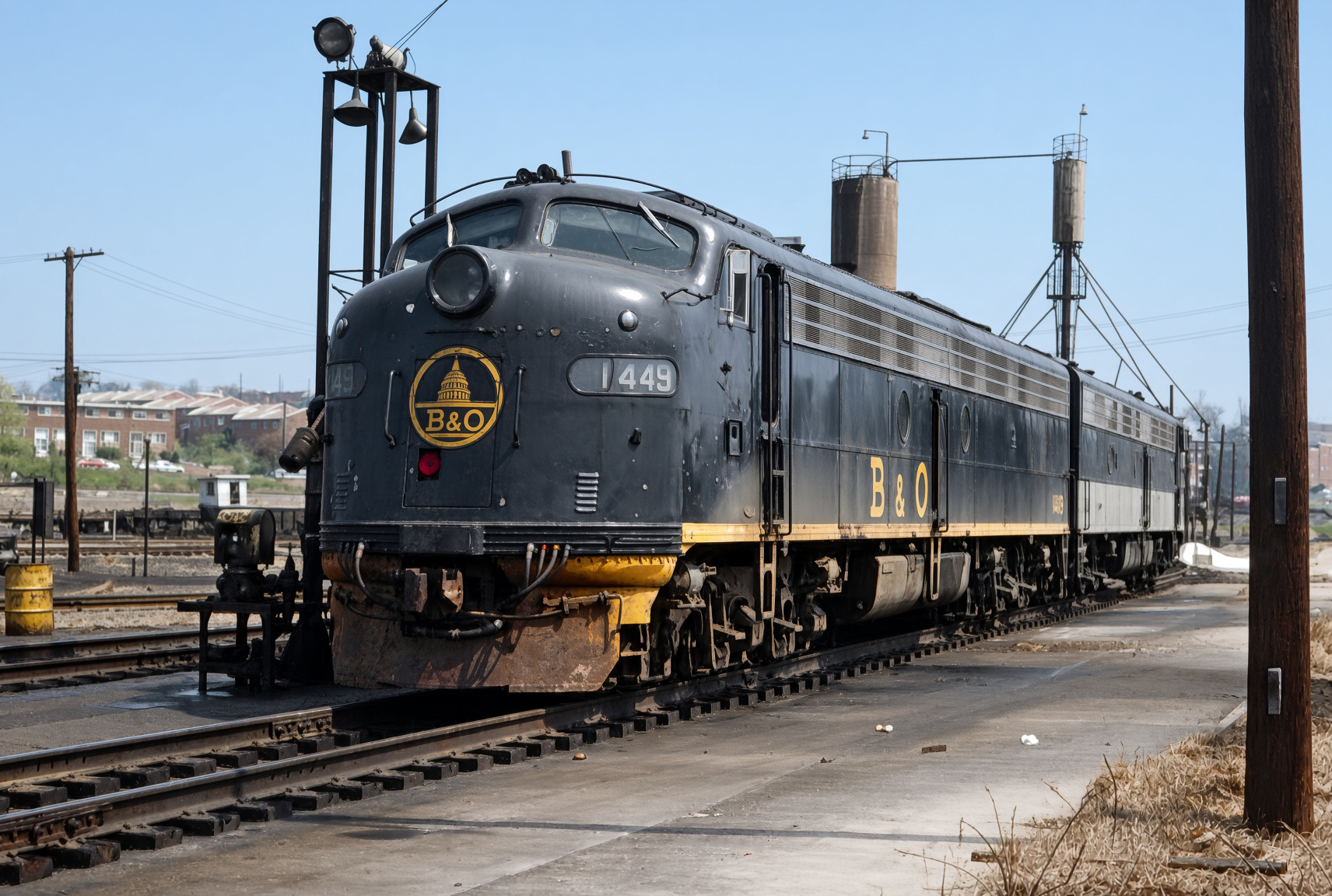
Baltimore & Ohio E8A #1449 and another E unit layover at the Ivy City engine terminal in Washington, D.C., on April 19, 1970. Marty Bernard photo.

Baltimore & Ohio E7As in the short-lived Sunburst livery at the Ivy City engine terminal, Washington, D.C., circa 1963. #1426 appears to be missing its nose herald. Photographer unknown.
How the map was built
The B&O was never one charter stretched west. It was a stack of companies, some built, some bought, some leased, that together made thirteen states and a slogan.
Baltimore & Ohio Chicago Terminal
The most important terminal subsidiary. In 1910 the B&O bought the bankrupt Chicago Terminal Transfer Railroad, itself descended from the La Salle & Chicago of 1867. At its peak the B&OCT ran Chicago Heights to Franklin Park via Blue Island and La Grange, with connections at Bellwood, Forest Hill, South Chicago, East Chicago, Calumet Park, Whiting, and Pine Junction. It put the parent into Grand Central Station on the North Side. The company still exists on paper as a CSX subsidiary. The terminal story is B&OCT.

Baltimore & Ohio F7A #4532 leads an eastbound freight through Martinsburg, West Virginia, on October 11, 1969. Roger Puta photo.
Baltimore, Pittsburgh & Chicago
Wholly owned, incorporated March 1872 in Ohio and Indiana (Illinois company 1873) to build from Chicago Junction to Chicago. Newark, Ohio, in 1873; open November 23, 1874. Consolidated 1876 as the Baltimore & Ohio and Chicago Railroad.
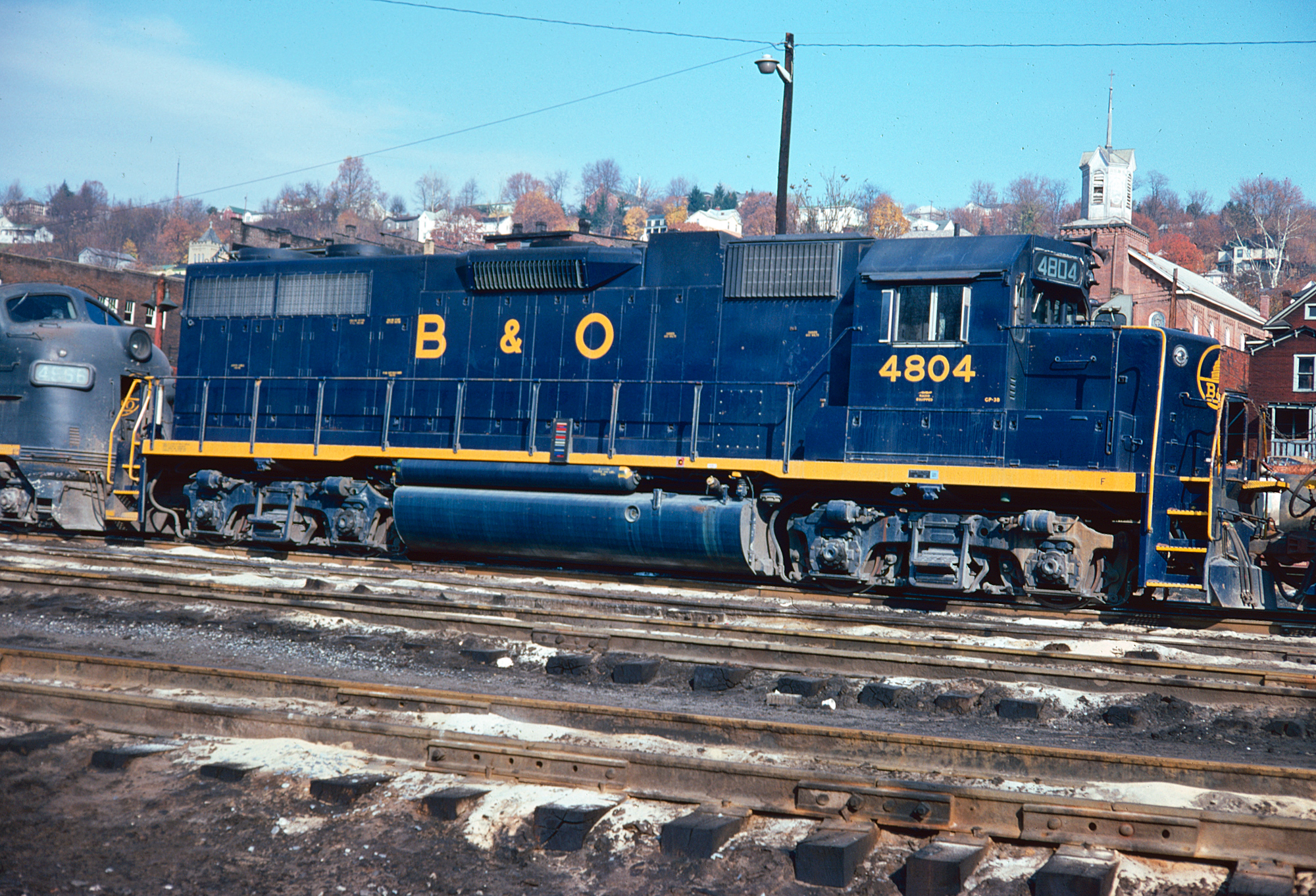
Baltimore & Ohio GP38 #4804 and F7A #4566 layover in Grafton, West Virginia, in November 1970. American-Rails.com collection.
Buffalo, Rochester & Pittsburgh
A central Pennsylvania–Buffalo/Rochester coal road, assembled March 10, 1887, from the Pittsburgh & State Line and an earlier BR&P after the Rochester & Pittsburgh failed. Willard bought it in 1929 and took over January 1, 1932, to reach western New York. The connection to Buffalo was never the best. He also bought the Buffalo & Susquehanna in 1932, a 1893 consolidation of logging lines from Sagamore, Pennsylvania, toward Addison and Wellsville, New York. Flooding in November 1942 cut the B&S south of Galeton. The north end became the Wellsville, Addison & Galeton in 1956 and lasted until 1979.
Marietta & Cincinnati / Northwestern Virginia / Ohio & Mississippi
The M&C formed in 1851 from the Belpre & Cincinnati and Franklin & Ohio, opened Marietta–Cincinnati in early 1857, and gave the B&O its Ohio stepping-stone. The Northwestern Virginia, the Parkersburg Branch, opened May 1, 1857. The Ohio & Mississippi, six-foot gauge to St. Louis with branches to Jeffersonville/Louisville and Shawneetown–Beardstown via Flora, was the Mississippi River piece. Together they are the St. Louis main.
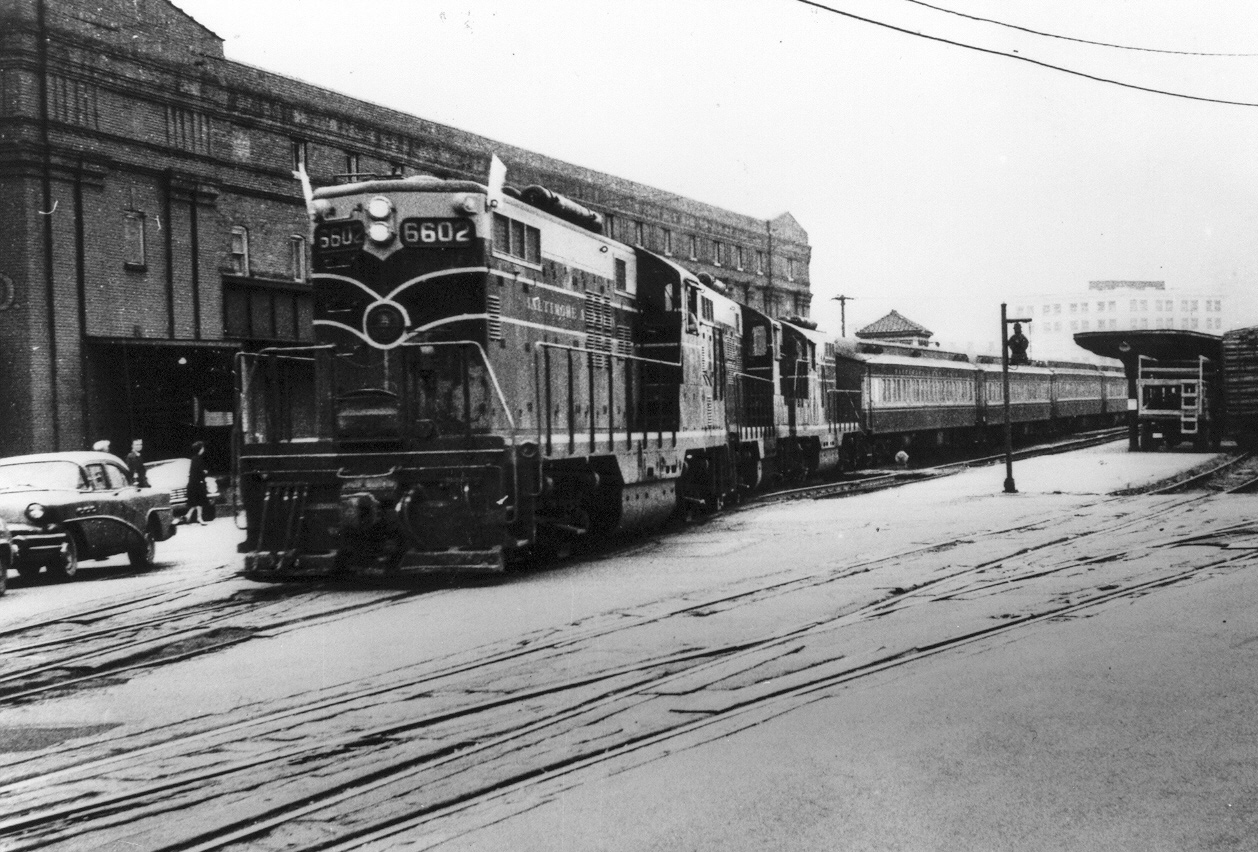
Baltimore & Ohio passenger GP9s, led by #6602, have arrived from Washington, D.C., with a passenger special at the large station in Wheeling, West Virginia, on May 12, 1963. The station remains; the tracks are gone. Photographer unknown. American-Rails.com collection.
Pittsburgh & Connellsville
Sand Patch. Cumberland to Pittsburgh, May 1871. The Chicago freight artery of the twentieth century still uses this mountain.
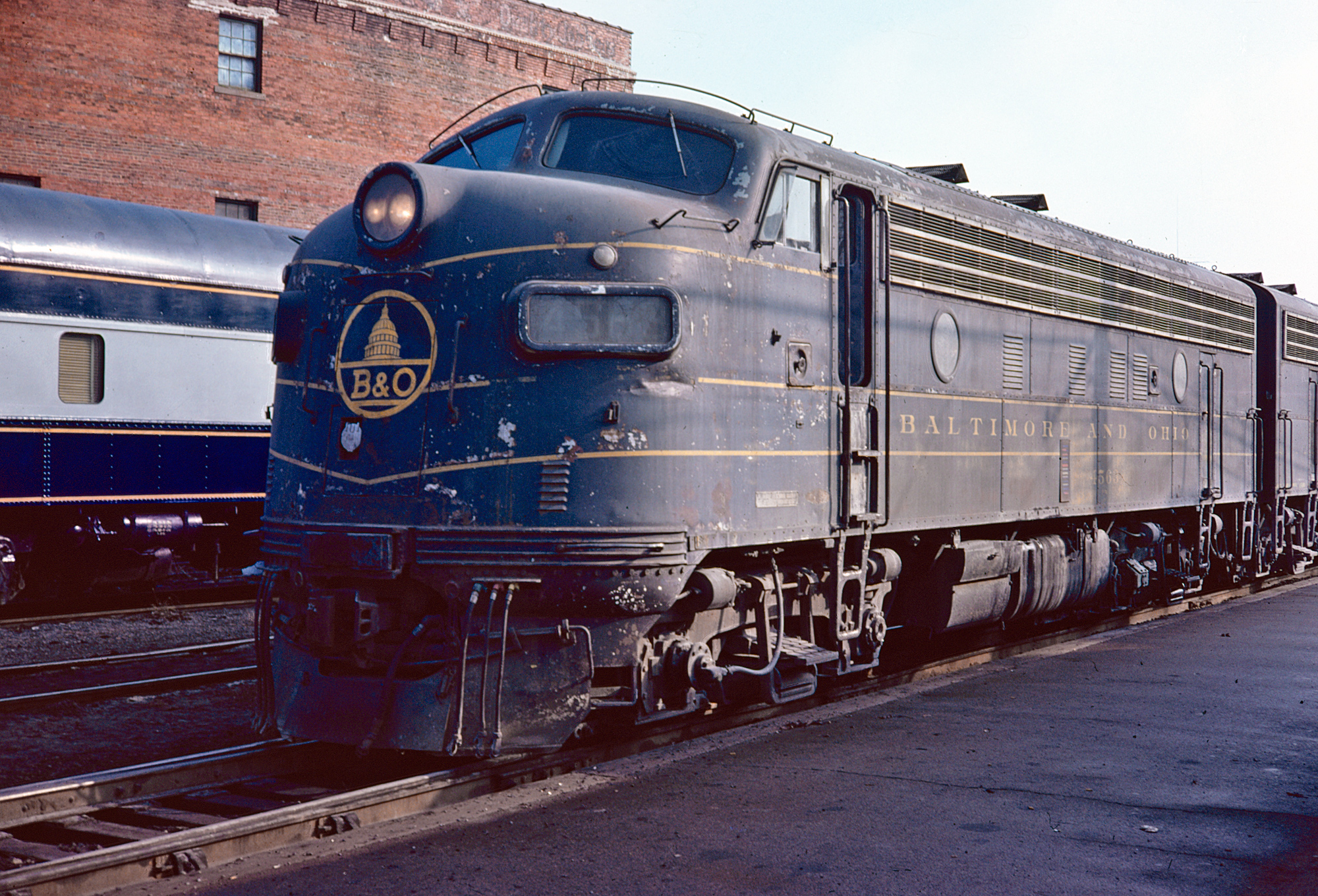
Baltimore & Ohio F7A #4563 sits at the west end of High Yard in Parkersburg, West Virginia, near OB Tower, awaiting departure west, February 1974. Parkersburg was a major division point on the St. Louis main. American-Rails.com collection.
Ohio River Rail Road
Backed by Rockefeller/Standard Oil money, construction south of Wheeling began in 1882 and reached Huntington in 1888, hugging the river. Oil and petrochemical plants followed. The B&O leased it in September 1901 and bought it in 1912. It tied Wheeling to Parkersburg and, at Huntington/Kenova, to the Chesapeake & Ohio.

A Baltimore & Ohio FA-2/FB-2 set has train #34 heading east through historic Harpers Ferry, West Virginia, as it crosses the Potomac River in the spring of 1956. Clarence Cade photo.
Virginia Extension
After the Civil War the B&O tried the Shenandoah. It leased the Winchester & Potomac, Harpers Ferry to Winchester, July 1, 1867; took the Winchester & Strasburg, 19 miles; and in 1873 used the Virginia Midland as far as Harrisonburg. The Valley Railroad, aimed at Salem near Roanoke, reached only Lexington in 1883 and stopped. The 1896 receivership sold the northern pieces. The VRR hung on into the early 1940s.
Alton Railroad
Willard bought the bankrupt Chicago & Alton in 1929 and renamed it the Alton Railroad in 1931, looking at Kansas City. The Abraham Lincoln streamliner was the passenger face of that hope. The Depression and the B&O’s own books killed the experiment. The Alton was separated in 1942, slipped into receivership, and went to the Gulf, Mobile & Ohio in May 1947.

A Baltimore & Ohio F7A rolls southbound along 2nd Street in St. Marys, West Virginia, on a summer day in the 1960s. The tankers are likely from the Quaker State refinery a quarter-mile behind the photographer. Trains have used this street trackage since the 1880s, at about 10 mph. John King photo.
Postwar years
Roy B. White succeeded Willard in 1941 and saw the company through the war. Howard E. Simpson inherited the 1950s. Highways and airlines took the passengers. Coal and merchandise still moved, but after 1956 the books turned. Payrolls shrank. Trailer-on-flat-car service was tried. By 1960 the losses were serious. Jervis Langdon Jr. came in 1961 to keep the railroad out of court. The Norfolk & Western–Virginian combination of 1959 had already opened the modern merger era. The New York Central wanted the B&O. So did the Chesapeake & Ohio.

Baltimore & Ohio F7s just east of Cumberland, Maryland, with a general manifest on a spring day in the 1950s. Photographer unknown. American-Rails.com collection.

B&O F7s, led by #935, head west at Shenandoah Junction, West Virginia, in September 1955. Photographer unknown.
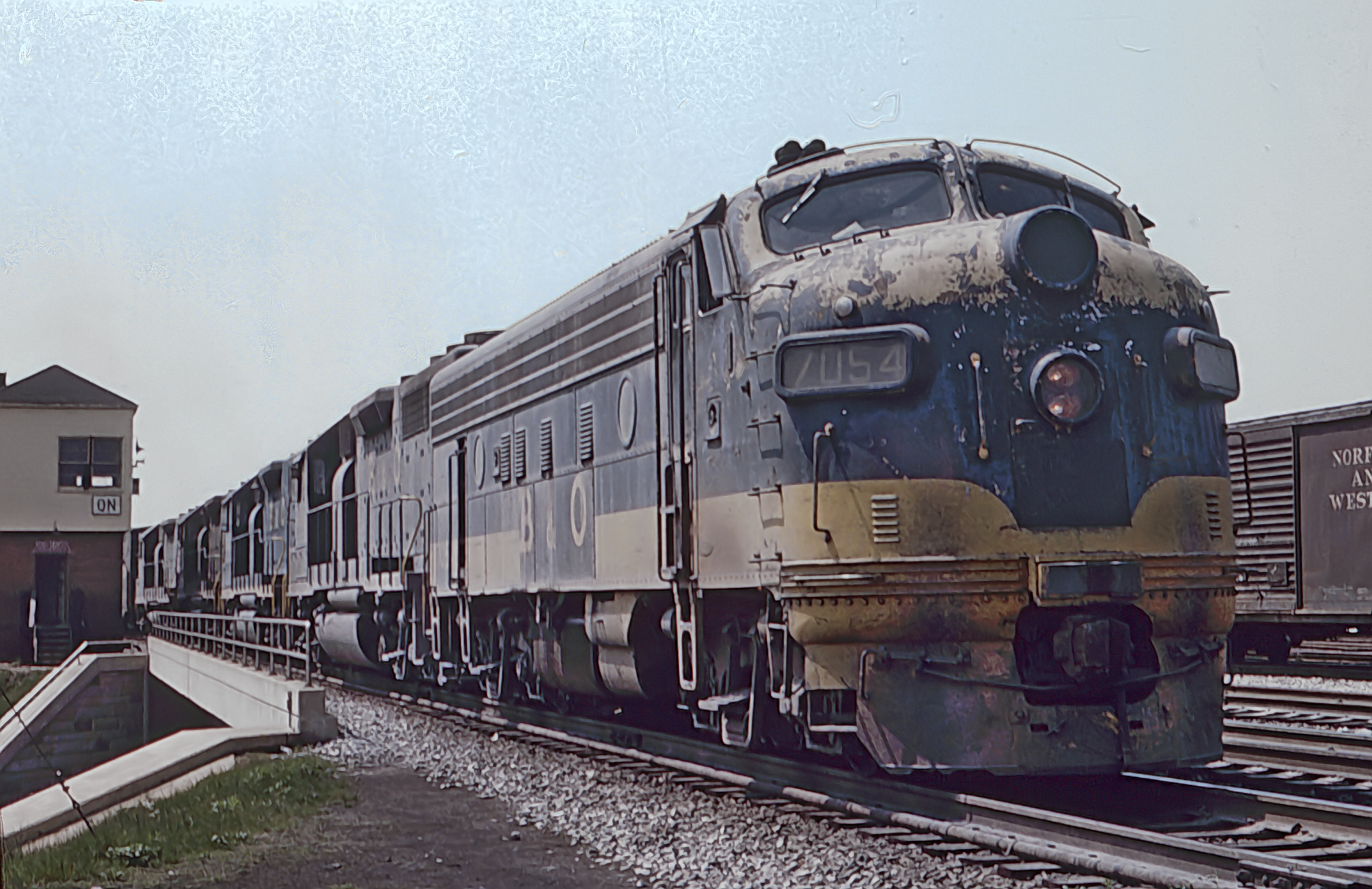
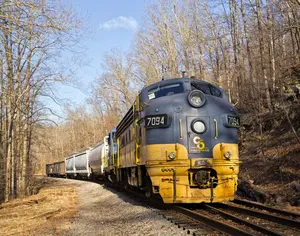
Baltmore & Ohio F7A #7054 (ex-C&O #7054) leads a freight past QN Tower on the Metropolitan Branch in Washington, DC on April 29, 1970. Marty Bernard photo.
C&O, Chessie, and CSX
The Interstate Commerce Commission approved C&O control on December 31, 1962. Direct control closed February 4, 1963. It was not a merger of the two corporations. The C&O left the B&O standing, in part to keep a Maryland tax exemption and in part because B&O people would not have taken an erasure quietly. Western Maryland stock accumulated until C&O/B&O had the Wild Mary in 1967. Yellow, blue, and vermilion GP40-2s with the Chess-“C” kitten silhouette began arriving in 1972. Chessie System, Inc. was incorporated in Virginia on February 26, 1973, and became parent of the C&O, B&O, and Western Maryland on June 15. The holding-company story is Chessie System. The C&O itself is Chesapeake & Ohio.
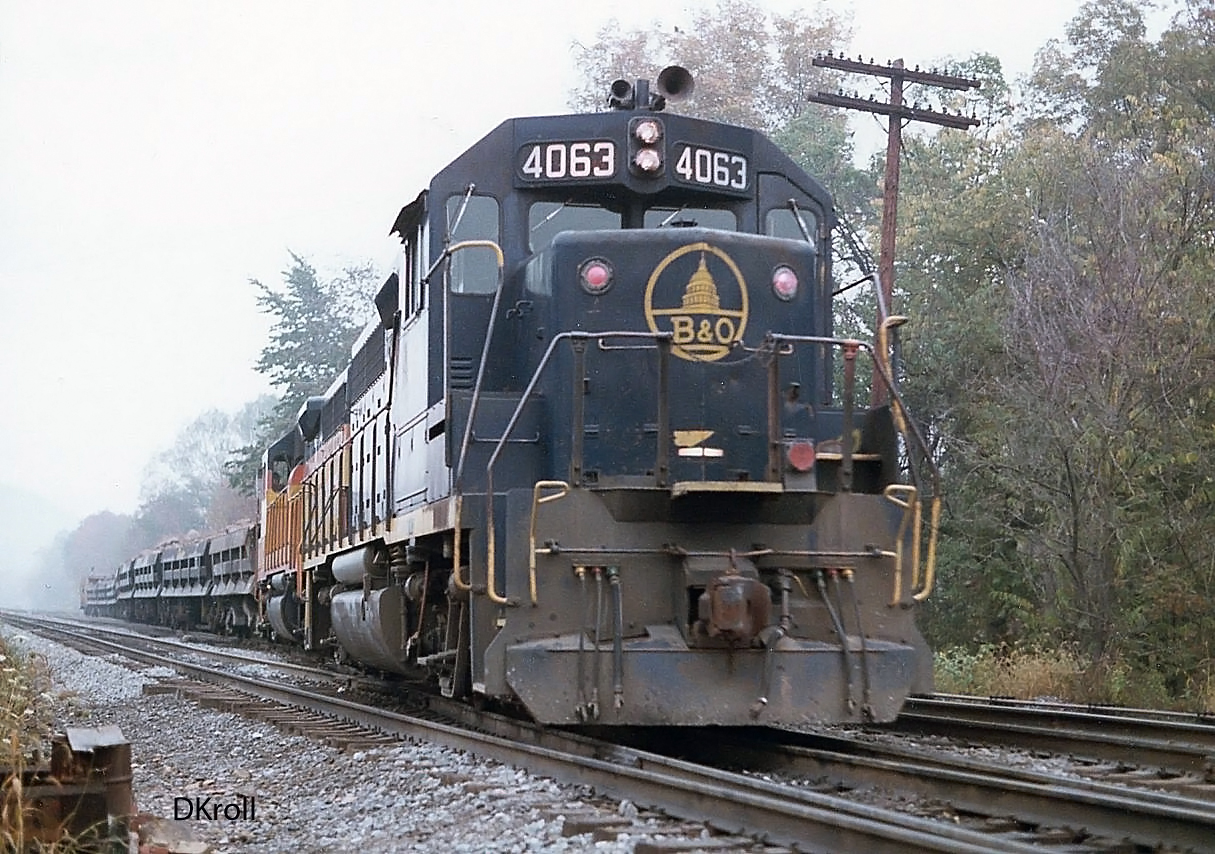
Baltimore & Ohio GP40 #4063 leads a ballast train repairing flood damage on the Sand Patch main near Hyndman, Pennsylvania, on October 15, 1984. Doug Kroll photo.
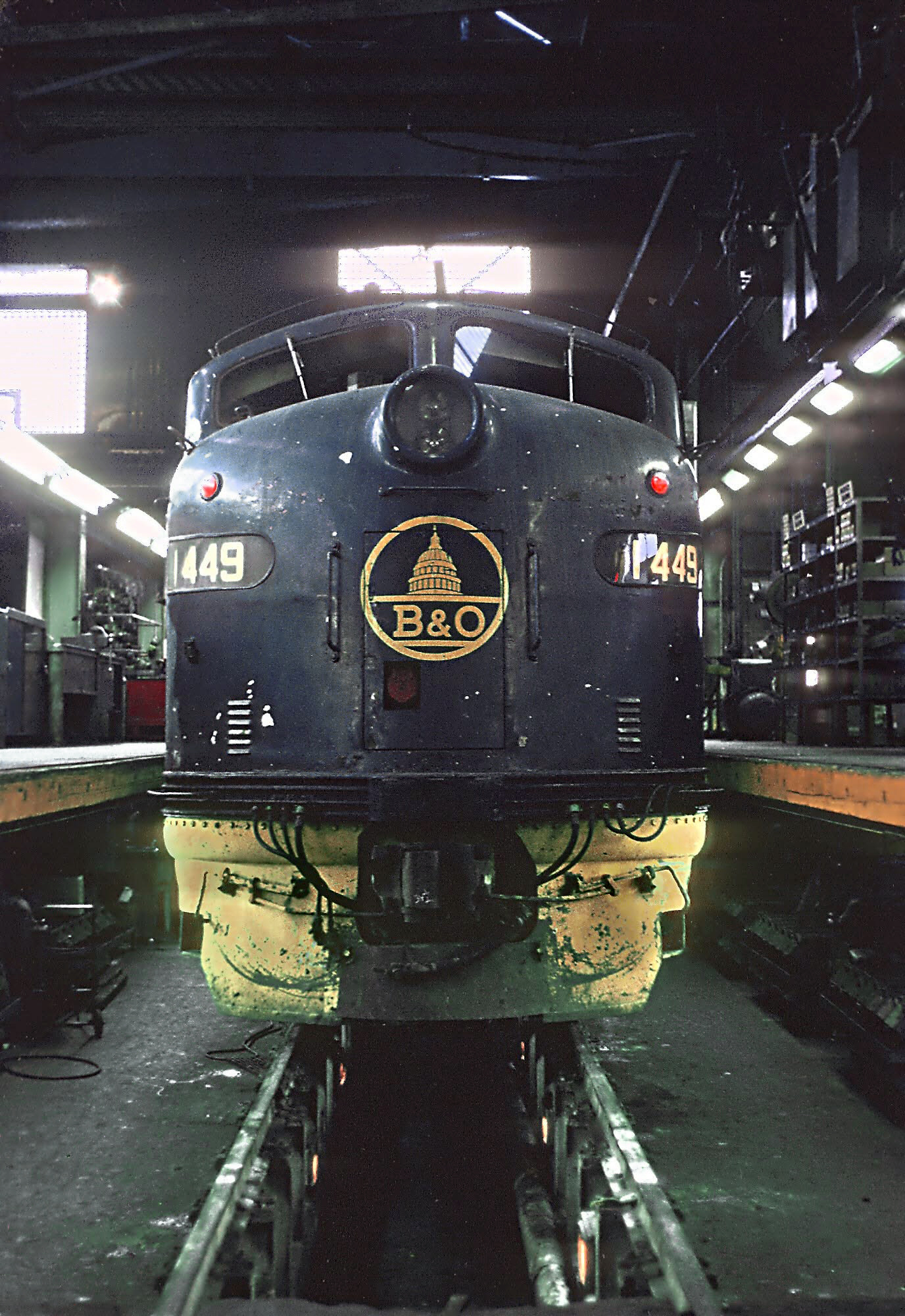
Baltimore & Ohio E8A #1449 receives attention at the shops in Cumberland, Maryland on December 5, 1970. Roger Puta photo.
Chessie System and Seaboard Coast Line Industries formed CSX Corporation on November 1, 1980. The B&O was already a paper company with a tax reason to exist. Western Maryland merged into the B&O on May 1, 1983. The B&O merged into the C&O on April 30, 1987. The C&O dissolved into CSX Transportation on August 31, 1987.
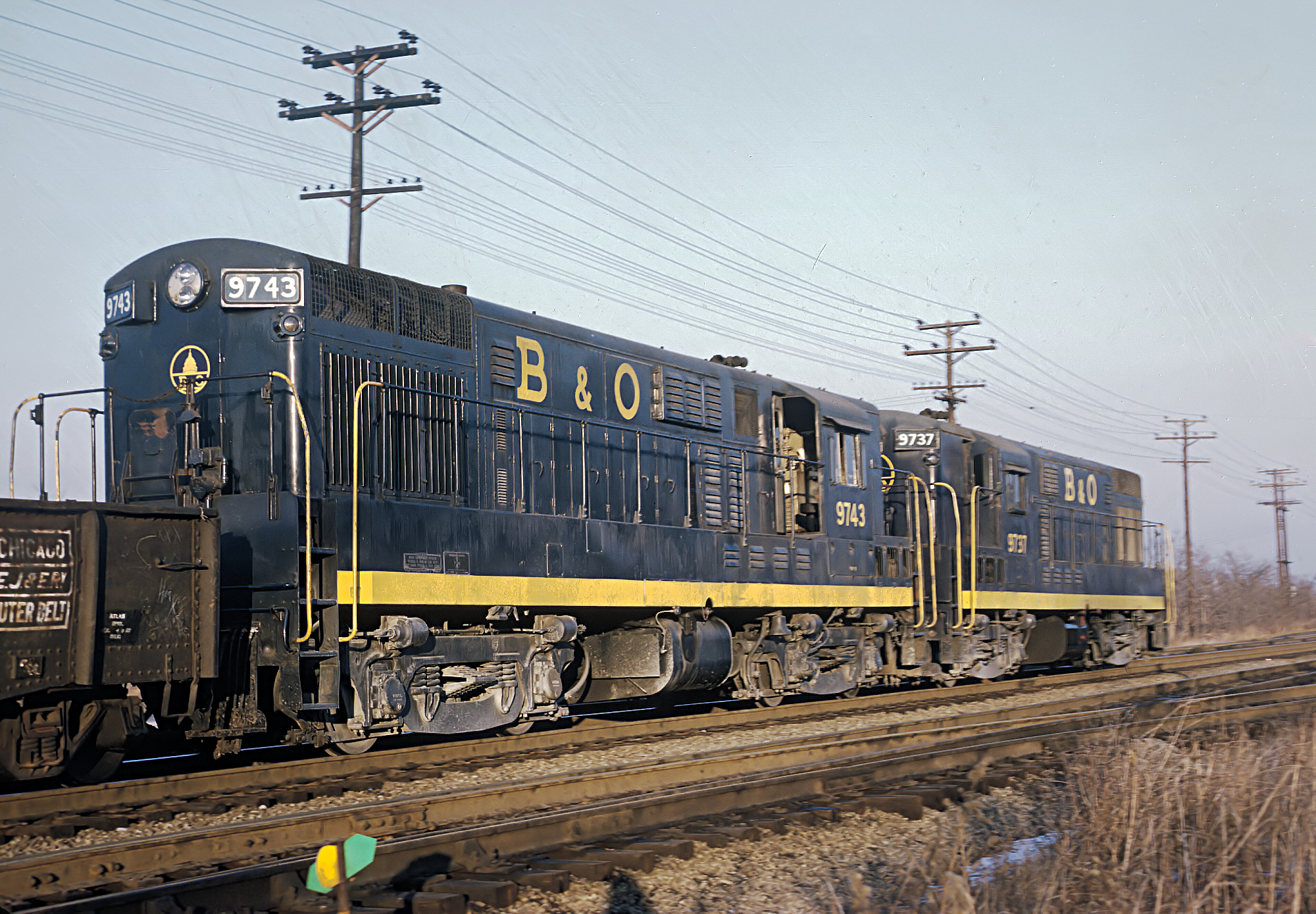
Baltimore & Ohio H16-44s #9743 (built as #6709) and #9737 (built as #925) on the Curtis Bay Branch in Baltimore, Maryland, on December 14, 1969. Roger Puta photo.
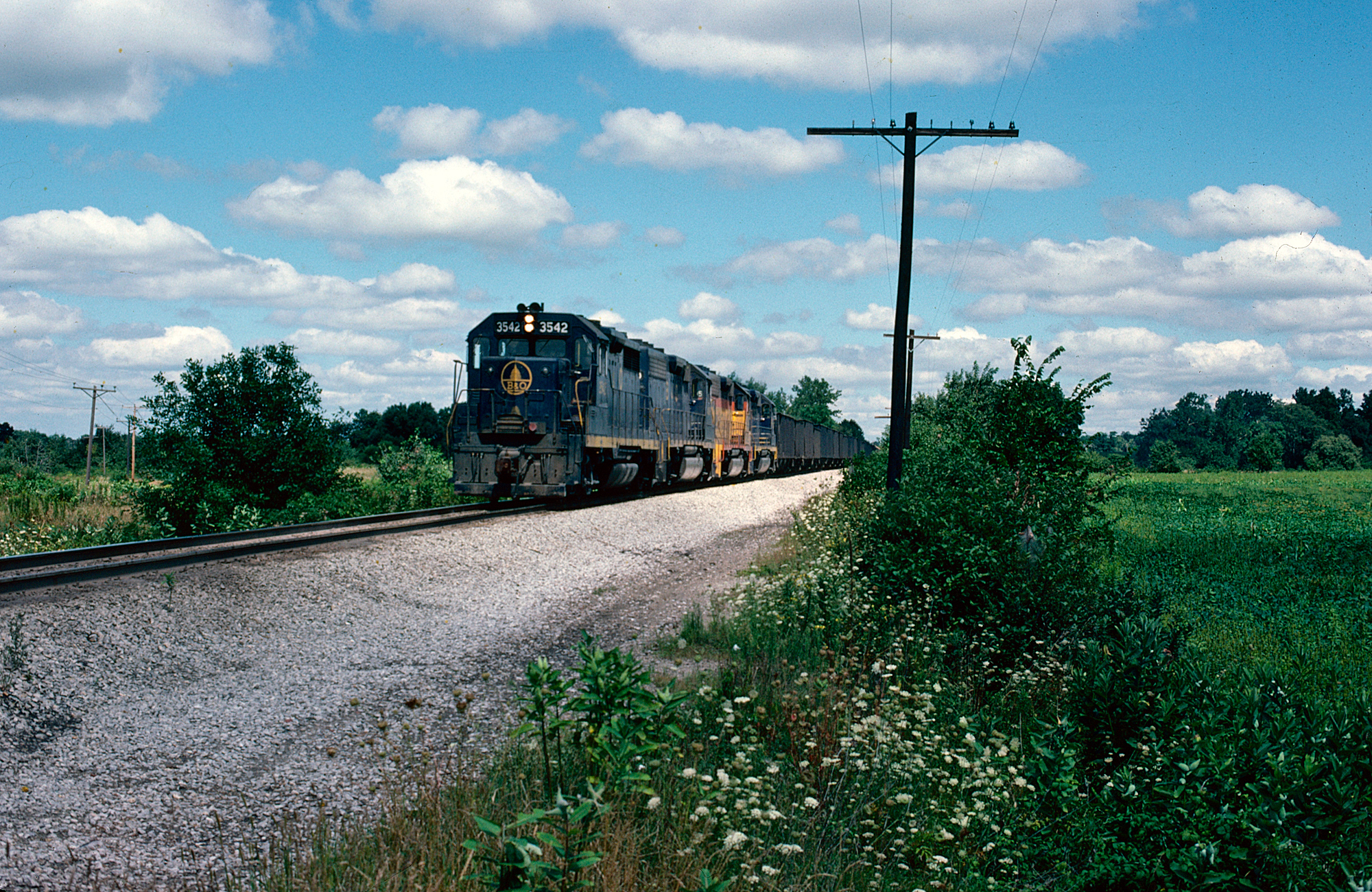
Baltimore & Ohio Geeps, led by GP35 #3542, southbound near Chippewa Lake, Ohio, on the CL&W Subdivision (Cleveland, Lorain & Wheeling), August 20, 1978. American-Rails.com collection.
The 1980s were hard on the old map. In 1985, just as double-stack containers were becoming the intermodal standard, CSX moved to cut the St. Louis main between Clarksburg and Parkersburg—the Parkersburg Branch—and much of the Ohio Division. When the container business took off, CSX lacked a short St. Louis–East Coast route of its own until Conrail pieces arrived in 1999. The abandoned right-of-way is still argued about. Upgraded for stacks it would have been the shortest haul between the St. Louis gateway and the Atlantic.

A pair of Chessie System/B&O GP40-2s lead an eastbound hotshot Philadelphia Trailerjet along the St. Louis main near Porterfield, Ohio, in June 1981. The right-of-way is empty today. Author’s collection.
What remains
CSX still runs the original Baltimore–Cumberland mountain main, Sand Patch, the Chicago line through Willard, and pieces of the Ohio River and northern West Virginia coal web. The Belt is an urban artery. Ellicott City station is a museum. Mount Clare is the B&O Railroad Museum. MARC uses the old Washington Branch and the Metropolitan Branch. Amtrak’s Floridian covers the former Capitol Limited path east of Chicago. In May 2023 CSX painted ES44AH 1827 in a B&O-inspired blue and gray, the charter year on the cab.
Mike Schafer, in Classic American Railroads, wrote the sentence that still fits: the B&O was never a healthy and extremely profitable railroad, and it is remembered for its pioneer spirit, determination in the face of adversity, innovative technology, superior service, courteous employees, and aesthetic equipment.
Related reading on American-Rails.com
- B&O steam roster (post-1900) · B&O diesel roster · B&O passenger trains
- Tom Thumb · Capitol Limited · National Limited · Royal Blue
- Columbian · Cincinnatian · Shenandoah
- Steam classes: E 2-8-0 · EL 2-8-8-0 · EM-1 2-8-8-4 · KB-1 2-6-6-4 · KK 2-6-6-2 · KL-1 2-6-8-0 · LL-1 0-8-8-0 · N-1 4-4-4-4 · P 4-6-2 · Q 2-8-2 · T 4-8-2 · V 4-6-4 · S 2-10-2
- B&O Chicago Terminal · Alton Railroad · Western Maryland
- Chesapeake & Ohio · Chessie System · CSX
- Pennsylvania Railroad · The Great Strike of 1877 · Railroads in the 1820s and 1830s
Sources
- Reynolds, Kirk, and David Oroszi. Baltimore & Ohio Railroad. Osceola, Wis.: MBI, 2000. Company narrative, subsidiaries, C&O years
- Reizenstein, Milton. The Economic History of the Baltimore and Ohio Railroad, 1827–1853. Baltimore, 1921. Chronology: charter February 28, 1827; cornerstone July 4, 1828; Ellicott’s Mills; Harpers Ferry December 1, 1834; Cumberland November 5, 1842; last spike December 24, 1852; first Wheeling train January 1, 1853
- Baltimore & Ohio Railroad Historical Society. Company history summary. First common carrier; Chicago Junction/Willard; 1874 Chicago line; Metropolitan Branch 1873
- Harwood, Herbert H., Jr. Royal Blue Line. The Baltimore–Philadelphia–Jersey City passenger route
- Schafer, Mike. Classic American Railroads. Osceola, Wis.: MBI, 1996. Character of the company
- Welsh, Joe. Baltimore & Ohio’s Capitol Limited and National Limited. St. Paul: MBI, 2007
- Solomon, Brian. Amtrak. Dining-car reputation. Electro-Motive E Units and F Units. Minneapolis: Voyageur Press, 2011
- Trains Magazine CSX merger family tree. Chessie System, Inc., February 26 / June 15, 1973; WM into B&O May 1, 1983; B&O into C&O April 30, 1987; C&O into CSXT August 31, 1987
- Baltimore Belt: B&O Official List No. 29, January 1, 1948 (7.2 miles Bay View–Hamburg Street; four miles electrified). July 1, 1895 public electric service
- Baltimore, Pittsburgh & Chicago / B&O&C: operations November 23, 1874 (borail.net timeline; B&O Historical Society)
- Live American-Rails Tom Thumb, passenger-train, steam-class, diesel-roster, Chessie, C&O, CSX, Alton, and 1877 pages as linked above
Recent Articles


-
West Point Route (Railroad): Map, History, Logo
Oct 16, 26 11:26 PM
 The West Point Route was a trademarked name comprising the Atlanta & West Point and Western Railway of Alabama, which were controlled by the Georgia Railroad.
 -
Virginian Railway Diesel Roster (All-Time)
Oct 16, 26 11:11 PM
 All-time diesel roster of the Virginian Railway. 40 Fairbanks-Morse H16-44s, 25 H24-66 Train Masters, and one GE 44-tonner. Serials included.
 -
Virginian Railway Steam Roster (Post 1900)
Oct 16, 26 10:55 PM
 Virginian Railway steam locomotives built since 1900. Mikados, 2-8-8-2s, the Triplex, class AE 2-10-10-2s, and the 1945 2-6-6-6s.
 -
Virginian Railway: Map, Rosters, History, Electrification
Oct 16, 26 10:51 PM
 Virginian Railway, Deepwater to Norfolk. Combined in 1907 and completed in 1909. Electrified from Roanoke to Elmore. Absorbed by the Norfolk & Western on December 1, 1959.
 -
Baldwin "Centipede" Locomotives: Specs, Roster, Photos
Oct 16, 26 03:58 PM
 Baldwin DR-12-8-1500/2 Centipede—2-D+D-2, two 608SC engines, 3,000 hp. SAL 4500 from the 1943 test bed. 54 on the serial list, 52 sold. PRR BP60 then BH50. None preserved.
 -
Louisville & Nashville Class M-1 2-8-4s: The Big Emmas
Oct 16, 26 03:52 PM
 Louisville & Nashville class M-1, 42 Big Emma 2-8-4s. Baldwin in 1942 and 1944, Lima in 1949. Coal trains from Neon to DeCoursey. No locomotive survives.
 -
Tennessee, Alabama and Georgia Railway: Map, History, Rosters
Oct 16, 26 03:21 PM
 Tennessee, Alabama and Georgia Railway, Chattanooga to Gadsden. The May 1929 card is 91.7 miles. Southern stock control closed on a January 1, 1971 schedule. Five diesels and Prince's steam list.
 -
Railroad Museums In The USA (2026): State Guides & Collections
Oct 16, 26 02:29 PM
 U.S. railroad museums—what they are vs tourist railroads, preservation history (R&LHS, NRHS, IRM, Steamtown), state guides, and destination collections. Confirm hours on each museum’s site.
 -
Wyoming Railroad Museums (2026): A Complete Guide
Oct 16, 26 02:26 PM
 Wyoming railroad museums—the Cheyenne Depot, Burlington 5633 at Douglas, Big Boy 4004, and the Laramie depot. Confirm hours and which locomotive is on the property.
 -
West Virginia Railroad Museums (2026): A Complete Guide
Oct 16, 26 12:52 PM
 West Virginia railroad museums—Cass Scenic’s geared steam, the Hinton C&O collection, and the Martinsburg B&O roundhouse. Confirm hours and which locomotive is assigned.
 -
Washington Railroad Museums (2026): A Complete Guide
Oct 16, 26 12:46 PM
 Washington railroad museums—Snoqualmie, Elbe, Chehalis, Reardan, and the Northern Pacific depot at Toppenish. Confirm hours and which locomotive is assigned.
 -
Vermont Railroad Museums (2026): A Complete Guide
Oct 16, 26 12:42 PM
 Vermont railroad museums—the Shelburne Museum’s 1890 station, Central Vermont No. 220, and the private car Grand Isle. Confirm hours on the site.
 -
Tennessee Central Railway: Map, Logo, Rosters, History
Oct 16, 26 11:32 AM
 Tennessee Central Railway, Harriman to Hopkinsville. Reorganized January 26, 1922. Last day August 31, 1968. Thirty-one diesels and the railroad's steam roster.
 -
Southern Railway Steam Roster (Post 1900)
Oct 16, 26 09:40 AM
Southern Railway steam locomotives built since 1900. Ps-4 Pacifics, Ts Mountains, USRA Santa Fes, and the subsidiary grids for the CNO&TP, Alabama Great Southern, and New Orleans and Northeastern. -
Southern Railway (USA): Map, Locomotives, Logo, History
Oct 16, 26 09:28 AM
 The Southern Railway, formed July 1, 1894 from the Richmond and Danville and the East Tennessee, Virginia and Georgia. Washington. Norfolk Southern Railway on December 31, 1990.
 -
Seaboard Coast Line Diesel Roster (All-Time)
Oct 15, 26 04:21 PM
 All-time diesel roster of the Seaboard Coast Line. Inherited Coast Line and Seaboard locomotives, then 623 new locomotives in the printed orders, plus 28 acquired from other railroads.
 -
Seaboard Coast Line Railroad: Map, History, Photos
Oct 15, 26 04:17 PM
 The Seaboard Coast Line, formed July 1, 1967 from the Atlantic Coast Line and the Seaboard Air Line. Jacksonville. Family Lines, then the Seaboard System on December 29, 1982.
 -
South Carolina Railroad Museums (2026): A Complete Guide
Oct 15, 26 02:54 PM
 South Carolina railroad museums—Winnsboro’s Rockton & Rion line, Spartanburg’s Hub City depot, Greenwood’s Baldwin No. 19, and the Best Friend replica. Confirm hours on each site.
 -
South Dakota Railroad Museums (2026): A Complete Guide
Oct 15, 26 10:55 AM
 South Dakota railroad museums—the Hill City museum beside the 1880 Train, and Prairie Village at Madison. Confirm hours, and confirm whether Hill City is still open.
 -
Seaboard Air Line Diesel Roster (All-Time)
Oct 15, 26 10:46 AM
 All-time diesel roster of the Seaboard Air Line. 734 locomotives: E4s in 1938, Centipedes, Alco road switchers, and GP40s through February 1967. Serials included.
 -
Seaboard Air Line Steam Roster (Post 1900)
Oct 15, 26 10:39 AM
 Seaboard Air Line steam locomotives built since 1900. Mikados, Russian Decapods, 2-10-2s, and the 2-6-6-4s sold to the Baltimore and Ohio in 1947. Drury's class grid.
 -
Seaboard Air Line Railroad: Map, Rosters, History
Oct 15, 26 10:34 AM
 The Seaboard Air Line, chartered in the Portsmouth and Roanoke of 1832 and formed July 1, 1900. Inland route to Florida. Merged into the Seaboard Coast Line on July 1, 1967.
 -
Utah Railroad Museums (2026): A Complete Guide
Oct 15, 26 12:04 AM
 Utah railroad museums—Ogden Union Station, Golden Spike at Promontory, the Helper mining museum, and the Heber Valley Railroad. Confirm hours on each site.
 -
Escanaba & Lake Superior Diesel Roster (All-Time)
Oct 14, 26 10:44 PM
All-time diesel roster of the Escanaba & Lake Superior. 30 locomotives: Baldwin switchers and RS-12s, two RF16s, three GP38s, three SD40-2s, and the Reserve Mining units. Serials and order numbers. -
Escanaba & Lake Superior Railroad: In Service Since 1898
Oct 14, 26 09:04 PM
 Escanaba & Lake Superior Railroad, chartered November 17, 1898, and still operating from Wells, Michigan. Logging line to Channing, the Milwaukee Road lines, and the diesel roster.
 -
Richmond, Fredericksburg & Potomac Diesel Roster (All-Time)
Oct 14, 26 08:49 PM
 All-time diesel roster of the Richmond, Fredericksburg and Potomac. 107 locomotives: 22 Alco S2s, one SW1, and an Electro-Motive road fleet from E8s to GP40-2s. Serials and order numbers.
 -
Richmond, Fredericksburg & Potomac Steam Roster (Since 1900)
Oct 14, 26 08:46 PM
 Richmond, Fredericksburg and Potomac steam locomotives built since 1900. Pacifics, Mountains, Berkshire-type 2-8-4s, and the named 4-8-4s. Last revenue run December 17, 1954.
 -
Richmond, Fredericksburg and Potomac Railroad: Map, Rosters, Logo
Oct 14, 26 08:36 PM
 The Richmond, Fredericksburg and Potomac, chartered February 25, 1834. A 113-mile Richmond–Washington bridge line. Named 4-8-4s, Potomac Yard, and the CSX sale of October 10, 1991.
 -
North Dakota Railroad Museums (2026): A Complete Guide
Oct 14, 26 08:29 PM
North Dakota railroad museums—Mandan’s state museum, the Railroad Museum of Minot, and Bonanzaville’s Northern Pacific 684. Confirm hours on each site. -
Oklahoma Railroad Museums (2026): A Complete Guide
Oct 14, 26 08:02 PM
Oklahoma railroad museums—the Oklahoma Railway Museum, Enid’s Frisco 1519, Waynoka’s Harvey House, and El Reno’s Rock Island depot. Confirm hours on each site. -
Oneida & Western Railroad: Map, History, Timetable
Oct 14, 26 06:47 PM
Oneida & Western Railroad, a Tennessee short line from Oneida to Jamestown. Chartered in 1912, opened to East Jamestown in 1921, and to Jamestown on December 10, 1930. Last revenue train March 4, 1954… -
Oneida and Western Railroad (Shamrock Coal Company)
Oct 14, 26 03:20 PM
 Shamrock Coal's mint-green coal trains, 1979–1987. Eight EMD SD40-2s, OWTX 9950–9957, order 786246. Two 72-car gondola sets. Louisville & Nashville, then CSX. Sold to BC Rail.
 -
Rhode Island Railroad Museums (2026): A Complete Guide
Oct 14, 26 03:03 PM
 Rhode Island railroad museums—the Friends’ museum in the 1875 Kingston depot, on the old New York, Providence and Boston. Confirm what is on view.
 -
Original Norfolk Southern Diesel Roster (All-Time)
Oct 14, 26 12:40 PM
 All-time diesel roster of the original Norfolk Southern Railway. 59 locomotives: Baldwin switchers and AS-416s, three GE 70-tonners, 17 GP18s, and seven GP38s. Serials and order numbers.
 -
Original Norfolk Southern Railway: Map, Rosters, History
Oct 14, 26 10:09 AM
 The original Norfolk Southern Railway, chartered in 1870 as the Elizabeth City & Norfolk. Norfolk to Charlotte. Merged into the Southern Railway on January 1, 1974. Baldwin diesels and the GP18s and G…
 -
Nebraska Railroad Museums (2026): A Complete Guide
Oct 14, 26 10:00 AM
 Nebraska railroad museums—the Durham Museum, Kenefick Park, Cody Park, and the Golden Spike Tower over Bailey Yard. Confirm hours on each site.
 -
Nevada Railroad Museums (2026): A Complete Guide
Oct 14, 26 09:51 AM
 Nevada railroad museums—Carson City, Boulder City, the Nevada Northern at East Ely, and the Virginia City depot. Confirm hours on each site.
 -
Montana Railroad Museums (2026): A Complete Guide
Oct 14, 26 12:17 AM
 Montana railroad museums—the Livingston depot, Fort Missoula’s Willamette, the Harlowton Milwaukee depot, and the Whitefish station. Confirm hours on each site.
 -
"Jawn Henry" Locomotive: Specs, Diagram, Photos
Oct 14, 26 12:03 AM
 Norfolk & Western No. 2300, class TE-1, the steam turbine-electric Jawn Henry. Baldwin-Lima-Hamilton, Westinghouse, and Babcock & Wilcox, May 1954. Specifications, the road tests, and the Dece…
 -
Atlantic and Danville Railway: Serving Southern VA
Oct 13, 26 04:32 PM
 Atlantic and Danville Railway, chartered in 1882, incorporated September 1883. Three-foot line to Claremont, then Norfolk to Danville. Southern lease from September 1, 1899, to July 1, 1949. Alco RS2s…
 -
Norfolk, Franklin and Danville Railroad: Map, Roster, History
Oct 13, 26 04:26 PM
 Norfolk, Franklin and Danville Railway, chartered October 2, 1962, and operating from November 1, 1962. Norfolk to Danville, 210.8 miles. Two Alco RS36s and four RS11s. Merged into the N&W on December…
 -
Norfolk & Western Diesel Roster (All-Time)
Oct 12, 26 11:59 PM
 Norfolk & Western diesel roster, all-time. 1,464 locomotives built new for the railroad, from the 1955 GP9s and RS-3s through the C36-7s, plus the merger fleets.
 -
Norfolk & Western Steam Roster (Post 1900)
Oct 12, 26 11:52 PM
 Norfolk & Western steam since 1898. The Roanoke grid: 1,266 locomotives, the J, the A, and the Y, and the last road steam on May 7, 1960.
 -
Norfolk & Western Railway: Map, Logo, Rosters, History
Oct 12, 26 11:45 PM
 The Norfolk & Western, from the City Point Railroad of 1838 to Norfolk Southern. Pocahontas coal, Roanoke steam, and the 1964 expansion.
 -
Louisiana Railroad Museums (2026): A Complete Guide
Oct 12, 26 11:24 PM
 Louisiana railroad museums—the DeQuincy depot, the Long Leaf sawmill, Jackson’s model railroad, and Southern Pacific 745. Confirm hours on each site.
 -
Michigan Railroad Museums (2026): A Complete Guide
Oct 12, 26 11:14 PM
 Michigan railroad museums—Pere Marquette 1225 at Owosso, Durand Union Station, The Henry Ford, and the Mount Clemens depot. Confirm hours on each site.
 -
Mississippi Railroad Museums (2026): A Complete Guide
Oct 12, 26 10:52 PM
Mississippi railroad museums—McComb’s rebuilt Illinois Central depot and Illinois Central 2542, and the Casey Jones museum at Water Valley. Confirm hours on each site. -
The "E2b": PRR's Experimental Freight Electrics
Oct 12, 26 10:33 PM
 PRR class E2b: six GE B-B freight electrics, 4939–4944, 2,500 hp, 11 kV AC. Specifications, roster, and the 1964 scrap.
 -
Alaska Railroad Museums (2026): A Complete Guide
Oct 12, 26 10:10 PM
 Alaska railroad museums—the Museum of Alaska in Wasilla, Tanana Valley No. 1 at Pioneer Park, and the Engine 557 shop. Confirm hours on each site.
 -
Western and Atlantic Railroad: Map, History, Timetables
Oct 12, 26 09:55 PM
 The Western & Atlantic Railroad of the State of Georgia, authorized December 21, 1836, from Atlanta to Chattanooga. The state still owns the 137.33-mile line. CSX leases it. The through railroad opene…