Chicago & North Western 4-6-2s 1617 & 1620: Minnesota 400 Yellow Jackets
Published: September 19, 2026
By: Adam Burns
The Chicago & North Western dressed exactly two Pacifics to match the Minnesota 400. Class E 4-6-2s 1617 and 1620 left Alco’s Schenectady works in September 1917 as ordinary coal-burning passenger engines, two of some 168 Es built at Schenectady and Brooks from 1909 to 1923. In 1941 the shops put air-smoothed casings on them in the same contours as the Class E-4 Hudsons, then painted the shells yellow and green so trains 418 and 419 would look like the rest of the 400 fleet. Crews called them Yellow Jackets. They were not unique to 1617. They were a pair.
They were not the rebuilt Class E-2 Pacifics of the original Chicago–Twin Cities 400, and they were not the nine olive E-4 Hudsons Alco built new in 1938 for Chicago–Omaha. The Minnesota run was a short Mankato–Wyeville connection. The railroad shrouded two old Es instead of buying a diesel. The shells stayed on after diesels took the name train in 1950. The leading “1” came off in 1951–52. Both were cut up in 1956. Neither was saved.
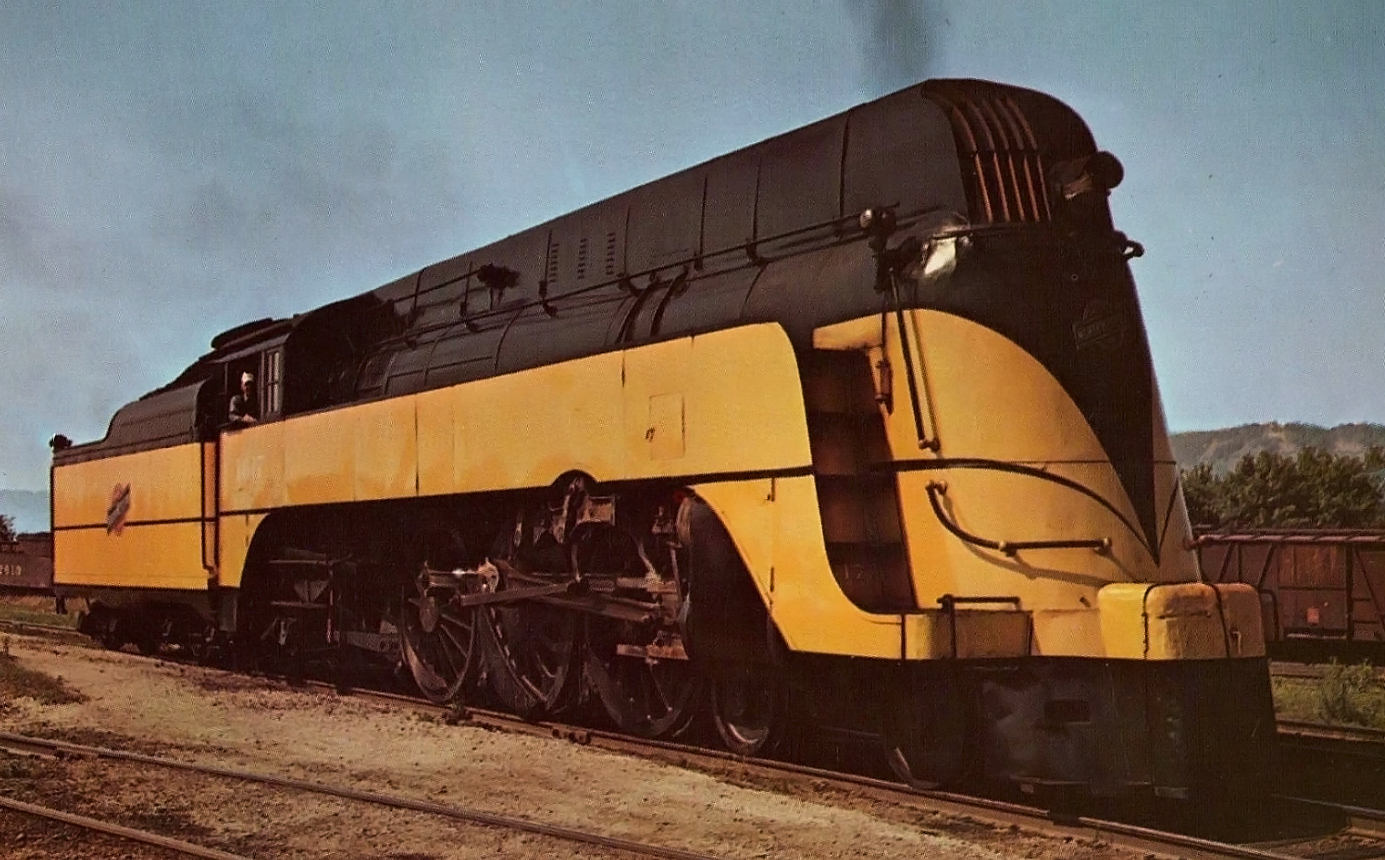
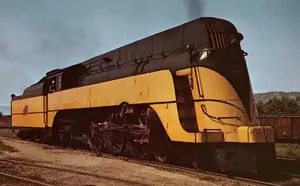
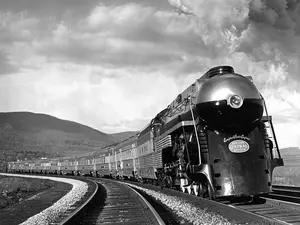
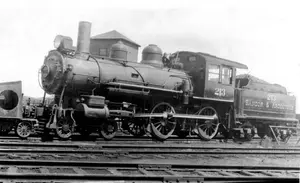
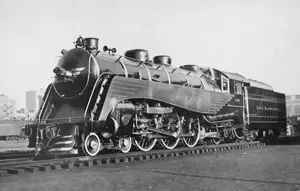
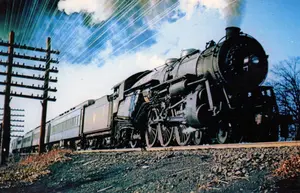
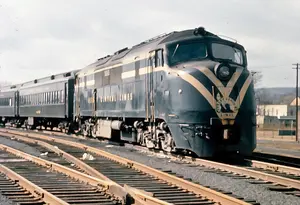
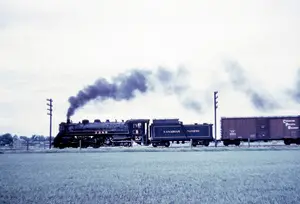
Chicago & North Western publicity photograph of Class E 4-6-2 #1617, posed in the late 1940s for the Minnesota 400. The still was issued as an Audio-Visual Designs postcard. American-Rails.com collection.
On this page: At a glance · What they were—and were not · Alco Class E, 1917 · Yellow-and-green shells, 1941 · Minnesota 400 · Still shrouded after the 400 · Specifications · 617, 620, none saved
At a glance
| Item | Detail |
|---|---|
| What they are | The only two Chicago & North Western Pacifics streamlined for the Minnesota 400. Class E 1617 and 1620. Crew nickname: Yellow Jackets |
| What they are not | Not the rebuilt Class E-2 4-6-2s of the Twin Cities 400. Not the nine olive Class E-4 Hudsons (4001–4009). Not the three Omaha Road E-3s of 1930. Not the train encyclopedia |
| Builder / class | Alco, Schenectady, September 1917. Class E. Works nos. 57318 (1617) and 57321 (1620) |
| Shroud | 1941. Same air-smoothed casing as the E-4 Hudsons, on a shorter Pacific wheelbase. Yellow and green, not Pullman olive |
| Train | Minnesota 400, trains 418/419, Mankato, Minn.–Wyeville, Wis. Engine change at Winona. In streamliner dress from January 1942 |
| Off the name train | April 30, 1950, when the Dakota 400 took the corridor with EMD E units. The pair kept the shells on local passenger work |
| Later numbers | Dropped the leading 1 in 1951–52: 617 and 620. The four-digit numbers went to new Alcos |
| End | 617 scrapped July 6, 1956. 620 in August 1956. Neither preserved |
Works numbers follow Locobase 15906 (1616–1627 = Alco 57317–57328). Shroud weight and 200 psi from the 1952 diagram tradition and later roster notes. Information compiled September 18, 2026.
What they were—and were not
The North Western streamlined steam in three different looks, for three different jobs. Four rebuilt Class E-2 Pacifics, unshrouded, launched the original 400 between Chicago and the Twin Cities on January 2, 1935, and gave way to Electro-Motive E3s in 1939. Nine Class E-4 4-6-4s came from Alco in 1938 already dressed, Pullman olive with yellow trim, for Chicago–Omaha. 1617 and 1620 were a third treatment: two 1917 Es, already a quarter-century old, given Hudson-style sheet metal in 1941 so a southern Minnesota connection train would match the yellow-and-green 400 cars.
Model-railroad copy sometimes folds those stories together and dates the Yellow Jackets to 1930, built for the Twin Cities 400 and scrapped in 1953. That is the Omaha Road E-3 build year mixed with the E-4 Hudson ending. These two engines were Schenectady 1917, Minnesota 400 from 1942, and last steam on the North Western in 1956.
Railfans often letter the pair Class ES. The 1952 company diagram book does not use that suffix for the shrouds. E-S, when the mechanical department used it at all, more often meant the stoker-and-appliance rebuild applied to many ordinary Es in the 1940s. On the railroad 1617 and 1620 remained Class E. The name that stuck in the cab was Yellow Jackets.
The 168-engine E class, the E-2 rebuilds, and the E-4 Hudsons belong on the company steam roster. The Mankato–Wyeville schedules, the nurse-stewardess coach, the 1945 Official Guide, and the Dakota and Rochester years belong on the Minnesota 400 page. This page stays with two road numbers.
Schenectady Pacifics, 1917
Class E was the North Western’s standard passenger 4-6-2: Alco Schenectady and Brooks, 1909 through 1923, 1500–1667 on the parent road, plus a similar Omaha Road batch. From 1580 (1913) they used Baker valve gear and 12-inch piston valves. 1610–1627, the 1916–17 lots, put 164,500 pounds on 75-inch drivers and weighed 263,500 pounds ready for service. Cylinders were 25 × 28. Fireboxes carried arch tubes. They were ordinary Midwest Pacifics—fast enough for the Chicago–Elroy and Chicago–Milwaukee runs the class had been designed around, not in the same sentence as a Hudson.
1617 and 1620 sat in the September 1917 Schenectady dozen, road numbers 1616–1627, works 57317–57328. 1617 was 57318. 1620 was 57321. They burned coal. They were not oil-burning E-2s. They were not the three enormous Omaha E-3s of 1930, the heaviest Pacifics built in North America, which never wore streamlining.
Shop records on the pair diverge slightly before the shrouds. 1620 had its boiler reset to 200 psi in August 1938 and a stoker applied in February 1940. 1617’s documented heavy shopping is October 1941, the same visit that put the casing on: stoker, 200 psi, and the Yellow Jacket shell together. By the time both engines were in Minnesota 400 paint they were the same machine—Class E, 200 pounds, mechanical stoker, about eight extra tons of sheet metal.
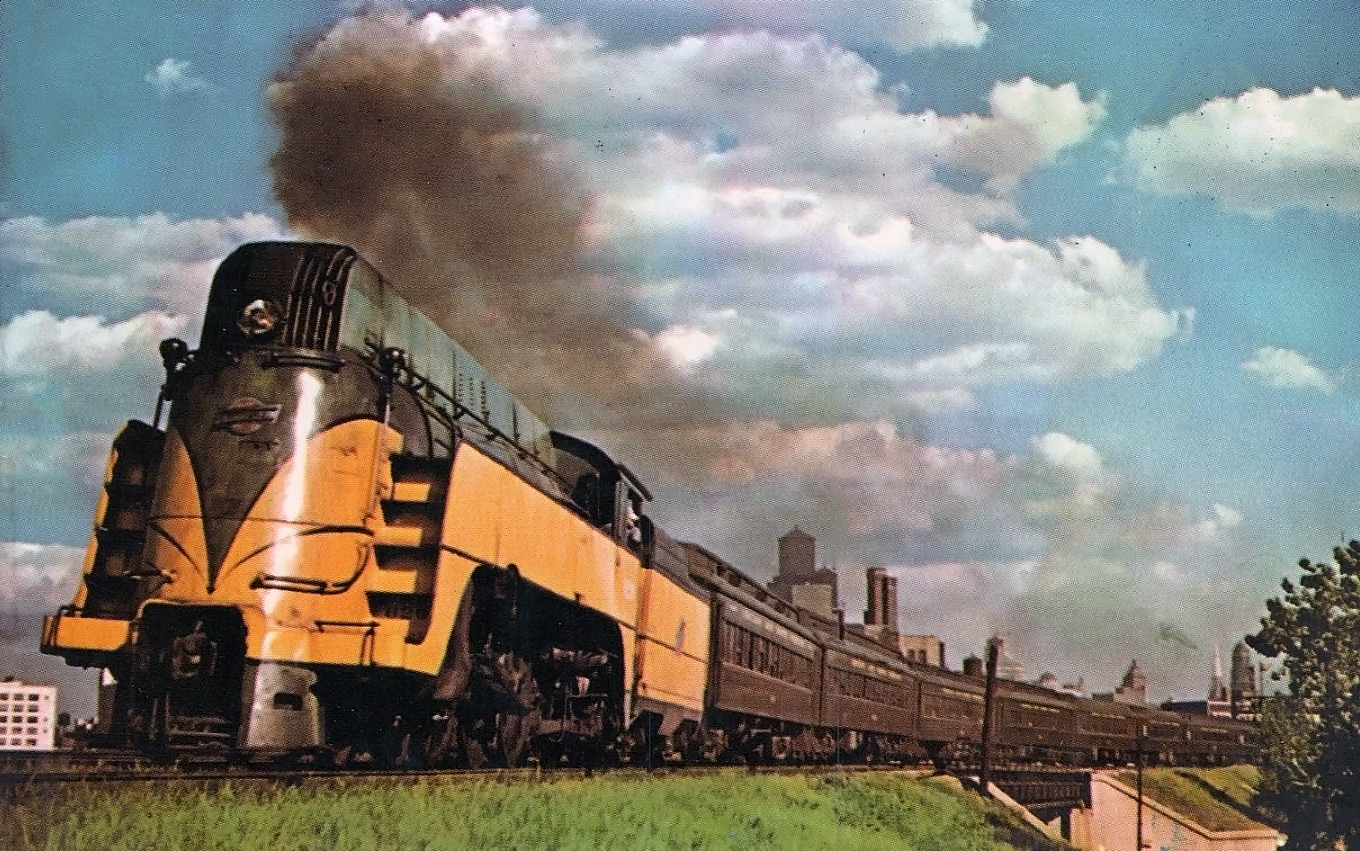
Chicago & North Western's other streamlined Class E 4-6-2 #620 (ex-1620), departs Chicago with a commuter train in May, 1955 about a year before the shrouding was scrapped. Robert Spragg photo. American-Rails.com collection.
An E-4 suit on a Pacific wheelbase
January 1942 was the month the North Western turned the 400 name into a fleet. New Pullman-Standard sets went out as the Minnesota, Peninsula, Shoreland/Valley, Capitol, and Chicago–Milwaukee 400s, echoing the 1939 Twin Cities train. Gasoline and tire rationing were already filling the conventional cars those streamliners released. The Minnesota run did not get a diesel. Mankato to Wyeville was about 204 miles. Jim Scribbins, in The 400 Story, is the standard account: the railroad shrouded two Class E Pacifics instead.
The shells followed the Class E-4 Hudson: bullet nose, skyline casing, skirting along the running board, tender tank enclosed to match. On the Hudsons that look was olive. On 1617 and 1620 it was the 400 yellow and green. Steve Llanso, writing from the company diagrams, noted the obvious: on the shorter Pacific wheelbase the same casing looked less powerful than stubby. The engines gained almost eight tons. Tractive effort rose when pressure went to 200 psi, to about 39,600 pounds. Drivers and rods stayed in the open, the way the E-4s did. It was not a bathtub. It was not a Loewy K4. It was a 1917 E wearing a Hudson coat cut for one train.
The publicity department posed 1617 broadside and three-quarter for stills that Audio-Visual Designs later sold as postcards. The late-1940s view at the top of this page is that company photograph—clean running gear, yellow nose, green boiler, the Minnesota 400 assignment lettered on the card even though the engine itself carried only the road number. Sister 1620 was the same engine in the same paint. A Robert Spragg photograph of 620 leaving Chicago in May 1955, still fully shrouded, is on the company page.
Two engines, one connection train
Trains 418 and 419 had started on June 14, 1936, as a conventional connection with the Twin Cities 400 at Wyeville, Wisconsin. First power was old Class D 4-4-2 Atlantics; Scribbins noted the train was often two cars. Rochester and the Mayo Clinic were on the line from the first day. Chicago through service was a short 1937–38 experiment, then gone until 1950. The 1942 streamliner rebuild is when 1617 and 1620 enter the story.
Locomotives were changed at Winona. East of the Mississippi the train was still a 400 only by brand and by the Wyeville meet; west of Winona it was southern Minnesota—Rochester, Owatonna, Waseca, Mankato. The assigned steam was this pair. When one was in the shop an ordinary E could substitute, which is why an unshrouded Pacific on 418/419 in the 1940s is not a contradiction. The Yellow Jackets were the advertised power, not the only power the mechanical department would let onto the train.
The consist, the nurse-stewardess stateroom, the illuminated rear-end sign, and the March 1945 Official Guide plates are on the train page. This leaf does not restage them. What matters here is that the Minnesota 400 was short enough, and diesel-scarce enough in 1941–42, that two rebuilt Es were the entire streamlined steam fleet for that name.
Still Yellow Jackets after 1950
On April 30, 1950, the Minnesota 400 was replaced by the through Chicago–Huron Dakota 400, trains 518/519, diesel from the start. 1617 and 1620 came off the name train. Unlike many American streamliner rebuilds, they did not shed the casings. Locobase is explicit: after they left the Minnesota 400 they went into local passenger service still air-smoothed. Photographs in the mid-1950s show 617 at Crystal Lake and 620 leaving Chicago with the nose, skyline, and skirting intact, yellow and green over ordinary coaches instead of a 400 set.
The four-digit numbers had to move. In 1951–52 the remaining Es dropped the leading 1, a system-wide compression as diesels took 1600-series slots. 1617 became 617. 1620 became 620. Alco delivered RS-3 1617 in July 1952 (serial 80135) and a six-motor 1620 in August (serial 80446). The steam engines kept the shells. The diesels kept the numbers.
Last years were Wisconsin Division locals and whatever Chicago suburban work still wanted steam. North Western steam in regular service ended May 10, 1956, when the last 4-6-2 closed out a commuter assignment. By then 617 was already in the 40th Street deadline. A visitor that April found her there with 620 behind her, the stack casing already off 617, the rest of the Yellow Jacket still on.
Specifications
Figures below are the 1610–1627 Class E diagram (Locobase 15906) for the as-built machine, with the 1941 shrouded state noted where the later diagrams and roster notes differ. Streamlining added weight; treat 263,500 pounds as 1917 and about 279,000 as the Yellow Jacket.
| Item | 1617 / 1620 |
|---|---|
| Builder | Alco, Schenectady. September 1917 |
| Works nos. | 57318 (1617), 57321 (1620) |
| Whyte / class | 4-6-2, Class E. Railfan ES refers to the shrouds, not a separate company subclass |
| Cylinders | 25 × 28 in. Baker gear, 12-in. piston valves |
| Drivers | 75 in. |
| Boiler pressure | 185 psi as built (class). 200 psi after 1938–41 shoppings |
| Engine weight | 263,500 lb as built (1610–1627). About 279,000 lb with shroud |
| Weight on drivers | 164,500 lb as built |
| Starting TE | About 36,700 lb at 185 psi; about 39,600 lb at 200 psi |
| Fuel | Coal. Mechanical stoker by 1940–41 |
| Shroud | 1941–1956. E-4 Hudson contours, yellow and green |
| Later numbers | 617 (1951–52), 620 (1951–52) |
Plain numbers, then scrap
617 was scrapped July 6, 1956. 620 followed in August. They had outlasted most of the E-4 Hudsons. They had kept a 1941 streamliner suit longer than the train they were dressed for. The North Western saved no Pacific. 1617 and 1620 exist as the publicity still on this page, as Spragg’s 1955 Chicago view of 620, as deadline photographs from 40th Street, and as two numbers on the Minnesota 400’s 1942 page.
Related reading on American-Rails.com
- Minnesota 400 · Twin Cities 400 · Dakota 400
- Chicago & North Western · 4-6-2 Pacific type · North Western Limited
- Streamliners
Sources
- Llanso, Steve. Locobase 15906 (Class E, 1580 series), 9383 (E late / E-S note), and 4856 (E superheated). C&NW 1927 and 1952 locomotive diagrams via Allen Stanley. Works 57317–57328 for 1616–1627; 1610–1627 weight 263,500 / 164,500 on drivers; 617 and 620 fitted 1941 with E-4 air-smoothed casing; shrouds retained after the Minnesota 400
- Scribbins, Jim. The 400 Story. Park Forest, Ill.: PTJ Books (Interurban Press), 1982; Minneapolis: University of Minnesota Press, 2008. January 1942 shrouded Class E Pacifics on the Minnesota 400; yellow and green, E-4-style shells; Winona engine change; Dakota 400 April 30, 1950
- Scribbins, Jim. “The 400.” RailNews, March 1997; reprinted TrainLife. Minnesota 400 became a streamliner in January 1942; two class E Pacifics shrouded rather than a new diesel for the short Mankato–Wyeville run
- Railroad Picture Archives, C&NW 617 (Alco 4-6-2, serial 57318). Schenectady September 1917; streamlined 1941; renumbered 617 in 1952; scrapped July 6, 1956. Sister 620 captions: 200 psi August 1938, stoker February 1940, shroud December 1941, scrapped August 1956
- RailPictures.Net, Juice Junkie. C&NW 617 in the 40th Street deadline, Chicago, April 1956, sister 620 behind her. Last C&NW steam in Chicago that spring
- American-Rails.com, Minnesota 400. January 1942 pair of Class E Pacifics; Scribbins on consist and Winona
- American-Rails.com, Chicago & North Western. Class E 1500–1667, 168 engines, 1909–1923, retired 1937–1956; last regular steam May 10, 1956; E-4 Hudsons 4001–4009, Alco 1938, olive
- Kelly, John. Chicago & North Western, Photo Archive: Passenger Trains of the 400 Fleet. Hudson, Wis.: Iconografix, 2006
- Murray, Tom. Chicago & North Western Railway. Minneapolis: Voyageur Press, 2008
- Audio-Visual Designs, Earlton, N.Y. Postcard of C&NW 1617, “Streamlined Pacific type locomotive for the C&NW’s Minnesota 400,” posed late 1940s. Chicago & North Western Railway photograph
Recent Articles


-
C&NW 4-6-2s 1617 & 1620: Minnesota 400 Yellow Jackets
Sep 19, 26 11:28 AM
 C&NW Class E Pacifics 1617 and 1620—Alco Schenectady 1917, yellow-and-green E-4-style shrouds 1941 for the Minnesota 400. Crews called them Yellow Jackets. Renumbered 617/620. Scrapped 1956.
 -
Erie Lackawanna Diesel Roster: All-Time
Sep 19, 26 10:13 AM
 Erie Lackawanna diesel—Erie and DL&W inheritance, GP35s, U25Bs, SD45/SDP45/SD45-2, U34CH. All-time roster with serials and orders. Conrail April 1 1976.
 -
Erie Lackawanna Railway: Map, History, Logo
Sep 19, 26 10:06 AM
 Erie Lackawanna Railway—Erie and DL&W, October 17 1960–March 31 1976. Von Willer, White revival, Dereco, Agnes, Conrail. High-and-wide Chicago main. Map, logo, what remains.
 -
"Empire State Express" (1941 Train): Timetables, Route, Consist
Sep 18, 26 10:59 PM
 NYC Empire State Express—George Daniels 1891 day train, 999’s 112.5 mph claim, Budd stainless streamliner December 7 1941, Cleveland and Detroit sections, diesels, 1967 name drop. Timetables, consist…
 -
New York Central 4-6-4s 5426 & 5429: Empire State Express Hudsons
Sep 18, 26 10:32 PM
 NYC J-3a Hudsons 5426 and 5429—Alco 1937, Budd stainless shrouds 1941 for the Empire State Express. Pearl Harbor inaugural. Shrouds off by 1950. Neither preserved.
 -
"Stourbridge Lion" Locomotive: Facts, History, Photos
Sep 18, 26 10:27 PM
 Stourbridge Lion—Foster, Rastrick 0-4-0, first steam locomotive in the United States. Horatio Allen, Honesdale, August 8, 1829. Too heavy for D&H gravity track. Boiler in Baltimore; Colonie replic…
 -
Delaware & Hudson Steam Roster (Post 1900)
Sep 18, 26 10:01 PM
 Delaware & Hudson steam—Camelback 2-8-0s, Loree high-pressure compounds, Class K 4-8-4s, forty Challengers. Post-1900 class roster after Drury. Last steam July 21, 1953.
 -
Boston & Maine Steam Roster (Post 1900)
Sep 18, 26 02:57 PM
 Boston & Maine steam—B-15 Moguls, K-8 Consolidations, P-4 Lima Pacifics, T-1 Limas, R-1 Mountains. Post-1900 class roster after Drury. Last steam July 23, 1956.
 -
Boston & Maine Diesel Roster (All-Time)
Sep 18, 26 01:25 PM
 Boston & Maine diesel—boxcab 1100 1935, Flying Yankee 6000, FTs, E7s, BL2s, GP7/GP9, GP38-2s and GP40-2s. All-time roster. Last steam July 23, 1956.
 -
Mid-Continent Railway Museum Dining (2026)
Sep 18, 26 01:21 PM
 2026 Mid-Continent dining in North Freedom—select-date seated meals in luxury cars, reservations required. Pizza Limited June 28. Confirm on midcontinent.org.
 -
Bessemer & Lake Erie Steam Roster (Post 1900)
Sep 18, 26 12:11 PM
 Bessemer & Lake Erie steam—C3A 150–151, D1A/D2A Santa Fes, 47 H1 Texas types after Burlington. Post-1900 class roster after Drury. Last steam 2-8-0 156, May 14, 1953.
 -
Bessemer & Lake Erie Diesel Roster (All Time)
Sep 18, 26 12:09 PM
 Bessemer & Lake Erie diesel—Westinghouse 281 1936, Baldwin DRS-6-6-1500s, F7s 1950–53, SD7/SD9/SD18/SD38 family, RSD-15s. All-time roster. Last steam 2-8-0 156, May 14, 1953.
 -
Bangor & Aroostook Steam Roster (Post 1900)
Sep 18, 26 11:21 AM
 Bangor & Aroostook steam—Manchester Ten-Wheelers, Alco Mountains 100–109, G-2 Consolidations, Pacifics 250–254. Post-1900 class roster after Drury. Last steam Pacific 251, July 22, 1951.
 -
Bangor & Aroostook Diesel Roster (All Time)
Sep 18, 26 11:09 AM
 Bangor & Aroostook diesel—F3s 1947, eight BL2s, E7s, GP7s leased to the PRR, GP9s, GP38s. All-time roster. Last regular steam July 22, 1951.
 -
B&O Steam Locomotive Roster (Post 1900)
Sep 18, 26 10:33 AM
 Baltimore & Ohio steam—Old Maude, E-27 Consolidations, Q Mikados, Big Sixes, EM-1 Yellowstones, President Pacifics. Post-1900 class roster after Drury. Last public steam May 17, 1958.
 -
Baltimore & Ohio (B&O): Diesel Roster (All-Time)
Sep 18, 26 10:28 AM
 Baltimore & Ohio diesel—boxcab 1925, EMC 50 1935, EA 1937, FTs, F3s, F7s, FA-2s, sharks, GP7/GP9, GP30s after C&O 1963, SD50s 8576–8595 1984. All-time roster. Last steam 1958.
 -
Detroit & Toledo Shore Line Railroad: Map, Roster, History
Sep 18, 26 12:32 AM
 Detroit & Toledo Shore Line—Pleasant Bay 1898, named 1899, Detroit–Toledo freight bridge, GTW and Clover Leaf/NKP/N&W. Merged into Grand Trunk Western June 26, 1981.
 -
Lackawanna Steam Locomotives: History, Roster & Photos
Sep 18, 26 12:17 AM
 Delaware, Lackawanna & Western steam—Camelback 2-8-0s, Mikados, freight Pacifics, Poconos 4-8-4s, Hudsons. Post-1900 roster after Drury. Last steam July 13, 1953.
 -
Lackawanna (DL&W) Diesel Roster: All Time
Sep 18, 26 12:11 AM
Delaware, Lackawanna & Western diesel—boxcabs 1926, EMC SC 425–426 1935, FTs 1945, F3/F7/E8, GP7s, RS-3s, FM Train Masters. All-time roster. Last steam 1953. -
Lackawanna Railroad: Map, History, Viaducts, Rosters
Sep 18, 26 12:04 AM
 TDelaware, Lackawanna & Western—Liggett’s Gap 1832, named March 11 1853, Hoboken–Buffalo, anthracite, Phoebe Snow, Cutoff and Tunkhannock. It merged with the Erie to form Erie Lackawanna on Octobe…
 -
Rail News, The Latest
Sep 17, 26 11:56 PM
This page provides a portal to the latest in rail news, from preservation and restortation subjects to other notable topics. -
Union Pacific Big Boy 4014 Sets First Holiday Tour for Make-A-Wish
Sep 17, 26 11:54 PM
 Union Pacific Big Boy 4014’s first holiday tour: Cheyenne–Denver tickets, Nov. 21 Denver-area display, Make-A-Wish. Museum patrons Oct. 16; public Oct. 19.
 -
Conrail Diesel Roster (All Time)
Sep 17, 26 10:27 PM
Conrail diesel—~5,000 inherited 1976, Big Blue, GP15-1s, SD40-2s, SD50s, Dash-8s, SD60/60M/60I, SD80MACs. All-time CR-number roster. -
Chessie System (Railroad): The C&O, B&O, And WM
Sep 17, 26 09:38 PM
 Chessie System, Inc.—C&O, B&O, and Western Maryland. Kitten-C paint 1972, holding company February 26 1973, CSX November 1 1980, C&O into CSXT August 31 1987.
 -
Chesapeake & Ohio (C&O) Diesel Roster: All-Time
Sep 17, 26 06:01 PM
 Chesapeake & Ohio diesel—late steam, no Fairbanks-Morse, E7s 1946, GP7/GP9 flood, F7s, GP40-2s, B30-7s, SD50s 1984–85. All-time roster. Steam ended 1956.
 -
Chesapeake & Ohio (C&O) Steam Roster: Post-1900
Sep 17, 26 03:18 PM
 Chesapeake & Ohio steam—H-8 Alleghenies, K-4 Kanawhas, T-1 Texas, Greenbriers, H-6 1949 Mallets. Post-1900 class roster including Pere Marquette and Hocking Valley. Last steam 1956.
 -
Chesapeake and Ohio Railway: Map, Logo, History
Sep 17, 26 02:36 PM
 Chesapeake & Ohio Railway—Louisa Railroad 1836, named August 31 1868, Ohio River 1873. Coal, Chessie the kitten, Pere Marquette 1947, B&O control 1963, into CSX August 31 1987. Complete corporate…
 -
TVRM Valentine Train Ride (2026)
Sep 17, 26 02:31 PM
 2026 TVRM Valentine Train Ride in Chattanooga—Feb. 6–15, plated dinner, Grand Junction Depot. Confirm on tvrail.com.
 -
River Fox Train Dining (2026)
Sep 17, 26 02:29 PM
 2026 River Fox Train in West Sacramento—Brunch Train and Murder Mystery dinner. 18095 County Road 117. Confirm on riverfoxtrain.com.
 -
Weehawken Terminal, Serving The West Shore Railroad
Sep 17, 26 01:38 PM
 Weehawken Terminal—West Shore / New York Central Hudson waterfront station, opened 1884. Five ferry slips, sixteen tracks, Weehawken Tunnel 4,014 feet. Last ferry March 25, 1959. Port Imperial and HBL…
 -
West Shore Railroad: Map, History, Timetables
Sep 17, 26 01:32 PM
 West Shore Railroad—New York, West Shore & Buffalo 1880–83, Weehawken to Buffalo. PRR-backed rival to the Central. Morgan settlement, 475-year NYC lease January 1 1886. CSX River Sub today.
 -
Jersey Central Diesel Locomotives: History, Roster & Photos
Sep 17, 26 01:20 PM
 Central Railroad of New Jersey diesel—boxcab 1000, Baldwin double-enders, F3s, Train Masters, SD35s, GP40Ps. All-time roster. Steam ended July 1, 1954.
 -
Jersey Central Steam Locomotives: History, Roster & Photos
Sep 17, 26 01:17 PM
 Central Railroad of New Jersey steam—Camelback Ten-Wheelers, USRA Mikados, G-class Pacifics, suburban tanks. Post-1900 class roster after Drury. Dieselized July 1, 1954.
 -
Jersey Central Railroad (CNJ): Map, Rosters, History
Sep 17, 26 01:14 PM
 Central Railroad of New Jersey—Elizabethtown & Somerville 1831, named April 23 1849. Communipaw, anthracite, Blue Comet, Reading/B&O control. Conrail April 1 1976. Complete corporate history.
 -
Central Vermont Diesel Locomotives: History, Roster & Photos
Sep 17, 26 11:35 AM
 Central Vermont diesel—Alco S-2s 1942, RS-3s, RS-11s from DW&P, EMD GP9s 1956–57, GP38ACs 1971. All-time roster. Last steam April 4, 1957.
 -
Central Vermont Steam Locomotives: History, Roster & Photos
Sep 17, 26 11:19 AM
 Central Vermont steam—ten Alco 2-10-4s of 1928, four U-1-a Mountains, Consolidations. Post-1900 class roster after Drury. Last steam April 4, 1957.
 -
Central Vermont Railway: Map, Logo, Rosters
Sep 17, 26 11:03 AM
 Central Vermont Railway—Vermont Central charter October 1843, Bethel–White River Junction June 26, 1848. Grand Trunk 1898, CN 1923, RailTex/NECR 1995. Complete corporate history.
 -
Fitchburg Railroad: Map, History, Timetables
Sep 17, 26 10:40 AM
 Fitchburg Railroad—chartered March 3, 1842, Boston–Fitchburg March 5, 1845. Alvah Crocker, Hoosac west door, Vermont & Massachusetts, Cheshire. B&M 99-year lease July 1, 1900. Complete corpora…
 -
Steam Railroading Institute Dining (2026)
Sep 17, 26 10:30 AM
 2026 SRI Owosso dining—vintage dining cars, select evenings. 2026 dinner calendar not posted; 2025 Up In Smoke is the recent example. Confirm on michigansteamtrain.com.
 -
Canadian Pacific Railway: Map, History, Logo, Photos
Sep 17, 26 12:06 AM
 Canadian Pacific Railway—incorporated February 16, 1881. Last spike Craigellachie November 7, 1885. Soo, Milwaukee, D&H, DM&E. CPKC April 14, 2023. Complete corporate history.
 -
Canadian Pacific Diesel Locomotives: History, Roster & Photos
Sep 17, 26 12:03 AM
 Canadian Pacific diesel—E8A 1800 in 1949, FP7/FP9, FA-2, C424, SD40-2, SD40-2F Red Barns, AC4400CW, ES44AC, SD30C-ECO, SD70ACu heritage. All-time roster. Last steam November 6, 1960.
 -
Canadian Pacific Steam Locomotives: History, Roster & Photos
Sep 16, 26 11:35 PM
 Canadian Pacific steam—3,257 engines 1881–1949. D10 Ten-Wheelers, G3 Pacifics, Royal Hudsons, Selkirk 2-10-4s. Post-1900 class roster after Drury. Last steam November 6, 1960.
 -
Woodstown Central Dining in Motion (2026)
Sep 16, 26 11:31 PM
 2026 Woodstown Central Dining in Motion—Salem County table car, 50–60 minutes, private table of four from $190. Confirm on woodstowncentral.com.
 -
NCTM Wine & Dine on the Rails (2026)
Sep 16, 26 11:28 PM
 2026 NCTM Wine & Dine on the Rails in Spencer—Feb. 13–15, three-course dinner, 21+, $145/$140. Sold out. Confirm next season on nctransportationmuseum.org.
 -
Southern Railway 4-6-2 1380: The Streamlined Ps-4
Sep 16, 26 10:34 PM
 Southern Railway Ps-4 4-6-2 1380—Alco 1923, serial 64857. Otto Kuhler streamlining at Spencer 1940–41 for the Tennessean. Only streamlined steam locomotive on the Southern. Scrapped Baltimore 1953.
 -
Texas Mexican Railway: Serving The Border Since The 1880s
Sep 16, 26 09:58 PM
 Texas Mexican Railway—Corpus Christi, San Diego & Rio Grande March 1875, 3-foot. Tex-Mex June 1881, Laredo Sept 1881, Rio Grande bridge 1883. Standard gauge July 17 1902. Mexican government 1900–1…
 -
Mount Hood Railroad Dining (2026): No Plated Dinner Train This Season
Sep 16, 26 09:53 PM
 2026 Mount Hood Railroad in Hood River is scenic Fruit Loop trains with snacks and sandwiches—not a plated dinner train. Confirm on mthoodrr.com.
 -
Peoria and Eastern Railway: Map, Timetables, History
Sep 16, 26 09:39 PM
 Peoria & Eastern—Danville, Urbana, Bloomington & Pekin 1866, IB&W 1869, OI&W 1887. Incorporated Feb 21 1890, Big Four next day. NYC 1930, Conrail 1976. GP7s 5612–5625. Complete corporate history.
 -
Boston and Maine Railroad: "Route Of The Minute Man"
Sep 16, 26 11:30 AM
 Boston & Maine—Andover & Wilmington 1833, NH charter June 27 1835. Eastern, Boston & Lowell, Fitchburg/Hoosac, Concord & Montreal. Section 77 March 12 1970. Guilford June 30 1983. CSX June 1 2…
 -
Smoky Valley Limited Dinner Train (2026)
Sep 16, 26 11:24 AM
 2026 Abilene & Smoky Valley Smoky Valley Limited—two-hour dinner from the 1887 Rock Island Depot. Kansas catering, ~$72–$110. Confirm on asvrr.org.