Great Bend Tunnel: Photos, Length, History
Published: February 13, 2025
By: Adam Burns
Nestled amid the rugged Appalachian Mountains of West Virginia lies the Great Bend Tunnel, a significant yet often overlooked piece of American history.
This once vital passageway through the mountains was part of the Chesapeake and Ohio Railway (C&O), crucial for the expansion of the railway network in the United States.
Also referred to as the Big Bend Tunnel, the location serves as the legendary site where John Henry famously triumphed over a steam drill, elevating him to the status of a prominent folk hero.
This historic site is situated approximately 10 miles east of Hinton along the pivotal main line of the Chesapeake & Ohio Railway, today part of CSX Transportation.
Notably, it stands as the longest tunnel within the C&O network, extending a straight length of 6,450 feet and effectively bypassing a seven-mile curvature of the Greenbrier River around Big Bend Mountain.
This article takes an in-depth look at the history of the tunnel, its role in the industrial expansion of the United States, and its cultural importance, underscoring the broader social changes and challenges during its construction era.
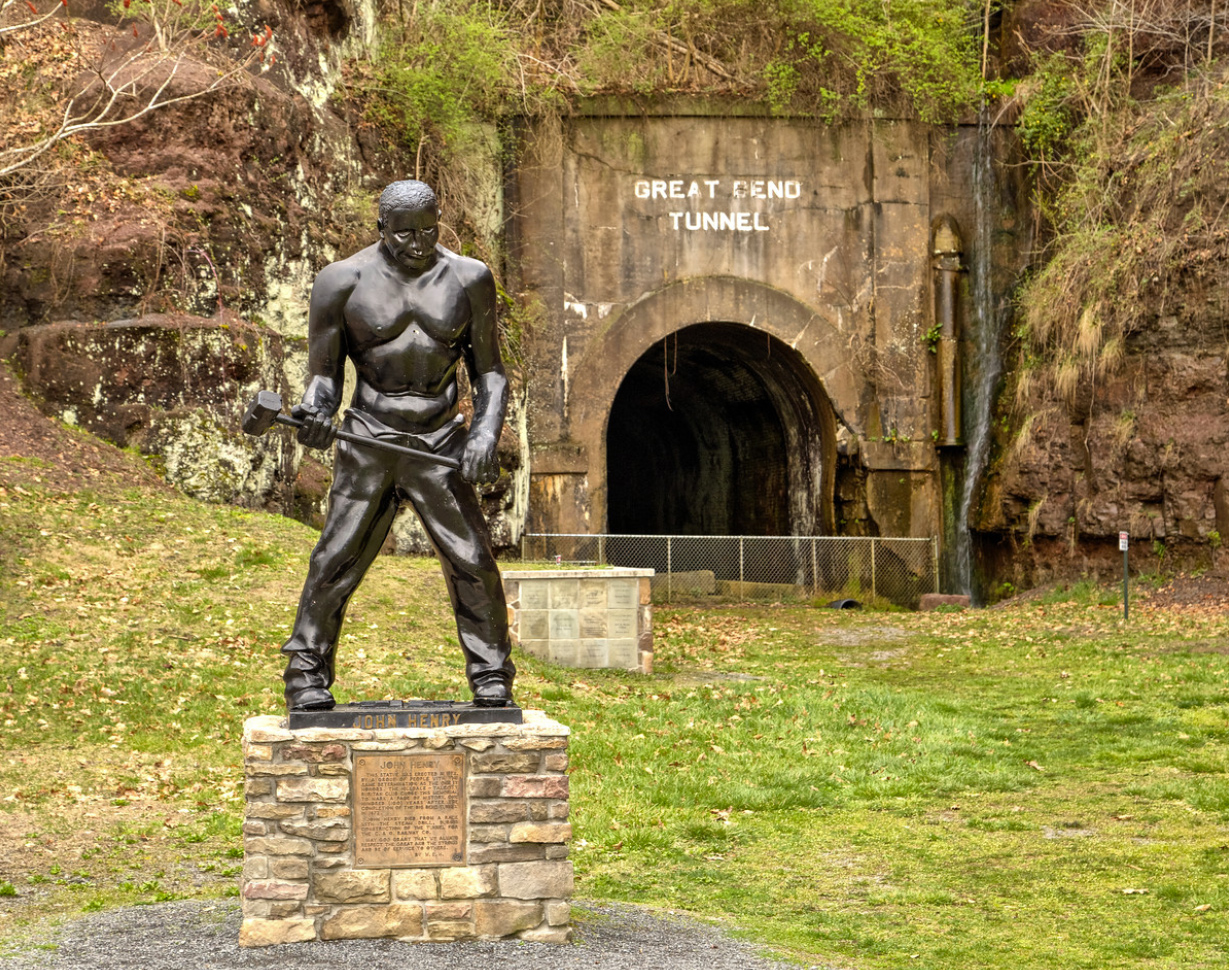 The famous memorial to John Henry at Great Bend Tunnel, which is no longer used for rail service. Loyd Lowry photo.
Historical Context
In the latter half of the 19th century, America was in the throes of its Industrial Revolution, with railways forming the backbone of its industrial and economic growth.
The Chesapeake & Ohio, established in 1868, was instrumental in linking the Atlantic seaboard with the Midwest and beyond. This connection facilitated not only the movement of agricultural and industrial goods but also people, fueling America's westward expansion.
The Appalachian region presented significant topographical challenges for the railways, necessitating the construction of multiple tunnels and bridges to enable unobstructed passage.
Among these engineering feats was the Great Bend Tunnel in Summers County, West Virginia, built as part of the C&O's main line through the southern Appalachian Mountains to serve the burgeoning coal industry, which was rapidly becoming a staple of the American economy.
Engineering Marvel
Initiated in February 1870, construction commenced at both tunnel ends and through two substantial intermediate shafts, measuring 365 and 170 feet in depth, which facilitated simultaneous work on six different fronts.
A workforce of about 800 men undertook this daunting three-year endeavor, tasked with cutting through resilient red shale, a material prone to disintegration upon air exposure, thereby precipitating numerous rockfalls and landslides. This perilous task claimed the lives of many workers, including, according to legend, the formidable John Henry, known as the "steel-drivin' man."
Workers had to contend with harsh conditions, limited technology, and the daunting task of carving a passage through the Appalachian earth, which was a formidable adversary due to its varied and rugged terrain.
Upon its completion on September 12, 1872, the tunnel was initially lined with timber. However, persistent rockfalls necessitated a complete brick arch lining, which was finalized by 1893.
A supplementary parallel tunnel was completed in 1932, leading to the closure of the original tunnel in 1974 after 102 years of service. Presently, every train traversing this route continues to journey beneath Big Bend Mountain.
John Henry and Cultural Significance
No discussion of the Great Bend Tunnel is complete without mentioning the legend of John Henry, an African American folk hero said to have competed against a steam-powered rock drilling machine at this very site.
The "Ballad of John Henry" captures this tale of human strength and spirit, embodying the struggle between man and machine during the Industrial Revolution—a pivotal transition period that redefined labor and technological advancement.
John Henry's story is celebrated in various forms of media, immortalized in songs, literature, and cinema, symbolizing the enduring spirit of the human worker amidst the rise of mechanization. While historical records do not confirm the details of John Henry's contest, the legend underscores the cultural and social dynamics at play during the tunnel's construction.
The significance of Mr. Henry as a cultural icon extends beyond folklore; it highlights the contributions of African Americans to America's industrial foundation, often marginalized in historical narratives. The legend of John Henry and the Great Bend Tunnel serves as a poignant reminder of the human cost of industrial progress and the perseverance of those who labored in anonymity.
Technological Transition
The tunnel also represents a transitional period in engineering, marked by the shift from manual labor to mechanized processes. The emergence of steam-powered machinery revolutionized the way infrastructural projects were approached, increasing efficiency but also rendering traditional labor methods obsolete.
This transition, embodied in the legend of John Henry, was not merely a technological shift but a cultural and economic one as well, raising fundamental questions about the future of work, the role of human labor in an increasingly mechanized world, and the value placed on human identity within the labor force.
These questions about technology and employment remain relevant in today's society, where technological advancement continues to disrupt traditional labor markets.
Preservation
Today, the tunnel stands as a testament to American ingenuity and the complex socio-historical landscape of the past century and a half. Preservation efforts have focused on maintaining the tunnel as a historical site, recognizing the need to honor both the engineering accomplishments it represents and the narratives of those who labored to create it.
The site holds potential for educational and cultural tourism, offering visitors insights into a crucial period of American history and the chance to reflect on the themes of industrialization, cultural identity, and labor that are woven into its legacy. Community-driven initiatives aim to keep the story of the Great Bend Tunnel alive, fostering a deeper understanding of its role in shaping both regional and national history.
Legacy
The tunnel, beyond its function as a passageway, represents a confluence of engineering achievement, cultural heritage, and socioeconomic transformation. Its construction was a microcosm of the broader changes sweeping through America during the late 19th century, from technological advancement to shifting labor dynamics.
Moreover, the tunnel's enduring cultural significance, particularly through the story of John Henry, highlights the power of folklore in capturing and preserving the human experiences that underpin historical milestones.
As such, the Great Bend Tunnel remains an essential chapter in the narrative of America's industrial evolution, a reminder of the resilience of the human spirit in the face of progress and a beacon for future reflections on technological and cultural change.
Recent Articles


-
Reading Steam Locomotives: History, Roster & Photos
Sep 24, 26 12:12 PM
 Reading steam—Wootten fireboxes, Camelback Consolidations, Mallets, K-1 Santa Fes, G-3 Pacifics, T-1 4-8-4s. Post-1900 roster after Drury. Rambles ended October 17, 1964.
 -
Reading Diesel Roster: All-Time
Sep 24, 26 12:10 PM
 Reading diesel roster—AGEIR boxcabs, FTs, FA-1s, RS-3s, Train Masters, GP30s through GP39-2s. Serials and order numbers. Conrail April 1, 1976.
 -
Reading Railroad: Map, Logo, History, Rosters
Sep 24, 26 12:08 PM
 Reading Company—Philadelphia & Reading, 1833. Anthracite, Port Richmond, Reading Terminal. Operating company January 1, 1924. Conrail April 1, 1976.
 -
Nevada Dinner Train Rides (2026): A Complete Guide
Sep 24, 26 12:02 PM
 2026 Nevada Northern Taste of Italy—adults-only gala from East Ely. The September 19 date has run. Confirm any later night on nnry.com.
 -
North Carolina Dinner Train Rides (2026): A Complete Guide
Sep 24, 26 11:24 AM
 2026 North Carolina dinner trains—NCTM Wine & Dine in Spencer sold out February 13–15. GSMR First Class is the plated meal on the Nantahala Gorge excursion. Confirm on the railroad.
 -
Railway Express Agency (REA): Signs, Trucks, Logo & History
Sep 24, 26 09:40 AM
 Railway Express Agency—railroad-owned express company. Incorporated December 7, 1928. Operations March 1, 1929. Red diamond, green trucks. Last regular express November 7, 1975.
 -
Michigan Dinner Train Rides (2026): A Complete Guide
Sep 24, 26 09:28 AM
 2026 Steam Railroading Institute dining in Owosso—select evenings, no public dinner dates posted. Confirm on michigansteamtrain.com.
 -
Pittsburgh and West Virginia Railway: Map, Rosters, History
Sep 24, 26 12:24 AM
 Pittsburgh & West Virginia—the Hi-Line. Wabash-Pittsburgh Terminal 1904. Railway January 29, 1917. Connellsville February 11, 1931. N&W lease October 16, 1964. Wheeling & Lake Erie from May 17, 1990.
 -
Indiana Dinner Train Rides (2026): A Complete Guide
Sep 24, 26 12:13 AM
 2026 Spirit of Jasper Ride & Dine is paused. No public trains. Depot at 201 Mill Street stays open as a rental. Confirm on spiritofjaspertrain.com.
 -
New Jersey Dinner Train Rides (2026): A Complete Guide
Sep 24, 26 12:01 AM
2026 Woodstown Central Dining in Motion—private table of four from $190, about an hour, Salem County. Confirm on woodstowncentral.com. -
Maryland Dinner Train Rides (2026): A Complete Guide
Sep 23, 26 05:19 PM
 2026 Western Maryland Scenic Allegheny Mountain Dinner Train—Cumberland, 3 hours, 21+, Saturday 7 p.m. Confirm on wmsr.com.
 -
Pittsburgh and Lake Erie Railroad: Map, Rosters, Photos
Sep 23, 26 03:28 PM
 Pittsburgh & Lake Erie—the Little Giant. Chartered 1875, Pittsburgh to Youngstown February 10, 1879. New York Central from 1883. Independent May 15, 1979. Last day September 11, 1992.
 -
Kansas Dinner Train Rides (2026): A Complete Guide
Sep 23, 26 01:11 PM
 2026 Abilene & Smoky Valley Smoky Valley Limited—two hours from the Rock Island Depot, about $72–$110, dates into December 31. Confirm on asvrr.org.
 -
The Belpaire Firebox: Simplicity and Greater Power
Sep 23, 26 01:03 PM
 Belpaire firebox—Alfred Belpaire, 1864. Square crown, straight staybolts at right angles. Pennsylvania standard after the 1880s. Great Northern was the other big user.
 -
Pennsylvania Railroad (PRR) Electric Roster: All Classes
Sep 23, 26 12:57 PM
Pennsylvania Railroad electrics—DD1s into Penn Station, P5s, 139 GG1s, B1 switchers, and 66 E44s. Class roster, 1905–1963. No unit-by-unit GG1 list. -
Penn Central Diesel Roster: All-Time
Sep 23, 26 12:46 PM
 Penn Central diesel roster—PRR classes on NYC, PRR, and New Haven power. New orders carry serials. GP38-2s are 7940-8162. Conrail April 1, 1976.
 -
Penn Central Railroad: Map, History, Logo
Sep 23, 26 12:32 PM
 Penn Central—Pennsylvania and New York Central merged February 1, 1968. New Haven January 1, 1969. Section 77 bankruptcy June 21, 1970. Conrail April 1, 1976.
 -
Iowa Dinner Train Rides (2026): A Complete Guide
Sep 23, 26 11:42 AM
 2026 Boone & Scenic Valley Wolf Dinner Train—Saturdays May–October, Union Pacific dining cars, Bass Point Creek High Bridge. Confirm on bsvrr.com.
 -
Pennsylvania-Reading Seashore Lines: Map, Roster, History
Sep 23, 26 12:32 AM
 Pennsylvania-Reading Seashore Lines—Atlantic City Railroad renamed July 15, 1933. Pennsylvania two-thirds, Reading one-third. Camden to Atlantic City, Cape May, and Millville. Conrail April 1, 1976.
 -
Wisconsin Dinner Train Rides (2026): A Complete Guide
Sep 23, 26 12:28 AM
2026 Wisconsin Great Northern dinner train in Trego—$105, Namekagon River, January 8–31 and May 5–December 17. Mid-Continent’s remaining 2026 calendar is snack and scenic. Confirm on the railroad. -
New Hampshire Dinner Train Rides (2026): A Complete Guide
Sep 23, 26 12:21 AM
2026 Cafe Lafayette Dinner Train in North Woodstock—five courses, 2 hours, from $125. Children under 6 not allowed. Confirm on nhdinnertrain.com. -
PRR "GG-1" Locomotives: Roster, Photos, Specs
Sep 23, 26 12:13 AM
 PRR GG1 electric: 139 locomotives, 4800–4938, built 1934–1943. Specs, Loewy shell, Amtrak numbers, and the last revenue trip on October 28, 1983.
 -
Montana Dinner Train Rides (2026): A Complete Guide
Sep 23, 26 12:04 AM
2026 Charlie Russell Chew Choo from Hanover, near Lewistown—4.5 hours, prime rib, adult $151. Remaining listed dates sold out. Confirm on montanadinnertrain.com. -
Kentucky Dinner Train Rides (2026): A Complete Guide
Sep 22, 26 11:52 PM
2026 My Old Kentucky Dinner Train in Bardstown—four courses, 2.5 hours, adult $116. Confirm on kydinnertrain.com. -
Tennessee Dinner Train Rides (2026): A Complete Guide
Sep 22, 26 11:45 PM
2026 TVRM Chattanooga Dinner Train—Grand Junction, select Fri/Sat March 6–October 24, 6 p.m., from $110. Confirm on tvrail.com. -
The Trainphone: PRR's Wireless Radio System
Sep 22, 26 11:17 PM
 Pennsylvania Trainphone—Union Switch & Signal inductive telephone. Bel-Del trial 1941, Frenchtown November 29, 1943. Carriers at 88 kHz and 144 kHz. Out of service April 30, 1967.
 -
Pennsylvania (PRR) Steam Roster: Post 1906
Sep 22, 26 11:13 PM
 ennsylvania steam after 1906—H8, H9, and H10 Consolidations, 574 L1s Mikados, 598 I1s Decapods, 425 K4s Pacifics, 301 M1 Mountains. Drury’s grid. Last steam November 30, 1957.
 -
Pennsylvania Railroad (PRR) Diesel Roster: All-Time List
Sep 22, 26 10:59 PM
 Pennsylvania diesel roster—SW 3908 in June 1937, then Alco, Baldwin, EMD, Fairbanks-Morse, GE, and Lima. Serials and Alco order numbers. Penn Central February 1, 1968.
 -
Pennsylvania Railroad: Map, Logo, History, Rosters
Sep 22, 26 10:02 PM
 Pennsylvania Railroad—chartered April 13, 1846, Harrisburg–Pittsburgh, Horseshoe Curve 1854, Penn Station 1910. Standard Railroad of the World. Penn Central February 1, 1968.
 -
Pennsylvania Dinner Train Rides (2026): A Complete Guide
Sep 22, 26 04:48 PM
 2026 Pennsylvania dinner trains—Colebrookdale Dining Class in Boyertown and Strasburg Dinner on the Rails. Confirm on each railroad.
 -
New York, Ontario & Western Steam Locomotives: History & Roster
Sep 22, 26 04:40 PM
 NYO&W steam—camelback 2-8-0s and 2-6-0s, Class X Bull Moose 2-10-2s, Class Y and Y-2 Mountains. All-time class roster. Steam finished in the summer of 1948. None saved.
 -
New York, Ontario & Western Diesel Roster: All-Time
Sep 22, 26 04:36 PM
 NYO&W diesel—five GE 44-tonners 101-105, eighteen FTs, seven F3s, twenty-one NW2s. Serials and the NW2 order E824. Railroad liquidated March 29 1957.
 -
New York, Ontario & Western Railway: Map, Roster, History
Sep 22, 26 04:26 PM
 New York, Ontario & Western—New York & Oswego Midland chartered January 11 1866, O&W January 21 1880. Scranton coal, West Shore rights. Last train March 29 1957.
 -
Massachusetts Dinner Train Rides (2026): A Complete Guide
Sep 22, 26 04:16 PM
 2026 Cape Cod Dinner Train—Hyannis, Buzzards Bay, and North Falmouth. Four-course, 3–3½ hours, from $99.99. Confirm on capetrain.com.
 -
Colorado Dinner Train Rides (2026): A Complete Guide
Sep 22, 26 03:51 PM
 2026 Royal Gorge Route First Class Dinner and Lunch from Cañon City. About 2 hours, 12+, from $199+. Confirm on royalgorgeroute.com.
 -
New York and Long Branch Railroad: A PRR & CNJ Subsidiary
Sep 22, 26 03:11 PM
 New York & Long Branch—chartered April 8 1868, Perth Amboy–Long Branch July 1 1875, Bay Head Junction 1881. Jersey Central and Pennsylvania trains. Conrail April 1 1976. NJ Transit North Jersey Co…
 -
Monongahela Railway Steam Locomotives: History & Roster
Sep 22, 26 01:34 PM
 Monongahela steam—H-5 Consolidations, USRA light Mikados 170–179, Baldwin L-2s, ex-P&LE L-3s. All-time roster. Last steam May 26, 1954.
 -
Monongahela Railway Diesel Roster: All-Time
Sep 22, 26 01:16 PM
 Monongahela diesel—27 Baldwin S-12s, NYC RF-16 sharks, P&LE GP7s, GP38s 2000–2004, Super 7s 2300–2310. Serials and orders. Last steam May 26, 1954.
 -
Monongahela Railway: Map, Rosters, History
Sep 22, 26 01:14 PM
 Monongahela Railway—incorporated December 31 1900, Railway July 1 1915. Brownsville–Fairmont coal road. Last steam May 26 1954. Conrail May 1 1993.
 -
Virginia Scenic Railway Dining (2026)
Sep 22, 26 01:09 PM
 2026 Virginia Scenic Railway—Blue Ridge Flyer Dining Class from Staunton, about 3 hours, plated meal. Sunday Brunch from Louisa, about $132. Confirm on virginiascenicrailway.com.
 -
Virginia Dinner Train Rides (2026): A Complete Guide
Sep 22, 26 01:03 PM
 2026 Virginia Scenic Railway—Blue Ridge Flyer Dining Class from Staunton, Alleghany Special Dining Class, Sunday Brunch from Louisa. Confirm on virginiascenicrailway.com.
 -
Oregon Dinner Train Rides (2026): A Complete Guide
Sep 22, 26 12:51 PM
 2026 Oregon has no plated dinner train on the calendar. Mount Hood is scenic with snacks. Oregon Coast Scenic’s evening ride is the 21+ Moonlight with sandwiches.
 -
Maine Central Steam Locomotives: History & Roster
Sep 22, 26 12:33 PM
Maine Central steam—Ten-Wheelers, W-class Consolidations, S-class Mikados, C-class Pacifics, Hudsons 701 and 702. Post-1900 roster after Drury. Last steam June 13, 1954. -
Maine Central Diesel Roster: All-Time
Sep 22, 26 12:04 PM
 Maine Central diesel—railcar 901, HH660s, GP7s, E7s, F3s, GP38s, U18Bs, ex-Rock Island U25Bs. All-time roster with serials and orders. Last steam June 13, 1954.
 -
Maine Central Railroad: Map, Logo, Rosters, History
Sep 22, 26 11:36 AM
 Maine Central—Androscoggin & Kennebec and Penobscot & Kennebec, October 28 1862. Pine Tree Route. Mountain Division, Portland–Bangor–Vanceboro. Last steam June 13 1954. Guilford June 1981.
 -
Maryland and Pennsylvania Railroad: Map, Roster, Logo
Sep 22, 26 12:14 AM
 Ma & Pa—Peach Bottom 1868, Maryland & Pennsylvania February 12 1901, Baltimore to York. Last steam November 29 1956. York Railway December 1 1999.
 -
New York Dinner Train Rides (2026): A Complete Guide
Sep 21, 26 11:59 PM
2026 New York dinner train—Adirondack Dinner Train from Utica, 6 p.m., about 3 hours, First Class from $139. Arcade & Attica mystery dinner is served at Curriers. Confirm on the railroad. -
California Dinner Train Rides (2026): A Complete Guide
Sep 21, 26 11:49 PM
 2026 California dinner trains—Napa Valley Wine Train plated meals, River Fox brunch and mystery dinner, Roaring Camp barbecue at camp. Confirm on each railroad.
 -
Roaring Camp Starlight Dinner Party (2026)
Sep 21, 26 11:33 PM
 2026 Roaring Camp Starlight Dinner Party—Beach Train from the Santa Cruz Boardwalk, barbecue at Felton, ride back after dark. Confirm on roaringcamp.com.
 -
Long Island Rail Road Steam Locomotives: History, Roster & Photos
Sep 21, 26 11:29 PM
 Long Island steam—G5s 20–50, H10s 101–119, last steam at Hicksville October 8, 1955. Post-1898 class roster.